

SIST EN 16186-9:2026
(Main)Railway applications - Driver's cabs - Part 9 : External visibility for metro vehicles
- Abstract
This document defines front visibility conditions including positions of drivers and its assessment.
This document applies to metro vehicles with or without permanent driver, excluding shuttles used for short distance transportation.
Metro vehicle definition is according to EN 17343.
NOTE For special vehicles, see EN 14033-4 and EN 15746-4.
- Status
- Published
- Public Enquiry End Date
- 30-Jun-2025
- Publication Date
- 20-Oct-2026
- Technical Committee
- IŽNP - Reilway applications
- Current Stage
- 6060 - National Implementation/Publication (Adopted Project)
- Start Date
- 21-Oct-2026
- Due Date
- 26-Dec-2026
- Completion Date
- 21-Oct-2026

SIST EN 16186-9:2026 is the Slovenian adoption of EN 16186-9:2026 for railway applications. It specifies external visibility conditions for metro vehicle driver’s cabs, including driver positions and how to assess visibility from the cab.
The document is aimed at cab designers, vehicle integrators, operators, and assessors who need to check whether a metro cab gives the driver the required forward, rear, and lateral view. It is written for metro vehicles with or without a permanent driver, and it also points readers to related standards for the definition of metro vehicles and for special vehicles.
What does SIST EN 16186-9:2026 specify?
SIST EN 16186-9:2026 defines the visibility conditions for metro cabs and the way those conditions are assessed. Its scope covers front visibility, rear visibility, and lateral visibility, together with the driver positions used for assessment.
The document applies to metro vehicles with or without a permanent driver, while shuttles used for short-distance transportation are excluded. It also refers to EN 17343 for the metro vehicle definition, and notes special vehicles in EN 14033-4 and EN 15746-4.
The document is organized into:
- Clause 1 Scope
- Clause 2 Normative references
- Clause 3 Terms and definitions
- Clause 4 Driver’s anthropometric data
- Clause 5 Forward visibility
- Clause 6 External rear visibility
- Clause 7 Lateral visibility
- Annex A and Annex B, both informative
| Annex | What it covers |
|---|---|
| Annex A | Forward visibility reference surfaces |
| Annex B | Forward visibility reference eye points for adjustable foot rest and adjustable seat |
What are the key requirements of SIST EN 16186-9:2026?
SIST EN 16186-9:2026 bases its visibility checks on defined driver body sizes and standard reference points. In practice, this means the cab must work for both the smallest and largest driver dummies used by the standard.
Driver anthropometric data and assessment setup
Clause 4 gives the body-size measures used for the visibility assessment, including the eye-point geometry for seated and standing positions. The minimum and maximum values are paired with corresponding figure requirements, so the design has to be checked against both extremes.
Clause 5 requires the forward-visibility assessment to be made on a vehicle at design mass under normal design payload conditions on straight and level track. The assessment uses the standard reference points of the two driver dummies and a single eye point.
Forward visibility
Clause 5 requires the cab to allow the driver to see signals in time and to anticipate hazards such as obstacles or wrong-positioned track elements. The document sets reference points for high and low external signals and says the theoretical sight lines must be demonstrated for both driver dummies.
For a seated driver, the eye to windscreen distance must be at least 500 mm. Permanent equipment inside or outside the cab must not cut the sight lines, except for the wiper. For driver instructor locations, the same visibility logic applies, but the external visibility of the secondary person may be reduced if needed by the operating concept.
Windscreen equipment and environmental control
Clause 5 also sets practical cab features that support visibility. The front windscreen cleaning device must cover most of the primary vision area, the wiper needs at least two wiping speeds, and washing must be controllable from inside the cab.
The cab also needs glare protection, de-icing, de-misting, and reflection control where relevant. These features matter because metro vehicles can run outdoors as well as in tunnels, so the driver still needs to see signals when the vehicle leaves the tunnel environment.
Rear and lateral visibility
Clause 6 requires rear visibility from the driving position for non-driverless metro vehicles. If rear monitoring is needed for passenger exchange, the device must let the driver see the defined test object at each open platform door or passenger door.
Clause 7 requires at least one side window or side door window on each side, except for driverless metro vehicles. If the side window is used for outside visibility, it must keep distortions low and have at least 70% visible light transmission.
What terms does SIST EN 16186-9:2026 define?
- Primary vision area - the part of the windscreen used to see track and signals from the driving position.
- Secondary vision area - the rest of the windscreen that the driver can also use for looking बाहर from the cab.
- Windscreen - the glazing in front of the driver used to observe the track ahead.
- Side windscreen - glazing at the side of a mainly transverse windscreen layout.
- Driver dummies - models based on the minimum and maximum anthropometric data used in the standard.
- Driverless metro - a metro normally operated without a driver on board.
- Shuttle - a rail system that runs back and forth between two points.
Who uses SIST EN 16186-9:2026?
SIST EN 16186-9:2026 is used by metro vehicle manufacturers, cab and windscreen designers, system integrators, safety engineers, and conformity assessors. It is also relevant to operators and buyers who need visibility requirements written into procurement or acceptance checks.
In practice, users apply it when designing the cab layout, selecting windscreen equipment, checking signal sight lines, and validating rear or side visibility for operation and station tasks.
Which standards are used with SIST EN 16186-9:2026?
- EN 17343 - provides the railway general terms and definitions used in the document.
- EN 15152:2019+A1:2023 - supplies windscreen-related definitions and other windscreen requirements referenced by Clause 3 and Clause 5.
- EN 15663 - provides the vehicle reference mass conditions used for visibility assessment.
- EN 16186-8 - gives the comfort articular angles referenced for the normal driving position.
- CEN/TR 16823 - provides background information on the anthropometric data used in Clause 4.
- EN 14033-4 and EN 15746-4 - are pointed to for special vehicles in the scope note.
What does the SIST EN 16186-9:2026 document contain?
The document contains anthropometric reference data, visibility assessment rules, and the test geometry needed to evaluate cab sight lines. It includes figures for body-size measures, forward visibility reference surfaces, and rear-visibility assessment.
Annex A and Annex B provide the geometric reference material used for forward visibility checks, including seated and standing driver positions and adjustable-seat cases. These annexes are useful when designing the cab layout or checking a prototype against the standard.
The document also includes the bibliography pointing to background and related work used to support the visibility and eye-point definitions.
Relations
- Effective Date
- 21-Oct-2026
- Effective Date
- 21-Oct-2026
Get Certified
Connect with accredited certification bodies for this standard

IRIS Certification (UNIFE)
International Railway Industry Standard certification.

TÜV SÜD Rail GmbH
TÜV SÜD railway certification services.

Bureau Veritas Railway Certification
Railway and transportation certification.
Sponsored listings
Frequently Asked Questions
SIST EN 16186-9:2026 is a standard published by the Slovenian Institute for Standardization (SIST). Its full title is "Railway applications - Driver's cabs - Part 9 : External visibility for metro vehicles". This standard covers: This document defines front visibility conditions including positions of drivers and its assessment. This document applies to metro vehicles with or without permanent driver, excluding shuttles used for short distance transportation. Metro vehicle definition is according to EN 17343. NOTE For special vehicles, see EN 14033-4 and EN 15746-4.
This document defines front visibility conditions including positions of drivers and its assessment. This document applies to metro vehicles with or without permanent driver, excluding shuttles used for short distance transportation. Metro vehicle definition is according to EN 17343. NOTE For special vehicles, see EN 14033-4 and EN 15746-4.
SIST EN 16186-9:2026 is classified under the following ICS (International Classification for Standards) categories: 45.060.10 - Tractive stock; 45.140 - Metro, tram and light rail equipment. The ICS classification helps identify the subject area and facilitates finding related standards.
SIST EN 16186-9:2026 has the following relationships with other standards: It is inter standard links to SIST EN 16334:2014, SIST EN 16186-4:2019. Understanding these relationships helps ensure you are using the most current and applicable version of the standard.
SIST EN 16186-9:2026 is associated with the following European legislation: Standardization Mandates: M/486. When a standard is cited in the Official Journal of the European Union, products manufactured in conformity with it benefit from a presumption of conformity with the essential requirements of the corresponding EU directive or regulation.
SIST EN 16186-9:2026 is available in PDF format for immediate download after purchase. The document can be added to your cart and obtained through the secure checkout process. Digital delivery ensures instant access to the complete standard document.
Standards Content (Sample)
SLOVENSKI STANDARD
01-december-2026
Železniške naprave - Voznikova kabina - 9. del: Zunanja vidljivost vozil podzemne
železnice
Railway applications - Driver's cabs - Part 9 : External visibility for metro vehicles
Bahnanwendungen - Führerraum - Teil 9: Sichtbedingungen nach außen bei U-
Bahnfahrzeugen
Applications ferroviaires - Cabines de conduite - Partie 9: Visibilité extérieure depuis la
cabine de métro
Ta slovenski standard je istoveten z: EN 16186-9:2026
ICS:
45.060.10 Vlečna vozila Tractive stock
45.140 Oprema za podzemne vlake, Metro, tram and light rail
tramvaje in lahka tirna vozila equipment
2003-01.Slovenski inštitut za standardizacijo. Razmnoževanje celote ali delov tega standarda ni dovoljeno.
EN 16186-9
EUROPEAN STANDARD
NORME EUROPÉENNE
October 2026
EUROPÄISCHE NORM
ICS 45.060.10; 45.140
English Version
Railway applications - Driver's cab - Part 9: External
visibility for metro vehicles
Applications ferroviaires - Cabines de conduite - Partie Bahnanwendungen - Führerraum - Teil 9:
9 : Visibilité extérieure depuis la cabine de métro Sichtbedingungen nach außen bei U-Bahnfahrzeugen
This European Standard was approved by CEN on 14 September 2026.
CEN members are bound to comply with the CEN/CENELEC Internal Regulations which stipulate the conditions for giving this
European Standard the status of a national standard without any alteration. Up-to-date lists and bibliographical references
concerning such national standards may be obtained on application to the CEN-CENELEC Management Centre or to any CEN
member.
This European Standard exists in three official versions (English, French, German). A version in any other language made by
translation under the responsibility of a CEN member into its own language and notified to the CEN-CENELEC Management
Centre has the same status as the official versions.
CEN members are the national standards bodies of Austria, Belgium, Bulgaria, Croatia, Cyprus, Czech Republic, Denmark, Estonia,
Finland, France, Germany, Greece, Hungary, Iceland, Ireland, Italy, Latvia, Lithuania, Luxembourg, Malta, Netherlands, Norway,
Poland, Portugal, Republic of North Macedonia, Romania, Serbia, Slovakia, Slovenia, Spain, Sweden, Switzerland, Türkiye and
United Kingdom.
EUROPEAN COMMITTEE FOR STANDARDIZATION
COMITÉ EUROPÉEN DE NORMALISATION
EUROPÄISCHES KOMITEE FÜR NORMUNG
CEN-CENELEC Management Centre: Rue de la Science 23, B-1040 Brussels
© 2026 CEN All rights of exploitation in any form and by any means reserved Ref. No. EN 16186-9:2026 E
worldwide for CEN national Members.
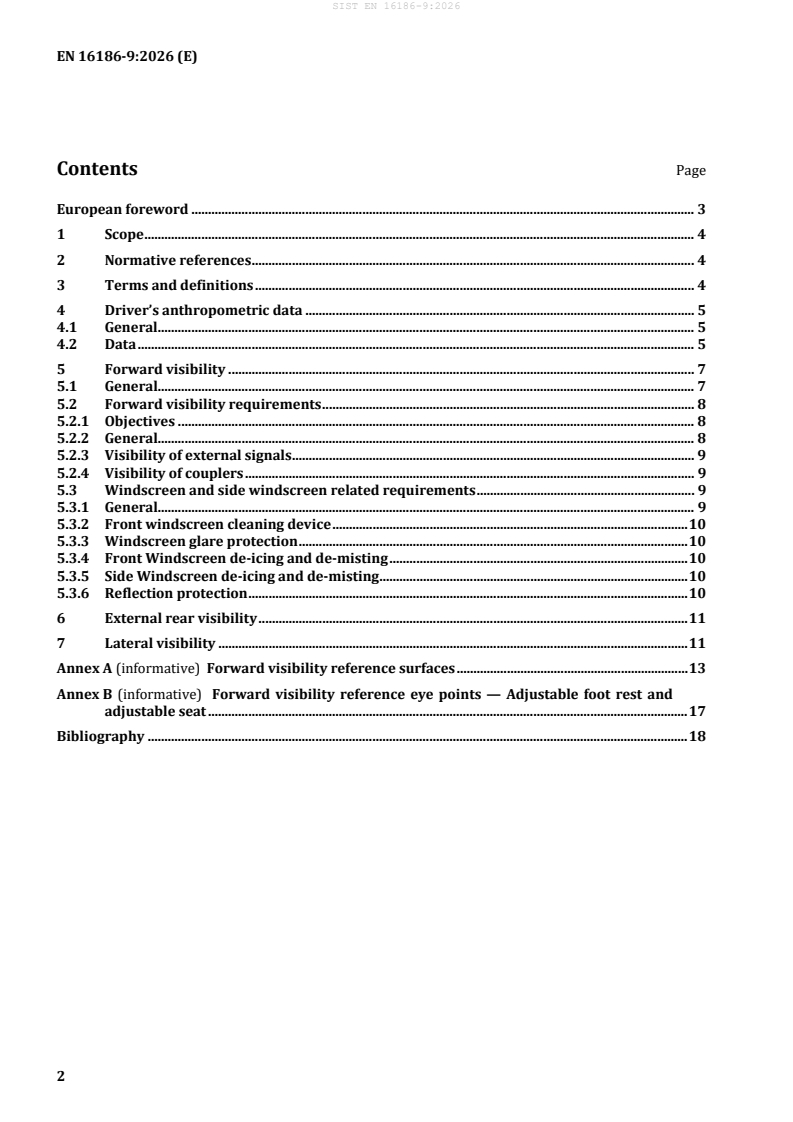
Contents Page
European foreword . 3
1 Scope . 4
2 Normative references . 4
3 Terms and definitions . 4
4 Driver’s anthropometric data . 5
4.1 General. 5
4.2 Data . 5
5 Forward visibility . 7
5.1 General. 7
5.2 Forward visibility requirements . 8
5.2.1 Objectives . 8
5.2.2 General. 8
5.2.3 Visibility of external signals . 9
5.2.4 Visibility of couplers . 9
5.3 Windscreen and side windscreen related requirements . 9
5.3.1 General. 9
5.3.2 Front windscreen cleaning device . 10
5.3.3 Windscreen glare protection . 10
5.3.4 Front Windscreen de-icing and de-misting . 10
5.3.5 Side Windscreen de-icing and de-misting . 10
5.3.6 Reflection protection . 10
6 External rear visibility . 11
7 Lateral visibility . 11
Annex A (informative) Forward visibility reference surfaces . 13
Annex B (informative) Forward visibility reference eye points — Adjustable foot rest and
adjustable seat . 17
Bibliography . 18
European foreword
This document (EN 16186-9:2026) has been prepared by Technical Committee CEN/TC 256 “Railway
applications”, the secretariat of which is held by DIN.
This European Standard shall be given the status of a national standard, either by publication of an
identical text or by endorsement, at the latest by April 2027, and conflicting national standards shall be
withdrawn at the latest by April 2027.
Attention is drawn to the possibility that some of the elements of this document may be the subject of
patent rights. CEN shall not be held responsible for identifying any or all such patent rights.
This document has been prepared under a standardization request addressed to CEN by the European
Commission. The Standing Committee of the EFTA States subsequently approves these requests for its
Member States.
Any feedback and questions on this document should be directed to the users’ national standards body.
A complete listing of these bodies can be found on the CEN website.
EN 16186 Railway applications — Driver’s cab consists of the following parts:
— Part 1: Anthropometric data and visibility;
— Part 2: Integration of displays, controls and indicators;
— Part 3: Design of displays;
— Part 4: Layout and access;
— Part 5: External visibility for tram vehicles;
— Part 6: Integration of displays, controls and indicators for tram vehicles;
— Part 7: Design of displays for tram vehicles;
— Part 8: Tram vehicle layout and access;
— Part 9: External visibility for metro vehicles.
NOTE Parts 1 to 4 of the above-mentioned standard series are only applicable for heavy rail vehicles and
parts 5 to 8 are only applicable to tram vehicles.
According to the CEN-CENELEC Internal Regulations, the national standards organisations of the
following countries are bound to implement this European Standard: Austria, Belgium, Bulgaria,
Croatia, Cyprus, Czech Republic, Denmark, Estonia, Finland, France, Germany, Greece, Hungary, Iceland,
Ireland, Italy, Latvia, Lithuania, Luxembourg, Malta, Netherlands, Norway, Poland, Portugal, Republic of
North Macedonia, Romania, Serbia, Slovakia, Slovenia, Spain, Sweden, Switzerland, Türkiye and the
United Kingdom.
1 Scope
This document defines front visibility conditions including positions of drivers and its assessment.
This document applies to metro vehicles with or without permanent driver, excluding shuttles used for
short distance transportation.
Metro vehicle definition is according to EN 17343.
NOTE For special vehicles, see EN 14033-4 and EN 15746-4.
2 Normative references
The following documents are referred to in the text in such a way that some or all of their content
constitutes requirements of this document. For dated references, only the edition cited applies. For
undated references, the latest edition of the referenced document (including any amendments) applies.
EN 17343, Railway applications — General terms and definitions
EN 15152:2019+A1:2023, Railway applications — Windscreens for trains
EN 15663, Railway applications — Vehicle reference masses
3 Terms and definitions
For the purposes of this document, the terms and definitions given in EN 17343 and the following apply.
ISO and IEC maintain terminology databases for use in standardization at the following addresses:
• ISO Online browsing platform: available at https://www.iso.org/obp
• IEC Electropedia: available at https://www.electropedia.org/
3.1
primary vision area
area of the windscreen through which track and signals are visible from the driving position
[SOURCE: EN 15152:2019+A1:2023, 3.3, modified – note 1 to entry has been deleted.]
3.2
secondary vision area term
area of the windscreen outside the primary vision area, through which the driver can also look from the
driving position
[SOURCE: EN 15152:2019+A1:2023, 3.4, modified – note 1 to entry has been deleted.]
3.3
windscreen
glazing in front of a driver through which the track ahead can be observed
[SOURCE: EN 15152:2019+A1:2023, 3.2, modified — “or passengers” is removed.]
3.4
side windscreen
additional glazing positioned at the side of a windscreen that is predominately positioned transversely
to the running direction
[SOURCE: EN 15152:2019+A1:2023, 3.2.2]
3.5
driver dummies
models referring to the min and max anthropometric data
Note 1 to entry: The anthropometric data are provided in Clause 4.
3.6
driverless metro
metro that, in normal operation, is operated without a driver on board
Note 1 to entry: A driverless metro can be operated by a driver with a simplified desk in degraded conditions.
3.7
shuttle
rail system that runs back and forth between two points
4 Driver’s anthropometric data
4.1 General
This Clause defines the anthropometric data on which the requirements in this document are based.
The background on these anthropometric data are provided in CEN/TR 16823.
4.2 Data
Figure 1 and Figure 2 give the body size measures.
Dimensions in millimetres
Measure Min. Max.
a
a 1 580 1 940
a
b 1 480 1 815
d 710 860
e 545 665
a
g 405 510
h 120 180
i 440 525
a
j 107 126
k 353 457
l 377 473
m 403 498
n 257 312
o 223 266
p 170 221
t 104 131
x 232 261
a
Includes 30 mm allowance for shoes.
Figure 1 — Principal body size measures
Dimensions in millimetres
Min. Max.
d see Figure 1
a
f 510 635
l see Figure 1
q 78 90
r 75 101
s 105 121
t see Figure 1
u 295 387
v 450 to 600 to
550 700
w 390 to 470 to
405 510
x see Figure 1
z 220 290
a
Includes 30 mm allowance
for shoes.
Key
a) sitting upright
b) sitting inclined
1 hip point
2 seat reference point (SRP)
3 heel point (HP), the lowest rear point of the heel
z/4 non-flexible part of the shoe pad
Figure 2 — Additional body size measures
The minimum distance between the eyes is 53 mm and the maximum distance between the eyes is
70 mm.
The minimum dimensions shall be used together with the minimum requirements listed in Figure 2.
The maximum dimensions shall be used together with the maximum requirements listed in Figure 2.
5 Forward visibility
5.1 General
For the seated driving position, the forward visibility requirements of 5.2.1 shall be ensured (see also
Annex A, Figure A.1 and Annex B).
For the standing driving position, the forward visibility requirements of 5.2.1 shall be ensured (see also
Annex A, Figure A.2).
The horizontal distance from the driver’s eye to the windscreen in seated position shall be a minimum
of 500 mm.
The sightlines as defined in 5.2 shall not be infringed by a
...