

SIST EN 16186-6:2024
(Main)Railway applications - Driver's cab - Part 6: Integration of displays, controls and indicators for tram vehicles
General Information
- Abstract
This document is applicable to vehicles operating on tram networks.
This document gives design requirements and guidance in order to ensure visibility and operability of displays, controls and indicators in the cab in all operating conditions (day, night, natural or artificial lighting).
It covers four aspects:
- the characteristics of the displays, controls and indicators in order to ensure proper visibility: i.e. range of luminance and contrast as well as the possibility of adjustment of perceived brightness;
- the requirements for the location of the displays, keyboards, controls and indicators in the cab and on the driver’s desk: i.e. position, angle of visibility, etc. with consideration of the normal driving position and the working environment (windscreen, natural or artificial lighting in the cab, unwanted glare and reflections, etc.);
- the characteristics and requirements for the location of microphones and loudspeakers;
- design of symbols.
NOTE All element numbers within the text refer to Table B.1.
This document does not apply to refurbishment of existing vehicles. This document is not intended to be applicable to driver's auxiliary desk, except for 5.3.13, Clause 6, 7.1.2, Clause 9 and Table B.1.
- Status
- Published
- Public Enquiry End Date
- 28-Feb-2022
- Publication Date
- 10-Oct-2024
- Technical Committee
- IŽNP - Reilway applications
- Current Stage
- 6060 - National Implementation/Publication (Adopted Project)
- Start Date
- 09-Oct-2024
- Due Date
- 14-Dec-2024
- Completion Date
- 11-Oct-2024

Overview
EN 16186-6:2024 - Railway applications: Driver’s cab, Part 6 - provides design requirements and guidance for the integration of displays, controls and indicators in tram vehicles. Published by CEN, this standard applies to new vehicles operating on tram networks and aims to ensure visibility and operability of cab elements in all lighting and driving conditions (day, night, natural or artificial lighting). It does not apply to refurbishment of existing vehicles and is not generally intended for the driver’s auxiliary desk except for specific clauses.
Key topics and technical requirements
The standard focuses on four main aspects related to cab human–machine interfaces:
- Visibility and legibility
- Requirements for display luminance and contrast ranges
- Adjustment capability for perceived brightness
- Positioning and ergonomics
- Rules for location, angle of visibility and reachability of displays, keyboards, controls and indicators relative to the normal driving position
- Consideration of windscreen geometry, natural/artificial cab lighting, glare and reflections
- Audio elements
- Characteristics and placement requirements for microphones and loudspeakers
- Audibility and hierarchy of audible warnings
- Symbol and text design
- Design principles for symbols, harmonized symbol appearance, colour combinations and font/type requirements
Additional technical material includes device resistance to cleaning agents, grouping and allocation of controls to hands, risk of inadvertent activation, synchronous operation considerations, and guidance on alarms and warnings. Annex A provides normative reach envelopes and fields of view; Annex B lists operating elements and driver’s desk integration information.
Practical applications and users
EN 16186-6:2024 is used by professionals involved in tram vehicle human factors and cab design, including:
- Vehicle designers and integrators specifying display and control layouts
- Ergonomics and human factors engineers creating driver-centred workstations
- Systems integrators and electronics suppliers developing cab instrumentation
- Manufacturers drafting procurement specifications and acceptance tests
- Safety assessors, operators and regulators validating cab ergonomics and audible/visual warnings
Typical uses: cab layout design reviews, procurement requirements for displays/controls, ergonomic assessments, and integration checks for new tram vehicle fleets.
Related standards
- EN 16186 series (Driver’s cab): Parts 1–8 (anthropometry, displays, layout, external visibility, etc.)
- CEN/TR 16823 (background on anthropometric data referenced by EN 16186)
Keywords: EN 16186-6:2024, driver’s cab, tram vehicles, integration of displays, controls, indicators, cab ergonomics, visibility, luminance, contrast, CEN standard.
Relations
- Effective Date
- 28-Jan-2026
- Effective Date
- 28-Jan-2026
- Effective Date
- 28-Jan-2026
- Effective Date
- 28-Jan-2026
- Effective Date
- 28-Jan-2026
- Refers
SIST EN 15227:2020+A1:2024 - Railway applications - Crashworthiness requirements for rail vehicles - Effective Date
- 28-Jan-2026
- Effective Date
- 28-Jan-2026
- Effective Date
- 28-Jan-2026
- Effective Date
- 28-Jan-2026
- Effective Date
- 28-Jan-2026
- Effective Date
- 28-Jan-2026
- Effective Date
- 28-Jan-2026
- Referred By
SIST EN 16186-8:2022 - Railway applications - Driver's cab - Part 8: Tram vehicle layout and access - Effective Date
- 28-Jan-2026
Get Certified
Connect with accredited certification bodies for this standard

IRIS Certification (UNIFE)
International Railway Industry Standard certification.

TÜV SÜD Rail GmbH
TÜV SÜD railway certification services.

Bureau Veritas Railway Certification
Railway and transportation certification.
Sponsored listings
Frequently Asked Questions
SIST EN 16186-6:2024 is a standard published by the Slovenian Institute for Standardization (SIST). Its full title is "Railway applications - Driver's cab - Part 6: Integration of displays, controls and indicators for tram vehicles". This standard covers: This document is applicable to vehicles operating on tram networks. This document gives design requirements and guidance in order to ensure visibility and operability of displays, controls and indicators in the cab in all operating conditions (day, night, natural or artificial lighting). It covers four aspects: - the characteristics of the displays, controls and indicators in order to ensure proper visibility: i.e. range of luminance and contrast as well as the possibility of adjustment of perceived brightness; - the requirements for the location of the displays, keyboards, controls and indicators in the cab and on the driver’s desk: i.e. position, angle of visibility, etc. with consideration of the normal driving position and the working environment (windscreen, natural or artificial lighting in the cab, unwanted glare and reflections, etc.); - the characteristics and requirements for the location of microphones and loudspeakers; - design of symbols. NOTE All element numbers within the text refer to Table B.1. This document does not apply to refurbishment of existing vehicles. This document is not intended to be applicable to driver's auxiliary desk, except for 5.3.13, Clause 6, 7.1.2, Clause 9 and Table B.1.
This document is applicable to vehicles operating on tram networks. This document gives design requirements and guidance in order to ensure visibility and operability of displays, controls and indicators in the cab in all operating conditions (day, night, natural or artificial lighting). It covers four aspects: - the characteristics of the displays, controls and indicators in order to ensure proper visibility: i.e. range of luminance and contrast as well as the possibility of adjustment of perceived brightness; - the requirements for the location of the displays, keyboards, controls and indicators in the cab and on the driver’s desk: i.e. position, angle of visibility, etc. with consideration of the normal driving position and the working environment (windscreen, natural or artificial lighting in the cab, unwanted glare and reflections, etc.); - the characteristics and requirements for the location of microphones and loudspeakers; - design of symbols. NOTE All element numbers within the text refer to Table B.1. This document does not apply to refurbishment of existing vehicles. This document is not intended to be applicable to driver's auxiliary desk, except for 5.3.13, Clause 6, 7.1.2, Clause 9 and Table B.1.
SIST EN 16186-6:2024 is classified under the following ICS (International Classification for Standards) categories: 45.060.10 - Tractive stock; 45.140 - Metro, tram and light rail equipment. The ICS classification helps identify the subject area and facilitates finding related standards.
SIST EN 16186-6:2024 has the following relationships with other standards: It is inter standard links to SIST EN 13272-2:2020, SIST EN 17355:2020, SIST EN 894-2:2000+A1:2009, SIST EN ISO 15008:2017, SIST EN 16186-8:2022+A1:2024, SIST EN 15227:2020+A1:2024, SIST EN 16186-5:2021+A1:2023, SIST EN 14752:2025, SIST-TS CEN ISO/TS 23302:2022, SIST EN 16186-7:2026, SIST EN 16334:2014, SIST EN 16186-4:2019, SIST EN 16186-8:2022. Understanding these relationships helps ensure you are using the most current and applicable version of the standard.
SIST EN 16186-6:2024 is associated with the following European legislation: Standardization Mandates: M/483, M/486. When a standard is cited in the Official Journal of the European Union, products manufactured in conformity with it benefit from a presumption of conformity with the essential requirements of the corresponding EU directive or regulation.
SIST EN 16186-6:2024 is available in PDF format for immediate download after purchase. The document can be added to your cart and obtained through the secure checkout process. Digital delivery ensures instant access to the complete standard document.
Standards Content (Sample)
SLOVENSKI STANDARD
01-december-2024
Železniške naprave - Voznikova kabina - 6. del: Združevanje slikovnih zaslonov ter
krmilnih in prikazovalnih elementov za tramvajska vozila
Railway applications - Driver's cab - Part 6: Integration of displays, controls and
indicators for tram vehicles
Bahnanwendungen - Führerraum - Teil 6: Integration von Displays, Bedien- und
Anzeigeelementen für Straßenbahnfahrzeuge
Applications ferroviaires - Cabine de conduite - Partie 6 : Intégration des afficheurs,
commandes et indicateurs pour tramways
Ta slovenski standard je istoveten z: EN 16186-6:2024
ICS:
45.060.10 Vlečna vozila Tractive stock
45.140 Oprema za podzemne vlake, Metro, tram and light rail
tramvaje in lahka tirna vozila equipment
2003-01.Slovenski inštitut za standardizacijo. Razmnoževanje celote ali delov tega standarda ni dovoljeno.
EN 16186-6
EUROPEAN STANDARD
NORME EUROPÉENNE
October 2024
EUROPÄISCHE NORM
ICS 45.060.10; 45.140
English Version
Railway applications - Driver's cab - Part 6: Integration of
displays, controls and indicators for tram vehicles
Applications ferroviaires - Cabine de conduite - Partie Bahnanwendungen - Führerraum - Teil 6: Integration
6 : Intégration des afficheurs, commandes et von Displays, Bedien- und Anzeigeelementen bei
indicateurs pour tramways Straßenbahnfahrzeugen
This European Standard was approved by CEN on 12 August 2024.
CEN members are bound to comply with the CEN/CENELEC Internal Regulations which stipulate the conditions for giving this
European Standard the status of a national standard without any alteration. Up-to-date lists and bibliographical references
concerning such national standards may be obtained on application to the CEN-CENELEC Management Centre or to any CEN
member.
This European Standard exists in three official versions (English, French, German). A version in any other language made by
translation under the responsibility of a CEN member into its own language and notified to the CEN-CENELEC Management
Centre has the same status as the official versions.
CEN members are the national standards bodies of Austria, Belgium, Bulgaria, Croatia, Cyprus, Czech Republic, Denmark, Estonia,
Finland, France, Germany, Greece, Hungary, Iceland, Ireland, Italy, Latvia, Lithuania, Luxembourg, Malta, Netherlands, Norway,
Poland, Portugal, Republic of North Macedonia, Romania, Serbia, Slovakia, Slovenia, Spain, Sweden, Switzerland, Türkiye and
United Kingdom.
EUROPEAN COMMITTEE FOR STANDARDIZATION
COMITÉ EUROPÉEN DE NORMALISATION
EUROPÄISCHES KOMITEE FÜR NORMUNG
CEN-CENELEC Management Centre: Rue de la Science 23, B-1040 Brussels
© 2024 CEN All rights of exploitation in any form and by any means reserved Ref. No. EN 16186-6:2024 E
worldwide for CEN national Members.
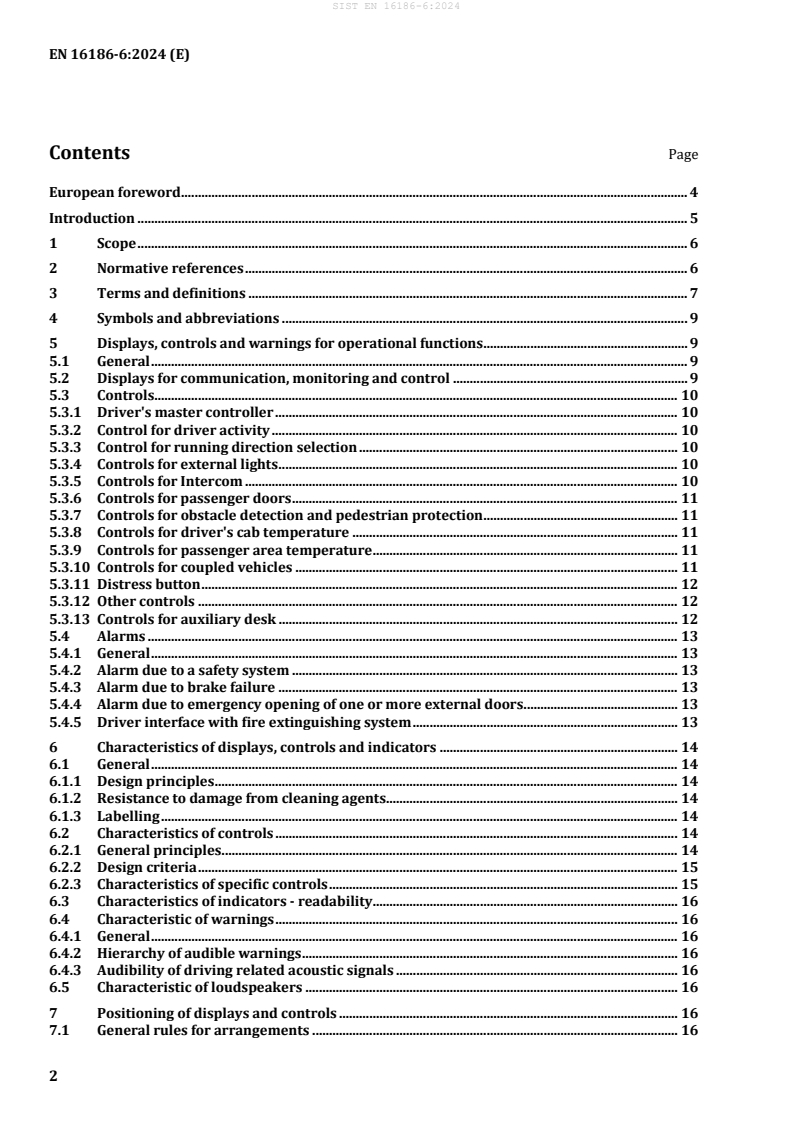
Contents Page
European foreword . 4
Introduction . 5
1 Scope . 6
2 Normative references . 6
3 Terms and definitions . 7
4 Symbols and abbreviations . 9
5 Displays, controls and warnings for operational functions . 9
5.1 General . 9
5.2 Displays for communication, monitoring and control . 9
5.3 Controls . 10
5.3.1 Driver's master controller . 10
5.3.2 Control for driver activity . 10
5.3.3 Control for running direction selection . 10
5.3.4 Controls for external lights . 10
5.3.5 Controls for Intercom . 10
5.3.6 Controls for passenger doors . 11
5.3.7 Controls for obstacle detection and pedestrian protection . 11
5.3.8 Controls for driver's cab temperature . 11
5.3.9 Controls for passenger area temperature . 11
5.3.10 Controls for coupled vehicles . 11
5.3.11 Distress button . 12
5.3.12 Other controls . 12
5.3.13 Controls for auxiliary desk . 12
5.4 Alarms . 13
5.4.1 General . 13
5.4.2 Alarm due to a safety system . 13
5.4.3 Alarm due to brake failure . 13
5.4.4 Alarm due to emergency opening of one or more external doors . 13
5.4.5 Driver interface with fire extinguishing system . 13
6 Characteristics of displays, controls and indicators . 14
6.1 General . 14
6.1.1 Design principles . 14
6.1.2 Resistance to damage from cleaning agents. 14
6.1.3 Labelling . 14
6.2 Characteristics of controls . 14
6.2.1 General principles . 14
6.2.2 Design criteria . 15
6.2.3 Characteristics of specific controls . 15
6.3 Characteristics of indicators - readability . 16
6.4 Characteristic of warnings . 16
6.4.1 General . 16
6.4.2 Hierarchy of audible warnings . 16
6.4.3 Audibility of driving related acoustic signals . 16
6.5 Characteristic of loudspeakers . 16
7 Positioning of displays and controls . 16
7.1 General rules for arrangements . 16
7.1.1 Driver’s desk design . 16
7.1.2 Human factors/ergonomic aspects . 17
7.1.3 Device positioning principle . 17
7.2 Positioning of displays . 18
7.2.1 Display location and orientation . 18
7.2.2 Preferred fields of view . 18
7.2.3 Positioning speed and ATP signalling information . 18
7.2.4 Positioning of other equipment . 18
7.3 Positioning of controls . 18
7.3.1 Reachability of controls on the driver’s desk of tram vehicles . 18
7.3.2 Reachability of controls on the driver’s desk of tram-train vehicles. 19
7.3.3 Grouping of controls . 19
7.3.4 Allocation to hands . 20
7.3.5 Accessibility . 20
7.3.6 Synchronous operation of elements . 20
7.3.7 Risk of inadvertent activation . 20
7.3.8 Position of specific controls . 20
7.3.9 Controls used while driving, but not located on the driver’s desk . 21
7.3.10 Controls only operated during standstill . 21
8 Lighting of cab, displays, controls and indicators . 22
8.1 Cab lighting . 22
8.2 Instruments' lighting . 22
8.3 Prevent disturbing the driver . 22
8.4 Reading zone of tram-train vehicles . 22
9 Symbol and text definition . 22
9.1 Symbol appearance . 22
9.2 Harmonized symbols . 22
9.2.1 General . 22
9.2.2 Combinations of colours . 23
9.2.3 Style of symbols . 23
9.2.4 Location with respect to controls . 23
9.2.5 Field for symbols . 23
9.2.6 New symbols . 23
9.3 Character type . 23
Annex A (normative) Reach envelopes and fields of view inside the cab . 24
Annex B (informative) Operating elements and integration at the driver's desk . 26
Bibliography . 41
European foreword
This document (EN 16186-6:2024) has been prepared by Technical Committee CEN/TC 256 “Railway
Applications”, the secretariat of which is held by DIN.
This European Standard shall be given the status of a national standard, either by publication of an
identical text or by endorsement, at the latest by April 2025, and conflicting national standards shall be
withdrawn at the latest by April 2025.
Attention is drawn to the possibility that some of the elements of this document may be the subject of
patent rights. CEN shall not be held responsible for identifying any or all such patent rights.
EN 16186, Railway applications — Driver's cab is written as an EN series on all the aspects to be
considered when designing a driver's cab, from anthropometric data and visibility, over the integration
of displays, controls and indicators as well as the design of displays to cab layout and access facilities. The
background information on the anthropometric data used is provided in CEN/TR 16823 [1].
EN 16186, Railway applications — Driver’s cab currently consists of the following parts:
— Part 1: Anthropometric data and visibility;
— Part 2: Integration of displays, controls and indicators;
— Part 3: Design of displays for heavy rail vehicles;
— Part 4: Layout and access;
— Part 5: External visibility for tram vehicles;
— Part 6: Integration of displays, controls and indicators for tram vehicles;
1)
— Part 7: Design of displays for tram vehicles ;
— Part 8: Layout and access for tram vehicles.
This document has been prepared under a standardization request addressed to CEN by the European
Commission. The Standing Committee of the EFTA States subsequently approves these requests for its
Member States.
Any feedback and questions on this document should be directed to the users’ national standards body.
A complete listing of these bodies can be found on the CEN website.
According to the CEN-CENELEC Internal Regulations, the national standards organisations of the
following countries are bound to implement this European Standard: Austria, Belgium, Bulgaria, Croatia,
Cyprus, Czech Republic, Denmark, Estonia, Finland, France, Germany, Greece, Hungary, Iceland, Ireland,
Italy, Latvia, Lithuania, Luxembourg, Malta, Netherlands, Norway, Poland, Portugal, Republic of North
Macedonia, Romania, Serbia, Slovakia, Slovenia, Spain, Sweden, Switzerland, Türkiye and the United
Kingdom.
1)
Under preparation. Stage at the time of publication: prEN 16186-7.
Introduction
This document addresses the operating and perception requirements of controls and displays elements
in tram vehicles driver cabs. It provides current cab design principles.
1 Scope
This document is applicable to vehicles operating on tram networks.
This document gives design requirements and guidance in order to ensure visibility and operability of
displays, controls and indicators in the cab in all operating conditions (day, night, natural or artificial
lighting).
It covers four aspects:
— the characteristics of the displays, controls and indicators in order to ensure proper visibility: i.e.
range of luminance and contrast as well as the possibility of adjustment of perceived brightness;
— the requirements for the location of the displays, keyboards, controls and indicators in the cab and
on the driver’s desk: i.e. position, angle of visibility, etc. with consideration of the normal driving
position and the working environment (windscreen, natural or artificial lighting in the cab, unwanted
glare and reflections, etc.);
— the characteristics and requirements for the location of microphones and loudspeakers;
— design of symbols.
NOTE All element numbers within the text refer to Table B.1.
This document does not apply to refurbishment of existing vehicles. This document is not intended to be
applicable to driver's auxiliary desk, except for 5.3.13, Clause 6, 7.1.2, Clause 9 and Table B.1.
2 Normative references
The following documents are referred to in the text in such a way that some or all of their content
constitutes requirements of this document. For dated references, only the edition cited applies. For
undated references, the latest edition of the referenced document (including any amendments) applies.
EN 894-2, Safety of machinery — Ergonomics requirements for the design of displays and control actuators
— Part 2: Displays
EN 13272-2, Railway applications — Electrical lighting for rolling stock in public transport systems — Part
2: Urban rail
EN 14752, Railway applications — Bodyside entrance systems for rolling stock
EN 15227, Railway applications — Crashworthiness requirements for rail vehicles
EN 16186-5, Railway applications — Driver’s cab — Part 5: External visibility for tram vehicles
EN 16186-8, Railway applications — Driver's cab — Part 8: Tram vehicle layout and access
EN 17355, Railway applications — Communication device for urban rail — System requirements
EN ISO 15008:2017, Road vehicles — Ergonomic aspects of transport information and control systems —
Specifications and test procedures for in-vehicle visual presentation (ISO 15008:2017)
ISO 3381, Railway applications — Acoustics — Noise measurement inside railbound vehicles
3 Terms and definitions
For the purposes of this document, the terms and definitions given in EN 16186-5, EN 16186-8 and the
following apply.
ISO and IEC maintain terminology databases for use in standardization at the following addresses:
— ISO Online browsing platform: available at https://www.iso.org/obp/
— IEC Electropedia: available at https://www.electropedia.org/
3.1
alarm
audible and/or visual warning requiring immediate action, with a defined priority
3.2
cab lighting
lighting that illuminates the driver’s cab
3.3
contrast
perception of a difference visually between one surface or element of a rail vehicle and another by
reference to their light reflectance values (LRV) or luminance values
Note 1 to entry: See BS 8300:2009+A1:2010 for further information.
[SOURCE: EN 16584-1:2017, 3.3, modified “building/” has been removed]]
3.4
control
device used to determine the behaviour or supervise the running of equipment
3.5
display
hardware device or system that shows text and/or graphic information and/or video to the user
Note 1 to entry: The display can have input device(s), for example a keyboard or a touchscreen.
3.6
monitor
apparatus for displaying video images
3.7
driver multifunctional interface
DMI
hardware including at least a display and an input device (e.g. keyboard)
3.8
emergency braking
application of a pre-defined brake force that, whilst taking into consideration the usable brake equipment
types, achieves the specified emergency braking performance and level of safety
Note 1 to entry: The braking performance and safety level of the emergency braking are typically equal to or
superior to that of the maximum service brake, assuming the demanded wheel-rail adhesion, etc. is available, and
is described in EN 13452-1.
[SOURCE: EN 14478:2017, 4.8.1, modified – “vehicle specific EN standards” is replaced with
“EN 13452-1”]
3.9
indicator
element designed to indicate the system status
3.10
instrument lighting
lighting that illuminates specific gauges to make their scales visible
3.11
operation aided system display
display that allows the driver to enter operational related information and to get real time information
EXAMPLES Route information, electronic timetable, messages from the control centre.
3.12
position-dependent control
control whose command is proportional to the position of its operating part
EXAMPLE Master controller, defining a specific traction value/deceleration level depending on the position.
3.13
time-dependent control
control whose command is proportional to the duration of the application of the operating part of the
device in a specific position
EXAMPLE Speed increase button on the automatic speed control.
3.14
RAL xxxx
colour codification by the German Institute for Quality Assurance and Certification, former Reichs-
Ausschuss für Lieferbedingungen
Note 1 to entry: RAL 3020 is the coding for traffic red.
3.15
safety braking
braking intended to achieve a higher level of system integrity than that achieved when service and
emergency braking
Note 1 to entry: The safety braking performance can be lower than achieved by full service braking or emergency
braking. The performances are described in EN 13452-1.
[SOURCE: EN 14478:2017, 4.8.4, modified — “specific to mass-transit brake systems” deleted and “when”
replaced by “by” in the note and “The performances are described in EN 13452-1” added]
3.16
warning
visual and/or audible indication triggered by an event of which the recipient needs to be aware and which
may not require immediate action
4 Symbols and abbreviations
For the purposes of this document, the following symbols and abbreviations apply.
ATP Automatic Train Protection
CCD Control Command Display
DAC Driver Activity Control
DMI Driver Multifunctional Interface
ETD Electronic Timetable Display
HVAC Heating, Ventilation and Air Conditioning
OCC Operations Control Centre
OASD Operation Aided System Display
PACM Pedestrian Anti-Crush Mechanism
PEMD Passenger Exchange Monitoring Display
PIS Passenger Information System
RAL “Reichs-Ausschuss für Lieferbedingungen” (German Institute for Quality Assurance and
Certification)
RVMD Rear View Monitoring Display
SRP Seat Reference Point
TDD Technical and Diagnostic Display
TRD Train Radio Display
5 Displays, controls and warnings for operational functions
5.1 General
The common elements and symbols are described in Annex B.
In the following text, two-digit numbers refer to Table B.1 that lists all the elements.
Controls and displays shall not impede visibility, as defined in EN 16186-5.
NOTE Additional equipment and additional requirements for tram-train vehicles relating to displays, controls
and warnings can be found in EN 16186-2.
If the cab has been activated, the following information shall be available at all times on the main desk:
— brake information:
— 10 – Release of continuously applied emergency brake;
— 04 – Operation Aided System Display (if provided).
If the cab is not activated, information may only be displayed on request.
5.2 Displays for communication, monitoring and control
Vehicle monitoring and vehicle control shall be provided, as a minimum, by 01 – Technical and Diagnostic
Display (TDD) and 05 – Speedometer. Additional displays can be provided, for example:
— 02 – Passenger exchange monitoring display (PEMD);
— 03 – Rear view monitoring display (RVMD);
— 04 – Operation aided system display (OASD).
NOTE A monitoring display can be a monitor.
For tram-train vehicles, if other displays are added, the forward visibility according to EN 16186-1 and
EN 16186-5 shall not be impeded.
5.3 Controls
5.3.1 Driver's master controller
The “tractive effort” shall increase by pushing the lever forward, and the “braking effort” shall increase
by drawing the lever towards the driver. For an emergency braking position, there shall be a notch clearly
distinguishable from other positions of the lever.
The tractive or braking effort level shall depend on the position of the lever of 11 – Master controller.
11 – Master controller shall be position-dependent.
NOTE The different emergency braking modes are described in EN 13452-1:2003, 3.2.3.
5.3.2 Control for driver activity
There shall be at least one 17 – Driver’s activity control element for the DAC function.
NOTE 1 DAC is also called “Deadman”.
NOTE 2 This function can be integrated in the master controller.
5.3.3 Control for running direction selection
There shall be a control for the selection of direction of running: 18 – Direction of running
(forwards/backwards).
The direction selected shall be indicated.
5.3.4 Controls for external lights
Controls for 36 – Dipped lights - main beam lights switching (head), 38 – External lights (head, tail), 39 –
Hazard warning lights and 40 – Direction indicators shall control all external lights of the vehicle.
Activated external lights shall be indicated.
If a fog lamp is available, 33 – Fog lamp control shall be provided.
5.3.5 Controls for Intercom
If there is no device to communicate with the control centre, the driver’s cab shall have a communication
device in accordance with EN 17355:
— 49 – A device (e.g. microphone, loudspeaker) to support the communication function;
— 50 – A signal for the communication request to the driver;
— 50 – A device for acknowledging the request for communication;
— 50 – A control to establish the communication link to the operated device;
— 50 – A control to cancel the communication link to the operated device.
These devices can be integrated or combined with other devices or functionalities.
Activated devices for communication shall be indicated.
5.3.6 Controls for passenger doors
The driver shall be able to select door side selection and release with 41 – Door side selection and release
and to cancel door release with 42 – Door release cancellation. The following functions should also be
provided:
— 43 – Opening of the passenger door nearest to the cab;
— 44 – Open/close door centrally;
— 45 – Forced closing of doors;
— 02 – Activation of a display to observe the passenger exchange.
NOTE 1 For vehicles with doors on one side, the door side selection function is not needed.
Open doors shall be indicated.
Depending on operational requirements, door side selection and door release may be combined.
NOTE 2 Door release and door release cancelation can be incorporated into one control.
NOTE 3 The functionalities of the door control system are referred in EN 14752.
Door controls shall be designed according to EN 14752.
5.3.7 Controls for obstacle detection and pedestrian protection
If vehicles are operated with obstacle detection and pedestrian protection, the following controls are
necessary:
— 30 – Obstacle detection control;
— 31 – PACM (pedestrian anti-crush mechanism) control for resetting;
— 32 – PACM (pedestrian anti-crush mechanism) activated.
NOTE Obstacle detection is the process of using sensors, data, and algorithms to detect objects that can
obstruct the movement of the tram vehicle or door.
5.3.8 Controls for driver's cab temperature
There shall be a device for regulating the temperature: 25 – Driver's cab heating and ventilation. This
should be compliant with EN 14813 series.
5.3.9 Controls for passenger area temperature
There shall be a device for regulating the temperature: 26 – Passenger area heating and ventilation. This
should be compliant with EN 14750 series.
5.3.10 Controls for coupled vehicles
If the vehicle is equipped with an automatic coupler, the cab shall have 57 – Uncoupling function control
to manage the coupling function.
Coupled vehicles shall be indicated.
5.3.11 Distress button
The distress button allows the driver to inform the control centre of any confrontational situation.
5.3.12 Other controls
Other controls shall be provided:
— 06 – Manual switch/point remote control;
— 09 – Warning bell;
— 10 – Release of continuously applied emergency brake;
— 21 – Mirror retracting (if retractable mirror is provided);
— 22 – Mirror adjustment (if external mirror is provided);
— 23 – Windscreen wiping/washing control;
— 24 – Window de-icing;
— 34 – Lighting in passenger area (if not automatic);
— 46 – General alarm acknowledgement;
— 47 – Passenger alarm device acknowledgement/reset;
— 49 – Microphone activation for announcements;
— 50 – Passenger communication device for communication following passenger request;
— 51 – Activation of OCC voice communication.
The following controls are optional:
— 07 – Traffic light command;
— 20 – Sun-visor control;
— 53 – Inter-cab ringer and voice communication activation command.
5.3.13 Controls for auxiliary desk
At least the following controls are required for shunting tram vehicles:
— 13 – Safety braking control;
— 17 – Driver activity control (DAC) (can be integrated in the traction/brake controller);
— 18 – Direction of running (forwards/backwards);
— 55 – Activation of the auxiliary desk;
— 54 – Combined traction/brake controller with minimum functionality (driving, rolling, braking,
emergency braking);
— 53 – Voice communication activation command;
— 09 – Warning bell;
— 39 – Hazard warning lights.
Additional controls and displays can be necessary depending on local operational conditions.
If the auxiliary desk is used with passengers on board, the following door controls shall be added:
— 41 – Door side selection and release;
— 42 – Door release cancellation;
— 44 – Open/close doors centrally;
— 45 – Forced closing of doors.
NOTE 1 An auxiliary desk is located at the end-car of one-directional vehicles for shunting purposes.
NOTE 2 An auxiliary desk is not a driver instructor panel.
5.4 Alarms
5.4.1 General
Critical operating situations can be indicated to the driver via audible and/or visual alarms. The resulting
action sequences result from the local operational rules.
5.4.2 Alarm due to a safety system
An audible and/or visual alarm to inform the driver of an immediate intervention by a safety system shall
be provided.
If a visual alarm is provided, it shall be located in the optimum field of view. See Figure A.2.
5.4.3 Alarm due to brake failure
A visual alarm shall indicate a failure of the brakes (e.g. ineffective brakes or a fault that reduces the
effectiveness of the braking system). There may also be an additional audible signal.
5.4.4 Alarm due to emergency opening of one or more external doors
Audible and visual alarms shall indicate to the driver an emergency opening of one or more passenger
doors. It should be possible to acknowledge and cancel audible signals for emergency door opening.
5.4.5 Driver interface with fire extinguishing system
There shall be no means for the driver to interfere with the operation of the fire extinguishing system, if
provided. Information that the fire extinguishing system has operated or is not available should be
provided in the cab.
6 Characteristics of displays, controls and indicators
6.1 General
6.1.1 Design principles
The design (e.g. the shape, the colour, the location) of the elements should assist the recognition of
different functions under all ambient lighting conditions.
As design reference for controls and displays, EN 894 (all parts) and EN 1005 (all parts) may apply.
For tram-train vehicles, additional characteristics of displays, controls and indicators can be found in
EN 16186-2.
6.1.2 Resistance to damage from cleaning agents
Labelling of operational elements shall not be rendered illegible by cleaning agents.
NOTE The list of acceptable cleaning agents is usually provided by the manufacturer.
6.1.3 Labelling
Where plain-text labels are provided, the following applies:
— the function “On” is represented by the Roman one “I”;
— the function “Off” is represented by the Arabic zero “0”;
— for plain-text markings see 9.3.
6.2 Characteristics of controls
6.2.1 General principles
6.2.1.1 Choice of interface for functions
Interfaces should help the driver to distinguish the functions to be executed, for example by different
shapes, colours or positions.
Controls may combine several associated functions.
The relevant driving tasks shall determine the choice to combine functions into a single control, e.g. a
combined lever for traction and braking.
6.2.1.2 Control principle
Position-dependent controls should be the preferred option rather than time-dependent ones.
6.2.1.3 Direction of actuation
The direction of actuation of controls should be coherent with the behaviour of their related control
systems.
6.2.1.4 Isolation devices
Isolation devices should be protected in order to prevent unintentional operation. The state of isolation
devices (in operation or not in operation) and protection shall be visible by the driver.
6.2.1.5 Perception of controls
Controls should be graduated and/or illuminated so that their operating positions can be recognized
(using tactile sense for graduated controls or vision for non-graduated controls). Where controls are
graduated, the graduations should be fine and precise enough for driving purposes.
6.2.1.6 Legibility of instruments
Graduation for identification of visual indicators shall be implemented according to EN 894-2.
6.2.2 Design criteria
6.2.2.1 Identification by shape
For 13 – Safety braking, a mushroom shaped button shall be used.
For other controls in vehicles running only on tram networks, no specific shape requirements apply.
6.2.2.2 Colours
6.2.2.2.1 General
Controls that shall be operated while driving shall have a colour differentiation relative to the desk
surface. Black or grey from the range of finishes RAL 9004, 9011, 9017 or 7016, 7021, 7024 in accordance
with register RAL 840-HR or equivalent may be used.
Markings and symbols of the controls in the driver’s cab should be realized with a high contrast to the
background e.g. RAL 9003, 9010 and 9016 may be used for the markings and symbols of the controls,
RAL 9005 may be used for the base.
For tram-train vehicles, in order to prevent any dangerous confusion with outside operational signalling,
no green lights or green illuminations are permitted in a driver’s cab, except for existing class B cab
signalling system.
6.2.2.2.2 Colour red
Essentially, controls that are only operated in the case of safety critical faults or emergency and associated
indicators shall be finished in red (RAL 3000, 3001, 3002, 3020 or equivalent).
6.2.2.2.3 Colour yellow
If there is some requirement to high-light a control, e.g. in case of frequent use for prescribed regular
procedures (e.g. doors), the colour yellow can be used on the element or on an adjacent surface. The
colour yellow can be defined by RAL 1003, 1004, 1018, 1021, 1023.
6.2.2.3 Robustness
The controls should be designed to withstand adverse ambient conditions and excessive mechanical
stress, for example:
— force effects during stressful situations;
— force effects during operation (such as shunting or coupling);
— liquid spills, food, dust, etc.
Their operability should not be affected by such conditions.
6.2.3 Characteristics of specific controls
54 – Combined traction/brake controller with minimum functionality should be time-dependent.
6.3 Characteristics of indicators - readability
All indicator lights should be designed so that they can be read correctly under natural or artificial lighting
conditions, including incidental lighting.
The contrast shall comply with EN ISO 15008:2017, 4.3.2.1.
6.4 Characteristic of warnings
6.4.1 General
Warnings should be designed in accordance with the following principles:
— Audible and visual warnings inside the cab should be distinctive and have appropriate loudness and
sound qualities and/or light intensities, in accordance with their functions, urgency and importance;
— Audible and visual warnings should not unnecessarily distract the driver’s attention from normal
driving duties;
— Audible and visual warnings should be consistent in their meaning;
— Audible information should meet all the following requirements:
— Each audible information should be distinguishable from all other audible information in the cab;
— Be audible from all applicable driving positions inside the cab and in all driving conditions;
— The audible warning should not cause drivers audible discomfort when triggered.
No more than seven different audible warnings shall be available in the cab (five recommended).
NOTE For audible and visual warnings, see also EN 16186-7 .
6.4.2 Hierarchy of audible warnings
At least for the warnings provided through a single channel there shall be a hierarchy of audible warnings
such that the most important, when triggered and until cancelled or acknowledged, will suppress less
important audible warnings.
6.4.3 Audibility of driving related acoustic signals
Audible information generated by acoustic signals inside the cab shall be at least L = 6 dB above the
pA
interior noise at the one-third octave band corresponding to the main tonal frequency of the alarm. The
interior noise used to compare the alarm in one-third octave frequency shall be the one measured at
maximum operational speed of the tram vehicle in accordance with ISO 3381.
6.5 Characteristic of loudspeakers
The volume of the loudspeakers should be adjustable by a control in the cab. The pre-set minimum
audible level is defined in 6.4.3.
7 Positioning of displays and controls
7.1 General rules for arrangements
7.1.1 Driver’s desk design
Driver's desk design shall permit operation by a single driver.
Driver’s desks should be designed in accordance with Annex B.
NOTE This design was not intended to consider ticket sales.
7.1.2 Human factors/ergonomic aspects
Human factors principles should be applied to optimize the arrangements in the driver's cab taking into
account:
a) the ideal positions of controls and instruments in terms of visibility, reachability and force
requirements;
b) constraints due to requirements arising from familiarity with existing designs;
c) constraints due to physical / technical requirements of the cab space.
NOTE 1 The above applies to normal driving and for degraded mode.
The operation of controls and the observation of instruments/displays should mitigate against fatigue
and should take into account the strength and biomechanical characteristics considering the
anthropometric range of drivers described in EN 16186-5.
NOTE 2 For further information on forces, repetition and postures, see EN 1005 (all parts) and for information
on displays see EN 894-2.
7.1.3 Device positioning principle
Cab devices should be positioned in accordance with the following principles:
a) importance principle – those displays and controls which are most essential to safe operation should
be in the most accessible positions, such as controls for brake, traction, horn/bell, doors;
b) frequency of use principle – those displays and controls which are used most frequently should be in
the most accessible positions, such as controls for brake, DAC, signalling;
c) function principle – displays and controls with closely related functions should be located close to
each other;
d) sequence of use principle – displays and controls which are used in sequence should be located close
to each other and their layout should relate logically to the sequence of operation;
e) the location of controls shall be defined in a way to avoid the need to cross the arms while driving.
The location of the device should be compliant with Annex A and Annex B.
Figure A.1 and Annex B are not applicable to tram-train vehicles.
In order to easily see and reach all safety related and/or frequently used elements while driving, the
access to safety elements shall not be inhibited or impeded by elements that do not have a function
essential to safety.
In order to avoid the driver's attention being unnecessarily diverted from observation of the line, the
zones 1 and 2 in accorda
...