

kSIST FprEN 1729-1:2026
(Main)Furniture - Chairs and tables for educational institutions - Part 1: Functional dimensions
- Abstract
This document specifies functional dimensions and markings for all chairs, stools and tables, for educational institutions, including fixed and adjustable chairs and tables.
It applies to both un-upholstered and upholstered chairs and stools as well as to both non-swivel and swivel chairs. It applies to furniture for use with laptop computers or portable devices.
It does not apply to ranked seating or special purpose workstations.
It does not apply to furniture used by teaching personnel.
Annex A (informative) includes guidance on size marks for adjustable chairs and tables.
Annex B (normative) includes double-sloped high chairs and associated tables.
Annex C (informative) includes guidance on calculating heights of double-sloped chairs and associated tables.
Annex D (normative) includes chair measurement methods.
Annex E (informative) includes a rationale for functional dimensions.
- Status
- Not Published
- Public Enquiry End Date
- 01-Jun-2025
- Technical Committee
- POH - Furniture
- Current Stage
- 5020 - Formal vote (FV) (Adopted Project)
- Start Date
- 24-Aug-2026
- Due Date
- 12-Oct-2026
- Completion Date
- 24-Sep-2026

kSIST FprEN 1729-1:2026 is a SIST draft European standard for furniture used in educational institutions. It specifies the functional dimensions, size marks and markings for chairs, stools and tables, including fixed and adjustable furniture, so the furniture can be matched to pupils and support good posture in general-purpose education. It also covers furniture for use with laptop computers or portable devices, and it is used together with EN 1729-2 for safety requirements and test methods.
What does kSIST FprEN 1729-1:2026 specify?
kSIST FprEN 1729-1:2026 specifies the functional dimensions and markings for educational chairs, stools and tables. It focuses on how the furniture should fit users and how it should be identified, rather than on construction design.
The scope covers:
- chairs, stools and tables for educational institutions
- fixed and adjustable furniture
- upholstered and un-upholstered chairs and stools
- non-swivel and swivel chairs
- furniture intended for laptop computers or portable devices
The document excludes ranked seating, special purpose workstations and furniture used by teaching personnel.
The document is organized into clauses on scope, normative references, terms and definitions, functional dimensions, chair measurement, marking, instructions, approval of range and test reports. It also has five annexes that separate guidance, special cases, measurement methods and rationale.
| Annex | What it covers |
|---|---|
| Annex A | Guidance for calculating the height of adjustable chairs and tables |
| Annex B | Functional dimensions for chairs with double-sloped seats and associated tables |
| Annex C | Guidance for calculating the height of chairs and tables in Annex B |
| Annex D | Determination of dimensions of chairs |
| Annex E | Rationale for functional dimensions |
What are the key requirements of kSIST FprEN 1729-1:2026?
kSIST FprEN 1729-1:2026 is built around matching furniture dimensions to the user and then checking those dimensions with defined methods. In practice, that means a supplier needs to know the size mark, measure the furniture in the right way and document the result clearly.
Functional dimensions are based on size marks and body-fit logic
Clause 4 ties chairs, tables and stools to size marks and colour codes. The document uses popliteal height, stature and standing elbow height as the main user references, and it states that the ranges shown do not include shoe allowance while chair and table heights do.
This matters because the standard is not prescribing a style of furniture. It is setting the dimensions that support posture and usability for different pupil groups.
Chairs with single-sloped seats and associated tables have defined limits
Clause 4.2 sets the functional dimensions for chairs with seat slopes between −5° and +7° and for their associated tables. For chairs in the higher size marks, the document requires a sufficient buttock zone and lumbar support, which are checked with the measurement method in Annex D.
For tables used with these chairs, Clause 4.3 allows horizontal, fixed-incline or user-inclinable tabletops, but a user-inclinable top must also be adjustable back to horizontal. The practical point is that the table has to work for writing, reading and similar classroom tasks without forcing an awkward posture.
Standing-height tables and tall chairs are handled differently
Clause 4.3.3 covers standing-height tables. Their height is matched to standing elbow height, and the document recommends height-adjustable tables.
Clause 4.3.2.3 covers tall chairs and the tables used with them. Instead of size-marking the table height in the usual way, the document uses the vertical distance between the top of the table and the top of the seat to match the table to the chair. That is important when selecting or checking furniture for work at a raised surface.
Stools have their own posture and use assumptions
Clause 4.3.5 states that stools are intended for short periods and that their seat angle is limited to a narrow range. The document also links stool seat height to the corresponding worksurface height and gives seat surface width and depth requirements.
In practice, this means a stool is not treated like a chair without a backrest. The height relationship to the work surface and the short-use intent are part of the selection decision.
Adjustable and multi-size furniture must cover every size mark it claims
Clause 4.3.4 sets requirements for adjustable and multi-size chairs and tables. Adjustment controls must be easy to reach and operate without special tools, and the furniture must meet the dimensional requirements of every size mark within the claimed range.
This matters for schools and buyers because a product range is only acceptable if each supported setting works on its own. The furniture also has to show which size marks it can cover.
Chair dimensions are measured with the SCMD and by direct methods
Clause 5 and Annex D define the school chair measuring device (SCMD) and the measurement procedure. The SCMD is used for size marks 3 to 7 to determine seat height, seat angle, seat depth, armrest height, the distance from backrest to armrest and the MFP, buttock zone and lumbar support. For some checks, the SCMD is loaded; for others it is not.
For size marks 0 to 2, Annex D gives direct measurement methods without the SCMD. This distinction matters because a test lab or manufacturer has to use the correct method for the size mark before comparing the result with the limits in Clause 4.
Marking, instructions, range approval and test reporting are controlled
Clause 6 requires legible and indelible marking, including the size mark or colour code, the size marks covered for adjustable furniture, manufacturer identification and production date. Tall chairs and stools also need a reference to the table height information they are intended to be used with, and tables for tall chairs need their height marked.
Clause 7 requires user instructions in the official language of the country of sale. They must cover the size-mark reference, maintenance, installation for multi-size furniture, operating instructions for adjustable furniture, a gas-lift warning and the short-use nature of stools.
Clause 8 requires each size mark in a range to be measured separately. Clause 9 requires the test report to identify the product, dimensions, size mark, test facility, date and statement of compliance. For buyers and auditors, this is the evidence trail that shows what was checked.
What terms does kSIST FprEN 1729-1:2026 define?
- Median plane - the vertical plane running front to rear through the centre of the seat and dividing the chair into two parts.
- Most forward point (MFP) - the most forward point on the backrest in the specified range on the median plane, as defined by the SCMD.
- Adjustable furniture - furniture that users can adjust without tools.
- Multi-size furniture - furniture adjusted at installation, not by users, to change from one size mark to another.
- Double-sloped seat - a seat intended for use on either the front or rear part, with the feet resting on a footrest or the floor.
- School chair measuring device (SCMD) - the measuring device used to determine MFP, the buttock zone and chair dimensions for school chairs.
- Stool - seating without backrest or armrests intended for short periods.
- Tall chair - a chair whose seat is higher than the seat height specified for the ordinary chair sizes and that has a footrest.
Who uses kSIST FprEN 1729-1:2026?
kSIST FprEN 1729-1:2026 is used by furniture manufacturers, product designers, test laboratories, quality managers, procurement teams and schools or educational authorities. They use it to select sizes, design products, check dimensions, prepare technical files and write purchasing or acceptance specifications.
It is also relevant to suppliers of classroom furniture for laptop or portable-device use, because the standard includes that use case. For buyers, the practical value is in comparing products on a common dimensional basis instead of relying on marketing descriptions.
What changed in kSIST FprEN 1729-1:2026 from the previous edition?
kSIST FprEN 1729-1:2026 will supersede EN 1729-1:2015. The document states two significant technical changes compared with the previous edition: rationalization of the annexes and improvement of the measurement method.
Which standards are used with kSIST FprEN 1729-1:2026?
- EN 1729-2, Furniture - Chairs and tables for educational institutions - Part 2: Safety requirements and test methods - provides the safety requirements and test methods used after the dimensional checks in this part.
What does the kSIST FprEN 1729-1:2026 document contain?
The document contains the size-mark system, the functional dimension tables for chairs, tables, tall chairs, stools and the special double-sloped-seat case, and the user-fit logic behind those tables. It also contains the figures that show key dimensions and the SCMD setup, plus the detailed measurement sequence in Annex D.
Annex D gives the working procedure for measuring chairs, including preparation of the chair, placement of the SCMD, determination of MFP, buttock zone and lumbar support, loading of the device and direct measurement of smaller size marks. Annex C provides worked examples for calculating chair and table heights in the double-sloped-seat case, and Annex E explains the ergonomic rationale behind the main dimensions.
The document also includes marking rules, user instruction content, approval of a furniture range and the minimum contents of a test report. For laboratories and certification work, those clauses matter as much as the dimension tables because they define how results are recorded and presented.
Relations
- Effective Date
- 01-May-2025
Frequently Asked Questions
kSIST FprEN 1729-1:2026 is a draft published by the Slovenian Institute for Standardization (SIST). Its full title is "Furniture - Chairs and tables for educational institutions - Part 1: Functional dimensions". This standard covers: This document specifies functional dimensions and markings for all chairs, stools and tables, for educational institutions, including fixed and adjustable chairs and tables. It applies to both un-upholstered and upholstered chairs and stools as well as to both non-swivel and swivel chairs. It applies to furniture for use with laptop computers or portable devices. It does not apply to ranked seating or special purpose workstations. It does not apply to furniture used by teaching personnel. Annex A (informative) includes guidance on size marks for adjustable chairs and tables. Annex B (normative) includes double-sloped high chairs and associated tables. Annex C (informative) includes guidance on calculating heights of double-sloped chairs and associated tables. Annex D (normative) includes chair measurement methods. Annex E (informative) includes a rationale for functional dimensions.
This document specifies functional dimensions and markings for all chairs, stools and tables, for educational institutions, including fixed and adjustable chairs and tables. It applies to both un-upholstered and upholstered chairs and stools as well as to both non-swivel and swivel chairs. It applies to furniture for use with laptop computers or portable devices. It does not apply to ranked seating or special purpose workstations. It does not apply to furniture used by teaching personnel. Annex A (informative) includes guidance on size marks for adjustable chairs and tables. Annex B (normative) includes double-sloped high chairs and associated tables. Annex C (informative) includes guidance on calculating heights of double-sloped chairs and associated tables. Annex D (normative) includes chair measurement methods. Annex E (informative) includes a rationale for functional dimensions.
kSIST FprEN 1729-1:2026 is classified under the following ICS (International Classification for Standards) categories: 97.140 - Furniture. The ICS classification helps identify the subject area and facilitates finding related standards.
kSIST FprEN 1729-1:2026 has the following relationships with other standards: It is inter standard links to SIST EN 1729-1:2016. Understanding these relationships helps ensure you are using the most current and applicable version of the standard.
kSIST FprEN 1729-1:2026 is available in PDF format for immediate download after purchase. The document can be added to your cart and obtained through the secure checkout process. Digital delivery ensures instant access to the complete standard document.
Standards Content (Sample)
SLOVENSKI STANDARD
oSIST prEN 1729-1:2025
01-maj-2025
Pohištvo - Stoli in mize za vzgojno-izobraževalne ustanove - 1. del: Funkcionalne
mere
Furniture - Chairs and tables for educational institutions - Part 1: Functional dimensions
Möbel - Stühle und Tische für Bildungseinrichtungen - Teil 1: Funktionsmaße
Ameublement - Sièges et tables pour établissements d'enseignement - Partie 1 :
Dimensions fonctionnelles
Ta slovenski standard je istoveten z: prEN 1729-1
ICS:
97.140 Pohištvo Furniture
oSIST prEN 1729-1:2025 en,fr,de
2003-01.Slovenski inštitut za standardizacijo. Razmnoževanje celote ali delov tega standarda ni dovoljeno.
oSIST prEN 1729-1:2025
oSIST prEN 1729-1:2025
DRAFT
EUROPEAN STANDARD
prEN 1729-1
NORME EUROPÉENNE
EUROPÄISCHE NORM
April 2025
ICS 97.140 Will supersede EN 1729-1:2015
English Version
Furniture - Chairs and tables for educational institutions -
Part 1: Functional dimensions
Ameublement - Sièges et tables pour établissements Möbel - Stühle und Tische für Bildungseinrichtungen -
d'enseignement - Partie 1 : Dimensions fonctionnelles Teil 1: Funktionsmaße
This draft European Standard is submitted to CEN members for enquiry. It has been drawn up by the Technical Committee
CEN/TC 207.
If this draft becomes a European Standard, CEN members are bound to comply with the CEN/CENELEC Internal Regulations
which stipulate the conditions for giving this European Standard the status of a national standard without any alteration.
This draft European Standard was established by CEN in three official versions (English, French, German). A version in any other
language made by translation under the responsibility of a CEN member into its own language and notified to the CEN-CENELEC
Management Centre has the same status as the official versions.
CEN members are the national standards bodies of Austria, Belgium, Bulgaria, Croatia, Cyprus, Czech Republic, Denmark, Estonia,
Finland, France, Germany, Greece, Hungary, Iceland, Ireland, Italy, Latvia, Lithuania, Luxembourg, Malta, Netherlands, Norway,
Poland, Portugal, Republic of North Macedonia, Romania, Serbia, Slovakia, Slovenia, Spain, Sweden, Switzerland, Türkiye and
United Kingdom.
Recipients of this draft are invited to submit, with their comments, notification of any relevant patent rights of which they are
aware and to provide supporting documentation.
Warning : This document is not a European Standard. It is distributed for review and comments. It is subject to change without
notice and shall not be referred to as a European Standard.
EUROPEAN COMMITTEE FOR STANDARDIZATION
COMITÉ EUROPÉEN DE NORMALISATION
EUROPÄISCHES KOMITEE FÜR NORMUNG
CEN-CENELEC Management Centre: Rue de la Science 23, B-1040 Brussels
© 2025 CEN All rights of exploitation in any form and by any means reserved Ref. No. prEN 1729-1:2025 E
worldwide for CEN national Members.
oSIST prEN 1729-1:2025
prEN 1729-1:2025 (E)
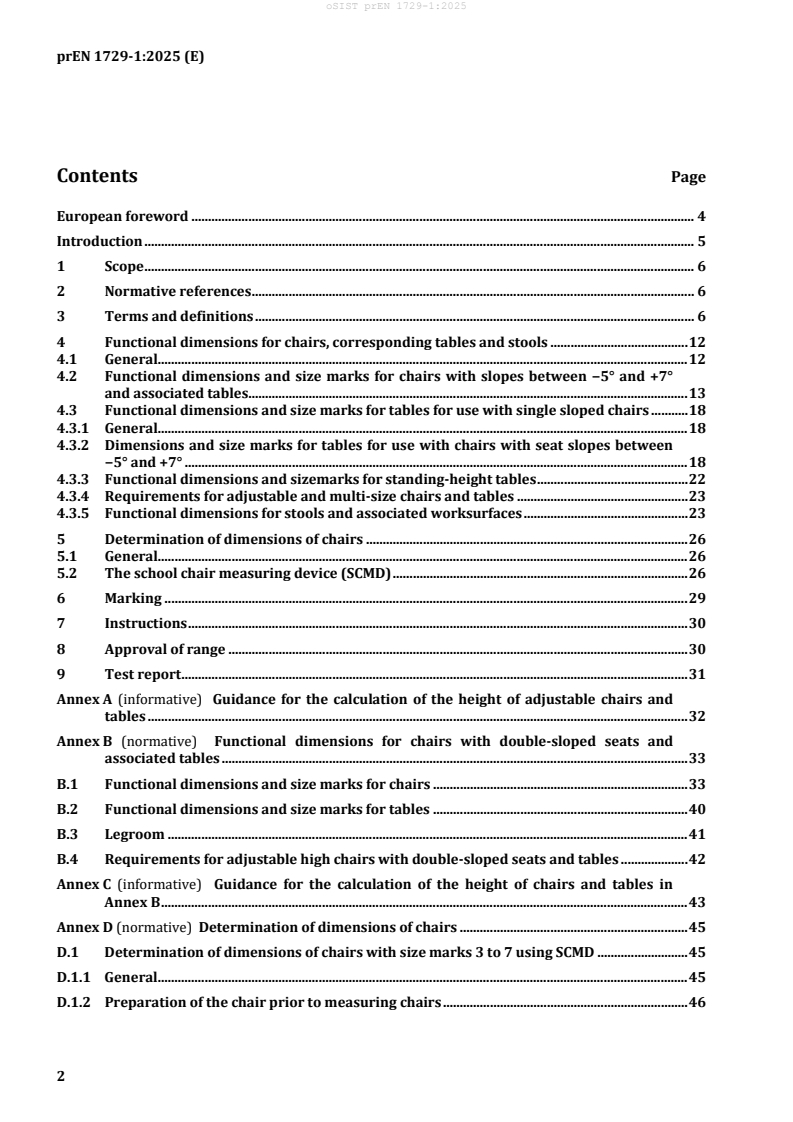
Contents Page
European foreword . 4
Introduction . 5
1 Scope . 6
2 Normative references . 6
3 Terms and definitions . 6
4 Functional dimensions for chairs, corresponding tables and stools . 12
4.1 General. 12
4.2 Functional dimensions and size marks for chairs with slopes between −5° and +7°
and associated tables . 13
4.3 Functional dimensions and size marks for tables for use with single sloped chairs . 18
4.3.1 General. 18
4.3.2 Dimensions and size marks for tables for use with chairs with seat slopes between
−5° and +7° . 18
4.3.3 Functional dimensions and sizemarks for standing-height tables . 22
4.3.4 Requirements for adjustable and multi-size chairs and tables . 23
4.3.5 Functional dimensions for stools and associated worksurfaces . 23
5 Determination of dimensions of chairs . 26
5.1 General. 26
5.2 The school chair measuring device (SCMD) . 26
6 Marking . 29
7 Instructions . 30
8 Approval of range . 30
9 Test report . 31
Annex A (informative) Guidance for the calculation of the height of adjustable chairs and
tables . 32
Annex B (normative) Functional dimensions for chairs with double-sloped seats and
associated tables . 33
B.1 Functional dimensions and size marks for chairs . 33
B.2 Functional dimensions and size marks for tables . 40
B.3 Legroom . 41
B.4 Requirements for adjustable high chairs with double-sloped seats and tables . 42
Annex C (informative) Guidance for the calculation of the height of chairs and tables in
Annex B . 43
Annex D (normative) Determination of dimensions of chairs . 45
D.1 Determination of dimensions of chairs with size marks 3 to 7 using SCMD . 45
D.1.1 General. 45
D.1.2 Preparation of the chair prior to measuring chairs . 46
oSIST prEN 1729-1:2025
prEN 1729-1:2025 (E)
D.1.3 Preparation of SCMD . 48
D.1.4 Initial placement of SCMD on the chair . 51
D.1.5 Final placement of SCMD on the chair . 57
D.1.6 Determination of MFP and verification of existence of lumbar support and backrest
height requirements . 58
D.1.7 Placement of mass on SCMD . 63
D.1.8 Measurement of seat angle, angle between seat and back, seat height and seat depth
with SCMD . 64
D.2 Determination of chair dimensions of chairs with size marks 3 to 7 without using
SCMD . 68
D.2.1 General . 68
D.2.2 Determination of backrest width (b ) . 68
D.2.3 Determination of seat width (b ) . 69
D.2.4 Determination of armrest length (n) . 69
D.2.5 Determination of armrest width (o) . 69
D.2.6 Determination of raised edges (e) . 69
D.3 Determination of dimensions of chairs with size marks 0 to 2 without using the
SCMD . 69
D.3.1 General . 69
D.3.2 Determination of seat height (h ) . 69
D.3.3 Determination of seat width (b ) . 70
D.3.4 Determination of backrest height (h ) . 70
D.3.5 Determination of raised edges and surfaces (e) . 70
Annex E (informative) Rationale . 71
Bibliography . 82
oSIST prEN 1729-1:2025
prEN 1729-1:2025 (E)
European foreword
This document (prEN 1729-1:2025) has been prepared by Technical Committee CEN/TC 207
“Furniture”, the secretariat of which is held by UNI.
This document is currently submitted to the CEN Enquiry.
This document will supersede EN 1729-1:2015.
EN 1729-1:202Y includes the following significant technical changes with respect to EN 1729-1:2015:
— rationalization of the annexes;
— improvement of the measurement method.
oSIST prEN 1729-1:2025
prEN 1729-1:2025 (E)
Introduction
This part of EN 1729 is based on the principle that chairs stools and tables, intended for use in
educational institutions for general-purpose education, should be designed to encourage good postures.
This part of EN 1729 takes selected national standards into consideration.
It does not specify design, but only those dimensions which promote good posture for either fixed or
adjustable furniture. The dimensional requirements of this document permit various interpretations of
design; hence customs, educational practices, technical and financial circumstances of individual
countries can be satisfied. It includes a rationale for the determination of functional dimensions.
The minimum dimensions specified are considered as the absolute minimum. They can be exceeded.
The maximum dimensions specified are considered as the absolute maximum; smaller dimensions can
be used.
EN 1729-2 specifies safety requirements and test methods.
oSIST prEN 1729-1:2025
prEN 1729-1:2025 (E)
1 Scope
This document specifies functional dimensions and markings for all chairs, stools and tables, for
educational institutions, including fixed and adjustable chairs and tables.
It applies to both un-upholstered and upholstered chairs and stools as well as to both non-swivel and
swivel chairs. It applies to furniture for use with laptop computers or portable devices.
It does not apply to ranked seating or special purpose workstations.
It does not apply to furniture used by teaching personnel.
Annex A (informative) includes guidance on size marks for adjustable chairs and tables.
Annex B (normative) includes double-sloped high chairs and associated tables.
Annex C (informative) includes guidance on calculating heights of double-sloped chairs and associated
tables.
Annex D (normative) includes chair measurement methods.
Annex E (informative) includes a rationale for functional dimensions.
2 Normative references
The following documents are referred to in the text in such a way that some or all of their content
constitutes requirements of this document. For dated references, only the edition cited applies. For
undated references, the latest edition of the referenced document (including any amendments) applies.
EN 1729-2, Furniture — Chairs and tables for educational institutions — Part 2: Safety requirements and
test methods
3 Terms and definitions
For the purposes of this document, the following terms and definitions apply.
ISO and IEC maintain terminology databases for use in standardization at the following addresses:
— ISO Online browsing platform: available at https://www.iso.org/obp/
— IEC Electropedia: available at https://www.electropedia.org/
3.1
median plane
vertical plane running from front to rear through the centre of the seat, dividing the chair into two parts
Note 1 to entry: See Figure 1.
3.2
transverse plane
vertical plane perpendicular to the median plane passing through the centre of the seat
Note 1 to entry: See Figure 1.
oSIST prEN 1729-1:2025
prEN 1729-1:2025 (E)
Key
1 median plane
2 transverse plane
Figure 1 — Illustration of the median and transverse planes
3.3
most forward point of the backrest
most forward point (MFP) in the specified range of the backrest on the median plane as defined by the
SCMD
Note 1 to entry: The specified range of the backrest is given in Table D.2.
Note 2 to entry: See Figure 2.
Key
1 MFP (most forward point)
Figure 2 — Position of MFP on a chair
3.4
adjustable furniture
furniture that can be adjusted by the users (pupils), without the need for tools
oSIST prEN 1729-1:2025
prEN 1729-1:2025 (E)
3.5
multi-size furniture
furniture that is adjustable at installation (not by the users) to change dimensions from one size mark
to another
3.6
double-sloped seat
seat intended for sitting using either the front part of the seat (leaning forward) or the rear part of the
seat (leaning backward), with the feet resting on a footrest or the floor
Note 1 to entry: See Figure 5 and Figure 6.
3.7
inclination of a single-sloped seat and of the front part of a double-sloped seat (α)
angle formed by the front part of the seat and the horizontal
Note 1 to entry: See Figure 3, Figure 4, Figure 5 and Figure 6.
Key
1 front
2 α < 0° (negative for rearward-sloping seats)
Figure 3 — Example of a single-sloped seat with a negative seat angle
Key
1 front
2 α > 0° (positive for forward-sloping seats)
Figure 4 — Example of a single-sloped seat with a positive seat angle
Key
1 front
2 α > 0°
3 α < 0°
Figure 5 — Examples of a single-sloped tiltable seat
oSIST prEN 1729-1:2025
prEN 1729-1:2025 (E)
Key
1 front
2 α > 0°
3 δ < 0°
Figure 6 — Example of a double-sloped seat (see Annex B)
3.8
inclination of the rear part of a double-sloped seat (δ)
angle formed by the horizontal and the rear part of the seat, determined in the median plane
Note 1 to entry: See Figure 6.
3.9
stool
seating without backrest or armrests and intended for use for short periods
Note 1 to entry: See Figure 7. The seat height to the footrest, h , can be to one size mark and the seat height to the
floor, h , can be to another size mark, as defined in Table 6 and Table 7.
Note 2 to entry: Any upward extension at the back of the stool below the Lumbar support range specified in
Table D.2 cannot be considered to be a backrest and the seating can be considered to be a stool (see Figure 20).
Key
1 stool seat
2 footrest
h8 seat height for stools as specified in Table E.1
h10 total stool height
Figure 7 — Stools with and without footrest
oSIST prEN 1729-1:2025
prEN 1729-1:2025 (E)
3.10
tall chair
chair with the height of seat from the floor higher than the seat height specified in Table 1 and with a
footrest
Note 1 to entry: See Figure 8.
Key
1 MFP (most forward point)
2 footrest
h seat height for tall chair as specified in Table D.1
Figure 8 — Tall chair with footrest
3.11
school chair measuring device SCMD
measuring device intended for determining MFP (most forward point), buttock zone and chair
dimensions of school chairs
Note 1 to entry: Details of the SCMD are given in 5.2 and the method of use is given in Annex D.
3.12
height of the seat (h )
vertical distance between the highest point on the front of the seat and the ground or the footrest, as
determined by SCMD or as described in D.3.2
Note 1 to entry: See Figure 12 and Figure 13.
3.13
effective depth of the seat (t )
distance from the back of the buttocks plate of the SCMD to the seat depth indicator pins of the SCMD
when the SCMD is placed on the chair
3.14
width of the seat (b )
horizontal distance between vertical lines through the side edges of the seat surface at a distance from
the front of the seat equal to half of seat depth (t )
oSIST prEN 1729-1:2025
prEN 1729-1:2025 (E)
Note 1 to entry: See Figure 9.
3.15
height of the backrest (h )
vertical distance between the top and the bottom of the backrest, determined on the median plane
Note 1 to entry: The minimum height of the backrest is the distance between the two pins on the vertical member
of the SCMD for size marks 3 to 7.
Note 2 to entry: See D.1.6 e) for size marks 3 to 7 and see Figure 12 and Figure 13 for size marks 0 to 2.
3.16
width of the backrest (b )
greatest horizontal distance between its side edges in the backrest range as defined by the two pins of
the backrest locator
Note 1 to entry: See Figure 9.
3.17
horizontal radius of the backrest (r )
radius of the backrest in the horizontal plane at the MFP
Note 1 to entry: See Figure 9.
3.18
inclination of a single-sloped seat (α)
angle between the seat and the horizontal as determined by the loaded SCMD on the chair
Note 1 to entry: See Figure 3, Figure 4, Figure 5 and Figure D.32.
3.19
angle between the seat and the backrest (γ)
angle between the vertical arm of the SCMD when it is inclined at the angle of the backrest and the top
of the base plate
Note 1 to entry: See Figure 12, Figure 13 and Figure D.33.
3.20
width of the armrest (o)
minimum distance between the sides of the armrest/armrest pad, measured at 5 mm below the top
surface of the armrest
Note 1 to entry: See Figure 11.
3.21
height of the armrest above the seat (p)
vertical distance between the top of the armrests and the bottom of the rear pins of the SCMD
Note 1 entry: See Figure 11.
3.22
distance from the backrest to the front of the armrest (q)
maximum horizontal distance between MFP and the front of the top of the armrest, the position of
which is determined by the SCMD
oSIST prEN 1729-1:2025
prEN 1729-1:2025 (E)
Note 1 to entry: See Figure 11.
3.23
width between the armrests (r)
minimum horizontal distance between the armrests/armrest pads
Note 1 to entry: See Figure 11.
3.24
length of the armrest (n)
greatest length in the fore and aft direction of the armrest horizontally within 20 mm below the highest
point
Note 1 to entry: See Figure 11.
3.25
distance between MFP and the back of the seat pad (x)
horizontal distance on the median plane between the rear edge of the seat and the vertical projection of
MFP
Note 1 to entry: See Figure 12 and Figure 13.
3.26
buttock zone (u)
space below the MFP and between the rear of the buttocks plate and the back of the chair as determined
by the SCMD
Note 1 to entry: See Figure 10.
3.27
raised side edges (e)
vertical distance from the top of sides to the seat surface between the side edges of seat as defined by
the SCMD
4 Functional dimensions for chairs, corresponding tables and stools
4.1 General
All chairs, tables and stools shall be assessed according to EN 1729-1, before being tested according to
EN 1729-2.
The stature and popliteal height ranges shown in Table 1, Table 2, Table B.1, Table B.2, Table 5 do not
include any allowance for shoes. All chair and table heights include an allowance for shoes. See also
Annex E (Rationale).
When measured in accordance with Annex D, the functional dimensions and corresponding size marks
and colour codes for chairs with slopes between −5° and +7° shall be as specified in Table 1.
The functional dimensions and corresponding size marks and colour codes for tall chairs shall be as
specified in Table 1. Tables suitable for tall chairs cannot be size marked. Table heights shall correspond
to the height of tall chairs as specified in Table 4.
The functional dimensions and corresponding size marks and colour codes for tables shall be as
specified in Table 2 and in Table 3.
oSIST prEN 1729-1:2025
prEN 1729-1:2025 (E)
The functional dimensions and corresponding size marks and colour codes for standing-height tables
except for height shall be as specified in Table 2 and in Table 3. The table heights of standing tables shall
be as specified in Table 5.
The functional dimensions and corresponding size marks and colour codes for stools shall be as
specified in Table 6 and in Table 7. Worksurfaces shall correspond to the height of stools as specified in
Table 6.
4.2 Functional dimensions and size marks for chairs with slopes between −5° and +7°
and associated tables
The dimensions and angles, size marks when measured in accordance with Annex D and colour codes
for chairs shall be as specified in Table 1.
Where dimensions are stated as ranges, the measured dimension shall be any value in this range.
Chairs with size marks 3 to 7 shall have sufficient buttocks zone as verified by D.1.4 h).
Chairs with size marks 3 to 7 shall have a lumbar support which is verified by D.1.5 c).
Key
b3 width of seat
b width of backrest
r horizontal radius of backrest
t4 effective depth of seat
Figure 9 — Key dimensions of a chair (plan view)
NOTE 1 Dimension t (seat depth) is shown schematically in Figure 9, the dimensions are determined by the
SCMD for size marks 3 to 7.
oSIST prEN 1729-1:2025
prEN 1729-1:2025 (E)
Key
1 MFP
2 buttock zone
t4 effective depth of seat (to be corrected to be shown as along the surface of seat)
Figure 10 — Key dimensions of a chair (section view) and the buttock zone (shaded area)
NOTE 2 Dimension t4 (seat depth) is shown schematically in Figure 10, the dimensions are determined by the
SCMD for size marks 3 to 7.
Dimensions in millimetres
Key
1 armrest (to be pointed at Black rectangles)
n length of armrest
o width of armrest
p height of armrest above the seat
q distance from backrest to front of armrest
r width between armrests
Figure 11 — Key dimensions for armrests
oSIST prEN 1729-1:2025
prEN 1729-1:2025 (E)
Key
1 inclination of the table top
2 MFP
α inclination of single-sloped seat
γ angle between seat and backrest
h height of table top
h height of backrest
h8 height of seat
t1 depth of table top
t effective depth of seat
x distance between MFP and back of seat pad
Figure 12 — Key dimensions of a chair with a negative seat angle and associated table
NOTE 4 Dimensions t4 (seat depth) and h7 (backrest height) are shown schematically in Figure 12, the
dimensions are determined by the SCMD for size marks 3 to 7.
oSIST prEN 1729-1:2025
prEN 1729-1:2025 (E)
Key
1 inclination of the table top
2 MFP
α inclination of single-sloped seat
γ angle between seat and backrest
h1 height of table top
h7 height of backrest
h height of seat
t depth of table top
t4 effective depth of seat
x distance between MFP and back of seat pad
Figure 13 — Key dimensions of a chair with a positive seat angle and associated table
NOTE 5 Dimensions t (seat depth) and h (backrest height) are shown schematically in Figure 13, the
4 7
dimensions are determined by the SCMD for size marks 3 to 7.
Table 1 — Dimensions and size marks for chairs with single-sloped seats
Dimensions in millimetres unless otherwise stated
Size mark 0 1 2 3 4 5 6 7
Colour code White Orange Violet Yellow Red Green Blue Brown
Guidance for 200 – 250 – 280 – 315 – 355 – 405 – 435 – 485+
suitable 250 280 315 355 405 435 485
Popliteal height
range
(without shoes)
Guidance for 800 – 930 – 1 080 – 1 190 – 1 330 – 1 460 – 1 590 1 740 –
suitable 950 1 160 1 210 1 420 1 590 1 765 – 1 880 2 070
Stature range
(without shoes)
oSIST prEN 1729-1:2025
prEN 1729-1:2025 (E)
Size mark 0 1 2 3 4 5 6 7
Colour code White Orange Violet Yellow Red Green Blue Brown
h Height of 210 260 310 350 380 430 460 510
seat ± 10
t Effective depth n/a n/a n/a 300 340 380 420 460
of seat ± 15 (0–
2), ± 25 (3–7)
b Seat width 210 240 280 320 340 360 380 400
(min)
e Raised edge 15 15 15 15 25 25 25 25
(max)
x Distance n/a n/a n/a 30 30 50 50 50
between MFP and
back of seat pad
(max)
h Backrest height 100 100 100 100 100 100 100 100
(min)
b Width of n/a n/a n/a 260 270 300 330 360
backrest (min)
r2 Horizontal n/a n/a n/a 300 300 300 300 300
radius of backrest
(min)
α Inclination of n/a n/a n/a -5° to +7° -5° to +7° -5° to +7° -5° to +7° -5° to +7°
seat
γ Angle between n/a n/a n/a 95° to 95° to 95° to 95° to 95° to
seat and backrest 110° 110° 110° 110° 110°
p Height of n/a n/a n/a 170 190 210 230 250
armrest above
seat −20 to +10
r Width between n/a n/a n/a 360 – 410 390 – 440 420 – 470 460 – 510 510 - 570
arms
q Distance from n/a n/a n/a n/a 225 250 275 300
backrest to front
edge of armrest
(max)
o Width of n/a n/a n/a n/a 20 20 20 20
armrest (min)
n Length of n/a n/a n/a n/a 80 80 80 80
armrest (min)
Depth of footrest n/a n/a n/a n/a 40 40 40 40
(min)
Length of footrest n/a n/a n/a 300 300 300 300 300
(min)
oSIST prEN 1729-1:2025
prEN 1729-1:2025 (E)
4.3 Functional dimensions and size marks for tables for use with single sloped chairs
4.3.1 General
Tabletops may be horizontal, with a fixed inclination or inclinable by the user. If the tabletop is user
inclinable, it shall be possible to adjust it to a horizontal position.
Tabletops which are or can be inclined are recommended.
Key
1 inclination of the table top
2 MFP
α inclination of single-sloped seat
γ angle between seat and backrest
h height of table top
h height of backrest
h8 height of seat
t1 depth of table top
t effective depth of seat
x distance between MFP and back of seat pad
Figure 14 — Key dimensions of a chair with a negative seat angle and associated table
NOTE Dimensions t4 (seat depth) and h7 (backrest height) are shown schematically in Figure 14, the
dimensions are determined by the SCMD for size marks 3 to 7.
4.3.2 Dimensions and size marks for tables for use with chairs with seat slopes between −5° and
+7°
4.3.2.1 General
Dimensions and size mark of tables shall be as specified as in Table 2, Figure 14 and Figure 15.
oSIST prEN 1729-1:2025
prEN 1729-1:2025 (E)
Table 2 — Dimensions and size marks for tables for use with chairs with seat slopes between −5°
and +7°
Dimensions in millimetres unless otherwise stated
Size mark 0 1 2 3 4 5 6 7
Colour code White Orange Violet Yellow Red Green Blue Brown
Guidance for 200 – 250 – 280 – 315 – 355 – 405 – 435 –
485+
suitable popliteal 250 280 315 355 405 435 485
height range
(without shoes)
Guidance for 800 – 950 930 – 1 080 – 1 190 – 1 330 – 1 460 – 1 590 – 1 740 –
suitable stature 1 160 1 210 1 420 1 590 1 765 1 880 2 070
range
(without shoes)
Fixed table top 20° 20 20 20 20 20 20 20
inclination (fixed)
(max)
Adjustable table 0° - 10° 0° - 10° 0° - 10° 0° - 10° 0° - 10° 0° - 10° 0° - 10° 0° - 10°
top inclination
d
range
(min)
h1 Height of 400 460 530 590 640 710 760 820
top ± 20
a a a
t Depth of top - 500 500 500 500 500 500 500
(min)
b b b b
w Width of top, - 600 600 600 600 600 600 600
per person at front
edge, where pupils
sit (min)
2 2 2 2 2 2 2
Surface area per - 0,15 m 0,15 m 0,15 m 0,15 m 0,15 m 0,15 m 0,15 m
person (min)
c c c c
Horizontal - 500 500 500 500 500 500 500
distance between
front
legs/structure,
where pupils sit,
per person (min)
a
Can be reduced to 400 mm (only when required by educational conditions).
b
Can be reduced to 550 mm (only when required by educational conditions).
c
Can be reduced to 450 mm (only when required by educational conditions).
d
If adjustable inclination, it shall include 0 ± 1 degrees.
oSIST prEN 1729-1:2025
prEN 1729-1:2025 (E)
Key
t depth of top
w width of top, per person at front edge, where pupils sit
Figure 15 — Examples of different table tops
4.3.2.2 Legroom
Legroom beneath the worksurfaces (tables and desks) shall be provided for each size mark in
accordance with the minimum dimensions as shown in Table 3 and Figure 16.
The legroom shall be measured by placing the template on the floor or on the footrest with its higher
end in line with the front edge of the table, where pupils sit, transversing between the legs of the table.
Overlapping of legroom templates is acceptable for a group of tables.
Key
1 front of table top
h legroom height at front of table top (from floor or from footrest to underside of table top)
h4 height of back of legroom (from floor or from footrest to underside of table top)
t2 depth of top of legroom
t depth of bottom of legroom
Figure 16— Legroom template
oSIST prEN 1729-1:2025
prEN 1729-1:2025 (E)
Table 3 — Minimum legroom template dimensions for tables for use with chairs with seat slopes
between −5° and +7°
Dimensions in millimetres
Size marks
0 1 2 3 4 5 6 7
h 325 380 440 495 545 610 665 725
h 275 325 375 420 465 520 565 620
t2 300 300 300 300 400 400 400 400
t3 400 400 400 400 500 500 500 500
The minimum width of the legroom is given in Table 2 (horizontal distance between front
legs/structure, where pupils sit, per person).
4.3.2.3 Dimensions and size marks for tables for use with tall chairs with seat slopes between
−5° and +7°
Key
1 inclination of the table top (the maximum value for a fixed or inclinable table top is 20°)
2 MFP
3 footrest
α inclination of single-sloped seat
γ angle between seat and backrest
h height of table top
h height of backrest
h8 height of seat
t depth of table top
t effective depth of seat
x distance between MFP and back of seat pad
z vertical distance between the top of the table and the top of the seat
Figure 17 — Key dimensions of a tall chair with a negative seat angle and associated table
oSIST prEN 1729-1:2025
prEN 1729-1:2025 (E)
NOTE Dimensions t (seat depth) and h (backrest height) are shown schematically in Figure 17, the
4 7
dimensions are determined by the SCMD for size marks 3 to 7.
Dimensions and size mark of tall tables except for the tabletop height (h ) tables shall be as specified as
in Table 2 and Figure 17.
The height of tabletops (h ) that are intended for use with tall chairs cannot be size marked. It is the
vertical distance between the top of the table and the top of the seat that defines the table’s suitability.
This distance (z) is shown in Table 4. The distance (z) shall be used in matching table height to tall
chairs. All other dimensions for tall tables to be used with tall chairs shall be as given in Table 2 and
Table 3.
The table shall be marked with its height (distance from the floor to the top of the table). This
information could be provided on a label directly or via a web address, QR-code or other suitable
application.
Table 4 — Distance between top of table and top of seat of a tall chair matching each size mark
Size mark z (mm)
(±10 mm)
0 150
1 150
2 160
3 170
4 190
5 210
6 230
7 250
4.3.3 Functional dimensions and sizemarks for standing-height tables
The dimensions except for table height, size marks and colour codes for standing-height tables shall be
as given in Table 2. Height of standing tables shall be as specified in Table 5.
oSIST prEN 1729-1:2025
prEN 1729-1:2025 (E)
Table 5 — Dimensions and size marks for standing-height tables
Dimensions in millimetres unless otherwise stated
Size mark 0 1 2 3 4 5 6 7
Colour code White Orange Violet Yellow Red Green Blue Brown
Guidance for 630 - 710 - 800 - 910 – 990 – 1 120 -
suitable standing 720 870 990 1 130 1 180 1 280
elbow height
range
(without shoes)
Guidance for 800 – 930 – 1 080 – 1 190 – 1 330 – 1 460 – 1 590 – 1 740 –
suitable stature 950 1 160 1 210 1 420 1 590 1 765 1 880 2 070
range
(without shoes)
h Height of 530 590 670 760 880 1 000 1 060 1 200
top ± 20
Height adjustable tables are recommended.
The ergonomic criterion for the height of standing-height tables is the standing elbow height plus shoe
allowance. In order to undertake general classroom work at a fixed height standing-height table,
shorter pupils are caused to raise their arms and elbows while taller pupils are caused to stoop, which
can result in backache. Hence the dimensions given in Table 5 are a compromise to minimize stooping
without forcing the shorter pupils to raise their elbows excessively.
4.3.4 Requirements for adjustable and multi-size chairs and tables
Adjustment controls shall:
a) be easily accessible to the user;
b) be possible to operate without the need for special tools.
Adjustable furniture (chairs and tables) designed to cover a range of size marks shall comply with the
dimensional requirements of each size mark covered (see Table 1 and Table 2).
Adjustments may be continuous or in fixed steps.
Multi-size furniture (chairs and tables) designed to cover a range of size marks shall comply with the
dimensional requirements of each size mark covered (see Table 1 and Table 2).
It shall be possible to identify the size marks to which the furniture can be adjusted to.
Examples of dimensions of adjustable chairs and tables are given in Annex A.
4.3.5 Functional dimensions for stools and associated worksurfaces
4.3.5.1 General
Stools are intended for use for short periods.
Seat angles of stools shall be +0°/-2°.
oSIST prEN 1729-1:2025
prEN 1729-1:2025 (E)
4.3.5.2 Functional dimensions for stools
Stool seat height (h ) for stools and corresponding height of work surfaces shall be as given in Tables 6
and Table 7 and as shown in Figure 18 and Figure 19.
Key
1 stool seat
2 footrest
h seat height for stools
h total stool height
Figure 18 — Key dimensions of a stool
Table 6 — Dimensions of stools for use with worksurfaces with clear legroom underneath
Dimensions in millimetres
Size Colour Corresponding worksurface (counter) Stool seat height
mark code height (from seat surface to top of footrest)
(= h + z) (h )
10 8
” is as shown in Table 1
Value of “z” is given in Table 4 Value of “h8
0 - -
1 - -
2 Violet (h + 160) ± 10 310 ± 15
3 Yellow (h + 170) ± 10 350 ± 15
4 Red (h + 190) ± 10 380 ± 15
5 Green (h + 210) ± 10 430 ± 15
6 Blue (h + 230) ± 10 460 ± 15
7 Brown (h + 250) ± 10 510 ± 15
oSIST prEN 1729-1:2025
prEN 1729-1:2025 (E)
Table 7 — Dimensions of seat surface for stools
Dimensions in millimetres
Size mark Minimum width (sw) Minimum depth (sd)
1–2 240 150
3–7 300 200
Seat angles of stools shall be +0°/-2°.
Key
s minimum depth
d
sw minimum width
Figure 19 — Width and depth of different types of stool seats
Any upward extension at the back of the stool below the MFP range as specified in Table D.2 shall not be
considered to be a backrest and the seating shall be considered to be a stool (see Figure 20).
Key
1 upward extension below the MFP range
2 footrest
Figure 20 — Stool with an upward extension below the MFP range
oSIST prEN 1729-1:2025
prEN 1729-1:2025 (E)
5 Determination of dimensions of chairs
5.1 General
The school chair measuring device (SCMD) shall be used for determining specified dimensions for
chairs in Annex A and Annex D with size marks 3 to 7. The dimensions determined using the SCMD are
seat height, seat angles, seat depth, armrest height and distance from backrest to front edge of armrest.
For determining each of these, except for the seat depth, the SCMD shall be loaded with loads as
specified.
The SCMD shall also be used to determine the position of MFP and whether the chair has the required
buttock zone and the required lumbar support. For determining each of these, the SCMD shall not be
loaded.
Chairs will be measured as specified in Annex D.
5.2 The school chair measuring device (SCMD)
Functional dimensions of tables for use with double sloped seats shall be as given in Table B.2, Figure
B.5 and Figure B.6. Figure 21, Figure 22, Figure 23 and Figure 24 show the necessary dimensions for the
functionality of the SCMD, which can be manufactured in different ways. The dimensions in Figure 21
and Figure 22 are in millimetres. Unless otherwise stated, tolerances shall be lengths ± 1 mm,
angles ± 1° and weight ± 5 %.
The total weight of the SCMD shall be 2,5 kg. The tolerance for the weights used in loading the SCMD
shall be ± 1 %.
The base of the SCMD shall be made of beech plywood or other material of similar weight and stiffness.
oSIST prEN 1729-1:2025
prEN 1729-1:2025 (E)
Dimensions are in millimetres unless specified otherwise
Key
1 base plate
2 buttock clearance plate, 2 mm thick
3 rear pins (hemispherical, diameter 15 mm, length 33 mm below the base plate)
4 front pins (hemispherical, diameter 15 mm, length below base plate in accordance with Table D.1)
5 seat depth indicator pins (diameter 15 mm, measuring tip aligned with inner side)
6 vertical arm
7 moveable backrest locator
7a adjustment screw of backrest locator
7b lower pin of backrest locator
7c upper pin of backrest locator
8 minimum height bottom pin backrest locator 120 mm
9 maximum height bottom pin backrest locator 250 mm
10 pivot pin, 6 mm ± 0,5 mm above base plate
13 pads to go under the front and rear pins (to be used only with upholstered seats)
15 base datum line
16 rear datum line
Figure 21 — Side view of the SCMD
oSIST prEN 1729-1:2025
prEN 1729-1:2025 (E)
Dimensions are in millimetres unless specified otherwise
Key
4 front pins (hemispherical, diameter 15mm, length below base plate in accordance with Table D.1)
5 seat depth indicator pins (diameter 15 mm, measuring tip aligned with the side towards front pins)
14 scale (starts at rear datum line and aligned with median plane of the SCMD)
16 rear datum line
Figure 22 — Top view of the SCMD
Figure 23 — Detailed view of seat depth scale on the base plate (Key 5)
oSIST prEN 1729-1:2025
prEN 1729-1:2025 (E)
Key
1 base plate
2 buttock clearance plate, 2 mm thick
6 vertical arm
7 moveable backrest locator
10 pivot pin, 6 mm ± 0,5 mm above base plate
11 sliding pivot point
12 vertical arm inclined at the angle of the backrest
15 base datum line
Figure 24 — Side view of the SCMD illustrating the movement of the vertical arm
6 Marking
Chairs, stools and tables shall be marked as size marks 0 to 7 as defined in 4.1.
The marking of fixed and adjustable chairs and tables shall be legible and indelible and shall include at
least the following information:
a) size mark or colour code or both, as specified in Table 1, Table 2, Table 3, Table 4, Table 5, Table 6,
Table B.1, Table B.2 and Table B.3;
b) marking on adjustable furniture of the size marks covered;
c) name and/or trade name and/or mark and address of the manufacturer or his or her authorized
representative in full or in abbreviated form, provided the abbreviation enables the manufacturer
and/or his or her authorized representative to be identified;
oSIST prEN 1729-1:2025
prEN 1729-1:2025 (E)
d) date of production by stating at least the year and month of production.
Tall chairs and stools shall also be marked with a reference where to find information on the table
height they are intended to be used with. This information shall be provided on a label directly or via a
web address, QR-code or other suitable application. Tables that are intended for use with tall chairs
shall be marked with their height (distance from the floor to the top of the table). This information shall
be provided on a label directly or via a web address, QR-code or other suitable application.
7 Instructions
The instructions shall be submitted with the furniture in the official languages of the country where the
furniture is sold. They can be given affixed to the furniture, on a label, in a leaflet or in the instructions
for use. They shall include at least the following:
a) Size mark reference: size mark identification shall be referenced to this document;
b) Maintenance instructions: including information on maintenance and cleaning;
c) Installation instructions fo
...