

SIST EN 50518:2019/A1:2023
(Amendment)Monitoring and Alarm Receiving Centre
General Information
- Abstract
This document specifies the minimum requirements for monitoring, receiving and processing of alarm messages generated by alarm systems taking place as a part of the total fire, safety and security solution.
For the purpose of this document, the term “alarm” is used in the broad sense to include fault, status and other messages received from one or more of a range of safety and security alarm systems such as but not limited to fire detection and fire alarm systems, fixed firefighting systems, intrusion and hold-up alarm systems, access control systems, video surveillance systems, social alarms systems and combinations of such systems.
This document gives requirements for two categories of ARC, category I and category II. A category I ARC will be designed, constructed and operated to a higher standard with respect to construction, security and integrity than a category II ARC.
The categorization is determined according to the type(s) of alarm messages handled.
Category I: ARCs handling messages from security applications:
- I&HAS’s;
- access control systems;
- VSS in security applications that require an emergency response (for example loss prevention);
- people monitoring, lone workers and object tracking systems for security applications;
- alarm messages handled by category II ARCs;
- combinations of the above systems.
Category II: ARC’s handling messages from non-security applications:
- fire alarm systems;
- fixed firefighting systems;
- social alarm systems;
- audio/video door entry systems;
- VSS in non-security applications (for example traffic flow);
- people monitoring, lone workers and object tracking systems for non-security applications;
- lifts emergency systems;
- combinations of the above systems.
The requirements apply to ARC’s (whether established in single or multiple sites) monitoring and processing alarms generated by systems installed at other locations and also to ARC’s monitoring solely alarms from systems within their own site.
The document includes functional and specific requirements supporting the services of an ARC.
The document does NOT apply to:
- alarm systems used for non-civil purposes;
- alarm systems for medical or health applications.
- Status
- Published
- Publication Date
- 08-May-2023
- Technical Committee
- EAL - Alarm systems
- Current Stage
- 6060 - National Implementation/Publication (Adopted Project)
- Start Date
- 08-May-2023
- Due Date
- 13-Jul-2023
- Completion Date
- 09-May-2023



Overview
SIST EN 50518:2019/A1:2023 is a European standard developed by the CLC (European Committee for Electrotechnical Standardization) that specifies the minimum requirements for Monitoring and Alarm Receiving Centres (ARCs). This standard focuses on the effective monitoring, receiving, and processing of alarm messages generated by a broad range of safety and security systems. The latest amendment A1 (2023) clarifies secure location requirements and updates construction and operational guidelines for ARCs.
The term “alarm” under this standard covers a wide spectrum of messages including fault, status, and emergency alerts stemming from various systems such as fire detection, intrusion alarms, access control, video surveillance, and social alarm systems. EN 50518 defines two categories of ARCs, Category I and Category II, based on the type and sensitivity of the alarms handled.
Key Topics
ARC Categories and Requirements
- Category I ARC: Designed and operated with higher standards for construction, security, and integrity. Handles alarms primarily from security applications including intrusion and hold-up alarm systems (I&HAS), access control, video surveillance for emergency response, and people/object tracking for security purposes.
- Category II ARC: Handles alarms from non-security applications like fire detection and alarm systems, fixed firefighting systems, social alarms, audio/video door entry, non-security video surveillance, and emergency lift systems.
Construction and Secure Location
- The 2023 amendment provides clarifications on what constitutes a “secure location”, which includes ARC Category I premises or locations compliant with published data centre standards such as the EN 50600 series. This includes updated guidance on emergency entry provisions and remote equipment room locations.
Alarm Systems and Safety Monitoring
- The standard outlines functional and specific requirements to ensure reliable operation of alarm receiving and processing.
- Operator safety and security monitoring is mandated, with automatic checks required at intervals not exceeding 60 minutes when fewer than three operators are on duty.
Scope and Exclusions
- Applies to ARCs monitoring alarms generated from various sites and alarm systems installed elsewhere or locally.
- Does not cover alarm systems used for non-civil purposes or specific medical and health-related alarm systems.
Applications
The SIST EN 50518:2019/A1:2023 standard is vital for organizations managing alarm receiving centres involved in integrated fire, safety, and security solutions. Key applications include:
- Security Operations Centres processing intrusion, hold-up, and access control system alarms to coordinate emergency response.
- Fire Monitoring Centres receiving and managing fire, smoke, and fixed firefighting system alerts to trigger rapid fire response measures.
- Social Alarm Centres catering to vulnerable populations needing social or personal emergency alerts.
- Video Surveillance Control Rooms for both security and non-security scenarios like traffic monitoring or facility management.
- Multi-site Centralized Monitoring allowing centralized alarm processing even for dispersed installations, ensuring consistent security standards.
Compliance with EN 50518 ensures reliable, secure, and efficient operation of ARCs, enhancing overall safety and security management for a variety of critical environments.
Related Standards
EN 50600 Series – Standards for data centres focusing on design, construction, and operational practices. Relevant for defining “secure locations” in the context of ARC equipment and infrastructure.
EN 54 Series – Fire detection and alarm systems standards, often integrated into the scope of ARC monitoring activities.
ISO/IEC 27001 – Information security management, complementary for maintaining data security within ARC systems.
EN 62305 – Protection against lightning, relevant for secure ARC site planning.
Conclusion
SIST EN 50518:2019/A1:2023 sets comprehensive minimum requirements for Monitoring and Alarm Receiving Centres, emphasizing security, operational integrity, and safety. By adhering to this standard, ARCs can effectively support civil fire, safety, and security alarm systems, ensuring prompt and reliable alarm processing with clear differentiation between security-sensitive (Category I) and non-security applications (Category II). This contributes significantly to the robustness and credibility of alarm monitoring infrastructures across Europe and beyond.
Relations
- Effective Date
- 25-Nov-2021
Get Certified
Connect with accredited certification bodies for this standard

CIS Institut d.o.o.
Personal Protective Equipment (PPE) certification body. Notified Body NB-2890 for EU Regulation 2016/425 PPE.

Kiwa BDA Testing
Building and construction product certification.
Kmetijski inštitut Slovenije
Agricultural Institute of Slovenia. Soil testing, plant health, agricultural product analysis.
Sponsored listings
Frequently Asked Questions
SIST EN 50518:2019/A1:2023 is a amendment published by the Slovenian Institute for Standardization (SIST). Its full title is "Monitoring and Alarm Receiving Centre". This standard covers: This document specifies the minimum requirements for monitoring, receiving and processing of alarm messages generated by alarm systems taking place as a part of the total fire, safety and security solution. For the purpose of this document, the term “alarm” is used in the broad sense to include fault, status and other messages received from one or more of a range of safety and security alarm systems such as but not limited to fire detection and fire alarm systems, fixed firefighting systems, intrusion and hold-up alarm systems, access control systems, video surveillance systems, social alarms systems and combinations of such systems. This document gives requirements for two categories of ARC, category I and category II. A category I ARC will be designed, constructed and operated to a higher standard with respect to construction, security and integrity than a category II ARC. The categorization is determined according to the type(s) of alarm messages handled. Category I: ARCs handling messages from security applications: - I&HAS’s; - access control systems; - VSS in security applications that require an emergency response (for example loss prevention); - people monitoring, lone workers and object tracking systems for security applications; - alarm messages handled by category II ARCs; - combinations of the above systems. Category II: ARC’s handling messages from non-security applications: - fire alarm systems; - fixed firefighting systems; - social alarm systems; - audio/video door entry systems; - VSS in non-security applications (for example traffic flow); - people monitoring, lone workers and object tracking systems for non-security applications; - lifts emergency systems; - combinations of the above systems. The requirements apply to ARC’s (whether established in single or multiple sites) monitoring and processing alarms generated by systems installed at other locations and also to ARC’s monitoring solely alarms from systems within their own site. The document includes functional and specific requirements supporting the services of an ARC. The document does NOT apply to: - alarm systems used for non-civil purposes; - alarm systems for medical or health applications.
This document specifies the minimum requirements for monitoring, receiving and processing of alarm messages generated by alarm systems taking place as a part of the total fire, safety and security solution. For the purpose of this document, the term “alarm” is used in the broad sense to include fault, status and other messages received from one or more of a range of safety and security alarm systems such as but not limited to fire detection and fire alarm systems, fixed firefighting systems, intrusion and hold-up alarm systems, access control systems, video surveillance systems, social alarms systems and combinations of such systems. This document gives requirements for two categories of ARC, category I and category II. A category I ARC will be designed, constructed and operated to a higher standard with respect to construction, security and integrity than a category II ARC. The categorization is determined according to the type(s) of alarm messages handled. Category I: ARCs handling messages from security applications: - I&HAS’s; - access control systems; - VSS in security applications that require an emergency response (for example loss prevention); - people monitoring, lone workers and object tracking systems for security applications; - alarm messages handled by category II ARCs; - combinations of the above systems. Category II: ARC’s handling messages from non-security applications: - fire alarm systems; - fixed firefighting systems; - social alarm systems; - audio/video door entry systems; - VSS in non-security applications (for example traffic flow); - people monitoring, lone workers and object tracking systems for non-security applications; - lifts emergency systems; - combinations of the above systems. The requirements apply to ARC’s (whether established in single or multiple sites) monitoring and processing alarms generated by systems installed at other locations and also to ARC’s monitoring solely alarms from systems within their own site. The document includes functional and specific requirements supporting the services of an ARC. The document does NOT apply to: - alarm systems used for non-civil purposes; - alarm systems for medical or health applications.
SIST EN 50518:2019/A1:2023 is classified under the following ICS (International Classification for Standards) categories: 13.320 - Alarm and warning systems. The ICS classification helps identify the subject area and facilitates finding related standards.
SIST EN 50518:2019/A1:2023 has the following relationships with other standards: It is inter standard links to SIST EN 50518:2019. Understanding these relationships helps ensure you are using the most current and applicable version of the standard.
SIST EN 50518:2019/A1:2023 is associated with the following European legislation: EU Directives/Regulations: 2012-01-0929. When a standard is cited in the Official Journal of the European Union, products manufactured in conformity with it benefit from a presumption of conformity with the essential requirements of the corresponding EU directive or regulation.
SIST EN 50518:2019/A1:2023 is available in PDF format for immediate download after purchase. The document can be added to your cart and obtained through the secure checkout process. Digital delivery ensures instant access to the complete standard document.
Standards Content (Sample)
SLOVENSKI STANDARD
01-julij-2023
Nadzorni in sprejemni centri za alarme - Dopolnilo A1
Monitoring and Alarm Receiving Centre
Alarmempfangsstelle
Centre de contrôle et de réception d'alarme
Ta slovenski standard je istoveten z: EN 50518:2019/A1:2023
ICS:
13.320 Alarmni in opozorilni sistemi Alarm and warning systems
2003-01.Slovenski inštitut za standardizacijo. Razmnoževanje celote ali delov tega standarda ni dovoljeno.
EUROPEAN STANDARD EN 50518:2019/A1
NORME EUROPÉENNE
EUROPÄISCHE NORM April 2023
ICS 13.320
English Version
Monitoring and Alarm Receiving Centre
Centre de contrôle et de réception d'alarme Alarmempfangsstelle
This amendment A1 modifies the European Standard EN 50518:2019; it was approved by CENELEC on 2023-03-27. CENELEC members
are bound to comply with the CEN/CENELEC Internal Regulations which stipulate the conditions for giving this amendment the status of a
national standard without any alteration.
Up-to-date lists and bibliographical references concerning such national standards may be obtained on application to the CEN-CENELEC
Management Centre or to any CENELEC member.
This amendment exists in three official versions (English, French, German). A version in any other language made by translation under the
responsibility of a CENELEC member into its own language and notified to the CEN-CENELEC Management Centre has the same status as
the official versions.
CENELEC members are the national electrotechnical committees of Austria, Belgium, Bulgaria, Croatia, Cyprus, the Czech Republic,
Denmark, Estonia, Finland, France, Germany, Greece, Hungary, Iceland, Ireland, Italy, Latvia, Lithuania, Luxembourg, Malta, the
Netherlands, Norway, Poland, Portugal, Republic of North Macedonia, Romania, Serbia, Slovakia, Slovenia, Spain, Sweden, Switzerland,
Türkiye and the United Kingdom.
European Committee for Electrotechnical Standardization
Comité Européen de Normalisation Electrotechnique
Europäisches Komitee für Elektrotechnische Normung
CEN-CENELEC Management Centre: Rue de la Science 23, B-1040 Brussels
© 2023 CENELEC All rights of exploitation in any form and by any means reserved worldwide for CENELEC Members.
Ref. No. EN 50518:2019/A1:2023 E
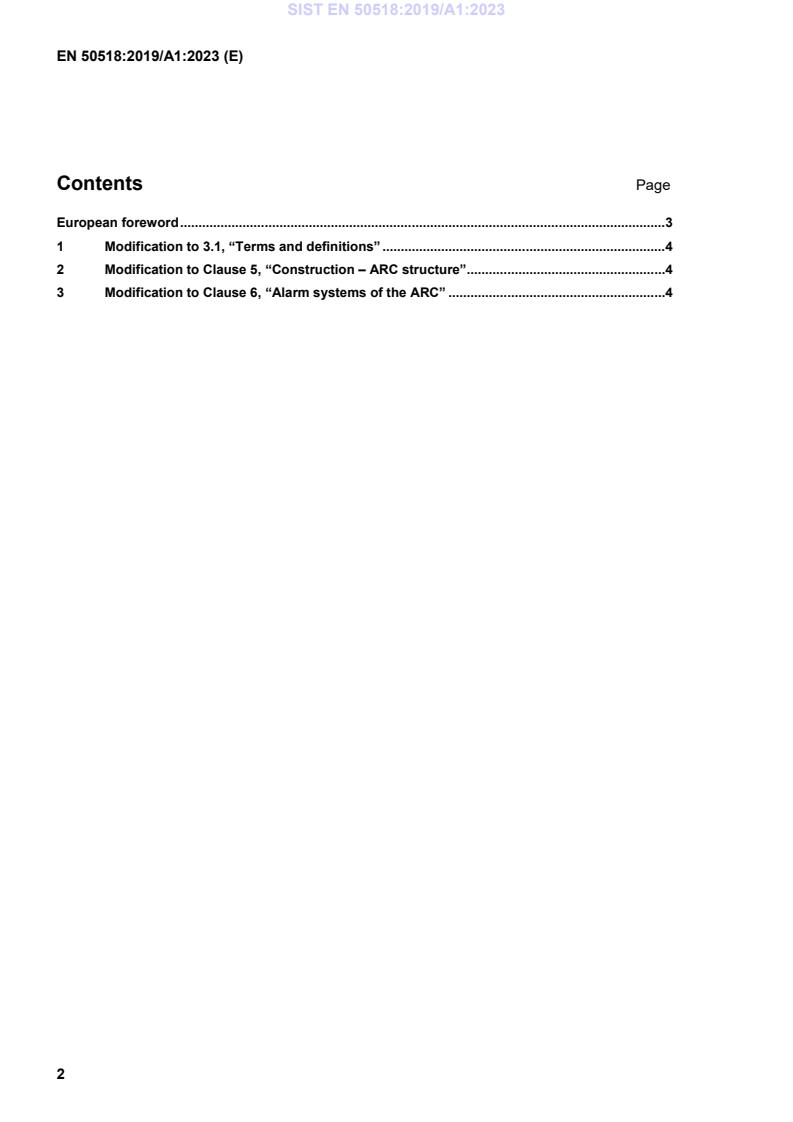
Contents Page
European foreword . 3
1 Modification to 3.1, “Terms and definitions” . 4
2 Modification to Clause 5, “Construction – ARC structure” . 4
3 Modification to Clause 6, “Alarm systems of the ARC” .
...