

SIST EN 13203-2:2022
(Main)Gas-fired domestic appliances producing hot water - Part 2: Assessment of energy consumption
General Information
- Abstract
This document is applicable to gas-fired appliances producing domestic hot water. It applies to both instantaneous and storage tank appliances; waters-heaters and combination boilers that have:
- a heat input not exceeding 400 kW;
- a hot water storage tank capacity (if any) not exceeding 2 000 l.
In the case of combination boilers, with or without storage tank, domestic hot water production is integrated or coupled, the whole being marketed as a single unit.
The water heaters covered by the present standard are considered "conventional water heaters" as defined by the Transitional Methods (Commission Communication 2014/C 207/03) then in the calculation formula for the Annual Electricity Consumption (AEC), Qcor is equal to zero.
In case of the boiler is equipped with an internal or external Passive Flue Heat Recovery Device (PFHRD), the boiler efficiency can be assessed by applying EN 13203-2:2022 in combination with EN 13203-7:2022. In case of a PFHRD, where the technology has the ability to recover energy out of flue gasses during central heating production to be able to preheat the domestic hot water (indirect contribution), to assess this indirect contribution EN 13203-7:2022 applies. EN 13203-2:2022 is applicable for measuring and calculating the direct efficiency (direct contribution) while combining the measuring results of EN 13203-7:2022 the overall efficiency (direct and indirect) can be calculated. EN 13203-1:2015 sets out in qualitative and quantitative terms the performance in delivery of domestic hot water for a selected variety of uses. It also gives a system for presenting the information to the user. The present document sets out a method for assessing the energy performance of the appliances. It specifies a few daily load profiles for each domestic hot water use, kitchen, shower, bath and a combination of these, together with corresponding test procedures, enabling the energy performances of different gas-fired appliances to be compared and matched to the needs of the user. Where other technologies are combined with a gas-fired boiler or a water heater to produce domestic hot water, specific parts of EN 13203 apply.
- Status
- Published
- Public Enquiry End Date
- 01-Mar-2021
- Publication Date
- 14-Nov-2022
- Technical Committee
- PLN - Gas appliances for domestic use
- Current Stage
- 6060 - National Implementation/Publication (Adopted Project)
- Start Date
- 26-Oct-2022
- Due Date
- 31-Dec-2022
- Completion Date
- 15-Nov-2022


Overview
EN 13203-2:2022 - "Gas-fired domestic appliances producing hot water - Part 2: Assessment of energy consumption" (CEN) defines test methods and calculation procedures to measure and compare the energy performance of gas-fired domestic hot water appliances. It covers both instantaneous and storage appliances, including combination boilers marketed as a single unit, with a heat input ≤ 400 kW and storage capacity ≤ 2 000 L. The standard supports Ecodesign and energy labelling requirements and sets out daily load profiles for realistic domestic use.
Key topics and technical requirements
- Scope and applicability: Instantaneous water heaters, storage water heaters and combination boilers within the stated heat input and tank capacity limits.
- Load profiles: Prescribed daily profiles for kitchen, shower, bath and mixed use to simulate domestic hot water demand and enable comparable energy assessments.
- Test conditions and measurements: Reference conditions, test room/water supply requirements, measurement uncertainties, and initial appliance adjustments.
- Energy calculations:
- Methods to determine daily gas energy (summer/winter mode and seasonally weighted),
- Daily electrical consumption, including standby and off-mode calculations,
- Determination of useful vs. wasted water.
- Ecodesign metrics: Water heating energy efficiency, Annual Fuel Consumption (AFC), Annual Electricity Consumption (AEC), and Smart Control Factor (SCF) are specified for product declaration.
- Passive Flue Heat Recovery Devices (PFHRD): For boilers with PFHRD, EN 13203-2:2022 is used for direct efficiency; indirect contributions from flue-gas recovery are assessed using EN 13203-7:2022 and combined to compute overall efficiency.
- Documentation and annexes: Informative annexes cover test rigs, instrumentation, declaration of maximum load profile and links to EU Ecodesign/Energy Labelling regulations (Annexes ZA–ZD).
Applications and users
EN 13203-2:2022 is intended for:
- Manufacturers of gas-fired water heaters and combination boilers validating energy performance and preparing Ecodesign/energy label data.
- Test laboratories and certification bodies conducting standardized performance testing.
- Regulators and compliance teams verifying conformity with EU ecodesign and energy labelling regulations.
- Specifiers, installers and procurement professionals comparing appliances by energy consumption, efficiency and suitability for user demand profiles.
Related standards
- EN 13203-1:2015 - performance in delivery and information presentation for domestic hot water.
- EN 13203-7:2022 - assessment for combination boilers equipped with a Passive Flue Heat Recovery Device (PFHRD).
- Relevant gas appliance and boiler safety standards and EU Regulations referenced in Annex ZA–ZD.
Keywords: EN 13203-2:2022, gas-fired domestic appliances, hot water, energy consumption assessment, combination boilers, PFHRD, AEC, AFC, ecodesign, load profiles.
Relations
- Effective Date
- 01-Dec-2022
- Effective Date
- 28-Jan-2026
- Effective Date
- 28-Jan-2026
- Effective Date
- 28-Jan-2026
- Effective Date
- 28-Jan-2026
- Effective Date
- 28-Jan-2026
- Referred By
SIST EN 26:2024 - Gas-fired instantaneous water heaters for the production of domestic hot water - Effective Date
- 28-Jan-2026
- Effective Date
- 28-Jan-2026
- Effective Date
- 28-Jan-2026
- Effective Date
- 28-Jan-2026
- Effective Date
- 28-Jan-2026
- Effective Date
- 28-Jan-2026
- Referred By
SIST EN 89:2015 - Gas-fired storage water heaters for the production of domestic hot water - Effective Date
- 28-Jan-2026
Get Certified
Connect with accredited certification bodies for this standard

DIBt (Deutsches Institut für Bautechnik)
German Institute for Building Technology.
DIN CERTCO
DIN Group product certification.

Aboma Certification B.V.
Specialized in construction, metal, and transport sectors.
Sponsored listings
Frequently Asked Questions
SIST EN 13203-2:2022 is a standard published by the Slovenian Institute for Standardization (SIST). Its full title is "Gas-fired domestic appliances producing hot water - Part 2: Assessment of energy consumption". This standard covers: This document is applicable to gas-fired appliances producing domestic hot water. It applies to both instantaneous and storage tank appliances; waters-heaters and combination boilers that have: - a heat input not exceeding 400 kW; - a hot water storage tank capacity (if any) not exceeding 2 000 l. In the case of combination boilers, with or without storage tank, domestic hot water production is integrated or coupled, the whole being marketed as a single unit. The water heaters covered by the present standard are considered "conventional water heaters" as defined by the Transitional Methods (Commission Communication 2014/C 207/03) then in the calculation formula for the Annual Electricity Consumption (AEC), Qcor is equal to zero. In case of the boiler is equipped with an internal or external Passive Flue Heat Recovery Device (PFHRD), the boiler efficiency can be assessed by applying EN 13203-2:2022 in combination with EN 13203-7:2022. In case of a PFHRD, where the technology has the ability to recover energy out of flue gasses during central heating production to be able to preheat the domestic hot water (indirect contribution), to assess this indirect contribution EN 13203-7:2022 applies. EN 13203-2:2022 is applicable for measuring and calculating the direct efficiency (direct contribution) while combining the measuring results of EN 13203-7:2022 the overall efficiency (direct and indirect) can be calculated. EN 13203-1:2015 sets out in qualitative and quantitative terms the performance in delivery of domestic hot water for a selected variety of uses. It also gives a system for presenting the information to the user. The present document sets out a method for assessing the energy performance of the appliances. It specifies a few daily load profiles for each domestic hot water use, kitchen, shower, bath and a combination of these, together with corresponding test procedures, enabling the energy performances of different gas-fired appliances to be compared and matched to the needs of the user. Where other technologies are combined with a gas-fired boiler or a water heater to produce domestic hot water, specific parts of EN 13203 apply.
This document is applicable to gas-fired appliances producing domestic hot water. It applies to both instantaneous and storage tank appliances; waters-heaters and combination boilers that have: - a heat input not exceeding 400 kW; - a hot water storage tank capacity (if any) not exceeding 2 000 l. In the case of combination boilers, with or without storage tank, domestic hot water production is integrated or coupled, the whole being marketed as a single unit. The water heaters covered by the present standard are considered "conventional water heaters" as defined by the Transitional Methods (Commission Communication 2014/C 207/03) then in the calculation formula for the Annual Electricity Consumption (AEC), Qcor is equal to zero. In case of the boiler is equipped with an internal or external Passive Flue Heat Recovery Device (PFHRD), the boiler efficiency can be assessed by applying EN 13203-2:2022 in combination with EN 13203-7:2022. In case of a PFHRD, where the technology has the ability to recover energy out of flue gasses during central heating production to be able to preheat the domestic hot water (indirect contribution), to assess this indirect contribution EN 13203-7:2022 applies. EN 13203-2:2022 is applicable for measuring and calculating the direct efficiency (direct contribution) while combining the measuring results of EN 13203-7:2022 the overall efficiency (direct and indirect) can be calculated. EN 13203-1:2015 sets out in qualitative and quantitative terms the performance in delivery of domestic hot water for a selected variety of uses. It also gives a system for presenting the information to the user. The present document sets out a method for assessing the energy performance of the appliances. It specifies a few daily load profiles for each domestic hot water use, kitchen, shower, bath and a combination of these, together with corresponding test procedures, enabling the energy performances of different gas-fired appliances to be compared and matched to the needs of the user. Where other technologies are combined with a gas-fired boiler or a water heater to produce domestic hot water, specific parts of EN 13203 apply.
SIST EN 13203-2:2022 is classified under the following ICS (International Classification for Standards) categories: 91.140.65 - Water heating equipment. The ICS classification helps identify the subject area and facilitates finding related standards.
SIST EN 13203-2:2022 has the following relationships with other standards: It is inter standard links to SIST EN 13203-2:2019, SIST EN 13203-7:2022, SIST EN 303-6:2019, SIST EN 13203-3:2022, SIST EN 13203-6:2022, SIST-TP CEN/TR 15316-6-4:2018, SIST EN 26:2024, SIST EN 13203-4:2022, SIST EN 12897:2016, SIST EN 12897:2016+A1:2020, SIST EN 13203-5:2022, SIST EN 13203-4:2017, SIST EN 89:2015. Understanding these relationships helps ensure you are using the most current and applicable version of the standard.
SIST EN 13203-2:2022 is associated with the following European legislation: EU Directives/Regulations: 2016/426, 80/779/EEC, 811/2013, 812/2013, 813/2013, 814/2013; Standardization Mandates: M/534, M/535. When a standard is cited in the Official Journal of the European Union, products manufactured in conformity with it benefit from a presumption of conformity with the essential requirements of the corresponding EU directive or regulation.
SIST EN 13203-2:2022 is available in PDF format for immediate download after purchase. The document can be added to your cart and obtained through the secure checkout process. Digital delivery ensures instant access to the complete standard document.
Standards Content (Sample)
SLOVENSKI STANDARD
01-december-2022
Nadomešča:
SIST EN 13203-2:2019
Plinske gospodinjske naprave za pripravo tople sanitarne vode - 2. del:
Ocenjevanje rabe energije
Gas-fired domestic appliances producing hot water - Part 2: Assessment of energy
consumption
Gasgeräte für die häusliche Warmwasserbereitung - Teil 2: Bewertung des
Energieverbrauchs
Appareils domestiques produisant de l'eau chaude sanitaire utilisant les combustibles
gazeux - Partie 2 : Évaluation de la consommation énergétique
Ta slovenski standard je istoveten z: EN 13203-2:2022
ICS:
91.140.65 Oprema za ogrevanje vode Water heating equipment
2003-01.Slovenski inštitut za standardizacijo. Razmnoževanje celote ali delov tega standarda ni dovoljeno.
EN 13203-2
EUROPEAN STANDARD
NORME EUROPÉENNE
August 2022
EUROPÄISCHE NORM
ICS 91.140.65 Supersedes EN 13203-2:2018
English Version
Gas-fired domestic appliances producing hot water - Part
2: Assessment of energy consumption
Appareils domestiques produisant de l'eau chaude Gasgeräte für die häusliche Warmwasserbereitung -
sanitaire utilisant les combustibles gazeux - Partie 2 : Teil 2: Bewertung des Energieverbrauchs
Évaluation de la consommation énergétique
This European Standard was approved by CEN on 13 June 2022.
This European Standard was corrected and reissued by the CEN-CENELEC Management Centre on 7 September 2022.
CEN members are bound to comply with the CEN/CENELEC Internal Regulations which stipulate the conditions for giving this
European Standard the status of a national standard without any alteration. Up-to-date lists and bibliographical references
concerning such national standards may be obtained on application to the CEN-CENELEC Management Centre or to any CEN
member.
This European Standard exists in three official versions (English, French, German). A version in any other language made by
translation under the responsibility of a CEN member into its own language and notified to the CEN-CENELEC Management
Centre has the same status as the official versions.
CEN members are the national standards bodies of Austria, Belgium, Bulgaria, Croatia, Cyprus, Czech Republic, Denmark, Estonia,
Finland, France, Germany, Greece, Hungary, Iceland, Ireland, Italy, Latvia, Lithuania, Luxembourg, Malta, Netherlands, Norway,
Poland, Portugal, Republic of North Macedonia, Romania, Serbia, Slovakia, Slovenia, Spain, Sweden, Switzerland, Türkiye and
United Kingdom.
EUROPEAN COMMITTEE FOR STANDARDIZATION
COMITÉ EUROPÉEN DE NORMALISATIO N
EUROPÄISCHES KOMITEE FÜR NORMUN G
CEN-CENELEC Management Centre: Rue de la Science 23, B-1040 Brussels
© 2022 CEN All rights of exploitation in any form and by any means reserved Ref. No. EN 13203-2:2022 E
worldwide for CEN national Members.
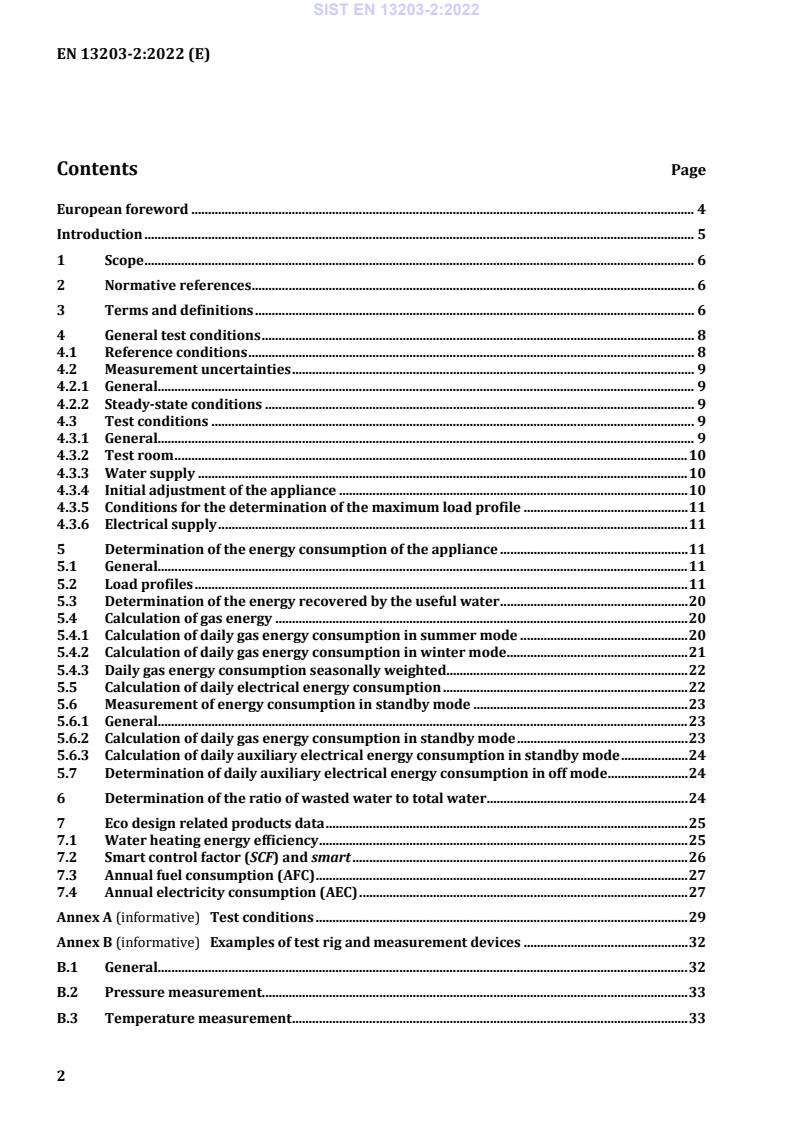
Contents Page
European foreword . 4
Introduction . 5
1 Scope . 6
2 Normative references . 6
3 Terms and definitions . 6
4 General test conditions . 8
4.1 Reference conditions . 8
4.2 Measurement uncertainties . 9
4.2.1 General. 9
4.2.2 Steady-state conditions . 9
4.3 Test conditions . 9
4.3.1 General. 9
4.3.2 Test room . 10
4.3.3 Water supply . 10
4.3.4 Initial adjustment of the appliance . 10
4.3.5 Conditions for the determination of the maximum load profile . 11
4.3.6 Electrical supply . 11
5 Determination of the energy consumption of the appliance . 11
5.1 General. 11
5.2 Load profiles . 11
5.3 Determination of the energy recovered by the useful water . 20
5.4 Calculation of gas energy . 20
5.4.1 Calculation of daily gas energy consumption in summer mode . 20
5.4.2 Calculation of daily gas energy consumption in winter mode . 21
5.4.3 Daily gas energy consumption seasonally weighted . 22
5.5 Calculation of daily electrical energy consumption . 22
5.6 Measurement of energy consumption in standby mode . 23
5.6.1 General. 23
5.6.2 Calculation of daily gas energy consumption in standby mode . 23
5.6.3 Calculation of daily auxiliary electrical energy consumption in standby mode . 24
5.7 Determination of daily auxiliary electrical energy consumption in off mode. 24
6 Determination of the ratio of wasted water to total water . 24
7 Eco design related products data . 25
7.1 Water heating energy efficiency . 25
7.2 Smart control factor (SCF) and smart . 26
7.3 Annual fuel consumption (AFC) . 27
7.4 Annual electricity consumption (AEC) . 27
Annex A (informative) Test conditions . 29
Annex B (informative) Examples of test rig and measurement devices . 32
B.1 General. 32
B.2 Pressure measurement. 33
B.3 Temperature measurement . 33
Annex C (informative) Declaration of the maximum load profile . 37
Annex ZA (informative) Relationship between this European Standard and the ecodesign
requirements of Commission Regulation (EU) n° 814/2013 [OJEU L239 of 6 September
2013] aimed to be covered . 38
Annex ZB (informative) Relationship between this European Standard and the energy labelling
requirements of Commission Delegated Regulation (EU) No 812/2013 [OJEU L239 of 6
September 2013] aimed to be covered . 40
Annex ZC (informative) Relationship between this European Standard and the Ecodesign
requirements of Commission Regulation (EU) n° 813/2013 [OJEU L239 of 6 September
2013] aimed to be covered . 41
Annex ZD (informative) Relationship between this European Standard and the energy labelling
requirements of Commission Delegated Regulation (EU) No 811/2013 [OJEU L239 of 6
September 2013] aimed to be covered . 42
Bibliography . 43
European foreword
This document (EN 13203-2:2022) has been prepared by Technical Committee CEN/TC 109 “Central
heating boilers using gaseous fuels”, the secretariat of which is held by NEN.
This European Standard shall be given the status of a national standard, either by publication of an
identical text or by endorsement, at the latest by February 2023, and conflicting national standards shall
be withdrawn at the latest by February 2023.
Attention is drawn to the possibility that some of the elements of this document may be the subject of
patent rights. CEN shall not be held responsible for identifying any or all such patent rights.
This document supersedes EN 13203-2:2018.
The main technical changes compared to EN 13203-2:2018 are the following:
— improvement of editorial errors;
— incorporation of ECOTESTS results;
— alignment of the text with the relevant Eco-design and Energy Labelling provisions in force.
This document has been prepared under a Standardization Request given to CEN by the European
Commission and the European Free Trade Association, and supports essential requirements of EU
Directive(s) / Regulation(s).
For relationship with EU Directive(s) / Regulation(s), see informative Annex ZA, ZB, ZC or ZD, which is
an integral part of this document.
The main purpose of this revision is to provide a means of conforming to requirements of Commission
Delegated Regulation (EC) n° 813/2013, (EC) n° 811/2013, (EC) n° 812/2013 and (EC) n° 814/2013.
Any feedback and questions on this document should be directed to the users’ national standards body.
A complete listing of these bodies can be found on the CEN website.
According to the CEN-CENELEC Internal Regulations, the national standards organisations of the
following countries are bound to implement this European Standard: Austria, Belgium, Bulgaria, Croatia,
Cyprus, Czech Republic, Denmark, Estonia, Finland, France, Germany, Greece, Hungary, Iceland, Ireland,
Italy, Latvia, Lithuania, Luxembourg, Malta, Netherlands, Norway, Poland, Portugal, Republic of North
Macedonia, Romania, Serbia, Slovakia, Slovenia, Spain, Sweden, Switzerland, Turkey and the United
Kingdom.
Introduction
The safety operation of the boiler or water heater is not covered by this document. Safety is proved by
means of the essential safety requirements of the Gas Appliances Regulation 2016/426/UE. This may be
achieved by compliance with the appropriate existing harmonized standards.
NOTE Useful standards are EN 26, EN 89, EN 15502-1, EN 15502-2-1 and EN 15502-2-2.
1 Scope
This document is applicable to gas-fired appliances producing domestic hot water. It applies to both
instantaneous and storage tank appliances; waters-heaters and combination boilers that have:
— a heat input not exceeding 400 kW;
— a hot water storage tank capacity (if any) not exceeding 2 000 l.
In the case of combination boilers, with or without storage tank, domestic hot water production is
integrated or coupled, the whole being marketed as a single unit.
The water heaters covered by the present standard are considered “conventional water heaters” as
defined by the Transitional Methods (Commission Communication 2014/C 207/03) then in the
calculation formula for the Annual Electricity Consumption (AEC), Q is equal to zero.
cor
In case of the boiler is equipped with an internal or external Passive Flue Heat Recovery Device (PFHRD),
the boiler efficiency can be assessed by applying EN 13203-2:2022 in combination with
EN 13203-7:2022. In case of a PFHRD, where the technology has the ability to recover energy out of flue
gasses during central heating production to be able to preheat the domestic hot water (indirect
contribution), to assess this indirect contribution EN 13203-7:2022 applies. EN 13203-2:2022 is
applicable for measuring and calculating the direct efficiency (direct contribution) while combining the
measuring results of EN 13203-7:2022 the overall efficiency (direct and indirect) can be calculated.
EN 13203-1:2015 sets out in qualitative and quantitative terms the performance in delivery of domestic
hot water for a selected variety of uses. It also gives a system for presenting the information to the user.
The present document sets out a method for assessing the energy performance of the appliances. It
specifies a few daily load profiles for each domestic hot water use, kitchen, shower, bath and a
combination of these, together with corresponding test procedures, enabling the energy performances of
different gas-fired appliances to be compared and matched to the needs of the user. Where other
technologies are combined with a gas-fired boiler or a water heater to produce domestic hot water,
specific parts of EN 13203 apply.
2 Normative references
The following documents are referred to in the text in such a way that some or all of their content
constitutes requirements of this document. For dated references, only the edition cited applies. For
undated references, the latest edition of the referenced document (including any amendments) applies.
EN 13203-7:2022, Gas-fired domestic appliances producing hot water — Part 7: Assessment of energy
consumption of combination boilers equipped with a passive flue heat recovery device
3 Terms and definitions
For the purposes of this document, the following terms and definitions apply.
ISO and IEC maintain terminological databases for use in standardization at the following addresses:
— IEC Electropedia: available at https://www.electropedia.org/
— ISO Online browsing platform: available at https://www.iso.org/obp
3.1
storage tank
reservoir for domestic hot water
3.2
nominal domestic hot water heat input (Q )
nw
value of the heat input to produce domestic hot water stated in the instructions
— Symbol: Q
nw
— Unit: kilowatt (kW)
3.3
summer mode
conditions during which the appliance supplies energy only for the production of domestic hot water
3.4
winter mode
conditions during which the combination boiler supplies energy for the production of domestic hot water
and space heating
3.5
domestic water test temperature (T )
cold
temperature of the delivered water at which the tests are conducted
3.6
control cycle
time cycle for keeping components and/or the storage tank (if any) of the domestic hot water circuit at
predetermined temperature level, consists of an «ON» duration time during which the heating of the
domestic hot water (by gas energy and/or auxiliary energy) is operating, and an «OFF» duration time
during which no heating occurs
3.7
useful water
quantity of water delivered at the tap for which the temperature increase is in accordance with the
requirement fixed for each individual delivery of the load profiles
3.8
wasted water
quantity of water delivered at the tap for which the temperature increase is not in accordance with the
requirement fixed for each individual delivery of the load profiles
3.9
standby mode
operating state in which the appliance can provide domestic hot water at any time
Note 1 to entry: During standby mode appliance may operate to maintain water temperature but no draw-off is
made.
3.10
off mode
state of an appliance, selected by the user, in which domestic hot water cannot be provided
3.11
useful water flow rate (D )
useful
quantity of water delivered by unit time at the tap for which the temperature increase is in accordance
with the requirement fixed for each individual draw-off of the load profiles
3.12
useful water temperature
water temperature, expressed in degrees Celsius, delivered at the tap
3.13
appliance flow rate
quantity of water delivered by the appliance by unit time before the mixing device, if applicable
3.14
appliance water temperature (T )
d
water temperature, expressed in degrees Celsius, delivered by the appliance before the mixing device
3.15
appliance water temperature rise (ΔT ) in K
d
measured useful temperature rise at the appliance outlet
3.16
water temperature rise (ΔT ) in K
m
difference between the useful water temperature and the cold water temperature, at which hot water is
contributing to the reference energy as specified in the load profiles
3.17
water temperature rise for basin draw-off types (ΔT ) in K
p
difference between the useful water temperature and the cold water temperature, to be achieved during
the water draw-offs, with a minimum value as specified in the load profiles
Note 1 to entry: The minimum temperature difference for basin draw-offs as specified in the load profiles shall
be achieved at least once during the water draw-offs.
3.18
rapid response temperature sensor
measuring instrument with a response time such that 90 % of the final temperature rise, from 15 °C to
100 °C, is obtained within 1 s, when the sensor is plunged into still water
Note 1 to entry: This time is chosen for dynamic measurement and not for steady-state purpose.
4 General test conditions
4.1 Reference conditions
Unless otherwise stated, the general test conditions shall be as follows:
— cold water temperature: 10 °C
— range over the whole duration of the test: (8 °C to 12 °C),
— cold water pressure: 2 bar
— ambient air temperature: 20 °C
— range over the whole duration of the test: (18 °C to 22 °C),
— electrical supply voltage: (230 ± 2) V (single phase).
4.2 Measurement uncertainties
4.2.1 General
Except where otherwise stated in the clauses describing the tests, the uncertainties of measurements
carried out shall not be greater than the maximum uncertainties indicated below.
The standard deviations shall be evaluated taking into account the various sources of uncertainty:
contribution from the instrument, repeatability, calibration, ambient conditions, etc.
— water flow rate: ± 1 %;
— gas flow rate: ± 1 %;
— time: ± 0,2 s;
— temperatures:
— ambient: ± 1 K,
— water: ± 0,5 K,
— gas: ± 0,5 K;
— gas pressure: ± 1 %;
— gas calorific value: ± 1 %;
— gas density: ± 0,5 %;
— electrical energy: ± 2 %.
The stated measurement uncertainties relate to individual measurements. For measurements that
combine several individual measurements, smaller uncertainties on the individual measurements may
be necessary to ensure a total uncertainty within ± 2 % under the steady-state conditions as specified by
4.2.2.
These uncertainties correspond to two standard deviations (2σ).
4.2.2 Steady-state conditions
Steady-state operating conditions are regarded as established when the appliance operates for sufficient
time to reach thermal stabilization.
To reach the steady-state the water temperature at the outlet of the appliance shall not vary by more
than ± 0,5 K.
NOTE This condition can be reached with a gas which is different from the reference gas, provided that the
appliance is supplied with the reference gas for at least 5 min before the requirements are verified.
4.3 Test conditions
4.3.1 General
Except where otherwise stated, the appliance is tested under the following conditions.
For combination gas boiler, the tests shall be carried out only in summer mode as defined in 3.3, and the
appliance shall be set in summer mode.
For all tests specified by this standard, the same adjustment of the appliance shall be maintained.
The load profile used for the measurement shall be the one declared according to the technical instruction
of the appliance (see also Annex C (informative)).
The tests shall be performed in the setting in which the appliance is delivered (out of the box-mode), and
which is documented as such in the technical instructions.
If there are temporary user's settings (automatically self-resetting within 24 h), these shall not be active.
Annex A (informative) gives examples of test cycles for different test conditions.
4.3.2 Test room
The appliance shall be installed in a well-ventilated, draught-free room (air speed less than 0,5 m/s).
The appliance shall be protected from direct solar radiation and radiation from heat generators.
Annex B (informative) gives examples of test rig and measurement devices.
4.3.3 Water supply
For the tests:
— the domestic water pressure is the inlet water pressure measured as close as possible to the
appliance (see example at Figure B.2);
— the inlet and outlet temperatures of the domestic water shall be measured in the centre of the flow
and as close as possible to the appliance (see examples at Figure B.3 and Figure B.4) and always
upstream of the electro-valve (tap).
The inlet temperatures shall be measured immediately upstream of the water inlet connection. Except
where otherwise stated, the outlet temperatures shall be measured immediately downstream of the
outlet connection or, in the case of an appliance with spout delivery, by means of an immersed
temperature measuring device, e.g. a u-tube fitted at the outlet of a tube of the same length as the
minimum length of the spout normally supplied together with the appliance.
Water temperatures shall be measured with a rapid response temperature sensor.
4.3.4 Initial adjustment of the appliance
The appliance shall be installed in accordance with the installation instructions.
The heat input shall be adjusted to within ± 2 % of the nominal domestic hot water heat input.
The initial adjustment of the appliance water temperature (T ) shall be as follows (see Figure A.1 and
d
Figure A.2):
a) Appliances with an adjustable temperature: the tests shall be carried out at a temperature not greater
than 65 °C, with a temperature increase equal or greater than 45 K above the water inlet
temperature. For the load profile XS the minimum temperature setting shall be equal to or greater
than 35 °C (ΔT 25 K above water inlet temperature).
b) Appliances with a fixed temperature: the tests shall be carried out at the temperature specified in the
appliance documentation, with a temperature increase equal or greater than 45 K above the water
inlet temperature. For the load profile XS the minimum temperature setting shall be equal to or
greater than 35 °C (ΔT 25 K above water inlet temperature).
NOTE The test conditions of 4.3.1 are applicable.
The same conditions of initial adjustment stated in the appliance documentation shall be used for all the
tests.
These conditions shall be included in the test report.
4.3.5 Conditions for the determination of the maximum load profile
The measurement of the domestic hot water efficiency shall be performed with the maximum load profile
or the one just below this load profile:
a) instantaneous appliances shall be set to the nominal heat input as stated on the data plate. If the user
instructions specify that it is possible to adjust the outlet temperature, this temperature shall be set
to the maximum possible value not exceeding 65 °C;
b) storage appliances shall be set to the nominal heat input as stated on the data plate. If the user
instructions specify that different modes are possible to be selected, the one that is able to store more
energy and that delivers more hot water during a 24 h period shall be used.
NOTE See Annex C (informative).
In case of declared maximal load profile 3XL or 4XL the load profile for testing should be XXL.
The load profile as used for the domestic hot water performance test shall be stated in the user
instructions.
4.3.6 Electrical supply
The appliance shall be supplied with the nominal voltage stated in the installation instructions.
5 Determination of the energy consumption of the appliance
5.1 General
This clause specifies the test methods to be employed in determining the energy consumption of
appliances.
5.2 Load profiles
All patterns specify a 24 h measurement cycle and within that cycle the starting times and the total energy
content (in kWh equivalent of hot water tapped) of each draw-off are specified.
Furthermore, the draw-off can be characterized in two ways, either “basin” type draw-off, versus
“continuous flow” draw-off.
The aim of the “basin” type is to arrive at an average temperature of the tub, so all supplied energy can
be considered useful from the very beginning of the draw-off (minimum useful temperature rise is 0 K).
The temperature rise (ΔT ) to be achieved during tapping, shall be 30 K for floor cleaning and bath and
p
45 K for the dish washes.
The aim of the “continuous flow” type is to use only the water equal and above a fixed useful temperature
rise (ΔT ). For the shower, household cleaning and large draw-offs a temperature rise of 30 K shall be
m
reached before counting the useful energy. For the small draw-offs a temperature rise (ΔT ) of 15 K shall
m
be reached.
NOTE 1 The temperature rises (in K) based on 10 °C inlet water temperature stated above are equivalent to the
temperatures (in °C) given by the load profiles tables in Regulations n° 811/2013, n° 812/2013, n° 813/2013 and
n° 814/2013. The tapping flow rates used to perform the different draw-offs of each of the eight load profiles are
specified by Tables 1 to 8.
In the load profiles, the requirements for water flow rate and temperatures are based on the delivery at
the tap in a mix of hot and cold water. Under the conditions of the initial adjustment, the appliance itself
produces hot water with a minimum temperature rise of 45 K. For the load profile XS the minimum
temperature setting shall be equal to or greater than 35°C (ΔT 25 K above water inlet temperature).
To fulfil the requirements stated in Tables 1 to 8 mixing hot water from the appliance with cold water of
10 °C at the tap is allowed either by using a mixing device (see examples at Figures B.1 and B.5) or by
recalculating the appliance flow rate (D ) according to the following formula:
min
∆T
useful
D = D (1)
min useful
∆T
d
where
D is the minimum test rig setting for the appliance flow rate of each individual
min
draw-off at temperature rise corresponding to ΔT , in l/min;
d
D is the useful water flow rate according to Tables 1 to 8, in l/min;
useful
ΔT is the appliance water temperature rise, with a minimum of 30 K;
d
ΔT is the higher value between the temperature rise to be achieved and the
useful
minimum temperature rise for counting the useful energy according to Tables 1
to 8.
If the appliance cannot deliver these flow rates, for instance due to the flow restrictor, it shall be checked
that the requirements are fulfilled by checking that (D ) is delivered.
min
If by design the appliance is fitted with a flow restrictor, the tests shall be carried out with this flow
restrictor.
The tests shall be performed by using the useful water flow rates specified by Tables 1 to 8.
Table 1 — Load profile XS
Draw-off Start Energy Type of draw-off Useful ΔT to be Minimum
p
n° (kWh) water flow ΔT for
(h:min) achieved m
rate at the
during counting
tap
tapping useful energy
(l/min)
(K) (K)
1 07:30 0,525 Medium 3 25
2 12:45 0,525 Medium 3 25
3 20:30 1,050 Large 3 25
Q 2,100
ref
Equivalent hot water litres at 60°C 36
Table 2 — Load profile S
Draw-off Start Energy Type of draw-off Useful ΔT to be Minimum
p
n° (kWh) water flow ΔT for
(h:min) achieved m
rate at the
during counting
tap
tapping useful energy
(l/min)
(K) (K)
1 07:00 0,105 Small 3 15
2 07:30 0,105 Small 3 15
3 08:30 0,105 Small 3 15
4 09:30 0,105 Small 3 15
5 11:30 0,105 Small 3 15
6 11:45 0,105 Small 3 15
7 12:45 0,315 Dish washing n°1 4 45 0
8 18:00 0,105 Small 3 15
9 18:15 0,105 Household cleaning 3 30
10 20:30 0,420 Dish washing n°2 4 45 0
11 21:30 0,525 Large 5 35
Q 2,100
ref
Equivalent hot water litres at 60°C 36
Table 3 — Load profile M
Draw- Start Energy Type of draw-off Useful ΔT to be Minimum
p
off n° (h:min) (kWh) water ΔT for
achieved m
flow rate
during counting
at the tap
tapping useful energy
(l/min)
(K) (K)
1 07:00 0,105 Small 3 15
2 07:05 1,400 Shower n°1 6 30
3 07:30 0,105 Small 3 15
4 08:01 0,105 Small 3 15
5 08:15 0,105 Small 3 15
6 08:30 0,105 Small 3 15
7 08:45 0,105 Small 3 15
8 09:00 0,105 Small 3 15
9 09:30 0,105 Small 3 15
10 10:30 0,105 Floor cleaning 3 30 0
11 11:30 0,105 Small 3 15
12 11:45 0,105 Small 3 15
13 12:45 0,315 Dish washing n°1 4 45 0
14 14:30 0,105 Small 3 15
15 15:30 0,105 Small 3 15
16 16:30 0,105 Small 3 15
17 18:00 0,105 Small 3 15
18 18:15 0,105 Household cleaning 3 30
19 18:30 0,105 Household cleaning 3 30
20 19:00 0,105 Small 3 15
21 20:30 0,735 Dish washing n°3 4 45 0
22 21:15 0,105 Small 3 15
23 21:30 1,400 Shower n°1 6 30
Q 5,845
ref
Equivalent hot water litres at 60 °C 100,2
Table 4 — Load profile L
Draw- Start Energy Type of draw-off Useful ΔT to be Minimum
p
off n° (h:min) (kWh) water ΔT for
achieved m
flow rate
during counting
at the tap
tapping useful
(l/min) energy
(K)
(K)
1 07:00 0,105 Small 3 15
2 07:05 1,400 Shower n°1 6 30
3 07:30 0,105 Small 3 15
4 07:45 0,105 Small 3 15
5 08:05 3,605 Bath n°1 10 30 0
6 08:25 0,105 Small 3 15
7 08:30 0,105 Small 3 15
8 08:45 0,105 Small 3 15
9 09:00 0,105 Small 3 15
10 09:30 0,105 Small 3 15
11 10:30 0,105 Floor cleaning 3 30 0
12 11:30 0,105 Small 3 15
13 11:45 0,105 Small 3 15
14 12:45 0,315 Dish washing n°1 4 45 0
15 14:30 0,105 Small 3 15
16 15:30 0,105 Small 3 15
17 16:30 0,105 Small 3 15
18 18:00 0,105 Small 3 15
19 18:15 0,105 Household cleaning 3 30
20 18:30 0,105 Household cleaning 3 30
21 19:00 0,105 Small 3 15
22 20:30 0,735 Dish washing n°3 4 45 0
23 21:00 3,605 Bath n°1 10 30 0
24 21:30 0,105 Small 3 15
Q 11,655
ref
Equivalent hot water litres at 60 °C 199,8
Table 5 — Load profile XL
Draw-off n° Start Energy Type of draw-off Useful ΔT to be Minimum
p
(h:min) (kWh) water flow ΔT for
achieved m
rate at the
during counting
tap
tapping useful energy
(l/min)
(K) (K)
1 07:00 0,105 Small 3 15
2 07:15 1,820 Shower n°2 6 30
3 07:26 0,105 Small 3 15
4 07:45 4,420 Bath n°2 10 30 0
5 08:01 0,105 Small 3 15
6 08:15 0,105 Small 3 15
7 08:30 0,105 Small 3 15
8 08:45 0,105 Small 3 15
9 09:00 0,105 Small 3 15
10 09:30 0,105 Small 3 15
11 10:00 0,105 Small 3 15
12 10:30 0,105 Floor cleaning 3 30 0
13 11:00 0,105 Small 3 15
14 11:30 0,105 Small 3 15
15 11:45 0,105 Small 3 15
16 12:45 0,735 Dish washing n°3 4 45 0
17 14:30 0,105 Small 3 15
18 15:00 0,105 Small 3 15
19 15:30 0,105 Small 3 15
20 16:00 0,105 Small 3 15
21 16:30 0,105 Small 3 15
22 17:00 0,105 Small 3 15
23 18:00 0,105 Small 3 15
24 18:15 0,105 Household 3 30
cleaning
25 18:30 0,105 Household 3 30
cleaning
26 19:00 0,105 Small 3 15
27 20:30 0,735 Dish washing n°3 4 45 0
28 20:46 4,420 Bath n°2 10 30 0
29 21:15 0,105 Small 3 15
Draw-off n° Start Energy Type of draw-off Useful ΔT to be Minimum
p
(h:min) (kWh) water flow ΔT for
achieved m
rate at the
during counting
tap
tapping useful energy
(l/min)
(K) (K)
30 21:30 4,420 Bath n°2 10 30 0
Q 19,070
ref
Equivalent hot water litres at 60°C 325
Table 6 — Load profile XXL
Draw- Start Energy Type of draw-off Useful ΔT to be Minimum
p
off n° (h:min) (kWh) water ΔT for
achieved m
flow rate
during counting
at the tap
tapping useful energy
(l/min) (K)
(K)
1 07:00 0,105 Small 3 15
2 07:15 1,820 Shower n°2 6 30
3 07:26 0,105 Small 3 15
4 07:45 6,240 Shower + bath 16 30 0
5 08:01 0,105 Small 3 15
6 08:15 0,105 Small 3 15
7 08:30 0,105 Small 3 15
8 08:45 0,105 Small 3 15
9 09:00 0,105 Small 3 15
10 09:30 0,105 Small 3 15
11 10:00 0,105 Small 3 15
12 10:30 0,105 Floor cleaning 3 30 0
13 11:00 0,105 Small 3 15
14 11:30 0,105 Small 3 15
15 11:45 0,105 Small 3 15
16 12:45 0,735 Dish washing n°3 4 45 0
17 14:30 0,105 Small 3 15
18 15:00 0,105 Small 3 15
19 15:30 0,105 Small 3 15
20 16:00 0,105 Small 3 15
21 16:30 0,105 Small 3 15
22 17:00 0,105 Small 3 15
Draw- Start Energy Type of draw-off Useful ΔT to be Minimum
p
off n° (h:min) (kWh) water ΔT for
achieved m
flow rate
during counting
at the tap
tapping useful energy
(l/min) (K)
(K)
23 18:00 0,105 Small 3 15
24 18:15 0,105 Household cleaning 3 30
25 18:30 0,105 Household cleaning 3 30
26 19:00 0,105 Small 3 15
27 20:30 0,735 Dish washing n°3 4 45 0
28 20:46 6,240 Shower + bath 16 30 0
29 21:15 0,105 Small 3 15
30 21:30 6,240 Shower + bath 16 30 0
Q 24,530
ref
Equivalent hot water litres at 60 °C 420
Table 7 — Load profile 3XL
Draw- Start Energy Type of draw-off Useful ΔT to be Minimum
p
off n° (h:min) (kWh) water ΔT for
achieved m
flow rate
during counting
at the tap
tapping useful energy
(l/min)
(K) (K)
1 07:00 11,2 General use n°3 48 30
2 08:01 5,04 General use n°8 24 15
3 09:00 1,68 General use n°9 24 15
4 10:30 0,84 General use n°10 24 30 0
5 11:45 1,68 General use n°9 24 15
6 12:45 2,52 General use n°11a 32 45 0
7 15:30 2,52 General use n°11 24 15
8 18:30 3,36 General use n°12 24 15
9 20:30 5,88 General use n°13 32 45 0
10 21:30 12,04 General use n°5 48 30
Q 46,76
ref
Equivalent hot water litres at 60 °C 800
Table 8 — Load profile 4XL
Draw- Start Energy Type of draw-off Useful ΔT to be Minimum
p
off n° (h:min) (kWh) water ΔT for
achieved m
flow rate
during counting
at the tap
tapping useful energy
(l/min)
(K) (K)
1 07:00 22,4 General use n°6 96 30
2 08:01 10,08 General use n°2 48 15
3 09:00 3,36 General use n°12a 48 15
4 10:30 1,68 General use n°9a 48 30 0
5 11:45 3,36 General use n°12a 48 15
6 12:45 5,04 General use n°8b 64 45 0
7 15:30 5,04 General use n°8a 48 15
8 18:30 6,72 General use n°1 48 15
9 20:30 11,76 General use n°4 64 45 0
10 21:30 24,08 General use n°7 96 30
Q 93,52
ref
Equivalent hot water litres at 60 °C 1600
There are eight different load profiles, depending on the energy content.
For each energy content, the load profile(s) is (are) based respectively on Tables 1 to 8. Each individual
draw-offs of the load profiles shall be completed, that means the valve shall be closed, and a delay of at
least one minute is required, before starting the following delivery.
Beginning and ending of the load profiles:
— for appliances with no energy consumption between deliveries (neither gas nor electricity), the
measured programme starts at 07h00 with the appliance at ambient temperature and finishes when
the burner is extinguished after the 21h30 tapping (see Figure A.4).
— for appliances with energy consumption between deliveries (either gas or electricity or both), the
tappings start with the tapping at 21h30. The measured cycle starts from the time the burner is
extinguished following the 21h30 delivery. The measured cycle ends when the burner is extinguished
following the last tapping at 21h30 on the next day (see Figure A.3). For storage water heaters this
measurement should be performed after a 24 h preliminary load profile in order to ensure the
thermal stabilization and this measurement should be repeated until the outcome of the last
measurement is within ± 5 % of the previous measurement.
It shall be ensured that the energy content at the beginning and at the end of the test is the same.
NOTE 2 The above indicated test conditions ensure that the test results are equivalent to the required
measurement conditions of Regulations n° 811/2013, n° 812/2013, n° 813/2013 and n° 814/2013.
NOTE 3 The energy not directly used for water heating (for example: standby, pilot flame) will be considered as
energy consumption.
5.3 Determination of the energy recovered by the useful water
The appliance shall be installed and adjusted in the initial state conditions and in the initial adjustment
conditions defined in 4.3.4.
The useful energy recovered by the water Q (kWh) is given according to the following formula:
H O
nt
i
Q c D⋅∆T t dt (2)
( )
HO w i i
∑∫
2 i=10
where
n is the number of draw-offs;
D is the water flow rate delivered at the tap, in l/min;
i
ΔT (t) is the instantaneous temperature rise during the tapping, in K;
i
t is the tapping duration of the useful water, in min;
i
−3
c is the specific heat capacity of water (1,163.10 kWh/l.K).
w
The useful energy recovered at each individual draw-off shall be set against the values given in Tables 1
to 8.
For each individual draw-off, the accuracy of the value shall be ± 10 Wh or ± within 2 % of the energy
content of this specific individual draw-off. For the overall load profile, the accuracy of the value shall be
within ± 2 %.
5.4 Calculation of gas energy
5.4.1 Calculation of daily gas energy consumption in summer mode
The daily gas energy consumption in summer mode shall be calculated according to the following
formula:
V ⋅⋅K NCV⋅ Q
g ref
Q = (3)
gas,S
Q
HO
where
Q is the daily gas energy consumption in summer mode calculated using NCV, in kWh;
gas,S
V 3
g is the measured gas consumption during the load profile, in m ;
NCV 3
is the net calorific value (at 15 °C and 1 013,25 mbar), in kWh/m ;
Q is the measured energy recovered by the water according to 5.3, in kWh;
H O
Q is the total delivered energy by the load profile, value from Tables 1 to 8, in kWh.
ref
and
pp+− p
a gs 288,15
K ⋅ (4)
1013,,25 T + 273 15
g
=
=
Ps exp 21,094− (5)
273,15+ T
g
where
p is the atmospheric pressure, in mbar;
a
p is the gas pressure, in mbar;
g
p is the saturated vapour pressure of water at t (mbar). If a dry meter is used for the
s g
measurement of the volume, the value of (p ) is equal to zero;
s
T is the gas temperature, in °C.
g
5.4.2 Calculation of daily gas energy consumption in winter mode
For all water heaters Q is equal to Q .
gas,W gas,S
For the combination boilers, with a heat input above 70 kW, Q is equal to Q .
gas,W gas,S
For the combination boilers, with storage capacity above 500 l, Q is equal to Q .
gas,W gas,S
For the combination boilers, with heat input below 70 kW and with storage capacity below 500 l, the daily
gas energy consumption in winter mode shall be calculated according to the following formula:
Q
gas,S
Q = (6)
gas,W
η × Q
CH−nom gas,S
1+ 0,5⋅ − 1
Q
ref
where
Q is the daily gas energy consumption calculated in winter mode using NCV, in kWh;
gas,W
Q is the daily gas energy consumption calculated in summer mode using NCV according
gas,S
to 5.4.1, in kWh;
is the useful efficiency at nominal heat input and at an average temperature of 70 °C for
η
CH−nom
the space heating function;
Q is the total energy delivered of the load profile used, value from Tables 1 to 8, in kWh.
ref
NOTE Unlike water heaters combination boilers have two functions in the winter mode, space heating and
domestic hot water. They switch between space heating and domestic hot water functions to fulfil demands as
required by the control system.
In the summer mode the combination boiler is 24 h in domestic hot water mode or standby mode.
The combination boiler in winter mode spends most of the demand time on space heating, outside any
night (or day) set-back periods (which require a lower room temperature and hence heating load).
When a combination boiler switches from space heating to domestic hot water mode and back to space
heating the standby losses usually generated from the domestic hot water mode are not lost but are
instead used in the space heating mode.
That means combination heaters have lower domestic hot water heat losses in winter mode than in
summer mode.
=
These energy saving benefits of combination boilers will be considered.
5.4.3 Daily gas energy consumption seasonally weighted
The daily gas energy consumption is weighted, to take into account both summer and winter modes, by
the following formula:
DD
W S
Q = Q ⋅ +⋅Q (7)
gas,p gas,W gas,S
D
...