


SIST EN 16931-1:2017
(Main)Electronic invoicing - Part 1: Semantic data model of the core elements of an electronic invoice
Electronic invoicing - Part 1: Semantic data model of the core elements of an electronic invoice
This European Standard establishes a semantic data model of the core elements of an electronic invoice. The semantic model includes only the essential information elements that an electronic invoice needs to ensure legal (including fiscal) compliance and to enable interoperability for cross-border, cross sector and for domestic trade. The semantic model may be used by organizations in the private and the public sector for public procurement invoicing. It may also be used for invoicing between private sector enterprises. It has not been specifically designed for invoicing consumers.
This European Standard complies at least with the following criteria:
- it is technologically neutral;
- it is compatible with relevant international standards on electronic invoicing;
- the application of this standard should comply with the requirements for the protection of personal data of Directive 95/46/EC, having due regard to the principles of privacy and data protection by-design, data minimization, purpose limitation, necessity and proportionality;
- it is consistent with the relevant provisions of Directive 2006/112/EC [2];
- it allows for the establishment of practical, user-friendly, flexible and cost-efficient electronic invoicing systems;
- it takes into account the special needs of small and medium-sized enterprises as well as of sub-central contracting authorities and contracting entities;
- it is suitable for use in commercial transactions between enterprises.
Elektronische Rechnungsstellung - Teil 1: Semantisches Datenmodell der Kernelemente einer elektronischen Rechnung
Facturation électronique - Partie 1: Modèle sémantique de données des éléments essentiels d'une facture électronique
Elektronsko izdajanje računov - 1. del: Semantični podatkovni model ključnih elementov za elektronski račun
***Dostop do te tehnične publikacije CEN in SIST je omogočila Evropska komisija.***
Ta evropski standard določa semantični podatkovni model ključnih elementov za elektronski račun. Semantični model vključuje samo bistvene informacije, ki jih mora elektronski račun vsebovati, da je skladen z zakonskimi (in davčnimi) zahtevami ter da omogoča interoperabilnost pri čezmejnem, medsektorskem in domačem poslovanju. Semantični model lahko uporabljajo organizacije v javnem in zasebnem sektorju pri izdajanju računov za javna naročila. Uporabljajo ga lahko tudi podjetja v zasebnem sektorju za izdajanje računov drugim podjetjem.
Ta evropski standard je skladen vsaj z naslednjimi kriteriji:
– je tehnološko nevtralen;
– je skladen z ustreznimi mednarodnimi standardi za izdajanje elektronskih računov;
– upošteva potrebo po varstvu osebnih podatkov v skladu z direktivo 95/46/ES [4], načrtovalni pristop, ki predvideva sisteme za varstvo podatkov v sami zasnovi izdelka, ter načela sorazmernosti, zmanjševanja podatkov in omejitve namena;
– je skladen z ustreznimi določbami Direktive 2006/112/ES [2];
– omogoča uvajanje praktičnih, uporabniku prijaznih, prilagodljivih in stroškovno učinkovitih sistemov za izdajanje elektronskih računov;
– upošteva posebne potrebe malih in srednje velikih podjetij ter javnih naročnikov na podcentralni ravni in drugih naročnikov;
– je primeren za uporabo pri komercialnih transakcijah med podjetji.
General Information
- Status
- Withdrawn
- Public Enquiry End Date
- 28-Feb-2016
- Publication Date
- 22-Aug-2017
- Withdrawal Date
- 15-Dec-2019
- Technical Committee
- ITC - Information technology
- Current Stage
- 9900 - Withdrawal (Adopted Project)
- Start Date
- 28-Nov-2019
- Due Date
- 21-Dec-2019
- Completion Date
- 16-Dec-2019
Relations
- Consolidated By
SIST EN 16931-1:2017+A1:2020 - Electronic invoicing - Part 1: Semantic data model of the core elements of an electronic invoice - Effective Date
- 01-Feb-2020


SIST EN 16931-1:2017 - Od 15.1.2019 je ta dokument brezplačen na podlagi dogovora med CEN in EK. Sestava: Dodatni stavek na naslovnici in posebna 2. stran !
Frequently Asked Questions
SIST EN 16931-1:2017 is a standard published by the Slovenian Institute for Standardization (SIST). Its full title is "Electronic invoicing - Part 1: Semantic data model of the core elements of an electronic invoice". This standard covers: This European Standard establishes a semantic data model of the core elements of an electronic invoice. The semantic model includes only the essential information elements that an electronic invoice needs to ensure legal (including fiscal) compliance and to enable interoperability for cross-border, cross sector and for domestic trade. The semantic model may be used by organizations in the private and the public sector for public procurement invoicing. It may also be used for invoicing between private sector enterprises. It has not been specifically designed for invoicing consumers. This European Standard complies at least with the following criteria: - it is technologically neutral; - it is compatible with relevant international standards on electronic invoicing; - the application of this standard should comply with the requirements for the protection of personal data of Directive 95/46/EC, having due regard to the principles of privacy and data protection by-design, data minimization, purpose limitation, necessity and proportionality; - it is consistent with the relevant provisions of Directive 2006/112/EC [2]; - it allows for the establishment of practical, user-friendly, flexible and cost-efficient electronic invoicing systems; - it takes into account the special needs of small and medium-sized enterprises as well as of sub-central contracting authorities and contracting entities; - it is suitable for use in commercial transactions between enterprises.
This European Standard establishes a semantic data model of the core elements of an electronic invoice. The semantic model includes only the essential information elements that an electronic invoice needs to ensure legal (including fiscal) compliance and to enable interoperability for cross-border, cross sector and for domestic trade. The semantic model may be used by organizations in the private and the public sector for public procurement invoicing. It may also be used for invoicing between private sector enterprises. It has not been specifically designed for invoicing consumers. This European Standard complies at least with the following criteria: - it is technologically neutral; - it is compatible with relevant international standards on electronic invoicing; - the application of this standard should comply with the requirements for the protection of personal data of Directive 95/46/EC, having due regard to the principles of privacy and data protection by-design, data minimization, purpose limitation, necessity and proportionality; - it is consistent with the relevant provisions of Directive 2006/112/EC [2]; - it allows for the establishment of practical, user-friendly, flexible and cost-efficient electronic invoicing systems; - it takes into account the special needs of small and medium-sized enterprises as well as of sub-central contracting authorities and contracting entities; - it is suitable for use in commercial transactions between enterprises.
SIST EN 16931-1:2017 is classified under the following ICS (International Classification for Standards) categories: 03.100.20 - Trade. Commercial function. Marketing; 35.240.63 - IT applications in trade. The ICS classification helps identify the subject area and facilitates finding related standards.
SIST EN 16931-1:2017 has the following relationships with other standards: It is inter standard links to SIST EN 16931-1:2017+A1:2020. Understanding these relationships helps ensure you are using the most current and applicable version of the standard.
SIST EN 16931-1:2017 is associated with the following European legislation: EU Directives/Regulations: 2014/55/EU, EUR-PUB; Standardization Mandates: M/528. When a standard is cited in the Official Journal of the European Union, products manufactured in conformity with it benefit from a presumption of conformity with the essential requirements of the corresponding EU directive or regulation.
SIST EN 16931-1:2017 is available in PDF format for immediate download after purchase. The document can be added to your cart and obtained through the secure checkout process. Digital delivery ensures instant access to the complete standard document.
Standards Content (Sample)
2003-01.Slovenski inštitut za standardizacijo. Razmnoževanje celote ali delov tega standarda ni dovoljeno.Elektronische Rechnungsstellung - Teil 1: Semantisches Datenmodell der Kernelemente einer elektronischen RechnungFacturation électronique - Partie 1: Modèle sémantique de données des éléments essentiels d'une facture électroniqueElectronic invoicing - Part 1: Semantic data model of the core elements of an electronic invoice35.240.63Uporabniške rešitve IT v trgoviniIT applications in trade03.100.20Trgovina. Komercialna dejavnost. TrženjeTrade. Commercial function. MarketingICS:Ta slovenski standard je istoveten z:EN 16931-1:2017SIST EN 16931-1:2017en,fr,de01-oktober-2017SIST EN 16931-1:2017SLOVENSKI
STANDARDaostop do te publikacije je omogočila bvropska komisija.Access to this publication is sponsored by the buropean Commission.
Users are allowed to make derivative use of this publication. Derivative applications, which are based on or use information from this publication shall include a statement that is well visible to the users clarifying that this is an implementation of the publication and stating that such reproduction is with the permission of CEN and SIST as copyright owners.
CEN and SIST bear no liability from the use of the content and implementation of such derivative application and give no warranties expressed or implied for any purpose of such implementation. In case of doubt, users shall always refer to the content of the publication provided by SIST which makes available the official authoritative text in the SIST-webshop.
Users are invited to apply the following statement on each issued electronic invoice: »This invoice complies with SIST EN 16931-1:2017 and SIST-TS CEN/TS 16931-2:2017«.
EUROPEAN STANDARD NORME EUROPÉENNE EUROPÄISCHE NORM
EN 16931-1
June
t r s y ICS
u wä t v rä t râ
u wä t v rä x u English Version
Electronic invoicing æ Part
sã Semantic data model of the core elements of an electronic invoice Facturation électronique æ Partie
sã Modèle sémantique de données des éléments essentiels d 5une facture électronique
Elektronische Rechnungsstellung æ Teil
sã Semantisches Datenmodell der Kernelemente einer elektronischen Rechnung This European Standard was approved by CEN on
s y April
t r s yä
egulations which stipulate the conditions for giving this European Standard the status of a national standard without any alterationä Upætoædate lists and bibliographical references concerning such national standards may be obtained on application to the CENæCENELEC Management Centre or to any CEN memberä
translation under the responsibility of a CEN member into its own language and notified to the CENæCENELEC Management Centre has the same status as the official versionsä
CEN members are the national standards bodies of Austriaá Belgiumá Bulgariaá Croatiaá Cyprusá Czech Republicá Denmarká Estoniaá Finlandá Former Yugoslav Republic of Macedoniaá Franceá Germanyá Greeceá Hungaryá Icelandá Irelandá Italyá Latviaá Lithuaniaá Luxembourgá Maltaá Netherlandsá Norwayá Polandá Portugalá Romaniaá Serbiaá Slovakiaá Sloveniaá Spainá Swedená Switzerlandá Turkey and United Kingdomä
EUROPEAN COMMITTEE FOR STANDARDIZATION COMITÉ EUROPÉEN DE NORMALISATION EUROPÄISCHES KOMITEE FÜR NORMUNG
CEN-CENELEC Management Centre:
Avenue Marnix 17,
B-1000 Brussels
t r s y CEN All rights of exploitation in any form and by any means reserved worldwide for CEN national Membersä Refä Noä EN
s x { u sæ sã t r s y ESIST EN 16931-1:2017
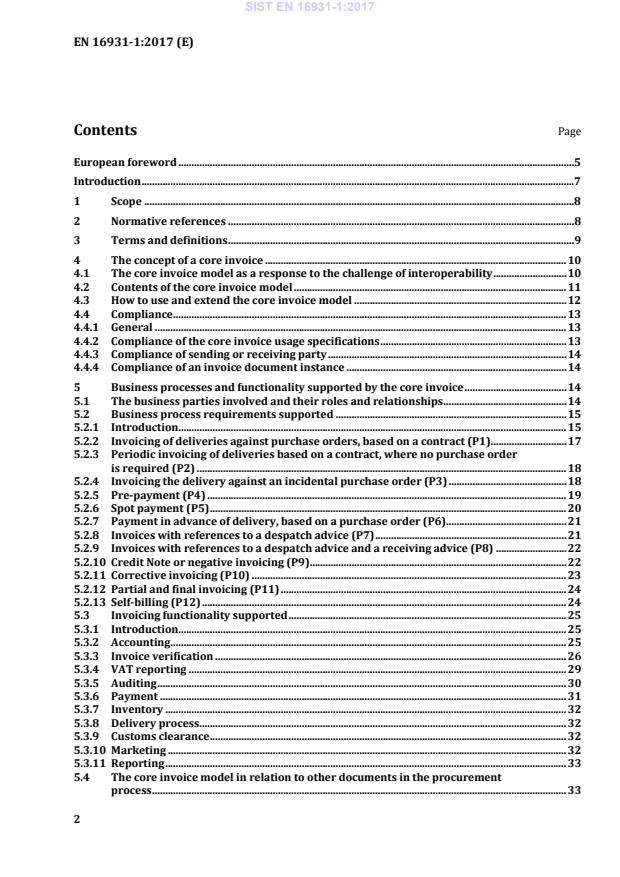
Examples . 99 A.1 Calculation examples . 99 A.1.1 Introduction. 99 A.1.2 Example 1 (Different Invoiced item VAT rates) . 99 A.1.3 Example 2 (Item price base quantity) . 101 A.1.4 Example 3 (Invoiced quantity unit of measure) . 103 A.1.5 Example 4 (Discounts, allowances and charges) . 104 A.1.6 Example 5 (Negative Invoice line) . 107 A.1.7 Example 6 (Prepayment and negative Amount due for payment) . 109 A.1.8 Example 7 (Standard VAT including VAT exempted lines) . 110 A.1.9 Example 8 (Reverse Charge, Intra EU supply and Export Invoices) . 112 A.2 Number of decimals and rounding . 113 A.3 Use cases . 114 A.3.1 Taxes other than VAT . 114 SIST EN 16931-1:2017
Assessment of the compliance of the European Standard with the requirements of the Standardization Request of the European Commission. 127 B.1 Introduction. 127 B.2 Sections of the invoice . 127 B.3 How requirements in the Standardization Request are met in EN 16931-1 . 128 B.3.1 EU Projects . 128 B.3.2 Specific business requirements . 130 B.3.3 ESO (European Standardization Organization- CEN) requirements . 138 B.4 Guide to indicators for relevance and risk as used in the above tables . 140 B.4.1 Relevance rating . 140 B.4.2 Risk rating . 140 Annex C (informative)
How the semantic model meets legal requirements from relevant directives . 141 Annex D (informative)
BPMN symbols . 146 Bibliography . 149
“Electronic Invoicing”, the secretariat of which is held by NEN. This European Standard shall be given the status of a national standard, either by publication of an identical text or by endorsement, at the latest by December 2017, and conflicting national standards shall be withdrawn at the latest by December 2017. Attention is drawn to the possibility that some of the elements of this document may be the subject of patent rights. CEN shall not be held responsible for identifying any or all such patent rights. This document has been prepared under a mandate given to CEN by the European Commission and the European Free Trade Association, and supports essential requirements of EU Directive 2014/55/EU [1]. For relationship with EU Directive 2014/55/EU [1], see informative Annex B, which is an integral part of this document. This document is part of a set of documents, consisting of: — EN 16931-1:2017 Electronic invoicing - Part 1: Semantic data model of the core elements of an electronic invoice — CEN/TS 16931-2:2017 Electronic invoicing - Part 2: List of syntaxes that comply with EN 16931-1 — CEN/TS 16931-3-1:2017 Electronic invoicing - Part 3-1: Methodology for syntax bindings of the core elements of an electronic invoice — CEN/TS 16931-3-2:2017 Electronic invoicing - Part 3-2: Syntax binding for ISO/IEC 19845 (UBL 2.1) invoice and credit note — CEN/TS 16931-3-3:2017 Electronic invoicing - Part 3-3: Syntax binding for UN/CEFACT XML Cross Industry Invoice D16B — CEN/TS 16931-3-4:2017 Electronic invoicing - Part 3-4: Syntax binding for UN/EDIFACT INVOIC D16B — CEN/TR 16931-4:2017 Electronic invoicing - Part 4: Guidelines on interoperability of electronic invoices at the transmission level — CEN/TR 16931-5:2017 Electronic invoicing - Part 5: Guidelines on the use of sector or country extensions in conjunction with EN 16931-1, methodology to be applied in the real environment SIST EN 16931-1:2017
1 In preparation. SIST EN 16931-1:2017
2 http://eur-lex.europa.eu/LexUriServ/LexUriServ.do?uri=COM:2010:0712:FIN:en:PDF. SIST EN 16931-1:2017
...
Questions, Comments and Discussion
Ask us and Technical Secretary will try to provide an answer. You can facilitate discussion about the standard in here.
Loading comments...