


oSIST prEN 12966:2023
(Main)Road vertical signs - Variable message traffic signs
Road vertical signs - Variable message traffic signs
This European Standard provides specifications for two types of variable message signs (VMS); i.e. continuous (see 3.4) and discontinuous (see 3.7).
This European Standard covers mobile, temporary and permanently installed VMS used in circulation areas, on public and private land, including tunnels for the information, guidance, warning and/or direction of traffic. Test modules are used to demonstrate compliance with the requirements.
This European Standard specifies visual and physical characteristics of VMS as well as their durability aspects. It also provides relevant requirements and corresponding test methods, assessment and verification of constancy of performance (AVCP) and marking.
NOTE Provisions for the evaluation of conformity with regards to type testing are further specified in 6.2; provisions with regards to factory production control (FPC) are further specified in 6.3.
This European Standard does not cover
a) sign gantries, cantilevers, posts (supports) and foundations,
b) signal heads,
c) sizes and shapes of VMS messages,
d) control units and monitoring units unless inside the VMS,
e) control of sign luminance.
Vertikale Verkehrszeichen - Wechselverkehrszeichen
Dieses Dokument enthält Festlegungen zu zwei Arten von Wechselverkehrszeichen(WVZ); d.h. zu kontinuier lichen (siehe3.3) und diskontinuierlichen (siehe3.6) Wechselverkehrszeichen.
Dieses Dokument behandelt dauerhaft aufgestellte WVZ, die auf Verkehrsflächen, auf öffentlichem und pri vatem Gelände, einschließlich in Tunneln, zur Information, als Leitlinie, Warnhinweis und/oder Richtungs- anzeige verwendet werden. Prüfmodule werden verwendet, um die Übereinstimmung mit den Anforderungen nachzuweisen.
Dieses Dokument legt die visuellen und physikalischen Merkmale von WVZ sowie deren Dauerhaftigkeits- aspekte fest. Es enthält außerdem die maßgeblichen Anforderungen und die entsprechenden Prüfverfahren, die Bewertung und Überprüfung der Leistungsbeständigkeit(AVCP) und die Kennzeichnung.
ANMERKUNG Die Bestimmungen zur Bewertung der Konformität im Hinblick auf die Typprüfung werden ausführlicher in 6.2 beschrieben; Bestimmungen im Hinblick auf die werkseigene Produktionskontrolle(WPK) werden ausführlicher in6.3.1 beschrieben.
Dieses Dokument behandelt nicht:
a) Schilderbrücken, Ausleger, Maste (Träger) und Fundamente;
b) Signalgeber;
c) Größen und Formen von WVZ-Zeicheninhalten;
d) Bedienungs- und Überwachungseinheiten, es sei denn, sie befinden sich im WVZ;
e) Steuerung der Leuchtdichte von Verkehrszeichen.
Signaux de signalisation routière verticale - Panneaux à messages variables
Le présent document fournit des spécifications pour les deux types de panneaux à messages variables (PMV) existants : les panneaux continus (voir le paragraphe 3.3) et les panneaux discontinus (voir le paragraphe 3.6).
Le présent document couvre les PMV installés de manière permanente pour informer, guider, mettre en garde et/ou indiquer le sens de la circulation aux usagers de voies publiques ou privées, y compris les tunnels. Des modules d’essai sont utilisés pour démontrer la conformité aux exigences.
Le présent document spécifie les caractéristiques visuelles et physiques des PMV ainsi que leurs aspects de durabilité. Il couvre également les exigences pertinentes et les méthodes d’essai correspondantes, l’évaluation et la vérification de la constance des performances (EVCP) et le marquage.
NOTE Les dispositions relatives à l’évaluation de la conformité des essais de type sont précisées en 6.2 ; les dispositions portant sur le contrôle de la production en usine (CPU) sont énoncées en 6.3.1.
Ce document ne couvre pas :
a) les portiques, potences, poteaux (supports) et fondations des panneaux,
b) les signaux,
c) les tailles et les formes des messages des PMV,
d) les organes de contrôle et de surveillance à l’exception de ceux qui sont intégrés au PMV,
e) le contrôle de la luminance des panneaux.
Pokončni cestni znaki - Prometni znaki s spremenljivo vsebino
General Information
- Status
- Not Published
- Public Enquiry End Date
- 05-Dec-2023
- Technical Committee
- OCE - Road equipment
- Current Stage
- 4020 - Public enquire (PE) (Adopted Project)
- Start Date
- 03-Oct-2023
- Due Date
- 20-Feb-2024
- Completion Date
- 14-Dec-2023
Relations
- Effective Date
- 02-Jun-2021
Overview
The oSIST prEN 12966:2023 standard, developed by CEN (European Committee for Standardization), establishes comprehensive specifications for road vertical variable message traffic signs (VMS). It covers two primary types of VMS: continuous and discontinuous displays. This European Standard applies to mobile, temporary, and permanently installed VMS deployed in various circulation areas, including on public and private land as well as tunnels.
The standard focuses on the visual and physical characteristics, ensuring VMS durability and effectiveness in providing traffic information, guidance, warnings, and directional messages. It incorporates key aspects such as test modules for compliance, relevant test methods, and verification procedures to maintain consistent sign performance.
Key Topics
Types of VMS
- Continuous VMS: Displays content in a seamless manner using a uniform matrix.
- Discontinuous VMS: Shows segmented or discrete message elements often using light-emitting components.
Scope and Application
- Suitable for mobile, temporary, and permanent installations.
- Designed for use in diverse environments, including roadways, tunnels, and private circulation areas.
Visual Performance Requirements
- Luminance and chromaticity criteria for clear visibility under various lighting and weather conditions.
- Legibility and beam width specifications to optimize message readability from appropriate distances.
Physical Characteristics and Durability
- Specifications on temperature range, impact resistance, vibration, corrosion, water ingress, and electrical safety.
- Safety provisions for preventing unauthorized access and ensuring long-term operational reliability.
Testing and Assessment
- Defined test modules that simulate real-world conditions to verify performance compliance.
- Methods for visual and physical performance testing, including luminance measurements and mechanical robustness.
- Assessment and Verification of Constancy of Performance (AVCP), including factory production control, to standardize quality assurance.
Marking and Documentation
- Codes for performance classes corresponding to different VMS types.
- Documentation requirements for manufacturers detailing design, electrical components, mounting, and retro-reflective properties.
Applications
The oSIST prEN 12966:2023 standard is essential for stakeholders involved in the design, manufacture, installation, and maintenance of variable message traffic signs across Europe. Key practical applications include:
- Traffic Management Authorities: Ensuring consistent and reliable VMS infrastructure for effective traffic information dissemination and control.
- Sign Manufacturers: Guiding the production of compliant VMS that meet rigorous European safety and performance criteria.
- Infrastructure Planners and Engineers: Selecting appropriate VMS types and installation methods for different roadway segments, including urban, rural, and tunnel environments.
- Maintenance Teams: Implementing standard protocols for ongoing performance assessment and upkeep based on specified test methods.
- Safety and Compliance Auditors: Verifying that VMS meet regulatory requirements and perform within approved safety parameters.
Related Standards
For a holistic approach to traffic sign standardization and safety, oSIST prEN 12966:2023 works in conjunction with several related standards, including but not limited to:
- EN 12899-1: Fixed vertical road traffic signs - Part 1: Fixed signs.
- EN 12966 Series: Continued development of standards for other aspects of variable message signs.
- EN ISO 20471: High visibility clothing standards for roadside workers involved in VMS installation and maintenance.
- Regulation (EU) No. 305/2011: Conformity assessment procedures applicable to construction products such as traffic signs.
- EN 60529: Degrees of protection provided by enclosures (IP Code) relevant for VMS waterproofing and dust protection.
By adhering to the oSIST prEN 12966:2023 standard, transportation authorities and manufacturers can ensure uniformity, safety, and optimal performance of variable message traffic signs, contributing significantly to road safety and traffic efficiency across Europe.

Frequently Asked Questions
oSIST prEN 12966:2023 is a draft published by the Slovenian Institute for Standardization (SIST). Its full title is "Road vertical signs - Variable message traffic signs". This standard covers: This European Standard provides specifications for two types of variable message signs (VMS); i.e. continuous (see 3.4) and discontinuous (see 3.7). This European Standard covers mobile, temporary and permanently installed VMS used in circulation areas, on public and private land, including tunnels for the information, guidance, warning and/or direction of traffic. Test modules are used to demonstrate compliance with the requirements. This European Standard specifies visual and physical characteristics of VMS as well as their durability aspects. It also provides relevant requirements and corresponding test methods, assessment and verification of constancy of performance (AVCP) and marking. NOTE Provisions for the evaluation of conformity with regards to type testing are further specified in 6.2; provisions with regards to factory production control (FPC) are further specified in 6.3. This European Standard does not cover a) sign gantries, cantilevers, posts (supports) and foundations, b) signal heads, c) sizes and shapes of VMS messages, d) control units and monitoring units unless inside the VMS, e) control of sign luminance.
This European Standard provides specifications for two types of variable message signs (VMS); i.e. continuous (see 3.4) and discontinuous (see 3.7). This European Standard covers mobile, temporary and permanently installed VMS used in circulation areas, on public and private land, including tunnels for the information, guidance, warning and/or direction of traffic. Test modules are used to demonstrate compliance with the requirements. This European Standard specifies visual and physical characteristics of VMS as well as their durability aspects. It also provides relevant requirements and corresponding test methods, assessment and verification of constancy of performance (AVCP) and marking. NOTE Provisions for the evaluation of conformity with regards to type testing are further specified in 6.2; provisions with regards to factory production control (FPC) are further specified in 6.3. This European Standard does not cover a) sign gantries, cantilevers, posts (supports) and foundations, b) signal heads, c) sizes and shapes of VMS messages, d) control units and monitoring units unless inside the VMS, e) control of sign luminance.
oSIST prEN 12966:2023 is classified under the following ICS (International Classification for Standards) categories: 93.080.30 - Road equipment and installations. The ICS classification helps identify the subject area and facilitates finding related standards.
oSIST prEN 12966:2023 has the following relationships with other standards: It is inter standard links to SIST EN 12966:2015+A1:2019. Understanding these relationships helps ensure you are using the most current and applicable version of the standard.
oSIST prEN 12966:2023 is associated with the following European legislation: EU Directives/Regulations: 305/2011; Standardization Mandates: M/111. When a standard is cited in the Official Journal of the European Union, products manufactured in conformity with it benefit from a presumption of conformity with the essential requirements of the corresponding EU directive or regulation.
oSIST prEN 12966:2023 is available in PDF format for immediate download after purchase. The document can be added to your cart and obtained through the secure checkout process. Digital delivery ensures instant access to the complete standard document.
Standards Content (Sample)
SLOVENSKI STANDARD
01-december-2023
Pokončni cestni znaki - Prometni znaki s spremenljivo vsebino
Road vertical signs - Variable message traffic signs
Vertikale Verkehrszeichen - Wechselverkehrszeichen
Signaux de signalisation routière verticale - Panneaux à messages variables
Ta slovenski standard je istoveten z: prEN 12966
ICS:
93.080.30 Cestna oprema in pomožne Road equipment and
naprave installations
2003-01.Slovenski inštitut za standardizacijo. Razmnoževanje celote ali delov tega standarda ni dovoljeno.
DRAFT
EUROPEAN STANDARD
NORME EUROPÉENNE
EUROPÄISCHE NORM
July 2023
ICS Will supersede
English Version
Road vertical signs - Variable message traffic signs
Signaux de signalisation routière verticale - Panneaux à Vertikale Verkehrszeichen - Wechselverkehrszeichen
messages variables
This draft European Standard is submitted to CEN members for enquiry. It has been drawn up by the Technical Committee
CEN/TC 226.
If this draft becomes a European Standard, CEN members are bound to comply with the CEN/CENELEC Internal Regulations
which stipulate the conditions for giving this European Standard the status of a national standard without any alteration.
This draft European Standard was established by CEN in three official versions (English, French, German). A version in any other
language made by translation under the responsibility of a CEN member into its own language and notified to the CEN-CENELEC
Management Centre has the same status as the official versions.
CEN members are the national standards bodies of Austria, Belgium, Bulgaria, Croatia, Cyprus, Czech Republic, Denmark, Estonia,
Finland, France, Germany, Greece, Hungary, Iceland, Ireland, Italy, Latvia, Lithuania, Luxembourg, Malta, Netherlands, Norway,
Poland, Portugal, Republic of North Macedonia, Romania, Serbia, Slovakia, Slovenia, Spain, Sweden, Switzerland, Türkiye and
United Kingdom.
Recipients of this draft are invited to submit, with their comments, notification of any relevant patent rights of which they are
aware and to provide supporting documentation.
Warning : This document is not a European Standard. It is distributed for review and comments. It is subject to change without
notice and shall not be referred to as a European Standard.
EUROPEAN COMMITTEE FOR STANDARDIZATION
COMITÉ EUROPÉEN DE NORMALISATION
EUROPÄISCHES KOMITEE FÜR NORMUNG
CEN-CENELEC Management Centre: Rue de la Science 23, B-1040 Brussels
© 2023 CEN All rights of exploitation in any form and by any means reserved Ref. No. prEN 12966:2023 E
worldwide for CEN national Members.
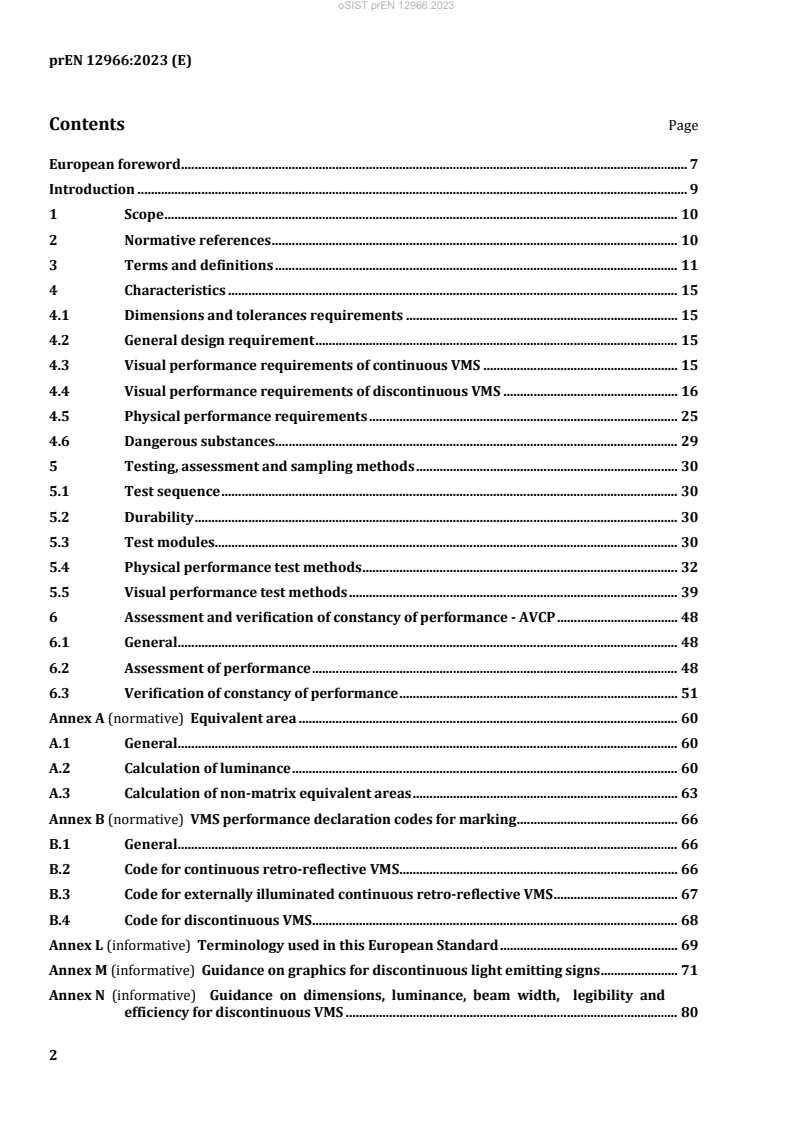
Contents Page
European foreword . 7
Introduction . 9
1 Scope . 10
2 Normative references . 10
3 Terms and definitions . 11
4 Characteristics . 15
4.1 Dimensions and tolerances requirements . 15
4.2 General design requirement . 15
4.3 Visual performance requirements of continuous VMS . 15
4.4 Visual performance requirements of discontinuous VMS . 16
4.5 Physical performance requirements . 25
4.6 Dangerous substances . 29
5 Testing, assessment and sampling methods . 30
5.1 Test sequence . 30
5.2 Durability . 30
5.3 Test modules. 30
5.4 Physical performance test methods . 32
5.5 Visual performance test methods . 39
6 Assessment and verification of constancy of performance - AVCP . 48
6.1 General . 48
6.2 Assessment of performance . 48
6.3 Verification of constancy of performance . 51
Annex A (normative) Equivalent area . 60
A.1 General . 60
A.2 Calculation of luminance . 60
A.3 Calculation of non-matrix equivalent areas . 63
Annex B (normative) VMS performance declaration codes for marking . 66
B.1 General . 66
B.2 Code for continuous retro-reflective VMS . 66
B.3 Code for externally illuminated continuous retro-reflective VMS . 67
B.4 Code for discontinuous VMS. 68
Annex L (informative) Terminology used in this European Standard . 69
Annex M (informative) Guidance on graphics for discontinuous light emitting signs . 71
Annex N (informative) Guidance on dimensions, luminance, beam width, legibility and
efficiency for discontinuous VMS . 80
Annex O (informative) Specific design issues . 97
O.1 Finish . 97
O.2 Front panels . 97
O.3 Front screens. 97
O.4 Appearance . 97
O.5 Electrolytic compatibility . 97
O.6 Protection against thermal overload . 97
O.7 Physical security against unauthorized access . 97
O.8 Interfaces between VMS, control, and higher order equipment . 97
O.9 Diagnostic . 98
Annex P (informative) Guidance for design of VMS messages. 99
Annex Q (informative) Technical documentation. 102
Q.1 Sign enclosure . 102
Q.2 Electrical equipment . 102
Q.3 Mounting devices (if applicable) . 102
Q.4 Retro-reflective and non-retro-reflective components . 102
Annex R (informative) Example of recommended summary of class combinations. 103
Annex ZA (informative) Relationship of this European Standard with Regulation (EU)
No.305/2011 . 110
ZA.1 Scope and relevant characteristics . 110
ZA.2 System of Assessment and Verification of Constancy of Performance (AVCP) . 114
ZA.3 Assignment of AVCP tasks . 114
ZA.4 The following clauses are not related to Regulation (EU) No 305/2011: . 115
Bibliography . 116
Figures Page
Figure 1 — Chromaticity areas for the colour classes C1 and C2 plotted in the CIE 1931
chromaticity diagram . 18
Figure 2 — Examples of passed and failed luminance distributions . 23
Figure 3 — Examples of variable message traffic sign test modules in front view – a) and c) -
and side view b) . 32
Figure 4 — Side elevation of the set-up for the measurement of luminance and luminance
ratio . 40
Figure 5 — Layout examples for a test module and the positioning of the measuring area
(circle) of the luminance meter . 45
Figure A.1 — Merging of elements . 60
Figure A.2 — Character with a regular orthogonal matrix of (5 × 8) elements . 61
Figure A.3 — Open line. 63
Figure A.4 — Closed line . 64
Figure A.5 — Example of symbol with an area fully populated with elements . 64
Figure A.6 — Example of symbol with an area partially populated with elements . 65
Figure B.1 — Code of performance classes of continuous retro-reflective VMS. 66
Figure B.2 — Code of performance classes of externally illuminated continuous retro-
reflective VMS . 67
Figure B.3 — Code of performance classes of discontinuous VMS . 68
Figure L.1 — Parts of a VMS . 69
Figure L.2 — Test configuration . 70
Figure M.1 — A legend seen at short (left), longer (centre), and very long distance (right) . 72
Figure M.2 — Example for calculation of dimensions of circular mandatory VMS . 75
Figure M.3 — Example for calculation of dimensions of circular mandatory VMS . 76
Figure M.4 — Example for calculation of dimensions of a triangular warning VMS . 76
Figure M.5 — Example of VMS using (64 × 64) elements with colour inversion . 77
Figure M.6 — Example of VMS using (48 × 48) elements with colour inversion . 77
Figure M.7 — Example of VMS using (32 × 32) elements with colour inversion . 78
Figure M.8 — Example of VMS using (64 × 64) elements, no colour inversion . 78
Figure M.9 — Example of VMS using (48 × 48) elements, no colour inversion . 79
Figure M.10 — Example of VMS using (32 × 32) elements, no colour inversion . 79
Figure N.1 — Relation between classes . 83
Figure N.2 — Example of coverage by beam width class B1 . 84
Figure N.3 — Example of coverage by beam width class B3 . 85
Figure N.4 — Example of coverage by beam width class B6 . 86
Figure N.5 — Legibility of group of VMS, centred on gantry above the road . 87
Figure N.6 — Legibility of group of VMS, mounted on cantilever aside the road . 88
Figure N.7 — Legibility of group of VMS, mounted on cantilever aside the road . 90
Figure N.8 — Legibility of group of VMS, mounted on cantilever aside the road . 91
Figure P.1 — Example of the design of the letter E in a regular orthogonal matrix . 99
Figure P.2 — Equivalent text dimensions using uppercase characters . 100
Figure P.3 — Equivalent text dimensions using upper- and lower-case characters . 101
Figure P.4 — Equivalent text dimensions using proportional character spacing . 101
Tables Page
Table 1 — Class designation of the visual performance parameters of VMS . 16
Table 2 — Corner points (CIE 1931 chromaticity co-ordinates x, y) of the chromaticity areas
for the colours of class C1 . 17
Table 3 — Corner points (CIE 1931 chromaticity co-ordinates x, y) of the chromaticity areas
for the colours of class C2 . 17
Table 4 — Le and La luminance limits for white on reference axis . 20
Table 5 — Le and La luminance limits for yellow on reference axis . 20
Table 6 — Le and La luminance limits for orange on reference axis . 20
Table 7 — Le and La luminance limits for green on reference axis. 21
Table 8 — Le and La luminance limits for red on reference axis . 21
Table 9 — Le and La luminance limits for blue on reference axis . 21
Table 10 — Minimum luminance ratio values (LR) for various colours and classes R1, R2 and
R3, at test angles on the reference axis and off the reference axis . 22
Table 11 — Beam width classes . 24
Table 12 — Class designation . 25
Table 13 — Temperature range classes . 26
Table 14 — Ingress protection level classes . 27
Table 15 — Effect of voltage interruption . 29
Table 16 — Operating voltage range, power-up activation and temporary overvoltage tests . 33
Table 17 — Frequency and voltage tests . 33
Table 18 — Impact test . 34
Table 19 — Vibration test . 34
Table 20 — Corrosion test . 35
Table 21 — Water ingress test - Severity . 35
Table 22 — Dust ingress test - Severity . 36
Table 23 — Temperature test . 36
Table 24 — Test angles (in degrees, with respect to the reference axis), used for the
measurement of luminance and luminance ratio with external illumination . 41
Table 25 — Test angles (in degrees, with respect to the reference axis), used for the
measurement of luminance without external illumination . 41
Table 26 — Test angles (in degrees, with respect to the reference axis), used for the
measurement of beam width, and for uniformity of luminous intensity and colour
of monochromatic elements . 42
Table 27 — Test angles (in degrees, with respect to the reference axis), used for the
measurement of uniformity of luminous intensity and colour of elements formed
by mixing colours . 43
Table 28 — Characteristics of continuous VMS. 49
Table 29 — Characteristics of discontinuous VMS. 50
Table 30 — Minimum frequency of testing continuous VMS for product testing and
evaluation as part of FPC . 53
Table 31 — Minimum frequency of testing discontinuous VMS for product testing and
evaluation as part of FPC . 54
Table M.1 — Parameters for mandatory signs using a red circle . 73
Table M.2 — Parameters for mandatory signs using a red triangle . 74
Table N.1 — Minimum dimensions of text (mm) . 81
Table N.2 — Minimum dimensions of circles (mm) . 82
Table N.3 — Minimum dimensions of triangles (mm) . 82
Table N.4 — Examples for applications of beam width classes . 83
Table N.5 — Examples for recognition time depending on character height, speed and
vertical beam width . 92
Table N.6 — Conversion from speed unit km/h to m/s . 92
Table R.1 — Example of summary of the characteristics of products . 103
Table R. 2 — Example 1 for visual performance class combination . 104
Table R. 3 — Example 2 for visual performance class combination . 106
Table R. 4— Example 3 for visual performance class combination . 107
Table R. 5 — Example 4 for visual performance class combination . 109
Table ZA.1 — Relevant clauses for continuous VMS . 110
Table ZA.2 — Relevant clauses for discontinuous VMS . 112
Table ZA.3 — Assignment of AVCP tasks for VMS under system 1 . 115
European foreword
This document (prEN 12966rev:2023) has been prepared by Technical Committee CEN/TC 226 “Road
equipment”, the secretariat of which is held by AFNOR.
This document is currently submitted to the CEN Enquiry.
This document will supersede EN 12966:2014+A1:2018
The main changes with respect to the previous edition EN 12966:2014+A1:2018 are listed below:
— Scope has been changed by removing mobile and temporary installed VMS, although required by
mandate M111
— Normative references have been dated
— Terms AVCP, CPR, FPC have been removed from clause 3
— Title of clause 4 has been changed from Product characteristics to Characteristics
— Everything that is non-mandated was deleted from clause 4
— New AVCP guidance document that does not have the ISO 9001 note is used
— Tunnel classes L1(T) and L2(T) found obsolete and have been removed from clause 4.4.1
— New wording in note to Table 11
— Note to clause 4.4.7 with reference to DELEGATED REGULATION (EU) 2021/1958 was added
— Clause 4.5.2.2 Pollution was removed
— Note to clause 4.5.2.4.3 providing explanation about applicability of DSLx classes added
— Note for clarification of Luminance and Luminance ratio requirements inside tunnels was added at
clause 5.5.4.4.1
— Better wording in clause 5.5.5 in regard with explaining test angles of L3(T)
— Clarification on test angles of L3(T) added
— Wording in clause M.2.2 improved in regard with element spacing
NOTE The structure of the document follows the requirements requested by the CEN HAS Consultant at the
time of drafting the document.
This document has been prepared under a Standardization Request given to CEN by the European
Commission and the European Free Trade Association, and supports essential requirements of
Regulation (EU) No 305/2011.
For relationship with Regulation (EU) No. 305/2011 [1], see informative Annex ZA, which is an integral
part of this document.
EN 12966, Road vertical sign – Variable message traffic signs, covers the product standard, assessment,
and verification of constancy of performance (AVCP) including type testing and factory production
control.
It derives from performance requirements and test methods published in CEN, CENELEC, CIE, IEC, and
ISO documents.
Introduction
This document is designed for use by manufacturers, who are placing their variable message traffic signs
on the market, as well as by Road Authorities and private developers who wish to use variable message
signs. It provides requirements for performance of characteristics of these signs, test and assessment
methods and the means of assessment and verification of constancy of performance (AVCP).
This document is a product standard covering the requirements for variable message traffic signs (VMS).
A VMS is a sign where the information shown can be changed or switched on or off as required. The
information can be text and/or symbols.
VMS fall into the two different types of continuous and discontinuous. Continuous VMS show sign faces
of the types of fixed signs defined in EN 12899. Discontinuous VMS use luminous elements to show
different messages on a single sign face.
There is diversity of VMS. Some have elements that are placed with a view of displaying a few
predetermined messages, while other have elements placed in arrays. Some can show messages where
all elements have approximately the same luminous intensity while other can vary the luminous intensity
individually. Some can show certain predetermined colours, while other can show a range of colours.
Some can show only character legends while other can show a wider range of legends.
This document does not describe the detailed form and configuration of a VMS. Therefore, test modules
representing the VMS are used to demonstrate compliance with the requirements of this document
because of the impracticality of testing some complete VMS.
Because of the major demands on a sign for good legibility and visibility throughout the required viewing
range, the main properties of the sign are described. These properties can vary depending on the
situation. For example, it will not be necessary to ask for a minimum temperature requirement of -40 °C
in Greece, but this needs to be considered in Lapland. For visual performance there will be a difference
between installation on highways - with good distance visibility and a narrow beam width - and
installation in cities, where there is only short distance legibility and when a wide beam width may be
required.
This document uses requirements for performance of the characteristics, which are not dependent on
technology. The visual and environmental performance is demonstrated on a test module representing
the VMS. This European Standard contains a number of defined requirements on VMS, some of which
have to be demonstrated on the test module, others that are to be verified by the manufacturer. It is the
manufacturer’s responsibility to ensure that the VMS is fully represented by the test module.
The performances of the main characteristics of discontinuous VMS are given by classes, which are
designed to be selected by choosing a combination of classes dependent on the end-user’s requirements.
National annexes may define class combination applicable to the local needs. This combination covers
not only the regulatory requirements of the destination country but also issues of lifetime, quality,
maintenance, and construction, all of which affect the ability of a sign in its particular application, to meet
safety and fitness for purpose. The details in the informative annexes are provided as useful guidance on
the additional aspects relating to VMS for those setting up purchasing contracts for signs or signing
systems.
Installed discontinuous VMS shall be regulated in view of the ambient light and the stroke width of
legends to provide the intended apparent luminance and balance of colours. Symbols and fonts for
character legends shall be designed to provide best possible legibility.
The working environment for VMS can be relatively harsh and equipment that is deemed "fit for purpose"
is expected to last in an exposed, corrosive environment for a minimum of 10 years. It is essential that all
materials and manufacturing processes take this into account.
1 Scope
This document provides specifications for two types of variable message signs (VMS); i.e., continuous
(see 3.3) and discontinuous (see 3.6).
This document covers permanently installed VMS used in circulation areas, on public and private land,
including tunnels for the information, guidance, warning and/or direction of traffic. Test modules are
used to demonstrate compliance with the requirements.
This document specifies visual and physical characteristics of VMS as well as their durability aspects. It
also provides relevant requirements and corresponding test methods, assessment, and verification of
constancy of performance (AVCP) and marking.
NOTE Provisions for the evaluation of conformity with regards to type testing are further specified in 6.2;
provisions with regards to factory production control (FPC) are further specified in 6.3.1.
This document does not cover:
a) sign gantries, cantilevers, posts (supports) and foundations,
b) signal heads,
c) sizes and shapes of VMS messages,
d) control units and monitoring units unless inside the VMS,
e) control of sign luminance.
2 Normative references
The following documents are referred to in the text in such a way that some or all of their content
constitutes requirements of this document. For dated references, only the edition cited applies. For
undated references, the latest edition of the referenced document (including any amendments) applies.
EN 12899-1:2007, Fixed, vertical road traffic signs — Part 1: Fixed signs
EN 12899-4:2007, Fixed, vertical road traffic signs — Part 4: Factory production control
EN 50293:2012, Road traffic signal systems — Electromagnetic compatibility
EN 50556:2018, Road traffic signal systems
EN 60068-2-1: 2007, Environmental testing — Part 2-1: Tests — Tests A: Cold (IEC 60068-2-1)
EN 60068-2-2:2007, Environmental testing — Part 2-2: Tests — Tests B: Dry heat (IEC 60068-2-2)
EN 60068-2-5:2018, Environmental testing — Part 2-5: Tests — Test Sa: Simulated solar radiation at
ground level and guidance for solar radiation testing (IEC 60068-2-5)
EN 60068-2-14:2009, Environmental testing — Part 2-14: Tests — Test N: change of temperature
(IEC 60068-2-14)
EN 60068-2-30:2005, Environmental testing — Part 2-30: Tests — Test Db: Damp heat, cyclic (12 h + 12 h
cycle) (IEC 60068-2-30)
EN 60068-2-64:2008 +A1:2019, Environmental testing — Part 2-64: Tests— Test Fh: Vibration, broadband
random and guidance (IEC 60068-2-64)
EN 60529:1991+A1:2000+A2:2013, Degrees of protection provided by enclosures (IP Code)
(IEC 60529:1989/A2:2013/COR1:2019)
EN 60598-1:2021, Luminaires — Part 1: General requirements and tests
EN 62368-1:2020, Audio/video, Information and communication technology — Safety - Part 1: Safety
requirements (IEC 62368-1:201427, modified)
EN ISO 9227:2017-07, Corrosion tests in artificial atmospheres — Salt spray tests (ISO 9227:2012)
IEC 60417-1, Graphical symbols for use on equipment — Part 1: Overview and application
ISO 7000:2014, Graphical symbols for use on equipment — Registered symbols
CIE 015:2018, Colorimetry
CIE S 017:2020, International lighting vocabulary
3 Terms and definitions
For the purposes of this document, the following terms and definitions given in CIE 015:2018 and
CIE S 017:2020 and the following apply.
ISO and IEC maintain terminology databases for use in standardization at the following addresses:
— ISO Online browsing platform: available at https://www.iso.org/obp/
— IEC Electropedia: available at https://www.electropedia.org/
3.1
backing board
surround to the VMS, used depending on local circumstances, providing improved visibility of the VMS
by means of increasing its size and by providing suitable visible contrast with the VMS background
3.2
cantilever support
support system with a single post and a cantilever arm supporting VMS(s) mounted over the traffic
lane(s)
3.3
CCM
compliance criteria met
3.4
continuous VMS
similar to fixed signs, the only difference being that by some electro- and/or mechanical means they
change between messages
EXAMPLE: Rotating prism signs, roller blinds, etc.
Note 1 to entry: Fixed signs are specified in accordance with EN 12899-1:2007.
3.5
control device
equipment used to execute a change of message other than by purely manual means
3.6
CWFT
classification without further testing
3.7
discontinuous VMS
signs which create messages using discontinuous individual elements that can be in one of two states (or
more) and can thereby create various messages on the same sign face, in the following colours: white,
yellow, orange, green, red and blue as specified herein
Example: Fibre optic signs, LED signs, LCD signs, etc.
3.8
display surface
visible part of a VMS that contains the elements that may be activated to display the message
3.9
distance between the light sources of adjacent elements
physical distance between the light sources of adjacent elements
Note 1 to entry: See Figure A.2.
3.10
element
basic visual light emitting and/or reflecting object or cluster of objects in the display surface of a VMS,
activated in conjunction with other elements to form the desired message-see also definition of “pixel”
3.11
element spacing
centre-centre distance of adjacent elements
3.12
equivalent area
it is needed for achieving the equivalent appearance of a VMS with a fixed sign in accordance with
EN 12899-1:2007
Note 1 to entry: Further explanation is given in Annex A.
3.13
front panel
visible part of a sign comprising the display surface; and the backing-board when this is integrated in the
front of the VMS
3.14
front screen
screen protecting the display surface or the parts of it against dust, water, etc.
3.15
gantry
support system spanning a carriageway with one or more posts on each side of the carriageway
supporting VMS mounted over the traffic lanes
3.16
horizontal reference plane
horizontal plane containing the reference axis, when the VMS is positioned in such a way that the
reference axis is horizontal
3.17
layout
physical arrangement of characters (text) and symbols, on the display surface
3.18
luminance
3.18.1
luminance L with external illumination
a10
during daylight condition when the VMS is ON, illuminated by sun at 10° above horizon, the perceived
luminance of a VMS (L ) is composed by the emitted light (L ) and the luminance caused by reflection
a10 e
of sun light (L )
b10
3.18.2
luminance L with external illumination
a5
during daylight condition when the VMS is ON, illuminated by sun at 5° above horizon, the perceived
luminance of a VMS (La5) is composed by the emitted light (Le) and the luminance caused by reflection of
sun light (L )
b5
3.18.3
luminance L by reflection of external illumination
b10
during daylight condition, when the VMS is OFF, L is the luminance caused by reflection of sun light at
b10
10° above horizon
3.18.4
luminance L by reflection of external illumination
b5
during daylight condition, when the VMS is OFF, L is the luminance caused by reflection of sun light at
b5
5° above horizon
3.18.5
luminance without external illumination L
e
when the VMS is ON, L is the luminance caused by emitted light only.
e
3.19
luminance ratio LR
3.19.1
luminance ratio LR
ratio of luminance emitted from the VMS in the ON state (L ) compared to the luminance emitted in the
e
OFF state by reflection (L ).
b10
Note 1 to entry: For calculation refer to 5.5.4.4.2.
3.19.2
luminance ratio LR
ratio of luminance emitted from the VMS in the ON state (L ) compared to the luminance emitted in the
e
OFF state by reflection (L ).
b5
Note 1 to entry: For calculation refer to 5.5.4.4.3.
3.20
manufacturer
any natural or legal person who manufactures a construction product or who has such a product designed
or manufactured, and markets that product under his name or trademark
3.21
matrix
grid whose intersections hold the centre of the elements used in a VMS; a matrix may cover the whole
display surface or part of it; axes X and Y of the grid may or may not be orthogonal
3.21.1
irregular matrix
spacing of intersections on either X or Y or both axes is not constant
3.21.2
regular matrix
spacing of intersections on the X and Y axes is constant but may differ between X and Y
3.22
message
configuration consisting of symbols and/or text
3.23
pixel
basic visual light emitting and/or reflecting object or cluster of objects in the display surface of a VMS,
activated in conjunction with other elements to form the desired message
Note 1 to entry: See 3.11.
3.24
reference axis
axis originating on the reference centre of the VMS / test module being perpendicular to the front of it,
unless otherwise defined by the manufacturer
3.25
reference centre
point on the VMS / test module which is designated to be the centre of the test area for specifying its
performance and which is defined by the manufacturer
3.26
support
structure intended to maintain the VMS in its designed position (poles, posts, fixing, columns, .)
3.27
test angles
horizontal test angle is the angle between the test axis and the vertical reference plane; and the vertical
test angle is the angle between the test axis and the horizontal reference plane
Note 1 to entry: When the test axis is lower than the horizontal reference plane the vertical component of the test
angle is designated as negative.
Note 2 to entry: When the test axis is to the left of the vertical reference plane as seen from the reference centre the
horizontal component is designated as negative.
3.28
test axis
line from the reference centre of the VMS / test module to the luminance meter head
3.29
test module
representing the VMS for testing purpose
Note 1 to entry: See 5.3.
3.30
variable message traffic sign
VMS
sign for the purpose of displaying one or more messages that may be changed or switched ON or OFF as
required
3.31
vertical reference plane
vertical plane containing the reference axis
3.32
VMS background
part of environmental scenery, which, to the viewer, immediately surrounds the VMS
4 Characteristics
4.1 Dimensions and tolerances requirements
Dimensions, shape and other physical parameters, character sizes, tolerances and character spacing shall
be as required by the purchaser. The dimensions of the characters and symbols shall be defined using
equivalent area as detailed in Annex A.
4.2 General design requirement
All parts of VMS shall be securely connected to the VMS housing.
NOTE Guidance is given in Annex O “Specific design issues”.
4.3 Visual performance requirements of continuous VMS
The visual performance for continuous VMS (see 3.4) and its durability shall be in accordance with the
relevant visual performance requirements and durability requirements of EN 12899-1:2007, 4.1.1.5,
7.2.2.1.4 or 7.3.1.8 as applicable to the specific type and class.
Compliance criterion: No deviation observed; abbreviation CCM (compliance criterion met) shall be used
as declaration code.
For retro-reflective sign faces, non-retro-reflective sign faces, transilluminated signs and externally
illuminated signs requirements are found in EN 12899-1:2007, 7.2.1, 7.2.2, 7.3 and 7.4 respectively.
4.4 Visual performance requirements of discontinuous VMS
4.4.1 Classification
The relevant class designations of the visual performance of discontinuous VMS shall be expressed as
listed in Table 1.
Table 1 — Class designation of the visual performance parameters of VMS
Visual performance
Class designation Remarks
parameter
a a
Colour C1, C2 C2 is the more restrictive
L3 has the highest luminance
L1, L2, L3, L1(*), L2(*), L3(*)
b
(*) for specific situations (see 4.4.3)
Luminance (La)
c
L3(T) This class is for tunnel use
d
Luminance ratio (LR) R1, R2, R3 R3 has the highest luminance ratio
Beam width B1, B2, B3, B4, B5, B6, B7 B7 has the widest beam
a
If one VMS using both classes for different colours, the colour is assigned together with the colour class,
e.g. wC1, rC2. see Figure 1.
b
Only one luminance class may be declared, requirements of L1, L2 and L3 are covered by classes L1(*),
L2(*) and L3(*) respectively.
c
The requirements for tunnel class is covered by class, L3 and L3(*) respectively.
d
Only one luminance ratio class may be declared.
NOTE 1 Care is needed because some class-combinations may be not effective.
NOTE 2 Specific design issues are covered in N.3, where guidance is given on class combinations, and in Annex O.
4.4.2 Colour
A VMS may be able to display one or more of the colours red, orange, yellow, white, green, and blue
specified herein.
The colour shall be measured in accordance with 5.5.3. The chromaticity coordinates of the colours are
defined in accordance with the CIE 1931 Standard Colorimetric Observer as referenced in CIE 015:2018.
The chromaticity co-ordinates of the colour class C1 shall conform to Table 2. The chromaticity co-
ordinates of the colour class C2 shall conform to Table 3. In Figure 1 these chromaticity areas are plotted
in CI
...
Questions, Comments and Discussion
Ask us and Technical Secretary will try to provide an answer. You can facilitate discussion about the standard in here.
Loading comments...