

SIST EN 50159:2026
(Main)Railway Applications - Communication, signalling and processing systems - Safety-related communication in transmission systems
- Abstract
This document is applicable to safety-related electronic systems using for digital communication purposes a transmission system which was not necessarily designed for safety-related applications. For transmission systems where the risk of unauthorized access is not negligible, the document defines the interface to the applicable cybersecurity standards.
Both safety-related equipment and non-safety-related equipment can be connected to the transmission system.
This document gives the specific requirements needed to achieve safety-related communication between safety-related equipment connected to the transmission system, while the general system requirements including allocation of safety requirements and content of the safety case are defined in EN 50129.
This document is not applicable to existing systems which had already been accepted prior to the release of this document. However, so far as reasonably practicable, it is applicable to modifications and extensions to existing systems, subsystems and equipment.
This document does not specify:
- the transmission system;
- equipment connected to the transmission system;
- solutions (e.g. for interoperability);
- which kind of data are safety-related and which are not.
A safety-related equipment connected through an open transmission system can be subjected to many different cybersecurity threats, against which an overall program is defined encompassing management, technical and operational aspects.
- Status
- Published
- Public Enquiry End Date
- 31-Mar-2025
- Publication Date
- 01-Sep-2026
- Technical Committee
- ŽEN - Electrical applications for railways
- Current Stage
- 6060 - National Implementation/Publication (Adopted Project)
- Start Date
- 17-Jul-2026
- Due Date
- 21-Sep-2026
- Completion Date
- 02-Sep-2026

SIST EN 50159:2026 is a CENELEC European Standard for railway applications, covering safety-related communication in transmission systems. It specifies how safety-related electronic systems can exchange digital messages over transmission systems that were not necessarily designed for safety use, and what protections are needed so the receiving side can trust the message.
SIST EN 50159:2026 is aimed at safety-related equipment, but it also addresses cases where non-safety-related equipment shares the same transmission system. When the risk of unauthorized access is not negligible, the standard points to the cybersecurity standards that sit alongside the safety requirements.
What does SIST EN 50159:2026 specify?
SIST EN 50159:2026 specifies the safety-related communication part of railway communication, signalling and processing systems. It tells you how to assess the transmission system, classify it, and choose defences so that messages remain authentic, intact, timely and in sequence.
The scope is limited to the communication function itself. SIST EN 50159:2026 does not specify the transmission system, the connected equipment, interoperability solutions, or which data items are safety-related.
The document is organized into the following main clauses and annexes:
| Part | What it covers |
|---|---|
| Clause 4 | Reference architecture for safety-related communication |
| Clause 5 | Hazards arising from the transmission system |
| Clause 6 | Classification of transmission systems |
| Clause 7 | Requirements for safety defences |
| Annex A | Hazard analysis and basic message errors |
| Annex B | Categories of transmission systems |
| Annex C | Guidance on defences, time stamps, safety codes and cryptographic options |
| Annex D | Guidance on change management for railway duty holders |
What are the key requirements of SIST EN 50159:2026?
SIST EN 50159:2026 requires the safety case to drive the communication design. In practice, that means the team must identify the hazards, classify the transmission system, choose the right defences, and record the assumptions and limits in the safety case and related requirements documents.
Clause 4: use a reference architecture
SIST EN 50159:2026 separates the communication path into safety-related transmission functions, optional safety-related access control, and the underlying transmission system. The practical point is that safety protection must be designed as part of the safety-related communication function, not assumed to come from the network alone.
Clause 4 also allows safety-related and non-safety-related traffic to share the same transmission system. That matters because mixed traffic is common in railway networks, and the standard shows how to keep safety communication separate in logic even when the physical media are shared.
Clause 5: treat message errors as the main hazard
SIST EN 50159:2026 treats the central hazard as accepting a message that looks valid but contains undetected errors. The document focuses on basic message errors such as repetition, deletion, insertion, re-sequencing, corruption, delay and masquerade.
This matters because the design effort is not just about preventing failures. It is about ensuring that the receiver can detect the failure modes that could lead to unsafe decisions.
Clause 6: classify the transmission system
SIST EN 50159:2026 uses three categories of transmission system. Category 1 is a closed system with fixed participants and negligible unauthorized access. Category 2 is an open system with negligible unauthorized access. Category 3 is an open system where unauthorized access is a real concern.
This classification matters because it changes the defence strategy. Category 1 can use a reduced set of defences, while Category 3 needs protection against cybersecurity threats and an interface to the relevant cybersecurity standards.
Clause 7: implement safety defences and justify them
SIST EN 50159:2026 requires adequate defences against all identified basic message errors, based on hazard identification, risk analysis and SIL allocation in accordance with EN 50129. The document also says that any assumption that a risk is negligible must be justified and recorded in the safety case.
The listed defences include sequence number, time stamp, time-out, source and destination identifiers, feedback message, identification procedure and safety code. In practice, these are the tools used to detect wrong order, stale data, wrong sender, missing messages and corrupted data.
For Category 1 transmission systems, a reduced set is sufficient: source or destination identifiers, sequence number or time stamp, and a safety code. That helps keep simple internal links simple, while still covering the main safety functions.
SIST EN 50159:2026 also requires functional independence between safety defences and any lower-integrity transmission functions. When different safety integrity levels share a transmission system, the safety-related messages must have different structures, achieved by different safety codes, so that a lower-integrity message cannot be accepted as a higher-integrity one.
The document recommends that safety-related transmission of a safety function use no more than 1 % of the tolerable random failure rate of the target SIL. It also says that safety defences must be implemented completely in the safety-related transmission function and independently from the transmission layers.
What terms does SIST EN 50159:2026 define?
SIST EN 50159:2026 defines the vocabulary used to talk about safety-related communication and its failure modes.
- Basic Message Errors (BME) - The standard’s set of message failure modes, including repetition, deletion, insertion, re-sequencing, corruption, delay and masquerade.
- Safety-related transmission function - The function in the safety-related equipment that ensures authenticity, integrity, timeliness and sequence of data.
- Safety code - Redundant data in a safety-related message that allows data corruption to be detected.
- Transmission system - The service used by the application to communicate message streams between participants.
- Closed transmission system - A transmission system with a fixed number or fixed maximum number of participants and negligible risk of unauthorized access.
- Open transmission system - A transmission system with unknown or variable participants and the potential for unauthorized access.
- Safety Integrity Level (SIL) - One of the defined discrete levels used to state the safety integrity requirements of safety-related functions.
- Safety-Related Application Condition (SRAC) - The conditions that need to be met when the safety-related application is integrated into the overall system.
Who uses SIST EN 50159:2026?
SIST EN 50159:2026 is used by railway duty holders, system integrators, signalling and rolling stock engineers, safety managers, and cybersecurity engineers. It is also relevant to assessors, maintainers, and buyers who need to decide whether a transmission system is acceptable for a safety-related application.
In practice, users apply the standard when they classify a transmission system, select defences, prepare or review a safety case, define SRAC, or manage changes to an installed system. It is especially useful where safety-related and non-safety-related traffic share the same network.
What changed in SIST EN 50159:2026 from the previous edition?
SIST EN 50159:2026 supersedes EN 50159:2010 and all of its amendments and corrigenda. The foreword states these significant technical changes:
- terminology has been harmonized, especially with the cybersecurity domain
- clauses 4 and 7.2 were generalized to cover mixed safety integrity contexts
- clauses 6 and 7.2 add coordination of cybersecurity requirements for Category 3 transmission systems
- Annex C.6 adds guidance on the separation between safety and cybersecurity
- Annex D adds guidance on change management for railway duty holders
Which standards are used with SIST EN 50159:2026?
SIST EN 50159:2026 cites these normative references:
- EN 50129 - provides the general safety-related electronic system requirements, including safety requirement allocation and the safety case
- CLC/TS 50701:2023 - provides railway cybersecurity terminology and context for cyber-related threats and controls
- EN IEC 63452 - provides the railway cybersecurity standard referenced by the document
Annex C also points to EN IEC 62443-3-3 when deriving cybersecurity system requirements for Category 3 cases. That is the standard the document uses as a cybersecurity reference point when the transmission path needs explicit cyber protection.
What does the SIST EN 50159:2026 document contain?
SIST EN 50159:2026 contains a reference architecture, a hazard analysis, category guidance, and a set of defensive techniques for safety-related communication. It also includes informative annexes that explain how message errors arise, how transmission systems are categorized, and how defences such as time stamps and safety codes are selected and assessed.
Annex A provides the hazard tree and the relationship between hazardous events and basic message errors. Annex B gives example categories and a decision matrix for transmission systems. Annex C includes guidance on time stamps, safety codes, cryptographic algorithms, communication between safety-related and non-safety-related applications, and formulas for sizing the safety code. Annex D outlines a change management process for railway duty holders when transmission systems or applications are modified.
Relations
- Effective Date
- 13-Oct-2026
- Effective Date
- 14-Jul-2026
- Effective Date
- 23-Jan-2024
- Effective Date
- 23-Jan-2024
Get Certified
Connect with accredited certification bodies for this standard

BSI Group
BSI (British Standards Institution) is the business standards company that helps organizations make excellence a habit.

IRIS Certification (UNIFE)
International Railway Industry Standard certification.

TÜV SÜD Rail GmbH
TÜV SÜD railway certification services.
Sponsored listings
Frequently Asked Questions
SIST EN 50159:2026 is a standard published by the Slovenian Institute for Standardization (SIST). Its full title is "Railway Applications - Communication, signalling and processing systems - Safety-related communication in transmission systems". This standard covers: This document is applicable to safety-related electronic systems using for digital communication purposes a transmission system which was not necessarily designed for safety-related applications. For transmission systems where the risk of unauthorized access is not negligible, the document defines the interface to the applicable cybersecurity standards. Both safety-related equipment and non-safety-related equipment can be connected to the transmission system. This document gives the specific requirements needed to achieve safety-related communication between safety-related equipment connected to the transmission system, while the general system requirements including allocation of safety requirements and content of the safety case are defined in EN 50129. This document is not applicable to existing systems which had already been accepted prior to the release of this document. However, so far as reasonably practicable, it is applicable to modifications and extensions to existing systems, subsystems and equipment. This document does not specify: - the transmission system; - equipment connected to the transmission system; - solutions (e.g. for interoperability); - which kind of data are safety-related and which are not. A safety-related equipment connected through an open transmission system can be subjected to many different cybersecurity threats, against which an overall program is defined encompassing management, technical and operational aspects.
This document is applicable to safety-related electronic systems using for digital communication purposes a transmission system which was not necessarily designed for safety-related applications. For transmission systems where the risk of unauthorized access is not negligible, the document defines the interface to the applicable cybersecurity standards. Both safety-related equipment and non-safety-related equipment can be connected to the transmission system. This document gives the specific requirements needed to achieve safety-related communication between safety-related equipment connected to the transmission system, while the general system requirements including allocation of safety requirements and content of the safety case are defined in EN 50129. This document is not applicable to existing systems which had already been accepted prior to the release of this document. However, so far as reasonably practicable, it is applicable to modifications and extensions to existing systems, subsystems and equipment. This document does not specify: - the transmission system; - equipment connected to the transmission system; - solutions (e.g. for interoperability); - which kind of data are safety-related and which are not. A safety-related equipment connected through an open transmission system can be subjected to many different cybersecurity threats, against which an overall program is defined encompassing management, technical and operational aspects.
SIST EN 50159:2026 is classified under the following ICS (International Classification for Standards) categories: 35.240.60 - IT applications in transport; 45.020 - Railway engineering in general. The ICS classification helps identify the subject area and facilitates finding related standards.
SIST EN 50159:2026 has the following relationships with other standards: It is inter standard links to kSIST FprEN IEC 63452:2026, SIST EN 16704-2-1:2017, SIST EN 50159:2010/A1:2020, SIST EN 50159:2010. Understanding these relationships helps ensure you are using the most current and applicable version of the standard.
SIST EN 50159:2026 is associated with the following European legislation: Standardization Mandates: M/591. When a standard is cited in the Official Journal of the European Union, products manufactured in conformity with it benefit from a presumption of conformity with the essential requirements of the corresponding EU directive or regulation.
SIST EN 50159:2026 is available in PDF format for immediate download after purchase. The document can be added to your cart and obtained through the secure checkout process. Digital delivery ensures instant access to the complete standard document.
Standards Content (Sample)
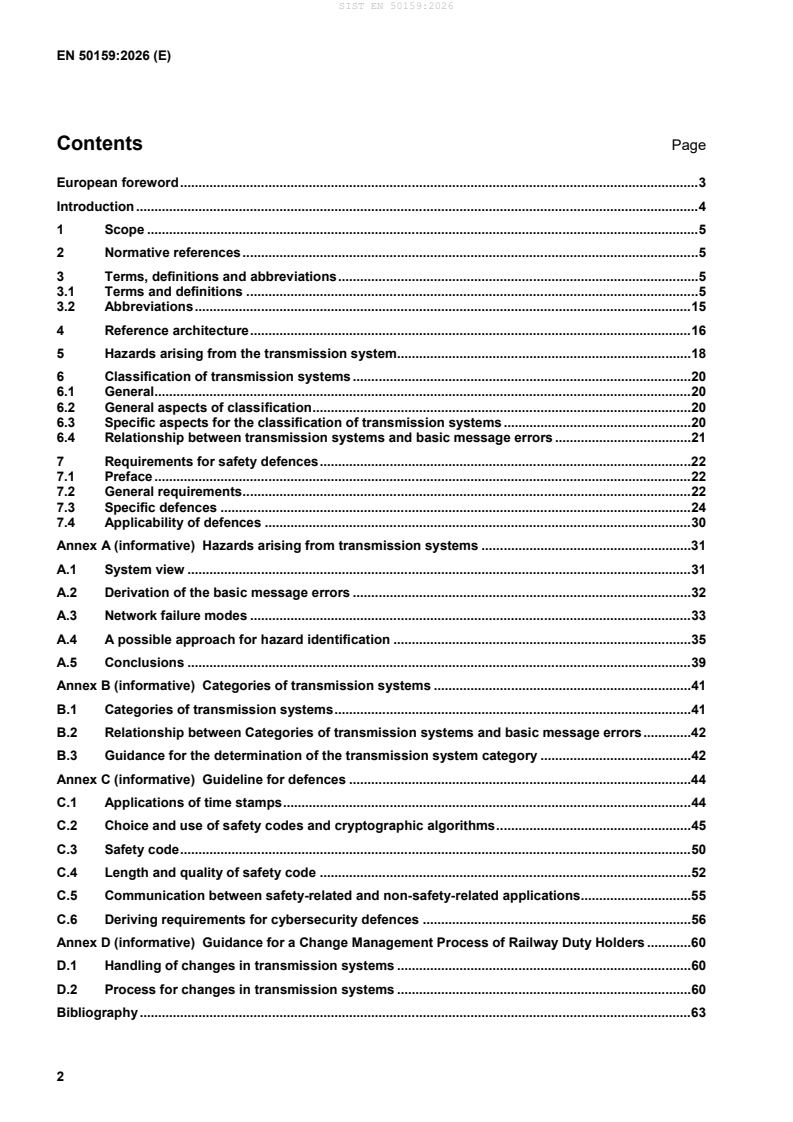
Contents
- Introduction
- 1 Scope
- 2 Normative references
- 3 Terms, definitions and abbreviations
- 3.1 Terms and definitions
- 3.1.1 absolute time stamp
- 3.1.2 access control
- 3.1.3 additional data
- 3.1.4 attack
- 3.1.5 authentic message
- 3.1.6 authenticity
- 3.1.7 basic message error
- 3.1.8 closed transmission system
- 3.1.9 communication
- 3.1.10 conduit
- 3.1.11 confidentiality
- 3.1.12 corrupted message
- 3.1.13 countermeasure
- 3.1.14 cryptographic algorithm
- 3.1.15 cryptographic safety code
- 3.1.16 cybersecurity
- 3.1.17 cyclic redundancy check
- 3.1.18 data
- 3.1.19 data corruption
- 3.1.20 defence
- 3.1.21 delayed message
- 3.1.22 deleted message
- 3.1.23 double time stamp
- 3.1.24 encryption
- 3.1.25 error
- 3.1.26 failure
- 3.1.27 fault
- 3.1.28 feedback message
- 3.1.29 hazard
- 3.1.30 hazard analysis
- 3.1.31 hazardous event
- 3.1.32 implicit data
- 3.1.33 information
- 3.1.34 inserted message
- 3.1.35 integrity
- 3.1.36 manipulation detection code
- 3.1.37 masqueraded message
- 3.1.38 message
- 3.1.39 message authentication code
- 3.1.40 message errors
- 3.1.41 message integrity
- 3.1.42 message stream
- 3.1.43 negligible risk
- 3.1.44 open transmission system
- 3.1.45 railway duty holder
- 3.1.46 random failure
- 3.1.47 redundancy check
- 3.1.48 redundant data
- 3.1.49 relative time stamp
- 3.1.50 repeated message
- 3.1.51 re-sequenced message
- 3.1.52 safe fall-back state
- 3.1.53 safety
- 3.1.54 safety case
- 3.1.55 safety code
- 3.1.56 safety integrity level
- 3.1.57 safety reaction
- 3.1.58 safety-related
- 3.1.59 safety-related transmission function
- 3.1.60 sequence number
- 3.1.61 source and destination identifier
- 3.1.62 systematic failure
- 3.1.63 threat
- 3.1.64 time stamp
- 3.1.65 timeliness
- 3.1.66 tolerable risk
- 3.1.67 transmission code
- 3.1.68 transmission system
- 3.1.69 trusted
- 3.1.70 unauthorized access
- 3.1.71 user data
- 3.1.72 valid message
- 3.1.73 validity
- 3.2 Abbreviations
- 4 Reference architecture
Introduction
If a safety-related electronic system involves communication of information, the transmission system forms an integral part of the safety-related system and it is understood that the communication is safe in accordance with EN 50129, with respect to random and systematic faults.
The transmission system considered in this document, which serves the transfer of information between different locations, has in general no particular preconditions to satisfy. It is from the safety point of view not trusted or not fully trusted.
This document is dedicated to the requirements to be taken into account for the communication of safetyrelated information over such transmission systems. Although the RAM aspects are not considered in this document, it is recommended to keep in mind that they are a major aspect of the operational safety.
The safety requirements depend on the characteristics of the transmission system. In order to reduce the complexity of the approach to demonstrate the safety of the system, transmission systems have been classified into three categories:
- Category 1: closed transmission systems;
- Category 2 and Category 3: open transmission systems.
For safety purposes application messages using Category 3 transmission systems need protection against unauthorized access that can corrupt the integrity of data. This document only provides general requirements to protect in case of Category 3 transmission systems. For a complete set of cybersecurity requirements, specific cybersecurity standards are applicable.
SIST EN 50159:2026 EN 50159:2026 (E)
1 Scope
This document is applicable to safety-related electronic systems using for digital communication purposes a transmission system which was not necessarily designed for safety-related applications. For transmission systems where the risk of unauthorized access is not negligible, the document defines the interface to the applicable cybersecurity standards.
Both safety-related equipment and non-safety-related equipment can be connected to the transmission system.
This document gives the specific requirements needed to achieve safety-related communication between safety-related equipment connected to the transmission system, while the general system requirements including allocation of safety requirements and content of the safety case are defined in EN 50129. This document is not applicable to existing systems which had already been accepted prior to the release of this document. However, so far as reasonably practicable, it is applicable to modifications and extensions to existing systems, subsystems and equipment.
This document does not specify:
- the transmission system;
- equipment connected to the transmission system;
- solutions (e.g. for interoperability);
- which kind of data are safety-related and which are not.
A safety-related equipment connected through an open transmission system can be subjected to many different cybersecurity threats, against which an overall program is defined encompassing management, technical and operational aspects.
2 Normative references
The following documents are referred to in the text in such a way that some or all of their content constitutes requirements of this document. For dated references, only the edition cited applies. For undated references, the latest edition of the referenced document (including any amendments) applies. EN 50129, Railway applications - Communication, signalling and processing systems - Safety related electronic systems for signalling CLC/TS 50701:2023, Railway applications - Cybersecurity
EN IEC 63452, Railway applications – Cybersecurity (IEC 63452)
3 Terms, definitions and abbreviations
3.1 Terms and definitions
For the purposes of this document, the following terms and definitions apply. ISO and IEC maintain terminology databases for use in standardization at the following addresses:
- ISO Online browsing platform: available at https://www.iso.org/obp
- IEC Electropedia: available at https://www.electropedia.org
Under preparation. Stage at the time of publication: prEN IEC 63452:2025.
SIST EN 50159:2026 EN 50159:2026 (E)
3.1.1 absolute time stamp
time stamp referenced to a global time which is common for a group of entities using a transmission system [SOURCE: IEC 60050-821:2017, 821-11-01]
3.1.2 access control
protection of system resources against unauthorized access Note 1 to entry: Unauthorized access can be physical or logical. In this document, this definition applies only to logical access to data transmission.
[SOURCE: CLC/TS 50701:2023, 3.1.3, modified — Note 1 to entry has been added.]
3.1.3 additional data
data which are not of any use to the ultimate user processes, but are used for control, availability, and safety purposes [SOURCE: IEC 60050-821:2017, 821-11-03]
3.1.4 attack
attempt to gain access to an information processing system in order to produce damage Note 1 to entry: The damage can be e.g. destruction, disclosure, alteration, disruption, unauthorized use. Note 2 to entry: In this document, this definition applies only to data transmission. [SOURCE: CLC/TS 50701:2023, 3.1.12, modified — Note 2 to entry has been added.]
3.1.5 authentic message
message in which information is known to have originated from the stated source [SOURCE: IEC 50050-821:2017, 821-11-04]
3.1.6 authenticity
state in which information is known to have originated from the stated source [SOURCE: IEC 60050-821:2017, 821-11-05, modified — “valid and” has been removed.]
3.1.7 basic message error
message error such as repetition, deletion, insertion, re-sequencing, corruption, delay and masquerade
3.1.8 closed transmission system
transmission system with a fixed number or fixed maximum number of participants having well-known and fixed properties, and where the risk of unauthorized access is negligible [SOURCE: IEC 60050-821:2017, 821-11-06, modified – “transmission system with a” has been added. “linked by a transmission system with” has been replaced with “having”. “considered” has been removed.]
SIST EN 50159:2026 EN 50159:2026 (E)
3.1.9 communication
information transfer according to agreed conventions [SOURCE: IEC 60050-701:2016, 701-01-04]
3.1.10 conduit
<cybersecurity> logical grouping of communication channels, connecting two or more zones, that share common security requirements Note 1 to entry: A conduit is allowed to traverse a zone as long as the security of the channels contained within the conduit is not impacted by the zone.
[SOURCE: EN IEC 62443-4-2:2019, 3.1.11]
3.1.11 confidentiality
<cybersecurity> assurance that information is not disclosed to unauthorized individuals, processes, or devices [SOURCE: CLC/TS 50701:2023, 3.1.27]
3.1.12 corrupted message
type of message error in which a data corruption occurs [SOURCE: IEC 60050-821:2017, 821-11-08]
3.1.13 countermeasure
<cybersecurity> action, device, procedure, or technique that reduces a threat, a vulnerability, or an attack by eliminating or preventing it, by minimizing the harm it can cause, or by discovering and reporting it so that corrective action can be taken [SOURCE: CLC/TS 50701:2023, 3.1.1, modified – Note 1 to entry has been omitted.]
3.1.14 cryptographic algorithm
algorithm based on the science of cryptography, including encryption algorithms, cryptographic hash algorithms, digital signature algorithms, and key agreement algorithms [SOURCE: IEC/TS 62443-1-1:2009, 3.2.3, modified - “upon” has been replaced with “on”.]
3.1.15 cryptographic safety code
safety code based on a cryptographic algorithm Note 1 to entry: A cryptographic safety code can be based on a cryptographic algorithm, which exhibits weaknesses with regards to security. In the safety context only the properties for error detection of the cryptographic safety code are relevant (rather than resistance to intentional attacks).
3.1.16 cybersecurity
<railway application> set of activities and measures taken with the objective to identify, protect against, detect, respond to, and recover from unauthorized access or cyberattack which could lead to an accident, an unsafe situation, or railway application performance degradation
SIST EN 50159:2026 EN 50159:2026 (E) Note 1 to entry: It is recognized that the term “cybersecurity” has a broader meaning in other standards and guidance, often including non-malevolent threats, human errors, and protection against natural disasters. Those aspects, except human errors degrading security controls, are not included in this document. [SOURCE: CLC/TS 50701:2023, 3.1.32]
3.1.17 cyclic redundancy check
<communication in transmission systems> cyclic code used to protect messages from the influence of data corruption [SOURCE: IEC 60050-821:2017, 821-11-10]
3.1.18 data
<communication in transmission systems> part of a message which represents some information Note 1 to entry: See also user data, additional data, redundant data. [SOURCE: IEC 60050-821:2017, 821-11-11, modified – Note 1 to entry has been added.]
3.1.19 data corruption
alteration of data [SOURCE: IEC 60050-821:2017, 821-11-13]
3.1.20 defence
measure incorporated in the design of a safety-related communication system to counter particular hazards [SOURCE: IEC 60050-821:2017, 821-11-14, modified – “safety” has been replaced with “safety-related”. “threats” has been replaced with “hazards”.]
3.1.21 delayed message
type of message error in which a message is received at a time later than intended [SOURCE: IEC 60050-821:2017, 821-11-15]
3.1.22 deleted message
type of message error in which a message is removed from the message stream [SOURCE: IEC 60050-821:2017, 821-11-16]
3.1.23 double time stamp
case when two entities exchange and compare their time stamps Note 1 to entry: In this case the time stamps in the entities are independent of each other. [SOURCE: IEC 60050-821:2017, 821-11-17]
3.1.24 encryption
<data> transformation of data in order to hide their semantic content using cryptography
SIST EN 50159:2026 EN 50159:2026 (E) Note 1 to entry: The reverse process is called decryption.
Note 2 to entry: In former version of this document the term “enciphering” was used. [SOURCE: IEC 60050-171:2019, 171-08-09, modified — Note 2 to entry has been added.]
3.1.25 error
discrepancy between a computed, observed or measured value or condition and the true, specified or theoretically correct value or condition Note 1 to entry: An error can be caused by a faulty item, e.g. a computing error made by faulty computer equipment. Note 2 to entry: A human error can be seen as a human action or inaction that can produce an unintended result. [SOURCE: IEC 60050-192:2024, 192-03-02, modified – Notes 1 and 2 to entry have been modified.]
3.1.26 failure
<item> loss of ability to perform as required Note 1 to entry: Qualifiers, such as catastrophic, critical, major, minor, marginal and insignificant, can be used to categorize failures according to the severity of consequences, the choice and definitions of severity criteria depending upon the field of application.
Note 2 to entry: Qualifiers, such as misuse, mishandling and weakness, can be used to categorize failures according to the cause of failure.
Note 3 to entry: “Failure” is an event, as distinguished from “fault”, which is a state. [SOURCE: IEC 60050-821:2017, 821-11-19, modified – “may” has been changed with “can” in notes 1 and 2 to entry. Note 3 to entry has been added.]
3.1.27 fault
<system> abnormal condition that could lead to an error in a system Note 1 to entry: A fault can be random or systematic.
[SOURCE: IEC 60050-821:2017, 821-11-20]
3.1.28 feedback message
response from a receiver to the sender, via a return channel [SOURCE: IEC 60050-821:2017, 821-11-21]
3.1.29 hazard
<railway> condition that can lead to an accident [SOURCE: EN 50129:2018, 3.1.21, modified – Note 1 to entry has been omitted.]
3.1.30 hazard analysis
process of identifying hazards and analysing their causes, and the derivation of requirements to limit the likelihood and consequences of hazards to a tolerable level
SIST EN 50159:2026 EN 50159:2026 (E) [SOURCE: IEC 60050-821:2017, 821-11-23]
3.1.31 hazardous event
event that can cause harm Note 1 to entry: A hazardous event can occur over a short period of time or over an extended period of time. [SOURCE: IEC 60050-903:2013, 903-01-04]
3.1.32 implicit data
additional data that is not transmitted but is known to the sender and receiver [SOURCE: IEC 60050-821:2017, 821-11-12]
3.1.33 information
knowledge concerning objects, such as facts, events, things, processes, or ideas (including concepts) that, within a certain context, has a particular meaning Note 1 to entry: Information can be represented for example by signs, symbols, pictures or sounds. [SOURCE: IEC 60050-171:2019, 171-01-01]
3.1.34 inserted message
type of message error in which an additional message is implanted in the message stream [SOURCE: IEC 60050-821:2017, 821-11-25, modified – “type of message error in which an” and “is” have been added. “which leads to an error” has been removed.]
3.1.35 integrity
<information>state in which information is complete and not altered [SOURCE: IEC 60050-821:2017, 821-11-26]
3.1.36 manipulation detection code
function of the whole message without a secret key Note 1 to entry: In contrast to a MAC there is no secret key involved. By the whole message is meant also any implicit data of the message which are not sent to the transmission system. The MDC is often based on a hash function. [SOURCE: IEC 60050-821:2017, 821-11-27, modified – Some editorial corrections in the note 1 to entry.]
3.1.37 masqueraded message
type of inserted message in which a non-authentic message is intentionally designed to appear to be authentic [SOURCE: IEC 60050-821:2017, 821-11-28, modified – “non-authentic” has been replaced with “type of”. “which is” has been replaced with “in which a non-authentic message is intentionally”.]
SIST EN 50159:2026 EN 50159:2026 (E)
3.1.38 message
<transmission systems> information which is transmitted in one or several packets from a sender to one or more receivers [SOURCE: IEC 60050-821:2017, 821-11-29]
3.1.39 message authentication code
cryptographic function of the whole message and a secret or public key Note 1 to entry: By the whole message is meant also any implicit data of the message which is not sent to the transmission system.
[SOURCE: IEC 60050-821:2017, 821-11-30, modified – Some editorial corrections in the note 1 to entry.]
3.1.40 message errors
set of all possible message failure modes which can lead to potentially dangerous situations, or to reduction in system availability Note 1 to entry: There can be a number of causes of each type of error. [SOURCE: IEC 60050-821:2017, 821-11-32]
3.1.41 message integrity
message in which information is complete and not altered [SOURCE: IEC 60050-821:2017, 821-11-33]
3.1.42 message stream
ordered set of messages [SOURCE: IEC 60050-821:2017, 821-11-34]
3.1.43 negligible risk
risk which is so low that it is not reasonable to implement additional measures Note 1 to entry: The risk of unauthorized access to the transmission system can be treated as negligible if the location and physical security of all points at which an item of equipment could be connected to the transmission system is such that it is not credible that a potential attacker could gain access. Note 2 to entry: Negligible risks are considered as insignificant and adequately controlled without defining further requirements.
3.1.44 open transmission system
transmission system with an unknown number of participants, having unknown, variable and non-trusted properties, used for unknown telecommunication services and having the potential for unauthorized access Note 1 to entry: In this document an open transmission system designates a transmission system of Category 2 or Category 3.
[SOURCE: IEC 60050-821:2017, 821-11-36, modified – Note 1 to entry has been added.]
SIST EN 50159:2026 EN 50159:2026 (E)
3.1.45 railway duty holder
body with the overall accountability for operating a railway system within the legal framework Note 1 to entry: Railway duty holder accountabilities for the overall system or its parts and life cycle activities are sometimes split between one or more bodies or entities. For example:
- the owner(s) of one or more parts of the system assets and their purchasing agents;
- the operator of the system;
- the maintainer(s) of one or more parts of the system.
Note 2 to entry: Typically, the railway duty holders are railway undertakings and the infrastructure managers. Such splits are based on either statutory instruments or contractual agreements. Such responsibilities are defined at the earliest stages of a system life cycle.
[SOURCE: EN 50126-1:2017, 3.48]
3.1.46 random failure
failure that occurs randomly in time [SOURCE: IEC 60050-821:2017, 821-11-38]
3.1.47 redundancy check
type of check that a predefined relationship exists between redundant data and user data within a message, to prove message integrity [SOURCE: IEC 60050-821:2017, 821-11-39]
3.1.48 redundant data
additional data, derived from the user data, by a safety-related transmission function [SOURCE: IEC 60050-821:2017, 821-11-40]
3.1.49 relative time stamp
time stamp referenced to the local clock of an entity Note 1 to entry: In general, there is no relationship to clocks of other entities. [SOURCE: IEC 60050-821:2017, 821-11-41]
3.1.50 repeated message
type of message error in which a single message is received more than once [SOURCE: IEC 60050-821:2017, 821-11-42]
3.1.51 re-sequenced message
type of message error in which the order of messages in the message stream is changed [SOURCE: IEC 60050-821:2017, 821-11-43]
SIST EN 50159:2026 EN 50159:2026 (E)
3.1.52 safe fall-back state
safe state of a safety-related equipment or system as a deviation from the fault-free state and as a result of a safety reaction leading to a reduced functionality of safety-related functions, possibly also of non-safetyrelated functions [SOURCE: IEC 60050-821:2017, 821-11-44, modified – “and possibly” has been replaced with “possibly”. “non-safety-related” has been replaced with “non-safety-related”.]
3.1.53 safety
freedom from unacceptable risk [SOURCE: IEC 60050-903:2013, 903-01-19]
3.1.54 safety case
documented demonstration that the product (e.g. a system, subsystem or equipment) complies with the specified safety requirements [SOURCE: IEC 60050-821:2017, 821-12-53]
3.1.55 safety code
redundant data included in a safety-related message to permit data corruptions to be detected by the safetyrelated transmission function Note 1 to entry: Also, codes based on cryptographic algorithms can be used as safety codes such as hash block codes or MAC with fixed keys. For such cryptographic safety codes the same requirements apply. [SOURCE: IEC 60050-821:2017, 821-11-45, modified – Note 1 to entry has been added.]
3.1.56 safety integrity level
one of a number of defined discrete levels for specifying the safety integrity requirements of safety-related functions allocated to the safety-related systems
3.1.57 safety reaction
safety-related protection taken by the safety process in response to an event (such as a failure of the transmission system), which can lead to a safe fall back state of the equipment [SOURCE: IEC 60050-821:2017, 821-11-47]
...