

oSIST prEN 131-9:2026
(Main)Ladders - Part 9: Step stools
General Information
- Abstract
This document specifies the requirements for step stools. This includes design characteristics, dimensions, materials, performance requirements, test methods and the declaration of suitability of use.
This document is not applicable to ladders and stepladders as defined by EN 131-1.
NOTE This document is applicable to both side ascendable ladder type step stools with an allowable standing height up to 1 m. Both side ascendable step ladders with an allowable standing height greater than 1 m belong to the scope of in EN 131-1.
This document is applicable to step stools designed for general professional and non-professional use.
This document is not applicable to step stools which by their design and instructions are intended and limited only for a specific professional use and as a result are not for general professional or non-professional use.
This document is not applicable to products intended for use by children falling under the scope of CEN/TC 252 "Child care articles" or toys falling under the scope of CEN/TC 52 "Safety of toys".
The products are intended to be used by one person only, requirements are based upon a maximum total load of 150 kg.
- Status
- Not Published
- Public Enquiry End Date
- 30-Mar-2026
- Technical Committee
- I13 - Imaginarni 13
- Current Stage
- 4020 - Public enquire (PE) (Adopted Project)
- Start Date
- 23-Jan-2026
- Due Date
- 12-Jun-2026
- Completion Date
- 31-Mar-2026
- Directive
- 2001/95/EC - General product safety
- Ref Project
prEN 131-9 - Ladders - Part 9: Step stools

Overview
oSIST prEN 131-9:2026: Ladders – Part 9: Step Stools is a European standard developed by CEN/TC 93 that specifies essential requirements for step stools. This standard covers step stools intended for general professional and non-professional use, focusing on functional design characteristics, dimensions, materials, performance criteria, rigorous test methods, and clear declarations of suitability for use. It is not applicable to ladders, stepladders (as defined in EN 131-1), children’s products, or items limited to specific professional applications.
With a maximum allowable standing height up to 1 meter, oSIST prEN 131-9:2026 ensures the safe construction, testing, and use of various types of step stools. These products are designed for use by a single person, with requirements based on a maximum total load of 150 kg.
Key Topics
- Scope and Applicability: oSIST prEN 131-9:2026 applies to both side-ascendable step stools for general use, but excludes stepladders, ladders, children’s step stools, and toys.
- Design Features: Specifies requirements for design characteristics, dimensions, and materials for different types of step stools, including fixed, folding, dome-type, one-step, and ladder-type variants.
- Safety and Performance Requirements: Outlines performance tests, slip resistance, load capacity, platform and step design, opening restraint mechanisms, and surface finishes.
- Test Methods: Details standardized test procedures to assess strength, static load, torsion, slip resistance, and compression security of step stools, ensuring safety and durability.
- Instructions and Marking: Highlights the importance of user instructions and product marking, which must comply with EN 131-3 to promote safe and correct usage.
- Exclusions: Not applicable to products intended for children per CEN/TC 252 or toys under CEN/TC 52, nor to step stools specific to certain professional uses.
Applications
Step stools built and tested in accordance with oSIST prEN 131-9:2026 are suitable for:
- Commercial and Professional Settings: Offices, warehouses, retail environments, and industrial workplaces that require safe, stable access to low-height areas.
- Non-Professional Use: Households, libraries, and public facilities where individuals may need occasional access to shelves, storage, or equipment at moderate heights.
- Versatility in Design: Covers step stools designed with folding, fixed legs, dome shapes, single-step, pull-out, and ladder configurations, offering manufacturers and users a wide range of compliant products.
- Enhanced Safety: Practical application of oSIST prEN 131-9:2026 requirements leads to improved user safety and product reliability due to standardized load tests, slip resistance features, and robust construction principles.
Compliance with this standard demonstrates a product’s suitability for general use, providing reassurance to buyers, employers, and safety inspectors regarding the step stool’s performance and reliability under specified conditions.
Related Standards
For a holistic approach to ladder and step stool safety, consider these related standards:
- EN 131-1: Ladders – Part 1: Terms, types, functional sizes
- EN 131-2: Ladders – Part 2: Requirements, testing, marking
- EN 131-3: Ladders – Part 3: Marking and user instructions
- EN 14183:2003: Superseded by oSIST prEN 131-9:2026, previously covered step stools
- EN 572-2: Glass in building – Basic soda lime silicate glass products
- EN 131-7: Mobile ladders with platform (for specialized platforms)
- CEN/TC 252: Standards for child care articles
- CEN/TC 52: Standards for toy safety
These standards collectively provide a robust framework for the design, testing, use, and safety of access equipment such as ladders and step stools across professional, commercial, and non-professional environments. Ensuring compliance helps manufacturers meet regulatory requirements and increases user confidence in product performance.
Relations
- Effective Date
- 28-Jan-2023
Frequently Asked Questions
oSIST prEN 131-9:2026 is a draft published by the Slovenian Institute for Standardization (SIST). Its full title is "Ladders - Part 9: Step stools". This standard covers: This document specifies the requirements for step stools. This includes design characteristics, dimensions, materials, performance requirements, test methods and the declaration of suitability of use. This document is not applicable to ladders and stepladders as defined by EN 131-1. NOTE This document is applicable to both side ascendable ladder type step stools with an allowable standing height up to 1 m. Both side ascendable step ladders with an allowable standing height greater than 1 m belong to the scope of in EN 131-1. This document is applicable to step stools designed for general professional and non-professional use. This document is not applicable to step stools which by their design and instructions are intended and limited only for a specific professional use and as a result are not for general professional or non-professional use. This document is not applicable to products intended for use by children falling under the scope of CEN/TC 252 "Child care articles" or toys falling under the scope of CEN/TC 52 "Safety of toys". The products are intended to be used by one person only, requirements are based upon a maximum total load of 150 kg.
This document specifies the requirements for step stools. This includes design characteristics, dimensions, materials, performance requirements, test methods and the declaration of suitability of use. This document is not applicable to ladders and stepladders as defined by EN 131-1. NOTE This document is applicable to both side ascendable ladder type step stools with an allowable standing height up to 1 m. Both side ascendable step ladders with an allowable standing height greater than 1 m belong to the scope of in EN 131-1. This document is applicable to step stools designed for general professional and non-professional use. This document is not applicable to step stools which by their design and instructions are intended and limited only for a specific professional use and as a result are not for general professional or non-professional use. This document is not applicable to products intended for use by children falling under the scope of CEN/TC 252 "Child care articles" or toys falling under the scope of CEN/TC 52 "Safety of toys". The products are intended to be used by one person only, requirements are based upon a maximum total load of 150 kg.
oSIST prEN 131-9:2026 is classified under the following ICS (International Classification for Standards) categories: 97.145 - Ladders. The ICS classification helps identify the subject area and facilitates finding related standards.
oSIST prEN 131-9:2026 has the following relationships with other standards: It is inter standard links to SIST EN 14183:2004. Understanding these relationships helps ensure you are using the most current and applicable version of the standard.
oSIST prEN 131-9:2026 is associated with the following European legislation: EU Directives/Regulations: 2001/95/EC; Standardization Mandates: M/285. When a standard is cited in the Official Journal of the European Union, products manufactured in conformity with it benefit from a presumption of conformity with the essential requirements of the corresponding EU directive or regulation.
oSIST prEN 131-9:2026 is available in PDF format for immediate download after purchase. The document can be added to your cart and obtained through the secure checkout process. Digital delivery ensures instant access to the complete standard document.
Standards Content (Sample)
SLOVENSKI STANDARD
01-marec-2026
Lestve - 9. del: Stopnične lestve
Ladders - Part 9: Step stools
Leitern - Teil 9: Tritte
Échelles - Partie 9 : Escabeaux
Ta slovenski standard je istoveten z: prEN 131-9
ICS:
97.145 Lestve Ladders
2003-01.Slovenski inštitut za standardizacijo. Razmnoževanje celote ali delov tega standarda ni dovoljeno.
DRAFT
EUROPEAN STANDARD
NORME EUROPÉENNE
EUROPÄISCHE NORM
January 2026
ICS 97.145 Will supersede EN 14183:2003
English Version
Ladders - Part 9: Step stools
Échelles - Partie 9 : Escabeaux Leitern - Teil 9: Tritte
This draft European Standard is submitted to CEN members for enquiry. It has been drawn up by the Technical Committee
CEN/TC 93.
If this draft becomes a European Standard, CEN members are bound to comply with the CEN/CENELEC Internal Regulations
which stipulate the conditions for giving this European Standard the status of a national standard without any alteration.
This draft European Standard was established by CEN in three official versions (English, French, German). A version in any other
language made by translation under the responsibility of a CEN member into its own language and notified to the CEN-CENELEC
Management Centre has the same status as the official versions.
CEN members are the national standards bodies of Austria, Belgium, Bulgaria, Croatia, Cyprus, Czech Republic, Denmark, Estonia,
Finland, France, Germany, Greece, Hungary, Iceland, Ireland, Italy, Latvia, Lithuania, Luxembourg, Malta, Netherlands, Norway,
Poland, Portugal, Republic of North Macedonia, Romania, Serbia, Slovakia, Slovenia, Spain, Sweden, Switzerland, Türkiye and
United Kingdom.
Recipients of this draft are invited to submit, with their comments, notification of any relevant patent rights of which they are
aware and to provide supporting documentation.
Warning : This document is not a European Standard. It is distributed for review and comments. It is subject to change without
notice and shall not be referred to as a European Standard.
EUROPEAN COMMITTEE FOR STANDARDIZATION
COMITÉ EUROPÉEN DE NORMALISATION
EUROPÄISCHES KOMITEE FÜR NORMUNG
CEN-CENELEC Management Centre: Rue de la Science 23, B-1040 Brussels
© 2026 CEN All rights of exploitation in any form and by any means reserved Ref. No. prEN 131-9:2026 E
worldwide for CEN national Members.
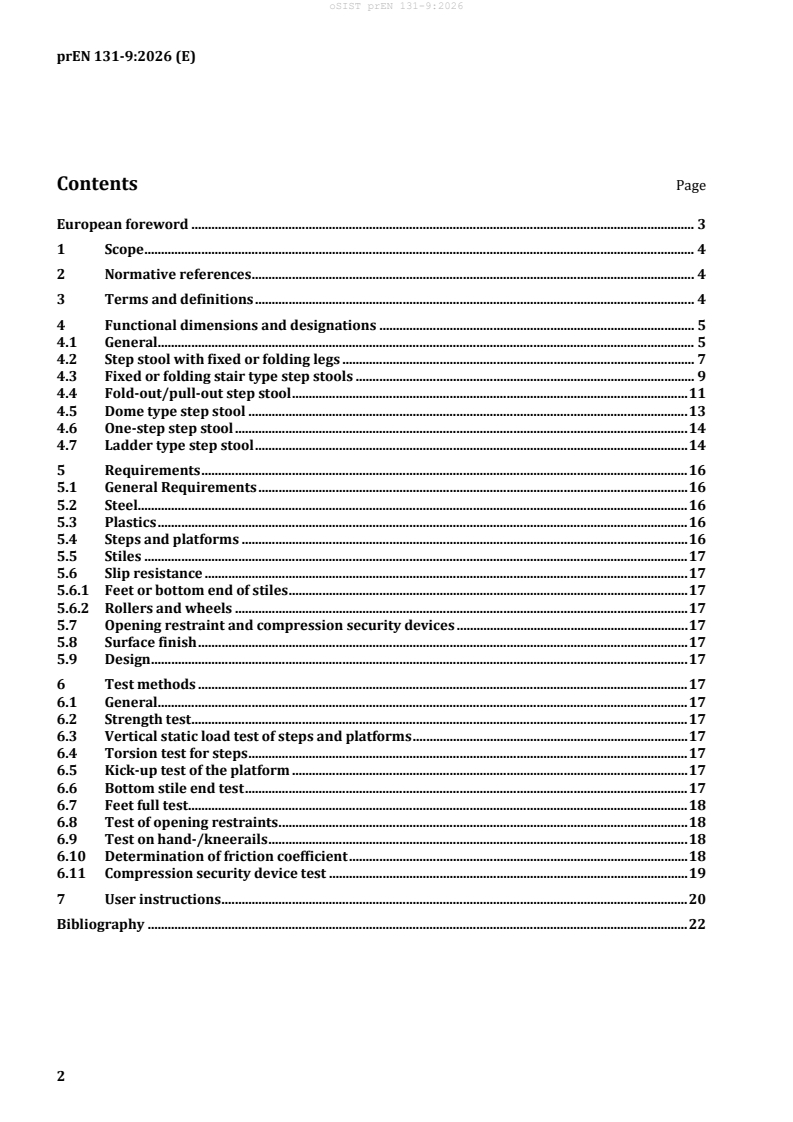
Contents Page
European foreword . 3
1 Scope . 4
2 Normative references . 4
3 Terms and definitions . 4
4 Functional dimensions and designations . 5
4.1 General. 5
4.2 Step stool with fixed or folding legs . 7
4.3 Fixed or folding stair type step stools . 9
4.4 Fold-out/pull-out step stool . 11
4.5 Dome type step stool . 13
4.6 One-step step stool . 14
4.7 Ladder type step stool . 14
5 Requirements . 16
5.1 General Requirements . 16
5.2 Steel. 16
5.3 Plastics . 16
5.4 Steps and platforms . 16
5.5 Stiles . 17
5.6 Slip resistance . 17
5.6.1 Feet or bottom end of stiles . 17
5.6.2 Rollers and wheels . 17
5.7 Opening restraint and compression security devices . 17
5.8 Surface finish . 17
5.9 Design . 17
6 Test methods . 17
6.1 General. 17
6.2 Strength test . 17
6.3 Vertical static load test of steps and platforms . 17
6.4 Torsion test for steps . 17
6.5 Kick-up test of the platform . 17
6.6 Bottom stile end test . 17
6.7 Feet full test. 18
6.8 Test of opening restraints . 18
6.9 Test on hand-/kneerails . 18
6.10 Determination of friction coefficient . 18
6.11 Compression security device test . 19
7 User instructions . 20
Bibliography . 22
European foreword
This document (prEN 131-9:2026) has been prepared by Technical Committee CEN/TC 93 “Ladders”, the
secretariat of which is held by DIN.
This document is currently submitted to the CEN Enquiry.
This document will supersede EN 14183:2003.
This document includes the following significant technical changes with respect to EN 14183:2003:
— standard integrated in the EN 131 series for ladders;
— all seating functions of step stools deleted;
— requirements and test methods aligned with EN 131-2 as far as possible;
— ladder type step stools added;
— determination of the friction coefficient in 6.10 modified and carried out on glass;
— compression security device test added as 6.11.
1 Scope
This document specifies the requirements for step stools. This includes design characteristics,
dimensions, materials, performance requirements, test methods and the declaration of suitability of use.
This document is not applicable to ladders and stepladders as defined by EN 131-1.
NOTE This document is applicable to both side ascendable ladder type step stools with an allowable standing
height up to 1 m. Both side ascendable step ladders with an allowable standing height greater than 1 m belong to
the scope of in EN 131-1.
This document is applicable to step stools designed for general professional and non-professional use.
This document is not applicable to step stools which by their design and instructions are intended and
limited only for a specific professional use and as a result are not for general professional or non-
professional use.
This document is not applicable to products intended for use by children falling under the scope of
CEN/TC 252 “Child care articles” or toys falling under the scope of CEN/TC 52 “Safety of toys”.
The products are intended to be used by one person only, requirements are based upon a maximum total
load of 150 kg.
2 Normative references
The following documents are referred to in the text in such a way that some or all of their content
constitutes requirements of this document. For dated references, only the edition cited applies. For
undated references, the latest edition of the referenced document (including any amendments) applies.
EN 131-2:2010+A3:2025, Ladders — Part 2: Requirements, testing, marking
EN 131-3, Ladders — Part 3: Marking and user instructions
EN 572-2, Glass in building — Basic soda lime silicate glass products — Part 2: Float glass
EN 12526, Castors and wheels — Vocabulary, recommended symbols and multilingual dictionary
EN ISO 14644-1, Cleanrooms and associated controlled environments — Part 1: Classification of air
cleanliness by particle concentration (ISO 14644-1)
3 Terms and definitions
For the purposes of this document, the terms and definitions given in EN 12526 and the following apply.
ISO and IEC maintain terminology databases for use in standardization at the following addresses:
— ISO Online browsing platform: available at https://www.iso.org/obp/
— IEC Electropedia: available at https://www.electropedia.org/
3.1
step stool
structure with a platform designed for standing on which can also incorporate one or more steps
3.2
stair type step stool
structure with deep steps and shallow climbing angle which can be climbed on one or both sides
Note 1 to entry: See Figure 4.
3.3
dome type step stool
structure ascendable from two or more sides with a platform and with or without an intermediate step
Note 1 to entry: See Figure 8.
3.4
one-step step stool
foldable or non-foldable structure consisting of one step only
Note 1 to entry: See Figure 9.
3.5
ladder type step stool
structure with fixed or foldable legs braced in position of use, which can be climbed on one or both sides
Note 1 to entry: See Figure 10 and Figure 11.
3.6
components of step stools
3.6.1
step
climbing support
3.6.2
platform
uppermost support for standing on
3.6.3
ascending leg
ascendable side of a step stool
3.6.4
supporting leg
side of a step stool that cannot be ascended
4 Functional dimensions and designations
4.1 General
The drawings are examples only and products need not correspond. However, dimensions shall be
applied. Step stools shall be fitted with steps that are uniformly spaced to within a tolerance of ±2 mm.
All types of products covered by this document may be fitted with castors and wheels.
There shall be no gap between the projection of the steps to the ground (see Figure 3).
A platform shall have a minimum area of 600 cm and shall include a square of 200 mm × 200 mm, see
Figure 1.
Openings in platforms and steps shall not allow a ball of a diameter of 35 mm to fall through.
The design shall seek to minimize the existence of shearing and squeeze points and where they do exist
to minimize the shearing and squeezing effects as far as practicable.
NOTE Shear or squeeze points exist if the distance between two accessible parts relative to each other is less
than 18 mm and more than 7 mm in any position during movement.
The radius of the horizontal edges of platforms and steps shall be max 15 mm (see Figure 1) in order to
avoid slipping at the edges.
If the height of the step stool is more than 750 mm and the platform is less than 240 mm × 400 mm a
hand-/kneerail is required which shall b
...