

SIST EN 319 411-2 V2.2.2:2018
(Main)Electronic Signatures and Infrastructures (ESI) - Policy and security requirements for Trust Service Providers issuing certificates - Part 2: Requirements for trust service providers issuing EU qualified certificates
General Information
- Abstract
The present document specifies policy and security requirements for the issuance, maintenance and life-cycle
management of EU qualified certificates as defined in Regulation (EU) No 910/2014 [i.1]. These policy and security
requirements support reference certificate policies for the issuance, maintenance and life-cycle management of EU
qualified certificates issued to natural persons (including natural persons associated with a legal person or a website)
and to legal persons (including legal persons associated with a website), respectively.
The present document does not specify how the requirements identified can be assessed by an independent party,
including requirements for information to be made available to such independent assessors, or requirements on such
assessors.
NOTE: See ETSI EN 319 403 [i.6] for guidance on assessment of TSP's processes and services. The present
document references ETSI EN 319 411-1 [2] for general requirements on TSP issuing certificates.
- Status
- Published
- Public Enquiry End Date
- 20-Nov-2017
- Publication Date
- 09-May-2018
- Technical Committee
- SPN - Services and Protocols for Networks
- Current Stage
- 6060 - National Implementation/Publication (Adopted Project)
- Start Date
- 04-May-2018
- Due Date
- 09-Jul-2018
- Completion Date
- 10-May-2018
- Mandate
- M/460
Buy Documents

ETSI EN 319 411-2 V2.2.0 (2017-08) - Electronic Signatures and Infrastructures (ESI); Policy and security requirements for Trust Service Providers issuing certificates; Part 2: Requirements for trust service providers issuing EU qualified certificates
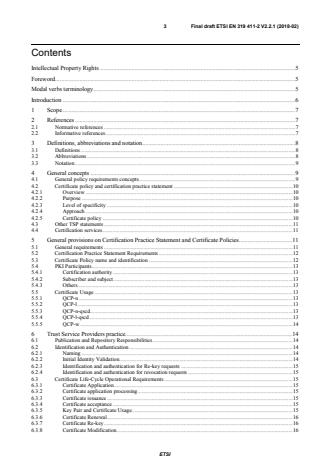
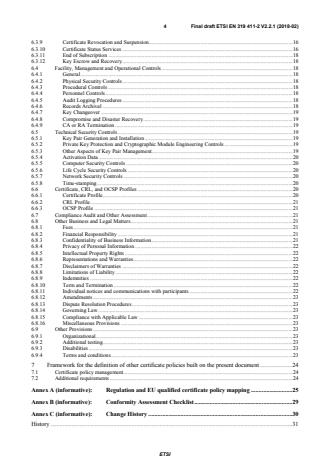
ETSI EN 319 411-2 V2.2.1 (2018-02) - Electronic Signatures and Infrastructures (ESI); Policy and security requirements for Trust Service Providers issuing certificates; Part 2: Requirements for trust service providers issuing EU qualified certificates

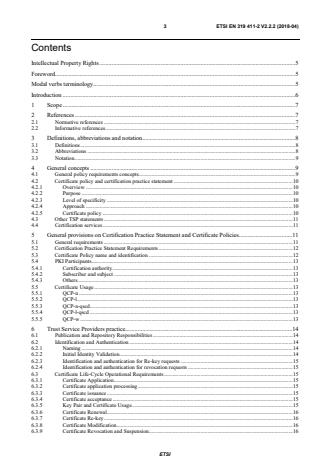
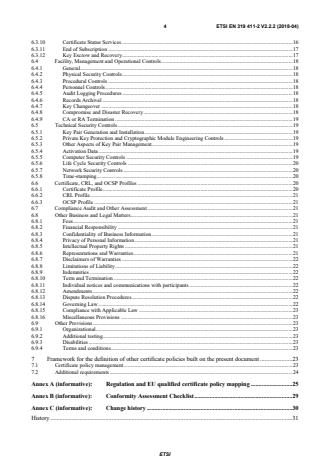
ETSI EN 319 411-2 V2.2.2 (2018-04) - Electronic Signatures and Infrastructures (ESI); Policy and security requirements for Trust Service Providers issuing certificates; Part 2: Requirements for trust service providers issuing EU qualified certificates

Overview
SIST EN 319 411-2 V2.2.2:2018 is a Slovenian adoption of the European Standard ETSI EN 319 411-2, specifying policy and security requirements for Trust Service Providers (TSPs) issuing EU qualified certificates. This standard supports the implementation of Regulation (EU) No 910/2014 (eIDAS), strengthening digital trust through consistent, secure issuance and management of qualified electronic certificates for both individuals and legal entities. The document ensures Trust Service Providers align with stringent requirements to issue qualified certificates for electronic signatures, seals, and website authentication within the European Union.
Key Topics
- Scope of Certification: Defines policy and security requirements for the complete lifecycle of EU qualified certificates, including issuance, maintenance, and revocation. Applies to certificates for natural persons (individuals), legal persons (organizations), and website authentication.
- Certificate Policies: Details five certificate policies:
- QCP-n: for individuals,
- QCP-l: for organizations,
- QCP-n-qscd and QCP-l-qscd: require Qualified Signature/Seal Creation Devices (QSCD),
- QCP-w: for website authentication certificates.
- Trust Service Provider Provisions: Outlines TSP responsibilities including:
- Publication and repository functions,
- Identity verification and authentication,
- Certificate generation, renewal, and revocation processes,
- Physical, technical, and procedural security controls,
- Compliance, auditing, and privacy requirements.
- Regulatory Alignment: References eIDAS Regulation and general requirements from ETSI EN 319 411-1; ensures TSPs meet European legal obligations for electronic trust services.
- Certificate Policy Documentation: Emphasizes structured documentation in line with frameworks such as IETF RFC 3647 to facilitate global compatibility and clarity.
Applications
This standard is essential for:
- Trust Service Providers (TSPs): Organizations issuing EU qualified certificates for digital signatures, seals, and website authentication. Adherence is crucial for compliance with eIDAS and to prove the trustworthiness of digital identities in electronic transactions.
- Public and Private Sector Entities: Governments, financial institutions, and enterprises leveraging qualified certificates for secure digital communication, transaction signing, and user authentication.
- Legal Admissibility: Qualified certificates issued under this standard provide higher evidentiary value for electronic signatures and seals within the EU, critical for contracts, official records, and cross-border transactions.
- Secure E-commerce and e-Government: Enhances trust in electronic transactions, strengthens online service security, and fosters interoperability in the European digital single market.
Related Standards
- ETSI EN 319 401: General policy requirements for Trust Service Providers.
- ETSI EN 319 411-1: General policy and security requirements for TSPs issuing certificates.
- ETSI EN 319 412 Series: Defines profiles for electronic certificate content.
- ETSI EN 319 403: Assessment framework for TSPs' process and service conformity.
- IETF RFC 3647: Structure for certificate policies and certification practices.
- Regulation (EU) No 910/2014 (eIDAS): Legal framework for electronic identification and trust services across the EU.
By conforming to SIST EN 319 411-2 V2.2.2:2018, organizations strengthen the reliability, security, and legal compliance of their digital trust services, facilitating secure digital transactions and fostering confidence in electronic communications throughout the European Union. This standard is a keystone for TSPs seeking accreditation and trust in the EU digital market.
Buy Documents
ETSI EN 319 411-2 V2.2.0 (2017-08) - Electronic Signatures and Infrastructures (ESI); Policy and security requirements for Trust Service Providers issuing certificates; Part 2: Requirements for trust service providers issuing EU qualified certificates
ETSI EN 319 411-2 V2.2.1 (2018-02) - Electronic Signatures and Infrastructures (ESI); Policy and security requirements for Trust Service Providers issuing certificates; Part 2: Requirements for trust service providers issuing EU qualified certificates
ETSI EN 319 411-2 V2.2.2 (2018-04) - Electronic Signatures and Infrastructures (ESI); Policy and security requirements for Trust Service Providers issuing certificates; Part 2: Requirements for trust service providers issuing EU qualified certificates
Get Certified
Connect with accredited certification bodies for this standard

BSI Group
BSI (British Standards Institution) is the business standards company that helps organizations make excellence a habit.

Bureau Veritas
Bureau Veritas is a world leader in laboratory testing, inspection and certification services.

DNV
DNV is an independent assurance and risk management provider.
Sponsored listings
Frequently Asked Questions
SIST EN 319 411-2 V2.2.2:2018 is a standard published by the Slovenian Institute for Standardization (SIST). Its full title is "Electronic Signatures and Infrastructures (ESI) - Policy and security requirements for Trust Service Providers issuing certificates - Part 2: Requirements for trust service providers issuing EU qualified certificates". This standard covers: The present document specifies policy and security requirements for the issuance, maintenance and life-cycle management of EU qualified certificates as defined in Regulation (EU) No 910/2014 [i.1]. These policy and security requirements support reference certificate policies for the issuance, maintenance and life-cycle management of EU qualified certificates issued to natural persons (including natural persons associated with a legal person or a website) and to legal persons (including legal persons associated with a website), respectively. The present document does not specify how the requirements identified can be assessed by an independent party, including requirements for information to be made available to such independent assessors, or requirements on such assessors. NOTE: See ETSI EN 319 403 [i.6] for guidance on assessment of TSP's processes and services. The present document references ETSI EN 319 411-1 [2] for general requirements on TSP issuing certificates.
The present document specifies policy and security requirements for the issuance, maintenance and life-cycle management of EU qualified certificates as defined in Regulation (EU) No 910/2014 [i.1]. These policy and security requirements support reference certificate policies for the issuance, maintenance and life-cycle management of EU qualified certificates issued to natural persons (including natural persons associated with a legal person or a website) and to legal persons (including legal persons associated with a website), respectively. The present document does not specify how the requirements identified can be assessed by an independent party, including requirements for information to be made available to such independent assessors, or requirements on such assessors. NOTE: See ETSI EN 319 403 [i.6] for guidance on assessment of TSP's processes and services. The present document references ETSI EN 319 411-1 [2] for general requirements on TSP issuing certificates.
SIST EN 319 411-2 V2.2.2:2018 is classified under the following ICS (International Classification for Standards) categories: 03.080.99 - Other services; 35.030 - IT Security; 35.040.01 - Information coding in general. The ICS classification helps identify the subject area and facilitates finding related standards.
SIST EN 319 411-2 V2.2.2:2018 is associated with the following European legislation: Standardization Mandates: M/460. When a standard is cited in the Official Journal of the European Union, products manufactured in conformity with it benefit from a presumption of conformity with the essential requirements of the corresponding EU directive or regulation.
SIST EN 319 411-2 V2.2.2:2018 is available in PDF format for immediate download after purchase. The document can be added to your cart and obtained through the secure checkout process. Digital delivery ensures instant access to the complete standard document.
Standards Content (Sample)
Draft ETSI EN 319 411-2 V2.2.0 (2017-08)
EUROPEAN STANDARD
Electronic Signatures and Infrastructures (ESI);
Policy and security requirements for
Trust Service Providers issuing certificates;
Part 2: Requirements for trust service providers issuing
EU qualified certificates
�
2 Draft ETSI EN 319 411-2 V2.2.0 (2017-08)
Reference
REN/ESI-0019411-2v221
Keywords
e-commerce, electronic signature, security, trust
services
ETSI
650 Route des Lucioles
F-06921 Sophia Antipolis Cedex - FRANCE
Tel.: +33 4 92 94 42 00 Fax: +33 4 93 65 47 16
Siret N° 348 623 562 00017 - NAF 742 C
Association à but non lucratif enregistrée à la
Sous-Préfecture de Grasse (06) N° 7803/88
Important notice
The present document can be downloaded from:
http://www.etsi.org/standards-search
The present document may be made available in electronic versions and/or in print. The content of any electronic and/or
print versions of the present document shall not be modified without the prior written authorization of ETSI. In case of any
existing or perceived difference in contents between such versions and/or in print, the only prevailing document is the
print of the Portable Document Format (PDF) version kept on a specific network drive within ETSI Secretariat.
Users of the present document should be aware that the document may be subject to revision or change of status.
Information on the current status of this and other ETSI documents is available at
https://portal.etsi.org/TB/ETSIDeliverableStatus.aspx
If you find errors in the present document, please send your comment to one of the following services:
https://portal.etsi.org/People/CommiteeSupportStaff.aspx
Copyright Notification
No part may be reproduced or utilized in any form or by any means, electronic or mechanical, including photocopying
and microfilm except as authorized by written permission of ETSI.
The content of the PDF version shall not be modified without the written authorization of ETSI.
The copyright and the foregoing restriction extend to reproduction in all media.
© ETSI 2017.
All rights reserved.
TM TM TM
DECT , PLUGTESTS , UMTS and the ETSI logo are trademarks of ETSI registered for the benefit of its Members.
TM
3GPP and LTE™ are trademarks of ETSI registered for the benefit of its Members and
of the 3GPP Organizational Partners.
oneM2M logo is protected for the benefit of its Members.
GSM® and the GSM logo are trademarks registered and owned by the GSM Association.
ETSI
3 Draft ETSI EN 319 411-2 V2.2.0 (2017-08)
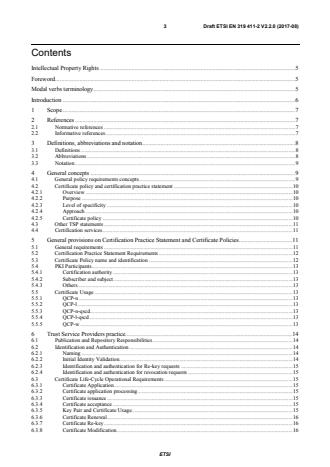
Contents
Intellectual Property Rights . 5
Foreword . 5
Modal verbs terminology . 5
Introduction . 6
1 Scope . 7
2 References . 7
2.1 Normative references . 7
2.2 Informative references . 7
3 Definitions, abbreviations and notation . 8
3.1 Definitions . 8
3.2 Abbreviations . 8
3.3 Notation . 9
4 General concepts . 9
4.1 General policy requirements concepts . 9
4.2 Certificate policy and certification practice statement . 10
4.2.1 Overview . 10
4.2.2 Purpose . 10
4.2.3 Level of specificity . 10
4.2.4 Approach . 10
4.2.5 Certificate policy . 10
4.3 Other TSP statements . 11
4.4 Certification services . 11
5 General provisions on Certification Practice Statement and Certificate Policies. 11
5.1 General requirements . 11
5.2 Certification Practice Statement Requirements . 12
5.3 Certificate Policy name and identification . 12
5.4 PKI Participants . 13
5.4.1 Certification authority . 13
5.4.2 Subscriber and subject . 13
5.4.3 Others . 13
5.5 Certificate Usage . 13
5.5.1 QCP-n . 13
5.5.2 QCP-l . 13
5.5.3 QCP-n-qscd. 13
5.5.4 QCP-l-qscd . 13
5.5.5 QCP-w . 13
6 Trust Service Providers practice . 14
6.1 Publication and Repository Responsibilities . 14
6.2 Identification and Authentication . 14
6.2.1 Naming . 14
6.2.2 Initial Identity Valid atio n . 14
6.2.3 Identification and authentication for Re-key requests . 15
6.2.4 Identification and authentication for revocation requests . 15
6.3 Certificate Life-Cycle Operational Requirements . 15
6.3.1 Certificate Application . 15
6.3.2 Certificate application processing . 15
6.3.3 Certificate issuance . 15
6.3.4 Certificate acceptance . 15
6.3.5 Key Pair and Certificate Usage . 15
6.3.6 Certificate Renewal. 16
6.3.7 Certificate Re-key . 16
6.3.8 Certificate Modification . 16
ETSI
4 Draft ETSI EN 319 411-2 V2.2.0 (2017-08)
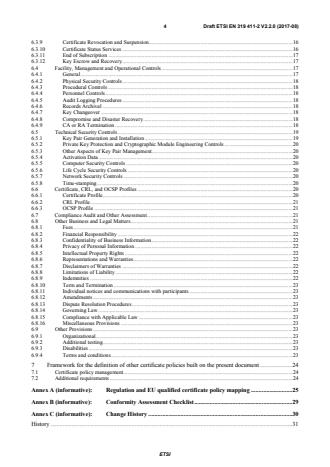
6.3.9 Certificate Revocation and Suspension. 16
6.3.10 Certificate Status Services . 16
6.3.11 End of Subscription . 17
6.3.12 Key Escrow and Recovery . 17
6.4 Facility, Management and Operational Controls . 17
6.4.1 General . 17
6.4.2 Physical Security Controls . 18
6.4.3 Procedural Controls . 18
6.4.4 Personnel Controls . 18
6.4.5 Audit Logging Procedures . 18
6.4.6 Records Archival . 18
6.4.7 Key Changeover . 18
6.4.8 Compromise and Disaster Recovery . 18
6.4.9 CA or RA Termination . 18
6.5 Technical Security Controls . 19
6.5.1 Key Pair Generation and Installation . 19
6.5.2 Private Key Protection and Cryptographic Module Engineering Controls . 20
6.5.3 Other Aspects of Key Pair Management . 20
6.5.4 Activation Data . 20
6.5.5 Computer Security Controls . 20
6.5.6 Life Cycle Security Controls . 20
6.5.7 Network Security Controls . 20
6.5.8 Time-stamping . 20
6.6 Certificate, CRL, and OCSP Profiles . 20
6.6.1 Certificate Profile . 20
6.6.2 CRL Profile . 21
6.6.3 OCSP Profile . 21
6.7 Compliance Audit and Other Assessment . 21
6.8 Other Business and Legal Matters . 21
6.8.1 Fees . 21
6.8.2 Financial Responsibility . 22
6.8.3 Confidentiality of Business Information . 22
6.8.4 Privacy of Personal Information . 22
6.8.5 Intellectual Property Rights . 22
6.8.6 Representations and Warranties . 22
6.8.7 Disclaimers of Warranties . 22
6.8.8 Limitations of Liability . 22
6.8.9 Indemnities . 22
6.8.10 Term and Termination . 23
6.8.11 Individual notices and communications with participants . 23
6.8.12 Amendments . 23
6.8.13 Dispute Resolution Procedures . 23
6.8.14 Governing Law . 23
6.8.15 Compliance with Applicable Law . 23
6.8.16 Miscellaneous Provisions . 23
6.9 Other Provisions . 23
6.9.1 Organizational . 23
6.9.2 Additional testing . 23
6.9.3 Disabilities . 23
6.9.4 Terms and conditions . 23
7 Framework for the definition of other certificate policies built on the present document . 24
7.1 Certificate policy management . 24
7.2 Additional requirements . 24
Annex A (informative): Regulation and EU qualified certificate policy mapping . 25
Annex B (informative): Conformity Assessment Checklist . 29
Annex C (informative): Change History . 30
History . 31
ETSI
5 Draft ETSI EN 319 411-2 V2.2.0 (2017-08)
Intellectual Property Rights
Essential patents
IPRs essential or potentially essential to the present document may have been declared to ETSI. The information
pertaining to these essential IPRs, if any, is publicly available for ETSI members and non-members, and can be found
in ETSI SR 000 314: "Intellectual Property Rights (IPRs); Essential, or potentially Essential, IPRs notified to ETSI in
respect of ETSI standards", which is available from the ETSI Secretariat. Latest updates are available on the ETSI Web
server (https://ipr.etsi.org/).
Pursuant to the ETSI IPR Policy, no investigation, including IPR searches, has been carried out by ETSI. No guarantee
can be given as to the existence of other IPRs not referenced in ETSI SR 000 314 (or the updates on the ETSI Web
server) which are, or may be, or may become, essential to the present document.
Trademarks
The present document may include trademarks and/or tradenames which are asserted and/or registered by their owners.
ETSI claims no ownership of these except for any which are indicated as being the property of ETSI, and conveys no
right to use or reproduce any trademark and/or tradename. Mention of those trademarks in the present document does
not constitute an endorsement by ETSI of products, services or organizations associated with those trademarks.
Foreword
This draft European Standard (EN) has been produced by ETSI Technical Committee Electronic Signatures and
Infrastructures (ESI), and is now submitted for the combined Public Enquiry and Vote phase of the ETSI standards EN
Approval Procedure.
The present document is part 2 of a multi-part deliverable covering policy requirements for Trust Service Providers
issuing certificates. Full details of the entire series can be found in part 1 [2].
The present document is derived from the requirements specified in ETSI TS 101 456 [i.2].
Proposed national transposition dates
Date of latest announcement of this EN (doa): 3 months after ETSI publication
Date of latest publication of new National Standard
or endorsement of this EN (dop/e): 6 months after doa
Date of withdrawal of any conflicting National Standard (dow): 6 months after doa
Modal verbs terminology
In the present document "shall", "shall not", "should", "should not", "may", "need not", "will", "will not", "can" and
"cannot" are to be interpreted as described in clause 3.2 of the ETSI Drafting Rules (Verbal forms for the expression of
provisions).
"must" and "must not" are NOT allowed in ETSI deliverables except when used in direct citation.
ETSI
6 Draft ETSI EN 319 411-2 V2.2.0 (2017-08)
Introduction
The Regulation (EU) No 910/2014 [i.1] establishes a legal framework for electronic signature and electronic seal and
for website authentication services. These concepts can be commonly achieved by using cryptographic mechanisms.
Electronic signatures and seals implemented by this way are digital signatures. Cryptographic mechanisms are generally
supported by a trust service provider (TSP) issuing public key certificates, commonly called a certification authority
(CA).
By providing general policy and security requirements for trust service providers issuing certificates, the part 1 of the
series ETSI EN 319 411-1 [2], is aiming to meet the general requirements of the international community to provide
trust and confidence in electronic transactions including, amongst others, requirements from Regulation (EU)
No 910/2014 [i.1] and from CA/Browser Forum [i.3].
The present document incorporates the general policy and security requirements as specified in ETSI EN 319 411-1 [2]
and adds further requirements in order to meet the specific requirements of Regulation (EU) N° 910/2014 for TSPs
issuing EU qualified certificates for electronic signatures and/or EU qualified certificates for electronic seals and/or EU
qualified certificates for website authentication in accordance with but not limited to Articles 19, 24, 28, 38 and 45 of
Regulation (EU) No 910/2014 [i.1].
Bodies wishing to establish policy requirements for TSPs issuing certificates in a regulatory context other than the EU
can build their specifications on the general policy requirements specified in ETSI EN 319 411-1 [2] to benefit from
global best practices, and specify any additional requirements in a manner similar to the present document.
Conformance to the present document on its own does not imply that the TSP, nor the certificates issued by the TSP, are
qualified in accordance with Regulation (EU) No 910/2014 [i.1].
ETSI
7 Draft ETSI EN 319 411-2 V2.2.0 (2017-08)
1 Scope
The present document specifies policy and security requirements for the issuance, maintenance and life-cycle
management of EU qualified certificates as defined in Regulation (EU) No 910/2014 [i.1]. These policy and security
requirements support reference certificate policies for the issuance, maintenance and life-cycle management of EU
qualified certificates issued to natural persons (including natural persons associated with a legal person or a website)
and to legal persons (including legal persons associated with a website), respectively.
The present document does not specify how the requirements identified can be assessed by an independent party,
including requirements for information to be made available to such independent assessors, or requirements on such
assessors. The present document however provides in annex B a checklist of the policy requirements specific to TSP
issuing EU qualified certificates (as expressed in the present document) as well as all the requirements incorporated by
reference to ETSI EN 319 411-1 [2] and ETSI EN 319 401 [1], that can be used by the TSP to prepare an assessment of
its practices against the present document and/or by the assessor when conducting the assessment for confirming that a
TSP meets the requirements for issuing qualified certificates under Regulation (EU) No 910/2014 [i.1].
NOTE: See ETSI EN 319 403 [i.6] for guidance on assessment of TSP's processes and services.
2 References
2.1 Normative references
References are either specific (identified by date of publication and/or edition number or version number) or
non-specific. For specific references, only the cited version applies. For non-specific references, the latest version of the
referenced document (including any amendments) applies.
Referenced documents which are not found to be publicly available in the expected location might be found at
https://docbox.etsi.org/Reference.
NOTE: While any hyperlinks included in this clause were valid at the time of publication, ETSI cannot guarantee
their long term validity.
The following referenced documents are necessary for the application of the present document.
[1] ETSI EN 319 401: "Electronic Signatures and Infrastructures (ESI); General Policy Requirements
for Trust Service Providers".
[2] ETSI EN 319 411-1: "Electronic Signatures and Infrastructures (ESI); Policy and security
requirements for trust service providers issuing certificates; Part 1: General requirements".
[3] ETSI EN 319 412-5: "Electronic Signatures and Infrastructures (ESI); Certificate Profiles; Part 5:
QCStatements".
[4] ISO/IEC 9594-8/Recommendation ITU-T X.509: "Information technology - Open Systems
Interconnection - The Directory - Part 8: Public-key and attribute certificate frameworks".
2.2 Informative references
References are either specific (identified by date of publication and/or edition number or version number) or
non-specific. For specific references, only the cited version applies. For non-specific references, the latest version of the
referenced document (including any amendments) applies.
NOTE: While any hyperlinks included in this clause were valid at the time of publication, ETSI cannot guarantee
their long term validity.
ETSI
8 Draft ETSI EN 319 411-2 V2.2.0 (2017-08)
The following referenced documents are not necessary for the application of the present document but they assist the
user with regard to a particular subject area.
[i.1] Regulation (EU) No 910/2014 of the European Parliament and of the Council on electronic
identification and trust services for electronic transactions in the internal market and repealing
Directive 1999/93/EC.
[i.2] ETSI TS 101 456: "Electronic Signatures and Infrastructures (ESI); Policy requirements for
certification authorities issuing qualified certificates".
[i.3] CA/Browser Forum: "Baseline Requirements for the Issuance and Management of Publicly-
Trusted Certificates".
[i.4] IETF RFC 3647: "Internet X.509 Public Key Infrastructure Certificate Policy and Certification
Practices Framework".
[i.5] Directive 95/46/EC of the European Parliament and of the Council of 24 October 1995 on the
protection of individuals with regard to the processing of personal data and on the free movement
of such data.
[i.6] ETSI EN 319 403: "Electronic Signatures and Infrastructures (ESI); Trust Service Provider
Conformity Assessment - Requirements for conformity assessment bodies assessing Trust Service
Providers".
[i.7] CA/Browser Forum: "Guidelines for The Issuance and Management of Extended Validation
Certificates v1.5.5".
[i.8] ETSI TS 119 612: "Electronic Signatures and Infrastructures (ESI); Trusted Lists".
[i.9] IETF RFC 6960: "Internet X.509 Public Key Infrastructure Online Certificate Status Protocol -
OCSP".
3 Definitions, abbreviations and notation
3.1 Definitions
For the purposes of the present document, the terms and definitions given in ETSI EN 319 401 [1], ETSI
EN 319 411-1 [2], Regulation (EU) No 910/2014 [i.1] and the following apply:
EU Qualified Certificate: qualified certificate as specified in Regulation (EU) No 910/2014 [i.1]
Qualified Electronic Signature/Seal Creation Device: As specified in Regulation (EU) No 910/2014 [i.1].
3.2 Abbreviations
For the purposes of the present document, the abbreviations given in ETSI EN 319 401 [1], ETSI EN 319 411-1 [2] and
the following apply:
QCP-l Policy for EU qualified certificate issued to a legal person
QCP-l-qscd Policy for EU qualified certificate issued to a legal person where the private key and the related
certificate reside on a QSCD
QCP-n Policy for EU qualified certificate issued to a natural person
QCP-n-qscd Policy for EU qualified certificate issued to a natural person where the private key and the related
certificate reside on a QSCD
QCP-w Policy for EU qualified website certificate issued to a natural or a legal person and linking the
website to that person
QSCD Qualified electronic Signature/Seal Creation Device
ETSI
9 Draft ETSI EN 319 411-2 V2.2.0 (2017-08)
3.3 Notation
The requirements identified in the present document include:
a) requirements applicable to any certificate policy. Such requirements are indicated by clauses without any
additional marking;
b) requirements applicable under certain conditions. Such requirements are indicated by clauses marked by
"[CONDITIONAL]";
c) requirements that include several choices which ought to be selected according to the applicable situation.
Such requirements are indicated by clauses marked by "[CHOICE]";
d) requirements applicable to the services offered under the applicable certificate policy. Such requirements are
indicated by clauses marked by the applicable certificate policy indicator: "[QCP-l]", "[QCP-n]",
"[QCP-l-qscd]", "[QCP-n-qscd]" and/or "[QCP-w]".
Each requirement is identified as follows:
<3 letters service component> - < the clause number> - <2 digit number – incremental>
The service components are:
• OVR: General requirement (requirement applicable to more than 1 component)
• GEN: Certificate Generation Services
• REG: Registration Services
• REV: Revocation Services
• DIS: Dissemination Services
• SDP: Subject Device Provisioning
• CSS: Certificate Status Service
The management of the requirement identifiers throughout subsequent editions of the present document is as follows:
• When a requirement is inserted at the end of a clause, the 2 digit number above is incremented to the next
available digit.
• When a requirement is inserted between two existing requirements, capital letters appended to the previous
requirement identifier are used to distinguish new requirements.
• The requirement identifier for deleted requirements are left and completed with "VOID".
• The requirement identifier for modified requirement are left void and the modified requirement is identified by
capital letter(s) appended to the initial requirement number.
4 General concepts
4.1 General policy requirements concepts
ETSI EN 319 411-1 [2], clause 4.1 applies.
ETSI
10 Draft ETSI EN 319 411-2 V2.2.0 (2017-08)
4.2 Certificate policy and certification practice statement
4.2.1 Overview
The explanations identified in ETSI EN 319 411-1 [2], clause 4.2.1 apply.
4.2.2 Purpose
The explanations identified in ETSI EN 319 411-1 [2], clause 4.2.2 apply.
4.2.3 Level of specificity
The guidelines identified in ETSI EN 319 411-1 [2], clause 4.2.3 apply.
4.2.4 Approach
The guidelines identified in ETSI EN 319 411-1 [2], clause 4.2.4 apply.
4.2.5 Certificate policy
The present document defines five certificate policies and allocates a policy identifier for each of them. These policy
identifiers are called "EU qualified certificate policy identifiers"; they are defined in clause 5.3.
The certificate policies are based on the following policies specified in ETSI EN 319 411-1 [2]:
• normalized certificate policy (NCP);
• enhanced normalized certificate policy (NCP+); and
• extended validation certificate policy (EVCP).
The five EU qualified certificate policies are:
1) A policy for EU qualified certificates issued to natural persons (QCP-n) offering the level of quality defined in
Regulation (EU) No 910/2014 [i.1] for EU qualified certificates:
- The requirements for QCP-n include all the NCP policy requirements, plus additional requirements
suited to support EU qualified certificates issuance and management as specified in Regulation (EU)
No 910/2014 [i.1].
- If the TSP's implementation of this policy requires a secure cryptographic device, the requirements for
QCP-n include all the NCP+ requirements, plus the additional requirements suited to support EU
qualified certificates issuance and management as specified in Regulation (EU) No 910/2014 [i.1].
2) A policy for EU qualified certificates issued to legal persons (QCP-l) offering the level of quality defined in
Regulation (EU) No 910/2014 [i.1] for EU qualified certificates:
- The requirements for QCP-l include all the NCP policy requirements, plus additional requirements suited
to support EU qualified certificates issuance and management as specified in Regulation (EU)
No 910/2014 [i.1].
- If the TSP's implementation of this policy requires a secure cryptographic device, the requirements for
QCP-n include all the NCP+ requirements, plus the additional requirements suited to support EU
qualified certificates issuance and management as specified in Regulation (EU) No 910/2014 [i.1].
ETSI
11 Draft ETSI EN 319 411-2 V2.2.0 (2017-08)
3) A policy (QCP-n-qscd) for EU qualified certificates issued to natural persons offering the level of quality
defined in Regulation (EU) No 910/2014 [i.1] for EU qualified certificates and requiring the use of a Qualified
Signature Creation Device (QSCD). Such policy requires that the private key related to the certified public key
resides in the QSCD:
- The requirements for QCP-n-qscd include all the QCP-n requirements (including all the NCP+
requirements), plus additional provisions suited to support EU qualified certificates issuance and
management as specified in Regulation (EU) No 910/2014 [i.1], including those specific to the QSCD
provision.
4) A policy (QCP-l-qscd) for EU qualified certificates issued to legal persons offering the level of quality defined
in Regulation (EU) No 910/2014 [i.1] for EU qualified certificates and requiring the use of a Qualified Seal
Creation Device (QSCD). Such policy requires that the private key related to the certified public key resides in
the QSCD:
- The requirements for QCP-l-qscd include all the QCP-l requirements (including all the NCP+
requirements), plus additional provisions suited to support EU qualified certificates issuance and
management as specified in Regulation (EU) No 910/2014 [i.1], including those specific to the QSCD
provision.
5) A policy for EU qualified website certificates (QCP-w) offering the level of quality defined in Regulation
(EU) No 910/2014 [i.1] for EU qualified certificates (requiring or not the use of a secure cryptographic device)
used in support of websites authentication:
- When the certificate is issued to a legal person the requirements for QCP-w include all the EVCP
requirements, plus additional provisions suited to support EU qualified certificates issuance and
management as specified in Regulation (EU) No 910/2014 [i.1].
- When the certificate is issued to a natural person the requirements for QCP-w include all the NCP
requirements, plus additional provisions suited to support EU qualified certificates issuance and
management as specified in Regulation (EU) No 910/2014 [i.1].
Clause 7 specifies a framework for other certificate policies which enhance or further constrain the above policies.
4.3 Other TSP statements
The guidelines identified in ETSI EN 319 411-1 [2], clause 4.3 apply.
4.4 Certification services
The service of issuing EU qualified certificates is broken down in component services presented in ETSI
EN 319 411-1 [2], clause 4.4 for the purposes of classifying requirements.
5 General provisions on Certification Practice
Statement and Certificate Policies
5.1 General requirements
The present document is structured broadly in line with IETF RFC 3647 [i.4] to assist TSPs in applying these
requirements to their own CP and CPS documentation.
ETSI
12 Draft ETSI EN 319 411-2 V2.2.0 (2017-08)
OVR-5.1-01: The general requirements specified in ETSI EN 319 411-1 [2], clause 5.1 shall apply.
In addition the following particular requirements apply:
OVR-5.1-02 [QCP-n] and [QCP-l] [CHOICE]:
• If the TSP's terms and conditions does not require a secure cryptographic device, all requirements defined for
NCP in ETSI EN 319 411-1 [2] shall apply. Where a requirement for NCP is specified differently for natural
person or legal person respectively, such requirement shall apply for QCP-n or QCP-l accordingly.
• If the TSP's terms and conditions requires a secure cryptographic device all requirements defined for NCP+ in
ETSI EN 319 411-1 [2] shall apply. Where a requirement for NCP+ is specified differently for natural person
or legal person respectively, such requirement shall apply for QCP-n or QCP-l accordingly.
OVR-5.1-03 [QCP-w] [CHOICE]:
• If the certificate is issued to a legal person, all requirements defined for EVCP in ETSI EN 319 411-1 [2], shall
apply.
• If the certificate is issued to a natural person, all requirements defined for NCP in ETSI EN 319 411-1 [2],
shall apply.
OVR-5.1-04 [QCP-n-qscd]: all requirements defined for [QCP-n], including all requirements defined for NCP+ in ETSI
EN 319 411-1 [2], shall apply. Where a requirement for NCP+ is specified differently for natural person or legal person
respectively, the requirement for natural person shall apply for QCP-n-qscd.
OVR-5.1-05 [QCP-l-qscd]: all requirements defined for [QCP-l], including all requirements defined for NCP+ in ETSI
EN 319 411-1 [2], shall apply. Where a requirement for NCP+ is specified differently for natural person or legal person
respectively, the requirement for legal person shall apply for QCP-l-qscd.
5.2 Certification Practice Statement Requirements
OVR-5.2-01: The requirements identified in ETSI EN 319 411-1 [2], clause 5.2 shall apply.
5.3 Certificate Policy name and identification
As described in IETF RFC 3647 [i.4], clause 3.3, certificates include a certificate policy identifier which can be used by
relying parties in determining the certificates suitability and trustworthiness for a particular application.
The identifiers for the EU qualified certificate policies specified in the present document are:
a) QCP-n: certificate policy for EU qualified certificates issued to natural persons;
Itu-t(0) identified-organization(4) etsi(0) qualified-certificate-policies(194112)
policy-identifiers(1) qcp-natural (0)
b) QCP-l: certificate policy for EU qualified certificates issued to legal persons;
itu-t(0) identified-organization(4) etsi(0) qualified-certificate-policies(194112)
policy-identifiers(1) qcp-legal (1)
c) QCP-n-qscd: certificate policy for EU qualified certificates issued to natural persons with private key related
to the certified public key in a QSCD;
Itu-t(0) identified-organization(4) etsi(0) qualified-certificate-policies(194112)
policy-identifiers(1) qcp-natural-qscd (2)
d) QCP-l-qscd: certificate policy for EU qualified certificates issued to legal persons with private key related to
the certified public key in a QSCD;
itu-t(0) identified-organization(4) etsi(0) qualified-certificate-policies(194112)
policy-identifiers(1) qcp-legal-qscd (3)
ETSI
13 Draft ETSI EN 319 411-2 V2.2.0 (2017-08)
e) QCP-w: certificate policy for EU qualified website authentication certificates;
itu-t(0) identified-organization(4) etsi(0) qualified-certificate-policies(194112)
policy-identifiers(1) qcp-web (4)
Including one of the policy identifiers defined above in a EU qualified certificate indicates that the certificate is issued
and managed according to the present document for that policy. The policy identifier can be used by relying parties in
determining the certificate's suitability and trustworthiness in the framework of Regulation (EU) No 910/2014 [i.1].
NOTE: See clause 4.2.5 for a general description of the above policies.
5.4 PKI Participants
5.4.1 Certification authority
The concepts described in ETSI EN 319 411-1 [2], clause 5.4.1 apply.
NOTE: Regulation (EU) No 910/2014 addresses liability of trust service providers. In particular, the TSP
identified as the qualified TSP issuing EU qualified certificates in the trusted list of qualified services,
maintains overall responsibility for meeting liability for the issuing of certificates as required in
Regulation (EU) No 910/2014 [i.1].
5.4.2 Subscriber and subject
ETSI EN 319 411-1 [2], clause 5.4.2 applies.
5.4.3 Others
ETSI EN 319 411-1 [2], clause 5.4.3 applies.
5.5 Certificate Usage
5.5.1 QCP-n
Certificates issued under these requirements are aimed to support the advanced electronic signatures based on a
qualified certificate defined in articles 26 and 27 of the Regulation (EU) No 910/2014 [i.1].
5.5.2 QCP-l
Certificates issued under these requirements are aimed to support the advanced electronic seals based on a qualified
certificate defined in articles 36 and 37 of the Regulation (EU) No 910/2014 [i.1].
5.5.3 QCP-n-qscd
Certificates issued under these requirements are aimed to support qualified electronic signatures such as defined in
article 3 (12) of the Regulation (EU) No 910/2014 [i.1].
5.5.4 QCP-l-qscd
Certificates issued under these requirements are aimed to support qualified electronic seals such as defined in
article 3 (27) of the Regulation (EU) No 910/2014 [i.1].
5.5.5 QCP-w
Certificates issued under these requirements are aimed to support website authentication based on a qualified certificate
defined in articles 3 (38) and 45 of the Regulation (EU) No 910/2014 [i.1].
ETSI
14 Draft ETSI EN 319 411-2 V2.2.0 (2017-08)
Certificates issued under these requirements endorse the requirement of EV Certificates whose purpose is specified in
clause 5.5 of ETSI EN 319 411-1 [2]. In addition, EU qualified certificates issued under this policy may be used to
provide a means by which a visitor to a website can be assured that there is a genuine and legitimate entity standing
behind the website as specified in Regulation (EU) No 910/2014 [i.1].
6 Trust Ser
...
Final draft ETSI EN 319 411-2 V2.2.1 (2018-02)
EUROPEAN STANDARD
Electronic Signatures and Infrastructures (ESI);
Policy and security requirements for
Trust Service Providers issuing certificates;
Part 2: Requirements for trust service providers issuing
EU qualified certificates
2 Final draft ETSI EN 319 411-2 V2.2.1 (2018-02)
Reference
REN/ESI-0019411-2v221
Keywords
e-commerce, electronic signature, security, trust
services
ETSI
650 Route des Lucioles
F-06921 Sophia Antipolis Cedex - FRANCE
Tel.: +33 4 92 94 42 00 Fax: +33 4 93 65 47 16
Siret N° 348 623 562 00017 - NAF 742 C
Association à but non lucratif enregistrée à la
Sous-Préfecture de Grasse (06) N° 7803/88
Important notice
The present document can be downloaded from:
http://www.etsi.org/standards-search
The present document may be made available in electronic versions and/or in print. The content of any electronic and/or
print versions of the present document shall not be modified without the prior written authorization of ETSI. In case of any
existing or perceived difference in contents between such versions and/or in print, the only prevailing document is the
print of the Portable Document Format (PDF) version kept on a specific network drive within ETSI Secretariat.
Users of the present document should be aware that the document may be subject to revision or change of status.
Information on the current status of this and other ETSI documents is available at
https://portal.etsi.org/TB/ETSIDeliverableStatus.aspx
If you find errors in the present document, please send your comment to one of the following services:
https://portal.etsi.org/People/CommiteeSupportStaff.aspx
Copyright Notification
No part may be reproduced or utilized in any form or by any means, electronic or mechanical, including photocopying
and microfilm except as authorized by written permission of ETSI.
The content of the PDF version shall not be modified without the written authorization of ETSI.
The copyright and the foregoing restriction extend to reproduction in all media.
© ETSI 2018.
All rights reserved.
TM TM TM
DECT , PLUGTESTS , UMTS and the ETSI logo are trademarks of ETSI registered for the benefit of its Members.
TM
3GPP and LTE™ are trademarks of ETSI registered for the benefit of its Members and
of the 3GPP Organizational Partners.
oneM2M logo is protected for the benefit of its Members.
GSM® and the GSM logo are trademarks registered and owned by the GSM Association.
ETSI
3 Final draft ETSI EN 319 411-2 V2.2.1 (2018-02)
Contents
Intellectual Property Rights . 5
Foreword . 5
Modal verbs terminology . 5
Introduction . 6
1 Scope . 7
2 References . 7
2.1 Normative references . 7
2.2 Informative references . 7
3 Definitions, abbreviations and notation . 8
3.1 Definitions . 8
3.2 Abbreviations . 8
3.3 Notation . 9
4 General concepts . 9
4.1 General policy requirements concepts . 9
4.2 Certificate policy and certification practice statement . 10
4.2.1 Overview . 10
4.2.2 Purpose . 10
4.2.3 Level of specificity . 10
4.2.4 Approach . 10
4.2.5 Certificate policy . 10
4.3 Other TSP statements . 11
4.4 Certification services . 11
5 General provisions on Certification Practice Statement and Certificate Policies. 11
5.1 General requirements . 11
5.2 Certification Practice Statement Requirements . 12
5.3 Certificate Policy name and identification . 12
5.4 PKI Participants . 13
5.4.1 Certification authority . 13
5.4.2 Subscriber and subject . 13
5.4.3 Others . 13
5.5 Certificate Usage . 13
5.5.1 QCP-n . 13
5.5.2 QCP-l . 13
5.5.3 QCP-n-qscd. 13
5.5.4 QCP-l-qscd . 13
5.5.5 QCP-w . 14
6 Trust Service Providers practice . 14
6.1 Publication and Repository Responsibilities . 14
6.2 Identification and Authentication . 14
6.2.1 Naming . 14
6.2.2 Initial Identity Valid atio n . 14
6.2.3 Identification and authentication for Re-key requests . 15
6.2.4 Identification and authentication for revocation requests . 15
6.3 Certificate Life-Cycle Operational Requirements . 15
6.3.1 Certificate Application . 15
6.3.2 Certificate application processing . 15
6.3.3 Certificate issuance . 15
6.3.4 Certificate acceptance . 15
6.3.5 Key Pair and Certificate Usage . 15
6.3.6 Certificate Renewal. 16
6.3.7 Certificate Re-key . 16
6.3.8 Certificate Modification . 16
ETSI
4 Final draft ETSI EN 319 411-2 V2.2.1 (2018-02)
6.3.9 Certificate Revocation and Suspension. 16
6.3.10 Certificate Status Services . 16
6.3.11 End of Subscription . 18
6.3.12 Key Escrow and Recovery . 18
6.4 Facility, Management and Operational Controls . 18
6.4.1 General . 18
6.4.2 Physical Security Controls . 18
6.4.3 Procedural Controls . 18
6.4.4 Personnel Controls . 18
6.4.5 Audit Logging Procedures . 18
6.4.6 Records Archival . 18
6.4.7 Key Changeover . 19
6.4.8 Compromise and Disaster Recovery . 19
6.4.9 CA or RA Termination . 19
6.5 Technical Security Controls . 19
6.5.1 Key Pair Generation and Installation . 19
6.5.2 Private Key Protection and Cryptographic Module Engineering Controls . 19
6.5.3 Other Aspects of Key Pair Management . 19
6.5.4 Activation Data . 20
6.5.5 Computer Security Controls . 20
6.5.6 Life Cycle Security Controls . 20
6.5.7 Network Security Controls . 20
6.5.8 Time-stamping . 20
6.6 Certificate, CRL, and OCSP Profiles . 20
6.6.1 Certificate Profile . 20
6.6.2 CRL Profile . 21
6.6.3 OCSP Profile . 21
6.7 Compliance Audit and Other Assessment . 21
6.8 Other Business and Legal Matters . 21
6.8.1 Fees . 21
6.8.2 Financial Responsibility . 21
6.8.3 Confidentiality of Business Information . 21
6.8.4 Privacy of Personal Information . 22
6.8.5 Intellectual Property Rights . 22
6.8.6 Representations and Warranties . 22
6.8.7 Disclaimers of Warranties . 22
6.8.8 Limitations of Liability . 22
6.8.9 Indemnities . 22
6.8.10 Term and Termination . 22
6.8.11 Individual notices and communications with participants . 22
6.8.12 Amendments . 23
6.8.13 Dispute Resolution Procedures . 23
6.8.14 Governing Law . 23
6.8.15 Compliance with Applicable Law . 23
6.8.16 Miscellaneous Provisions . 23
6.9 Other Provisions . 23
6.9.1 Organizational . 23
6.9.2 Additional testing . 23
6.9.3 Disabilities . 23
6.9.4 Terms and conditions . 23
7 Framework for the definition of other certificate policies built on the present document . 24
7.1 Certificate policy management . 24
7.2 Additional requirements . 24
Annex A (informative): Regulation and EU qualified certificate policy mapping . 25
Annex B (informative): Conformity Assessment Checklist . 29
Annex C (informative): Change History . 30
History . 31
ETSI
5 Final draft ETSI EN 319 411-2 V2.2.1 (2018-02)
Intellectual Property Rights
Essential patents
IPRs essential or potentially essential to the present document may have been declared to ETSI. The information
pertaining to these essential IPRs, if any, is publicly available for ETSI members and non-members, and can be found
in ETSI SR 000 314: "Intellectual Property Rights (IPRs); Essential, or potentially Essential, IPRs notified to ETSI in
respect of ETSI standards", which is available from the ETSI Secretariat. Latest updates are available on the ETSI Web
server (https://ipr.etsi.org/).
Pursuant to the ETSI IPR Policy, no investigation, including IPR searches, has been carried out by ETSI. No guarantee
can be given as to the existence of other IPRs not referenced in ETSI SR 000 314 (or the updates on the ETSI Web
server) which are, or may be, or may become, essential to the present document.
Trademarks
The present document may include trademarks and/or tradenames which are asserted and/or registered by their owners.
ETSI claims no ownership of these except for any which are indicated as being the property of ETSI, and conveys no
right to use or reproduce any trademark and/or tradename. Mention of those trademarks in the present document does
not constitute an endorsement by ETSI of products, services or organizations associated with those trademarks.
Foreword
This final draft European Standard (EN) has been produced by ETSI Technical Committee Electronic Signatures and
Infrastructures (ESI), and is now submitted for the Vote phase of the ETSI standards EN Approval Procedure.
The present document is part 2 of a multi-part deliverable covering policy requirements for Trust Service Providers
issuing certificates. Full details of the entire series can be found in part 1 [2].
The present document is derived from the requirements specified in ETSI TS 101 456 [i.2].
Proposed national transposition dates
Date of latest announcement of this EN (doa): 3 months after ETSI publication
Date of latest publication of new National Standard
or endorsement of this EN (dop/e): 6 months after doa
Date of withdrawal of any conflicting National Standard (dow): 6 months after doa
Modal verbs terminology
In the present document "shall", "shall not", "should", "should not", "may", "need not", "will", "will not", "can" and
"cannot" are to be interpreted as described in clause 3.2 of the ETSI Drafting Rules (Verbal forms for the expression of
provisions).
"must" and "must not" are NOT allowed in ETSI deliverables except when used in direct citation.
ETSI
6 Final draft ETSI EN 319 411-2 V2.2.1 (2018-02)
Introduction
The Regulation (EU) No 910/2014 [i.1] establishes a legal framework for electronic signature and electronic seal and
for website authentication services. These concepts can be commonly achieved by using cryptographic mechanisms.
Electronic signatures and seals implemented by this way are digital signatures. Cryptographic mechanisms are generally
supported by a trust service provider (TSP) issuing public key certificates, commonly called a certification authority
(CA).
By providing general policy and security requirements for trust service providers issuing certificates, the part 1 of the
series ETSI EN 319 411-1 [2], is aiming to meet the general requirements of the international community to provide
trust and confidence in electronic transactions including, amongst others, requirements from Regulation (EU)
No 910/2014 [i.1] and from CA/Browser Forum [i.3].
The present document incorporates the general policy and security requirements as specified in ETSI EN 319 411-1 [2]
and adds further requirements in order to meet the specific requirements of Regulation (EU) N° 910/2014 for TSPs
issuing EU qualified certificates for electronic signatures and/or EU qualified certificates for electronic seals and/or EU
qualified certificates for website authentication in accordance with but not limited to Articles 19, 24, 28, 38 and 45 of
Regulation (EU) No 910/2014 [i.1].
Bodies wishing to establish policy requirements for TSPs issuing certificates in a regulatory context other than the EU
can build their specifications on the general policy requirements specified in ETSI EN 319 411-1 [2] to benefit from
global best practices, and specify any additional requirements in a manner similar to the present document.
Conformance to the present document on its own does not imply that the TSP, nor the certificates issued by the TSP, are
qualified in accordance with Regulation (EU) No 910/2014 [i.1].
ETSI
7 Final draft ETSI EN 319 411-2 V2.2.1 (2018-02)
1 Scope
The present document specifies policy and security requirements for the issuance, maintenance and life-cycle
management of EU qualified certificates as defined in Regulation (EU) No 910/2014 [i.1]. These policy and security
requirements support reference certificate policies for the issuance, maintenance and life-cycle management of EU
qualified certificates issued to natural persons (including natural persons associated with a legal person or a website)
and to legal persons (including legal persons associated with a website), respectively.
The present document does not specify how the requirements identified can be assessed by an independent party,
including requirements for information to be made available to such independent assessors, or requirements on such
assessors. The present document however provides in annex B a checklist of the policy requirements specific to TSP
issuing EU qualified certificates (as expressed in the present document) as well as all the requirements incorporated by
reference to ETSI EN 319 411-1 [2] and ETSI EN 319 401 [1], that can be used by the TSP to prepare an assessment of
its practices against the present document and/or by the assessor when conducting the assessment for confirming that a
TSP meets the requirements for issuing qualified certificates under Regulation (EU) No 910/2014 [i.1].
NOTE: See ETSI EN 319 403 [i.6] for guidance on assessment of TSP's processes and services.
2 References
2.1 Normative references
References are either specific (identified by date of publication and/or edition number or version number) or
non-specific. For specific references, only the cited version applies. For non-specific references, the latest version of the
referenced document (including any amendments) applies.
Referenced documents which are not found to be publicly available in the expected location might be found at
https://docbox.etsi.org/Reference.
NOTE: While any hyperlinks included in this clause were valid at the time of publication, ETSI cannot guarantee
their long term validity.
The following referenced documents are necessary for the application of the present document.
[1] ETSI EN 319 401: "Electronic Signatures and Infrastructures (ESI); General Policy Requirements
for Trust Service Providers".
[2] ETSI EN 319 411-1: "Electronic Signatures and Infrastructures (ESI); Policy and security
requirements for trust service providers issuing certificates; Part 1: General requirements".
[3] ETSI EN 319 412-5: "Electronic Signatures and Infrastructures (ESI); Certificate Profiles; Part 5:
QCStatements".
[4] ISO/IEC 9594-8/Recommendation ITU-T X.509: "Information technology - Open Systems
Interconnection - The Directory - Part 8: Public-key and attribute certificate frameworks".
2.2 Informative references
References are either specific (identified by date of publication and/or edition number or version number) or
non-specific. For specific references, only the cited version applies. For non-specific references, the latest version of the
referenced document (including any amendments) applies.
NOTE: While any hyperlinks included in this clause were valid at the time of publication, ETSI cannot guarantee
their long term validity.
ETSI
8 Final draft ETSI EN 319 411-2 V2.2.1 (2018-02)
The following referenced documents are not necessary for the application of the present document but they assist the
user with regard to a particular subject area.
[i.1] Regulation (EU) No 910/2014 of the European Parliament and of the Council on electronic
identification and trust services for electronic transactions in the internal market and repealing
Directive 1999/93/EC.
[i.2] ETSI TS 101 456: "Electronic Signatures and Infrastructures (ESI); Policy requirements for
certification authorities issuing qualified certificates".
[i.3] CA/Browser Forum: "Baseline Requirements for the Issuance and Management of Publicly-
Trusted Certificates".
[i.4] IETF RFC 3647: "Internet X.509 Public Key Infrastructure Certificate Policy and Certification
Practices Framework".
[i.5] Directive 95/46/EC of the European Parliament and of the Council of 24 October 1995 on the
protection of individuals with regard to the processing of personal data and on the free movement
of such data.
[i.6] ETSI EN 319 403: "Electronic Signatures and Infrastructures (ESI); Trust Service Provider
Conformity Assessment - Requirements for conformity assessment bodies assessing Trust Service
Providers".
[i.7] CA/Browser Forum: "Guidelines for The Issuance and Management of Extended Validation
Certificates v1.5.5".
[i.8] ETSI TS 119 612: "Electronic Signatures and Infrastructures (ESI); Trusted Lists".
[i.9] IETF RFC 6960: "Internet X.509 Public Key Infrastructure Online Certificate Status Protocol -
OCSP".
[i.10] ETSI TR 119 411-4: "Electronic Signatures and Infrastructures (ESI); Policy and security
requirements for Trust Service Providers issuing certificates; Part 4: Checklist supporting audit of
TSP against EN 319 411-1 or EN 319 411-2".
3 Definitions, abbreviations and notation
3.1 Definitions
For the purposes of the present document, the terms and definitions given in ETSI EN 319 401 [1], ETSI
EN 319 411-1 [2], Regulation (EU) No 910/2014 [i.1] and the following apply:
EU Qualified Certificate: Qualified certificate aAs specified in Regulation (EU) No 910/2014 [i.1].
Qualified Electronic Signature/Seal Creation Device: As specified in Regulation (EU) No 910/2014 [i.1].
3.2 Abbreviations
For the purposes of the present document, the abbreviations given in ETSI EN 319 401 [1], ETSI EN 319 411-1 [2] and
the following apply:
QCP-l Policy for EU qualified certificate issued to a legal person
QCP-l-qscd Policy for EU qualified certificate issued to a legal person where the private key and the related
certificate reside on a QSCD
QCP-n Policy for EU qualified certificate issued to a natural person
QCP-n-qscd Policy for EU qualified certificate issued to a natural person where the private key and the related
certificate reside on a QSCD
QCP-w Policy for EU qualified website certificate issued to a natural or a legal person and linking the
website to that person
QSCD Qualified electronic Signature/Seal Creation Device
ETSI
9 Final draft ETSI EN 319 411-2 V2.2.1 (2018-02)
3.3 Notation
The requirements identified in the present document include:
a) requirements applicable to any certificate policy. Such requirements are indicated by clauses without any
additional marking;
b) requirements applicable under certain conditions. Such requirements are indicated by clauses marked by
"[CONDITIONAL]";
c) requirements that include several choices which ought to be selected according to the applicable situation.
Such requirements are indicated by clauses marked by "[CHOICE]";
d) requirements applicable to the services offered under the applicable certificate policy. Such requirements are
indicated by clauses marked by the applicable certificate policy indicator: "[QCP-l]", "[QCP-n]",
"[QCP-l-qscd]", "[QCP-n-qscd]" and/or "[QCP-w]".
Each requirement is identified as follows:
<3 letters service component> - < the clause number> - <2 digit number – incremental>
The service components are:
• OVR: General requirement (requirement applicable to more than 1 component)
• GEN: Certificate Generation Services
• REG: Registration Services
• REV: Revocation Services
• DIS: Dissemination Services
• SDP: Subject Device Provisioning
• CSS: Certificate Status Service
The management of the requirement identifiers throughout subsequent editions of the present document is as follows:
• When a requirement is inserted at the end of a clause, the 2 digit number above is incremented to the next
available digit.
• When a requirement is inserted between two existing requirements, capital letters appended to the previous
requirement identifier are used to distinguish new requirements.
• The requirement identifier for deleted requirements are left and completed with "VOID".
• The requirement identifier for modified requirement are left void and the modified requirement is identified by
capital letter(s) appended to the initial requirement number.
4 General concepts
4.1 General policy requirements concepts
ETSI EN 319 411-1 [2], clause 4.1 applies.
ETSI
10 Final draft ETSI EN 319 411-2 V2.2.1 (2018-02)
4.2 Certificate policy and certification practice statement
4.2.1 Overview
The explanations identified in ETSI EN 319 411-1 [2], clause 4.2.1 apply.
4.2.2 Purpose
The explanations identified in ETSI EN 319 411-1 [2], clause 4.2.2 apply.
4.2.3 Level of specificity
The guidelines identified in ETSI EN 319 411-1 [2], clause 4.2.3 apply.
4.2.4 Approach
The guidelines identified in ETSI EN 319 411-1 [2], clause 4.2.4 apply.
4.2.5 Certificate policy
The present document defines five certificate policies and allocates a policy identifier for each of them. These policy
identifiers are called "EU qualified certificate policy identifiers"; they are defined in clause 5.3.
The certificate policies are based on the following policies specified in ETSI EN 319 411-1 [2]:
• normalized certificate policy (NCP);
• enhanced normalized certificate policy (NCP+); and
• extended validation certificate policy (EVCP).
The five EU qualified certificate policies are:
1) A policy for EU qualified certificates issued to natural persons (QCP-n) offering the level of quality defined in
Regulation (EU) No 910/2014 [i.1] for EU qualified certificates:
- The requirements for QCP-n include all the NCP policy requirements, plus additional requirements
suited to support EU qualified certificates issuance and management as specified in Regulation (EU)
No 910/2014 [i.1].
- If the TSP's implementation of this policy requires a secure cryptographic device, the requirements for
QCP-n include all the NCP+ requirements, plus the additional requirements suited to support EU
qualified certificates issuance and management as specified in Regulation (EU) No 910/2014 [i.1].
2) A policy for EU qualified certificates issued to legal persons (QCP-l) offering the level of quality defined in
Regulation (EU) No 910/2014 [i.1] for EU qualified certificates:
- The requirements for QCP-l include all the NCP policy requirements, plus additional requirements suited
to support EU qualified certificates issuance and management as specified in Regulation (EU)
No 910/2014 [i.1].
- If the TSP's implementation of this policy requires a secure cryptographic device, the requirements for
QCP-n include all the NCP+ requirements, plus the additional requirements suited to support EU
qualified certificates issuance and management as specified in Regulation (EU) No 910/2014 [i.1].
ETSI
11 Final draft ETSI EN 319 411-2 V2.2.1 (2018-02)
3) A policy (QCP-n-qscd) for EU qualified certificates issued to natural persons offering the level of quality
defined in Regulation (EU) No 910/2014 [i.1] for EU qualified certificates and requiring the use of a Qualified
Signature Creation Device (QSCD). Such policy requires that the private key related to the certified public key
resides in the QSCD:
- The requirements for QCP-n-qscd include all the QCP-n requirements (including all the NCP+
requirements), plus additional provisions suited to support EU qualified certificates issuance and
management as specified in Regulation (EU) No 910/2014 [i.1], including those specific to the QSCD
provision.
4) A policy (QCP-l-qscd) for EU qualified certificates issued to legal persons offering the level of quality defined
in Regulation (EU) No 910/2014 [i.1] for EU qualified certificates and requiring the use of a Qualified Seal
Creation Device (QSCD). Such policy requires that the private key related to the certified public key resides in
the QSCD:
- The requirements for QCP-l-qscd include all the QCP-l requirements (including all the NCP+
requirements), plus additional provisions suited to support EU qualified certificates issuance and
management as specified in Regulation (EU) No 910/2014 [i.1], including those specific to the QSCD
provision.
5) A policy for EU qualified website certificates (QCP-w) offering the level of quality defined in Regulation
(EU) No 910/2014 [i.1] for EU qualified certificates (requiring or not the use of a secure cryptographic device)
used in support of websites authentication:
- When the certificate is issued to a legal person the requirements for QCP-w include all the EVCP
requirements, plus additional provisions suited to support EU qualified certificates issuance and
management as specified in Regulation (EU) No 910/2014 [i.1].
- When the certificate is issued to a natural person the requirements for QCP-w include all the NCP
requirements, plus additional provisions suited to support EU qualified certificates issuance and
management as specified in Regulation (EU) No 910/2014 [i.1].
Clause 7 specifies a framework for other certificate policies which enhance or further constrain the above policies.
4.3 Other TSP statements
The guidelines identified in ETSI EN 319 411-1 [2], clause 4.3 apply.
4.4 Certification services
The service of issuing EU qualified certificates is broken down in component services presented in ETSI
EN 319 411-1 [2], clause 4.4 for the purposes of classifying requirements.
5 General provisions on Certification Practice
Statement and Certificate Policies
5.1 General requirements
The present document is structured broadly in line with IETF RFC 3647 [i.4] to assist TSPs in applying these
requirements to their own CP and CPS documentation.
ETSI
12 Final draft ETSI EN 319 411-2 V2.2.1 (2018-02)
OVR-5.1-01: The general requirements specified in ETSI EN 319 411-1 [2], clause 5.1 shall apply.
In addition the following particular requirements apply:
OVR-5.1-02 [QCP-n] and [QCP-l] [CHOICE]:
• If the TSP's terms and conditions does not require a secure cryptographic device, all requirements defined for
NCP in ETSI EN 319 411-1 [2] shall apply. Where a requirement for NCP is specified differently for natural
person or legal person respectively, such requirement shall apply for QCP-n or QCP-l accordingly.
• If the TSP's terms and conditions requires a secure cryptographic device all requirements defined for NCP+ in
ETSI EN 319 411-1 [2] shall apply. Where a requirement for NCP+ is specified differently for natural person
or legal person respectively, such requirement shall apply for QCP-n or QCP-l accordingly.
OVR-5.1-03 [QCP-w] [CHOICE]:
• If the certificate is issued to a legal person, all requirements defined for EVCP in ETSI EN 319 411-1 [2], shall
apply.
• If the certificate is issued to a natural person, all requirements defined for NCP in ETSI EN 319 411-1 [2],
shall apply.
OVR-5.1-04 [QCP-n-qscd]: all requirements defined for [QCP-n], including all requirements defined for NCP+ in ETSI
EN 319 411-1 [2], shall apply. Where a requirement for NCP+ is specified differently for natural person or legal person
respectively, the requirement for natural person shall apply for QCP-n-qscd.
OVR-5.1-05 [QCP-l-qscd]: all requirements defined for [QCP-l], including all requirements defined for NCP+ in ETSI
EN 319 411-1 [2], shall apply. Where a requirement for NCP+ is specified differently for natural person or legal person
respectively, the requirement for legal person shall apply for QCP-l-qscd.
5.2 Certification Practice Statement Requirements
OVR-5.2-01: The requirements identified in ETSI EN 319 411-1 [2], clause 5.2 shall apply.
5.3 Certificate Policy name and identification
As described in IETF RFC 3647 [i.4], clause 3.3, certificates include a certificate policy identifier which can be used by
relying parties in determining the certificates suitability and trustworthiness for a particular application.
The identifiers for the EU qualified certificate policies specified in the present document are:
a) QCP-n: certificate policy for EU qualified certificates issued to natural persons;
Itu-t(0) identified-organization(4) etsi(0) qualified-certificate-policies(194112)
policy-identifiers(1) qcp-natural (0)
b) QCP-l: certificate policy for EU qualified certificates issued to legal persons;
itu-t(0) identified-organization(4) etsi(0) qualified-certificate-policies(194112)
policy-identifiers(1) qcp-legal (1)
c) QCP-n-qscd: certificate policy for EU qualified certificates issued to natural persons with private key related
to the certified public key in a QSCD;
Itu-t(0) identified-organization(4) etsi(0) qualified-certificate-policies(194112)
policy-identifiers(1) qcp-natural-qscd (2)
d) QCP-l-qscd: certificate policy for EU qualified certificates issued to legal persons with private key related to
the certified public key in a QSCD;
itu-t(0) identified-organization(4) etsi(0) qualified-certificate-policies(194112)
policy-identifiers(1) qcp-legal-qscd (3)
ETSI
13 Final draft ETSI EN 319 411-2 V2.2.1 (2018-02)
e) QCP-w: certificate policy for EU qualified website authentication certificates;
itu-t(0) identified-organization(4) etsi(0) qualified-certificate-policies(194112)
policy-identifiers(1) qcp-web (4)
Including one of the policy identifiers defined above in a EU qualified certificate indicates that the certificate is issued
and managed according to the present document for that policy. The policy identifier can be used by relying parties in
determining the certificate's suitability and trustworthiness in the framework of Regulation (EU) No 910/2014 [i.1].
NOTE: See clause 4.2.5 for a general description of the above policies.
OVR-5.3-01: The requirement identified in ETSI EN 319 411-1 [2], clause 5.3 shall apply.
5.4 PKI Participants
5.4.1 Certification authority
The concepts described in ETSI EN 319 411-1 [2], clause 5.4.1 apply.
NOTE: Regulation (EU) No 910/2014 [i.1] addresses liability of trust service providers. In particular, the TSP
identified as the qualified TSP issuing EU qualified certificates in the trusted list of qualified services,
maintains overall responsibility for meeting liability for the issuing of certificates as required in
Regulation (EU) No 910/2014 [i.1].
OVR-5.4.1-01: The requirements identified in ETSI EN 319 411-1 [2], clause 5.4.1 shall apply.
5.4.2 Subscriber and subject
ETSI EN 319 411-1 [2], clause 5.4.2 applies.
5.4.3 Others
OVR-5.4.3-01: The requirement identified in ETSI EN 319 411-1 [2], clause 5.4.3 shall apply.
5.5 Certificate Usage
5.5.1 QCP-n
Certificates issued under these requirements are aimed to support the advanced electronic signatures based on a
qualified certificate defined in articles 26 and 27 of the Regulation (EU) No 910/2014 [i.1].
5.5.2 QCP-l
Certificates issued under these requirements are aimed to support the advanced electronic seals based on a qualified
certificate defined in articles 36 and 37 of the Regulation (EU) No 910/2014 [i.1].
5.5.3 QCP-n-qscd
Certificates issued under these requirements are aimed to support qualified electronic signatures such as defined in
article 3 (12) of the Regulation (EU) No 910/2014 [i.1].
5.5.4 QCP-l-qscd
Certificates issued under these requirements are aimed to support qualified electronic seals such as defined in
article 3 (27) of the Regulation (EU) No 910/2014 [i.1].
ETSI
14 Final draft ETSI EN 319 411-2 V2.2.1 (2018-02)
5.5.5 QCP-w
Certificates issued under these requirements are aimed to support website authentication
...
EUROPEAN STANDARD
Electronic Signatures and Infrastructures (ESI);
Policy and security requirements for
Trust Service Providers issuing certificates;
Part 2: Requirements for trust service providers issuing
EU qualified certificates
2 ETSI EN 319 411-2 V2.2.2 (2018-04)
Reference
REN/ESI-0019411-2v221
Keywords
e-commerce, electronic signature, security, trust
services
ETSI
650 Route des Lucioles
F-06921 Sophia Antipolis Cedex - FRANCE
Tel.: +33 4 92 94 42 00 Fax: +33 4 93 65 47 16
Siret N° 348 623 562 00017 - NAF 742 C
Association à but non lucratif enregistrée à la
Sous-Préfecture de Grasse (06) N° 7803/88
Important notice
The present document can be downloaded from:
http://www.etsi.org/standards-search
The present document may be made available in electronic versions and/or in print. The content of any electronic and/or
print versions of the present document shall not be modified without the prior written authorization of ETSI. In case of any
existing or perceived difference in contents between such versions and/or in print, the only prevailing document is the
print of the Portable Document Format (PDF) version kept on a specific network drive within ETSI Secretariat.
Users of the present document should be aware that the document may be subject to revision or change of status.
Information on the current status of this and other ETSI documents is available at
https://portal.etsi.org/TB/ETSIDeliverableStatus.aspx
If you find errors in the present document, please send your comment to one of the following services:
https://portal.etsi.org/People/CommiteeSupportStaff.aspx
Copyright Notification
No part may be reproduced or utilized in any form or by any means, electronic or mechanical, including photocopying
and microfilm except as authorized by written permission of ETSI.
The content of the PDF version shall not be modified without the written authorization of ETSI.
The copyright and the foregoing restriction extend to reproduction in all media.
© ETSI 2018.
All rights reserved.
TM TM TM
DECT , PLUGTESTS , UMTS and the ETSI logo are trademarks of ETSI registered for the benefit of its Members.
TM TM
3GPP and LTE are trademarks of ETSI registered for the benefit of its Members and
of the 3GPP Organizational Partners.
oneM2M logo is protected for the benefit of its Members. ®
GSM and the GSM logo are trademarks registered and owned by the GSM Association.
ETSI
3 ETSI EN 319 411-2 V2.2.2 (2018-04)
Contents
Intellectual Property Rights . 5
Foreword . 5
Modal verbs terminology . 5
Introduction . 6
1 Scope . 7
2 References . 7
2.1 Normative references . 7
2.2 Informative references . 7
3 Definitions, abbreviations and notation . 8
3.1 Definitions . 8
3.2 Abbreviations . 8
3.3 Notation . 9
4 General concepts . 9
4.1 General policy requirements concepts . 9
4.2 Certificate policy and certification practice statement . 10
4.2.1 Overview . 10
4.2.2 Purpose . 10
4.2.3 Level of specificity . 10
4.2.4 Approach . 10
4.2.5 Certificate policy . 10
4.3 Other TSP statements . 11
4.4 Certification services . 11
5 General provisions on Certification Practice Statement and Certificate Policies. 11
5.1 General requirements . 11
5.2 Certification Practice Statement Requirements . 12
5.3 Certificate Policy name and identification . 12
5.4 PKI Participants . 13
5.4.1 Certification authority . 13
5.4.2 Subscriber and subject . 13
5.4.3 Others . 13
5.5 Certificate Usage . 13
5.5.1 QCP-n . 13
5.5.2 QCP-l . 13
5.5.3 QCP-n-qscd. 13
5.5.4 QCP-l-qscd . 13
5.5.5 QCP-w . 13
6 Trust Service Providers practice . 14
6.1 Publication and Repository Responsibilities . 14
6.2 Identification and Authentication . 14
6.2.1 Naming . 14
6.2.2 Initial Identity Valid atio n . 14
6.2.3 Identification and authentication for Re-key requests . 15
6.2.4 Identification and authentication for revocation requests . 15
6.3 Certificate Life-Cycle Operational Requirements . 15
6.3.1 Certificate Application . 15
6.3.2 Certificate application processing . 15
6.3.3 Certificate issuance . 15
6.3.4 Certificate acceptance . 15
6.3.5 Key Pair and Certificate Usage . 15
6.3.6 Certificate Renewal. 16
6.3.7 Certificate Re-key . 16
6.3.8 Certificate Modification . 16
6.3.9 Certificate Revocation and Suspension. 16
ETSI
4 ETSI EN 319 411-2 V2.2.2 (2018-04)
6.3.10 Certificate Status Services . 16
6.3.11 End of Subscription . 17
6.3.12 Key Escrow and Recovery . 17
6.4 Facility, Management and Operational Controls . 18
6.4.1 General . 18
6.4.2 Physical Security Controls . 18
6.4.3 Procedural Controls . 18
6.4.4 Personnel Controls . 18
6.4.5 Audit Logging Procedures . 18
6.4.6 Records Archival . 18
6.4.7 Key Changeover . 18
6.4.8 Compromise and Disaster Recovery . 18
6.4.9 CA or RA Termination . 19
6.5 Technical Security Controls . 19
6.5.1 Key Pair Generation and Installation . 19
6.5.2 Private Key Protection and Cryptographic Module Engineering Controls . 19
6.5.3 Other Aspects of Key Pair Management . 19
6.5.4 Activation Data . 19
6.5.5 Computer Security Controls . 19
6.5.6 Life Cycle Security Controls . 20
6.5.7 Network Security Controls . 20
6.5.8 Time-stamping . 20
6.6 Certificate, CRL, and OCSP Profiles . 20
6.6.1 Certificate Profile . 20
6.6.2 CRL Profile . 21
6.6.3 OCSP Profile . 21
6.7 Compliance Audit and Other Assessment . 21
6.8 Other Business and Legal Matters . 21
6.8.1 Fees . 21
6.8.2 Financial Responsibility . 21
6.8.3 Confidentiality of Business Information . 21
6.8.4 Privacy of Personal Information . 21
6.8.5 Intellectual Property Rights . 21
6.8.6 Representations and Warranties . 21
6.8.7 Disclaimers of Warranties . 22
6.8.8 Limitations of Liability . 22
6.8.9 Indemnities . 22
6.8.10 Term and Termination . 22
6.8.11 Individual notices and communications with participants . 22
6.8.12 Amendments . 22
6.8.13 Dispute Resolution Procedures . 22
6.8.14 Governing Law . 22
6.8.15 Compliance with Applicable Law . 23
6.8.16 Miscellaneous Provisions . 23
6.9 Other Provisions . 23
6.9.1 Organizational . 23
6.9.2 Additional testing . 23
6.9.3 Disabilities . 23
6.9.4 Terms and conditions . 23
7 Framework for the definition of other certificate policies built on the present document . 23
7.1 Certificate policy management . 23
7.2 Additional requirements . 24
Annex A (informative): Regulation and EU qualified certificate policy mapping . 25
Annex B (informative): Conformity Assessment Checklist . 29
Annex C (informative): Change history . 30
History . 31
ETSI
5 ETSI EN 319 411-2 V2.2.2 (2018-04)
Intellectual Property Rights
Essential patents
IPRs essential or potentially essential to normative deliverables may have been declared to ETSI. The information
pertaining to these essential IPRs, if any, is publicly available for ETSI members and non-members, and can be found
in ETSI SR 000 314: "Intellectual Property Rights (IPRs); Essential, or potentially Essential, IPRs notified to ETSI in
respect of ETSI standards", which is available from the ETSI Secretariat. Latest updates are available on the ETSI Web
server (https://ipr.etsi.org/).
Pursuant to the ETSI IPR Policy, no investigation, including IPR searches, has been carried out by ETSI. No guarantee
can be given as to the existence of other IPRs not referenced in ETSI SR 000 314 (or the updates on the ETSI Web
server) which are, or may be, or may become, essential to the present document.
Trademarks
The present document may include trademarks and/or tradenames which are asserted and/or registered by their owners.
ETSI claims no ownership of these except for any which are indicated as being the property of ETSI, and conveys no
right to use or reproduce any trademark and/or tradename. Mention of those trademarks in the present document does
not constitute an endorsement by ETSI of products, services or organizations associated with those trademarks.
Foreword
This European Standard (EN) has been produced by ETSI Technical Committee Electronic Signatures and
Infrastructures (ESI).
The present document is part 2 of a multi-part deliverable covering policy requirements for Trust Service Providers
issuing certificates. Full details of the entire series can be found in part 1 [2].
The present document is derived from the requirements specified in ETSI TS 101 456 [i.2].
National transposition dates
Date of adoption of this EN: 23 April 2018
Date of latest announcement of this EN (doa): 31 July 2018
Date of latest publication of new National Standard
or endorsement of this EN (dop/e): 31 January 2019
Date of withdrawal of any conflicting National Standard (dow): 31 January 2019
Modal verbs terminology
In the present document "shall", "shall not", "should", "should not", "may", "need not", "will", "will not", "can" and
"cannot" are to be interpreted as described in clause 3.2 of the ETSI Drafting Rules (Verbal forms for the expression of
provisions).
"must" and "must not" are NOT allowed in ETSI deliverables except when used in direct citation.
ETSI
6 ETSI EN 319 411-2 V2.2.2 (2018-04)
Introduction
The Regulation (EU) No 910/2014 [i.1] establishes a legal framework for electronic signature and electronic seal and
for website authentication services. These concepts can be commonly achieved by using cryptographic mechanisms.
Electronic signatures and seals implemented by this way are digital signatures. Cryptographic mechanisms are generally
supported by a trust service provider (TSP) issuing public key certificates, commonly called a certification authority
(CA).
By providing general policy and security requirements for trust service providers issuing certificates, the part 1 of the
series ETSI EN 319 411-1 [2], is aiming to meet the general requirements of the international community to provide
trust and confidence in electronic transactions including, amongst others, requirements from Regulation (EU)
No 910/2014 [i.1] and from CA/Browser Forum [i.3].
The present document incorporates the general policy and security requirements as specified in ETSI EN 319 411-1 [2]
and adds further requirements in order to meet the specific requirements of Regulation (EU) N° 910/2014 for TSPs
issuing EU qualified certificates for electronic signatures and/or EU qualified certificates for electronic seals and/or EU
qualified certificates for website authentication in accordance with but not limited to articles 19, 24, 28, 38 and 45 of
Regulation (EU) No 910/2014 [i.1].
Bodies wishing to establish policy requirements for TSPs issuing certificates in a regulatory context other than the EU
can build their specifications on the general policy requirements specified in ETSI EN 319 411-1 [2] to benefit from
global best practices, and specify any additional requirements in a manner similar to the present document.
Conformance to the present document on its own does not imply that the TSP, nor the certificates issued by the TSP, are
qualified in accordance with Regulation (EU) No 910/2014 [i.1].
ETSI
7 ETSI EN 319 411-2 V2.2.2 (2018-04)
1 Scope
The present document specifies policy and security requirements for the issuance, maintenance and life-cycle
management of EU qualified certificates as defined in Regulation (EU) No 910/2014 [i.1]. These policy and security
requirements support reference certificate policies for the issuance, maintenance and life-cycle management of EU
qualified certificates issued to natural persons (including natural persons associated with a legal person or a website)
and to legal persons (including legal persons associated with a website), respectively.
The present document does not specify how the requirements identified can be assessed by an independent party,
including requirements for information to be made available to such independent assessors, or requirements on such
assessors.
NOTE: See ETSI EN 319 403 [i.6] for guidance on assessment of TSP's processes and services. The present
document references ETSI EN 319 411-1 [2] for general requirements on TSP issuing certificates.
2 References
2.1 Normative references
References are either specific (identified by date of publication and/or edition number or version number) or
non-specific. For specific references, only the cited version applies. For non-specific references, the latest version of the
referenced document (including any amendments) applies.
Referenced documents which are not found to be publicly available in the expected location might be found at
https://docbox.etsi.org/Reference.
NOTE: While any hyperlinks included in this clause were valid at the time of publication, ETSI cannot guarantee
their long term validity.
The following referenced documents are necessary for the application of the present document.
[1] ETSI EN 319 401: "Electronic Signatures and Infrastructures (ESI); General Policy Requirements
for Trust Service Providers".
[2] ETSI EN 319 411-1: "Electronic Signatures and Infrastructures (ESI); Policy and security
requirements for trust service providers issuing certificates; Part 1: General requirements".
[3] ETSI EN 319 412-5: "Electronic Signatures and Infrastructures (ESI); Certificate Profiles; Part 5:
QCStatements".
[4] ISO/IEC 9594-8/Recommendation ITU-T X.509: "Information technology - Open Systems
Interconnection - The Directory - Part 8: Public-key and attribute certificate frameworks".
2.2 Informative references
References are either specific (identified by date of publication and/or edition number or version number) or
non-specific. For specific references, only the cited version applies. For non-specific references, the latest version of the
referenced document (including any amendments) applies.
NOTE: While any hyperlinks included in this clause were valid at the time of publication, ETSI cannot guarantee
their long term validity.
The following referenced documents are not necessary for the application of the present document but they assist the
user with regard to a particular subject area.
[i.1] Regulation (EU) No 910/2014 of the European Parliament and of the Council on electronic
identification and trust services for electronic transactions in the internal market and repealing
Directive 1999/93/EC.
ETSI
8 ETSI EN 319 411-2 V2.2.2 (2018-04)
[i.2] ETSI TS 101 456: "Electronic Signatures and Infrastructures (ESI); Policy requirements for
certification authorities issuing qualified certificates".
[i.3] CA/Browser Forum: "Baseline Requirements for the Issuance and Management of Publicly-
Trusted Certificates".
[i.4] IETF RFC 3647: "Internet X.509 Public Key Infrastructure Certificate Policy and Certification
Practices Framework".
[i.5] Directive 95/46/EC of the European Parliament and of the Council of 24 October 1995 on the
protection of individuals with regard to the processing of personal data and on the free movement
of such data.
[i.6] ETSI EN 319 403: "Electronic Signatures and Infrastructures (ESI); Trust Service Provider
Conformity Assessment - Requirements for conformity assessment bodies assessing Trust Service
Providers".
[i.7] CA/Browser Forum: "Guidelines for The Issuance and Management of Extended Validation
Certificates v1.5.5".
[i.8] ETSI TS 119 612: "Electronic Signatures and Infrastructures (ESI); Trusted Lists".
[i.9] IETF RFC 6960: "Internet X.509 Public Key Infrastructure Online Certificate Status Protocol -
OCSP".
[i.10] ETSI TR 119 411-4: "Electronic Signatures and Infrastructures (ESI); Policy and security
requirements for Trust Service Providers issuing certificates; Part 4: Checklist supporting audit of
TSP against EN 319 411-1 or EN 319 411-2".
3 Definitions, abbreviations and notation
3.1 Definitions
For the purposes of the present document, the terms and definitions given in ETSI EN 319 401 [1], ETSI
EN 319 411-1 [2], Regulation (EU) No 910/2014 [i.1] and the following apply:
EU Qualified Certificate: Qualified certificate as specified in Regulation (EU) No 910/2014 [i.1].
Qualified Electronic Signature/Seal Creation Device: As specified in Regulation (EU) No 910/2014 [i.1].
3.2 Abbreviations
For the purposes of the present document, the abbreviations given in ETSI EN 319 401 [1], ETSI EN 319 411-1 [2] and
the following apply:
QCP-l Policy for EU qualified certificate issued to a legal person
QCP-l-qscd Policy for EU qualified certificate issued to a legal person where the private key and the related
certificate reside on a QSCD
QCP-n Policy for EU qualified certificate issued to a natural person
QCP-n-qscd Policy for EU qualified certificate issued to a natural person where the private key and the related
certificate reside on a QSCD
QCP-w Policy for EU qualified website certificate issued to a natural or a legal person and linking the
website to that person
QSCD Qualified electronic Signature/Seal Creation Device
ETSI
9 ETSI EN 319 411-2 V2.2.2 (2018-04)
3.3 Notation
The requirements identified in the present document include:
a) requirements applicable to any certificate policy. Such requirements are indicated by clauses without any
additional marking;
b) requirements applicable under certain conditions. Such requirements are indicated by clauses marked by
"[CONDITIONAL]";
c) requirements that include several choices which ought to be selected according to the applicable situation.
Such requirements are indicated by clauses marked by "[CHOICE]";
d) requirements applicable to the services offered under the applicable certificate policy. Such requirements are
indicated by clauses marked by the applicable certificate policy indicator: "[QCP-l]", "[QCP-n]",
"[QCP-l-qscd]", "[QCP-n-qscd]" and/or "[QCP-w]".
Each requirement is identified as follows:
<3 letters service component> - < the clause number> - <2 digit number – incremental>
The service components are:
• OVR: General requirement (requirement applicable to more than 1 component)
• GEN: Certificate Generation Services
• REG: Registration Services
• REV: Revocation Services
• DIS: Dissemination Services
• SDP: Subject Device Provisioning
• CSS: Certificate Status Service
The management of the requirement identifiers throughout subsequent editions of the present document is as follows:
• When a requirement is inserted at the end of a clause, the 2 digit number above is incremented to the next
available digit.
• When a requirement is inserted between two existing requirements, capital letters appended to the previous
requirement identifier are used to distinguish new requirements.
• The requirement identifier for deleted requirements are left and completed with "VOID".
• The requirement identifier for modified requirement are left void and the modified requirement is identified by
capital letter(s) appended to the initial requirement number.
4 General concepts
4.1 General policy requirements concepts
ETSI EN 319 411-1 [2], clause 4.1 applies.
ETSI
10 ETSI EN 319 411-2 V2.2.2 (2018-04)
4.2 Certificate policy and certification practice statement
4.2.1 Overview
The explanations identified in ETSI EN 319 411-1 [2], clause 4.2.1 apply.
4.2.2 Purpose
The explanations identified in ETSI EN 319 411-1 [2], clause 4.2.2 apply.
4.2.3 Level of specificity
The guidelines identified in ETSI EN 319 411-1 [2], clause 4.2.3 apply.
4.2.4 Approach
The guidelines identified in ETSI EN 319 411-1 [2], clause 4.2.4 apply.
4.2.5 Certificate policy
The present document defines five certificate policies and allocates a policy identifier for each of them. These policy
identifiers are called "EU qualified certificate policy identifiers"; they are defined in clause 5.3.
The certificate policies are based on the following policies specified in ETSI EN 319 411-1 [2]:
• normalized certificate policy (NCP);
• enhanced normalized certificate policy (NCP+); and
• extended validation certificate policy (EVCP).
The five EU qualified certificate policies are:
1) A policy for EU qualified certificates issued to natural persons (QCP-n) offering the level of quality defined in
Regulation (EU) No 910/2014 [i.1] for EU qualified certificates:
- The requirements for QCP-n include all the NCP policy requirements, plus additional requirements
suited to support EU qualified certificates issuance and management as specified in Regulation (EU)
No 910/2014 [i.1].
- If the TSP's implementation of this policy requires a secure cryptographic device, the requirements for
QCP-n include all the NCP+ requirements, plus the additional requirements suited to support EU
qualified certificates issuance and management as specified in Regulation (EU) No 910/2014 [i.1].
2) A policy for EU qualified certificates issued to legal persons (QCP-l) offering the level of quality defined in
Regulation (EU) No 910/2014 [i.1] for EU qualified certificates:
- The requirements for QCP-l include all the NCP policy requirements, plus additional requirements suited
to support EU qualified certificates issuance and management as specified in Regulation (EU)
No 910/2014 [i.1].
- If the TSP's implementation of this policy requires a secure cryptographic device, the requirements for
QCP-n include all the NCP+ requirements, plus the additional requirements suited to support EU
qualified certificates issuance and management as specified in Regulation (EU) No 910/2014 [i.1].
ETSI
11 ETSI EN 319 411-2 V2.2.2 (2018-04)
3) A policy (QCP-n-qscd) for EU qualified certificates issued to natural persons offering the level of quality
defined in Regulation (EU) No 910/2014 [i.1] for EU qualified certificates and requiring the use of a Qualified
Signature Creation Device (QSCD). Such policy requires that the private key related to the certified public key
resides in the QSCD:
- The requirements for QCP-n-qscd include all the QCP-n requirements (including all the NCP+
requirements), plus additional provisions suited to support EU qualified certificates issuance and
management as specified in Regulation (EU) No 910/2014 [i.1], including those specific to the QSCD
provision.
4) A policy (QCP-l-qscd) for EU qualified certificates issued to legal persons offering the level of quality defined
in Regulation (EU) No 910/2014 [i.1] for EU qualified certificates and requiring the use of a Qualified Seal
Creation Device (QSCD). Such policy requires that the private key related to the certified public key resides in
the QSCD:
- The requirements for QCP-l-qscd include all the QCP-l requirements (including all the NCP+
requirements), plus additional provisions suited to support EU qualified certificates issuance and
management as specified in Regulation (EU) No 910/2014 [i.1], including those specific to the QSCD
provision.
5) A policy for EU qualified website certificates (QCP-w) offering the level of quality defined in Regulation
(EU) No 910/2014 [i.1] for EU qualified certificates (requiring or not the use of a secure cryptographic device)
used in support of websites authentication:
- When the certificate is issued to a legal person the requirements for QCP-w include all the EVCP
requirements, plus additional provisions suited to support EU qualified certificates issuance and
management as specified in Regulation (EU) No 910/2014 [i.1].
- When the certificate is issued to a natural person the requirements for QCP-w include all the NCP
requirements, plus additional provisions suited to support EU qualified certificates issuance and
management as specified in Regulation (EU) No 910/2014 [i.1].
Clause 7 specifies a framework for other certificate policies which enhance or further constrain the above policies.
4.3 Other TSP statements
The guidelines identified in ETSI EN 319 411-1 [2], clause 4.3 apply.
4.4 Certification services
The service of issuing EU qualified certificates is broken down in component services presented in ETSI
EN 319 411-1 [2], clause 4.4 for the purposes of classifying requirements.
5 General provisions on Certification Practice
Statement and Certificate Policies
5.1 General requirements
The present document is structured broadly in line with IETF RFC 3647 [i.4] to assist TSPs in applying these
requirements to their own CP and CPS documentation.
OVR-5.1-01: The general requirements specified in ETSI EN 319 411-1 [2], clause 5.1 shall apply.
ETSI
12 ETSI EN 319 411-2 V2.2.2 (2018-04)
In addition the following particular requirements apply:
OVR-5.1-02 [QCP-n] and [QCP-l] [CHOICE]:
• If the TSP's terms and conditions does not require a secure cryptographic device, all requirements defined for
NCP in ETSI EN 319 411-1 [2] shall apply. Where a requirement for NCP is specified differently for natural
person or legal person respectively, such requirement shall apply for QCP-n or QCP-l accordingly.
• If the TSP's terms and conditions requires a secure cryptographic device all requirements defined for NCP+ in
ETSI EN 319 411-1 [2] shall apply. Where a requirement for NCP+ is specified differently for natural person
or legal person respectively, such requirement shall apply for QCP-n or QCP-l accordingly.
OVR-5.1-03 [QCP-w] [CHOICE]:
• If the certificate is issued to a legal person, all requirements defined for EVCP in ETSI EN 319 411-1 [2], shall
apply.
• If the certificate is issued to a natural person, all requirements defined for NCP in ETSI EN 319 411-1 [2],
shall apply.
OVR-5.1-04 [QCP-n-qscd]: all requirements defined for [QCP-n], including all requirements defined for NCP+ in ETSI
EN 319 411-1 [2], shall apply. Where a requirement for NCP+ is specified differently for natural person or legal person
respectively, the requirement for natural person shall apply for QCP-n-qscd.
OVR-5.1-05 [QCP-l-qscd]: all requirements defined for [QCP-l], including all requirements defined for NCP+ in ETSI
EN 319 411-1 [2], shall apply. Where a requirement for NCP+ is specified differently for natural person or legal person
respectively, the requirement for legal person shall apply for QCP-l-qscd.
5.2 Certification Practice Statement Requirements
OVR-5.2-01: The requirements identified in ETSI EN 319 411-1 [2], clause 5.2 shall apply.
5.3 Certificate Policy name and identification
As described in IETF RFC 3647 [i.4], clause 3.3, certificates include a certificate policy identifier which can be used by
relying parties in determining the certificates suitability and trustworthiness for a particular application.
The identifiers for the EU qualified certificate policies specified in the present document are:
a) QCP-n: certificate policy for EU qualified certificates issued to natural persons;
Itu-t(0) identified-organization(4) etsi(0) qualified-certificate-policies(194112)
policy-identifiers(1) qcp-natural (0)
b) QCP-l: certificate policy for EU qualified certificates issued to legal persons;
itu-t(0) identified-organization(4) etsi(0) qualified-certificate-policies(194112)
policy-identifiers(1) qcp-legal (1)
c) QCP-n-qscd: certificate policy for EU qualified certificates issued to natural persons with private key related
to the certified public key in a QSCD;
Itu-t(0) identified-organization(4) etsi(0) qualified-certificate-policies(194112)
policy-identifiers(1) qcp-natural-qscd (2)
d) QCP-l-qscd: certificate policy for EU qualified certificates issued to legal persons with private key related to
the certified public key in a QSCD;
itu-t(0) identified-organization(4) etsi(0) qualified-certificate-policies(194112)
policy-identifiers(1) qcp-legal-qscd (3)
e) QCP-w: certificate policy for EU qualified website authentication certificates;
itu-t(0) identified-organization(4) etsi(0) qualified-certificate-policies(194112)
policy-identifiers(1) qcp-web (4)
ETSI
13 ETSI EN 319 411-2 V2.2.2 (2018-04)
Including one of the policy identifiers defined above in a EU qualified certificate indicates that the certificate is issued
and managed according to the present document for that policy. The policy identifier can be used by relying parties in
determining the certificate's suitability and trustworthiness in the framework of Regulation (EU) No 910/2014 [i.1].
NOTE: See clause 4.2.5 for a general description of the above policies.
OVR-5.3-01: The requirement identified in ETSI EN 319 411-1 [2], clause 5.3 shall apply.
5.4 PKI Participants
5.4.1 Certification authority
The concepts described in ETSI EN 319 411-1 [2], clause 5.4.1 apply.
NOTE: Regulation (EU) No 910/2014 [i.1] addresses liability of trust service providers. In particular, the TSP
identified as the qualified TSP issuing EU qualified certificates in the trusted list of qualified services,
maintains overall responsibility for meeting liability for the issuing of certificates as required in
Regulation (EU) No 910/2014 [i.1].
OVR-5.4.1-01: The requirements identified in ETSI EN 319 411-1 [2], clause 5.4.1 shall apply.
5.4.2 Subscriber and subject
ETSI EN 319 411-1 [2], clause 5.4.2 applies.
5.4.3 Others
OVR-5.4.3-01: The requirement identified in ETSI EN 319 411-1 [2], clause 5.4.3 shall apply.
5.5 Certificate Usage
5.5.1 QCP-n
Certificates issued under these requirements are aimed to support the advanced electronic signatures based on a
qualified certificate defined in articles 26 and 27 of the Regulation (EU) No 910/2014 [i.1].
5.5.2 QCP-l
Certificates issued under these requirements are aimed to support the advanced electronic seals based on a qualified
certificate defined in articles 36 and 37 of the Regulation (EU) No 910/2014 [i.1].
5.5.3 QCP-n-qscd
Certificates issued under these requirements are aimed to support qualified electronic signatures such as defined in
article 3 (12) of the Regulation (EU) No 910/2014 [i.1].
5.5.4 QCP-l-qscd
Certificates issued under these requirements are aimed to support qualified electronic seals such as defined in
article 3 (27) of the Regulation (EU) No 910/2014 [i.1].
5.5.5 QCP-w
Certificates issued under these requirements are aimed to support website authentication based on a qualified certificate
defined in articles 3 (38) and 45 of the Regulation (EU) No 910/2014 [i.1].
ETSI
14 ETSI EN 319 411-2 V2.2.2 (2018-04)
Certificates issued under these requirements endorse the requirement of EV Certificates whose purpose is specified in
clause 5.5 of ETSI EN 319 411-1 [2]. In addition, EU qualified certificates issued under this policy may be used to
provide a means by which a visitor to a website can be assured that there is a genuine and legitimate entity standing
behind the website as specified in Regulation (EU) No 910/2014 [i.1].
6 Trust Service Providers practice
6.1 Publication and Repository Responsibilities
OVR-6.1-01: The requirements specified in ETSI EN 319 411-1 [2], clause 6.1 shall apply.
6.2
...
2003-01.Slovenski inštitut za standardizacijo. Razmnoževanje celote ali delov tega standarda ni dovoljeno.Elektronski podpisi in infrastruktura (ESI) - Zahteve politike in varnosti za ponudnike storitev zaupanja, ki izdajajo digitalna potrdila - 2. del: Zahteve za ponudnike storitev zaupanja, ki izdajajo kvalificirana digitalna potrdila v EUElectronic Signatures and Infrastructures (ESI) - Policy and security requirements for Trust Service Providers issuing certificates - Part 2: Requirements for trust service providers issuing EU qualified certificates35.040.01Kodiranje informacij na splošnoInformation coding in general35.030Informacijska varnostIT Security03.080.99Druge storitveOther servicesICS:Ta slovenski standard je istoveten z:ETSI EN 319 411-2 V2.2.2 (2018-04)SIST EN 319 411-2 V2.2.2:2018en01-junij-2018SIST EN 319 411-2 V2.2.2:2018SLOVENSKI
STANDARD
EUROPEAN STANDARD SIST EN 319 411-2 V2.2.2:2018
ETSI ETSI EN 319 411-2 V2.2.2 (2018-04) 2
Reference REN/ESI-0019411-2v221 Keywords e-commerce, electronic signature, security, trust services ETSI 650 Route des Lucioles F-06921 Sophia Antipolis Cedex - FRANCE
Tel.: +33 4 92 94 42 00
Fax: +33 4 93 65 47 16
Siret N° 348 623 562 00017 - NAF 742 C Association à but non lucratif enregistrée à la Sous-Préfecture de Grasse (06) N° 7803/88
Important notice The present document can be downloaded from: http://www.etsi.org/standards-search The present document may be made available in electronic versions and/or in print. The content of any electronic and/or print versions of the present document shall not be modified without the prior written authorization of ETSI. In case of any existing or perceived difference in contents between such versions and/or in print, the only prevailing document is the print of the Portable Document Format (PDF) version kept on a specific network drive within ETSI Secretariat. Users of the present document should be aware that the document may be subject to revision or change of status. Information on the current status of this and other ETSI documents is available at https://portal.etsi.org/TB/ETSIDeliverableStatus.aspx If you find errors in the present document, please send your comment to one of the following services: https://portal.etsi.org/People/CommiteeSupportStaff.aspx Copyright Notification No part may be reproduced or utilized in any form or by any means, electronic or mechanical, including photocopying and microfilm except as authorized by written permission of ETSI. The content of the PDF version shall not be modified without the written authorization of ETSI. The copyright and the foregoing restriction extend to reproduction in all media.
© ETSI 2018. All rights reserved.
DECTTM, PLUGTESTSTM, UMTSTM and the ETSI logo are trademarks of ETSI registered for the benefit of its Members. 3GPPTM and LTETM are trademarks of ETSI registered for the benefit of its Members and of the 3GPP Organizational Partners. oneM2M logo is protected for the benefit of its Members. GSM® and the GSM logo are trademarks registered and owned by the GSM Association. SIST EN 319 411-2 V2.2.2:2018
ETSI ETSI EN 319 411-2 V2.2.2 (2018-04) 3 Contents Intellectual Property Rights . 5 Foreword . 5 Modal verbs terminology . 5 Introduction . 6 1 Scope . 7 2 References . 7 2.1 Normative references . 7 2.2 Informative references . 7 3 Definitions, abbreviations and notation . 8 3.1 Definitions . 8 3.2 Abbreviations . 8 3.3 Notation . 9 4 General concepts . 9 4.1 General policy requirements concepts . 9 4.2 Certificate policy and certification practice statement . 10 4.2.1 Overview . 10 4.2.2 Purpose . 10 4.2.3 Level of specificity . 10 4.2.4 Approach . 10 4.2.5 Certificate policy . 10 4.3 Other TSP statements . 11 4.4 Certification services . 11 5 General provisions on Certification Practice Statement and Certificate Policies. 11 5.1 General requirements . 11 5.2 Certification Practice Statement Requirements . 12 5.3 Certificate Policy name and identification . 12 5.4 PKI Participants . 13 5.4.1 Certification authority . 13 5.4.2 Subscriber and subject . 13 5.4.3 Others . 13 5.5 Certificate Usage . 13 5.5.1 QCP-n . 13 5.5.2 QCP-l . 13 5.5.3 QCP-n-qscd. 13 5.5.4 QCP-l-qscd . 13 5.5.5 QCP-w . 13 6 Trust Service Providers practice . 14 6.1 Publication and Repository Responsibilities . 14 6.2 Identification and Authentication . 14 6.2.1 Naming . 14 6.2.2 Initial Identity Validation . 14 6.2.3 Identification and authentication for Re-key requests . 15 6.2.4 Identification and authentication for revocation requests . 15 6.3 Certificate Life-Cycle Operational Requirements . 15 6.3.1 Certificate Application . 15 6.3.2 Certificate application processing . 15 6.3.3 Certificate issuance . 15 6.3.4 Certificate acceptance . 15 6.3.5 Key Pair and Certificate Usage . 15 6.3.6 Certificate Renewal. 16 6.3.7 Certificate Re-key . 16 6.3.8 Certificate Modification . 16 6.3.9 Certificate Revocation and Suspension. 16 SIST EN 319 411-2 V2.2.2:2018
ETSI ETSI EN 319 411-2 V2.2.2 (2018-04) 4 6.3.10 Certificate Status Services . 16 6.3.11 End of Subscription . 17 6.3.12 Key Escrow and Recovery . 17 6.4 Facility, Management and Operational Controls . 18 6.4.1 General . 18 6.4.2 Physical Security Controls . 18 6.4.3 Procedural Controls . 18 6.4.4 Personnel Controls . 18 6.4.5 Audit Logging Procedures . 18 6.4.6 Records Archival . 18 6.4.7 Key Changeover . 18 6.4.8 Compromise and Disaster Recovery . 18 6.4.9 CA or RA Termination . 19 6.5 Technical Security Controls . 19 6.5.1 Key Pair Generation and Installation . 19 6.5.2 Private Key Protection and Cryptographic Module Engineering Controls . 19 6.5.3 Other Aspects of Key Pair Management . 19 6.5.4 Activation Data . 19 6.5.5 Computer Security Controls . 19 6.5.6 Life Cycle Security Controls . 20 6.5.7 Network Security Controls . 20 6.5.8 Time-stamping . 20 6.6 Certificate, CRL, and OCSP Profiles . 20 6.6.1 Certificate Profile . 20 6.6.2 CRL Profile . 21 6.6.3 OCSP Profile . 21 6.7 Compliance Audit and Other Assessment . 21 6.8 Other Business and Legal Matters . 21 6.8.1 Fees . 21 6.8.2 Financial Responsibility . 21 6.8.3 Confidentiality of Business Information . 21 6.8.4 Privacy of Personal Information . 21 6.8.5 Intellectual Property Rights . 21 6.8.6 Representations and Warranties . 21 6.8.7 Disclaimers of Warranties . 22 6.8.8 Limitations of Liability . 22 6.8.9 Indemnities . 22 6.8.10 Term and Termination . 22 6.8.11 Individual notices and communications with participants . 22 6.8.12 Amendments . 22 6.8.13 Dispute Resolution Procedures . 22 6.8.14 Governing Law . 22 6.8.15 Compliance with Applicable Law . 23 6.8.16 Miscellaneous Provisions . 23 6.9 Other Provisions . 23 6.9.1 Organizational . 23 6.9.2 Additional testing . 23 6.9.3 Disabilities . 23 6.9.4 Terms and conditions . 23 7 Framework for the definition of other certificate policies built on the present document . 23 7.1 Certificate policy management . 23 7.2 Additional requirements . 24 Annex A (informative): Regulation and EU qualified certificate policy mapping . 25 Annex B (informative): Conformity Assessment Checklist . 29 Annex C (informative): Change history . 30 History . 31
ETSI ETSI EN 319 411-2 V2.2.2 (2018-04) 5 Intellectual Property Rights Essential patents IPRs essential or potentially essential to normative deliverables may have been declared to ETSI. The information pertaining to these essential IPRs, if any, is publicly available for ETSI members and non-members, and can be found in ETSI SR 000 314: "Intellectual Property Rights (IPRs); Essential, or potentially Essential, IPRs notified to ETSI in respect of ETSI standards", which is available from the ETSI Secretariat. Latest updates are available on the ETSI Web server (https://ipr.etsi.org/). Pursuant to the ETSI IPR Policy, no investigation, including IPR searches, has been carried out by ETSI. No guarantee can be given as to the existence of other IPRs not referenced in ETSI SR 000 314 (or the updates on the ETSI Web server) which are, or may be, or may become, essential to the present document. Trademarks The present document may include trademarks and/or tradenames which are asserted and/or registered by their owners. ETSI claims no ownership of these except for any which are indicated as being the property of ETSI, and conveys no right to use or reproduce any trademark and/or tradename. Mention of those trademarks in the present document does not constitute an endorsement by ETSI of products, services or organizations associated with those trademarks. Foreword This European Standard (EN) has been produced by ETSI Technical Committee Electronic Signatures and Infrastructures (ESI). The present document is part 2 of a multi-part deliverable covering policy requirements for Trust Service Providers issuing certificates. Full details of the entire series can be found in part 1 [2]. The present document is derived from the requirements specified in ETSI TS 101 456 [i.2].
National transposition dates Date of adoption of this EN: 23 April 2018 Date of latest announcement of this EN (doa): 31 July 2018 Date of latest publication of new National Standard or endorsement of this EN (dop/e):
31 January 2019 Date of withdrawal of any conflicting National Standard (dow): 31 January 2019
Modal verbs terminology In the present document "shall", "shall not", "should", "should not", "may", "need not", "will", "will not", "can" and "cannot" are to be interpreted as described in clause 3.2 of the ETSI Drafting Rules (Verbal forms for the expression of provisions). "must" and "must not" are NOT allowed in ETSI deliverables except when used in direct citation. SIST EN 319 411-2 V2.2.2:2018
ETSI ETSI EN 319 411-2 V2.2.2 (2018-04) 6 Introduction The Regulation (EU) No 910/2014 [i.1] establishes a legal framework for electronic signature and electronic seal and for website authentication services. These concepts can be commonly achieved by using cryptographic mechanisms. Electronic signatures and seals implemented by this way are digital signatures. Cryptographic mechanisms are generally supported by a trust service provider (TSP) issuing public key certificates, commonly called a certification authority (CA). By providing general policy and security requirements for trust service providers issuing certificates, the part 1 of the series ETSI EN 319 411-1 [2], is aiming to meet the general requirements of the international community to provide trust and confidence in electronic transactions including, amongst others, requirements from Regulation (EU) No 910/2014 [i.1] and from CA/Browser Forum [i.3]. The present document incorporates the general policy and security requirements as specified in ETSI EN 319 411-1 [2] and adds further requirements in order to meet the specific requirements of Regulation (EU) N° 910/2014 for TSPs issuing EU qualified certificates for electronic signatures and/or EU qualified certificates for electronic seals and/or EU qualified certificates for website authentication in accordance with but not limited to articles 19, 24, 28, 38 and 45 of Regulation (EU) No 910/2014 [i.1].
Bodies wishing to establish policy requirements for TSPs issuing certificates in a regulatory context other than the EU can build their specifications on the general policy requirements specified in ETSI EN 319 411-1 [2] to benefit from global best practices, and specify any additional requirements in a manner similar to the present document. Conformance to the present document on its own does not imply that the TSP, nor the certificates issued by the TSP, are qualified in accordance with Regulation (EU) No 910/2014 [i.1]. SIST EN 319 411-2 V2.2.2:2018
ETSI ETSI EN 319 411-2 V2.2.2 (2018-04) 7 1 Scope The present document specifies policy and security requirements for the issuance, maintenance and life-cycle management of EU qualified certificates as defined in Regulation (EU) No 910/2014 [i.1]. These policy and security requirements support reference certificate policies for the issuance, maintenance and life-cycle management of EU qualified certificates issued to natural persons (including natural persons associated with a legal person or a website) and to legal persons (including legal persons associated with a website), respectively. The present document does not specify how the requirements identified can be assessed by an independent party, including requirements for information to be made available to such independent assessors, or requirements on such assessors. NOTE: See ETSI EN 319 403 [i.6] for guidance on assessment of TSP's processes and services. The present document references ETSI EN 319 411-1 [2] for general requirements on TSP issuing certificates. 2 References 2.1 Normative references References are either specific (identified by date of publication and/or edition number or version number) or non-specific. For specific references, only the cited version applies. For non-specific references, the latest version of the referenced document (including any amendments) applies. Referenced documents which are not found to be publicly available in the expected location might be found at https://docbox.etsi.org/Reference.
NOTE: While any hyperlinks included in this clause were valid at the time of publication, ETSI cannot guarantee their long term validity. The following referenced documents are necessary for the application of the present document. [1] ETSI EN 319 401: "Electronic Signatures and Infrastructures (ESI); General Policy Requirements for Trust Service Providers". [2] ETSI EN 319 411-1: "Electronic Signatures and Infrastructures (ESI); Policy and security requirements for trust service providers issuing certificates; Part 1: General requirements". [3] ETSI EN 319 412-5: "Electronic Signatures and Infrastructures (ESI); Certificate Profiles; Part 5: QCStatements". [4] ISO/IEC 9594-8/Recommendation ITU-T X.509: "Information technology - Open Systems Interconnection - The Directory - Part 8: Public-key and attribute certificate frameworks". 2.2 Informative references References are either specific (identified by date of publication and/or edition number or version number) or non-specific. For specific references, only the cited version applies. For non-specific references, the latest version of the referenced document (including any amendments) applies. NOTE: While any hyperlinks included in this clause were valid at the time of publication, ETSI cannot guarantee their long term validity. The following referenced documents are not necessary for the application of the present document but they assist the user with regard to a particular subject area. [i.1] Regulation (EU) No 910/2014 of the European Parliament and of the Council on electronic identification and trust services for electronic transactions in the internal market and repealing Directive 1999/93/EC. SIST EN 319 411-2 V2.2.2:2018
ETSI ETSI EN 319 411-2 V2.2.2 (2018-04) 8 [i.2] ETSI TS 101 456: "Electronic Signatures and Infrastructures (ESI); Policy requirements for certification authorities issuing qualified certificates". [i.3] CA/Browser Forum: "Baseline Requirements for the Issuance and Management of Publicly-Trusted Certificates". [i.4] IETF RFC 3647: "Internet X.509 Public Key Infrastructure Certificate Policy and Certification Practices Framework". [i.5] Directive 95/46/EC of the European Parliament and of the Council of 24 October 1995 on the protection of individuals with regard to the processing of personal data and on the free movement of such data. [i.6] ETSI EN 319 403: "Electronic Signatures and Infrastructures (ESI); Trust Service Provider Conformity Assessment - Requirements for conformity assessment bodies assessing Trust Service Providers". [i.7] CA/Browser Forum: "Guidelines for The Issuance and Management of Extended Validation Certificates v1.5.5". [i.8] ETSI TS 119 612: "Electronic Signatures and Infrastructures (ESI); Trusted Lists". [i.9] IETF RFC 6960: "Internet X.509 Public Key Infrastructure Online Certificate Status Protocol - OCSP". [i.10] ETSI TR 119 411-4: "Electronic Signatures and Infrastructures (ESI); Policy and security requirements for Trust Service Providers issuing certificates; Part 4: Checklist supporting audit of TSP against EN 319 411-1 or EN 319 411-2". 3 Definitions, abbreviations and notation 3.1 Definitions For the purposes of the present document, the terms and definitions given in ETSI EN 319 401 [1], ETSI EN 319 411-1 [2], Regulation (EU) No 910/2014 [i.1] and the following apply: EU Qualified Certificate: Qualified certificate as specified in Regulation (EU) No 910/2014 [i.1]. Qualified Electronic Signature/Seal Creation Device: As specified in Regulation (EU) No 910/2014 [i.1]. 3.2 Abbreviations For the purposes of the present document, the abbreviations given in ETSI EN 319 401 [1], ETSI EN 319 411-1 [2] and the following apply: QCP-l Policy for EU qualified certificate issued to a legal person QCP-l-qscd Policy for EU qualified certificate issued to a legal person where the private key and the related certificate reside on a QSCD QCP-n Policy for EU qualified certificate issued to a natural person QCP-n-qscd Policy for EU qualified certificate issued to a natural person where the private key and the related certificate reside on a QSCD QCP-w Policy for EU qualified website certificate issued to a natural or a legal person and linking the website to that person QSCD Qualified electronic Signature/Seal Creation Device SIST EN 319 411-2 V2.2.2:2018
ETSI ETSI EN 319 411-2 V2.2.2 (2018-04) 9 3.3 Notation The requirements identified in the present document include: a) requirements applicable to any certificate policy. Such requirements are indicated by clauses without any additional marking; b) requirements applicable under certain conditions. Such requirements are indicated by clauses marked by "[CONDITIONAL]"; c) requirements that include several choices which ought to be selected according to the applicable situation. Such requirements are indicated by clauses marked by "[CHOICE]"; d) requirements applicable to the services offered under the applicable certificate policy. Such requirements are indicated by clauses marked by the applicable certificate policy indicator: "[QCP-l]", "[QCP-n]", "[QCP-l-qscd]", "[QCP-n-qscd]" and/or "[QCP-w]". Each requirement is identified as follows: <3 letters service component> - < the clause number> - <2 digit number – incremental> The service components are: • OVR: General requirement (requirement applicable to more than 1 component) • GEN: Certificate Generation Services • REG: Registration Services • REV: Revocation Services • DIS: Dissemination Services • SDP: Subject Device Provisioning • CSS: Certificate Status Service The management of the requirement identifiers throughout subsequent editions of the present document is as follows: • When a requirement is inserted at the end of a clause, the 2 digit number above is incremented to the next available digit. • When a requirement is inserted between two existing requirements, capital letters appended to the previous requirement identifier are used to distinguish new requirements. • The requirement identifier for deleted requirements are left and completed with "VOID". • The requirement identifier for modified requirement are left void and the modified requirement is identified by capital letter(s) appended to the initial requirement number. 4 General concepts 4.1 General policy requirements concepts ETSI EN 319 411-1 [2], clause 4.1 applies. SIST EN 319 411-2 V2.2.2:2018
ETSI ETSI EN 319 411-2 V2.2.2 (2018-04) 10 4.2 Certificate policy and certification practice statement 4.2.1 Overview The explanations identified in ETSI EN 319 411-1 [2], clause 4.2.1 apply. 4.2.2 Purpose The explanations identified in ETSI EN 319 411-1 [2], clause 4.2.2 apply. 4.2.3 Level of specificity The guidelines identified in ETSI EN 319 411-1 [2], clause 4.2.3 apply. 4.2.4 Approach The guidelines identified in ETSI EN 319 411-1 [2], clause 4.2.4 apply. 4.2.5 Certificate policy The present document defines five certificate policies and allocates a policy identifier for each of them. These policy identifiers are called "EU qualified certificate policy identifiers"; they are defined in clause 5.3. The certificate policies are based on the following policies specified in ETSI EN 319 411-1 [2]: • normalized certificate policy (NCP); • enhanced normalized certificate policy (NCP+); and • extended validation certificate policy (EVCP). The five EU qualified certificate policies are: 1) A policy for EU qualified certificates issued to natural persons (QCP-n) offering the level of quality defined in Regulation (EU) No 910/2014 [i.1] for EU qualified certificates: - The requirements for QCP-n include all the NCP policy requirements, plus additional requirements suited to support EU qualified certificates issuance and management as specified in Regulation (EU) No 910/2014 [i.1]. - If the TSP's implementation of this policy requires a secure cryptographic device, the requirements for QCP-n include all the NCP+ requirements, plus the additional requirements suited to support EU qualified certificates issuance and management as specified in Regulation (EU) No 910/2014 [i.1]. 2) A policy for EU qualified certificates issued to legal persons (QCP-l) offering the level of quality defined in Regulation (EU) No 910/2014 [i.1] for EU qualified certificates: - The requirements for QCP-l include all the NCP policy requirements, plus additional requirements suited to support EU qualified certificates issuance and management as specified in Regulation (EU) No 910/2014 [i.1]. - If the TSP's implementation of this policy requires a secure cryptographic device, the requirements for QCP-n include all the NCP+ requirements, plus the additional requirements suited to support EU qualified certificates issuance and management as specified in Regulation (EU) No 910/2014 [i.1]. SIST EN 319 411-2 V2.2.2:2018
ETSI ETSI EN 319 411-2 V2.2.2 (2018-04) 11 3) A policy (QCP-n-qscd) for EU qualified certificates issued to natural persons offering the level of quality defined in Regulation (EU) No 910/2014 [i.1] for EU qualified certificates and requiring the use of a Qualified Signature Creation Device (QSCD). Such policy requires that the private key related to the certified public key resides in the QSCD: - The requirements for QCP-n-qscd include all the QCP-n requirements (including all the NCP+ requirements), plus additional provisions suited to support EU qualified certificates issuance and management as specified in Regulation (EU) No 910/2014 [i.1], including those specific to the QSCD provision. 4) A policy (QCP-l-qscd) for EU qualified certificates issued to legal persons offering the level of quality defined in Regulation (EU) No 910/2014 [i.1] for EU qualified certificates and requiring the use of a Qualified Seal Creation Device (QSCD). Such policy requires that the private key related to the certified public key resides in the QSCD: - The requirements for QCP-l-qscd include all the QCP-l requirements (including all the NCP+ requirements), plus additional provisions suited to support EU qualified certificates issuance and management as specified in Regulation (EU) No 910/2014 [i.1], including those specific to the QSCD provision. 5) A policy for EU qualified website certificates (QCP-w) offering the level of quality defined in Regulation (EU) No 910/2014 [i.1] for EU qualified certificates (requiring or not the use of a secure cryptographic device) used in support of websites authentication: - When the certificate is issued to a legal person the requirements for QCP-w include all the EVCP requirements, plus additional provisions suited to support EU qualified certificates issuance and management as specified in Regulation (EU) No 910/2014 [i.1]. - When the certificate is issued to a natural person the requirements for QCP-w include all the NCP requirements, plus additional provisions suited to support EU qualified certificates issuance and management as specified in Regulation (EU) No 910/2014 [i.1]. Clause 7 specifies a framework for other certificate policies which enhance or further constrain the above policies. 4.3 Other TSP statements The guidelines identified in ETSI EN 319 411-1 [2], clause 4.3 apply. 4.4 Certification services The service of issuing EU qualified certificates is broken down in component services presented in ETSI EN 319 411-1 [2], clause 4.4 for the purposes of classifying requirements. 5 General provisions on Certification Practice Statement and Certificate Policies 5.1 General requirements The present document is structured broadly in line with IETF RFC 3647 [i.4] to assist TSPs in applying these requirements to their own CP and CPS documentation. OVR-5.1-01: The general requirements specified in ETSI EN 319 411-1 [2], clause 5.1 shall apply. SIST EN 319 411-2 V2.2.2:2018
ETSI ETSI EN 319 411-2 V2.2.2 (2018-04) 12 In addition the following particular requirements apply: OVR-5.1-02 [QCP-n] and [QCP-l] [CHOICE]: • If the TSP's terms and conditions does not require a secure cryptographic device, all requirements defined for NCP in ETSI EN 319 411-1 [2] shall apply. Where a requirement for NCP is specified differently for natural person or legal person respectively, such requirement shall apply for QCP-n or QCP-l accordingly. • If the TSP's terms and conditions requires a secure cryptographic device all requirements defined for NCP+ in ETSI EN 319 411-1 [2] shall apply. Where a requirement for NCP+ is specified differently for natural person or legal person respectively, such requirement shall apply for QCP-n or QCP-l accordingly. OVR-5.1-03 [QCP-w] [CHOICE]: • If the certificate is issued to a legal person, all requirements defined for EVCP in ETSI EN 319 411-1 [2], shall apply. • If the certificate is issued to a natural person, all requirements defined for NCP in ETSI EN 319 411-1 [2], shall apply. OVR-5.1-04 [QCP-n-qscd]: all requirements defined for [QCP-n], including all requirements defined for NCP+ in ETSI EN 319 411-1 [2], shall apply. Where a requirement for NCP+ is specified differently for natural person or legal person respectively, the requirement for natural person shall apply for QCP-n-qscd. OVR-5.1-05 [QCP-l-qscd]: all requirements defined for [QCP-l], including all requirements defined for NCP+ in ETSI EN 319 411-1 [2], shall apply. Where a requirement for NCP+ is specified differently for natural person or legal person respectively, the requirement for legal person shall apply for QCP-l-qscd. 5.2 Certification Practice Statement Requirements OVR-5.2-01: The requirements identified in ETSI EN 319 411-1 [2], clause 5.2 shall apply. 5.3 Certificate Policy name and identification As described in IETF RFC 3647 [i.4], clause 3.3, certificates include a certificate policy identifier which can be used by relying parties in determining the certificates suitability and trustworthiness for a particular application. The identifiers for the EU qualified certificate policies specified in the present document are: a) QCP-n: certificate policy for EU qualified certificates issued to natural persons; Itu-t(0) identified-organization(4) etsi(0) qualified-certificate-policies(194112)
policy-identifiers(1) qcp-natural (0)
b) QCP-l: certificate policy for EU qualified certificates issued to legal persons; itu-t(0) identified-organization(4) etsi(0) qualified-certificate-policies(194112)
policy-identifiers(1) qcp-legal (1)
c) QCP-n-qscd: certificate policy for EU qualified certificates issued to natural persons with private key related to the certified public key in a QSCD; Itu-t(0) identified-organization(4) etsi(0) qualified-certificate-policies(194112)
policy-identifiers(1) qcp-natural-qscd (2)
d) QCP-l-qscd: certificate policy for EU qualified certificates issued to legal persons with private key related to the certified public key in a QSCD; itu-t(0) identified-organization(4) etsi(0) qualified-certificate-policies(194112)
policy-identifiers(1) qcp-legal-qscd (3)
e) QCP-w: certificate policy for EU qualified website authentication certificates; itu-t(0) identified-organization(4) etsi(0) qualified-certificate-policies(194112)
policy-identifiers(1) qcp-web (4)
ETSI ETSI EN 319 411-2 V2.2.2 (2018-04) 13 Including one of the policy identifiers defined above in a EU qualified certificate indicates that the certificate is issued and managed according to the present document for that policy. The policy identifier can be used by relying parties in determining the certificate's suitability and trustworthiness in the framework of Regulation (EU) No 910/2014 [i.1]. NOTE: See clause 4.2.5 for a general description of the above policies. OVR-5.3-01: The requirement identified in ETSI EN 319 411-1 [2], clause 5.3 shall apply. 5.4 PKI Participants 5.4.1 Certification authority The concepts described in ETSI EN 319 411-1 [2], clause 5.4.1 apply. NOTE: Regulation (EU) No 910/2014 [i.1] addresses liability of trust service providers. In particular, the TSP identified as the qualified TSP issuing EU qualified certificates in the trusted list of qualified services, maintains overall responsibility for meeting liability for the issuing of certificates as required in Regulation (EU) No 910/2014 [i.1]. OVR-5.4.1-01: The requirements identified in ETSI EN 319 411-1 [2], clause 5.4.1 shall apply. 5.4.2 Subscriber and subject ETSI EN 319 411-1 [2], clause 5.4.2 applies. 5.4.3 Others OVR-5.4.3-01: The requirement identified in ETSI EN 319 411-1 [2], clause 5.4.3 shall apply. 5.5 Certificate Usage 5.5.1 QCP-n Certificates issued under these requirements are aimed to support the advanced electronic signatures based on a qualified certificate defined in articles 26 and 27 of the Regulation (EU) No 910/2014 [i.1]. 5.5.2 QCP-l Certificates issued under these requirements are aimed to support the advanced electronic seals based on a qualified certificate defined in articles 36 and 37 of the Regulation (EU) No 910/2014 [i.1]. 5.5.3 QCP-n-qscd Certificates issued under these requirements are aimed to support qualified electronic signatures such as defined in article 3 (12) of the Regulation (EU) No 910/2014 [i.1]. 5.5.4 QCP-l-qscd Certificates issued under these requirements are aimed to support qualified electronic seals such as defined in article 3 (27) of the Regulation (EU) No 910/2014 [i.1]. 5.5.5 QCP-w Certificates issued under these requirements are aimed to support website authentication based on a qualified certificate defined in articles 3 (38) and 45 of the Regulation (EU) No 910/2014 [i.1]. SIST EN 319 411-2 V2.2.2:2018
ETSI ETSI EN 319 411-2 V2.2.2 (2018-04) 14 Certificates issued under these requirements endorse the requirement of EV Certificates whose purpose is specified in clause 5.5 of ETSI EN 319 411-1 [2]. In addition, EU qualified certificates issued under this policy may be used to provide a means by which a visitor to a website can be assured that there is a genuine and legitimate entity standing behind the website as specified in Regulation (EU) No 910/2014 [i.1]. 6 Trust Service Providers practice 6.1 Publication and Repository Responsibilities OVR-6.1-01: The requirements specified in ETSI EN 319 4
...