

SIST ISO 7870-1:2020
Control charts - Part 1: General guidelines
General Information
- Abstract
This document presents key elements and the philosophy of the control chart approach, and identifies a wide variety of control charts (including those related to the Shewhart control chart, those stressing process acceptance or online process adjustment, and specialized control charts).
It presents an overview of the basic principles and concepts of control charts and illustrates the relationship among various control chart approaches to aid in the selection of the most appropriate part of ISO 7870 for given circumstances. It does not specify statistical control methods using control charts. These methods are specified in the relevant parts of ISO 7870.
- Status
- Published
- Publication Date
- 19-May-2020
- Technical Committee
- ISTM - Statistical methods
- Current Stage
- 6060 - National Implementation/Publication (Adopted Project)
- Start Date
- 18-May-2020
- Due Date
- 23-Jul-2020
- Completion Date
- 20-May-2020
Buy Documents








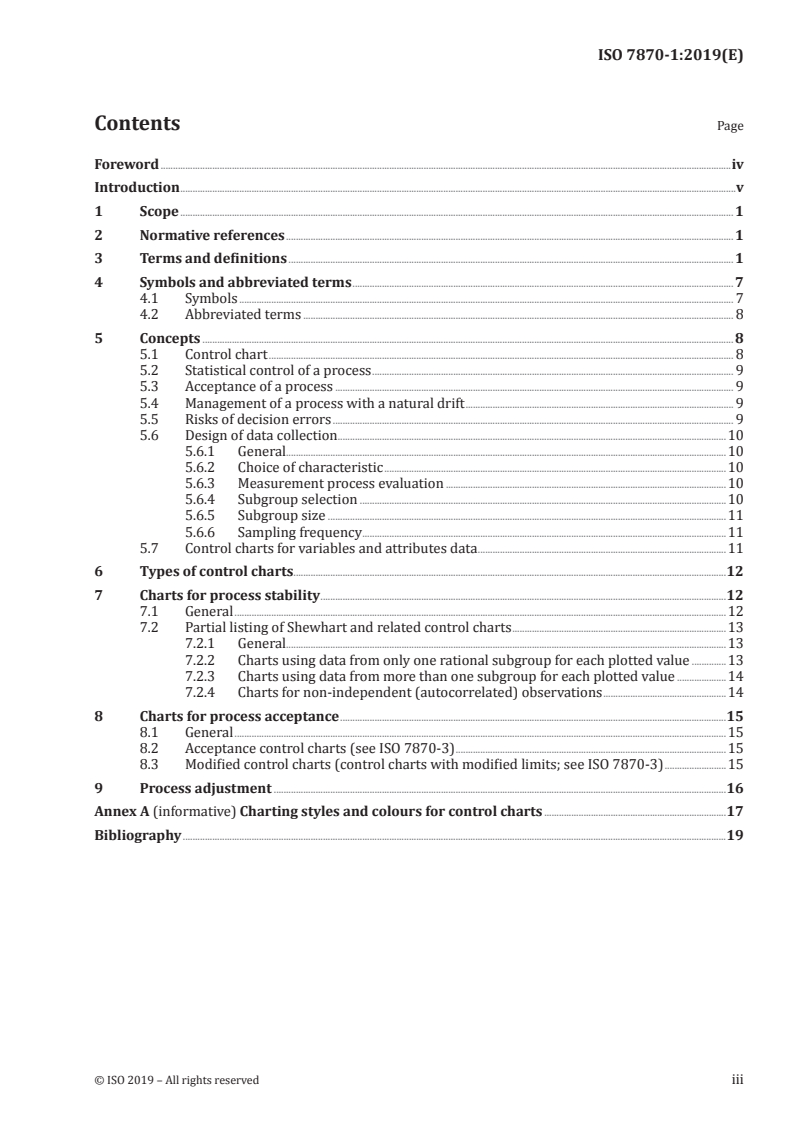

ISO 7870-1:2019 - Control charts — Part 1: General guidelines/26/2019




ISO 7870-1:2019 - Cartes de contrôle — Partie 1: Lignes directrices générales/26/2019
Overview
SIST ISO 7870-1:2020 - "Control charts - Part 1: General guidelines" - provides the conceptual framework and selection guidance for control charts used in Statistical Process Control (SPC). Rather than prescribing specific statistical procedures, this part outlines the philosophy, terminology, chart types, and planning considerations that underpin effective control-charting across manufacturing, service, and administrative processes. It helps users choose the appropriate part of the ISO 7870 series for their needs.
Key topics and technical scope
ISO 7870-1 covers foundational topics and requirements for designing and applying control charts:
- Definitions & symbols: standard terms (control chart, control limit, Shewhart control chart, variables vs attributes charts) and notations referenced to ISO 3534-1/2.
- Control chart concepts: purposes of control charts (process stability, variability estimation, special-cause detection, pattern recognition, capability indication).
- Types of control charts: overview of Shewhart-related charts, charts for variables and attributes (X̄, median, moving average, p, np, c, u, standardized p), and specialized charts (including charts for autocorrelated data).
- Design considerations: guidance on measurement process evaluation, choice of characteristic, subgroup selection, subgroup size, and sampling frequency to ensure reliable monitoring.
- Applications-oriented categories: charts for process stability, process acceptance, and process adjustment (prediction and online control).
- Risk awareness: discussion of decision risks (false alarms and missed signals) and the role of chart design in managing them.
- Practical presentation: Annex on charting styles and colours to promote consistent, interpretable displays.
Note: ISO 7870-1 does not specify statistical control methods (numerical rules or limit calculations); those methods are detailed in the relevant parts of ISO 7870 (for example, ISO 7870-3 is referenced for acceptance control charts).
Practical applications and intended users
ISO 7870-1 is valuable for professionals implementing or improving SPC and control-chart systems:
- Quality engineers and process engineers designing monitoring systems
- Statisticians and methodologists selecting chart types for variable or attribute data
- Production and operations managers seeking online process indicators
- Suppliers, auditors, and conformity-assessment bodies validating SPC practices
- Continuous improvement and Six Sigma practitioners
Typical applications include monitoring process stability, detecting special causes, assessing process capability relative to specifications, managing online adjustments, and designing sampling schemes.
Related standards
- ISO 7870 series (other parts specify statistical methods and chart-specific procedures, e.g., ISO 7870-3 for acceptance charts)
- ISO 3534-1 and ISO 3534-2 (vocabulary and symbols for statistics)
Keywords: ISO 7870-1, control charts, statistical process control, SPC, Shewhart control chart, process stability, process acceptance, process adjustment, variables control chart, attributes control chart.
Relations
- Effective Date
- 01-Jul-2020
Buy Documents
ISO 7870-1:2019 - Control charts — Part 1: General guidelines/26/2019
ISO 7870-1:2019 - Cartes de contrôle — Partie 1: Lignes directrices générales/26/2019
Get Certified
Connect with accredited certification bodies for this standard

BSI Group
BSI (British Standards Institution) is the business standards company that helps organizations make excellence a habit.

Bureau Veritas
Bureau Veritas is a world leader in laboratory testing, inspection and certification services.

DNV
DNV is an independent assurance and risk management provider.
Sponsored listings
Frequently Asked Questions
SIST ISO 7870-1:2020 is a standard published by the Slovenian Institute for Standardization (SIST). Its full title is "Control charts - Part 1: General guidelines". This standard covers: This document presents key elements and the philosophy of the control chart approach, and identifies a wide variety of control charts (including those related to the Shewhart control chart, those stressing process acceptance or online process adjustment, and specialized control charts). It presents an overview of the basic principles and concepts of control charts and illustrates the relationship among various control chart approaches to aid in the selection of the most appropriate part of ISO 7870 for given circumstances. It does not specify statistical control methods using control charts. These methods are specified in the relevant parts of ISO 7870.
This document presents key elements and the philosophy of the control chart approach, and identifies a wide variety of control charts (including those related to the Shewhart control chart, those stressing process acceptance or online process adjustment, and specialized control charts). It presents an overview of the basic principles and concepts of control charts and illustrates the relationship among various control chart approaches to aid in the selection of the most appropriate part of ISO 7870 for given circumstances. It does not specify statistical control methods using control charts. These methods are specified in the relevant parts of ISO 7870.
SIST ISO 7870-1:2020 is classified under the following ICS (International Classification for Standards) categories: 03.120.30 - Application of statistical methods. The ICS classification helps identify the subject area and facilitates finding related standards.
SIST ISO 7870-1:2020 has the following relationships with other standards: It is inter standard links to SIST ISO 7870-1:2015. Understanding these relationships helps ensure you are using the most current and applicable version of the standard.
SIST ISO 7870-1:2020 is available in PDF format for immediate download after purchase. The document can be added to your cart and obtained through the secure checkout process. Digital delivery ensures instant access to the complete standard document.
Standards Content (Sample)
SLOVENSKI STANDARD
01-julij-2020
Nadomešča:
SIST ISO 7870-1:2015
Kontrolne (procesne) karte - 1. del: Splošne smernice
Control charts - Part 1: General guidelines
Cartes de contrôle - Partie 1: Lignes directrices générales
Ta slovenski standard je istoveten z: ISO 7870-1:2019
ICS:
03.120.30 Uporaba statističnih metod Application of statistical
methods
2003-01.Slovenski inštitut za standardizacijo. Razmnoževanje celote ali delov tega standarda ni dovoljeno.
INTERNATIONAL ISO
STANDARD 7870-1
Third edition
2019-11
Control charts —
Part 1:
General guidelines
Cartes de contrôle —
Partie 1: Lignes directrices générales
Reference number
©
ISO 2019
© ISO 2019
All rights reserved. Unless otherwise specified, or required in the context of its implementation, no part of this publication may
be reproduced or utilized otherwise in any form or by any means, electronic or mechanical, including photocopying, or posting
on the internet or an intranet, without prior written permission. Permission can be requested from either ISO at the address
below or ISO’s member body in the country of the requester.
ISO copyright office
CP 401 • Ch. de Blandonnet 8
CH-1214 Vernier, Geneva
Phone: +41 22 749 01 11
Fax: +41 22 749 09 47
Email: copyright@iso.org
Website: www.iso.org
Published in Switzerland
ii © ISO 2019 – All rights reserved
Contents Page
Foreword .iv
Introduction .v
1 Scope . 1
2 Normative references . 1
3 Terms and definitions . 1
4 Symbols and abbreviated terms . 7
4.1 Symbols . 7
4.2 Abbreviated terms . 8
5 Concepts . 8
5.1 Control chart . 8
5.2 Statistical control of a process . 9
5.3 Acceptance of a process . 9
5.4 Management of a process with a natural drift . 9
5.5 Risks of decision errors . 9
5.6 Design of data collection .10
5.6.1 General.10
5.6.2 Choice of characteristic .10
5.6.3 Measurement process evaluation .10
5.6.4 Subgroup selection .10
5.6.5 Subgroup size .11
5.6.6 Sampling frequency .11
5.7 Control charts for variables and attributes data .11
6 Types of control charts.12
7 Charts for process stability .12
7.1 General .12
7.2 Partial listing of Shewhart and related control charts .13
7.2.1 General.13
7.2.2 Charts using data from only one rational subgroup for each plotted value .13
7.2.3 Charts using data from more than one subgroup for each plotted value .14
7.2.4 Charts for non-independent (autocorrelated) observations .14
8 Charts for process acceptance .15
8.1 General .15
8.2 Acceptance control charts (see ISO 7870-3) .15
8.3 Modified control charts (control charts with modified limits; see ISO 7870-3) .15
9 Process adjustment .16
Annex A (informative) Charting styles and colours for control charts .17
Bibliography .19
Foreword
ISO (the International Organization for Standardization) is a worldwide federation of national standards
bodies (ISO member bodies). The work of preparing International Standards is normally carried out
through ISO technical committees. Each member body interested in a subject for which a technical
committee has been established has the right to be represented on that committee. International
organizations, governmental and non-governmental, in liaison with ISO, also take part in the work.
ISO collaborates closely with the International Electrotechnical Commission (IEC) on all matters of
electrotechnical standardization.
The procedures used to develop this document and those intended for its further maintenance are
described in the ISO/IEC Directives, Part 1. In particular the different approval criteria needed for the
different types of ISO documents should be noted. This document was drafted in accordance with the
editorial rules of the ISO/IEC Directives, Part 2 (see www .iso .org/ directives).
Attention is drawn to the possibility that some of the elements of this document may be the subject of
patent rights. ISO shall not be held responsible for identifying any or all such patent rights. Details of
any patent rights identified during the development of the document will be in the Introduction and/or
on the ISO list of patent declarations received (see www .iso .org/ patents).
Any trade name used in this document is information given for the convenience of users and does not
constitute an endorsement.
For an explanation of the voluntary nature of standards, the meaning of ISO specific terms and
expressions related to conformity assessment, as well as information about ISO's adherence to the
World Trade Organization (WTO) principles in the Technical Barriers to Trade (TBT), see www .iso .org/
iso/ foreword .html.
This document was prepared by Technical Committee ISO/TC 69, Applications of statistical methods,
Subcommittee SC 4, Applications of statistical methods in process management.
This third edition of ISO 7870-1 cancels and replaces the second edition (ISO 7870-1:2014), which has
been technically revised.
The main changes compared to the previous edition are as follows:
— Added Annex A, specifying the conventions for drafting control charts.
A list of all parts in the ISO 7870 series can be found on the ISO website.
Any feedback or questions on this document should be directed to the user’s national standards body. A
complete listing of these bodies can be found at www .iso .org/ members .html.
iv © ISO 2019 – All rights reserved
Introduction
Every production, service, or administrative process contains a certain amount of variability due to the
presence of a large number of causes. The observed results from a process are, as a result, not constant.
Studying this variability to gain an understanding of its characteristics provides a basis for taking
action on a process.
Control charts are a fundamental tool of statistical process control (SPC). They provide a simple
graphical method that can be used to
a) indicate if the process is stable, i.e. operating within a stable system of random causes, also known
as inherent variability and referred to as being in a “state of statistical control”,
b) estimate the magnitude of the inherent variability of the process,
c) compare information from samples representing the current state of a process against control
limits reflecting this variability, with the objective of determining whether the process variability
has remained stable or is reduced or increased,
d) identify, investigate, and possibly reduce/eliminate the effect of special causes of variability, which
can drive the process to an unacceptable level of performance,
e) aid in the regulation of a process through the identification of patterns of variability such as trends,
runs, cycles, etc.,
f) determine if the process is behaving in a predictable and stable manner so that it will be possible to
assess if the process is able to meet specifications,
g) determine whether or not the process can be expected to satisfy product or service requirements
and process capability for the characteristic(s) being measured,
h) provide a basis for process adjustment through prediction using statistical models, and
i) assist in the assessment of the performance of a measurement system.
A major virtue of the control chart is its ease of construction and use. It provides the production or
service operator, engineer, administrator, and manager with an online indicator about the behaviour of
the process. However, in order for the control chart to be a reliable and efficient indicator of the state
of the process, careful attention has to be paid at the planning stage to such matters as selecting the
appropriate type of chart for the process under study and determining a proper sampling scheme.
General concepts useful to a successful design of a control chart are presented in Annex A.
INTERNATIONAL STANDARD ISO 7870-1:2019(E)
Control charts —
Part 1:
General guidelines
1 Scope
This document presents key elements and the philosophy of the control chart approach, and identifies
a wide variety of control charts (including those related to the Shewhart control chart, those stressing
process acceptance or online process adjustment, and specialized control charts).
It presents an overview of the basic principles and concepts of control charts and illustrates the
relationship among various control chart approaches to aid in the selection of the most appropriate
part of ISO 7870 for given circumstances. It does not specify statistical control methods using control
charts. These methods are specified in the relevant parts of ISO 7870.
2 Normative references
The following documents are referred to in the text in such a way that some or all of their content
constitutes requirements of this document. For dated references, only the edition cited applies. For
undated references, the latest edition of the referenced document (including any amendments) applies.
ISO 3534-1, Statistics — Vocabulary and symbols — Part 1: General statistical terms and terms used in
probability
ISO 3534-2, Statistics — Vocabulary and symbols — Part 2: Applied statistics
3 Terms and definitions
For the purposes of this document, the terms and definitions given in ISO 3534-1, ISO 3534-2 and the
following apply.
ISO and IEC maintain terminological databases for use in standardization at the following addresses:
— ISO Online browsing platform: available at https:// www .iso .org/ obp
— IEC Electropedia: available at http:// www .electropedia .org/
3.1
control chart
chart with control limits (3.2) on which some statistical measure of a series of samples is plotted in a
particular order to steer the process with respect to that measure
Note 1 to entry: The particular order is usually based on time or sample number order.
Note 2 to entry: The control chart operates most effectively when the measure is a process variable which is
correlated with an ultimate product or service characteristic.
[SOURCE: ISO 3534-2:2006, 2.3.1, modified — added "with control limits" after "chart" in definition,
deleted "and to control and reduce variation" after "to that measure".]
3.2
control limit
statistical value defining an intended level of stability for a produced characteristic
Note 1 to entry: One or two control limits are represented on the control chart.
Note 2 to entry: The term “stability” is not meant only for a process in control but it can also be stability against
a target value.
3.3
Shewhart control chart
control chart (3.1) with Shewhart control limits (3.4) intended primarily to distinguish between the
variation in the plotted measure due to random causes and that due to special causes
[SOURCE: ISO 3534-2:2006, 2.3.2]
3.4
Shewhart control limit
control limit (3.2) determined statistically from the variation of the process due to the random
causes alone
3.5
acceptance control chart
control chart (3.1) intended primarily to evaluate whether or not the plotted measure can be expected
to satisfy specified tolerances
[SOURCE: ISO 3534-2:2006, 2.3.3]
3.6
process adjustment control chart
control chart (3.1) which uses a prediction model of the process to estimate and plot the future course of
the process if no change is made, and to quantify the change to be made to keep the process deviations
within acceptable limits
[SOURCE: ISO 3534-2:2006, 2.3.4]
3.7
variables control chart
control chart (3.1) in which the measure plotted represents data on a continuous scale
[SOURCE: ISO 3534-2:2006, 2.3.6, modified — deleted "Shewhart" before "control chart".]
3.8
attributes control chart
control chart (3.1) in which the measure plotted represents countable or categorized data
[SOURCE: ISO 3534-2:2006, 2.3.7, modified — in the term, "attributes" used instead of "attribute"; in the
definition, deleted "Shewhart" before "control chart".]
3.9
c chart
count control chart
attributes control chart (3.8) for the number of incidences where the opportunity for occurrence is fixed
Note 1 to entry: Incidences of a particular type, for example, number of absentees and number of sales leads,
form the count. In the quality field, incidences are often expressed as nonconformities and the fixed opportunity
relates to samples of constant size or fixed amount of material. Examples are “flaws in each 100 m of fabric” and
“errors in each 100 invoices”.
[SOURCE: ISO 3534-2:2006, 2.3.8]
2 © ISO 2019 – All rights reserved
3.10
u chart
count per unit control chart
attributes control chart (3.8) for the number of incidences per unit where the opportunity is variable
Note 1 to entry: Incidences of a particular type, for example, number of absentees and number of sales leads, form
the count. In the quality field, incidences are often expressed as nonconformities and the variable opportunity
relates to subgroups of variable size or variable amounts of material.
[SOURCE: ISO 3534-2:2006, 2.3.9]
3.11
np chart
number of categorized units control chart
attributes control chart (3.8) for number of units of a given classification where the subgroup size is
constant
Note 1 to entry: In the quality field, the classification usually takes the form of “nonconforming units”.
[SOURCE: ISO 3534-2:2006, 2.3.10, modified — definition uses "subgroup" instead of "sample".]
3.12
p chart
proportion categorized units control chart
percent categorized units control chart
attributes control chart (3.8) for number of units of a given classification per total number of units in the
sample expressed either as a proportion or percent
Note 1 to entry: In the quality field, the classification usually takes the form of “nonconforming unit”.
Note 2 to entry: The p chart is applied particularly when the subgroup size is variable.
Note 3 to entry: The plotted measure can be expressed as a proportion or as a percentage.
[SOURCE: ISO 3534-2:2006, 2.3.11]
3.13
standardized p chart
attributes control chart (3.8) where proportions of given classification are expressed as standardized
normal variates
3.14
X bar control chart
average control chart
variables control chart (3.7) for evaluating the process level in terms of subgroup averages
[SOURCE: ISO 3534-2:2006, 2.3.12]
3.15
median control chart
variables control chart (3.7) for evaluating the process level in terms of subgroup medians
[SOURCE: ISO 3534-2:2006, 2.3.13]
3.16
moving average control chart
control chart (3.1) for evaluating the process level in terms of the arithmetic average of each successive
n observations
Note 1 to entry: This chart is particularly useful when only one observation per subgroup is available. Examples
are process characteristics such as temperature, pressure and time.
Note 2 to entry: The current observation replaces the oldest of the latest n + 1 observations.
Note 3 to entry: It has the disadvantage of an unweighted carry-over effect lasting n points.
[SOURCE: ISO 3534-2:2006, 2.3.14]
3.17
individuals control chart
X control chart
variables control chart (3.7) for evaluating the process level in terms of the individual observations in
the sample
Note 1 to entry: This chart is usually accompanied by a moving range chart, frequently with n = 2.
Note 2 to entry: It sacrifices the advantages of averaging in terms of minimizing random variation and the normal
distribution central limit theorem assumptions.
Note 3 to entry: Individual values are expressed by the symbols x , x , x , …
1 2 3
Note 4 to entry: In the case of charts for individuals, the symbol R represents the value of the moving range,
moving
which is the absolute value of the difference between two successive values, thus, xx−−, xx , etc.
12 23
[SOURCE: ISO 3534-2:2006, 2.3.15, modified — Note 3 to entry and Note 4 to entry added.]
3.18
cumulative sum control chart
CUSUM chart
control chart (3.1) where the cumulative sum of deviations of successive sample values from a reference
value is plotted to detect shifts in the level of the measure plotted
Note 1 to entry: The ordinate of each plotted point represents the algebraic sum of the previous ordinate and the
most recent deviation from the reference, target, or control value.
Note 2 to entry: The best discrimination of changes in level is achieved when reference value is equal to the
overall average value.
Note 3 to entry: The chart can be used in control, diagnostic or predictive mode.
Note 4 to entry: When used in control mode, it can be interpreted graphically by a mask (e.g. V-mask)
superimposed on the graph. A signal occurs if the path of the CUSUM intersects or touches the boundary of the
mask. Alternatively, a tabular approach to CUSUM may be used instead.
[SOURCE: ISO 3534-2:2006, 2.3.5, modified —Last sentence to Note 4 to entry added.]
3.19
EWMA control chart
exponentially weighted moving average control chart
control chart (3.1) for evaluating the process level in terms of an exponentially smoothed moving average
[SOURCE: ISO 3534-2:2006, 2.3.16]
3.20
Z chart
variables control chart (3.7) for evaluating the process in terms of subgroup standardized normal
variates
3.21
group control chart for averages
variables control chart (3.7) for evaluating the process level in terms of subgroup (with several sources)
highest and lowest averages with corresponding source identification
3.22
group control chart for ranges
variables control chart (3.7) for evaluating the process variation in terms of subgroup (with several
sources) highest ranges with corresponding source identification
4 © ISO 2019 – All rights reserved
3.23
high-low control chart
variables control chart (3.7) for evaluating the process level in terms of subgroup largest and
smallest values
3.24
trend control chart
control chart (3.1) for evaluating the process level with respect to the deviation of the subgroup averages
from an expected change in the process level
Note 1 to entry: The trend can be determined empirically or by regression techniques.
Note 2 to entry: A trend is an upward or downward tendency, after exclusion of the random variation and cyclical
effects, when observed values are plotted in the time order of the observations.
[SOURCE: ISO 3534-2:2006, 2.3.17]
3.25
R chart
range control chart
variables control chart (3.7) for evaluating variation in terms of subgroup ranges
Note 1 to entry: The value of the subgroup range is given by the symbol R, the difference between the largest and
smallest observations of a subgroup.
Note 2 to entry: The average value of the subgroup ranges is denoted by the symbol R .
[SOURCE: ISO 3534-2:2006, 2.3.18, modified — Note 1 to entry and Note 2 to entry added.]
3.26
s chart
standard deviation control chart
variables control chart (3.7) for evaluating variation in terms of subgroup standard deviations
Note 1 to entry: The value of the subgroup standards deviation is given by the symbol s.
Note 2 to entry: The average value of the subgroup standard deviations is denoted by the symbol s .
[SOURCE: ISO 3534-2:2006, 2.3.19, modified — Note 1 to entry and Note 2 to entry added.]
3.27
moving range control chart
variables control chart (3.7) for evaluating variation in terms of the range of each successive n
observations
Note 1 to entry: The current observation replaces the oldest of the latest n + 1 observations.
[SOURCE: ISO 3534-2:2006, 2.3.20]
3.28
control chart for coefficient of variation
variables control chart (3.7) for evaluating variation in terms of subgroup coefficient of variation
3.29
multivariate control chart
control chart (3.1) in terms of the responses of two or more mutually correlated variates combined as a
single sample statistic for each subgroup
[SOURCE: ISO 3534-2:2006, 2.3.21]
3.30
multiple characteristic control chart
attributes control chart (3.8) for evaluating the process level based on more than one characteristic
[SOURCE: ISO 3534-2:2006, 2.3.22, modified — "for evaluating the process level" added.]
3.31
demerit control chart
quality score chart
multiple characteristic control chart (3.30) for evaluating the process level where different weights are
apportioned to events depending on their perceived significance
[SOURCE: ISO 3534-2:2006, 2.3.23, modified — "for evaluating the process level" added.]
3.32
process adjustment
action to reduce the deviation from the target in the output characteristic by making appropriate
compensatory changes in some other control variable by measurement of fluctuations in an input or
output variable
Note 1 to entry: Ongoing monitoring determines whether the process and the system of process adjustment itself
are, or are not, in a state of statistical control.
[SOURCE: ISO 3534-2:2006, 2.3.24, modified — using "by making appropriate compensatory changes in
some other control variable by measurement of fluctuations in an input or output variable" instead of
"by feed-forward control and/or feedback control".]
3.33
control variable
variable in the process that is varied as a function of the actuating signal so as to change the value of the
process output
Note 1 to entry: Actuating signal can be triggered by measurable changes in process.
[SOURCE: ISO 3534-2:2006, 2.3.27, modified — Note 1 to entry added.]
3.34
autocorrelation
internal correlation between members of series of observations ordered in time
[SOURCE: ISO 3534-2:2006, 2.3.28]
3.35
special cause
source of process variation other than inherent process variation
Note 1 to entry: Sometimes “special cause” is taken to be synonymous with “assignable cause”. However, a
distinction is recognized. A special cause is assignable only when it is specifically identified.
Note 2 to entry: A special cause arises because of specific circumstances that are not always present. As such, in a
process subject to special causes, the magnitude of the variation from time to time is unpredictable.
[SOURCE: ISO 3534-2:2006, 2.2.4]
3.36
random cause
common cause
chance cause
source of process variation that is inherent in a process over time
Note 1 to entry: In a process subject only to random cause variation, the variation is predictable within
statistically established limits.
6 © ISO 2019 – All rights reserved
Note 2 to entry: The reduction of these causes gives rise to process improvement. However, the extent of their
identification, reduction, and removal is the subject of cost/benefit analysis in terms of technical tractability and
economics.
[SOURCE: ISO 3534-2:2006, 2.2.5]
4 Symbols and abbreviated terms
4.1 Symbols
n subgroup size
p proportion or fraction of units
R subgroup range
R moving range
moving
average of subgroup ranges
R
average of subgroup moving ranges
R
moving
s subgroup standard deviation
s
average of subgroup standard deviations
X individual value
U upper control limit for means
CL
X
L lower control limit for means
CL
X
U upper control limit for individual value
CL
X
L lower control limit for individual value
CL
X
U upper control limit for ranges
CL
R
L lower control limit for ranges
CL
R
U upper warning limit for means
WL
X
L lower warning limit for means
WL
X
U upper warning limit for individual value
WL
X
L lower warning limit for individual value
WL
X
average of subgroup individual values
X
NOTE In International Standards, abbreviated terms can contain multiple letters, whereas symbols consist
only of a single letter. The reason for this is to avoid misinterpretation of compound letters as an indication of
multiplication, in formulae.
4.2 Abbreviated terms
CUSUM Cumulative sum
EWMA Exponentially weighted moving average
FMEA Failure mode and effects analysis
SPC Statistical process control
5 Concepts
5.1 Control chart
The control chart is a graphical display of data from the process, which allows a visual assessment
of the process variability and stability. At defined intervals, subgroups of items of a specified size are
obtained and the value of a characteristic or feature of the items is determined. The data obtained are
typically summarized through the use of appropriate statistics and it is these statistics that are plotted
on the control chart. A typical control chart will consist of a centre line that reflects the level around
which the plotted statistic can be expected to vary. In addition, this control chart will have two lines,
called control limits, placed one on each side of the centre line that define a band within which the
statistic can be expected to lie randomly if the process is in control (see Annex A).
The two control limits are used as a criterion for judging the state of control of a process. The limits
define a band, the width of which is determined in part by the inherent variability of the process. If the
chosen statistic plots within the band, the chart is indicating that the process is in a state of statistical
control and hence the process is allowed to continue operating as it is currently configured. However, a
value of the statistic plotting outside the control limits indicates that the process can be “out of control”.
The control chart is then providing a signal suggesting that a special cause of variability can be present
and consequently there is a need for action on the process.
Actions that can be taken on the process consist of
a) undertaking an investigation to determine the source(s) of a special cause(s), with a view to
elimination, correction, or reduction of the effect of such cause(s) in the future,
b) making a process adjustment,
c) continuing the process on a risk assessment basis,
d) stopping the process or taking containment action until correction has been made, and
e) retaining the special cause, making it permanent whenever possible in cases where special cause
indications are of a positive nature (e.g. process improvement).
Sometimes, a second set of limits called “warning limits” is also placed on the control chart. The
observation of a plotted point falling outside the warning limits but not outside the control limits
indicates that, although no “action” is required on the process, increased attention should be paid to the
process since a suspicion has been raised that a special cause might have affected the process. It might
prove advantageous to then shorten the interval of time to the next sample and/or to increase the size
of the next sample in order to more quickly determine if the process has undergone a change. When
warning limits are included on the control chart, the control limits are then sometimes called “action
limits”.
Optionally, additional rules used for judging the state of control of a process take various forms, such as
data points within limits but exhibiting unusual patterns. These rules, often called “decision rules” or
“test rules,” are defined in ISO 7870-2 along with their associated pattern tests.
8 © ISO 2019 – All rights reserved
When the objective is that of process acceptance, additional limit(s), called acceptance limit(s), might be
needed as a decision criterion to judge the process acceptability. See 5.3. Acceptance control charts are
defined in ISO 7870-3.
5.2 Statistical control of a process
Control charts are often used to judge the stability of a process. A process is considered to be in a
“state of statistical control” (the process is effectively said to be “in statistical control”) if it is affected
by random (or common, or chance) causes only, i.e. if no extraordinary, unexpected, or special (or
assignable) causes have entered the system. Such special causes can affect either the level at which the
process is operating, the degree of variability around the process level, or both simultaneously.
Variations due to random or chance causes occur in a random fashion and are usually found to obey
certain statistical laws. In essence, when a process is “in statistical control”, it is possible to predict
reliably the behaviour of that process, whereas when special (or assignable) causes enter the system,
the process is subject to the results of these causes and the outcome cannot be predicted without
information about their presence and effect. A process found not to be in a state of statistical control is
said to be “out of control” and requires intervention to bring it into such a state. For certain economic or
natural phenomena, there might be no known way to intervene and the control chart simply serves to
identify a lack of control.
5.3 Acceptance of a process
In addition to monitoring the stability of the process, control charts can also be used to judge the
acceptability of a process. When the process is in statistical control, it is then possible to determine,
with controlled risks of decision errors, if the process output does or does not meet product or service
requirements. This is most effective when the variability of the process is small compared to the
tolerance defined by the specifications. In such situations, the process level can temporarily shift to an
out-of-control state, yet all product and service requirements are still being met. The control chart is
then used to maintain the acceptable status of the process, notwithstanding the dynamic nature of the
process level. Specific control charts, as described in ISO 7870-3, are needed in this case.
5.4 Management of a process with a natural drift
When some irremovable disturbance causes the process level to drift, for example the concentration
of a specific chemical in a batch, there can exist a compensatory variable that can be manipulated to
adjust the level of the process. In this situation, specifically designed charts can be used to indicate
when and by how much the process should be adjusted to compensate for the disturbance effects. This
type of control often results in a significant reduction in the variability of the process. In particular, it
guarantees that the process will not be adjusted more often than necessary (over-adjustment), which
would instead increase the inherent variability.
5.5 Risks of decision errors
In judging the state of control of a process using a set of decision rules together with a limited sample of
data points, two types of decision errors can be made.
The first type of error (type I error) is made when a plotted point results in the decision that the process
is not in statistical control and action is required on the process; but the true situation is that the
process is operating within a system of random causes. Hence, the process will have been erroneously
declared to be “out of control”. The risk of making this type of error is called the “alpha (α) risk”.
The second type of error (type II error) results when a special cause affecting the process has occurred
but the data from the process has not yet led to the decision being made that the process is “out of
control”. Until the control chart indicates otherwise, the process will erroneously be declared to be “in
statistical control”. The risk of making this type of error is called the “beta (β) risk”.
To control the risk of these errors, control limits, sets of decision rules, and subgroup sizes can be
appropriately chosen.
5.6 Design of data collection
5.6.1 General
The most important element of data collection is the selection of the characteristics to be studied and
the identification of the place or stages of control. The way in which data are collected is of fundamental
importance to the efficient operation of the control chart to discriminate effectively random against
special causes. Based upon an understanding of the nature of the process and the data to be collected,
careful consideration shall be given to how the samples or subgroups are to be defined, their appropriate
subgroup sizes, and the frequency at which they are obtained.
5.6.2 Choice of characteristic
To start, a decision is taken with regard to the characteristics for which a control programme is desired.
In choosing the characteristic, the following aspects are required. One is that the characteristic strongly
reflects the state of process. The other is that the characteristic is related to assuring the quality
characteristic of product. An example choosing the characteristic is demonstrated. Table 1 shows
a subject matter for choosing the characteristic, which is based on the results of FMEA and process
analysis. The higher the severity ranking of the product characteristic and the earlier in the process
one is able to control it, the better. Considering Table 1, the roll pressure and the stress torque applied
to hinge can be candidates for the characteristics of control charts.
Table 1 — Subject matter for choosing characteristics
Component
Severity ranking Product characteristic Process parameter
characteristics of
(from FMEA table) examples examples
the product
9 to 10, safety critical Thickness of an insulator Shaft diameter Roll pressure
5 to 8, significant Pitch diameter Stress torque applied
Resistance to movement
characteristic of the screw to hinge
2 to 4, others Scratches Surface texture Handling
5.6.3 Measurement process evaluation
Before implementing any type of process control activity, it is of crucial importance to ensure the
validity of the measurement process. The variability induced by measurement (see ISO 22514-7)
shall be estimated in order to check that it can adequately detect characteristics variation. In this
context, choice of measurement (including method, device, etc.) needs to be capable with respect to
specifications or to process variability.
5.6.4 Subgroup selection
Subgroups are samples of collected items obtained from the process in a defined manner. Data from
characteristics of these items are determined from which statistics, such as a number of nonconformities
or an average or a range, can be computed and plotted on the control chart.
Rational samples or subgroups should be selected in a manner that makes each subgroup as
homogeneous as the process will permit. Within a rational subgroup, variation is presumed to be due
only to random causes. These causes are sources of variation inherent in a process over time. Rational
subgroups are selected to enable the detection of any special causes of variation between subgroups.
Short-term variability is measured using the variability within a series of reasonably homogeneous
subgroups and determines the position of the control limits on the control chart, while long-term
variability is usually evaluated in terms of changes between subgroups. Time order is often a good
basis for forming subgroups because it allows for detection of special causes that can occur over time.
10 © ISO 2019 – All rights reserved
However, other bases, such as the need to study operator-to-operator variability, machine-to-machine
variability, or supplier-to-supplier variability, can suggest that subgroups be defined across operator,
machine, or supplier instead of over time.
The rational subgroup should be subject to all usual sources of random cause variation if it is to
have meaningful value. For example, a series of repeat readings on a piece of material set in a testing
instrument will fail to include the contribution of locating the material in the instrument or of obtaining
the sample. If these aspects were inherent in a usual testing environment, the repeat readings would
give an unrealistic, low estimate of inherent measurement variability. Thus, almost any actual
measurement from the process would appear to be “out of control”.
5.6.5 Subgroup size
Subgroup size should be selected so as to balance the ability to detect small shifts in the process and the
risk of not detecting special causes. A larger subgroup size, although more costly, will provide a more
precise assessment of the process, therefore allowing for a more efficient monitoring. However, if the
sample is too large, special causes have more opportunities to occur within the collection period of the
sample, causing increased within-sample variation; hence, control limits might be unduly widened and
many special causes can occur without detection.
When dealing with attributes data, the subgroup size needed to detect changes in the process proportion
will ordinarily be very much larger than the subgroup size using variables data, since attributes data
carry much less information than variables data.
In some situations, it is impractical, or it does not make sense, to form subgroups, but rather to collect
information on individual units, so that, essentially, subgroup size is equal to one. This is the case when
testing is destructive or sampling is costly, or when repeated measurements on the process (continuous
or batch processes) differ only because of instrument or analysis error.
5.6.6 Sampling frequency
Sampling frequency is dependent upon the magnitude of the shift in the process that is considered to
be crucial to detect in a timely fashion, as well as upon the cost of the process operating in an out-
of-statistical-control state. The smaller the shift to be detected, the greater the number of samples,
of a given size, that will need to be collected before a signal is detected on the chart. Shortening the
period between which samples are taken will decrease the period before any process fault is detected,
and in which the process might have operated in an out-of-control state and produced faulty product.
However, in defining the period, cost considerations of sampling and testing can also be considered.
Care should be taken to ensure that the period does not synchronize with parameters that can affect
the process (e.g. always sampling at the start of the work
...
INTERNATIONAL ISO
STANDARD 7870-1
Third edition
2019-11
Control charts —
Part 1:
General guidelines
Cartes de contrôle —
Partie 1: Lignes directrices générales
Reference number
©
ISO 2019
© ISO 2019
All rights reserved. Unless otherwise specified, or required in the context of its implementation, no part of this publication may
be reproduced or utilized otherwise in any form or by any means, electronic or mechanical, including photocopying, or posting
on the internet or an intranet, without prior written permission. Permission can be requested from either ISO at the address
below or ISO’s member body in the country of the requester.
ISO copyright office
CP 401 • Ch. de Blandonnet 8
CH-1214 Vernier, Geneva
Phone: +41 22 749 01 11
Fax: +41 22 749 09 47
Email: copyright@iso.org
Website: www.iso.org
Published in Switzerland
ii © ISO 2019 – All rights reserved
Contents Page
Foreword .iv
Introduction .v
1 Scope . 1
2 Normative references . 1
3 Terms and definitions . 1
4 Symbols and abbreviated terms . 7
4.1 Symbols . 7
4.2 Abbreviated terms . 8
5 Concepts . 8
5.1 Control chart . 8
5.2 Statistical control of a process . 9
5.3 Acceptance of a process . 9
5.4 Management of a process with a natural drift . 9
5.5 Risks of decision errors . 9
5.6 Design of data collection .10
5.6.1 General.10
5.6.2 Choice of characteristic .10
5.6.3 Measurement process evaluation .10
5.6.4 Subgroup selection .10
5.6.5 Subgroup size .11
5.6.6 Sampling frequency .11
5.7 Control charts for variables and attributes data .11
6 Types of control charts.12
7 Charts for process stability .12
7.1 General .12
7.2 Partial listing of Shewhart and related control charts .13
7.2.1 General.13
7.2.2 Charts using data from only one rational subgroup for each plotted value .13
7.2.3 Charts using data from more than one subgroup for each plotted value .14
7.2.4 Charts for non-independent (autocorrelated) observations .14
8 Charts for process acceptance .15
8.1 General .15
8.2 Acceptance control charts (see ISO 7870-3) .15
8.3 Modified control charts (control charts with modified limits; see ISO 7870-3) .15
9 Process adjustment .16
Annex A (informative) Charting styles and colours for control charts .17
Bibliography .19
Foreword
ISO (the International Organization for Standardization) is a worldwide federation of national standards
bodies (ISO member bodies). The work of preparing International Standards is normally carried out
through ISO technical committees. Each member body interested in a subject for which a technical
committee has been established has the right to be represented on that committee. International
organizations, governmental and non-governmental, in liaison with ISO, also take part in the work.
ISO collaborates closely with the International Electrotechnical Commission (IEC) on all matters of
electrotechnical standardization.
The procedures used to develop this document and those intended for its further maintenance are
described in the ISO/IEC Directives, Part 1. In particular the different approval criteria needed for the
different types of ISO documents should be noted. This document was drafted in accordance with the
editorial rules of the ISO/IEC Directives, Part 2 (see www .iso .org/ directives).
Attention is drawn to the possibility that some of the elements of this document may be the subject of
patent rights. ISO shall not be held responsible for identifying any or all such patent rights. Details of
any patent rights identified during the development of the document will be in the Introduction and/or
on the ISO list of patent declarations received (see www .iso .org/ patents).
Any trade name used in this document is information given for the convenience of users and does not
constitute an endorsement.
For an explanation of the voluntary nature of standards, the meaning of ISO specific terms and
expressions related to conformity assessment, as well as information about ISO's adherence to the
World Trade Organization (WTO) principles in the Technical Barriers to Trade (TBT), see www .iso .org/
iso/ foreword .html.
This document was prepared by Technical Committee ISO/TC 69, Applications of statistical methods,
Subcommittee SC 4, Applications of statistical methods in process management.
This third edition of ISO 7870-1 cancels and replaces the second edition (ISO 7870-1:2014), which has
been technically revised.
The main changes compared to the previous edition are as follows:
— Added Annex A, specifying the conventions for drafting control charts.
A list of all parts in the ISO 7870 series can be found on the ISO website.
Any feedback or questions on this document should be directed to the user’s national standards body. A
complete listing of these bodies can be found at www .iso .org/ members .html.
iv © ISO 2019 – All rights reserved
Introduction
Every production, service, or administrative process contains a certain amount of variability due to the
presence of a large number of causes. The observed results from a process are, as a result, not constant.
Studying this variability to gain an understanding of its characteristics provides a basis for taking
action on a process.
Control charts are a fundamental tool of statistical process control (SPC). They provide a simple
graphical method that can be used to
a) indicate if the process is stable, i.e. operating within a stable system of random causes, also known
as inherent variability and referred to as being in a “state of statistical control”,
b) estimate the magnitude of the inherent variability of the process,
c) compare information from samples representing the current state of a process against control
limits reflecting this variability, with the objective of determining whether the process variability
has remained stable or is reduced or increased,
d) identify, investigate, and possibly reduce/eliminate the effect of special causes of variability, which
can drive the process to an unacceptable level of performance,
e) aid in the regulation of a process through the identification of patterns of variability such as trends,
runs, cycles, etc.,
f) determine if the process is behaving in a predictable and stable manner so that it will be possible to
assess if the process is able to meet specifications,
g) determine whether or not the process can be expected to satisfy product or service requirements
and process capability for the characteristic(s) being measured,
h) provide a basis for process adjustment through prediction using statistical models, and
i) assist in the assessment of the performance of a measurement system.
A major virtue of the control chart is its ease of construction and use. It provides the production or
service operator, engineer, administrator, and manager with an online indicator about the behaviour of
the process. However, in order for the control chart to be a reliable and efficient indicator of the state
of the process, careful attention has to be paid at the planning stage to such matters as selecting the
appropriate type of chart for the process under study and determining a proper sampling scheme.
General concepts useful to a successful design of a control chart are presented in Annex A.
INTERNATIONAL STANDARD ISO 7870-1:2019(E)
Control charts —
Part 1:
General guidelines
1 Scope
This document presents key elements and the philosophy of the control chart approach, and identifies
a wide variety of control charts (including those related to the Shewhart control chart, those stressing
process acceptance or online process adjustment, and specialized control charts).
It presents an overview of the basic principles and concepts of control charts and illustrates the
relationship among various control chart approaches to aid in the selection of the most appropriate
part of ISO 7870 for given circumstances. It does not specify statistical control methods using control
charts. These methods are specified in the relevant parts of ISO 7870.
2 Normative references
The following documents are referred to in the text in such a way that some or all of their content
constitutes requirements of this document. For dated references, only the edition cited applies. For
undated references, the latest edition of the referenced document (including any amendments) applies.
ISO 3534-1, Statistics — Vocabulary and symbols — Part 1: General statistical terms and terms used in
probability
ISO 3534-2, Statistics — Vocabulary and symbols — Part 2: Applied statistics
3 Terms and definitions
For the purposes of this document, the terms and definitions given in ISO 3534-1, ISO 3534-2 and the
following apply.
ISO and IEC maintain terminological databases for use in standardization at the following addresses:
— ISO Online browsing platform: available at https:// www .iso .org/ obp
— IEC Electropedia: available at http:// www .electropedia .org/
3.1
control chart
chart with control limits (3.2) on which some statistical measure of a series of samples is plotted in a
particular order to steer the process with respect to that measure
Note 1 to entry: The particular order is usually based on time or sample number order.
Note 2 to entry: The control chart operates most effectively when the measure is a process variable which is
correlated with an ultimate product or service characteristic.
[SOURCE: ISO 3534-2:2006, 2.3.1, modified — added "with control limits" after "chart" in definition,
deleted "and to control and reduce variation" after "to that measure".]
3.2
control limit
statistical value defining an intended level of stability for a produced characteristic
Note 1 to entry: One or two control limits are represented on the control chart.
Note 2 to entry: The term “stability” is not meant only for a process in control but it can also be stability against
a target value.
3.3
Shewhart control chart
control chart (3.1) with Shewhart control limits (3.4) intended primarily to distinguish between the
variation in the plotted measure due to random causes and that due to special causes
[SOURCE: ISO 3534-2:2006, 2.3.2]
3.4
Shewhart control limit
control limit (3.2) determined statistically from the variation of the process due to the random
causes alone
3.5
acceptance control chart
control chart (3.1) intended primarily to evaluate whether or not the plotted measure can be expected
to satisfy specified tolerances
[SOURCE: ISO 3534-2:2006, 2.3.3]
3.6
process adjustment control chart
control chart (3.1) which uses a prediction model of the process to estimate and plot the future course of
the process if no change is made, and to quantify the change to be made to keep the process deviations
within acceptable limits
[SOURCE: ISO 3534-2:2006, 2.3.4]
3.7
variables control chart
control chart (3.1) in which the measure plotted represents data on a continuous scale
[SOURCE: ISO 3534-2:2006, 2.3.6, modified — deleted "Shewhart" before "control chart".]
3.8
attributes control chart
control chart (3.1) in which the measure plotted represents countable or categorized data
[SOURCE: ISO 3534-2:2006, 2.3.7, modified — in the term, "attributes" used instead of "attribute"; in the
definition, deleted "Shewhart" before "control chart".]
3.9
c chart
count control chart
attributes control chart (3.8) for the number of incidences where the opportunity for occurrence is fixed
Note 1 to entry: Incidences of a particular type, for example, number of absentees and number of sales leads,
form the count. In the quality field, incidences are often expressed as nonconformities and the fixed opportunity
relates to samples of constant size or fixed amount of material. Examples are “flaws in each 100 m of fabric” and
“errors in each 100 invoices”.
[SOURCE: ISO 3534-2:2006, 2.3.8]
2 © ISO 2019 – All rights reserved
3.10
u chart
count per unit control chart
attributes control chart (3.8) for the number of incidences per unit where the opportunity is variable
Note 1 to entry: Incidences of a particular type, for example, number of absentees and number of sales leads, form
the count. In the quality field, incidences are often expressed as nonconformities and the variable opportunity
relates to subgroups of variable size or variable amounts of material.
[SOURCE: ISO 3534-2:2006, 2.3.9]
3.11
np chart
number of categorized units control chart
attributes control chart (3.8) for number of units of a given classification where the subgroup size is
constant
Note 1 to entry: In the quality field, the classification usually takes the form of “nonconforming units”.
[SOURCE: ISO 3534-2:2006, 2.3.10, modified — definition uses "subgroup" instead of "sample".]
3.12
p chart
proportion categorized units control chart
percent categorized units control chart
attributes control chart (3.8) for number of units of a given classification per total number of units in the
sample expressed either as a proportion or percent
Note 1 to entry: In the quality field, the classification usually takes the form of “nonconforming unit”.
Note 2 to entry: The p chart is applied particularly when the subgroup size is variable.
Note 3 to entry: The plotted measure can be expressed as a proportion or as a percentage.
[SOURCE: ISO 3534-2:2006, 2.3.11]
3.13
standardized p chart
attributes control chart (3.8) where proportions of given classification are expressed as standardized
normal variates
3.14
X bar control chart
average control chart
variables control chart (3.7) for evaluating the process level in terms of subgroup averages
[SOURCE: ISO 3534-2:2006, 2.3.12]
3.15
median control chart
variables control chart (3.7) for evaluating the process level in terms of subgroup medians
[SOURCE: ISO 3534-2:2006, 2.3.13]
3.16
moving average control chart
control chart (3.1) for evaluating the process level in terms of the arithmetic average of each successive
n observations
Note 1 to entry: This chart is particularly useful when only one observation per subgroup is available. Examples
are process characteristics such as temperature, pressure and time.
Note 2 to entry: The current observation replaces the oldest of the latest n + 1 observations.
Note 3 to entry: It has the disadvantage of an unweighted carry-over effect lasting n points.
[SOURCE: ISO 3534-2:2006, 2.3.14]
3.17
individuals control chart
X control chart
variables control chart (3.7) for evaluating the process level in terms of the individual observations in
the sample
Note 1 to entry: This chart is usually accompanied by a moving range chart, frequently with n = 2.
Note 2 to entry: It sacrifices the advantages of averaging in terms of minimizing random variation and the normal
distribution central limit theorem assumptions.
Note 3 to entry: Individual values are expressed by the symbols x , x , x , …
1 2 3
Note 4 to entry: In the case of charts for individuals, the symbol R represents the value of the moving range,
moving
which is the absolute value of the difference between two successive values, thus, xx−−, xx , etc.
12 23
[SOURCE: ISO 3534-2:2006, 2.3.15, modified — Note 3 to entry and Note 4 to entry added.]
3.18
cumulative sum control chart
CUSUM chart
control chart (3.1) where the cumulative sum of deviations of successive sample values from a reference
value is plotted to detect shifts in the level of the measure plotted
Note 1 to entry: The ordinate of each plotted point represents the algebraic sum of the previous ordinate and the
most recent deviation from the reference, target, or control value.
Note 2 to entry: The best discrimination of changes in level is achieved when reference value is equal to the
overall average value.
Note 3 to entry: The chart can be used in control, diagnostic or predictive mode.
Note 4 to entry: When used in control mode, it can be interpreted graphically by a mask (e.g. V-mask)
superimposed on the graph. A signal occurs if the path of the CUSUM intersects or touches the boundary of the
mask. Alternatively, a tabular approach to CUSUM may be used instead.
[SOURCE: ISO 3534-2:2006, 2.3.5, modified —Last sentence to Note 4 to entry added.]
3.19
EWMA control chart
exponentially weighted moving average control chart
control chart (3.1) for evaluating the process level in terms of an exponentially smoothed moving average
[SOURCE: ISO 3534-2:2006, 2.3.16]
3.20
Z chart
variables control chart (3.7) for evaluating the process in terms of subgroup standardized normal
variates
3.21
group control chart for averages
variables control chart (3.7) for evaluating the process level in terms of subgroup (with several sources)
highest and lowest averages with corresponding source identification
3.22
group control chart for ranges
variables control chart (3.7) for evaluating the process variation in terms of subgroup (with several
sources) highest ranges with corresponding source identification
4 © ISO 2019 – All rights reserved
3.23
high-low control chart
variables control chart (3.7) for evaluating the process level in terms of subgroup largest and
smallest values
3.24
trend control chart
control chart (3.1) for evaluating the process level with respect to the deviation of the subgroup averages
from an expected change in the process level
Note 1 to entry: The trend can be determined empirically or by regression techniques.
Note 2 to entry: A trend is an upward or downward tendency, after exclusion of the random variation and cyclical
effects, when observed values are plotted in the time order of the observations.
[SOURCE: ISO 3534-2:2006, 2.3.17]
3.25
R chart
range control chart
variables control chart (3.7) for evaluating variation in terms of subgroup ranges
Note 1 to entry: The value of the subgroup range is given by the symbol R, the difference between the largest and
smallest observations of a subgroup.
Note 2 to entry: The average value of the subgroup ranges is denoted by the symbol R .
[SOURCE: ISO 3534-2:2006, 2.3.18, modified — Note 1 to entry and Note 2 to entry added.]
3.26
s chart
standard deviation control chart
variables control chart (3.7) for evaluating variation in terms of subgroup standard deviations
Note 1 to entry: The value of the subgroup standards deviation is given by the symbol s.
Note 2 to entry: The average value of the subgroup standard deviations is denoted by the symbol s .
[SOURCE: ISO 3534-2:2006, 2.3.19, modified — Note 1 to entry and Note 2 to entry added.]
3.27
moving range control chart
variables control chart (3.7) for evaluating variation in terms of the range of each successive n
observations
Note 1 to entry: The current observation replaces the oldest of the latest n + 1 observations.
[SOURCE: ISO 3534-2:2006, 2.3.20]
3.28
control chart for coefficient of variation
variables control chart (3.7) for evaluating variation in terms of subgroup coefficient of variation
3.29
multivariate control chart
control chart (3.1) in terms of the responses of two or more mutually correlated variates combined as a
single sample statistic for each subgroup
[SOURCE: ISO 3534-2:2006, 2.3.21]
3.30
multiple characteristic control chart
attributes control chart (3.8) for evaluating the process level based on more than one characteristic
[SOURCE: ISO 3534-2:2006, 2.3.22, modified — "for evaluating the process level" added.]
3.31
demerit control chart
quality score chart
multiple characteristic control chart (3.30) for evaluating the process level where different weights are
apportioned to events depending on their perceived significance
[SOURCE: ISO 3534-2:2006, 2.3.23, modified — "for evaluating the process level" added.]
3.32
process adjustment
action to reduce the deviation from the target in the output characteristic by making appropriate
compensatory changes in some other control variable by measurement of fluctuations in an input or
output variable
Note 1 to entry: Ongoing monitoring determines whether the process and the system of process adjustment itself
are, or are not, in a state of statistical control.
[SOURCE: ISO 3534-2:2006, 2.3.24, modified — using "by making appropriate compensatory changes in
some other control variable by measurement of fluctuations in an input or output variable" instead of
"by feed-forward control and/or feedback control".]
3.33
control variable
variable in the process that is varied as a function of the actuating signal so as to change the value of the
process output
Note 1 to entry: Actuating signal can be triggered by measurable changes in process.
[SOURCE: ISO 3534-2:2006, 2.3.27, modified — Note 1 to entry added.]
3.34
autocorrelation
internal correlation between members of series of observations ordered in time
[SOURCE: ISO 3534-2:2006, 2.3.28]
3.35
special cause
source of process variation other than inherent process variation
Note 1 to entry: Sometimes “special cause” is taken to be synonymous with “assignable cause”. However, a
distinction is recognized. A special cause is assignable only when it is specifically identified.
Note 2 to entry: A special cause arises because of specific circumstances that are not always present. As such, in a
process subject to special causes, the magnitude of the variation from time to time is unpredictable.
[SOURCE: ISO 3534-2:2006, 2.2.4]
3.36
random cause
common cause
chance cause
source of process variation that is inherent in a process over time
Note 1 to entry: In a process subject only to random cause variation, the variation is predictable within
statistically established limits.
6 © ISO 2019 – All rights reserved
Note 2 to entry: The reduction of these causes gives rise to process improvement. However, the extent of their
identification, reduction, and removal is the subject of cost/benefit analysis in terms of technical tractability and
economics.
[SOURCE: ISO 3534-2:2006, 2.2.5]
4 Symbols and abbreviated terms
4.1 Symbols
n subgroup size
p proportion or fraction of units
R subgroup range
R moving range
moving
average of subgroup ranges
R
average of subgroup moving ranges
R
moving
s subgroup standard deviation
s
average of subgroup standard deviations
X individual value
U upper control limit for means
CL
X
L lower control limit for means
CL
X
U upper control limit for individual value
CL
X
L lower control limit for individual value
CL
X
U upper control limit for ranges
CL
R
L lower control limit for ranges
CL
R
U upper warning limit for means
WL
X
L lower warning limit for means
WL
X
U upper warning limit for individual value
WL
X
L lower warning limit for individual value
WL
X
average of subgroup individual values
X
NOTE In International Standards, abbreviated terms can contain multiple letters, whereas symbols consist
only of a single letter. The reason for this is to avoid misinterpretation of compound letters as an indication of
multiplication, in formulae.
4.2 Abbreviated terms
CUSUM Cumulative sum
EWMA Exponentially weighted moving average
FMEA Failure mode and effects analysis
SPC Statistical process control
5 Concepts
5.1 Control chart
The control chart is a graphical display of data from the process, which allows a visual assessment
of the process variability and stability. At defined intervals, subgroups of items of a specified size are
obtained and the value of a characteristic or feature of the items is determined. The data obtained are
typically summarized through the use of appropriate statistics and it is these statistics that are plotted
on the control chart. A typical control chart will consist of a centre line that reflects the level around
which the plotted statistic can be expected to vary. In addition, this control chart will have two lines,
called control limits, placed one on each side of the centre line that define a band within which the
statistic can be expected to lie randomly if the process is in control (see Annex A).
The two control limits are used as a criterion for judging the state of control of a process. The limits
define a band, the width of which is determined in part by the inherent variability of the process. If the
chosen statistic plots within the band, the chart is indicating that the process is in a state of statistical
control and hence the process is allowed to continue operating as it is currently configured. However, a
value of the statistic plotting outside the control limits indicates that the process can be “out of control”.
The control chart is then providing a signal suggesting that a special cause of variability can be present
and consequently there is a need for action on the process.
Actions that can be taken on the process consist of
a) undertaking an investigation to determine the source(s) of a special cause(s), with a view to
elimination, correction, or reduction of the effect of such cause(s) in the future,
b) making a process adjustment,
c) continuing the process on a risk assessment basis,
d) stopping the process or taking containment action until correction has been made, and
e) retaining the special cause, making it permanent whenever possible in cases where special cause
indications are of a positive nature (e.g. process improvement).
Sometimes, a second set of limits called “warning limits” is also placed on the control chart. The
observation of a plotted point falling outside the warning limits but not outside the control limits
indicates that, although no “action” is required on the process, increased attention should be paid to the
process since a suspicion has been raised that a special cause might have affected the process. It might
prove advantageous to then shorten the interval of time to the next sample and/or to increase the size
of the next sample in order to more quickly determine if the process has undergone a change. When
warning limits are included on the control chart, the control limits are then sometimes called “action
limits”.
Optionally, additional rules used for judging the state of control of a process take various forms, such as
data points within limits but exhibiting unusual patterns. These rules, often called “decision rules” or
“test rules,” are defined in ISO 7870-2 along with their associated pattern tests.
8 © ISO 2019 – All rights reserved
When the objective is that of process acceptance, additional limit(s), called acceptance limit(s), might be
needed as a decision criterion to judge the process acceptability. See 5.3. Acceptance control charts are
defined in ISO 7870-3.
5.2 Statistical control of a process
Control charts are often used to judge the stability of a process. A process is considered to be in a
“state of statistical control” (the process is effectively said to be “in statistical control”) if it is affected
...
INTERNATIONAL ISO
STANDARD 7870-1
Third edition
2019-11
Control charts —
Part 1:
General guidelines
Cartes de contrôle —
Partie 1: Lignes directrices générales
Reference number
©
ISO 2019
© ISO 2019
All rights reserved. Unless otherwise specified, or required in the context of its implementation, no part of this publication may
be reproduced or utilized otherwise in any form or by any means, electronic or mechanical, including photocopying, or posting
on the internet or an intranet, without prior written permission. Permission can be requested from either ISO at the address
below or ISO’s member body in the country of the requester.
ISO copyright office
CP 401 • Ch. de Blandonnet 8
CH-1214 Vernier, Geneva
Phone: +41 22 749 01 11
Fax: +41 22 749 09 47
Email: copyright@iso.org
Website: www.iso.org
Published in Switzerland
ii © ISO 2019 – All rights reserved
Contents Page
Foreword .iv
Introduction .v
1 Scope . 1
2 Normative references . 1
3 Terms and definitions . 1
4 Symbols and abbreviated terms . 7
4.1 Symbols . 7
4.2 Abbreviated terms . 8
5 Concepts . 8
5.1 Control chart . 8
5.2 Statistical control of a process . 9
5.3 Acceptance of a process . 9
5.4 Management of a process with a natural drift . 9
5.5 Risks of decision errors . 9
5.6 Design of data collection .10
5.6.1 General.10
5.6.2 Choice of characteristic .10
5.6.3 Measurement process evaluation .10
5.6.4 Subgroup selection .10
5.6.5 Subgroup size .11
5.6.6 Sampling frequency .11
5.7 Control charts for variables and attributes data .11
6 Types of control charts.12
7 Charts for process stability .12
7.1 General .12
7.2 Partial listing of Shewhart and related control charts .13
7.2.1 General.13
7.2.2 Charts using data from only one rational subgroup for each plotted value .13
7.2.3 Charts using data from more than one subgroup for each plotted value .14
7.2.4 Charts for non-independent (autocorrelated) observations .14
8 Charts for process acceptance .15
8.1 General .15
8.2 Acceptance control charts (see ISO 7870-3) .15
8.3 Modified control charts (control charts with modified limits; see ISO 7870-3) .15
9 Process adjustment .16
Annex A (informative) Charting styles and colours for control charts .17
Bibliography .19
Foreword
ISO (the International Organization for Standardization) is a worldwide federation of national standards
bodies (ISO member bodies). The work of preparing International Standards is normally carried out
through ISO technical committees. Each member body interested in a subject for which a technical
committee has been established has the right to be represented on that committee. International
organizations, governmental and non-governmental, in liaison with ISO, also take part in the work.
ISO collaborates closely with the International Electrotechnical Commission (IEC) on all matters of
electrotechnical standardization.
The procedures used to develop this document and those intended for its further maintenance are
described in the ISO/IEC Directives, Part 1. In particular the different approval criteria needed for the
different types of ISO documents should be noted. This document was drafted in accordance with the
editorial rules of the ISO/IEC Directives, Part 2 (see www .iso .org/ directives).
Attention is drawn to the possibility that some of the elements of this document may be the subject of
patent rights. ISO shall not be held responsible for identifying any or all such patent rights. Details of
any patent rights identified during the development of the document will be in the Introduction and/or
on the ISO list of patent declarations received (see www .iso .org/ patents).
Any trade name used in this document is information given for the convenience of users and does not
constitute an endorsement.
For an explanation of the voluntary nature of standards, the meaning of ISO specific terms and
expressions related to conformity assessment, as well as information about ISO's adherence to the
World Trade Organization (WTO) principles in the Technical Barriers to Trade (TBT), see www .iso .org/
iso/ foreword .html.
This document was prepared by Technical Committee ISO/TC 69, Applications of statistical methods,
Subcommittee SC 4, Applications of statistical methods in process management.
This third edition of ISO 7870-1 cancels and replaces the second edition (ISO 7870-1:2014), which has
been technically revised.
The main changes compared to the previous edition are as follows:
— Added Annex A, specifying the conventions for drafting control charts.
A list of all parts in the ISO 7870 series can be found on the ISO website.
Any feedback or questions on this document should be directed to the user’s national standards body. A
complete listing of these bodies can be found at www .iso .org/ members .html.
iv © ISO 2019 – All rights reserved
Introduction
Every production, service, or administrative process contains a certain amount of variability due to the
presence of a large number of causes. The observed results from a process are, as a result, not constant.
Studying this variability to gain an understanding of its characteristics provides a basis for taking
action on a process.
Control charts are a fundamental tool of statistical process control (SPC). They provide a simple
graphical method that can be used to
a) indicate if the process is stable, i.e. operating within a stable system of random causes, also known
as inherent variability and referred to as being in a “state of statistical control”,
b) estimate the magnitude of the inherent variability of the process,
c) compare information from samples representing the current state of a process against control
limits reflecting this variability, with the objective of determining whether the process variability
has remained stable or is reduced or increased,
d) identify, investigate, and possibly reduce/eliminate the effect of special causes of variability, which
can drive the process to an unacceptable level of performance,
e) aid in the regulation of a process through the identification of patterns of variability such as trends,
runs, cycles, etc.,
f) determine if the process is behaving in a predictable and stable manner so that it will be possible to
assess if the process is able to meet specifications,
g) determine whether or not the process can be expected to satisfy product or service requirements
and process capability for the characteristic(s) being measured,
h) provide a basis for process adjustment through prediction using statistical models, and
i) assist in the assessment of the performance of a measurement system.
A major virtue of the control chart is its ease of construction and use. It provides the production or
service operator, engineer, administrator, and manager with an online indicator about the behaviour of
the process. However, in order for the control chart to be a reliable and efficient indicator of the state
of the process, careful attention has to be paid at the planning stage to such matters as selecting the
appropriate type of chart for the process under study and determining a proper sampling scheme.
General concepts useful to a successful design of a control chart are presented in Annex A.
INTERNATIONAL STANDARD ISO 7870-1:2019(E)
Control charts —
Part 1:
General guidelines
1 Scope
This document presents key elements and the philosophy of the control chart approach, and identifies
a wide variety of control charts (including those related to the Shewhart control chart, those stressing
process acceptance or online process adjustment, and specialized control charts).
It presents an overview of the basic principles and concepts of control charts and illustrates the
relationship among various control chart approaches to aid in the selection of the most appropriate
part of ISO 7870 for given circumstances. It does not specify statistical control methods using control
charts. These methods are specified in the relevant parts of ISO 7870.
2 Normative references
The following documents are referred to in the text in such a way that some or all of their content
constitutes requirements of this document. For dated references, only the edition cited applies. For
undated references, the latest edition of the referenced document (including any amendments) applies.
ISO 3534-1, Statistics — Vocabulary and symbols — Part 1: General statistical terms and terms used in
probability
ISO 3534-2, Statistics — Vocabulary and symbols — Part 2: Applied statistics
3 Terms and definitions
For the purposes of this document, the terms and definitions given in ISO 3534-1, ISO 3534-2 and the
following apply.
ISO and IEC maintain terminological databases for use in standardization at the following addresses:
— ISO Online browsing platform: available at https:// www .iso .org/ obp
— IEC Electropedia: available at http:// www .electropedia .org/
3.1
control chart
chart with control limits (3.2) on which some statistical measure of a series of samples is plotted in a
particular order to steer the process with respect to that measure
Note 1 to entry: The particular order is usually based on time or sample number order.
Note 2 to entry: The control chart operates most effectively when the measure is a process variable which is
correlated with an ultimate product or service characteristic.
[SOURCE: ISO 3534-2:2006, 2.3.1, modified — added "with control limits" after "chart" in definition,
deleted "and to control and reduce variation" after "to that measure".]
3.2
control limit
statistical value defining an intended level of stability for a produced characteristic
Note 1 to entry: One or two control limits are represented on the control chart.
Note 2 to entry: The term “stability” is not meant only for a process in control but it can also be stability against
a target value.
3.3
Shewhart control chart
control chart (3.1) with Shewhart control limits (3.4) intended primarily to distinguish between the
variation in the plotted measure due to random causes and that due to special causes
[SOURCE: ISO 3534-2:2006, 2.3.2]
3.4
Shewhart control limit
control limit (3.2) determined statistically from the variation of the process due to the random
causes alone
3.5
acceptance control chart
control chart (3.1) intended primarily to evaluate whether or not the plotted measure can be expected
to satisfy specified tolerances
[SOURCE: ISO 3534-2:2006, 2.3.3]
3.6
process adjustment control chart
control chart (3.1) which uses a prediction model of the process to estimate and plot the future course of
the process if no change is made, and to quantify the change to be made to keep the process deviations
within acceptable limits
[SOURCE: ISO 3534-2:2006, 2.3.4]
3.7
variables control chart
control chart (3.1) in which the measure plotted represents data on a continuous scale
[SOURCE: ISO 3534-2:2006, 2.3.6, modified — deleted "Shewhart" before "control chart".]
3.8
attributes control chart
control chart (3.1) in which the measure plotted represents countable or categorized data
[SOURCE: ISO 3534-2:2006, 2.3.7, modified — in the term, "attributes" used instead of "attribute"; in the
definition, deleted "Shewhart" before "control chart".]
3.9
c chart
count control chart
attributes control chart (3.8) for the number of incidences where the opportunity for occurrence is fixed
Note 1 to entry: Incidences of a particular type, for example, number of absentees and number of sales leads,
form the count. In the quality field, incidences are often expressed as nonconformities and the fixed opportunity
relates to samples of constant size or fixed amount of material. Examples are “flaws in each 100 m of fabric” and
“errors in each 100 invoices”.
[SOURCE: ISO 3534-2:2006, 2.3.8]
2 © ISO 2019 – All rights reserved
3.10
u chart
count per unit control chart
attributes control chart (3.8) for the number of incidences per unit where the opportunity is variable
Note 1 to entry: Incidences of a particular type, for example, number of absentees and number of sales leads, form
the count. In the quality field, incidences are often expressed as nonconformities and the variable opportunity
relates to subgroups of variable size or variable amounts of material.
[SOURCE: ISO 3534-2:2006, 2.3.9]
3.11
np chart
number of categorized units control chart
attributes control chart (3.8) for number of units of a given classification where the subgroup size is
constant
Note 1 to entry: In the quality field, the classification usually takes the form of “nonconforming units”.
[SOURCE: ISO 3534-2:2006, 2.3.10, modified — definition uses "subgroup" instead of "sample".]
3.12
p chart
proportion categorized units control chart
percent categorized units control chart
attributes control chart (3.8) for number of units of a given classification per total number of units in the
sample expressed either as a proportion or percent
Note 1 to entry: In the quality field, the classification usually takes the form of “nonconforming unit”.
Note 2 to entry: The p chart is applied particularly when the subgroup size is variable.
Note 3 to entry: The plotted measure can be expressed as a proportion or as a percentage.
[SOURCE: ISO 3534-2:2006, 2.3.11]
3.13
standardized p chart
attributes control chart (3.8) where proportions of given classification are expressed as standardized
normal variates
3.14
X bar control chart
average control chart
variables control chart (3.7) for evaluating the process level in terms of subgroup averages
[SOURCE: ISO 3534-2:2006, 2.3.12]
3.15
median control chart
variables control chart (3.7) for evaluating the process level in terms of subgroup medians
[SOURCE: ISO 3534-2:2006, 2.3.13]
3.16
moving average control chart
control chart (3.1) for evaluating the process level in terms of the arithmetic average of each successive
n observations
Note 1 to entry: This chart is particularly useful when only one observation per subgroup is available. Examples
are process characteristics such as temperature, pressure and time.
Note 2 to entry: The current observation replaces the oldest of the latest n + 1 observations.
Note 3 to entry: It has the disadvantage of an unweighted carry-over effect lasting n points.
[SOURCE: ISO 3534-2:2006, 2.3.14]
3.17
individuals control chart
X control chart
variables control chart (3.7) for evaluating the process level in terms of the individual observations in
the sample
Note 1 to entry: This chart is usually accompanied by a moving range chart, frequently with n = 2.
Note 2 to entry: It sacrifices the advantages of averaging in terms of minimizing random variation and the normal
distribution central limit theorem assumptions.
Note 3 to entry: Individual values are expressed by the symbols x , x , x , …
1 2 3
Note 4 to entry: In the case of charts for individuals, the symbol R represents the value of the moving range,
moving
which is the absolute value of the difference between two successive values, thus, xx−−, xx , etc.
12 23
[SOURCE: ISO 3534-2:2006, 2.3.15, modified — Note 3 to entry and Note 4 to entry added.]
3.18
cumulative sum control chart
CUSUM chart
control chart (3.1) where the cumulative sum of deviations of successive sample values from a reference
value is plotted to detect shifts in the level of the measure plotted
Note 1 to entry: The ordinate of each plotted point represents the algebraic sum of the previous ordinate and the
most recent deviation from the reference, target, or control value.
Note 2 to entry: The best discrimination of changes in level is achieved when reference value is equal to the
overall average value.
Note 3 to entry: The chart can be used in control, diagnostic or predictive mode.
Note 4 to entry: When used in control mode, it can be interpreted graphically by a mask (e.g. V-mask)
superimposed on the graph. A signal occurs if the path of the CUSUM intersects or touches the boundary of the
mask. Alternatively, a tabular approach to CUSUM may be used instead.
[SOURCE: ISO 3534-2:2006, 2.3.5, modified —Last sentence to Note 4 to entry added.]
3.19
EWMA control chart
exponentially weighted moving average control chart
control chart (3.1) for evaluating the process level in terms of an exponentially smoothed moving average
[SOURCE: ISO 3534-2:2006, 2.3.16]
3.20
Z chart
variables control chart (3.7) for evaluating the process in terms of subgroup standardized normal
variates
3.21
group control chart for averages
variables control chart (3.7) for evaluating the process level in terms of subgroup (with several sources)
highest and lowest averages with corresponding source identification
3.22
group control chart for ranges
variables control chart (3.7) for evaluating the process variation in terms of subgroup (with several
sources) highest ranges with corresponding source identification
4 © ISO 2019 – All rights reserved
3.23
high-low control chart
variables control chart (3.7) for evaluating the process level in terms of subgroup largest and
smallest values
3.24
trend control chart
control chart (3.1) for evaluating the process level with respect to the deviation of the subgroup averages
from an expected change in the process level
Note 1 to entry: The trend can be determined empirically or by regression techniques.
Note 2 to entry: A trend is an upward or downward tendency, after exclusion of the random variation and cyclical
effects, when observed values are plotted in the time order of the observations.
[SOURCE: ISO 3534-2:2006, 2.3.17]
3.25
R chart
range control chart
variables control chart (3.7) for evaluating variation in terms of subgroup ranges
Note 1 to entry: The value of the subgroup range is given by the symbol R, the difference between the largest and
smallest observations of a subgroup.
Note 2 to entry: The average value of the subgroup ranges is denoted by the symbol R .
[SOURCE: ISO 3534-2:2006, 2.3.18, modified — Note 1 to entry and Note 2 to entry added.]
3.26
s chart
standard deviation control chart
variables control chart (3.7) for evaluating variation in terms of subgroup standard deviations
Note 1 to entry: The value of the subgroup standards deviation is given by the symbol s.
Note 2 to entry: The average value of the subgroup standard deviations is denoted by the symbol s .
[SOURCE: ISO 3534-2:2006, 2.3.19, modified — Note 1 to entry and Note 2 to entry added.]
3.27
moving range control chart
variables control chart (3.7) for evaluating variation in terms of the range of each successive n
observations
Note 1 to entry: The current observation replaces the oldest of the latest n + 1 observations.
[SOURCE: ISO 3534-2:2006, 2.3.20]
3.28
control chart for coefficient of variation
variables control chart (3.7) for evaluating variation in terms of subgroup coefficient of variation
3.29
multivariate control chart
control chart (3.1) in terms of the responses of two or more mutually correlated variates combined as a
single sample statistic for each subgroup
[SOURCE: ISO 3534-2:2006, 2.3.21]
3.30
multiple characteristic control chart
attributes control chart (3.8) for evaluating the process level based on more than one characteristic
[SOURCE: ISO 3534-2:2006, 2.3.22, modified — "for evaluating the process level" added.]
3.31
demerit control chart
quality score chart
multiple characteristic control chart (3.30) for evaluating the process level where different weights are
apportioned to events depending on their perceived significance
[SOURCE: ISO 3534-2:2006, 2.3.23, modified — "for evaluating the process level" added.]
3.32
process adjustment
action to reduce the deviation from the target in the output characteristic by making appropriate
compensatory changes in some other control variable by measurement of fluctuations in an input or
output variable
Note 1 to entry: Ongoing monitoring determines whether the process and the system of process adjustment itself
are, or are not, in a state of statistical control.
[SOURCE: ISO 3534-2:2006, 2.3.24, modified — using "by making appropriate compensatory changes in
some other control variable by measurement of fluctuations in an input or output variable" instead of
"by feed-forward control and/or feedback control".]
3.33
control variable
variable in the process that is varied as a function of the actuating signal so as to change the value of the
process output
Note 1 to entry: Actuating signal can be triggered by measurable changes in process.
[SOURCE: ISO 3534-2:2006, 2.3.27, modified — Note 1 to entry added.]
3.34
autocorrelation
internal correlation between members of series of observations ordered in time
[SOURCE: ISO 3534-2:2006, 2.3.28]
3.35
special cause
source of process variation other than inherent process variation
Note 1 to entry: Sometimes “special cause” is taken to be synonymous with “assignable cause”. However, a
distinction is recognized. A special cause is assignable only when it is specifically identified.
Note 2 to entry: A special cause arises because of specific circumstances that are not always present. As such, in a
process subject to special causes, the magnitude of the variation from time to time is unpredictable.
[SOURCE: ISO 3534-2:2006, 2.2.4]
3.36
random cause
common cause
chance cause
source of process variation that is inherent in a process over time
Note 1 to entry: In a process subject only to random cause variation, the variation is predictable within
statistically established limits.
6 © ISO 2019 – All rights reserved
Note 2 to entry: The reduction of these causes gives rise to process improvement. However, the extent of their
identification, reduction, and removal is the subject of cost/benefit analysis in terms of technical tractability and
economics.
[SOURCE: ISO 3534-2:2006, 2.2.5]
4 Symbols and abbreviated terms
4.1 Symbols
n subgroup size
p proportion or fraction of units
R subgroup range
R moving range
moving
average of subgroup ranges
R
average of subgroup moving ranges
R
moving
s subgroup standard deviation
s
average of subgroup standard deviations
X individual value
U upper control limit for means
CL
X
L lower control limit for means
CL
X
U upper control limit for individual value
CL
X
L lower control limit for individual value
CL
X
U upper control limit for ranges
CL
R
L lower control limit for ranges
CL
R
U upper warning limit for means
WL
X
L lower warning limit for means
WL
X
U upper warning limit for individual value
WL
X
L lower warning limit for individual value
WL
X
average of subgroup individual values
X
NOTE In International Standards, abbreviated terms can contain multiple letters, whereas symbols consist
only of a single letter. The reason for this is to avoid misinterpretation of compound letters as an indication of
multiplication, in formulae.
4.2 Abbreviated terms
CUSUM Cumulative sum
EWMA Exponentially weighted moving average
FMEA Failure mode and effects analysis
SPC Statistical process control
5 Concepts
5.1 Control chart
The control chart is a graphical display of data from the process, which allows a visual assessment
of the process variability and stability. At defined intervals, subgroups of items of a specified size are
obtained and the value of a characteristic or feature of the items is determined. The data obtained are
typically summarized through the use of appropriate statistics and it is these statistics that are plotted
on the control chart. A typical control chart will consist of a centre line that reflects the level around
which the plotted statistic can be expected to vary. In addition, this control chart will have two lines,
called control limits, placed one on each side of the centre line that define a band within which the
statistic can be expected to lie randomly if the process is in control (see Annex A).
The two control limits are used as a criterion for judging the state of control of a process. The limits
define a band, the width of which is determined in part by the inherent variability of the process. If the
chosen statistic plots within the band, the chart is indicating that the process is in a state of statistical
control and hence the process is allowed to continue operating as it is currently configured. However, a
value of the statistic plotting outside the control limits indicates that the process can be “out of control”.
The control chart is then providing a signal suggesting that a special cause of variability can be present
and consequently there is a need for action on the process.
Actions that can be taken on the process consist of
a) undertaking an investigation to determine the source(s) of a special cause(s), with a view to
elimination, correction, or reduction of the effect of such cause(s) in the future,
b) making a process adjustment,
c) continuing the process on a risk assessment basis,
d) stopping the process or taking containment action until correction has been made, and
e) retaining the special cause, making it permanent whenever possible in cases where special cause
indications are of a positive nature (e.g. process improvement).
Sometimes, a second set of limits called “warning limits” is also placed on the control chart. The
observation of a plotted point falling outside the warning limits but not outside the control limits
indicates that, although no “action” is required on the process, increased attention should be paid to the
process since a suspicion has been raised that a special cause might have affected the process. It might
prove advantageous to then shorten the interval of time to the next sample and/or to increase the size
of the next sample in order to more quickly determine if the process has undergone a change. When
warning limits are included on the control chart, the control limits are then sometimes called “action
limits”.
Optionally, additional rules used for judging the state of control of a process take various forms, such as
data points within limits but exhibiting unusual patterns. These rules, often called “decision rules” or
“test rules,” are defined in ISO 7870-2 along with their associated pattern tests.
8 © ISO 2019 – All rights reserved
When the objective is that of process acceptance, additional limit(s), called acceptance limit(s), might be
needed as a decision criterion to judge the process acceptability. See 5.3. Acceptance control charts are
defined in ISO 7870-3.
5.2 Statistical control of a process
Control charts are often used to judge the stability of a process. A process is considered to be in a
“state of statistical control” (the process is effectively said to be “in statistical control”) if it is affected
...
NORME ISO
INTERNATIONALE 7870-1
Troisième édition
2019-11
Cartes de contrôle —
Partie 1:
Lignes directrices générales
Control charts —
Part 1: General guidelines
Numéro de référence
©
ISO 2019
DOCUMENT PROTÉGÉ PAR COPYRIGHT
© ISO 2019
Tous droits réservés. Sauf prescription différente ou nécessité dans le contexte de sa mise en œuvre, aucune partie de cette
publication ne peut être reproduite ni utilisée sous quelque forme que ce soit et par aucun procédé, électronique ou mécanique,
y compris la photocopie, ou la diffusion sur l’internet ou sur un intranet, sans autorisation écrite préalable. Une autorisation peut
être demandée à l’ISO à l’adresse ci-après ou au comité membre de l’ISO dans le pays du demandeur.
ISO copyright office
Case postale 401 • Ch. de Blandonnet 8
CH-1214 Vernier, Genève
Tél.: +41 22 749 01 11
Fax: +41 22 749 09 47
E-mail: copyright@iso.org
Web: www.iso.org
Publié en Suisse
ii © ISO 2019 – Tous droits réservés
Sommaire Page
Avant-propos .iv
Introduction .v
1 Domaine d’application . 1
2 Références normatives . 1
3 Termes et définitions . 1
4 Symboles et termes abrégés . 7
4.1 Symboles . 7
4.2 Termes abrégés . 8
5 Concepts . 8
5.1 Carte de contrôle . 8
5.2 Maîtrise statistique d’un processus . 9
5.3 Acceptation d’un processus . 9
5.4 Gestion d’un processus avec dérive intrinsèque .10
5.5 Risques d’erreurs de décision .10
5.6 Conception du recueil de données .10
5.6.1 Généralités .10
5.6.2 Choix de caractéristique .10
5.6.3 Évaluation du processus de mesurage .11
5.6.4 Sélection du sous-groupe .11
5.6.5 Effectif du sous-groupe .11
5.6.6 Fréquence d’échantillonnage .12
5.7 Cartes de contrôle par mesures et par attributs .12
6 Types de cartes de contrôle .13
7 Cartes de stabilité du processus .13
7.1 Généralités .13
7.2 Liste partielle des cartes de contrôle de Shewhart et cartes de contrôle associées .14
7.2.1 Généralités .14
7.2.2 Cartes utilisant des données obtenues à partir d’un seul sous-groupe
rationnel pour chaque valeur reportée .14
7.2.3 Cartes utilisant des données à partir de plusieurs sous-groupes pour
chaque valeur reportée .15
7.2.4 Cartes pour les observations non indépendantes (auto-corrélées) .15
8 Cartes pour acceptation du processus .16
8.1 Généralités .16
8.2 Cartes de contrôle pour acceptation (voir l’ISO 7870-3) .17
8.3 Cartes de contrôle modifiées (cartes de contrôle dont les limites sont modifiées;
voir l’ISO 7870-3) .17
9 Ajustement du processus .17
Annexe A (informative) Styles et couleurs de présentation des cartes de contrôle .18
Bibliographie .20
Avant-propos
L’ISO (Organisation internationale de normalisation) est une fédération mondiale d’organismes
nationaux de normalisation (comités membres de l’ISO). L’élaboration des Normes internationales est
en général confiée aux comités techniques de l’ISO. Chaque comité membre intéressé par une étude
a le droit de faire partie du comité technique créé à cet effet. Les organisations internationales,
gouvernementales et non gouvernementales, en liaison avec l’ISO participent également aux travaux.
L’ISO collabore étroitement avec la Commission électrotechnique internationale (IEC) en ce qui
concerne la normalisation électrotechnique.
Les procédures utilisées pour élaborer le présent document et celles destinées à sa mise à jour sont
décrites dans les Directives ISO/IEC, Partie 1. Il convient, en particulier, de prendre note des différents
critères d’approbation requis pour les différents types de documents ISO. Le présent document a été
rédigé conformément aux règles de rédaction données dans les Directives ISO/IEC, Partie 2 (voir www
.iso .org/ directives).
L’attention est attirée sur le fait que certains des éléments du présent document peuvent faire l’objet de
droits de propriété intellectuelle ou de droits analogues. L’ISO ne saurait être tenue pour responsable
de ne pas avoir identifié de tels droits de propriété et averti de leur existence. Les détails concernant
les références aux droits de propriété intellectuelle ou autres droits analogues identifiés lors de
l’élaboration du document sont indiqués dans l’Introduction et/ou dans la liste des déclarations de
brevets reçues par l’ISO (voir www .iso .org/ brevets).
Les appellations commerciales éventuellement mentionnées dans le présent document sont données
pour information, par souci de commodité, à l’intention des utilisateurs et ne sauraient constituer un
engagement.
Pour une explication de la nature volontaire des normes, la signification des termes et expressions
spécifiques de l’ISO liés à l’évaluation de la conformité, ou pour toute information au sujet de l’adhésion
de l’ISO aux principes de l’Organisation mondiale du commerce (OMC) concernant les obstacles
techniques au commerce (OTC), voir le lien suivant: www .iso .org/ iso/ fr/ avant -propos .html.
Le présent document a été élaboré par le comité technique ISO/TC 69, Application des méthodes
statistiques, sous-comité SC 4, Application de méthodes statistiques au management de produits et de
processus.
Cette troisième édition de l’ISO 7870-1 annule et remplace la deuxième édition (ISO 7870-1:2014), qui a
fait l’objet d’une révision technique.
Les principales modifications par rapport à l’édition précédente sont les suivantes:
— ajout de l’Annexe A spécifiant les conventions pour l’élaboration de cartes de contrôle.
Une liste de toutes les parties de la série ISO 7870 se trouve sur le site web de l’ISO.
Il convient que l’utilisateur adresse tout retour d’information ou toute question concernant le présent
document à l’organisme national de normalisation de son pays. Une liste exhaustive desdits organismes
se trouve à l’adresse www .iso .org/ fr/ members .html.
iv © ISO 2019 – Tous droits réservés
Introduction
Tout processus de production, de service ou d’administration comporte une certaine variabilité due
à la présence d’un grand nombre de causes. En conséquence, les résultats observés d’un processus ne
sont pas constants. L’étude de cette variabilité permet de comprendre ses caractéristiques et ainsi de
fournir une base pour agir sur un processus.
Les cartes de contrôle sont un outil fondamental de la maîtrise statistique des processus (MSP). Elles
fournissent une méthode graphique simple qui peut être utilisée pour:
a) indiquer si le processus est stable, c’est-à-dire s’il fonctionne dans un «système stable de causes
aléatoires» et désigné comme étant dans un «état de maîtrise statistique»;
b) estimer l’amplitude de la variabilité intrinsèque du processus;
c) comparer des informations d’échantillons représentant l’état courant d’un processus à des limites
de contrôle représentant cette variabilité, afin de déterminer si la variabilité du processus est
restée stable ou si elle est réduite ou accrue;
d) identifier, analyser et éventuellement réduire/éliminer les effets des causes spéciales de variation
qui peuvent donner lieu à un niveau de performance inacceptable du processus;
e) aider à réguler un processus en identifiant les schémas de variabilité tels que tendances, suites,
cycles, etc.;
f) déterminer si le processus se comporte de manière prévisible et stable, de sorte qu’il sera possible
d’évaluer la capacité du processus à satisfaire aux spécifications;
g) déterminer si l’on peut s’attendre à ce que le processus réponde aux exigences du produit ou du
service et déterminer l’aptitude du processus pour la ou les caractéristiques à mesurer;
h) fournir une base d’ajustement du processus par prédiction en utilisant des modèles de séries
temporelles; et
i) aider à l’évaluation de la performance d’un système de mesure.
L’un des avantages majeurs de la carte de contrôle est sa facilité de construction et d’utilisation. Elle
fournit au personnel de production ou de service, qu’il s’agisse d’un opérateur, d’un ingénieur, d’un
administrateur ou d’un responsable, un indicateur continu du comportement du processus. Cependant,
pour que la carte de contrôle constitue un indicateur fiable et efficace de l’état du processus, il faut, lors
de l’étape de planification, prêter une attention toute particulière à des questions telles que le choix du
type de carte qui convient au processus objet de l’étude et la détermination du plan d’échantillonnage
adéquat.
Les concepts généraux utiles à une conception réussie d’une carte de contrôle sont présentés dans
l’Annexe A.
NORME INTERNATIONALE ISO 7870-1:2019(F)
Cartes de contrôle —
Partie 1:
Lignes directrices générales
1 Domaine d’application
Le présent document présente les principaux éléments et les démarches de la carte de contrôle; il
identifie également une large gamme de cartes de contrôle (y compris celles liées à la carte de contrôle
de Shewhart, celles qui mettent l’accent sur l’acceptation du processus ou les approches prédictives
continues, et les cartes de contrôle particulières).
Il donne une présentation générale des principes et concepts fondamentaux des cartes de contrôle et
illustre les rapports entre les diverses approches de cartes de contrôle pour aider à choisir la partie
de l’ISO 7870 qui convient le mieux à des circonstances données. Il ne spécifie pas des méthodes de
maîtrise statistique utilisant des cartes de contrôle. Ces méthodes sont spécifiées dans les parties
pertinentes de l’ISO 7870.
2 Références normatives
Les documents suivants cités dans le texte constituent, pour tout ou partie de leur contenu, des
exigences du présent document. Pour les références datées, seule l’édition citée s’applique. Pour les
références non datées, la dernière édition du document de référence s’applique (y compris les éventuels
amendements).
ISO 3534-1, Statistique — Vocabulaire et symboles — Partie 1: Termes statistiques généraux et termes
utilisés en calcul des probabilités
ISO 3534-2, Statistique — Vocabulaire et symboles — Partie 2: Statistique appliquée
3 Termes et définitions
Pour les besoins du présent document, les termes et définitions donnés dans l’ISO 3534-1 et l’ISO 3534-2
ainsi que les suivants, s’appliquent.
L’ISO et l’IEC tiennent à jour des bases de données terminologiques destinées à être utilisées en
normalisation, consultables aux adresses suivantes:
— ISO Online browsing platform: disponible à l’adresse https:// www .iso .org/ obp
— IEC Electropedia: disponible à l’adresse http:// www .electropedia .org/
3.1
carte de contrôle
graphique avec des limites de contrôle (3.2) sur lequel sont reportées les valeurs d’une mesure statistique
faite sur une série d’échantillons dans un ordre particulier pour orienter le processus en fonction de
cette mesure
Note 1 à l'article: L’ordre particulier est généralement fondé sur un ordre chronologique ou de numéro
d’échantillon.
Note 2 à l'article: La carte de contrôle est plus efficace lorsque la mesure concerne une variable du processus
corrélée à un produit final ou à une caractéristique de service.
[SOURCE: ISO 3534-2:2006, 2.3.1, modifiée — «avec des limites de contrôle» ajouté après «graphique»
dans la définition, «et pour contrôler et réduire la variation» supprimé après «de cette mesure»]
3.2
limite de contrôle
valeur statistique qui définit un niveau de stabilité prévu pour une caractéristique produite
Note 1 à l'article: Une ou deux limite(s) de contrôle est (sont) représentée(s) sur la carte de contrôle.
Note 2 à l'article: Le terme «stabilité» ne fait pas uniquement référence à un processus maîtrisé, mais peut
également désigner la stabilité par rapport à une valeur cible.
3.3
carte de contrôle de Shewhart
carte de contrôle (3.1) avec des limites de contrôle de Shewhart (3.4) principalement utilisée pour
différencier une variation sur la mesure reportée due à des causes aléatoires et celle due à des causes
spéciales
[SOURCE: ISO 3534-2:2006, 2.3.2]
3.4
limite de contrôle de Shewhart
limite de contrôle (3.2) déterminée statistiquement à partir de la variation du processus, due à des
causes aléatoires seulement
3.5
carte de contrôle pour acceptation
carte de contrôle (3.1) principalement utilisée pour évaluer si la mesure reportée peut satisfaire ou non
les tolérances spécifiées
[SOURCE: ISO 3534-2:2006, 2.3.3]
3.6
carte de contrôle d’ajustement de processus
carte de contrôle (3.1) utilisant des modèles prévisionnels du processus, afin d’estimer et de tracer le
déroulement futur du processus si aucune modification n’intervient, et de quantifier les changements à
apporter pour que les écarts du processus restent dans des limites acceptables
[SOURCE: ISO 3534-2:2006, 2.3.4]
3.7
carte de contrôle par mesures
carte de contrôle (3.1) sur laquelle la mesure reportée correspond aux données d’une échelle de valeurs
continues
[SOURCE: ISO 3534-2:2006, 2.3.6, modifiée — «de Shewhart» supprimé après «carte de contrôle»]
3.8
carte de contrôle par attributs
carte de contrôle (3.1) sur laquelle la mesure reportée correspond à des données qu’il est possible de
compter ou de classer
[SOURCE: ISO 3534-2:2006, 2.3.7, modifiée — dans le terme, «attributs» utilisé à la place de «attribut»;
dans la définition, «de Shewhart» supprimé après «carte de contrôle»]
2 © ISO 2019 – Tous droits réservés
3.9
carte c
carte de contrôle par comptage
carte de contrôle par attributs (3.8) du nombre d’incidences dont la probabilité d’occurrence est fixée
Note 1 à l'article: Les incidences d’un type particulier, par exemple nombre d’absents et nombre de clients
éventuels, sont comptées. Pour ce qui concerne la qualité, les incidences sont souvent exprimées en termes de
non-conformités et la probabilité établie concerne des échantillons à effectif constant ou des quantités fixes de
matériaux. Exemples: «défauts par 100 m de tissu» et «erreurs par 100 factures».
[SOURCE: ISO 3534-2:2006, 2.3.8]
3.10
carte u
carte de comptage par unité
carte de contrôle par attributs (3.8) du nombre d’incidences par unité dont l’occurrence est variable
Note 1 à l'article: Les incidences d’un type particulier, par exemple nombre d’absents et nombre de clients
éventuels, sont comptées. Pour ce qui concerne la qualité, les incidences sont souvent exprimées en termes de
non-conformités et l’occurrence variable concerne des sous-groupes à effectif variable ou des quantités variables
de matériaux.
[SOURCE: ISO 3534-2:2006, 2.3.9]
3.11
carte np
carte de contrôle du nombre d’unités classées
carte de contrôle par attributs (3.8) du nombre d’unités d’un type donné dont l’effectif de sous-groupe
est constant
Note 1 à l'article: Pour ce qui concerne la qualité, la classification est généralement établie en termes d’«unités
non conformes».
[SOURCE: ISO 3534-2:2006, 2.3.10, modifiée — dans la définition, «de sous-groupe» est utilisé à la place
«d’échantillon»]
3.12
carte p
carte de contrôle de proportion d’unités classées
carte de contrôle de pourcentage d’unités classées
carte de contrôle par attributs (3.8) du nombre d’unités d’un type donné par le nombre total d’unités
d’un échantillon, exprimé en proportion ou en pourcentage
Note 1 à l'article: Pour ce qui concerne la qualité, la classification est généralement établie en termes d’«unités
non conformes».
Note 2 à l'article: La carte p est plus particulièrement utilisée lorsque l’effectif de sous-groupe est variable.
Note 3 à l'article: La mesure reportée peut être exprimée en proportion ou en pourcentage.
[SOURCE: ISO 3534-2:2006, 2.3.11]
3.13
carte p normalisée
carte de contrôle par attributs (3.8) dans laquelle les proportions d’une classification donnée sont
exprimées sous la forme de variables normales réduites
3.14
carte X bar
carte de contrôle des moyennes
carte de contrôle par mesures (3.7) pour évaluer le niveau du processus par les moyennes des sous-groupes
[SOURCE: ISO 3534-2:2006, 2.3.12]
3.15
carte de contrôle des médianes
carte de contrôle par mesures (3.7) pour évaluer le niveau du processus par les médianes des sous-groupes
[SOURCE: ISO 3534-2:2006, 2.3.13]
3.16
carte de contrôle à moyenne mobile
carte de contrôle (3.1) pour évaluer le niveau du processus en se fondant sur la moyenne arithmétique
de n observations successives
Note 1 à l'article: Cette carte est particulièrement utile lorsqu’on ne dispose que d’une seule observation par
sous-groupe. Exemples: caractéristiques du processus telles que température, pression et temps.
Note 2 à l'article: La dernière observation remplace la plus ancienne des n + 1 observations précédentes.
Note 3 à l'article: Elle présente l’inconvénient d’un effet de report non pondéré durant n points.
[SOURCE: ISO 3534-2:2006, 2.3.14]
3.17
carte de contrôle d’observations individuelles
carte de contrôle X
carte de contrôle par mesures (3.7) pour évaluer le niveau du processus en se basant sur les observations
individuelles faites sur l’échantillon
Note 1 à l'article: Cette carte est généralement associée à une carte à étendue mobile, souvent avec n = 2.
Note 2 à l'article: Elle sacrifie les avantages du calcul des moyennes par réduction de la variation aléatoire et sur
les hypothèses du théorème de la limite centrale selon une loi normale.
Note 3 à l'article: Les valeurs individuelles sont exprimées par les symboles x , x , x , …
1 2 3
Note 4 à l'article: Dans le cas des cartes pour les individus, le symbole R représente l’étendue mobile, qui est
mobile
la valeur absolue de la différence entre deux valeurs successives, comme suit xx−−, xx , etc.
12 23
[SOURCE: ISO 3534-2:2006, 2.3.15, modifiée — Note 3 à l’article et Note 4 à l’article ajoutées]
3.18
carte de contrôle à somme cumulée
carte CUSUM
carte de contrôle (3.1) sur laquelle est reportée la somme cumulée des écarts relevés sur les échantillons
successifs par rapport à une valeur de référence pour déceler des modifications du niveau de la mesure
reportée
Note 1 à l'article: L’ordonnée de chaque point représenté correspond à la somme algébrique de l’ordonnée
précédente et du dernier écart constaté par rapport à la valeur de référence, cible ou de contrôle.
Note 2 à l'article: La meilleure discrimination des modifications de niveau est obtenue lorsque la valeur de
référence est égale à la valeur moyenne totale.
Note 3 à l'article: La carte peut être utilisée en mode de contrôle, de diagnostic ou de prévision.
Note 4 à l'article: En mode de contrôle, la carte peut être interprétée par superposition d’un masque (par exemple,
masque en V) sur le graphique. Un signal se déclenche lorsque le tracé CUSUM touche ou traverse le masque.
Sinon une approche tabulaire de CUSUM peut être utilisée à la place.
[SOURCE: ISO 3534-2:2006, 2.3.5, modifiée — Dernière phrase de la Note 4 à l’article ajoutée]
4 © ISO 2019 – Tous droits réservés
3.19
carte de contrôle EWMA
carte de contrôle à moyenne mobile et à pondération exponentielle
carte de contrôle (3.1) pour évaluer le niveau du processus selon une moyenne mobile fondée sur une
pondération exponentielle
[SOURCE: ISO 3534-2:2006, 2.3.16]
3.20
carte Z
carte de contrôle par mesures (3.7) pour évaluer le processus selon les variables normales réduites des
sous-groupes
3.21
carte de contrôle de groupe pour les moyennes
carte de contrôle par mesures (3.7) pour évaluer le niveau du processus selon les moyennes les plus
élevées et les plus faibles du sous-groupe (à l’aide de plusieurs sources) avec identification de la source
correspondante
3.22
carte de contrôle de groupe pour les étendues
carte de contrôle par mesures (3.7) pour évaluer la variation du processus selon les étendues les plus
élevées du sous-groupe (à l’aide de plusieurs sources) avec identification de la source correspondante
3.23
carte de contrôle haute-basse
carte de contrôle par mesures (3.7) pour évaluer le niveau du processus selon les valeurs les plus élevées
et les plus basses du sous-groupe
3.24
carte de contrôle de tendance
carte de contrôle (3.1) pour évaluer le niveau du processus fondée sur l’écart des moyennes d’un sous-
groupe par rapport à la tendance prévisible du niveau du processus
Note 1 à l'article: La tendance peut être déterminée de manière empirique ou par des techniques de régression.
Note 2 à l'article: Une tendance se définit comme une tendance croissante ou décroissante, après exclusion de la
variation aléatoire et des effets cycliques, quand les valeurs observées sont reportées sur un graphique dans un
ordre chronologique.
[SOURCE: ISO 3534-2:2006, 2.3.17]
3.25
carte R
carte de contrôle de l’étendue
carte de contrôle par mesures (3.7) de la variation en considérant les étendues du sous-groupe
Note 1 à l'article: La valeur de l’étendue du sous-groupe est donnée par le symbole R, soit la différence entre la
plus grande et la plus petite observation d’un sous-groupe.
Note 2 à l'article: La valeur moyenne des étendues du sous-groupe est donnée par le symbole R .
[SOURCE: ISO 3534-2:2006, 2.3.18, modifiée — Note 1 à l’article et Note 2 à l’article ajoutées]
3.26
carte de contrôle s
carte de contrôle de l’écart-type
carte de contrôle par mesures (3.7) de la variation en considérant les écarts-types du sous-groupe
Note 1 à l'article: La valeur de l’écart-type du sous-groupe est donnée par le symbole s.
Note 2 à l'article: La valeur moyenne des écarts-types du sous-groupe est donnée par le symbole s .
[SOURCE: ISO 3534-2:2006, 2.3.19, modifiée — Note 1 à l’article et Note 2 à l’article ajoutées]
3.27
carte de contrôle à étendue mobile
carte de contrôle par mesures (3.7) de la variation fondée sur l’étendue des n observations successives
Note 1 à l'article: La dernière observation remplace la plus ancienne des n + 1 observations précédentes.
[SOURCE: ISO 3534-2:2006, 2.3.20]
3.28
carte de contrôle pour le coefficient de variation
carte de contrôle par mesures (3.7) de la variation en considérant le coefficient de variation du sous-groupe
3.29
carte de contrôle pour plusieurs variables
carte de contrôle (3.1) fondée sur les réponses de deux variables corrélées, ou plus, combinées en une
seule statistique d’échantillon pour chaque sous-groupe
[SOURCE: ISO 3534-2:2006, 2.3.21]
3.30
carte de contrôle à plusieurs caractéristiques
carte de contrôle par attributs (3.8) pour évaluer le niveau du processus, fondée sur plus d’une
caractéristique
[SOURCE: ISO 3534-2:2006, 2.3.22, modifiée — «pour évaluer le niveau du processus» ajouté]
3.31
carte de contrôle de démérite
carte de contrôle de score
carte de contrôle à plusieurs caractéristiques (3.30) pour évaluer le niveau du processus, dans laquelle
différents poids sont attribués à des événements en fonction de leur signification perçue
[SOURCE: ISO 3534-2:2006, 2.3.23, modifiée — «pour évaluer le niveau du processus» ajouté]
3.32
ajustement du processus
action visant à réduire l’écart par rapport à la cible de la caractéristique de sortie par compensations
appropriées apportées à certaines autres mesures de contrôle en mesurant les fluctuations d’une
mesure d’entrée ou de sortie
Note 1 à l'article: La surveillance continue détermine si le processus et le système d’ajustement du processus
proprement dit sont ou ne sont pas en état de maîtrise statistique.
[SOURCE: ISO 3534-2:2006, 2.3.24, modifiée — «par compensations appropriées apportées à certaines
autres mesures de contrôle en mesurant les fluctuations d’une mesure d’entrée ou de sortie» utilisé à la
place de «par contrôle prédictif et/ou contrôle rétroactif»]
3.33
mesure de contrôle
mesure du processus modifiée en fonction du signal de commande de manière à changer la valeur de la
sortie du processus
Note 1 à l'article: Le signal de commande peut être déclenché par des modifications mesurables du processus.
[SOURCE: ISO 3534-2:2006, 2.3.27, modifiée — Note 1 à l’article ajoutée]
6 © ISO 2019 – Tous droits réservés
3.34
autocorrélation
corrélation interne entre les membres d’une série d’observations chronologiques
[SOURCE: ISO 3534-2:2006, 2.3.28]
3.35
cause spéciale
source de variation de processus autre que la variation intrinsèque du
processus
Note 1 à l'article: La «cause spéciale» est parfois référencée comme «cause systématique». Une distinction doit
toutefois être faite. Une cause spéciale est systématique uniquement lorsqu’elle est spécifiquement identifiée.
Note 2 à l'article: Une cause spéciale survient du fait de circonstances spécifiques qui ne sont pas toujours
présentes. Ainsi, par exemple, dans un processus soumis à des causes spéciales, l’amplitude de la variation peut
parfois ne pas être prévisible.
[SOURCE: ISO 3534-2:2006, 2.2.4]
3.36
cause aléatoire
cause commune
cause fortuite
source de variation de processus intrinsèque tout au long d’un processus
Note 1 à l'article: Dans un processus soumis uniquement à une variation de cause aléatoire, la variation est
prévisible dans les limites statistiquement établies.
Note 2 à l'article: La réduction de ces causes donne lieu à l’amélioration du processus. Cependant, la mesure de
leur identification, réduction et élimination fera l’objet d’une analyse coût/bénéfice en termes de résolubilité
technique et d’économie.
[SOURCE: ISO 3534-2:2006, 2.2.5]
4 Symboles et termes abrégés
4.1 Symboles
n effectif du sous-groupe
p proportion ou fraction d’unités
R étendue du sous-groupe
R étendue mobile
mobile
moyenne des étendues du sous-groupe
R
moyenne des étendues mobiles du sous-groupe
R
mobile
s écart-type du sous-groupe
s
moyenne des écarts-types du sous-groupe
X valeur individuelle
U limite de contrôle supérieure pour des moyennes
CL
X
L limite de contrôle inférieure pour des moyennes
CL
X
U limite de contrôle supérieure pour une valeur individuelle
CL
X
L limite de contrôle inférieure pour une valeur individuelle
CL
X
U limite de contrôle supérieure pour des étendues
CL
R
L limite de contrôle inférieure pour des étendues
CL
R
U limite de surveillance supérieure pour des moyennes
WL
X
L limite de surveillance inférieure pour des moyennes
WL
X
U limite de surveillance supérieure pour une valeur individuelle
WL
X
L limite de surveillance inférieure pour une valeur individuelle
WL
X
moyenne des valeurs individuelles du sous-groupe
X
NOTE Dans les Normes internationales, les termes abrégés peuvent être constitués de plusieurs lettres,
tandis que les symboles ne peuvent être constitués que d’une seule lettre. Cela est appliqué afin d’éviter une
mauvaise interprétation en prenant dans une formule les lettres comme une indication d’une multiplication de
symboles.
4.2 Termes abrégés
CUSUM Somme cumulée
EWMA Moyenne mobile et à pondération exponentielle
AMDE Analyse des modes de défaillance et de leurs effets
MSP Maîtrise statistique des processus
5 Concepts
5.1 Carte de contrôle
La carte de contrôle est un affichage graphique de la variabilité et de la stabilité existante dans des
données obtenues à partir du processus. À des intervalles définis, on obtient des sous-groupes
d’individus d’un effectif spécifié et l’on détermine la valeur d’une caractéristique ou d’une fonctionnalité
des individus. Les données obtenues sont en général synthétisées au moyen de statistiques appropriées;
ce sont ces statistiques qui sont reportées sur la carte de contrôle. Une carte de contrôle type comprend
une ligne centrale reflétant le niveau autour duquel on peut s’attendre à ce que la statistique reportée
varie. En outre, cette carte de contrôle dispose de deux lignes, appelées «limites de contrôle», placées
de chaque côté de la ligne centrale, qui définissent une bande dans laquelle il est vraisemblable que la
statistique s’inscrive aléatoirement si le processus est maîtrisé (voir l’Annexe A).
Les deux limites de contrôle sont utilisées comme critères de jugement de l’état de maîtrise d’un
processus. Les limites définissent une bande dont la largeur est en partie déterminée par la
variabilité intrinsèque du processus. Si la statistique choisie s’inscrit dans la bande, la carte indique
que le processus est en état de maîtrise statistique et qu’il peut donc continuer à fonctionner dans sa
configuration actuelle. Cependant, si la statistique ne s’inscrit pas dans les limites de contrôle, cela
indique qu’il est possible que le processus soit non maîtrisé. Ainsi, la carte de contrôle fournit un signal
suggérant qu’il est possible qu’une cause spéciale de variabilité soit présente et, en conséquence, il est
nécessaire d’intervenir sur le processus.
8 © ISO 2019 – Tous droits réservés
Les interventions possibles sur le processus sont les suivantes:
a) entreprendre une analyse afin de déterminer la ou les sources d’une ou plusieurs causes spéciales
en vue d’éliminer, de corriger ou de réduire leurs effets dans le futur;
b) faire un ajustement du processus;
c) poursuivre le processus sur la base d’une évaluation des risques;
d) arrêter le processus ou prendre des mesures de confinement jusqu’à ce que les corrections
nécessaires aient été effectuées; et
e) garder la cause spéciale et la rendre permanente, dans la mesure du possible, dans les cas où les
indications de cause spéciale sont de nature positive (par exemple, amélioration du processus).
Un second ensemble de limites, appelées «limites de surveillance», est parfois placé sur la carte de
contrôle. L’observation d’un point tracé qui s’inscrit à l’extérieur des limites de surveillance, mais qui
reste dans les limites de contrôle, indique que, bien qu’il ne soit pas nécessaire d’agir sur le processus,
il convient de lui prêter une attention toute particulière, car il se peut qu’une cause spéciale l’ait
affecté. Il peut alors s’avérer avantageux de réduire le laps de temps jusqu’au prochain échantillon
et/ou d’augmenter l’effectif du prochain échantillon afin d’anticiper plus rapidement les éventuelles
modifications du processus. Lorsque des limites de surveillance sont incluses sur la carte de contrôle,
les limites de contrôle sont parfois appelées «limites d’action».
Les règles facultatives et supplémentaires utilisées pour juger l’état de maîtrise d’un processus
se présentent sous diverses formes telles que des points de données s’inscrivant dans les limites
admissibles, mais présentant une structure inhabituelle. Ces règles, souvent appelées «règles de
décision» ou «règles d’essai», sont définies dans l’ISO 7870-2 avec les essais de schémas associés.
Lorsque l’objectif est l’acceptation du processus, il peut être nécessaire d’inclure une ou plusieurs
limites supplémentaires, appelées «limite(s) d’acceptation», qui peuvent être utilisées comme critères
de décision afin de juger de l’acceptabilité du processus. Voir 5.3. Les cartes de contrôle pour acceptation
sont définies dans l’ISO 7870-3.
5.2 Maîtrise statistique d’un processus
Les cartes de contrôle sont souvent utilisées pour juger de la stabilité d’un processus. Un processus est
considéré être dans un «état de maîtrise statistique» (le processus est effectivement dit «en maîtrise
statistique») s’il n’est affecté que par des causes aléatoires (ou communes ou fortuites), c’est-à-dire si
aucune cause extraordinaire, inattendue ou spéciale (ou systématique) n’est entrée dans le système.
Ces causes spéciales peuvent affecter soit le niveau auquel le processus fonctionne, soit le degré de
variabilité autour du niveau du processus, ou les deux simultanément.
Les variations dues à des causes aléatoires ou fortuites se produisent de manière aléatoire et obéissent
généralement à certaines lois statistiques. Par essence, lorsqu’un processus est «en état de maîtrise
statistique», il est possible de prédire de manière fiable le comportement de ce processus, alors que
lorsque des causes spéciales (ou systématiques) entrent dans le système, le processus est soumis aux
résultats de ces causes et il n’est pas possible d’en prédire l’aboutissement sans disposer d’informations
sur leur présence et leur répercussion. Lorsqu’il est considéré qu’un processus n’est pas en état de
maîtrise statistique, il est dit «non maîtrisé» et une intervention est nécessaire pour l’amener dans ledit
état de maîtrise statistique. Pour certains phénomènes économiques ou naturels, il peut être admis
qu’il n’existe pas de façon connue d’intervenir et la carte de contrôle sert simplement à identifier une
absence de maîtrise.
5.3 Acceptation d’un processus
Outre la surveillance de la stabilité du processus, les cartes de contrôle peuvent également être
utilisées pour juger de l’acceptabilité d’un processus. Lorsque le processus est en état de maîtrise
statistique, il est possible de déterminer, avec des risques maîtrisés d’erreurs de décision, si les données
de sortie du processus répondent ou ne répondent pas aux exigences du produit ou du service. Cette
détermination est d’autant plus efficace que la variabilité du processus est faible par rapport à la
tolérance définie par les spécifications. Dans de telles situations, il est admis que le niveau de processus
puisse temporairement passer à un «état non maîtrisé» même si toutes les exigences du produit et du
service sont encore satisfaites. La carte de contrôle est alors utilisée pour maintenir l’état acceptable
du processus, malgré la nature dynamique du niveau de processus. Dans ce cas, il est nécessaire de
disposer de cartes de contrôle spécifiques, telles que décrites dans l’ISO 7870-3.
5.4 Gestion d’un processus avec dérive intrinsèque
Lorsque des perturbations ne pouvant être éliminées entraînent une dérive du niveau du processus,
par exemple la concentration d’un produit chimique particulier dans un lot, il se peut qu’il existe une
variable compensatoire pouvant être manipulée de manière à ajuster le niveau du processus. Dans
ce cas, des cartes spécialement conçues peuvent être utilisées pour indiquer à quel moment et dans
quelle mesure il convient d’ajuster le processus pour compenser les effets de la perturbation. Ce type
de maîtrise donne souvent lieu à une réduction significative de la variabilité du processus. Il garantit
notamment que le processus ne sera pas ajusté plus souvent que nécessaire (surajustement), ce qui au
contraire, augmenterait la variabilité intrinsèque.
5.5 Risques d’erreurs de décision
Lors du jugement de l’état de maîtrise d’un processus fondé sur un ensemble de règles de décision et un
échantillon limité de points de données, deux types d’erreurs de décision peuvent survenir.
Le premier type d’erreur (erreur de type I ou fausse alerte) se produit lorsqu’un point tracé conduit à la
décision que le processus n’est pas en état de maîtrise statistique et nécessite une intervention, alors qu’en
réalité le processus fonctionne dans un système de causes aléatoires. Par conséquent, le processus aura
été déclaré à tort «non maîtrisé». «Risque alpha (α)» désigne la probabilité de commettre cette erreur.
Le second type d’erreur (erreur de type II ou non-détection) se produit lorsqu’une cause spéciale
affectant le processus a eu lieu, mais que les données du processus n’ont pas encore conduit à la décision
que le processus est «non maîtrisé». Le processus sera déclaré à tort comme étant «en état de maîtrise
statistique» jusqu’à ce que la carte de contrôle fournisse des indications contraires. «Risque bêta (β)»
désigne la probabilité de commettre cette erreur.
Pour maîtriser le risque de ces erreurs, les limites de contrôle, les ensembles de règles de décision et les
effectifs de sous-groupe peuvent être soigneusement choisis.
5.6 Conception du recueil de données
5.6.1 Généralités
L’élément le plus important du recueil de données est le choix des caractéristiques à étudier et
l’identification de l’emplacement ou des stades de contrôle. La manière dont les données sont recueillies
revêt une importance fondamentale pour que la carte de contrôle puisse distinguer efficacement les
causes aléatoires des causes spéciales. En se fondant sur une compréhension de la nature du processus
et des données à recueillir, il faut examiner avec attention la manière dont les échantillons ou les sous-
groupes doivent être définis, leurs effectifs appropriés et la fréquence à laquelle ils sont obtenus.
5.6.2 Choix de caractéristique
En premier lieu, une décision est prise concernant les caractéristiques pour lesquelles un programme
de maîtrise est souhaité. Pour choisir la caractéristique, les aspects suivants sont requis. Le premier
est que la caractéristique reflète l’état du processus. Le deuxième vise à assurer la caractéristique
qualité d’un produit. Un exemple de choix de caractéristique est détaillé dans le Tableau 1, qui illustre
un choix de caractéristique fondé sur les résultats de l’analyse des modes de défaillance et de leurs
effets (AMDE) et de l’analyse du processus. Plus la caractéristique du produit possède un niveau de
gravité élevé et plus tôt on peut la maîtriser dans le processus, mieux c’est. En considérant le Tableau 1,
10 © ISO 2019 – Tous droits réservés
la pression du rouleur et la contrainte de serrage appliquée à la charnière peuvent être retenues comme
caractéristiques de cartes de contrôle.
Tableau 1 — Critères de choix de caractéristique
Niveaux de gravité Exemples Caractéristiques Exemples
(tirés de la de caractéristique des composants de paramètre
grille d’AMDE) de produit du produit de processus
9 à 10: critique Épaisseur d’un isolant Diamètre d’arbre Pression du rouleur
5 à 8: caractéristique Contrainte de serrage
Résistance au mouvement Diamètre du pas de vis
significative appliquée à la charnière
2 à 4: autres Éraflures Texture de surface Manipulation
5.6.3 Évaluation du processus de mesurage
Quelle que soit l’activité de maîtrise du processus à mettre en œuvre, il est d’une importance
primordiale de s’assurer de la validité du processus de mesurage. La variabilité induite par un
processus de mesurage (voir l’ISO 22514-7) doit être estimée de manière à vérifier que le processus
peut correctement détecter une variation des caractéristiques. Dans ce cadre, il est nécessaire que le
choix du processus de mesurage (y compris la méthode, le dispositif, etc.) soit adéquat par rapport aux
spécifications ou à la variabilité du processus.
5.6.4 Sélection du sous-groupe
Les sous-groupes sont des échantillons d’individus recueillis à partir du processus, de manière définie.
Les données obtenues à partir des carac
...
NORME ISO
INTERNATIONALE 7870-1
Troisième édition
2019-11
Cartes de contrôle —
Partie 1:
Lignes directrices générales
Control charts —
Part 1: General guidelines
Numéro de référence
©
ISO 2019
DOCUMENT PROTÉGÉ PAR COPYRIGHT
© ISO 2019
Tous droits réservés. Sauf prescription différente ou nécessité dans le contexte de sa mise en œuvre, aucune partie de cette
publication ne peut être reproduite ni utilisée sous quelque forme que ce soit et par aucun procédé, électronique ou mécanique,
y compris la photocopie, ou la diffusion sur l’internet ou sur un intranet, sans autorisation écrite préalable. Une autorisation peut
être demandée à l’ISO à l’adresse ci-après ou au comité membre de l’ISO dans le pays du demandeur.
ISO copyright office
Case postale 401 • Ch. de Blandonnet 8
CH-1214 Vernier, Genève
Tél.: +41 22 749 01 11
Fax: +41 22 749 09 47
E-mail: copyright@iso.org
Web: www.iso.org
Publié en Suisse
ii © ISO 2019 – Tous droits réservés
Sommaire Page
Avant-propos .iv
Introduction .v
1 Domaine d’application . 1
2 Références normatives . 1
3 Termes et définitions . 1
4 Symboles et termes abrégés . 7
4.1 Symboles . 7
4.2 Termes abrégés . 8
5 Concepts . 8
5.1 Carte de contrôle . 8
5.2 Maîtrise statistique d’un processus . 9
5.3 Acceptation d’un processus . 9
5.4 Gestion d’un processus avec dérive intrinsèque .10
5.5 Risques d’erreurs de décision .10
5.6 Conception du recueil de données .10
5.6.1 Généralités .10
5.6.2 Choix de caractéristique .10
5.6.3 Évaluation du processus de mesurage .11
5.6.4 Sélection du sous-groupe .11
5.6.5 Effectif du sous-groupe .11
5.6.6 Fréquence d’échantillonnage .12
5.7 Cartes de contrôle par mesures et par attributs .12
6 Types de cartes de contrôle .13
7 Cartes de stabilité du processus .13
7.1 Généralités .13
7.2 Liste partielle des cartes de contrôle de Shewhart et cartes de contrôle associées .14
7.2.1 Généralités .14
7.2.2 Cartes utilisant des données obtenues à partir d’un seul sous-groupe
rationnel pour chaque valeur reportée .14
7.2.3 Cartes utilisant des données à partir de plusieurs sous-groupes pour
chaque valeur reportée .15
7.2.4 Cartes pour les observations non indépendantes (auto-corrélées) .15
8 Cartes pour acceptation du processus .16
8.1 Généralités .16
8.2 Cartes de contrôle pour acceptation (voir l’ISO 7870-3) .17
8.3 Cartes de contrôle modifiées (cartes de contrôle dont les limites sont modifiées;
voir l’ISO 7870-3) .17
9 Ajustement du processus .17
Annexe A (informative) Styles et couleurs de présentation des cartes de contrôle .18
Bibliographie .20
Avant-propos
L’ISO (Organisation internationale de normalisation) est une fédération mondiale d’organismes
nationaux de normalisation (comités membres de l’ISO). L’élaboration des Normes internationales est
en général confiée aux comités techniques de l’ISO. Chaque comité membre intéressé par une étude
a le droit de faire partie du comité technique créé à cet effet. Les organisations internationales,
gouvernementales et non gouvernementales, en liaison avec l’ISO participent également aux travaux.
L’ISO collabore étroitement avec la Commission électrotechnique internationale (IEC) en ce qui
concerne la normalisation électrotechnique.
Les procédures utilisées pour élaborer le présent document et celles destinées à sa mise à jour sont
décrites dans les Directives ISO/IEC, Partie 1. Il convient, en particulier, de prendre note des différents
critères d’approbation requis pour les différents types de documents ISO. Le présent document a été
rédigé conformément aux règles de rédaction données dans les Directives ISO/IEC, Partie 2 (voir www
.iso .org/ directives).
L’attention est attirée sur le fait que certains des éléments du présent document peuvent faire l’objet de
droits de propriété intellectuelle ou de droits analogues. L’ISO ne saurait être tenue pour responsable
de ne pas avoir identifié de tels droits de propriété et averti de leur existence. Les détails concernant
les références aux droits de propriété intellectuelle ou autres droits analogues identifiés lors de
l’élaboration du document sont indiqués dans l’Introduction et/ou dans la liste des déclarations de
brevets reçues par l’ISO (voir www .iso .org/ brevets).
Les appellations commerciales éventuellement mentionnées dans le présent document sont données
pour information, par souci de commodité, à l’intention des utilisateurs et ne sauraient constituer un
engagement.
Pour une explication de la nature volontaire des normes, la signification des termes et expressions
spécifiques de l’ISO liés à l’évaluation de la conformité, ou pour toute information au sujet de l’adhésion
de l’ISO aux principes de l’Organisation mondiale du commerce (OMC) concernant les obstacles
techniques au commerce (OTC), voir le lien suivant: www .iso .org/ iso/ fr/ avant -propos .html.
Le présent document a été élaboré par le comité technique ISO/TC 69, Application des méthodes
statistiques, sous-comité SC 4, Application de méthodes statistiques au management de produits et de
processus.
Cette troisième édition de l’ISO 7870-1 annule et remplace la deuxième édition (ISO 7870-1:2014), qui a
fait l’objet d’une révision technique.
Les principales modifications par rapport à l’édition précédente sont les suivantes:
— ajout de l’Annexe A spécifiant les conventions pour l’élaboration de cartes de contrôle.
Une liste de toutes les parties de la série ISO 7870 se trouve sur le site web de l’ISO.
Il convient que l’utilisateur adresse tout retour d’information ou toute question concernant le présent
document à l’organisme national de normalisation de son pays. Une liste exhaustive desdits organismes
se trouve à l’adresse www .iso .org/ fr/ members .html.
iv © ISO 2019 – Tous droits réservés
Introduction
Tout processus de production, de service ou d’administration comporte une certaine variabilité due
à la présence d’un grand nombre de causes. En conséquence, les résultats observés d’un processus ne
sont pas constants. L’étude de cette variabilité permet de comprendre ses caractéristiques et ainsi de
fournir une base pour agir sur un processus.
Les cartes de contrôle sont un outil fondamental de la maîtrise statistique des processus (MSP). Elles
fournissent une méthode graphique simple qui peut être utilisée pour:
a) indiquer si le processus est stable, c’est-à-dire s’il fonctionne dans un «système stable de causes
aléatoires» et désigné comme étant dans un «état de maîtrise statistique»;
b) estimer l’amplitude de la variabilité intrinsèque du processus;
c) comparer des informations d’échantillons représentant l’état courant d’un processus à des limites
de contrôle représentant cette variabilité, afin de déterminer si la variabilité du processus est
restée stable ou si elle est réduite ou accrue;
d) identifier, analyser et éventuellement réduire/éliminer les effets des causes spéciales de variation
qui peuvent donner lieu à un niveau de performance inacceptable du processus;
e) aider à réguler un processus en identifiant les schémas de variabilité tels que tendances, suites,
cycles, etc.;
f) déterminer si le processus se comporte de manière prévisible et stable, de sorte qu’il sera possible
d’évaluer la capacité du processus à satisfaire aux spécifications;
g) déterminer si l’on peut s’attendre à ce que le processus réponde aux exigences du produit ou du
service et déterminer l’aptitude du processus pour la ou les caractéristiques à mesurer;
h) fournir une base d’ajustement du processus par prédiction en utilisant des modèles de séries
temporelles; et
i) aider à l’évaluation de la performance d’un système de mesure.
L’un des avantages majeurs de la carte de contrôle est sa facilité de construction et d’utilisation. Elle
fournit au personnel de production ou de service, qu’il s’agisse d’un opérateur, d’un ingénieur, d’un
administrateur ou d’un responsable, un indicateur continu du comportement du processus. Cependant,
pour que la carte de contrôle constitue un indicateur fiable et efficace de l’état du processus, il faut, lors
de l’étape de planification, prêter une attention toute particulière à des questions telles que le choix du
type de carte qui convient au processus objet de l’étude et la détermination du plan d’échantillonnage
adéquat.
Les concepts généraux utiles à une conception réussie d’une carte de contrôle sont présentés dans
l’Annexe A.
NORME INTERNATIONALE ISO 7870-1:2019(F)
Cartes de contrôle —
Partie 1:
Lignes directrices générales
1 Domaine d’application
Le présent document présente les principaux éléments et les démarches de la carte de contrôle; il
identifie également une large gamme de cartes de contrôle (y compris celles liées à la carte de contrôle
de Shewhart, celles qui mettent l’accent sur l’acceptation du processus ou les approches prédictives
continues, et les cartes de contrôle particulières).
Il donne une présentation générale des principes et concepts fondamentaux des cartes de contrôle et
illustre les rapports entre les diverses approches de cartes de contrôle pour aider à choisir la partie
de l’ISO 7870 qui convient le mieux à des circonstances données. Il ne spécifie pas des méthodes de
maîtrise statistique utilisant des cartes de contrôle. Ces méthodes sont spécifiées dans les parties
pertinentes de l’ISO 7870.
2 Références normatives
Les documents suivants cités dans le texte constituent, pour tout ou partie de leur contenu, des
exigences du présent document. Pour les références datées, seule l’édition citée s’applique. Pour les
références non datées, la dernière édition du document de référence s’applique (y compris les éventuels
amendements).
ISO 3534-1, Statistique — Vocabulaire et symboles — Partie 1: Termes statistiques généraux et termes
utilisés en calcul des probabilités
ISO 3534-2, Statistique — Vocabulaire et symboles — Partie 2: Statistique appliquée
3 Termes et définitions
Pour les besoins du présent document, les termes et définitions donnés dans l’ISO 3534-1 et l’ISO 3534-2
ainsi que les suivants, s’appliquent.
L’ISO et l’IEC tiennent à jour des bases de données terminologiques destinées à être utilisées en
normalisation, consultables aux adresses suivantes:
— ISO Online browsing platform: disponible à l’adresse https:// www .iso .org/ obp
— IEC Electropedia: disponible à l’adresse http:// www .electropedia .org/
3.1
carte de contrôle
graphique avec des limites de contrôle (3.2) sur lequel sont reportées les valeurs d’une mesure statistique
faite sur une série d’échantillons dans un ordre particulier pour orienter le processus en fonction de
cette mesure
Note 1 à l'article: L’ordre particulier est généralement fondé sur un ordre chronologique ou de numéro
d’échantillon.
Note 2 à l'article: La carte de contrôle est plus efficace lorsque la mesure concerne une variable du processus
corrélée à un produit final ou à une caractéristique de service.
[SOURCE: ISO 3534-2:2006, 2.3.1, modifiée — «avec des limites de contrôle» ajouté après «graphique»
dans la définition, «et pour contrôler et réduire la variation» supprimé après «de cette mesure»]
3.2
limite de contrôle
valeur statistique qui définit un niveau de stabilité prévu pour une caractéristique produite
Note 1 à l'article: Une ou deux limite(s) de contrôle est (sont) représentée(s) sur la carte de contrôle.
Note 2 à l'article: Le terme «stabilité» ne fait pas uniquement référence à un processus maîtrisé, mais peut
également désigner la stabilité par rapport à une valeur cible.
3.3
carte de contrôle de Shewhart
carte de contrôle (3.1) avec des limites de contrôle de Shewhart (3.4) principalement utilisée pour
différencier une variation sur la mesure reportée due à des causes aléatoires et celle due à des causes
spéciales
[SOURCE: ISO 3534-2:2006, 2.3.2]
3.4
limite de contrôle de Shewhart
limite de contrôle (3.2) déterminée statistiquement à partir de la variation du processus, due à des
causes aléatoires seulement
3.5
carte de contrôle pour acceptation
carte de contrôle (3.1) principalement utilisée pour évaluer si la mesure reportée peut satisfaire ou non
les tolérances spécifiées
[SOURCE: ISO 3534-2:2006, 2.3.3]
3.6
carte de contrôle d’ajustement de processus
carte de contrôle (3.1) utilisant des modèles prévisionnels du processus, afin d’estimer et de tracer le
déroulement futur du processus si aucune modification n’intervient, et de quantifier les changements à
apporter pour que les écarts du processus restent dans des limites acceptables
[SOURCE: ISO 3534-2:2006, 2.3.4]
3.7
carte de contrôle par mesures
carte de contrôle (3.1) sur laquelle la mesure reportée correspond aux données d’une échelle de valeurs
continues
[SOURCE: ISO 3534-2:2006, 2.3.6, modifiée — «de Shewhart» supprimé après «carte de contrôle»]
3.8
carte de contrôle par attributs
carte de contrôle (3.1) sur laquelle la mesure reportée correspond à des données qu’il est possible de
compter ou de classer
[SOURCE: ISO 3534-2:2006, 2.3.7, modifiée — dans le terme, «attributs» utilisé à la place de «attribut»;
dans la définition, «de Shewhart» supprimé après «carte de contrôle»]
2 © ISO 2019 – Tous droits réservés
3.9
carte c
carte de contrôle par comptage
carte de contrôle par attributs (3.8) du nombre d’incidences dont la probabilité d’occurrence est fixée
Note 1 à l'article: Les incidences d’un type particulier, par exemple nombre d’absents et nombre de clients
éventuels, sont comptées. Pour ce qui concerne la qualité, les incidences sont souvent exprimées en termes de
non-conformités et la probabilité établie concerne des échantillons à effectif constant ou des quantités fixes de
matériaux. Exemples: «défauts par 100 m de tissu» et «erreurs par 100 factures».
[SOURCE: ISO 3534-2:2006, 2.3.8]
3.10
carte u
carte de comptage par unité
carte de contrôle par attributs (3.8) du nombre d’incidences par unité dont l’occurrence est variable
Note 1 à l'article: Les incidences d’un type particulier, par exemple nombre d’absents et nombre de clients
éventuels, sont comptées. Pour ce qui concerne la qualité, les incidences sont souvent exprimées en termes de
non-conformités et l’occurrence variable concerne des sous-groupes à effectif variable ou des quantités variables
de matériaux.
[SOURCE: ISO 3534-2:2006, 2.3.9]
3.11
carte np
carte de contrôle du nombre d’unités classées
carte de contrôle par attributs (3.8) du nombre d’unités d’un type donné dont l’effectif de sous-groupe
est constant
Note 1 à l'article: Pour ce qui concerne la qualité, la classification est généralement établie en termes d’«unités
non conformes».
[SOURCE: ISO 3534-2:2006, 2.3.10, modifiée — dans la définition, «de sous-groupe» est utilisé à la place
«d’échantillon»]
3.12
carte p
carte de contrôle de proportion d’unités classées
carte de contrôle de pourcentage d’unités classées
carte de contrôle par attributs (3.8) du nombre d’unités d’un type donné par le nombre total d’unités
d’un échantillon, exprimé en proportion ou en pourcentage
Note 1 à l'article: Pour ce qui concerne la qualité, la classification est généralement établie en termes d’«unités
non conformes».
Note 2 à l'article: La carte p est plus particulièrement utilisée lorsque l’effectif de sous-groupe est variable.
Note 3 à l'article: La mesure reportée peut être exprimée en proportion ou en pourcentage.
[SOURCE: ISO 3534-2:2006, 2.3.11]
3.13
carte p normalisée
carte de contrôle par attributs (3.8) dans laquelle les proportions d’une classification donnée sont
exprimées sous la forme de variables normales réduites
3.14
carte X bar
carte de contrôle des moyennes
carte de contrôle par mesures (3.7) pour évaluer le niveau du processus par les moyennes des sous-groupes
[SOURCE: ISO 3534-2:2006, 2.3.12]
3.15
carte de contrôle des médianes
carte de contrôle par mesures (3.7) pour évaluer le niveau du processus par les médianes des sous-groupes
[SOURCE: ISO 3534-2:2006, 2.3.13]
3.16
carte de contrôle à moyenne mobile
carte de contrôle (3.1) pour évaluer le niveau du processus en se fondant sur la moyenne arithmétique
de n observations successives
Note 1 à l'article: Cette carte est particulièrement utile lorsqu’on ne dispose que d’une seule observation par
sous-groupe. Exemples: caractéristiques du processus telles que température, pression et temps.
Note 2 à l'article: La dernière observation remplace la plus ancienne des n + 1 observations précédentes.
Note 3 à l'article: Elle présente l’inconvénient d’un effet de report non pondéré durant n points.
[SOURCE: ISO 3534-2:2006, 2.3.14]
3.17
carte de contrôle d’observations individuelles
carte de contrôle X
carte de contrôle par mesures (3.7) pour évaluer le niveau du processus en se basant sur les observations
individuelles faites sur l’échantillon
Note 1 à l'article: Cette carte est généralement associée à une carte à étendue mobile, souvent avec n = 2.
Note 2 à l'article: Elle sacrifie les avantages du calcul des moyennes par réduction de la variation aléatoire et sur
les hypothèses du théorème de la limite centrale selon une loi normale.
Note 3 à l'article: Les valeurs individuelles sont exprimées par les symboles x , x , x , …
1 2 3
Note 4 à l'article: Dans le cas des cartes pour les individus, le symbole R représente l’étendue mobile, qui est
mobile
la valeur absolue de la différence entre deux valeurs successives, comme suit xx−−, xx , etc.
12 23
[SOURCE: ISO 3534-2:2006, 2.3.15, modifiée — Note 3 à l’article et Note 4 à l’article ajoutées]
3.18
carte de contrôle à somme cumulée
carte CUSUM
carte de contrôle (3.1) sur laquelle est reportée la somme cumulée des écarts relevés sur les échantillons
successifs par rapport à une valeur de référence pour déceler des modifications du niveau de la mesure
reportée
Note 1 à l'article: L’ordonnée de chaque point représenté correspond à la somme algébrique de l’ordonnée
précédente et du dernier écart constaté par rapport à la valeur de référence, cible ou de contrôle.
Note 2 à l'article: La meilleure discrimination des modifications de niveau est obtenue lorsque la valeur de
référence est égale à la valeur moyenne totale.
Note 3 à l'article: La carte peut être utilisée en mode de contrôle, de diagnostic ou de prévision.
Note 4 à l'article: En mode de contrôle, la carte peut être interprétée par superposition d’un masque (par exemple,
masque en V) sur le graphique. Un signal se déclenche lorsque le tracé CUSUM touche ou traverse le masque.
Sinon une approche tabulaire de CUSUM peut être utilisée à la place.
[SOURCE: ISO 3534-2:2006, 2.3.5, modifiée — Dernière phrase de la Note 4 à l’article ajoutée]
4 © ISO 2019 – Tous droits réservés
3.19
carte de contrôle EWMA
carte de contrôle à moyenne mobile et à pondération exponentielle
carte de contrôle (3.1) pour évaluer le niveau du processus selon une moyenne mobile fondée sur une
pondération exponentielle
[SOURCE: ISO 3534-2:2006, 2.3.16]
3.20
carte Z
carte de contrôle par mesures (3.7) pour évaluer le processus selon les variables normales réduites des
sous-groupes
3.21
carte de contrôle de groupe pour les moyennes
carte de contrôle par mesures (3.7) pour évaluer le niveau du processus selon les moyennes les plus
élevées et les plus faibles du sous-groupe (à l’aide de plusieurs sources) avec identification de la source
correspondante
3.22
carte de contrôle de groupe pour les étendues
carte de contrôle par mesures (3.7) pour évaluer la variation du processus selon les étendues les plus
élevées du sous-groupe (à l’aide de plusieurs sources) avec identification de la source correspondante
3.23
carte de contrôle haute-basse
carte de contrôle par mesures (3.7) pour évaluer le niveau du processus selon les valeurs les plus élevées
et les plus basses du sous-groupe
3.24
carte de contrôle de tendance
carte de contrôle (3.1) pour évaluer le niveau du processus fondée sur l’écart des moyennes d’un sous-
groupe par rapport à la tendance prévisible du niveau du processus
Note 1 à l'article: La tendance peut être déterminée de manière empirique ou par des techniques de régression.
Note 2 à l'article: Une tendance se définit comme une tendance croissante ou décroissante, après exclusion de la
variation aléatoire et des effets cycliques, quand les valeurs observées sont reportées sur un graphique dans un
ordre chronologique.
[SOURCE: ISO 3534-2:2006, 2.3.17]
3.25
carte R
carte de contrôle de l’étendue
carte de contrôle par mesures (3.7) de la variation en considérant les étendues du sous-groupe
Note 1 à l'article: La valeur de l’étendue du sous-groupe est donnée par le symbole R, soit la différence entre la
plus grande et la plus petite observation d’un sous-groupe.
Note 2 à l'article: La valeur moyenne des étendues du sous-groupe est donnée par le symbole R .
[SOURCE: ISO 3534-2:2006, 2.3.18, modifiée — Note 1 à l’article et Note 2 à l’article ajoutées]
3.26
carte de contrôle s
carte de contrôle de l’écart-type
carte de contrôle par mesures (3.7) de la variation en considérant les écarts-types du sous-groupe
Note 1 à l'article: La valeur de l’écart-type du sous-groupe est donnée par le symbole s.
Note 2 à l'article: La valeur moyenne des écarts-types du sous-groupe est donnée par le symbole s .
[SOURCE: ISO 3534-2:2006, 2.3.19, modifiée — Note 1 à l’article et Note 2 à l’article ajoutées]
3.27
carte de contrôle à étendue mobile
carte de contrôle par mesures (3.7) de la variation fondée sur l’étendue des n observations successives
Note 1 à l'article: La dernière observation remplace la plus ancienne des n + 1 observations précédentes.
[SOURCE: ISO 3534-2:2006, 2.3.20]
3.28
carte de contrôle pour le coefficient de variation
carte de contrôle par mesures (3.7) de la variation en considérant le coefficient de variation du sous-groupe
3.29
carte de contrôle pour plusieurs variables
carte de contrôle (3.1) fondée sur les réponses de deux variables corrélées, ou plus, combinées en une
seule statistique d’échantillon pour chaque sous-groupe
[SOURCE: ISO 3534-2:2006, 2.3.21]
3.30
carte de contrôle à plusieurs caractéristiques
carte de contrôle par attributs (3.8) pour évaluer le niveau du processus, fondée sur plus d’une
caractéristique
[SOURCE: ISO 3534-2:2006, 2.3.22, modifiée — «pour évaluer le niveau du processus» ajouté]
3.31
carte de contrôle de démérite
carte de contrôle de score
carte de contrôle à plusieurs caractéristiques (3.30) pour évaluer le niveau du processus, dans laquelle
différents poids sont attribués à des événements en fonction de leur signification perçue
[SOURCE: ISO 3534-2:2006, 2.3.23, modifiée — «pour évaluer le niveau du processus» ajouté]
3.32
ajustement du processus
action visant à réduire l’écart par rapport à la cible de la caractéristique de sortie par compensations
appropriées apportées à certaines autres mesures de contrôle en mesurant les fluctuations d’une
mesure d’entrée ou de sortie
Note 1 à l'article: La surveillance continue détermine si le processus et le système d’ajustement du processus
proprement dit sont ou ne sont pas en état de maîtrise statistique.
[SOURCE: ISO 3534-2:2006, 2.3.24, modifiée — «par compensations appropriées apportées à certaines
autres mesures de contrôle en mesurant les fluctuations d’une mesure d’entrée ou de sortie» utilisé à la
place de «par contrôle prédictif et/ou contrôle rétroactif»]
3.33
mesure de contrôle
mesure du processus modifiée en fonction du signal de commande de manière à changer la valeur de la
sortie du processus
Note 1 à l'article: Le signal de commande peut être déclenché par des modifications mesurables du processus.
[SOURCE: ISO 3534-2:2006, 2.3.27, modifiée — Note 1 à l’article ajoutée]
6 © ISO 2019 – Tous droits réservés
3.34
autocorrélation
corrélation interne entre les membres d’une série d’observations chronologiques
[SOURCE: ISO 3534-2:2006, 2.3.28]
3.35
cause spéciale
source de variation de processus autre que la variation intrinsèque du
processus
Note 1 à l'article: La «cause spéciale» est parfois référencée comme «cause systématique». Une distinction doit
toutefois être faite. Une cause spéciale est systématique uniquement lorsqu’elle est spécifiquement identifiée.
Note 2 à l'article: Une cause spéciale survient du fait de circonstances spécifiques qui ne sont pas toujours
présentes. Ainsi, par exemple, dans un processus soumis à des causes spéciales, l’amplitude de la variation peut
parfois ne pas être prévisible.
[SOURCE: ISO 3534-2:2006, 2.2.4]
3.36
cause aléatoire
cause commune
cause fortuite
source de variation de processus intrinsèque tout au long d’un processus
Note 1 à l'article: Dans un processus soumis uniquement à une variation de cause aléatoire, la variation est
prévisible dans les limites statistiquement établies.
Note 2 à l'article: La réduction de ces causes donne lieu à l’amélioration du processus. Cependant, la mesure de
leur identification, réduction et élimination fera l’objet d’une analyse coût/bénéfice en termes de résolubilité
technique et d’économie.
[SOURCE: ISO 3534-2:2006, 2.2.5]
4 Symboles et termes abrégés
4.1 Symboles
n effectif du sous-groupe
p proportion ou fraction d’unités
R étendue du sous-groupe
R étendue mobile
mobile
moyenne des étendues du sous-groupe
R
moyenne des étendues mobiles du sous-groupe
R
mobile
s écart-type du sous-groupe
s
moyenne des écarts-types du sous-groupe
X valeur individuelle
U limite de contrôle supérieure pour des moyennes
CL
X
L limite de contrôle inférieure pour des moyennes
CL
X
U limite de contrôle supérieure pour une valeur individuelle
CL
X
L limite de contrôle inférieure pour une valeur individuelle
CL
X
U limite de contrôle supérieure pour des étendues
CL
R
L limite de contrôle inférieure pour des étendues
CL
R
U limite de surveillance supérieure pour des moyennes
WL
X
L limite de surveillance inférieure pour des moyennes
WL
X
U limite de surveillance supérieure pour une valeur individuelle
WL
X
L limite de surveillance inférieure pour une valeur individuelle
WL
X
moyenne des valeurs individuelles du sous-groupe
X
NOTE Dans les Normes internationales, les termes abrégés peuvent être constitués de plusieurs lettres,
tandis que les symboles ne peuvent être constitués que d’une seule lettre. Cela est appliqué afin d’éviter une
mauvaise interprétation en prenant dans une formule les lettres comme une indication d’une multiplication de
symboles.
4.2 Termes abrégés
CUSUM Somme cumulée
EWMA Moyenne mobile et à pondération exponentielle
AMDE Analyse des modes de défaillance et de leurs effets
MSP Maîtrise statistique des processus
5 Concepts
5.1 Carte de contrôle
La carte de contrôle est un affichage graphique de la variabilité et de la stabilité existante dans des
données obtenues à partir du processus. À des intervalles définis, on obtient des sous-groupes
d’individus d’un effectif spécifié et l’on détermine la valeur d’une caractéristique ou d’une fonctionnalité
des individus. Les données obtenues sont en général synthétisées au moyen de statistiques appropriées;
ce sont ces statistiques qui sont reportées sur la carte de contrôle. Une carte de contrôle type comprend
une ligne centrale reflétant le niveau autour duquel on peut s’attendre à ce que la statistique reportée
varie. En outre, cette carte de contrôle dispose de deux lignes, appelées «limites de contrôle», placées
de chaque côté de la ligne centrale, qui définissent une bande dans laquelle il est vraisemblable que la
statistique s’inscrive aléatoirement si le processus est maîtrisé (voir l’Annexe A).
Les deux limites de contrôle sont utilisées comme critères de jugement de l’état de maîtrise d’un
processus. Les limites définissent une bande dont la largeur est en partie déterminée par la
variabilité intrinsèque du processus. Si la statistique choisie s’inscrit dans la bande, la carte indique
que le processus est en état de maîtrise statistique et qu’il peut donc continuer à fonctionner dans sa
configuration actuelle. Cependant, si la statistique ne s’inscrit pas dans les limites de contrôle, cela
indique qu’il est possible que le processus soit non maîtrisé. Ainsi, la carte de contrôle fournit un signal
suggérant qu’il est possible qu’une cause spéciale de variabilité soit présente et, en conséquence, il est
nécessaire d’intervenir sur le processus.
8 © ISO 2019 – Tous droits réservés
Les interventions possibles sur le processus sont les suivantes:
a) entreprendre une analyse afin de déterminer la ou les sources d’une ou plusieurs causes spéciales
en vue d’éliminer, de corriger ou de réduire leurs effets dans le futur;
b) faire un ajustement du processus;
c) poursuivre le processus sur la base d’une évaluation des risques;
d) arrêter le processus ou prendre des mesures de confinement jusqu’à ce que les corrections
nécessaires aient été effectuées; et
e) garder la cause spéciale et la rendre permanente, dans la mesure du possible, dans les cas où les
indications de cause spéciale sont de nature positive (par exemple, amélioration du processus).
Un second ensemble de limites, appelées «limites de surveillance», est parfois placé sur la carte de
contrôle. L’observation d’un point tracé qui s’inscrit à l’extérieur des limites de surveillance, mais qui
reste dans les limites de contrôle, indique que, bien qu’il ne soit pas nécessaire d’agir sur le processus,
il convient de lui prêter une attention toute particulière, car il se peut qu’une cause spéciale l’ait
affecté. Il peut alors s’avérer avantageux de réduire le laps de temps jusqu’au prochain échantillon
et/ou d’augmenter l’effectif du prochain échantillon afin d’anticiper plus rapidement les éventuelles
modifications du processus. Lorsque des limites de surveillance sont incluses sur la carte de contrôle,
les limites de contrôle sont parfois appelées «limites d’action».
Les règles facultatives et supplémentaires utilisées pour juger l’état de maîtrise d’un processus
se présentent sous diverses formes telles que des points de données s’inscrivant dans les limites
admissibles, mais présentant une structure inhabituelle. Ces règles, souvent appelées «règles de
décision» ou «règles d’essai», sont définies dans l’ISO 7870-2 avec les essais de schémas associés.
Lorsque l’objectif est l’acceptation du processus, il peut être nécessaire d’inclure une ou plusieurs
limites supplémentaires, appelées «limite(s) d’acceptation», qui peuvent être utilisées comme critères
de décision afin de juger de l’acceptabilité du processus. Voir 5.3. Les cartes de contrôle pour acceptation
sont définies dans l’ISO 7870-3.
5.2 Maîtrise statistique d’un processus
Les cartes de contrôle sont souvent utilisées pour juger de la stabilité d’un processus. Un processus est
considéré être dans un «état de maîtrise statistique» (le processus est effectivement dit «en maîtrise
statistique») s’il n’est affecté que par des causes aléatoires (ou communes ou fortuites), c’est-à-dire si
aucune cause extraordinaire, inattendue ou spéciale (ou systématique) n’est entrée dans le système.
Ces causes spéciales peuvent affecter soit le niveau auquel le processus fonctionne, soit le degré de
variabilité autour du niveau du processus, ou les deux simultanément.
Les variations dues à des causes aléatoires ou fortuites se produisent de manière aléatoire et obéissent
généralement à certaines lois statistiques. Par essence, lorsqu’un processus est «en état de maîtrise
statistique», il est possible de prédire de manière fiable le comportement de ce processus, alors que
lorsque des causes spéciales (ou systématiques) entrent dans le système, le processus est soumis aux
résultats de ces causes et il n’est pas possible d’en prédire l’aboutissement sans disposer d’informations
sur leur présence et leur répercussion. Lorsqu’il est considéré qu’un processus n’est pas en état de
maîtrise statistique, il est dit «non maîtrisé» et une intervention est nécessaire pour l’amener dans ledit
état de maîtrise statistique. Pour certains phénomènes économiques ou naturels, il peut être admis
qu’il n’existe pas de façon connue d’intervenir et la carte de contrôle sert simplement à identifier une
absence de maîtrise.
5.3 Acceptation d’un processus
Outre la surveillance de la stabilité du processus, les cartes de contrôle peuvent également être
utilisées pour juger de l’acceptabilité d’un processus. Lorsque le processus est en état de maîtrise
statistique, il est possible de déterminer, avec des risques maîtrisés d’erreurs de décision, si les données
de sortie du processus répondent ou ne répondent pas aux exigences du produit ou du service. Cette
détermination est d’autant plus efficace que la variabilité du processus est faible par rapport à la
tolérance définie par les spécifications. Dans de telles situations, il est admis que le niveau de processus
puisse temporairement passer à un «état non maîtrisé» même si toutes les exigences du produit et du
service sont encore satisfaites. La carte de contrôle est alors utilisée pour maintenir l’état acceptable
du processus, malgré la nature dynamique du niveau de processus. Dans ce cas, il est nécessaire de
disposer de cartes de contrôle spécifiques, telles que décrites dans l’ISO 7870-3.
5.4 Gestion d’un processus avec dérive intrinsèque
Lorsque des perturbations ne pouvant être éliminées entraînent une dérive du niveau du processus,
par exemple la concentration d’un produit chimique particulier dans un lot, il se peut qu’il existe une
variable compensatoire pouvant être manipulée de manière à ajuster le niveau du processus. Dans
ce cas, des cartes spécialement conçues peuvent être utilisées pour indiquer à quel moment et dans
quelle mesure il convient d’ajuster le processus pour compenser les effets de la perturbation. Ce type
de maîtrise donne souvent lieu à une réduction significative de la variabilité du processus. Il garantit
notamment que le processus ne sera pas ajusté plus souvent que nécessaire (surajustement), ce qui au
contraire, augmenterait la variabilité intrinsèque.
5.5 Risques d’erreurs de décision
Lors du jugement de l’état de maîtrise d’un processus fondé sur un ensemble de règles de décision et un
échantillon limité de points de données, deux types d’erreurs de décision peuvent survenir.
Le premier type d’erreur (erreur de type I ou fausse alerte) se produit lorsqu’un point tracé conduit à la
décision que le processus n’est pas en état de maîtrise statistique et nécessite une intervention, alors qu’en
réalité le processus fonctionne dans un système de causes aléatoires. Par conséquent, le processus aura
été déclaré à tort «non maîtrisé». «Risque alpha (α)» désigne la probabilité de commettre cette erreur.
Le second type d’erreur (erreur de type II ou non-détection) se produit lorsqu’une cause spéciale
affectant le processus a eu lieu, mais que les données du processus n’ont pas encore conduit à la décision
que le processus est «non maîtrisé». Le processus sera déclaré à tort comme étant «en état de maîtrise
statistique» jusqu’à ce que la carte de contrôle fournisse des indications contraires. «Risque bêta (β)»
désigne la probabilité de commettre cette erreur.
Pour maîtriser le risque de ces erreurs, les limites de contrôle, les ensembles de règles de décision et les
effectifs de sous-groupe peuvent être soigneusement choisis.
5.6 Conception du recueil de données
5.6.1 Généralités
L’élément le plus important du recueil de données est le choix des caractéristiques à étudier et
l’identification de l’emplacement ou des stades de contrôle. La manière dont les données sont recueillies
revêt une importance fondamentale pour que la carte de contrôle puisse distinguer efficacement les
causes aléatoires des causes spéciales. En se fondant sur une compréhension de la nature du processus
et des données à recueillir, il faut examiner avec attention la manière dont les échantillons ou les sous-
groupes doivent être définis, leurs effectifs appropriés et la fréquence à laquelle ils sont obtenus.
5.6.2 Choix de caractéristique
En premier lieu, une décision est prise concernant les caractéristiques pour lesquelles un programme
de maîtrise est souhaité. Pour choisir la caractéristique, les aspects suivants sont requis. Le premier
est que la caractéristique reflète l’état du processus. Le deuxième vise à assurer la caractéristique
qualité d’un produit. Un exemple de choix de caractéristique est détaillé dans le Tableau 1, qui illustre
un choix de caractéristique fondé sur les résultats de l’analyse des modes de défaillance et de leurs
effets (AMDE) et de l’analyse du processus. Plus la caractéristique du produit possède un niveau de
gravité élevé et plus tôt on peut la maîtriser dans le processus, mieux c’est. En considérant le Tableau 1,
10 © ISO 2019 – Tous droits réservés
la pression du rouleur et la contrainte de serrage appliquée à la charnière peuvent être retenues comme
caractéristiques de cartes de contrôle.
Tableau 1 — Critères de choix de caractéristique
Niveaux de gravité Exemples Caractéristiques Exemples
(tirés de la de caractéristique des composants de paramètre
grille d’AMDE) de produit du produit de processus
9 à 10: critique Épaisseur d’un isolant Diamètre d’arbre Pression du rouleur
5 à 8: caractéristique Contrainte de serrage
Résistance au mouvement Diamètre du pas de vis
significative appliquée à la charnière
2 à 4: autres Éraflures Texture de surface Manipulation
5.6.3 Évaluation du processus de mesurage
Quelle que soit l’activité de maîtrise du processus à mettre en œuvre, il est d’une importance
primordiale de s’assurer de la validité du processus de mesurage. La variabilité induite par un
processus de mesurage (voir l’ISO 22514-7) doit être estimée de manière à vérifier que le processus
peut correctement détecter une variation des caractéristiques. Dans ce cadre, il est nécessaire que le
choix du processus de mesurage (y compris la méthode, le dispositif, etc.) soit adéquat par rapport aux
spécifications ou à la variabilité du processus.
5.6.4 Sélection du sous-groupe
Les sous-groupes sont des échantillons d’individus recueillis à partir du processus, de manière définie.
Les données obtenues à partir des carac
...