

SIST EN 16204:2012
(Main)Foodstuffs - Determination of lipophilic algal toxins (okadaic acid group toxins, yessotoxins, azaspiracids, pectenotoxins) in shellfish and shellfish products by LC-MS/MS
General Information
- Abstract
This European Standard specifies a multi-reference method for the determination of lipophilic algal toxins (fat-soluble algal toxins produced by some dinoflagellates) in raw shellfish and shellfish products including cooked shellfish, by liquid chromatography coupled to tandem mass spectrometry LC-MS/MS [1], [2], [3]. This method has been validated in an inter-laboratory study consisting of three parts via the analysis of both naturally contaminated homogenates of blue mussel and spiked extracts of blue mussel, oyster and clam. For further information on the validation, see Annex A. Additional studies have investigated further matrices (see [4], [5]).
The detection limit for toxins of the okadaic acid group, azaspiracids and pectenotoxins was determined to be 6 µg/kg shellfish meat and for yessotoxins 10 µg/kg shellfish meat.
Quantitative determination of okadaic acid (OA), pectenotoxin 2 (PTX-2), azaspiracid-1 (AZA-1) and yessotoxin (YTX) can be carried out directly by means of standard substances available commercially. Assuming an equal response factor, okadaic acid is used for the indirect quantitative determination of the two dinophysistoxins dinophysistoxin-1 (DTX-1) and dinophysistoxin 2 (DTX-2); likewise azaspiracid 1 (AZA-1) is used for the indirect quantitative determination of azaspiracid-2 (AZA-2) and azaspiracid-3 (AZA-3), while YTX is used for homo-yessotoxin, 45-OH-yessotoxin and 45-OH-homo-yessotoxin, and PTX-2 for pectenotoxin-1 (PTX-1).
The limit of quantification (LOQ) for toxins of the okadaic acid group, azaspiracids and pectenotoxins was determined to be 20 µg/kg shellfish meat and for yessotoxins 35 µg/kg shellfish meat.
By means of hydrolysis [6], the esters of okadaic acid, DTX-1 and DTX-2 can also be determined quantitatively as the corresponding free acids.
- Status
- Published
- Public Enquiry End Date
- 14-Mar-2011
- Publication Date
- 01-Aug-2012
- Technical Committee
- KŽP - Agricultural food products
- Current Stage
- 6060 - National Implementation/Publication (Adopted Project)
- Start Date
- 02-Jul-2012
- Due Date
- 06-Sep-2012
- Completion Date
- 02-Aug-2012



Overview
EN 16204:2012 (CEN) specifies a validated LC‑MS/MS method for the determination of lipophilic algal toxins in raw and cooked shellfish and shellfish products. The standard targets the major fat‑soluble marine biotoxins: okadaic acid (OA) group toxins, yessotoxins (YTX), azaspiracids (AZA) and pectenotoxins (PTX). EN 16204:2012 defines sample preparation, HPLC separation (reverse‑phase), tandem mass spectrometric detection (triple quadrupole), calibration and calculation procedures, and includes inter‑laboratory validation data (Annex A).
Key topics and technical requirements
- Scope & validation: Multi‑reference method validated in inter‑laboratory studies on naturally contaminated blue mussel and spiked extracts of mussel, oyster and clam. Suitable for raw and cooked matrices.
- Analytical technique: HPLC (reverse‑phase) coupled to triple‑quadrupole LC‑MS/MS with options for acidic or basic chromatography.
- Sample prep: Homogenize shellfish meat, extract (recommended: 80% aqueous methanol), centrifuge and filter. Typical test portion: (2.00 ± 0.02) g homogenate per extraction.
- Quantification:
- Direct quantitative standards available for OA, PTX‑2, AZA‑1 and YTX.
- Indirect quantification using surrogate standards: OA for DTX‑1/DTX‑2, AZA‑1 for AZA‑2/AZA‑3, PTX‑2 for PTX‑1, YTX for several YTX analogues.
- External calibration with matrix correction and sequence quality controls are specified.
- Performance limits:
- Detection limit (LOD): 6 µg/kg (OA group, AZA, PTX); 10 µg/kg (YTX).
- Limit of quantification (LOQ): 20 µg/kg (OA group, AZA, PTX); 35 µg/kg (YTX).
- Hydrolysis option: Alkaline hydrolysis is specified to convert OA esters (and DTX esters) to free acids for quantitative determination.
- Supporting information: Annexes provide precision data, example MS conditions for common instruments, and typical chromatograms.
Applications and users
EN 16204:2012 is intended for:
- Food control and public health laboratories monitoring shellfish safety.
- National reference labs and regulatory authorities implementing LC‑MS/MS methods for compliance testing.
- Seafood processors and quality assurance teams performing routine toxin screening or investigation of contamination incidents.
- Research labs studying toxin occurrence, matrix effects and method performance.
Practical benefits include harmonized procedures for reliable detection/quantification of lipophilic algal toxins, documented LOD/LOQ for regulatory use, and validated approaches for different shellfish matrices.
Related standards and references
- Commission Regulation (referenced in EN 16204) endorses LC‑MS/MS as a reference methodology for lipophilic toxins.
- EN ISO 3696 (water for analytical laboratory use) is normatively referenced for reagent quality.
- Annexes in EN 16204 give instrument‑specific MS settings and inter‑laboratory precision data useful for laboratory implementation.
Keywords: EN 16204:2012, LC‑MS/MS, lipophilic algal toxins, okadaic acid, yessotoxin, azaspiracid, pectenotoxin, shellfish testing, food safety.
Relations
- Effective Date
- 28-Jan-2026
Get Certified
Connect with accredited certification bodies for this standard

BSI Group
BSI (British Standards Institution) is the business standards company that helps organizations make excellence a habit.

Bureau Veritas
Bureau Veritas is a world leader in laboratory testing, inspection and certification services.

DNV
DNV is an independent assurance and risk management provider.
Sponsored listings
Frequently Asked Questions
SIST EN 16204:2012 is a standard published by the Slovenian Institute for Standardization (SIST). Its full title is "Foodstuffs - Determination of lipophilic algal toxins (okadaic acid group toxins, yessotoxins, azaspiracids, pectenotoxins) in shellfish and shellfish products by LC-MS/MS". This standard covers: This European Standard specifies a multi-reference method for the determination of lipophilic algal toxins (fat-soluble algal toxins produced by some dinoflagellates) in raw shellfish and shellfish products including cooked shellfish, by liquid chromatography coupled to tandem mass spectrometry LC-MS/MS [1], [2], [3]. This method has been validated in an inter-laboratory study consisting of three parts via the analysis of both naturally contaminated homogenates of blue mussel and spiked extracts of blue mussel, oyster and clam. For further information on the validation, see Annex A. Additional studies have investigated further matrices (see [4], [5]). The detection limit for toxins of the okadaic acid group, azaspiracids and pectenotoxins was determined to be 6 µg/kg shellfish meat and for yessotoxins 10 µg/kg shellfish meat. Quantitative determination of okadaic acid (OA), pectenotoxin 2 (PTX-2), azaspiracid-1 (AZA-1) and yessotoxin (YTX) can be carried out directly by means of standard substances available commercially. Assuming an equal response factor, okadaic acid is used for the indirect quantitative determination of the two dinophysistoxins dinophysistoxin-1 (DTX-1) and dinophysistoxin 2 (DTX-2); likewise azaspiracid 1 (AZA-1) is used for the indirect quantitative determination of azaspiracid-2 (AZA-2) and azaspiracid-3 (AZA-3), while YTX is used for homo-yessotoxin, 45-OH-yessotoxin and 45-OH-homo-yessotoxin, and PTX-2 for pectenotoxin-1 (PTX-1). The limit of quantification (LOQ) for toxins of the okadaic acid group, azaspiracids and pectenotoxins was determined to be 20 µg/kg shellfish meat and for yessotoxins 35 µg/kg shellfish meat. By means of hydrolysis [6], the esters of okadaic acid, DTX-1 and DTX-2 can also be determined quantitatively as the corresponding free acids.
This European Standard specifies a multi-reference method for the determination of lipophilic algal toxins (fat-soluble algal toxins produced by some dinoflagellates) in raw shellfish and shellfish products including cooked shellfish, by liquid chromatography coupled to tandem mass spectrometry LC-MS/MS [1], [2], [3]. This method has been validated in an inter-laboratory study consisting of three parts via the analysis of both naturally contaminated homogenates of blue mussel and spiked extracts of blue mussel, oyster and clam. For further information on the validation, see Annex A. Additional studies have investigated further matrices (see [4], [5]). The detection limit for toxins of the okadaic acid group, azaspiracids and pectenotoxins was determined to be 6 µg/kg shellfish meat and for yessotoxins 10 µg/kg shellfish meat. Quantitative determination of okadaic acid (OA), pectenotoxin 2 (PTX-2), azaspiracid-1 (AZA-1) and yessotoxin (YTX) can be carried out directly by means of standard substances available commercially. Assuming an equal response factor, okadaic acid is used for the indirect quantitative determination of the two dinophysistoxins dinophysistoxin-1 (DTX-1) and dinophysistoxin 2 (DTX-2); likewise azaspiracid 1 (AZA-1) is used for the indirect quantitative determination of azaspiracid-2 (AZA-2) and azaspiracid-3 (AZA-3), while YTX is used for homo-yessotoxin, 45-OH-yessotoxin and 45-OH-homo-yessotoxin, and PTX-2 for pectenotoxin-1 (PTX-1). The limit of quantification (LOQ) for toxins of the okadaic acid group, azaspiracids and pectenotoxins was determined to be 20 µg/kg shellfish meat and for yessotoxins 35 µg/kg shellfish meat. By means of hydrolysis [6], the esters of okadaic acid, DTX-1 and DTX-2 can also be determined quantitatively as the corresponding free acids.
SIST EN 16204:2012 is classified under the following ICS (International Classification for Standards) categories: 67.050 - General methods of tests and analysis for food products; 67.120.30 - Fish and fishery products. The ICS classification helps identify the subject area and facilitates finding related standards.
SIST EN 16204:2012 has the following relationships with other standards: It is inter standard links to SIST EN ISO 3696:1998. Understanding these relationships helps ensure you are using the most current and applicable version of the standard.
SIST EN 16204:2012 is available in PDF format for immediate download after purchase. The document can be added to your cart and obtained through the secure checkout process. Digital delivery ensures instant access to the complete standard document.
Standards Content (Sample)
2003-01.Slovenski inštitut za standardizacijo. Razmnoževanje celote ali delov tega standarda ni dovoljeno.VSHNWURPHWULMRLebensmittel - Bestimmung der lipophilen Algentoxine (Okadasäuregruppen-Toxine, Yessotoxine, Azaspirosäuren, Pectenotoxine) in Schalentieren und Schalentiererzeugnissen mit LC-MS/MSProduits alimentaires - Dosage des toxines algales lipophiles (toxines du groupe acide okadaïque, yessotoxines, azaspiracides, pecténotoxines) dans les coquillages et les produits à base de coquillages par CL-SM/SMFoodstuffs - Determination of lipophilic algal toxins (okadaic acid group toxins, yessotoxins, azaspiracids, pectenotoxins) in shellfish and shellfish products by LC-MS/MS67.120.30Ribe in ribji proizvodiFish and fishery products67.050Splošne preskusne in analizne metode za živilske proizvodeGeneral methods of tests and analysis for food productsICS:Ta slovenski standard je istoveten z:EN 16204:2012SIST EN 16204:2012en,fr,de01-september-2012SIST EN 16204:2012SLOVENSKI
STANDARD
EUROPEAN STANDARD NORME EUROPÉENNE EUROPÄISCHE NORM
EN 16204
May 2012 ICS 67.120.30 English Version
Foodstuffs - Determination of lipophilic algal toxins (okadaic acid group toxins, yessotoxins, azaspiracids, pectenotoxins) in shellfish and shellfish products by LC-MS/MS
Produits alimentaires - Dosage des toxines algales lipophiles (toxines du groupe acide okadaïque, yessotoxines, azaspiracides, pecténotoxines) dans les coquillages et les produits à base de coquillages par CL-SM/SM
Lebensmittel - Bestimmung der lipophilen Algentoxine (Okadasäuregruppen-Toxine, Yessotoxine, Azaspirosäuren, Pectenotoxine) in Schalentieren und Schalentiererzeugnissen mit LC-MS/MS This European Standard was approved by CEN on 20 April 2012.
CEN members are bound to comply with the CEN/CENELEC Internal Regulations which stipulate the conditions for giving this European Standard the status of a national standard without any alteration. Up-to-date lists and bibliographical references concerning such national standards may be obtained on application to the CEN-CENELEC Management Centre or to any CEN member.
This European Standard exists in three official versions (English, French, German). A version in any other language made by translation under the responsibility of a CEN member into its own language and notified to the CEN-CENELEC Management Centre has the same status as the official versions.
CEN members are the national standards bodies of Austria, Belgium, Bulgaria, Croatia, Cyprus, Czech Republic, Denmark, Estonia, Finland, France, Germany, Greece, Hungary, Iceland, Ireland, Italy, Latvia, Lithuania, Luxembourg, Malta, Netherlands, Norway, Poland, Portugal, Romania, Slovakia, Slovenia, Spain, Sweden, Switzerland, Turkey and United Kingdom.
EUROPEAN COMMITTEE FOR STANDARDIZATION
COMITÉ EUROPÉEN DE NORMALISATION EUROPÄISCHES KOMITEE FÜR NORMUNG
Management Centre:
Avenue Marnix 17,
B-1000 Brussels © 2012 CEN All rights of exploitation in any form and by any means reserved worldwide for CEN national Members. Ref. No. EN 16204:2012: ESIST EN 16204:2012
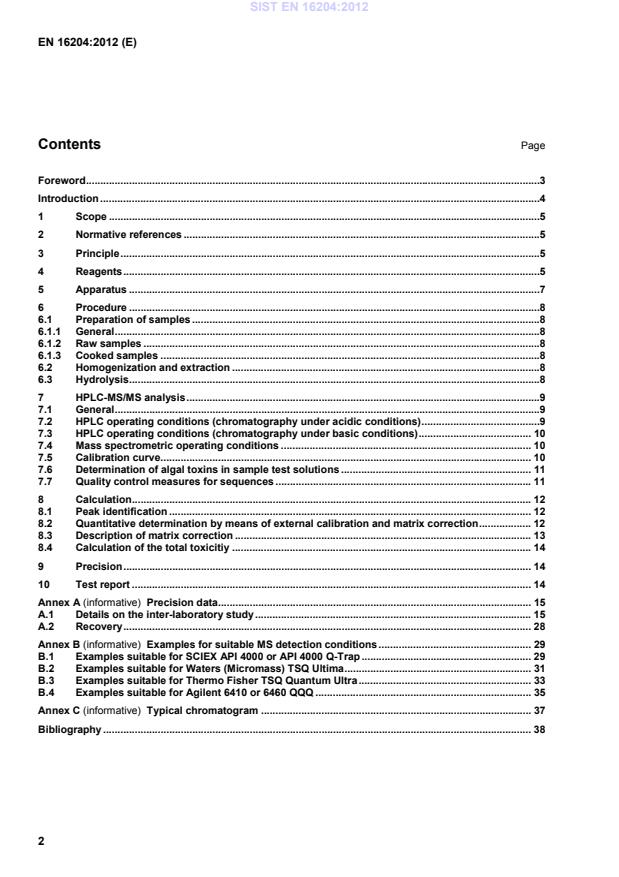
Precision data . 15A.1Details on the inter-laboratory study . 15A.2Recovery . 28Annex B (informative)
Examples for suitable MS detection conditions . 29B.1Examples suitable for SCIEX API 4000 or API 4000 Q-Trap . 29B.2Examples suitable for Waters (Micromass) TSQ Ultima . 31B.3Examples suitable for Thermo Fisher TSQ Quantum Ultra . 33B.4Examples suitable for Agilent 6410 or 6460 QQQ . 35Annex C (informative)
Typical chromatogram . 37Bibliography . 38 SIST EN 16204:2012
2 Normative references The following documents, in whole or in part, are normatively referenced in this document and are indispensable for its application. For dated references, only the edition cited applies. For undated references, the latest edition of the referenced document (including any amendments) applies. EN ISO 3696:1995, Water for analytical laboratory use
Specification and test methods (ISO 3696:1987) 3 Principle Remove the shellfish meat from the shell and homogenize the total shellfish meat. Extraction is carried out with aqueous methanol (3 = 80 %). Separation is performed on a HPLC reverse-phase column provided with a binary gradient and detection is carried out by means of tandem mass spectrometry using triple quadrupole technology. The concentration of lipophilic toxins is determined by means of external calibration. 4 Reagents If not otherwise specified, reagents of analytical grade and solvents suitable for LC-MS/MS shall be used. Water shall be distilled in glass vessels or demineralised before use, or shall be of equivalent purity according to EN ISO 3696:1995. Since the use of this method involves reagents harmful to health, appropriate precautionary and protective measures such as avoiding skin contact and using an extractor hood shall be taken. 4.1 Aqueous methanol (3= 80 %). NOTE The validation data of this method have been elaborated with 80 % aqueous methanol. However, it has been shown (see [4], [5]) that equivalent results can be obtained when using 100 % methanol. 4.2 Acetonitrile SIST EN 16204:2012
4.8 Ammonium hydrogen carbonate 4.9 HPLC mobile phase 1 (chromatography under acidic conditions) 4.9.1 Eluent A1 Dissolve 126 mg (to give a 2 mmol/l solution) of ammonium formate (4.6) and 2 ml (to give a 50 mmol/l solution) of formic acid (4.5) in 50 ml of water and fill up to 1 000 ml with water. If necessary, filter the eluent using a 0,45 µm membrane filter. 4.9.2 Eluent B1 Dissolve 126 mg (to give a 2 mmol/l solution) ammonium formate (4.6) and 2 ml (to give a 50 mmol/l solution) of formic acid (4.5) in 50 ml of water. Add 950 ml of acetonitrile (4.2) and filter the eluent using a 0,45 µm membrane filter, if required. 4.10 HPLC mobile phase 2 (chromatography under basic conditions) 4.10.1 Eluent A2 Dissolve 395 mg (to give a 5 mmol/l solution) of ammonium hydrogen carbonate (4.8) in 1 000 ml of water. If necessary, filter the eluent using a 0,45 µm membrane filter. 4.10.2 Eluent B2 Dissolve 395 mg (to give a 5 mmol/l solution) of ammonium hydrogen carbonate (4.8) in 50 ml water. Add 950 ml of acetonitrile (4.2) in portions of about 100 ml. Shake vigorously after each portion added. If necessary, filter the eluent using a 0,45 µm membrane filter.
4.11 Toxin-free shellfish homogenate To estimate and determine matrix effects, standard solutions in matrix are prepared. The shellfish homogenate required for this purpose is prepared from shellfishes that have been proved free from toxins. 4.12 Reference substances1) NOTE During the validation study, the following reference substances were available. If other certified reference substances should become available in the future, the use of these substances is recommended. 4.12.1 Okadaic acid (OA) 4.12.2 Pectenotoxin-2 (PTX-2)
1) Reference substances can be purchased from National Research Council Canada (NRC), Institute for Marine Bioscience, Halifax, for instance (http://www.nrc-cnrc.gc.ca). This is an example for suitable products available commercially. This information is given for the convenience of users of this standard and does not constitute an endorsement by CEN of these products. SIST EN 16204:2012
5.5 Analytical balance, accuracy to the nearest 0,1 mg.
5.6 Volumetric flask, 20 ml or 10 ml. 5.7 Graduated cylinder and suitable pipettes.
5.8 High Performance Liquid Chromatography (HPLC) system, capable of gradient elution.
5.9 HPLC vials. 5.10 Triple-Quadrupol-LC-MS/MS system. 5.11 Analytical Reversed Phase Column, e.g. RP C18, particle size 3 µm, 150 mm (length) × 2 mm (diameter) or C8, 50 mm (length) x 2 mm (diameter), 3 µm particle size, (only for acidic conditions). Optionally, an appropriate guard column may be used. 5.12 Syringe or membrane filter (e.g. regenerated cellulose membranes with a pore diameter of 0,45 µm).
2) Ultra Turrax® is an example for a suitable product available commercially from various suppliers. This information is given for the convenience of users of this standard and does not constitute an endorsement by CEN of this product. SIST EN 16204:2012
6.1.2 Raw samples After receipt, the raw samples should be shelled and drained, and then frozen until used for analysis or shall be extracted immediately. 6.1.3 Cooked samples The sample is cooked/steamed after receipt then drained and shelled. If it is not immediately treated, it can be cooled down until 24 h. To cook the shellfish, heat a sufficient amount of water (approximately 2 l to 3 l water per 1 kg of shellfish) to the boiling point. When the water is boiling, place shellfish into the water and cook under further addition of heat for approximately 3 min. After cooking, remove the shellfish meat from the open shells and homogenize. 6.2 Homogenization and extraction For the determination of lipophilic algal toxins, homogenize 100 g to 200 g shellfish meat or the meat of 50 to 100 whole shellfish in order to ensure representative data. If only small amounts are available, the whole sample amount is used.
Homogenize shellfish meat by means of a mechanical blender (5.1) and prepare immediately or store at
– 18 °C.
Weigh (2,00 ± 0,02) g of homogenate into a centrifuge tube (5.2). Add 9 ml of aqueous methanol (4.1) and mix for 1 min using a blender (5.1) at 13 500 min–1. Subsequently, centrifuge (5.2) the mixture at approximately 2 000 x g at room temperature for 5 min. Decant the supernatants into a 20 ml volumetric flask. Repeat the extraction. Decant the second supernatants into the 20 ml volumetric flask and dilute to the mark with aqueous methanol (4.1). Subsequently, filter the extract using a 0,45 µm membrane filter (5.12). As an alternative to filtration, a high-speed table centrifuge with 10 000 × g may be used for the same purpose (5.14). If only a small sample amount is available, (1,00 ± 0,01) g homogenate may be extracted twice with 4,5 ml of methanol (4.1) and made up to 10 ml. 6.3 Hydrolysis The hydrolysis step is necessary for determination of toxins of the okadaic acid group, bound as esters. From this step, the sum of free and bound toxins of the okadaic acid group is determined. The bound toxins are determined as the difference of the sum (after hydrolysis) and the free toxins (without hydrolysis). Pipette 1,0 ml of methanolic extract (6.2) into a vial (5.9). Add 125 µl of sodium hydroxide (4.3) and heat in a heat block (5.4) at (76 ± 2) °C for 40 min. After cooling the solution to room temperature, add 125 µl of SIST EN 16204:2012
EXAMPLE 1 When using the C18-column specified in 5.11 and the mobile phases A1 (4.9.1) and B1 (4.9.2), the conditions in Table 1 were found to be appropriate:
Table 1 — HPLC operating conditions 1 Time min Flow rate ml/min Mobile phase A1 % Mobile phase B1 % 0 0,2 60 40 6,0 0,2 10 90 14,5 0,2 10 90 15,5 0,2 60 40 21,0 0,2 60 40
Flow rate mobile phase (column): 0,2 ml/min
Injection volume: 5 µl to 10 µl Column oven temperature (including the guard column): 40 °C EXAMPLE 2 When using the C8 column, specified in 5.11, and the mobile phases A1 (4.9.1) and B1 (4.9.2), the conditions in Table 2 were found to be appropriate:
Table 2 — HPLC operating conditions 2 Time min Flow rate ml/min Mobile phase A1 % Mobile phase B1 % 0 0,2 70 30 8,0 0,2 10 90 11,0 0,2 10 90 11,5 0,2 70 30 16,0 0,2 70 30
Flow rate mobile phase (column): 0,2 ml/min
Injection volume: 5 µl to 10 µl Column oven temperature (including the guard column): 40 °C 7.3 HPLC operating conditions 2 (chromatography under basic conditions) When using the column specified in 5.11 and the mobile phases A2 (4.10.1) and B2 (4.10.2), the conditions in Table 3 were found to be appropriate (see also Figure C.1): Table 3 — HPLC operating conditions 3 Time min Flow rate ml/min Mobile phase A2 % Mobile phase B2 % 0 0,2 80 20 15,0 0,2 10 90 20,0 0,2 10 90 21,0 0,2 80 20 26,0 0,2 80 20
Flow rate mobile phase (column): 0,2 ml/min
Injection volume: 5 µl to 10 µl Column oven temperature (including the guard column): 40 °C 7.4 Mass spectrometric operating conditions The measurement may be performed using various instruments and instrument parameters. Some instrument parameters are listed in Annex B. These conditions have been shown to provide satisfactory results. 7.5 Calibration curve Prepare a calibration curve which includes at least 6 concentration levels (excluding the origin) and which covers a concentration range from e.g. 1,5 ng/ml to 25 ng/ml (or 3,0 ng/ml to 50 ng/ml for YTX). If a larger SIST EN 16204:2012
The lowest standard should be at or equal to the LOQ. Samples more highly concentrated than the highest calibration level can also be diluted with blank shellfish extract to obtain the calibration range. The ratio between intercept and slope is calculated and used as a quality parameter. The absolute value of this ratio corresponds to the concentration plotted on the x-axis and shall not be greater than half the quantification limit. Additionally, the correlation coefficient (r2) should be equal to or greater than 0,985. 7.6 Determination of algal toxins in sample test solutions Inject aliquots of the sample test solution (6.2), (6.3) into the HPLC system in an appropriate sequence. 7.7 Quality control measures for sequences All samples subject to quantitative determination of lipophilic algal toxins shall be analyzed at least by duplicate injection. The repeatability limit of the duplicate injection shall be smaller than 2,8 × r, where, r stands for the repeatability standard deviation of the extract. To check the quality of chemical analysis, it has proven necessary to run simultaneously at least one QM sample per sequence. This sample should contain a known concentration of lipophilic algal toxins such as a sample with assigned value used in an inter-laboratory trial, a certified reference material (e.g. NRC Mus-b), a laboratory reference material, or a blank extract/blank homogenate spiked with standards. When tolerance or warning limits are defined, the different repeatability standard deviations of extracts and homogenates shall be taken into account.
The matrix effects expected within a sequence shall be corrected as described in 8.3. For the determination of lipophilic algal toxins the adoption of a defined sequence has been proven suitable. The following operations layout is recommended: a) For sequences including more than 20 samples or exceeding a run time of 12 h: 1) calibration standards; 2) matrix correction standard; 3) QM sample; 4) samples (n > 20, first injection); 5) calibration standards; 6) matrix correction standard; 7) QM sample; 8) samples (n > 20, second injection); 9) optionally: one calibration standard. b) For sequences including less than 20 samples or a run time below 12 h: 1) samples (n < 20, first injection); SIST EN 16204:2012
8 Calculation 8.1 Peak identification The qualitative detection of lipophilic toxins is carried out by comparison of the retention time of the analytes in the sample with those of the standard substances or reference material. A confirmatory transition may be acquired for definitive identification of the analyte.
8.2 Quantitative determination by means of external calibration and matrix correction The quantitative determination is performed according to the method of the external standard by integration of the peak areas in relation to the calibration line of the standard solutions. Assuming an equal response factor, okadaic acid is used for the quantitative determination of the dinophysistoxins DTX-1 and DTX-2; likewise AZA-1 is used for the quantitative determination of AZA-2 and AZA-3. YTX is used for homo-yessotoxin, 45-OH-yessotoxin and 45-OH-homo-yessotoxin, and PTX-2 for PTX-1, if applicable. For the determination of the esters of OA, DTX-1 or DTX-2, quantification of the free acids is carried out before and after hydrolysis. It would be appropriate to use certified standards for the other analogues as soon as they are commercially available. Evaluation is based on the linear equation of the regression line of the individual lipophilic algal toxins. The correction of matrix effects is performed with the aid of a toxin-free shellfish extract of the same matrix strength which is spiked with standard substances (4.12.6). Calculate the mass concentration of the individual toxins in a sample using Formula (1): correctionMatrix ××−=Fab)(Ac (1) where c is the mass concentration of the analyte in micrograms toxin per kilogram of sample; A is the peak area, in units; b is the Y-intercept of the regression line; a is the slope of the regression line;
F is the dilution factor:
10 for measurement of the crude extract (6.2) without hydrolysis; 12,5 for measurement of the crude extract (6.3) with hydrolysis. SIST EN 16204:2012
Where single point matrix correction is applied, the prepared matrix standard (see 4.12.6) is analyzed. The concentration of the matrix standard is determined by means of the regression line. The concentration found is an indication of the apparent recovery (matrix effect) of the analytes and reflects the response suppression or enhancement of the analytes in the matrix. The concentration determined in the unknown sample is corrected with the apparent recovery.
EXAMPLE 1 AZA-1 in the matrix standard: ab)(Ac−=]1AZAmatrix[ (external calibration) (2) ng/ml5,7]AZA1matrix[=c 100 % recovery (spiked): here: 15 ng/ml (3)
apparent recovery [matrix AZA-1] = 50 %
(4) If, for instance, the apparent recovery of AZA-1 in matrix is determined to be 50 %, the AZA-1 concentration of each unknown sample shall be corrected by applying the factor for correction of apparent recovery.
EXAMPLE 2 AZA-1 matrix correction in the unknown sample:
(5) Matrix effects are determined for the individual toxins as follows: OA: Recovery of the 15 ng/ml standard in matrix; the OA can also be corrected using a dilution (e.g. 1/20 in matrix) of Mus-b3) with blank shellfish extract; DTX-2: Assumption of the same matrix effect as for OA; DTX-1: Recovery of DTX-1 in NRC Mus-b3) (e.g. 1/20 in matrix) or assumption of the same matrix effect as for OA; PTX-2: Recovery of the 15 ng/ml standard in matrix; PTX-1: Assumption of the same matrix effect as for PTX-2; YTX: Recovery of the 30 ng/ml standard in matrix; 45-OH-YTX, homo-YTX and 45-OH-homo-YTX: Assumption of the same matrix effects as for YTX;
3) The certified reference material Mus-b is obtained from a mix of mussels digestive gland and algal cells. ())50:here(recoveryapparent100calibrationexternal1AZA]corr 1 [×=cAZAc SIST EN 16204:2012
Precision data A.1 Details on the inter-laboratory study The data given in Table A.1 to Table A.12 were obtained in an international inter-laboratory study (see [8], [16]) organized by the Working Group “Phycotoxins” of the Federal Office for Consumer Protection and Food Safety (Bundesamt für Verbraucherschutz und Lebensmittelsicherheit — BVL) according to the German Food and Feed Code, Section 64 (Lebensmittel- und Futtermittelgesetzbuch-LFGB, § 64) in accordance with ISO 5725-2, -4 and -6 with 16 participating laboratories from different European countries (including 7 NRLs). This validation study was carried out in three independent sub-studies. Precision data for okadaic acid, DTX-2, DTX-1 (including their esters), AZA-1, AZA-2, AZA-3, YTX, 45-OH-YTX and PTX-2 were determined in naturally contaminated blue mussels (homogenate of cooked and raw mussels), spiked extracts of oysters (homogenate of raw shellfish) and spiked extracts of clams (homogenate of raw shellfish). Test samples 1 to 8 were analyzed by 13 laboratories by means of duplicate injection (analogous to the repeatability standard deviation (SD) of an extract) in three separate sequences (intermediate conditions). Test samples 9 to 12 were analyzed by eight laboratories within one single sequence by means of duplicate injection (analogous to the repeatability standard deviation (SD) of an extract). Test samples 13 to 16 were analysed by 15 laboratories within one single sequence by means of duplicate injection (analogous to the repeatability standard deviation (SD) of an extract). The results of the statistical evaluation of the investigated toxins are given in Table A.1 to Table A.12. The corrected HORRAT values were calculated according to [17]. The different analytical conditions, i.e. acidic and basic mobile phases, have been used by the different participants and had no influence on the laboratory results. Sample 2 is a blank blue mussel homogenate which was found by all laboratories as an uncontaminated material.
13 13 13 7 7 15 15
Number of laboratories retained after eliminating outliers 13
11 12 13 7 7 15 15
Number of outliers (laboratories) 0
2 1 0 0 0 0 0
Number of accepted results 156
66 72 156 28 28 30 30
Mean value, x, µg/kg 96,36 < LOD111,7 82,5 99,5 17,4 71,9 127,5464,92 < LOD < LODRepeatability standard deviation sr, µg/kg 11,4
8,9 8,2 10,4 1,8 3,5
Repeatability relative standard deviation, RSDr, % 11,8
8,0 9,9 10,5 10,4 4,9
Repeatability limit r [r = 2,8 × sr ], µg/kg 31,8
25,0 22,9 29,2 5,1 9,9
Reproducibility standard deviation sR, µg/kg 20,4
25,9 12,1 22,5 6,6 22,1 19,4 10,6
Reproducibility relative standard deviation, RSDR, % 21,2
23,2 14,7 22,6 37,9 30,8 15,2 16,3
Reproducibility limit R [R = 2,8 × sR], µg/kg 57,2
72,6 34,0 63,0 18,5 62,0 54,3 29,6
Intermediate conditions, % 14,1
9,6 10,7 11,9
HorRat value, corrected according to [17] 0,96
1,05 0,67 1,03 1,72 1,40 0,69 0,74
HorRatR value, uncorrected 0,93
1,04 0,63 1,00 1,29 1,30 0,69 0,67
a Samples 1/3: Blue mussels, cooked, naturally contaminated homogenate (blind duplicate). b
Sample 4: Blue mussels, cooked, naturally contaminated homogenate. c
Sample 5: Extract of samples 1/3 and additionally spiked with PTX-2. d
Sample 7: Clams, raw, extract of blank clams spiked with OA, AZA-1, PTX-2 and YTX. e
Samples 6/8: Oysters, raw, extract of blank oysters spiked with OA, AZA-1, PTX-2 and YTX (blind duplicate). f
Samples 9/11: Blue mussels, cooked, naturally contaminated homogenate (blind duplicate). g
Samples 10/12: Blue mussels, cooked, naturally contaminated homogenate (blind duplicate). h to k
Samples 13 to 16: Blue mussels, raw, naturally contaminated homogenates.
7 15 14
Number of laboratories retained after eliminating outliers 13
6 14 13
Number of outliers (laboratories) 0
1 1 1
Number of accepted results 156
24 28 26
Mean value, x, µg/kg 21,80 < LOD 28,90 < LOD< LOD< LOD10,78 36,22 19,29 < LOD< LODRepeatability standard deviation sr, µg/kg 3,16
4,7
1,0
Repeatability relative standard deviation, RSDr, % 14,5
16,3
9,5
Repeatability limit r [r = 2,8 × sr ], µg/kg 8,85
13,2
2,9
Reproducibility standard deviation sR, µg/kg 8,24
7,6
4,5 11,9 6,6
Reproducibility relative standard deviation, RSDR, % 37,8
26,2
42,0 32,8 34,0
Reproducibility limit R [R = 2,8 × sR], µg/kg 23,07
21,2
12,7 33,3 18,4
Intermediate conditions, % 24,4
18,0
HorRat value, corrected according to [17] 1,72
1,19
1,91 1,49 1,54
HorRatR value, uncorrected 1,33
0,96
1,33 1,24 1,17
a
Samples 1/3: Blue mussels, cooked, naturally contaminated homogenate (blind duplicate). b
Sample 4: Blue mussels, cooked, naturally contaminated homogenate. c
Sample 5: Extract of samples 1/3 and additionally spiked with PTX-2. d
Sample 7: Clams, raw, extract of blank clams spiked with OA, AZA-1, PTX-2 and YTX. e
Samples 6/8: Oysters, raw, extract of blank oysters spiked with OA, AZA-1, PTX-2 and YTX (blind duplicate). f
Samples 9/11: Blue mussels, cooked, naturally contaminated homogenate (blind duplicate). g
Samples 10/12: Blue mussels, cooked, naturally contaminated homogenate (blind duplicate). h to k
Samples 13 to 16: Blue mussels, raw, naturally contaminated homogenates.
7 7 13 9
Number of laboratories retained after eliminating outliers 13
6 6 12 8
Number of outliers (laboratories) 0
1 1 1 1
Number of accepted results 156
24 24 24 16
Mean value, x, µg/kg 50,27 < LOD 49,88 < LOD< LOD10,98 41,59 11,02 8,11 < LOD < LODRepeatability standard deviation sr, µg/kg 5,5
6,3
0,7 1,9
Repeatability relative standard deviation, RSDr, % 10,9
12,7
6,1 4,6
Repeatability limit r [r = 2,8 × sr ], µg/kg 15,3
17,7
1,9 5,4
Reproducibility standard deviation sR, µg/kg 14,7
12,3
3,6 11,4 3,7 1,8
Reproducibility relative standard deviation, RSDR, % 29,2
24,6
32,4 27,3 33,7 22,4
Reproducibility limit R [R = 2,8 × sR], µg/kg 41,1
34,4
10,0 31,8 10,4 5,1
Intermediate conditions, % 13,1
13,7
HorRat value, corrected according to [17] 1,33
1,12
1,47 1,24 1,53 1,02
HorRatR value, uncorrected 1,16
0,98
1,03 1,06 1,07 0,68
a
Samples 1/3: Blue mussels, cooked, naturally contaminated homogenate (blind duplicate). b
Sample 4: Blue mussels, cooked, naturally contaminated homogenate. c
Sample 5: Extract of samples 1/3 and additionally spiked with PTX-2. d
Sample 7: Clams, raw, extract of blank clams spiked with OA, AZA-1, PTX-2 and YTX. e
Samples 6/8: Oysters, raw, extract of blank oysters spiked with OA, AZA-1, PTX-2 and YTX (blind duplicate). f
Samples 9/11: Blue mussels, cooked, naturally contaminated homogenate (blind duplicate). g
Samples 10/12: Blue mussels, cooked, naturally contaminated homogenate (blind duplicate). h to k
Samples 13 to 16: Blue mussels, raw, naturally contaminated homogenates.
5,1 18,7 10,7 2,3 2,6
Repeatability relative standard deviation, RSDr, % 24,6
22,2 14,3 13,1 12,9 13,9
Repeatability limit r [r = 2,8 × sr ], µg/kg 16,1
14,3 52,4 30,0 6,5 7,3
Reproducibility standard deviation sR, µg/kg 6,9 9,0 6,9 19,1 17,0 6,1 6,2 32,0 14,8 10,1 5,8 Reproducibility relative standard deviation, RSDR, % 29,4 24,6 30,1 14,6 20,8 33,9 32,6 28,8 28,3 26,9 22,7 Reproducibility limit R [R = 2,8 × sR], µg/kg 19,2 25,3 19,4 53,5 47,6 17,0 17,2 89,6 41,6 28,3 16,3 Intermediate conditions, % 29,0 24,6 20,8 14,3 17,3
HorRat value, corrected according to [17] 1,34 1,12 1,37 0,67 0,95 1,54 1,48 1,31 1,28 1,22 1,03 HorRatR value, uncorrected 1,04 0,94 1,07 0,67 0,89 1,16 1,12 1,29 1,13 1,02 0,82 a
Samples 1/3: Blue mussels, cooked, naturally contaminated homogenate (blind duplicate). b
Sample 4: Blue mussels, cooked, naturally contaminated homogenate. c
Sample 5: Extract of samples 1/3 and additionally spiked with PTX-2. d
Sample 7: Clams, raw, extract of blank clams spiked with OA, AZA-1, PTX-2 and YTX. e
Samples 6/8: Oysters, raw, extract of blank oysters spiked with OA, AZA-1, PTX-2 and YTX (blind duplicate). f
Samples 9/11: Blue mussels, cooked, naturally contaminated homogenate (blind duplicate). g
Samples 10/12: Blue mussels, cooked, naturally contaminated homogenate (blind duplicate). h to k
Samples 13 to 16: Blue mussels, raw, naturally contaminated homogenates. SIST EN 16204:2012
15 15 15 15 Number of laboratories retained after eliminating outliers 13 13
13 13 13 13 Number of outliers (laboratories) 0 0
2 2 2 2 Number of accepted results 156 78
26 26 26 26 Mean value, x, µg/kg 48,08 78,57 < LOD < LOD< LOD< LOD< LOD174,6779,37 65,53 44,09 Repeatability standard deviation sr, µg/kg 9,5
Repeatability relative standard deviation, RSDr, % 19,7
Repeatability limit r [r = 2,8 × sr ], µg/kg 26,5
Reproducibility standard deviation sR, µg/kg 14,0 20,4
54,0 21,3 17,6 10,9 Reproducibility relative standard deviation, RSDR, % 29,2 25,9
30,9 26,8 26,9 24,8 Reproducibility limit R [R = 2,8 × sR], µg/kg 39,3 57,0
151,1 59,6 49,4 30,6 Intermediate conditions, % 25,7 19,4
HorRat value, corrected according to [17] 1,33 1,18
1,48 1,22 1,22 1,13 HorRatR value, uncorrected 1,16 1,10
1,48 1,14 1,11 0,97 a
Samples 1/3: Blue mussels, cooked, naturally contaminated homogenate (blind duplicate). b
Sample 4: Blue mussels, cooked, naturally contaminated homogenate. c
Sample 5: Extract of samples 1/3 and additionally spiked with PTX-2. d
Sample 7: Clams, raw, extract of blank clams spiked with OA, AZA-1, PTX-2 and YTX. e
Samples 6/8: Oysters, raw, extract of blank oysters spiked with OA, AZA-1, PTX-2 and YTX (blind duplicate). f
Samples 9/11: Blue mussels, cooked, naturally contaminated homogenate (blind duplicate). g
Samples 10/12: Blue mussels, cooked, naturally contaminated homogenate (blind duplicate). h to k
Samples 13 to 16: Blue mussels, raw, naturally contaminated homogenates.
Sample 1/3a 4b 5c 7d 6/8e 9/11f 10/12g13h 14i 15j 16k Year of inter-laboratory test 2009 2009 2009 2009 2009 2009 2009 2010 2010 2010 2010 Number of laboratories
8 8
15 15 Number of laboratories retained after eliminating outliers
7 7
14 14 Number of outliers (laboratories) 0 0
1 1
1 1 Number of accepted results
28 28
28 28 Mean value, x, µg/kg < LOD 68,51 < LOD< LOD< LOD80,26 33,17 < LOD < LOD 219,17118,11Repeatability standard deviation sr, µg/kg
5,1 5,7
Repeatability relative standard deviation, RSDr, %
6,3 17,3
Repeatability limit r
[r = 2,8 × sr ], µg/kg
14,2 16,1
Reproducibility standard deviation sR, µg/kg
23,3
27,1 12,8
76,7 42,3 Reproducibility relative standard deviation, RSDR, %
34,0
33,8 38,7
35,0 35,8 Reproducibility limit R [R = 2,8 × sR], µg/kg
65,2
76,
...