

SIST EN 1488:2021
(Main)Building valves - Expansion groups - Tests and requirements
General Information
- Abstract
This document specifies, dimensions, materials and performance requirements (including methods of test) for expansion groups, of nominal sizes from DN 15 to DN 25, having working pressures from 0,1 MPa (1 bar) to 1,0 MPa (10 bar).
Expansion groups are fitted to the cold potable water supply only for expansion purposes, e.g. of storage water heaters, having a maximum distribution temperature of 95 °C.
Expansion groups limit pressure in the water heater to which they are fitted, that is produced by thermal expansion of the water, prevent the backflow of water into the supply pipe and prevent the discharged water to get into contact with the water in the water heater.
Expansion groups do not control temperature and alone do not constitute the protection required for storage water heaters.
NOTE The use of the device specified in this document does not override the need to use controls (e.g. thermostats and thermal cut-outs) which act directly on the power sources of water heaters (for more information see Annex A).
- Status
- Published
- Public Enquiry End Date
- 14-Jun-2020
- Publication Date
- 17-Jun-2021
- Technical Committee
- IOVO - Water supply and waste water engineering
- Current Stage
- 6060 - National Implementation/Publication (Adopted Project)
- Start Date
- 14-Jun-2021
- Due Date
- 19-Aug-2021
- Completion Date
- 18-Jun-2021


Overview
EN 1488:2021 - Building valves: Expansion groups - Tests and requirements is a CEN standard that specifies dimensions, materials, performance criteria and test methods for expansion groups (nominal sizes DN 15 to DN 25) used on the cold potable water supply to cope with thermal expansion from storage water heaters. It covers devices with working pressures from 0.1 MPa (1 bar) to 1.0 MPa (10 bar) and a maximum distribution temperature of 95 °C. EN 1488:2021 supersedes EN 1488:2000 and updates material rules, testing (including disinfectant compatibility), torque testing and coating procedures.
Key topics and technical requirements
- Scope & function
- Designed to limit pressure produced by thermal expansion, prevent backflow into the supply pipe and ensure discharged water does not contact the water heater contents.
- Not a temperature control device and does not replace thermostats or thermal cut-outs (see Annex A for heater classification).
- Materials & surface finishes
- Requirements and tests for acceptable materials, detection of residual stress, corrosion resistance and coating adherence.
- Compatibility testing with shock-disinfection agents used in potable water networks.
- Design & dimensions
- Dimensional requirements for DN 15–25, connections, test/pressure ports, air break to drain and discharge interfaces.
- Requirements for replacing expansion valves and for captive rotating nuts/tail pieces.
- Hydraulic tests
- Flow rate verification, tightness tests for isolating valves and whole expansion groups, and test media/tolerance rules.
- Mechanical tests
- Body pressure tests, bending moment, torsional strength, torque tests and endurance tests for moving parts and easing gear.
- Component tests
- Performance, tightness and endurance tests for isolating valves, check valves and the expansion (safety) valve.
- Acoustic tests, classification, marking and documentation
- Sound emission testing, product classification, required marking and delivery documentation.
Applications and users
- Practical use: Specification, selection and conformity testing of expansion groups fitted to storage water heaters and other potable water systems to manage thermal expansion.
- Typical users:
- Manufacturers of building valves and expansion groups
- Product testing laboratories and certification bodies
- Plumbing/HVAC designers and specifiers
- Installers and maintenance engineers
- Regulatory authorities and purchasers requiring compliance with European standards
Related standards
- Prepared by CEN/TC 164 (“Water supply”) and intended to be used alongside other European standards for water supply systems and valves. EN 1488:2021 replaces the 2000 edition and aligns testing and material procedures with current CEN practice.
Keywords: EN 1488:2021, expansion groups, building valves, potable water, storage water heaters, tests and requirements, DN 15, DN 25, thermal expansion.
Relations
- Effective Date
- 01-Sep-2021
- Effective Date
- 28-Jan-2026
- Effective Date
- 28-Jan-2026
- Effective Date
- 28-Jan-2026
- Effective Date
- 28-Jan-2026
- Effective Date
- 28-Jan-2026
- Effective Date
- 28-Jan-2026
- Effective Date
- 28-Jan-2026
- Effective Date
- 28-Jan-2026
- Effective Date
- 28-Jan-2026
- Refers
SIST EN ISO 9227:2023 - Corrosion tests in artificial atmospheres - Salt spray tests (ISO 9227:2022) - Effective Date
- 28-Jan-2026
- Effective Date
- 28-Jan-2026
- Effective Date
- 28-Jan-2026
- Effective Date
- 28-Jan-2026
- Effective Date
- 28-Jan-2026
Get Certified
Connect with accredited certification bodies for this standard

DIBt (Deutsches Institut für Bautechnik)
German Institute for Building Technology.
DIN CERTCO
DIN Group product certification.

Aboma Certification B.V.
Specialized in construction, metal, and transport sectors.
Sponsored listings
Frequently Asked Questions
SIST EN 1488:2021 is a standard published by the Slovenian Institute for Standardization (SIST). Its full title is "Building valves - Expansion groups - Tests and requirements". This standard covers: This document specifies, dimensions, materials and performance requirements (including methods of test) for expansion groups, of nominal sizes from DN 15 to DN 25, having working pressures from 0,1 MPa (1 bar) to 1,0 MPa (10 bar). Expansion groups are fitted to the cold potable water supply only for expansion purposes, e.g. of storage water heaters, having a maximum distribution temperature of 95 °C. Expansion groups limit pressure in the water heater to which they are fitted, that is produced by thermal expansion of the water, prevent the backflow of water into the supply pipe and prevent the discharged water to get into contact with the water in the water heater. Expansion groups do not control temperature and alone do not constitute the protection required for storage water heaters. NOTE The use of the device specified in this document does not override the need to use controls (e.g. thermostats and thermal cut-outs) which act directly on the power sources of water heaters (for more information see Annex A).
This document specifies, dimensions, materials and performance requirements (including methods of test) for expansion groups, of nominal sizes from DN 15 to DN 25, having working pressures from 0,1 MPa (1 bar) to 1,0 MPa (10 bar). Expansion groups are fitted to the cold potable water supply only for expansion purposes, e.g. of storage water heaters, having a maximum distribution temperature of 95 °C. Expansion groups limit pressure in the water heater to which they are fitted, that is produced by thermal expansion of the water, prevent the backflow of water into the supply pipe and prevent the discharged water to get into contact with the water in the water heater. Expansion groups do not control temperature and alone do not constitute the protection required for storage water heaters. NOTE The use of the device specified in this document does not override the need to use controls (e.g. thermostats and thermal cut-outs) which act directly on the power sources of water heaters (for more information see Annex A).
SIST EN 1488:2021 is classified under the following ICS (International Classification for Standards) categories: 23.060.01 - Valves in general; 91.140.60 - Water supply systems. The ICS classification helps identify the subject area and facilitates finding related standards.
SIST EN 1488:2021 has the following relationships with other standards: It is inter standard links to SIST EN 1488:2000, SIST EN 806-2:2005, SIST EN 13959:2005, SIST EN 1567:2000, SIST EN 806-1:2001, SIST EN 806-1:2001/A1:2001, SIST EN 806-3:2006, SIST EN ISO 6509-1:2014, SIST EN ISO 3822-3:2018, SIST EN 10226-1:2004, SIST EN ISO 9227:2023, SIST EN ISO 3822-1:1999, SIST EN ISO 228-1:2003, SIST EN 1254-2:2021, SIST EN 806-4:2011. Understanding these relationships helps ensure you are using the most current and applicable version of the standard.
SIST EN 1488:2021 is associated with the following European legislation: EU Directives/Regulations: 305/2011, 98/83/EC. When a standard is cited in the Official Journal of the European Union, products manufactured in conformity with it benefit from a presumption of conformity with the essential requirements of the corresponding EU directive or regulation.
SIST EN 1488:2021 is available in PDF format for immediate download after purchase. The document can be added to your cart and obtained through the secure checkout process. Digital delivery ensures instant access to the complete standard document.
Standards Content (Sample)
SLOVENSKI STANDARD
01-september-2021
Nadomešča:
SIST EN 1488:2000
Ventili v stavbah - Ekspanzijski bloki - Preskusi in zahteve
Building valves - Expansion groups - Tests and requirements
Gebäudearmaturen - Sicherheitsgruppen für Expansionswasser - Prüfungen und
Anforderungen
Robinetterie de bâtiment - Groupes d'expansion - Essais et exigences
Ta slovenski standard je istoveten z: EN 1488:2021
ICS:
23.060.01 Ventili na splošno Valves in general
91.140.60 Sistemi za oskrbo z vodo Water supply systems
2003-01.Slovenski inštitut za standardizacijo. Razmnoževanje celote ali delov tega standarda ni dovoljeno.
EN 1488
EUROPEAN STANDARD
NORME EUROPÉENNE
May 2021
EUROPÄISCHE NORM
ICS 91.140.60 Supersedes EN 1488:2000
English Version
Building valves - Expansion groups - Tests and
requirements
Robinetterie de bâtiment - Groupes d'expansion - Gebäudearmaturen - Sicherheitsgruppen für
Essais et exigences Expansionswasser - Prüfungen und Anforderungen
This European Standard was approved by CEN on 19 March 2021.
CEN members are bound to comply with the CEN/CENELEC Internal Regulations which stipulate the conditions for giving this
European Standard the status of a national standard without any alteration. Up-to-date lists and bibliographical references
concerning such national standards may be obtained on application to the CEN-CENELEC Management Centre or to any CEN
member.
This European Standard exists in three official versions (English, French, German). A version in any other language made by
translation under the responsibility of a CEN member into its own language and notified to the CEN-CENELEC Management
Centre has the same status as the official versions.
CEN members are the national standards bodies of Austria, Belgium, Bulgaria, Croatia, Cyprus, Czech Republic, Denmark, Estonia,
Finland, France, Germany, Greece, Hungary, Iceland, Ireland, Italy, Latvia, Lithuania, Luxembourg, Malta, Netherlands, Norway,
Poland, Portugal, Republic of North Macedonia, Romania, Serbia, Slovakia, Slovenia, Spain, Sweden, Switzerland, Turkey and
United Kingdom.
EUROPEAN COMMITTEE FOR STANDARDIZATION
COMITÉ EUROPÉEN DE NORMALISATION
EUROPÄISCHES KOMITEE FÜR NORMUNG
CEN-CENELEC Management Centre: Rue de la Science 23, B-1040 Brussels
© 2021 CEN All rights of exploitation in any form and by any means reserved Ref. No. EN 1488:2021 E
worldwide for CEN national Members.
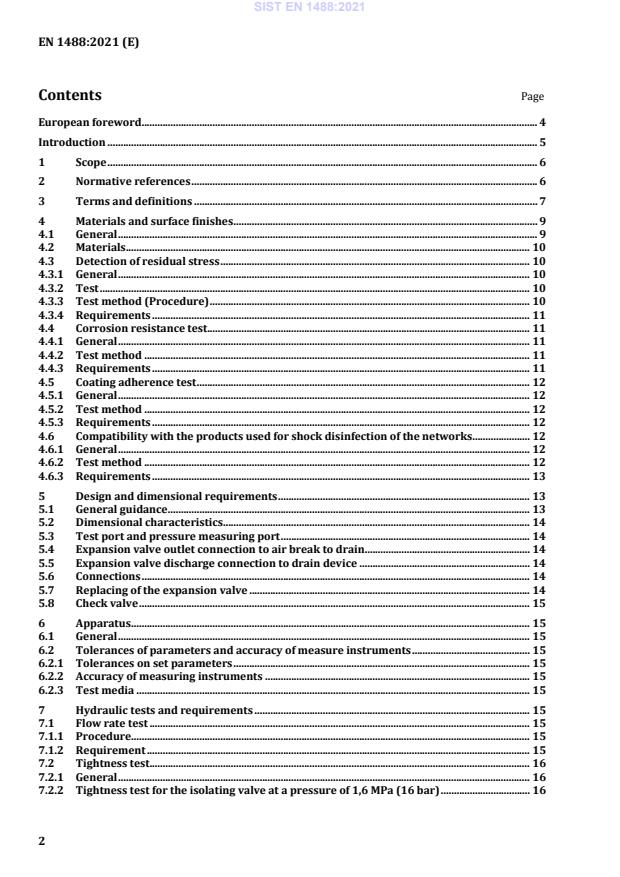
Contents Page
European foreword . 4
Introduction . 5
1 Scope . 6
2 Normative references . 6
3 Terms and definitions . 7
4 Materials and surface finishes . 9
4.1 General . 9
4.2 Materials . 10
4.3 Detection of residual stress . 10
4.3.1 General . 10
4.3.2 Test . 10
4.3.3 Test method (Procedure) . 10
4.3.4 Requirements . 11
4.4 Corrosion resistance test . 11
4.4.1 General . 11
4.4.2 Test method . 11
4.4.3 Requirements . 11
4.5 Coating adherence test . 12
4.5.1 General . 12
4.5.2 Test method . 12
4.5.3 Requirements . 12
4.6 Compatibility with the products used for shock disinfection of the networks. 12
4.6.1 General . 12
4.6.2 Test method . 12
4.6.3 Requirements . 13
5 Design and dimensional requirements . 13
5.1 General guidance . 13
5.2 Dimensional characteristics. 14
5.3 Test port and pressure measuring port . 14
5.4 Expansion valve outlet connection to air break to drain. 14
5.5 Expansion valve discharge connection to drain device . 14
5.6 Connections . 14
5.7 Replacing of the expansion valve . 14
5.8 Check valve . 15
6 Apparatus . 15
6.1 General . 15
6.2 Tolerances of parameters and accuracy of measure instruments . 15
6.2.1 Tolerances on set parameters . 15
6.2.2 Accuracy of measuring instruments . 15
6.2.3 Test media . 15
7 Hydraulic tests and requirements . 15
7.1 Flow rate test . 15
7.1.1 Procedure. 15
7.1.2 Requirement . 15
7.2 Tightness test . 16
7.2.1 General . 16
7.2.2 Tightness test for the isolating valve at a pressure of 1,6 MPa (16 bar) . 16
7.2.3 Expansion group tightness test . 16
8 Mechanical tests and requirements . 16
8.1 Mechanical strength . 16
8.1.1 Pressure test of the body of the expansion group . 16
8.1.2 Bending moment test . 17
8.2 Mechanical strength of the easing gear of the expansion valve . 18
8.2.1 Procedure . 18
8.2.2 Requirement . 18
8.3 Torsional strength of the expansion group’s body . 18
8.3.1 General . 18
8.3.2 Procedure . 18
8.3.3 Requirement . 19
8.4 Torque test of the captive rotating nuts/tail pieces . 19
8.4.1 General . 19
8.4.2 Procedure . 19
8.4.3 Requirement . 19
9 Tests and requirements of the components of the expansion group . 20
9.1 Isolating valve . 20
9.1.1 General . 20
9.1.2 General requirements . 20
9.1.3 Test of manual operation . 20
9.1.4 Endurance test . 20
9.2 Tightness between check valve and group's body . 21
9.2.1 General . 21
9.2.2 Verification of the leak tightness between the group’s body and the check valve at
low pressure . 21
9.2.3 Verification of the leak tightness between the group’s body and the check valve
under high pressure . 21
9.3 Expansion valve . 21
9.3.1 Pressures . 21
9.3.2 Cold water pressure tests . 22
9.4 Endurance test . 23
9.4.1 Procedure . 23
9.4.2 Requirement . 23
9.5 Easing gear (manual control device) . 24
9.5.1 Operation of the easing gear . 24
9.5.2 Easing gear endurance test . 24
9.6 Air break to drain . 24
10 Acoustic tests and requirements. 24
11 Classification . 25
12 Designation . 25
13 Marking . 26
14 Technical documents and presentation at delivery . 26
Annex A (informative) Classification of water heaters according to heating method . 27
Bibliography . 29
European foreword
This document (EN 1488:2021) has been prepared by Technical Committee CEN/TC 164 “Water
supply”, the secretariat of which is held by AFNOR.
This European Standard shall be given the status of a national standard, either by publication of an
identical text or by endorsement, at the latest by November 2021, and conflicting national standards
shall be withdrawn at the latest by November 2021.
Attention is drawn to the possibility that some of the elements of this document may be the subject of
patent rights. CEN shall not be held responsible for identifying any or all such patent rights.
This document supersedes EN 1488:2000.
In comparison with the previous edition, the following technical modifications have been made:
— chapter on materials was completely revised;
— testing with disinfectant was introduced;
— torque test was added;
— testing for safety valve was changed and optimized;
— coating test procedure was revised;
— normative references were updated;
— editorial changes have been made throughout the entire document.
According to the CEN-CENELEC Internal Regulations, the national standards organisations of the
following countries are bound to implement this European Standard: Austria, Belgium, Bulgaria,
Croatia, Cyprus, Czech Republic, Denmark, Estonia, Finland, France, Germany, Greece, Hungary, Iceland,
Ireland, Italy, Latvia, Lithuania, Luxembourg, Malta, Netherlands, Norway, Poland, Portugal, Republic of
North Macedonia, Romania, Serbia, Slovakia, Slovenia, Spain, Sweden, Switzerland, Turkey and the
United Kingdom.
Introduction
With regards to potential adverse effect on the quality of water intended for human consumption,
caused by the product covered by this document:
1) This document provides no information as to whether the product may be used without restriction
in any of the Member States of the EU or EFTA.
2) It should be noted that, whilst awaiting the adoption of verifiable European criteria, existing
national regulations concerning the use or the characteristics of this product remain in force.
1 Scope
This document specifies, dimensions, materials and performance requirements (including methods of
test) for expansion groups, of nominal sizes from DN 15 to DN 25, having working pressures from
0,1 MPa (1 bar) to 1,0 MPa (10 bar).
Expansion groups are fitted to the cold potable water supply only for expansion purposes, e.g. of
storage water heaters, having a maximum distribution temperature of 95 °C.
Expansion groups limit pressure in the water heater to which they are fitted, that is produced by
thermal expansion of the water, prevent the backflow of water into the supply pipe and prevent the
discharged water to get into contact with the water in the water heater.
Expansion groups do not control temperature and alone do not constitute the protection required for
storage water heaters.
NOTE The use of the device specified in this document does not override the need to use controls (e.g.
thermostats and thermal cut-outs) which act directly on the power sources of water heaters (for more
information see Annex A).
2 Normative references
The following documents are referred to in the text in such a way that some or all of their content
constitutes requirements of this document. For dated references, only the edition cited applies. For
undated references, the latest edition of the referenced document (including any amendments) applies.
EN 806 (all parts), Specifications for installations inside buildings conveying water for human
consumption
EN 1254-2, Copper and copper alloys — Plumbing fittings — Part 2: Fittings with compression ends for
use with copper tubes
EN 1567, Building valves — Water pressure reducing valves and combination water pressure reducing
valves — Requirements and tests
EN 1717:2000, Protection against pollution of potable water in water installations and general
requirements of devices to prevent pollution by backflow
EN 10226-1, Pipe threads where pressure tight joints are made on the threads — Part 1: Taper external
threads and parallel internal threads — Dimensions, tolerances and designation
EN 13959, Anti-pollution check valves — DN 6 to DN 250 inclusive family E, type A, B, C and D
EN ISO 3822-1, Acoustics — Laboratory tests on noise emission from appliances and equipment used in
water supply installations — Part 1: Method of measurement (ISO 3822-1)
EN ISO 3822-3, Acoustics — Laboratory tests on noise emission from appliances and equipment used in
water supply installations — Part 3: Mounting and operating conditions for in-line valves and appliances
(ISO 3822-3)
EN ISO 6509 (all parts), Corrosion of metals and alloys — Determination of dezincification resistance of
copper alloys with zinc (ISO 6509)
EN ISO 228-1, Pipe threads where pressure-tight joints are not made on the threads — Part 1: Dimensions,
tolerances and designation (ISO 228-1)
EN ISO 9227, Corrosion tests in artificial atmospheres — Salt spray tests (ISO 9227)
1 All pressures are gauge unless otherwise stated.
3 Terms and definitions
For the purposes of this document, the following terms and definitions apply.
ISO and IEC maintain terminological databases for use in standardization at the following addresses:
— ISO Online browsing platform: available at https://www.iso.org/obp
— IEC Electropedia: available at https://www.electropedia.org/
3.1
expansion group
group that limits the pressure increase due to the volume expansion when water is heated, prevents the
backflow of the water into the main circuit and the contamination of water contained in the water
heater with discharged water, allows to control the function of the backflow prevention and isolates the
water heater for maintenance services
Note 1 to entry: An expansion group comprises of the following components in a single unit, in an upstream to
downstream order as shown in Table 1.
Table 1 — Components of the expansion group
Quantity
Component
an isolating valve 1
a test port for monitoring the check valve 1
a check valve 1
a
an isolating valve
a
an additional outlet connection
an expansion valve 1
an air break to drain 1
a
a pressure measuring port
a
optional
3.2
isolating valve
valve that isolates the water heater from the potable water supply
3.3
check valve
valve that allows water to flow into a water heater, and automatically prevents water returning to the
water supply
3.4
additional outlet connection
connection to supply cold potable water to be supplied to an additional device, e.g. inline hot water
supply tempering valves, etc.
3.5
expansion valve
valve that limits the pressure of the water in the water heater to a predetermined value by discharging
water to drain
3.6
air break to drain
device that prevents discharged water from returning to the expansion group and thus to the water
heater
3.7
pressure measuring port
measuring port that allows pressure measuring equipment to be connected
3.8
nominal set pressure
P
nr
pressure of the expansion valve which is set on production
Note 1 to entry: The “nominal set pressure” (P ) is often called “set pressure”.
nr
3.9
water tightness pressure
P
e
pressure up to which the expansion valve is closed
Note 1 to entry: See Figure 1.
3.10
initial opening pressure
P
dc
pressure at which the expansion valve opens for the first time, as indicated by the first droplet of water
at the outlet of the expansion group, after a period of storage
Note 1 to entry: See Figure 1.
3.11
opening pressure
P
o
pressure at which the expansion valve open as indicated by the appearance of water at the outlet of the
expansion group
Note 1 to entry: See Figure 1.
3.12
rating pressure
P
dn
pressure at which the discharged flow is above the limit
Note 1 to entry: See Figure 1 and Table 8.
3.13
closing pressure
P
f
pressure at which the expansion valve closes after having reached the rating pressure
Note 1 to entry: See Figure 1.
Key
pressure
Y
X time
Figure 1 — Pressures
4 Materials and surface finishes
4.1 General
The selection of materials is the responsibility of the manufacturer, provided they satisfy the following
requirements:
a) materials and coatings shall not contaminate the potable water;
b) in a technical document, the manufacturer shall state the nature of the materials and coatings used;
c) materials with insufficient corrosion resistance (e.g. cast iron, aluminium) shall have additional
protection;
d) the materials used shall be suitable for the temperatures specified in the tests in this document;
e) the materials, and in particular copper alloys, for which recommendations or international
standards exist, shall comply with the relevant recommendations or international standards.
4.2 Materials
All materials coming into contact with water intended for human consumption shall present no health
risk nor cause any change to the water in terms of quality, appearance, smell or taste.
NOTE While awaiting the adoption of verifiable European criteria for testing materials in contact with water
intended for human consumption, existing national regulations concerning the use and/or the characteristics of
these products remain in force.
Copper-zinc alloys containing more than 10 % zinc are subject to dezincification when submitted to
water capable of dezincification. In the countries where the use of products made of dezincification
resistant materials is required, the materials used shall guarantee a dezincification depth less than
200 μm in any direction. For this purpose materials shall be tested in accordance with the standard
EN ISO 6509 (all parts) and the product shall be marked in compliance with the indications according to
Clause 13.
4.3 Detection of residual stress
4.3.1 General
This test shall be performed for bodies made out of brass materials and with female threads according
to EN 10226-1 and compression ends according to EN 1254-2.
4.3.2 Test
This test is based on ISO 6957. Its purpose is to verify the resistance to cracking under stress corrosion
in ammonia medium (as described in 4.3.3 b).
The test entails exposing test specimens consisting of the assembled expansion group in an atmosphere
loaded with ammonia vapour.
4.3.3 Test method (Procedure)
The paragraph below details ISO 6957.
Test solution:
a) Use solutions of analysis quality and of distilled water.
b) Solution of ammonia at 20 % (in weight).
c) The pH of the test solution is to be adjusted to 9.5 by using hydrochloric acid.
d) The test temperature is to be (23 ± 2) °C with a measurement uncertainty of ± 1 °C.
Test specimen:
e) The test specimen consists of three samples of a single assembled product. The test specimen is
inserted into the test enclosure under no stress.
Instructions:
f) Rinse the test specimens with a clean non-chlorinated solvent (for example, ethanol).
g) Let it dry in the air.
h) Insert the test specimens into the test enclosure along with the ammonia solution. The volume of
the container made of glass (e.g. desiccator) is to be minimum (10 ± 1) l.
i) The volume of the solution inserted is to be (200 ± 10) ml per 3 l of total volume of the container
(e.g. for a 10 l container it means (667 ± 33) ml.
j) Place the test specimens in the container in such a way that they will not touch each other and that
...