

SIST EN 50289-3-13:2004
(Main)Communication cables - Specifications for test methods -- Part 3-13: Mechanical test methods - Aeolian vibration
General Information
- Abstract
This Part 3-13 of EN 50289 details the method of test to determine the ability of exposed overhead cables used in analogue and digital communication systems to withstand dynamic stresses similar to those imposed by laminar wind flow induced vibrations in overhead lines.
It is to be read in conjunction with Part 3-1 of EN 50289, which contains essential provisions for its application.
- Status
- Published
- Publication Date
- 31-Mar-2004
- Technical Committee
- iTEL - Communication cables
- Current Stage
- 6060 - National Implementation/Publication (Adopted Project)
- Start Date
- 01-Apr-2004
- Due Date
- 01-Apr-2004
- Completion Date
- 01-Apr-2004

Overview
EN 50289-3-13:2003 - Communication cables: Mechanical test methods - Aeolian vibration defines a standardized test method to determine the ability of exposed overhead communication cables (analogue, digital, copper and optical) to withstand dynamic stresses caused by aeolian (wind‑induced) vibration. It is intended to be read with EN 50289-3-1 (general mechanical test requirements) and uses definitions from EN 50290-1-2.
Key topics and requirements
- Scope and samples
- Minimum cable test length: 50 m (unless otherwise specified).
- Minimum optical fibre test length: 100 m (splicing permitted if needed).
- Test equipment
- Electronically controlled shaker (vertical excitation), dynamometer/load cell to measure tension, and suitable suspension/anchoring assemblies.
- Optical tests: light source at 1 550 nm or 1 310 nm with power meter/monitoring (bandwidth 0–300 Hz minimum); OTDR if required.
- Copper tests: network analyser and continuity testers.
- Procedure
- Install sample with representative end terminations and maintain constant tension (allow for temperature changes).
- Typical installation tension: 15–25% of rated maximum tensile load unless otherwise specified.
- Span geometry: overall span ≥ 30 m, active span ≈ 20 m; static sag angle ≈ 1.5° ± 0.5° in the active span.
- Shaker location: provide at least six vibration loops between shaker and suspension. Monitor mid‑loop (antinode) amplitude (free loop).
- Test frequencies chosen to simulate resonance under laminar wind speeds typically 0.5–7 m/s. Relevant relations:
- f = k · v / D (Hz), where k is the Strouhal constant (≈ 0.2 for aerial cables)
- λ = (1 / f) · √(T / m) (wavelength λ in metres; T = tension, m = mass per unit length)
- Acceptance & reporting
- Acceptance criteria are defined in the relevant product/specification; failures include permanent or temporary damage or changes in optical/electrical characteristics beyond specified limits.
- Test report must document span geometry, tension, suspension details, vibration modes, monitoring frequencies, equipment characteristics, ambient conditions and pass/fail criteria.
Applications and users
EN 50289-3-13 is used to:
- Qualify and type‑approve overhead optical and copper communication cables for wind‑induced vibration resilience.
- Support product design, quality assurance, type testing, and compliance checks for cable manufacturers, independent test laboratories, telecom network operators, utilities and standards bodies.
- Inform installation guidelines for exposed aerial cable systems to reduce fatigue, microbending and signal degradation.
Related standards
- EN 50289-3-1 - Communication cables: Mechanical test methods - General requirements
- EN 50290-1-2 - Communication cables: Definitions
Keywords: EN 50289-3-13, aeolian vibration, communication cables, overhead cables, vibration testing, optical cable testing, mechanical test methods.
Relations
- Effective Date
- 03-Feb-2026
Get Certified
Connect with accredited certification bodies for this standard

ANCE
Mexican certification and testing association.

Intertek Slovenia
Intertek testing, inspection, and certification services in Slovenia.

LNE (Laboratoire National de Métrologie et d'Essais)
French national laboratory for metrology and testing.
Sponsored listings
Frequently Asked Questions
SIST EN 50289-3-13:2004 is a standard published by the Slovenian Institute for Standardization (SIST). Its full title is "Communication cables - Specifications for test methods -- Part 3-13: Mechanical test methods - Aeolian vibration". This standard covers: This Part 3-13 of EN 50289 details the method of test to determine the ability of exposed overhead cables used in analogue and digital communication systems to withstand dynamic stresses similar to those imposed by laminar wind flow induced vibrations in overhead lines. It is to be read in conjunction with Part 3-1 of EN 50289, which contains essential provisions for its application.
This Part 3-13 of EN 50289 details the method of test to determine the ability of exposed overhead cables used in analogue and digital communication systems to withstand dynamic stresses similar to those imposed by laminar wind flow induced vibrations in overhead lines. It is to be read in conjunction with Part 3-1 of EN 50289, which contains essential provisions for its application.
SIST EN 50289-3-13:2004 is classified under the following ICS (International Classification for Standards) categories: 33.120.10 - Coaxial cables. Waveguides. The ICS classification helps identify the subject area and facilitates finding related standards.
SIST EN 50289-3-13:2004 has the following relationships with other standards: It is inter standard links to SIST EN 50290-4-1:2015. Understanding these relationships helps ensure you are using the most current and applicable version of the standard.
SIST EN 50289-3-13:2004 is available in PDF format for immediate download after purchase. The document can be added to your cart and obtained through the secure checkout process. Digital delivery ensures instant access to the complete standard document.
Standards Content (Sample)
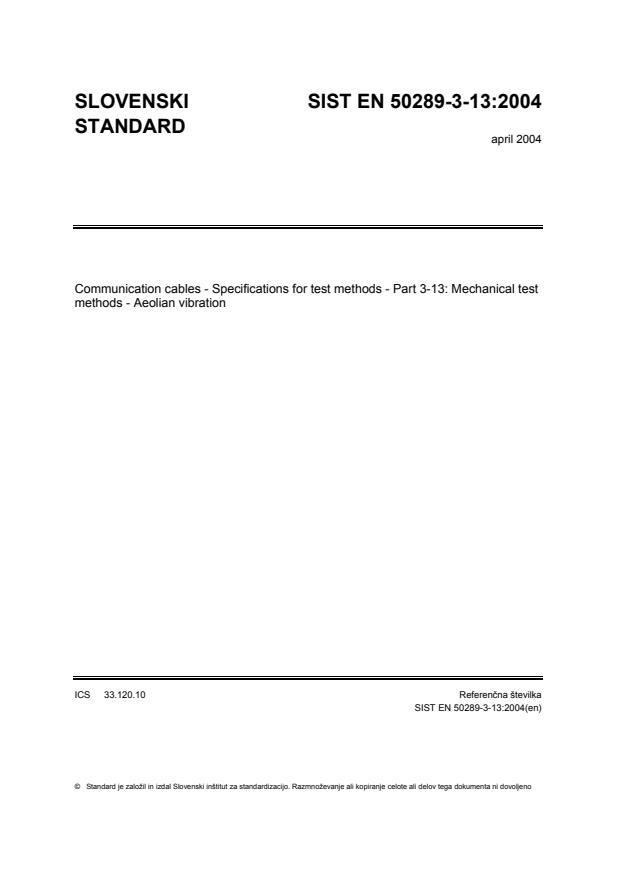
SLOVENSKI SIST EN 50289-3-13:2004
STANDARD
april 2004
Communication cables - Specifications for test methods - Part 3-13: Mechanical test
methods - Aeolian vibration
ICS 33.120.10 Referenčna številka
© Standard je založil in izdal Slovenski inštitut za standardizacijo. Razmnoževanje ali kopiranje celote ali delov tega dokumenta ni dovoljeno
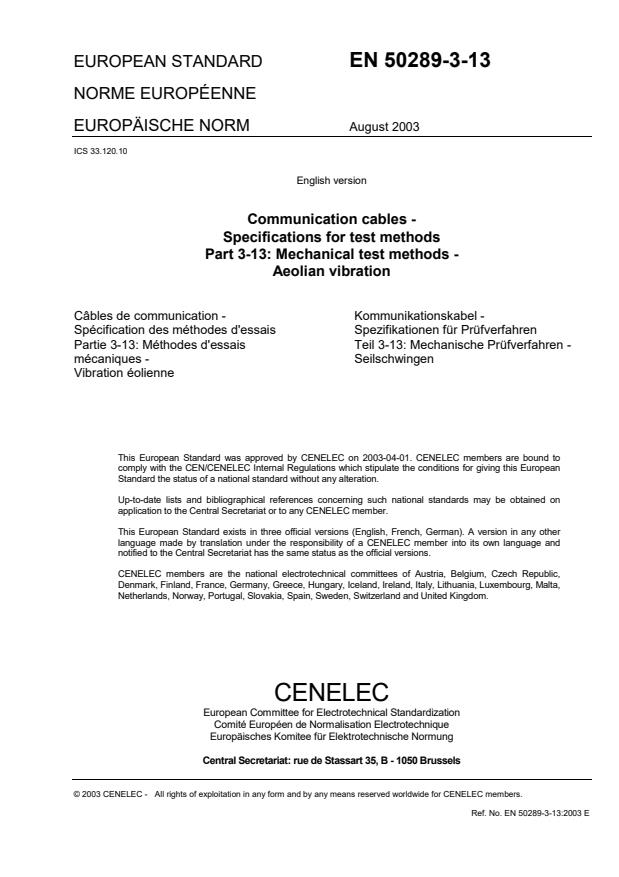
EUROPEAN STANDARD EN 50289-3-13
NORME EUROPÉENNE
EUROPÄISCHE NORM August 2003
ICS 33.120.10
English version
Communication cables -
Specifications for test methods
Part 3-13: Mechanical test methods -
Aeolian vibration
Câbles de communication - Kommunikationskabel -
Spécification des méthodes d'essais Spezifikationen für Prüfverfahren
Partie 3-13: Méthodes d'essais Teil 3-13: Mechanische Prüfverfahren -
mécaniques - Seilschwingen
Vibration éolienne
This European Standard was approved by CENELEC on 2003-04-01. CENELEC members are bound to
comply with the CEN/CENELEC Internal Regulations which stipulate the conditions for giving this European
Standard the status of a national standard without any alteration.
Up-to-date lists and bibliographical references concerning such national standards may be obtained on
application to the Central Secretariat or to any CENELEC member.
This European Standard exists in three official versions (English, French, German). A version in any other
language made by translation under the responsibility of a CENELEC member into its own language and
notified to the Central Secretariat has the same status as the official versions.
CENELEC members are the national electrotechnical committees of Austria, Belgium, Czech Republic,
Denmark, Finland, France, Germany, Greece, Hungary, Iceland, Ireland, Italy, Lithuania, Luxembourg, Malta,
Netherlands, Norway, Portugal, Slovakia, Spain, Sweden, Switzerland and United Kingdom.
CENELEC
European Committee for Electrotechnical Standardization
Comité Européen de Normalisation Electrotechnique
Europäisches Komitee für Elektrotechnische Normung
Central Secretariat: rue de Stassart 35, B - 1050 Brussels
© 2003 CENELEC - All rights of exploitation in any form and by any means reserved worldwide for CENELEC members.
Ref. No. EN 50289-3-13:2003 E
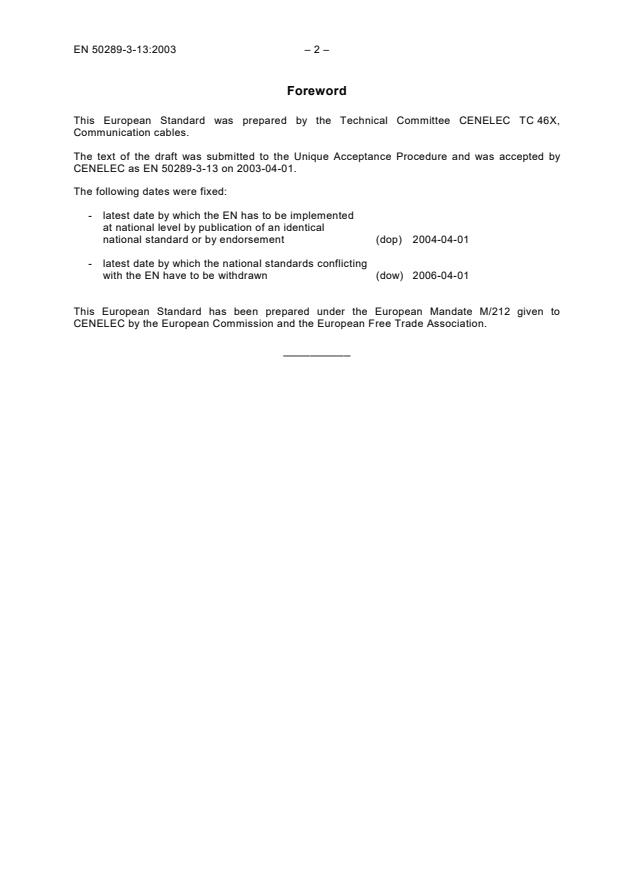
Foreword
This European Standard was prepared by the Technical Committee CENELEC TC 46X,
Communication cables.
The text of the draft was submitted to the Unique Acceptance Procedure and was accepted by
CENELEC as EN 50289-3-13 on 2003-04-01.
The following dates were fixed:
- latest date by which the EN has to be implemented
at national level by publication of an identical
national standard or by endorsement (dop) 2004-04-01
- latest date by which the national standards conflicting
with the EN have to be withdrawn (dow) 2006-04-01
This European Standard has been prepared under the European Mandate M/212 given to
CENELEC by the European Commission and the European Free Trade Association.
__________
– 3 – EN 50289-3-13:2003
Contents
1 Scope. 4
2 Normative references . 4
3 Definitions. 4
4 Test method. 4
4.1 Sample. 4
4.2 Equipment.4
4.3 Procedure.5
4.4 Details to be specified . 6
5 Requirements. 6
6 Test report. 6
Figure 1 – Typical test arrangement for aeolian vibration test. 8
1 Scope
This Part 3-13 of EN 50289 details the method of test to determine the ability of exposed
overhead cables used in analogue and digital communication systems to withstand dynamic
stresses similar to those imposed by laminar wind flow induced vibrations in overhead lines.
It is to be read in conjunction with Part 3-1 of EN 50289, which contains essential provisions for its
application.
2 Normative references
This European Standard incorporates by dated or undated reference, provisions from other
publications. These normative references are cited at the appropriate places in the text and the
publications are listed hereafter. For dated references, subsequent amendments to or revisions of
any of these publications apply to this European Standard only when incorporated in it by
amendment or revision. For undated references the latest edition of the publication referred to
applies (including amendments).
EN 50289-3-1 2001
Communication cables – Specifications for test methods —
Part 3-1: Mechanical test methods – General requirements
1)
EN 50290-1-2 Communication cables — Part 1-2: Definitions
3 Definitions
For the purposes of this European Standard
...