

oSIST prEN ISO 6789-1:2025
(Main)Assembly tools for screws and nuts - Hand torque tools - Part 1: Requirements and methods for design conformance testing and quality conformance testing: minimum requirements for declaration of conformance (ISO/DIS 6789-1:2025)
General Information
- Abstract
This document specifies the conformance testing and marking requirements for hand torque tools used for controlled tightening of screws and nuts. It also specifies the minimum requirements for a manufacturer’s declaration of conformance for hand torque tools.
This document applies to hand torque tools which are classified as indicating torque tools (Type I) and setting torque tools (Type II).
NOTE Hand torque tools covered by this document are those identified in ISO 1703:2018 by reference numbers 7 1 00 01 0 to 7 1 00 14 0 inclusive. Torque limiting hand torque tools do not yet have reference numbers and will not do so until the next revision of ISO 1703
This document does not specify requirements of calibration certificates for hand torque tools. These are described in ISO 6789‑2.
This document does not specify requirements for verifying the performance of hand torque tools. These are described in ISO 6789-3.
- Status
- Not Published
- Public Enquiry End Date
- 09-Oct-2025
- Technical Committee
- I13 - Imaginarni 13
- Current Stage
- 4020 - Public enquire (PE) (Adopted Project)
- Start Date
- 16-Jun-2025
- Due Date
- 03-Nov-2025
- Completion Date
- 09-Oct-2025

Overview
The oSIST prEN ISO 6789-1:2025:2025 standard, titled Assembly tools for screws and nuts – Hand torque tools – Part 1: Requirements and methods for design conformance testing and quality conformance testing: minimum requirements for declaration of conformance, has been developed by CEN under the ISO framework. This international standard specifies essential design and quality conformance testing criteria for hand torque tools used in the controlled tightening of screws and nuts. It also outlines the minimum requirements for a manufacturer’s declaration of conformance to ensure that tools meet specified performance and quality benchmarks.
Focusing primarily on indicating torque tools (Type I) and setting torque tools (Type II), this standard aims to unify the testing methods and conformity declarations issued by manufacturers, thereby building trust and reliability in manual torque tools used across industries.
Key Topics
- Scope and Applicability
This standard applies to hand torque tools identified under ISO 1703:2018 reference numbers 7 1 00 01 0 to 7 1 00 14 0, excluding torque limiting hand torque tools, which will be covered in a later revision. - Design Conformance Testing
Requirements include testing maximum torque values, specified torque and angle ranges, and permissible errors in torque and angle measurements. The standard also discusses the impact of tool geometric changes, bending effects, and orientation relative to the ground during testing. - Quality Conformance Testing
Defined methodologies ensure tools produced during manufacturing maintain quality standards as declared by the manufacturer. - Manufacturer’s Declaration of Conformance
Minimum declaration requirements are specified, providing manufacturers with a framework for certifying tool compliance. This declaration separates design conformity from calibration and performance verification, which are covered in ISO 6789-2 and ISO 6789-3 respectively. - Marking and Identification
Clear marking requirements for torque tools facilitate traceability and compliance verification during use.
Applications
The oSIST prEN ISO 6789-1:2025:2025 standard serves as a critical guideline for manufacturers, calibration laboratories, quality assurance teams, and end-users involved in various industrial fields where manual tightening of screws and nuts is performed, including:
- Manufacturing and Assembly Lines – Ensuring correct torque application to secure fasteners without damage.
- Automotive and Aerospace Industries – Where controlled torque is essential for safety and performance.
- Maintenance and Repair Services – Verifying tool accuracy through declared conformance to avoid malfunctions.
- Quality Control and Compliance Audits – Using the standard to assess consistency and conformity of torque tools.
By adhering to this standard, organizations can improve product reliability, enhance worker safety, and comply with relevant regulatory requirements related to torque tool performance.
Related Standards
- ISO 6789-2:2025 – Specifies requirements for calibration certificates for hand torque tools, detailing calibration procedures and uncertainty calculations.
- ISO 6789-3 – Focuses on performance verification methods and reporting to validate whether torque tools meet required specifications during usage.
- ISO 1703:2018 – Provides classification and reference numbers for hand torque tools applicable under this standard.
- ISO 1173 and ISO 1174-1 – Specify dimensions and drive ends for screwdriver bits and hand socket tools related to torque tools.
These complementary standards collectively support a comprehensive quality management and conformance system for hand torque tools.
By implementing the oSIST prEN ISO 6789-1:2025:2025 standard, manufacturers and users of hand torque tools can ensure adherence to international best practices for design, testing, and quality assurance. This leads to enhanced accuracy in tightening operations crucial for reliable mechanical assemblies worldwide.
Relations
- Effective Date
- 05-Apr-2023
Get Certified
Connect with accredited certification bodies for this standard

DVS-ZERT GmbH
German welding certification society.
CARES (UK Certification Authority for Reinforcing Steels)
UK certification for reinforcing steels and construction.
EWF/IIW (European/International Welding Federation)
International welding personnel certification.
Sponsored listings
Frequently Asked Questions
oSIST prEN ISO 6789-1:2025 is a draft published by the Slovenian Institute for Standardization (SIST). Its full title is "Assembly tools for screws and nuts - Hand torque tools - Part 1: Requirements and methods for design conformance testing and quality conformance testing: minimum requirements for declaration of conformance (ISO/DIS 6789-1:2025)". This standard covers: This document specifies the conformance testing and marking requirements for hand torque tools used for controlled tightening of screws and nuts. It also specifies the minimum requirements for a manufacturer’s declaration of conformance for hand torque tools. This document applies to hand torque tools which are classified as indicating torque tools (Type I) and setting torque tools (Type II). NOTE Hand torque tools covered by this document are those identified in ISO 1703:2018 by reference numbers 7 1 00 01 0 to 7 1 00 14 0 inclusive. Torque limiting hand torque tools do not yet have reference numbers and will not do so until the next revision of ISO 1703 This document does not specify requirements of calibration certificates for hand torque tools. These are described in ISO 6789‑2. This document does not specify requirements for verifying the performance of hand torque tools. These are described in ISO 6789-3.
This document specifies the conformance testing and marking requirements for hand torque tools used for controlled tightening of screws and nuts. It also specifies the minimum requirements for a manufacturer’s declaration of conformance for hand torque tools. This document applies to hand torque tools which are classified as indicating torque tools (Type I) and setting torque tools (Type II). NOTE Hand torque tools covered by this document are those identified in ISO 1703:2018 by reference numbers 7 1 00 01 0 to 7 1 00 14 0 inclusive. Torque limiting hand torque tools do not yet have reference numbers and will not do so until the next revision of ISO 1703 This document does not specify requirements of calibration certificates for hand torque tools. These are described in ISO 6789‑2. This document does not specify requirements for verifying the performance of hand torque tools. These are described in ISO 6789-3.
oSIST prEN ISO 6789-1:2025 is classified under the following ICS (International Classification for Standards) categories: 25.140.30 - Hand-operated tools. The ICS classification helps identify the subject area and facilitates finding related standards.
oSIST prEN ISO 6789-1:2025 has the following relationships with other standards: It is inter standard links to SIST EN ISO 6789-1:2017. Understanding these relationships helps ensure you are using the most current and applicable version of the standard.
oSIST prEN ISO 6789-1:2025 is available in PDF format for immediate download after purchase. The document can be added to your cart and obtained through the secure checkout process. Digital delivery ensures instant access to the complete standard document.
Standards Content (Sample)
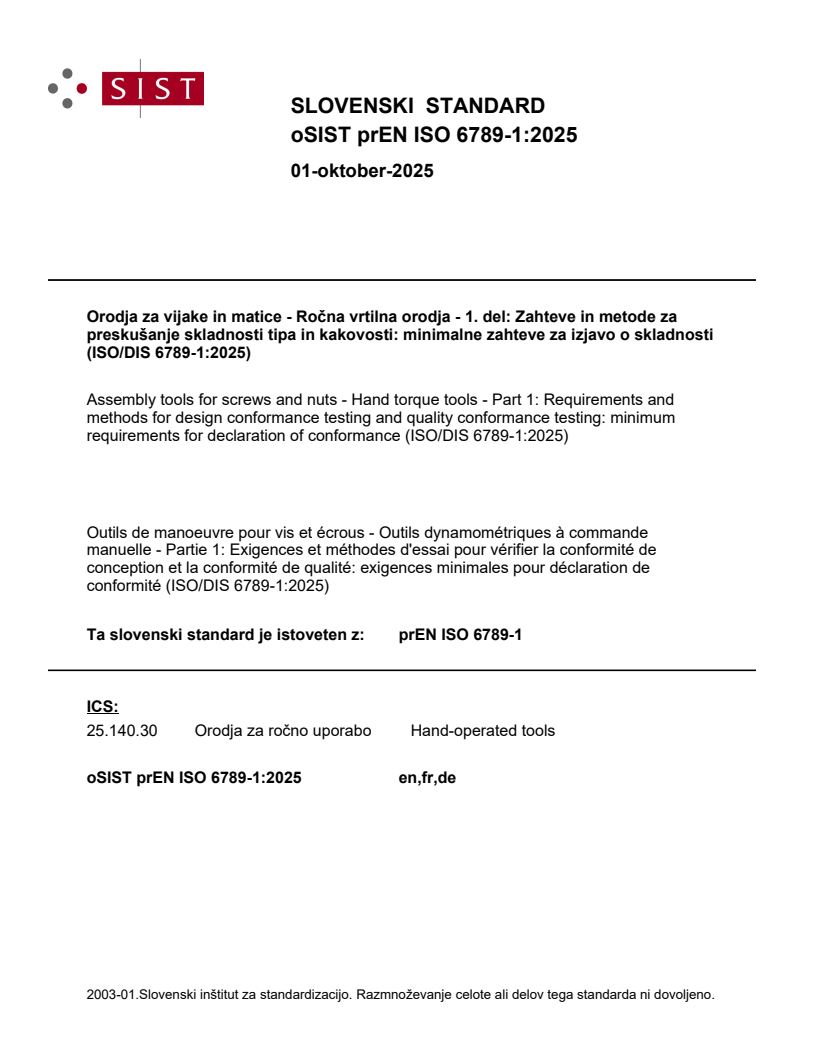
SLOVENSKI STANDARD
01-oktober-2025
Orodja za vijake in matice - Ročna vrtilna orodja - 1. del: Zahteve in metode za
preskušanje skladnosti tipa in kakovosti: minimalne zahteve za izjavo o skladnosti
(ISO/DIS 6789-1:2025)
Assembly tools for screws and nuts - Hand torque tools - Part 1: Requirements and
methods for design conformance testing and quality conformance testing: minimum
requirements for declaration of conformance (ISO/DIS 6789-1:2025)
Outils de manoeuvre pour vis et écrous - Outils dynamométriques à commande
manuelle - Partie 1: Exigences et méthodes d'essai pour vérifier la conformité de
conception et la conformité de qualité: exigences minimales pour déclaration de
conformité (ISO/DIS 6789-1:2025)
Ta slovenski standard je istoveten z: prEN ISO 6789-1
ICS:
25.140.30 Orodja za ročno uporabo Hand-operated tools
2003-01.Slovenski inštitut za standardizacijo. Razmnoževanje celote ali delov tega standarda ni dovoljeno.
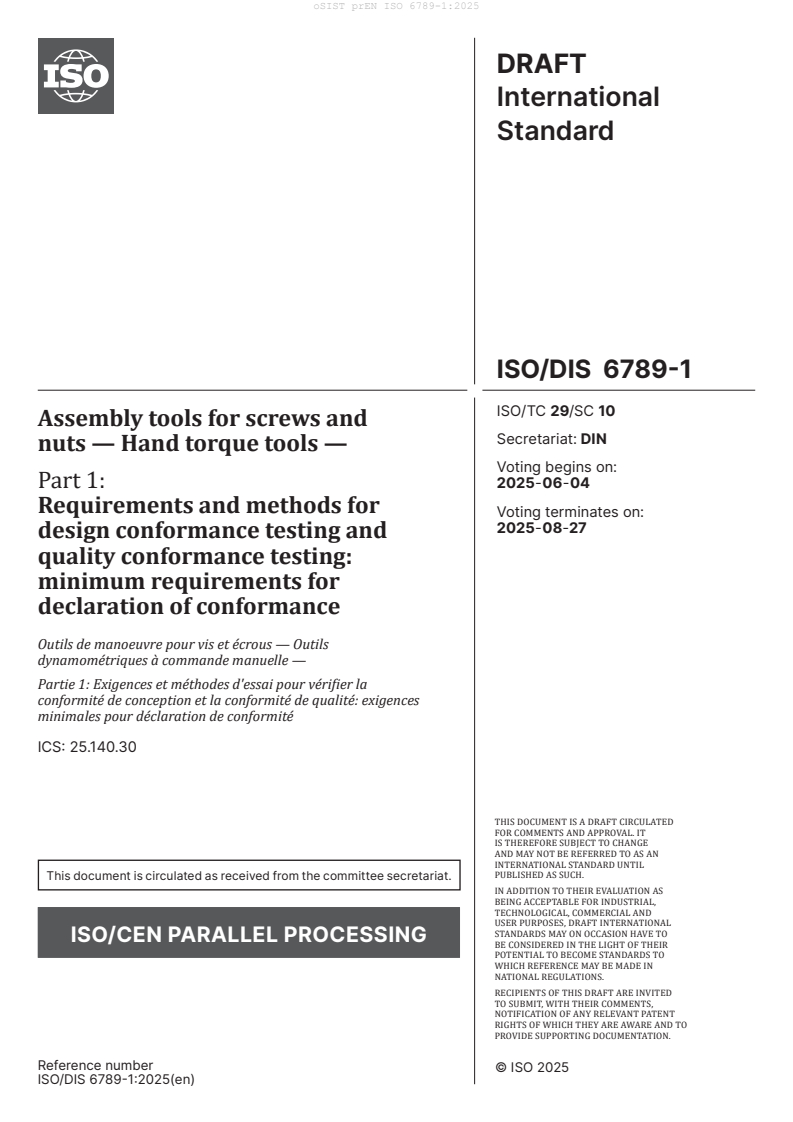
DRAFT
International
Standard
ISO/DIS 6789-1
ISO/TC 29/SC 10
Assembly tools for screws and
Secretariat: DIN
nuts — Hand torque tools —
Voting begins on:
Part 1: 2025-06-04
Requirements and methods for
Voting terminates on:
2025-08-27
design conformance testing and
quality conformance testing:
minimum requirements for
declaration of conformance
Outils de manoeuvre pour vis et écrous — Outils
dynamométriques à commande manuelle —
Partie 1: Exigences et méthodes d'essai pour vérifier la
conformité de conception et la conformité de qualité: exigences
minimales pour déclaration de conformité
ICS: 25.140.30
THIS DOCUMENT IS A DRAFT CIRCULATED
FOR COMMENTS AND APPROVAL. IT
IS THEREFORE SUBJECT TO CHANGE
AND MAY NOT BE REFERRED TO AS AN
INTERNATIONAL STANDARD UNTIL
PUBLISHED AS SUCH.
This document is circulated as received from the committee secretariat.
IN ADDITION TO THEIR EVALUATION AS
BEING ACCEPTABLE FOR INDUSTRIAL,
TECHNOLOGICAL, COMMERCIAL AND
USER PURPOSES, DRAFT INTERNATIONAL
STANDARDS MAY ON OCCASION HAVE TO
ISO/CEN PARALLEL PROCESSING
BE CONSIDERED IN THE LIGHT OF THEIR
POTENTIAL TO BECOME STANDARDS TO
WHICH REFERENCE MAY BE MADE IN
NATIONAL REGULATIONS.
RECIPIENTS OF THIS DRAFT ARE INVITED
TO SUBMIT, WITH THEIR COMMENTS,
NOTIFICATION OF ANY RELEVANT PATENT
RIGHTS OF WHICH THEY ARE AWARE AND TO
PROVIDE SUPPORTING DOCUMENTATION.
Reference number
ISO/DIS 6789-1:2025(en)
DRAFT
ISO/DIS 6789-1:2025(en)
International
Standard
ISO/DIS 6789-1
ISO/TC 29/SC 10
Assembly tools for screws and
Secretariat: DIN
nuts — Hand torque tools —
Voting begins on:
Part 1:
Requirements and methods for
Voting terminates on:
design conformance testing and
quality conformance testing:
minimum requirements for
declaration of conformance
Outils de manoeuvre pour vis et écrous — Outils
dynamométriques à commande manuelle —
Partie 1: Exigences et méthodes d'essai pour vérifier la
conformité de conception et la conformité de qualité: exigences
minimales pour déclaration de conformité
ICS: 25.140.30
THIS DOCUMENT IS A DRAFT CIRCULATED
FOR COMMENTS AND APPROVAL. IT
IS THEREFORE SUBJECT TO CHANGE
AND MAY NOT BE REFERRED TO AS AN
INTERNATIONAL STANDARD UNTIL
PUBLISHED AS SUCH.
This document is circulated as received from the committee secretariat.
IN ADDITION TO THEIR EVALUATION AS
BEING ACCEPTABLE FOR INDUSTRIAL,
© ISO 2025
TECHNOLOGICAL, COMMERCIAL AND
USER PURPOSES, DRAFT INTERNATIONAL
All rights reserved. Unless otherwise specified, or required in the context of its implementation, no part of this publication may
STANDARDS MAY ON OCCASION HAVE TO
ISO/CEN PARALLEL PROCESSING
be reproduced or utilized otherwise in any form or by any means, electronic or mechanical, including photocopying, or posting on
BE CONSIDERED IN THE LIGHT OF THEIR
the internet or an intranet, without prior written permission. Permission can be requested from either ISO at the address below
POTENTIAL TO BECOME STANDARDS TO
WHICH REFERENCE MAY BE MADE IN
or ISO’s member body in the country of the requester.
NATIONAL REGULATIONS.
ISO copyright office
RECIPIENTS OF THIS DRAFT ARE INVITED
CP 401 • Ch. de Blandonnet 8
TO SUBMIT, WITH THEIR COMMENTS,
CH-1214 Vernier, Geneva
NOTIFICATION OF ANY RELEVANT PATENT
Phone: +41 22 749 01 11
RIGHTS OF WHICH THEY ARE AWARE AND TO
PROVIDE SUPPORTING DOCUMENTATION.
Email: copyright@iso.org
Website: www.iso.org
Published in Switzerland Reference number
ISO/DIS 6789-1:2025(en)
ii
ISO/DIS 6789-1:2025(en)
Contents Page
Foreword .iv
Introduction .v
1 Scope . 1
2 Normative references . 1
3 Terms, definitions and symbols . 1
3.1 Terms and definitions .1
3.2 Symbols, designations and units .3
4 Classification . 4
5 Requirements . 4
5.1 Design conformance testing .4
5.1.1 Maximum torque values .5
5.1.2 Specified torque range .5
5.1.3 Specified angle range .5
5.1.4 Scales, dials and displays for torque .6
5.1.5 Scales, dials and displays for angle .6
5.1.6 Maximum permissible torque error .6
5.1.7 Maximum permissible angle error .7
5.1.8 Overloading test .7
5.1.9 Endurance test .7
5.1.10 Effect of geometric changes.8
5.1.11 Effect of orientation with respect to ground .9
5.1.12 Influence of bending on angle measurement .9
5.2 Manufacturer’s Declaration of Conformance .9
6 Conformance with quality control requirements .10
7 Marking . .10
Annex A (normative) Examples of indicating torque tools (Type I) .11
Annex B (normative) Examples of setting torque tools (Type II) .13
Annex C (informative) Explanation of key changes in this edition of the standard with relation
to the performance of torque tools. .15
Annex D (informative) Example Manufacturer’s Declaration of Conformance. .18
Bibliography . 19
iii
ISO/DIS 6789-1:2025(en)
Foreword
ISO (the International Organization for Standardization) is a worldwide federation of national standards
bodies (ISO member bodies). The work of preparing International Standards is normally carried out through
ISO technical committees. Each member body interested in a subject for which a technical committee
has been established has the right to be represented on that committee. International organizations,
governmental and non-governmental, in liaison with ISO, also take part in the work. ISO collaborates closely
with the International Electrotechnical Commission (IEC) on all matters of electrotechnical standardization.
The procedures used to develop this document and those intended for its further maintenance are described
in the ISO/IEC Directives, Part 1. In particular the different approval criteria needed for the different types
of ISO documents should be noted. This document was drafted in accordance with the editorial rules of the
ISO/IEC Directives, Part 2 (see www.iso.org/directives).
Attention is drawn to the possibility that some of the elements of this document may be the subject of patent
rights. ISO shall not be held responsible for identifying any or all such patent rights. Details of any patent
rights identified during the development of the document will be in the Introduction and/or on the ISO list of
patent declarations received (see www.iso.org/patents).
Any trade name used in this document is information given for the convenience of users and does not
constitute an endorsement.
For an explanation on the voluntary nature of standards, the meaning of ISO specific terms and
expressions related to conformity assessment, as well as information about ISO's adherence to the World
Trade Organization (WTO) principles in the Technical Barriers to Trade (TBT) see the following URL:
www.iso.org/iso/foreword.html.
This document was prepared by Technical Committee ISO/TC 29, Small tools, Subcommittee SC 10, Assembly
tools for screws and nuts, pliers and nippers.
This second edition of ISO 6789-1, together with revisions of ISO 6789-2 and the addition of ISO 6789-3,
cancels and replaces ISO 6789-1:2017 and ISO6789-2:2017 which have been technically revised with changes
as follows. ISO 6789-1:2017 has been divided into two parts. The requirements for design and quality
control during manufacture as well as the manufacturer’s Declaration of Conformance are now solely aimed
at manufacturers and remain in ISO 6789-1. The minimum requirements for conformance verification of
tools during use are moved to the new ISO 6789-3.
Minimum requirements for calibration are still found in ISO 6789-2
iv
ISO/DIS 6789-1:2025(en)
Introduction
This revision has incorporated user feedback on the following general topics.
Clarifying for users of the standard which parts they should purchase to carry out their work related to
hand torque tools. (See below)
Achieving a significant reduction in the number of uncertainty measurements required to provide a
calibration certificate
Separating the declaration of conformance issued by a manufacturer from the performance report issued
by a test house or internal quality control function.
The calibration or verification of angle measurements found in a growing number of torque tools
The addition of tools that can be either indicating or setting according to the customer need.
The three parts of ISO 6789 that result from this revision can be summarised as follows:
ISO 6789-1 continues to provide designers and manufacturers with relevant minimum requirements for
the development and documentation of hand torque tools. The manufacturer may choose the level of doc-
umentation supplied with the tool according to the typical needs of the manufacturer’s customers. This
could be a certificate of calibration according to ISO 6789-2 or a verification report according to ISO 6789-3
ISO 6789-2 provides manufacturers and calibration laboratories with requirements for both torque and
angle calibrations of hand torque tools together with streamlined methods for the calculation of uncer-
tainties. Additionally, minimum requirements for the calibration of torque measurement devices as an
alternative when national standards are not available, are described in ISO 6789-2, Annex C
ISO 6789-3 provides basic requirements for verifying and reporting whether the torque tool complies
with the torque performance requirements of ISO 6789-1. It has been created as a separate standard to
make it more accessible to users who are not torque tool manufacturers. The verification defined in ISO
6789-3 does not have as much detailed information, so does not provide the same degree of confidence
in the performance of the torque tool, as a calibration certificate defined in ISO 6789-2.
The following scenarios may be of help in assisting users of the ISO 6789 series to identify the appropriate
part(s) applicable to their activities:
Customer requires a torque tool with an accredited calibration certificate in order to meet legislative or
commercial requirements. Solution is to purchase a torque tool and submit it to an accredited calibration
laboratory for a Certificate of Calibration. (Note: Some torque tool manufacturers may offer such a service.)
The calibration should be according to ISO6789-2. The torque tool will be supplied with a Manufacturer’s
Declaration of Conformance that the tool complies with the design requirements of ISO 6789-1
Customer requires a calibration certificate in order to understand the technical performance of the torque
tool. Solution is to purchase a torque tool that is supplied with a Certificate of Calibration. If such a product
is not readily available, then a torque tool with a Performance Verification Report according to ISO6789-3
can be purchased and submitted to a calibration laboratory for calibration according to ISO6789-2. The
torque tool will be supplied with a manufacturer’s Declaration of Conformance that the tool complies with
the design requirements of ISO 6789-1
Customer does not have any legislative, commercial or technical constraints but would still like some
confirmation that the torque tool will perform with the level of accuracy required. Solution is to purchase
a torque tool that has a Manufacturer’s Declaration of Conformance confirming that the tool has been
designed and tested during development in accordance with ISO 6789-1 and is provided with a Performance
Verification Report that shows the accuracy level of that specific tool. The lack of the above constraints
should not deter the customer from obtaining the increased information and legal protection that comes
with a Calibration Certificate compared with a Performance Verification Report.
v
DRAFT International Standard ISO/DIS 6789-1:2025(en)
Assembly tools for screws and nuts — Hand torque tools —
Part 1:
Requirements and methods for design conformance testing
and quality conformance testing: minimum requirements for
declaration of conformance
1 Scope
This document specifies the conformance testing and marking requirements for hand torque tools used for
controlled tightening of screws and nuts. It also specifies the minimum requirements for a manufacturer’s
declaration of conformance for hand torque tools.
This document applies to hand torque tools which are classified as indicating torque tools (Type I) and
setting torque tools (Type II).
NOTE Hand torque tools covered by this document are those identified in ISO 1703:2018 by reference
numbers 7 1 00 01 0 to 7 1 00 14 0 inclusive. Torque limiting hand torque tools do not yet have reference numbers and
will not do so until the next revision of ISO 1703
This document does not specify requirements of calibration certificates for hand torque tools. These are
described in ISO 6789-2.
This document does not specify requirements for verifying the performance of hand torque tools. These are
described in ISO 6789-3.
2 Normative references
The following documents are referred to in the text in such a way that some or all of their content constitutes
requirements of this document. For dated references, only the edition cited applies. For undated references,
the latest edition of the referenced document (including any amendments) applies.
ISO 1173, Assembly tools for screws and nuts — Drive ends for hand- and machine-operated screwdriver bits
and connecting parts — Dimensions, torque testing
ISO 1174-1, Assembly tools for screws and nuts — Driving squares — Part 1: Driving squares for hand socket tools
ISO 6789-2:2025, Assembly tools for screws and nuts — Hand torque tools — Part 2: Requirements for calibration
and determination of measurement uncertainty
ISO 6789-3:2025, Assembly tools for screws and nuts — Hand torque tools — Part 3: Requirements for
performance verifications
ISO/IEC 17025, General requirements for the competence of testing and calibration laboratories
3 Terms, definitions and symbols
3.1 Terms and definitions
For the purposes of this document, the following terms and definitions apply
ISO/DIS 6789-1:2025(en)
ISO and IEC maintain terminological databases for use in standardization at the following addresses:
— IEC Electropedia: available at https:// www .electropedia .org/
— ISO Online browsing platform: available at https:// www .iso .org/ obp
3.1.1
design conformance test
technical examination of conformance with those requirements to be met during design or modification of
hand torque tools
3.1.2
quality conformance test
technical examination of conformance with those requirements to be met during manufacture of hand
torque tool
3.1.3
manufacturer’s declaration of conformance
documented information provided by the manufacturer that the torque tool complies with the requirements
of this document
3.1.4
maximum permissible relative error
maximum value of observed measurement error of the torque tool expressed as a percentage of the reference
torque value on the torque measurement device
Note 1 to entry: Sometimes the term “accuracy” is still used in place of the term “maximum permissible error” which
is, however, not technically correct. The concept “measurement accuracy” is not a quantity and is not given a numerical
quantity value. A measurement is said to be more accurate when it offers a smaller measurement error.
Note 2 to entry: Error is defined as the measured quantity value minus a reference quantity value in ISO/IEC Guide 99.
3.1.5
torque measurement system
combination of a torque measurement device and the loading system for application of torque that acts as
the measurement standard for the hand torque tool
Note 1 to entry: A calibration system as defined in ISO 6789-2 can also be used as a torque measurement system in this
document.
3.1.6
torque measurement device
working measurement standard provided either mechanically or by an electronic torque transducer and display
3.1.7
direct angle measurement
angle measurement where the rotation angle is directly measured by measuring the proportion of one full
revolution of the rotating element
Note 1 to entry: This type of measuring device usually utilises a protractor or angle encoder system
3.1.8
indirect angle measurement
angle measurement where the rotation angle is indirectly measured or defined by a mathematically
determined measurand proportional to the rotation angle.
Note 1 to entry: This type of measuring device usually utilises a gyroscope or similar on a lever arm
ISO/DIS 6789-1:2025(en)
3.1.9
angle measurement system
combination of an angle measurement device and the loading system for application of tangential force that
acts as the angle measurement standard for the hand torque tool
Note 1 to entry: A calibration system as defined in ISO 6789-2 can also be used as an angle measurement system in
this document.
3.1.10
angle measurement device
working measurement standard provided either mechanically or by an electronic angle encoder and display
3.1.11
indicating torque tool (Type I)
tool that indicates by means of a mechanical scale, dial or electronic display, the value of torque exerted by
the tool at the output drive
3.1.12
setting torque tool (Type II)
tool sensing torque transmitted by comparing the torque applied with a self-contained standard and
signalling the transmission of the pre-selected value by a physical impulse, with or without audible signal,
causing a temporary reduction in the torque applied
Note 1 to entry: Some setting torque tools can also be used as an indicating tool without signalling the transmission
of the preselected value. In this mode they are acting as indicating torque tools. Manufacturers should make clear to
users the performance of the torque tool in each mode.
3.1.13
wrench, adjustable graduated or with display
tool designed to be adjusted by the user, which has a scale or a display to assist adjustment
3.1.14
wrench, adjustable non-graduated
tool designed to be adjusted by the user with the aid of a torque measurement system
3.1.15
wrench fixed adjustment
tool not designed to be adjusted by the user, i.e. having a single setting
3.1.16
wrench, torque limiting
tool designed to prevent transfer of torque higher than the set value
Note 1 to entry: This is often achieved by inserting a spring within the torque transfer mechanism such that above a
certain value the spring will always compress or extend and prevent further torque transfer.
3.2 Symbols, designations and units
The designations used in this document are indicated in Table 1.
ISO/DIS 6789-1:2025(en)
Table 1 — Symbols, designations and units
Symbol Designation Unit
a Relative error of the tool output torque from the target torque %
Value of torque desired, which may be the indicated, set, nominal value, depending on the
X N ⋅ m
a
type and class of the torque tool
X Observed value shown by the torque measurement device N ⋅ m
o
a Absolute error of the tool measured angle from the target angle °
θ
θ Value of angle indicated by the torque tool °
a
θ Observed value shown by the angle measurement device °
o
4 Classification
The hand torque tools to which this document applies are classified as follows.
a) Indicating torque tools (Type I; see Annex A):
1) Class A: Wrench, torsion or flexion bar;
2) Class B: Wrench, rigid housing, with scale or dial or display;
3) Class C: Wrench, rigid housing and electronic measurement;
4) Class D: Screwdriver, with scale or dial or
...