

SIST EN 13718-2:2015+A1:2020
(Main)Medical vehicles and their equipment - Air ambulances - Part 2: Operational and technical requirements for air ambulances
General Information
- Abstract
This part of EN 13718 specifies the requirements for performance and equipping for air ambulances, including requirements for interfaces to medical devices used for the transport and treatment of sick or injured persons. This part of EN 13718 is applicable to air ambulances capable of transporting at least one person on a stretcher.
NOTE Requirements are specified for categories of air ambulances based on the different intended use. These are the helicopter emergency medical service (HEMS) the helicopter intensive care medical service (HICAMS) and the fixed wing air ambulance (FWAA).
- Status
- Published
- Publication Date
- 19-Apr-2020
- Technical Committee
- VAZ - Healthcare
- Current Stage
- 6060 - National Implementation/Publication (Adopted Project)
- Start Date
- 02-Apr-2020
- Due Date
- 07-Jun-2020
- Completion Date
- 20-Apr-2020
- Directive
- 93/42/EEC - Medical devicesOJ Ref: L 129, OJ L 129 OJ Date: 15-Apr-2021
Buy Documents




Overview
EN 13718-2:2015+A1:2020 (CEN) specifies the operational and technical requirements for air ambulances. It applies to helicopters and fixed‑wing aircraft configured to transport at least one patient on a stretcher and is intended to ensure safe, continuous patient care during air transport. This part is the aircraft-focused complement to EN 13718‑1, which covers medical devices used in air ambulances. Amendment A1 (approved December 2019) clarifies and updates provisions such as patient‑compartment illumination, rotor safety and compatibility with medical device interfaces.
Key Topics and Requirements
The standard covers practical technical areas that affect safety, interoperability and patient care, including:
- Patient compartment environment: temperature, humidity, ventilation, air‑conditioning, variable atmospheric pressure, interior lighting and noise exposure.
- Electrical power & EMI: requirements for supplying medical devices, electrical interfaces and electromagnetic interference considerations to ensure device compatibility.
- Mechanical compatibility: rail systems, fixation points and mechanical vibration requirements for securing stretchers and medical devices.
- Restraint and safety systems: patient restraints, crew and equipment restraint systems, emergency exits and fire safety measures.
- Patient handling: loading/unloading procedures, communication systems and defined patient treatment area dimensions.
- Air ambulance categories: tailored requirements for HEMS (Helicopter Emergency Medical Service), HICAMS (Helicopter Intensive Care Medical Service) and FWAA (Fixed Wing Air Ambulance).
- Gas installations: design, capacity, continuity of supply, pipeline distribution, colour coding/marking, alarms, leak testing and maintenance of medical gas systems.
- Equipment lists and testing: minimum lists of medical devices/medicinal products (normative Annexes A & B), and tests for mechanical integrity, leakage and cross‑connections.
- Personnel and operations: roles and minimum operating expectations for flight and medical crews.
Applications
EN 13718-2 is used to:
- Define technical specifications for converting aircraft into air ambulances.
- Guide procurement and acceptance criteria for air ambulance fleets.
- Inform maintenance, inspection and testing regimes for medical gas and electrical systems.
- Ensure interoperability of medical devices with aircraft interfaces during patient transport.
- Support compliance with EU regulatory frameworks referenced in Annex ZA.
Who Uses This Standard
- Air ambulance operators and emergency medical services (HEMS/HICAMS/FWAA)
- Aircraft manufacturers and modification centers (STCs/retrofits)
- Medical device and medical gas system manufacturers integrating into aircraft
- Regulators, safety assessors and procurement teams
- Maintenance organizations and clinical governance teams
Related Standards
- EN 13718‑1 (medical devices used in air ambulances)
- References to EU directives (e.g., Medical Devices Directive 93/42/EEC) are included in Annex ZA.
EN 13718‑2:2015+A1:2020 provides the common technical baseline for safe, interoperable and effective air ambulance operations across Europe.
Relations
- Effective Date
- 01-May-2020
- Effective Date
- 09-Feb-2026
- Effective Date
- 09-Feb-2026
- Effective Date
- 09-Feb-2026
- Effective Date
- 09-Feb-2026
- Effective Date
- 09-Feb-2026
- Effective Date
- 09-Feb-2026
- Effective Date
- 28-Jan-2026
- Effective Date
- 28-Jan-2026
- Effective Date
- 28-Jan-2026
- Effective Date
- 28-Jan-2026
- Effective Date
- 28-Jan-2026
- Effective Date
- 28-Jan-2026
- Effective Date
- 28-Jan-2026
- Effective Date
- 28-Jan-2026
Buy Documents
Get Certified
Connect with accredited certification bodies for this standard

BSI Group
BSI (British Standards Institution) is the business standards company that helps organizations make excellence a habit.

TÜV Rheinland
TÜV Rheinland is a leading international provider of technical services.

TÜV SÜD
TÜV SÜD is a trusted partner of choice for safety, security and sustainability solutions.
Sponsored listings
Frequently Asked Questions
SIST EN 13718-2:2015+A1:2020 is a standard published by the Slovenian Institute for Standardization (SIST). Its full title is "Medical vehicles and their equipment - Air ambulances - Part 2: Operational and technical requirements for air ambulances". This standard covers: This part of EN 13718 specifies the requirements for performance and equipping for air ambulances, including requirements for interfaces to medical devices used for the transport and treatment of sick or injured persons. This part of EN 13718 is applicable to air ambulances capable of transporting at least one person on a stretcher. NOTE Requirements are specified for categories of air ambulances based on the different intended use. These are the helicopter emergency medical service (HEMS) the helicopter intensive care medical service (HICAMS) and the fixed wing air ambulance (FWAA).
This part of EN 13718 specifies the requirements for performance and equipping for air ambulances, including requirements for interfaces to medical devices used for the transport and treatment of sick or injured persons. This part of EN 13718 is applicable to air ambulances capable of transporting at least one person on a stretcher. NOTE Requirements are specified for categories of air ambulances based on the different intended use. These are the helicopter emergency medical service (HEMS) the helicopter intensive care medical service (HICAMS) and the fixed wing air ambulance (FWAA).
SIST EN 13718-2:2015+A1:2020 is classified under the following ICS (International Classification for Standards) categories: 11.040.01 - Medical equipment in general; 11.160 - First aid; 49.020 - Aircraft and space vehicles in general. The ICS classification helps identify the subject area and facilitates finding related standards.
SIST EN 13718-2:2015+A1:2020 has the following relationships with other standards: It is inter standard links to SIST EN 13718-2:2015, SIST EN 60601-2-24:2015, SIST EN 60601-1-12:2015, SIST EN 60601-2-4:2011, SIST EN 60601-2-34:2014, SIST EN 80601-2-30:2010/A1:2015, SIST EN 80601-2-30:2010, SIST EN ISO 15002:2008, SIST EN 14605:2005+A1:2009, SIST EN ISO 10079-2:2014, SIST EN ISO 374-1:2017, SIST EN 3-9:2007, SIST EN ISO 5364:2016, SIST EN ISO 13688:2013, SIST EN ISO 374-1:2017/A1:2018. Understanding these relationships helps ensure you are using the most current and applicable version of the standard.
SIST EN 13718-2:2015+A1:2020 is associated with the following European legislation: EU Directives/Regulations: 93/42/EEC; Standardization Mandates: M/023. When a standard is cited in the Official Journal of the European Union, products manufactured in conformity with it benefit from a presumption of conformity with the essential requirements of the corresponding EU directive or regulation.
SIST EN 13718-2:2015+A1:2020 is available in PDF format for immediate download after purchase. The document can be added to your cart and obtained through the secure checkout process. Digital delivery ensures instant access to the complete standard document.
Standards Content (Sample)
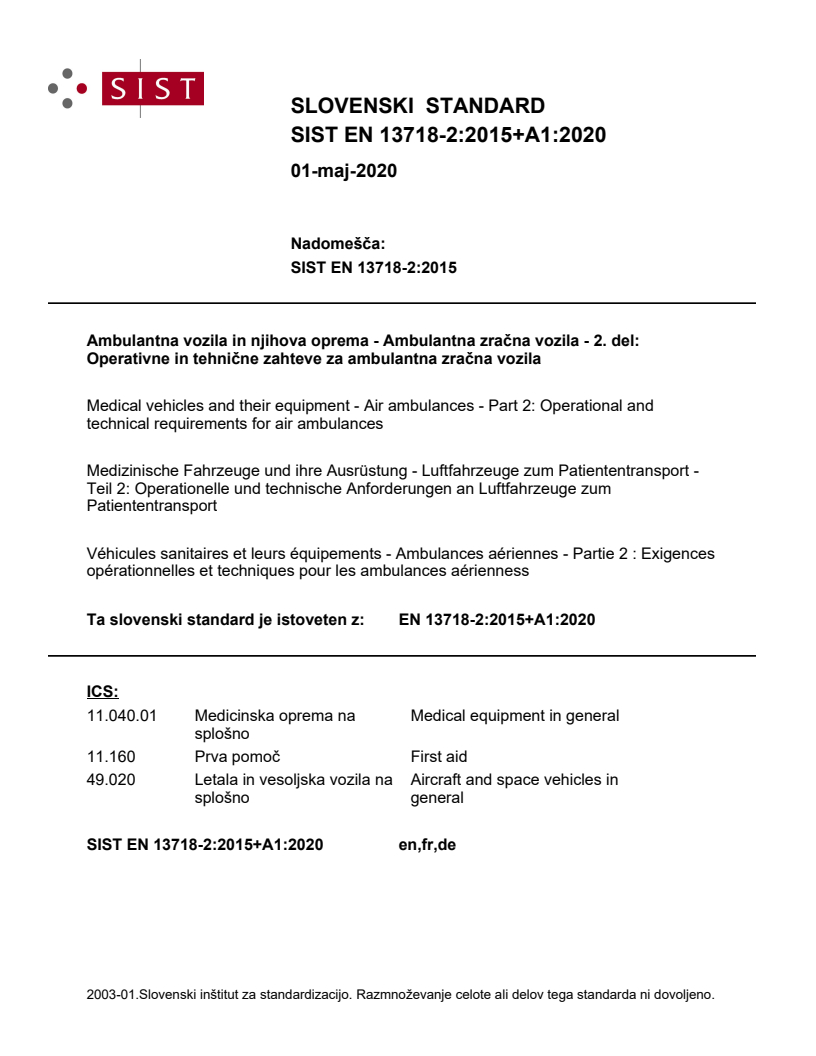
SLOVENSKI STANDARD
01-maj-2020
Nadomešča:
SIST EN 13718-2:2015
Ambulantna vozila in njihova oprema - Ambulantna zračna vozila - 2. del:
Operativne in tehnične zahteve za ambulantna zračna vozila
Medical vehicles and their equipment - Air ambulances - Part 2: Operational and
technical requirements for air ambulances
Medizinische Fahrzeuge und ihre Ausrüstung - Luftfahrzeuge zum Patiententransport -
Teil 2: Operationelle und technische Anforderungen an Luftfahrzeuge zum
Patiententransport
Véhicules sanitaires et leurs équipements - Ambulances aériennes - Partie 2 : Exigences
opérationnelles et techniques pour les ambulances aérienness
Ta slovenski standard je istoveten z: EN 13718-2:2015+A1:2020
ICS:
11.040.01 Medicinska oprema na Medical equipment in general
splošno
11.160 Prva pomoč First aid
49.020 Letala in vesoljska vozila na Aircraft and space vehicles in
splošno general
2003-01.Slovenski inštitut za standardizacijo. Razmnoževanje celote ali delov tega standarda ni dovoljeno.
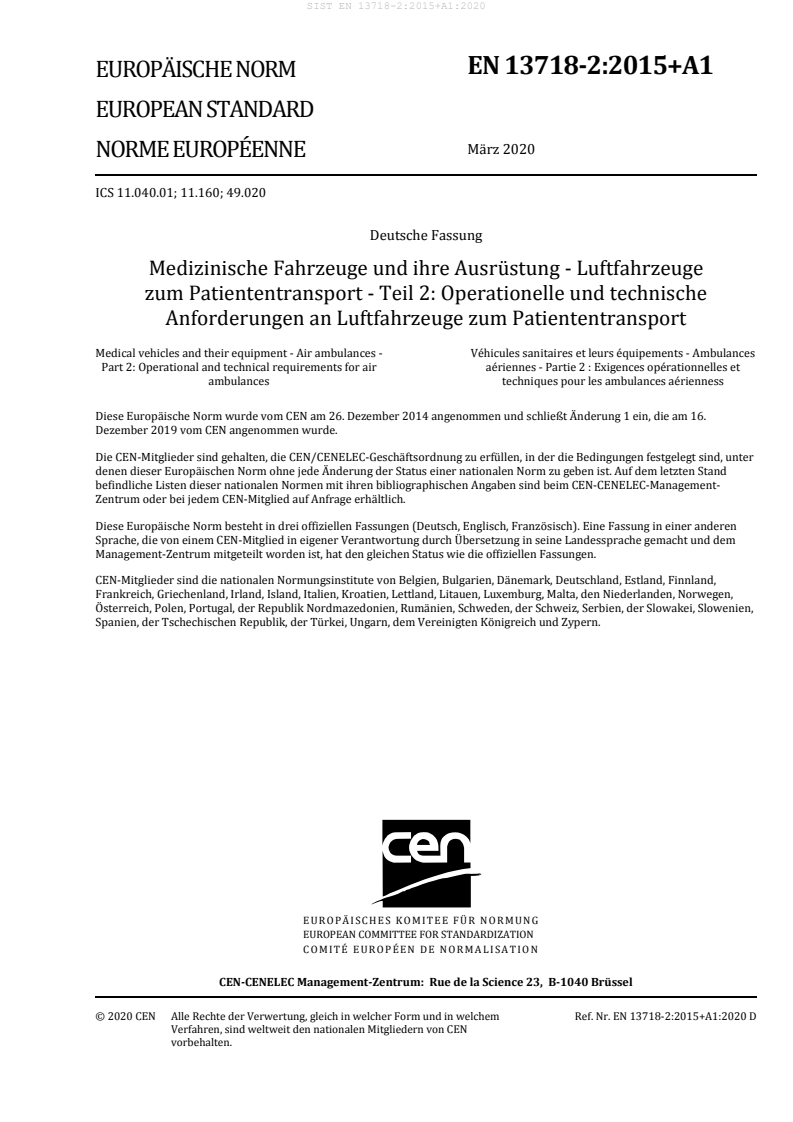
EN 13718-2:2015+A1
EUROPEAN STANDARD
NORME EUROPÉENNE
March 2020
EUROPÄISCHE NORM
ICS 11.040.01; 11.160; 49.020
English Version
Medical vehicles and their equipment - Air ambulances -
Part 2: Operational and technical requirements for air
ambulances
Véhicules sanitaires et leur équipement - Ambulances Medizinische Fahrzeuge und ihre Ausrüstung -
aériennes - Partie 2 : Exigences opérationnelles et Luftfahrzeuge zum Patiententransport - Teil 2:
techniques pour les ambulances aériennes Operationelle und technische Anforderungen an
Luftfahrzeuge zum Patiententransport
This European Standard was approved by CEN on 26 December 2014 and includes Amendment 1 approved by CEN on 16
December 2019.
CEN members are bound to comply with the CEN/CENELEC Internal Regulations which stipulate the conditions for giving this
European Standard the status of a national standard without any alteration. Up-to-date lists and bibliographical references
concerning such national standards may be obtained on application to the CEN-CENELEC Management Centre or to any CEN
member.
This European Standard exists in three official versions (English, French, German). A version in any other language made by
translation under the responsibility of a CEN member into its own language and notified to the CEN-CENELEC Management
Centre has the same status as the official versions.
CEN members are the national standards bodies of Austria, Belgium, Bulgaria, Croatia, Cyprus, Czech Republic, Denmark, Estonia,
Finland, France, Germany, Greece, Hungary, Iceland, Ireland, Italy, Latvia, Lithuania, Luxembourg, Malta, Netherlands, Norway,
Poland, Portugal, Republic of North Macedonia, Romania, Serbia, Slovakia, Slovenia, Spain, Sweden, Switzerland, Turkey and
United Kingdom.
EUROPEAN COMMITTEE FOR STANDARDIZATION
COMITÉ EUROPÉEN DE NORMALISATION
EUROPÄISCHES KOMITEE FÜR NORMUNG
CEN-CENELEC Management Centre: Rue de la Science 23, B-1040 Brussels
© 2020 CEN All rights of exploitation in any form and by any means reserved Ref. No. EN 13718-2:2015+A1:2020 E
worldwide for CEN national Members.
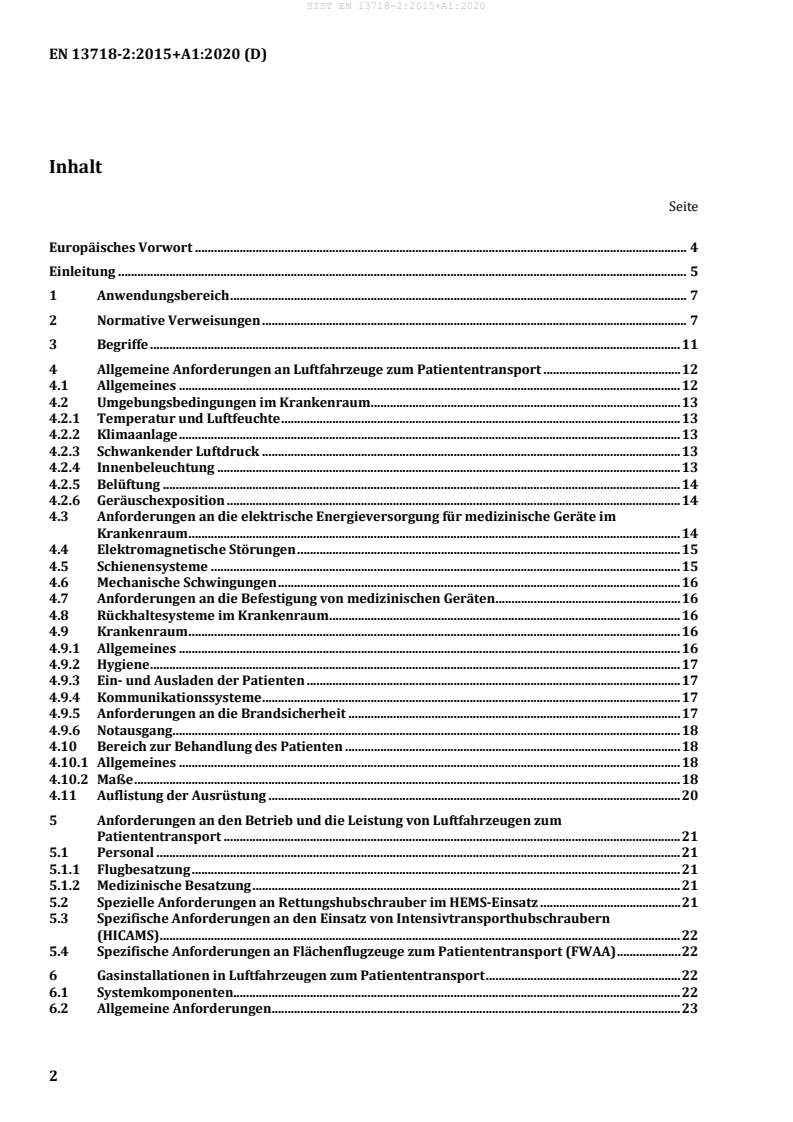
Contents Page
European foreword . 4
Introduction . 5
1 Scope . 6
2 Normative references . 6
3 Terms and definitions . 10
4 General requirements for air ambulances . 11
4.1 General . 11
4.2 Environmental conditions in the patient compartment . 12
4.2.1 Temperature and humidity . 12
4.2.2 Air conditioning system (ACS) . 12
4.2.3 Variable atmospheric pressure . 12
4.2.4 Interior light. 12
4.2.5 Ventilation . 12
4.2.6 Noise exposure . 13
4.3 Requirements for electrical power supply for medical devices in the patient
compartment . 13
4.4 Electromagnetic interference . 14
4.5 Rail systems . 14
4.6 Mechanical vibration . 14
4.7 Requirements for fixation of medical devices . 14
4.8 Restraint systems in the patient compartment . 14
4.9 Patient compartment . 15
4.9.1 General . 15
4.9.2 Hygienic . 15
4.9.3 Patient loading and unloading . 15
4.9.4 Communication systems . 16
4.9.5 Fire safety requirements . 16
4.9.6 Emergency exit . 16
4.10 Patient treatment area . 16
4.10.1 General . 16
4.10.2 Dimensions . 16
4.11 Lists of equipment. 18
5 Air ambulances, operation and performance requirements . 19
5.1 Personnel . 19
5.1.1 Flight crew . 19
5.1.2 Medical crew . 19
5.2 Specific requirements for helicopters operated in Helicopter Emergency Medical
Service (HEMS) . 19
5.3 Specific requirements for Helicopter Intensive Care Medical Service (HICAMS) . 19
5.4 Specific requirements for Fixed Wing Air Ambulances (FWAA) . 20
6 Gas installations in air ambulances . 20
6.1 System components . 20
6.2 General requirements . 20
6.2.1 Capacity and pressure operating range. 20
6.2.2 Continuity of supply . 21
6.3 Supply systems with gas cylinders . 21
6.4 Supply systems for compressed medical air . 21
6.5 Supply systems with air compressor . 22
6.6 Pipeline distribution system . 22
6.7 Marking and colour coding . 23
6.8 Alarms . 23
6.9 Testing . 23
6.9.1 General . 23
6.9.2 Test for mechanical integrity for compressed medical gas systems . 23
6.9.3 Test for leakage on all pipeline systems and for mechanical integrity of vacuum
pipeline systems . 24
6.9.4 Leakage from the compressed medical gas pipelines . 24
6.9.5 Test for cross connection . 24
6.10 Maintenance . 24
Annex A (normative) Medical devices in air ambulances . 25
A.1 Introduction. 25
A.2 Additional equipment . Error! Bookmark not defined.
Annex B (normative) Medicinal products and equipment additional to medical devices in
air ambulances . 31
B.1 Introduction. 31
Annex C (informative) A–deviations . 34
C.1 Deviation in Germany . 34
C.1.1 Additional specifications for the medical crew . 34
Annex ZA (informative) !Relationship between this European standard and the essential
requirements of Directive 93/42/EEC [OJ L 169] aimed to be covered . 35
Bibliography . 37
European foreword
This document (EN 13718-2:2015+A1:2020) has been prepared by Technical Committee CEN/TC 239
“Rescue systems”, the secretariat of which is held by DIN.
This European Standard shall be given the status of a national standard, either by publication of an
identical text or by endorsement, at the latest by September 2020, and conflicting national standards
shall be withdrawn at the latest by September 2020.
Attention is drawn to the possibility that some of the elements of this document may be the subject of
patent rights. CEN shall not be held responsible for identifying any or all such patent rights.
This document includes Amendment 1 approved by CEN on 2019-12-16.
This document supersedes !EN 13718-2:2015."
The start and finish of text introduced or altered by amendment is indicated in the text by tags !".
This document has been prepared under a mandate given to CEN by the European Commission and the
European Free Trade Association, and supports essential requirements of EU Directive(s).
For relationship with EU Directive(s), see informative Annex ZA which is an integral part of this
document.
EN 13718-2:2008 has been technically revised. The following points represent the most important
changes in the revision:
a) clarified unclear issues in this part of the standard and between the two parts of the standard (for
example requirements for patient's compartment illumination);
b) changed text related to enhancing safety related to the risk from rotors on helicopters;
c) clarified the requirements for the patient compartment;
d) the standard has been modified/integrated to meet the Medical Devices Directive 93/42/EEC
requirements.
EN 13718 consists of the following parts, under the general title: Medical vehicles and their equipment –
Air ambulance:
— Part 1: Requirements for medical devices used in air ambulances;
— Part 2: Operational and technical requirements for air ambulances.
According to the CEN/CENELEC Internal Regulations, the national standards organizations of the
following countries are bound to implement this European Standard: Austria, Belgium, Bulgaria,
Croatia, Cyprus, Czech Republic, Denmark, Estonia, Finland, France, Germany, Greece, Hungary, Iceland,
Ireland, Italy, Latvia, Lithuania, Luxembourg, Malta, Netherlands, Norway, Poland, Portugal, Republic of
North Macedonia, Romania, Slovakia, Slovenia, Spain, Sweden, Switzerland, Turkey and the United
Kingdom.
Introduction
This part of EN 13718 provides requirements for air ambulances, and in particular covers requirements
for the ambulance role of the aircraft.
Air ambulances are equipped with medical devices as well as drugs and rescue equipment to be used by
medical personnel. Requirements for medical devices intended for use in air ambulances are provided
in EN 13718-1. This standard is supplementary to several European Standards as well as laws and
regulations providing the requirements for aircraft in order to provide continuous patient care and
monitoring during transport in and between various ambulance types and hospitals. The requirements
cover ambulance flights in general. Several national and regional rules and regulations apply to aircraft
being used as ambulances. This part of EN 13718 gives information on these in the annexes and in notes
throughout the text. Provisions for the safety and care both of the patient as well as of the crew and the
medical personnel are contained in existing national and international laws, regulations and guidelines.
This part of EN 13718 provides some general requirements for the safe operation of aircraft being used
as ambulances. These requirements are not covered by the scope of the Medical Devices Directive or by
international agreements for craft, transportation and traffic. They are provided in order to secure the
safe and secure handling of patients. In order to accommodate continuity of patient care between
different kinds of ambulances, some specific requirements are given. Requirements are set in order to
secure safe use and handling of medical devices.
Aircraft being used as ambulances are equipped with medical devices, medicinal products and rescue
equipment to enable the medical personnel to provide continuous patient care. The minima for the
medical devices are specified in Annex A. The requirements set out in this part of EN 13718 give the
minimum provisions for an ambulance service to provide satisfactory care and medical attention to
emergency patients as well as other patients during transportation. The requirements are based on the
state of the art of today and common practice in Europe.
This European Standard gives minimum requirements for interfaces and compatibility of medical
devices used in air ambulances. The standards work was called for by the EU Commission by a mandate
linked with the Medical Devices Directive (see Annex ZA and Bibliography [1]).
This European Standard is supplementary to several other European Standards and gives requirements
for medical devices when used in situations where the ambient conditions differ from the normal
indoor conditions prevailing within the health care system. Several specific requirements are related to
the conditions prevailing in air ambulances. The requirements set are carefully selected to ensure
interoperability and continuous patient care.
Medical devices need to conform to the applicable essential requirements in the Medical Devices
Directive, 93/42/EEC. The essential requirements are listed in Annex I of the Medical Devices Directive.
Annex ZA in this European Standard lists the essential requirements that are covered by the identified
clauses of this European Standard.
The environmental conditions for medical devices used in air ambulances are different from those
expected in a normal hospital environment. In particular, this implies environmental conditions such as
temperature and humidity, vibration and shock caused by movement of the air ambulances, variable
atmospheric pressures and electromagnetic disturbances between the air ambulances and the medical
device.
1 Scope
This part of EN 13718 specifies the requirements for performance and equipping for air ambulances,
including requirements for interfaces to medical devices used for the transport and treatment of sick or
injured persons. This part of EN 13718 is applicable to air ambulances capable of transporting at least
one person on a stretcher.
NOTE Requirements are specified for categories of air ambulances based on the different intended use. These
are the helicopter emergency medical service (HEMS) the helicopter intensive care medical service (HICAMS) and
the fixed wing air ambulance (FWAA).
2 Normative references
The following documents are referred to in the text in such a way that some or all of their content
constitutes requirements of this document. For dated references, only the edition cited applies. For
undated references, the latest edition of the referenced document (including any amendments) applies.
EN 3-7:2004+A1:2007, Portable fire extinguishers — Part 7: Characteristics, performance requirements
and test methods
EN 3-8:2006, Portable fire extinguishers — Part 8: Additional requirements to EN 3-7 for the construction,
resistance to pressure and mechanical tests for extinguishers with a maximum allowable pressure equal to
or lower than 30 bar
!EN 3-9:2006+AC:2007, Portable fire extinguishers — Part 9: Additional requirements to EN 3-7 for
pressure resistance of CO2 extinguishers"
EN 3-10:2009, Portable fire extinguishers — Part 10: Provisions for evaluating the conformity of a
portable fire extinguisher to EN 3-7
!EN 143:2000+A1:2017, Respiratory protective devices — Particle filters — Requirements, testing,
marking (Corrigendum AC:2002 and AC:2005 incorporated)"
!EN ISO 374-1:2016+A1:2018, Protective gloves against dangerous chemicals and micro-organisms —
Part 1: Terminology and performance requirements for chemical risks (ISO 374-1:2016+A1:2018)"
EN 455-1:2000, Medical gloves for single use — Part 1: Requirements and testing for freedom from holes
!EN 455-2:2015, Medical gloves for single use — Part 2: Requirements and testing for physical
properties"
!EN 455-3:2015, Medical gloves for single use — Part 3: Requirements and testing for biological
evaluation"
EN 794-3:1998+A2:2009, Lung ventilators — Part 3: Particular requirements for emergency and
transport ventilators
EN 1618:1997, Catheters other than intravascular catheters — Test methods for common properties
!Deleted tex"t"
!EN 1865-1:2010+A1:2015, Patient handling equipment used in road ambulances — Part 1: General
stretcher systems and patient handling equipment"
!EN 13718-1:2014+A1:2020, Medical vehicles and their equipment — Air ambulances — Part 1:
Requirements for medical devices used in air ambulances"
!EN 13976-1:2018, Rescue systems — Transportation of incubators — Part 1: Interface conditions"
!EN 13976-2:2018, Rescue systems — Transportation of incubators — Part 2: System requirements"
EN 14605:2005+A1:2009, Protective clothing against liquid chemicals — Performance requirements for
clothing with liquid-tight (Type 3) or spray-tight (Type 4) connections, including items providing
protection to parts of the body only (Types PB [3] and PB [4])
!Deleted text"
EN 60601-2-4:2011, Medical electrical equipment — Part 2-4: Particular requirements for the basic
safety and essential performance of cardiac defibrillators (IEC 60601-2-4:2010)
!Deleted text"
!EN 60601-2-24:2015, Medical electrical equipment — Part 2-24: Particular requirements for basic
safety and essential performance of infusion pumps and controllers (IEC 60601-2-24:2012)"
!EN 60601-2-34:2014, Medical electrical equipment — Part 2-34: Particular requirements for the basic
safety and essential performance of invasive blood pressure monitoring equipment
(IEC 60601-2-34:2011)"
!EN 80601-2-30:2010+A1:2015, Medical electrical equipment — Part 2-30: Particular requirements
for the basic safety and essential performance of automated non-invasive sphygmomanometers
(IEC 80601-2-30:2009 + Corrigendum Jan. 2010 + A1:2013)"
!EN ISO 5356-1:2015, Anaesthetic and respiratory equipment — Conical connectors — Part 1: Cones
and sockets (ISO 5356-1:2015)"
!EN ISO 5359:2014+A1:2017, Anaesthetic and respiratory equipment — Low-pressure hose assemblies
for use with medical gases (ISO 5359:2014+Amd1:2017)"
!EN ISO 5361:2016, Anaesthetic and respiratory equipment — Tracheal tubes and connectors
(ISO 5361:2016)"
!EN ISO 5364:2016, Anaesthetic and respiratory equipment — Oropharyngeal airways
(ISO 5364:2016)"
!EN ISO 5366:2016, Anaesthetic and respiratory equipment — Tracheostomy tubes and connectors
(ISO 5366:2016)"
EN ISO 5367:2014, Anaesthetic and respiratory equipment — Breathing sets and connectors
(ISO 5367:2014)
!EN ISO 6009:2016, Hypodermic needles for single use — Colour coding for identification
(ISO 6009:2016)"
EN ISO 7376:2009, Anaesthetic and respiratory equipment — Laryngoscopes for tracheal intubation
(ISO 7376:2009)
!EN ISO 7396-1:2016, Medical gas pipeline systems — Part 1: Pipeline systems for compressed medical
gases and vacuum (ISO 7396-1:2016)"
EN ISO 7396-2:2007, Medical gas pipeline systems — Part 2: Anaesthetic gas scavenging disposal systems
(ISO 7396-2:2007)
!EN ISO 7864:2016, Sterile hypodermic needles for single use — Requirements and test methods
(ISO 7864:2016)"
!EN ISO 7886-1:2018, Sterile hypodermic syringes for single use — Part 1: Syringes for manual use
(ISO 7886 1:2017)"
EN ISO 7886-2:1997, Sterile hypodermic syringes for single use — Part 2: Syringes for use with power-
driven syringe pumps (ISO 7886-2:1996)
!EN ISO 8537:2016, Sterile single-use syringes, with or without needle, for insulin (ISO 8537:2016)"
EN ISO 9170-1:2008, Terminal units for medical gas pipeline systems — Part 1: Terminal units for use
with compressed medical gases and vacuum (ISO 9170-1:2008)
EN ISO 9360-1:2009, Anaesthetic and respiratory equipment — Heat and moisture exchangers (HMEs) for
humidifying respired gases in humans — Part 1: HMEs for use with minimum tidal volumes of 250 ml
(ISO 9360-1:2000)
!EN ISO 10079-1:2015, Medical suction equipment — Part 1: Electrically powered suction equipment
(ISO 10079 1:2015)"
EN ISO 10079-2:2014, Medical suction equipment — Part 2: Manually powered suction equipment
(ISO 10079-2:2014)
EN ISO 10079-3:2014, Medical suction equipment — Part 3: Suction equipment powered from a vacuum
or positive pressure gas source (ISO 10079-3:2014)
EN ISO 10524-1:2006, Pressure regulators for use with medical gases — Part 1: Pressure regulators and
pressure regulators with flow-metering devices (ISO 10524-1:2006)
EN ISO 10524-2:2006, Pressure regulators for use with medical gases — Part 2: Manifold and line
pressure regulators (ISO 10524-2:2005)
!EN ISO 10524-3:2006+A1:2013, Pressure regulators for use with medical gases — Part 3: Pressure
regulators integrated with cylinder valves (ISO 10524-3:2005+Amd1:2013)"
EN ISO 10524-4:2008, Pressure regulators for use with medical gases — Part 4: Low-pressure regulators
(ISO 10524-4:2008)
!EN ISO 10555-1:2013+A1:2017, Intravascular catheters — Sterile and single-use catheters — Part 1:
General requirements (ISO 10555-1:2013+Amd1:2017)"
EN ISO 10555-3:2013, Intravascular catheters — Sterile and single-use catheters — Part 3: Central
venous catheters (ISO 10555-3:2013)
EN ISO 10555-5:2013, Intravascular catheters — Sterile and single-use catheters — Part 5: Over-needle
peripheral catheters (ISO 10555-5:2013)
!EN ISO 11070:2014+A1:2018, Sterile single-use intravascular introducers, dilators and guidewires
(ISO 11070:2014+Amd1:2018)"
EN ISO 13688:2013, Protective clothing — General requirements (ISO 13688:2013)
EN ISO 15002:2008, Flow-metering devices for connection to terminal units of medical gas pipeline
systems (ISO 15002:2008)
EN ISO 18777:2009, Transportable liquid oxygen systems for medical use — Particular requirements
(ISO 18777:2005)
!EN ISO 19054:2006+A1:2016, Rail systems for supporting medical equipment
(ISO 19054:2005+Amd1:2016)"
EN ISO 23328-1:2008, Breathing system filters for anaesthetic and respiratory use — Part 1: Salt test
method to assess filtration performance (ISO 23328-1:2003)
EN ISO 23328-2:2009, Breathing system filters for anaesthetic and respiratory use — Part 2: Non-
filtration aspects (ISO 23328-2:2002)
!EN ISO 80601-2-55:2018, Medical electrical equipment — Part 2-55: Particular requirements for the
basic safety and essential performance of respiratory gas monitors (ISO 80601-2-55:2018)"
!EN ISO 80601-2-56:2017, Medical electrical equipment — Part 2-56: Particular requirements for
basic safety and essential performance of clinical thermometers for body temperature measurement
(ISO 80601-2-56:2017)"
EN ISO 80601-2-61:2011, Medical electrical equipment — Part 2-61: Particular requirements for basic
safety and essential performance of pulse oximeter equipment (ISO 80601-2-61:2011)
EN ISO 81060-1:2012, Non-invasive sphygmomanometers — Part 1: Requirements and test methods for
non-automated measurement type (ISO 81060-1:2007)
EN ISO 81060-2:2014, Non-invasive sphygmomanometers — Part 2: Clinical investigation of automated
measurement type (ISO 81060-2:2013)
!EN 60601-1-12:2015, Medical electrical equipment — Part 1-12: General requirements for basic
safety and essential performance — Collateral Standard: Requirements for medical electrical equipment
and medical electrical systems intended for use in the emergency medical services environment
(IEC 60601-1-12:2014)"
!EN ISO 80369-7:2017, Small-bore connectors for liquids and gases in healthcare applications — Part
7: Connectors for intravascular or hypodermic applications (ISO 80369-7:2016, Corrected version 2016-
12-01)"
!EN ISO 80601-2-12:2011+AC:2011, Medical electrical equipment — Part 2-12: Particular
requirements for basic safety and essential performance of critical care ventilators
(ISO/IEC 80601-2-12:2011+Cor:2011)"
!ISO 7137:1995, Aircraft — Environmental conditions and test procedures for airborne equipment"
European Aviation Safety Agency (EASA) Certification Specifications CS-23, Normal, Utility, Aerobatic,
and Commuter Category Aeroplanes
European Aviation Safety Agency (EASA) Certification Specifications CS-25, Large Aeroplanes
European Aviation Safety Agency (EASA) Certification Specifications CS-27, Small Rotorcraft
European Aviation Safety Agency (EASA) Certification Specifications CS-29, Large Rotorcraft
3 Terms and definitions
For the purposes of this document, the following terms and definitions apply.
3.1
air ambulance
aircraft designed to be normally staffed by two medically trained personnel equipped and intended for
the transportation of at least one stretcher patient who will receive medical treatment during transport
3.2
fixed wing air ambulance
FWAA
aircraft especially equipped for transportation, medical treatment and care of patients, including
patients requiring intensive care treatment
3.3
flight crew
members of the crew intended to operate the aircraft
Note 1 to entry: See Commission Regulation (EU) No 1178/2011.
3.4
helicopter emergency medical service
HEMS
flight by a helicopter, the purpose of which is to facilitate emergency medical assistance, where
immediate and rapid transportation is essential, by carrying:
— medical personnel;
— medical supplies (equipment, blood, organs, drugs);
— ill or injured persons and other persons directly involved
3.5
helicopter intensive care medical service
HICAMS
flight by a helicopter, especially staffed and equipped for the transportation, medical treatment and care
of patients requiring intensive care treatment, mainly in inter-hospital transfers
3.6
interchangeability
facility to transfer patients between scenes of emergencies, ambulances and hospitals as well as
between hospitals, including transport between countries, providing continuous patient care, treatment
and monitoring
3.7
interface
means or place of interaction between one or more of the medical devices, the ambient conditions, the
user, the patient, and when relevant, the various kinds of ambulances
![SOURCE EN 13976-1:2018, definition 3.3]"
3.8
interoperability
facility to connect various medical devices that are fixed to patients, into connections of associated
medical devices including the possibility of connecting powered medical devices to various kinds of
ambulances
3.9
medical crew
qualified members of the crew intended to provide patient care
3.10
medical device
instrument, apparatus, appliance, material or other article, whether used alone or in combination,
including the software necessary for its proper application, intended by the manufacturer to be used for
human beings for the purpose of diagnosis, prevention, monitoring, treatment or alleviation of disease
and injury
3.11
patient compartment
defined space which provides the possibility to install and transport one or more patient(s), a medical
crew, medical devices, systems and installations which are required during flight to properly treat and
care for the patient
3.12
patient treatment area
area located within the patient compartment which is required to carry a patient on a stretcher as well
as the area in the vicinity to the stretcher enabling the medical crew to properly care and treat a patient
4 General requirements for air ambulances
4.1 General
Air ambulances shall be designed to enable fast and safe access of medical personnel to people in need
of medical attention at sites outside of hospitals, to and between hospitals.
Intensive care patients transportation requires specially trained personnel.
Air ambulances shall be designed to accommodate the personnel, creating the safe and healthy working
environment. Air ambulances shall allow treatment for at least one stretcher patient.
Air ambulances shall be equipped with medical devices in accordance with Annex A and other life
supporting equipment in accordance with Annex B, in order to provide continuous patient care.
Equipment and systems shall be selected and designed to enable interchangeability and interoperability
(see 3.6 and 3.8, respectively).
The installation of medical devices and equipment shall be in accordance with the applicable
airworthiness requirements (EASA CS-23, CS-25, CS-27, CS-29).
4.2 Environmental conditions in the patient compartment
4.2.1 Temperature and humidity
A heating system shall be provided capable of raising the temperature in the patient compartment from
0 °C to + 18 °C in less than 30 min when the outside air temperature is 0 °C.
There should be an auxiliary system to heat/cool the patient compartment when stationary.
Normal ambient humidity conditions for patient treatment should be aimed at.
4.2.2 Air conditioning system (ACS)
In some regions of Europe, the outside air temperature can be extremely high.
For helicopters operating in those areas where the maximum external reference temperature was
above 35 °C for more than 15 days per year, during at least the past 10 years, the helicopter shall be
equipped with an Air Conditioning System.
NOTE The maximum external reference temperature is the maximum temperature determined for that area
by the relevant National Weather Institution, based on the previous 10 years record available.
According to the mission and medical operation requirements, the ACS shall be capable of maintaining
the working environment, for the crew and for the patient, at an acceptable temperature level.
4.2.3 Variable atmospheric pressure
Air ambulances which operate regularly at flight altitude above 15 000 feet shall have a pressurized
cabin system. The operating pressure in the patient compartment above 15 000 feet shall be equivalent
to the operating pressure at 3 500 feet.
4.2.4 Interior light
Lighting shall be provided in accordance with Table 1.
Table 1 — Patient’s compartment illumination
Illuminance
Type Spot light
(minimum)
Stretcher area 300 lx 400 lx
Patient compartment 50 lx
The spot light shall provide an illuminated area with a diameter of at least 200 mm.
NOTE The colour temperature of the light will change the appearance of skin and organs. Therefore, it is
important that the interior lighting is suitable for patient care during transport. It is believed that it is not
necessary in ambulance use to define “daylight” or “natural colour balance” in a more exact way other than the
colour temperature. Regarding the colour temperature a comparison can be that examining lights in hospitals are
normally between 3 800 K and 4 300 K.
4.2.5 Ventilation
Means shall be provided for the patient compartment to be ventilated. Ventilation systems shall be
designed to prevent draught to the patient(s) and crew.
4.2.6 Noise exposure
If noise exposure to the patient compartment during transport exceeds 85 dB (A), protection to both
patient(s) and personnel shall be established and available.
NOTE 1 Patients, in particular children, can need specially designed protection.
NOTE 2 Specific requirements for sound protection in a working environment exist in some countries or
regions.
Sound protection shall allow communication between the medical personnel, the pilot and the
patient(s) when experiencing ambient noise conditions greater than 85 dB (A).
4.3 Requirements for electrical power supply for medical devices in the patient
compartment
A minimum of four separately protected 12 V DC outlets shall be available. Optionally one additional
outlet may be supplied by a separate battery, dedicated to medical devices. The outlets shall be
available for medical equipment and located in the area of storage and/or use of the medical device.
The nominal voltage shall be 13,8 V.
The voltage shall be between 12,4 V and 15,1 V !(see EN 13718-1:2014+A1:2020, 4.5.2, and
EN 60601-1-12:2015)."
The outlets shall have as a minimum the capacity of delivering: 1 each 14 A and 3 each 7 A.
NOTE 1 Not simultaneously.
The total available current shall be at least 25 A.
The power supply shall continuously supply medical devices with electrical power with engines
running.
The outlets for the medical devices shall be labelled with the nominal voltage and current rating.
Outlets should have a visible indication under intended operational conditions in order to show if the
power is switched on.
If 24 VDC is available for use with medical devices, the nominal voltage should be 27,5 V. At least one
outlet shall be rated 10 A.
Electrical outlets for medical devices shall be female and have means for locking the connectors to the
outlets.
If AC power is provided by an inverter and available for use with medical devices, the voltage supplied
by the inverter shall comply with the range required in !EN 13718-1:2014+A1:2020", 4.5.4. The
inverter shall have the capacity to deliver at least 1500 W. The inverter is to be considered as an
accessory to the medical devices.
Any AC inverter shall be connected to the airframe ground with two independent connections. The
touch current between the inverter and any part of the airframe ground in the patient compartment
shall be less than 100 uA at no fault condition.
NOTE 2 Further information of safe installation of AC inverters can be found in EN 60601-1:2006, Clause 16;
ME systems.
Connectors shall be designed to prevent short-circuiting under the environmental conditions prevailing
in the air ambulances.
Connectors conforming to MIL-DTL-26482 may be used (see EN 13718-1).
The aircraft shall, when parked on ground, be provided with an external single-point-connection to
enable charging of batteries in electro medical devices which are connected to 12 VDC outlets.
When the aircraft is connected to AC mains on the ground means should be provided to prevent earth
leakage currents.
!If the air ambulance is intended to carry a transport incubator system it shall have a four pole outlet
as specified in EN 13976-1:2018 Clause 4.2.3 Figure 2 and Figure 3."
4.4 Electromagnetic interference
Electromagnetic disturbances caused by the aircraft shall not influence the safe operation of the
medical device and vice versa.
Medical devices intended for use in air ambulances should conform to !ISO 7137:1995."
4.5 Rail systems
If rail systems are used, they shall be in accordance with the applicable airworthiness requirements
(EASA CS-23, CS-25, CS-27, CS-29).
If rail clamps are used they shall conform to !EN ISO 19054:2006+A1:2016" with additional
fixation requirements in accordance with the applicable airworthiness requirements (EASA CS-23, CS-
25, CS-27, CS-29).
Manufacturers of the aircraft installation and/or of the medical devices intended for transport and use
within air ambulances shall provide recommendations for the proper attachment of the medical device.
NOTE A typical rail system consists of for example rail supports, rail, rail clamps, equipment mount holders,
equipment mounts and equipment pin holders and equipment mount pins.
4.6 Mechanical vibration
Mechanical vibration shall be kept to a minimum in all phases of the flight.
NOTE Vibration-absorbing devices can prove useful both for patient(s) and personnel. Requirements can be
found in ISO 2631-1.
4.7 Requirements for fixation of medical devices
All medical devices shall be either fitted to or stowed in the aircraft securely.
A location in the aircraft shall be specified for the stowage and efficient use of medical devices. Essential
medical devices for the management of vital functions, including airway management and ventilation
shall be in reach of the medical personnel while seated. Medical devices required for use outside the
aircraft shall be easily accessible. All medical devices shall be securely and safely stowed.
!If the air ambulance is intended to carry a transport incubator system which is to be
interchangeable between road or air ambulances it shall have means for complying with a track rail
system as specified in EN 13976-1:2018 Clause 4.1.3. This can be done by integrated rails in the floor or
by using an interface."
4.8 Restraint systems in the patient compartment
During transport, a certified restraint system shall be available to secure the patient(s) and personnel,
as well as the medical devices and other equipment.
Requirements for fixing and restraint systems according to the type of aircraft shall apply.
Requirements for medical devices that are brought into an aircraft should follow the minimum
requirements for the stowage of baggage and cargo.
4.9 Patient compartment
4.9.1 General
The patient compartment shall provide at least:
— two seats (for the medical personnel allowing direct access to the stretcher patient);
— one stretcher.
If more than one stretcher patient is being carried, the following rules shall be applied:
a) HEMS: It shall be possible to provide adequate treatment to all patients transported.
b) FWAA: During transport
...
SLOVENSKI STANDARD
01-maj-2020
Nadomešča:
SIST EN 13718-2:2015
Ambulantna vozila in njihova oprema - Ambulantna zračna vozila - 2. del:
Operativne in tehnične zahteve za ambulantna zračna vozila
Medical vehicles and their equipment - Air ambulances - Part 2: Operational and
technical requirements for air ambulances
Medizinische Fahrzeuge und ihre Ausrüstung - Luftfahrzeuge zum Patiententransport -
Teil 2: Operationelle und technische Anforderungen an Luftfahrzeuge zum
Patiententransport
Véhicules sanitaires et leurs équipements - Ambulances aériennes - Partie 2 : Exigences
opérationnelles et techniques pour les ambulances aérienness
Ta slovenski standard je istoveten z: EN 13718-2:2015+A1:2020
ICS:
11.040.01 Medicinska oprema na Medical equipment in general
splošno
11.160 Prva pomoč First aid
49.020 Letala in vesoljska vozila na Aircraft and space vehicles in
splošno general
2003-01.Slovenski inštitut za standardizacijo. Razmnoževanje celote ali delov tega standarda ni dovoljeno.
EN 13718-2:2015+A1
EUROPÄISCHE NORM
EUROPEAN STANDARD
März 2020
NORME EUROPÉENNE
ICS 11.040.01; 11.160; 49.020
Deutsche Fassung
Medizinische Fahrzeuge und ihre Ausrüstung - Luftfahrzeuge
zum Patiententransport - Teil 2: Operationelle und technische
Anforderungen an Luftfahrzeuge zum Patiententransport
Medical vehicles and their equipment - Air ambulances - Véhicules sanitaires et leurs équipements - Ambulances
Part 2: Operational and technical requirements for air aériennes - Partie 2 : Exigences opérationnelles et
ambulances techniques pour les ambulances aérienness
Diese Europäische Norm wurde vom CEN am 26. Dezember 2014 angenommen und schließt Änderung 1 ein, die am 16.
Dezember 2019 vom CEN angenommen wurde.
Die CEN-Mitglieder sind gehalten, die CEN/CENELEC-Geschäftsordnung zu erfüllen, in der die Bedingungen festgelegt sind, unter
denen dieser Europäischen Norm ohne jede Änderung der Status einer nationalen Norm zu geben ist. Auf dem letzten Stand
befindliche Listen dieser nationalen Normen mit ihren bibliographischen Angaben sind beim CEN-CENELEC-Management-
Zentrum oder bei jedem CEN-Mitglied auf Anfrage erhältlich.
Diese Europäische Norm besteht in drei offiziellen Fassungen (Deutsch, Englisch, Französisch). Eine Fassung in einer anderen
Sprache, die von einem CEN-Mitglied in eigener Verantwortung durch Übersetzung in seine Landessprache gemacht und dem
Management-Zentrum mitgeteilt worden ist, hat den gleichen Status wie die offiziellen Fassungen.
CEN-Mitglieder sind die nationalen Normungsinstitute von Belgien, Bulgarien, Dänemark, Deutschland, Estland, Finnland,
Frankreich, Griechenland, Irland, Island, Italien, Kroatien, Lettland, Litauen, Luxemburg, Malta, den Niederlanden, Norwegen,
Österreich, Polen, Portugal, der Republik Nordmazedonien, Rumänien, Schweden, der Schweiz, Serbien, der Slowakei, Slowenien,
Spanien, der Tschechischen Republik, der Türkei, Ungarn, dem Vereinigten Königreich und Zypern.
EUROPÄISCHES KOMITEE FÜR NORMUNG
EUROPEAN COMMITTEE FOR STANDARDIZATION
COMITÉ EUROPÉEN DE NORMALISATION
CEN-CENELEC Management-Zentrum: Rue de la Science 23, B-1040 Brüssel
© 2020 CEN Alle Rechte der Verwertung, gleich in welcher Form und in welchem Ref. Nr. EN 13718-2:2015+A1:2020 D
Verfahren, sind weltweit den nationalen Mitgliedern von CEN
vorbehalten.
Inhalt
Seite
Europäisches Vorwort . 4
Einleitung . 5
1 Anwendungsbereich . 7
2 Normative Verweisungen . 7
3 Begriffe . 11
4 Allgemeine Anforderungen an Luftfahrzeuge zum Patiententransport . 12
4.1 Allgemeines . 12
4.2 Umgebungsbedingungen im Krankenraum . 13
4.2.1 Temperatur und Luftfeuchte . 13
4.2.2 Klimaanlage . 13
4.2.3 Schwankender Luftdruck . 13
4.2.4 Innenbeleuchtung . 13
4.2.5 Belüftung . 14
4.2.6 Geräuschexposition . 14
4.3 Anforderungen an die elektrische Energieversorgung für medizinische Geräte im
Krankenraum . 14
4.4 Elektromagnetische Störungen . 15
4.5 Schienensysteme . 15
4.6 Mechanische Schwingungen . 16
4.7 Anforderungen an die Befestigung von medizinischen Geräten . 16
4.8 Rückhaltesysteme im Krankenraum . 16
4.9 Krankenraum . 16
4.9.1 Allgemeines . 16
4.9.2 Hygiene . 17
4.9.3 Ein- und Ausladen der Patienten . 17
4.9.4 Kommunikationssysteme . 17
4.9.5 Anforderungen an die Brandsicherheit . 17
4.9.6 Notausgang . 18
4.10 Bereich zur Behandlung des Patienten . 18
4.10.1 Allgemeines . 18
4.10.2 Maße . 18
4.11 Auflistung der Ausrüstung . 20
5 Anforderungen an den Betrieb und die Leistung von Luftfahrzeugen zum
Patiententransport . 21
5.1 Personal . 21
5.1.1 Flugbesatzung . 21
5.1.2 Medizinische Besatzung . 21
5.2 Spezielle Anforderungen an Rettungshubschrauber im HEMS-Einsatz . 21
5.3 Spezifische Anforderungen an den Einsatz von Intensivtransporthubschraubern
(HICAMS) . 22
5.4 Spezifische Anforderungen an Flächenflugzeuge zum Patiententransport (FWAA) . 22
6 Gasinstallationen in Luftfahrzeugen zum Patiententransport . 22
6.1 Systemkomponenten. 22
6.2 Allgemeine Anforderungen . 23
6.2.1 Kapazität und Betriebsdruckbereich . 23
6.2.2 Versorgungskontinuität . 23
6.3 Versorgungssysteme mit Gasflaschen . 23
6.4 Versorgungssysteme für medizinische Druckluft . 24
6.5 Versorgungssysteme mit Luftkompressor . 24
6.6 Rohrverteilersystem . 25
6.7 Kennzeichnung und Farbcodierung . 25
6.8 Alarme . 26
6.9 Prüfung . 26
6.9.1 Allgemeines . 26
6.9.2 Prüfung der mechanischen Unversehrtheit von medizinischen Druckgassystemen. 26
6.9.3 Prüfung aller Rohrleitungssysteme auf Leckage und Prüfung der Vakuum-
Leitungssysteme auf mechanische Unversehrtheit . 26
6.9.4 Leckage von Rohrleitungen für medizinische Druckgase . 27
6.9.5 Prüfung auf Querverbindungen . 27
6.10 Wartung . 27
Anhang A (normativ) Medizinprodukte in Luftfahrzeugen zum Patiententransport . 28
A.1 Einleitung . 28
Anhang B (normativ) Zusätzlich zu den Medizinprodukten erforderliche Arzneimittel sowie
Ausrüstungen für Luftfahrzeuge zum Patiententransport . 33
B.1 Einleitung . 33
Anhang C (informativ) A–Abweichungen . 36
C.1 Abweichung in Deutschland . 36
C.1.1 Zusätzliche Spezifikationen für die medizinische Besatzung . 36
Anhang ZA (informativ) !Zusammenhang zwischen dieser Europäischen Norm und den
grundlegenden Anforderungen der abzudeckenden Richtlinie 93/42/EWG [OJ L 169] . 37
Literaturhinweise . 39
Europäisches Vorwort
Dieses Dokument (EN 13718-2:2015+A1:2020) wurde vom Technischen Komitee CEN/TC 239
„Rettungssysteme“ erarbeitet, dessen Sekretariat von DIN gehalten wird.
Diese Europäische Norm muss den Status einer nationalen Norm erhalten, entweder durch Veröffentlichung
eines identischen Textes oder durch Anerkennung bis September 2020, und etwaige entgegenstehende
nationale Normen müssen bis September 2020 zurückgezogen werden.
Es wird auf die Möglichkeit hingewiesen, dass einige Elemente dieses Dokuments Patentrechte berühren
können. CEN ist nicht dafür verantwortlich, einige oder alle diesbezüglichen Patentrechte zu identifizieren.
Dieses Dokument enthält die Änderung 1, angenommen von CEN am 2019-12-16.
Dieses Dokument ersetzt !EN 13718-2:2015."
Der Beginn und das Ende von neuem oder geändertem Text werden durch die Markierungen ! und "
angezeigt.
Dieses Dokument wurde im Rahmen eines Mandats erarbeitet, das die Europäische Kommission und die
Europäische Freihandelsassoziation CEN erteilt haben, und unterstützt grundlegende Anforderungen der
EU-Richtlinien.
Zum Zusammenhang mit EU-Richtlinien siehe informativen Anhang ZA, der Bestandteil dieses Dokuments
ist.
EN 13718-2:2008 wurde fachlich überarbeitet. Nachfolgend sind die wesentlichsten Änderungen dieser
Überarbeitung aufgeführt:
a) Erläuterung unklarer Aspekte in diesem Teil der Norm und zwischen den beiden Teilen der Norm
(beispielsweise bezüglich der Anforderungen an die Beleuchtung im Krankenraum);
b) veränderter Text zum Thema Erhöhung der Sicherheit in Bezug auf die Risiken im Zusammenhang mit
den Rotoren an Helikoptern;
c) nähere Erläuterung der Anforderungen an den Krankenraum;
d) die Norm wurde modifiziert/integriert, um die Anforderungen der
Medizinprodukterichtlinie 93/42/EWG zu erfüllen.
EN 13718 besteht aus den folgenden Teilen unter dem Haupttitel Medizinische Fahrzeuge und ihre
Ausrüstung — Luftfahrzeuge zum Patiententransport:
Teil 1: Anforderungen an medizinische Geräte, die in Luftfahrzeugen zum Patiententransport verwendet
werden
Teil 2: Operationelle und technische Anforderungen an Luftfahrzeuge zum Patiententransport
Entsprechend der CEN-CENELEC-Geschäftsordnung sind die nationalen Normungsinstitute der folgenden
Länder gehalten, diese Europäische Norm zu übernehmen: Belgien, Bulgarien, Dänemark, Deutschland, die
Republik Nordmazedonien, Estland, Finnland, Frankreich, Griechenland, Irland, Island, Italien, Kroatien,
Lettland, Litauen, Luxemburg, Malta, Niederlande, Norwegen, Österreich, Polen, Portugal, Rumänien,
Schweden, Schweiz, Serbien, Slowakei, Slowenien, Spanien, Tschechische Republik, Türkei, Ungarn,
Vereinigtes Königreich und Zypern.
Einleitung
Dieser Teil der EN 13718 enthält Anforderungen an Luftfahrzeuge zum Patiententransport; er behandelt
insbesondere Anforderungen an den Einsatz von Luftfahrzeugen als Rettungsdienstfahrzeuge.
Luftfahrzeuge zum Patiententransport sind sowohl mit Medizinprodukten (Geräten) als auch mit
Arzneimitteln und Rettungseinrichtungen ausgestattet, die vom medizinischen Personal anzuwenden sind.
Anforderungen an die Medizinprodukte (Geräte), die zum Einsatz in Luftfahrzeugen zum Patiententransport
vorgesehen sind, sind in EN 13718-1 angegeben. Diese Norm stellt eine Ergänzung zu mehreren
Europäischen Normen sowie zu Gesetzen und Verordnungen dar, die Anforderungen an Luftfahrzeuge
enthalten, die dazu dienen, eine kontinuierliche Betreuung und Überwachung der Patienten während des
Transports in und zwischen unterschiedlichen Typen von Rettungsdienstfahrzeugen und Krankenhäusern
zu erreichen. Die Anforderungen betreffen Flüge von Rettungsdienstfahrzeugen im Allgemeinen. Bezüglich
der Verwendung von Luftfahrzeugen als Rettungsdienstfahrzeuge gelten verschiedene nationale und
regionale Regeln und Verordnungen. In diesem Teil der EN 13718 sind die entsprechenden Informationen
dazu in den Anhängen und Anmerkungen innerhalb des gesamten Textes enthalten. Bestimmungen für die
Sicherheit und Betreuung sowohl des Patienten als auch der Besatzung und des medizinischen Personals
sind in bestehenden nationalen und internationalen Gesetzen, Verordnungen und Leitlinien enthalten.
Dieser Teil der EN 13718 enthält einige allgemeine Anforderungen an den sicheren Betrieb von Luftfahr-
zeugen, die als Rettungsdienstfahrzeuge eingesetzt werden. Diese Anforderungen sind nicht durch den
Anwendungsbereich der Medizinprodukterichtlinie oder internationale Abkommen über Fahrzeuge,
Transport und Verkehr abgedeckt. Sie wurden aufgenommen, um den sicheren Umgang mit dem Patienten
sicherzustellen. Um die kontinuierliche Patientenbetreuung beim Wechsel zwischen unterschiedlichen Arten
von Rettungsdienstfahrzeugen sicherzustellen, sind einige spezifische Anforderungen angegeben. Es sind
Anforderungen festgelegt, um die sichere Anwendung und Handhabung von Medizinprodukten (Geräten)
sicherzustellen.
Luftfahrzeuge, die als Rettungsdienstfahrzeuge eingesetzt werden, sind mit Medizinprodukten (Geräten),
Arzneimitteln und Rettungseinrichtungen ausgestattet, um eine kontinuierliche Patientenbetreuung durch
das medizinische Personal zu ermöglichen. Die Mindestausstattung mit Medizinprodukten (Geräten) ist in
Anhang A festgelegt. Die in diesem Teil der EN 13718 angegebenen Anforderungen stellen die
Mindestbestimmungen für den Rettungsdienst dar, deren Einhaltung für eine zufriedenstellende Betreuung
und medizinische Behandlung sowohl von Notfallpatienten als auch von sonstigen Patienten während des
Transports erforderlich ist. Grundlage der Anforderungen sind der gegenwärtige Stand der Technik und die
allgemeine Praxis in Europa.
Diese Europäische Norm enthält Mindestanforderungen an Schnittstellen und die Kompatibilität von
Medizinprodukten (Geräten), die in Luftfahrzeugen zum Patiententransport zum Einsatz kommen. Die
Normungsarbeit wurde durch die EU-Kommission auf Grundlage eines Mandats entsprechend der
Medizinprodukterichtlinie (siehe Anhang ZA und Literaturhinweise [1]) in Auftrag gegeben.
Die vorliegende Europäische Norm ergänzt mehrere weitere Europäische Normen und enthält
Anforderungen an Medizinprodukte (Geräte) für den Einsatz in Situationen, in denen sich die
Umgebungsbedingungen von den üblicherweise im Gesundheitswesen vorliegenden
Innenraumbedingungen unterscheiden. Mehrere spezifische Anforderungen betreffen die in Luftfahrzeugen
zum Patiententransport vorherrschenden Bedingungen. Die festgelegten Anforderungen wurden sorgfältig
ausgewählt, um Produktkompatibilität und kontinuierliche Betreuung der Patienten sicherzustellen.
Medizinprodukte (Geräte) müssen den anwendbaren grundlegenden Anforderungen der Medizinprodukte-
richtlinie 93/42/EWG entsprechen. Die grundlegenden Anforderungen sind in Anhang I zur Medizin-
produkterichtlinie aufgelistet. Der in dieser Europäischen Norm aufgeführte Anhang ZA enthält die
grundlegenden Anforderungen, die in speziell identifizierten Abschnitten dieser Europäischen Norm
behandelt werden.
Die Umgebungsbedingungen für Medizinprodukte (Geräte), die in Luftfahrzeugen zum Patiententransport
verwendet werden, unterscheiden sich von denen, die in einer üblichen Krankenhausumgebung erwartet
werden. Dies betrifft insbesondere Bedingungen wie Temperatur und Luftfeuchte, die durch die Bewegung
der Luftfahrzeuge zum Patiententransport verursachten Schwingungen und Stöße, variable Luftdrücke und
elektromagnetische Störungen zwischen den Luftfahrzeugen zum Patiententransport und den
Medizinprodukten (Geräten).
1 Anwendungsbereich
Dieser Teil von EN 13718 legt die Anforderungen an die Leistung und Ausrüstung von Luftfahrzeugen zum
Patiententransport fest, die für den Transport und die Behandlung kranker oder verletzter Personen
eingesetzt werden; dies schließt Anforderungen an die Schnittstellen mit den Medizinprodukten (Geräten)
ein. Dieser Teil von EN 13718 ist für Luftfahrzeuge zum Patiententransport anwendbar, die in der Lage sind,
mindestens eine Person auf einer Krankentrage zu transportieren.
ANMERKUNG Die Anforderungen für Kategorien von Luftfahrzeugen zum Patiententransport werden auf der
Grundlage der verschiedenen vorgesehenen Verwendungszwecke festgelegt. Bei diesen Kategorien handelt es sich um
Rettungstransporthubschrauber (RTH) (en: helicopter emergency medical service (HEMS)), intensivmedizinische
Hubschrauber (ITH) (en: helicopter intensive care medical service (HICAMS)) und Flächenflugzeuge zum
Patiententransport (en: fixed wing air ambulance (FWAA)).
2 Normative Verweisungen
Die folgenden Dokumente werden im Text in solcher Weise in Bezug genommen, dass einige Teile davon
oder ihr gesamter Inhalt Anforderungen des vorliegenden Dokuments darstellen. Bei datierten
Verweisungen gilt nur die in Bezug genommene Ausgabe. Bei undatierten Verweisungen gilt die letzte
Ausgabe des in Bezug genommenen Dokuments (einschließlich aller Änderungen).
EN 3-7:2004+A1:2007, Tragbare Feuerlöscher — Teil 7: Eigenschaften, Leistungsanforderungen und
Prüfungen
EN 3-8:2006, Tragbare Feuerlöscher — Teil 8: Zusätzliche Anforderungen zu EN 3-7 an die konstruktive
Ausführung, Druckfestigkeit, mechanische Prüfungen für tragbare Feuerlöscher mit einem maximal zulässigen
Druck kleiner gleich 30 bar
!EN 3-9:2006+AC:2007, Tragbare Feuerlöscher — Teil 9: Zusätzliche Anforderungen zu EN 3-7 an die
Druckfestigkeit von Kohlendioxid-Feuerlöschern "
EN 3-10:2009, Tragbare Feuerlöscher — Teil 10: Festlegungen für die Bestätigung der Konformität tragbarer
Feuerlöscher nach EN 3-7
!EN 143:2000+A1:2017, Atemschutzgeräte — Partikelfilter — Anforderungen, Prüfung, Kennzeichnung
(einschließlich Korrigendum AC:2002 und AC:2005)"
!EN ISO 374-1:2016 + A1:2018, Schutzhandschuhe gegen gefährliche Chemikalien und Mikroorganismen —
Teil 1: Terminologie und Leistungsanforderungen für chemische Risiken (ISO 374-1:2016 + A1:2018)"
EN 455-1:2000, Medizinische Handschuhe zum einmaligen Gebrauch — Teil 1: Anforderungen und Prüfung auf
Dichtheit
!EN 455-2:2015, Medizinische Handschuhe zum einmaligen Gebrauch — Teil 2: Anforderungen und Prüfung
der physikalischen Eigenschaften"
!EN 455-3:2015, Medizinische Handschuhe zum einmaligen Gebrauch — Teil 3: Anforderungen und Prüfung
für die biologische Bewertung"
EN 794-3:1998+A2:2009, Lungenbeatmungsgeräte — Teil 3: Besondere Anforderungen an Notfall- und
Transportbeatmungsgeräte
EN 1618:1997, Nicht-intravasale Katheter — Prüfverfahren für allgemeine Eigenschaften
!Gestrichener Text"
!EN 1865-1:2010+A1:2015, Krankentransportmittel im Krankenkraftwagen — Teil 1: Allgemeine
Krankentragesysteme und Krankentransportmittel"
!EN 13718-1:2014+A1:2020, Medizinische Fahrzeuge und ihre Ausrüstung — Luftfahrzeuge zum
Patiententransport — Teil 1: Anforderungen an medizinische Gerät, die in Luftfahrzeugen zum
Patiententransport verwendet werden"
!EN 13976-1:2018, Rettungssysteme — Inkubatortransport — Teil 1: Anforderungen an Schnittstellen"
!EN 13976-2:2018, Rettungssysteme — Inkubatortransport — Teil 2: Anforderungen an das
Transportsystem"
EN 14605:2005+A1:2009, Schutzkleidung gegen flüssige Chemikalien — Leistungsanforderungen an
Chemikalienschutzanzüge mit flüssigkeitsdichten (Typ 3) oder spraydichten (Typ 4) Verbindungen zwischen
den Teilen der Kleidung, einschließlich der Kleidungsstücke, die nur einen Schutz für Teile des Körpers
gewähren (Typen PB [3] und PB [4])
!Gestrichener Text"
EN 60601-2-4:2011, Medizinische elektrische Geräte — Teil 2-4: Besondere Festlegungen für die Sicherheit
einschließlich der wesentlichen Leistungsmerkmale von Defibrillatoren (IEC 60601-2-4:2010)
!Gestrichener Text"
!EN 60601-2-24:2015, Medizinische elektrische Geräte — Teil 2-24: Besondere Festlegungen für die
Sicherheit einschließlich der wesentlichen Leistungsmerkmale von Infusionspumpen und Infusionsreglern (IEC
60601-2-24:2012)"
!EN 60601-2-34:2014, Medizinische elektrische Gerät — Teil 2-34: Besondere Festlegungen für die
Sicherheit einschließlich wesentlicher Leistungsmerkmale von invasiven Blutdruck-Überwachungsgeräten
(IEC 60601-2-34:2011)"
!EN 80601-2-30:2010+A1:2015, Medizinische elektrische Geräte — Teil 2-30: Besondere Festlegungen für
die Sicherheit einschließlich der wesentlichen Leistungsmerkmale von nicht-invasiven Sphygmomanometern
von automatisiertem Typ (IEC 80601-2-30:2009 + Corrigendum 2010-01 + A1:2013)"
!EN ISO 5356-1:2015, Anästhesie- und Beatmungsgeräte — Konische Konnektoren — Teil 1: Männliche und
weibliche Konen (ISO 5356-1:2015)"
!EN ISO 5359:2014+A1:2017, Anästhesie- und Beatmungsgeräte — Niederdruck-Schlauchleitungssysteme
zur Verwendung mit medizinischen Gasen (ISO 5359:2014+Amd 1:2017)"
!EN ISO 5361:2016, Anästhesie- und Beatmungsgeräte — Trachealtuben und Verbindungsstücke
(ISO 5361:2016)"
!EN ISO 5364:2016, Anästhesie- und Beatmungsgeräte — Oropharyngealtuben (ISO 5364:2016)"
!EN ISO 5366:2016, Anästhesie- und Beatmungsgeräte — Tracheotomietuben und Verbindungsstücke
(ISO 5366:2016)"
EN ISO 5367:2014, Anästhesie- und Beatmungsgeräte — Atemsets und Verbindungsstücke (ISO 5367:2014)
!EN ISO 6009:2016, Medizinische Einmalkanülen — Farbcodierung zur Identifizierung (ISO 6009:2016)"
EN ISO 7376:2009, Anästhesie- und Beatmungsgeräte — Laryngoskope für Trachealintubation
(ISO 7376:2009)
!EN ISO 7396-1:2016, Rohrleitungssysteme für medizinische Gase — Teil 1: Rohrleitungssysteme für
medizinische Druckgase und Vakuum (ISO 7396-1:2016)"
EN ISO 7396-2:2007, Rohrleitungssysteme für medizinische Gase — Teil 2: Entsorgungssysteme von
Anästhesiegas-Fortleitungssystemen (ISO 7396-2:2007)
!EN ISO 7864:2016, Sterile Injektionskanülen für den Einmalgebrauch — Anforderungen und Prüfverfahren
(ISO 7864:2016)"
!EN ISO 7886-1:2018, Sterile Einmalspritzen für medizinische Zwecke — Teil 1: Spritzen zum manuellen
Gebrauch (ISO 7886-1:2017)"
EN ISO 7886-2:1997, Sterile Einmalspritzen für medizinische Zwecke — Teil 2: Spritzen zur Verwendung mit
Spritzenpumpen (ISO 7886-2:1996)
!EN ISO 8537:2016, Sterile Insulin-Einmalspritzen mit oder ohne Kanüle (ISO 8537:2016)"
EN ISO 9170-1:2008, Entnahmestellen für Rohrleitungssysteme für medizinische Gase — Teil 1:
Entnahmestellen für medizinische Druckgase und Vakuum (ISO 9170-1:2008)
EN ISO 9360-1:2009, Anästhesie und Beatmungssysteme — Wärme- und Feuchtigkeitsaustauscher zur
Anfeuchtung von Atemgasen beim Menschen — Teil 1: Wärme- und Feuchtigkeitsaustauscher zur Verwendung
bei Mindesthubvolumina von 250 ml (ISO 9360-1:2000)
!EN ISO 10079-1:2015, Medizinische Absauggeräte — Teil 1: Elektrisch betriebene Absauggeräte
(ISO 10079-1:2015)"
EN ISO 10079-2:2014, Medizinische Absauggeräte — Teil 2: Handbetriebene Absauggeräte
(ISO 10079-2:2014)
EN ISO 10079-3:2014, Medizinische Absauggeräte — Teil 3: Vakuum- oder druckquellenbetriebene
Absauggeräte (ISO 10079-3:2014)
EN ISO 10524-1:2006, Druckminderer zur Verwendung mit medizinischen Gasen — Teil 1: Druckminderer und
Druckminderer mit Durchflussmessgeräten (ISO 10524-1:2006)
EN ISO 10524-2:2006, Druckminderer zur Verwendung mit medizinischen Gasen — Teil 2:
Hauptstellendruckregler und Leitungsdruckminderer (ISO 10524-2:2005)
!EN ISO 10524-3:2006 + A1:2013, Druckminderer zur Verwendung mit medizinischen Gasen — Teil 3:
Druckminderer in Flaschenventilen (ISO 10524-3:2005/Amd 1:2013)"
EN ISO 10524-4:2008, Druckminderer zur Verwendung mit medizinischen Gasen — Teil 4:
Niederdruckminderer (ISO 10524-4:2008)
!EN ISO 10555-1:2013 + A1:2017, Intravaskuläre Katheter — Sterile Katheter zur einmaligen
Verwendung — Teil 1: Allgemeine Anforderungen (ISO 10555-1:2013/Amd 1:2017)"
EN ISO 10555-3:2013, Intravaskuläre Katheter — Sterile Katheter zur einmaligen Verwendung — Teil 3:
Zentrale venöse Katheter (ISO 10555-3:2013)
EN ISO 10555-5:2013, Intravaskuläre Katheter — Sterile Katheter zur einmaligen Verwendung — Teil 5:
Periphere Katheter mit innen liegender Kanüle (ISO 10555-5:2013)
!EN ISO 11070:2014 + A1:2018, Sterile intravaskuläre Einführungsinstrumente, Dilatatoren und
Führungsdrähte zur einmaligen Verwendung (ISO 11070:2014/Amd 1:2018)"
EN ISO 13688:2013, Schutzkleidung —Allgemeine Anforderungen (ISO 13688:2013)
EN ISO 15002:2008, Durchflussmesseinrichtungen zum Anschluss an Entnahmestellen von
Rohrleitungssystemen für medizinische Gase (ISO 15002:2008)
EN ISO 18777:2009, Flüssigsauerstoffsysteme für medizinische Anwendungen — Besondere Anforderungen
(ISO 18777:2005)
!EN ISO 19054:2006+A1:2016, Schienensysteme zum Halten medizinischer Geräte
+ Amd 1:2016)"
(ISO 19054:2005
EN ISO 23328-1:2008, Filter für Atemsysteme zur Anwendung bei Anästhesie und Beatmung — Teil 1:
Prüfverfahren mit Salzpartikeln zur Bewertung der Filterleistung (ISO 23328-1:2003)
EN ISO 23328-2:2009, Filter für Atemsysteme zur Anwendung bei Anästhesie und Beatmung — Teil 2: Aspekte,
die nicht die Filtration betreffen (ISO 23328-2:2002)
!EN ISO 80601-2-55:2018, Medizinische elektrische Geräte — Teil 2-55: Besondere Festlegungen für die
Sicherheit einschließlich der wesentlichen Leistungsmerkmale von Überwachungsgeräten für Atemgase
(ISO 80601-2-55:2018)"
!EN ISO 80601-2-56:2017, Medizinische elektrische Geräte — Teil 2-56: Besondere Festlegungen für die
Sicherheit einschließlich der wesentlichen Leistungsmerkmale von medizinischen Thermometern zum Messen
der Körpertemperatur (ISO 80601-2-56:2017)"
EN ISO 80601-2-61:2011, Medizinische elektrische Geräte — Teil 2-61: Besondere Festlegungen für die
Sicherheit einschließlich der wesentlichen Leistungsmerkmale von Pulsoximetriegeräten (ISO 80601-2-61:2011)
EN ISO 81060-1:2012, Nicht invasive Blutdruckmessgeräte — Teil 1: Anforderungen und Prüfverfahren der
nicht-automatisierten Bauart (ISO 81060-1:2007)
EN ISO 81060-2:2014, Nichtinvasive Blutdruckmessgeräte — Teil 2: Klinische Prüfung von Geräten der
automatisierten Bauart (ISO 81060-2:2013)
!EN 60601-1-12:2015, Medizinische elektrische Geräte — Teil 1-12: Allgemeine Festlegungen für die
Sicherheit einschließlich der wesentlichen Leistungsmerkmale — Ergänzungsnorm: Anforderungen an
medizinische elektrische Geräte und medizinische elektrische Systeme in der Umgebung für den Notfalleinsatz
(IEC 60601-1-12:2014)"
!EN ISO 80369-7:2017, Verbindungsstücke mit kleinem Durchmesser für Flüssigkeiten und Gase in
medizinischen Anwendungen — Teil 7: Verbindungsstücke mit einem 6 % (Luer) Kegel für intravaskuläre oder
hypodermische Anwendungen (ISO 80369-7:2016, korrigierte Fassung 2016-12-01)"
!EN ISO 80601-2-12:2011 + AC:2011, Medizinische elektrische Geräte — Teil 2-12: Besondere Festlegungen
für die Sicherheit einschließlich der wesentlichen Leistungsmerkmale von Beatmungsgeräten für die
Intensivpflege (ISO 80601-2-12:2011+Cor 1:2011)"
!ISO 7137:1995, Aircraft — Environmental conditions and test procedures for airborne equipment"
European Aviation Safety Agency (EASA), Certification Specification CS-23 Normal, Utility, Aerobatic, and
Commuter Category Aeroplanes
European Aviation Safety Agency (EASA) Certification Specifications CS-25, Large Aeroplanes
European Aviation Safety Agency (EASA) Certification Specifications CS-27, Small Rotorcraft
European Aviation Safety Agency (EASA) Certification Specifications CS-29, Large Rotorcraft
3 Begriffe
Für die Anwendung dieses Dokuments gelten die folgenden Begriffe.
3.1
Luftfahrzeug zum Patiententransport
Luftfahrzeug, das dafür ausgelegt ist, üblicherweise mit zwei medizinisch ausgebildeten Personen besetzt zu
sein, und das dafür ausgerüstet und vorgesehen ist, mindestens einen Patienten auf einer Krankentrage zu
transportieren, der während des Transports medizinisch versorgt wird
3.2
Flächenflugzeug zum Patiententransport
FWAA
(en: fixed wing air ambulance)
speziell für den Transport, die medizinische Behandlung und die Betreuung von Patienten, einschließlich
Patienten, die eine intensivmedizinische Betreuung benötigen, ausgerüstetes Flugzeug
3.3
Flugbesatzung
Mitglieder der Besatzung, deren Aufgabe es ist, das Luftfahrzeug zu bedienen
Anmerkung 1 zum Begriff: Siehe Verordnung (EU) Nr. 1178/2011 der Kommission.
3.4
Rettungshubschrauber-Einsatz
HEMS
(en: helicopter emergency medical service)
Flug mit einem Hubschrauber zu dem Zweck, die medizinische Notfallversorgung zu ermöglichen, wenn
sofortiger und schneller Transport entscheidend ist, und bei dem
medizinisches Personal;
medizinische Ausrüstungen (Gerätschaften, Blut, Organe, Medikamente);
kranke oder verletzte Personen und weitere direkt beteiligte Personen befördert werden
3.5
Intensivtransporthubschrauber-Einsatz
HICAMS
(en: helicopter intensive care medical service)
Flug mit einem Hubschrauber, speziell besetzt und ausgestattet, um Patienten, die eine intensivmedizinische
Betreuung benötigen, zu transportieren, medizinisch zu behandeln und zu betreuen, insbesondere bei
Transporten von Krankenhaus zu Krankenhaus
3.6
Austauschbarkeit
Möglichkeit, Patienten zwischen Notfallorten, Rettungsdienstfahrzeugen und Krankenhäusern sowie zwi-
schen Krankenhäusern, auch über Landesgrenzen, zu transportieren, wobei eine kontinuierliche Betreuung,
Behandlung und Überwachung des Patienten bereitgestellt wird
3.7
Schnittstelle
Mittel oder Ort der Wechselbeziehungen zwischen einem oder mehreren medizinischen Geräten, den
Umgebungsbedingungen, dem Anwender, dem Patienten und, falls zutreffend, dem Rettungsdienstfahrzeug
![QUELLE: EN 13976-1:2018, Begriff 3.3]"
3.8
Produktkompatibilität
Möglichkeit des Anschlusses verschiedener an Patienten befestigter Medizinprodukte (Geräte) an ent-
sprechenden Anschlussvorrichtungen dazugehöriger Medizinprodukte (Geräte), einschließlich der
Möglichkeit des Anschlusses elektronischer Medizinprodukte in unterschiedlichen Arten von
Rettungsdienstfahrzeugen
3.9
medizinische Besatzung
qualifizierte Mitglieder der Besatzung, vorgesehen für die Patientenbetreuung
3.10
Medizinprodukt (Gerät)
Instrument, Apparat, Vorrichtung, Material oder anderer Gegenstand, einzeln oder gemeinsam verwendet,
und einschließlich der für die ordnungsgemäße Anwendung des Medizinprodukts erforderlichen Software,
die vom Hersteller zur Anwendung am Menschen zum Zweck der Diagnose, Prävention, Überwachung,
Behandlung oder Linderung von Krankheiten und Verletzungen bestimmt ist
3.11
Krankenraum
definierter Bereich, der die Aufnahme und den Transport eines oder mehrerer Patienten und einer
medizinischen Besatzung sowie von Medizinprodukten, Systemen und Installationen ermöglicht, die
während des Fluges erforderlich sind, um den Patienten ordnungsgemäß zu behandeln und zu betreuen
3.12
Bereich zur Behandlung des Patienten
Bereich innerhalb des Krankenraums, der erforderlich ist, um einen Patienten auf einer Krankentrage zu
lagern, sowie der Bereich um die Trage herum, der es der medizinischen Besatzung ermöglicht, den
Patienten ordnungsgemäß zu behandeln und zu betreuen
4 Allgemeine Anforderungen an Luftfahrzeuge zum Patiententransport
4.1 Allgemeines
Luftfahrzeuge zum Patiententransport müssen so ausgelegt sein, dass sie an Orten außerhalb von
Krankenhäusern sowie während der Beförderung zu und zwischen Krankenhäusern den schnellen und
sicheren Zugang des medizinischen Personals zu Personen ermöglichen, die medizinische Betreuung
benötigen.
Der intensivmedizinische Patiententransport erfordert speziell ausgebildetes Personal.
Luftfahrzeuge zum Patiententransport müssen so ausgelegt sein, dass das Personal eine sichere und gesunde
Arbeitsumgebung zur Verfügung hat. Die Behandlung von mindestens einem Patienten auf einer
Krankentrage muss möglich sein.
Luftfahrzeuge zum Patiententransport müssen mit Medizinprodukten nach Anhang A und weiteren
lebenserhaltenden Geräten nach Anhang B ausgestattet sein, damit eine kontinuierliche Patientenbetreuung
gegeben ist. Ausstattung und Systeme müssen so ausgewählt und ausgelegt werden, dass Austauschbarkeit
und Produktkompatibilität ermöglicht werden (siehe 3.6 bzw. 3.8).
Die Installation der medizinischen Geräte und der Ausrüstung muss die anwendbaren Anforderungen an die
Luftfahrttauglichkeit erfüllen (EASA CS-23, CS-25, CS-27, CS-29).
4.2 Umgebungsbedingungen im Krankenraum
4.2.1 Temperatur und Luftfeuchte
Es muss eine Heizungsanlage vorhanden sein, mit der die Temperatur im Krankenraum bei einer
Außenlufttemperatur von 0 °C innerhalb von weniger als 30 min von 0 °C auf + 18 °C erhöht werden kann.
Ein Hilfssystem zur Beheizung/Kühlung des Krankenraums im Ruhezustand des Fahrzeugs sollte vorhanden
sein.
Für die Behandlung der Patienten sollten übliche Bedingungen der Umgebungsluftfeuchte angestrebt
werden.
4.2.2 Klimaanlage
In einigen Regionen Europas kann die Temperatur der Außenluft extrem hoch sein.
Helikopter, die in Regionen zum Einsatz kommen, in denen die höchste Bezugs-Außentemperatur
wenigstens in den letzten 10 Jahren an mehr als 15 Tagen im Jahr über 35 °C lag, müssen mit einer
Klimaanlage ausgestattet sein.
ANMERKUNG Bei der höchsten Bezugs-Außentemperatur handelt es sich um die Höchsttemperatur, die auf der
Grundlage der verfügbaren Aufzeichnungen der vorausgegangenen 10 Jahre durch die zuständige nationale Wetter-
behörde für dieses Gebiet bestimmt wurde.
In Übereinstimmung mit dem Auftrag und den Anforderungen an den medizinischen Betrieb muss die
Klimaanlage in der Lage sein, eine für Besatzung und Patienten annehmbare Temperatur in der
Arbeitsumgebung aufrechtzuerhalten.
4.2.3 Schwankender Luftdruck
Luftfahrzeuge zum Patiententransport, die regelmäßig in Flughöhen von über 15 000 ft in Betrieb sind,
müssen über Druckkabinen verfügen. In einer Höhe von über 15 000 ft muss der Betriebsdruck im
Krankenraum dem in einer Höhe von 3 500 ft entsprechen.
4.2.4 Innenbeleuchtung
Es muss eine Beleuchtung nach Tabelle 1 vorhanden sein.
Tabelle 1 — Beleuchtung im Krankenraum
Typ Beleuchtungsstärke Arbeitsleuchte
(mindestens)
Bereich für die Krankentrage 300 lx 400 lx
Krankenraum 50 lx
Die Arbeitsleuchte muss einen beleuchteten Bereich mit einem Durchmesser von mindestens 200 mm
bieten.
ANMERKUNG Die Farbtemperatur des Lichtes ändert das Erscheinungsbild von Haut und Organen. Daher ist es
wichtig, dass die Innenbeleuchtung für die Patientenbetreuung während des Transports geeignet ist. Es wird davon
ausgegangen, dass es für den Einsatz von Rettungsdienstfahrzeugen nicht erforderlich ist, „Tageslicht“ oder „natürliches
Farbgleichgewicht“ genauer zu definieren als entsprechend der Farbtemperatur. Bezüglich der Farbtemperatur kann
die Tatsache als Vergleich dienen, dass die Untersuchungsleuchten in Krankenhäusern üblicherweise zwischen 3 800 K
und 4 300 K liegen.
4.2.5 Belüftung
Es muss ein Belüftungssystem für den Krankenraum vorhanden sein. Das Belüftungssystem muss so
ausgelegt sein, dass Patient(en) und Besatzung keiner Zugluft ausgesetzt sind.
4.2.6 Geräuschexposition
Wenn die Geräuschexposition im Krankenraum während des Transports 85 dB(A) übersteigt, muss ein
entsprechender Schutz für Patient(en) und Personal vorhanden und verfügbar sein.
ANMERKUNG 1 Für Patienten, insbesondere Kinder, kann eine speziell ausgelegte Schutzvorrichtung erforderlich sein.
ANMERKUNG 2 In einigen Ländern oder Regionen bestehen spezielle Anforderungen an den Schallschutz in der
Arbeitsumgebung.
Der Schallschutz muss die Sprechverbindung zwischen dem medizinischen Personal, dem Piloten und
dem/den Patienten bei Umgebungsgeräuschbedingungen mit mehr als 85 dB(A) ermöglichen.
4.3 Anforderungen an die elektrische Energieversorgung für medizinische Geräte im
Krankenraum
Es müssen mindestens vier separat geschützte Steckdosen für 12 V Gleichstrom vorhanden sein. Optional
darf eine zusätzliche Steckdose durch eine separate Batterie versorgt werden, die speziell für
Medizinprodukte vorgesehen ist. Die Steckdosen müssen für die medizinische Ausrüstung zur Verfügung
stehen und im Aufbewahrungs- und/oder Verwendungsbereich des medizinischen Geräts liegen.
Die Nennspannung muss 13,8 V betragen.
Die Spannung muss zwischen 12,4 V und 15,1 V liegen !(siehe EN 13718-1:2014+A1:2020, 4.5.2, und
EN 60601-1-12:2015)."
Die Steckdosen müssen mindestens die folgende Strombelastbarkeit aufweisen: 1 Dose je 14 A und 3 Dosen
je 7 A.
ANMERKUNG 1 Nicht simultan.
Der verfügbare Gesamtstrom muss mindestens 25 A betragen.
Die Stromversorgung muss medizinische Geräte bei laufendem Motor kontinuierlich mit elektrischer
Energie versorgen.
Die Steckdosen der medizinischen Geräte müssen mit der Nennspannung und dem Nennstrom
gekennzeichnet sein.
Die Steckdosen sollten über eine unter den vorgesehenen Betriebsbedingungen sichtbare Anzeige
dahingehend verfügen, ob der Strom eingeschaltet ist.
Stehen 24 V Gleichstrom für die Anwendung mit medizinischen Geräten zur Verfügung, sollte die
Nennspannung 27,5 V betragen. Mindestens eine Steckdose muss mit 10 A bemessen sei
...