

SIST EN 50600-4-3:2017
(Main)Information technology - Data centre facilities and infrastructures - Part 4-3: Renewable Energy Factor
General Information
- Abstract
This European Standard:
a) defines the Renewable Energy Factor (REF) of a data centre;
b) specifies a methodology to calculate and to present the REF;
c) provides information on the correct interpretation of the REF.
- Status
- Published
- Publication Date
- 16-Jan-2017
- Technical Committee
- ELI - Electrical and communication installations
- Current Stage
- 6060 - National Implementation/Publication (Adopted Project)
- Start Date
- 11-Jan-2017
- Due Date
- 18-Mar-2017
- Completion Date
- 17-Jan-2017

Overview
EN 50600-4-3:2016 (CLC) defines the Renewable Energy Factor (REF) for data centres and specifies a standardised methodology to calculate, measure, present and interpret it. REF is a key performance indicator (KPI) expressed as the ratio of renewable energy owned and controlled by a data centre to the total annual data centre energy consumption. The standard targets data centre managers and stakeholders seeking a consistent metric for reporting and improving the share of renewable energy in a data centre’s energy portfolio.
Key topics and requirements
- Definition of REF - REF = Eren / EDC, where:
- Eren = renewable energy (kWh) owned and controlled by the data centre (including on‑site generation whose environmental attributes are retired by the data centre, and purchased renewable energy certificates where applicable).
- EDC = total annual data centre energy consumption (kWh) measured at the data centre boundary, including supporting infrastructure (electricity, gas, district utilities).
- Measurement & boundary rules - Total energy is measured at the data centre boundary or at the point of generation within that boundary; the standard clarifies what energy types to include.
- Use of renewable energy certificates (RECs) - Provides guidance on how tradable instruments are treated when establishing ownership/control of renewable attributes (see Annex A).
- Calculation methodology - Stepwise approach and worked examples are provided (Annex B, Annex C) to compute REF, including time‑interval summation for variable renewable generation.
- Reporting and interpretation - Reporting formats, recommended disclosure items and correct interpretation of REF as a KPI are outlined to ensure comparability and transparency.
- Scope limitations - REF is focused on the share of renewable electricity and does not set performance targets or aggregate with other KPIs.
Practical applications and users
- Data centre managers and operators - Monitor and report renewable energy share, set procurement targets, and validate progress toward corporate sustainability goals.
- Facility and energy planners - Use REF to design energy procurement strategies (on‑site generation, power purchase agreements, RECs) and balance mix between local generation and grid supply.
- Sustainability and compliance teams - Demonstrate compliance with national or corporate renewable energy targets and support claims about renewable energy use.
- Consultants, designers and integrators - Incorporate REF considerations into data centre design, metering strategy and energy management systems.
Related standards
- EN 50600-1 - General concepts for data centre facilities and infrastructures
- EN 50600-4-1 - Overview and general requirements for KPIs
- EN 50600-4-2 - Power Usage Effectiveness (PUE)
- CLC/TR 50600-99-1 - Recommended practices for energy management
Keywords: EN 50600-4-3, Renewable Energy Factor, REF, data centre, renewable energy certificate, KPI, data centre energy consumption, REF calculation, PUE.
Relations
- Effective Date
- 12-May-2026
- Effective Date
- 03-Feb-2026
- Effective Date
- 03-Feb-2026
- Effective Date
- 01-Jun-2019
Get Certified
Connect with accredited certification bodies for this standard

BSI Group
BSI (British Standards Institution) is the business standards company that helps organizations make excellence a habit.

NYCE
Mexican standards and certification body.
Sponsored listings
Frequently Asked Questions
SIST EN 50600-4-3:2017 is a standard published by the Slovenian Institute for Standardization (SIST). Its full title is "Information technology - Data centre facilities and infrastructures - Part 4-3: Renewable Energy Factor". This standard covers: This European Standard: a) defines the Renewable Energy Factor (REF) of a data centre; b) specifies a methodology to calculate and to present the REF; c) provides information on the correct interpretation of the REF.
This European Standard: a) defines the Renewable Energy Factor (REF) of a data centre; b) specifies a methodology to calculate and to present the REF; c) provides information on the correct interpretation of the REF.
SIST EN 50600-4-3:2017 is classified under the following ICS (International Classification for Standards) categories: 35.110 - Networking. The ICS classification helps identify the subject area and facilitates finding related standards.
SIST EN 50600-4-3:2017 has the following relationships with other standards: It is inter standard links to SIST EN 50600-3-1:2026, SIST-TS CLC/TS 50600-5-1:2023, SIST-TP CLC/TR 50600-99-2:2018, SIST EN 50600-4-3:2017/A1:2019. Understanding these relationships helps ensure you are using the most current and applicable version of the standard.
SIST EN 50600-4-3:2017 is associated with the following European legislation: Standardization Mandates: M/462. When a standard is cited in the Official Journal of the European Union, products manufactured in conformity with it benefit from a presumption of conformity with the essential requirements of the corresponding EU directive or regulation.
SIST EN 50600-4-3:2017 is available in PDF format for immediate download after purchase. The document can be added to your cart and obtained through the secure checkout process. Digital delivery ensures instant access to the complete standard document.
Standards Content (Sample)
2003-01.Slovenski inštitut za standardizacijo. Razmnoževanje celote ali delov tega standarda ni dovoljeno.Informacijska tehnologija - Naprave in infrastruktura podatkovnih centrov - 4-3. del: Delež obnovljive energijeInformationstechnik - Einrichtungen und Infrastrukturen von Rechenzentren - Teil 4-3: Anteil erneuerbarer EnergienTechnologie de l’information - Installation et infrastructures de centres de traitement de données - Partie 4-3 : Coefficient d'énergie renouvelableInformation technology - Data centre facilities and infrastructures - Part 4-3: Renewable Energy Factor35.110OmreževanjeNetworkingICS:Ta slovenski standard je istoveten z:EN 50600-4-3:2016SIST EN 50600-4-3:2017en01-februar-2017SIST EN 50600-4-3:2017SLOVENSKI
STANDARD
EUROPEAN STANDARD NORME EUROPÉENNE EUROPÄISCHE NORM
EN 50600-4-3
December 2016 ICS 35.020; 35.110; 35.160
English Version
Information technology - Data centre facilities and infrastructures - Part 4-3: Renewable Energy Factor
Technologie de l'information - Installation et infrastructures de centres de traitement de données - Partie 4-3 : Coefficient d'énergie renouvelable
Informationstechnik - Einrichtungen und Infrastrukturen von Rechenzentren - Teil 4-3: Anteil erneuerbarer Energien This European Standard was approved by CENELEC on 2016-10-10. CENELEC members are bound to comply with the CEN/CENELEC Internal Regulations which stipulate the conditions for giving this European Standard the status of a national standard without any alteration. Up-to-date lists and bibliographical references concerning such national standards may be obtained on application to the CEN-CENELEC Management Centre or to any CENELEC member.
This European Standard exists in three official versions (English, French, German). A version in any other language made by translation under the responsibility of a CENELEC member into its own language and notified to the CEN-CENELEC Management Centre has the same status as the official versions. CENELEC members are the national electrotechnical committees of Austria, Belgium, Bulgaria, Croatia, Cyprus, the Czech Republic, Denmark, Estonia, Finland, Former Yugoslav Republic of Macedonia, France, Germany, Greece, Hungary, Iceland, Ireland, Italy, Latvia, Lithuania, Luxembourg, Malta, the Netherlands, Norway, Poland, Portugal, Romania, Slovakia, Slovenia, Spain, Sweden, Switzerland, Turkey and the United Kingdom. European Committee for Electrotechnical Standardization
Comité Européen de Normalisation Electrotechnique Europäisches Komitee für Elektrotechnische Normung CEN-CENELEC Management Centre: Avenue Marnix 17,
B-1000 Brussels © 2016 CENELEC All rights of exploitation in any form and by any means reserved worldwide for CENELEC Members.
Ref. No. EN 50600-4-3:2016 E SIST EN 50600-4-3:2017
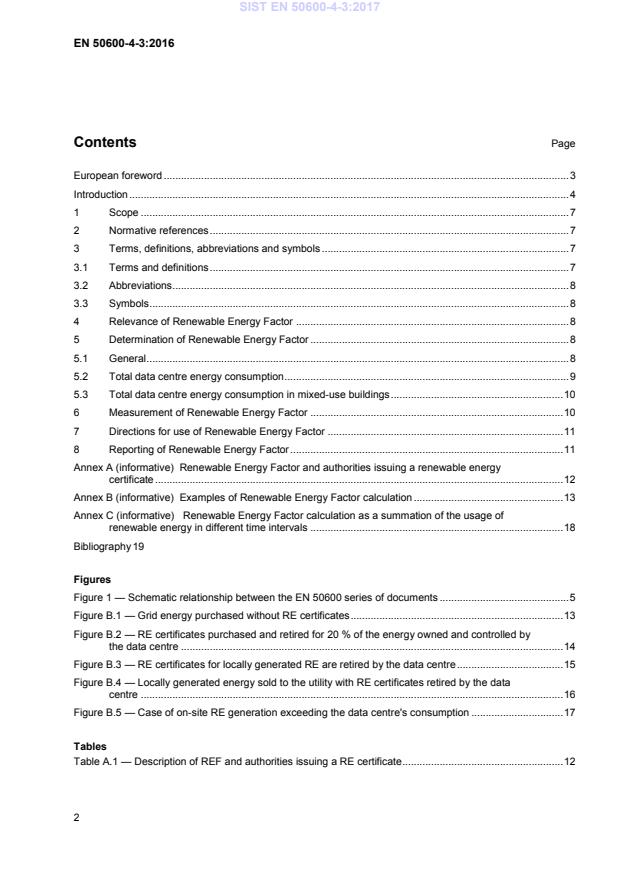
Contents Page European foreword . 3 Introduction . 4 1 Scope . 7 2 Normative references . 7 3 Terms, definitions, abbreviations and symbols . 7 3.1 Terms and definitions . 7 3.2 Abbreviations . 8 3.3 Symbols . 8 4 Relevance of Renewable Energy Factor . 8 5 Determination of Renewable Energy Factor . 8 5.1 General . 8 5.2 Total data centre energy consumption . 9 5.3 Total data centre energy consumption in mixed-use buildings . 10 6 Measurement of Renewable Energy Factor . 10 7 Directions for use of Renewable Energy Factor . 11 8 Reporting of Renewable Energy Factor . 11 Annex A (informative)
Renewable Energy Factor and authorities issuing a renewable energy certificate . 12 Annex B (informative)
Examples of Renewable Energy Factor calculation . 13 Annex C (informative)
Renewable Energy Factor calculation as a summation of the usage of renewable energy in different time intervals . 18 Bibliography 19
Figures Figure 1 — Schematic relationship between the EN 50600 series of documents . 5 Figure B.1 — Grid energy purchased without RE certificates . 13 Figure B.2 — RE certificates purchased and retired for 20 % of the energy owned and controlled by the data centre . 14 Figure B.3 — RE certificates for locally generated RE are retired by the data centre . 15 Figure B.4 — Locally generated energy sold to the utility with RE certificates retired by the data centre . 16 Figure B.5 — Case of on-site RE generation exceeding the data centre's consumption . 17
Tables Table A.1 — Description of REF and authorities issuing a RE certificate . 12
Introduction The unrestricted access to internet-based information demanded by the information society has led to an exponential growth of both internet traffic and the volume of stored/retrieved data. Data centres are housing and supporting the information technology and network telecommunications equipment for data processing, data storage and data transport. They are required both by network operators (delivering those services to customer premises) and by enterprises within those customer premises. Data centres need to provide modular, scalable and flexible facilities and infrastructures to easily accommodate the rapidly changing requirements of the market. In addition, energy consumption of data centres has become critical both from an environmental point of view (reduction of carbon footprint) and with respect to economic considerations (cost of energy) for the data centre operator. The implementation of data centres varies in terms of: a) purpose (enterprise, co-location, co-hosting, or network operator facilities); b) security level; c) physical size; d) accommodation (mobile, temporary and permanent constructions). The needs of data centres also vary in terms of availability of service, the provision of security and the objectives for energy efficiency. These needs and objectives influence the design of data centres in terms of building construction, power distribution, environmental control and physical security. Effective management and operational information is required to monitor achievement of the defined needs and objectives. This series of European Standards specifies requirements and recommendations to support the various parties involved in the design, planning, procurement, integration, installation, operation and maintenance of facilities and infrastructures within data centres. These parties include: 1) owners, facility managers, ICT managers, project managers, main contractors; 2) architects, consultants, building designers and builders, system and installation designers; 3) facility and infrastructure integrators, suppliers of equipment; 4) installers, maintainers. At the time of publication of this European Standard, the EN 50600 series will comprise the following standards and documents: — EN 50600-1, Information technology — Data centre facilities and infrastructures — Part 1: General concepts; — EN 50600-2-1, Information technology — Data centre facilities and infrastructures — Part 2-1: Building construction; — EN 50600-2-2, Information technology — Data centre facilities and infrastructures — Part 2-2: Power distribution; — EN 50600-2-3, Information technology — Data centre facilities and infrastructures — Part 2-3: Environmental control; — EN 50600-2-4, Information technology — Data centre facilities and infrastructures — Part 2-4: Telecommunications cabling infrastructure; SIST EN 50600-4-3:2017
— EN 50600-2-5, Information technology — Data centre facilities and infrastructures — Part 2-5: Security systems; — EN 50600-3-1, Information technology — Data centre facilities and infrastructures — Part 3-1: Management and operational information; — EN 50600-4-1, Information technology — Data centre facilities and infrastructures — Part 4-1: Overview of and general requirements for key performance indicators; — EN 50600-4-2, Information technology — Data centre facilities and infrastructures — Part 4-2: Power Usage Effectiveness; — EN 50600-4-3, Information technology — Data centre facilities and infrastructures — Part 4-3: Renewable Energy Factor; — CLC/TR 50600-99-1, Information technology — Data centre facilities and infrastructures — Part 99-1: Recommended practices for energy management. The inter-relationship of the standards within the EN 50600 series is shown in Figure 1.
Figure 1 — Schematic relationship between the EN 50600 series of documents EN 50600-2-X standards specify requirements and recommendations for particular facilities and infrastructures to support the relevant classification for “availability”, “physical security” and “energy efficiency enablement” selected from EN 50600-1. EN 50600-3-X documents specify requirements and recommendations for data centre operations, processes and management. EN 50600-4-X documents specify requirements and recommendations for key performance indicators (KPIs) used to assess and improve the resource usage efficiency and effectiveness, respectively, of a data centre. In today’s digital society data centre growth, and power consumption in particular, is an inevitable consequence and that growth will demand increasing power consumption despite the most stringent energy efficiency strategies. This makes the need for key performance indicators that cover the effective use of resources (including but not limited to energy) and the reduction of CO2 emissions essential. NOTE 1 Within the EN 50600–4-X series, the term “resource usage effectiveness” is more generally used for KPIs in preference to “resource usage efficiency”, which is restricted to situations where the input and output parameters used to define the KPI have the same units. SIST EN 50600-4-3:2017
In order to enable the optimum resource effectiveness of data centres a suite of effective KPIs is needed to measure and report on resources consumed in order to develop an improvement roadmap. These standards are intended to accelerate the provision of operational infrastructures with improved resource usage effectiveness. This European Standard specifies the Renewable Energy Factor (REF), which provides a quantitative metric for the actual use of renewable energy, in the form of electricity, in a data centre. NOTE 2 This standard adopts the ISO/IEC definition of renewable energy, but defers to the definition that apply within local jurisdiction(s). The use of and the demand for renewable energy becomes increasingly popular since it reduces or replaces the use of non-renewable energy sources. In many countries, legislation promotes the use of renewable energy and gives incentives in order to increase the diversity of energy dependence and improve the social sustainability. In several countries, governments have targets for the use of renewable energy and/or companies have a target for the use of renewable energy among all electricity consumed. The use of renewable energy as one of the sources to power data centre becomes increasingly important as their electricity consumption has risen to a significant share of the total global electricity consumption. This European Standard is intended for use by data centre managers. The use of the Renewable Energy Factor as a key performance indicator allows data centre managers to improve a data centre’s energy procurement portfolio and increase the diversity of energy dependence. Data centre managers can confirm their achievement of the use of renewable energy to their national or corporate targets. Additional standards in the EN 50600-4-X series will be developed, each describing a specific KPI for resource usage effectiveness or efficiency. The EN 50600-4-X series does not specify limits or targets for any KPI and does not describe or imply, unless specifically stated, any form of aggregation of individual KPIs into a combined nor an overall KPI for data centre resource usage effectiveness or efficiency. This series of European Standards does not address the selection of information technology and network telecommunications equipment, software and associated configuration issues. SIST EN 50600-4-3:2017
1 Scope This European Standard: a) defines the Renewable Energy Factor (REF) of a data centre; b) specifies a methodology to calculate and to present the REF; c) provides information on the correct interpretation of the REF. 2 Normative references The following documents, in whole or in part, are normatively referenced in this document and are indispensable for its application. For dated references, only the edition cited applies. For undated references, the latest edition of the referenced document (including any amendments) applies. EN 50600-1, Information technology - Data centre facilities and infrastructures - Part 1: General concepts ISO 8601, Data elements and interchange formats — Information interchange — Representation of dates and times 3 Terms, definitions, abbreviations and symbols 3.1 Terms and definitions For the purposes of this document, the terms and definitions given in EN 50600-1 and the following apply. 3.1.1 renewable energy energy obtained from a renewable energy source Note 1 to en
...