

SIST EN 50174-4:2026
(Main)Information technology - Cabling installation - Part 4: Testing of installed optical fibre cabling
General Information
- Abstract
This document specifies systems and methods for the inspection and testing of installed optical fibre cabling designed in accordance with premises cabling standards including the EN 50173 series. The test methods refer to existing standards-based procedures where they exist.
- Status
- Published
- Public Enquiry End Date
- 16-Oct-2024
- Publication Date
- 07-Jan-2026
- Technical Committee
- ELI - Electrical and communication installations
- Current Stage
- 6060 - National Implementation/Publication (Adopted Project)
- Start Date
- 18-Dec-2025
- Due Date
- 22-Feb-2026
- Completion Date
- 08-Jan-2026


Overview
SIST EN 50174-4:2026: Information technology - Cabling installation - Part 4: Testing of installed optical fibre cabling is a European standard developed by the Slovenian Institute for Standardization (SIST) and CENELEC. It provides comprehensive guidelines for the inspection and testing of installed optical fibre cabling, compliant with structured cabling requirements such as the EN 50173 series. This standard ensures that optical fibre installations meet quality, performance, and reliability requirements through rigorous, standards-based testing and verification methods.
The document outlines test procedures essential for confirming the performance and conformance of optical fibre cabling used in premises networks. It addresses both single-mode and multimode fibre types and establishes the framework for evaluating installed cabling using recognized measurement techniques.
Key Topics
- Scope and Applicability
- Specifies testing methods for installed optical fibre cabling compliant with EN 50173 series and related standards.
- Applicable to structured cabling systems within buildings or campus infrastructures.
- Test Equipment and Methods
- Describes requirements for test tools including light source and power meter (LSPM), optical time domain reflectometer (OTDR), test cords, reference adaptors, and inspection tools.
- Procedures for visual inspection and cleanliness verification of connectors and interfaces.
- Test Procedures
- Standardized procedures for attenuation measurement, continuity verification, polarity tests, and end-to-end performance assessment.
- Requirements for multi-fibre and single-fibre connector testing.
- Use of both LSPM and OTDR for comprehensive characterization of optical link performance.
- Documentation and Quality Assurance
- Emphasizes proper recording and reporting of test results as part of quality control.
- Guidance on acceptance criteria, marginal results, and treatment of non-compliant findings.
- Safety and Reference Standards
- Integrates references to safety standards for laser products and best practices for testing environments.
Applications
SIST EN 50174-4:2026 is intended for all stakeholders involved in the design, installation, operation, and maintenance of optical fibre cabling systems, including:
- Network Designers and Planners
- Ensures the installed cabling meets required performance levels and supports intended IT services.
- Installers and Contractors
- Provides clear methods for verifying the quality of completed installations before handover.
- ICT Facility Managers and Owners
- Supports ongoing operation, performance maintenance, and troubleshooting of fibre infrastructure.
- Auditors and Inspectors
- Delivers standardized procedures for third-party verification and compliance assessment.
By following these procedures, organizations can validate the reliability, performance, and durability of their optical cabling, helping to avoid costly downtime and service disruption.
Related Standards
The testing processes and quality principles outlined in SIST EN 50174-4:2026 are closely integrated with these European and international standards:
- EN 50173 Series – Generic cabling for customer premises (design, implementation, and operation)
- EN 50174-1, -2, -3 – Installation specification, inside and outside plant installation practices, and quality assurance
- EN IEC 61280-4-1 & EN IEC 61280-4-5 – Fibre-optic test procedures for attenuation measurement in multimode and MPO cabling
- EN 61300-3-35 – Visual inspection standards for fibre optic connectors
- EN 60825-2 – Laser safety for optical fibre communication systems
- EN 50310 – Bonding and grounding requirements for IT cabling
SIST EN 50174-4:2026 provides essential guidance for high-performance fibre cabling infrastructure, supporting robust, future-ready information technology networks across commercial and industrial environments. Implementing these standardized testing practices ensures reliable, high-speed connectivity and supports compliance with European cabling norms.
Relations
- Effective Date
- 02-Jun-2026
- Effective Date
- 09-Feb-2026
- Effective Date
- 03-Feb-2026
- Effective Date
- 03-Feb-2026
- Effective Date
- 03-Feb-2026
- Effective Date
- 03-Feb-2026
- Effective Date
- 03-Feb-2026
- Effective Date
- 03-Feb-2026
- Effective Date
- 03-Feb-2026
- Effective Date
- 03-Feb-2026
- Effective Date
- 03-Feb-2026
- Effective Date
- 03-Feb-2026
- Effective Date
- 03-Feb-2026
- Effective Date
- 03-Feb-2026
- Effective Date
- 03-Feb-2026
Get Certified
Connect with accredited certification bodies for this standard

BSI Group
BSI (British Standards Institution) is the business standards company that helps organizations make excellence a habit.

NYCE
Mexican standards and certification body.

ANCE
Mexican certification and testing association.
Sponsored listings
Frequently Asked Questions
SIST EN 50174-4:2026 is a standard published by the Slovenian Institute for Standardization (SIST). Its full title is "Information technology - Cabling installation - Part 4: Testing of installed optical fibre cabling". This standard covers: This document specifies systems and methods for the inspection and testing of installed optical fibre cabling designed in accordance with premises cabling standards including the EN 50173 series. The test methods refer to existing standards-based procedures where they exist.
This document specifies systems and methods for the inspection and testing of installed optical fibre cabling designed in accordance with premises cabling standards including the EN 50173 series. The test methods refer to existing standards-based procedures where they exist.
SIST EN 50174-4:2026 is classified under the following ICS (International Classification for Standards) categories: 33.040.50 - Lines, connections and circuits; 35.110 - Networking. The ICS classification helps identify the subject area and facilitates finding related standards.
SIST EN 50174-4:2026 has the following relationships with other standards: It is inter standard links to SIST EN IEC 60825-2:2026, SIST EN 1964-1:1999, SIST EN 61755-3-31:2016, SIST EN 50173-1:2003, SIST EN IEC 61755-3-2:2024, SIST EN 61755-2-4:2015, SIST EN IEC 61280-4-5:2020, SIST EN 60825-2:2005, SIST EN IEC 61755-3-1:2024, SIST EN 61755-2-5:2015, SIST EN IEC 62614-1:2020, SIST EN IEC 61280-4-1:2019, SIST EN IEC 61300-3-35:2023, SIST EN IEC 61280-1-4:2023, SIST EN 61300-3-42:2008. Understanding these relationships helps ensure you are using the most current and applicable version of the standard.
SIST EN 50174-4:2026 is available in PDF format for immediate download after purchase. The document can be added to your cart and obtained through the secure checkout process. Digital delivery ensures instant access to the complete standard document.
Standards Content (Sample)
SLOVENSKI STANDARD
01-februar-2026
Informacijska tehnologija - Kabelska inštalacija - 4. del: Preskušanje vgrajenih
optičnih kablov
Information technology - Cabling installation - Part 4: Testing of installed optical fibre
cabling
Informationstechnik - Installation von Kommunikationsverkabelung - Teil 4: Messung von
installierter Lichtwellenleiterverkabelung
Technologies de l’information - Installation de câblage - Partie 4: Essais d’une installation
de câblage à fibres optiques
Ta slovenski standard je istoveten z: EN 50174-4:2025
ICS:
33.040.50 Vodi, zveze in tokokrogi Lines, connections and
circuits
35.110 Omreževanje Networking
2003-01.Slovenski inštitut za standardizacijo. Razmnoževanje celote ali delov tega standarda ni dovoljeno.
EUROPEAN STANDARD EN 50174-4
NORME EUROPÉENNE
EUROPÄISCHE NORM December 2025
ICS 35.110
English Version
Information technology - Cabling installation - Part 4: Testing of
installed optical fibre cabling
Technologies de l'information - Installation de câblage - Informationstechnik - Installation von
Partie 4: Essais d'une installation de câblage à fibres Kommunikationsverkabelung - Teil 4: Messung von
optiques installierter Lichtwellenleiterverkabelung
This European Standard was approved by CENELEC on 2025-12-01. CENELEC members are bound to comply with the CEN/CENELEC
Internal Regulations which stipulate the conditions for giving this European Standard the status of a national standard without any alteration.
Up-to-date lists and bibliographical references concerning such national standards may be obtained on application to the CEN-CENELEC
Management Centre or to any CENELEC member.
This European Standard exists in three official versions (English, French, German). A version in any other language made by translation
under the responsibility of a CENELEC member into its own language and notified to the CEN-CENELEC Management Centre has the
same status as the official versions.
CENELEC members are the national electrotechnical committees of Austria, Belgium, Bulgaria, Croatia, Cyprus, the Czech Republic,
Denmark, Estonia, Finland, France, Germany, Greece, Hungary, Iceland, Ireland, Italy, Latvia, Lithuania, Luxembourg, Malta, the
Netherlands, Norway, Poland, Portugal, Republic of North Macedonia, Romania, Serbia, Slovakia, Slovenia, Spain, Sweden, Switzerland,
Türkiye and the United Kingdom.
European Committee for Electrotechnical Standardization
Comité Européen de Normalisation Electrotechnique
Europäisches Komitee für Elektrotechnische Normung
CEN-CENELEC Management Centre: Rue de la Science 23, B-1040 Brussels
© 2025 CENELEC All rights of exploitation in any form and by any means reserved worldwide for CENELEC Members.
Ref. No. EN 50174-4:2025 E
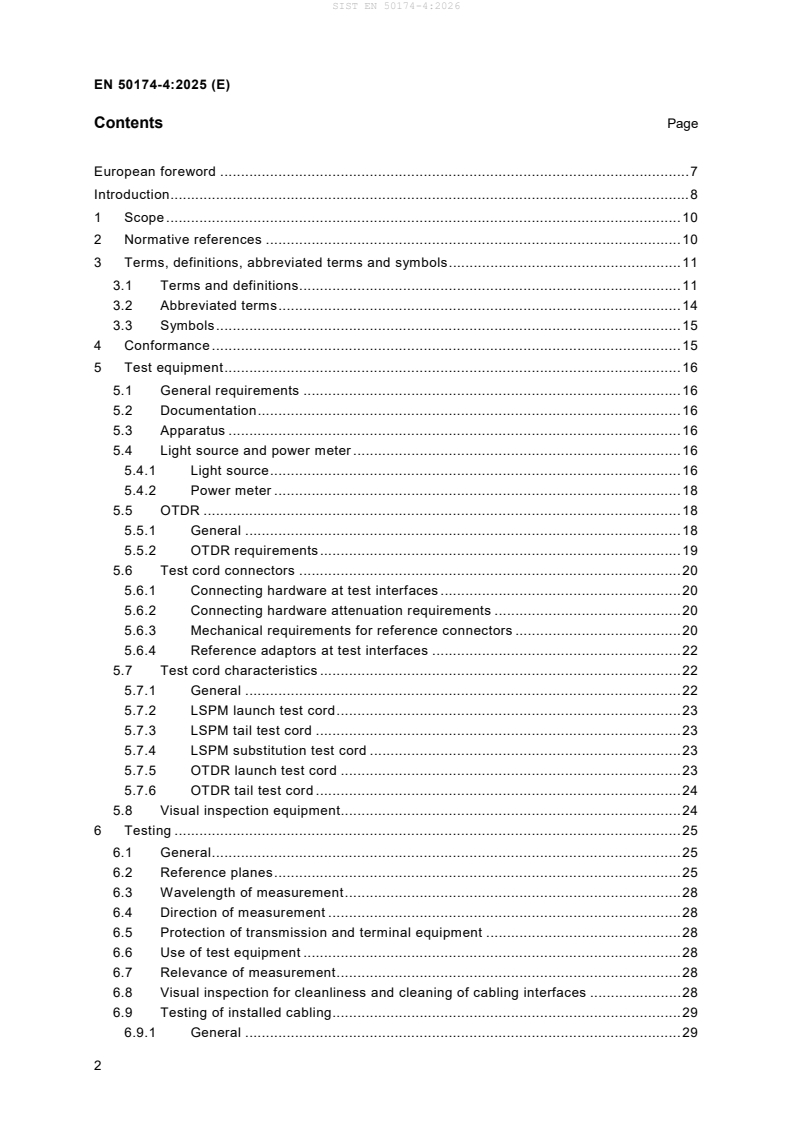
Contents Page
European foreword . 7
Introduction . 8
1 Scope . 10
2 Normative references . 10
3 Terms, definitions, abbreviated terms and symbols . 11
3.1 Terms and definitions . 11
3.2 Abbreviated terms . 14
3.3 Symbols . 15
4 Conformance . 15
5 Test equipment . 16
5.1 General requirements . 16
5.2 Documentation . 16
5.3 Apparatus . 16
5.4 Light source and power meter . 16
5.4.1 Light source . 16
5.4.2 Power meter . 18
5.5 OTDR . 18
5.5.1 General . 18
5.5.2 OTDR requirements . 19
5.6 Test cord connectors . 20
5.6.1 Connecting hardware at test interfaces . 20
5.6.2 Connecting hardware attenuation requirements . 20
5.6.3 Mechanical requirements for reference connectors . 20
5.6.4 Reference adaptors at test interfaces . 22
5.7 Test cord characteristics . 22
5.7.1 General . 22
5.7.2 LSPM launch test cord . 23
5.7.3 LSPM tail test cord . 23
5.7.4 LSPM substitution test cord . 23
5.7.5 OTDR launch test cord . 23
5.7.6 OTDR tail test cord . 24
5.8 Visual inspection equipment. 24
6 Testing . 25
6.1 General . 25
6.2 Reference planes . 25
6.3 Wavelength of measurement . 28
6.4 Direction of measurement . 28
6.5 Protection of transmission and terminal equipment . 28
6.6 Use of test equipment . 28
6.7 Relevance of measurement . 28
6.8 Visual inspection for cleanliness and cleaning of cabling interfaces . 28
6.9 Testing of installed cabling . 29
6.9.1 General . 29
6.9.2 Attenuation of single fibre connector cabling – LSPM . 29
6.9.3 Attenuation of multi-fibre connector cabling – LSPM . 41
6.9.4 Attenuation of link and channel by means of OTDR testing . 51
6.9.5 Propagation delay . 55
6.9.6 Length . 55
6.9.7 Optical fibre continuity . 57
6.9.8 Cabling polarity . 57
6.9.9 Optical fibre core size . 57
7 Performance assessment of installed cabling components using OTDR . 57
7.1 General . 57
7.2 OTDR basis . 57
7.3 Fundamental parameters that define the operational capability of an OTDR . 58
7.3.1 Dynamic range . 58
7.3.2 Dynamic margin . 58
7.3.3 Pulse width . 59
7.3.4 Averaging time . 59
7.3.5 Dead zone . 59
7.3.6 Group index . 59
7.3.7 Measurement range . 59
7.3.8 Distance sampling . 60
7.3.9 Event threshold . 60
7.4 Bi-directional measurement . 60
7.5 Attenuation of optical fibre cable . 60
7.5.1 Test method . 60
7.5.2 Treatment of results . 61
7.6 Attenuation of local and remote test interfaces . 62
7.6.1 Test method . 62
7.6.2 Test system measurement uncertainties . 63
7.6.3 Treatment of results . 63
7.7 Attenuation of connecting hardware . 63
7.7.1 Test method . 63
7.7.2 Test system measurement uncertainties . 64
7.7.3 Treatment of results . 64
7.8 Return loss of connecting hardware . 65
7.8.1 General . 65
7.8.2 Test method . 65
7.8.3 Test system measurement uncertainties . 66
7.8.4 Treatment of results . 66
7.9 Optical fibre length . 67
7.9.1 Test method . 67
7.9.2 Measurement uncertainties . 69
7.9.3 Treatment of results . 69
8 Test result documentation . 69
Annex A (normative) Test cord attenuation verification . 71
A.1 General requirements . 71
A.2 Attenuation (test and substitution test cord reference connections) . 71
Annex B (informative) Quality planning . 73
B.1 General . 73
B.2 Specification of cabling components . 74
B.3 Treatment of non-compliant results . 74
Annex C (informative) Examples of calculations of channel and permanent link limits . 75
C.1 Channel measurement . 75
C.2 Permanent link measurement . 75
Annex D (informative) Optional inspection of polished end face of test connectors. 77
Annex E (normative) Cleaning of connectors. 78
E.1 General . 78
E.2 Cleaning procedure for LC multimode cabling interface . 78
E.3 Cleaning procedure for the LC single-mode cabling interfaces . 80
E.4 Cleaning procedure for the LC/APC single-mode cabling interfaces . 80
E.5 Cleaning procedure for single-mode (SM) MPO APC cabling interface. 81
Annex F (normative) MPO to MPO link or permanent link – enhanced-three-test-cord
method LSPM . 83
F.1 General . 83
F.2 Requirements for the test system . 83
F.3 Test method . 83
F.4 Measurement uncertainties . 85
F.5 Treatment of results . 85
Bibliography . 87
Table of Figures
Figure 1 — Schematic relationship between the EN 50174 series and other relevant
standards . 9
Figure 2 — OTDR characterization using a launch test cord and a tail test cord . 19
Figure 3 — An example of test cord labelling and identification . 23
Figure 4 — OTDR launch test cord and tail test cord schematic . 24
Figure 5 — Normal illumination (left) and illumination with floodlight (right) . 25
Figure 6 — Representative reference planes for channels, links, permanent links, E2E
links, MPTL . 26
Figure 7 — Test reference planes . 27
Figure 8 — Fibre end face cleaning cycle . 29
Figure 9 — Connection of LS to LTC to PM for reference setting . 31
Figure 10 — Connection of LTC to TTC to verify attenuation of reference connectors . 31
Figure 11 — Connections to link or permanent link for attenuation measurement . 32
Figure 12 — Connection of LS to LTC to PM for reference setting . 34
Figure 13 — Connection of LTC to TTC to verify attenuation of reference connectors . 34
Figure 14 — Connections to E2E link for attenuation measurement . 35
Figure 15 — Connection of LS to LTC to near end EQP cord to PM for reference setting
...................................................................................................................................... 37
Figure 16 — Connections to channel test for attenuation measurement . 37
Figure 17 — Connection of LS – LTC – PM for reference setting. 39
Figure 18 — Connection of LTC to TTC to verify attenuation of reference connectors . 39
Figure 19 — Connections to MPTL for attenuation measurement . 40
Figure 20 — Connection of LS to LTC to PM for reference setting . 42
Figure 21 — Connection of LTC to TTC for test‐cord verification . 42
Figure 22 — Connections to link or permanent link attenuation . 43
Figure 23 — Connection of LS to LTC to PM for reference setting . 45
Figure 24 — Connection of LTC-PCTC-TTC to verify the attenuation of reference
connectors . 45
Figure 25 — Connections to E2E link for attenuation measurement . 46
Figure 26 — Connection of LS to LTC to PM for reference setting . 48
Figure 27 — Connection of LTC to TTC for test‐cord verification . 48
Figure 28 — Connection of LTC to PCTC to TTC for enhanced-three‐test‐cord
verification . 48
Figure 29 — MPO to single fibre link attenuation testing where no pin conversion is
required on launch test cord . 49
Figure 30 — MPO to single fibre link attenuation testing where pin conversion is required
on LTC . 50
Figure 31 — OTDR measurement of installed cabling (permanent link) – linear
regression measurement method . 53
Figure 32 — OTDR measurement of installed cabling (channel): two-point attenuation
measurement method . 54
Figure 33 — OTDR measurement of optical fibre attenuation . 62
Figure 34 — OTDR measurement of connection attenuation . 63
Figure 35 — OTDR measurement of joint attenuation . 65
Figure 36 — OTDR measurement of return loss . 66
Figure 37 — Determination of length using an OTDR . 68
Figure 38 — OTDR characterization of a SMF permanent link containing a break . 68
Figure 39 — OTDR characterization of a permanent link containing a macrobend . 69
Figure A.1 — Measurement of launch test cord, tail test cord and substitution test cord
interface attenuation . 71
Figure E.1 — Example of multimode LC channel interface . 78
Figure E.2 — Example of multimode LC link interface . 78
Figure E.3 — Example of MPO channel interface . 79
Figure E.4 — Example of MPO link interface . 79
Figure E.5 — Example of MPO ferrule with normal illumination (left) and side illumination
(right) . 80
Figure E.6 — Example of single-mode LC channel interface . 80
Figure E.7 — Example of single-mode LC link interface . 80
Figure E.8 — Example of single-mode LC/APC channel interface . 81
Figure E.9 — Example of single-mode LC/APC link interface . 81
Figure E.10 — Example of SM MPO APC channel interface . 82
Figure E.11 — Example of SM MPO/APC link interface . 82
Figure F.1 — Connection of LS to LTC to PM for reference setting . 84
Figure F.2 — Connection of LTC to STC to TTC for enhanced-three‐test‐cord verification
...................................................................................................................................... 84
Figure F.3 — Connections to link or permanent link for attenuation measurement where
no pin conversion is required on test cords . 84
Table of Tables
Table 1 — Contextual relationship between EN 50174 series and other standards
relevant for information technology cabling systems . 9
Table 2 — MMF spectral requirements . 18
Table 3 — SMF spectral requirements . 18
Table 4 — Connector identification and attenuation test limits . 20
Table 5 — Single fibre MM reference connector requirements . 21
Table 6 — Single fibre single-mode reference connector requirements . 21
Table 7 — Multi-fibre MM reference connector requirements . 21
Table 8 — Multi-fibre single-mode reference connector requirements . 22
Table 9 — Default group index values . 59
Table 10 — Default backscattering coefficient values. 67
Table D.1 — Cladding zone requirements of reference connectors . 77
Table D.2 — Core zone requirements of reference connectors . 77
European foreword
This document (EN 50174-4:2025) has been prepared by Technical Committee CLC/TC 215,
“Electrotechnical aspects of telecommunication equipment”. It is based on ISO/IEC 14763-3:2024.
The following dates are fixed:
• latest date by which this document has to be (dop) 2026-12-31
implemented at national level by publication of
an identical national standard or by
endorsement
• latest date by which the national standards (dow) 2028-12-31
conflicting with this document have to be
withdrawn
EN 50174 comprises four parts. All for parts support the specification, implementation, operation and
qualification of information technology cabling. There are specific requirements for cabling systems that
are in accordance with the design requirements of the EN 50173 series. However, the three parts also
apply to cabling systems of any design including those in accordance with standards such as EN 50700.
This part, EN 50174-4, is concerned with the measurement and visual inspection of installed optical fibre
cabling.
Attention is drawn to the possibility that some of the elements of this document may be the subject of
patent rights. CENELEC shall not be held responsible for identifying any or all such patent rights.
This document has been prepared under a standardization request addressed to CENELEC by the
European Commission. The Standing Committee of the EFTA States subsequently approves these
requests for its Member States.
Introduction
The importance of services delivered by information technology cabling infrastructure is similar to that
of utilities such as heating, lighting and electricity supplies. As with those utilities, interruptions to service
can have a serious impact. Poor quality of service due to lack of planning, use of inappropriate
components, incorrect installation, poor administration or inadequate support can threaten an
organization’s effectiveness.
There are four phases in the successful implementation of information technology cabling. These are:
a) design;
b) specification – the detailed requirement for the cabling, including the planning of its accommodation
and associated building services addressing specific environments (e.g. electromagnetic) together
with the quality assurance requirements to be applied;
c) installation – in accordance with the requirements of the specification;
d) operation – the management of connectivity and the maintenance of transmission performance
during the life of the cabling.
This European Standard is in four parts and addresses the specification, installation, operational aspects
and measurement of installed cabling. The EN 50173 series and other application standards cover
design issues.
This document details the inspection and test procedures for optical fibre cabling designed in
accordance with premises cabling standards including the EN 50173 series and installed in accordance
with the requirements and recommendations of EN 50174-2 and EN 50174-3. This document has been
prepared in support of EN 50173 series.
Users of this document should be familiar with relevant premises cabling standards and the other
documents of the EN 50174 series.
EN 50174-1 is used during the specification phase. EN 50174-2 and EN 50174-3 are intended to be
used by the personnel directly involved in the planning aspects (of the specification phase) and
installation phase. EN 50174-2 is applicable inside buildings and EN 50174-3 is applicable outside
buildings.
This European Standard is also relevant to:
— main contractors;
— designers, suppliers, installers, inspectors (auditors), maintainers and owners of information
technology cabling;
— end users.
Figure 1 and Table 1 show the schematic and contextual relationships between the standards produced
by CLC/TC 215 for information technology cabling, namely:
1) this and other parts of the EN 50174 series;
2) generic cabling design (EN 50173 series);
3) application dependent cabling design (e.g. EN 50700);
4) bonding requirements (EN 50310).
Figure 1 — Schematic relationship between the EN 50174 series and other relevant standards
Table 1 — Contextual relationship between EN 50174 series and other standards relevant for
information technology cabling systems
Building design Generic cabling Specification Installation Operation phase
phase design phase phase phase
EN 50173-2 EN 50174-1
EN 50173-3
EN 50173-4 EN 50174-2
EN 50173-5 EN 50174-3
EN 50310 EN 50174-4 EN 50174-1
EN 50173-6
EN 50173-20 EN 50310
(these ENs EN 50697
reference general
requirements of
EN 50173-1)
The quality plan for each installation will define the acceptance tests and sampling levels selected for
that installation. Requirements and recommendations for the development of a quality plan are given in
EN 50174-1.
1 Scope
This document specifies systems and methods for the inspection and testing of installed optical fibre
cabling designed in accordance with premises cabling standards including the EN 50173 series. The
test methods refer to existing standards-based procedures where they exist.
2 Normative references
The following documents are referred to in the text in such a way that some or all of their content
constitutes requirements of this document. For dated references, only the edition cited applies. For
undated references, the latest edition of the referenced document (including any amendments) applies.
EN 50173-1, Information technology - Generic cabling systems - Part 1: General requirements
EN 50174-1, Information technology - Cabling installation - Part 1: Installation specification and quality
assurance
EN 60825-2, Safety of laser products - Part 2: Safety of optical fibre communication systems (OFCS)
(IEC 60825-2)
EN IEC 61280-1-3, Fibre optic communication subsystem test procedures - Part 1-3: General
communication subsystems - Measurement of central wavelength, spectral width and additional spectral
characteristics (IEC 61280-1-3)
EN IEC 61280-1-4, Fibre optic communication subsystem test procedures - Part 1-4: General
communication subsystems - Light source encircled flux measurement method (IEC 61280-1-4)
EN IEC 61280-4-1, Fibre-optic communication subsystem test procedures - Part 4-1: Installed cabling
plant - Multimode attenuation measurement (IEC 61280-4-1)
EN IEC 61280-4-5, Fibre-optic communication subsystem test procedures - Part 4-5: Installed cabling
plant - Attenuation measurement of MPO terminated fibre optic cabling plant using test equipment with
MPO interfaces (IEC 61280-4-5)
EN IEC 61300-3-35, Fibre optic interconnecting devices and passive components - Basic test and
measurement procedures - Part 3-35: Examinations and measurements - Visual inspection of fibre optic
connectors and fibre-stub transceivers (IEC 61300-3-35)
EN 61300-3-42, Fibre optic interconnecting devices and passive components - Basic test and
measurement procedures - Part 3-42: Examinations and measurements - Attenuation of single mode
alignment sleeves and or adaptors with resilient alignment sleeves (IEC 61300-3-42)
EN 61755-2-4, Fibre optic interconnecting devices and passive components - Connector optical
interfaces - Part 2-4: Connection parameters of non-dispersion shifted single-mode physically contacting
fibres - Non-angled for reference connection applications (IEC 61755-2-4)
EN 61755-2-5, Fibre optic interconnecting devices and passive components - Connector optical
interfaces - Part 2-5: Connection parameters of non-dispersion shifted single-mode physically contacting
fibres - Angled for reference connection applications (IEC 61755-2-5)
EN IEC 61755-3-1, Fibre optic connector optical interfaces - Part 3-1: Optical interface, 2,5 mm and 1,25
mm diameter cylindrical full zirconia PC ferrule, single mode fibre (IEC 61755-3-1)
EN IEC 61755-3-2, Fibre optic connector optical interfaces - Part 3-2: Optical interface, 2,5 mm and 1,25
mm diameter cylindrical full zirconia ferrules for 8 degrees angled-PC single mode fibres
(IEC 61755-3-2)
EN 61755-3-31, Fibre optic interconnecting devices and passive components - Connector optical
interfaces - Part 3-31: Connector parameters of non-dispersion shifted single mode physically contacting
fibres - Angled polyphenylene sulphide rectangular ferrules (IEC 61755-3-31)
EN IEC 62614-1, Fibre optics - Multimode launch conditions - Part 1: Launch condition requirements for
measuring multimode attenuation
IEC 60050-731, International Electrotechnical Vocabulary (IEV) - Part 731: Optical fibre communication)
IEC/TR 61282-14, Fibre optic communication system design guidelines - Part 14: Determination of the
uncertainties of attenuation measurements in fibre plants
IEC PAS 63267-3-31, Fibre optic interconnecting devices and passive components – Fibre optic
connector optical interfaces – Part 3-31: End face geometry – Flat PC PPS rectangular ferrule multimode
fibres
3 Terms, definitions, abbreviated terms and symbols
3.1 Terms and definitions
For the purposes of this document, the terms and definitions given in EN 50173-1, IEC 60050-731 and
the following apply.
ISO and IEC maintain terminology databases for use in standardization at the following addresses:
• IEC Electropedia: available at https://www.electropedia.org/
• ISO Online browsing platform: available at https://www.iso.org/obp
3.1.1
adaptor
device that enables interconnection between terminated optical fibre cables
3.1.2
attenuation
A
reduction in optical power induced by transmission through a medium such as optical fibre, given as
A = −10 log (P /P ), where P and P are the power, typically measured in mW, into and out of
out in in out
the cabling
Note 1 to entry: The values of A are in decibel (dB).
3.1.3
attenuation dead zone
region on an OTDR after the event where the displaced trace
deviates from the undisturbed backscatter trace by more than a given vertical distance ΔF
Note 1 to entry: ΔF is commonly accepted to be a value of 0,5 dB
[SOURCE: EN 61746-1:2011, and EN 61746-2:2011, 3.3, modified – The note has been changed and
Figure 1 has not been included.]
3.1.4
bi-directional measurement
technique consisting of two measurements of the same optical fibre, made by launching light into
opposite ends of that fibre
3.1.5
cable sheath
covering over the optical fibre or conductor assembly that can include one or more metallic members,
strength members or jackets
Note 1 to entry: Sometimes simply referred to as “sheath”.
3.1.6
connection
mated device including terminations connecting two cables or cable elements
3.1.7
encircled flux
fraction of cumulative near-field power to the total output power as a function of radial distance from the
optical centre of the core
3.1.8
fail result
measured value which fails to meet the specified requirement and where the absolute value of the
difference between the measured value and the specified requirement is greater than the stated
measurement uncertainty
3.1.9
launch test cord
cable assembly used to connect from a light source to the cabling under test or as part of a test reference
measurement
3.1.10
light source and power meter
test system consisting of a light source (LS), power meter (PM) and associated test cords used to
measure the attenuation of installed cable plant
3.1.11
marginal result
measured value which differs from the specified requirement by an amount not exceeding the stated
measurement uncertainty
3.1.12
multimode fibre
optical fibre along whose core the radiation of two or more bound modes can propagate at the
wavelength of interest
Note 1 to entry: A typical multimode fibre propagates 100 modes or more.
[SOURCE: IEC 60050-731:1991, 731-02-03, modified – The definition has been slightly changed and
Note 1 to entry added.]
3.1.13
optical fibre
waveguide shaped as a filament, made of dielectric materials for guiding optical waves
[SOURCE: IEC 60050-151:2001/AMD3:2019, 151-12-35]
3.1.14
optical time domain reflectometer
OTDR
test system consisting of an optical time-domain reflectometer and associated test cords used to
characterize and measure the attenuation of installed cable plant and specific elements within that cable
plan
3.1.15
pass result
measured value which meets the specified requirements and where the absolute value of the difference
between the measured value and the specified requirement is greater than the stated measurement
uncertainty, provided any apparent gain does not exceed the measurement uncertainty
3.1.16
pin conversion test cord
PCTC
cord used to change the mated connector from pinned to unpinned, and vice versa when there is a
pinning incompatibility between the launch test cord and link under test
3.1.17
reference adaptor
adaptor with tighter tolerances (single-mode adapters), to ensure reference connections can be attained
3.1.18
reference connector
connector with tightened tolerances terminated onto an optical fibre that can require tightened tolerances
such that the expected attenuation formed by mating two such assemblies is less than or equal to a
specified value that is lower than the normal expected attenuation
3.1.19
reference measurement
measurement of the output power of the light source that is used to determine the input power level to
the cabling under test
3.1.20
reference plane
theoretical plane without thickness or tolerances
Note 1 to entry: The reference plane is used to define spaces in mechanical structures.
[SOURCE: IEC 60050-581:2008, 581-25-30]
3.1.21
single-mode fibre
optical fibre which supports only one mode of light transmission
3.1.22
substitution test cord
test cord used within a reference measurement which is replaced during the measurement of the
attenuation of the cabling under test
3.1.23
tail test cord
cable assembly used to connect from a power meter to the cabling under test or as part of a test
reference measurement
3.1.24
test cord
cable assembly used either to connect test equipment to the cabling under test or as part of a test
reference measurement
3.1.25
test operator
skilled person who tests in accordance with instructions provided by the test system designer
3.1.26
test system
test equipment, test cords and adaptors necessary to undertake a given test in accordance with the
requirements of this document
3.1.27
defect
surface feature such as pits, scratch, chips and loose debris
3.1.28
loose debris
particles and debris on the surface that can be removed by cleaning
3.1.29
pit
permanent non-linear surface damage
3.1.30
scratch
permanent linear surface damage
3.2 Abbreviated terms
For the purposes of this document, the abbreviated terms of EN 50173-1 and the following apply.
APC angled physical contact
BIMMF bend insensitive multimode fibre referred to as enhanced macrobend loss fibre
CP consolidation point
DUT device under test
EQP equipment
E2E end-to-end
EC equipment cord
ffs for further study
IOR index of refraction
LC LC connector
LTC launch test cord
LS light source
LSPM light source power meter
MF multi fibre
MM multimode
MMF multimode fibre
MPO multi-fibre push on (based on rectangular ferrule)
MPTL modular plug terminated link
N/A not applicable
OTDR optical time domain reflectometer
PC physical contact
PCTC pin conversion test cord
PM power meter
RL return loss
RMS root mean square
SC subscriber connector
SF single fibre
SFC single fibre connector
SM single-mode
SMF single-mode fibre
STC substitution test cord
TTC tail test cord
VCSEL Vertical cavity surface emitting laser
3.3 Symbols
For the purposes of this document the following symbols apply.
Optical fibre connector (general)
Optical fibre connector on installed cabling
Optical fibre connector with reference termination
Optical fibre adaptor (general)
Optical fibre adaptor embedded in cabling
Optical fibre reference adaptor
Splice
4 Conformance
To test installed cabling in accordance with this document:
a) the reference connectors shall conform to the requirements of 5.6;
b) the requirements of Clause 6 shall be met;
c) the test equipment and test cords shall conform to the requirements of Clause 5;
d) the test method, as appropriate, and treatment of results shall conform to Clauses 6 and 7;
e) information about the test equipment shall be documented in accordance with 5.2;
f) the test results shall be documented in accordance with Clause 6 and Clause 8.
To inspect installed cabling in accordance with this document:
1) the inspection equipment shall conform to the requirements of 5.8;
2) the inspection method, as appropriate, shall conform to 6.8.
This document does not specify which test or sampling level is to be adopted as this is specified in the
quality plan (see Annex B) meeting the requirements of EN 50174-1. This document does define the
test method and equipment to be utilized for specific tests.
Laser safety is outside the scope of this document, and is covered by other standards and by regulations.
However, information given by this document can be of assistance.
5 Test equipment
5.1 General requirements
The test equipment and particularly the adaptors, test cords terminated with reference connectors and
reference connectors, affect the uncertainty of the attenuation measurement for a given component, link
or channel.
The test equipment shall be calibrated using standardized procedures (e.g. EN IEC 61315 for optical
power meter and EN 61746 series for OTDR), or tester manufacturer's documented procedures, as
appropriate.
The test operator shall have evidence, in the form of a valid calibration certificate, to support the use of
the test equipment at the time the tests are carried out.
Index matching materials (gels or fluids) between the polished end faces of connectors shall not be
used.
5.2 Documentation
Test equipment used for conformance testing should include apparatus specific documentation,
certificates of compliance to specific standards (i.e. encircled flux), test cord test data, and the factory
calibration date.
5.3 Apparatus
Apparatus requirements apply to single-fibre and multi-fibre LSPM and OTDR devices. An LSPM uses
a light source and power meter at each end of the fibre cabling. An OTDR makes a measurement single-
ended, from either fib
...