

SIST EN 14488-7:2006
(Main)Testing sprayed concrete - Part 7: Fibre content of fibre reinforced concrete
- Abstract
This part of European Standard specifies a method for the determination of the fibre content of sprayed concrete from either a fresh or hardened (i.e. before or after set) concrete sample. Only the method using a fresh sample is appropriate with polymer fibres, while both types are applicable with steel fibres.
- Status
- Published
- Publication Date
- 30-Sep-2006
- Technical Committee
- BBB - Concrete, reinforced concrete and prestressed concrete
- Current Stage
- 6060 - National Implementation/Publication (Adopted Project)
- Start Date
- 01-Oct-2006
- Due Date
- 01-Oct-2006
- Completion Date
- 01-Oct-2006

SIST EN 14488-7:2006 is the Slovenian standard identical to EN 14488-7:2006, published by SIST. It specifies a method for determining the fibre content of sprayed concrete from either a fresh or a hardened sample, so it is used when a project needs a measured fibre content rather than a nominal mix value.
The standard covers both steel fibres and polymer fibres, but the fresh-sample method is the one applicable to polymer fibres. In practice, that means the user must choose the sampling route that matches the fibre type and the stage of the concrete.
What does SIST EN 14488-7:2006 specify?
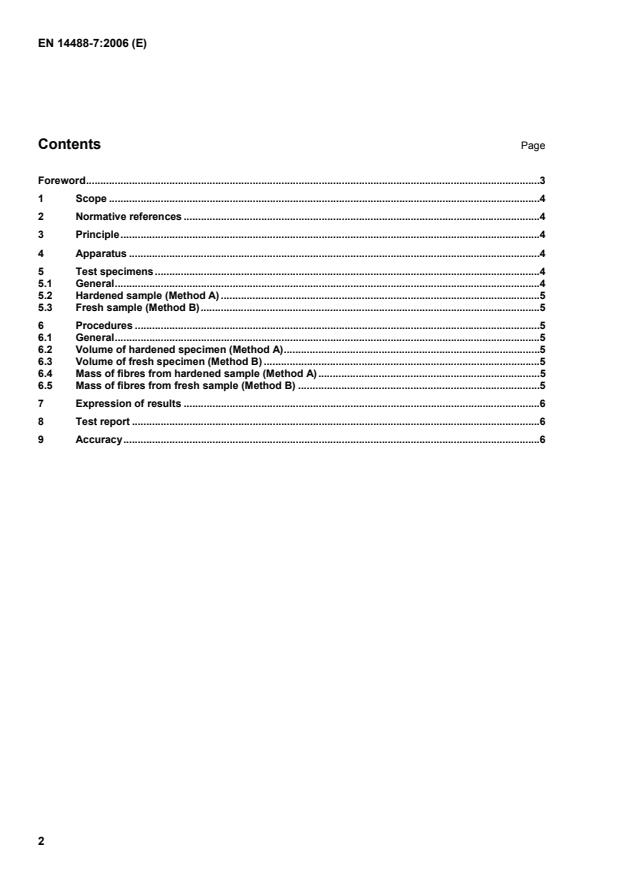
SIST EN 14488-7:2006 specifies how to determine fibre content in sprayed concrete from either fresh concrete or concrete that has already set. It is organized into clauses 1 to 9, covering scope, references, principle, apparatus, test specimens, procedures, expression of results, test report, and accuracy.
The standard is focused on one measurement: how much fibre is present in a sampled piece of sprayed concrete. That matters because sprayed concrete can vary with depth and location, so the sample has to match the quality-control purpose.
What are the key requirements of SIST EN 14488-7:2006?
Clause 1 limits the method to sprayed concrete and distinguishes between fresh and hardened samples. It also states that the fresh-sample method is appropriate for polymer fibres, while both methods can be used for steel fibres. For practice, this means the fibre type affects which sampling route is valid.
Clause 3 sets out the principle: fibres are extracted from the sample, then fibre content is determined from fibre mass and sample volume. The reader therefore needs both a reliable volume measurement and a clean fibre mass measurement.
Clause 5 gives the specimen rules. Fresh samples may come from the basic mix, in situ material, or a test panel, while hardened samples may come from in situ material or a test panel. The standard also notes that fibre content may vary with location because of the spraying process, so the sampling location must match the purpose of the test.
Clause 5.2 requires three hardened test cores and ties their preparation to EN 14488-1 and EN 12504-1. Clause 5.3 requires three fresh test coupons and says they should be cut so that they represent the full depth of the sprayed layer where possible. In practice, this means the result should reflect the material as placed, not just a convenient sample.
Clause 6 gives two routes for measuring volume. Hardened specimens can be measured by actual dimensions or by weighing in water, and fresh coupons are measured by the weighing-in-water method. The standard therefore links the fibre-content result to density-style measurements, which means careful handling and correct immersion practice matter.
Clause 6.4 and 6.5 describe fibre recovery. Hardened specimens are crushed so the fibres can be separated, then cleaned and weighed; fresh specimens are washed so the cement and fine material can be removed. The method and weighing resolution depend on fibre type, so the lab has to distinguish steel fibres from polymer fibres before reporting.
Clause 7 gives the calculation of fibre content from fibre mass and specimen volume, and Clause 8 requires the report to identify the specimen, fibre type, method used, specimen mass, fibre mass, calculated fibre content, average value, standard deviation, and any deviation from the standard. In practice, the report must support both traceability and comparison with specification limits.
What terms does SIST EN 14488-7:2006 define?
- Method A - the procedure for a hardened sample, used when the concrete has already set and the fibres are recovered after crushing the specimen.
- Method B - the procedure for a fresh sample, used when the sprayed concrete has not reached final set and the fibres are recovered by washing out the matrix.
- Cf - the symbol for fibre content, expressed in kg/m3 after calculation from fibre mass and sample volume.
- mf - the mass of fibres extracted from the sample, measured after cleaning the recovered fibres.
- Vd - the volume of the sample before fibre extraction, obtained by dimensions or by weighing in water.
- Sprayed concrete - concrete placed by spraying, where fibre distribution can vary with depth and location.
Who uses SIST EN 14488-7:2006?
SIST EN 14488-7:2006 is used by testing laboratories, contractors, specifiers, quality managers, and project owners working with fibre-reinforced sprayed concrete. They use it to check whether a placed material has the fibre content needed for quality control, acceptance checks, or compliance with a project specification.
It is especially relevant where fibre type matters, because the document treats polymer fibres and steel fibres differently. That makes the standard useful when a buyer or engineer needs a common test method for inspection and acceptance.
Which standards are used with SIST EN 14488-7:2006?
- EN 12350-6 - used for density of fresh concrete and for the weighing-in-water method for fresh specimen volume.
- EN 12390-7 - used for density of hardened concrete and for hardened specimen volume by actual dimensions or weighing in water.
- EN 12504-1 - used for cored specimens and their testing, supporting hardened sample preparation.
- EN 14488-1 - used for sampling fresh and hardened sprayed concrete and for the hardened core requirements.
The foreword also places this part within the EN 14488 series, alongside parts covering sampling, compressive strength, flexural strengths, bond strength, energy absorption, and thickness.
What does the SIST EN 14488-7:2006 document contain?
The document contains two test routes, one for hardened samples and one for fresh samples, with separate specimen preparation and fibre-recovery steps for each. It also gives the apparatus needed for weighing and immersion, including a water tank at controlled temperature and a suitable cutting tool for fresh material.
Clause 6 provides the practical procedures for measuring specimen volume and extracting fibres, and Clause 7 gives the calculation for fibre content. Clause 8 defines what the test report has to record, and Clause 9 states that there are currently no accuracy data for the test.
Relations
- Effective Date
- 28-Jan-2026
- Effective Date
- 28-Jan-2026
- Effective Date
- 28-Jan-2026
- Effective Date
- 28-Jan-2026
- Effective Date
- 28-Jan-2026
- Referred By
SIST EN 206:2013+A1:2016 - Concrete - Specification, performance, production and conformity - Effective Date
- 28-Jan-2026
- Effective Date
- 28-Jan-2026
- Referred By
SIST EN 14487-1:2023 - Sprayed concrete - Part 1: Definitions, specifications and conformity - Effective Date
- 28-Jan-2026
- Referred By
SIST EN 14487-1:2006 - Sprayed concrete - Part 1: Definitions, specifications and conformity - Effective Date
- 28-Jan-2026
- Referred By
SIST EN 206:2013+A2:2021 - Concrete - Specification, performance, production and conformity - Effective Date
- 28-Jan-2026
Get Certified
Connect with accredited certification bodies for this standard

DIBt (Deutsches Institut für Bautechnik)
German Institute for Building Technology.
DIN CERTCO
DIN Group product certification.

Aboma Certification B.V.
Specialized in construction, metal, and transport sectors.
Sponsored listings
Frequently Asked Questions
SIST EN 14488-7:2006 is a standard published by the Slovenian Institute for Standardization (SIST). Its full title is "Testing sprayed concrete - Part 7: Fibre content of fibre reinforced concrete". This standard covers: This part of European Standard specifies a method for the determination of the fibre content of sprayed concrete from either a fresh or hardened (i.e. before or after set) concrete sample. Only the method using a fresh sample is appropriate with polymer fibres, while both types are applicable with steel fibres.
This part of European Standard specifies a method for the determination of the fibre content of sprayed concrete from either a fresh or hardened (i.e. before or after set) concrete sample. Only the method using a fresh sample is appropriate with polymer fibres, while both types are applicable with steel fibres.
SIST EN 14488-7:2006 is classified under the following ICS (International Classification for Standards) categories: 91.100.30 - Concrete and concrete products. The ICS classification helps identify the subject area and facilitates finding related standards.
SIST EN 14488-7:2006 has the following relationships with other standards: It is inter standard links to SIST EN 12390-7:2019, SIST EN 12504-1:2019, SIST EN 12350-6:2019, SIST EN 14488-1:2005, SIST EN 14490:2010, SIST EN 206:2013+A1:2016, SIST EN 206:2013, SIST EN 14487-1:2023, SIST EN 14487-1:2006, SIST EN 206:2013+A2:2021. Understanding these relationships helps ensure you are using the most current and applicable version of the standard.
SIST EN 14488-7:2006 is available in PDF format for immediate download after purchase. The document can be added to your cart and obtained through the secure checkout process. Digital delivery ensures instant access to the complete standard document.
Standards Content (Sample)
2003-01.Slovenski inštitut za standardizacijo. Razmnoževanje celote ali delov tega standarda ni dovoljeno.Testing sprayed concrete - Part 7: Fibre content of fibre reinforced concretePreskušanje brizganega betona – 7. del: Vsebnost vlaken v vlaknatem armiranem betonuEssais pour béton projeté - Partie 7 : Teneur en fibres du béton renforcé par des fibresPrüfung von Spritzbeton - Teil 7: Fasergehalt von faserverstärktem BetonTa slovenski standard je istoveten z:EN 14488-7:2006SIST EN 14488-7:2006en91.100.30Beton in betonski izdelkiConcrete and concrete productsICS:SLOVENSKI
STANDARDSIST EN 14488-7:200601-oktober-2006
EUROPEAN STANDARDNORME EUROPÉENNEEUROPÄISCHE NORMEN 14488-7April 2006ICS 91.100.30 English VersionTesting sprayed concrete - Part 7: Fibre content of fibrereinforced concreteEssais pour béton projeté - Partie 7 : Teneur en fibres dubéton renforcé par des fibresPrüfung von Spritzbeton - Teil 7: Fasergehalt vonfaserverstärktem BetonThis European Standard was approved by CEN on 27 February 2006.CEN members are bound to comply with the CEN/CENELEC Internal Regulations which stipulate the conditions for giving this EuropeanStandard the status of a national standard without any alteration. Up-to-date lists and bibliographical references concerning such nationalstandards may be obtained on application to the Central Secretariat or to any CEN member.This European Standard exists in three official versions (English, French, German). A version in any other language made by translationunder the responsibility of a CEN member into its own language and notified to the Central Secretariat has the same status as the officialversions.CEN members are the national standards bodies of Austria, Belgium, Cyprus, Czech Republic, Denmark, Estonia, Finland, France,Germany, Greece, Hungary, Iceland, Ireland, Italy, Latvia, Lithuania, Luxembourg, Malta, Netherlands, Norway, Poland, Portugal, Romania,Slovakia, Slovenia, Spain, Sweden, Switzerland and United Kingdom.EUROPEAN COMMITTEE FOR STANDARDIZATIONCOMITÉ EUROPÉEN DE NORMALISATIONEUROPÄISCHES KOMITEE FÜR NORMUNGManagement Centre: rue de Stassart, 36
B-1050 Brussels© 2006 CENAll rights of exploitation in any form and by any means reservedworldwide for CEN national Members.Ref. No. EN 14488-7:2006: E
This European Standard is part of a series concerned with testing sprayed concrete.
This series EN 14488 ‘Testing sprayed concrete’ includes the following parts: Part 1: Sampling fresh and hardened concrete Part 2: Compressive strength of young sprayed concrete Part 3: Flexural strengths (first peak, ultimate and residual) of fibre reinforced beam specimens Part 4: Bond strength of cores by direct tension Part 5: Determination of energy absorption capacity of fibre reinforced slab specimens Part 6: Thickness of concrete on a substrate Part 7: Fibre content of fibre reinforced concrete According to the CEN/CENELEC Internal Regulations, the national standards organizations of the following countries are bound to implement this European Standard: Austria, Belgium, Cyprus, Czech Republic, Denmark, Estonia, Finland, France, Germany,
...