


kSIST-TS FprCEN/TS 16614-5:2025
(Main)Public transport - Network and timetable exchange (NeTEx) - Part 5: Alternative modes exchange format
Public transport - Network and timetable exchange (NeTEx) - Part 5: Alternative modes exchange format
16614 (NeTEx) is composed of a series of standards:
- Part 1: Description of the public transport network topology exchange format.
- Part 2: Description of the scheduled timetables exchange format.
- Part 3: Description of the fare information exchange format.
- Part 4: Description of the passenger information European profile (EPIP).
- Part 5: Description of the alternative modes exchange format.
- Part 6: Description of the accessibility European profile (EPIAP).
The present update concerns Part 3.
All the parts will be updated together, except Part 6 currently under formal vote (a NWI is produced for each Part). This update is done in a similar timeframe as the Transmodel (EN12896) revision, to achieve the best possible consistency.
The updated version of TS 16614 is going to be published as NeTEx v2.
The global updates consist in the following main extensions/enhancements:
- Deck plan allowing for a digitalised representation of spaces and equipment on board vehicles (with considerations of accessibility features),
- Physical layout of compound vehicles (e.g. train composition),
- Multiple minor enhancements, adjustments, and fixes to consider all the feedback from the previous versions of NeTEx, especially in the context of the European Delegated Regulation EU 2017/1926
Consistency and coherences with Transmodel and SIRI and OJP have also been challenged and minor updates are to be integrated in this revision.
Öffentlicher Verkehr - Netzwerk- und Fahrplan-Austausch (NeTEx) - Teil 5: Austauschformate für alternative Modi
Transport Public - Échanges des informations planifiées (NeTEx) - Partie 5: Format d'échange pour les modes alternatifs
Javni prevoz - Izmenjava omrežnih in voznorednih podatkov (NeTEx) - 5. del: Izmenjavni format za alternativne načine
General Information
- Status
- Not Published
- Public Enquiry End Date
- 31-Dec-2025
- Technical Committee
- ITC - Information technology
- Current Stage
- 5520 - Unique Acceptance Procedure (UAP) (Adopted Project)
- Start Date
- 29-Oct-2025
- Due Date
- 18-Mar-2026
- Completion Date
- 22-Dec-2025
Relations
- Effective Date
- 19-Jun-2024
Overview
FprCEN/TS 16614-5 (NeTEx Part 5) - Public transport: Network and timetable exchange – Alternative modes exchange format - defines a standardized data model and XML mapping for representing non-traditional public transport services (e.g., bike sharing, car sharing, carpooling, intelligent parking, micro‑mobility). Part 5 is part of the NeTEx series and is being revised alongside other NeTEx Parts to form NeTEx v2, aligned with the Transmodel revision to improve consistency and support EU requirements (e.g., delegated acts such as EU 2017/1926). The NeTEx XML schema and guidance are available from the NeTEx website and GitHub.
Key topics and technical requirements
- Data model & XSD mapping rules: A physical XML schema (XSD) mapping for alternative modes, including reusable components and naming conventions.
- Topology & network objects: Representation of alternative‑mode topology, stops/areas, connections and route restrictions.
- Single-journey services & trip model: Structures for journeys, vehicle locations, trip legs and passenger trip modelling specific to shared and on‑demand services.
- Geofencing & permitted areas: Definitions for geofences, permitted-use areas and spatial constraints for shared vehicles.
- Fare management & customer transactions: Models for medium access devices, payment means, purchase packages and fare rules for alternative modes.
- Passenger information & frames: Data elements for customer-facing information, availability, status and frames for scheduled/non-scheduled services.
- Vehicle composition & deck plans: New features for digital deck plans and physical layout of compound vehicles (e.g., train composition), with accessibility considerations.
- Interoperability mappings: Annexes and mapping guidance for GBFS and IXSI, and harmonization with Transmodel, SIRI and OJP.
- Compliance & updates: The revision incorporates feedback, minor fixes, and enhancements to align with regulatory and operational practice.
Applications and who uses it
- Public transport authorities and city mobility planners: integrate shared mobility into network datasets and multimodal planning.
- Mobility service providers (bike/car sharing, ridepooling): exchange fleet, station/parking and availability data with authorities and aggregators.
- Journey planner and trip‑planning vendors: consume NeTEx Part 5 to provide seamless multimodal itineraries combining conventional PT and alternative modes.
- Ticketing and back‑office systems: manage fares, access devices and customer transactions across modes.
- ITS integrators and software developers: implement interoperable XML exchanges, mapping to GBFS/IXSI and link to SIRI real‑time feeds.
Related standards
- NeTEx Parts 1–6 (network, timetables, fares, passenger info, accessibility)
- Transmodel (EN 12896) - conceptual model alignment
- SIRI (real‑time interfaces), OJP (Journey Planning)
- GBFS and IXSI mappings (included annexes)
- EU delegated acts referenced (e.g., EU 2017/1926)
Keywords: NeTEx, FprCEN/TS 16614-5, alternative modes, shared mobility data exchange, multimodal trip planning, NeTEx v2, Transmodel, SIRI, GBFS, IXSI, geofencing, deck plan, fare management.

Frequently Asked Questions
kSIST-TS FprCEN/TS 16614-5:2025 is a draft published by the Slovenian Institute for Standardization (SIST). Its full title is "Public transport - Network and timetable exchange (NeTEx) - Part 5: Alternative modes exchange format". This standard covers: 16614 (NeTEx) is composed of a series of standards: - Part 1: Description of the public transport network topology exchange format. - Part 2: Description of the scheduled timetables exchange format. - Part 3: Description of the fare information exchange format. - Part 4: Description of the passenger information European profile (EPIP). - Part 5: Description of the alternative modes exchange format. - Part 6: Description of the accessibility European profile (EPIAP). The present update concerns Part 3. All the parts will be updated together, except Part 6 currently under formal vote (a NWI is produced for each Part). This update is done in a similar timeframe as the Transmodel (EN12896) revision, to achieve the best possible consistency. The updated version of TS 16614 is going to be published as NeTEx v2. The global updates consist in the following main extensions/enhancements: - Deck plan allowing for a digitalised representation of spaces and equipment on board vehicles (with considerations of accessibility features), - Physical layout of compound vehicles (e.g. train composition), - Multiple minor enhancements, adjustments, and fixes to consider all the feedback from the previous versions of NeTEx, especially in the context of the European Delegated Regulation EU 2017/1926 Consistency and coherences with Transmodel and SIRI and OJP have also been challenged and minor updates are to be integrated in this revision.
16614 (NeTEx) is composed of a series of standards: - Part 1: Description of the public transport network topology exchange format. - Part 2: Description of the scheduled timetables exchange format. - Part 3: Description of the fare information exchange format. - Part 4: Description of the passenger information European profile (EPIP). - Part 5: Description of the alternative modes exchange format. - Part 6: Description of the accessibility European profile (EPIAP). The present update concerns Part 3. All the parts will be updated together, except Part 6 currently under formal vote (a NWI is produced for each Part). This update is done in a similar timeframe as the Transmodel (EN12896) revision, to achieve the best possible consistency. The updated version of TS 16614 is going to be published as NeTEx v2. The global updates consist in the following main extensions/enhancements: - Deck plan allowing for a digitalised representation of spaces and equipment on board vehicles (with considerations of accessibility features), - Physical layout of compound vehicles (e.g. train composition), - Multiple minor enhancements, adjustments, and fixes to consider all the feedback from the previous versions of NeTEx, especially in the context of the European Delegated Regulation EU 2017/1926 Consistency and coherences with Transmodel and SIRI and OJP have also been challenged and minor updates are to be integrated in this revision.
kSIST-TS FprCEN/TS 16614-5:2025 is classified under the following ICS (International Classification for Standards) categories: 03.220.01 - Transport in general; 35.240.60 - IT applications in transport. The ICS classification helps identify the subject area and facilitates finding related standards.
kSIST-TS FprCEN/TS 16614-5:2025 has the following relationships with other standards: It is inter standard links to SIST-TS CEN/TS 16614-5:2022. Understanding these relationships helps ensure you are using the most current and applicable version of the standard.
kSIST-TS FprCEN/TS 16614-5:2025 is available in PDF format for immediate download after purchase. The document can be added to your cart and obtained through the secure checkout process. Digital delivery ensures instant access to the complete standard document.
Standards Content (Sample)
SLOVENSKI STANDARD
01-december-2025
Javni prevoz - Izmenjava omrežnih in voznorednih podatkov (NeTEx) - 5. del:
Izmenjavni format za alternativne načine
Public transport - Network and timetable exchange (NeTEx) - Part 5: Alternative modes
exchange format
Öffentlicher Verkehr - Netzwerk- und Fahrplan-Austausch (NeTEx) - Teil 5:
Austauschformate für alternative Modi
Transport Public - Échanges des informations planifiées (NeTEx) - Partie 5: Format
d'échange pour les modes alternatifs
Ta slovenski standard je istoveten z: FprCEN/TS 16614-5
ICS:
03.220.01 Transport na splošno Transport in general
35.240.60 Uporabniške rešitve IT v IT applications in transport
prometu
2003-01.Slovenski inštitut za standardizacijo. Razmnoževanje celote ali delov tega standarda ni dovoljeno.
FINAL DRAFT
TECHNICAL SPECIFICATION
SPÉCIFICATION TECHNIQUE
TECHNISCHE SPEZIFIKATION
October 2025
ICS Will supersede CEN/TS 16614-5:2022
English Version
Public transport - Network and timetable exchange
(NeTEx) - Part 5: Alternative modes exchange format
Transport Public - Échanges des informations Öffentlicher Verkehr - Netzwerk- und Fahrplan-
planifiées (NeTEx) - Partie 5: Format d'échange pour Austausch (NeTEx) - Teil 5: Austauschformate für
les modes alternatifs alternative Modi
This draft Technical Specification is submitted to CEN members for Vote. It has been drawn up by the Technical Committee
CEN/TC 278.
CEN members are the national standards bodies of Austria, Belgium, Bulgaria, Croatia, Cyprus, Czech Republic, Denmark, Estonia,
Finland, France, Germany, Greece, Hungary, Iceland, Ireland, Italy, Latvia, Lithuania, Luxembourg, Malta, Netherlands, Norway,
Poland, Portugal, Republic of North Macedonia, Romania, Serbia, Slovakia, Slovenia, Spain, Sweden, Switzerland, Türkiye and
United Kingdom.
Recipients of this draft are invited to submit, with their comments, notification of any relevant patent rights of which they are
aware and to provide supporting documentation.
Warning : This document is not a Technical Specification. It is distributed for review and comments. It is subject to change
without notice and shall not be referred to as a Technical Specification.
EUROPEAN COMMITTEE FOR STANDARDIZATION
COMITÉ EUROPÉEN DE NORMALISATION
EUROPÄISCHES KOMITEE FÜR NORMUNG
CEN-CENELEC Management Centre: Rue de la Science 23, B-1040 Brussels
© 2025 CEN All rights of exploitation in any form and by any means reserved Ref. No. FprCEN/TS 16614-5:2025 E
worldwide for CEN national Members.
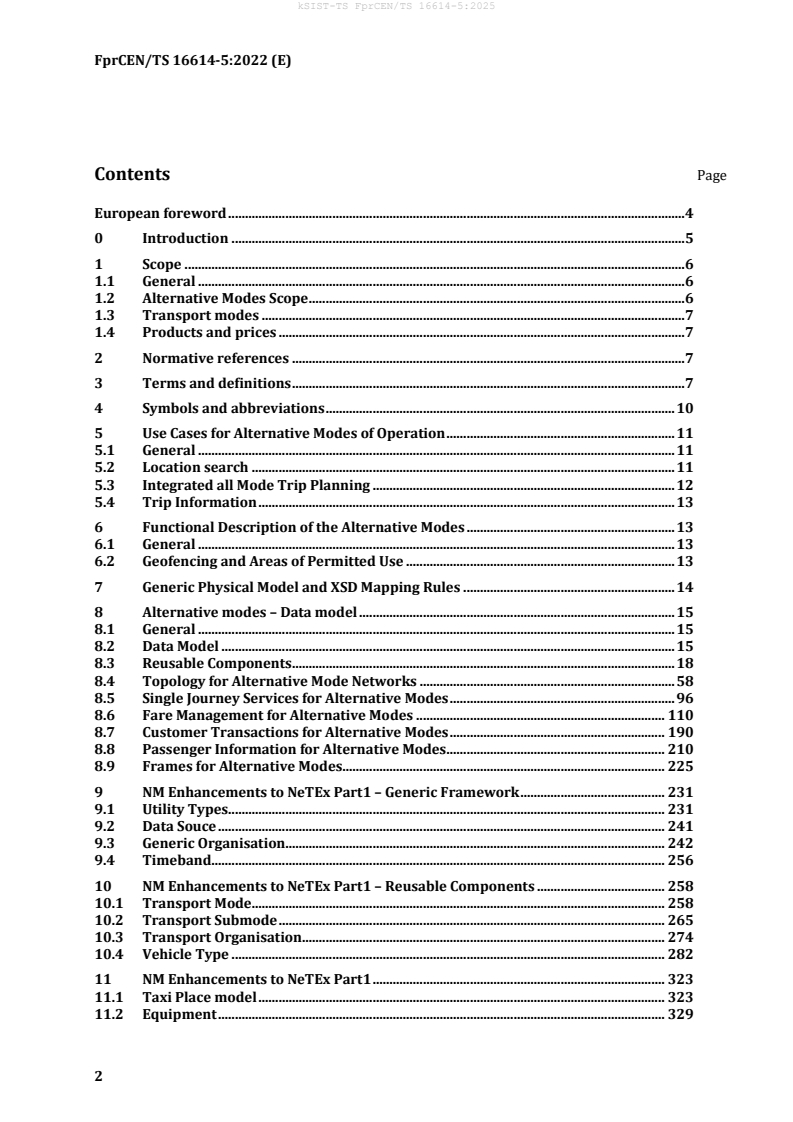
Contents Page
European foreword . 4
0 Introduction . 5
1 Scope . 6
1.1 General . 6
1.2 Alternative Modes Scope . 6
1.3 Transport modes . 7
1.4 Products and prices . 7
2 Normative references . 7
3 Terms and definitions . 7
4 Symbols and abbreviations . 10
5 Use Cases for Alternative Modes of Operation . 11
5.1 General . 11
5.2 Location search . 11
5.3 Integrated all Mode Trip Planning . 12
5.4 Trip Information . 13
6 Functional Description of the Alternative Modes . 13
6.1 General . 13
6.2 Geofencing and Areas of Permitted Use . 13
7 Generic Physical Model and XSD Mapping Rules . 14
8 Alternative modes – Data model . 15
8.1 General . 15
8.2 Data Model . 15
8.3 Reusable Components . 18
8.4 Topology for Alternative Mode Networks . 58
8.5 Single Journey Services for Alternative Modes . 96
8.6 Fare Management for Alternative Modes . 110
8.7 Customer Transactions for Alternative Modes . 190
8.8 Passenger Information for Alternative Modes. 210
8.9 Frames for Alternative Modes. 225
9 NM Enhancements to NeTEx Part1 – Generic Framework . 231
9.1 Utility Types . 231
9.2 Data Souce . 241
9.3 Generic Organisation. 242
9.4 Timeband . 256
10 NM Enhancements to NeTEx Part1 – Reusable Components . 258
10.1 Transport Mode . 258
10.2 Transport Submode . 265
10.3 Transport Organisation . 274
10.4 Vehicle Type . 282
11 NM Enhancements to NeTEx Part1 . 323
11.1 Taxi Place model . 323
11.2 Equipment . 329
11.3 Facilities . 345
12 NM Enhancements to NeTEx Part1 – ND . 386
12.1 Route Restriction Assessment . 386
13 NM Enhancements to NeTEx Part1 – TP . 391
13.1 Alternative Mode Connections . 391
14 NM Enhancements to NeTEx Part3 – FM . 399
14.1 Medium Access Device model . 399
14.2 Customer Payment Means Model . 407
14.3 Customer Purchase Package . 411
Annex A (informative) Functional Description of Alternative Modes (from Transmodel)
........................................................................................................................................................... 427
A.1 Categorisation of Modes of Transport. 427
A.2 Limits of the Specification . 430
A.3 Functions and Aspects related to the Alternative Modes . 430
A.4 Cycling . 434
A.5 Car Sharing . 437
A.6 Carpooling . 440
Annex B (informative) GBFS mapping - to NeTEx and SIRI . 447
B.1 GBFS Data Specification (GBFS) . 447
B.2 GBFS Outline Mapping to NeTEx and SIRI . 451
B.3 GBFS to NeTEx Mapping tables . 453
B.4 GBFS to SIRI Mapping tables . 464
B.5 GBFS to SIRI Comments respecting the Mapping Table . 468
B.6 Examples of Mapping - GBFS . 469
B.7 Examples of mapping – GBFS to SIRI . 486
Annex C (informative) IXSI mapping to NeTEx New Modes . 492
C.1 IXSI Interface for X Sharing Information Car Sharing AOI . 492
C.2 IXSI mapping to NeTEx New Modes . 492
C.3 Scope . 492
C.4 Examples of mapping – IXSI to NeTEx . 493
Annex D (informative) Interoperability Summary . 498
D.1 Introduction . 498
D.2 Stakeholders . 498
D.3 Other Formats . 499
Annex E (informative) Revisions of CEN/TS 17413:2020 to implement NeTEx . 503
E.1 Introduction . 503
E.2 Transmodel/NeTEx Revisions of CEN/TS 17413:2020 . 503
E.3 Additions . 506
E.4 Noted as missing from Transmodel 6.0 – outside NeTEx . 506
E.5 Events and Log Entries for Alternative Modes . 506
Annex F (informative) Alternative Mode Trip Model . 509
F.1 Passenger Trip . 509
F.2 Vehicle Location . 513
Annex G (informative) Other enhancements in V1.2.2 and V2.0 of NeTEx . 515
G.1 Introduction . 515
G.2 Changes . 515
European foreword
This document (CEN/TS 16614-5:2025) has been prepared by Technical Committee CEN/TC 278
“Intelligent Transport Systems”, the secretariat of which is held by NEN.
This document is currently submitted to the Vote on TS.
This document has been prepared under a Standardization Request given to CEN by the European
Commission and the European Free Trade Association and supports essential requirements of
EU Directive(s) /Regulation(s).
In addition, it supports the fundamental requirements for Urban Rail of CEN-CENELEC Guide 26.
This document will supersede CEN/TS 16614-5:2022.
This document presents Part 5 of the European Technical Specification known as “NeTEx”. NeTEx
provides a framework for specifying communications and data exchange protocols for organisations
wishing to exchange scheduled information relating to public transport operations. As defined by
Transmodel, 'Public transport' has to be understood as services advertised and available for use by the
general public carried out by any means of transport.
The full NeTEx Technical Specification is made up of six parts defining a single European Standard
series, which provides a complete exchange format for public transport networks, timetable
description and fare information.
— Part 1 is the description of the public transport network topology exchange format. It also contains
use cases shared with part 2, and modelling rules and the description of a framework shared by all
parts.
— Part 2 is the description of the scheduled timetables exchange format.
— Part 3 is the description of the fare information exchange format.
— Part 4 is the description of the passenger information European profile.
— Part 5 (this document) is the description of the alternative modes exchange format.
— Part 6 is the description of the European passenger information accessibility profile.
Part 1 is fully standalone. Parts 2,3, 4, 5 and 6 rely on Part 1 and possibly any other previous part.
The XML schema can be downloaded from http://netex-cen.eu (or directly from
https://github.com/NeTEx-CEN/NeTEx), along with available guidance on its use, example XML files,
and case studies of national and local deployments.
This document is highly technical, and a special care has been taken to keep the text readable. In
particular a set of formatting conventions is followed that enhances the usual CEN writing rules in
order to distinguish references to elements of the formal models within text:
— Transmodel terms and NeTEx conceptual model elements are in capital letters (JOURNEY
PATTERN for example).
— NeTEx physical model names are in bold italic font and use CamelCase style with no spaces
(JourneyPattern, for example).
— NeTEx physical model attribute types are in italic font and use CamelCase style with no spaces
(TypeOfEntity, for example).
Any feedback and questions on this document should be directed to the users’ national standards body.
A complete listing of these bodies can be found on the CEN website.
0 Introduction
Public transport services rely increasingly on information systems to ensure reliable, efficient
operation and widely accessible, accurate passenger information. These systems are used for a range
of specific purposes: setting schedules and timetables; managing vehicle fleets; publicising fares,
issuing tickets and receipts; providing real-time information on service running, and so on.
Services already present in the urban environment such as multimodal information and traffic
management and control are already well understood. Reference data models and data exchange
formats for the use of these services, in particular data sets describing the public transport offer, are
already standardised and available. However, there is a need for reference data models to
accommodate emerging modes of transport to allow seamless transitions for the traveller between all
available modes. Examples of these new modes include car and cycle sharing, car-pooling, and
intelligent parking (Park & Ride).
The first three parts of the European Technical Specification NeTEx specify a Network, Timetable, and
Fare Exchange format for Public Transport. The purpose of NeTEx is to exchange data relating to
scheduled public transport between the systems of PT organisations. It can be seen as complementary
to the SIRI (Service Interface for Real-time Information) standard, as SIRI needs a prior exchange of
reference data from NeTEx’s scope to provide the necessary context for the subsequent exchange of a
real-time data. A fourth part describes a profile for using NeTEx for the cross-border exchange of
timetable data (European Passenger Information profile – EPIP).
This document (NeTEx – Part 5) specifies exchanges of data for alternative transport modes between
systems and organisations. It encompasses alternative (i.e. non-traditional) modes of personal use of
transport (such as cycle sharing, car-pooling, rental, etc.) often provided as mobility services. Such
services may be provided by organisations other than conventional transport operators and use of
them may involve the passengers themselves steering the vehicles and determining the exact route.
Part 5 describes some extensions and additions to the prior NeTEx model. It is a complement to Parts
1, 2, 3 in the sense that it uses a subset of the concepts defined there.
Well-defined, open interfaces have a crucial role in improving the economic and technical viability of
Public Transport Information Systems of all kinds. Using standardised interfaces, systems can be
implemented as discrete pluggable modules that can be chosen from a wide variety of suppliers in a
competitive market, rather than as monolithic proprietary systems from a single supplier. Different
data sets can be integrated and systems linked together to provide services that cover a wide area and
proved advanced multimodal function for travellers. Interfaces also allow the systematic automated
testing of each functional module, vital for managing the complexity of increasing large and dynamic
systems. Furthermore, individual functional modules can be replaced or evolved, without unexpected
breakages of obscurely dependent function.
This standard will improve the ease of integration of public transport information with other modes
of transport making it easier to provide service that allow passengers to plan and make multi-modal
journeys that seamlessly combine legs made on both conventional public transport and self-guided
modes.
By generalising and extending a standard already in place, the standard is able to reuse an existing
context and many existing components, minimizing the effort required to deploy it.
1 Scope
1.1 General
NeTEx is dedicated to the exchange of scheduled data (network, timetable and fare information). It is
based on Transmodel European reference model for PT data. The most recent version of NeTEx v1.1
is based on the most recent version of Transmodel, V6.0 (EN 12986 1/2/3/4/5/6), which now
incorporates the prior IFOPT (EN 28701). NeTEx also relates to SIRI (CEN 15531-1/2/3/4) and
supports the exchange of information of relevance for passenger information about public transport
services and also for running Automated Vehicle Monitoring Systems (AVMS).
NOTE NeTEx is an implementation of a subset of Transmodel (including IFOPT); the definitions and
explanations of its concepts are extracted directly from Transmodel and reused in NeTEx, sometimes with
adaptations in order to fit the NeTEx context. Although the data exchanges targeted by NeTEx Parts 1 to 5 are
predominantly oriented towards provisioning passenger information systems, AVMS and fare systems with data
from transit scheduling systems, it is not restricted to this purpose and NeTEx can also provide an effective
solution to many other use cases for transport data exchange.
1.2 Alternative Modes Scope
This Part 5 of NeTEx is specifically concerned with the exchange of reference data to support “new”
alternative modes for mobility services, adding certain new concepts to the NeTEx schema (indicated
as NeTEx v1.2.2), but also to a high degree making use of existing schema elements defined in NeTEx
Parts 1, 2 and 3.
The high-level design for alternative modes support is derived from a conceptual model for alternative
modes CEN/TS 17413:2020 prepared by CEN working group TC278 WG17. This CEN Technical
Specification describes a conceptual model for alternative modes as an extension to Transmodel V6.0
and based on a detailed set of use cases taken from CEN/TS 17413:2020, and given in Appendix A.
The NeTEx format is concerned with a subset of the use cases for reference data (real-time use cases
are covered by dynamic protocols such as SIRI and DATEX II). Overall, it is concerned with data for the
following purposes:
— to be able to integrate legs made on alternative modes with conventional mode legs in seamless
trip plans;
— to describe the coverage areas of alternative mode mobility services so that trip planning engines
and others can make passengers aware of the possibility of using them, and provide appropriate
links to invoke the dynamic services;
— to be able to find the locations of access points for alternative mode services, such as parking
points, pooling stations, etc. including their relation to access points for conventional modes;
— to be able to indicate the costs of the mobility services for specific trip legs. Where operators offer
a bundle of modes services (for example free cycle use with metro use) to be able to include the
“fare product” for alternative mode legs in the sales offer;
— to be able to indicate how to book, purchase and pay for mobility services, and how to access them.
NeTEx is primarily concerned with the exchange of reference data to allow the integration of new
modes with other data; it does not describe dynamic services. CEN/TS 17413:2020 specification
indicates the nature of some of these services such as trip planning.
1.3 Transport modes
All mass public transport modes are taken into account by NeTEx, including train, bus, coach, metro,
tramway, ferry, air, and their submodes. Such modes are provided by transport operators, who may
operate one or more modes.
NeTEx part 5 widens the concept of an operator to include providers of other forms of transport, and
introduces the separate concept of a “mode of operation” to classify the way services are provided:
conventional, flexible, pooling, sharing, etc.
1.4 Products and prices
The overall approach for the definition of products for alternative modes within NeTEx Part 5
Alternative modes) follows the approach used by Transmodel v6.0 Part5 (Fare Management data
model), namely through the definition of access rights rather than of just products. Prices are
separated from the things they price. The existing model also allows for dynamic prices to be fetched
from a pricing engine.
This approach of using the access rights related to the urban public transport (for all urban modes)
can be applied to any mode, including long-distance rail and alternative modes.
Exchange protocols
The exchange of data in NeTEx format can be undertaken using a variety of protocols. For example:
through dedicated web services, through data file exchanges by FTP or otherwise, or by using the SIRI
exchange protocol as described in part 2 of the SIRI documentation. NeTEx adds additional services
using the common SIRI transport mechanisms.
2 Normative references
There are no normative references in this document.
3 Terms and definitions
For the purposes of this document, the following terms and definitions apply.
ISO and IEC maintain terminological databases for use in standardization at the following addresses:
— IEC Electropedia: available at https://www.electropedia.org/
— ISO Online browsing platform: available at https://www.iso.org/obp
3.1
access mode
characterization of the traveller’s movement (e.g. walking, cycling, etc.) enabling the traveller to reach
a public transport stop or to carry out a leg of a trip
3.2
alternative mode
publicly advertised mode of operation different from the conventional mode of operation, in particular
vehicle sharing, vehicle rental and vehicle pooling
3.3
car pooling
vehicle pooling applied to cars, consisting in sharing a privately owned car for a trip between a defined
driver who is already engaged in the trip and at least another traveller
3.4
car rental
vehicle rental applied to cars, consisting in making car(s) available at specified agencies with the
constraint to bring them back at specified agencies
3.5
car sharing
vehicle sharing applied to cars, consisting of the short-term use of a vehicle for a specific journey or
time where the car might be taken from and parked at different places in an urban area
3.6
conventional mode (of operation)
legacy mode of operation which is provided as a scheduled and/or flexible publicly advertised
transport offer relying on a set of features:
— drivers are employees;
— the fleet is owned by an authority, or owned or run by an operator
— the network topology is defined well in advance and is based on lines and journey patterns
Note to entry: The distinction between alternative and conventional mode of operation relies on the fact that
one or more of the conditions as above may not be fulfilled. Moreover, the difference is in the mode of operation
rather than the way the traveller is served.
3.7
cycle rental
vehicle rental applied to cycles (e.g. bikes, e-bikes, motorcycles, scooters, etc.), consisting in making
cycle(s) available at specified agencies with the constraint to bring them back at specified agencies
3.8
cycle sharing
vehicle sharing applied to cycles (e.g. bikes, e-bikes, motorcycles, scooters, etc.), consisting of short-
term cycle rental where the cycle can be taken from and parked at different places in the urban area
3.9
flexible transport mode (of operation)
passenger transport operation linked to a fixed network/schedule but offering flexibility, in order for
instance, to optimize the service or to satisfy passenger demand
3.10
operational service
activities performed by actors in charge of operation of a service
3.11
mobility service
alternative mode transport service available over a widespread area, for example car-pooling, rental,
etc.
3.12
park and ride
activity allowing travellers to transfer between personal/alternative mode and conventional mode
3.13
park and ride facility
location dedicated to travellers allowing them a modal transfer, in particular to leave/pick up their
personal vehicles before/after a trip on public transport
3.14
personal mode
private mode of operation excluding any publicly advertised use
3.15
public transport
means of transport advertised and available for use by the general public
3.16
scheduled mode
passenger transport operation following a fixed schedule and fixed routes
3.17
taxi
type of vehicle pooling operation where the vehicle is driven by a driver providing services to
travellers for commercial reasons
3.18
taxi stand
set of spots where any taxi is able to safely stop for a short period of time to load passengers
3.19
traveller information provision
activity consisting in the provision of information on the rules/conditions related to a traveller service
and concerning the available transportation means
3.20
traveller service
activity (in general, initiated by users) in view of facilitating/enabling a trip
3.21
walking mode
walking as considered as an access mode so the traveller walks to a stop point to get to the transport
option
3.22
vehicle pooling
particular mode of operation of a privately-owned vehicle (car, motorcycle, etc.) consisting in sharing
the vehicle for a trip between a defined driver who is already engaged in the trip and at least one other
traveller
3.23
vehicle rental
particular mode of operation of a vehicle fleet (in general privately owned) consisting in making it
available at specified agencies with the constraint to bring them back at specified agencies
3.24
vehicle sharing
short term vehicle rental where the vehicle can be taken from and parked at different places in the
urban area, often without the constraint of bringing the vehicle back to a dedicated specific location
3.25
vehicle with driver
vehicle operating on demand such as a taxi, chauffeured car or dispatched mini-cab
4 Symbols and abbreviations
ABT Account Based Ticketing
CCAM Cooperative, Connected and Automated Mobility
EU European Union
EPIP European Passenger Information Profile for NeTEx
GBFS General Bikeshare feed specification
GDF Geographic Data Files
GNSS Global Navigation Satellite System
GPS Global Positioning System
GTFS General Transit Feed specification
INSPIRE Infrastructure for Spatial Information in Europe
iOS iPhone Operating System
IXSI Interface for X-Sharing Information
ITS Intelligent Transport Systems
JSON JavaScript Object Notation
MaaS Mobility as a Service
NM New Modes
RDEX Ridesharing Data Exchange
SPDX Software Package Data Exchange
U-ITS Urban Intelligent Transport Systems
NOTE In this document, alternative mode of operation, alternative mode and new mode are used as
synonyms (with a preference to alternative mode). Conventional mode of operation is used as synonym of
conventional mode, flexible mode of operation is synonymous to flexible mode, scheduled mode of operation as
synonymous to scheduled mode.
5 Use Cases for Alternative Modes of Operation
5.1 General
NeTEx support for alternative modes is intended to include the exchange of reference data to support
integrated passenger information for all modes. It is assumed that dynamic data exchange such as real-
time statuses and predictions, real time trip-offers, etc, will be covered by other APIs – see Annexes –
for alternative mode dynamic functions that are outside of the scope of NeTEx but are in the
Transmodel scope, and mostly covered by SIRI for data exchange. The scope of NeTEx coverage
includes the following use cases.
5.2 Location search
The below uses-cases represent all the different types of location searches that one traveller can do
using a online service, a mobile app, or any other digital tool. The search is often limited to a specific
(topographic) area.
Table 1 — Location search use cases
Use Case Description Contributing elements in
this document
Location Search: Park and Finding the Park and Ride location PARKING model.
Ride
Location Search: Bike Finding a Bike Sharing Station STOP PLACE, SITE Model.
Sharing Stations
Location Search: Car Finding a Car Sharing Station PARKING model.
Sharing Stations
Location Search: Publicly Finding publicly accessible refuelling Via PARKING MODEL,
accessible refuelling stations. REFUELLING EQUIPMENT,
stations for combustion, PARKING EQUIPMENT, NB –
charging stations for details are outside of scope.
electric vehicles
Location Search: Secure Finding Secure Bike and other Vehicle PARKING model.
Vehicle Parking type Parking, including opening times
and permitted stay lengths.
Available vehicles Provisioning services with registered FLEET and VEHICLE MODE
vehicles MODEL.
Service Coverage Availability of an alternative service in MOBILITY SERVICE.
a given e area
Service Discovery Available online services ON-LINE SERVICE.
5.3 Integrated all Mode Trip Planning
Trip plan computation may be monomodal or intermodal and be for alternative modes only,
conventional model only, or both. Computation may include finding legs, estimated travel times by day
type and time-band by transport mode/combination of transport modes.
Table 2 — integrated modes use cases
Use Case Description Contributing elements in
this document
Alternative Mode legs Legs for all alternative modes including meeting SINGLE JOURNEY, VEHICLE
for trip planning. points, available single journeys. MEETING POINT.
Can include timings and estimated trip times.
Costs of Alternative Cost of using an alternative mode to make DISTANCE MATRIX
Mode legs and services. journey or to travel within an area. ELEMENT, TARIFF, FARE
STRUCTURE ELEMENT,
FARE PRICE.
Spatial route plots. Spatial route plots for alternative mode legs. VEHICLE MEETING LINK,
ROUTE PATH.
Traveller profile for car User preferences for car sharing. USER PROFILE,
sharing INDIVIDUAL TRAVELLER.
Product prerequisites Information on any prerequisite products for SALES DISCOUNT RIGHT,
and entitlements. alternative mode products and any entitlements ENTITLEMENT GIVEN,
to other travel services given by alternative ENTITLEMENT REQUIRED.
mode products.
Network priorities and Where some restriction or priority for MODE RESTRICTION
restrictions. ALTERNATIVE MODEs occurs: lane priority for ASSESSMENT. NB data may
carpooling, reserved lane for bikes, two-way for be integrated from INSPIRE
bike and one-way for cars, etc. This information etc.
is mainly for traveller information purpose.
5.4 Trip Information
Table 3 — Trip information use cases
Use Case Description Contributing elements in
this document
Information Service: Includes retail channels, fulfilment methods, DISTRIBUTION
Where and how to buy payment methods, location of the retail devices. ASSIGNMENT.
tickets for demand DISTRIBUTION CHANNEL,
responsive modes. FULFILMENT METHOD,
RETAIL DEVICE
Vehicle facilities such as Facilities that a traveller might find on the FACILITY SET, FACILITY,
classes of carriage, on- alternative mode. EQUIPMENT.
board Wi-Fi.
How to book car sharing, Includes retail channels, fulfilment methods, BOOKING
taxis, cycle hire etc. payment methods. ARRANGEMENTS.
How to access a vehicle. How to access a rented or shared vehicle. VEHICLE RELEASE
EQUIPMENT SERVICE
ACCESS CODE, VEHICLE
ACCESS ASSIGNMENT.
Where how to pay for car Includes retail channels, fulfilment methods, BOOKING
parking, hydrogen, petrol payment methods. ARRANGEMENTS,
and diesel recharging. TICKETING EQUIPMENT,
REFUELLING.
6 Functional Description of the Alternative Modes
6.1 General
The Functional description of the alternative modes is the same as that of the Transmodel compatible
definition, described in CEN/TS 17413:2020 specification.
A normative CEN standardised functional specification is being developed as Transmodel.
For convenience, the functional description is included in this document as an informative annex – see
Annex A.
The NeTEx specification includes functional enhancement over the original CEN/TS 17413:2020
function (now incorporated in a new Transmodel Part 10).
6.2 Geofencing and Areas of Permitted Use
Most vehicle systems, such as cycle share, vehicle rental, etc., operate only within a specific spatial
area. This area may be indicated though maps or passenger information, or for vehicle with remote
immobilisation systems, may even be enforced electronically by GPS detection.
Within the spatial extent there may be areas where only certain uses (or even no use at all) is
permitted. The permitted areas may be described using mobility service constraint zones, each
expressing a spatial extent and the permitted uses.
Mobility service constraint zones can also be used to limit use for other purposes, for example pollution
control zones.
7 Generic Physical Model and XSD Mapping Rules
NeTEx uses a model driven design approach – a conceptual model, describe in UML, is systematically
mapped into a more explicit implementation model, also in UML, which is then used to code an XML
schema. The modularisation of packages in the schema follows the modularisation in the design
MODELs. Transmodel relationships are implemented in the XML by containment or by reference as
appropriate.
A method to map from a conceptual model to a physical XML model is described in NeTEx Part1. The
same method I used for alternative modes to map from a Transmodel alternative model to an extended
NeTEx XML schema. A number of revisions are made from the original CEN/TS 17413:2020 model to
arrive at a stable Transmodel alternative model (Transmodel Part 10 (prEN 12896-10) will replace
CEN/TS 17413:2020 drafted by PT1711) – see Annex E.
The additions to the NeTEx XML schema are backwards compatible – existing documents will still
validate.
In the following chapter, for each submodel diagrams are provided for; (a) the conceptual modelling
UML; (b) the corresponding physical model in UML, including identifiers, foreign keys and
enumerations; (c) The corresponding XML schema elements, including XML groups, attributes and
data types.
Some additional conventions are used to show Revisions and Extensions to the Transmodel 6.2 model
as shown in the following diagram.
Entities
— Red triangle – Entity added to Transmodel 6.0 for alternative modes
Relationships
— Black – Existing Transmodel 6.0 Relationship
— Red – Added for Alternative modes by PT1711 (CEN/TS 17413:2020)
— Blue – Added /revised of Alternative modes for Transmodel NeTEx.
Figure 1 — Additional Conventions (UML)
8 Alternative modes – Data model
8.1 General
Following the Transmodel separation of concerns, the representation of the alternative modes is
broken down into a number of separate submodels. The following section describes each functional
submodel. In addition, some views are given to show how existing model elements may be used to
represent alternative mode data without any additional changes being necessary.
The section is primarily concerned to document the XML schema, relating it to the physical model on
which it is based. In order to relate the physical model to the corresponding Transmodel elements
from which it is derived, each section is introduced by a UML diagram of the respective Transmodel
Conceptual model.
8.2 Data Model
8.2.1 Overview
To support alternative modes, the existing v1.1 parts of NeTEx are extended (as NeTEx v1.2.2) in three
distinct ways:
— A small number of new elements, attributes, and enumeration values are added to certain existing
packages in the existing schema (covering the NeTEx Framework and Part1, Part2 and Part3).
These extend the capabilities of the existing NeTEx components. Existing documents will still
validate correctly against these parts.
— A small number of new packages are added as reusable components to the existing parts, as they
are referenced by one or more of the modified core packages or may be of wider use for future
NeTEx modules. These also extend the capabilities of the existing components, (for example, the
various MODEs of OPERATION).
— A separate NeTEx Part5 module is added, containing a number of new packages that are specific
to the alternative modes. This includes two new specific version frames; the MOBILITY SERVICE
FRAME and the SINGLE JOURNEY FRAME, to hold the added elements. These allow the definition
of carpooling, vehicle sharing, rental and other alternative mode services.
Packages that are specific to alternative modes are marked NM. The packages are ordered in general
in order of dependency.
Figure 2 — NM Package Overview
The NeTEx Part5 specific packages are organized into five main groups:
— NM RC Explicit Frames – Provides frames to group alternative mode components.
— NM RC Reusable Components – Common components added to facilitate new modes.
— NM Topology – Provides several models for spatial information linked to alternative modes of
operation.
— NM Journey Service - Describes alternative mode services such as vehicle pooling, sharing
journeys, etc.
— NM Fare Management – Describes Fare and pricing models for alternative modes.
— NM Travel Information: provides sub-models representing data requirements for the traveller
information services.
Figure 3 — NM Package Overview
8.3 Reusable Components
8.3.1 General
This section describes new general-purpose components that are added to the core Transmodel/
NeTEx framew
...
Questions, Comments and Discussion
Ask us and Technical Secretary will try to provide an answer. You can facilitate discussion about the standard in here.
Loading comments...