


SIST EN 14825:2012
(Main)Air conditioners, liquid chilling packages and heat pumps, with electrically driven compressors, for space heating and cooling - Testing and rating at part load conditions and calculation of seasonal performance
Air conditioners, liquid chilling packages and heat pumps, with electrically driven compressors, for space heating and cooling - Testing and rating at part load conditions and calculation of seasonal performance
This European Standard covers air conditioners, heat pumps and liquid chilling packages. It applies to factory made units defined in EN 14511 1, except single duct, control cabinet and close control units.
This European Standard gives the calculation methods for the determination of reference seasonal energy efficiency SEER and SEERon and reference seasonal coefficient of performance SCOP, SCOPon and SCOPnet.
Such calculation methods may be based on calculated or measured values.
In case of measured values, this European Standard covers the test methods for determination of capacities, EER and COP values during active mode at part load conditions. It also covers test methods for electric power consumption during thermostat off mode, standby mode and crankcase heater mode.
This European Standard serves as an input for the calculation of the system energy efficiency in heating mode of specific heat pump systems in buildings, as stipulated in the standard EN 15316-4-2.
Luftkonditionierer, Flüssigkeitskühlsätze und Wärmepumpen mit elektrisch angetriebenen Verdichtern zur Raumbeheizung und -kühlung - Prüfung und Leistungsbemessung unter Teillastbedingungen und Berechnung der jahreszeitbedingten Leistungszahl
Die vorliegende Europäische Norm behandelt Luftkonditionierer, Wärmepumpen und Flüssigkeitskühlsätze.
Sie gilt für werkseitig hergestellte Geräte nach EN 14511-1:2011, mit Ausnahme von Einkanal-
Luftkonditionierern, Schaltschrankkühlgeräten und Verfahrens-Luftkonditionierern.
Diese Europäische Norm enthält Berechnungsverfahren zur Ermittlung des Bezugswertes der saisonalen
Arbeitszahl im Kühlbetrieb SEER und SEERon und des Bezugswertes der saisonalen Arbeitszahl im Heizbetrieb
SCOP, SCOPon und SCOPnet.
Derartige Berechnungsverfahren können auf Rechen- oder Messwerten beruhen.
Im Fall von Messwerten behandelt diese Europäische Norm Prüfverfahren zur Ermittlung von Leistungen,
EER- und COP-Werten im Aktiv-Modus unter Teillastbedingungen. Außerdem behandelt sie Prüfverfahren zur
Ermittlung der Leistungsaufnahme im Betriebszustand „Temperaturregler AUS“, im Bereitschaftsmodus und
im Betriebszustand mit Kurbelgehäuseheizung.
Die vorliegende Norm dient als Vorgabe zur Berechnung der systembezogenen Energieeffizienz im Heizbetrieb
von spezifischen Wärmepumpensystemen in Gebäuden, wie in der Norm EN 15316-4-2 festgelegt.
Climatiseurs, groupes refroidisseurs de liquide et pompes à chaleur avec compresseur entraîné par moteur électrique pour le chauffage et la réfrigération des locaux - Essais et détermination des caractéristiques à charge partielle et calcul de performance saisonnière
La présente Norme européenne couvre les essais des climatiseurs, pompes à chaleur et groupes
refroidisseurs de liquide. Elle s'applique aux appareils fabriqués en usine définis dans l'EN 14511-1:2011,
excepté les appareils à simple raccordement, les appareils pour armoire de commande et les appareils pour
enceinte contrôlée.
La présente norme donne les méthodes de calcul pour la détermination de l'efficacité frigorifique saisonnière
SEER et SEERon et du coefficient de performance saisonnier SCOP, SCOPon et SCOPnet.
De telles méthodes de calcul peuvent être basées sur des valeurs mesurées ou calculées.
Dans le cas de valeurs mesurées, la présente Norme européenne couvre les méthodes d’essai relatives à la
détermination des puissances, EER et COP pendant le mode actif aux conditions de charge partielle. Elle
couvre également les méthodes d’essai relatives à la consommation d’énergie électrique en mode arrêt par
thermostat, en mode veille et en mode dispositif de chauffage de carter.
La présente Norme européenne sert d'entrée pour le calcul de l'efficacité frigorifique des systèmes en mode
chauffage des systèmes de pompes à chaleur spécifiques dans les bâtiments, comme stipulé dans la norme
EN 15316-4-2.
Klimatske naprave, enote za tekočinsko hlajenje in toplotne črpalke z električnimi kompresorji za segrevanje in hlajenje prostora - Preskušanje in ocenitev ob delni obremenitvi ter izračun letnega učinka
Ta evropski standard se nanaša na klimatske naprave, toplotne črpalke in enote za tekočinsko hlajenje. Uporablja se za tovarniško izdelane enote, določene v standardu EN 14511-1:2011, razen za enote z enim vodom, enote s stikalno omarico in enote za neposredni nadzor. V tem evropskem standardu so navedene metode za izračun referenčne sezonske energetske učinkovitosti SEER in SEERon ter referenčnih sezonskih koeficientov učinkovitosti SCOP, SCOPon in SCOPnet. Takšne metode izračuna lahko temeljijo na izračunanih ali izmerjenih vrednostih. V primeru izmerjenih vrednosti ta evropski standard zajema preskusne metode za določanje zmogljivosti, vrednosti EER in COP med aktivnim delovanjem ob delnih obremenitvenih pogojih. Prav tako zajema preskusne metode za porabo električne energije enote ob izključenem termostatu, v stanju pripravljenosti in v načinu grelnika ohišja med sezono hlajenja. Ta evropski standard se uporablja za vhodne podatke za izračun sistemske energetske učinkovitosti v načinu ogrevanja, in sicer za posebne sisteme toplotnih črpalk v stavbah, kot določa standard EN 15316-4-2.
General Information
- Status
- Withdrawn
- Public Enquiry End Date
- 24-Jul-2011
- Publication Date
- 07-May-2012
- Withdrawal Date
- 11-Dec-2013
- Technical Committee
- I13 - Imaginarni 13
- Current Stage
- 9900 - Withdrawal (Adopted Project)
- Start Date
- 12-Dec-2013
- Due Date
- 04-Jan-2014
- Completion Date
- 12-Dec-2013
Relations
- Effective Date
- 01-Jul-2012
- Effective Date
- 01-Jan-2014

Frequently Asked Questions
SIST EN 14825:2012 is a standard published by the Slovenian Institute for Standardization (SIST). Its full title is "Air conditioners, liquid chilling packages and heat pumps, with electrically driven compressors, for space heating and cooling - Testing and rating at part load conditions and calculation of seasonal performance". This standard covers: This European Standard covers air conditioners, heat pumps and liquid chilling packages. It applies to factory made units defined in EN 14511 1, except single duct, control cabinet and close control units. This European Standard gives the calculation methods for the determination of reference seasonal energy efficiency SEER and SEERon and reference seasonal coefficient of performance SCOP, SCOPon and SCOPnet. Such calculation methods may be based on calculated or measured values. In case of measured values, this European Standard covers the test methods for determination of capacities, EER and COP values during active mode at part load conditions. It also covers test methods for electric power consumption during thermostat off mode, standby mode and crankcase heater mode. This European Standard serves as an input for the calculation of the system energy efficiency in heating mode of specific heat pump systems in buildings, as stipulated in the standard EN 15316-4-2.
This European Standard covers air conditioners, heat pumps and liquid chilling packages. It applies to factory made units defined in EN 14511 1, except single duct, control cabinet and close control units. This European Standard gives the calculation methods for the determination of reference seasonal energy efficiency SEER and SEERon and reference seasonal coefficient of performance SCOP, SCOPon and SCOPnet. Such calculation methods may be based on calculated or measured values. In case of measured values, this European Standard covers the test methods for determination of capacities, EER and COP values during active mode at part load conditions. It also covers test methods for electric power consumption during thermostat off mode, standby mode and crankcase heater mode. This European Standard serves as an input for the calculation of the system energy efficiency in heating mode of specific heat pump systems in buildings, as stipulated in the standard EN 15316-4-2.
SIST EN 14825:2012 is classified under the following ICS (International Classification for Standards) categories: 23.120 - Ventilators. Fans. Air-conditioners; 27.080 - Heat pumps; 91.140.30 - Ventilation and air-conditioning systems. The ICS classification helps identify the subject area and facilitates finding related standards.
SIST EN 14825:2012 has the following relationships with other standards: It is inter standard links to SIST-TS CEN/TS 14825:2005, SIST EN 14825:2014. Understanding these relationships helps ensure you are using the most current and applicable version of the standard.
SIST EN 14825:2012 is available in PDF format for immediate download after purchase. The document can be added to your cart and obtained through the secure checkout process. Digital delivery ensures instant access to the complete standard document.
Standards Content (Sample)
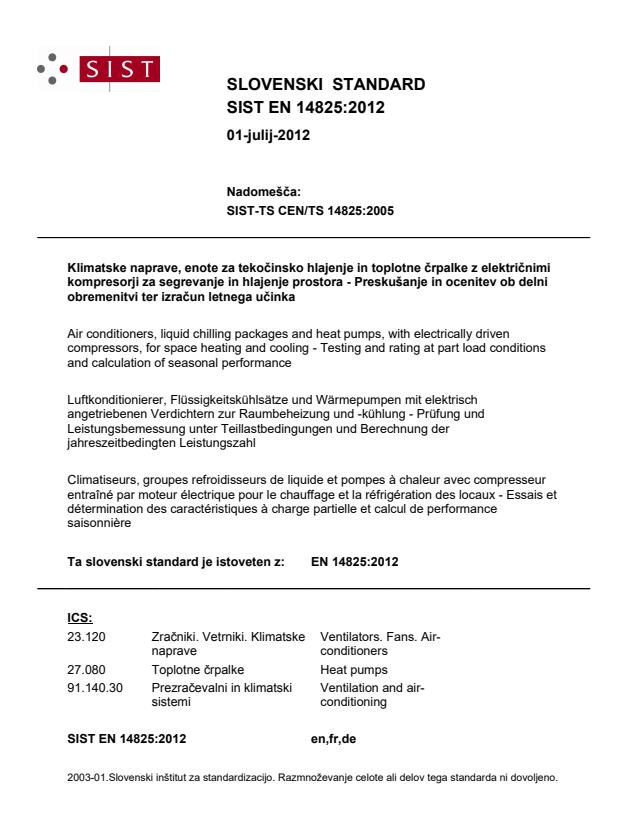
2003-01.Slovenski inštitut za standardizacijo. Razmnoževanje celote ali delov tega standarda ni dovoljeno.Luftkonditionierer, Flüssigkeitskühlsätze und Wärmepumpen mit elektrisch angetriebenen Verdichtern zur Raumbeheizung und -kühlung - Prüfung und Leistungsbemessung unter Teillastbedingungen und Berechnung der jahreszeitbedingten LeistungszahlClimatiseurs, groupes refroidisseurs de liquide et pompes à chaleur avec compresseur entraîné par moteur électrique pour le chauffage et la réfrigération des locaux - Essais et détermination des caractéristiques à charge partielle et calcul de performance saisonnièreAir conditioners, liquid chilling packages and heat pumps, with electrically driven compressors, for space heating and cooling - Testing and rating at part load conditions and calculation of seasonal performance91.140.30VLVWHPLVentilation and air-conditioning27.080Heat pumps23.120QDSUDYHVentilators. Fans. Air-conditionersICS:Ta slovenski standard je istoveten z:EN 14825:2012SIST EN 14825:2012en,fr,de01-julij-2012SIST EN 14825:2012SLOVENSKI
STANDARDSIST-TS CEN/TS 14825:20051DGRPHãþD
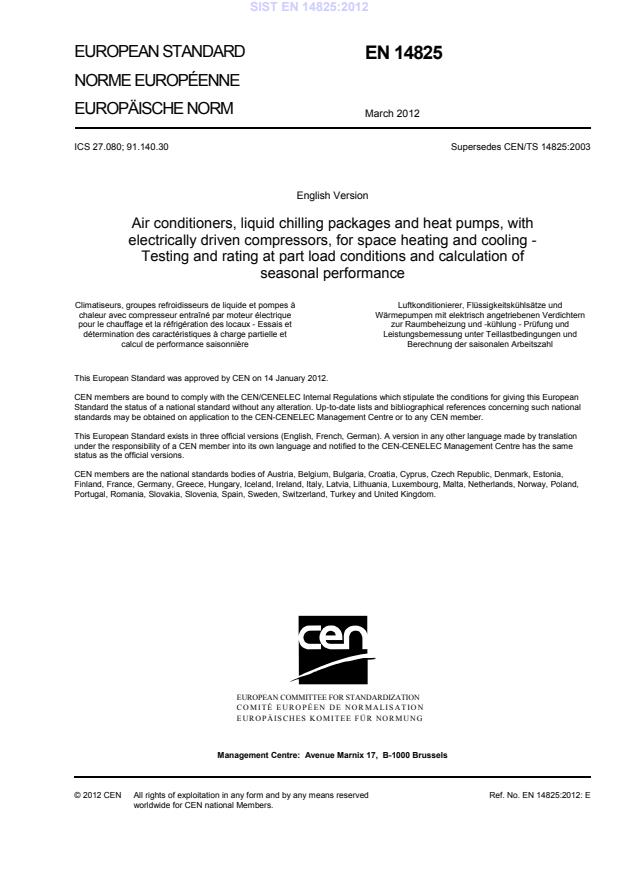
EUROPEAN STANDARD NORME EUROPÉENNE EUROPÄISCHE NORM
EN 14825
March 2012 ICS 27.080; 91.140.30 Supersedes CEN/TS 14825:2003English Version
Air conditioners, liquid chilling packages and heat pumps, with electrically driven compressors, for space heating and cooling - Testing and rating at part load conditions and calculation of seasonal performance
Climatiseurs, groupes refroidisseurs de liquide et pompes à chaleur avec compresseur entraîné par moteur électrique pour le chauffage et la réfrigération des locaux - Essais et détermination des caractéristiques à charge partielle et calcul de performance saisonnière
Luftkonditionierer, Flüssigkeitskühlsätze und Wärmepumpen mit elektrisch angetriebenen Verdichtern zur Raumbeheizung und -kühlung - Prüfung und Leistungsbemessung unter Teillastbedingungen und Berechnung der saisonalen Arbeitszahl This European Standard was approved by CEN on 14 January 2012.
CEN members are bound to comply with the CEN/CENELEC Internal Regulations which stipulate the conditions for giving this European Standard the status of a national standard without any alteration. Up-to-date lists and bibliographical references concerning such national standards may be obtained on application to the CEN-CENELEC Management Centre or to any CEN member.
This European Standard exists in three official versions (English, French, German). A version in any other language made by translation under the responsibility of a CEN member into its own language and notified to the CEN-CENELEC Management Centre has the same status as the official versions.
CEN members are the national standards bodies of Austria, Belgium, Bulgaria, Croatia, Cyprus, Czech Republic, Denmark, Estonia, Finland, France, Germany, Greece, Hungary, Iceland, Ireland, Italy, Latvia, Lithuania, Luxembourg, Malta, Netherlands, Norway, Poland, Portugal, Romania, Slovakia, Slovenia, Spain, Sweden, Switzerland, Turkey and United Kingdom.
EUROPEAN COMMITTEE FOR STANDARDIZATION
COMITÉ EUROPÉEN DE NORMALISATION EUROPÄISCHES KOMITEE FÜR NORMUNG
Management Centre:
Avenue Marnix 17,
B-1000 Brussels © 2012 CEN All rights of exploitation in any form and by any means reserved worldwide for CEN national Members. Ref. No. EN 14825:2012: ESIST EN 14825:2012
Calculation example for reference SEERon and reference SEER –Application of an air-to-air unit with variable capacity . 58A.1 Calculation of SEERon . 58A.2 Calculation of SEER . 59A.2.1 Calculation of reference annual cooling demand (Qc) according to Equation (2) . 59A.2.2 Calculation of reference SEER according to Equation (1) . 59Annex B (informative)
Calculation example for reference SCOPon and reference SCOPnet of a fixed capacity air-to-water heat pump used for floor heating . 60Annex C (informative)
Adaption of water temperature for fixed capacity units . 64Annex D (informative)
Determination of reference annual cooling/heating demands and determination of hours for active mode, thermostat off, standby, off mode and crankcase heater mode . 67D.1 General track . 67D.2 Determination of reference annual cooling/heating demands and hours for active mode, thermostat off, standby, off mode . 67D.3 Hours used for crankcase heater mode . 69Annex E (informative)
Compensation method for air-to-water and water/brine-to-water units . 70E.1 General . 70E.2 Compensation system for reduced capacity test in cooling mode . 70E.3 Compensation system for reduced capacity test in heating mode . 71Bibliography . 72 SIST EN 14825:2012
Part 1: Terms and definitions EN 14511-2, Air conditioners, liquid chilling packages and heat pumps with electrically driven compressors for space heating and cooling
Part 2: Test conditions EN 14511-3:2011, Air conditioners, liquid chilling packages and heat pumps with electrically driven compressors for space heating and cooling
Part 3: Test methods 3 Terms, definitions, symbols, abbreviated terms and units 3.1 Terms and definitions For the purposes of this document, the terms and definitions given in EN 14511-1:2011 (unless otherwise stated) and the following apply. 3.1.1 reference design conditions for cooling Tdesignc temperature conditions at 35 ºC dry bulb (24 ºC wet bulb) outdoor temperature and 27 ºC dry bulb (19 ºC wet bulb) indoor temperature 3.1.2 reference design conditions for heating Tdesignh temperature conditions for average, colder and warmer climates Note 1 to entry: average = -10ûC, colder = -22ûC, warmer = 2ûC SIST EN 14825:2012
Note 1 to entry: It is possible to calculate the SEER/SEERon or SCOP/SCOPon/SCOPnet of a unit for more than one Pdesign value. Note 2 to entry: Expressed in kW. 3.1.4 part load cooling or heating load of the building which is less than the full load 3.1.5 part load ratio part load or full load divided by the full load Note 1 to entry: If 100 % part load ratio is mentioned, this equals full load. 3.1.6 declared capacity DC cooling (or heating) capacity a unit can deliver at any temperature condition A, B, C, D, E or F, as declared by the manufacturer Note 1 to entry: This is the capacity delivered by the refrigerant cycle of the unit without supplementary electric heaters, even if those are integrated in the unit. Note 2 to entry: The temperature conditions for part load conditions A, B, C, D, E or F are explained in the tables. 3.1.7 capacity ratio CR cooling (or heating) part load or full load divided by the declared cooling (or heating) capacity of the unit at the same temperature conditions 3.1.8 reference cooling season representative climate profile by temperature bins for cooling corresponding to the reference design conditions for cooling Note 1 to entry: The climate profile for cooling is explained in Table 36. 3.1.9 reference heating season(s) representative climate profile(s) by temperature bins for heating corresponding to the reference design conditions for heating Note 1 to entry: There are three reference heating seasons: “A” average, “C” colder and “W” warmer. The climate profiles for heating are explained in Table 37. SIST EN 14825:2012
3.1.12 operation limit temperature TOL lowest outdoor temperature at which the heat pump can still deliver heating capacity, as declared by the manufacturer 3.1.13 reference annual cooling demand Qc representative annual cooling demand which is used for the calculation of reference SEER Note 1 to entry: For certain types of units, Qce is calculated by multiplying the full load value in cooling (Pdesignc) by the number of equivalent cooling hours. This is explained in Annex D. Note 2 to entry: The representative annual cooling demand is based on an estimated average use pattern. This is explained in Annex D.
Note 3 to entry: Expressed in kWh. 3.1.14 reference annual heating demand(s) Qh representative annual heating demand(s) which are used for the calculation of reference SCOP Note 1 to entry: There are three reference heating demands: “A” average, “C” colder and “W” warmer, corresponding to the three reference heating seasons. Note 2 to entry: For certain types of units, Qh is calculated by multiplying the full load value in heating (Pdesignh) by the number of equivalent heating hours. This is explained in Annex D. Note 3 to entry: The representative annual heating demand is based on an estimated average use pattern. This is explained in Annex D.
Note 4 to entry: Expressed in kWh. SIST EN 14825:2012
Note 1 to entry: Expressed in kW/kW, see Tables 2 to 5. 3.1.16 energy efficiency ratio at part load EERPL cooling capacity at part load or full load conditions divided by the effective power input of a unit at specific temperature conditions
Note : to entry: The EER includes degradation losses when the declared capacity of the unit is higher than the cooling capacity demand. Note 2 to entry: Expressed in kW/kW. 3.1.17 coefficient of performance at declared capacity COPDC declared heating capacity of the unit divided by the effective power input of a unit at specific temperature conditions, A, B, C, D, E and F, where applicable.
Note 1 to entry: Expressed in kW/kW. 3.1.18 coefficient of performance at part load COPPL heating capacity at part load or full load divided by the effective power input of a unit at specific temperature conditions
Note 1 to entry: When the declared capacity of the unit is higher than the heating demand, the COP includes degradation losses. When the declared capacity of the unit is lower than the heating demand (i.e. below the bivalent temperature condition), the COP of the declared capacity is used. Note 2 to entry: Expressed in kW/kW. 3.1.19 seasonal energy efficiency ratio SEER seasonal efficiency of a unit calculated for the reference annual cooling demand, which is determined from mandatory conditions given in this European Standard and used for marking, comparison and certification purposes
Note 1 to entry: For calculation of SEER, the electricity consumption of a unit is used, including the electricity consumption during active mode, thermostat off mode, standby mode and that of the crankcase heater. Note 2 to entry: Expressed in kWh/kWh. SIST EN 14825:2012
Note 1 to entry: For calculation of SEERon, the electricity consumption during active mode is used. This excludes the power consumption during thermostat off mode, standby mode or that of the crank case heater. Note 2 to entry: Expressed in kWh/kWh. 3.1.21 seasonal coefficient of performance SCOP seasonal efficiency of a unit calculated for the reference annual heating demand(s), which is determined from mandatory conditions given in this European Standard and used for marking, comparison and certification purposes
Note 1 to entry: For calculation of SCOP, the electricity consumption of a unit is used, including the power consumption during active mode, thermostat off mode, standby mode, that of the crankcase heater and where required that of an additional electric back up heater, regardless whether this back up heater is included in the unit or not. Note 2 to entry: Expressed in kWh/kWh. 3.1.22 active mode coefficient of performance SCOPon seasonal efficiency of a unit in active heating mode which is determined from mandatory conditions given in this European Standard and used for marking, comparison and certification purposes
Note 1 to entry: For calculation of SCOPon, the electricity consumption during active mode is used. This excludes the power consumption during thermostat off mode, standby mode or that of the crank case heater. The power consumption of an electric back up heater is added for the part load conditions where the declared capacity of the unit is lower than the heating load, regardless whether this back up heater is included in the unit or not. Note 2 to entry: Expressed in kWh/kWh. 3.1.23 Net seasonal coefficient of performance SCOPnet seasonal efficiency of a unit in active heating mode without supplementary electric heaters which is determined from mandatory conditions given in this European Standard and used for marking, comparison and certification purposes
Note 1 to entry: For calculation of SCOPnet, the electricity consumption during active mode is used. This excludes the power consumption during thermostat off mode, standby mode or that of the crank case heater. For the part load conditions where the declared capacity of the unit is lower than the heating load, the power consumption of a back up heater is not included.
Note 2 to entry: Expressed in kWh/kWh. 3.1.24 electric back up heater elbu supplementary electric heater, with a COP of 1, considered in the calculation of SCOP and SCOPon, regardless of whether this is supplied together with the unit SIST EN 14825:2012
Symbols, abbreviated terms and units (1 of 2) Symbol and abbreviated terms Denomination Units A Average Climate
C Colder Climate
Cc Degradation Coefficient for air-to-water or water/brine units
Cd Degradation Coefficient for air-to-air or water/brine-to-air units
COPDC Coefficient of Performance at the declared capacity kW/kW COPPL Coefficient of Performance at Part LoadTj kW/kW COP(Tj) Coefficient of Performance at the corresponding Bin Temperature kW/kW CR Capacity Ratio kW/kW DC Declared Capacity kW EERDC Energy Efficiency Ratio at the Declared Capacity kW/kW EERPL Energy Efficiency Ratio at Part Load kW/kW EER(Tj) Energy Efficiency Ratio at the corresponding Bin Temperature kW/kW elbu Electric Back Up Heater kW SIST EN 14825:2012
Symbols, abbreviated terms and units (2 of 2) Hj Bin Hours h Hce Equivalent cooling hours h Hhe Equivalent heating hours h HCK Hours of use in the crank case heater mode h HOFF Hours of use in the off mode h HTO Hours of use in the thermostat off mode h HSB Hours of use in the standby mode h PCK Power consumption in the crank case heater mode kW POFF Power consumption in the off mode kW PSB Power consumption in the standby mode kW PTO Power consumption in the thermostat off mode kW Pdesign Full Load kW Pdesignc Full Load Cooling kW Pdesignh Full Load Heating kW Ph(Tj) Heating demand of the building for the corresponding temperature Tj kW Pc Cooling demand kWh Ph Heating demand kWh QCE Reference Annual Cooling Demand kWh QHE Reference Annual Heating Demand kWh SCOP Seasonal Coefficient of Performance kW/kW SCOPnet Seasonal Coefficient of Performance in the active mode without backup heater kW/kW SCOPon Seasonal Coefficient of Performance in active mode kWh/kWh SEER Seasonal Energy Efficiency Ratio kW/kW SEERon Seasonal Energy Efficiency Ratio in the active mode kW/kW Tbivalent Bivalent Temperature ºC Tdesign Reference Design Temperature Conditions ºC Tdesignc Reference Design Temperature Conditions for cooling ºC Tdesignh Reference Design Temperature Conditions for heating ºC Tj Bin Temperature ºC TOL Operation Limit Temperature ºC W Warmer Climate
Part load conditions for reference SEER and reference SEERon calculation of air-to-air units
Part load ratio Part load ratio Outdoor air dry bulb temperature Indoor air dry bulb (wet bulb) temperatures
% °C °C A (35-16)/(Tdesignc -16) 100
35 27(19) B (30-16)/(Tdesignc -16) 74
30 27(19) C (25-16)/(Tdesignc -16) 47
25 27(19) D (20-16)/(Tdesignc -16) 21
20 27(19)
4.3 Water-to-air units and brine-to-air units The part load conditions for determining the reference SEER (Equation (1)) and reference SEERon (Equation (3)) are given in the following table. Table 3
Part load conditions for reference SEER and reference SEERon calculation of water-to-air and brine-to-air units
Part load ratio Part load ratio Outdoor heat exchanger Indoor heat exchanger Cooling tower b or water loop application Inlet/outlet water temperatures Ground coupled application (water or brine)Inlet/outlet water temperatures Dry cooler application Inlet/outlet water temperatures Air dry bulb (wet bulb) temperatures
% °C °C °C °C A (35-16)/(Tdesignc -16) 100
30 / 35 10 / 15 50 / 45 27(19) B (30-16)/(Tdesignc -16) 74
26 / a 10 / a 45 / a 27(19) C (25-16)/(Tdesignc -16) 47
22 / a 10 / a 40 / a 27(19) D (20-16)/(Tdesignc -16) 21
18 / a 10 / a 35 / a 27(19) a With the water flow rate as determined during the “A” test. b If a cooling tower and a water-to-air unit are sold as a matched assembly, they shall be tested as an air-to-air unit.
Part load conditions for reference SEER and reference SEERon calculation of air-to-water units
Part load ratio Part load ratio Outdoor heat exchanger Indoor heat exchanger Air dry bulb temperature Fan coil application Inlet/outlet water temperatures Cooling floor application Inlet/outlet water temperatures Fixed outlet Variable outlet
% °C °C °C °C A (35-16)/(Tdesignc -16) 100
35 12 / 7 12 / 7 23 / 18 B (30-16)/(Tdesignc -16) 74
30 a / 7 a / 8,5 a / 18 C (25-16)/(Tdesignc -16) 47
25 a / 7 a / 10
a / 18 D (20-16)/(Tdesignc -16) 21
20 a / 7 a / 11,5 a / 18 a With the water flow rate as determined during “A” test for units with a fixed water flow rate or with a fixed delta T of 5 K for units with a variable water flow rate.
For units that have to cycle on/off to reach the required part load ratio, the temperature of the inlet shall be fixed according to the Equation (13) in 8.4.1. 4.5 Water-to-water and brine-to-water units For each application, units either allowing or not allowing a variation of the outlet water temperature with the outdoor temperature are considered. The variable outlet temperature shall only be applied when the control provides an outdoor air temperature dependant modification of the outlet temperature. The part load conditions for determining the reference SCOP (Equation (7)), reference SCOPon (Equation (9)) and reference SCOPnet (Equation (10)) are given in the following tables: The part load conditions for determining the reference SEER (Equation (1)) and reference SEERon (Equation (3)) are given in the following table. SIST EN 14825:2012
Part load conditions for reference SEER and reference SEERon calculation for water-to-water units and brine-to-water units
Part load ratio Part load ratio Outdoor heat exchanger Indoor heat exchanger Cooling tower b application Inlet/outlet water temperatures Ground coupled application (water or brine) Inlet/outlet water temperatures Dry cooler application Inlet/outlet water temperatures Fan coil application Inlet/outlet water temperatures Cooling floor application Inlet/outlet water temperatures Fixed outlet Variable outlet
% °C °C °C °C °C °C A (35-16)/ (Tdesignc -16) 100
30 / 35 10 / 15 50 / 45 12 / 7 12 / 7 23 / 18 B (30-16)/ (Tdesignc -16) 74
26 / a 10 / a 45 / a a / 7 a / 8,5 a / 18 C (25-16)/ (Tdesignc -16) 47
22 / a 10 / a 40 / a a / 7 a / 10 a / 18 D (20-16)/ (Tdesignc -16) 21
18 / a 10 / a 35 / a a / 7 a / 11,5 a / 18 a With the water flow rate as determined during “A” test for units with a fixed water flow rate or with a fixed delta T of 5 K for units with a variable water flow rate. b If a cooling tower and water-to-air unit are sold as a matched assembly, they shall be tested as an air-to-air unit.
For units that have to cycle on/off to reach the required part load ratio, the inlet temperature of the indoor heat exchanger should be fixed according to the Equation (13) in 8.4.1. 5 Part load conditions in heating mode 5.1 General For the purpose of calculation of application SCOP and reference SCOP / SCOPon / SCOPnet as explained in Clause 7, the part load ratios mentioned below should be based on the part load ratio formulas (1st column of Tables 6 to 35) and not on the rounded figures as mentioned in the 2nd column of these tables. For the purpose of reference SCOP and reference SCOPon / SCOPnet, there are three reference conditions: average (A), warmer (W) and colder (C). The relevant Tdesignh values are defined as follows: Tdesign “average” dry bulb temperature conditions at -10 ºC outdoor temperature and 20 ºC indoor temperature; Tdesign “colder” dry bulb temperature conditions at -22 ºC outdoor temperature and 20 ºC indoor temperature ; Tdesign “warmer” dry bulb temperature conditions at +2 ºC outdoor temperature and 20 ºC indoor temperature, SIST EN 14825:2012
Part load conditions for reference SCOP, reference SCOPon and reference SCOPnet calculation of air-to-air units for the reference heating season “A” = average
A Outdoor air dry bulb (wet bulb) temperatures Indoor air dry bulb temperature Part load ratio Part load ratio
% °C °C A (-7-16)/(Tdesignh -16) 88 -7(-8) 20 B (+2-16)/(Tdesignh -16) 54 2(1) 20 C (+7-16)/(Tdesignh -16) 35 7(6) 20 D (+12-16)/(Tdesignh -16) 15 12(11) 20 E (TOL-16)/(Tdesignh -16) TOL 20 F (Tbivalent-16)/(Tdesignh -16) Tbivalent 20
Table 7
Part load conditions for reference SCOP, reference SCOPon and reference SCOPnet calculation of air-to-air units for the reference heating season “W” = warmer
W Outdoor air dry bulb (wet bulb) temperatures Indoor air dry bulb temperature
Part load ratio Part load ratio
% °C °C A (not applicable)
B (+2-16)/(Tdesignh -16) 100 2(1) 20 C (+7-16)/(Tdesignh -16) 64 7(6) 20 D (+12-16)/(Tdesignh -16) 29 12(11) 20 E (TOL-16)/(Tdesignh -16) TOL 20 F (Tbivalent-16)/(Tdesignh -16) Tbivalent 20
Part load conditions for reference SCOP, reference SCOPon and reference SCOPnet calculation of air-to-air units for the reference heating season “C” = colder
C Outdoor air dry bulb (wet bulb) temperatures Indoor air dry bulb temperature Part load ratio Part load ratio
% °C °C A (-7-16)/(Tdesignh -16) 61 -7(-8) 20 B (+2-16)/(Tdesignh -16) 37 2(1) 20 C (+7-16)/(Tdesignh -16) 24 7(6) 20 D (+12-16)/(Tdesignh -16) 11 12(11) 20 E (TOL-16)/(Tdesignh -16) TOL 20 F (Tbivalent-16)/(Tdesignh -16) Tbivalent 20
5.3 Water-to-air and brine-to-air units The part load conditions for determining the reference SCOP (Equati
...
Questions, Comments and Discussion
Ask us and Technical Secretary will try to provide an answer. You can facilitate discussion about the standard in here.
Loading comments...