

oSIST prEN IEC 63478-3:2025
(Main)User’s quality of experience (QoE) on multimedia conferencing services - Part 3: Measurement methods
- Status
- Not Published
- Public Enquiry End Date
- 29-Sep-2025
- Technical Committee
- AVM - Audio, video and multimedia systems and equipment
- Current Stage
- 4020 - Public enquire (PE) (Adopted Project)
- Start Date
- 29-Jul-2025
- Due Date
- 16-Dec-2025
- Completion Date
- 15-Oct-2025

oSIST prEN IEC 63478-3:2025 is the Slovenian standard identical to prEN IEC 63478-3:2025, published by SIST. It specifies measurement methods for user’s Quality of Experience (QoE) on multimedia conferencing services. The document is aimed at service providers, developers, testers, and evaluators who need a common way to measure video, audio, synchronization, accessibility, interoperability, participation, openness, and UI/UX.
What does oSIST prEN IEC 63478-3:2025 specify?
oSIST prEN IEC 63478-3:2025 describes the measurement methods for QoE parameters on multimedia conferencing services. In practice, it tells readers how to assess the user experience with a mix of subjective feedback, objective technical measurements, and hybrid methods.
The document is organized into these main parts:
- Clause 1 Scope
- Clause 2 Normative references
- Clause 3 Terms and definitions
- Clause 4 Design approach for QoE measurement
- Clause 5 QoE measurement model
- Clause 6 Measurement of QoE parameters
- Clause 7 Functional operations for QoE measurement
- Clause 8 Presentation of QoE measurement results
- Annex A, an informative example of QoE measurement for multimedia conferencing services
Annex A is an example case, not a requirements section. It shows how the methods can be applied in a real measurement exercise.
What are the key requirements of oSIST prEN IEC 63478-3:2025?
Clause 4 - choose the measurement approach to fit the QoE factor
oSIST prEN IEC 63478-3:2025 separates QoE measurement into subjective, objective, and hybrid approaches. That matters because not every QoE factor is best measured the same way.
- Subjective measurement collects user feedback directly, for example through surveys, interviews, diaries, or ratings.
- Objective measurement uses technical data such as delay, jitter, packet loss, bitrate, and other measurable service or device parameters.
- Hybrid measurement combines both, which is useful when user perception and technical performance both affect the result.
In practice, this clause helps a reader decide whether a parameter should be rated by users, captured by tools, or measured by both.
Clause 5 - use a measurement model that matches the service situation
oSIST prEN IEC 63478-3:2025 presents three models for organizing QoE measurement:
- Timeline rating model - measures QoE before, during, and after the conference
- Common survey model - uses a service-side view plus user rating scales
- Honeycomb model - evaluates seven service attributes
This matters because different measurement questions need different timing and structure. For example, pre-conference factors can include user age, device type, purpose of use, and communication environment, while in-conference factors can focus on video, audio, and network status.
Clause 6 - measure QoE by service area, not as one single score
oSIST prEN IEC 63478-3:2025 groups QoE into service areas and then into individual parameters. The main areas are:
- Video quality
- Audio quality
- Synchronization
- Accessibility
- Interoperability
- Participation
- Openness
- UI/UX
This clause matters in practice because it prevents a service team from treating QoE as a single vague number. Instead, it points to the specific areas that affect user satisfaction.
Examples of what the document measures include:
- video visual clarity and latency
- audio clarity, noise, latency, dynamic range, and echo cancellation
- synchronization accuracy, adaptivity, and consistency
- accessibility support, compatibility with assistive devices, and captioning/transcription
- cross-platform compatibility, integration with other services, and security
- user group size and collaboration tools
- transparency and Open API/SDK
- intuitive design, consistency across platforms, customizability, and feedback/notifications
Table 2 classifies these factors and shows whether the method is subjective, objective, or hybrid. That helps a reader select the right test method for each service feature.
Clause 7 - run QoE measurement as a controlled process
oSIST prEN IEC 63478-3:2025 divides QoE measurement into initialization, monitoring, evaluation, authentication, and data management. That is important because QoE measurement is not just a survey or a tool run - it is a process.
The document describes interactions between:
- MCC, the multimedia conferencing client
- MCS, the multimedia conferencing server
- QMA, the QoE Measurement Agent
- QMM, the QoE Measurement Manager
In practice, the process starts with initialization, then moves to repeated monitoring, and ends with analysis and reporting. Authentication and data management support secure access, traceability, stored results, and user profile handling.
Clause 8 - present results in a form people can use
oSIST prEN IEC 63478-3:2025 says QoE results can be presented as:
- tables and charts for quantitative reporting
- report-based analysis for qualitative findings
- model-based representation using the Timeline rating model, Honeycomb model, or Common survey model
This matters because a measurement result is only useful if decision-makers can read it. A provider may need charts for trend tracking, while a quality team may need a written analysis and recommendations.
Annex A - apply the methods in an example case
Annex A gives an informative example of hybrid QoE measurement for a multimedia conferencing service. It shows how subjective and objective methods can be combined across pre-conference, during-conference, and post-conference phases, and it illustrates how findings can lead to improvement actions.
What terms does oSIST prEN IEC 63478-3:2025 define?
- API (Application Programming Interface) - A software interface that lets systems connect and exchange functions or data.
- MCC (Multimedia Conferencing Client) - The client side of the conferencing service that participates in initialization, measurement, and user interaction.
- MCS (Multimedia Conferencing Server) - The server side that manages service delivery and communicates with the measurement functions.
- QMA (QoE Measurement Agent) - The function that receives measurement requests and coordinates QoE measurement tasks.
- QMM (QoE Measurement Manager) - The function that receives measured values, analyzes them, and manages the QoE measurement process.
- QoE (Quality of Experience) - The user’s perceived quality of the multimedia conferencing service.
- SDK (Software Development Kit) - A development package that supports integration or extension of the service.
- UI/UX (User Interface / User eXperience) - The visible interaction design and the user’s experience of using the service.
Who uses oSIST prEN IEC 63478-3:2025?
oSIST prEN IEC 63478-3:2025 is used by organizations that build, operate, test, or assess multimedia conferencing services. That includes service providers, software developers, system integrators, quality teams, usability teams, and accessibility teams.
It is also relevant to people working with audio, video and multimedia systems and teleconferencing equipment. In practice, they use it to design QoE surveys, run technical measurements, compare service behavior across platforms, analyze results, and report improvement actions.
Which standards are used with oSIST prEN IEC 63478-3:2025?
- IEC 63478-2 - Provides the requirements that this part measures against.
- IEC TR 63478-1 - Gives the general considerations for measuring user’s QoE in the IEC 63478 series.
- ITU-T P.910 - Gives subjective video quality assessment methods.
- ITU-T P.911 - Gives subjective audiovisual quality assessment methods for multimedia applications.
- ITU-T P.920 - Gives interactive test methods for audiovisual communications.
- IEC 62251 - Covers quality assessment for audio-video communication systems.
- IEC 62312-1-1 - Gives measurement methods for synchronization of audio and video equipment and systems.
- IEC 62312-2 - Gives methods for synchronization of audio and video systems.
What does the oSIST prEN IEC 63478-3:2025 document contain?
The document contains a structured framework for QoE measurement on multimedia conferencing services. It includes a three-part measurement approach, a set of QoE models, a parameter list grouped by service area, and a process flow for initialization, monitoring, evaluation, authentication, and data management.
It also includes several figures and tables that support practical use:
- Figure 1 to Figure 3 show the three QoE models
- Figure 4 to Figure 6 show the service blocks and operational flow
- Table 1 summarizes the Honeycomb model attributes
- Table 2 lists the QoE parameters
- Annex A gives a worked example with test phases, measurement methods, results, and recommendations
For readers, that means the document is not only conceptual. It gives a measurement structure, a classification of what to measure, and an example of how to turn measurements into actionable service improvements.
Relations
- Effective Date
- 22-Sep-2026
Get Certified
Connect with accredited certification bodies for this standard

ANCE
Mexican certification and testing association.

Intertek Slovenia
Intertek testing, inspection, and certification services in Slovenia.

LNE (Laboratoire National de Métrologie et d'Essais)
French national laboratory for metrology and testing.
Sponsored listings
Frequently Asked Questions
oSIST prEN IEC 63478-3:2025 is a draft published by the Slovenian Institute for Standardization (SIST). Its full title is "User’s quality of experience (QoE) on multimedia conferencing services - Part 3: Measurement methods". This standard covers: User’s quality of experience (QoE) on multimedia conferencing services - Part 3: Measurement methods
User’s quality of experience (QoE) on multimedia conferencing services - Part 3: Measurement methods
oSIST prEN IEC 63478-3:2025 is classified under the following ICS (International Classification for Standards) categories: 33.160.60 - Multimedia systems and teleconferencing equipment. The ICS classification helps identify the subject area and facilitates finding related standards.
oSIST prEN IEC 63478-3:2025 has the following relationships with other standards: It is inter standard links to oSIST prEN IEC 63478-2:2025. Understanding these relationships helps ensure you are using the most current and applicable version of the standard.
oSIST prEN IEC 63478-3:2025 is available in PDF format for immediate download after purchase. The document can be added to your cart and obtained through the secure checkout process. Digital delivery ensures instant access to the complete standard document.
Standards Content (Sample)
SLOVENSKI STANDARD
01-september-2025
Kakovost uporabniške izkušnje (QoE) za multimedijske konferenčne storitve - 3.
del: Merilne metode
User’s quality of experience (QoE) on multimedia conferencing services - Part 3:
Measurement methods
Qualité de l'expérience de l'usager (QoE) sur les services de conférence multimédia -
Partie 3: Méthodes de mesurage
Ta slovenski standard je istoveten z: prEN IEC 63478-3:2025
ICS:
33.160.60 Večpredstavni (multimedijski) Multimedia systems and
sistemi in oprema za teleconferencing equipment
telekonference
2003-01.Slovenski inštitut za standardizacijo. Razmnoževanje celote ali delov tega standarda ni dovoljeno.
100/4345/CDV
COMMITTEE DRAFT FOR VOTE (CDV)
PROJECT NUMBER:
IEC 63478-3 ED1
DATE OF CIRCULATION: CLOSING DATE FOR VOTING:
2025-07-18 2025-10-10
SUPERSEDES DOCUMENTS:
100/4300/CD, 100/4338/CC
IEC TC 100 : AUDIO, VIDEO AND MULTIMEDIA SYSTEMS AND EQUIPMENT
SECRETARIAT: SECRETARY:
Japan Ms Mahiru Uehara
OF INTEREST TO THE FOLLOWING COMMITTEES: HORIZONTAL FUNCTION(S):
ASPECTS CONCERNED:
SUBMITTED FOR CENELEC PARALLEL VOTING NOT SUBMITTED FOR CENELEC PARALLEL VOTING
Attention IEC-CENELEC parallel voting
The attention of IEC National Committees, members of
CENELEC, is drawn to the fact that this Committee Draft
for Vote (CDV) is submitted for parallel voting.
The CENELEC members are invited to vote through the
CENELEC online voting system.
This document is still under study and subject to change. It should not be used for reference purposes.
Recipients of this document are invited to submit, with their comments, notification of any relevant patent rights of
which they are aware and to provide supporting documentation.
Recipients of this document are invited to submit, with their comments, notification of any relevant “In Some
Countries” clauses to be included should this proposal proceed. Recipients are reminded that the CDV stage is
the final stage for submitting ISC clauses. (SEE AC/22/2007 OR NEW GUIDANCE DOC).
TITLE:
User’s Quality of Experience (QoE) on Multimedia Conferencing Services - Part 3:
Measurement methods
PROPOSED STABILITY DATE: 2029
NOTE FROM TC/SC OFFICERS:
electronic file, to make a copy and to print out the content for the sole purpose of preparing National Committee positions.
You may not copy or "mirror" the file or printed version of the document, or any part of it, for any other purpose without
permission in writing from IEC.
IEC CDV 63478-3 © IEC 2025
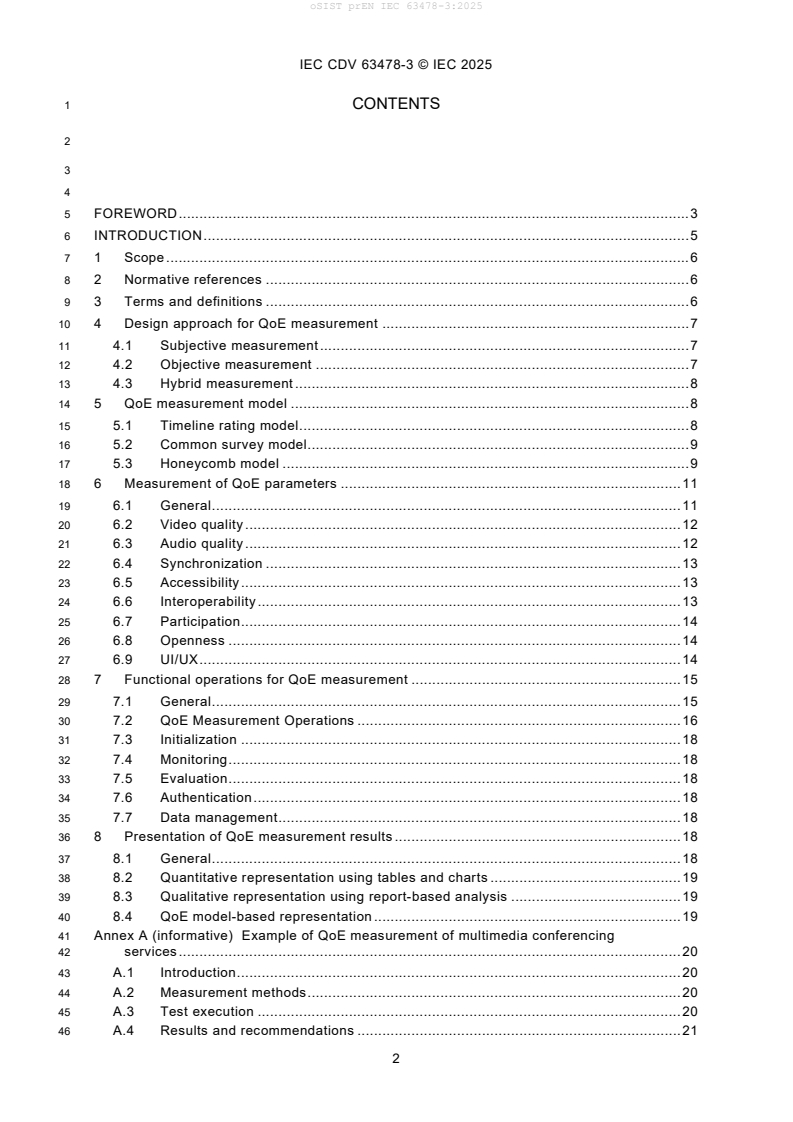
1 CONTENTS
5 FOREWORD . 3
6 INTRODUCTION . 5
7 1 Scope . 6
8 2 Normative references . 6
9 3 Terms and definitions . 6
10 4 Design approach for QoE measurement . 7
11 4.1 Subjective measurement . 7
12 4.2 Objective measurement . 7
13 4.3 Hybrid measurement . 8
14 5 QoE measurement model . 8
15 5.1 Timeline rating model . 8
16 5.2 Common survey model. 9
17 5.3 Honeycomb model . 9
18 6 Measurement of QoE parameters . 11
19 6.1 General . 11
20 6.2 Video quality . 12
21 6.3 Audio quality . 12
22 6.4 Synchronization . 13
23 6.5 Accessibility . 13
24 6.6 Interoperability . 13
25 6.7 Participation . 14
26 6.8 Openness . 14
27 6.9 UI/UX . 14
28 7 Functional operations for QoE measurement . 15
29 7.1 General . 15
30 7.2 QoE Measurement Operations . 16
31 7.3 Initialization . 18
32 7.4 Monitoring . 18
33 7.5 Evaluation . 18
34 7.6 Authentication . 18
35 7.7 Data management . 18
36 8 Presentation of QoE measurement results . 18
37 8.1 General . 18
38 8.2 Quantitative representation using tables and charts . 19
39 8.3 Qualitative representation using report-based analysis . 19
40 8.4 QoE model-based representation . 19
41 Annex A (informative) Example of QoE measurement of multimedia conferencing
42 services . 20
43 A.1 Introduction . 20
44 A.2 Measurement methods . 20
45 A.3 Test execution . 20
46 A.4 Results and recommendations . 21
IEC CDV 63478-3 © IEC 2025
47 A.5 Conclusion . 21
48 Bibliography . 22
50 Figure 1 – Timeline rating model . 7
51 Figure 2 – Simple survey example of Common Survey model . 8
52 Figure 3 – Honeycomb model . 9
53 Figure 4 – QoE measurement service functional blocks . 14
54 Figure 5 – Interworking between functional entities for QoE measurement . 15
55 Figure 6 – Operational flows for QoE measurement . 16
57 Table 1 – Attributes of Honeycomb model . 8
58 Table 2 – List of QoE parameters. 10
59 Table A.1 – QoE factors and measurement methods . 19
IEC CDV 63478-3 © IEC 2025
62 INTERNATIONAL ELECTROTECHNICAL COMMISSION
63 ____________
65 USER’S QUALITY OF EXPERIENCE ON MULTIMEDIA CONFERENCING
66 SERVICES
68 Part 3: Measurement methods
72 FOREWORD
73 1) The International Electrotechnical Commission (IEC) is a worldwide organization for standardization comprising
74 all national electrotechnical committees (IEC National Committees). The object of IEC is to promote international
75 co-operation on all questions concerning standardization in the electrical and electronic fields. To this end and
76 in addition to other activities, IEC publishes International Standards, Technical Specifications, Technical Reports,
77 Publicly Available Specifications (PAS) and Guides (hereafter referred to as "IEC Publication(s)"). Their
78 preparation is entrusted to technical committees; any IEC National Committee interested in the subject dealt with
79 may participate in this preparatory work. International, governmental and non-governmental organizations liaising
80 with the IEC also participate in this preparation. IEC collaborates closely with the International Organization for
81 Standardization (ISO) in accordance with conditions determined by agreement between the two organizations.
82 2) The formal decisions or agreements of IEC on technical matters express, as nearly as possible, an international
83 consensus of opinion on the relevant subjects since each technical committee has representation from all
84 interested IEC National Committees.
85 3) IEC Publications have the form of recommendations for international use and are accepted by IEC National
86 Committees in that sense. While all reasonable efforts are made to ensure that the technical content of IEC
87 Publications is accurate, IEC cannot be held responsible for the way in which they are used or for any
88 misinterpretation by any end user.
89 4) In order to promote international uniformity, IEC National Committees undertake to apply IEC Publications
90 transparently to the maximum extent possible in their national and regional publications. Any divergence between
91 any IEC Publication and the corresponding national or regional publication shall be clearly indicated in the latter.
92 5) IEC itself does not provide any attestation of conformity. Independent certification bodies provide conformity
93 assessment services and, in some areas, access to IEC marks of conformity. IEC is not responsible for any
94 services carried out by independent certification bodies.
95 6) All users should ensure that they have the latest edition of this publication.
96 7) No liability shall attach to IEC or its directors, employees, servants or agents including individual experts and
97 members of its technical committees and IEC National Committees for any personal injury, property damage or
98 other damage of any nature whatsoever, whether direct or indirect, or for costs (including legal fees) and
99 expenses arising out of the publication, use of, or reliance upon, this IEC Publication or any other IEC
100 Publications.
101 8) Attention is drawn to the Normative references cited in this publication. Use of the referenced publications is
102 indispensable for the correct application of this publication.
103 9) IEC draws attention to the possibility that the implementation of this document may involve the use of (a)
104 patent(s). IEC takes no position concerning the evidence, validity or applicability of any claimed patent rights in
105 respect thereof. As of the date of publication of this document, IEC had not received notice of (a) patent(s), which
106 may be required to implement this document. However, implementers are cautioned that this may not represent
107 the latest information, which may be obtained from the patent database available at https://patents.iec.ch. IEC
108 shall not be held responsible for identifying any or all such patent rights.
109 IEC 63478-3 has been prepared by subcommittee WG 11: USER’S QUALITY OF EXPERIENCE
110 (QoE) ON MULTIMEDIA CONFERENCING SERVICES, of IEC technical committee TC 100:
111 AUDIO, VIDEO AND MULTIMEDIA SYSTEMS AND EQUIPMENT. It is an International
112 Standard.
113 The text of this International Standard is based on the following documents:
Draft Report on voting
XX/XX/FDIS XX/XX/RVD
IEC CDV 63478-3 © IEC 2025
115 Full information on the voting for its approval can be found in the report on voting indicated in
116 the above table.
117 The language used for the development of this International Standard is English.
118 This document was drafted in accordance with ISO/IEC Directives, Part 2, and developed in
119 accordance with ISO/IEC Directives, Part 1 and ISO/IEC Directives, IEC Supplement available
120 at www.iec.ch/members_experts/refdocs. The main document types developed by IEC are
121 described in greater detail at www.iec.ch/publications.
122 The committee has decided that the contents of this document will remain unchanged until the
123 stability date indicated on the IEC website under webstore.iec.ch in the data related to the
124 specific document. At this date, the document will be
125 • reconfirmed,
126 • withdrawn,
127 • replaced by a revised edition, or
128 • amended.
IEC CDV 63478-3 © IEC 2025
130 INTRODUCTION
131 With the global COVID-19 pandemic, the meetings on business and education have shifted from
132 offline to online modes. Consequently, a range of multimedia conferencing services has been
133 developed, enabling users to choose and enjoy conferencing services based on personal
134 preferences. To ensure optimal user experience, it is essential to measure the Quality of
135 Experience (QoE) for multimedia conferencing services. However, there is currently a lack of
136 standardized methods for measuring a user's QoE in this context. Thus, there is a pressing
137 need to provide guidelines for measuring and evaluating a user's QoE for multimedia
138 conferencing services.
139 Traditionally, Quality of Service (QoS) has been measured for network data communication,
140 represented by objective index values like delay, throughput, and jitter. In contrast, QoE
141 represents a user's level of satisfaction with a specific service and reflects human emotional
142 quality. As such, QoE is subject to overall service performance from the user's perspective. In
143 the case of multimedia conferencing services, measuring QoE is challenging due to varying
144 user preferences/requirements and service/application characteristics. Therefore, a unified
145 framework is necessary to measure and evaluate a user's QoE for multimedia conferencing
146 services.
147 This document (IEC 63478) aims to provide guidelines for enhancing a user's QoE for
148 multimedia conferencing services. The series specifies general considerations and
149 requirements to enhance a user's QoE and measurement methods for associated QoE
150 parameters.
151 The IEC 63478 consists of the following parts:
152 - Part 1: General;
153 - Part 2: Requirements; and
154 - Part 3: Measurement methods.
155 Part 1 of IEC 63478-1 (Technical Report) describes general considerations to measure user's
156 QoE.
157 Part 2 of IEC 63478-2 (International Standard) describes the requirements to be considered to
158 measure user's QoE.
159 Part 3 of IEC 63478-3 (International Standard) describes the measurement methods for QoE
160 parameters.
IEC CDV 63478-3 © IEC 2025
162 USER’S QUALITY OF EXPERIENCE ON MULTIMEDIA CONFERENCING
163 SERVICES
165 Part 3: Measurement methods
169 1 Scope
170 This part of IEC 63478-3 describes the measurement methods for user’s Quality of Experience
171 (QoE) parameters on multimedia conferencing services.
172 2 Normative references
173 The following documents are referred to in the text in such a way that some or all of their content
174 constitutes requirements of this document. For dated references, only the edition cited applies.
175 For undated references, the latest edition of the referenced document (including any
176 amendments) applies.
177 IEC 63478-2, User’s Quality of Experience (QoE) on Multimedia Conferencing Services – Part
178 2: Requirements
179 3 Terms and definitions
180 For the purposes of this document, the following terms and definitions apply.
181 ISO and IEC maintain terminology databases for use in standardization at the following
182 addresses:
183 • IEC Electropedia: available at https://www.electropedia.org/
184 • ISO Online browsing platform: available at https://www.iso.org/obp
185 3.1
186 API
187 Application Programming Interface
188 3.2
189 MCC
190 Multimedia Conferencing Client
191 3.3
192 MCS
193 Multimedia Conferencing Server
194 3.4
195 QMA
196 QoE Measurement Agent
197 3.5
198 QMM
199 QoE Measurement Manager
IEC CDV 63478-3 © IEC 2025
200 3.6
201 QoE
202 Quality of Experience
203 3.7
204 SDK
205 Software Development Kit
206 3.8
207 UI/UX
208 User Interface / User eXperience
209 4 Design approach for QoE measurement
210 4.1 Subjective measurement
211 Subjective measurement approach to measure QoE in multimedia conferencing services
212 involves obtaining feedback directly from users about their perception of the quality of the
213 conference. Here are some of the commonly used subjective approach to measure QoE:
214 • Surveys
215 Surveys are a common subjective approach to measure QoE. Participants are asked to rate
216 their overall experience of the multimedia conferencing service, including audio and video
217 quality, ease of use, and reliability.
218 • Focus groups
219 Focus groups are another subjective approach that involves gathering a group of users to
220 discuss their experiences with the multimedia conferencing service. Participants share their
221 opinions, feedback, and suggestions about the service.
222 • Interviews
223 Interviews with individual users provide in-depth insights into their experience with the
224 multimedia conferencing service. Participants provide feedback on specific aspects of the
225 service, such as audio quality, video quality, or user interface.
226 • User diaries
227 User diaries involve asking users to keep a record of their experiences with the multimedia
228 conferencing service over a period of time. Participants record their perceptions of the
229 service, any issues they encounter, and suggestions for improvement.
230 • User ratings
231 User ratings can be obtained by asking users to rate specific aspects of the multimedia
232 conferencing service, such as audio and video quality, ease of use, and reliability. These
233 ratings can be used to calculate an overall QoE score.
234 4.2 Objective measurement
235 The objective measurement approach is a QoE measurement method that uses technical
236 parameters and measurements to evaluate the quality of multimedia services. This approach
237 focuses on quantifiable metrics such as delay, jitter, packet loss, and bitrate to assess the
238 quality of the service.
239 Here are some of the commonly used objective approach to measure QoE:
240 • Objective assessment
241 This approach involves collecting objective data about the service, such as network latency,
242 packet loss, and other technical parameters. This data is then analysed to determine the
243 quality of the service.
244 • QoE metrics
IEC CDV 63478-3 © IEC 2025
245 These are standardized metrics used to measure QoE, such as Mean Opinion Score (MOS),
246 which is a measure of the overall quality of the service based on user ratings.
247 • Behavioural analysis
248 This approach involves analysing user behaviours to determine the quality of the service.
249 For example, user engagement and participation in a meeting can be used as indicators of
250 the quality of the service.
251 • Automated testing
252 This approach involves using automated tools to simulate user behaviour and measure the
253 QoE of the service. This can be useful for testing the service under different network
254 conditions and user scenarios.
255 4.3 Hybrid measurement
256 The hybrid measurement approach combines both subjective and objective measurement
257 approaches to evaluate the QoE of multimedia services. This approach is often used to provide
258 a more accurate and comprehensive evaluation of the QoE, as it combines the benefits of both
259 approaches. The hybrid approach involves collecting both objective and subjective data, then
260 using statistical methods to analyze and compare the data to arrive at a QoE score.
261 5 QoE measurement model
262 5.1 Timeline rating model
263 The timeline rating model is a QoE measurement model that involves measuring QoE parameter
264 values at different stages of multimedia conferencing, namely before, during, and after the
265 conference. It is essential to determine the appropriate timing for each QoE parameter to be
266 measured. Factors such as user age, device type, purpose of use, and communication
267 environment are crucial for QoE measurement before the conference. These factors are
268 gathered before the QoE parameter aggregation service begins and the user starts using the
269 service. During the conference, video quality, audio quality, and network status can be
270 measured. After the conference, the user's overall satisfaction level or opinion can be measured.
272 Figure 1 – Timeline rating model
IEC CDV 63478-3 © IEC 2025
273 5.2 Common survey model
274 In the common survey model, the MCS measures the management information to provide
275 multimedia conferencing services to the MCC. For example, these include service type, the
276 number of users and traffic.
277 On the other hand, the MCC uses the Timeline rating model which is a subjective approach
278 used to measure the quality of multimedia conferencing services. In this model, users are asked
279 to rate the quality of the service on a fixed scale, such as a 5-point or 7-point scale. Users are
280 usually presented with a stimulus, such as a video or audio clip, and are asked to rate the
281 quality of the stimulus based on a specific attribute, such as video quality, audio quality, or
282 overall quality.
284 Figure 2 – Simple survey example of Common Survey model
285 5.3 Honeycomb model
286 The Honeycomb model can be used to evaluate the QoE of a multimedia conferencing service
287 by examining how well it satisfies the following seven attributes as described in Table 1.
288 Table 1 – Attributes of Honeycomb model
Attribute Description
Useful How much the service can give satisfaction in the viewpoint of the service purposes
Usable How much the service can be usable
Findable How much easily users can find the information they want in the service duration
Credible How much the multimedia service can be trusted as a stable service
Desirable How much the service is desirable for users
Accessible How well the service accommodates users with different needs
Valuable How much the service is valuable for users
IEC CDV 63478-3 © IEC 2025
289 By measuring these attributes using various techniques such as surveys, usability testing, user
290 feedback, and analytics, service providers can evaluate the QoE of their multimedia
291 conferencing service and identify areas for improvement.
293 Figure 3 – Honeycomb model
294 • Useful
295 The usefulness of the multimedia conferencing service can be measured by evaluating how
296 well it meets the needs of the users. This can be done through user surveys or by analyzing
297 user behaviours and interaction with the service.
298 • Usable
299 The usability of the service can be measured by evaluating how easy it is for users to
300 navigate and perform tasks within the service. This can be done through usability testing
301 and user feedback.
302 • Findable
303 The findability of the service can be measured by evaluating how easily users can find what
304 they are looking for within the service. This can be done through search engine optimization
305 and user testing.
306 • Credible
307 The credibility of the service can be measured by evaluating the accuracy and
308 trustworthiness of the information and content provided by the service. This can be done
309 through user feedback and third-party reviews.
310 • Desirable
311 The desirability of the service can be measured by evaluating how attractive and appealing
312 it is to users. This can be done through user surveys and aesthetic evaluations.
313 • Accessible
314 The accessibility of the service can be measured by evaluating how well it accommodates
315 users with disabilities and different needs. This can be done through accessibility testing
316 and user feedback.
317 • Valuable
318 The value of the service can be measured by evaluating the benefits that it provides to users.
319 This can be done through user surveys and analysis of user behaviours.
IEC CDV 63478-3 © IEC 2025
320 6 Measurement of QoE parameters
321 6.1 General
322 For QoE measurement, the following QoE parameters are considered in Table 2.
323 Table 2 – List of QoE parameters
QoE parameter QoE factor Type Mandatory/Optional
Visual clarity Hybrid Mandatory
Video quality
Latency Objective Mandatory
Clarity Subjective Mandatory
Noise Subjective Mandatory
Audio quality Latency Objective Mandatory
Dynamic range Objective
Echo cancellation Objective
Accuracy Hybrid Mandatory
Synchronization Adaptive Objective
Consistency Objective
Support for assistive technologies Objective Mandatory
Accessibility Compatibility with assistive devices Objective
Captioning and transcription Objective Mandatory
Cross-platform compatibility Objective Mandatory
Interoperability Integration with other services Objective Mandatory
Security Objective Mandatory
User group size Objective Mandatory
Participation
Collaboration tools Objective Mandatory
Transparency Objective
Openness
Open API/SDK Objective
Intuitive and user-friendly design Subjective Mandatory
Consistency across platforms Hybrid
UI/UX
Customizability Objective
Feedback and notifications Objective Mandatory
324 To measure the user QoE of a multimedia conferencing service, various QoE parameters need
325 to be considered, which are described in detail in Part 2 of the document. An additional
326 consideration for measurement is Type, which refers to the subjective and/or objective
327 approach to measuring a specific QoE factor. Subjective measurements are based on user
328 feedback, while objective measurements are based on quantitative measurements of
329 multimedia conferencing services or whether specific features are provided.
IEC CDV 63478-3 © IEC 2025
330 6.2 Video quality
331 Video quality is a critical factor in multimedia conferencing services, and is determined by the
332 visual clarity of the video stream and the smoothness of the stream relati
...