


SIST EN 1366-10:2022
(Main)Fire resistance tests for service installations - Part 10: Smoke control dampers
Fire resistance tests for service installations - Part 10: Smoke control dampers
This document specifies test methods for smoke control dampers to assess their performance under elevated temperature or fire conditions, as well as at ambient temperatures.
Smoke control damper tests are used to confirm that the furnace testing requirements of EN 12101-8 are met and EN 12101-8 is for consideration before carrying out these tests.
Smoke control dampers tested to this document are expected to be classified using EN 13501-4 and this document is expected to be considered before carrying out these tests.
NOTE Some smoke control dampers to be tested might require testing following the information given in EN 1366-2 and this needs consideration before carrying out testing.
This document is expected to be read in conjunction with EN 12101-8, EN 13501-4, EN 1366-2 and EN 1363-1, the latter giving further details for fire resistance testing.
For installation details, the requirements for smoke extraction ducts are for consideration and these are defined in EN 1366-8 and EN 1366-9.
Feuerwiderstandsprüfungen für Installationen - Teil 10: Entrauchungsklappen
Dieses Dokument legt Prüfverfahren für Entrauchungsklappen zur Beurteilung ihrer Leistung bei erhöhten Temperaturen oder unter Brandbedingungen sowie unter Umgebungstemperaturen fest.
Prüfungen an Entrauchungsklappen werden durchgeführt, um zu beurteilen, ob die Brandschutzanforderungen nach EN 12101 8 erfüllt werden; EN 12101 8 ist vor der Durchführung dieser Prüfungen zu berücksichtigen.
Es wird davon ausgegangen, dass Entrauchungsklappen, die nach diesem Dokument geprüft wurden, nach EN 13501 4 klassifiziert werden. Dieses Dokument ist vor der Durchführung dieser Prüfungen zu berücksichtigen.
ANMERKUNG Einige der zu prüfenden Entrauchungsklappen erfordern möglicherweise eine Prüfung nach den Angaben in EN 1366 2, was vor der Durchführung der Prüfung berücksichtigt werden muss.
Dieses Dokument muss im Zusammenhang mit EN 12101 8, EN 13501 4, EN 1366 2 und EN 1363 1 betrachtet werden, wobei die letztgenannte Norm weitere Einzelheiten zur Prüfung des Feuerwiderstands angibt.
Einzelheiten zum Einbau von Entrauchungsleitungen, die zu berücksichtigen sind, sind in EN 1366 8 und EN 1366 9 festgelegt.
Essais de résistance au feu des installations techniques - Partie 10 : Volets de désenfumage
Le présent document spécifie des méthodes d’essai pour évaluer la performance des volets de désenfumage dans des conditions de température élevée ou d’incendie, ainsi qu’à température ambiante.
Les essais relatifs aux volets de désenfumage sont utilisés pour confirmer que les exigences d’essai de résistance au feu de l’EN 12101-8 sont satisfaites ; dans ce cas, l’EN 12101-8 est à prendre en compte avant de réaliser ces essais.
Il est attendu que les volets de désenfumage soumis aux essais conformément au présent document soient classés conformément à l’EN 13501-4 et que ce document soit pris en compte avant de réaliser les essais.
NOTE Certains volets de désenfumage à soumettre à essai peuvent exiger la réalisation des essais suivant les informations données dans l’EN 1366-2 et il est nécessaire de prendre cela en compte avant d’effectuer les essais.
Le présent document est destiné à être lu conjointement avec l’EN 12101-8, l’EN 13501-4, l’EN 1366-2 et l’EN 1363-1, cette dernière donnant des détails supplémentaires sur les essais de résistance au feu.
Pour les détails concernant l’installation, les exigences applicables aux conduits d’extraction de fumées sont à prendre en compte ; elles sont définies dans l’EN 1366-8 et l’EN 1366-9.
Preskusi požarne odpornosti servisnih inštalacij - 10. del: Dimne lopute
Ta dokument določa preskusne metode za dimne lopute za ocenjevanje njihovega delovanja pri povišanih temperaturah ali v požarnih razmerah.
Upoštevati je treba, da bo dimno loputo morda treba preskusiti v skladu s standardom EN 1366-2, kar je treba upoštevati pred izvedbo teh preskusov.
S preskusi dimnih loput se potrjuje, da so zahteve za preskušanje peči iz standarda EN 12101-8 izpolnjene, pred izvajanjem teh preskusov pa je treba upoštevati standard EN 12101-8.
Pričakuje se, da bodo dimne lopute, preskušene v skladu s tem dokumentom, razvrščene v skladu s standardom EN 13501-4 in da bo pred izvajanjem teh preskusov upoštevan ta dokument.
V ta namen se pričakuje, da se bo ta dokument bral skupaj s standardi EN 12101-8, EN 13501-4, EN 1366-2 in EN 1363-1, pri čemer zadnji podaja dodatne podrobnosti glede preskušanja požarne odpornosti.
Pri podrobnostih glede namestitve je treba upoštevati zahteve za kanale za odvod dima, ki so določene v standardih EN 1366-8 in EN 1366-9.
General Information
- Status
- Withdrawn
- Public Enquiry End Date
- 14-Oct-2020
- Publication Date
- 09-Oct-2022
- Withdrawal Date
- 18-Sep-2024
- Technical Committee
- POZ - Požarna varnost
- Current Stage
- 9900 - Withdrawal (Adopted Project)
- Start Date
- 19-Sep-2024
- Due Date
- 12-Oct-2024
- Completion Date
- 19-Sep-2024
Relations
- Effective Date
- 01-Nov-2022
- Effective Date
- 01-Nov-2024
- Effective Date
- 03-Aug-2022

Frequently Asked Questions
SIST EN 1366-10:2022 is a standard published by the Slovenian Institute for Standardization (SIST). Its full title is "Fire resistance tests for service installations - Part 10: Smoke control dampers". This standard covers: This document specifies test methods for smoke control dampers to assess their performance under elevated temperature or fire conditions, as well as at ambient temperatures. Smoke control damper tests are used to confirm that the furnace testing requirements of EN 12101-8 are met and EN 12101-8 is for consideration before carrying out these tests. Smoke control dampers tested to this document are expected to be classified using EN 13501-4 and this document is expected to be considered before carrying out these tests. NOTE Some smoke control dampers to be tested might require testing following the information given in EN 1366-2 and this needs consideration before carrying out testing. This document is expected to be read in conjunction with EN 12101-8, EN 13501-4, EN 1366-2 and EN 1363-1, the latter giving further details for fire resistance testing. For installation details, the requirements for smoke extraction ducts are for consideration and these are defined in EN 1366-8 and EN 1366-9.
This document specifies test methods for smoke control dampers to assess their performance under elevated temperature or fire conditions, as well as at ambient temperatures. Smoke control damper tests are used to confirm that the furnace testing requirements of EN 12101-8 are met and EN 12101-8 is for consideration before carrying out these tests. Smoke control dampers tested to this document are expected to be classified using EN 13501-4 and this document is expected to be considered before carrying out these tests. NOTE Some smoke control dampers to be tested might require testing following the information given in EN 1366-2 and this needs consideration before carrying out testing. This document is expected to be read in conjunction with EN 12101-8, EN 13501-4, EN 1366-2 and EN 1363-1, the latter giving further details for fire resistance testing. For installation details, the requirements for smoke extraction ducts are for consideration and these are defined in EN 1366-8 and EN 1366-9.
SIST EN 1366-10:2022 is classified under the following ICS (International Classification for Standards) categories: 13.220.50 - Fire-resistance of building materials and elements; 91.060.40 - Chimneys, shafts, ducts; 91.140.30 - Ventilation and air-conditioning systems. The ICS classification helps identify the subject area and facilitates finding related standards.
SIST EN 1366-10:2022 has the following relationships with other standards: It is inter standard links to SIST EN 1366-10:2011+A1:2017, SIST EN 1366-10:2022+A1:2024, SIST EN 1366-10:2022/kFprA1:2024. Understanding these relationships helps ensure you are using the most current and applicable version of the standard.
SIST EN 1366-10:2022 is associated with the following European legislation: EU Directives/Regulations: 305/2011; Standardization Mandates: M/117. When a standard is cited in the Official Journal of the European Union, products manufactured in conformity with it benefit from a presumption of conformity with the essential requirements of the corresponding EU directive or regulation.
SIST EN 1366-10:2022 is available in PDF format for immediate download after purchase. The document can be added to your cart and obtained through the secure checkout process. Digital delivery ensures instant access to the complete standard document.
Standards Content (Sample)
SLOVENSKI STANDARD
01-november-2022
Nadomešča:
SIST EN 1366-10:2011+A1:2017
Preskusi požarne odpornosti servisnih inštalacij - 10. del: Dimne lopute
Fire resistance tests for service installations - Part 10: Smoke control dampers
Feuerwiderstandsprüfungen für Installationen - Teil 10: Entrauchungsklappen
Essais de résistance au feu des installations techniques - Partie 10 : Volets de
désenfumage
Ta slovenski standard je istoveten z: EN 1366-10:2022
ICS:
13.220.50 Požarna odpornost Fire-resistance of building
gradbenih materialov in materials and elements
elementov
91.060.40 Dimniki, jaški, kanali Chimneys, shafts, ducts
2003-01.Slovenski inštitut za standardizacijo. Razmnoževanje celote ali delov tega standarda ni dovoljeno.
EN 1366-10
EUROPEAN STANDARD
NORME EUROPÉENNE
September 2022
EUROPÄISCHE NORM
ICS 13.220.50; 91.140.30 Supersedes EN 1366-10:2011+A1:2017
English Version
Fire resistance tests for service installations - Part 10:
Smoke control dampers
Essais de résistance au feu des installations techniques Feuerwiderstandsprüfungen für Installationen - Teil
- Partie 10 : Volets de désenfumage 10: Entrauchungsklappen
This European Standard was approved by CEN on 24 July 2022.
CEN members are bound to comply with the CEN/CENELEC Internal Regulations which stipulate the conditions for giving this
European Standard the status of a national standard without any alteration. Up-to-date lists and bibliographical references
concerning such national standards may be obtained on application to the CEN-CENELEC Management Centre or to any CEN
member.
This European Standard exists in three official versions (English, French, German). A version in any other language made by
translation under the responsibility of a CEN member into its own language and notified to the CEN-CENELEC Management
Centre has the same status as the official versions.
CEN members are the national standards bodies of Austria, Belgium, Bulgaria, Croatia, Cyprus, Czech Republic, Denmark, Estonia,
Finland, France, Germany, Greece, Hungary, Iceland, Ireland, Italy, Latvia, Lithuania, Luxembourg, Malta, Netherlands, Norway,
Poland, Portugal, Republic of North Macedonia, Romania, Serbia, Slovakia, Slovenia, Spain, Sweden, Switzerland, Türkiye and
United Kingdom.
EUROPEAN COMMITTEE FOR STANDARDIZATION
COMITÉ EUROPÉEN DE NORMALISATION
EUROPÄISCHES KOMITEE FÜR NORMUNG
CEN-CENELEC Management Centre: Rue de la Science 23, B-1040 Brussels
© 2022 CEN All rights of exploitation in any form and by any means reserved Ref. No. EN 1366-10:2022 E
worldwide for CEN national Members.
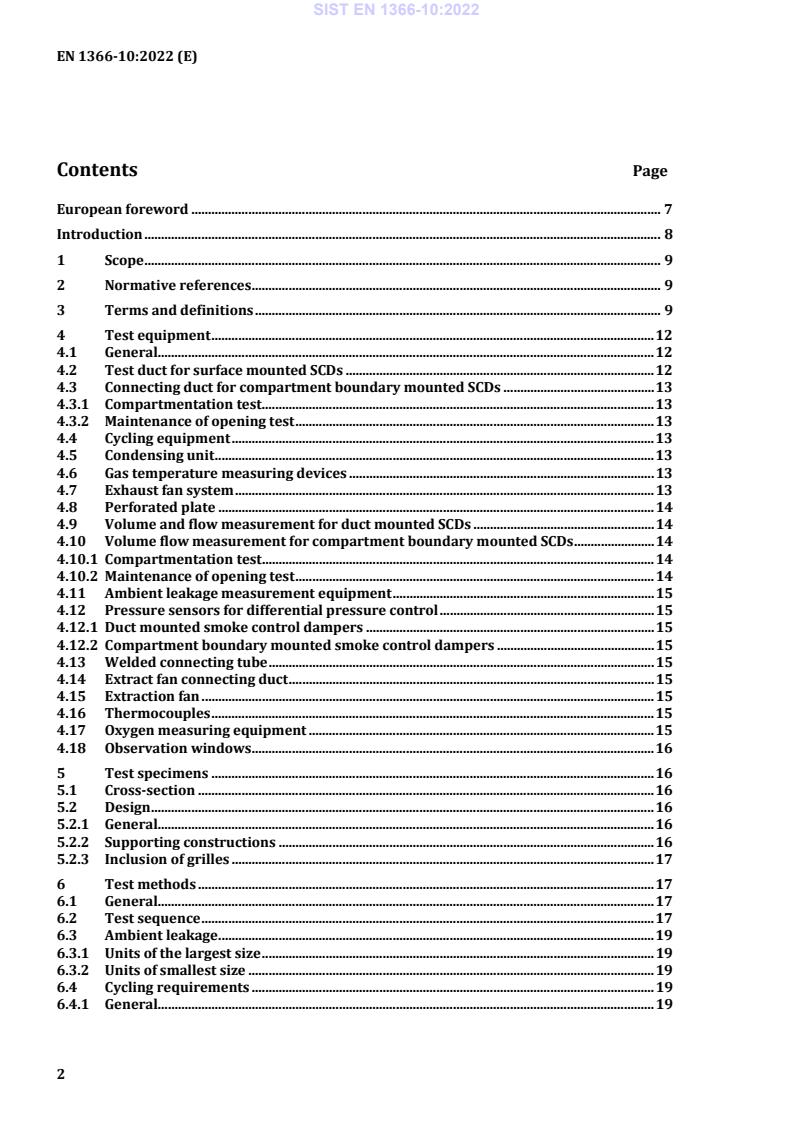
Contents Page
European foreword . 7
Introduction . 8
1 Scope . 9
2 Normative references . 9
3 Terms and definitions . 9
4 Test equipment . 12
4.1 General. 12
4.2 Test duct for surface mounted SCDs . 12
4.3 Connecting duct for compartment boundary mounted SCDs . 13
4.3.1 Compartmentation test . 13
4.3.2 Maintenance of opening test . 13
4.4 Cycling equipment . 13
4.5 Condensing unit . 13
4.6 Gas temperature measuring devices . 13
4.7 Exhaust fan system . 13
4.8 Perforated plate . 14
4.9 Volume and flow measurement for duct mounted SCDs . 14
4.10 Volume flow measurement for compartment boundary mounted SCDs . 14
4.10.1 Compartmentation test . 14
4.10.2 Maintenance of opening test . 14
4.11 Ambient leakage measurement equipment . 15
4.12 Pressure sensors for differential pressure control . 15
4.12.1 Duct mounted smoke control dampers . 15
4.12.2 Compartment boundary mounted smoke control dampers . 15
4.13 Welded connecting tube . 15
4.14 Extract fan connecting duct . 15
4.15 Extraction fan . 15
4.16 Thermocouples . 15
4.17 Oxygen measuring equipment . 15
4.18 Observation windows . 16
5 Test specimens . 16
5.1 Cross-section . 16
5.2 Design . 16
5.2.1 General. 16
5.2.2 Supporting constructions . 16
5.2.3 Inclusion of grilles . 17
6 Test methods . 17
6.1 General. 17
6.2 Test sequence . 17
6.3 Ambient leakage . 19
6.3.1 Units of the largest size . 19
6.3.2 Units of smallest size . 19
6.4 Cycling requirements . 19
6.4.1 General. 19
6.4.2 Smoke control damper to be used in dedicated smoke control systems, operated only
in the case of emergency . 19
6.4.3 Smoke control damper to be used as part of a general HVAC system as well as a smoke
control system, or as part of a smoke control systems that is cycled every day to check
operation . 19
6.4.4 Smoke control damper to be used as part of a general HVAC system as well as a smoke
control system, that uses a modulating actuator . 20
6.5 Selection of elevated temperature and fire resistance tests . 20
6.6 Fire resistance tests and elevated temperature tests . 21
6.6.1 Duct mounted smoke control dampers . 21
6.6.2 Compartment boundary mounted smoke control dampers . 22
6.6.3 Additional test information . 25
6.7 Initiation regime . 26
6.7.1 Smoke control dampers for systems with automatic activation (AA) . 26
6.7.2 Smoke control damper for systems with manual activation (MA) . 27
6.8 HOT400/30 extension test . 29
6.9 Special constructions . 29
7 Test procedure . 29
7.1 Fire resistance or elevated temperature and maintenance of opening test for duct
mounted smoke control dampers . 29
7.1.1 General . 29
7.1.2 Pre-test calibration . 29
7.1.3 Ignition of furnace . 31
7.1.4 Operate the damper . 31
7.1.5 Furnace conditions. 31
7.1.6 Thermocouples for insulation (I) . 31
7.1.7 Oxygen measurements . 32
7.1.8 General observations . 32
7.1.9 Reduction of cross-section/maintenance of opening . 32
7.1.10 Leakage calculations . 32
7.1.11 Termination of test . 32
7.2 Fire resistance tests for smoke control dampers mounted in a compartment boundary
................................................................................................................................................................... 33
7.2.1 General . 33
7.2.2 Pre-test calibration . 33
7.2.3 Ignition of furnace . 33
7.2.4 Operate the damper . 33
7.2.5 Furnace conditions. 33
7.2.6 Thermocouples for insulation (I) . 33
7.2.7 General observations . 34
7.2.8 Leakage calculations . 34
7.2.9 Termination of test . 34
7.3 Maintenance of opening test for compartment boundary mounted smoke control
dampers . 34
7.3.1 General . 34
7.3.2 Pre-test calibration . 34
7.3.3 Ignition of furnace . 35
7.3.4 Operate a damper . 35
7.3.5 Furnace conditions. 35
7.3.6 Thermocouples for insulation (I) . 35
7.3.7 General observations . 35
7.3.8 Reduction of cross-section/maintenance of opening . 36
7.3.9 Termination of test . 36
8 Performance criteria . 36
8.1 Integrity . 36
8.1.1 General. 36
8.1.2 Integrity at perimeter . 36
8.2 Insulation . 40
8.2.1 General. 40
8.2.2 Thermocouples at the compartment boundary outside of the furnace . 40
8.3 Reduced leakage . 40
8.4 Times and observations . 41
8.5 Other . 41
9 Test report . 41
9.1 General. 41
9.2 Duct mounted single and multi-compartment tests . 42
9.3 Compartment boundary compartmentation test . 43
9.4 Compartment boundary maintenance of opening test . 43
10 Direct field of application of test results (DIAP) . 44
10.1 Compartment boundary mounted smoke control dampers . 44
10.2 Smoke control damper sizes . 44
10.3 Duct mounted smoke control damper mounting positions . 44
10.4 Distance between mounting positions in compartment boundary applications . 44
10.5 Blade pivot axis . 44
10.6 Pressure difference . 45
10.7 Elevated temperatures . 45
10.8 Cycling tests . 45
10.8.1 Smoke control dampers meeting the cycling requirements for modulating
applications . 45
10.8.2 Smoke control dampers meeting the cycling requirements for use with combined
smoke control and general HVAC applications and for smoke control systems that are
cycle checked every day . 45
10.8.3 Smoke control dampers meeting the cycling requirements for smoke control dampers
that are operated only in the case of emergency. 45
10.8.4 Load application . 45
10.9 Initiation method . 45
10.10 Duct mounted smoke control dampers – application to ducts other than that tested
................................................................................................................................................................... 46
10.10.1 Single compartment smoke control dampers . 46
10.10.2 Multi compartment smoke control dampers . 46
10.11 Compartment mounted smoke control dampers – application to shafts, walls and
constructions other than that tested . 47
10.11.1 Single compartment smoke control dampers . 47
10.11.2 Multi compartment smoke control dampers . 47
10.12 Standard damper open or closed position. 47
Annex A (normative) Cycling test . 74
A.1 General. 74
A.2 Purpose of the test . 74
A.3 Method of Application for loading . 74
A.3.1 General. 74
A.3.2 Smoke control damper with single blade . 74
A.3.3 Smoke control damper with multi blades of smaller area. 75
A.3.4 Circular smoke control dampers load calculation . 75
A.3.5 Test arrangement for dampers with horizontal blade pivot axis . 76
A.3.6 Test arrangement for dampers with vertical blade pivot axis . 77
A.3.7 Report . 80
A.4 Background for the torque value (informative) . 80
A.4.1 Threshold rates of the working condition of the system . 80
A.4.2 Previous experience . 80
Annex B (informative) Leakage calculation from oxygen measurement . 82
B.1 General . 82
B.2 Supporting information on leakage flowrate calculations . 83
B.2.1 Components in mixed fluids (mass and volume ratios) . 83
B.2.2 Application to oxygen in air . 84
B.2.3 Volume ratios and conservation of the mass during the smoke exhaust test . 84
B.2.4 Assumptions and reworking . 86
Annex C (normative) Maintenance of opening calculation . 88
C.1 Calculation of the theoretical total mass M of hot gases during the fire test. 88
max
C.1.1 Basis. 88
C.1.2 Method . 88
C.1.3 Summary . 89
C.2 Calculation of the actual total mass M of hot gases during the fire test . 90
actual
C.2.1 Basis. 90
C.2.2 Method . 91
C.2.3 Summary . 92
C.2.4 Graphical representation of typical integral calculation from data . 92
Annex D (normative) Optional High Operating Test HOT 400/30 classification . 94
D.1 General . 94
D.2 Tests . 94
D.2.1 General . 94
D.2.2 Equipment . 94
D.2.3 Ambient leakage test . 95
D.2.4 Cycling test . 95
D.2.5 Ambient leakage test . 95
D.2.6 Standby temperature test . 95
D.2.7 HOT 400/30 Test . 95
D.2.8 Performance criteria . 96
Annex E (informative) Leakage and pressure classification clarification . 99
Bibliography . 100
European foreword
This document (EN 1366-10:2022) has been prepared by Technical Committee CEN/TC 127 “Fire safety
in buildings”, the secretariat of which is held by BSI.
This European Standard shall be given the status of a national standard, either by publication of an
identical text or by endorsement, at the latest by March 2023, and conflicting national standards shall be
withdrawn at the latest by March 2023.
Attention is drawn to the possibility that some of the elements of this document may be the subject of
patent rights. CEN shall not be held responsible for identifying any or all such patent rights.
This document supersedes EN 1366-10:2011+A1:2017.
This document has been prepared under a mandate given to CEN by the European Commission and the
European Free Trade Association.
EN 1366, Fire resistance tests for service installations consists of the following:
— Part 1: Ventilation ducts
— Part 2: Fire dampers
— Part 3: Penetration seals
— Part 4: Linear joint seals
— Part 5: Service ducts and shafts
— Part 6: Raised access and hollow core floors
— Part 7: Conveyor systems and their closures
— Part 8: Smoke extraction ducts
— Part 9: Single compartment smoke extraction ducts
— Part 10: Smoke control dampers
— Part 11: Fire protective systems for cable systems and associated components
— Part 12: Non-mechanical fire barrier for ventilation ductwork
— Part 13: Chimneys
Any feedback and questions on this document should be directed to the users’ national standards body.
A complete listing of these bodies can be found on the CEN website.
According to the CEN-CENELEC Internal Regulations, the national standards organisations of the
following countries are bound to implement this European Standard: Austria, Belgium, Bulgaria, Croatia,
Cyprus, Czech Republic, Denmark, Estonia, Finland, France, Germany, Greece, Hungary, Iceland, Ireland,
Italy, Latvia, Lithuania, Luxembourg, Malta, Netherlands, Norway, Poland, Portugal, Republic of North
Macedonia, Romania, Serbia, Slovakia, Slovenia, Spain, Sweden, Switzerland, Türkiye and the United
Kingdom.
Introduction
When smoke and heat exhaust ventilation is being considered, it becomes apparent that a clear path
between the area where heat and smoke is being generated (source of the fire) and the outside of the
building is needed.
To create this path ducts and an uninterrupted smoke extract path are needed. This means that smoke
control dampers at the fire and along the path are open and will remain open. Smoke control dampers at
branches, or on the surface of the duct, along the path are closed and will remain closed. In fact, if the duct
crosses a compartment boundary it becomes part of the fire compartment in which the fire started.
The purpose of this document is to define test methods to evaluate the abilities of smoke control dampers
to:
a) be applicable to single compartment and/or multi compartment fire resisting applications;
b) be applicable to automatic systems or systems with manual activation;
c) change state from closed to open at elevated temperatures, (and vice versa);
d) once opened maintain a defined cross-sectional area at elevated temperature or under fire conditions
following the standard time/temperature curve; and
e) maintain a satisfactory leakage performance when subjected to negative pressure at elevated
temperatures or under fire conditions following the standard time/temperature curve.
The units are mounted for the tests in a manner representative of practice.
Temperature and integrity measurements are carried out on various parts of the test construction during
the test. The required leakage measurements are measured by direct flow measurement at the prescribed
pressure differentials. Ambient leakage of the units is also recorded.
The satisfactory passing of some, or all, of these tests will allow products to be assessed in accordance
with EN 12101-8 and be classified to EN 13501-4. The required temperatures, pressure differentials etc.
are stated in EN 12101-8. EN 13501-4 requires a classification report.
CAUTION:
The attention of all persons concerned with managing and carrying out this furnace testing is drawn to
the fact that fire testing can be hazardous and that there is a possibility that toxic and/or harmful smoke
and gases can be evolved during the test. Mechanical and operational hazards can also arise during the
construction of the test elements or structures, their testing and disposal of test residues.
An assessment of all potential hazards and risks to health should be made and safety precautions should
be identified and provided. Written safety instructions should be issued. Appropriate training should be
given to relevant personnel. Laboratory personnel should ensure that they follow written safety
instructions at all times.
1 Scope
This document specifies test methods for smoke control dampers to assess their performance under
elevated temperature or fire conditions, as well as at ambient temperatures.
Smoke control damper tests are used to confirm that the furnace testing requirements of EN 12101-8 are
met and EN 12101-8 is for consideration before carrying out these tests.
Smoke control dampers tested to this document are expected to be classified using EN 13501-4 and this
document is expected to be considered before carrying out these tests.
NOTE Some smoke control dampers to be tested might require testing following the information given in EN
1366-2 and this needs consideration before carrying out testing.
This document is expected to be read in conjunction with EN 12101-8, EN 13501-4, EN 1366-2 and
EN 1363-1, the latter giving further details for fire resistance testing.
For installation details, the requirements for smoke extraction ducts are for consideration and these are
defined in EN 1366-8 and EN 1366-9.
2 Normative references
The following documents are referred to in the text in such a way that some or all of their content
constitutes requirements of this document. For dated references, only the edition cited applies. For
undated references, the latest edition of the referenced document (including any amendments) applies.
EN 1363-1, Fire resistance tests — Part 1: General requirements
EN 1366-2, Fire resistance tests for service installations — Part 2: Fire dampers
EN 1366-8, Fire resistance tests for service installations — Part 8: Smoke extraction ducts
EN 1366-9, Fire resistance tests for service installations — Part 9: Single compartment smoke extraction
ducts
EN 1751, Ventilation for buildings — Air terminal devices — Aerodynamic testing of damper and valves
EN 10095, Heat resisting steels and nickel alloys
EN 13501-4, Fire classification of construction products and building elements — Part 4: Classification
using data from fire resistance tests on components of smoke control systems
EN ISO 5167-1, Measurement of fluid flow by means of pressure differential devices inserted in circular
cross-section conduits running full — Part 1: General principles and requirements (ISO 5167-1)
3 Terms and definitions
For the purposes of this document, the following terms and definitions apply.
ISO and IEC maintain terminological databases for use in standardization at the following addresses:
— ISO Online browsing platform: available at https://www.iso.org/obp
— IEC Electropedia: available at https://www.electropedia.org/
3.1
elevated temperature
temperature in excess of normal ambient air, below those necessary for fire resistance testing (i.e. the
standard fire curve in accordance with EN 1363-1), to which smoke and heat exhaust ducts for single
compartments are tested
3.2
HOT 400/30
additional test and classification for a smoke control damper that requires proof of opening and closing
operations for 30 minutes at 400 °C
3.3
HVAC
heating, ventilating and air conditioning
Note 1 to entry: Usually used with the addition of the word “system”.
3.4
interface control unit
device which controls the operation of the actuator located at the smoke control damper or within the
same fire zone as the smoke control damper and usually associated with a smoke control/fire alarm
system
3.5
largest size
greatest size of smoke control damper individual unit including the maximum width and height (as
opposed to an assembly/battery of units) proposed for sale/manufacture
3.6
modulating actuator
smoke control damper control mechanism which can control the smoke control damper to be in a
position or number of positions between fully open and fully closed in normal day to day operation (not
fire conditions)
3.7
penetration seal
fire stopping method
product(s) used between the smoke control system duct/damper and the fire compartment structure to
maintain the fire resistance, and tested in accordance with EN 1366-8 (ducts) or EN 1366-10 (dampers)
3.8
safety position
position (open or closed) into which specific projects could require certain dampers to move to, or remain
in, depending upon the fire location within the building
Note 1 to entry: Specific projects can require certain smoke control dampers to move to an open or closed position,
depending upon the fire location within the building.
3.9
smallest size
least size of smoke control damper individual unit including the minimum width and height proposed for
sale/manufacture
3.10
multi-compartment smoke control damper
multi-compartment SCD
device which can be open or closed to control the flow of smoke and hot gases into, from or within a duct
for use in multi-compartment applications which is required to maintain compartmentation when closed
3.11
single compartment smoke control damper
single compartment SCD
device which can be open or closed to control the flow of smoke and hot gases into, from or within a duct
for use in single compartment applications at elevated temperatures (600 °C)
3.12
builders work
any construction formed from concrete, blockwork, light wall or other materials as part of general
construction, such as used to construct shafts, walls and floors
3.13
duct mounted smoke control damper
duct mounted SCD
smoke control damper mounted on the surface of, or in line with a smoke control duct and not associated
with a compartment boundary formed from builders’ work – e.g. a shaft, wall, floor
3.14
compartment mounted smoke control damper
compartment mounted SCD
smoke control damper mounted at a compartment boundary formed from builders’ work – e.g. a shaft,
wall, floor
3.15
smoke control damper for systems with automatic activation
smoke control damper that is applicable to the smoke control systems that operate automatically on
receipt of a smoke or fire alarm without any manual action/intervention and allow no firefighter
overrides
Note 1 to entry: A smoke control system with an attended control room can also be accepted as an automatic
system, provided that once initiated, the system does not cause the smoke control damper position to be changed.
3.16
smoke control damper for systems with manual activation
smoke control damper that is applicable to the smoke control systems (smoke and heat exhaust
ventilation type or pressurization type), that will be put into operation, on detection smoke or fire, by
human intervention (e.g. by pressing a button or pulling a handle) leading to a sequence of automatic
actions in the operation of the smoke control system or a system that allows firefighter overrides
3.17
thermal operating device
temperature sensitive device such as a fusible element which responds to temperature to initiate a
subsequent action such as causes the damper to change position
Note 1 to entry: Further information is given in Figure 1.
Key
1 fire compartments
2 smoke reservoirs
4 air inlets
5 smoke barriers
6 powered smoke and heat exhaust ventilator (fan)
7 smoke control dampers for single compartments (EN 12101-8 and EN 1366-10)
8 smoke control ducts for single compartments (EN 12101-7 and EN 1366-9)
9 smoke control ducts for multi compartments (EN 12101-7 and EN 1366-8)
10 smoke control dampers for multi compartments (EN 12101-8 and EN 1366-10) mounted inside or
outside of wall or floor (compartmentation tests)
11 smoke control dampers for multi compartments (EN 12101-8 and EN 1366-10) mounted on the surface
of the duct (surface of duct tests)
12 electrical equipment
Figure 1 — Example of powered smoke and heat exhaust ventilation system in cross-section
4 Test equipment
4.1 General
In addition to the test equipment specified in EN 1363-1, the equipment in the following clauses is
required (examples of test arrangements are given in Figure 4, Figure 5, Figure 8 and Figure 9).
4.2 Test duct for surface mounted SCDs
See 5.2.2.2 and 5.2.2.3.
4.3 Connecting duct for compartment boundary mounted SCDs
4.3.1 Compartmentation test
See EN 1366-2.
4.3.2 Maintenance of opening test
The duct connector (Figure 9, item 9) shall be classified in accordance with EN 13501-4 and match the
damper cross section.
A normal steel fabricated duct may be used for the mounting of the perforated plate (Figure 9, item 5).
The perforated plate mounting duct shall have a cross section 1 000 mm × 250 mm and have a minimum
length of 2 m. The perforated plate mounting duct may be provided with a gas tight observation window.
4.4 Cycling equipment
Full information on the equipment needed to perform the cycling tests is shown in Annex A. In addition,
the following shall be considered:
Equipment shall be required to control a supply to allow the smoke control damper actuator to be cycled.
This equipment shall be able to provide the nominal operating motive force less 10 %, plus 15 %, and be
variable between these values to confirm that the smoke control damper shall operate at the extremes. If
the unit to be tested requires a control signal of any type this shall be provided in addition and shall be
able to give the device a signal at each extreme and any in between these.
Methods of adding a load to the smoke control damper are required (see Annex A).
NOTE A device that allows the smoke control damper to be cycled automatically, together with a method of
recording completed cycles, would be useful. A test could thereby be set to run without attendance, noting that each
cycle could potentially take 120 s.
4.5 Condensing unit
When performing the compartmentation test, there could be a requirement for a condensing unit,
because the smoke control damper could generate some steam; refer to EN 1366-2.
4.6 Gas temperature measuring devices
These shall be positioned adjacent to the flow measuring device. A suitable device is a 1,5 mm diameter
sheathed thermocouple (Type K) orientated vertically with its measuring junction located at the centre
line of the measuring duct and at a distance equal to twice the diameter of the measuring duct
downstream from the flow measuring device. A similar thermocouple shall be located at the exit from the
connecting duct plenum (see Figure 8, Figure 19, Figure 20).
4.7 Exhaust fan system
This shall be capable of controlling the flow rates and maintaining the speci
...
Questions, Comments and Discussion
Ask us and Technical Secretary will try to provide an answer. You can facilitate discussion about the standard in here.
Loading comments...