

SIST EN 4165-001:2015
(Main)Aerospace series - Connectors, electrical, rectangular, modular - Operating temperature 175 °C continous - Part 001: Technical specification
General Information
- Abstract
This European standard specifies the general characteristics, the conditions for qualification, acceptance and quality assurance, as well as the test programs and groups for rectangular connectors with one or multiple removable modules, intended for use in a temperature range from 55 °C to 175 °C continuous.
This family of connectors is particularly suitable for aeronautic use in zones of severe environmental conditions on board aircraft, applying EN 2282.
The maximum in-service temperature can be limited by maximum temperature of contacts.
- Status
- Published
- Publication Date
- 08-Nov-2015
- Technical Committee
- I13 - Imaginarni 13
- Current Stage
- 6060 - National Implementation/Publication (Adopted Project)
- Start Date
- 29-Oct-2015
- Due Date
- 03-Jan-2016
- Completion Date
- 09-Nov-2015

Overview - SIST EN 4165-001:2015 (EN 4165-001)
SIST EN 4165-001:2015 (EN 4165-001) is a European aerospace standard for rectangular, modular electrical connectors designed for continuous operation up to 175 °C. It defines the general characteristics, qualification and acceptance conditions, quality assurance, and detailed test programs for connectors with one or multiple removable modules intended to operate in the temperature range −55 °C to 175 °C continuous. This family of connectors is specifically suited to severe environmental zones on board aircraft and is applied in conjunction with EN 2282. Note: the maximum in‑service temperature may be further limited by the maximum temperature rating of contacts.
Key technical topics and requirements
- Design and dimensional specifications: complete drawings and series definitions (series 2 and 3), module cavities, plug/receptacle interfaces and coupling features.
- Contact and module interfaces: interfacial dimensions, male/female contact sealing and contact arrangements for multiple module types.
- Qualification and testing programs: environmental, mechanical and electrical tests including acceptance tests, tooling testing and resistance to fluids (references to EN 2591-100 appear in test tables).
- Quality assurance & control: procedures for production acceptance, sampling plans for qualification of metallic/composite housings and modules, maintenance of qualification and lot inspection.
- Marking, designation, delivery and storage: requirements for labeling, packaging, delivery conditions and storage to preserve connector performance.
- Figures and tables: extensive illustrations and tables covering mated dimensions, contact positions, gauges and sampling matrices.
Practical applications
- Use in aeronautical and aerospace systems requiring high-temperature continuous operation and resistance to harsh environmental conditions (e.g., engine bay, hot zones).
- Selection and procurement of rectangular modular connectors for aircraft wiring harnesses, avionics racks, and panel interconnects.
- Design guidance for connector manufacturers, system integrators and test laboratories to ensure compliance with European aerospace requirements.
Who should use this standard
- Connector and cable harness manufacturers
- Aerospace system and mechanical engineers
- Test laboratories performing connector qualification and acceptance
- Procurement and quality assurance teams specifying connector requirements for aircraft programs
- Certification bodies and maintenance organizations verifying connector conformance
Related standards
- EN 2282 (environmental zones for aeronautic use)
- EN 2591-100 (referenced for test methods in tables)
SIST EN 4165-001:2015 is essential when specifying or qualifying rectangular modular aerospace connectors for high-temperature, severe-environment applications - ensuring compatibility, interchangeability and proven performance.
Relations
- Effective Date
- 01-Dec-2015
- Effective Date
- 18-Mar-2026
- Effective Date
- 18-Mar-2026
- Effective Date
- 18-Mar-2026
- Effective Date
- 09-Feb-2026
- Effective Date
- 28-Jan-2026
- Effective Date
- 28-Jan-2026
- Effective Date
- 28-Jan-2026
- Effective Date
- 28-Jan-2026
- Effective Date
- 28-Jan-2026
- Effective Date
- 28-Jan-2026
- Effective Date
- 28-Jan-2026
- Effective Date
- 28-Jan-2026
- Effective Date
- 28-Jan-2026
- Effective Date
- 28-Jan-2026
Get Certified
Connect with accredited certification bodies for this standard

BUREAU VERITAS Certification Germany
Bureau Veritas certification in Germany.

Element Materials Technology
Materials testing and product certification.

AQMS Ltd.
AQMS provides ISO certification to SMEs across the UK.
Sponsored listings
Frequently Asked Questions
SIST EN 4165-001:2015 is a standard published by the Slovenian Institute for Standardization (SIST). Its full title is "Aerospace series - Connectors, electrical, rectangular, modular - Operating temperature 175 °C continous - Part 001: Technical specification". This standard covers: This European standard specifies the general characteristics, the conditions for qualification, acceptance and quality assurance, as well as the test programs and groups for rectangular connectors with one or multiple removable modules, intended for use in a temperature range from 55 °C to 175 °C continuous. This family of connectors is particularly suitable for aeronautic use in zones of severe environmental conditions on board aircraft, applying EN 2282. The maximum in-service temperature can be limited by maximum temperature of contacts.
This European standard specifies the general characteristics, the conditions for qualification, acceptance and quality assurance, as well as the test programs and groups for rectangular connectors with one or multiple removable modules, intended for use in a temperature range from 55 °C to 175 °C continuous. This family of connectors is particularly suitable for aeronautic use in zones of severe environmental conditions on board aircraft, applying EN 2282. The maximum in-service temperature can be limited by maximum temperature of contacts.
SIST EN 4165-001:2015 is classified under the following ICS (International Classification for Standards) categories: 31.220.10 - Plug-and-socket devices. Connectors; 49.060 - Aerospace electric equipment and systems. The ICS classification helps identify the subject area and facilitates finding related standards.
SIST EN 4165-001:2015 has the following relationships with other standards: It is inter standard links to SIST EN 4165-001:2009, SIST EN 3155-070:2026, SIST EN 3155-071:2026, SIST EN 3155-008:2026, SIST ISO 263:1998, SIST EN 4830-002:2016, SIST EN 4830-003:2016, SIST EN 4165-025:2017, SIST EN 9133:2018, SIST EN 3197:2011, SIST EN ISO 10239:2001, SIST EN 3155-008:2019, SIST EN 4830-004:2016, SIST EN 4701-003:2014, SIST EN 2591-100:2024. Understanding these relationships helps ensure you are using the most current and applicable version of the standard.
SIST EN 4165-001:2015 is available in PDF format for immediate download after purchase. The document can be added to your cart and obtained through the secure checkout process. Digital delivery ensures instant access to the complete standard document.
Standards Content (Sample)
2003-01.Slovenski inštitut za standardizacijo. Razmnoževanje celote ali delov tega standarda ni dovoljeno.Luft- und Raumfahrt - Elektrischer Rechtecksteckverbinder in modularer Bauweise - Betriebstemperatur 175 °C - Teil 001: Technische LieferbedingungenSérie aérospatiale - Connecteurs électriques rectangulaires modulaires - Température d'utilisation 175 °C continu - Partie 001 : Spécification techniqueAerospace series - Connectors, electrical, rectangular, modular - Operating temperature 175 °C continous - Part 001: Technical specification49.060Aerospace electric equipment and systems31.220.10Plug-and-socket devices. ConnectorsICS:Ta slovenski standard je istoveten z:EN 4165-001:2015SIST EN 4165-001:2015en,fr,de01-december-2015SIST EN 4165-001:2015SLOVENSKI
STANDARDSIST EN 4165-001:20091DGRPHãþD
EUROPEAN STANDARD NORME EUROPÉENNE EUROPÄISCHE NORM
EN 4165-001
October
t r s w ICS
v {ä r x r Supersedes EN
v s x wæ r r sã t r r yEnglish Version
Aerospace series æ Connectorsá electricalá rectangulará modular æ Operating temperature
s y w
¹C continuous æ Part
r r sã Technical specification Luftæ und Raumfahrt æ Elektrischer Rechtecksteckverbinder in modularer Bauweise æ Betriebstemperatur
s y w
¹C æ Teil
r r sã Technische Lieferbedingungen
Série aérospatiale æ Connecteurs électriques rectangulaires modulaires æ Température d 5utilisation
s y w
¹C continu æ Partie
r r sã Spécification technique This European Standard was approved by CEN on
w March
t r s wä
egulations which stipulate the conditions for giving this European Standard the status of a national standard without any alterationä Upætoædate lists and bibliographical references concerning such national standards may be obtained on application to the CENæCENELEC Management Centre or to any CEN memberä
translation under the responsibility of a CEN member into its own language and notified to the CENæCENELEC Management Centre has the same status as the official versionsä
CEN members are the national standards bodies of Austriaá Belgiumá Bulgariaá Croatiaá Cyprusá Czech Republicá Denmarká Estoniaá Finlandá Former Yugoslav Republic of Macedoniaá Franceá Germanyá Greeceá Hungaryá Icelandá Irelandá Italyá Latviaá Lithuaniaá Luxembourgá Maltaá Netherlandsá Norwayá Polandá Portugalá Romaniaá Slovakiaá Sloveniaá Spainá Swedená Switzerlandá Turkey and United Kingdomä
EUROPEAN COMMITTEE FOR STANDARDIZATION COMITÉ EUROPÉEN DE NORMALISATION EUROPÄISCHES KOMITEE FÜR NORMUNG
CEN-CENELEC Management Centre:
Avenue Marnix 17,
B-1000 Brussels
t r s w CEN All rights of exploitation in any form and by any means reserved worldwide for CEN national Membersä Refä Noä EN
v s x wæ r r sã t r s w ESIST EN 4165-001:2015
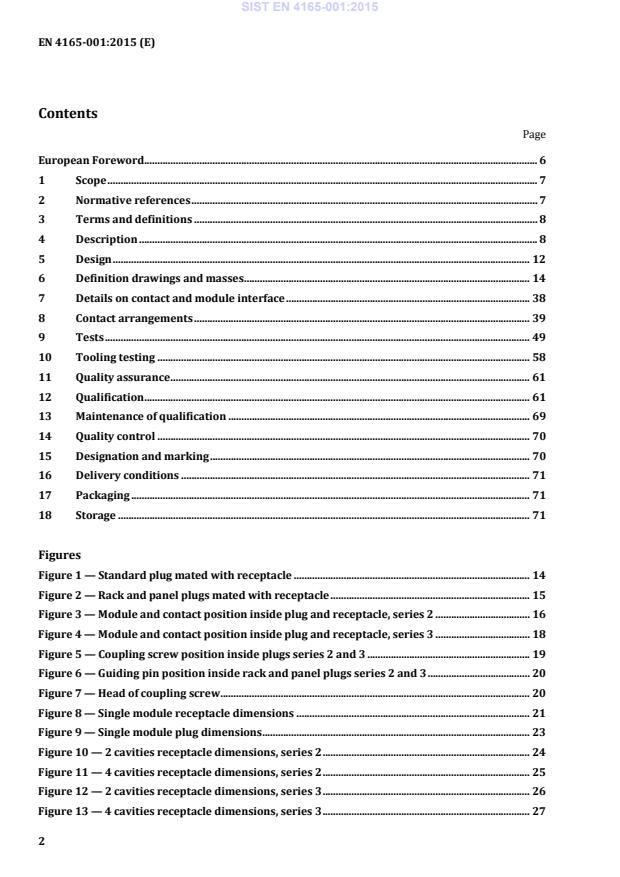
Page European Foreword . 6 1 Scope . 7 2 Normative references . 7 3 Terms and definitions . 8 4 Description . 8 5 Design . 12 6 Definition drawings and masses . 14 7 Details on contact and module interface . 38 8 Contact arrangements . 39 9 Tests . 49 10 Tooling testing . 58 11 Quality assurance . 61 12 Qualification . 61 13 Maintenance of qualification . 69 14 Quality control . 70 15 Designation and marking . 70 16 Delivery conditions . 71 17 Packaging . 71 18 Storage . 71
Figures Figure 1 — Standard plug mated with receptacle . 14 Figure 2 — Rack and panel plugs mated with receptacle . 15 Figure 3 — Module and contact position inside plug and receptacle, series 2 . 16 Figure 4 — Module and contact position inside plug and receptacle, series 3 . 18 Figure 5 — Coupling screw position inside plugs series 2 and 3 . 19 Figure 6 — Guiding pin position inside rack and panel plugs series 2 and 3 . 20 Figure 7 — Head of coupling screw . 20 Figure 8 — Single module receptacle dimensions . 21 Figure 9 — Single module plug dimensions . 23 Figure 10 — 2 cavities receptacle dimensions, series 2 . 24 Figure 11 — 4 cavities receptacle dimensions, series 2 . 25 Figure 12 — 2 cavities receptacle dimensions, series 3 . 26 Figure 13 — 4 cavities receptacle dimensions, series 3 . 27 SIST EN 4165-001:2015
male module . 39 Figure 27 — Interfacial view of 12-20 male module . 40 Figure 28 — Interfacial view of 08-16 male module . 40 Figure 29 — Interfacial view of 04-12 male module . 41 Figure 30 — Interfacial view of 01-08 male module . 41 Figure 31 — Interfacial view of
01Q18 and 01L18 male module . 42 Figure 32 — Interfacial view of 01Q28 and 01L28 male module . 43 Figure 33 — Interfacial view of 99-01 and 99A01 male module . 44 Figure 34 — Interfacial view of 99-02 male module . 44 Figure 35 — Interfacial view of 99-10 male module . 45 Figure 36 — Interfacial view of 20Y22 female module . 45 Figure 37 — Interfacial view of 2AY22
female module . 46 Figure 38 — Interfacial view of 2BY22 female module . 46 Figure 39 — Interfacial view of 20Z22 male module . 47 Figure 40 — Interfacial view of 2AZ22 male module . 47 Figure 41 — Interfacial view of 2BZ22
male module . 48 Figure 43 — Gauges dimensions for 4 cavities housing series 2 and 3 . 59 Figure 44 — Gauges dimensions for 2 cavities housing series 2 and 3 . 60 Figure 45 — Gauges dimensions to test the stability of male contacts in module . 61
Tables Table 1 — Mated dimensions . 15 Table 2 — Contact position. 17 Table 3 — Contact position. 19 Table 4 — Coding pin position . 19 Table 5 — Plug module cavity dimensions, series 2 and 3 . 36 SIST EN 4165-001:2015
EN 2282, Aerospace series — Characteristics of aircraft electrical supplies EN 2591-1001), Aerospace series — Elements of electrical and optical connection — Test methods — Part 001: General EN 3155-002, Aerospace series — Electrical contacts used in elements of connection — Part 002: List and utilization of contacts EN 3155-008, Aerospace series — Electrical contacts used in elements of connection —
Part 008: Contacts, electrical, male, type A, crimp, class S — Product standard EN 3155-070, Aerospace series — Electrical contacts used in elements of connection —
Part 070: Contacts, electrical, male, type A, crimp, class S — Product standard EN 3155-071, Aerospace series — Electrical contacts used in elements of connection —
Part 071: Contacts, electrical, female, type A, crimp, class S — Product standard EN 3155-082, Aerospace series — Electrical contacts used in elements of connection —
Part 082: Contacts, electrical, female, type A, crimp, class S — Product standard 2) EN 3197, Aerospace series — Design and installation of aircraft electrical and optical interconnection systems EN 3909, Aerospace series — Test fluids and test methods for electric components and sub-assemblies EN 4165-002, Aerospace series — Connectors, electrical, rectangular, modular — Operating temperature 175 °C continuous — Part 002: Specification of performance and contact arrangements EN 4165-003, Aerospace series — Connectors, electrical, rectangular, modular — Operating temperature 175 °C continuous — Part 003: Modules series 2 and series 3 — Product standard EN 4165-020, Aerospace series — Connectors, electrical, rectangular, modular — Operating temperature 175 °C continuous — Part 020: Coupling system keyway for receptacle – Product standard
1)
And all parts quoted in this European Standard. 2)
Published as ASD-STAN Prestandard at the date of publication of this European Standard (http://www.asd-stan.org/). SIST EN 4165-001:2015
3)
Published by: DoD National (US) Mil. Department of Defense (http://www.defenselink.mil/). 4)
Published as ASD-STAN Technical Report at the date of publication of this European Standard (http://www.asd-stan.org/). SIST EN 4165-001:2015
4.2 Housing All parts except module are considered “housing”. All “housings” models, except class C, shall meet electrical performances described in Table 39. 4.3 Receptacle 4.3.1 Centre coupling mechanism The receptacle may be attached by: Rectangular flange with two mounting holes; Two end flanges with transversal holes (panel mounting) and lateral holes (stackable mounting). SIST EN 4165-001:2015
The female modules use female contacts and male modules use male contacts. These modules use crimp or solder contacts of sizes 22, 20, 16, 12 and 8. They are rear release and held in the housing by two retention tines. They are removable from the rear with a specific tool. The modules have two keys which engage in the keyways of the housing. Polarization is ensured by the different positions which the secondary keys may take. The module polarisation is identified by letter A, B, C, D, E, F or N (universal). A blank module is installed in a cavity where no contacts are required. This module is a male module with a universal polarization (N) installable in all coding cavities (A, B, C, D, E, F) and in all housing types (plug or receptacle). Modules shall be interchangeable in cavities of housing with different configurations. Modules are available in four configurations: Without peripheral sealing and with standard fuel resistance : type 1; With peripheral sealing and with standard fuel resistance : type 2; Without peripheral sealing and with reinforced fuel resistance : type 3; With peripheral sealing and with reinforced fuel resistance : type 4. 4.7 Keying mechanism 4.7.1 Central coupling mechanism and rack and panel 4.7.1.1 Coding pin (receptacle) Keying mechanism shall provide 36 position keying capabilities. These 36 positions are given with 6 different coding pins, identified by colour code. The main key is wider than the other, polarization is ensured by the different positions which the secondary key may take. Universal coding pin is compatible with all polarization codes. Coding pin shall be interchangeable between different housing models. They are fitted in the housing with a specific tool and the modification of coding position shall be made at the front face of the connector with specific tool. 4.7.1.2 Clipped coding socket (plug) Keying mechanism shall provide 36 position keying capabilities. These 36 positions are given with 6 different coding sockets, identified by colour code. The main keyway is wider than the other; polarization is ensured by the different positions which the secondary keyway may take. Universal coding socket is compatible with all polarization codes. Coding socket shall be interchangeable between different housing models. They are front clipped in the housing without specific tool and the modification of coding position shall be either made by the front face of the connector with a new coding pin (a removed coding socket is not reusable). SIST EN 4165-001:2015
Colour and coding are defined in product standard EN 4165-024 and EN 4165-025. 4.8 Materials and surface treatment When dissimilar metals are in close contact, adequate protection against corrosion shall be used for the electromotive force of the cell not to exceed 0,25 V. 4.8.1 Housings The material of the housing for the connectors shall as follows (see EN 4165-002 for more details): Aluminium alloy with plating; Composite with plating;
Composite without plating. 4.8.2 Contacts Removable contacts (see EN 3155-002). 4.8.3 Non-metallic materials The materials used for module, seals and grommets shall have mechanical characteristics compliant with the required use. 5 Design 5.1 Housings The connector housings shall be a one piece construction. They shall accommodate the rear accessories and other fittings defined in this specification (see EN 4165-002). The rectangular flange receptacle can furthermore be fitted with a conductive gasket ensuring electrical continuity between the connector housing and panel. For centre coupling mechanism, the threads shall conform to ISO 263, and the coupling mechanism shall be designed so that the male and female contacts engage when it is rotated clockwise the right and disengage when it is rotated anticlockwise to the left. The centre coupling screw shall be a hexagonal socket head screw and compatible with the coupling torque values defined in the product standard. For push-pull latching mechanism, the locking mechanism shall be designed so that coupling is done by pushing the plug onto the receptacle. The mechanism has also a sliding perpendicular to the axis of engagement of the plug onto the receptacle. Unlocking is done by pressure on the mechanism and perpendicular to the axis of engagement of the plug onto the receptacle. The accessories shall be fixed by screw or clip on the rear of connectors. SIST EN 4165-001:2015
Electrical contact;
Sealed interface compression; Locking. SIST EN 4165-001:2015
Key 1 Receptacle assembly 2 Standard plug assembly 3 Mechanical bottoming plate
Figure 1 — Standard plug mated with receptacle SIST EN 4165-001:2015
a) Standard rack and panel plug b) Reversed rack and panel plug Key
1 Receptacle assembly 3 Mechanical bottoming plate 2 Standard rack and panel plug assembly 4 Reserved rack and panel plug assembly
Figure 2 — Rack and panel plugs mated with receptacle Table 1 — Mated dimensions
A B C D E F Series 2 38,5 37,8 33,4 32,9 19,3 17,9 14,2 13,0 40,0 36,0 34,9 30,9 Series 3 47,1 46,4 42,0 41,5 19,65 18,25 14,55 13,35 40,0 36,0 34,9 30,9
6.1.2 Plug and receptacle, series 2 Module and contact position Dimensions are in millimetres, see Figure 3 and Table 2.
Key 1 Mechanical bottom of receptacle 5 Male module assembly (all sizes) 2 Female module assembly (size 8) 6 Mechanical bottom of plug 3 Female module assembly (sizes 22 – 20 – 16 – 12) 7 See EN 4165-021. 4 See EN 4165-020
a For sizes 22 – 20 – 16 – 12 modules b For size 8 module c See Figure 7 d See Figures 5 and 6 Figure 3 — Module and contact position inside plug and receptacle, series 2 SIST EN 4165-001:2015
A B C D Sizes 22 – 20 – 16 – 12 6,66 6,20 6,38 5,93 3,00 2,54 3,27 2,82 Size 8 6,79 6,33 6,51 5,93 2,87 2,41 3,27 2,69
6.1.3 Plug and receptacle, series 3 Module and contact position Dimensions are in millimetres, see Figure 4 to Figure 7, Table 3 and Table 4.
Key 1 Mechanical bottom of receptacle 4 Male module assembly (all sizes) 2 Female module assembly (all sizes) 5 Mechanical bottom of plug 3 See EN 4165-020 for series 2 and EN 4165-024 for series 3 6 See EN 4165-021 a For sizes 22 – 20 – 16 – 12 modules b For size 8 module c See Figure 7. d See Figures 5 and 6 Figure 4 — Module and contact position inside plug and receptacle, series 3 SIST EN 4165-001:2015
A B C D Sizes 22 – 20 – 16 – 12 6,66 6,20 14,94 14,49 11,56 11,10 3,27 2,82 Size 8 6,79 6,33 15,07 14,49 11,43 10,97 3,27 2,69
Table 4 — Coding pin position
E Coupling with clicker-nut plug 12,62 12,38 Coupling with rack and panel plug series 3 21,18 20,94
Key 1 Active thread 12,6 min.
Figure 5 — Coupling screw position inside plugs series 2 and series 3 SIST EN 4165-001:2015
Figure 6 — Guiding pin position inside rack and panel plugs series 2 and series 3
Key 1 Hexagonal groove 3,02 – 3,08/flat
Figure 7 — Head of coupling screw SIST EN 4165-001:2015
Key a Type
Figure 8 — Single module receptacle dimensions SIST EN 4165-001:2015
Key a Locking slide down: 9,1 min.
b Unlocked position: 3,9 ± 0,13
(continued)
Figure 9 — Single module plug dimensions SIST EN 4165-001:2015
Key 1 Centre line 2 Groove only for classes F, W and A 3 Module cavities coding, see Figure 22 4 Coding pin cavity (see Figure 14) 5 Mechanical bottom of receptacle
Figure 10 — 2 cavities receptacle dimensions, series 2 6.2.2 4 cavities receptacle dimensions, series 2 Dimensions are in millimetres, see Figure 11.
Key 1 Centre line 2 Groove only for classes F, W and A 3 Module cavities coding, see Figure 22 4 Coding pin cavity, see Figure 14 5 Mechanical bottom of receptacle
Figure 11 — 4 cavities receptacle dimensions, series 2 6.2.3 2 cavities receptacle dimensions, series 3 Dimensions are in millimetres, see Figure 12.
Key 1 Centre line 2 Groove only for classes F, W and A 3 Module cavities coding, see Figure 22 4 Coding pin cavity, see Figure 14 5 Mechanical bottom of receptacle
Figure 12 — 2 cavities receptacle dimensions, series 3 6.2.4 4 cavities receptacle dimensions, series 3 Dimensions are in millimetres, see Figure 13.
Key 1 Centre line 2 Groove only for classes F and W 3 Module cavities coding, see Figure 22 4 Coding pin cavity, see Figure 14 5 Mechanical bottom of receptacle Figure 13 — 4 cavities receptacle dimensions, series 3 6.3 Receptacle coding pin cavity dimensions, series 2 and series 3 Dimensions are in millimetres, see Figure 14.
Key 1 Centre line 2 Bottoming plate for coding pin 3 Mechanical bottom of receptacle
Figure 14 — Receptacle coding pin cavity dimensions, series 2 and series SIST EN 4165-001:2015
6.4 Receptacle module cavities dimensions, series 2 and series 3
Key 1 Module cavity coding see Figure 22 2 Mechanical bottom of receptacle 3 Centre line
Figure 15 — Receptacle module cavity dimensions, series 2 and 3SIST EN 4165-001:2015
6.5 2 cavities plug dimensions, series 2 Dimensions are in millimetres, see Figure 16.
Key 1 Mechanical bottom of plug 2 Coding key cavity, see Figure 20 3 Module cavities coding, see Figure 22 4 Point of engagement EMI feature 5 Centre line
Figure 16 — 2 cavities plug dimensions, series 2 SIST EN 4165-001:2015
Key 1 Mechanical bottom of plug 2 Coding key cavity, see Figure 20. 3 Module cavities coding, see Figure 22. 4 Point of engagement EMI feature 5 Centre line Figure 17 — 4 cavities plug dimensions, series 2 6.7 2 cavities plug dimensions, series 3 Dimensions are in millimetres, see Figure 18.
Key 1 Mechanical bottom of plug 2 Coding key cavity, see Figure 20. 3 Module cavities coding, see Figure 22. 4 Point of engagement EMI feature 5 Centre line
Figure 18 — 2 cavities plug dimensions, series 3 SIST EN 4165-001:2015
Key 1 Mechanical bottom of plug 2 Coding key cavity, see Figure 20. 3 Module cavities coding, see Figure 22. 4 Point of engagement EMI feature 5 Centre line Figure 19 — 4 cavities plug dimensions, series 3 6.9 Plug coding key cavity dimensions, series 2 and series 3 Dimensions are in millimetres, see Figure 20.
Key 1 Centre line 2 Mechanical bottom of plug
Figure 20 — Plug coding key cavity dimensions – Series 2 and series 3SIST EN 4165-001:2015
6.10 Plug module cavity dimensions, series 2 and series
...