

SIST EN 14934:2008
(Main)Thermal insulation and light weight fill products for civil engineering applications - Factory made products of extruded polystyrene foam (XPS) - Specification
General Information
- Abstract
This European Standard specifies the requirements for factory made products of extruded polystyrene foam which are used for frost insulation of roads, railways, trafficked areas, light weight fill for reduction of horizontal and vertical earth pressure and other civil engineering applications.
The products are manufactured in the form of boards, which are also available with special edge and surface treatment (tongue & grooves, shiplap etc.). The standard also covers multilayered insulation boards.
This standard describes product characteristics and includes procedures for testing, evaluation of conformity, marking and labelling.
The standard does not specify the required level of a given property to be achieved by a product to demonstrate fitness for purpose in a particular application. The classes and levels required for a given application are to be found in regulations or non-conflicting standards.
For applications where thermal resistance is required, products with a declared thermal resistance lower than 0,25 m²K/W or a declared thermal conductivity greater than 0,060 W/(m K) are not covered by this standard. This standard does not cover in situ insulation products and products intended to be used for insulation of buildings, of building equipment and industrial installations or products intended for acoustic insulation.
- Status
- Published
- Publication Date
- 25-May-2008
- Technical Committee
- TOP - Thermal insulation
- Current Stage
- 6060 - National Implementation/Publication (Adopted Project)
- Start Date
- 19-Mar-2008
- Due Date
- 24-May-2008
- Completion Date
- 26-May-2008
- Directive
- 305/2011 - Regulation (eu) No 305/2011 of the European Parliament and of the Council of 9 march 2011 laying down harmonised conditions for the marketing of construction products and repealing council directive 89/106/eecOJ Ref: C 259 OJ Date: 08-Aug-2014
89/106/EEC - Construction productsOJ Ref: C 290 OJ Date: 04-Dec-2007

Overview
EN 14934:2007 - published by CEN - is the European specification for factory-made extruded polystyrene foam (XPS) products used in civil engineering. It defines the characteristics, testing procedures, conformity assessment, marking and labelling for XPS boards used chiefly for frost insulation of roads, railways and trafficked areas, and as lightweight fill to reduce horizontal and vertical earth pressures. The standard covers single- and multilayer boards and common edge/surface treatments (tongue & groove, shiplap). It excludes in-situ insulation, building equipment/industrial insulation, and acoustic-only products.
Key topics
- Scope and product forms: Factory-made XPS boards (including multilayer and profiled edges) for civil engineering applications.
- Declared thermal limits: Products with declared thermal resistance < 0.25 m²·K/W or declared thermal conductivity > 0.060 W/(m·K) are outside the scope.
- Product properties and classes: Defines classes and levels for dimensional tolerances, compressive behaviour, deformation under load, long-term water absorption, freeze–thaw resistance and other mechanical/thermal properties.
- Testing procedures: Includes sampling, conditioning and referenced test methods (compression, thermal resistance by guarded hot plate/heat flow meter, water vapour transmission, long-term water absorption by immersion/diffusion, freeze–thaw, cyclic loading). Annexes address declared/aged thermal values, cyclic square-wave load behaviour, factory production control (FPC) and additional properties (compressive modulus, cell structure, shear).
- Conformity & labelling: Sets requirements for evaluation of conformity, marking and labelling. Annex ZA links the standard to the EU Construction Products Directive procedures (CE marking).
Practical applications
- Frost protection beneath pavements, rail tracks and other trafficked infrastructure to avoid frost heave.
- Lightweight fill in embankments and retaining structures where reduced earth pressure is required.
- Civil engineering insulation solutions where robust mechanical performance, low water uptake and freeze–thaw resistance are essential.
Using EN 14934 helps specifiers ensure the XPS product has been tested and classified for the intended civil engineering environment.
Who should use this standard
- Civil and geotechnical engineers specifying insulation and fill materials
- Manufacturers of XPS boards for infrastructure projects
- Test laboratories performing mechanical and thermal testing on XPS products
- Procurement and compliance teams verifying conformity and CE marking for construction products
Related standards
EN 12667 / EN 12939 (thermal resistance tests), EN 822–EN 826 (dimensional and compression tests), EN 12086 / EN 12087 / EN 12088 / EN 12091 (water vapour, water absorption, freeze–thaw), EN 13172 (evaluation of conformity), EN 13501‑1 (reaction to fire), EN ISO 9229 (vocabulary). These referenced standards are integral to applying EN 14934 in practice.
Keywords: EN 14934:2007, XPS, extruded polystyrene foam, thermal insulation, lightweight fill, civil engineering, frost insulation, road insulation, testing, conformity, CEN.
Relations
- Effective Date
- 04-Feb-2026
- Effective Date
- 28-Jan-2026
- Effective Date
- 28-Jan-2026
- Effective Date
- 28-Jan-2026
- Effective Date
- 28-Jan-2026
- Effective Date
- 28-Jan-2026
- Effective Date
- 28-Jan-2026
- Effective Date
- 28-Jan-2026
- Effective Date
- 28-Jan-2026
- Effective Date
- 28-Jan-2026
- Effective Date
- 28-Jan-2026
- Effective Date
- 28-Jan-2026
- Effective Date
- 28-Jan-2026
- Effective Date
- 28-Jan-2026
- Effective Date
- 28-Jan-2026
Get Certified
Connect with accredited certification bodies for this standard

DIBt (Deutsches Institut für Bautechnik)
German Institute for Building Technology.
DIN CERTCO
DIN Group product certification.

Aboma Certification B.V.
Specialized in construction, metal, and transport sectors.
Sponsored listings
Frequently Asked Questions
SIST EN 14934:2008 is a standard published by the Slovenian Institute for Standardization (SIST). Its full title is "Thermal insulation and light weight fill products for civil engineering applications - Factory made products of extruded polystyrene foam (XPS) - Specification". This standard covers: This European Standard specifies the requirements for factory made products of extruded polystyrene foam which are used for frost insulation of roads, railways, trafficked areas, light weight fill for reduction of horizontal and vertical earth pressure and other civil engineering applications. The products are manufactured in the form of boards, which are also available with special edge and surface treatment (tongue & grooves, shiplap etc.). The standard also covers multilayered insulation boards. This standard describes product characteristics and includes procedures for testing, evaluation of conformity, marking and labelling. The standard does not specify the required level of a given property to be achieved by a product to demonstrate fitness for purpose in a particular application. The classes and levels required for a given application are to be found in regulations or non-conflicting standards. For applications where thermal resistance is required, products with a declared thermal resistance lower than 0,25 m²K/W or a declared thermal conductivity greater than 0,060 W/(m K) are not covered by this standard. This standard does not cover in situ insulation products and products intended to be used for insulation of buildings, of building equipment and industrial installations or products intended for acoustic insulation.
This European Standard specifies the requirements for factory made products of extruded polystyrene foam which are used for frost insulation of roads, railways, trafficked areas, light weight fill for reduction of horizontal and vertical earth pressure and other civil engineering applications. The products are manufactured in the form of boards, which are also available with special edge and surface treatment (tongue & grooves, shiplap etc.). The standard also covers multilayered insulation boards. This standard describes product characteristics and includes procedures for testing, evaluation of conformity, marking and labelling. The standard does not specify the required level of a given property to be achieved by a product to demonstrate fitness for purpose in a particular application. The classes and levels required for a given application are to be found in regulations or non-conflicting standards. For applications where thermal resistance is required, products with a declared thermal resistance lower than 0,25 m²K/W or a declared thermal conductivity greater than 0,060 W/(m K) are not covered by this standard. This standard does not cover in situ insulation products and products intended to be used for insulation of buildings, of building equipment and industrial installations or products intended for acoustic insulation.
SIST EN 14934:2008 is classified under the following ICS (International Classification for Standards) categories: 91.100.60 - Thermal and sound insulating materials. The ICS classification helps identify the subject area and facilitates finding related standards.
SIST EN 14934:2008 has the following relationships with other standards: It is inter standard links to SIST EN ISO 11925-2:2026, SIST EN ISO 9229:2008, SIST EN ISO 1716:2018, SIST EN 1605:2013, SIST EN 13172:2002, SIST EN 13501-1:2019, SIST EN ISO 29466:2023, SIST EN ISO 16546:2020, SIST EN ISO 1182:2020, SIST EN ISO 16534:2020, SIST EN 480-13:2003, SIST EN 12939:2001, SIST EN ISO 29468:2022, SIST EN 12086:1999, SIST EN 824:2013. Understanding these relationships helps ensure you are using the most current and applicable version of the standard.
SIST EN 14934:2008 is associated with the following European legislation: EU Directives/Regulations: 305/2011, 89/106/EEC; Standardization Mandates: M/103. When a standard is cited in the Official Journal of the European Union, products manufactured in conformity with it benefit from a presumption of conformity with the essential requirements of the corresponding EU directive or regulation.
SIST EN 14934:2008 is available in PDF format for immediate download after purchase. The document can be added to your cart and obtained through the secure checkout process. Digital delivery ensures instant access to the complete standard document.
Standards Content (Sample)
2003-01.Slovenski inštitut za standardizacijo. Razmnoževanje celote ali delov tega standarda ni dovoljeno.Toplotnoizolacijski in lahki polnilni/nasipni proizvodi za inženirske objekte - Proizvodi iz ekstrudiranega polistirena (XPS) - SpecifikacijaWärmedämmung und leichte Füllprodukte für Anwendungen im Tiefbau - Werkmäßig hergestellte Produkte aus extrudiertem Polystyrolschaum (XPS) - SpezifikationProduits isolants thermiques et de remblayage pour les applications de génie civil - Produits manufacturés en mousse de polystyrene extrudé (XPS) - SpécificationsThermal insulation and light weight fill products for civil engineering applications - Factory made products of extruded polystyrene foam (XPS) -
Specification91.100.60Thermal and sound insulating materialsICS:Ta slovenski standard je istoveten z:EN 14934:2007SIST EN 14934:2008en01-junij-2008SIST EN 14934:2008SLOVENSKI
STANDARD
EUROPEAN STANDARDNORME EUROPÉENNEEUROPÄISCHE NORMEN 14934September 2007ICS 83.100; 93.010 English VersionThermal insulation and light weight fill products for civilengineering applications - Factory made products of extrudedpolystyrene foam (XPS) - SpecificationProduits isolants thermiques et de remblayage pour lesapplications de génie civil - Produits manufacturés enmousse de polystyrène extrudé (XPS) - SpécificationsWärmedämmung und leichte Füllprodukte fürAnwendungen im Tiefbau - Werkmäßig hergestellteProdukte aus extrudiertem Polystyrolschaum (XPS) -SpezifikationThis European Standard was approved by CEN on 13 July 2007.CEN members are bound to comply with the CEN/CENELEC Internal Regulations which stipulate the conditions for giving this EuropeanStandard the status of a national standard without any alteration. Up-to-date lists and bibliographical references concerning such nationalstandards may be obtained on application to the CEN Management Centre or to any CEN member.This European Standard exists in three official versions (English, French, German). A version in any other language made by translationunder the responsibility of a CEN member into its own language and notified to the CEN Management Centre has the same status as theofficial versions.CEN members are the national standards bodies of Austria, Belgium, Bulgaria, Cyprus, Czech Republic, Denmark, Estonia, Finland,France, Germany, Greece, Hungary, Iceland, Ireland, Italy, Latvia, Lithuania, Luxembourg, Malta, Netherlands, Norway, Poland, Portugal,Romania, Slovakia, Slovenia, Spain, Sweden, Switzerland and United Kingdom.EUROPEAN COMMITTEE FOR STANDARDIZATIONCOMITÉ EUROPÉEN DE NORMALISATIONEUROPÄISCHES KOMITEE FÜR NORMUNGManagement Centre: rue de Stassart, 36
B-1050 Brussels© 2007 CENAll rights of exploitation in any form and by any means reservedworldwide for CEN national Members.Ref. No. EN 14934:2007: ESIST EN 14934:2008
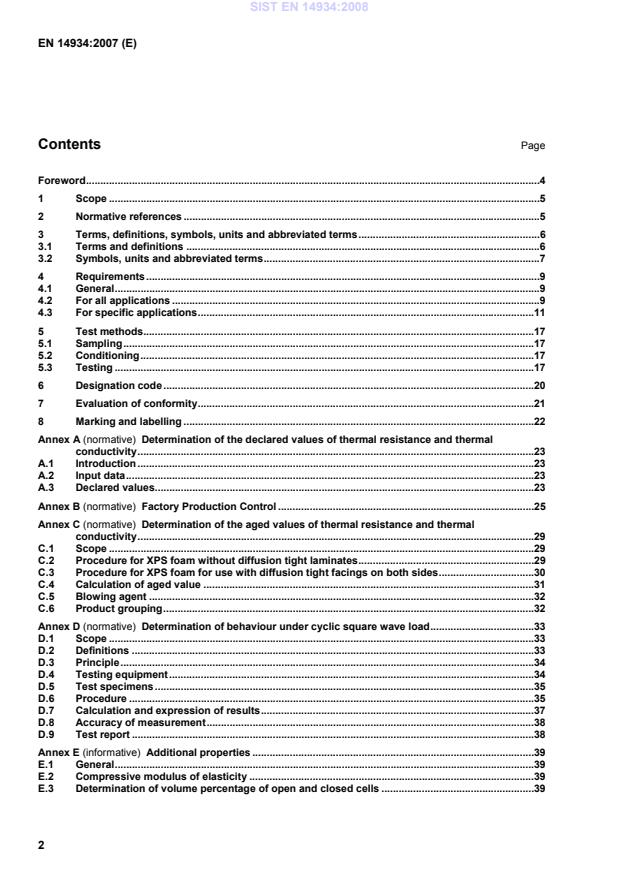
Determination of the declared values of thermal resistance and thermal conductivity.23 A.1 Introduction.23 A.2 Input data.23 A.3 Declared values.23 Annex B (normative)
Factory Production Control.25 Annex C (normative)
Determination of the aged values of thermal resistance and thermal conductivity.29 C.1 Scope.29 C.2 Procedure for XPS foam without diffusion tight laminates.29 C.3 Procedure for XPS foam for use with diffusion tight facings on both sides.30 C.4 Calculation of aged value.31 C.5 Blowing agent.32 C.6 Product grouping.32 Annex D (normative)
Determination of behaviour under cyclic square wave load.33 D.1 Scope.33 D.2 Definitions.33 D.3 Principle.34 D.4 Testing equipment.34 D.5 Test specimens.35 D.6 Procedure.35 D.7 Calculation and expression of results.37 D.8 Accuracy of measurement.38 D.9 Test report.38 Annex E (informative)
Additional properties.39 E.1 General.39 E.2 Compressive modulus of elasticity.39 E.3 Determination of volume percentage of open and closed cells.39 SIST EN 14934:2008
Relationship between this European Standard and the Essential Requirements of EU Directive 89/106/EEC, EU Construction Products Directive.41 ZA.1 Scope and relevant characteristics.41 ZA.2 Procedures for the attestation of conformity of extruded polystyrene foam products.43 ZA.3 CE Marking and labelling.48 Bibliography.50
Figures Figure D.1 — Required load cycle during the fatigue test.35 Figure D.2 — Dimensions of the test specimen.36 Figure D.3 — Test set-up.37 Figure ZA.1 — Example CE marking information.49 Tables Table 1 — Tolerances of length, width, squareness and flatness.10 Table 2 — Classes for thickness tolerances.10 Table 3 — Levels for compressive stress at 10 % deformation or compressive strength.11 Table 4 — Levels for deformation under specified compressive load and temperature conditions.12 Table 5 — Levels for compressive stress at 2 % deformation or compressive strength.13 Table 6 — Levels for compressive stress at 5 % deformation or compressive strength.13 Table 7 — Levels for long term water absorption by total immersion.16 Table 8 — Levels for long term water absorption by diffusion.16 Table 9 — Levels for Freeze-thaw resistance.16 Table 10 — Test methods, test specimens and conditions.18 Table A.1 — Values of k for one sided 90 % tolerance interval with a confidence level of 90 %.24 Table B.1 — Minimum product testing frequencies.25 Table B.2 — Minimum product testing frequencies for the reaction to fire characteristics.27 Table E.1 — Test methods, test specimens, conditions and minimum testing frequencies.40 Table ZA.1 — Relevant clauses.42
3 Terms, definitions, symbols, units and abbreviated terms 3.1 Terms and definitions For the purposes of this document, the following terms and definitions apply. 3.1.1 Terms and definitions as given in EN ISO 9229:2007 3.1.1.1 extruded polystyrene foam rigid cellular plastics insulation material expanded and extruded with or without a skin, from polystyrene or one of its copolymers and which has a closed cell structure 3.1.1.2 board rigid or semi-rigid insulation product of rectangular shape and cross section in which the thickness is uniform and substantially smaller than the other dimensions SIST EN 14934:2008
sinus load application CLRT(i,z) σ i
is the symbol of the declared level for resistance to cyclic compressive loading with square wave load application CS(10\Y) is the symbol of the declared level for compressive stress at 10 % deformation or compressivestrength CS(5\Y) is the symbol of the declared level for compressive stress at 5 % deformation or compressive strength CS(2\Y) is the symbol of the declared level for compressive stress at 2 % deformation or compressivestrength DLT(2)5 is the symbol of the declared level of deformation under specified compressive load andtemperature at conditions set 2 with a maximum of 5 % deformation DS(T+) is the symbol of the declared value for dimensional stability at specified temperature DS(TH) is the symbol of the declared value for dimensional stability under specified temperature andhumidity FTC is the symbol of the declared level for freeze-thaw resistance MU is the symbol of the declared level for water vapour diffusion resistance factor T is the symbol of the declared class for thickness tolerances WD(V) is the symbol of the declared level for water absorption by diffusion WL(T) is the symbol of the declared level for long term water absorption by total immersion Z is the symbol of the declared value for water vapour resistance Abbreviated terms used in this standard: XPS is extruded polystyrene foam 4 Requirements 4.1 General Product properties shall be assessed in accordance with Clause 5. To comply with this standard, products shall meet the requirements of 4.2, and the requirements of 4.3 as appropriate. NOTE Information on additional properties is given in Annex E. One test result for a product property is the average of the measured values on the number of test specimens given in Table 10. 4.2 For all applications 4.2.1 Length, width, squareness, flatness Length, l, and width, b, shall be determined in accordance with EN 822, the squareness on length and width, Sb, in accordance with EN 824, and the flatness, Smax, in accordance with EN 825. No test result shall deviate from the declared values by more than the tolerances given in Table 1. SIST EN 14934:2008
8 5 7,0 1 000 to 2 000 ±
10 5 14,0 > 2 000 to 4 000 ±
10 5 28,0 > 4 000 ±
10 5 35,0
4.2.2 Thickness Thickness, d, shall be determined in accordance with EN 823. No test result shall deviate from the nominal thickness, dN, by more than the tolerances given in Table 2 for the labelled class. Table 2 — Classes for thickness tolerances Class Tolerances mm Thickness mm T1 – 2 – 2 – 2 + 2 + 3 + 8 < 50 50 ≤ dN ≤ 120 > 120 T2 – 1,5 – 1,5 – 1,5 + 1,5 + 1,5 + 1,5 < 50 50 ≤ dN ≤ 120 > 120 T3 – 1 – 1 – 1 + 1 + 1 + 1 < 50 50 ≤ dN ≤ 120 > 120
4.2.3 Dimensional stability under specified temperature and humidity conditions Dimensional stability under specified temperature and humidity conditions shall be determined in accordance with EN 1604. The test shall be carried out after storage for 48 h at (23 ± 2) °C and (90 ± 5) % relative humidity. The relative changes in length, ∆εl , in width, ∆εb, and in thickness, ∆εd, shall not exceed 2 %. This test shall not be performed when the more severe test, described in 4.3.2.2 is used. 4.2.4 Compressive stress at 10 % deformation or compressive strength The compressive stress at 10 % deformation, σ10, or the compressive strength, σm, shall be determined in accordance with EN 826. No test result for either the compressive stress at 10 % deformation, σ10, or the compressive strength, σm, whichever is the greatest, shall be lower than the values given in Table 3 for the declared level. SIST EN 14934:2008
4.2.5 Reaction to fire 4.2.5.1 Reaction to fire classification Reaction to fire classification (Euroclasses) shall be determined in accordance with EN 13501-1. 4.2.5.2 Continuous glowing combustion Where subject to regulation, the continuous glowing combustion shall be declared. In the absence of a European test method which is under development, the existing relevant national test method applies. 4.3 For specific applications 4.3.1 General If there is no requirement for a property described in 4.3 for a product in use, then the property does not need to be determined and declared by the manufacturer. 4.3.2 Dimensional stability under specified conditions 4.3.2.1 Dimensional stability at specified temperature Dimensional stability at specified temperature shall be determined in accordance with EN 1604. The test shall be carried out after storage for 48 h at (70 ± 2) °C. The relative changes in length, ∆εl, in width, ∆εb, and in thickness, ∆εd, shall not exceed 5 %. SIST EN 14934:2008
4.3.3 Compressive stress at 2 % and 5 % deformation or compressive strength The compressive stress at 2 % and/ or 5 % deformation, σ2, and/or, σ5, or the compressive strength, σm, shall be determined in accordance with EN 826. No test result for either the compressive stress at 2 % and/or 5 % deformation, σ2, and/ or, σ5, or the compressive strength, σm, whichever is the greatest, shall be lower than the values given in Table 5 and Table 6 for the declared level. NOTE Although EN 826 does not specify the calculation of the compressive stress at 2 % and 5 % deformation, the calculation should be done in the same way. SIST EN 14934:2008
Table 5 — Levels for compressive stress at 2 % deformation or compressive strength Level Requirement kPa CS(2\Y) 100 > 100 CS(2\Y) 200 ≥ 200 CS(2\Y) 250 ≥ 250 CS(2\Y) 300 ≥ 300 CS(2\Y) 350 ≥ 350 CS(2\Y) 400 ≥ 400 CS(2\Y) 450 ≥ 450 CS(2\Y) 500 ≥ 500 CS(2\Y) 600 ≥ 600 CS(2\Y) 650 ≥ 650 CS(2\Y) 700 ≥ 700 CS(2\Y) 800 ≥ 800 CS(2\Y) 900 ≥ 900 CS(2\Y) 1 000 ≥ 1.000 Table 6 — Levels for compressive stress at 5 % deformation or compressive strength Level Requirement kPa CS(5\Y) 100 > 100 CS(5\Y) 200 ≥ 200 CS(5\Y) 250 ≥ 250 CS(5\Y) 300 ≥ 300 CS(5\Y) 350 ≥ 350 CS(5\Y) 400 ≥ 400 CS(5\Y) 450 ≥ 450 CS(5\Y) 500 ≥ 500 CS(5\Y) 600 ≥ 600 CS(5\Y) 650 ≥ 650 CS(5\Y) 700 ≥ 700 CS(5\Y) 800 ≥ 800 CS(5\Y) 900 ≥ 900 CS(5\Y) 1 000 ≥ 1.000
and the total thickness reduction shall be declared in levels, i1, with steps of 0,5% at the declared stress. No test result shall exceed the declared levels at the declared stress. NOTE 1 For building applications a total thickness reduction, ε t, of 2 % and an exploration time of 50 years are generally required. NOTE 2 Examples for declaration of levels for compressive creep. Level
Test time days Extrapolation time years Declared stress kPa Requirement % CC(i1/ i2 / 10)σc
122 10 σc ε t≤ i1 and
ε ct ≤ i2
CC(i1/ i2 / 25)σc
304 25 σc ε t≤ i1 and ε ct ≤ i2
CC(i1/ i2 / 50)σc
608 50 σc ε t≤ i1 and ε ct i≤ 2
NOTE 3 Referring to the designation code CC(i1/i2/y)σc, according to Clause 6, a declared level CC(2/1.5/50)100, for example, indicates a value not exceeding 1,5 % for compressive creep and 2 % for total thickness reduction after extrapolation at 50 years (i.e. 30 times six hundred eight days of testing) under a declared stress of 100 kPa. 4.3.6
Resistance to cyclic compressive loading 4.3.6.1 Resistance to cyclic compressive loading with square wave load application The resistance to cycling compressive loading with square wave load application shall be determined in accordance with Annex D and shall be used specifically for railway applications. The relative compression, Di, in %, shall be determined after a defined number of load cycles and the applied compressive stress, σi . The relative compression, Di , shall be declared as level, i. No test result shall exceed the declared level of, Di, after 2 x 10⁶
load cycles at the declared stress. NOTE
For railway applications typically a relative compression, Di , of 5 % after 2 x 10⁶
load cycles at a compressive stress or compressive strength of 100 to 300 kPa are generally required. 4.3.6.2 Resistance to cyclic compressive loading with sinus load application The resistance to cycling compressive loading with sinus load application shall be determined in accordance either with EN 13793. The relative deformation, εI,max, in percent shall be determined after a defined number of load cycles and the applied compressive stress, σi . The relative deformation, εI,max, shall be declared as level, i. No test result shall exceed the declared level at the declared number of load cycles and the declared stress. SIST EN 14934:2008
kPa, 3 000 kPa, 3 500 kPa, 4 000 kPa. 4.3.8 Thermal resistance and thermal conductivity
The thermal resistance and thermal conductivity shall be based upon measurements carried out in accordance with EN 12667 or EN 12939 for thick products. For light weight fill applications without thermal insulation requirements it is permitted to declare the maximum thermal conductivity value as defined in the Scope of this European Standard (0,060 W/(m⋅K)). The thermal resistance and thermal conductivity shall be determined in accordance with Annex A and Annex C and declared by the manufacturer according to the following: the reference mean temperature shall be 10 °C; the measured values shall be expressed with three significant figures; the thermal resistance, λD, shall always be declared. The thermal conductivity, λD, shall be declared where possible; the declared thermal resistance, λD, and the declared thermal conductivity, λD, shall be given as limit values representing at least 90 % of the production, determined with a confidence level of 90 %; the value of thermal conductivity, λ90/90, shall be rounded upwards to the nearest 0,001 W/(m⋅K) and declared as λD in levels with steps of 0,001 W/(m⋅K); the declared thermal resistance, λD, shall be calculated from the nominal thickness, d N ,and the corresponding
thermal conductivity value, λ90/90, unless measured directly; the value of thermal resistance, R90/90, when calculated from the nominal thickness, d N , and the corresponding thermal conductivity, λ90/90, shall be rounded downwards to the nearest 0,05 m²⋅K/W, and declared as λD in levels with steps of 0,05 m²⋅K/W; the value of, R90/90, for those products for which only the thermal resistance is measured directly, shall be rounded downwards to the nearest 0,05 m²⋅K/W and declared as λD in levels with steps of 0,05 m²⋅K/W. 4.3.9 Water absorption 4.3.9.1 Long term water absorption by immersion Water absorption by total immersion, Wlt, shall be determined in accordance with EN 12087 method 2A. No test result shall be higher than the value given in Table 7, for the declared level. SIST EN 14934:2008
4.3.9.2 Long term water absorption by diffusion Water absorption by diffusion, WdV, shall be determined in accordance with EN 12088. No test result shall be higher than the value given in Table 8 for the declared level. Table 8 — Levels for long term water absorption by diffusion Level Requirement % by volume WD (V) 5 ≤ 5 WD (V) 3 ≤ 3
4.3.10 Freeze-thaw resistance Freeze-thaw resistance shall be determined in accordance with EN 12091 using the test specimen from 4.3.9.2. The additional water absorption, WV, shall be not higher than the value given in Table 9 for the declared level. Table 9 — Levels for Freeze-thaw resistance Level Requirement
% by volume FTC 5 ≤ 5 FTC 4 ≤ 4 FTC 3 ≤ 3 FTC 2 ≤ 2 FTC 1 ≤ 1
After the freeze-thaw test the reduction in compressive stress at 10 % deformation, σ10, or the compressive strength, σm, of the dry specimens, when tested in accordance with EN 826 shall not exceed 10 % of the initial value. SIST EN 14934:2008
Dimensions in millimetres Clause Test method Specific conditionsNo Title
Test specimen length and widtha Minimum number of measurements to get one test result 4.2.1 Length and width EN 822 Full size 1 - 4.2.1 Squareness on length and width
EN 824 Full size 1 - 4.2.1 Flatness EN 825 Full size 1 - 4.2.2 Thickness EN 823 Full size 1 Load: (250 ± 5) Pa 4.2.3 Dimensional stability under specified temperature and humidity conditions EN 1604 200 x 200 2 Condition specimens for 45 days Test condition: 23 ºC, 90 % relative humidity 4.2.4 Compressive stress at 10% deformation EN 826 100 x 100 5 Condition specimens for 45 days
or compressive strength
150 x 150
(Length and width of specimen shall be ≥ thickness of specimen)
4.2.5.1 Reaction to fire See EN 13501-1 4.2.5.2 Continuous glowing combustion b Dimensional stability at specified temperature
EN 1604 200 x 200 2 Condition specimens for 45 days 4.3.2 Dimensional stability under specified temperature and humidity conditions EN 1604 200 x 200 2 Condition specimens for 45 days, Test condition: 70 oC, 90 % relative humidity SIST EN 14934:2008
Test specimen length and widtha Minimum number of measurements to get one test result
Deformation under specified compressive load and temperature conditions EN 1605 100 x 100 3 Condition specimens for 45 days 100 x 100 5 4.3.3 Compressive stress at 2 % and /or 5 % deformation or compressive strength EN 826 150 x 150
Condition specimens for 45 days (Length and width of specimen shall be ≥ thickness of specimen) 4.3.4 Point load EN 826 See 4.2.4
EN 1606 100 x 100 2 Test specimen selected
4.3.5 Compressive creep
150 x 150
from the mean compressive strength/ stress area of a board. Condition specimens for 45 days 4.3.6.1 Resistance to cyclic compressive loading with square wave load application
Annex D
400 x 400
2 Condition specimens for 45 days
4.3.6.2 Resistance to cyclic compressive loading with sinus load application EN 13793
200 x 200
Condition specimens for 45 days 4.3.7 Bending strength EN 12089 length: 5dN (≤ 550) width:150 Thickness: max. 100 3
Method B 4.3.8 Thermal resistance -Thermal conductivity EN 12667 or EN 12939 See EN 12667 or EN 12939 and Annex C
See Annex C
4.3.9.1 Long term water absorption by immersion EN 12087 200 x 200 2 Method 2A
4.3.9.2 Long term water absorption by diffusion EN 12088 500 x 500 2 - SIST EN 14934:2008
Test specimen length and widtha Minimum number of measurements to get one test result 4.3.10 Freeze-thaw resistance EN 12091 500 x 500
1 Set A
100 x 100 or 5 Set B1 and B2
150 x 150 3 Set B1 and B2 4.3.11 Water vapour transmission
EN 12086 See 6.1 in EN 12086:1997 3 Conditions, Set A 4.3.12 Release of dangerous substances
b - - - a Always full-size product thickness, except for 4.3.8 and 4.3.7. b Not yet available.
6 Designation code A designation code for the product shall be given by the manufacturer. The following shall be included except when there is no requirement for a property described in 4.3: The extruded polystyrene foam abbreviated term XPS This European Standard number EN 14934 Thickness tolerances
Ti Compressive stress or compressive strength CS(2 or 5 or 10\Y) i Compressive creep CC(i1/ i2/y) σc Resistance to cyclic compressive loading with square wave load CLRT(i,z) σ i Resistance to cyclic compressive loading with sinus load CLR(i,z) σ i Bending strength BS i Dimensional stability at specified temperature DS(T+) Dimensional stability under specified temperature and humidity conditions DS(TH) Deformation under specified compressive load and temperature conditions DLT (i) 5 Long term water absorption by immersion WL(T) i SIST EN 14934:2008
MUi or Zi Freeze-thaw resistance FTC i where “i” shall be used to indicate the relevant class or level, “z” is the number of cycles and “σi” indicates the compressive stress applied for resistance to cyclic compressive loading . For compressive creep “σc” shall be used to indicate the compressive stress and “y” to indicate the number of years. NOTE The designation code for CE marking for an extruded polystyrene foam product is illustrated by the following example. XPS-EN14934-T1-DLT(2)5-CS(10\Y)300-CC(2/1,5/50)100-CLRT(5/2x106)150-CLR(5/2x106)150-WD(V)3-WL(T)3 -MU 150 -FTC2 7 Evaluation of conformity The conformity of the extruded polystyrene foam products with the requirements of this standard and with the stated values (including classes) shall be demonstrated by: initial type testing, factory production control by the manufacturer, including product asses
...