


oSIST prEN ISO 4935:2026
(Main)Steel and iron - Determination of sulfur content - Infrared absorption method after combustion in an induction furnace (ISO/DIS 4935:2025)
Steel and iron - Determination of sulfur content - Infrared absorption method after combustion in an induction furnace (ISO/DIS 4935:2025)
The method is applicable to sulphur contents between 0,002 % (m/m) and 0,10 % (m/m). Specifies principle, reagents and material, apparatus, sampling, procedure, expression of results and test report. Annex A gives additional information on the international cooperative tests. Annex B represents the precision date graphically. Annex C deals with induction furnaces and infrared sulfur analysers.
Stahl und Eisen - Bestimmung des Schwefelgehalts - Verfahren mit Infrarotabsorption nach Verbrennung im Induktionsofen (ISO/DIS 4935:2025)
Aciers et fontes - Détermination du soufre - Méthode par absorption dans l'infrarouge après combustion dans un four à induction (ISO/DIS 4935:2025)
Jeklo in železo - Določevanje žvepla - Infrardeča absorpcijska metoda po zgorevanju v indukcijski peči (ISO/DIS 4935:2025)
General Information
- Status
- Not Published
- Public Enquiry End Date
- 30-Jan-2026
- Technical Committee
- IFEK - Ferrous metals
- Current Stage
- 4020 - Public enquire (PE) (Adopted Project)
- Start Date
- 21-Nov-2025
- Due Date
- 10-Apr-2026
Relations
- Effective Date
- 25-Oct-2023
Overview
The oSIST prEN ISO 4935:2026 standard, titled Steel and Iron - Determination of Sulfur Content - Infrared Absorption Method after Combustion in an Induction Furnace (ISO/DIS 4935:2025), is a technical document developed by the European Committee for Standardization (CEN) in collaboration with ISO/TC 17/SC 1. This standard specifies a precise analytical method for determining sulfur content in steel and iron materials, within a sulfur concentration range of 0.002% to 0.10% by mass fraction. The method utilizes combustion in a high-frequency induction furnace followed by sulfur dioxide measurement via infrared absorption.
This updated 2025 edition replaces the 1989 version with revised normative references, updated precision data, and improved editorial clarity. It is intended for industrial, technological, commercial, and laboratory settings where accurate sulfur analysis in ferrous metals is critical.
Key Topics
Scope and Application
- Applicable for sulfur contents from 0.002% to 0.10% (m/m).
- Covers steel and iron materials.
Analytical Principle
- Sample combustion at high temperature in an induction furnace with oxygen.
- Sulfur transforms into sulfur dioxide (SO₂).
- SO₂ concentration measured by infrared absorption, correlating to sulfur content.
Reagents and Materials
- High-purity oxygen (minimum 99.5% volume fraction).
- Water free from sulfur dioxide and analytical grade reagents.
- Accelerator materials such as tungsten-tin mixture.
- Standard sulfur solutions prepared from potassium sulfate.
- Inert filtering materials like quartz wool and attapulgus clay impregnated with sodium hydroxide.
Apparatus
- High-frequency induction furnace specifically designed for sample combustion.
- Infrared sulfur analyzers.
- Volumetric glassware conforming to ISO standards.
- Micro pipettes, ceramic crucibles, and tin capsules.
Sampling and Preparation
- Follow ISO 14284 for steel and iron sampling to ensure representative and consistent test portions.
- Clean and prepare samples to avoid contamination, using suitable solvents such as high-purity acetone.
Test Procedure
- Purification of oxygen supply to remove contaminants.
- Combustion of prepared test sample with an accelerator inside the induction furnace.
- Measurement of resulting SO₂ by infrared absorption.
- Calibration curves generated for sulfur concentration ranges to ensure accuracy.
Expression of Results
- Calculation methods for sulfur content.
- Precision, accuracy, and reporting formats explained.
Safety Precautions
- Handling of induction furnace and oxygen cylinders.
- Protection from combustion hazards and hazardous reagents like magnesium perchlorate and quartz wool.
Annexes
- Commercial instrument features and recommended operational practices.
- Precision data visualization and interlaboratory test results.
- Detailed guidance on induction furnaces and infrared analyzers.
Applications
The oSIST prEN ISO 4935:2026 method is widely used in:
- Metallurgical Laboratories: For quality control and composition verification in steel and iron production.
- Industrial Manufacturing: Monitoring sulfur content helps prevent brittleness and ensures mechanical properties meet specifications.
- Research and Development: Precise sulfur quantification assists in material innovation and process optimization.
- Regulatory Compliance: Aligns with international norms for chemical composition determination in ferrous metals.
- Environmental Monitoring: Tracking sulfur levels to comply with environmental standards and reduce pollutant emissions during manufacturing.
Using this standardized infrared absorption method after combustion allows fast, accurate, and reproducible sulfur analysis, essential for maintaining high-quality steel and iron products.
Related Standards
- ISO 14284: Steel and iron - Sampling and preparation of samples for the determination of chemical composition.
- ISO 3696: Water for analytical laboratory use - Specification and test methods, essential for reagent preparation.
- ISO 648 & ISO 1042: Laboratory glassware - Standards for volumetric pipettes and flasks relevant to precise solution handling.
- ISO/TC 17/SC 1: Technical committee responsible for steel chemical analysis standards.
These interrelated standards support comprehensive and reliable chemical testing workflows in metallurgical laboratories, ensuring compliance with international benchmarks.
Keywords: oSIST prEN ISO 4935:2026, sulfur content determination, steel and iron analysis, infrared absorption method, induction furnace combustion, sulfur dioxide measurement, metallurgical standards, chemical composition testing, ISO 4935:2025, sulfur analysis in metals.

Frequently Asked Questions
oSIST prEN ISO 4935:2026 is a draft published by the Slovenian Institute for Standardization (SIST). Its full title is "Steel and iron - Determination of sulfur content - Infrared absorption method after combustion in an induction furnace (ISO/DIS 4935:2025)". This standard covers: The method is applicable to sulphur contents between 0,002 % (m/m) and 0,10 % (m/m). Specifies principle, reagents and material, apparatus, sampling, procedure, expression of results and test report. Annex A gives additional information on the international cooperative tests. Annex B represents the precision date graphically. Annex C deals with induction furnaces and infrared sulfur analysers.
The method is applicable to sulphur contents between 0,002 % (m/m) and 0,10 % (m/m). Specifies principle, reagents and material, apparatus, sampling, procedure, expression of results and test report. Annex A gives additional information on the international cooperative tests. Annex B represents the precision date graphically. Annex C deals with induction furnaces and infrared sulfur analysers.
oSIST prEN ISO 4935:2026 is classified under the following ICS (International Classification for Standards) categories: 77.040.30 - Chemical analysis of metals; 77.080.01 - Ferrous metals in general. The ICS classification helps identify the subject area and facilitates finding related standards.
oSIST prEN ISO 4935:2026 has the following relationships with other standards: It is inter standard links to SIST EN 24935:1997. Understanding these relationships helps ensure you are using the most current and applicable version of the standard.
oSIST prEN ISO 4935:2026 is available in PDF format for immediate download after purchase. The document can be added to your cart and obtained through the secure checkout process. Digital delivery ensures instant access to the complete standard document.
Standards Content (Sample)
SLOVENSKI STANDARD
01-januar-2026
Jeklo in železo - Določevanje žvepla - Infrardeča absorpcijska metoda po
zgorevanju v indukcijski peči (ISO/DIS 4935:2025)
Steel and iron - Determination of sulfur content - Infrared absorption method after
combustion in an induction furnace (ISO/DIS 4935:2025)
Stahl und Eisen - Bestimmung des Schwefelgehalts - Verfahren mit Infrarotabsorption
nach Verbrennung im Induktionsofen (ISO/DIS 4935:2025)
Aciers et fontes - Détermination du soufre - Méthode par absorption dans l'infrarouge
après combustion dans un four à induction (ISO/DIS 4935:2025)
Ta slovenski standard je istoveten z: prEN ISO 4935
ICS:
77.040.30 Kemijska analiza kovin Chemical analysis of metals
77.080.01 Železne kovine na splošno Ferrous metals in general
2003-01.Slovenski inštitut za standardizacijo. Razmnoževanje celote ali delov tega standarda ni dovoljeno.
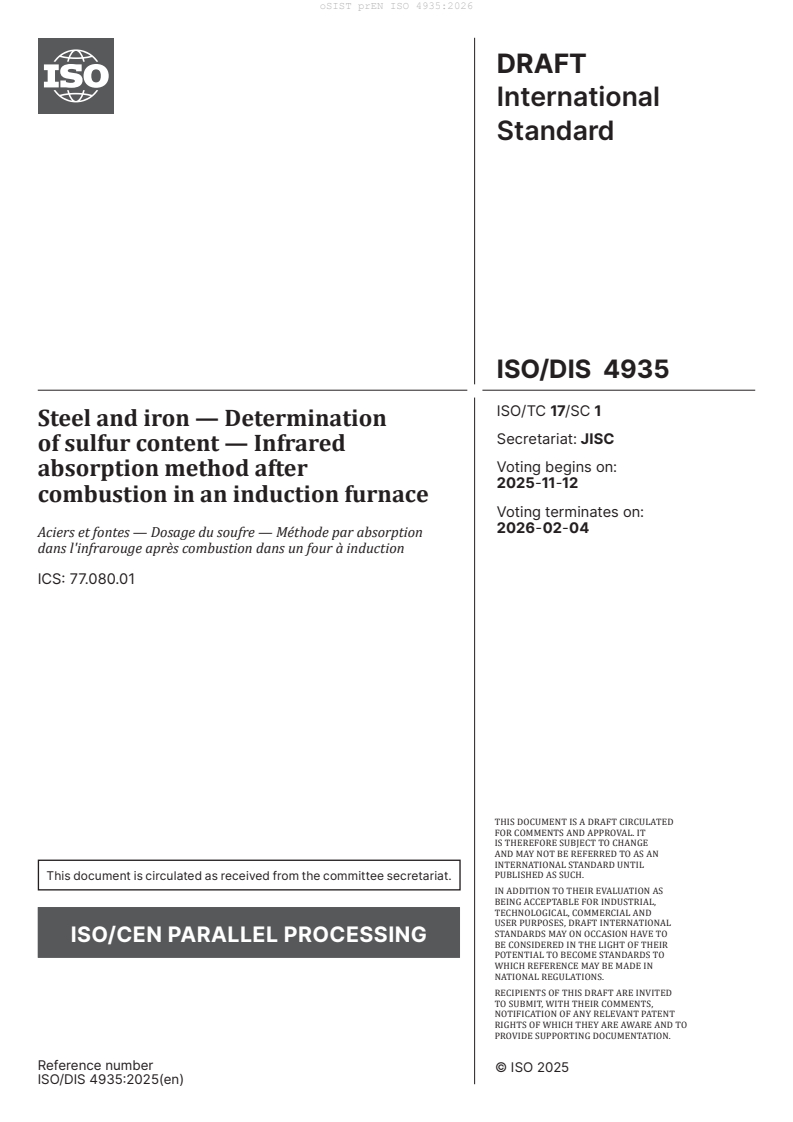
DRAFT
International
Standard
ISO/DIS 4935
ISO/TC 17/SC 1
Steel and iron — Determination
Secretariat: JISC
of sulfur content — Infrared
Voting begins on:
absorption method after
2025-11-12
combustion in an induction furnace
Voting terminates on:
2026-02-04
Aciers et fontes — Dosage du soufre — Méthode par absorption
dans l'infrarouge après combustion dans un four à induction
ICS: 77.080.01
THIS DOCUMENT IS A DRAFT CIRCULATED
FOR COMMENTS AND APPROVAL. IT
IS THEREFORE SUBJECT TO CHANGE
AND MAY NOT BE REFERRED TO AS AN
INTERNATIONAL STANDARD UNTIL
PUBLISHED AS SUCH.
This document is circulated as received from the committee secretariat.
IN ADDITION TO THEIR EVALUATION AS
BEING ACCEPTABLE FOR INDUSTRIAL,
TECHNOLOGICAL, COMMERCIAL AND
USER PURPOSES, DRAFT INTERNATIONAL
STANDARDS MAY ON OCCASION HAVE TO
ISO/CEN PARALLEL PROCESSING
BE CONSIDERED IN THE LIGHT OF THEIR
POTENTIAL TO BECOME STANDARDS TO
WHICH REFERENCE MAY BE MADE IN
NATIONAL REGULATIONS.
RECIPIENTS OF THIS DRAFT ARE INVITED
TO SUBMIT, WITH THEIR COMMENTS,
NOTIFICATION OF ANY RELEVANT PATENT
RIGHTS OF WHICH THEY ARE AWARE AND TO
PROVIDE SUPPORTING DOCUMENTATION.
Reference number
ISO/DIS 4935:2025(en)
DRAFT
ISO/DIS 4935:2025(en)
International
Standard
ISO/DIS 4935
ISO/TC 17/SC 1
Steel and iron — Determination
Secretariat: JISC
of sulfur content — Infrared
Voting begins on:
absorption method after
combustion in an induction furnace
Voting terminates on:
Aciers et fontes — Dosage du soufre — Méthode par absorption
dans l'infrarouge après combustion dans un four à induction
ICS: 77.080.01
THIS DOCUMENT IS A DRAFT CIRCULATED
FOR COMMENTS AND APPROVAL. IT
IS THEREFORE SUBJECT TO CHANGE
AND MAY NOT BE REFERRED TO AS AN
INTERNATIONAL STANDARD UNTIL
PUBLISHED AS SUCH.
This document is circulated as received from the committee secretariat.
IN ADDITION TO THEIR EVALUATION AS
BEING ACCEPTABLE FOR INDUSTRIAL,
© ISO 2025
TECHNOLOGICAL, COMMERCIAL AND
USER PURPOSES, DRAFT INTERNATIONAL
All rights reserved. Unless otherwise specified, or required in the context of its implementation, no part of this publication may
STANDARDS MAY ON OCCASION HAVE TO
ISO/CEN PARALLEL PROCESSING
be reproduced or utilized otherwise in any form or by any means, electronic or mechanical, including photocopying, or posting on
BE CONSIDERED IN THE LIGHT OF THEIR
the internet or an intranet, without prior written permission. Permission can be requested from either ISO at the address below
POTENTIAL TO BECOME STANDARDS TO
WHICH REFERENCE MAY BE MADE IN
or ISO’s member body in the country of the requester.
NATIONAL REGULATIONS.
ISO copyright office
RECIPIENTS OF THIS DRAFT ARE INVITED
CP 401 • Ch. de Blandonnet 8
TO SUBMIT, WITH THEIR COMMENTS,
CH-1214 Vernier, Geneva
NOTIFICATION OF ANY RELEVANT PATENT
Phone: +41 22 749 01 11
RIGHTS OF WHICH THEY ARE AWARE AND TO
PROVIDE SUPPORTING DOCUMENTATION.
Email: copyright@iso.org
Website: www.iso.org
Published in Switzerland Reference number
ISO/DIS 4935:2025(en)
ii
ISO/DIS 4935:2025(en)
Contents Page
Foreword .iv
1 Scope . 1
2 Normative references . 1
3 Terms and definitions . 1
4 Principle . 1
5 Reagent and materials . 1
6 Apparatus . 2
7 Sampling and sample preparation . 3
8 Procedure . 3
8.1 General operating instructions .3
8.2 Test sample and sample preparation .3
8.3 Blank test .4
8.3.1 Low standard .4
8.4 Determination .5
8.5 Establishment of the calibration curve .5
8.5.1 Samples having sulfur contents less than 0,005 % (mass fraction) .5
8.5.2 Samples having sulfur contents between 0,005 % (mass fraction) and 0,04 %
(mass fraction) .6
8.5.3 Samples having sulfur contents between 0,04 % (mass fraction) and 0,1 %
(mass fraction) .6
9 Expression of results . 7
9.1 Method of calculation .7
9.2 Precision . . .7
10 Test report . 8
Annex A (informative) Features of commercial high-frequancy induction furnaces and infrared
sulfur analysers . 9
Annex B (informative) Additional information on the international interlaboratory test .11
Annex C (informative) Graphical representation of precision data . 14
Bibliography .15
iii
ISO/DIS 4935:2025(en)
Foreword
ISO (the International Organization for Standardization) is a worldwide federation of national standards
bodies (ISO member bodies). The work of preparing International Standards is normally carried out through
ISO technical committees. Each member body interested in a subject for which a technical committee
has been established has the right to be represented on that committee. International organizations,
governmental and non-governmental, in liaison with ISO, also take part in the work. ISO collaborates closely
with the International Electrotechnical Commission (IEC) on all matters of electrotechnical standardization.
The procedures used to develop this document and those intended for its further maintenance are described
in the ISO/IEC Directives, Part 1. In particular, the different approval criteria needed for the different types
of ISO document should be noted. This document was drafted in accordance with the editorial rules of the
ISO/IEC Directives, Part 2 (see www.iso.org/directives).
ISO draws attention to the possibility that the implementation of this document may involve the use of (a)
patent(s). ISO takes no position concerning the evidence, validity or applicability of any claimed patent
rights in respect thereof. As of the date of publication of this document, ISO had not received notice of (a)
patent(s) which may be required to implement this document. However, implementers are cautioned that
this may not represent the latest information, which may be obtained from the patent database available at
www.iso.org/patents. ISO shall not be held responsible for identifying any or all such patent rights.
Any trade name used in this document is information given for the convenience of users and does not
constitute an endorsement.
For an explanation of the voluntary nature of standards, the meaning of ISO specific terms and expressions
related to conformity assessment, as well as information about ISO's adherence to the World Trade
Organization (WTO) principles in the Technical Barriers to Trade (TBT), see www.iso.org/iso/foreword.html.
This document was prepared by Technical Committee ISO/TC 17, Steel, Subcommittee SC 1, Methods of
determination of chemical composition.
This second edition cancels and replaces the first edition (ISO 4935:1989), which has been technically
revised.
The main changes compared to the previous edition are as follows:
— Normative references have been revised;
— The precision data has been updated;
— The text has been improved editorially.
Any feedback or questions on this document should be directed to the user’s national standards body. A
complete listing of these bodies can be found at www.iso.org/members.html.
iv
DRAFT International Standard ISO/DIS 4935:2025(en)
Steel and iron — Determination of sulfur content — Infrared
absorption method after combustion in an induction furnace
1 Scope
This document specifies an infrared absorption method after combustion in an induction furnace for
determination of sulfur in steel and iron.
The method is applicable to sulfur contents between 0,002 % (mass fraction) and 0,10 % (mass fraction).
2 Normative references
The following documents are referred to in the text in such a way that some or all of their content constitutes
requirements of this document. For dated references, only the edition cited applies. For undated references,
the latest edition of the referenced document (including any amendments) applies.
ISO 648, Laboratory glassware — Single-volume pipettes
ISO 1042, Laboratory glassware — One-mark volumetric flasks
ISO 3696, Water for analytical laboratory use — Specification and test methods
ISO 14284, Steel and iron — Sampling and preparation of samples for the determination of chemical composition
3 Terms and definitions
No terms and definitions are listed in this document.
ISO and IEC maintain terminology databases for use in standardization at the following addresses:
— ISO Online browsing platform: available at https:// www .iso .org/ obp
— IEC Electropedia: available at https:// www .electropedia .org/
4 Principle
Combustion of a test portion in presence of an accelerator at a high temperature in a high-frequency
induction furnace in a current of pure oxygen. Transformation of sulfur into sulfur dioxide.
Measurement by infrared absorption of the Sulfur dioxide carried by a current of oxygen.
5 Reagent and materials
During the analysis, unless otherwise stated, use only reagents of recognized analytical grade and only
distilled water in accordance with ISO 3696 or water of equivalent purity.
5.1 Water, free from sulfur dioxide.
Boil water for 30 min, cool to room temperature and bubble with oxygen (5.2) for 15 min. Prepare just before use.
ISO/DIS 4935:2025(en)
5.2 Oxygen, 99,5 % (volume fraction) minimum.
An oxidation catalyst [copper(II) oxide or platinum] tube heated to a temperature above 450 °C shall be used
prior to a purifying unit (see Annex A), when the presence of organic contaminants is suspected in the oxygen.
5.3 Pure iron, of known low sulfur content less than 0,000 5 % (mass fraction).
5.4 Appropriate solvent, suitable for washing greasy or dirty test samples, for example, high-purity acetone
5.5 Magnesium perchlorate [Mg(ClO ) ], particle size: from 0,7 mm to 1,2 mm.
4 2
WARNING — Magnesium perchlorate is a highly potent reagent and shall be opened as short as
possible and kept in a dry and organic free environment. It also pulverises during storage and using
too small particles will cause changes or stop the flow. Using a grid to separate small particles is not
recommended but just vibrate will cause larger particles on top.
5.6 Accelerator, tungsten-tin mixture or tungsten of known low sulfur content less than 0,000 5 % (mass
fraction). The particle size of the accelerator may be dependent on the type of apparatus used.
5.7 Quartz wool, fine or course shall be used as glass wool will absorb sulfur (SO ).
WARNING — Quartz is hazardous to inhale so protective breathing filter and a hood shall be used
when handling quartz wool.
5.8 Sulfur, standard solutions
Weigh, to the nearest 0,1 mg, the mass given in Table 1 of potassium sulfate [minimum purity: 99,9 % (mass
fraction)] previously dried at 105 °C to 110 °C for 1 h or to constant mass and cooled in a desiccator.
Table 1 — Preparation of sulfur standard solutions
Reference of sulfur standard solution Mass of potassium sulfate Concentration of sulfur
g mg/ml
5.7.1 0,217 4 0,40
5.7.2 0,380 4 0,70
5.7.3 0,543 4 1,00
5.7.4 1,086 9 2,00
5.7.5 1,902 2 3,50
5.7.6 2,717 2 5,00
5.7.7 4,347 5 8,00
Transfer quantitatively into seven 100 ml one-mark volumetric flasks. Dilute to the mark with water and mix.
5.9 Inert ceramic, (attapulgus clay) impregnated with sodium hydroxide, particle size: from 0,7 mm
to 1,2 mm.
6 Apparatus
During the analysis, unless otherwise stated, use only ordinary laboratory apparatus.
All volumetric glassware shall be class A, in accordance with ISO 648 or ISO 1042 as appropriate.
The apparatus required for combustion in a high-frequency induction furnace and the subsequent infrared
absorption measurement of the evolved sulfur dioxide may be obtained commercially from a number of
manufacturers. Follow the manufacturer’s instructions for the operation of the instrument.
ISO/DIS 4935:2025(en)
Features of commercial instruments are given in Annex A.
6.1 Micro pipette, 50 μl and 100 μl, the limit of error shall be less than 1 μl.
6.2 Tin capsule, about 6 mm in diameter, 18 mm in height, 0,3 g in mass and approximately 0,4 ml in volume.
6.3 Ceramic crucible, capable of withstanding combustion in an induction furnace
Ignite crucibles in an electric furnace in air or in a current of oxygen for not less than 2 h at 1 100 °C and
store in a desiccator before use.
NOTE For the determination of low sulfur contents it is advisable to ignite crucibles at 1 350 °C in a current of oxygen
7 Sampling and sample preparation
Sampling and preparation of the samples shall be carried out in accordance with ISO 14284 or appropriate
national standards for steel and iron.
8 Procedure
WARNING — The risks related to combustion analysis are mainly burns in pre-igniting the ceramic
crucibles and in the fusions. Use crucible tongs at all times and suitable containers for the used
crucibles. Normal precautions for handling oxygen cylinders shall be taken. Oxygen from the
combustion process shall be removed effectively from the apparatus since a high concentration of
oxygen in a confined space can present a fire hazard.
8.1 General operating instructions
Purify the oxygen supply using tubes packed with the inert ceramic (attapulgus clay) impregnated with
sodium hydroxide (5.8) and magnesium perchlorate (5.5), and maintain a quiescent flow rate whilst on
standby. Maintain a quartz wool (5.7), filter or a stainless steel net as a dust collector. Clean and change as
necessary. The furnace chamber, pedestal post and filter trap shall be cleaned frequently to remove oxide
build-up.
Allow each item of equipment to stabilize for the time recommended by the manufacturers of the equipment
when the main supply is switched on after being out of action for any length of time.
After cleaning the furnace chamber and/or changing filters or after the equipment has been inoperative for
a period, stabilize the apparatus by burning several samples of similar type to the samples to be analyzed
prior to setting up for analysis.
Flush oxygen through the apparatus and adju
...
Questions, Comments and Discussion
Ask us and Technical Secretary will try to provide an answer. You can facilitate discussion about the standard in here.
Loading comments...