

SIST EN 14499:2025
(Main)Textile floor coverings - Classification of carpet underlays
General Information
- Abstract
This document specifies minimum performance requirements for fibrous, non-fibrous and combined underlays, together with their classification for seven classes of intended use/application.
- Status
- Published
- Publication Date
- 25-Nov-2024
- Technical Committee
- ITEK - Textile and textile products
- Current Stage
- 6060 - National Implementation/Publication (Adopted Project)
- Start Date
- 21-Nov-2024
- Due Date
- 26-Jan-2025
- Completion Date
- 26-Nov-2024



Overview
SIST EN 14499:2025 is the Slovenian standard (identical to EN 14499:2024) that defines the minimum performance requirements and classification system for carpet underlays used with textile floor coverings. Issued by the Slovenski inštitut za standardizacijo (SIST), this standard covers fibrous, non-fibrous, and combined underlay types. It establishes a comprehensive framework for evaluating and specifying underlay products according to their performance and intended end-use environments. By facilitating uniform assessment criteria, SIST EN 14499:2025 enables manufacturers, specifiers, and installers to ensure optimal performance, durability, and suitability of carpet underlays for various residential, commercial, and luxury applications.
Key Topics
SIST EN 14499:2025 addresses several critical areas for the classification of carpet underlays:
- Types of Underlay: The standard encompasses fibrous underlays (such as needlefelt and impregnated varieties), non-fibrous underlays (including cellular rubber, cellular plastics, and rubber crumb), and combined multi-layer constructions.
- Minimum Performance Requirements: Performance characteristics such as breaking strength, thickness loss under static and dynamic loading, compression, and resistance to cracking are specified. Testing methods are referenced to related ISO standards to ensure consistency.
- Classification System: Underlays are categorized into seven distinct classes based on intended use - from light domestic to heavy commercial and luxury environments. This classification is determined by objective measures of compression and work of compression following dynamic loading.
- Sampling and Marking: The standard outlines procedures for sample selection, preparation, and marking of products to guarantee traceability, authenticity, and compliance.
- Test Methods: Normative annexes detail methodologies for determining resistance to breaking and cracking, as well as work of compression after dynamic loading.
Applications
SIST EN 14499:2025 is targeted at a wide range of stakeholders in the flooring and construction industries, offering practical benefits in several key areas:
- Manufacturing and Product Development: Carpet underlay manufacturers can ensure their products meet recognized criteria for physical durability, longevity, and performance across various environments.
- Building and Interior Design: Architects, specifiers, and flooring contractors can select underlays based on standardized classes to optimize comfort, acoustic performance, and durability for residential, hospitality, and commercial projects.
- Quality Control and Procurement: Procurement officers gain a reliable benchmark for comparing products, supporting informed purchasing and inventory decisions.
- Compliance and Certification: Testing laboratories and regulatory authorities benefit from established procedures for product testing and certification, contributing to safer and higher-quality flooring solutions.
- Sustainability and Lifecycle Considerations: By using classified and properly tested underlays, lifecycle impacts of flooring can be better controlled, contributing to reduced maintenance costs and improved building performance.
Related Standards
For comprehensive assurance of quality and compatibility, SIST EN 14499:2025 should be used alongside the following standards and references:
- EN ISO 9405: Assessment of changes in appearance in textile floor coverings
- EN ISO 13934-1: Tensile properties of fabrics using the strip method
- ISO 1765: Determination of thickness in machine-made floor coverings
- ISO 1957: Guidelines for sampling and specimen preparation for physical tests
- ISO 2094: Measurement of thickness loss under dynamic loading
- ISO 3415 & ISO 3416: Measurement of thickness loss after static loading
- ISO 10361: Resistance to change in appearance using mechanical testers
- BS 4098: Methods for determining thickness, compression, and recovery characteristics
By adhering to SIST EN 14499:2025 and employing the associated test methods and classification criteria, stakeholders ensure the selection and use of carpet underlays meet established European quality and performance standards, supporting enhanced durability, safety, and satisfaction in textile floor covering installations.
Relations
- Effective Date
- 28-Jan-2026
- Refers
SIST EN ISO 6710:2017 - Single-use containers for venous blood specimen collection (ISO 6710:2017) - Effective Date
- 28-Jan-2026
- Effective Date
- 28-Jan-2026
- Effective Date
- 28-Jan-2026
- Effective Date
- 28-Jan-2026
- Effective Date
- 28-Jan-2026
- Effective Date
- 28-Jan-2026
- Effective Date
- 28-Jan-2026
- Effective Date
- 28-Jan-2023
Frequently Asked Questions
SIST EN 14499:2025 is a standard published by the Slovenian Institute for Standardization (SIST). Its full title is "Textile floor coverings - Classification of carpet underlays". This standard covers: This document specifies minimum performance requirements for fibrous, non-fibrous and combined underlays, together with their classification for seven classes of intended use/application.
This document specifies minimum performance requirements for fibrous, non-fibrous and combined underlays, together with their classification for seven classes of intended use/application.
SIST EN 14499:2025 is classified under the following ICS (International Classification for Standards) categories: 97.150 - Floor coverings. The ICS classification helps identify the subject area and facilitates finding related standards.
SIST EN 14499:2025 has the following relationships with other standards: It is inter standard links to SIST EN 12094-1:2003, SIST EN ISO 6710:2017, SIST EN 12237:2004, SIST EN ISO 3656:2011, SIST EN ISO 13934-1:2013, SIST EN ISO 25178-603:2014, SIST EN ISO 9405:2017, SIST EN 1307:2009, SIST EN 14499:2015. Understanding these relationships helps ensure you are using the most current and applicable version of the standard.
SIST EN 14499:2025 is available in PDF format for immediate download after purchase. The document can be added to your cart and obtained through the secure checkout process. Digital delivery ensures instant access to the complete standard document.
Standards Content (Sample)
SLOVENSKI STANDARD
01-januar-2025
Tekstilne talne obloge - Minimalne zahteve za podloge preprog
Textile floor coverings - Classification of carpet underlays
Textile Bodenbeläge - Klassifizierung von Teppichunterlagen
Revêtements de sol textiles - Classification des thibaudes de moquette
Ta slovenski standard je istoveten z: EN 14499:2024
ICS:
97.150 Talne obloge Floor coverings
2003-01.Slovenski inštitut za standardizacijo. Razmnoževanje celote ali delov tega standarda ni dovoljeno.
EN 14499
EUROPEAN STANDARD
NORME EUROPÉENNE
November 2024
EUROPÄISCHE NORM
ICS 97.150 Supersedes EN 14499:2015
English Version
Textile floor coverings - Classification of carpet underlays
Revêtements de sol textiles - Classification des Textile Bodenbeläge - Klassifizierung von
thibaudes de moquette Teppichunterlagen
This European Standard was approved by CEN on 21 July 2024.
CEN members are bound to comply with the CEN/CENELEC Internal Regulations which stipulate the conditions for giving this
European Standard the status of a national standard without any alteration. Up-to-date lists and bibliographical references
concerning such national standards may be obtained on application to the CEN-CENELEC Management Centre or to any CEN
member.
This European Standard exists in three official versions (English, French, German). A version in any other language made by
translation under the responsibility of a CEN member into its own language and notified to the CEN-CENELEC Management
Centre has the same status as the official versions.
CEN members are the national standards bodies of Austria, Belgium, Bulgaria, Croatia, Cyprus, Czech Republic, Denmark, Estonia,
Finland, France, Germany, Greece, Hungary, Iceland, Ireland, Italy, Latvia, Lithuania, Luxembourg, Malta, Netherlands, Norway,
Poland, Portugal, Republic of North Macedonia, Romania, Serbia, Slovakia, Slovenia, Spain, Sweden, Switzerland, Türkiye and
United Kingdom.
EUROPEAN COMMITTEE FOR STANDARDIZATION
COMITÉ EUROPÉEN DE NORMALISATION
EUROPÄISCHES KOMITEE FÜR NORMUNG
CEN-CENELEC Management Centre: Rue de la Science 23, B-1040 Brussels
© 2024 CEN All rights of exploitation in any form and by any means reserved Ref. No. EN 14499:2024 E
worldwide for CEN national Members.
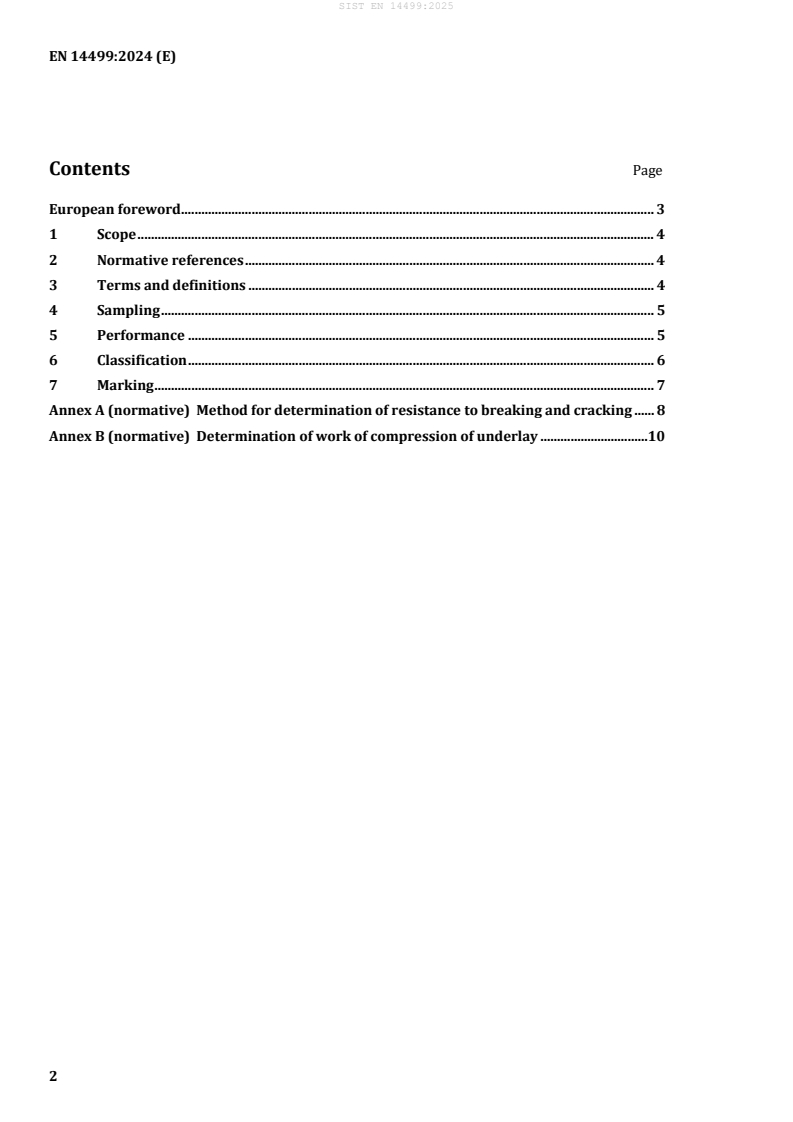
Contents Page
European foreword . 3
1 Scope . 4
2 Normative references . 4
3 Terms and definitions . 4
4 Sampling . 5
5 Performance . 5
6 Classification . 6
7 Marking . 7
Annex A (normative) Method for determination of resistance to breaking and cracking . 8
Annex B (normative) Determination of work of compression of underlay .10
European foreword
This document (EN 14499:2024) has been prepared by Technical Committee CEN/TC 134 “Resilient,
textile, laminate and modular mechanical locked floor coverings”, the secretariat of which is held by NBN.
This European Standard shall be given the status of a national standard, either by publication of an
identical text or by endorsement, at the latest by May 2025, and conflicting national standards shall be
withdrawn at the latest by May 2025.
Attention is drawn to the possibility that some of the elements of this document may be the subject of
patent rights. CEN shall not be held responsible for identifying any or all such patent rights.
This document supersedes EN 14499:2015.
— Changes to the title;
— Changes to the Scope;
— Changes in terminology.
Any feedback and questions on this document should be directed to the users’ national standards body.
A complete listing of these bodies can be found on the CEN website.
According to the CEN-CENELEC Internal Regulations, the national standards organisations of the
following countries are bound to implement this European Standard: Austria, Belgium, Bulgaria, Croatia,
Cyprus, Czech Republic, Denmark, Estonia, Finland, France, Germany, Greece, Hungary, Iceland, Ireland,
Italy, Latvia, Lithuania, Luxembourg, Malta, Netherlands, Norway, Poland, Portugal, Republic of North
Macedonia, Romania, Serbia, Slovakia, Slovenia, Spain, Sweden, Switzerland, Türkiye and the United
Kingdom.
1 Scope
This document specifies minimum performance requirements for fibrous, non-fibrous and combined
underlays, together with their classification for seven classes of intended use/application.
2 Normative references
The following documents are referred to in the text in such a way that some or all of their content
constitutes requirements of this document. For dated references, only the edition cited applies. For
undated references, the latest edition of the referenced document (including any amendments) applies.
EN ISO 9405, Textile floor coverings — Assessment of changes in appearance (ISO 9405)
EN ISO 13934-1, Textiles — Tensile properties of fabrics — Part 1: Determination of maximum force and
elongation at maximum force using the strip method (ISO 13934-1)
ISO 1765, Machine-made textile floor coverings — Determination of thickness
ISO 1957, Machine-made textile floor coverings — Selection and cutting of specimens for physical tests
ISO 2094, Textile floor coverings — Determination of thickness loss under dynamic loading
ISO 3415, Textile floor coverings — Determination of thickness loss after brief, moderate static loading
ISO 3416, Textile floor coverings — Determination of thickness loss after prolonged, heavy static loading
ISO 10361, Textile floor coverings — Production of changes in appearance by means of Vettermann drum
and hexapod tumbler tester
BS 4098, Method for the determination of thickness, compression and recovery characteristics of textile floor
coverings
3 Terms and definitions
For the purposes of this document, the following terms and definitions apply.
ISO and IEC maintain terminology databases for use in standardization at the following addresses:
— IEC Electropedia: available at https://www.electropedia.org/
— ISO Online browsing platform: available at https://www.iso.org/obp
3.1
needlefelt fibrous underlay
material made wholly of fibres entangled or matted together by needling of a fibre batt
3.2
impregnated fibrous underlay
material made of fibres consolidated by impregnation with a binding agent
Note 1 to entry: A woven, nonwoven or film scrim may be included in a fibrous underlay for support during
manufacture.
3.3
cellular rubber underlay
material formed of a vulcanized rubber foam, with or without a carrier or backing material bonded
thereto
...