

SIST EN 14215:2026
(Main)Textile floor coverings - Classification of rugs and runners
General Information
- Abstract
This document specifies the requirements for classification of woven, tufted, knitted, needled, flocked, bonded, hand-tufted rugs and runners into use classes with regard to one or more of the following properties: wear, appearance retention, additional performance properties and classes for luxury rating.
This document is not applicable to hand-knotted rugs and runners, to barrier mats or to bathroom rugs.
This document refers to the classification as defined in EN ISO 10874:2012.
- Status
- Published
- Public Enquiry End Date
- 25-Apr-2024
- Publication Date
- 22-Dec-2025
- Technical Committee
- ITEK - Textile and textile products
- Current Stage
- 6060 - National Implementation/Publication (Adopted Project)
- Start Date
- 18-Dec-2025
- Due Date
- 22-Feb-2026
- Completion Date
- 23-Dec-2025

Overview
EN 14215:2025 - "Textile floor coverings - Classification of rugs and runners" (CEN) defines how woven, tufted, knitted, needled, flocked, bonded and hand‑tufted rugs and runners are classified into use classes. The standard sets identification, basic performance and classification rules covering wear, appearance retention, additional performance properties and luxury rating. It is not applicable to hand‑knotted rugs, barrier mats or bathroom rugs and implements the use‑class system referenced in EN ISO 10874:2012.
Key topics and technical requirements
- Scope and product types: Applies to machine and non‑machine manufactured rugs and runners including pile and flat/needled types (A1–A3, B1–B3), flocked and bonded constructions.
- Use classes / levels of use: Domestic 21 (moderate), 22 (general), 23 (heavy); Commercial 31 (moderate), 32 (general), 33 (heavy). Final class is the lowest class determined from all relevant tests.
- Identification requirements: Products must declare commercial name, fibre composition of the use surface, type of manufacture, type of use‑surface and backing(s). Nominal values such as thickness, total mass and pile mass must be declared with specified tolerances.
- Basic performance tests: Key test methods and minimums include:
- Colour fastness (light, rubbing, water) per EN ISO 105 series (man‑made fibres ≥5 to light; natural ≥4; rubbing wet ≥3; dry ≥3–4; water change/staining thresholds as specified).
- Pile retention and durability: tuft withdrawal force per ISO 4919 (cut pile ≥3.0 N average, no result <1.5 N; loop pile ≥10.0 N average, no result <5.0 N); mass loss and fibre bind per EN ISO 12951 and EN 984 where applicable.
- Identification tolerances: thickness +15%/−10%; total mass ±15%; other property tolerances as defined.
- Luxury rating: Five luxury classes (LC1–LC5) based on mass per unit area thresholds (e.g., LC1 ≤400 g/m2 for flat/low‑pile items; LC2 >400 g/m2; LC3 >600 g/m2; LC4 >800 g/m2; LC5 >1000 g/m2).
- Additional properties: Classification can include castor‑chair suitability, stair suitability and other characteristics aligned with EN 1307.
Practical applications and users
EN 14215:2025 is essential for:
- Manufacturers - product development, labelling and conformity declaration.
- Test laboratories - specifying and reporting required tests.
- Specifiers, architects and interior designers - selecting rugs/runners for intended traffic and performance.
- Procurement, retailers and facility managers - comparing products by use class, luxury rating and additional features (castor suitability, stair use).
- Installers and compliance officers - ensuring products meet tolerance and safety/performance requirements.
Using EN 14215 supports consistent product classification, better buyer guidance and easier regulatory compliance for textile floor coverings.
Related standards (select)
- EN 1307:2014+A3:2018 - Textile floor coverings - Classification
- EN ISO 10874:2012 - Classification (use classes)
- EN ISO 105 (B02, E01, X12) - Colour fastness tests
- EN ISO 12951:2020 - Mass loss / stair nosing appearance
- EN 14159:2014 - Dimensional tolerances
- ISO 2424:2024 - Vocabulary
Keywords: EN 14215:2025, textile floor coverings, rugs and runners classification, luxury rating, use classes, pile retention, tuft withdrawal.
Relations
- Effective Date
- 09-Feb-2026
- Effective Date
- 28-Jan-2026
- Effective Date
- 28-Jan-2026
- Effective Date
- 28-Jan-2026
- Effective Date
- 28-Jan-2026
- Effective Date
- 28-Jan-2026
- Effective Date
- 28-Jan-2026
- Effective Date
- 28-Jan-2026
- Effective Date
- 28-Jan-2026
- Effective Date
- 28-Jan-2026
- Effective Date
- 28-Jan-2026
- Effective Date
- 28-Jan-2026
- Effective Date
- 28-Jan-2026
- Effective Date
- 28-Jan-2026
- Effective Date
- 28-Jan-2026
Frequently Asked Questions
SIST EN 14215:2026 is a standard published by the Slovenian Institute for Standardization (SIST). Its full title is "Textile floor coverings - Classification of rugs and runners". This standard covers: This document specifies the requirements for classification of woven, tufted, knitted, needled, flocked, bonded, hand-tufted rugs and runners into use classes with regard to one or more of the following properties: wear, appearance retention, additional performance properties and classes for luxury rating. This document is not applicable to hand-knotted rugs and runners, to barrier mats or to bathroom rugs. This document refers to the classification as defined in EN ISO 10874:2012.
This document specifies the requirements for classification of woven, tufted, knitted, needled, flocked, bonded, hand-tufted rugs and runners into use classes with regard to one or more of the following properties: wear, appearance retention, additional performance properties and classes for luxury rating. This document is not applicable to hand-knotted rugs and runners, to barrier mats or to bathroom rugs. This document refers to the classification as defined in EN ISO 10874:2012.
SIST EN 14215:2026 is classified under the following ICS (International Classification for Standards) categories: 97.150 - Floor coverings. The ICS classification helps identify the subject area and facilitates finding related standards.
SIST EN 14215:2026 has the following relationships with other standards: It is inter standard links to SIST ISO 1763:2021, SIST EN ISO 10874:2012/A1:2021, SIST EN ISO 12951:2020, SIST EN ISO 4918:2021, SIST EN ISO 105-E01:2013, SIST EN ISO 105-B02:2014, SIST EN 984:2002, SIST EN 1307:2014+A3:2019, SIST EN ISO 105-X12:2016, SIST EN 14159:2015, SIST EN 12237:2004, SIST EN 15398:2020, SIST EN ISO 10874:2012, SIST-TS CEN/TS 15398:2016, SIST EN 1963:2007. Understanding these relationships helps ensure you are using the most current and applicable version of the standard.
SIST EN 14215:2026 is available in PDF format for immediate download after purchase. The document can be added to your cart and obtained through the secure checkout process. Digital delivery ensures instant access to the complete standard document.
Standards Content (Sample)
SLOVENSKI STANDARD
01-februar-2026
Tekstilne talne obloge - Klasifikacija preprog in tekačev
Textile floor coverings - Classification of rugs and runners
Textile Bodenbeläge - Einstufung von abgepassten Teppichen und Läufern
Revêtements de sol textiles - Classement des carpettes et passages
Ta slovenski standard je istoveten z: EN 14215:2025
ICS:
97.150 Talne obloge Floor coverings
2003-01.Slovenski inštitut za standardizacijo. Razmnoževanje celote ali delov tega standarda ni dovoljeno.
EN 14215
EUROPEAN STANDARD
NORME EUROPÉENNE
December 2025
EUROPÄISCHE NORM
ICS 97.150 Supersedes EN 14215:2018
English Version
Textile floor coverings - Classification of rugs and runners
Revêtements de sol textiles - Classement des carpettes Textile Bodenbeläge - Einstufung von abgepassten
et passages Teppichen und Läufern
This European Standard was approved by CEN on 17 November 2025.
CEN members are bound to comply with the CEN/CENELEC Internal Regulations which stipulate the conditions for giving this
European Standard the status of a national standard without any alteration. Up-to-date lists and bibliographical references
concerning such national standards may be obtained on application to the CEN-CENELEC Management Centre or to any CEN
member.
This European Standard exists in three official versions (English, French, German). A version in any other language made by
translation under the responsibility of a CEN member into its own language and notified to the CEN-CENELEC Management
Centre has the same status as the official versions.
CEN members are the national standards bodies of Austria, Belgium, Bulgaria, Croatia, Cyprus, Czech Republic, Denmark, Estonia,
Finland, France, Germany, Greece, Hungary, Iceland, Ireland, Italy, Latvia, Lithuania, Luxembourg, Malta, Netherlands, Norway,
Poland, Portugal, Republic of North Macedonia, Romania, Serbia, Slovakia, Slovenia, Spain, Sweden, Switzerland, Türkiye and
United Kingdom.
EUROPEAN COMMITTEE FOR STANDARDIZATION
COMITÉ EUROPÉEN DE NORMALISATION
EUROPÄISCHES KOMITEE FÜR NORMUNG
CEN-CENELEC Management Centre: Rue de la Science 23, B-1040 Brussels
© 2025 CEN All rights of exploitation in any form and by any means reserved Ref. No. EN 14215:2025 E
worldwide for CEN national Members.
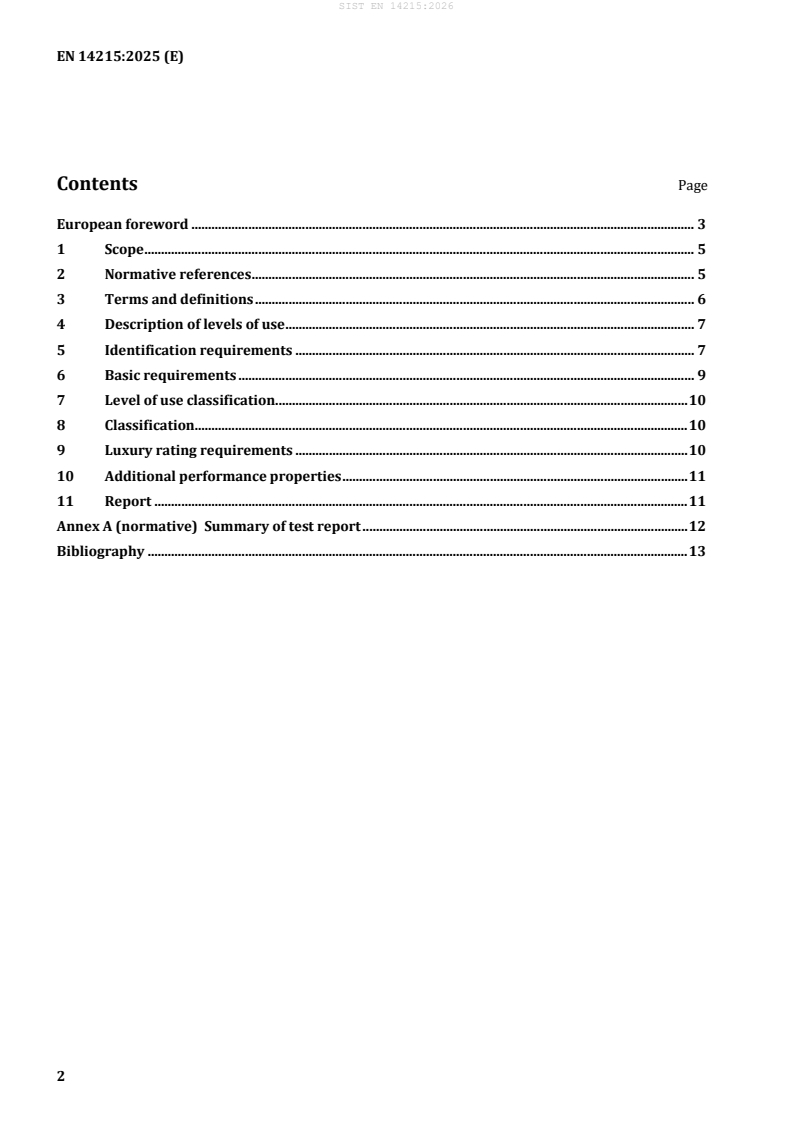
Contents Page
European foreword . 3
1 Scope . 5
2 Normative references . 5
3 Terms and definitions . 6
4 Description of levels of use . 7
5 Identification requirements . 7
6 Basic requirements . 9
7 Level of use classification . 10
8 Classification. 10
9 Luxury rating requirements . 10
10 Additional performance properties . 11
11 Report . 11
Annex A (normative) Summary of test report . 12
Bibliography . 13
European foreword
This document (EN 14215:2025) has been prepared by Technical Committee CEN/TC 134 “Resilient,
textile, laminate and modular mechanical locked floor coverings”, the secretariat of which is held by NBN.
This European Standard shall be given the status of a national standard, either by publication of an
identical text or by endorsement, at the latest by June 2026, and conflicting national standards shall be
withdrawn at the latest by June 2026.
Attention is drawn to the possibility that some of the elements of this document may be the subject of
patent rights. CEN shall not be held responsible for identifying any or all such patent rights.
This document supersedes EN 14215:2018.
— Title of document: “machine-made” is deleted from the title.
— Clause 1 Scope: Rephrased with wider scope of type of manufacture and aligned with
EN 1307:2014+A3:2018.
— Clause 2 Normative references: General update and publication dates are included of referred norms.
— Clause 3 Terms and definitions: Definitions of abbreviations deleted, added definitions of nominal
value and needled floor coverings.
— Clause 4 Description of levels of use: Clause added, including Table 1 “Levels of use intensity” for both
domestic and commercial use, aligned with EN 1307:2014+A3:2018 Clause 4 Table 1.
— Clause 5 Table 2 Identification characteristics: Needled and flocked floor covering types added,
tolerances aligned with EN 1307:2014+A3:2018 Clause 5 Table 2.
— Clause 6 Table 3 Basic requirements: Needled and flocked floor covering types added.
— Clause 7 Level of use classification: Reference made to EN 1307:2014+A3:2018 Clause 7 Table 4 for
alignment.
— Clause 8 Classification: Reference made to EN 1307:2014+A3:2018 Clauses 8 till 12 for alignment.
— Clause 9 Table 4 Luxury rating classes: Requirements aligned with EN 1307:2014+A3:2018 Clause 13
Table 18.
— Clause 10 Table 5 Additional performance properties: Requirements for castor chair suitability and
suitability for use on stairs aligned with EN 1307:2014+A3:2018 Clause 14 Table 19.
— Annex A Summary test report: Referred to the lists of references of EN 1307:2014+A3:2018
Annex B.2.
Any feedback and questions on this document should be directed to the users’ national standards body.
A complete listing of these bodies can be found on the CEN website.
According to the CEN-CENELEC Internal Regulations, the national standards organisations of the
following countries are bound to implement this European Standard: Austria, Belgium, Bulgaria, Croatia,
Cyprus, Czech Republic, Denmark, Estonia, Finland, France, Germany, Greece, Hungary, Iceland, Ireland,
Italy, Latvia, Lithuania, Luxembourg, Malta, Netherlands, Norway, Poland, Portugal, Republic of North
Macedonia, Romania, Serbia, Slovakia, Slovenia, Spain, Sweden, Switzerland, Türkiye and the United
Kingdom.
1 Scope
This document specifies the requirements for classification of woven, tufted, knitted, needled, flocked,
bonded, hand-tufted rugs and runners into use classes with regard to one or more of the following
properties: wear, appearance retention, additional performance properties and classes for luxury rating.
This document is not applicable to hand-knotted rugs and runners, to barrier mats or to bathroom rugs.
.
This document refers to the classification as defined in EN ISO 10874:2012
2 Normative references
The following documents are referred to in the text in such a way that some or all of their content
constitutes requirements of this document. For dated references, only the edition cited applies. For
undated references, the latest edition of the referenced document (including any amendments) applies.
EN 984:2001, Textile floor coverings — Determination of the mass per unit area of the use surface of
needled floor coverings
EN 1307:2014+A3:2018, Textile floor coverings — Classification
EN 15398:2020, Resilient, textile, laminate and modular mechanical locked floor coverings (MMF) — Floor
covering standard symbols — Complementary element
EN 14159:2014, Textile floor coverings — Requirements for tolerances on (linear) dimensions of rugs,
runners, carpet tiles and wall-to-wall carpet and for tolerances on pattern repeat
EN ISO 105-B02:2014, Textiles — Tests for colour fastness — Part B02: Colour fastness to artificial light:
Xenon arc fading lamp test (ISO 105-B02:2014)
EN ISO 105-E01:2013, Textiles — Tests for colour fastness — Part E01: Colour fastness to water
(ISO 105-E01:2013)
EN ISO 105-X12:2016, Textiles — Tests for colour fastness — Part X12: Colour fastness to rubbing
(ISO 105-X12:2016)
EN ISO 4918:2021, Resilient, textile and laminate floor coverings — Castor chair test (ISO 4918:2016,
including Amd 1:2018)
EN ISO 10874:2012 , Resilient, textile and laminate floor coverings — Classification
(ISO 10874:2009/Amd 1:2020)
EN ISO 12951:2020, Textile floor coverings — Determination of mass loss, fibre bind and stair nosing
appearance change using the Lisson Tretrad machine (ISO 12951:2020)
ISO 1763:2020, Textile floor coverings — Determination of number of tufts and/or loops per unit length
and per unit area
ISO 1765:1986, Machine-made textile floor coverings — Determination of thickness
ISO 2424:2024, Textile floor coverings — Vocabulary
ISO 4919:2012, Carpets — Determination of tuft withdrawal force
As impacted by EN ISO 10874:2012/A1:2020
ISO 8543:2020, Textile floor coverings — Methods for determination of mass
3 Terms and definitions
For the purposes of this document, the terms and definitions given in ISO 2424:2024 and the following
apply.
ISO and IEC maintain terminology databases for use in standardization at the following addresses:
— ISO Online browsing platform: available at https://www.iso.org/obp/
— IEC Electropedia: available at https://www.electropedia.org/
3.1
nominal value
value stated by the manufacturer
3.2
flat needled floor covering
flat needled homogeneous floor covering
type A1
flat needled floor covering with one visible layer
Note 1 to entry: Layers such as secondary backing are also taken into consideration for the determination of the
number of layers.
3.3
flat needled floor covering
type A2
flat needled floor covering with more than one visible layer, the bonding compo
...