


oSIST prEN 10344:2022
(Main)Malleable cast iron fittings with compression ends for steel pipes
Malleable cast iron fittings with compression ends for steel pipes
This standard specifies the requirements for the design, performance and testing of fittings made of malleable cast iron (see also clause 5 Materials) with compression ends for steel pipes. It applies to steel piping systems for different application fields, such as gas supply, distribution of water for general purposes and for human consumption, irrigation, fire fighting, aqueous liquids, compressed air and gaseous fuel systems.
It also applies to oil piping systems, provided the elastomeric sealing material is compatible with the oil and the operating conditions.
It contains requirements and tests relating to compression fittings which can be disconnected from smooth walled steel pipes or other cylindrical metal structural elements, which are applicable for dismantleable joints. The fittings can also incorporate other types of connection, such as threaded, flanged, compression ends for connection of polyethylene pipes, etc., and can also take on various structural shapes, such as, straight piece, elbow or T-piece, etc. Their range of sizes covers nominal sizes DN 6 to DN 100 (size 1/8 to 4).
Tempergussfittings mit Klemmanschlüssen für Stahlrohre
Diese Norm legt die Anforderungen an die Konstruktion, Anwendungsmerkmale und Prüfung von Tempergussfittings mit Klemmanschlüssen für Stahlrohre fest. Sie gilt für Rohrleitungssysteme aus Stahl für unterschiedliche Anwendungsbereiche, z. B. Gasversorgung, Wasserverteilung für allgemeine Zwecke sowie für Trinkwasser, Bewässerung, Löschwassersysteme, wässrige Lösungen, Druckluft und gasförmige Brennstoffe.
Diese Norm gilt ebenfalls für Rohrleitungen für Öl, sofern die Elastomer-Abdichtungen mit dem Öl und den Betriebsbedingungen kompatibel sind.
Die Norm enthält Anforderungen und Prüfungen für Klemmanschlüsse, die von glattwandigen Stahlrohren oder anderen zylindrischen Bauteilen aus Metall (im folgenden kurz „glatte Rohrverbindungen“ genannt)
demontiert werden können. Die Fittings können auch andere Verbindungsarten umfassen, z. B. Gewinde-, Flansch- und Klemmverbindungen für Rohre aus Polyethylen usw. und in unterschiedlichen Formen ausgeführt sein, z. B. als gerade Anschlüsse, Bogen oder T-Stücke, usw. Der Nennweitenbereich umfasst die Nennweiten DN 6 bis DN 100 (Größe ⅛ bis 4).
Raccords à compression en fonte malléable pour tubes en acier
La présente norme spécifie les exigences de conception, de performances et d’essai des raccords à compression en fonte malléable pour tubes en acier. Elle s’applique aux réseaux de canalisations en acier utilisés dans des différents champs d’application, tels que l’alimentation en gaz, la distribution d’eau destinée à des usages généraux et à la consommation humaine, l’irrigation, la lutte contre l’incendie, les liquides aqueux, les systèmes à air comprimé et à combustibles gazeux.
La présente norme s’applique également aux réseaux de canalisations d'hydrocarbures, à la condition que le produit d’étanchéité élastomère soit compatible avec l’huile et les conditions de fonctionnement.
Elle spécifie des exigences et des essais relatifs aux raccords à compression pouvant être démontés à partir de tubes lisses en acier ou d’autres éléments structurels cylindriques en métal, utilisables pour les joints démontables. Les raccords peuvent également comporter d’autres types de connexions, telles que les extrémités de compression filetées ou à bride, utilisées pour des tubes en polyéthylène, entre autres. Ils peuvent aussi se présenter sous différentes formes : raccords droits, coudes ou tés. Leur gamme de dimensions comprend les dimensions nominales DN 6 à DN 100 (dimension 1/8 à 4).
Fitingi iz temprane železove litine s prižemnimi priključki za železne cevi
General Information
- Status
- Not Published
- Public Enquiry End Date
- 12-Jul-2022
- Technical Committee
- IFEK - Ferrous metals
- Current Stage
- 98 - Abandoned project (Adopted Project)
- Start Date
- 13-May-2024
- Due Date
- 18-May-2024
- Completion Date
- 13-May-2024
- Directive
- 89/106/EEC - Construction products
Overview
The oSIST prEN 10344:2022 standard, developed by CEN (European Committee for Standardization), specifies the essential requirements, design criteria, performance benchmarks, and testing procedures for malleable cast iron fittings with compression ends intended for use with steel pipes. These fittings are crucial components in various steel piping systems across multiple sectors including gas supply, water distribution, irrigation, fire fighting, compressed air, gaseous fuel systems, and oil piping-provided compatibility of elastomeric seals with oil and operating conditions is ensured.
Covering nominal sizes from DN 6 to DN 100 (1/8 to 4 inches), oSIST prEN 10344:2022 facilitates standardized, reliable compression fittings that allow simple installation and dismantling, suitable for applications requiring secure, leak-tight joints with smooth-walled steel pipes or other cylindrical metal structural elements.
Key Topics
Material Specifications: The fittings are made primarily of malleable cast iron, chosen for its strength and durability. The standard also covers elastomeric sealing materials, mandating their suitability for specific fluid types including water, gas, and oil.
Connection Types: While the core focus is on compression ends for steel pipes, the standard permits fittings with other connection types such as threaded ends (in line with EN 10226-1), flanged ends, and compression fittings for polyethylene pipes.
Design and Structural Variants: Fittings can include various shapes like straight pieces, elbows, and T-pieces, designed to meet diverse piping layout needs while ensuring structural integrity under operating pressures.
Corrosion Protection: The standard specifies corrosion resistance measures such as hot dip galvanizing, detailing chemical composition, coating thickness, surface conditions, and non-metallic coatings to enhance durability in harsh environments.
Performance and Testing: oSIST prEN 10344:2022 outlines rigorous testing criteria including mechanical strength, leak tightness under varying pressure and temperature conditions, resistance to vibrations, pull-out resistance, and reaction to fire classification compliant with EN 13501-1.
Durability and Safety: Emphasis on durability of both fittings and seals ensures longevity and safety in operation, including behavior under negative pressure (vacuum) and pressure cycling. The standard also addresses the presence of dangerous substances to align with environmental and health regulations.
Applications
The malleable cast iron fittings covered by oSIST prEN 10344:2022 serve critical roles in:
Gas Supply Systems: For secure, pressure-tight connections in natural gas distribution and gaseous fuel lines within buildings or industrial installations.
Water Distribution: Ensuring safe conveyance of water for general use and human consumption, compliant with health standards.
Fire Fighting Installations: Reliable fittings capable of withstanding firefighting system pressures and conditions.
Irrigation and Agricultural Piping: Durable fittings for aqueous liquids in irrigation systems requiring corrosion resistance and longevity.
Compressed Air Systems: Components designed to maintain integrity under repeated pressure cycling and vibration typical in industrial air supply lines.
Oil Piping: Applicable where sealing materials are compatible with the oil, combining metal strength and chemical resistance.
This standard is indispensable for manufacturers, designers, and installers in plumbing, gas engineering, water supply, and related fields, providing a unified framework for components that must deliver safety, reliability, and ease of assembly/disassembly.
Related Standards
Complementing oSIST prEN 10344:2022 are several harmonized and referenced standards that ensure consistency and interoperability, including:
- EN 549 - Rubber materials for seals in gas equipment
- EN 681-1 & EN 682 - Elastomeric seals requirements for water and gas piping
- EN 10226-1 - Threaded pipe connections for pressure-tight joints
- EN 1562 - Founding standards for malleable cast irons
- EN ISO 9227 - Salt spray corrosion testing
- EN 13501-1 - Fire reaction classification of construction products
- EN 10217-1 & EN 10216-1 - Technical delivery conditions for steel tubes
- EN 10284 - Compression fittings for polyethylene piping systems
Together with oSIST prEN 10344:2022, these standards form a comprehensive regulatory ecosystem ensuring high quality, safe, and effective malleable cast iron compression fittings for steel piping applications across Europe and beyond.
Keywords: malleable cast iron fittings, compression fittings, steel pipe fittings, gas supply fittings, water distribution fittings, fire fighting piping, corrosion protection, EN 10344 standard, European pipe fittings standard, malleable iron compression ends, piping systems compliance.

Frequently Asked Questions
oSIST prEN 10344:2022 is a draft published by the Slovenian Institute for Standardization (SIST). Its full title is "Malleable cast iron fittings with compression ends for steel pipes". This standard covers: This standard specifies the requirements for the design, performance and testing of fittings made of malleable cast iron (see also clause 5 Materials) with compression ends for steel pipes. It applies to steel piping systems for different application fields, such as gas supply, distribution of water for general purposes and for human consumption, irrigation, fire fighting, aqueous liquids, compressed air and gaseous fuel systems. It also applies to oil piping systems, provided the elastomeric sealing material is compatible with the oil and the operating conditions. It contains requirements and tests relating to compression fittings which can be disconnected from smooth walled steel pipes or other cylindrical metal structural elements, which are applicable for dismantleable joints. The fittings can also incorporate other types of connection, such as threaded, flanged, compression ends for connection of polyethylene pipes, etc., and can also take on various structural shapes, such as, straight piece, elbow or T-piece, etc. Their range of sizes covers nominal sizes DN 6 to DN 100 (size 1/8 to 4).
This standard specifies the requirements for the design, performance and testing of fittings made of malleable cast iron (see also clause 5 Materials) with compression ends for steel pipes. It applies to steel piping systems for different application fields, such as gas supply, distribution of water for general purposes and for human consumption, irrigation, fire fighting, aqueous liquids, compressed air and gaseous fuel systems. It also applies to oil piping systems, provided the elastomeric sealing material is compatible with the oil and the operating conditions. It contains requirements and tests relating to compression fittings which can be disconnected from smooth walled steel pipes or other cylindrical metal structural elements, which are applicable for dismantleable joints. The fittings can also incorporate other types of connection, such as threaded, flanged, compression ends for connection of polyethylene pipes, etc., and can also take on various structural shapes, such as, straight piece, elbow or T-piece, etc. Their range of sizes covers nominal sizes DN 6 to DN 100 (size 1/8 to 4).
oSIST prEN 10344:2022 is classified under the following ICS (International Classification for Standards) categories: 23.040.40 - Metal fittings. The ICS classification helps identify the subject area and facilitates finding related standards.
oSIST prEN 10344:2022 is associated with the following European legislation: EU Directives/Regulations: 305/2011, 89/106/EEC; Standardization Mandates: M/131. When a standard is cited in the Official Journal of the European Union, products manufactured in conformity with it benefit from a presumption of conformity with the essential requirements of the corresponding EU directive or regulation.
oSIST prEN 10344:2022 is available in PDF format for immediate download after purchase. The document can be added to your cart and obtained through the secure checkout process. Digital delivery ensures instant access to the complete standard document.
Standards Content (Sample)
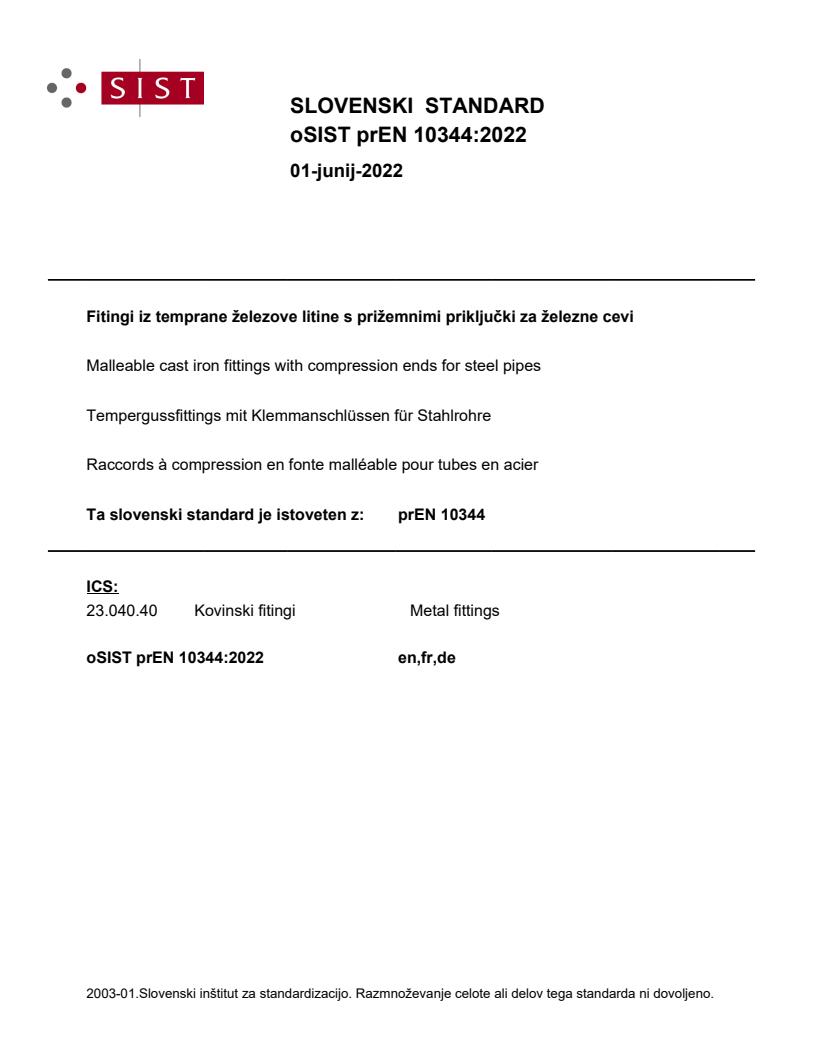
SLOVENSKI STANDARD
01-junij-2022
Fitingi iz temprane železove litine s prižemnimi priključki za železne cevi
Malleable cast iron fittings with compression ends for steel pipes
Tempergussfittings mit Klemmanschlüssen für Stahlrohre
Raccords à compression en fonte malléable pour tubes en acier
Ta slovenski standard je istoveten z: prEN 10344
ICS:
23.040.40 Kovinski fitingi Metal fittings
2003-01.Slovenski inštitut za standardizacijo. Razmnoževanje celote ali delov tega standarda ni dovoljeno.
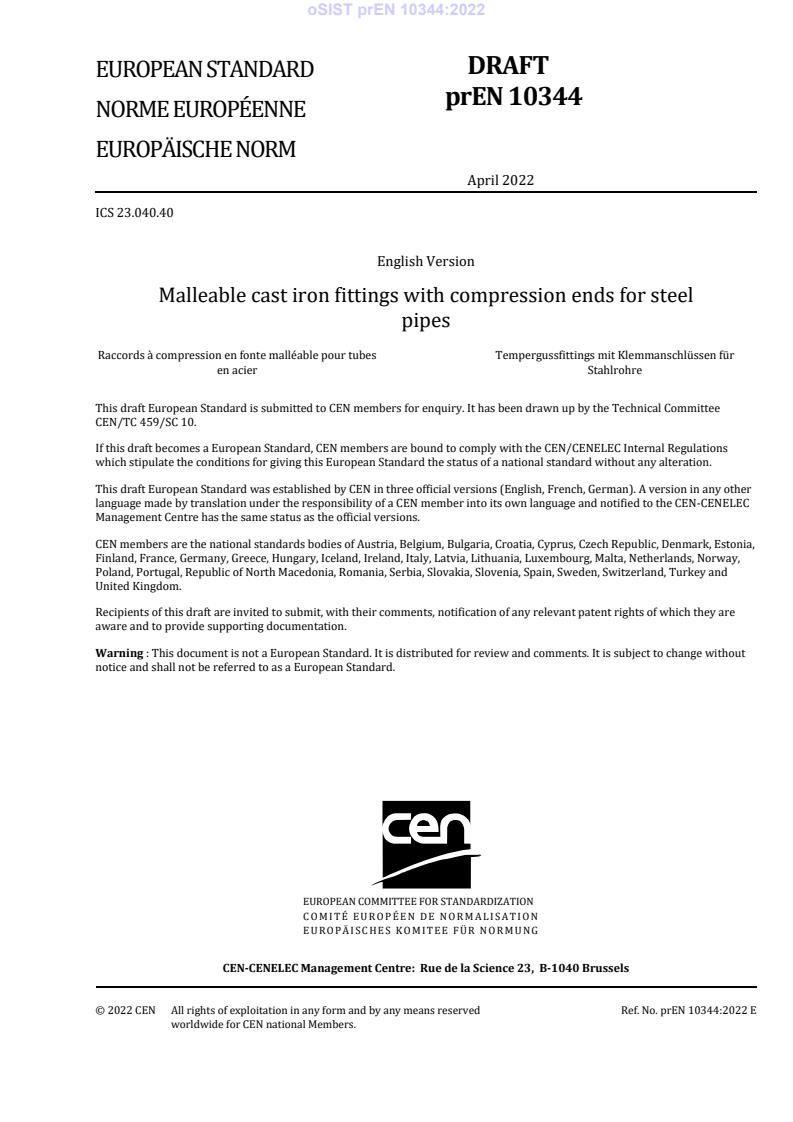
DRAFT
EUROPEAN STANDARD
NORME EUROPÉENNE
EUROPÄISCHE NORM
April 2022
ICS 23.040.40
English Version
Malleable cast iron fittings with compression ends for steel
pipes
Raccords à compression en fonte malléable pour tubes Tempergussfittings mit Klemmanschlüssen für
en acier Stahlrohre
This draft European Standard is submitted to CEN members for enquiry. It has been drawn up by the Technical Committee
CEN/TC 459/SC 10.
If this draft becomes a European Standard, CEN members are bound to comply with the CEN/CENELEC Internal Regulations
which stipulate the conditions for giving this European Standard the status of a national standard without any alteration.
This draft European Standard was established by CEN in three official versions (English, French, German). A version in any other
language made by translation under the responsibility of a CEN member into its own language and notified to the CEN-CENELEC
Management Centre has the same status as the official versions.
CEN members are the national standards bodies of Austria, Belgium, Bulgaria, Croatia, Cyprus, Czech Republic, Denmark, Estonia,
Finland, France, Germany, Greece, Hungary, Iceland, Ireland, Italy, Latvia, Lithuania, Luxembourg, Malta, Netherlands, Norway,
Poland, Portugal, Republic of North Macedonia, Romania, Serbia, Slovakia, Slovenia, Spain, Sweden, Switzerland, Turkey and
United Kingdom.
Recipients of this draft are invited to submit, with their comments, notification of any relevant patent rights of which they are
aware and to provide supporting documentation.
Warning : This document is not a European Standard. It is distributed for review and comments. It is subject to change without
notice and shall not be referred to as a European Standard.
EUROPEAN COMMITTEE FOR STANDARDIZATION
COMITÉ EUROPÉEN DE NORMALISATION
EUROPÄISCHES KOMITEE FÜR NORMUNG
CEN-CENELEC Management Centre: Rue de la Science 23, B-1040 Brussels
© 2022 CEN All rights of exploitation in any form and by any means reserved Ref. No. prEN 10344:2022 E
worldwide for CEN national Members.
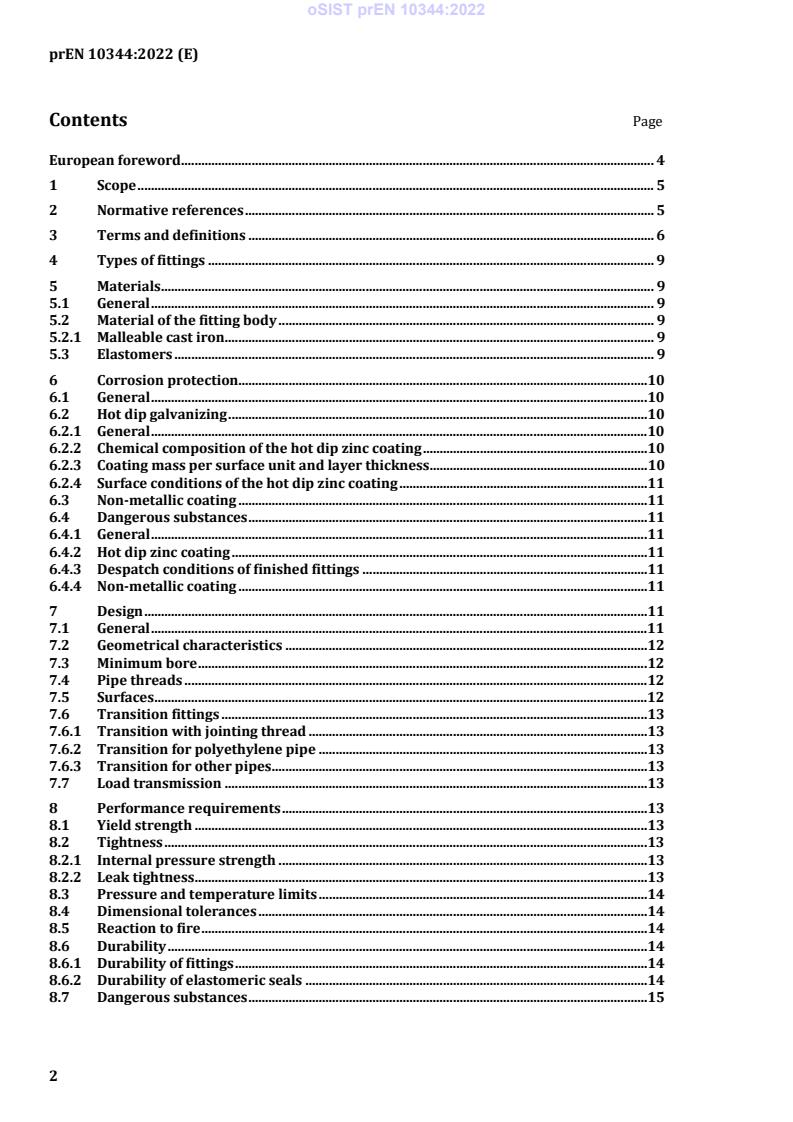
Contents Page
European foreword . 4
1 Scope . 5
2 Normative references . 5
3 Terms and definitions . 6
4 Types of fittings . 9
5 Materials . 9
5.1 General . 9
5.2 Material of the fitting body . 9
5.2.1 Malleable cast iron . 9
5.3 Elastomers . 9
6 Corrosion protection.10
6.1 General .10
6.2 Hot dip galvanizing .10
6.2.1 General .10
6.2.2 Chemical composition of the hot dip zinc coating .10
6.2.3 Coating mass per surface unit and layer thickness.10
6.2.4 Surface conditions of the hot dip zinc coating .11
6.3 Non-metallic coating .11
6.4 Dangerous substances .11
6.4.1 General .11
6.4.2 Hot dip zinc coating .11
6.4.3 Despatch conditions of finished fittings .11
6.4.4 Non-metallic coating .11
7 Design .11
7.1 General .11
7.2 Geometrical characteristics .12
7.3 Minimum bore .12
7.4 Pipe threads .12
7.5 Surfaces .12
7.6 Transition fittings .13
7.6.1 Transition with jointing thread .13
7.6.2 Transition for polyethylene pipe .13
7.6.3 Transition for other pipes .13
7.7 Load transmission .13
8 Performance requirements .13
8.1 Yield strength .13
8.2 Tightness .13
8.2.1 Internal pressure strength .13
8.2.2 Leak tightness .13
8.3 Pressure and temperature limits .14
8.4 Dimensional tolerances .14
8.5 Reaction to fire .14
8.6 Durability .14
8.6.1 Durability of fittings .14
8.6.2 Durability of elastomeric seals .14
8.7 Dangerous substances .15
9 Test requirements . 15
9.1 General . 15
9.2 Component test . 16
9.2.1 Testing of malleable cast iron . 16
9.2.2 Testing of plastic components . 16
9.2.3 Testing of sealing materials . 17
9.2.4 Testing of hot dip zinc coating . 17
9.2.5 Analysis of polycyclic aromatic hydrocarbons . 17
9.2.6 Testing of non-metallic coating . 17
9.2.7 Material tests . 17
9.2.8 Visual inspection . 18
9.2.9 Geometrical characteristics . 18
9.2.10 Leak tightness of fitting body . 18
9.3 Assembly tests . 19
9.3.1 General . 19
9.3.2 Leak tightness under internal pressure . 19
9.3.3 Leak tightness under pressure cycling . 19
9.3.4 Leak tightness after repeated movements . 19
9.3.5 Resistance to pull-out. 21
9.3.6 Resistance to vibrations . 21
9.3.7 Leak tightness after temperature changes . 22
9.3.8 Behaviour in case of negative pressure (vacuum) . 22
9.3.9 Leak tightness under high temperature for fuel gas application . 23
9.3.10 Surface protection – Testing by salt spray test . 23
10 Assessment of conformity . 23
11 Designation of fittings . 23
11.1 Elements of the designation for ordering . 23
11.2 Additional notes on designation of size . 24
11.3 Examples of designation . 24
12 Marking . 24
Annex A (normative) Surface protection - Salt spray test . 25
A.1 Requirements . 25
A.2 Testing . 25
European foreword
This document (prEN 10344:2022) has been prepared by Technical Committee CEN/TC 459 “ECISS -
European Committee for Iron and Steel Standardization” , the secretariat of which is held by AFNOR.
This document is currently submitted to the CEN Enquiry.
Through its sub-committee CEN/TC 459/SC 10 “Steel tubes, and iron and steel fittings” (secretariat: UNI).
1 Scope
This document specifies the requirements for the design, performance and testing of fittings made of
malleable cast iron (see also Clause 5 Materials) with compression ends for steel pipes.
This document applies to steel piping systems for different application fields, such as gas supply,
distribution and supply of water for general purposes and for human consumption, irrigation,
firefighting, aqueous liquids, pressurized air and gaseous fuel systems.
NOTE Products complying with this document used for drinking water applications are expected to comply
with the relevant national, regional or local regulatory provisions applicable in the place of use. Due to the variety
and dynamic of the requirements, it is advisable to check the compliance.
This document contains requirements and tests relating to compression fittings which can be connected
to smooth walled steel pipes. The fittings can also incorporate other types of connection, such as threaded
ends in conformance with EN 10226-1, flanged ends, compression ends for connection for pipes other
than steel, etc., and can also take on various structural shapes, such as, straight piece, elbow or T-piece,
etc. Their range of sizes covers nominal sizes DN 10 to DN 100 (size ⅜ to 4).
2 Normative references
The following documents are referred to in the text in such a way that some or all of their content
constitutes requirements of this document. For dated references, only the edition cited applies. For
undated references, the latest edition of the referenced document (including any amendments) applies.
EN 549, Rubber materials for seals and diaphragms for gas appliances and gas equipment
EN 681-1, Elastomeric seals - Materials requirements for pipe joint seals used in water and drainage
applications - Part 1: Vulcanized rubber
EN 682, Elastomeric Seals - Materials requirements for seals used in pipes and fittings carrying gas and
hydrocarbon fluids
EN 806-2, Specification for installations inside buildings conveying water for human consumption - Part 2:
Design
EN 1562, Founding - Malleable cast irons
EN 1775:2007, Gas supply - Gas pipework for buildings - Maximum operating pressure less than or equal to
5 bar - Functional recommendations
EN 10204, Metallic products - Types of inspection documents
EN 10216-1, Seamless steel tubes for pressure purposes - Technical delivery conditions - Part 1: Non-alloy
steel tubes with specified room temperature properties
EN 10217-1, Welded steel tubes for pressure purposes - Technical delivery conditions - Part 1: Electric
welded and submerged arc welded non-alloy steel tubes with specified room temperature properties
EN 10226-1, Pipe threads where pressure tight joints are made on the threads - Part 1: Taper external
threads and parallel internal threads - Dimensions, tolerances and designation
EN 10226-3, Pipes threads where pressure tight joint are made on the threads - Part 3: Verification by
means of limit gauges
EN 10255, Non-alloy steel tubes suitable for welding and threading - Technical delivery conditions
EN 10284, Malleable cast iron fittings with compression ends for polyethylene (PE) piping systems
EN 13501-1, Fire classification of construction products and building elements - Part 1: Classification using
data from reaction to fire tests
EN ISO 228-1, Pipe threads where pressure-tight joints are not made on the threads - Part 1: Dimensions,
tolerances and designation (ISO 228-1)
EN ISO 228-2, Pipe threads where pressure-tight joints are not made on the threads - Part 2: Verification by
means of limit gauges (ISO 228-2)
EN ISO 1460, Metallic coatings - Hot dip galvanized coatings on ferrous materials - Gravimetric
determination of the mass per unit area (ISO 1460)
EN ISO 2178, Non-magnetic coatings on magnetic substrates - Measurement of coating thickness -
Magnetic method (ISO 2178)
EN ISO 6892-1, Metallic materials - Tensile testing - Part 1: Method of test at room temperature (ISO 6892-
1)
EN ISO 9227, Corrosion tests in artificial atmospheres - Salt spray tests (ISO 9227)
EN ISO 19892, Plastics piping systems - Thermoplastics pipes and fittings for hot and cold water - Test
method for the resistance of joints to pressure cycling (ISO 19892)
ISO 2859-1, Sampling procedures for inspection by attributes — Part 1: Sampling schemes indexed by
acceptance quality limit (AQL) for lot-by-lot inspection
3 Terms and definitions
For the purposes of this document, the following terms and definitions apply.
ISO and IEC maintain terminological databases for use in standardization at the following addresses:
— ISO Online browsing platform: available at https://www.iso.org/obp
— IEC Electropedia: available at https://www.electropedia.org/
3.1 General
3.1.1
fitting
connecting piece for pipes and other piping accessories, consisting of one or more parts
3.1.2
compression fitting
connecting piece for pipes and other piping accessories, equipped with minimum one compression end,
sealing by elastomeric gaskets
3.1.3
transition fitting
fitting jointing different types of pipe and/or comprising different types of outlet
3.1.4
end-load-resistant joint
joint which can resist axial loads without additional external mechanical support
3.1.5
non-end-load-resistant joint
joint which cannot resist axial loads without additional external mechanical support
3.1.6
fitting size
nominal size of the connecting (steel) pipe(s)
Note 1 to entry: For transition fittings, the size designation follows the type of the outlet.
3.1.7
fitting body
main pressure-bearing part of a fitting
3.1.8
outlet
end of a fitting for the purpose of connection with a pipe or other piping accessories
3.1.9
run
two principal axially aligned outlets of a tee
3.1.10
branch
side outlet of a tee
3.1.11
compression end
end in which a mechanical joint is formed by the tightening of a nut to compress a ring or sleeve onto the
outside wall of the tube, or clamp a flared portion of the tube to the body of a fitting
Note 1 to entry: The assembled joint should be understood as being demountable.
Note 2 to entry: The purpose of a compression end is to connect pipe and fitting body using a compression
system, consisting of a body and a nut or flange, by using common tools.
3.1.12
grip
locking ring
ring that holds the pipes in place and prevents pull out from the joint
3.1.13
minimum bore
smallest internal diameter of a fitting measured at any cross-section
3.1.14
smooth wall
smooth pipe surface in the seal and clamping area which is unshaped, undamaged and untreated
Note 1 to entry: Cleaning and deburring is not regarded as treatment.
3.1.15
dismountability
ability of a fitting to disconnect and re-assemble the joint without destroying the fitting body and the pipe,
except the components of the jointing system, such as the sealing and grip or locking rings
3.1.16
jointing thread
thread complying with EN 10226-1
3.1.17
fastening thread
thread complying with EN ISO 228-1
3.1.18
component test
test to verify the performance of a fitting carried out on the non-assembled fitting or fitting parts
3.1.19
assembly test
test to verify the fitness for purpose of an assembled fitting connected with the pipe(s)
3.2 Movability
3.2.1
angular deflection
maximum angle α subtended between the axes of the fitting and the connected pipe when the assembly
still remains leak-tight following 2 full deflections by ±α in relation to the starting position
Note 1 to entry: α is according to manufacturer's specifications.
3.2.2
axial movability
axial path within which the fitting remains leak-tight following 2 full path changes by ±a in relation to the
starting position
Note 1 to entry: a is according to manufacturer's specifications.
3.2.3
torsional angle
maximum angle β within the piece can twist around its axis, when the assembly still remains leak-tight
following 2 full twists by ±β in relation to the starting position
Note 1 to entry: β is according to manufacturer's specifications.
3.2.4
resistance to pull-out
ability of the joint to withstand axial forces, applied mechanically or through internal pressure, while
remaining leak-tight
3.3 Pressure and temperature
3.3.1
allowable operating pressure
PFA
maximum operating pressure of the connected pipe joint(s) in continuous function
3.3.2
allowable operating temperature
TFA
maximum operating temperature of the connected pipe joint(s) in continuous function
4 Types of fittings
Types and shapes of fittings are to the discretion of the manufacturer and therefore not standardized or
limited regarding measurements.
5 Materials
5.1 General
All materials of fitting body and components shall be resistant against the medium of the respective
application.
NOTE In case of potable water, the national hygienic requirements apply.
5.2 Material of the fitting body
5.2.1 Malleable cast iron
The material used for the fitting body shall be malleable cast iron conforming to EN 1562. The grade of
material used shall be selected from the following grades:
Grade EN-GJMW-400-5 for fittings in whiteheart malleable iron.
Grade EN-GJMB-350-10 for fittings in blackheart malleable iron.
Fittings shall be identified by material symbols according to the selected material mentioned above and
as given in Table 1.
Table 1 — Material symbols
Material symbol Material grade
EN-GJMW-400–5 or
A
EN-GJMB-350–10
5.3 Elastomers
The material of elastomeric sealing rings used in fittings shall be chosen for drinking water application
from EN 681-1 and for gas supply from EN 682, and/or EN 549, depending on the specific application and
shall conform to the appropriate class and type. For applications in cold geographic areas or for cooling
circuits the minimum design temperature is –20 °C (see Table 3) and the test requirements specified in
9.3.7 are to be considered. For elevated temperatures above 70 °C, see Table 3, the test temperature in
9.3.7 shall be raised to the maximum operating temperature in the relevant application.
NOTE For the choice of elastomeric materials, it is advisable to comply with national regulations.
6 Corrosion protection
6.1 General
In applications where materials are susceptible to corrosion, the components shall be adequately
protected as follows.
NOTE For the choice of corrosion protection, it is advisable to comply with national regulations.
6.2 Hot dip galvanizing
6.2.1 General
Where a protection by zinc coating is required, the zinc coating shall be applied by the hot dip galvanizing
process and shall meet the following requirements.
Additional permanent coatings on top of the hot dip zinc coating do not fall under the category of hot dip
galvanizing in terms of use in the potable water application. The suitability of additional permanent
coatings for potable water applications should be demonstrated by testing.
6.2.2 Chemical composition of the hot dip zinc coating
The content by mass of the accompanying elements in the finished zinc coating shall not exceed the
following maximum values:
— antimony (Sb) 0,01 %
— arsenic (As) 0,02 %
— bismuth (Bi) 0,01 %
— cadmium (Cd) 0,01 %
— lead (Pb) 0,1 %
NOTE The chemical composition is restricted with regard to the limitation of dangerous substances also in
respect to potable water applications. When fittings are used in potable water applications, relevant national
hygienic regulations apply.
6.2.3 Coating mass per surface unit and layer thickness
The surface related mass of the zinc coating shall not be less than 500 g/m , which equals to a layer
thickness of 70 μm. These limits refer to the average of 5 fittings with 10 measurements each, statistically
distributed across the fitting. The layer mass/thickness measured on an individual sample shall not be
less than 450 g/m (63 μm).
The medium layer thickness s of the zinc coating in µm shall be calculated by using the approximation
formula:
m
A
s=
72,
where
m is the surface related mass of the zinc coating in g/m .
A
6.2.4 Surface conditions of the hot dip zinc coating
The zinc coating on the internal surface of the fitting shall be continuous with the exception of machined
black surfaces. In the special case of larger material cross-sections, the iron-zinc alloy phases may grow
through. The internal zinc coating shall be free from zinc blisters, zinc burrs, non-metallic remainders.
6.3 Non-metallic coating
Depending on external and internal conditions of use, also non-metallic coatings may be used if they are
requested by the purchaser.
NOTE If the non-metallic coating is used in drinking water applications, relevant national regulations apply.
6.4 Dangerous substances
6.4.1 General
For the use of fittings produced in accordance with this document, it is advisable to comply with national
regulations with regard to the release of dangerous substances.
6.4.2 Hot dip zinc coating
The chemical composition of the hot dip zinc coating shall not exceed the limits given in 6.2.2.
6.4.3 Despatch conditions of finished fittings
The surface of the fitting shall be free of polycyclic aromat
...
Questions, Comments and Discussion
Ask us and Technical Secretary will try to provide an answer. You can facilitate discussion about the standard in here.
Loading comments...