

SIST EN 302 217-3 V1.2.1:2008
Fixed Radio Systems - Characteristics and requirements for point-to-point equipment and antennas - Part 3: Harmonized EN covering essential requirements of article 3.2 of R&TTE Directive for equipment operating in frequency bands where simplified or no frequency co-ordination procedures are applied
- Abstract
To amend EN 302 217-3 in order to incorporate equipment for the frequency band 64-66 GHz.
The present document specifies the essential requirements for point-to-point Digital Fixed Radio Systems (DFRS) operating in higher frequency bands, which might not require detailed link-by-link co-ordinated frequency planning; this imply either no co-ordination at all (i.e. the band usage is free and the user is responsible for detecting a suitable interference-free operating frequency) or simplified co-ordination procedures implying the knowledge of existing links (e.g. through a public national database) so that the impact of a possible new link could be evaluated on the basis of budgetary considerations of typical equipment receiver parameters (which will not be considered related to essential requirements of art 3.2 R&TTE Directive [1]). It is intended to cover the provisions of Directive 1999/5/EC [1] (R&TTE Directive) regarding article 3.2, which states that "… radio equipment shall be so constructed that it effectively uses the spectrum allocated to terrestrial/space radio communications and orbital resources so as to avoid harmful interference".
The EN 302 217 series introduces requirements for systems (equipment and antennas) that were formerly covered by EN 301 751 [20] and that are technically equivalent or less stringent requirements. Therefore, from a strictly technical point of view, it is expected that equipment already conforming to the previous EN 301 751 [20] or previous versions of the present harmonized standard, would not need a new test report for re-assessment of essential requirements according this new multi-part deliverable; however, legal implications with respect to the declaration of conformity and equipment labelling are not in the scope of the present document. In addition to the present document, other ENs that specify technical requirements in respect of essential requirements
under other parts of article 3 of the R&TTE Directive [1] will apply to equipment within the scope of the present
document.
- Status
- Published
- Publication Date
- 25-Aug-2008
- Technical Committee
- SPN - Services and Protocols for Networks
- Current Stage
- 6060 - National Implementation/Publication (Adopted Project)
- Start Date
- 08-Aug-2008
- Due Date
- 13-Oct-2008
- Completion Date
- 26-Aug-2008
- Mandate
- M/284
Buy Documents


ETSI EN 302 217-3 V1.2.1 (2008-02) - Fixed Radio Systems; Characteristics and requirements for point-to-point equipment and antennas; Part 3: Harmonized EN covering essential requirements of article 3.2 of R&TTE Directive for equipment operating in frequency bands where simplified or no frequency co-ordination procedures are applied



SIST EN 302 217-3 V1.2.1:2008 is the Slovenian adoption of ETSI EN 302 217-3 V1.2.1 (2008-02). It is a harmonized European standard for point-to-point Digital Fixed Radio Systems (DFRS) and antennas operating in frequency bands where simplified or no frequency coordination is used. The document specifies the essential requirements under article 3.2 of the R&TTE Directive for manufacturers, suppliers, operators, and test laboratories.
What does SIST EN 302 217-3 V1.2.1:2008 specify?
SIST EN 302 217-3 V1.2.1:2008 covers the spectrum-use requirements for point-to-point DFRS in higher frequency bands, including equipment in the 64 GHz to 66 GHz band. It applies where frequency planning is free or simplified, so the key concern is avoiding harmful interference while using the band effectively.
The standard is mainly for fixed radio equipment without integral antennas, but it also applies to systems with integral antennas when the relevant equipment and antenna requirements are both met. It is organized into five main clauses and a set of normative and informative annexes that separate general requirements from band-specific limits and test guidance.
| Annex | What it covers |
|---|---|
| Annex A | HS Requirements and conformance Test specifications Table (HS-RTT) |
| Annex B | Wide radio-frequency band covering units and multirate equipment specification and tests |
| Annex UA | Frequency bands around 58 GHz |
| Annex UB | Frequency band 64 GHz to 66 GHz |
| Annex UC | Void |
| Annex UD | Rationale for the interference limit formula |
| Annex UE | Capacity and receiver characteristics in the band 64 GHz to 65 GHz |
| Annex UF | Bibliography |
| Annex UG | EN title in the official languages |
What are the key requirements of SIST EN 302 217-3 V1.2.1:2008?
The main technical focus of SIST EN 302 217-3 V1.2.1:2008 is interference avoidance, transmitter control, and proof by testing. The document ties each requirement to a test method and, where needed, to a specific frequency band annex.
Spectrum access and channel selection
- Class A equipment shall use the RF-channel selection procedure, while Class B equipment does not use that automatic procedure. In practice, Class A installations must check that a channel is not already occupied before transmitting.
- The RF-channel selection procedure is meant to detect and protect existing transmissions. That matters when a new link is being installed or when antenna alignment could disturb an existing system.
- A channel is treated as occupied when interference exceeds the limit expressed in clause 4.2.2.1, with the band-specific constant given in annexes UA to UC. The reader needs the declared receiver bandwidth and the applicable annex value to judge whether a channel is free.
- Frequency agility is optional, but if it is implemented, the equipment shall be able to change channel automatically after unacceptable interference lasts too long, and the automatic function shall be disableable. This gives operators a fallback when interference appears after installation.
Transmitter, antenna, and emission limits
- The transmitter maximum mean output power and the Equivalent Isotropically Radiated Power (EIRP) are limited by band-specific values in annexes UA to UC. For procurement or type testing, the supplier must state the nominal output power and tolerances.
- The radio frequency (RF) spectrum mask is system dependent and is also defined by the relevant annex. This is the part that controls how much energy can spill into nearby frequencies.
- Spurious emissions shall comply with CEPT/ERC/REC 74-01 and the out-of-band to spurious boundary follows ITU-R SM.1539. In practice, this means measurements are not limited to the wanted channel and must also cover unwanted emissions in the spurious domain.
- For integral antennas, the radiation pattern envelope (off-axis EIRP density) and antenna gain are essential requirements, with the antenna limits taken from EN 302 217-4-2. Antenna cross-polar discrimination (XPD) has no requirement in this document.
- The maximum RF frequency tolerance is given in the relevant annex. That matters because frequency drift affects channel occupancy and interference risk.
Testing and evidence of conformity
- Compliance testing shall follow the methods in EN 301 126-1 and EN 301 126-3-1, with environmental conditions taken from the declared operational profile. In practice, the supplier must declare the operating environment and the tests must cover representative reference and extreme conditions.
- For transmitter testing, the document specifies which channels to test and how to treat continuous and burst signals. This is important for links using time-division methods, where average power during a burst is what matters.
- For wide radio-frequency band covering units, the test report is built from tests on selected channels across the operating range. For multirate or multiformat equipment, transmitter tests apply at any supported bit rate and format, while channel selection and receiver tests are performed at the lowest and highest bit rates for each format.
- Annex A is the master cross-reference table for essential requirements and test specifications. It tells the reader which clauses are unconditional, which depend on optional features, and which tests are essential for a presumption of conformity.
What terms does SIST EN 302 217-3 V1.2.1:2008 define?
- DFRS (Digital Fixed Radio Systems) - digital fixed radio systems used for point-to-point terrestrial links.
- Class A - digital equipment that applies the automatic RF-channel selection procedure for interference avoidance and error-performance improvement.
- Class B - equipment without the automatic RF-channel selection procedure.
- EIRP (Equivalent Isotropically Radiated Power) - the radiated power limit used for equipment with integral antennas and, where relevant, for systems offered without antennas by reference to allowable antenna gain.
- XPD (Cross-Polar Discrimination) - the antenna cross-polar measure named in the document, for which no requirement applies here.
- RPE (Radiation Pattern Envelope) - the off-axis EIRP density requirement that controls how radiation falls away from the main beam.
- ATPC (Automatic Transmit Power Control) - a transmit-power control feature that may change emitted power, including during fading, subject to the annex limits.
- RSL (Received Signal Level) - the received power level used in annex UE for receiver performance examples and thresholds.
Who uses SIST EN 302 217-3 V1.2.1:2008?
Manufacturers of point-to-point fixed radio equipment use this standard to design transmitters, receivers, channel selection functions, and antenna arrangements. Test laboratories use it to build compliance test reports and to choose the correct channels, climatic conditions, and measurement methods.
Network operators and system planners use it when selecting equipment classes and checking whether a planned link can share spectrum with existing links. Administrations and regulators use it when defining national channel use, coordination practice, and spectrum sharing rules.
It is relevant to fixed radio applications such as interconnection between cellular networks, private video surveillance links, and short high-capacity connections in the 65 GHz range.
What changed in SIST EN 302 217-3 V1.2.1:2008 from the previous edition?
The scope states that this edition amends EN 302 217-3 to incorporate equipment for the 64 GHz to 66 GHz band. The history also shows the move to V1.2.1 publication in February 2008.
Which standards are used with SIST EN 302 217-3 V1.2.1:2008?
| Reference | What it contributes |
|---|---|
| Directive 1999/5/EC | The legal framework for article 3.2 essential requirements |
| CEPT/ERC/REC 74-01 | Limits and definitions for unwanted emissions in the spurious domain |
| CEPT/ERC/REC 12-09 | Channel arrangement for 57.0 GHz to 59.0 GHz systems |
| CEPT/ECC/REC (05)02 | Use of the 64.0 GHz to 66.0 GHz band for Fixed Service |
| ETSI EN 301 126-1 | General conformance testing for point-to-point equipment |
| ETSI EN 301 126-3-1 | Conformance testing for point-to-point antennas |
| ETSI EN 302 217-1 | Shared definitions, symbols, abbreviations, and system structure |
| ETSI EN 302 217-4-2 | Antenna harmonized requirements used for integral antennas |
| ITU-R SM.1539 | Boundary between out-of-band and spurious domains |
| ITU-T O.151, O.181, O.191 | Test signals and error-performance methods for PDH, SDH, and ATM interfaces |
What does the SIST EN 302 217-3 V1.2.1:2008 document contain?
The document contains clause-by-clause technical requirements, the corresponding test methods, and band-specific annexes for 58 GHz and 64 GHz to 66 GHz operation. It also contains the HS-RTT table that maps each essential requirement to its clause and test status.
Annex UA gives the 58 GHz digital and analogue system limits, including power, EIRP, spectrum mask, frequency tolerance, and channel-selection parameters. Annex UB gives the 64 GHz to 66 GHz channel arrangements, spectral-efficiency classes, transmitter power and EIRP constraints, density-mask guidance, and antenna gain limits.
The main body includes the test approach for transmitter power, spectrum mask, spurious emissions, frequency tolerance, antenna directionality, and receiver spurious emissions. Annex UD explains the reasoning behind the interference threshold formula, and Annex UE provides receiver-performance examples such as BER, C/I, and CW interference sensitivity for the 64 GHz to 65 GHz band.
Relations
- Effective Date
- 25-Jan-2010
Buy Documents
ETSI EN 302 217-3 V1.2.1 (2008-02) - Fixed Radio Systems; Characteristics and requirements for point-to-point equipment and antennas; Part 3: Harmonized EN covering essential requirements of article 3.2 of R&TTE Directive for equipment operating in frequency bands where simplified or no frequency co-ordination procedures are applied
Get Certified
Connect with accredited certification bodies for this standard

ANCE
Mexican certification and testing association.

Intertek Slovenia
Intertek testing, inspection, and certification services in Slovenia.

LNE (Laboratoire National de Métrologie et d'Essais)
French national laboratory for metrology and testing.
Sponsored listings
Frequently Asked Questions
SIST EN 302 217-3 V1.2.1:2008 is a standard published by the Slovenian Institute for Standardization (SIST). Its full title is "Fixed Radio Systems - Characteristics and requirements for point-to-point equipment and antennas - Part 3: Harmonized EN covering essential requirements of article 3.2 of R&TTE Directive for equipment operating in frequency bands where simplified or no frequency co-ordination procedures are applied". This standard covers: To amend EN 302 217-3 in order to incorporate equipment for the frequency band 64-66 GHz. The present document specifies the essential requirements for point-to-point Digital Fixed Radio Systems (DFRS) operating in higher frequency bands, which might not require detailed link-by-link co-ordinated frequency planning; this imply either no co-ordination at all (i.e. the band usage is free and the user is responsible for detecting a suitable interference-free operating frequency) or simplified co-ordination procedures implying the knowledge of existing links (e.g. through a public national database) so that the impact of a possible new link could be evaluated on the basis of budgetary considerations of typical equipment receiver parameters (which will not be considered related to essential requirements of art 3.2 R&TTE Directive [1]). It is intended to cover the provisions of Directive 1999/5/EC [1] (R&TTE Directive) regarding article 3.2, which states that "… radio equipment shall be so constructed that it effectively uses the spectrum allocated to terrestrial/space radio communications and orbital resources so as to avoid harmful interference". The EN 302 217 series introduces requirements for systems (equipment and antennas) that were formerly covered by EN 301 751 [20] and that are technically equivalent or less stringent requirements. Therefore, from a strictly technical point of view, it is expected that equipment already conforming to the previous EN 301 751 [20] or previous versions of the present harmonized standard, would not need a new test report for re-assessment of essential requirements according this new multi-part deliverable; however, legal implications with respect to the declaration of conformity and equipment labelling are not in the scope of the present document. In addition to the present document, other ENs that specify technical requirements in respect of essential requirements under other parts of article 3 of the R&TTE Directive [1] will apply to equipment within the scope of the present document.
To amend EN 302 217-3 in order to incorporate equipment for the frequency band 64-66 GHz. The present document specifies the essential requirements for point-to-point Digital Fixed Radio Systems (DFRS) operating in higher frequency bands, which might not require detailed link-by-link co-ordinated frequency planning; this imply either no co-ordination at all (i.e. the band usage is free and the user is responsible for detecting a suitable interference-free operating frequency) or simplified co-ordination procedures implying the knowledge of existing links (e.g. through a public national database) so that the impact of a possible new link could be evaluated on the basis of budgetary considerations of typical equipment receiver parameters (which will not be considered related to essential requirements of art 3.2 R&TTE Directive [1]). It is intended to cover the provisions of Directive 1999/5/EC [1] (R&TTE Directive) regarding article 3.2, which states that "… radio equipment shall be so constructed that it effectively uses the spectrum allocated to terrestrial/space radio communications and orbital resources so as to avoid harmful interference". The EN 302 217 series introduces requirements for systems (equipment and antennas) that were formerly covered by EN 301 751 [20] and that are technically equivalent or less stringent requirements. Therefore, from a strictly technical point of view, it is expected that equipment already conforming to the previous EN 301 751 [20] or previous versions of the present harmonized standard, would not need a new test report for re-assessment of essential requirements according this new multi-part deliverable; however, legal implications with respect to the declaration of conformity and equipment labelling are not in the scope of the present document. In addition to the present document, other ENs that specify technical requirements in respect of essential requirements under other parts of article 3 of the R&TTE Directive [1] will apply to equipment within the scope of the present document.
SIST EN 302 217-3 V1.2.1:2008 is classified under the following ICS (International Classification for Standards) categories: 33.060.30 - Radio relay and fixed satellite communications systems; 33.120.40 - Aerials. The ICS classification helps identify the subject area and facilitates finding related standards.
SIST EN 302 217-3 V1.2.1:2008 has the following relationships with other standards: It is inter standard links to SIST EN 302 217-3 V1.1.3:2005. Understanding these relationships helps ensure you are using the most current and applicable version of the standard.
SIST EN 302 217-3 V1.2.1:2008 is associated with the following European legislation: EU Directives/Regulations: 1999/5/EC; Standardization Mandates: M/284. When a standard is cited in the Official Journal of the European Union, products manufactured in conformity with it benefit from a presumption of conformity with the essential requirements of the corresponding EU directive or regulation.
SIST EN 302 217-3 V1.2.1:2008 is available in PDF format for immediate download after purchase. The document can be added to your cart and obtained through the secure checkout process. Digital delivery ensures instant access to the complete standard document.
Standards Content (Sample)
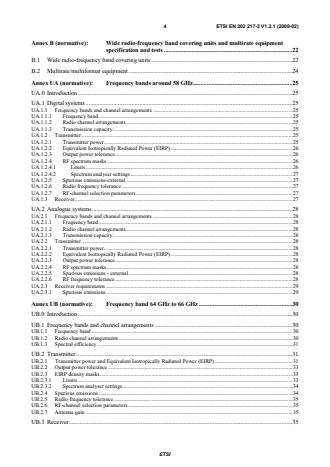
Contents
- Introduction
- 3.2 Use of Spectrum
- 8 ETSI EN 302 217-3 V1.2.1 (2008-02)
- 1 Scope
- 9 ETSI EN 302 217-3 V1.2.1 (2008-02)
- 2 References
- 2.1 Normative references
- 10 ETSI EN 302 217-3 V1.2.1 (2008-02)
- 2.2 Informative references
- 11 ETSI EN 302 217-3 V1.2.1 (2008-02)
- 3 Definitions, symbols and abbreviations
- 3.1 Definitions
- 3.2 Symbols
- 3.3 Abbreviations
- 4 Technical requirements specifications
- 4.1 Environmental profile
- 4.2 RF-channel selection
- 12 ETSI EN 302 217-3 V1.2.1 (2008-02)
- 13 ETSI EN 302 217-3 V1.2.1 (2008-02)
- 4.3 Transmitter requirements
- 14 ETSI EN 302 217-3 V1.2.1 (2008-02)
- 15 ETSI EN 302 217-3 V1.2.1 (2008-02)
- 4.4 Receiver requirements
- 5 Testing for compliance with technical requirements
- 5.1 Environmental conditions for testing
- 16 ETSI EN 302 217-3 V1.2.1 (2008-02)
- 5.2 RF-channel selection
- 5.3 Essential radio test suites for the transmitter
- 17 ETSI EN 302 217-3 V1.2.1 (2008-02)
- 18 ETSI EN 302 217-3 V1.2.1 (2008-02)
- 5.4 Essential radio test suites for the receiver
- 19 ETSI EN 302 217-3 V1.2.1 (2008-02)
- 20 ETSI EN 302 217-3 V1.2.1 (2008-02)
- 1 Transmitter power
- 3 Output power tolerance
- 21 ETSI EN 302 217-3 V1.2.1 (2008-02)
- 22 ETSI EN 302 217-3 V1.2.1 (2008-02)
- 23 ETSI EN 302 217-3 V1.2.1 (2008-02)
- 24 ETSI EN 302 217-3 V1.2.1 (2008-02)
- 25 ETSI EN 302 217-3 V1.2.1 (2008-02)
- 26 ETSI EN 302 217-3 V1.2.1 (2008-02)
- 27 ETSI EN 302 217-3 V1.2.1 (2008-02)
- 28 ETSI EN 302 217-3 V1.2.1 (2008-02)
- 29 ETSI EN 302 217-3 V1.2.1 (2008-02)
- 30 ETSI EN 302 217-3 V1.2.1 (2008-02)
- 31 ETSI EN 302 217-3 V1.2.1 (2008-02)
- 32 ETSI EN 302 217-3 V1.2.1 (2008-02)
- 33 ETSI EN 302 217-3 V1.2.1 (2008-02)
- 34 ETSI EN 302 217-3 V1.2.1 (2008-02)
- 35 ETSI EN 302 217-3 V1.2.1 (2008-02)
- 36 ETSI EN 302 217-3 V1.2.1 (2008-02)
- 37 ETSI EN 302 217-3 V1.2.1 (2008-02)
- 38 ETSI EN 302 217-3 V1.2.1 (2008-02)
- 39 ETSI EN 302 217-3 V1.2.1 (2008-02)
- 40 ETSI EN 302 217-3 V1.2.1 (2008-02)
- 41 ETSI EN 302 217-3 V1.2.1 (2008-02)
- 65 GHz
- 42 ETSI EN 302 217-3 V1.2.1 (2008-02)
- 43 ETSI EN 302 217-3 V1.2.1 (2008-02)
- Bibliography
- 44 ETSI EN 302 217-3 V1.2.1 (2008-02)
- 45 ETSI EN 302 217-3 V1.2.1 (2008-02)
- 46 ETSI EN 302 217-3 V1.2.1 (2008-02)
Introduction
The EN 302 217 series has been produced in order to rationalize a large number of previous ETSI ENs dealing with equipment and antennas for Point-to-Point (P-P) Fixed Service applications. For more details, see foreword in the EN 302 217-1 [7].
The present document is part of a set of standards developed by ETSI and is designed to fit in a modular structure to cover all radio and telecommunications terminal equipment within the scope of the R&TTE Directive [1]. The modular structure is described in EG 201 399 and shown in figure 1.
3.3f 3.3e Emergency* 3.3d Fraud* 3.3c Privacy* 3.3b No harm to the network* * If needed a Scope by Inter-working via the network* equipement 3.3a class or type Inter-working with the network*
3.2 Use of Spectrum
Spectrum New radio harmonized standards Scoped by frequency and/or equipment type Radio Product EMC 3.1b EN 301 489 multi-part EMC standard EMC Generic and product standards also notified under EMC Directive Standards covering Human Exposure to Electromagnetic Fields
relating to individual productcs 3.1a New standards for acoustic safety Safety Standards also notified under LV Directive Non-radio Radio (RE) Non TTE TTE Legend:
Scope ot the present document: Any Point-to-point DFRS and antennas in all frequency bands
Figure 1: Modular structure for the various standards used under the R&TTE Directive NOTE: For article 3.1b the diagram shows EN 301 489 [16], the multi-part product EMC standard for radio used under the EMC Directive 89/336/EEC [17]. For Fixed Radio Systems EN, EN 301 489-1 [18] and EN 301 489-4 [19] are relevant.
ETSI
8 ETSI EN 302 217-3 V1.2.1 (2008-02)
1 Scope
The present document specifies the essential requirements for point-to-point Digital Fixed Radio Systems (DFRS) operating in higher frequency bands, which might not require detailed link-by-link co-ordinated frequency planning; this imply either no co-ordination at all (i.e. the band usage is free and the user is responsible for detecting a suitable interference-free operating frequency) or simplified co-ordination procedures implying the knowledge of existing links (e.g. through a public national database) so that the impact of a possible new link could be evaluated on the basis of budgetary considerations of typical equipment receiver parameters (which will not be considered related to essential requirements of art 3.2 R&TTE Directive [1]). It is intended to cover the provisions of Directive 1999/5/EC [1] (R&TTE Directive) regarding article 3.2, which states that "… radio equipment shall be so constructed that it effectively uses the spectrum allocated to terrestrial/space radio communications and orbital resources so as to avoid harmful interference".
The EN 302 217 series introduces requirements for systems (equipment and antennas) that were formerly covered by EN 301 751 [20] and that are technically equivalent or less stringent requirements. Therefore, from a strictly technical point of view, it is expected that equipment already conforming to the previous EN 301 751 [20] or previous versions of the present harmonized standard, would not need a new test report for re-assessment of essential requirements according this new multi-part deliverable; however, legal implications with respect to the declaration of conformity and equipment labelling are not in the scope of the present document.
In addition to the present document, other ENs that specify technical requirements in respect of essential requirements under other parts of article 3 of the R&TTE Directive [1] will apply to equipment within the scope of the present document.
NOTE: A list of such ENs is included on the web site http://www.newapproach.org/. In order to technically cover different market and network requirements, with an appropriate balance of performance to cost and effective and appropriate use of the radio spectrum, the present document, together with EN 302 217-4-2 [8], offers system types and antennas alternatives, for selection by administrations, operators and manufacturers dependent on the desired use of the radio spectrum and network/market requirements, those options include:
- channel separation alternatives (as provided by the relevant CEPT Recommendation);
- implemented procedure for free radio channel selection;
- antenna directivity class alternatives (for different network density requirement). The present document is mainly intended to cover fixed radio equipment without integral antennas. However, it also applies to fixed radio systems products with integral antennas, for which all the technical requirements included in the present document and in EN 302 217-4-2 [8] apply. For more background information on the equipment and antenna parameters here identified as relevant to article 3.2 of R&TTE Directive see EG 201 399 [15] and TR 101 506 [21] . For example, the frequency band 58 GHz is proposed to be used by various technologies for uncoordinated use of the band. Besides the RF-channel selection procedure, specified in clause 4.2 to avoid unacceptable interference situations, this band also benefits from the high and stable atmospheric attenuation which suppresses efficiently distant interferers (about 10 dB/km to 15 dB/km at sea level, refer to ITU-R Recommendation P.676 [22] . For the purposes of the present document two equipment Classes are specified depending on the network requirements:
- Class A: Digital equipment which apply the automatic RF-channel selection procedure (see clause 4.2) for interference avoidance and error performance enhancement.
- Class B: Equipment without automatic RF-channel selection procedure. Typical applications for Class A equipment are interconnection between cellular networks where, in some cases, there is a need for short length connections (up to about 500 m). The RF channel selection procedure shall be used to protect existing systems from a new system being commissioned. However, the channel selection procedure may not guarantee interference free installation or operation in all cases, due to limitations in the procedure with respect to the variety of systems.
Typical applications for Class B equipment are:
- private connections, such as video surveillance systems in 58 GHz band; ETSI
9 ETSI EN 302 217-3 V1.2.1 (2008-02)
- very high capacity (of Gigabit/s order or more) over relatively short links (up to around 2 km) in 65 GHz band (e.g. for connecting large data servers).
2 References
References are either specific (identified by date of publication and/or edition number or version number) or non-specific.
- For a specific reference, subsequent revisions do not apply.
- Non-specific reference may be made only to a complete document or a part thereof and only in the following cases:
- if it is accepted that it will be possible to use all future changes of the referenced document for the purposes of the referring document;
- for informative references.
Referenced documents which are not found to be publicly available in the expected location might be found at http://docbox.etsi.org/Reference.
For online referenced documents, information sufficient to identify and locate the source shall be provided. Preferably, the primary source of the referenced document should be cited, in order to ensure traceability. Furthermore, the reference should, as far as possible, remain valid for the expected life of the document. The reference shall include the method of access to the referenced document and the full network address, with the same punctuation and use of upper case and lower case letters.
NOTE: While any hyperlinks included in this clause were valid at the time of publication ETSI cannot guarantee their long term validity.
2.1 Normative references
The following referenced documents are indispensable for the application of the present document. For dated references, only the edition cited applies. For non-specific references, the latest edition of the referenced document (including any amendments) applies.
[1] Directive 1999/5/EC of the European Parliament and of the Council of 9 March 1999 on radio equipment and telecommunications terminal equipment and the mutual recognition of their conformity (R&TTE Directive).
[2] CEPT/ERC/REC 74-01 (2005): "Unwanted emissions in the spurious domain". [3] CEPT/ERC/REC 12-09 (2004): "Radio frequency channel arrangement for Fixed Service systems operating in the band 57,0 - 59,0 GHz which do not require frequency planning". [4] CEPT/ECC/REC/(05)02 (2005): "Use of the 64,0 - 66,0 GHz frequency band for Fixed Service". [5] ETSI EN 301 126-1 (V1.1.2): "Fixed Radio Systems; Conformance testing; Part 1: Point-to-Point equipment - Definitions, general requirements and test procedures". [6] ETSI EN 301 126-3-1 (V1.1.1): "Fixed Radio Systems; Conformance testing; Part 3-1: Point-to- Point antennas; Definitions, general requirements and test procedures". [7] ETSI EN 302 217-1 (V1.2.1): "Fixed Radio Systems; Characteristics and requirements for pointto-point equipment and antennas; Part 1: Overview and system-independent common characteristics".
[8] ETSI EN 302 217-4-2 (V1.3.1): "Fixed Radio Systems; Characteristics and requirements for pointto-point equipment and antennas; Part 4-2: Harmonized EN covering essential requirements of Article 3.2 of R&TTE Directive for antennas".
ETSI
10 ETSI EN 302 217-3 V1.2.1 (2008-02)
[9] IEEE 1802.3 (2001): "IEEE Conformance Test Methodology for IEEE Standards for Local and Metropolitan Area Networks-Specific Requirements-Part 3: Carrier Sense Multiple Access with Collision Detection (CSMA/CD) Access Method and Physical Layer Specifications". [10] IEEE 802.3 (2002): "Information technology - Telecommunications and information exchange between systems - Local and metropolitan area networks - Specific requirements - Part 3: Carrier Sense Multiple Access with Collision Detection (CSMA/CD) access method and physical layer specifications".
[11] ITU-R Recommendation SM.1539 (2002): "Variation of the boundary between the out-of-band and spurious domains required for the application of Recommendations ITU-R SM.1541 and ITU- R SM.329".
[12] ITU-T Recommendation O.151 and Corrigendum 1 (2002): "Error performance measuring equipment operating at the primary rate and above".
[13] ITU-T Recommendation O.181 (2002): "Equipment to assess error performance on STM-N interfaces".
[14] ITU-T Recommendation O.191 (2000): "Equipment to measure the cell transfer performance of ATM connections".
2.2 Informative references
[15] ETSI EG 201 399: "Electromagnetic compatibility and Radio spectrum Matters (ERM); A guide to the production of candidate Harmonized Standards for application under the R&TTE Directive". [16] ETSI EN 301 489 (All parts): "Electromagnetic compatibility and Radio spectrum Matters (ERM); ElectroMagnetic Compatibility (EMC) standard for radio equipment and services". [17] EMC Directive 89/336/EEC: "Council Directive of 3 May 1989 on the approximation of the laws of the Member States relating to electromagnetic compatibility". [18] ETSI EN 301 489-1: "Electromagnetic compatibility and Radio spectrum Matters (ERM); ElectroMagnetic Compatibility (EMC) standard for radio equipment and services; Part 1:
Common technical requirements".
[19] ETSI EN 301 489-4: "Electromagnetic compatibility and Radio spectrum Matters (ERM); ElectroMagnetic Compatibility (EMC) standard for radio equipment and services; Part 4: Specific conditions for fixed radio links and ancillary equipment and services". [20] ETSI EN 301 751 (V1.2.1): "Fixed Radio Systems; Point-to-Point equipments and antennas; Generic harmonized standard for Point-to-Point digital fixed radio systems and antennas covering the essential requirements under article 3.2 of the 1999/5/EC Directive". [21] ETSI TR 101 506: "Fixed Radio Systems; Generic definitions, terminology and applicability of essential requirements under the article 3.2 of 99/05/EC Directive to Fixed Radio Systems". [22] ITU-R Recommendation P.676: "Attenuation by atmospheric gases". [23] ITU-R Recommendation F.1191: "Bandwidths and unwanted emissions of digital radio-relay systems".
[24] ETSI EN 302 217-2-1: "Fixed Radio Systems; Characteristics and requirements for point-to-point equipment and antennas; Part 2-1: System-dependent requirements for digital systems operating in frequency bands where frequency co-ordination is applied".
[25] ETSI EN 302 217-2-2: "Fixed Radio Systems; Characteristics and requirements for point-to-point equipment and antennas; Part 2-2: Harmonized EN covering essential requirements of Article 3.2 of R&TTE Directive for digital systems operating in frequency bands where frequency coordination is applied". [26] ITU-R Recommendation F.1497: "Radio-frequency channel arrangements for fixed wireless systems operating in the band 55.78-59 GHz".
ETSI
11 ETSI EN 302 217-3 V1.2.1 (2008-02)
[27] ITU-R Recommendation F.1101: "Characteristics of digital fixed wireless systems below about 17 GHz".
[28] ETSI EN 301 390 (V1.2.1): "Fixed Radio Systems; Point-to-point and Multipoint Systems; Spurious emissions and receiver immunity limits at equipment/antenna port of Digital Fixed Radio Systems".
[29] ITU Radio Regulations (2004).
3 Definitions, symbols and abbreviations
3.1 Definitions
For the purposes of the present document, the terms and definitions given in EN 302 217-1 [7] apply.
3.2 Symbols
For the purposes of the present document, the symbols given in EN 302 217-1 [7] apply.
3.3 Abbreviations
For the purposes of the present document, the abbreviations given in EN 302 217-1 [7] apply.
4 Technical requirements specifications
Guidance and description of the phenomena relevant to "essential requirements" under article 3.2 is given in EG 201 399 [15]; specific applications and descriptions for DFRS is given in TR 101 506 [21] . In the following clauses, limits are required to be met at specific reference points of the system block diagram. Reference points and the system block diagram are those set out in figure 1 of EN 302 217-1 [7]. In the case of wide radio-frequency bands covering units and multirate/multiformat equipment, these specifications shall be met at any frequency and at any rate/format. However the tests, required for generating a test report and/or declaration of conformity, in order to fulfil any conformity assessment procedure with respect to the R&TTE Directive [1], shall be carried-out in accordance with the principles set out in annex B. Testing methods and conditions for assessing all requirements are specified in clause 5, where each clause directly refers to corresponding clause in this clause.
4.1 Environmental profile
The required environmental profile for operation of the equipment shall be declared by the supplier. The equipment shall comply with all the technical requirements of the present document at all times when operating within the boundary limits of the required operational environmental profile. For testing the compliance with technical requirements see also EN 301 126-1 [5] and clause 5 of the present document. NOTE: With the generic term of environmental profile, it is here intended any variation of the "external" conditions (e.g. climatic and external primary/secondary power supply sources feeding the equipment to be assessed) that might affect the system parameter relevant to the "essential requirements" of article 3.2 of the R&TTE Directive [1].
4.2 RF-channel selection
RF-channel selection procedure is mandatory for Class A equipment only. ETSI
12 ETSI EN 302 217-3 V1.2.1 (2008-02)
4.2.1 RF-channel selection procedure
The purpose of the RF-channel selection procedure is to detect and protect existing transmissions in order to avoid unacceptable interference situations.
At both transmission sites, radio-relay terminals shall measure during installation, the interference levels of both receive and transmit channels (see note). Only in the instance when an unoccupied channel is identified and selected as the transmission channel shall the transmit power be switched on. The interference avoidance requirements for the receiver to detect occupied channels are specified in clause 4.2.2.
The principle of protecting existing transmission shall be respected also during the antenna alignment procedure. NOTE: If the national regulatory rules allow to change the frequency of the link during its operation, it may be considered, in order to decrease the possibility of undetected interference, to apply the RF channel selection procedure whenever appropriate (e.g. when restoring a link after a failure or by suitable automatic timed routine in conjunction with frequency agility as in clause 4.2.3).
4.2.2 Interference avoidance requirements
4.2.2.1 Interference avoidance limit
The radio relay terminal shall consider the radio channel occupied when the level of the interference is above the following limit:
- Pi > C dBm + 10 log (BW/10 MHz).
Where:
- BW is the noise bandwidth of the receiver expressed in MHz.
- Pi is the interference power expressed in dBm measured within the receiver noise bandwidth (BW). The value C is dependent on frequency band and is given in the relevant annexes UA to UC. For the rationale of the interference limit formula see annex UD. For test purpose this requirement shall be fulfilled at reference point C within the intended band of transmission:
- with a signal similar to the transmitted one;
- with a CW signal at any frequency within this band.
The value of the intended band of transmission shall be declared by the supplier.
4.2.3 Frequency agile automatic channel selection
Frequency agility is an optional feature.
If unacceptable interference which exceeds a predetermined duration is observed, an automatic change of RF-channel can be initiated using the RF-channel selection procedure described above. If an automatic RF-channel change facility is implemented a means shall be provided to disable it. Unacceptable interference criteria shall be declared by the supplier (see clause UD.3).
ETSI
13 ETSI EN 302 217-3 V1.2.1 (2008-02)
4.3 Transmitter requirements
The specified transmitter characteristics shall be met with the appropriate base band signals applied at one of the reference points X' of figure 1 of EN 302 217-1 [7].
The appropriate base band signals for most common digital interfaces are given in table 1. Table 1: Test signal and type of base band interface Type of base band signal interface at X/X' Test signal to be applied according to:
PDH ITU-T Recommendation O.151 [12] (PRBS) SDH ITU-T Recommendation O.181 [13] ATM ITU-T Recommendation O.191 [14] Ethernet interface (packet data) IEEE 1802.3 [9] and IEEE 802.3 [10] Other than the above Relevant standards which the interface refers to (see note) NOTE: When standard interfaces are provided they shall comply with ITU-T standards or other standardized interface declared by the supplier. However, in some applications of these radio relay systems, interface parts may be integrated with other systems and therefore standard interfaces (X, X' reference sections) are not available under these circumstances. In the latter case the radio system assessment shall be made including those other equipment for properly supplying all loading conditions foreseen.
4.3.1 Transmitter power
4.3.1.1 Transmitter power
Transmitter maximum mean output power at reference point C' of the system block diagram (figure 1 of EN 302 217-1 [7]) shall not exceed A dBW (including tolerance and, if applicable, ATPC/RTPC influence). The values of A are dependent on frequency band and are given in the relevant annexes UA to UC.
...
Contents
- Introduction
- 3.2 Use of Spectrum
- 8 ETSI EN 302 217-3 V1.2.1 (2008-02)
- 1 Scope
- 9 ETSI EN 302 217-3 V1.2.1 (2008-02)
- 2 References
- 2.1 Normative references
- 10 ETSI EN 302 217-3 V1.2.1 (2008-02)
- 2.2 Informative references
- 11 ETSI EN 302 217-3 V1.2.1 (2008-02)
- 3 Definitions, symbols and abbreviations
- 3.1 Definitions
- 3.2 Symbols
- 3.3 Abbreviations
- 4 Technical requirements specifications
- 4.1 Environmental profile
- 4.2 RF-channel selection
- 12 ETSI EN 302 217-3 V1.2.1 (2008-02)
- 13 ETSI EN 302 217-3 V1.2.1 (2008-02)
- 4.3 Transmitter requirements
- 14 ETSI EN 302 217-3 V1.2.1 (2008-02)
- 15 ETSI EN 302 217-3 V1.2.1 (2008-02)
- 4.4 Receiver requirements
- 5 Testing for compliance with technical requirements
- 5.1 Environmental conditions for testing
- 16 ETSI EN 302 217-3 V1.2.1 (2008-02)
- 5.2 RF-channel selection
- 5.3 Essential radio test suites for the transmitter
- 17 ETSI EN 302 217-3 V1.2.1 (2008-02)
- 18 ETSI EN 302 217-3 V1.2.1 (2008-02)
- 5.4 Essential radio test suites for the receiver
- 19 ETSI EN 302 217-3 V1.2.1 (2008-02)
- 20 ETSI EN 302 217-3 V1.2.1 (2008-02)
- 1 Transmitter power
- 3 Output power tolerance
- 21 ETSI EN 302 217-3 V1.2.1 (2008-02)
- 22 ETSI EN 302 217-3 V1.2.1 (2008-02)
- 23 ETSI EN 302 217-3 V1.2.1 (2008-02)
- 24 ETSI EN 302 217-3 V1.2.1 (2008-02)
- 25 ETSI EN 302 217-3 V1.2.1 (2008-02)
- 26 ETSI EN 302 217-3 V1.2.1 (2008-02)
- 27 ETSI EN 302 217-3 V1.2.1 (2008-02)
- 28 ETSI EN 302 217-3 V1.2.1 (2008-02)
- 29 ETSI EN 302 217-3 V1.2.1 (2008-02)
- 30 ETSI EN 302 217-3 V1.2.1 (2008-02)
- 31 ETSI EN 302 217-3 V1.2.1 (2008-02)
- 32 ETSI EN 302 217-3 V1.2.1 (2008-02)
- 33 ETSI EN 302 217-3 V1.2.1 (2008-02)
- 34 ETSI EN 302 217-3 V1.2.1 (2008-02)
- 35 ETSI EN 302 217-3 V1.2.1 (2008-02)
- 36 ETSI EN 302 217-3 V1.2.1 (2008-02)
- 37 ETSI EN 302 217-3 V1.2.1 (2008-02)
- 38 ETSI EN 302 217-3 V1.2.1 (2008-02)
- 39 ETSI EN 302 217-3 V1.2.1 (2008-02)
- 40 ETSI EN 302 217-3 V1.2.1 (2008-02)
- 41 ETSI EN 302 217-3 V1.2.1 (2008-02)
- 65 GHz
- 42 ETSI EN 302 217-3 V1.2.1 (2008-02)
- 43 ETSI EN 302 217-3 V1.2.1 (2008-02)
- Bibliography
- 44 ETSI EN 302 217-3 V1.2.1 (2008-02)
- 45 ETSI EN 302 217-3 V1.2.1 (2008-02)
- 46 ETSI EN 302 217-3 V1.2.1 (2008-02)
Introduction
The EN 302 217 series has been produced in order to rationalize a large number of previous ETSI ENs dealing with equipment and antennas for Point-to-Point (P-P) Fixed Service applications. For more details, see foreword in the EN 302 217-1 [7].
The present document is part of a set of standards developed by ETSI and is designed to fit in a modular structure to cover all radio and telecommunications terminal equipment within the scope of the R&TTE Directive [1]. The modular structure is described in EG 201 399 and shown in figure 1.
3.3f 3.3e Emergency* 3.3d Fraud* 3.3c Privacy* 3.3b No harm to the network* * If needed a Scope by Inter-working via the network* equipement 3.3a class or type Inter-working with the network*
3.2 Use of Spectrum
Spectrum New radio harmonized standards Scoped by frequency and/or equipment type Radio Product EMC 3.1b EN 301 489 multi-part EMC standard EMC Generic and product standards also notified under EMC Directive Standards covering Human Exposure to Electromagnetic Fields
relating to individual productcs 3.1a New standards for acoustic safety Safety Standards also notified under LV Directive Non-radio Radio (RE) Non TTE TTE Legend:
Scope ot the present document: Any Point-to-point DFRS and antennas in all frequency bands
Figure 1: Modular structure for the various standards used under the R&TTE Directive NOTE: For article 3.1b the diagram shows EN 301 489 [16], the multi-part product EMC standard for radio used under the EMC Directive 89/336/EEC [17]. For Fixed Radio Systems EN, EN 301 489-1 [18] and EN 301 489-4 [19] are relevant.
ETSI
SIST EN 302 217-3 V1.2.1:2008
8 ETSI EN 302 217-3 V1.2.1 (2008-02)
1 Scope
The present document specifies the essential requirements for point-to-point Digital Fixed Radio Systems (DFRS) operating in higher frequency bands, which might not require detailed link-by-link co-ordinated frequency planning; this imply either no co-ordination at all (i.e. the band usage is free and the user is responsible for detecting a suitable interference-free operating frequency) or simplified co-ordination procedures implying the knowledge of existing links (e.g. through a public national database) so that the impact of a possible new link could be evaluated on the basis of budgetary considerations of typical equipment receiver parameters (which will not be considered related to essential requirements of art 3.2 R&TTE Directive [1]). It is intended to cover the provisions of Directive 1999/5/EC [1] (R&TTE Directive) regarding article 3.2, which states that "… radio equipment shall be so constructed that it effectively uses the spectrum allocated to terrestrial/space radio communications and orbital resources so as to avoid harmful interference".
The EN 302 217 series introduces requirements for systems (equipment and antennas) that were formerly covered by EN 301 751 [20] and that are technically equivalent or less stringent requirements. Therefore, from a strictly technical point of view, it is expected that equipment already conforming to the previous EN 301 751 [20] or previous versions of the present harmonized standard, would not need a new test report for re-assessment of essential requirements according this new multi-part deliverable; however, legal implications with respect to the declaration of conformity and equipment labelling are not in the scope of the present document.
In addition to the present document, other ENs that specify technical requirements in respect of essential requirements under other parts of article 3 of the R&TTE Directive [1] will apply to equipment within the scope of the present document.
NOTE: A list of such ENs is included on the web site http://www.newapproach.org/. In order to technically cover different market and network requirements, with an appropriate balance of performance to cost and effective and appropriate use of the radio spectrum, the present document, together with EN 302 217-4-2 [8], offers system types and antennas alternatives, for selection by administrations, operators and manufacturers dependent on the desired use of the radio spectrum and network/market requirements, those options include:
- channel separation alternatives (as provided by the relevant CEPT Recommendation);
- implemented procedure for free radio channel selection;
- antenna directivity class alternatives (for different network density requirement). The present document is mainly intended to cover fixed radio equipment without integral antennas. However, it also applies to fixed radio systems products with integral antennas, for which all the technical requirements included in the present document and in EN 302 217-4-2 [8] apply. For more background information on the equipment and antenna parameters here identified as relevant to article 3.2 of R&TTE Directive see EG 201 399 [15] and TR 101 506 [21] . For example, the frequency band 58 GHz is proposed to be used by various technologies for uncoordinated use of the band. Besides the RF-channel selection procedure, specified in clause 4.2 to avoid unacceptable interference situations, this band also benefits from the high and stable atmospheric attenuation which suppresses efficiently distant interferers (about 10 dB/km to 15 dB/km at sea level, refer to ITU-R Recommendation P.676 [22] . For the purposes of the present document two equipment Classes are specified depending on the network requirements:
- Class A: Digital equipment which apply the automatic RF-channel selection procedure (see clause 4.2) for interference avoidance and error performance enhancement.
- Class B: Equipment without automatic RF-channel selection procedure. Typical applications for Class A equipment are interconnection between cellular networks where, in some cases, there is a need for short length connections (up to about 500 m). The RF channel selection procedure shall be used to protect existing systems from a new system being commissioned. However, the channel selection procedure may not guarantee interference free installation or operation in all cases, due to limitations in the procedure with respect to the variety of systems.
Typical applications for Class B equipment are:
- private connections, such as video surveillance systems in 58 GHz band; ETSI
SIST EN 302 217-3 V1.2.1:2008
9 ETSI EN 302 217-3 V1.2.1 (2008-02)
- very high capacity (of Gigabit/s order or more) over relatively short links (up to around 2 km) in 65 GHz band (e.g. for connecting large data servers).
2 References
References are either specific (identified by date of publication and/or edition number or version number) or non-specific.
- For a specific reference, subsequent revisions do not apply.
- Non-specific reference may be made only to a complete document or a part thereof and only in the following cases:
- if it is accepted that it will be possible to use all future changes of the referenced document for the purposes of the referring document;
- for informative references.
Referenced documents which are not found to be publicly available in the expected location might be found at http://docbox.etsi.org/Reference.
For online referenced documents, information sufficient to identify and locate the source shall be provided. Preferably, the primary source of the referenced document should be cited, in order to ensure traceability. Furthermore, the reference should, as far as possible, remain valid for the expected life of the document. The reference shall include the method of access to the referenced document and the full network address, with the same punctuation and use of upper case and lower case letters.
NOTE: While any hyperlinks included in this clause were valid at the time of publication ETSI cannot guarantee their long term validity.
2.1 Normative references
The following referenced documents are indispensable for the application of the present document. For dated references, only the edition cited applies. For non-specific references, the latest edition of the referenced document (including any amendments) applies.
[1] Directive 1999/5/EC of the European Parliament and of the Council of 9 March 1999 on radio equipment and telecommunications terminal equipment and the mutual recognition of their conformity (R&TTE Directive).
[2] CEPT/ERC/REC 74-01 (2005): "Unwanted emissions in the spurious domain". [3] CEPT/ERC/REC 12-09 (2004): "Radio frequency channel arrangement for Fixed Service systems operating in the band 57,0 - 59,0 GHz which do not require frequency planning". [4] CEPT/ECC/REC/(05)02 (2005): "Use of the 64,0 - 66,0 GHz frequency band for Fixed Service". [5] ETSI EN 301 126-1 (V1.1.2): "Fixed Radio Systems; Conformance testing; Part 1: Point-to-Point equipment - Definitions, general requirements and test procedures". [6] ETSI EN 301 126-3-1 (V1.1.1): "Fixed Radio Systems; Conformance testing; Part 3-1: Point-to- Point antennas; Definitions, general requirements and test procedures". [7] ETSI EN 302 217-1 (V1.2.1): "Fixed Radio Systems; Characteristics and requirements for pointto-point equipment and antennas; Part 1: Overview and system-independent common characteristics".
[8] ETSI EN 302 217-4-2 (V1.3.1): "Fixed Radio Systems; Characteristics and requirements for pointto-point equipment and antennas; Part 4-2: Harmonized EN covering essential requirements of Article 3.2 of R&TTE Directive for antennas".
ETSI
SIST EN 302 217-3 V1.2.1:2008
10 ETSI EN 302 217-3 V1.2.1 (2008-02)
[9] IEEE 1802.3 (2001): "IEEE Conformance Test Methodology for IEEE Standards for Local and Metropolitan Area Networks-Specific Requirements-Part 3: Carrier Sense Multiple Access with Collision Detection (CSMA/CD) Access Method and Physical Layer Specifications". [10] IEEE 802.3 (2002): "Information technology - Telecommunications and information exchange between systems - Local and metropolitan area networks - Specific requirements - Part 3: Carrier Sense Multiple Access with Collision Detection (CSMA/CD) access method and physical layer specifications".
[11] ITU-R Recommendation SM.1539 (2002): "Variation of the boundary between the out-of-band and spurious domains required for the application of Recommendations ITU-R SM.1541 and ITU- R SM.329".
[12] ITU-T Recommendation O.151 and Corrigendum 1 (2002): "Error performance measuring equipment operating at the primary rate and above".
[13] ITU-T Recommendation O.181 (2002): "Equipment to assess error performance on STM-N interfaces".
[14] ITU-T Recommendation O.191 (2000): "Equipment to measure the cell transfer performance of ATM connections".
2.2 Informative references
[15] ETSI EG 201 399: "Electromagnetic compatibility and Radio spectrum Matters (ERM); A guide to the production of candidate Harmonized Standards for application under the R&TTE Directive". [16] ETSI EN 301 489 (All parts): "Electromagnetic compatibility and Radio spectrum Matters (ERM); ElectroMagnetic Compatibility (EMC) standard for radio equipment and services". [17] EMC Directive 89/336/EEC: "Council Directive of 3 May 1989 on the approximation of the laws of the Member States relating to electromagnetic compatibility". [18] ETSI EN 301 489-1: "Electromagnetic compatibility and Radio spectrum Matters (ERM); ElectroMagnetic Compatibility (EMC) standard for radio equipment and services; Part 1:
Common technical requirements".
[19] ETSI EN 301 489-4: "Electromagnetic compatibility and Radio spectrum Matters (ERM); ElectroMagnetic Compatibility (EMC) standard for radio equipment and services; Part 4: Specific conditions for fixed radio links and ancillary equipment and services". [20] ETSI EN 301 751 (V1.2.1): "Fixed Radio Systems; Point-to-Point equipments and antennas; Generic harmonized standard for Point-to-Point digital fixed radio systems and antennas covering the essential requirements under article 3.2 of the 1999/5/EC Directive". [21] ETSI TR 101 506: "Fixed Radio Systems; Generic definitions, terminology and applicability of essential requirements under the article 3.2 of 99/05/EC Directive to Fixed Radio Systems". [22] ITU-R Recommendation P.676: "Attenuation by atmospheric gases". [23] ITU-R Recommendation F.1191: "Bandwidths and unwanted emissions of digital radio-relay systems".
[24] ETSI EN 302 217-2-1: "Fixed Radio Systems; Characteristics and requirements for point-to-point equipment and antennas; Part 2-1: System-dependent requirements for digital systems operating in frequency bands where frequency co-ordination is applied".
[25] ETSI EN 302 217-2-2: "Fixed Radio Systems; Characteristics and requirements for point-to-point equipment and antennas; Part 2-2: Harmonized EN covering essential requirements of Article 3.2 of R&TTE Directive for digital systems operating in frequency bands where frequency coordination is applied". [26] ITU-R Recommendation F.1497: "Radio-frequency channel arrangements for fixed wireless systems operating in the band 55.78-59 GHz".
ETSI
SIST EN 302 217-3 V1.2.1:2008
11 ETSI EN 302 217-3 V1.2.1 (2008-02)
[27] ITU-R Recommendation F.1101: "Characteristics of digital fixed wireless systems below about 17 GHz".
[28] ETSI EN 301 390 (V1.2.1): "Fixed Radio Systems; Point-to-point and Multipoint Systems; Spurious emissions and receiver immunity limits at equipment/antenna port of Digital Fixed Radio Systems".
[29] ITU Radio Regulations (2004).
3 Definitions, symbols and abbreviations
3.1 Definitions
For the purposes of the present document, the terms and definitions given in EN 302 217-1 [7] apply.
3.2 Symbols
For the purposes of the present document, the symbols given in EN 302 217-1 [7] apply.
3.3 Abbreviations
For the purposes of the present document, the abbreviations given in EN 302 217-1 [7] apply.
4 Technical requirements specifications
Guidance and description of the phenomena relevant to "essential requirements" under article 3.2 is given in EG 201 399 [15]; specific applications and descriptions for DFRS is given in TR 101 506 [21] . In the following clauses, limits are required to be met at specific reference points of the system block diagram. Reference points and the system block diagram are those set out in figure 1 of EN 302 217-1 [7]. In the case of wide radio-frequency bands covering units and multirate/multiformat equipment, these specifications shall be met at any frequency and at any rate/format. However the tests, required for generating a test report and/or declaration of conformity, in order to fulfil any conformity assessment procedure with respect to the R&TTE Directive [1], shall be carried-out in accordance with the principles set out in annex B. Testing methods and conditions for assessing all requirements are specified in clause 5, where each clause directly refers to corresponding clause in this clause.
4.1 Environmental profile
The required environmental profile for operation of the equipment shall be declared by the supplier. The equipment shall comply with all the technical requirements of the present document at all times when operating within the boundary limits of the required operational environmental profile. For testing the compliance with technical requirements see also EN 301 126-1 [5] and clause 5 of the present document. NOTE: With the generic term of environmental profile, it is here intended any variation of the "external" conditions (e.g. climatic and external primary/secondary power supply sources feeding the equipment to be assessed) that might affect the system parameter relevant to the "essential requirements" of article 3.2 of the R&TTE Directive [1].
4.2 RF-channel selection
RF-channel selection procedure is mandatory for Class A equipment only. ETSI
SIST EN 302 217-3 V1.2.1:2008
12 ETSI EN 302 217-3 V1.2.1 (2008-02)
4.2.1 RF-channel selection procedure
The purpose of the RF-channel selection procedure is to detect and protect existing transmissions in order to avoid unacceptable interference situations.
At both transmission sites, radio-relay terminals shall measure during installation, the interference levels of both receive and transmit channels (see note). Only in the instance when an unoccupied channel is identified and selected as the transmission channel shall the transmit power be switched on. The interference avoidance requirements for the receiver to detect occupied channels are specified in clause 4.2.2.
The principle of protecting existing transmission shall be respected also during the antenna alignment procedure. NOTE: If the national regulatory rules allow to change the frequency of the link during its operation, it may be considered, in order to decrease the possibility of undetected interference, to apply the RF channel selection procedure whenever appropriate (e.g. when restoring a link after a failure or by suitable automatic timed routine in conjunction with frequency agility as in clause 4.2.3).
4.2.2 Interference avoidance requirements
4.2.2.1 Interference avoidance limit
The radio relay terminal shall consider the radio channel occupied when the level of the interference is above the following limit:
- Pi > C dBm + 10 log (BW/10 MHz).
Where:
- BW is the noise bandwidth of the receiver expressed in MHz.
- Pi is the interference power expressed in dBm measured within the receiver noise bandwidth (BW). The value C is dependent on frequency band and is given in the relevant annexes UA to UC. For the rationale of the interference limit formula see annex UD. For test purpose this requirement shall be fulfilled at reference point C within the intended band of transmission:
- with a signal similar to the transmitted one;
- with a CW signal at any frequency within this band.
The value of the intended band of transmission shall be declared by the supplier.
4.2.3 Frequency agile automatic channel selection
Frequency agility is an optional feature.
If unacceptable interference which exceeds a predetermined duration is observed, an automatic change of RF-channel can be initiated using the RF-channel selection procedure described above. If an automatic RF-channel change facility is implemented a means shall be provided to disable it. Unacceptable interference criteria shall be declared by the supplier (see clause UD.3).
ETSI
SIST EN 302 217-3 V1.2.1:2008
13 ETSI EN 302 217-3 V1.2.1 (2008-02)
4.3 Transmitter requirements
The specified transmitter characteristics shall be met with the appropriate base band signals applied at one of the reference points X' of figure 1 of EN 302 217-1 [7].
The appropriate base band signals for most common digital interfaces are given in table 1. Table 1: Test signal and type of base band interface Type of base band signal interface at X/X' Test signal to be applied according to:
PDH ITU-T Recommendation O.151 [12] (PRBS) SDH ITU-T Recommendation O.181 [13] ATM ITU-T Recommendation O.191 [14] Ethernet interface (packet data) IEEE 1802.3 [9] and IEEE 802.3 [10] Other than the above Relevant standards which the interface refers to (see note) NOTE: When standard interfaces are provided they shall comply with ITU-T standards or other standardized interface declared by the supplier. However, in some applications of these radio relay systems, interface parts may be integrated with other systems and therefore standard interfaces (X, X' reference sections) are not available under these circumstances. In the latter case the radio system assessment shall be made including those other equipment for properly supplying all loading conditions foreseen.
4.3.1 Transmitter power
4.3.1.1 Transmitter power
Transmitter maximum mean output power at reference point C' of the system block diagram (figure 1 of EN 302 217-1 [7]) shall not exceed A dBW (including tolerance and, if applicable, ATPC/RTPC influence). The values of A are dependent on frequency band and are given in the relevant annexes UA to UC.
...