

SIST-TS CEN/TS 18334:2026
(Main)Extractables and leachables assessment in vaping products
- Abstract
This document is applicable to electronic cigarettes and similar vapour producing devices intended to produce aerosol from e-liquids for consumption by inhalation. It is applicable to devices intended for use with e-liquids. This document is also applicable to e-liquid containers.
This document:
— specifies the considerations and approach required to establish levels of extractable and leachable substances in vaping products, e-liquid cartridges, and e-liquid refill containers;
— specifies a risk-based approach to enable manufacturers to understand the risk associated with the levels of extractable and leachable substances;
— describes an approach to toxicological risk assessment that contributes to an understanding of whether leachable compound levels are within acceptable limits over the anticipated shelf life of the product;
— builds on the requirements of CEN/TS 17287:2019, 5.1 [10] Material (migration) by detailing an analytical and toxicological approach to establish that “no e-liquid contact material shall transfer constituents into the e-liquid at levels that endanger human health”
— does not consider that substances may also transfer directly to the user via direct contact with components as this consideration is included in CEN/TS 17287;
— does not specify all testing necessary to establish the shelf life of products.
- Status
- Published
- Public Enquiry End Date
- 29-Jun-2026
- Publication Date
- 05-Oct-2026
- Technical Committee
- I13 - Imaginarni 13
- Current Stage
- 6060 - National Implementation/Publication (Adopted Project)
- Start Date
- 05-Oct-2026
- Due Date
- 10-Dec-2026
- Completion Date
- 06-Oct-2026

SIST-TS CEN/TS 18334:2026 is the Slovenian adoption of CEN/TS 18334:2026, a CEN Technical Specification on extractables and leachables assessment in vaping products. It sets out a risk-based, stepwise approach for manufacturers and testing laboratories to assess substances that can migrate from device materials, e-liquid cartridges, and refill containers into e-liquid or aerosol.
What does SIST-TS CEN/TS 18334:2026 specify?
SIST-TS CEN/TS 18334:2026 applies to electronic cigarettes and similar vapour producing devices intended to make aerosol from e-liquids for inhalation, including devices used with e-liquids and e-liquid containers. It specifies how to establish levels of extractable and leachable substances, how to judge the risk they present, and how to use toxicological assessment to decide whether leachable levels are acceptable over the anticipated shelf life of the product.
The document is organized into scope, normative references, terms and definitions, general requirements, desk-based risk assessment, extractables assessment, leachables assessment in e-liquid, toxicological risk assessment, and changes in suppliers of materials. Annex A is informative and gives material-specific background information.
| Annex | What it covers |
|---|---|
| Annex A (informative) | Material Information for glass, metal, plastics and elastomers, ceramics, and plant based materials used with minimal processing |
The scope also makes two important limits clear in practice. The document does not address direct transfer to the user by direct contact with components, because that is covered in CEN/TS 17287, and it does not set out all testing needed to establish product shelf life.
What are the key requirements of SIST-TS CEN/TS 18334:2026?
Stepwise assessment logic
Clause 4 introduces a stepwise route: desk-based risk assessment, extraction study, toxicological prioritization, leachable study in e-liquid if needed, toxicological assessment, and, where justified, leachable study in aerosol. In practice, this helps a manufacturer avoid unnecessary testing while still following a defensible path from material selection to consumer exposure assessment.
Clause 4 also notes that the main focus is chemical migration into e-liquid and possible inhalation exposure. It does not cover product quality effects such as container integrity or changes in colour or flavour, so those issues need separate evaluation if they matter to the product.
Desk-based risk assessment and extractables
Clause 5 requires a desk-based risk assessment of the componentry before any laboratory work. Components in direct contact with e-liquid are treated as higher risk, materials only in contact with aerosol are assessed by considering elevated temperatures, and components with no contact are usually lower risk, but each case must be justified and documented.
Clause 6.1 requires extractables studies to be done in a suitably accredited laboratory with methods qualified for the intended analysis. Non-targeted analysis is used to detect, separate, identify as far as practicable, and semi-quantitatively estimate volatiles, semi-volatiles, non-volatiles, and elemental impurities. In practice, that means the laboratory must be able to find unknowns, not just measure a short list of known compounds.
Clause 6.5.2 and 6.5.3 guide the extraction design. The chosen solvents must bracket the product or e-liquid pH range, include polar and semi-polar media, and use analytical-quality solvents; nicotine is excluded from the extraction solvents because of residue formation risk. For prolonged contact, the document points to exhaustive extraction; for shorter contact, it points to exaggerated extraction using Arrhenius-based time and temperature selection.
Thresholds, methods, and toxicological screening
Clause 6.2 introduces the analytical evaluation threshold (AET) as the point below which compounds do not need identification, quantification, or reporting. The AET is based on a safety threshold such as a threshold of toxicological concern or safety concern threshold, with a separate treatment for metals and with highly toxic cohorts of concern ruled out before the threshold approach is used.
Clause 6.3 explains that the dose-based safety threshold is converted into a concentration-based AET using the amount of test item, extraction volume, daily use, sequential extractions, a concentration factor, and an uncertainty factor. Clause 6.4 then explains how that uncertainty factor is selected, with the choice depending on the analytical approach and the quality of the quantitation data.
Clause 6.5.4 names the main analytical techniques: HSGCMS for volatiles, GCMS for semi-volatiles, LCMS for non-volatiles, and ICP-MS for nitric-acid extracts used for metals and elemental impurities. Results above the AET must be reported so they can feed the toxicological risk assessment, and the methods must be qualified for their purpose.
Clause 6.5.5 requires toxicological review of extractables above the AET by, or under the auspices of, a registered toxicologist with ERT status or equivalent competence. The output is a list of compounds to target in leachables studies, the required sensitivity of the methods, and, where justified, a decision that further leachable testing is not needed.
Leachables, aerosol, and change control
Clause 7 requires leachables assessment to use the actual packaging and delivery system in commercial form, representative manufacturing conditions, and the actual e-liquid for closed systems and bottles. Studies should cover real-time storage and can also include accelerated conditions, but not only accelerated conditions; they should use appropriate time points, batches, and replicates so trending over shelf life can be assessed.
Clause 7.4 keeps the same analytical families for leachables and adds targeted and non-targeted aspects based on the extractables toxicology review. Clause 7.5 gives the AET approach for leachables studies, and clause 7.6 requires validation and feasibility work, including checks for matrix effects and the use of surrogate standards when authentic standards are not available.
Clause 7.7 covers simulation studies for open systems and refill containers, including surrogate e-liquids, typical use, storage, and aerosol assessment where needed. If aerosol is assessed, the puffing regimen shall follow ISO 20768 or EN 17957 as appropriate, and the collection method must be shown fit for purpose.
Clause 8 requires a toxicological risk assessment for each leachable compound and a Toxicological Risk Assessment report for each commercial e-liquid stock keeping unit, available on request and reviewed at least every 5 years or when relevant new data appear. Clause 9 extends the same process to material or supplier changes, so a new supplier or new material triggers the same risk-based evaluation path.
What terms does SIST-TS CEN/TS 18334:2026 define?
- Analytical evaluation threshold (AET) - the concentration level below which a compound does not need identification, quantification, or reporting as an extractable or leachable.
- Extractable - a substance released from a component under laboratory extraction conditions and extraction vehicles.
- Leachable - a substance released from a vaping device or material during normal use.
- E-liquid - the base liquid, with or without nicotine, nicotine salts, or other ingredients, that is intended to be turned into aerosol by a vaping device.
- Simulated-use extraction - an extraction method that mimics typical use and is intended to represent the worst-case leachables profile.
- Toxicological risk assessment - the process of judging the potential of a chemical to cause harm at a specified level of exposure.
- Vaping product - a product that vaporises e-liquid to generate an inhalable aerosol drawn through the device by the user.
Who uses SIST-TS CEN/TS 18334:2026?
Manufacturers of vaping products, e-liquid containers, and packaging or delivery systems use this document to plan material selection, testing, and change control. Testing laboratories use it to design extractables and leachables studies, qualify methods, and report results in a form suitable for toxicological review.
Toxicologists and regulatory or quality teams use it to judge whether detected compounds require further study or targeted analysis. Suppliers of components and materials also use it when they need to support a material change, a new supplier, or a product investigation.
Which standards are used with SIST-TS CEN/TS 18334:2026?
| Standard | What it contributes |
|---|---|
| EN 17957 | Vaping regime for products intended for direct to lung inhalation, used when aerosol studies need a puffing regime |
| EN ISO 20768 | Definitions and standard conditions for routine analytical vaping machines, used for vaping machine conditions and some aerosol studies |
| EN 17648 | E-liquid ingredients, including pH-related considerations used in solvent selection and open-system study design |
| EN ISO 10993-18 | Chemical characterization methods and risk-management approach that support analytical threshold and uncertainty-factor considerations |
| EN ISO/IEC 17025 | Competence requirements for testing and calibration laboratories, relevant to laboratory accreditation and method quality |
| ISO/TS 21726 | Threshold of toxicological concern approach, used when discussing safety-based thresholds and cohorts of concern |
| CEN/TS 17287 | Requirements and test methods for electronic cigarette devices, including direct-contact migration considerations |
| ASTM F1980 | Accelerated aging guidance referenced for time-temperature selection in short-term extraction work |
| ICH M7 | A safety-threshold reference used when selecting a toxicological threshold for analysis |
| ICH Q3D | Elemental impurities guidance relevant to metals and other inorganic species |
What does the SIST-TS CEN/TS 18334:2026 document contain?
SIST-TS CEN/TS 18334:2026 includes a process flow chart, a comparison of extraction approaches for combined versus individual components, and formulas for calculating the AET for extractables and leachables. It also sets out solvent selection, extraction conditions, analytical technique choices, validation and feasibility checks, and the logic for targeted and non-targeted analysis.
The document further describes how to assess leachables in e-liquid and in aerosol, including study design, collection methods, reporting units, and how thermal degradation and transfer to aerosol should be considered in the overall risk assessment. Annex A adds material-oriented background for glass, metals, plastics and elastomers, ceramics, and minimally processed plant-based materials.
Get Certified
Connect with accredited certification bodies for this standard

Control Union Certifications
Global certification for agriculture and sustainability.

ECOCERT
Organic and sustainability certification.

FSC International
Forest Stewardship Council certification.
Sponsored listings
Frequently Asked Questions
SIST-TS CEN/TS 18334:2026 is a technical specification published by the Slovenian Institute for Standardization (SIST). Its full title is "Extractables and leachables assessment in vaping products". This standard covers: This document is applicable to electronic cigarettes and similar vapour producing devices intended to produce aerosol from e-liquids for consumption by inhalation. It is applicable to devices intended for use with e-liquids. This document is also applicable to e-liquid containers. This document: — specifies the considerations and approach required to establish levels of extractable and leachable substances in vaping products, e-liquid cartridges, and e-liquid refill containers; — specifies a risk-based approach to enable manufacturers to understand the risk associated with the levels of extractable and leachable substances; — describes an approach to toxicological risk assessment that contributes to an understanding of whether leachable compound levels are within acceptable limits over the anticipated shelf life of the product; — builds on the requirements of CEN/TS 17287:2019, 5.1 [10] Material (migration) by detailing an analytical and toxicological approach to establish that “no e-liquid contact material shall transfer constituents into the e-liquid at levels that endanger human health” — does not consider that substances may also transfer directly to the user via direct contact with components as this consideration is included in CEN/TS 17287; — does not specify all testing necessary to establish the shelf life of products.
This document is applicable to electronic cigarettes and similar vapour producing devices intended to produce aerosol from e-liquids for consumption by inhalation. It is applicable to devices intended for use with e-liquids. This document is also applicable to e-liquid containers. This document: — specifies the considerations and approach required to establish levels of extractable and leachable substances in vaping products, e-liquid cartridges, and e-liquid refill containers; — specifies a risk-based approach to enable manufacturers to understand the risk associated with the levels of extractable and leachable substances; — describes an approach to toxicological risk assessment that contributes to an understanding of whether leachable compound levels are within acceptable limits over the anticipated shelf life of the product; — builds on the requirements of CEN/TS 17287:2019, 5.1 [10] Material (migration) by detailing an analytical and toxicological approach to establish that “no e-liquid contact material shall transfer constituents into the e-liquid at levels that endanger human health” — does not consider that substances may also transfer directly to the user via direct contact with components as this consideration is included in CEN/TS 17287; — does not specify all testing necessary to establish the shelf life of products.
SIST-TS CEN/TS 18334:2026 is classified under the following ICS (International Classification for Standards) categories: 65.160 - Tobacco, tobacco products and related equipment. The ICS classification helps identify the subject area and facilitates finding related standards.
SIST-TS CEN/TS 18334:2026 is available in PDF format for immediate download after purchase. The document can be added to your cart and obtained through the secure checkout process. Digital delivery ensures instant access to the complete standard document.
Standards Content (Sample)
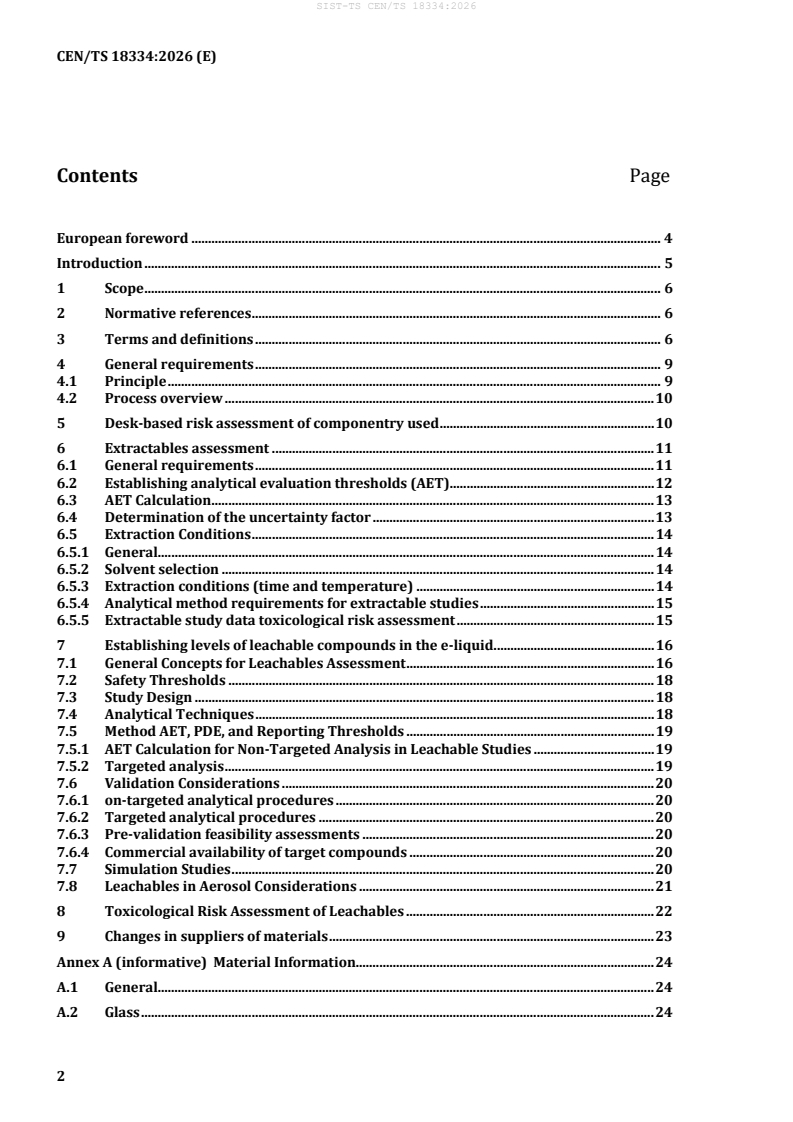
Contents
- Introduction
- 1 Scope
- 2 Normative references
- 3 Terms and definitions
- 3.1 accelerated extraction
- 3.2 analytical evaluation threshold
- 3.3 component
- 3.4 compound
- 3.5 constituent
- 3.6 e-liquid
- 3.7 e-liquid cartridge
- 3.8 exaggerated extraction
- 3.9 extractable
- 3.10 extraction vehicle
- 3.11 flavouring
- 3.12 ingredient
- 3.13 leachable
- 3.14 manufacturer
- 3.15 nicotine
- 3.16 Permitted Daily Exposure Limit
- 3.17 safety concern threshold
- 3.18 semi-quantitative analysis
- 3.19 simulated-use extraction
- 3.20 toxicological risk assessment
- 3.21 vaping product
- 4 General requirements
- 4.1 Principle
- 4.2 Process overview
- 5 Desk-based risk assessment of componentry used
- 6 Extractables assessment
- 6.1 General requirements
- 6.2 Establishing analytical evaluation thresholds (AET)
- 6.3 AET Calculation
- 6.4 Determination of the uncertainty factor
- 6.5 Extraction Conditions
- 7 Establishing levels of leachable compounds in the e-liquid
- 7.1 General Concepts for Leachables Assessment
- 7.2 Safety Thresholds
- 7.3 Study Design
- 7.4 Analytical Techniques
- 7.5 Method AET, PDE, and Reporting Thresholds
- 7.6 Validation Considerations
- 7.7 Simulation Studies
- 7.8 Leachables in Aerosol Considerations
- 8 Toxicological Risk Assessment of Leachables
- 9 Changes in suppliers of materials
- Annex A
- Bibliography
Introduction
This document provides state-of-the-art guidance for the testing of extractables and leachables in vaping products.
Extractables and Leachables refers to substances that have the potential to migrate from components and materials of construction into the e-liquid unintentionally.
Extractables can be released from a material of construction under laboratory conditions which may be varied to accelerate or exaggerate the removal of compounds from the construction materials. Extractables have the potential to leach into the e-liquid.
Leachables are substances that migrate from a material of construction into the e-liquid under normal conditions of storage and use. These substances, or their degradation products, once in the e-liquid, may then aerosolize for transfer to the consumer.
This document states the general principles and requirements for measuring and assessing extractable and leachable substances in vaping products.
The recommendations in this document are relevant to the majority of product types currently available, and the principles have been developed with the potential for application to future products. The principles may also be applied to the e-liquid manufacturing process equipment.
SIST-TS CEN/TS 18334:2026 CEN/TS 18334:2026 (E)
1 Scope
This document is applicable to electronic cigarettes and similar vapour producing devices intended to produce aerosol from e-liquids for consumption by inhalation. It is applicable to devices intended for use with e-liquids. This document is also applicable to e-liquid containers. This document:
- specifies the considerations and approach required to establish levels of extractable and leachable substances in vaping products, e-liquid cartridges, and e-liquid refill containers;
- specifies a risk-based approach to enable manufacturers to understand the risk associated with the levels of extractable and leachable substances;
- describes an approach to toxicological risk assessment that contributes to an understanding of whether leachable compound levels are within acceptable limits over the anticipated shelf life of the product;
- builds on the requirements of CEN/TS 17287:2019, 5.1 [10] Material (migration) by detailing an analytical and toxicological approach to establish that “no e-liquid contact material shall transfer constituents into the e-liquid at levels that endanger human health”
- does not consider that substances may also transfer directly to the user via direct contact with components as this consideration is included in CEN/TS 17287;
- does not specify all testing necessary to establish the shelf life of products.
2 Normative references
The following documents, in whole or in part, are normatively referenced in this document and are indispensable for its application. For dated references, only the edition cited applies. For undated references, the latest edition of the referenced document (including any amendments) applies. EN 17957, Vapour products - Vaping regime for products intended to be used for direct to lung inhalation EN ISO 20768, Vapour products — Routine analytical vaping machine — Definitions and standard conditions (ISO 20768)
3 Terms and definitions
For the purposes of this document, the following terms and definitions apply. ISO and IEC maintain terminological databases for use in standardization at the following addresses:
- ISO Online browsing platform: available at https://www.iso.org/obp
- IEC Electropedia: available at http://www.electropedia.org/
3.1 accelerated extraction
extraction whose duration is shorter than, but still representative of the duration of typical use and whose conditions are exaggerated without resulting in a chemical or physical change to the substances being extracted
SIST-TS CEN/TS 18334:2026 CEN/TS 18334:2026 (E)
3.2 analytical evaluation threshold
AET threshold below which the analysts do not need identification, quantification, or reporting as an extractable or a leachable
3.3 component
item which forms one part of a vaping device or e-liquid container, but is not itself a vaping device or e- liquid container
3.4 compound
individual chemical substance that usually has a unique CAS RN number
3.5 constituent
individual chemical substance within an ingredient
3.6 e-liquid
base liquid, which may or may not contain nicotine and/or nicotine salts and/or other ingredients, intended for transformation into an aerosol by a vaping device
3.7 e-liquid cartridge
e-liquid container that can be loaded directly into an e-cigarette, which can be disposable
3.8 exaggerated extraction
extraction that is intended to result in a greater number or amount of chemical constituents being released as compared to the amount generated under the usual conditions of use Note 1 to entry: It is important to ensure that the exaggerated extraction does not result in a chemical or physical change of the material or the substances being extracted.
3.9 extractable
substance that is released from a component when the component is extracted using laboratory extraction conditions and extraction vehicles
3.10 extraction vehicle
medium (solution or solvent) which is used to extract (or leach) a test article for the purpose of establishing the test article’s extractables or leachables profile Note 1 to entry: It is preferred that extraction vehicles be analytically expedient
3.11 flavouring
ingredient that imparts smell and/or taste
SIST-TS CEN/TS 18334:2026 CEN/TS 18334:2026 (E)
3.12 ingredient
any compound or mixture of compounds intentionally included in an e-liquid EXAMPLE Vegetable glycerol, propylene glycol, nicotine, flavourings
3.13 leachable
substance that is released from a vaping device or material during its usual use
3.14 manufacturer
any entity which manufactures a product or has a product designed or manufactured, and/or markets that product under their name or trademark
3.15 nicotine
(S)-3-(1-methyl-2-pyrrolidinyl)pyridine, conforming to the Chemical Abstracts Service nomenclature under n° CAS: 54-11-5
3.16 Permitted Daily Exposure Limit
PDE PDE limit for a compound represents the amount of that compound that is unlikely to cause harm to an individual when exposed to that compound during long term exposure
3.17 safety concern threshold
SCT threshold below which a leachable (or an extractable as a probable leachable) has a dose so low that it presents a negligible safety concern from carcinogenic and non-carcinogenic toxic effects
3.18 semi-quantitative analysis
analytical approach which provides an analyte’s concentration by using the response from a surrogate substance (or substances), specifically accounting for the relative responses of the analyte and the surrogate
3.19 simulated-use extraction
extraction using a method that simulates typical use Note 1 to entry: A simulated-use extraction is performed to estimate the type and amount of substances that are expected to be released from a vaping device or e-liquid container during its typical use. A simulated-use extraction is designed to produce an extractables profile that represents the worst-case leachables profile, meaning that all leachables are also extractables and the levels of all individual extractables are at least equal to the level of all individual leachables.
3.20 toxicological risk assessment
act of determining the potential of a chemical to elicit an adverse effect based on a specified level of exposure
SIST-TS CEN/TS 18334:2026 CEN/TS 18334:2026 (E)
3.21 vaping product
product that vapourises e-liquid to generate an inhalable aerosol carried by air drawn through the device by the user Note 1 to entry: Vaping products also referred to as electronic cigarette, e-cig, vapour product, personal vapouriser, or ENDS/ENNDS. [6] Note 2 to entry: Vaping products differ from tobacco products in that they do not contain tobacco.
4 General requirements
4.1 Principle
Vaping products are diverse in their design and approach to delivering an inhalable aerosol. Regardless of an individual product's design, there may be a risk of chemicals migrating from the parts of the e- cigarette into the e-liquid, which may then be inhaled by the user. This may or may not contribute to health effects of the user; however, a process to establish the potential health impact of substances that may migrate into e-liquid is contained herein.
No assessment is included in relation to the impact of substance migration into e-liquid on product quality issues e.g. integrity of the container, changes in e-liquid colour or flavour etc. A stepwise approach is proposed consisting of:
a) Desk-based risk assessment of componentry used b) Extraction study c) Toxicological risk prioritization based on extractable study data d) Leachable study in e-liquid (if required based on toxicological assessment of extraction study data) e) Toxicological assessment of leachable in e-liquid study data f) Leachable study in aerosol (if required based on toxicological assessment of leachable study in e- liquid data) g) Toxicological assessment of leachable in aerosol study data NOTE In case assessment is required to also assess organoleptic changes to the product, the materials and limitations expressed in food contact material legislation can be followed. Commission Regulation (EU) No 10/2011 of 14 January 2011 on plastic materials and articles intended to come into contact with food.
SIST-TS CEN/TS 18334:2026 CEN/TS 18334:2026 (E)
4.2 Process overview
Dashed line indicates an optional route as a decision may be made to proceed directly to aerosol leachables testing in case it is predicted that PDE (3.16) will be exceeded in liquid but transfer to aerosol may be limited.
“High risk extractable identified” defined and determined by toxicological assessment. Figure 1 — Process Overview Flow Chart
5 Desk-based risk assessment of componentry used
To establish the requirement for further extractable and leachable studies, a desk-based risk assessment is first conducted.
The desk-based assessment consists of establishing whether there is existing extractable and leachable data for the componentry to evaluate the level of risk they pose in terms of chemical migration into the e-liquid and subsequent risk of aerosolization. Generally, materials that are in contact with the e-liquid are considered high risk as the contact can be over a prolonged period of time, materials in contact with only the aerosol shall be considered and risk justified based on the likelihood of contact temperatures
SIST-TS CEN/TS 18334:2026 CEN/TS 18334:2026 (E) being elevated, whereas materials that are not in contact with the e-liquid or aerosol are considered low risk; however, the risk shall be documented and justified for each component by the manufacturer. Based on the output of the risk assessment, a decision as to which components are included in the extractable and leachable studies can be made, including the potential to leverage any existing data.
6 Extractables assessment
6.1 General requirements
Extraction studies are performed to detect, identify, and quantify extractables for toxicological risk
assessment. The laboratory undertaking this assessment shall be suitably accredited and with suitable method qualification reports, with its scope of accreditation appropriate to the analytical procedures being performed.
Identification of extractables is performed by non-targeted analysis. Analytical methods used for nontargeted analysis shall perform four functions:
a) they shall detect a wide range of chemical species (volatiles, semi-volatiles, non-volatiles, and elemental impurities); b) they shall be able to separate chemical species to distinguish between the analytes. This enables a unique response for each analyte; c) they shall provide, as far as reasonably practicable, information with which the chemical species identity can be elucidated whilst minimizing the number of unknown compounds, an appropriate library shall be maintained to allow identification of compounds/minimize number of unknown compounds. They shall minimize erroneous identification and quantitation e.g. by use of an appropriate array of standards accounting for their response factors and method uncertainty; d) they shall provide information with which the chemical species concentration can be estimated in a semiquantitative manner.
Extractions from the components identified in the desk-based assessment shall be made. This can either be performed by combining the components or by extraction of individual components or by combining components made from the same materials. Each of these approaches have advantages and disadvantages, non-exhaustive examples of these are highlighted in the Table 1:
More information can be found in EN ISO/IEC 17025:2017 [4].
SIST-TS CEN/TS 18334:2026 CEN/TS 18334:2026 (E) Table 1 Extraction Advantage Disadvantage a Combined all components Minimizes number of extract Data will not establish the solutions for analysis which source of any compound reduces the cost for testing extracted (does not establish extractable profile for each material or component) Combining components made Reduces the number of Will establish extract profile a from the same materials sample solutions for analysis for each material but not for controlling the cost of testing each component Extraction of individual Establishes an extract profile Requires the highest number components separately for each individual of samples for analysis and component allowing any therefore is more expensive problematic components to than combination be identified and replaced approaches.
a When combining components, the ratio shall be maintained to that in the product.
6.2 Establishing analytical evaluation thresholds (AET)
An AET (3.2) is a value used to ensure appropriate sensitivity of the analytical techniques used in extractable and leachable studies. The AET should be derived from a safety-based threshold (such as an adequate toxicological threshold of concern (TTC) as established by the International Council for Harmonization (ICH) M7 guideline [7] or SCT (3.17) as established by the Product Quality Research Institute [2]. If this is not practically achievable, an analytical threshold, such as the Limit of Quantification (LOQ) can be used as the reporting threshold. If the LOQ is used to derive the AET, the appropriateness of the threshold shall be considered in the toxicological risk assessment. The threshold concept can be applied to extractables in the circumstance that extractables are used to project the worst-case release of leachables from test article.
AET is only applicable to organic extractables or leachables. Metals may have differing levels, dependent on the individual element, that may be considered acceptable, such as those described in ICH Q3D ‘Elemental Impurities’ [8].
Thresholds, such as a TTC or SCT, establish a daily dose of leachables (and other potentially toxic impurities) below which there is limited toxicological risk over long term exposure. Some highly toxic substances (i.e. cohorts of concern) are excluded from a TTC approach and their presence should be ruled out before the AET is applied. Any specifically targeted analytes of concern for the specific material of construction should be assessed individually, independent of the AET. Types and examples of cohorts of concern are described in ISO/TS 21726 [9]. Chemical species present at levels below the safety-based threshold are deemed to be appropriately safe and do not require additional assessment (identification and quantification). These thresholds (e.g. SCT or TTC) in combination with an appropriate factor that addresses the uncertainty of the analytical method, become identification thresholds, as substances dosed at and above the threshold should be identified to allow for their safety assessment — while substances dosed below the threshold are deemed to present an acceptably low toxicological safety risk without identification.
SIST-TS CEN/TS 18334:2026 CEN/TS 18334:2026 (E)
6.3 AET Calculation
The application of the threshold concept requires that a dose-based threshold (e.g. SCT or TTC) be converted to a concentration-based threshold (AET).
The conversion from a dose-based threshold (e.g. SCT or TTC) from typically µg/day to a concentrationbased threshold (AET) in µg/mL. The AET in μg/mL can be calculated using Formula (1).
SCT × A ×CF AET = µg/mL B ×C ××S UF (1) where AET is threshold below which the analyst need not identify or quantify leachables or report them for potential toxicological assessment (µg/mL); SCT or (TTC) is the safety concern threshold or threshold of toxicological concern (µg/day); A is the number, amount or surface area of test items extracted (item, g, cm2); B is the volume of extract used (mL); C is the number, amount or surface area of test item used by the consumer daily (item, g, cm2/day); S is the number of sequential extracts performed (exhaustive extractions); UF is the uncertainty factor; CF is the concentration factor (calculated using Formula (2).
InitialV olume CF= FinalV olume (2) A toxicologist shall be consulted in selecting the appropriate safety-based threshold that supports the toxicological risk assessment.
6.4 Determination of the uncertainty factor
As the analytical procedures used to assess extractables from materials vary, their respective accuracy of the reported value will also vary; the quantification technique can have a particularly large impact on the accuracy of the reported value. For example, quantification can involve using a surrogate standard to normalize the responses obtained for all relevant analytes. In such an approach, one estimates the concentration of each analyte based on the assumption that all analytes respond similarly, among themselves and to the surrogate standard (i.e. all substances have the same response factor). Due to the likely variability in analyte response factors, the concentration estimates obtained from a surrogate may result in differing degrees of accuracy. An uncertainty factor can be applied to account for the varying levels of accuracy.
The uncertainty factors may be justified based on the means of quantitation, for example, through the use of relative response factor libraries or targeted analysis using validated methods. When quantification is achieved using relative response factor libraries, the user should justify the uncertainty factor values selected. When quantification is achieved with calibration curves generated via the analysis of authentic standards with qualified analytical methods, the concentration estimates obtained for the qualified analytes are considered highly accurate, resulting in the possibility of an uncertainty factor as low as 1. Without information to better inform the analysts on the correct uncertainty factor, a factor of 4 can be applied for GC-MS methods and a factor of 10 for LC-MS methods. The AET is adjusted via the uncertainty
...