

SIST EN 14998:2005
(Main)Derivatives from coal pyrolysis - Coal tar based oils: fluxings oils - Specifications and test methods
- Abstract
This document gives specifications and defines test methods for coal tar fluxing oils. Annex specifies this warning for use for industrial purposes. The main purposes of these oils are to reduce the viscosity of bituminous (carbonaceous) binders used for road construction. They may be used in conjunction with petrochemical feedstocks.
- Status
- Published
- Publication Date
- 31-May-2005
- Technical Committee
- I13 - Imaginarni 13
- Current Stage
- 6060 - National Implementation/Publication (Adopted Project)
- Start Date
- 01-Jun-2005
- Due Date
- 01-Jun-2005
- Completion Date
- 01-Jun-2005

SIST EN 14998:2005 is the Slovenian adoption of EN 14998:2005 from CEN. It specifies coal tar based fluxing oils and the test methods used to check them, with a focus on products used to reduce the viscosity of bituminous binders for road construction.
What does SIST EN 14998:2005 specify?
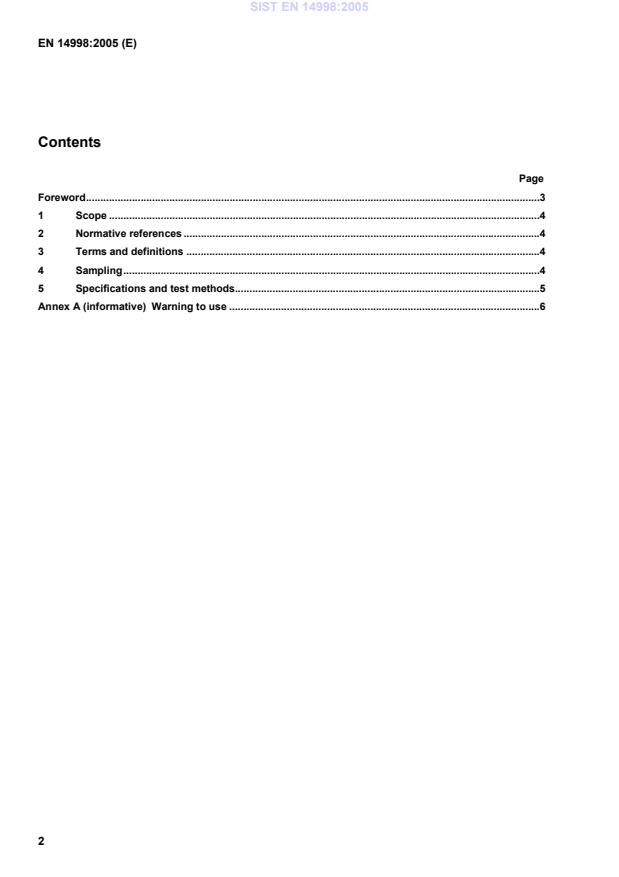
SIST EN 14998:2005 covers specifications and test methods for coal tar fluxing oils. It is organized into scope, normative references, terms and definitions, sampling, and a specification table, plus an informative annex with a warning for use.
The standard is written for industrial use. It also notes that these oils may be used together with petrochemical feedstocks.
What are the key requirements of SIST EN 14998:2005?
Clause 4 requires sampling for the characteristics in the specification table to follow EN 1014-1. In practice, the sample you test has to be taken in a consistent way, otherwise the property results in Table 1 are not reliable.
Clause 5 is the technical core of SIST EN 14998:2005. It sets four grades - A, B, C and D - and links each grade to a set of property limits and a test method. That gives buyers, producers, and laboratories one shared basis for classification.
How the grades are used
Grade A is intended for storable cold mix binders and slurry sealings. Grade B and Grade C are used for binders for surface dressing, with Grade B for cold weather conditions and Grade C for warm weather conditions. Grade D comes from low temperature coal tar distillation and is intended for binders for precoated chippings.
In practice, the grade tells you what the oil is meant for. That matters when selecting a fluxing oil for road works, because the wrong grade can affect handling, weather performance, and binder preparation.
What properties are controlled
Clause 5 uses Table 1 to control distillation range, density at 20 °C, water content, crystallization temperature, benzo[a]pyrene content, flash point, and viscosity. The table gives different limits by grade, so compliance is checked against both the product class and the measured property.
This matters because the standard does not treat the oils as one generic material. A supplier has to show that the product matches the grade-specific property limits, and a buyer can check the same properties on delivery.
Which test methods are used
The table assigns test methods to each property. It uses EN ISO 3405 for distillation, ISO 3675 for density, ISO 760 for water content, EN 13991 for crystallization temperature, EN 1014-3 for benzo[a]pyrene content, EN ISO 2719 for flash point, and EN 12846 for viscosity.
Clause 5 also notes that ISO 3733 may be used as an alternative for water determination. For laboratories, that means the document points to recognized methods rather than describing a new in-house procedure.
What Annex A adds
Annex A is informative and gives a warning for use. It covers composition and chemical characterization, first aid measures, handling and storage, and disposal considerations.
In practice, Annex A is the part people use when they need safety and handling guidance for industrial use, including general hygiene, storage, and waste handling points.
What terms does SIST EN 14998:2005 define?
SIST EN 14998:2005 applies the terms and definitions from EN 12303:2000 and EN 13847:2001. The key terms used in the document include:
- Coal tar fluxing oils - coal tar based oils used to reduce the viscosity of bituminous binders.
- Bituminous binders - carbonaceous binders used in road construction that can be softened or adjusted with fluxing oils.
- Surface dressing - a road treatment mentioned as a use for Grades B and C.
- Slurry sealings - a cold mix application named for Grade A.
- Precoated chippings - chippings prepared with binder, linked here to Grade D.
- Benzo[a]pyrene - a component whose content is limited in the specification table.
Who uses SIST EN 14998:2005?
SIST EN 14998:2005 is used by producers of coal tar based fluxing oils, testing laboratories, road binder formulators, and quality managers. It is also relevant to buyers and specifiers who need to choose a grade and check delivery against a defined set of properties.
Road construction users need it because the grades are tied to practical applications such as cold mix binders, slurry sealings, surface dressing, and precoated chippings. Safety, storage, and disposal staff also use Annex A when handling the product in industrial settings.
Which standards are used with SIST EN 14998:2005?
The document relies on several companion standards:
- EN 1014-1 - sampling procedure for creosote, used here for taking samples.
- EN 1014-3 - method for determining benzo[a]pyrene content.
- EN 12303:2000 - terminology for coal tar based oils.
- EN 12846 - efflux viscometer method for viscosity.
- EN 13847:2001 - terminology and classification for coal tar and pitch based binders.
- EN 13991 - specifications and test methods for creosotes, used here for crystallization temperature.
- EN ISO 2719 - flash point by Pensky-Martens closed cup.
- EN ISO 3405 - distillation characteristics at atmospheric pressure.
- EN ISO 3675 - density by hydrometer.
- ISO 760 - Karl Fischer water determination.
- ISO 3733 - named as an alternative method for water determination.
What does the SIST EN 14998:2005 document contain?
The document’s main technical content is Table 1, which pairs each grade with property limits and the corresponding test method. That table is what laboratories and suppliers use to check conformance.
It also contains the sampling clause, the terms-and-definitions clause, and Annex A with use warnings and handling information. For a practical user, that means the document covers selection, sampling, testing, and basic industrial safety guidance in one standard.
Relations
- Effective Date
- 25-Aug-2026
- Effective Date
- 28-Jan-2026
- Effective Date
- 28-Jan-2026
- Effective Date
- 28-Jan-2026
- Effective Date
- 28-Jan-2026
- Effective Date
- 28-Jan-2026
- Effective Date
- 28-Jan-2026
- Effective Date
- 28-Jan-2026
- Effective Date
- 28-Jan-2026
- Effective Date
- 28-Jan-2026
- Effective Date
- 28-Jan-2026
Get Certified
Connect with accredited certification bodies for this standard

Element Materials Technology
Materials testing and product certification.

ABS Group Brazil
ABS Group certification services in Brazil.

ABS Quality Evaluations Inc.
American Bureau of Shipping quality certification.
Sponsored listings
Frequently Asked Questions
SIST EN 14998:2005 is a standard published by the Slovenian Institute for Standardization (SIST). Its full title is "Derivatives from coal pyrolysis - Coal tar based oils: fluxings oils - Specifications and test methods". This standard covers: This document gives specifications and defines test methods for coal tar fluxing oils. Annex specifies this warning for use for industrial purposes. The main purposes of these oils are to reduce the viscosity of bituminous (carbonaceous) binders used for road construction. They may be used in conjunction with petrochemical feedstocks.
This document gives specifications and defines test methods for coal tar fluxing oils. Annex specifies this warning for use for industrial purposes. The main purposes of these oils are to reduce the viscosity of bituminous (carbonaceous) binders used for road construction. They may be used in conjunction with petrochemical feedstocks.
SIST EN 14998:2005 is classified under the following ICS (International Classification for Standards) categories: 75.160.10 - Solid fuels. The ICS classification helps identify the subject area and facilitates finding related standards.
SIST EN 14998:2005 has the following relationships with other standards: It is inter standard links to SIST ISO 760:1995, SIST EN ISO 2719:2026, SIST EN 12303:2000, SIST EN 13991:2024, SIST EN 1014-1:2010, SIST EN ISO 3405:2019, SIST EN 1014-3:2011, SIST EN ISO 3675:1999, SIST EN 12846-1:2023, SIST EN ISO 4630-1:2005, SIST EN 13847:2002. Understanding these relationships helps ensure you are using the most current and applicable version of the standard.
SIST EN 14998:2005 is available in PDF format for immediate download after purchase. The document can be added to your cart and obtained through the secure checkout process. Digital delivery ensures instant access to the complete standard document.
Standards Content (Sample)
2003-01.Slovenski inštitut za standardizacijo. Razmnoževanje celote ali delov tega standarda ni dovoljeno.Derivati pri pirolizi premoga - Olja iz premogovega katrana: olja za zmanjševanje viskoznosti bitumenskih veziv - Specifikacije in preskusne metodeDerivate der Kohlenpyrolyse - Steinkohlenteeröl: Fluxöle - Anforderungen und PrüfverfahrenProduits dérivés de la pyrolyse du charbon - Huiles de goudron de houille: fluxants - Spécifications et méthodes d'essaiDerivatives from coal pyrolysis - Coal tar based oils: fluxings oils - Specifications and test methods75.160.10Trda gorivaSolid fuelsICS:Ta slovenski standard je istoveten z:EN 14998:2005SIST EN 14998:2005en,fr,de01-junij-2005SIST EN 14998:2005SLOVENSKI
STANDARD
EUROPEAN STANDARDNORME EUROPÉENNEEUROPÄISCHE NORMEN 14998January 2005ICS 75.160.20English versionDerivatives from coal pyrolysis - Coal tar based oils: fluxings oils- Specifications and test methodsProduits dérivés de la pyrolyse du charbon - Huiles degoudron de houille: fuidifiants - Spécifications et méthodesd'essaiDerivate der Kohlenpyrolyse - Steinkohlenteeröl: Fluxöle -Anforderungen und PrüfverfahrenThis European Standard was approved by CEN on 9 December 2004.CEN members are bound to comply with the CEN/CENELEC Internal Regulations which stipulate the conditions for giving this EuropeanStandard the status of a national standard without any alteration. Up-to-date lists and bibliographical references concerning such nationalstandards may be obtained on application to the Central Secretariat or to any CEN member.This European Standard exists in three official versions (English, French, German). A version in any other language made by translationunder the responsibility of a CEN member into its own language and notified to the Central Secretariat has the same status as the officialversions.CEN members are the national standards bodies of Austria, Belgium, Cyprus, Czech Republic, Denmark, Estonia, Finland, France,Germany, Greece, Hungary, Iceland, Ireland, Italy, Latvia, Lithuania, Luxembourg, Malta, Netherlands, Norway, Poland, Portugal, Slovakia,Slovenia, Spain, Sweden, Switzerland and United Kingdom.EUROPEAN COMMITTEE FOR STANDARDIZATIONCOMITÉ EUROPÉEN DE NORMALISATIONEUROPÄISCHES KOMITEE FÜR NORMUNGManagement Centre: rue de Stassart, 36
B-1050 Brussels© 2005 CENAll rights of exploitation in any form and by any means reservedworldwide for CEN national Members.Ref. No. EN 14998:2005: ESIST EN 14998:2005
Warning to use.6
This document (EN 14998:2005) has been prepared by Technical Committee CEN/TC 317, "Derivatives from coal pyrolysis", the secretariat of which is held by IBN. This document is based on NF M 15-003. This European Standard shall be given the status of a national standard, either by publication of an identical text or by endorsement, at the latest by July 2005, and conflicting national standards shall be withdrawn at the latest by July 2005. According to the CEN/CENELEC Internal Regulations, the national standards organizations of the following countries are bound to implement this European Standard: Austria, Belgium, Cyprus, Czech Republic, Denmark, Estonia, Finland, France, Germany, Greece, Hungary, Iceland, Ireland, Italy, Latvia, Lithuania, Luxembourg, Malta, Netherlands, Norway, Poland, Portugal, Slovakia, Slovenia, Spain, Sweden, Switzerland and United Kingdom.
...