

SIST EN 1993-5:2007
(Main)Eurocode 3 - Design of steel structures - Part 5: Piling
General Information
- Abstract
Complementary to Part 1. Varied general rules and additional detailed rules for the structural design of steel bearing piles and sheet piles and concrete filled steel piles.
- Status
- Published
- Publication Date
- 06-May-2007
- Technical Committee
- KON - Structures
- Current Stage
- 6060 - National Implementation/Publication (Adopted Project)
- Start Date
- 12-Apr-2007
- Due Date
- 17-Jun-2007
- Completion Date
- 07-May-2007



Overview
SIST EN 1993-5:2007 (Eurocode 3: Design of Steel Structures – Part 5: Piling) provides essential design rules and detailed application guidance for steel bearing piles, sheet piles, and concrete-filled steel piles used in construction. This standard complements the general provisions in Eurocode 3 Part 1 and is developed to ensure the safe, reliable, and durable design of piling foundations and retaining structures for civil engineering projects, both on land and over water. It serves as a harmonized European standard to facilitate compliance with regulatory requirements, harmonize design practices, and support the construction product specification and procurement processes.
Key Topics
- Design Principles: Outlines general and detailed rules for structural design of steel piles, including ultimate and serviceability limit states, and specific application provisions for foundation and retaining wall structures.
- Types of Piles Covered:
- Steel bearing piles (hollow, H-type, X-type cross-sections)
- Steel sheet piles (Z-shaped, U-shaped, straight web profiles)
- Combined walls (primary and secondary elements)
- Concrete-filled steel piles
- Durability: Provides requirements for corrosion protection, material selection, and calculation of corrosion rates during the design of steel piling elements.
- Detailing and Connections: Specifies provisions for structural connections such as walings, bracing, anchors, interlocks, pile couplers, and joint detailing.
- Execution and Workmanship: Relies on referenced standards for installation and fabrication processes of steel piles, ensuring quality and safety during execution.
- Testing and Analysis: Includes design guidance for testing procedures (especially for class 4 sheet piles), and frameworks for both calculation-based and test-based design.
Applications
SIST EN 1993-5:2007 finds its application in a wide array of construction and civil engineering projects, including but not limited to:
- Piled Foundations: Design of steel piles for building and infrastructure foundations, providing axial, tensile, and lateral resistance.
- Retaining Structures: Design of permanent or temporary retaining walls composed of steel sheet piles or combined wall systems for soil and water retention.
- Waterfront and Marine Structures: Use in quay walls, bulkheads, cofferdams, and other marine infrastructure requiring robust and durable piling solutions.
- Bridge Abutments and Embankments: Piling systems for supporting abutments and embankment stabilization.
- Earth Retention and Excavation Support: Temporary or permanent shoring and earth support systems using driven sheet piling during excavation works.
- Combined Systems: Application rules for combined walls, including high modulus retaining walls and king pile solutions.
Related Standards
SIST EN 1993-5:2007 is intended for use in conjunction with the following key standards to ensure comprehensive and harmonized structural design:
- EN 1990: Basis of structural design
- EN 1991: Actions on structures
- EN 1993-1: General rules for steel structures (and subsidiary parts, including rules for fire design, joints, fatigue, and member properties)
- EN 1997: Geotechnical design (for site investigation and soil parameter assessment)
- EN 12063, EN 12699, EN 14199, EN 1536, EN 1537: Execution of special geotechnical works, including installation and quality control requirements for different pile types and sheet pile walls
- EN 10248, EN 10249: Hot-rolled and cold-formed sheet piling material standards
Practical Value
Implementing SIST EN 1993-5:2007 ensures:
- Regulatory compliance with national and European construction codes
- Safety and reliability in design and execution of steel pile foundations and retaining walls
- Consistency and harmonization in structural engineering practices across Europe
- Clear frameworks for addressing durability, corrosion, and service life of steel piling systems
- Adaptability for various ground conditions, construction methods, and project types
By following this standard, engineers, designers, and constructors can achieve cost-effective, high-quality, and sustainable solutions for steel piling in building and civil engineering projects.
Relations
- Effective Date
- 01-Jun-2007
- Effective Date
- 14-Nov-2018
- Effective Date
- 19-Aug-2026
- Refers
kSIST FprEN 1991-1-6:2025 - Eurocode 1 - Actions on structures - Part 1-6: Actions during execution - Effective Date
- 25-Mar-2026
- Effective Date
- 25-Mar-2026
- Effective Date
- 25-Mar-2026
- Effective Date
- 25-Mar-2026
- Effective Date
- 25-Mar-2026
- Effective Date
- 25-Mar-2026
- Effective Date
- 25-Mar-2026
- Refers
kSIST FprEN 1993-1-11:2025 - Eurocode 3 - Design of steel structures - Part 1-11: Tension components - Effective Date
- 25-Mar-2026
- Effective Date
- 25-Mar-2026
- Effective Date
- 25-Mar-2026
- Effective Date
- 28-Jan-2026
- Effective Date
- 28-Jan-2026
Get Certified
Connect with accredited certification bodies for this standard

DIBt (Deutsches Institut für Bautechnik)
German Institute for Building Technology.
DIN CERTCO
DIN Group product certification.

Aboma Certification B.V.
Specialized in construction, metal, and transport sectors.
Sponsored listings
Frequently Asked Questions
SIST EN 1993-5:2007 is a standard published by the Slovenian Institute for Standardization (SIST). Its full title is "Eurocode 3 - Design of steel structures - Part 5: Piling". This standard covers: Complementary to Part 1. Varied general rules and additional detailed rules for the structural design of steel bearing piles and sheet piles and concrete filled steel piles.
Complementary to Part 1. Varied general rules and additional detailed rules for the structural design of steel bearing piles and sheet piles and concrete filled steel piles.
SIST EN 1993-5:2007 is classified under the following ICS (International Classification for Standards) categories: 91.010.30 - Technical aspects; 91.080.13 - Steel structures. The ICS classification helps identify the subject area and facilitates finding related standards.
SIST EN 1993-5:2007 has the following relationships with other standards: It is inter standard links to SIST ENV 1993-5:2001, kSIST FprEN 1993-5:2025, SIST EN ISO 6892-2:2026, kSIST FprEN 1991-1-6:2025, kSIST FprEN 1991-4:2025, kSIST FprEN 1994-2:2025, kSIST FprEN 1994-1-1:2025, kSIST FprEN 1991-1-4:2025, kSIST FprEN 1991-1-8:2025, kSIST FprEN 1991-3:2025, kSIST FprEN 1993-1-11:2025, kSIST FprEN 1994-1-2:2025, kSIST FprEN 1998-1-2:2025, SIST EN 1991-1-4:2005/A1:2010, SIST EN 10249-1:1998. Understanding these relationships helps ensure you are using the most current and applicable version of the standard.
SIST EN 1993-5:2007 is associated with the following European legislation: EU Directives/Regulations: 2005-01-4408, 305/2011, 89/106/EEC; Standardization Mandates: M/265, M/BC/CEN/89/11. When a standard is cited in the Official Journal of the European Union, products manufactured in conformity with it benefit from a presumption of conformity with the essential requirements of the corresponding EU directive or regulation.
SIST EN 1993-5:2007 is available in PDF format for immediate download after purchase. The document can be added to your cart and obtained through the secure checkout process. Digital delivery ensures instant access to the complete standard document.
Standards Content (Sample)
2003-01.Slovenski inštitut za standardizacijo. Razmnoževanje celote ali delov tega standarda ni dovoljeno.Eurocode 3 - Design of steel structures - Part 5: PilingEvrokod 3: Projektiranje jeklenih konstrukcij - 5. del: PilotiranjeEurocode 3 - Calcul des structures en acier - Partie 5: Pieux et palplanchesEurocode 3 - Bemessung und Konstruktion von Stahlbauten - Teil 5: Pfähle und SpundwändeTa slovenski standard je istoveten z:EN 1993-5:2007SIST EN 1993-5:2007en;de91.080.10Kovinske konstrukcijeMetal structures91.010.30Technical aspectsICS:SIST ENV 1993-5:20011DGRPHãþDSLOVENSKI
STANDARDSIST EN 1993-5:200701-junij-2007
EUROPEAN STANDARDNORME EUROPÉENNEEUROPÄISCHE NORMEN 1993-5February 2007ICS 91.010.30; 91.080.10Supersedes ENV 1993-5:1998
English VersionEurocode 3 - Design of steel structures - Part 5: PilingEurocode 3 - Calcul des structures en acier - Partie 5:Pieux et palplanchesEurocode 3 - Bemessung und Konstruktion vonStahlbauten - Teil 5: Pfähle und SpundwändeThis European Standard was approved by CEN on 12 June 2006.CEN members are bound to comply with the CEN/CENELEC Internal Regulations which stipulate the conditions for giving this EuropeanStandard the status of a national standard without any alteration. Up-to-date lists and bibliographical references concerning such nationalstandards may be obtained on application to the CEN Management Centre or to any CEN member.This European Standard exists in three official versions (English, French, German). A version in any other language made by translationunder the responsibility of a CEN member into its own language and notified to the CEN Management Centre has the same status as theofficial versions.CEN members are the national standards bodies of Austria, Belgium, Bulgaria, Cyprus, Czech Republic, Denmark, Estonia, Finland,France, Germany, Greece, Hungary, Iceland, Ireland, Italy, Latvia, Lithuania, Luxembourg, Malta, Netherlands, Norway, Poland, Portugal,Romania, Slovakia, Slovenia, Spain, Sweden, Switzerland and United Kingdom.EUROPEAN COMMITTEE FOR STANDARDIZATIONCOMITÉ EUROPÉEN DE NORMALISATIONEUROPÄISCHES KOMITEE FÜR NORMUNGManagement Centre: rue de Stassart, 36
B-1050 Brussels© 2007 CENAll rights of exploitation in any form and by any means reservedworldwide for CEN national Members.Ref. No. EN 1993-5:2007: E
EN 1993-5: 2007 (E)
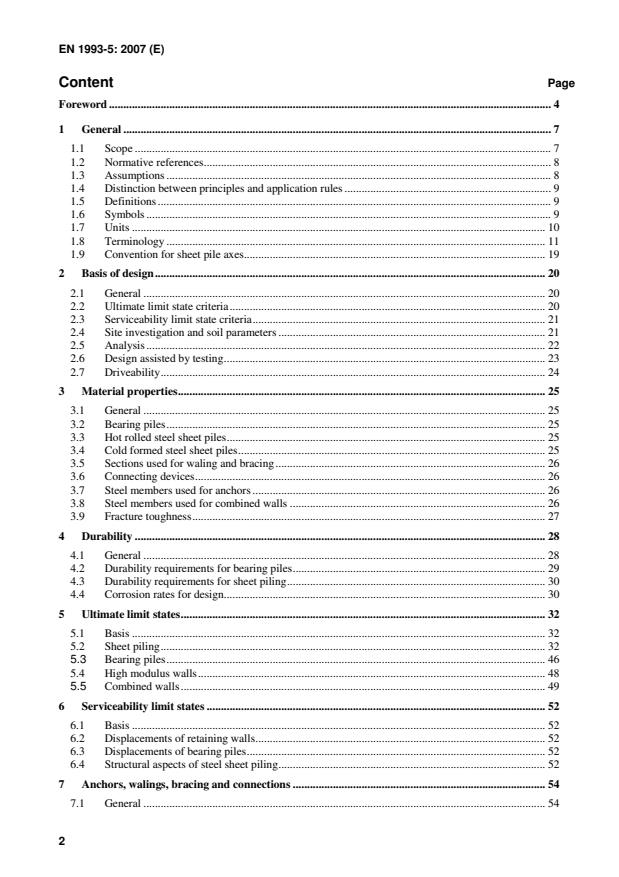
2 Content Page Foreword.4 1 General.7 1.1 Scope.7 1.2 Normative references.8 1.3 Assumptions.8 1.4 Distinction between principles and application rules.9 1.5 Definitions.9 1.6 Symbols.9 1.7 Units.10 1.8 Terminology.11 1.9 Convention for sheet pile axes.19 2 Basis of design.20 2.1 General.20 2.2 Ultimate limit state criteria.20 2.3 Serviceability limit state criteria.21 2.4 Site investigation and soil parameters.21 2.5 Analysis.22 2.6 Design assisted by testing.23 2.7 Driveability.24 3 Material properties.25 3.1 General.25 3.2 Bearing piles.25 3.3 Hot rolled steel sheet piles.25 3.4 Cold formed steel sheet piles.25 3.5 Sections used for waling and bracing.26 3.6 Connecting devices.26 3.7 Steel members used for anchors.26 3.8 Steel members used for combined walls.26 3.9 Fracture toughness.27 4 Durability.28 4.1 General.28 4.2 Durability requirements for bearing piles.29 4.3 Durability requirements for sheet piling.30 4.4 Corrosion rates for design.30 5 Ultimate limit states.32 5.1 Basis.32 5.2 Sheet piling.32 5.3 Bearing piles.46 5.4 High modulus walls.48 5.5 Combined walls.49 6 Serviceability limit states.52 6.1 Basis.52 6.2 Displacements of retaining walls.52 6.3 Displacements of bearing piles.52 6.4 Structural aspects of steel sheet piling.52 7 Anchors, walings, bracing and connections.54 7.1 General.54
EN 1993-5: 2007 (E)
3 7.2 Anchorages.54 7.3 Walings and bracing.56 7.4 Connections.56 8 Execution.64 8.1 General.64 8.2 Steel sheet piling.64 8.3 Bearing piles.64 8.4 Anchorages.64 8.5 Walings, bracings and connections.64 A [normative] - Thin walled steel sheet piling.65 A.1 General.65 A.2 Basis of design.66 A.3 Properties of materials and cross-sections.66 A.4 Local buckling.70 A.5 Resistance of cross-sections.72 A.6 Design by calculation.76 A.7 Design assisted by testing.77 B [informative] - Testing of thin walled steel sheet piles.79 B.1 General.79 B.2 Single span beam test.79 B.3 Intermediate support test.80 B.4 Double span beam test.81 B.5 Evaluation of test results.82 C [informative] - Guidance for the design of steel sheet piling.84 C.1 Design of sheet pile cross section at ultimate limit state.84 C.2 Serviceability limit state.87 D [informative] - Primary elements of combined walls.89 D.1 I-sections used as primary elements.89 D.2 Tubular piles used as primary elements.91
EN 1993-5: 2007 (E)
4 Foreword This European Standard EN 1993-5, “Eurocode 3: Design of steel structures: Part 5 Piling”, has been prepared by Technical Committee CEN/TC250 « Structural Eurocodes », the Secretariat of which is held by BSI. CEN/TC250 is responsible for all Structural Eurocodes.
This European Standard shall be given the status of a National Standard, either by publication of an identical text or by endorsement, at the latest by August 2007, and conflicting National Standards shall be withdrawn at latest by March 2010.
This Eurocode supersedes ENV 1993-5:1998.
According to the CEN-CENELEC Internal Regulations, the National Standard Organizations of the following countries are bound to implement this European Standard: Austria, Belgium, Bulgaria, Cyprus, Czech Republic, Denmark, Estonia, Finland, France, Germany, Greece, Hungary, Iceland, Ireland, Italy, Latvia, Lithuania, Luxembourg, Malta, Netherlands, Norway, Poland, Portugal, Romania, Slovakia, Slovenia, Spain, Sweden, Switzerland and United Kingdom.
Background to the Eurocode programme In 1975, the Commission of the European Community decided on an action programme in the field of construction, based on article 95 of the Treaty. The objective of the programme was the elimination of technical obstacles to trade and the harmonisation of technical specifications.
Within this action programme, the Commission took the initiative to establish a set of harmonised technical rules for the design of construction works which, in a first stage, would serve as an alternative to the national rules in force in the Member States and, ultimately, would replace them.
For fifteen years, the Commission, with the help of a Steering Committee with Representatives of Member States, conducted the development of the Eurocodes programme, which led to the first generation of European codes in the 1980’s.
In 1989, the Commission and the Member States of the EU and EFTA decided, on the basis of an agreement1 between the Commission and CEN, to transfer the preparation and the publication of the Eurocodes to the CEN through a series of Mandates, in order to provide them with a future status of European Standard (EN). This links de facto the Eurocodes with the provisions of all the Council's Directives and/or Commission’s Decisions dealing with European standards (e.g. the Council Directive 89/106/EEC on construction products - CPD - and Council Directives 93/37/EEC, 92/50/EEC and 89/440/EEC on public works and services and equivalent EFTA Directives initiated in pursuit of setting up the internal market).
The Structural Eurocode programme comprises the following standards generally consisting of a number of Parts: EN 1990
Eurocode:
Basis of structural design EN 1991
Eurocode 1:
Actions on structures EN 1992
Eurocode 2:
Design of concrete structures EN 1993
Eurocode 3:
Design of steel structures EN 1994
Eurocode 4:
Design of composite steel and concrete structures EN 1995
Eurocode 5:
Design of timber structures EN 1996
Eurocode 6:
Design of masonry structures EN 1997
Eurocode 7:
Geotechnical design EN 1998
Eurocode 8:
Design of structures for earthquake resistance EN 1999
Eurocode 9:
Design of aluminium structures
1 Agreement between the Commission of the European Communities and the European Committee for Standardisation (CEN) concerning the work on EUROCODES for the design of building and civil engineering works (BC/CEN/03/89).
EN 1993-5: 2007 (E)
5 Eurocode standards recognise the responsibility of regulatory authorities in each Member State and have safeguarded their right to determine values related to regulatory safety matters at national level where these continue to vary from State to State. Status and field of application of Eurocodes The Member States of the EU and EFTA recognise that Eurocodes serve as reference documents for the following purposes:
as a means to prove compliance of building and civil engineering works with the essential requirements of Council Directive 89/106/EEC, particularly Essential Requirement Nº1 – Mechanical resistance and stability - and Essential Requirement Nº2 - Safety in case of fire; - as a basis for specifying contracts for construction works and related engineering services; - as a framework for drawing up harmonised technical specifications for construction products (ENs and ETAs)
The Eurocodes, as far as they concern the construction works themselves, have a direct relationship with the Interpretative Documents2 referred to in Article 12 of the CPD, although they are of a different nature from harmonised product standard3. Therefore, technical aspects arising from the Eurocodes work need to be adequately considered by CEN Technical Committees and/or EOTA Working Groups working on product standards with a view to achieving a full compatibility of these technical specifications with the Eurocodes. The Eurocode standards provide common structural design rules for everyday use for the design of whole structures and component products of both a traditional and an innovative nature. Unusual forms of construction or design conditions are not specifically covered and additional expert consideration will be required by the designer in such cases. National Standards implementing Eurocodes The National Standards implementing Eurocodes will comprise the full text of the Eurocode (including any annexes), as published by CEN, which may be preceded by a National title page and National foreword, and may be followed by a National Annex (informative). The National Annex (informative) may only contain information on those parameters which are left open in the Eurocode for national choice, known as Nationally Determined Parameters, to be used for the design of buildings and civil engineering works to be constructed in the country concerned, i.e.:
- values for partial factors and/or classes where alternatives are given in the Eurocode, - values to be used where a symbol only is given in the Eurocode, - geographical and climatic data specific to the Member State, e.g. snow map, - the procedure to be used where alternative procedures are given in the Eurocode, - references to non-contradictory complementary information to assist the user to apply the Eurocode.
According to Art. 3.3 of the CPD, the essential requirements (ERs) shall be given concrete form in interpretative documents for the creation of the necessary links between the essential requirements and the mandates for hENs and ETAGs/ETAs.
According to Art. 12 of the CPD the interpretative documents shall: (a) give concrete form to the essential requirements by harmonising the terminology and the technical bases and indicating classes or levels for each requirement where necessary; (b) indicate methods of correlating these classes or levels of requirement with the technical specifications, e.g. methods of calculation and of proof, technical rules for project design, etc.; (c) serve as a reference for the establishment of harmonised standards and guidelines for European technical approvals. The Eurocodes, de facto, play a similar role in the field of the ER 1 and a part of ER 2.
EN 1993-5: 2007 (E)
Links between Eurocodes and product harmonised technical specifications (ENs and ETAs) There is a need for consistency between the harmonised technical specifications for construction products and the technical rules for works4. Furthermore, all the information accompanying the CE Marking of the construction products which refer to Eurocodes should clearly mention which Nationally Determined Parameters have been taken into account. Additional information specific to EN 1993-5 EN 1993-5 gives design rules for steel sheet piling and bearing piles to supplement the generic rules in EN 1993-1. EN 1993-5 is intended to be used with Eurocodes EN 1990 - Basis of design, EN 1991 - Actions on structures and Part 1 of EN 1997 Geotechnical Design.
Matters that are already covered in those documents are not repeated.
EN 1993-5 is intended for use by - committees drafting design related product, testing and execution standards, - clients (e.g. for the formulation of their specific requirements) - designers and constructors - relevant authorities.
Numerical values for partial factors and other parameters are recommended as basic values that provide an acceptable level of safety. They have been selected assuming that an appropriate level of workmanship and quality management applies. Annex A and Annex B have been prepared to complement the provisions of EN 1993-1-3 for class 4 steel sheet piles. Annex C gives guidance on the plastic design of steel sheet pile retaining structures.
Annex D gives one possible set of design rules for primary elements of combined walls.
Reference should be made to EN 1997 for geotechnical design which is not covered in this document.
National Annex for EN 1993-5 This standard gives alternative procedures, values and recommendations for classes with notes indicating where national choices may have to be made. Therefore the National Standard implementing EN 1993-5 should have a National Annex containing all Nationally Determined Parameters to be used for the design of buildings and civil engineering works to be constructed in the relevant country.
National choice is allowed in EN 1993-5 through clauses:
3.7 (1) 3.9 (1)P 4.4 (1)
5.1.1 (4) 5.2.2 (2) 5.2.2 (13) 5.2.5 (7) 5.5.4 (2) 6.4 (3)
7.1 (4) 7.2.3 (2) 7.4.2 (4) A.3.1 (3) B.5.4 (1) D.2.2 (5)
See Art. 3.3 and Art. 12 of the CPD, as well as clauses 4.2, 4.3.1, 4.3.2 and 5.2 of ID 1.
EN 1993-5: 2007 (E)
7 1 General 1.1 Scope
(1) Part 5 of EN 1993 provides principles and application rules for the structural design of bearing piles and sheet piles made of steel. (2) It also provides examples of detailing for foundation and retaining wall structures.
(3) The field of application includes: - steel piled foundations for civil engineering works on land and over water;
temporary or permanent structures needed to carry out steel piling work;
- temporary or permanent retaining structures composed of steel sheet piles, including all kinds of combined walls.
(4) The field of application excludes: - offshore platforms;
dolphins.
(5) Part 5 of EN 1993 also includes application rules for steel piles filled with concrete.
(6) Special requirements for seismic design are not covered. Where the effects of ground movements caused by earthquakes are relevant see EN 1998. (7) Design provisions are also given for walings, bracing and anchorages, see section 7.
(8) The design of steel sheet piling using class 1, 2 and 3 cross-sections is covered in sections 5 and 6, whereas the design of class 4 cross-sections is covered in annex A.
NOTE: The testing of class 4 sheet piles is covered in annex B.
(9) The design procedures for crimped U-piles and straight web steel sheet piles utilise design resistances obtained by testing. Reference should be made to EN 10248 for testing procedures.
(10) Geotechnical aspects are not covered in this document. Reference is made to EN 1997.
(11) Provisions for taking into account the effects of corrosion in the design of piling are given in section 4.
(12) Allowance for plastic global analysis in accordance with 5.4.3 of EN 1993-1-1 is given in 5.2.
NOTE: Guidance for the design of steel sheet pile walls allowing for plastic global analysis is given in Annex C. (13) The design of combined walls at ultimate limit states is covered in section 5 including general provisions for the design of primary elements. NOTE: Guidance for the design of both tubular piles and I-sections used as primary elements is given in Annex D.
EN 1993-5: 2007 (E)
1.2 Normative references This European Standard incorporates by dated or undated reference, provisions from other publications. These normative references are cited at the appropriate places in the text and the publications are listed hereafter.
For dated references, subsequent amendments to, or revisions of, any of these publications apply to this European Standard only when incorporated in it by amendment or revision. For undated references the latest edition of the publication referred to applies. EN 1990 Eurocode:
Basis of structural design EN 1991 Eurocode 1:
Actions on structures EN 1992 Eurocode 2:
Design of concrete structures EN 1993 Eurocode 3:
Design of steel structures Part 1.1:
General rules: General rules and rules for buildings; Part 1.2:
General rules: Structural fire design; Part 1.3:
General rules: Supplementary rules for cold formed thin gauge members and sheeting; Part 1.5: General rules:
Plated structural elements;
Part 1.6: General rules:
Strength and stability of shell structures Part 1.8: General rules:
Design of joints Part 1.9: General rules:
Fatigue Part 1.10: General rules:
Material toughness and through-thickness properties Part 1.11: General rules:
Design of structures with tension components made of steel EN 1994 Eurocode 4:
Design of composite steel and concrete structures EN 1997 Eurocode 7:
Geotechnical design EN 1998 Eurocode 8:
Earthquake resistant design of structures; EN 10002 Metallic materials; tensile testing; EN 10027 Designation systems for steel; EN 10210 Hot finished structural hollow sections of non-alloy fine grain structural steels; EN 10219 Cold formed structural hollow sections of non-alloy fine grain structural steels; EN 10248 Hot rolled sheet piling of non alloy steels; EN 10249 Cold formed sheet piling of non alloy steels; EN 1536 Execution of special geotechnical work - Bored piles; EN 1537 Execution of special geotechnical work - Ground anchors; EN 12063 Execution of special geotechnical work - Sheet-pile walls; EN 12699 Execution of special geotechnical work - Displacement piles; EN 14199 Execution of special geotechnical work - Micro piles; EN 10045 Metallic materials; Charpy impact test; EN 1090-2 Execution of steel structures and aluminium structures, Part 2: Technical requirements for steel structures. 1.3 Assumptions (1) In addition to the general assumptions in EN 1990 the following assumptions apply:
Installation and fabrication of steel piles and steel sheet piles are in accordance with EN 12699, EN 14199 and EN 12063.
EN 1993-5: 2007 (E)
9 1.4 Distinction between principles and application rules
(1)P Reference shall be made to 1.4 of EN 1990. 1.5 Definitions
For the purpose of this standard, the following definitions apply:
1.5.1
foundation: Part of a construction work including piles and possibly their pile cap.
1.5.2
retaining structure: A construction element including walls retaining soil, similar material and/or water, and, where relevant, their support systems (e.g. anchorages).
1.5.3
soil-structure interaction: The mutual influence of deformations on soil and a foundation or a retaining structure. 1.6 Symbols
(1) In addition to those given in EN 1993-1-1, the following main symbols are used:
c Slant height of the web of steel sheet piles, see Figure 5-1;
a Inclination of the web, see Figure 5-1.
(2) In addition to those given in EN 1993-1-1, the following subscripts are used:
red
Reduced.
(3) In addition to those given in EN 1993-1-1, the following major symbols are used:
Av Projected shear area, see Figure 5-1;
FEd Design value of the anchor force;
FQ,Ed Additional horizontal force resulting from global buckling to be resisted by the toe of a sheet pile to allow for the assumption of a non-sway buckling mode, see Figure 5-4;
Ft,Rd Design tension resistance of an anchor;
Ft,Ed Design value of the circumferential tensile force in a cellular cofferdam;
Ft,ser Axial force in an anchor under characteristic loading;
Fta,Ed Design tensile force in the arc cell of a cellular cofferdam;
Ftc,Ed Design tensile force in the common wall of a cellular cofferdam;
Ftg,Rd Design tensile resistance of shafts of anchors;
Ftm,Ed Design tensile force in the main cell of a cellular cofferdam;
EN 1993-5: 2007 (E)
10 Fts,Rd Design tensile resistance of simple straight web steel sheet piles;
Ftt,Rd Design tensile resistance of threads of anchors;
Rc,Rd Design resistance of a sheet pile to a local transverse force;
Rtw,Rd Design tensile resistance of the webs of a sheet pile to the introduction of a local transverse force;
RVf,Rd Design shear resistance of the flange of a sheet pile to the introduction of a local transverse force;
pm,Ed Design value of the internal pressure acting in the main cell of a cellular cofferdam;
ra Initial radius of the arc cell in a cellular cofferdam;
rm Initial radius of the main cell in a cellular cofferdam;
tf Nominal flange thickness of a steel sheet pile;
tw Nominal web thickness of steel sheet piles;
B Factor accounting for the possible reduction of the section modulus of U-piles due to insufficient shear force transmission in the interlocks;
D Factor accounting for the possible reduction of the bending stiffness of U-piles due to insufficient shear force transmission in the interlocks;
R Factor accounting for the interlock resistance of straight web steel sheet piles;
T Factor accounting for the behaviour of a welded junction pile at ultimate limit states;
o,I Factor accounting for the reduction of the second moment of area about the wall axis due to the ovalisation of the tube;
P Factor accounting for the effects of differential water pressure on transverse local plate bending.
(4) Further symbols are defined where they first occur. 1.7 Units (1)
S.I. units should be used in accordance with ISO 1000.
(2)
The following units are recommended for use in calculations:
- forces and loads:
kN, kN/m, kN/m2; - unit mass:
kg/m3; - unit weight:
kN/m3; - stresses and strengths:
N/mm² (MN/m2 or MPa); - bending moments:
kNm; - torsional moments:
kNm.
EN 1993-5: 2007 (E)
11 1.8 Terminology For the purposes of this Standard, the following terminology is used:
NOTE: Figure 1-1 to Figure 1-10 are only examples and are provided in order to enhance the understanding of the wording of the terminology used. The examples are by no means exhaustive and they do not represent any preferred detailing. 1.8.1 Anchorage The general expression used to describe the anchoring system at the back of a retaining wall, such as dead-man anchors, anchor plates or anchor screens, screw anchors, ground anchors, anchor piles and expanded bodies. Examples of connections between anchors and a sheet pile wall are shown in Figure 1-1. 1.8.2 Anchored wall A wall whose stability depends upon penetration of the sheet piling into the ground and also upon one or more anchor levels. 1.8.3 Bearing piles Structural elements (hollow type, H-type, cruciform or X-type cross-sections) incorporated into the foundations of building or civil engineering works and used for resisting axial compressive or tensile forces, moments and transverse (shear) forces (see Table 1-1). The bearing resistance is achieved by base resistance or shaft friction or a combination of both. 1.8.4 Bracing Struts perpendicular or at an angle to the front face of a retaining wall, supporting the wall and usually connected to the walings (see Figure 1-2). 1.8.5 Cantilever wall Wall whose stability depends solely upon the penetration of the sheet piling into the ground. 1.8.6 Cellular cofferdams Cofferdams constructed of straight web profiles with interlock tensile strength sufficient to resist the circumferential tension developed in the cellular walls due to the radial pressure of the contained fill (see Figure 1-3). The stability of these cells is obtained by the self-weight of the fill. Two basic types of cellular cofferdams are: - Cellular cofferdams involving circular cells: This type of cofferdam consists of individual cells of large diameter connected together by arcs of smaller diameter (see Figure 1-4a);
Cellular cofferdams involving diaphragm cells: This type of cofferdam consists of two rows of circular arcs connected together by diaphragms perpendicular to the axis of the cofferdam (see Figure 1-4b). 1.8.7 Combined walls Retaining walls composed of primary and secondary elements. The primary elements are normally steel tubular piles, I-sections or built up box types, spaced uniformly along the length of the wall. The secondary elements are generally steel sheet piles of various types installed in the spaces between the primary elements and connected to them by interlocks (see Figure 1-5). 1.8.8 Double U-pile Two threaded single U sheet piles with a crimped or welded common interlock allowing for shear force transmission.
EN 1993-5: 2007 (E)
12 1.8.9 Driveability The ability of a sheet pile or bearing pile to be driven through the ground strata to the required penetration depth without detrimental effects. 1.8.10 Driving Any method for installing a pile into the ground to the required depth, such as impact driving, vibrating, pressing or screwing or by a combination of these or other methods.
1.8.11 High modulus wall A high strength retaining wall formed by interlocking steel elements that have the same geometry. The elements may consist of fabricated profiles, see Figure 1-6, to obtain a high section modulus. 1.8.12 Interlock The portion of a steel sheet pile or other sheeting that connects adjacent elements by means of a thumb and finger or similar configuration to make a continuous wall. Interlocks may be described as
- Free:
Threaded interlocks that are neither crimped nor welded;
Crimped: Interlocks of threaded single piles that have been mechanically connected by crimped points;
Welded: Interlocks of threaded single piles that have been mechanically connected by continuous or intermittent welding. 1.8.13 Jagged wall Special sheet pile wall configuration in which the single piles are arranged either to enhance the moment of inertia of the wall (see example in Figure 1-7) or to suit special applications (see example in Figure 1-8). 1.8.14 Pile coupler A mechanical friction sleeve used to lengthen a steel tubular or X shaped pile. 1.8.15 Propped wall A retaining wall whose stability depends upon penetration of the sheet piling into the ground and also upon one or more levels of bracing. 1.8.16 Soldier or king pile wall Soldier or king pile walls consist of vertical piles (king, master or soldier piles) driven at intervals, supporting intermediate horizontal elements (boarding, planks or lagging), see Figure 1-9. The king or master piles may be rolled or welded I-sections, tubular or box sections. 1.8.17 Steel box piles Piles with a non-circular hollow shape formed from two or more hot-rolled sections continuously or intermittently welded together in longitudinal direction (see Table 1-1). 1.8.18 Steel tubular piles Piles of circular cross-section formed by the seamless, longitudinal or helical welding processes (see Table 1-1). 1.8.19 Steel sheet pile The individual steel elements of which a sheet pile wall is composed. The types of steel sheet piles covered in this Part 5 are given in Table 1-2: Z-shaped, U-shaped and straight web profiles, and in Table A-1 of
EN 1993-5: 2007 (E)
13 Annex A for cold formed sheet piling. The interlocks of the Z-piles are located on the extreme fibres of the wall, whereas the interlocks of U-shaped and straight web profiles are located on the axis of the retaining wall. 1.8.20 Steel sheet pile wall The screen of sheet piles that forms a continuous wall by threading of the interlocks. 1.8.21 T-connection Special element, see Figure 1-10, to connect two cellular cofferdams by arcs of smaller diameter, see Figure 1-3. 1.8.22 Triple U-pile A sheet pile consisting of three threaded single U sheet piles with two crimped or welded common interlocks allowing for shear force transmission. 1.8.23 Waling Horizontal beam, usually of steel or reinforced concrete, fixed to the retaining wall and used to transmit the design support force for the wall into the tie rods or struts.
Table 1-1: Examples of cross-sections of steel bearing piles Type of cross-section Representation Hollow type (examples), see Note
H type
X type
Note:
Reference should be made to EN 12699 and EN 14199 for execution details.
EN 1993-5: 2007 (E)
Table 1-2: Steel sheet piles Type of cross-section Single pile Double pile Z - profiles
U - profiles
Straight web profiles
Note:
Reference should be made to EN 10248 for details of the interlocks.
A Tie rod;
B Washer plate;
C Sheet pile;
D Waling
Figure 1-1:
Examples of connections between anchors and sheet pile walls
EN 1993-5: 2007 (E)
A Waling; B Strut
Figure 1-2: Example of bracing
A T-junction;
B Internal pressure;
C Circumferential tensile force
Figure 1-3: Cellular cofferdams
EN 1993-5: 2007 (E)
a)
Structure formed with circular cells
b)
Structure formed with diaphragm cells
Figure 1-4: Examples of cellular structures
A Primary Elements;
B Secondary Elements
Figure 1-5: Examples of combined walls
EN 1993-5: 2007 (E)
A Sheet pile welded to I-Section; B I-section; C Connector welded to I-Section
Figure 1-6: Examples of high modulus walls
A Connector welded to one double pile; B Crimped Interlock
Figure 1-7: Example of a jagged wall formed from U-profiles
EN 1993-5: 2007 (E)
Figure 1-8: Example of a jagged wall formed from Z-profiles
A Lagging, boarding, planks;
B Soldier, king or master pile
Figure 1-9: Example of a soldier pile wall
a) Bolted
b) Welded
Figure 1-10: Examples of T-connections
EN 1993-5: 2007 (E)
19 1.9 Convention for sheet pile axes (1) For sheet piling the following axis convention is used:
- generally
-
x - x
is the longitudinal axis of a pile;
- y - y
is the cross-sectional axis parallel to the retaining wall;
- z - z
is the other cross-sectional axis;
- where necessary
-
u - u is the principal axis nearest to the plane of the retaining wall if this does not coincide with the y-y axis;
- v - v
is the other principal axis if this does not coincide with z-z.
NOTE: This differs from the axis convention used in EN 1993-1-1. Care therefore needs to be taken when cross-reference is made to Part 1.1.
EN 1993-5: 2007 (E)
20 2 Basis of design 2.1 General (1)P For the design of bearing piles and sheet piling, including the design of walings, bracing and anchorages, the provisions of EN 1990 apply, except where different provisions are given in this document.
(2) In the following, specific provisions are given for the design of bearing piles and sheet piling to fulfil the safety and durability requirements for both serviceability and ultimate limit states.
(3) The bearing resistance of the ground should be determined according to EN 1997-1.
(4)P All design situations, including each stage of execution and use, shall be taken into account, see EN 1990. (5) The driveability of bearing piles and sheet piles should be taken into account in the design of the structure, see 2.7. (6) The provisions given in this document apply equally to temporary and permanent structures, unless otherwise stated, see EN 1990.
(7) In the following distinction is made between bearing piles and retaining walls where relevant.
(8) For provisions regarding walings, bracing, connections and anchors, reference should be made to section 7. 2.2 Ultimate limit state criteria
(1)P The following ultimate limit state criteria shall be taken into account:
a) failure of the construction by failure in the soil (the soil resistance is exceeded);
b) structural failure;
c) combination of failure in the soil and structural failure.
NOTE: Failure of adjacent structures may be caused by deformations resulting from excavation. If adjacent structures are sensitive to such deformations, recommendations for dealing with the situation can be given for the project.
(2) Verifications related to ultimate limit state criteria should be carried out in accordance with EN 1997-1. (3) Depending on the design situation the resistance to one or more of the following modes of structural failure should be verified: - for bearing piles:
- failure due to bending and/or axial force;
- failure due to overall flexural buckling, taking account of the restraint provided by the ground and by the supported structure at the connections to it;
- local failure at points of load application;
EN 1993-5: 2007 (E)
- fatigue.
- for retaining walls:
- failure due to bending and/or axial force; - failure due to overall flexural buckling, taking account of the restraint provided by the soil;
- local buckling due to overall bending;
- local failure at points of load application (e.g. web crippling);
- fatigue. 2.3 Serviceability limit state criteria
(1) Unless otherwise specified, the following serviceability limit state criteria should be taken into account: - for bearing piles:
- limits to vertical settlements or horizontal displacements necessary to suit the supported structure;
- vibration limits necessary to suit structures directly connected to, or adjacent to, the bearing piles.
- for retaining walls:
- deformation limits necessary to suit the serviceability of the retaining wall itself;
- limits to horizontal displacements, vertical settlements or vibrations, necessary to suit structures directly connected to, or adjacent to, the retaining wall itself.
(2) Values for the limits given in (1), in relation to the combination of actions to be taken into account according to EN 1990, should be defined for each project.
(3) Where relevant, values for limits imposed by adjacent structures should be defined for the project. Guidance for determining such limits is given in EN 1997-1.
NOTE: Serviceability criteria may be the governing criteria for the design.
2.4 Site investigation and soil parameters (1)P Parameters for soil and/or backfill shall be determined from geotechnical investigation in accordance with EN 1997.
EN 1993-5: 2007 (E)
22 2.5 Analysis 2.5.1 General (1) Global analysis should be carried out to determine the
effects of actions (internal forces and moments, stresses, strains and displacements) over the whole or part of the structure. Additional local analyses of the structure should be carried out where necessary, e.g. load application points, connections etc.
(2) Analyses may be carried out using idealisations of the geometry, behaviour of the structure and behaviour of the soil. The idealisations should be selected with regard to the design situation.
(3) Except where the design is sensitive to the effects of variations, assessment of the effects of actions in piled foundations and in sheet pile walls may be carried out on the basis of nominal values of geometrical data.
(4) Structural fire design should be taken into account through the provisions of EN 1993-1-2 and EN 1991-1-2. 2.5.2 Assessment of actions (1) Where relevant, actions should be taken from EN 1991, otherwise they should be defined for the project and agreed with the client. (2) In the case of piled foundations, actions due to vertical or transverse ground movements (e.g. down-drag, etc.) should be assessed in accordance with EN 1997-1.
(3) The actions transmitted to the structure through the soil should be assessed by using models selected in accordance with EN 1997-1, or defined for the project and agreed with the client.
(4) Where necessary, the effects of actions resulting from variations in temperature with time, or from special loads not specified in EN 1991, should be taken into account.
NOTE 1: It may be necessary to take into account temperature effects, for example on struts, if there are likely to be large variations in temperature. The design may prescribe measures to reduce the influence of temperature v
...