

SIST EN 17468-2:2022
(Main)Fibre-cement products - Determination of pull through and shear resistance and bending strength calculations - Part 2: Profiled sheets
General Information
- Abstract
This document specifies test methods for pull through (tension/compression testing for fasteners through the sheets) and shear resistance of fibre-cement profiled sheets according to EN 494. The results are only applicable to the fibre-cement product and not to the complete fixing assembly.
It applies only to products as delivered.
The field of application for pull through resistance is defined in 7.6.
The field of application for shear resistance is defined in 8.6.
NOTE For design purposes of fibre-cement profiled sheets in the final application, the failure modes pull-out and breaking of the fixings or substructure are not in the scope of this standard. They might become decisive and need to be tested or calculated according to the relevant design standards for fixings (e.g. Eurocode 3 for steel, Eurocode 5 for wood and Eurocode 9 for aluminium substructures) and compared with the results for pull-through and shear resistance.
- Status
- Published
- Public Enquiry End Date
- 14-Oct-2020
- Publication Date
- 23-Mar-2022
- Technical Committee
- IKER - Ceramics
- Current Stage
- 6060 - National Implementation/Publication (Adopted Project)
- Start Date
- 23-Mar-2022
- Due Date
- 28-May-2022
- Completion Date
- 24-Mar-2022

Overview
EN 17468-2:2022 - "Fibre‑cement products - Determination of pull through and shear resistance and bending strength calculations - Part 2: Profiled sheets" is a CEN testing standard for fibre‑cement profiled sheets (as defined in EN 494). It specifies standardized laboratory test methods to determine:
- Pull through (tension/compression) resistance for fasteners through profiled sheets
- Shear resistance (both parallel and perpendicular to corrugations)
- Procedures and calculations for bending strength and bending modulus of elasticity
The standard applies only to products as delivered and to the fibre‑cement product itself - not to complete fixing assemblies or the performance of fixings and substructures.
Key topics and technical requirements
- Scope and applicability: Tests are limited to delivered profiled sheets; fields of application for pull through and shear resistance are defined in clauses 7.6 and 8.6.
- Sampling and type testing: Sampling methods and preparation of test specimens for pull through and shear tests are specified. Type testing is required for new products or when manufacturing changes may affect performance.
- Test equipment and procedures: Requirements for tensile/testing machines (calibrated per EN ISO 7500‑1), test set‑ups for shear tests, and details on fastener types used during testing.
- Result expression and reporting: Methods to express pull through and shear results, including average, characteristic and design values, and required test report content.
- Mechanical characteristics: Calculation procedures for bending strength (longitudinal and transverse) and bending modulus of elasticity; statistical treatment for characteristic values (reference to EN 1990 factors).
- Limitations: Failure modes such as pull‑out or breakage of fixings/substructure are not covered - designers must consult relevant fixings/substructure standards.
Practical applications
- Provide standardized performance data for manufacturers to declare mechanical properties of fibre‑cement profiled roofing and cladding sheets.
- Enable test laboratories to perform comparable pull‑through, shear and bending strength tests.
- Help specifiers, roof and façade designers, and building authorities assess product suitability and use test results as input for assembly design (note: fixing/substructure verification is separate).
Who should use this standard
- Fibre‑cement product manufacturers and R&D teams
- Accredited testing laboratories and certification bodies
- Structural and roofing engineers, façade consultants, and building regulators
- Procurement and quality control professionals in construction materials
Related standards
- EN 494 - Fibre‑cement profiled sheets (product specification and test methods)
- EN 17468‑1 - Part 1: Flat sheets (companion document)
- EN ISO 7500‑1 - Calibration of testing machines
- EN 1990 / Eurocodes (basis of structural design) and Eurocode standards for fixings/substructures (e.g., Eurocode 3, 5, 9)
EN 17468‑2:2022 is a testing standard (no classifications) that establishes harmonized methods for assessing the intrinsic mechanical resistance of profiled fibre‑cement sheets used in roofing and cladding systems.
Relations
- Effective Date
- 28-Jan-2026
- Effective Date
- 28-Jan-2026
Get Certified
Connect with accredited certification bodies for this standard

DIBt (Deutsches Institut für Bautechnik)
German Institute for Building Technology.
DIN CERTCO
DIN Group product certification.

Aboma Certification B.V.
Specialized in construction, metal, and transport sectors.
Sponsored listings
Frequently Asked Questions
SIST EN 17468-2:2022 is a standard published by the Slovenian Institute for Standardization (SIST). Its full title is "Fibre-cement products - Determination of pull through and shear resistance and bending strength calculations - Part 2: Profiled sheets". This standard covers: This document specifies test methods for pull through (tension/compression testing for fasteners through the sheets) and shear resistance of fibre-cement profiled sheets according to EN 494. The results are only applicable to the fibre-cement product and not to the complete fixing assembly. It applies only to products as delivered. The field of application for pull through resistance is defined in 7.6. The field of application for shear resistance is defined in 8.6. NOTE For design purposes of fibre-cement profiled sheets in the final application, the failure modes pull-out and breaking of the fixings or substructure are not in the scope of this standard. They might become decisive and need to be tested or calculated according to the relevant design standards for fixings (e.g. Eurocode 3 for steel, Eurocode 5 for wood and Eurocode 9 for aluminium substructures) and compared with the results for pull-through and shear resistance.
This document specifies test methods for pull through (tension/compression testing for fasteners through the sheets) and shear resistance of fibre-cement profiled sheets according to EN 494. The results are only applicable to the fibre-cement product and not to the complete fixing assembly. It applies only to products as delivered. The field of application for pull through resistance is defined in 7.6. The field of application for shear resistance is defined in 8.6. NOTE For design purposes of fibre-cement profiled sheets in the final application, the failure modes pull-out and breaking of the fixings or substructure are not in the scope of this standard. They might become decisive and need to be tested or calculated according to the relevant design standards for fixings (e.g. Eurocode 3 for steel, Eurocode 5 for wood and Eurocode 9 for aluminium substructures) and compared with the results for pull-through and shear resistance.
SIST EN 17468-2:2022 is classified under the following ICS (International Classification for Standards) categories: 91.060.20 - Roofs; 91.100.40 - Products in fibre-reinforced cement. The ICS classification helps identify the subject area and facilitates finding related standards.
SIST EN 17468-2:2022 has the following relationships with other standards: It is inter standard links to SIST EN 494:2013+A1:2015, SIST EN ISO 7500-1:2018. Understanding these relationships helps ensure you are using the most current and applicable version of the standard.
SIST EN 17468-2:2022 is available in PDF format for immediate download after purchase. The document can be added to your cart and obtained through the secure checkout process. Digital delivery ensures instant access to the complete standard document.
Standards Content (Sample)
SLOVENSKI STANDARD
01-maj-2022
Vlaknatocementni proizvodi - Ugotavljanje vlečne odpornosti in strižne trdnosti ter
izračun upogibne trdnosti - 2. del: Valovite strešne plošče
Fibre-cement products - Determination of pull through and shear resistance and bending
strength calculations - Part 2: Profiled sheets
Faserzementprodukte - Bestimmung des Durchzugs- und Querkraftwiderstandes und
der Biegefestigkeit - Teil 2: Wellplatten
Produits en fibres-ciment - Détermination des calculs de résistance au déboutonnage, au
cisaillement et à la flexion - Partie 2 : Plaques profilées
Ta slovenski standard je istoveten z: EN 17468-2:2022
ICS:
91.060.20 Strehe Roofs
91.100.40 Cementni izdelki, ojačani z Products in fibre-reinforced
vlakni cement
2003-01.Slovenski inštitut za standardizacijo. Razmnoževanje celote ali delov tega standarda ni dovoljeno.
EN 17468-2
EUROPEAN STANDARD
NORME EUROPÉENNE
March 2022
EUROPÄISCHE NORM
ICS 91.100.40
English Version
Fibre-cement products - Determination of pull through
and shear resistance and bending strength calculations -
Part 2: Profiled sheets
Produits en fibres-ciment - Détermination des calculs Faserzementprodukte - Bestimmung des Durchzugs-
de résistance au déboutonnage, au cisaillement et à la und Querkraftwiderstandes und der Biegefestigkeit -
flexion - Partie 2 : Plaques profilées Teil 2: Wellplatten
This European Standard was approved by CEN on 10 January 2022.
CEN members are bound to comply with the CEN/CENELEC Internal Regulations which stipulate the conditions for giving this
European Standard the status of a national standard without any alteration. Up-to-date lists and bibliographical references
concerning such national standards may be obtained on application to the CEN-CENELEC Management Centre or to any CEN
member.
This European Standard exists in three official versions (English, French, German). A version in any other language made by
translation under the responsibility of a CEN member into its own language and notified to the CEN-CENELEC Management
Centre has the same status as the official versions.
CEN members are the national standards bodies of Austria, Belgium, Bulgaria, Croatia, Cyprus, Czech Republic, Denmark, Estonia,
Finland, France, Germany, Greece, Hungary, Iceland, Ireland, Italy, Latvia, Lithuania, Luxembourg, Malta, Netherlands, Norway,
Poland, Portugal, Republic of North Macedonia, Romania, Serbia, Slovakia, Slovenia, Spain, Sweden, Switzerland, Turkey and
United Kingdom.
EUROPEAN COMMITTEE FOR STANDARDIZATION
COMITÉ EUROPÉEN DE NORMALISATION
EUROPÄISCHES KOMITEE FÜR NORMUNG
CEN-CENELEC Management Centre: Rue de la Science 23, B-1040 Brussels
© 2022 CEN All rights of exploitation in any form and by any means reserved Ref. No. EN 17468-2:2022 E
worldwide for CEN national Members.
EN 17468:2022 (E)
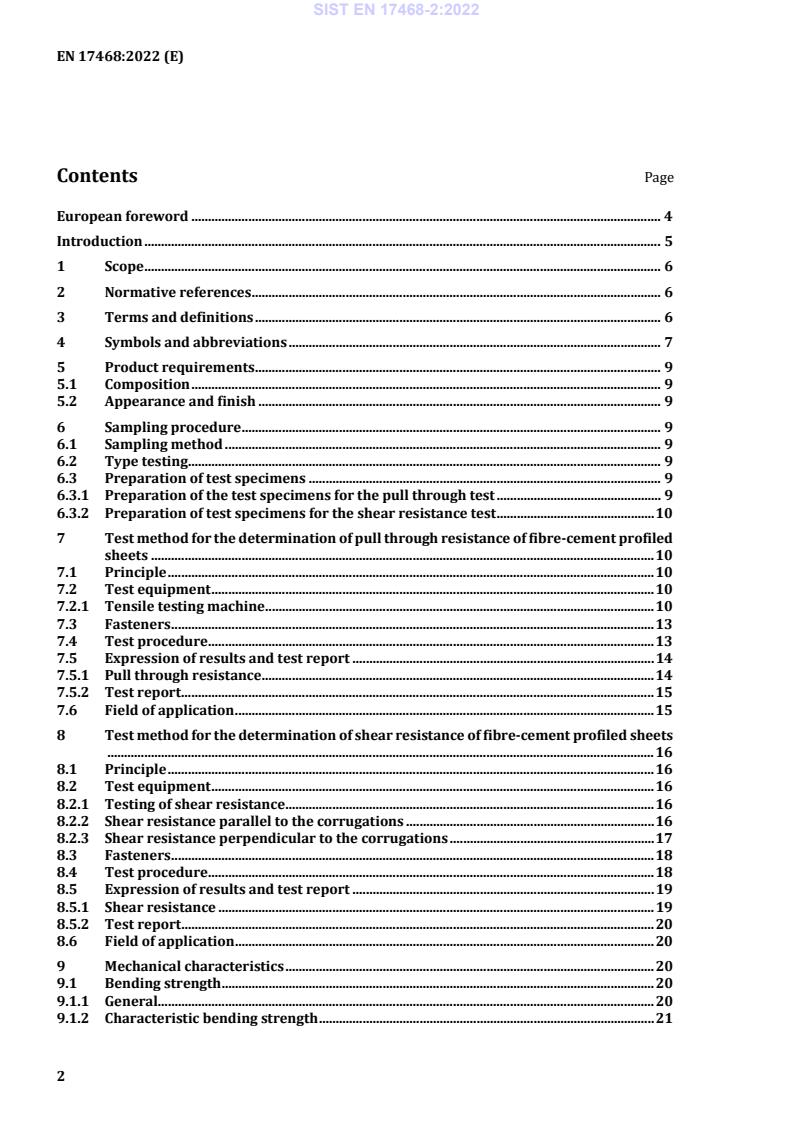
Contents Page
European foreword . 4
Introduction . 5
1 Scope . 6
2 Normative references . 6
3 Terms and definitions . 6
4 Symbols and abbreviations . 7
5 Product requirements . 9
5.1 Composition . 9
5.2 Appearance and finish . 9
6 Sampling procedure . 9
6.1 Sampling method . 9
6.2 Type testing . 9
6.3 Preparation of test specimens . 9
6.3.1 Preparation of the test specimens for the pull through test . 9
6.3.2 Preparation of test specimens for the shear resistance test . 10
7 Test method for the determination of pull through resistance of fibre-cement profiled
sheets . 10
7.1 Principle . 10
7.2 Test equipment . 10
7.2.1 Tensile testing machine . 10
7.3 Fasteners . 13
7.4 Test procedure . 13
7.5 Expression of results and test report . 14
7.5.1 Pull through resistance . 14
7.5.2 Test report . 15
7.6 Field of application . 15
8 Test method for the determination of shear resistance of fibre-cement profiled sheets
................................................................................................................................................................... 16
8.1 Principle . 16
8.2 Test equipment . 16
8.2.1 Testing of shear resistance . 16
8.2.2 Shear resistance parallel to the corrugations . 16
8.2.3 Shear resistance perpendicular to the corrugations . 17
8.3 Fasteners . 18
8.4 Test procedure . 18
8.5 Expression of results and test report . 19
8.5.1 Shear resistance . 19
8.5.2 Test report . 20
8.6 Field of application . 20
9 Mechanical characteristics . 20
9.1 Bending strength . 20
9.1.1 General. 20
9.1.2 Characteristic bending strength . 21
9.1.3 Bending modulus of elasticity . 22
9.1.4 Longitudinal direction . 23
9.1.5 Transverse direction . 24
9.1.6 Design bending strength . 24
9.2 Pull through resistance / shear resistance . 25
9.2.1 Characteristic pull through resistance / shear resistance . 25
9.2.2 Design pull through resistance / shear resistance . 25
Bibliography . 26
European foreword
This document (EN 17468-2:2022) has been prepared by Technical Committee CEN/TC 128 “Roof
covering products for discontinuous laying and products for wall cladding”, the secretariat of which is
held by NBN.
This European Standard shall be given the status of a national standard, either by publication of an
identical text or by endorsement, at the latest by September 2022, and conflicting national standards shall
be withdrawn at the latest by September 2022.
Attention is drawn to the possibility that some of the elements of this document may be the subject of
patent rights. CEN shall not be held responsible for identifying any or all such patent rights.
This document is part 2 of the EN 17468 series and deals with profiled sheets, whereas part 1 deals with
flat sheets.
Any feedback and questions on this document should be directed to the users’ national standards body.
A complete listing of these bodies can be found on the CEN website.
According to the CEN-CENELEC Internal Regulations, the national standards organisations of the
following countries are bound to implement this European Standard: Austria, Belgium, Bulgaria, Croatia,
Cyprus, Czech Republic, Denmark, Estonia, Finland, France, Germany, Greece, Hungary, Iceland, Ireland,
Italy, Latvia, Lithuania, Luxembourg, Malta, Netherlands, Norway, Poland, Portugal, Republic of North
Macedonia, Romania, Serbia, Slovakia, Slovenia, Spain, Sweden, Switzerland, Turkey and the United
Kingdom.
Introduction
Different fibre-cement profiled sheets on the market are assessed for pull through resistance.
Fibre-cement profiled sheets have been evaluated for pull through and shear resistance by a number of
test methods designed to simulate conditions of use.
The results from the different existing methods are not directly comparable.
This document establishes an agreed method for evaluation of the pull through resistance of fibre-cement
profiled sheet products, based on the experiences obtained over the last number of years in different
countries. The document is partly based on the French national standard NF P30-311.
This is a testing standard with no classifications, but this test procedure may be used by national
regulators to set classifications for roof and wall assemblies.
The performance of an assembly constructed with these products depends not only on the properties of
product as required by this document, but also on the design, construction and performance of an
assembly to be assessed by appropriate methods such as calculations or testing.
1 Scope
This document specifies test methods for pull through (tension/compression testing for fasteners
through the sheets) and shear resistance of fibre-cement profiled sheets according to EN 494. The results
are only applicable to the fibre-cement product and not to the complete fixing assembly.
It applies only to products as delivered.
The field of application for pull through resistance is defined in 7.6.
The field of application for shear resistance is defined in 8.6.
NOTE For design purposes of fibre-cement profiled sheets in the final application, the failure modes pull-out
and breaking of the fixings or substructure are not in the scope of this standard. They might become decisive and
need to be tested or calculated according to the relevant design standards for fixings (e.g. Eurocode 3 for steel,
Eurocode 5 for wood and Eurocode 9 for aluminium substructures) and compared with the results for pull-through
and shear resistance.
2 Normative references
The following documents are referred to in the text in such a way that some or all of their content
constitutes requirements of this document. For dated references, only the edition cited applies. For
undated references, the latest edition of the referenced document (including any amendments) applies.
EN 494:2012+A1:2015, Fibre-cement profiled sheets and fittings - Product specification and test methods
EN 1990, Eurocode - Basis of structural design
EN ISO 7500-1, Metallic materials - Calibration and verification of static uniaxial testing machines - Part 1:
Tension/compression testing machines - Calibration and verification of the force-measuring system (ISO
7500-1)
3 Terms and definitions
For the purposes of this document, the following terms and definitions apply.
ISO and IEC maintain terminological databases for use in standardization at the following addresses:
— ISO Online browsing platform: available at https://www.iso.org/obp
— IEC Electropedia: available at https://www.electropedia.org/
3.1
profiled sheet
as defined in EN 494
3.2
type test
test carried out to demonstrate conformity with the requirements of this document or for approval of a
new product and/or when a fundamental change is made in formulation and/or method of manufacture
the effects of which cannot be predicted on the basis of previous experience
Note 1 to entry: The test is performed on the delivered product, but is not required for each batch.
3.3
as delivered
same condition as the fibre-cement producer intends to supply the product after completing all aspects
of the process including maturing and, when appropriate, painting
3.4
span
distance between the parallel support axes
3.5
lap
overlap
amount one sheet overlaps another at either the end (end lap) or the side (side lap)
4 Symbols and abbreviations
For the purpose of this document, the following symbols and abbreviations apply.
a it can be the deformation or the pitch of the corrugation as defined in EN 494
b dimension of the specimen as defined in EN 494
e thickness of a sheet, in millimetres
e average thickness of sheets, in millimetres
m
e nominal thickness of the sheet according to EN 494, in millimetres
nom
E bending modulus of elasticity
m
F load
F pull through load at failure
ax
F average pull through load at failure
ax,m
F load at the intersection of the test diagram and the 10 % reduced linear regression of the
el
E modulus
F load of test i at intersection of the test diagram and the 10 % reduced linear regression of
el,i
the E modulus (see Figure 6)
F breaking load of test i
max,i
F shear load at failure
v
F characteristic shear load at failure
v,k
F maximum shear load perpendicular to the corrugation
v⊥
F maximum shear load parallel to the corrugation
v∥
F the average failure load for pull through/shear resistance
m
F average shear load at failure
vm
M bending moment at rupture as defined in EN 494 for test i with respect to the chosen test
i,test
conditioning “test”, e.g. when the conditioning is “wet”, it reads: M
i,wet
h dimension from the extreme top of the corrugation to the neutral axis
t
h dimension from the extreme bottom of the corrugation to the neutral axis
b
k statistical factor derived from EN 1990
I second moment of area, also known as area moment of inertia, of fibre-cement profiled
nom
sheets (nominal thickness)
l clear span between the supports in the breaking load test or span between the centre of
s
the supports in the bending moment test as defined in EN 494; in millimetres
l the minimum edge distance longitudinal to the direction of the corrugation
min,long
l the minimum edge distance perpendicular to the direction of the corrugation
min,perp
f bending strength at rupture
f bending strength in the longitudinal direction, from breaking load testing
BL
f bending strength in the transverse direction, from bending moment testing
BM
f characteristic bending strength in the longitudinal direction, from breaking load testing
BL,k
f 5 % quantile of the bending strength in the longitudinal direction
BL,0.5
f bending strength by the load F at the intersection of the test diagram and the 10 %
el el,i
reduced linear regression of the E modulus (see Figure 6)
f mean value of the yield strength
el,mean
f mean value of the yield strength in the longitudinal direction
BL,el,mean
f characteristic bending strength in the transverse direction, from bending moment testing
BM,k
f 5 % quantile of the bending strength in the transverse direction
BM,0.5
f mean value of the yield strength in the transverse direction
BM,el,mean
f characteristic bending strength
k
f design bending strength
d
design bending strength in the longitudinal direction, from breaking load testing
fBL,d
f design bending strength in the transverse direction, from bending moment testing
BM,d
f 5 % quantile of the maximum bending strength
0.5
R in statistics, the coefficient of determination “R squared”, is the proportion of the variance
in the dependent variable that is predictable from the independent variable(s)
R mean quotient of the modulus of rupture of exposed and unexposed specimen, where “i”
i
shall stand for either of the following testing options: 1) testing freeze-thaw, 2) soak-dry
and 3) warm-water according to EN 494
R mean quotient of the modulus of rupture of exposed and unexposed specimen at 95 %
L,i
confidence level as defined in EN 494, where “i” shall stand for either of the following
testing options: 1) freeze-thaw, 2) soak-dry and 3) warm-water according to EN 494
R characteristic resistance
k
R characteristic pull through resistance
ax,k
R average pull through resistance
ax,m
R characteristic shear resistance
v,k
R average shear resistance
v,m
R characteristic shear resistance perpendicular to the corrugation
v,k⊥
R average shear resistance perpendicular to the corrugation
v,m⊥
R characteristic shear resistance parallel to the corrugation
v,k∥
Rv,m∥ average shear resistance parallel to the corrugation
R design value pull through/shear resistance
d
s estimate of the standard deviation
W section modulus corresponding to the breaking load
nom,BL
W section modulus corresponding to the bending moment
nom,BM
α ageing factor gained by multiplication of the three mean quotients of the modulus of
rupture R from the warm water, soak dry and freeze thaw type tests in EN 494
i
γ partial safety factor for a component property under consideration of model uncertainties
M
and size deviations
γ confidence level (%)
γ partial factor for the dead load (γ = 1,35)
F F
κwet correction factor “kappa wet” to take into consideration different test conditions
5 Product requirements
5.1 Composition
The test method is applicable to fibre-cement profiled sheets manufactured in accordance with EN 494.
5.2 Appearance and finish
The appearance and finish shall be evaluated as defined in EN 494.
6 Sampling procedure
6.1 Sampling method
Take an adequate number of full size sheets drawn at random from a consignment of sheets or, in the
case of continuous production, from a production batch. All test specimens used on the test assembly
shall be from the same consignment or production batch. The size of the batch is chosen by the
manufacturer up to a maximum of one week’s production.
6.2 Type testing
The pull through resistance and shear resistance tests, for fibre-cement profiled sheets, are type tests.
For continuous production the type test shall be repeated at least once every year.
6.3 Preparation of test specimens
6.3.1 Preparation of the test specimens for the pull through test
Cut 2 samples from a minimum of 10 profiled sheets to a length of (625 ± 5) mm and a width of
2 corrugations ± 5 mm. For each test, the 2 samples should be taken from the same sheet. For crown
fixings, the test specimens shall comprise one crown and two valleys, with the crown central in the width
of the test specimen. For valley fixings, the test specimen should comprise one valley and two crowns,
with the valley central in the width of the test specimen.
The specimens should be stored for 7 days ± 1 day in ambient laboratory conditions followed by 24 h
immersion in water.
The normal conditioning is 7 days at 23 °C / 50 % RH followed by 24 h under water, the same as the
conditioning for type testing breaking load and bending moment in accordance with EN 494. Other
conditions may be used provided that for design appropriate correction factors are introduced to
(Kappa wet) is used for calculation
recalculate the measured values to the wet conditioning. A factor κwet
of the design values (see 9.2.2 Formula (21)) in wet condition.
The sheets shall be pre-drilled allowing a clearance hole around the fastener as recommended by the
sheeting manufacturer (minimum 1 mm clearance) or, for tests on winged fasteners, directly using the
self-drilling fasteners. The sheets can be pre-drilled before or after conditioning.
6.3.2 Preparation of test specimens for the shear resistance test
Cut a minimum of 20 profiled sheets (10 for both directions) to a length of (300 ± 5) mm and a width of
3 corrugations with the cuts at the crown corrugations.
The specimens should be stored for 7 days ± 1 day in ambient laboratory conditions followed by 24 h
immersion in water.
The normal conditioning is 7 days at 23 °C / 50 % RH followed by 24 h under water, the same as the
conditioning for type testing breaking load and bending moment in accordance with EN 494. Other
conditions may be used provided that for design appropriate correction factors are introduced to
recalculate the measured values to the wet conditioning.
The sheets shall be pre-drilled allowing a clearance hole around the fastener as recommended by the
sheeting manufacturer or use self-drilling fasteners. The sheets can be pre-drilled before or after
conditioning.
The minimum edge distances (longitudinal and perpendicular) l and should be specified by
min,long lmin,perp
the manufacturer.
7 Test method for the determination of pull through resistance of fibre-cement
profiled sheets
7.1 Principle
The pull through resistance is determined by the maximum load F (in N) required to pull the fastener
ax
through the test sheet.
7.2 Test equipment
7.2.1 Tensile testing machine
The test rig shall be essentially composed of a vertical-uniaxial class-1 tensile testing machine as per
EN ISO 7500-1 with force capacity ap
...