


oSIST prEN 196-10:2025
(Main)Methods of testing cement - Part 10: Determination of the water-soluble chromium (VI) content of cement
General Information
- Abstract
This document specifies the method for the determination of the water-soluble chromium (VI) content of cement.
A reference method is described consisting of two stages, an extraction procedure and an analysis of the filtered extract. Guidance on other extraction procedures, suitable for screening tests, for factory production control or other purposes, is given but in case of dispute or failure to comply with a regulatory limit only the reference method is used. The reference method has alternatives whereby the filtered extract can be subjected to an oxidation step or not. The criteria by which the appropriate procedure is selected are set down. Other instrumental procedures can be used for the analysis of the filtered extract provided they are calibrated against the analysis of the filtered extract using the reference procedure. In the case of a dispute, only the reference method is used.
This document specifies, for the determination of water-soluble chromium (VI) in the filtered extract, the reference methods (colorimetric determination by diphenylcarbazide in acidic conditions) and another method for the determination of total water-soluble chromium (VI) (by inductively coupled plasma optical emission spectroscopy, ICP-OES).
The ICP-OES determines the total chromium content independently of the chemical species, i.e. whether it is present as chromium (III) or chromium (VI), for example. Experience has demonstrated that soluble chromium (VI) is predominantly present during the processing phase, such that, in most cases, the determination of total water-soluble chromium (VI) effectively reflects the chromium (VI) content. The water-soluble chromium (VI) content of cement can therefore be assessed conservatively using the method based on ICP-OES described in this document.
In the case of a dispute, only the reference methods are used. This document specifies a method that applies to cements.
NOTE 1 Annex A provides guidance on the possible application of this document to the determination of the water-soluble chromium (VI) content of cement-containing preparations.
NOTE 2 Annexes B and C provide information on other test procedures based on paste extraction and thus depart from the performance of cement in its normal conditions of use. They can be carried out with or without the oxidation process. It is important that users are aware that results using these methods can be significantly different to those obtained by the reference method. In the case of dispute or failure to comply with the regulatory limit, only the reference method is used.
NOTE 3 Annex D provides guidance on a method for determination of the excess reducing agent content of cement as used in the factory internal control system of some countries. It is important that manufacturers using such an internal control method ensure themselves of the relevance of results in comparison with testing by the reference method.
- Status
- Not Published
- Public Enquiry End Date
- 18-Dec-2025
- Technical Committee
- CAA - Mineral binders and masonry
- Current Stage
- 4020 - Public enquire (PE) (Adopted Project)
- Start Date
- 09-Oct-2025
- Due Date
- 26-Feb-2026
- Completion Date
- 04-Feb-2026

Overview
oSIST prEN 196-10:2025: Methods of testing cement – Part 10: Determination of the water-soluble chromium (VI) content of cement sets out the standardized procedures for measuring the water-soluble hexavalent chromium content in cement. Published by CEN (European Committee for Standardization), this document provides a reference method critical for ensuring compliance with regulatory requirements, particularly within the European Union. The standard supports the assessment and control of chromium (VI) levels due to their significance for health, safety, and environmental protection within the construction materials sector.
Key Topics
- Reference Methodology: The standard details a two-stage reference method involving an extraction process and subsequent analysis of the filtered extract. Only this method is permitted in cases of disputes or regulatory non-compliance.
- Extraction Procedures: Extraction replicates real-world conditions using standard mortar preparation followed by filtration. Guidance is also given on alternative extraction procedures, such as paste extraction, primarily for screening and internal quality control.
- Analysis Techniques:
- Colorimetric Determination: The primary reference technique uses diphenylcarbazide in acidic conditions to determine chromium (VI) content via spectrophotometry.
- ICP-OES: Inductively Coupled Plasma Optical Emission Spectroscopy can be used to determine total water-soluble chromium as an alternative or for conservative assessment, provided it is calibrated against the reference procedure.
- In the event of dispute, only results from the colorimetric reference method are valid.
- Regulatory Context: The standard is designed to support conformity with regulations, notably the REACH Regulation (EC No 1907/2006) and other directives concerning the restriction of hazardous substances in cement.
- Annexes and Guidance:
- Application of the standard to cement-containing preparations.
- Alternative extraction and screening methods.
- Information for factory production control, including assessment of reducing agents added to cement.
Applications
Implementing oSIST prEN 196-10:2025 brings practical benefits for:
- Cement Manufacturers: Ensures products meet stringent EU regulatory limits for water-soluble chromium (VI), helping mitigate risks associated with allergic reactions and skin sensitization in end-users.
- Quality Control Laboratories: Provides validated, harmonized test methods to monitor chromium (VI) content consistently across diverse facilities and regions.
- Regulatory Compliance: Assists manufacturers, importers, and distributors in demonstrating and documenting compliance with applicable chemical and construction product regulations.
- Product Safety: Enhances the safety profile of cement and cement-containing preparations, supporting customer and workforce health and aligning with market expectations.
- Factory Production Control: Offers options for screening and internal quality processes, supporting rapid detection and control of chromium (VI) levels during manufacturing.
Related Standards
For comprehensive cement testing and regulatory compliance, consider these related standards:
- EN 196-1: Methods of testing cement – Part 1: Determination of strength.
- EN 196-2: Chemical analysis of cement.
- EN 196-3: Determination of setting times and soundness.
- EN 196-7: Methods of taking and preparing samples of cement.
- EN 197-10: Assessment of conformity scheme for water-soluble hexavalent chromium – under preparation.
- EN ISO 21420: General requirements for protective gloves (for context in handling hazardous substances).
By aligning with oSIST prEN 196-10:2025 and related standards, industry stakeholders ensure accurate chromium (VI) testing, support regulatory requirements, and promote the safe use of cement in construction applications.
Keywords: cement testing, chromium (VI) content, water-soluble chromium, reference method, colorimetric determination, ICP-OES, regulatory compliance, CEN standard, EN 196-10, REACH, factory production control, cement quality.
Relations
- Effective Date
- 20-Nov-2024
Get Certified
Connect with accredited certification bodies for this standard

DIBt (Deutsches Institut für Bautechnik)
German Institute for Building Technology.
DIN CERTCO
DIN Group product certification.

Aboma Certification B.V.
Specialized in construction, metal, and transport sectors.
Sponsored listings
Frequently Asked Questions
oSIST prEN 196-10:2025 is a draft published by the Slovenian Institute for Standardization (SIST). Its full title is "Methods of testing cement - Part 10: Determination of the water-soluble chromium (VI) content of cement". This standard covers: This document specifies the method for the determination of the water-soluble chromium (VI) content of cement. A reference method is described consisting of two stages, an extraction procedure and an analysis of the filtered extract. Guidance on other extraction procedures, suitable for screening tests, for factory production control or other purposes, is given but in case of dispute or failure to comply with a regulatory limit only the reference method is used. The reference method has alternatives whereby the filtered extract can be subjected to an oxidation step or not. The criteria by which the appropriate procedure is selected are set down. Other instrumental procedures can be used for the analysis of the filtered extract provided they are calibrated against the analysis of the filtered extract using the reference procedure. In the case of a dispute, only the reference method is used. This document specifies, for the determination of water-soluble chromium (VI) in the filtered extract, the reference methods (colorimetric determination by diphenylcarbazide in acidic conditions) and another method for the determination of total water-soluble chromium (VI) (by inductively coupled plasma optical emission spectroscopy, ICP-OES). The ICP-OES determines the total chromium content independently of the chemical species, i.e. whether it is present as chromium (III) or chromium (VI), for example. Experience has demonstrated that soluble chromium (VI) is predominantly present during the processing phase, such that, in most cases, the determination of total water-soluble chromium (VI) effectively reflects the chromium (VI) content. The water-soluble chromium (VI) content of cement can therefore be assessed conservatively using the method based on ICP-OES described in this document. In the case of a dispute, only the reference methods are used. This document specifies a method that applies to cements. NOTE 1 Annex A provides guidance on the possible application of this document to the determination of the water-soluble chromium (VI) content of cement-containing preparations. NOTE 2 Annexes B and C provide information on other test procedures based on paste extraction and thus depart from the performance of cement in its normal conditions of use. They can be carried out with or without the oxidation process. It is important that users are aware that results using these methods can be significantly different to those obtained by the reference method. In the case of dispute or failure to comply with the regulatory limit, only the reference method is used. NOTE 3 Annex D provides guidance on a method for determination of the excess reducing agent content of cement as used in the factory internal control system of some countries. It is important that manufacturers using such an internal control method ensure themselves of the relevance of results in comparison with testing by the reference method.
This document specifies the method for the determination of the water-soluble chromium (VI) content of cement. A reference method is described consisting of two stages, an extraction procedure and an analysis of the filtered extract. Guidance on other extraction procedures, suitable for screening tests, for factory production control or other purposes, is given but in case of dispute or failure to comply with a regulatory limit only the reference method is used. The reference method has alternatives whereby the filtered extract can be subjected to an oxidation step or not. The criteria by which the appropriate procedure is selected are set down. Other instrumental procedures can be used for the analysis of the filtered extract provided they are calibrated against the analysis of the filtered extract using the reference procedure. In the case of a dispute, only the reference method is used. This document specifies, for the determination of water-soluble chromium (VI) in the filtered extract, the reference methods (colorimetric determination by diphenylcarbazide in acidic conditions) and another method for the determination of total water-soluble chromium (VI) (by inductively coupled plasma optical emission spectroscopy, ICP-OES). The ICP-OES determines the total chromium content independently of the chemical species, i.e. whether it is present as chromium (III) or chromium (VI), for example. Experience has demonstrated that soluble chromium (VI) is predominantly present during the processing phase, such that, in most cases, the determination of total water-soluble chromium (VI) effectively reflects the chromium (VI) content. The water-soluble chromium (VI) content of cement can therefore be assessed conservatively using the method based on ICP-OES described in this document. In the case of a dispute, only the reference methods are used. This document specifies a method that applies to cements. NOTE 1 Annex A provides guidance on the possible application of this document to the determination of the water-soluble chromium (VI) content of cement-containing preparations. NOTE 2 Annexes B and C provide information on other test procedures based on paste extraction and thus depart from the performance of cement in its normal conditions of use. They can be carried out with or without the oxidation process. It is important that users are aware that results using these methods can be significantly different to those obtained by the reference method. In the case of dispute or failure to comply with the regulatory limit, only the reference method is used. NOTE 3 Annex D provides guidance on a method for determination of the excess reducing agent content of cement as used in the factory internal control system of some countries. It is important that manufacturers using such an internal control method ensure themselves of the relevance of results in comparison with testing by the reference method.
oSIST prEN 196-10:2025 is classified under the following ICS (International Classification for Standards) categories: 91.100.10 - Cement. Gypsum. Lime. Mortar. The ICS classification helps identify the subject area and facilitates finding related standards.
oSIST prEN 196-10:2025 has the following relationships with other standards: It is inter standard links to SIST EN 196-10:2016. Understanding these relationships helps ensure you are using the most current and applicable version of the standard.
oSIST prEN 196-10:2025 is available in PDF format for immediate download after purchase. The document can be added to your cart and obtained through the secure checkout process. Digital delivery ensures instant access to the complete standard document.
Standards Content (Sample)
SLOVENSKI STANDARD
01-december-2025
Metode preskušanja cementa - 10. del: Določevanje vodotopnega kroma (VI) v
cementu
Methods of testing cement - Part 10: Determination of the water-soluble chromium (VI)
content of cement
Prüfverfahren für Zement - Teil 10: Bestimmung des Gehaltes an wasserlöslichem
Chrom (VI) in Zement
Méthodes d'essais des ciments - Partie 10 : Détermination de la teneur en chrome (VI)
soluble dans l'eau des ciments
Ta slovenski standard je istoveten z: prEN 196-10
ICS:
91.100.10 Cement. Mavec. Apno. Malta Cement. Gypsum. Lime.
Mortar
2003-01.Slovenski inštitut za standardizacijo. Razmnoževanje celote ali delov tega standarda ni dovoljeno.
DRAFT
EUROPEAN STANDARD
prEN 196-10
NORME EUROPÉENNE
EUROPÄISCHE NORM
October 2025
ICS 91.100.10 Will supersede EN 196-10:2016
English Version
Methods of testing cement - Part 10: Determination of the
water-soluble chromium (VI) content of cement
Méthodes d'essais des ciments - Partie 10 : Prüfverfahren für Zement - Teil 10: Bestimmung des
Détermination de la teneur en chrome (VI) soluble Gehaltes an wasserlöslichem Chrom (VI) in Zement
dans l'eau des ciments
This draft European Standard is submitted to CEN members for enquiry. It has been drawn up by the Technical Committee
CEN/TC 51.
If this draft becomes a European Standard, CEN members are bound to comply with the CEN/CENELEC Internal Regulations
which stipulate the conditions for giving this European Standard the status of a national standard without any alteration.
This draft European Standard was established by CEN in three official versions (English, French, German). A version in any other
language made by translation under the responsibility of a CEN member into its own language and notified to the CEN-CENELEC
Management Centre has the same status as the official versions.
CEN members are the national standards bodies of Austria, Belgium, Bulgaria, Croatia, Cyprus, Czech Republic, Denmark, Estonia,
Finland, France, Germany, Greece, Hungary, Iceland, Ireland, Italy, Latvia, Lithuania, Luxembourg, Malta, Netherlands, Norway,
Poland, Portugal, Republic of North Macedonia, Romania, Serbia, Slovakia, Slovenia, Spain, Sweden, Switzerland, Türkiye and
United Kingdom.
Recipients of this draft are invited to submit, with their comments, notification of any relevant patent rights of which they are
aware and to provide supporting documentation.
Warning : This document is not a European Standard. It is distributed for review and comments. It is subject to change without
notice and shall not be referred to as a European Standard.
EUROPEAN COMMITTEE FOR STANDARDIZATION
COMITÉ EUROPÉEN DE NORMALISATION
EUROPÄISCHES KOMITEE FÜR NORMUNG
CEN-CENELEC Management Centre: Rue de la Science 23, B-1040 Brussels
© 2025 CEN All rights of exploitation in any form and by any means reserved Ref. No. prEN 196-10:2025 E
worldwide for CEN national Members.
prEN 196-10:2025 (E)
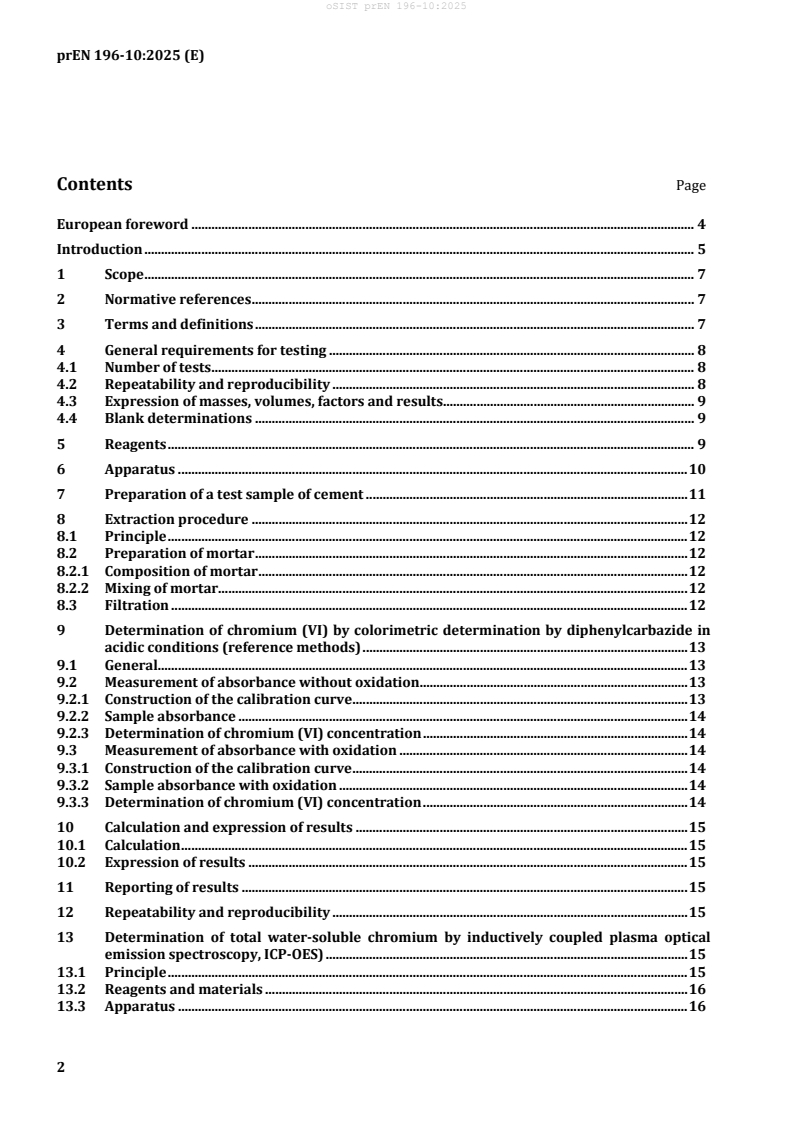
Contents Page
European foreword . 4
Introduction . 5
1 Scope . 7
2 Normative references . 7
3 Terms and definitions . 7
4 General requirements for testing . 8
4.1 Number of tests . 8
4.2 Repeatability and reproducibility . 8
4.3 Expression of masses, volumes, factors and results. 9
4.4 Blank determinations . 9
5 Reagents . 9
6 Apparatus . 10
7 Preparation of a test sample of cement . 11
8 Extraction procedure . 12
8.1 Principle . 12
8.2 Preparation of mortar . 12
8.2.1 Composition of mortar . 12
8.2.2 Mixing of mortar. 12
8.3 Filtration . 12
9 Determination of chromium (VI) by colorimetric determination by diphenylcarbazide in
acidic conditions (reference methods) . 13
9.1 General. 13
9.2 Measurement of absorbance without oxidation . 13
9.2.1 Construction of the calibration curve . 13
9.2.2 Sample absorbance . 14
9.2.3 Determination of chromium (VI) concentration . 14
9.3 Measurement of absorbance with oxidation . 14
9.3.1 Construction of the calibration curve . 14
9.3.2 Sample absorbance with oxidation . 14
9.3.3 Determination of chromium (VI) concentration . 14
10 Calculation and expression of results . 15
10.1 Calculation . 15
10.2 Expression of results . 15
11 Reporting of results . 15
12 Repeatability and reproducibility . 15
13 Determination of total water-soluble chromium by inductively coupled plasma optical
emission spectroscopy, ICP-OES) . 15
13.1 Principle . 15
13.2 Reagents and materials . 16
13.3 Apparatus . 16
prEN 196-10:2025 (E)
13.3.1 Inductively coupled plasma optical emission spectrometer . 16
13.3.2 Automatic sample changer . 17
13.4 Extraction procedure . 17
13.4.1 Principle . 17
13.4.2 Preparation of mortar . 17
13.4.3 Composition of mortar . 17
13.4.4 Mixing of mortar. 17
13.5 Filtration . 17
13.6 Sample preparation . 17
13.7 Calibration . 17
14 Measuring . 17
15 Test procedure . 17
16 Expression of results . 18
17 Reporting of results . 18
18 Repeatability and reproducibility . 18
Annex A (informative) Guidance on the determination of the water-soluble chromium (VI) content
of cement-containing preparations. 19
Annex B (informative) Guidance on screening test method (1) using paste extraction – method
based on DS 1020:1984 . 21
Annex C (informative) Guidance on screening test method (2) using paste extraction – method
based on TRGS 613 . 24
Annex D (informative) Guidance on the photometric determination of chromium reduction
capacity in cements . 28
Annex E (informative) Preparation of standard calibration solution . 32
Bibliography . 34
prEN 196-10:2025 (E)
European foreword
This document (prEN 196-10:2025) has been prepared by Technical Committee CEN/TC 51 “Cement and
building limes”, the secretariat of which is held by NBN.
This document is currently submitted to the CEN Enquiry.
This document will supersede EN 196-10:2016.
prEN 196-10:2025 includes the following significant technical changes with respect to EN 196-10:2016:
— Introduction the determination of water-soluble chromium in the filtrate by inductively coupled plasma
optical emission spectroscopy, ICP-OES). This procedure permits the determination of water-soluble
chromium in the filtrate without the need for an oxidation step.
This European Standard series, under the general title Methods of testing cement, comprises the following parts:
— Part 1: Determination of strength;
— Part 2: Chemical analysis of cement;
— Part 3: Determination of setting times and soundness;
— Part 5: Pozzolanicity test for pozzolanic cement;
— Part 6: Determination of fineness;
— Part 7: Methods of taking and preparing samples of cement;
— Part 8: Heat of hydration — Solution method;
— Part 9: Heat of hydration — Semi-adiabatic method;
— Part 10: Determination of the water-soluble chromium (VI) content of cement;
— Part 11: Heat of hydration — Isothermal conduction calorimetry method.
NOTE Another document, CEN/TR 196-4 Methods of testing cement — Part 4: Quantitative determination of
constituents, has been published as a CEN Technical Report.
prEN 196-10:2025 (E)
Introduction
This document specifies the reference and an alternative method for the determination of water-soluble
chromium (VI) content of cement that consists of two stages, an extraction procedure and an analysis of the
filtered extract.
This document test method has adopted the principle that extraction is carried out under conditions
approximating as closely as possible to those during the commercial use of cement. Consequently, extraction is
by standard mortar and subsequent filtration. Other extraction procedures based on paste extraction have
traditionally been used and are included in Annexes C and D for use as screening tests, in factory production
control or laboratories not having access to equipment specified in EN 196-1 to produce mortar. The use of
paste extraction is outside the normal conditions of use of cement.
This document test method has adopted the principle of analysis by spectrophotometry as reference method
for the determination of chromium (VI) in the filtrate. The procedure is set down generally permit the analysis
to be carried out without the need for an oxidation step. On rare occasions, some cements can contain reducing
species that interfere, in acid solution, with the analysis of Cr(VI) that cannot be determined correctly with the
method without oxidation; in this case the analysis require an oxidation step.
Another method using inductively coupled plasma optical emission spectroscopy (ICP-OES) is described for the
determination of water-soluble chromium in the filtrate. This procedure permits the determination of total
water-soluble chromium in the filtrate without the need for an oxidation step.
NOTE ICP-OES, if no chromatography is used, is not selective on Cr(VI) and also considers Cr(III) if water soluble
amounts would be present.
Inter-laboratory testing has demonstrated that it is necessary to include an ‘initial assessment test in order to
observe the effects on the analysis. By comparing the results obtained from the method with and without the
oxidation step, it can be determined whether, for that cement, the reference method should include the
oxidation step.
Other instrumental procedures can be used for the analysis of the filtered extract provided they are calibrated
against the analysis of the filtered extract using the reference procedure.
This document’s test method has drawn heavily on the Danish Standard DS 1020:1984 and the extraction
procedure developed by the French cement industry association ATILH. Careful consideration has been given
to the details of the German TRGS 613 method developed by Germany’s Hazardous Materials Committee in
support of Industrial Regulations for Hazardous Materials. Notice was also taken of the British Cement
Association ‘inherent colour’ method; the draft method produced by CEN/TC 193/WG1, reference N680, for
cement-based adhesives; EN ISO 21420 for protective gloves; and to the method, reference ID-215, developed
by the Occupational Safety and Health Administration, Salt Lake, USA.
The USA Portland Cement Association, Research and Development report Serial No. 2554 “Review and
evaluation of analytical methods for the determination of hexavalent chromium in hydraulic cements and
clinker” by Waldemar A. Klemm was found to be most helpful in resolving technical issues. CEN/TR 14589
confirmed that chromium species and solubilities are sensitive to pH and redox conditions and care has been
taken to address these in this document by controlling sample exposure to air, by adding the indicator to the
alkaline filtered extract and by precisely specifying the pH for the analytical procedure.
This document test method was developed in order to provide a reference test method for use in the evaluation
of compliance of cement with the requirements in the Regulation (EC) No 1907/2006 of the European
Parliament and of the Council of 18 December 2006 concerning the Registration, Evaluation, Authorization and
Restriction of Chemicals (REACH), establishing a European Chemicals Agency, amending Directive 1999/45/EC
and repealing Council Regulation (EEC) No 793/93 and Commission Regulation (EC) No 1488/94 as well as
Council Directive 76/769/EEC and Commission Directives 91/155/EEC, 93/67/EEC, 93/105/EC and
2000/21/EC which contain prohibitions, among other requirements, against placing on the market or using
prEN 196-10:2025 (E)
cement, and cement-containing mixtures, if they contain, when hydrated, more than 2 mg/kg (0,00 02 %)
soluble chromium VI of the total dry weight of the cement.
EN 197-10 specifies the scheme for the assessment of conformity with the regulatory limit for water-soluble
hexavalent chromium.
Under preparation. Stage at the time of preparation: prEN 197-10:2025
prEN 196-10:2025 (E)
1 Scope
This document specifies the method for the determination of the water-soluble chromium (VI) content of
cement.
A reference method is described consisting of two stages, an extraction procedure and an analysis of the filtered
extract. Guidance on other extraction procedures, suitable for screening tests, for factory production control or
other purposes, is given but in case of dispute or failure to comply with a regulatory limit only the reference
method is used. The reference method has alternatives whereby the filtered extract can be subjected to an
oxidation step or not. The criteria by which the appropriate procedure is selected are set down. Other
instrumental procedures can be used for the analysis of the filtered extract provided they are calibrated against
the analysis of the filtered extract using the reference procedure. In the case of a dispute, only the reference
method is used.
This document specifies, for the determination of water-soluble chromium (VI) in the filtered extract, the
reference methods (colorimetric determination by diphenylcarbazide in acidic conditions) and another method
for the determination of total water-soluble chromium (by inductively coupled plasma optical emission
spectroscopy, ICP-OES).
The ICP-OES determines the total chromium content independently of the chemical species, i.e. whether it is
present as chromium (III) or chromium (VI), for example. Experience has demonstrated that soluble chromium
(VI) is predominantly present during the processing phase, such that, in most cases, the determination of total
water-soluble chromium effectively reflects the chromium (VI) content. The water-soluble chromium (VI)
content of cement can therefore be assessed conservatively using the method based on ICP-OES described in
this document.
In the case of a dispute, only the reference methods are used. This document specifies a method that applies to
cements.
NOTE 1 Annex A provides guidance on the possible application of this document to the determination of the water-
soluble chromium (VI) content of cement-containing preparations.
NOTE 2 Annexes B and C provide information on other test procedures based on paste extraction and thus depart from
the performance of cement in its normal conditions of use. They can be carried out with or without the oxidation process.
It is important that users are aware that results using these methods might be significantly different to those obtained by
the reference method. In the case of dispute or failure to comply with the regulatory limit, only the reference method is
used.
NOTE 3 Annex D provides guidance on a method for determination of the excess reducing agent content of cement as
used in the factory internal control system of some countries. It is important that manufacturers using such an internal
control method ensure themselves of the relevance of results in comparison with testing by the reference method.
2 Normative references
The following documents are referred to in the text in such a way that some or all their content constitutes
requirements of this document. For dated references, only the edition cited applies. For undated references, the
latest edition of the referenced document (including any amendments) applies.
EN 196-1, Methods of testing cement — Part 1: Determination of strength
EN 196-7, Methods of testing cement — Part 7: Methods of taking and preparing samples of cement
3 Terms and definitions
For the purposes of this document, the following terms and definitions apply.
prEN 196-10:2025 (E)
ISO and IEC maintain terminology databases for use in standardization at the following addresses:
— ISO Online browsing platform: available at https://www.iso.org/obp/
— IEC Electropedia: available at https://www.electropedia.org/
3.1
analyte
element to be determined
3.2
calibration solution
solution used (at least two) to calibrate the instrument, prepared from stock solutions by adding acids, buffer,
reference element and salts as needed
3.3
stock solution
solution with accurately known analyte concentration(s), prepared from pure chemicals
Note 1 to entry: Certified commercial standard solutions can be used.
Note 2 to entry: Stock solutions are reference materials within the meaning of ISO Guide 30.
3.4
blank test solution
solution prepared in the same way as the test sample solution but omitting the test portion
3.5
calibration check solution
solution of an accurately known analyte concentration, prepared from pure chemicals; the solution should be
independent from the calibration stock solution
Note 1 to entry: See Annex E.
3.6
calibration blank solution
solution prepared like the calibration standards but omitting the analyte
4 General requirements for testing
4.1 Number of tests
Determination of water-soluble chromium (VI) content of cement, where the determination is not part of a
series subject to statistical control, shall be carried out in duplicate.
Where the determination is one of a series subject to statistical control, a single test shall be the minimum
required.
In the case of a dispute, the number of tests shall be two (see also 4.3).
4.2 Repeatability and reproducibility
Repeatability - precision under repeatability conditions where independent test results are obtained with the
same method on identical test items (material) in the same laboratory by the same operator using the same
equipment within short intervals of time.
prEN 196-10:2025 (E)
Reproducibility - precision under reproducibility conditions where test results are obtained with the same
method on identical test items (material) in different laboratories with different operators using different
equipment.
Repeatability and reproducibility in this document are expressed as repeatability standard deviation and
reproducibility standard deviation in percent by mass.
4.3 Expression of masses, volumes, factors and results
Express masses in the extraction stage in grams to the nearest 0,1 g. Express masses in the analytical stage in
grams to the nearest 0,0001 g and volumes from burettes in millilitres to the nearest 0,05 ml unless otherwise
specified.
Express the calculated results, where a single test result has been obtained, as a percentage of the cement as
received.
Express the calculated results, where two test results have been obtained, as the mean of the results, as a
percentage of the cement as received.
If the two test results differ by more than twice the standard deviation of repeatability, repeat the test and take
the mean of the two closest test results.
Express the reported water-soluble chromium (VI) content as a percentage of the cement as received, to four
decimal places.
Where the results of determinations with and without oxidation are to be compared, results shall be considered
equivalent if they do not differ by more than twice the standard deviation of repeatability.
The results of all individual tests shall be recorded.
4.4 Blank determinations
Carry out a blank determination without a sample following the same procedure and using the same amounts
of reagents. Correct the results obtained for the analytical determination accordingly.
5 Reagents
Use only reagents of analytical quality. References to water mean distilled or deionised water with electrical
conductivity ≤ 0,5 mS/m.
Unless otherwise stated percent means percent by mass.
Unless otherwise stated the densities of concentrated liquid reagents (ρ) used in this document are on the basis
of g/cm at 20 °C.
5.1 Concentrated hydrochloric acid (HCl), ρ = 1,18 to 1,19.
5.2 Dilute hydrochloric acid, 1,0 mol/l.
5.3 Dilute hydrochloric acid, 0,04 mol/l.
5.4 Acetone, (CH .CO.CH ), ρ = 0,79.
3 3
5.5 Indicator solution. Dissolve 0,125 g of s-diphenylcarbazide (C H NHNH)CO, (1,5-
6 5 2
diphenylcarbohydrazide) in 25 ml of acetone (5.4) in a 50 ml volumetric flask. Make up to the mark with
acetone. The indicator solution will keep for one week, if kept refrigerated.
prEN 196-10:2025 (E)
5.6 Standard chromate solution
5.6.1 Stock solution: Dissolve 0,141 4 g dried potassium dichromate (K Cr O ), dried to constant mass at
2 2 7
(140 ± 5) °C, in water in a 1 000 ml volumetric flask and make up to the mark with water. The stock solution
will last for one month.
This solution contains 50 mg Cr(VI) in a litre.
NOTE Ready-to-use stock solution is commercially available.
5.6.2 Standard solution: Transfer 50,0 ml stock solution (5.6.1) to a 500 ml volumetric flask and make up to
the mark with water. The standard solution shall be used no later than one month after preparation of the stock
solution.
This solution contains 5 mg Cr(VI) in a litre.
5.7 Sand, in accordance with EN 196-1.
5.8 Sodium peroxodisulfate (sodium persulfate), Na S O .
2 2 8
5.9 Orthophosphoric acid, H PO , (85 %).
3 4
5.10 Concentrated nitric acid, HNO (65 %; ~ 1,4 kg/l).
6 Apparatus
6.1 Balance(s)
— analytical balance, capable of weighing to an accuracy of ± 0,000 5 g;
— laboratory balance, capable of weighing to an accuracy of ± 1 g.
6.2 Mixer, two speed in accordance with EN 196-1.
6.3 Spectrophotometer, for measuring the absorbance of a solution at 540 nm, or filter photometer
equipped with a filter giving maximum transmission at approximately 540 nm.
6.4 Cells, with a light path of 10 mm.
6.5 Volumetric glassware, 50 ml, 500 ml and 1 000 ml volumetric flasks; 1,0 ml; 2,0 ml; 5,0 ml; 10,0 ml;
15,0 ml and 50,0 ml pipettes.
6.6 pH meter, capable of measuring pH to an accuracy of ± 0,05.
6.7 Filter media, of pore size 7 μm or less, composed of fibre, free from organic binders, or equivalent fritted
glass filter. Some filter media can become contaminated during manufacture with substances that can reduce
chromium (VI). A blank test should be carried out to ensure the suitability of the filter medium selected.
6.8 Filtration equipment, Filtration equipment consisting of a Buchner funnel, (e.g. diameter 205 mm, fitted
onto a 2-l filter flask), partially full of sand, inside which is a low form beaker to collect the filtrate, placed on
top of the bed of sand. The apparatus is connected to a vacuum pump (see Figure 1).
prEN 196-10:2025 (E)
Key
1 mortar
2 filter funnel
3 to vacuum
4 low form beaker
5 filter flask
6 sand
Figure 1 — Typical arrangement of filtration equipment
6.9 Laboratory oven, capable of maintaining a temperature of (140 ± 5) °C.
6.10 Heating plate, capable of maintaining a temperature of (280 ± 10) °C.
6.11 Timer, capable of measuring to an accuracy of ± 1 s.
7 Preparation of a test sample of cement
Immediately before chemical analysis, treat the laboratory sample, taken in accordance with EN 196-7, as
follows to obtain a homogeneous test sample.
Take approximately 1 000 g of the laboratory sample by means of a sample divider or by quartering.
Transfer this test sample to a clean dry container with an airtight closure and shake vigorously to mix it
thoroughly.
Carry out all operations as quickly as possible and immediately seal in an airtight. container to ensure that the
test sample is exposed to ambient air only for the minimum time.
prEN 196-10:2025 (E)
8 Extraction procedure
8.1 Principle
Cement is made into a mortar using sand in accordance with EN 196-1 and water. The mortar is mixed for a
specified time and then filtered. An aliquot of filtrate is treated with s-diphenylcarbazide and acidified within a
narrow range of pH. Chromium (VI) in acid solution forms a red-violet complex the absorption of which is
measured spectrophotometrically at 540 nm. The water-soluble chromium (VI) content is determined from a
calibration curve.
8.2 Preparation of mortar
8.2.1 Composition of mortar
The proportions by mass shall be one part of cement (see Clause 6), three parts of sand (5.7), and one-half
part of water (i.e. water/cement ratio 0,50).
NOTE The water to be used is analytical grade.
Each batch shall consist of (450 ± 2) g of cement, (M), (1 350 ± 5) g of sand and (225 ± 1) g of water, (V ).
Where cements to be tested are rapid setting, a water/cement ratio of 0,50 might not yield sufficient filtrate for
analysis. In these cases, it is permissible to increase the water content, and hence the water/cement ratio, until
sufficient filtrate (see 8.3) is obtained. This deviation should be reported.
8.2.2 Mixing of mortar
Weigh the cement and water by means of the laboratory balance (6.1). When water is added by volume it shall
be dispensed with an accuracy of ± 1 ml. Mix each batch of mortar mechanically using the mixer (6.2). The
timing of the various mixing stages refers to the times at which mixer power is switched on/off and shall be
maintained within ± 2 s.
The mixing procedure shall be as follows:
a) place the water and the cement into the bowl, taking care to avoid loss of water or cement;
b) immediately the water and cement are brought into contact start the mixer at the low speed (see EN 196-1,
table of mixer speeds) whilst starting the timing of the mixing stages. After 30 s of mixing, add the sand
steadily during the next 30 s. Switch the mixer to the high speed (see EN 196-1, table of mixer speeds) and
continue the mixing for an additional 30 s;
c) stop the mixer for 90 s. During the first 30 s, remove by means of a rubber or plastics scraper the mortar
adhering to the wall and bottom part of the bowl and place in the middle of the bowl;
d) continue the mixing at the high speed for 60 s.
Normally, these mixing operations are carried out automatically. Manual control of these operations and
timings may be used.
8.3 Filtration
Ensure that the filtration equipment (6.8) (filter flask, filter crucible or Buchner funnel and filter medium and
low form beaker) is dry before each use. Fit the filter crucible or Buchner funnel and filter medium (5.7). Do not
pre-wet the filter medium. Apply the vacuum and place the mortar into the filtration equipment. Filter for a
maximum of 10 min to obtain a volume of 10 ml to 15 ml of filtrate.
If 10 ml is not obtained in this time, continue filtering to obtain sufficient quantity to carry out the
determination(s). Report this deviation.
prEN 196-10:2025 (E)
The filtrate may be stored for up to 8 h before determination of the chromium (VI) content but if the storage
period exceeds 30 min it shall be kept in a sealed air-tight container to prevent evaporation.
Where a filtrate has a turbidity that cannot be removed by simple filtration, it may be filtered by centrifuge,
filter press or filtered over a fine-pore membrane filter. Report the alternative filtration method used. No
verification against the reference method is required in these cases. Where the filtrate still has turbidity, the
blank used with these samples should be a filtrate from the respective sample but without the addition of
indicator solution.
9 Determination of chromium (VI) by colorimetric determination by
diphenylcarbazide in acidic conditions (reference methods)
9.1 General
Results of inter-laboratory testing have indicated the importance of following the precise operations, their
sequence and the timings in order to obtain the quoted values for repeatability and reproducibility.
Some constituents of cement, other than chromium reducing agents purposely added, can contain reducing
substances (e.g. sulfide, sulfite) that can, during the determination of soluble chromium (VI) using
diphenylcarbazide in acidic conditions, lead to an artificial decrease in the amount of chromium (VI)
determined. Addition of diphenylcarbazide whilst the solution is alkaline should suppress the effect of sulfide
but might not suppress other reducing substances. It is necessary to carry out the determination with and
without treatment by an oxidising agent initially, in order to observe the effects on the results in accordance
with 9.2 and 9.3, respectively.
Results shall be assessed as follows:
a) if the difference between the results of the two determinations, each carried out in duplicate, is not more
than 2 × S (i.e. 2 × 0,000 015 %) then the results are deemed to belong to the same population and the
r
method without the oxidation step can be used for subsequent tests on the cement;
b) if the difference between the results of the two determinations, each carried out in duplicate, is greater
than 2 × S (i.e. 2 × 0,000 015 %) then the results are deemed to belong to different populations and the
r
method (with respect to oxidation/without oxidation) giving the higher result shall then be used for
subsequent tests on the cement.
9.2 Measurement of absorbance without oxidation
9.2.1 Construction of the calibration curve
Transfer 1,0 ml; 2,0 ml; 5,0 ml; 10,0 ml; and 15,0 ml of standard solution (5.6.2) to 50 ml volumetric flasks.
Add 5,0 ml indicator solution (5.5) and 5 ml of 0,04 mol/l hydrochloric acid (5.3). Make up to the mark with
water.
The calibration solutions contain respectively 0,1 mg; 0,2 mg; 0,5 mg; 1,0 mg and 1,5 mg Cr(VI) in a litre.
Measure the absorbance values against the procedural blank (4.4) at 540 nm, 15 min to 20 min after addition
of the indicator solution.
Construct the calibration curve by plotting the measured absorbance values against the concentration of
chromium (VI).
The validity of the calibration shall be checked at least once per month, or before use when infrequently used,
by testing the mid-range sample, which shall not depart from the calibration value by more than ± 2 % of the
calibrated value.
prEN 196-10:2025 (E)
9.2.2 Sample absorbance
Within 8 h after filtration, pipette 5,0 ml, (V ), filtrate (8.3) into a 100 ml beaker. Add 20 ml water, 5,0 ml
indicator solution (5.5), shake and adjust pH with pH meter (6.6) to between 2,1 and 2,5 by addition of
1,0 mol/l hydrochloric acid (5.2) (normally between 0,2 and 0,6 ml corresponding to 5 to 15 drops). The steps
from addition of indicator solution to adjustment of pH shall be completed within 30 s. Record the pH value.
Transfer to a 50 ml, (V ), volumetric flask. Make up to the mark with water and shake the flask.
Measure the absorbance of the solution against the procedural blank (4.4) at 540 nm, 15 min to 20 min after
addition of the indicator solution.
9.2.3 Determination of chromium (VI) concentration
Determine the concentration, (C), of water-soluble chromium (VI) in mg/litre from the calibration curve.
9.3 Measurement of absorbance with oxidation
9.3.1 Construction of the calibration curve
9.3.1.1 Preparation of calibration solutions
Weigh (500 ± 1) mg sodium peroxodisulfate (5.8) into 250 ml wide-necked conical flasks, add 5 ml ortho-
phosphoric acid (concentration 85 %) (5.9), and 2,0 ml; 4,0 ml; 10,0 ml; 20,0 ml; and 30,0 ml standard
solution (5.6.2).
9.3.1.2 Oxidation and measurement of absorbance
Dilute the solutions with approximately 120 ml of water and place on a heating plate at (280 ± 10) °C for
(45 ± 1) min. In order to avoid boiling retardation, add a magnetic stirrer bar. At the end of the 45 min the
volume of the solution should be approximately 40 ml. Avoid excessive evaporation in order to prevent
decomposition of chromium (VI). Allow to cool and remove the stirrer bar.
Transfer the solutions into 100 ml, (V ), volumetric flasks, add 5,0 ml indicator solution (5.5) and make up to
the mark with water.
The calibration solutions contain respectively 0,1 mg; 0,2 mg; 0,5 mg; 1,0 mg; and 1,50 mg Cr(VI) in a litre.
Measure the absorbance of the solution against the procedural blank (3.4) at 540 nm, 15 min to 20 min after
addition of the indicator solution.
9.3.1.3 Plotting the calibration curve
Construct the calibration curve by plotting the measured absorbance values against the concentration of
chromium (VI).
The validity of the calibration shall be checked at least once per month, or before use when infrequently used,
by testing the mid-range sample, which shall not depart from the calibration value by more than ± 2 % of the
calibrated value.
9.3.2 Sample absorbance with oxidation
Weigh (500 ± 1) mg sodium peroxodisulfate (5.8) into a 250 ml wide-necked conical flask, add 5 ml ortho-
), of the filtrate (8.3).
phosphoric acid (concentration 85 %) (5.9) and, by pipette, 5,0 ml, (V2
Carry out the oxidation and measurement of absorbance in accordance with 9.3.1.2.
9.3.3 Determination of chromium (VI) concentration
Determine the concentration, (C), of water-soluble chromium (VI) in mg/l from the calibration curve.
prEN 196-10:2025 (E)
10 Calculation and expression of results
10.1 Calculation
Calculate the content of chromium (VI), K, in % by mass of the cement as received to the nearest 0,000 01 %
using Formula (1):
V V
3 1 −4
(1)
KC=××× 10
V M
2
where
K is the content of chromium (VI) in the cement, in %,
C is the concentration of chromium (VI) taken from the calibration curve, in mg/l,
V is the volume of elutant (8.2.1), in ml,
V is the volume of filtrate (9.2.2) or (9.3.2) used in the analysis, in ml,
V is the volume of the volumetric flask (9.2.2) or (9.3.1.2), in ml,
M is the mass of cement eluted (8.2.1), in g.
NOTE 1 V /V is the dilution factor used for the dilution of the test filtrate at 9.2.3 or 9.3.2 and 9.3.1.2.
3 2
NOTE 2 V1/M is the water to cement ratio used in the preparation of the mortar, nominally 0,50 but see NOTE 2 at 8.2.1.
NOTE 3 For cement containing preparations, M is the mass of the cement fraction in the suspended preparation, in g.
10.2 Expression of results
Express the results as, either the mean of two test results, where the determination is carried out in duplicate,
or a single value where the determination consists of one test, for water-soluble chromium (VI) content in
percentage by mass of cement as received.
−6
NOTE To convert results expressed in % by mass to 10 (ppm) (µg/g) multiply by 10 000.
11 Reporting of results
Report the water-soluble chromium (VI) content to the nearest 0,000 1 % by mass of the cement as received.
Report any departures from the reference method used in the determination.
12 Repeatability and reproducibility
For cements having a water-soluble chromium (VI) content between 0,000 1 % and 0,000 5 %:
The standard deviation for repeatability, S , is 0,000 015 % by mass.
r
The standard deviation for reproducibility, S , is 0,000 040 % by mass.
R
13 Determination of total water-soluble chromium by inductively coupled plasma
optical emission spectroscopy, ICP-OES)
13.1 Principle
This elemental analysis technique uses the measurement of optical emission from ionized atoms to either
identify or determine the concentration of the analyte.
prEN 196-10:2025 (E)
A portion of a sample is directly injected into the spray-chamber of an inductively coupled plasma emission
spectrometer. The total water-soluble chromium content is determined by comparing the emission of the
chromium in the test portion with the emission of the calibration solutions at the same wavelength.
This procedure permits the determination of total water-soluble chromium in the filtrate without the need for
an oxidation step.
13.2 Reagents and materials
Reagents of known analytical grade shall be used, provided it is first ascertained that the reagent is of
sufficiently high purity to permit its use without reducing the accuracy of the determination.
For all the dilution use ultrapure demineralized water.
Use Argon as carrier gas stream, with a minimum purity of 99,999 %. Other auxiliary gases as well as argon
may be used, for example nitrogen, oxygen and synthetic air, as required by the equipment manufacturer’s
specifications.
13.3 Apparatus
13.3.1 Inductively coupled plasma optical emission spectrometer
Inductively coupled plasma (ICP) sources couple radio frequency energy to an Ar gas stream. The RF energy
completely ionizes the argon gas to generate a high-temperature plasma that can effectively ionize elements
with very high first ionization potentials.
WARNING — It is essential that the manufacturer’s safety instructions are strictly observed when using this
apparatus.
The ICP a
...