

SIST EN 301 489-1 V1.9.2:2011
(Main)Electromagnetic compatibility and Radio spectrum Matters (ERM) - ElectroMagnetic Compatibility (EMC) standard for radio equipment and services - Part 1: Common technical requirements
- Abstract
The present document contains the common requirements for radio communications equipment and associated ancillary equipment, in respect of ElectroMagnetic Compatibility (EMC).
Product dependent arrangements necessary to perform the EMC tests on dedicated types of radio communications equipment, and the assessment of test results, are detailed in the appropriate product related parts of EN 301 489 series [i.13].
The present document, together with the product related part, specifies the applicable EMC tests, the methods of measurement, the limits and the performance criteria for radio equipment and associated ancillary equipment. In case of differences (for instance concerning special conditions, definitions, abbreviations) between part 1 of EN 301 489
series [i.13] and the relevant product related part of EN 301 489 series [i.13], the product related part takes precedence.
Technical specifications related to the antenna port of radio equipment and radiated emissions from the enclosure port of radio equipment and combinations of radio and associated ancillary equipment are not included in the present document. Such technical specifications are normally found in the relevant product standards for the effective use of the radio spectrum.
The environment classification used in the present document refers to the environment classification used in:
• EN 61000-6-3 [i.4] and EN 61000-6-1 [i.5] for the residential, commercial and light industrial environment; or
• TR 101 651 [i.6] for the telecommunication centre environment; or
• ISO 7637-2 [8] for the vehicular environment.
The EMC requirements have been selected to ensure an adequate level of compatibility for apparatus intended to be used in the environments mentioned above. The levels, however, do not cover extreme cases which may occur in any location but with low probability of occurrence.
For radio equipment and associated ancillary equipment intended to be installed in motor vehicles (i.e. ESAs) and not related to immunity related functions of the vehicle, additional technical requirements necessary to demonstrate conformance to the motor vehicle EMC Directive 2004/104/EC [i.8], are set out in annex B (normative) of the present document.
The present document may not cover those cases where a potential source of interference which is producing individually repeated transient phenomena or a continuous phenomenon is permanently present, e.g. a radar or broadcast site in the near vicinity. In such a case it may be necessary to use special protection applied to either the source of interference or the interfered part or both.
Where none of the existing specific product related radio parts covers the required conditions for a particular radio equipment/service e.g. in case of the initial introduction of a new radio service or a special application, the present document can be used together with specific information for the radio equipment provided by the manufacturer, for the purposes of testing to the EMC requirements set out in the present document.
In all cases where a radio product falls within the scope of a specific product related radio part of the standard, the product related part takes precedence.
Compliance of radio equipment to the requirements of the present document does not signify compliance to any requirements related to spectrum management or to the use of the equipment (licensing requirements).
Compliance to the requirements of the present document does not signify compliance to any safety requirements.
However, it is the responsibility of the assessor of the equipment to record in the test report any observations regarding the test sample becoming dangerous or unsafe as a result of the application of the tests called for in the present document.
NOTE: Radio equipment for use in maritime environment is covered by other ETSI EMC standards.
- Status
- Published
- Publication Date
- 16-Oct-2011
- Technical Committee
- MOC - Mobile Communications
- Current Stage
- 6060 - National Implementation/Publication (Adopted Project)
- Start Date
- 30-Sep-2011
- Due Date
- 05-Dec-2011
- Completion Date
- 17-Oct-2011
Buy Documents
en_30148901v010901o - Electromagnetic compatibility and Radio spectrum Matters (ERM); ElectroMagnetic Compatibility (EMC) standard for radio equipment and services; Part 1: Common technical requirements
en_30148901v010902p - Electromagnetic compatibility and Radio spectrum Matters (ERM); ElectroMagnetic Compatibility (EMC) standard for radio equipment and services; Part 1: Common technical requirements



SIST EN 301 489-1 V1.9.2:2011 is the Slovenian adoption of ETSI EN 301 489-1, a Harmonized European Standard for ElectroMagnetic Compatibility (EMC) of radio equipment and associated ancillary equipment. It sets the common technical requirements, test methods, limits, and performance criteria that manufacturers, test laboratories, and assessors use together with the relevant product-specific part of the EN 301 489 series.
What does SIST EN 301 489-1 V1.9.2:2011 specify?
SIST EN 301 489-1 V1.9.2:2011 specifies the common EMC requirements for radio communications equipment and associated ancillary equipment. It is the shared base document for the EN 301 489 series, while the product-related parts add the detailed arrangements for each radio type.
The scope includes the EMC tests, measurement methods, limits, and performance criteria to be used with the relevant product part. If a product-related part gives different special conditions, definitions, or abbreviations, that product-related part takes precedence.
The standard does not include antenna-port technical specifications or radiated emissions from the enclosure port of radio equipment and combinations of radio and associated ancillary equipment. Those topics are normally handled in the product standards for effective use of the radio spectrum.
| Annex | What it covers |
|---|---|
| Annex A | HS Requirements and conformance Test specifications Table (HS-RTT) |
| Annex B | After market equipment (ESAs) for vehicles, for compliance with Directive 2004/104/EC |
| Annex C | Application of harmonized EMC standards to multi-radio, multi-standard-radio, and combined radio, non-radio equipment |
| Annex D | EN title in the official languages |
| Annex E | Bibliography |
What are the key requirements of SIST EN 301 489-1 V1.9.2:2011?
SIST EN 301 489-1 V1.9.2:2011 requires EMC testing to be done in representative operating conditions, with the right product-specific part and the right test configuration. In practice, this means the equipment must be set up as it will be used, and the test report must record the mode and configuration.
Test conditions and performance assessment
Clause 4 sets the test conditions. The equipment is tested in the mode that produces the largest emission in the band being checked, with normal modulation and with ports connected as they are in use. Clause 5 distinguishes equipment that can provide a continuous communication link from equipment that cannot, and it also separates ancillary equipment from the main radio function.
Clause 6 sets the performance criteria for continuous phenomena and transient phenomena. For ancillary equipment tested alone, the manufacturer supplies the pass/fail criteria unless the ancillary equipment is tested with a transmitter or receiver, in which case the radio criteria apply. This matters because the same disturbance can be acceptable for one product type and not for another.
Emissions requirements
Clause 8 covers EMC emissions. Ancillary equipment tested on its own must meet EN 55022 Class B limits, or Class A limits if it is intended only for telecommunication centres. Conducted emissions on DC power ports, AC mains ports, and telecommunication ports are measured from 150 kHz to 30 MHz using EN 55022 methods, with the appropriate network or load arrangement.
Clause 8 also links the product to the public-supply EMC standards for harmonic current emissions and voltage fluctuations and flicker. The applicable reference depends on input current, so buyers and test labs need to check whether the equipment is within the lower or higher current range before choosing the test route.
Immunity requirements
Clause 9 covers immunity. The main tests include radio frequency electromagnetic field immunity, electrostatic discharge, fast transients common mode, radio frequency common mode, vehicular transients and surges, voltage dips and interruptions, and surges on mains and telecommunication ports. The standard gives the test methods, operating conditions, and performance criteria for each case.
The immunity levels are specific enough to drive test planning. For example, the document uses 3 V/m for radiated RF immunity, 4 kV contact discharge and 8 kV air discharge for electrostatic discharge, and ISO 7637-2 for vehicular transient testing. That tells a test house what to set up and tells a buyer what kind of disturbance environment the equipment is expected to survive.
Special cases
Annex B adds technical requirements for after market equipment for vehicles that are not related to immunity-related functions of the vehicle, to demonstrate conformance with Directive 2004/104/EC. Annex C gives rules for combined equipment, including multi-radio and multi-standard-radio products, so teams can avoid duplicate testing and choose the right primary product and exclusion bands.
What terms does SIST EN 301 489-1 V1.9.2:2011 define?
- ancillary equipment - Equipment used with a receiver or transmitter to add operational or control functions, but not needed for the basic radio function.
- base station equipment - Radio or ancillary equipment intended for fixed installation and powered from the AC mains or an extended local DC mains network.
- Electrical/Electronic Sub-Assembly (ESA) - An electrical or electronic device or set of devices intended to be part of a vehicle.
- Equipment Under Test (EUT) - The equipment being checked during the EMC test.
- multi-radio equipment - Radio equipment with two or more radio transmitters or receivers using different technologies that may operate at the same time.
- multi-standard radio - Radio equipment able to process two or more carriers in common active RF components at the same time, with at least one carrier using a different radio access technology.
- telecommunication port - A voice, data, or signalling connection intended to link widely dispersed systems through public or private networks.
- host equipment - Equipment that has its own user function and gains additional function from installed radio communications equipment.
Who uses SIST EN 301 489-1 V1.9.2:2011?
SIST EN 301 489-1 V1.9.2:2011 is used by radio equipment manufacturers, test laboratories, conformity assessors, and suppliers of ancillary equipment. It is also used by teams working on fixed, mobile, portable, and vehicular radio products.
In practice, these users apply it when they need to plan EMC tests, choose representative configurations, judge pass/fail behavior, and write test reports. It is especially relevant for product development, type testing, and conformity assessment of radio equipment combined with other functions.
What changed in SIST EN 301 489-1 V1.9.2:2011 from the previous edition?
The document history lists V1.9.1 (April 2011) as the earlier publication and V1.9.2 (September 2011) as this edition.
Which standards are used with SIST EN 301 489-1 V1.9.2:2011?
SIST EN 301 489-1 V1.9.2:2011 is used with several named standards and documents:
- EN 301 489 series [i.13] - the product-specific companion parts that add special conditions and take precedence where they differ.
- EN 55022 - the conducted-emission method and limits used for enclosure, DC/AC power, and telecommunication ports.
- EN 61000-4-2, -4-3, -4-4, -4-5, -4-6, -4-11 - the immunity test methods for ESD, radiated RF field, fast transients, surge, conducted RF, and voltage dips/interruption.
- ISO 7637-2 - the vehicular transient test method for 12 V and 24 V DC powered equipment.
- EN 61000-3-2, -3-3, -3-11, -3-12 - the mains power standards for harmonic current, voltage fluctuations, and flicker.
- CISPR 25 and EN 55016-1-4 - the measurement framework used in the vehicle-related annex.
- EN 61000-6-1 and EN 61000-6-3 - the generic environment classifications referenced for residential, commercial, and light industrial use.
- TR 101 651 - the environment classification for telecommunication centres.
What does the SIST EN 301 489-1 V1.9.2:2011 document contain?
The document contains clauses for scope, references, definitions and abbreviations, test conditions, performance assessment, performance criteria, applicability tables, emissions methods and limits, and immunity methods and levels. It also contains Annex A with the HS-RTT table, Annex B for vehicle-related ESAs, and Annex C for combined and multi-radio equipment.
It includes table-based limits and applicability maps, test setups for power and telecommunication ports, and detailed measurement directions for emissions and immunity. The annexes are meant to support design verification, EMC testing, and conformity assessment without repeating the product-specific parts of the series.
Buy Documents
en_30148901v010901o - Electromagnetic compatibility and Radio spectrum Matters (ERM); ElectroMagnetic Compatibility (EMC) standard for radio equipment and services; Part 1: Common technical requirements
en_30148901v010902p - Electromagnetic compatibility and Radio spectrum Matters (ERM); ElectroMagnetic Compatibility (EMC) standard for radio equipment and services; Part 1: Common technical requirements
Get Certified
Connect with accredited certification bodies for this standard

ANCE
Mexican certification and testing association.

Intertek Slovenia
Intertek testing, inspection, and certification services in Slovenia.

LNE (Laboratoire National de Métrologie et d'Essais)
French national laboratory for metrology and testing.
Sponsored listings
Frequently Asked Questions
SIST EN 301 489-1 V1.9.2:2011 is a standard published by the Slovenian Institute for Standardization (SIST). Its full title is "Electromagnetic compatibility and Radio spectrum Matters (ERM) - ElectroMagnetic Compatibility (EMC) standard for radio equipment and services - Part 1: Common technical requirements". This standard covers: The present document contains the common requirements for radio communications equipment and associated ancillary equipment, in respect of ElectroMagnetic Compatibility (EMC). Product dependent arrangements necessary to perform the EMC tests on dedicated types of radio communications equipment, and the assessment of test results, are detailed in the appropriate product related parts of EN 301 489 series [i.13]. The present document, together with the product related part, specifies the applicable EMC tests, the methods of measurement, the limits and the performance criteria for radio equipment and associated ancillary equipment. In case of differences (for instance concerning special conditions, definitions, abbreviations) between part 1 of EN 301 489 series [i.13] and the relevant product related part of EN 301 489 series [i.13], the product related part takes precedence. Technical specifications related to the antenna port of radio equipment and radiated emissions from the enclosure port of radio equipment and combinations of radio and associated ancillary equipment are not included in the present document. Such technical specifications are normally found in the relevant product standards for the effective use of the radio spectrum. The environment classification used in the present document refers to the environment classification used in: • EN 61000-6-3 [i.4] and EN 61000-6-1 [i.5] for the residential, commercial and light industrial environment; or • TR 101 651 [i.6] for the telecommunication centre environment; or • ISO 7637-2 [8] for the vehicular environment. The EMC requirements have been selected to ensure an adequate level of compatibility for apparatus intended to be used in the environments mentioned above. The levels, however, do not cover extreme cases which may occur in any location but with low probability of occurrence. For radio equipment and associated ancillary equipment intended to be installed in motor vehicles (i.e. ESAs) and not related to immunity related functions of the vehicle, additional technical requirements necessary to demonstrate conformance to the motor vehicle EMC Directive 2004/104/EC [i.8], are set out in annex B (normative) of the present document. The present document may not cover those cases where a potential source of interference which is producing individually repeated transient phenomena or a continuous phenomenon is permanently present, e.g. a radar or broadcast site in the near vicinity. In such a case it may be necessary to use special protection applied to either the source of interference or the interfered part or both. Where none of the existing specific product related radio parts covers the required conditions for a particular radio equipment/service e.g. in case of the initial introduction of a new radio service or a special application, the present document can be used together with specific information for the radio equipment provided by the manufacturer, for the purposes of testing to the EMC requirements set out in the present document. In all cases where a radio product falls within the scope of a specific product related radio part of the standard, the product related part takes precedence. Compliance of radio equipment to the requirements of the present document does not signify compliance to any requirements related to spectrum management or to the use of the equipment (licensing requirements). Compliance to the requirements of the present document does not signify compliance to any safety requirements. However, it is the responsibility of the assessor of the equipment to record in the test report any observations regarding the test sample becoming dangerous or unsafe as a result of the application of the tests called for in the present document. NOTE: Radio equipment for use in maritime environment is covered by other ETSI EMC standards.
The present document contains the common requirements for radio communications equipment and associated ancillary equipment, in respect of ElectroMagnetic Compatibility (EMC). Product dependent arrangements necessary to perform the EMC tests on dedicated types of radio communications equipment, and the assessment of test results, are detailed in the appropriate product related parts of EN 301 489 series [i.13]. The present document, together with the product related part, specifies the applicable EMC tests, the methods of measurement, the limits and the performance criteria for radio equipment and associated ancillary equipment. In case of differences (for instance concerning special conditions, definitions, abbreviations) between part 1 of EN 301 489 series [i.13] and the relevant product related part of EN 301 489 series [i.13], the product related part takes precedence. Technical specifications related to the antenna port of radio equipment and radiated emissions from the enclosure port of radio equipment and combinations of radio and associated ancillary equipment are not included in the present document. Such technical specifications are normally found in the relevant product standards for the effective use of the radio spectrum. The environment classification used in the present document refers to the environment classification used in: • EN 61000-6-3 [i.4] and EN 61000-6-1 [i.5] for the residential, commercial and light industrial environment; or • TR 101 651 [i.6] for the telecommunication centre environment; or • ISO 7637-2 [8] for the vehicular environment. The EMC requirements have been selected to ensure an adequate level of compatibility for apparatus intended to be used in the environments mentioned above. The levels, however, do not cover extreme cases which may occur in any location but with low probability of occurrence. For radio equipment and associated ancillary equipment intended to be installed in motor vehicles (i.e. ESAs) and not related to immunity related functions of the vehicle, additional technical requirements necessary to demonstrate conformance to the motor vehicle EMC Directive 2004/104/EC [i.8], are set out in annex B (normative) of the present document. The present document may not cover those cases where a potential source of interference which is producing individually repeated transient phenomena or a continuous phenomenon is permanently present, e.g. a radar or broadcast site in the near vicinity. In such a case it may be necessary to use special protection applied to either the source of interference or the interfered part or both. Where none of the existing specific product related radio parts covers the required conditions for a particular radio equipment/service e.g. in case of the initial introduction of a new radio service or a special application, the present document can be used together with specific information for the radio equipment provided by the manufacturer, for the purposes of testing to the EMC requirements set out in the present document. In all cases where a radio product falls within the scope of a specific product related radio part of the standard, the product related part takes precedence. Compliance of radio equipment to the requirements of the present document does not signify compliance to any requirements related to spectrum management or to the use of the equipment (licensing requirements). Compliance to the requirements of the present document does not signify compliance to any safety requirements. However, it is the responsibility of the assessor of the equipment to record in the test report any observations regarding the test sample becoming dangerous or unsafe as a result of the application of the tests called for in the present document. NOTE: Radio equipment for use in maritime environment is covered by other ETSI EMC standards.
SIST EN 301 489-1 V1.9.2:2011 is classified under the following ICS (International Classification for Standards) categories: 33.060.01 - Radiocommunications in general; 33.100.01 - Electromagnetic compatibility in general. The ICS classification helps identify the subject area and facilitates finding related standards.
SIST EN 301 489-1 V1.9.2:2011 is associated with the following European legislation: EU Directives/Regulations: 1999/5/EC, 2004/108/EU, 2014/30/EU; Standardization Mandates: M/284, M/358. When a standard is cited in the Official Journal of the European Union, products manufactured in conformity with it benefit from a presumption of conformity with the essential requirements of the corresponding EU directive or regulation.
SIST EN 301 489-1 V1.9.2:2011 is available in PDF format for immediate download after purchase. The document can be added to your cart and obtained through the secure checkout process. Digital delivery ensures instant access to the complete standard document.
Standards Content (Sample)
Contents
- 1 Scope
- 10 Final draft ETSI EN 301 489-1 V1.9.1 (2011-04)
- 2 References
- 2.1 Normative references
- 11 Final draft ETSI EN 301 489-1 V1.9.1 (2011-04)
- 2.2 Informative references
- 3 Definitions and abbreviations
- 3.1 Definitions
- 12 Final draft ETSI EN 301 489-1 V1.9.1 (2011-04)
- 13 Final draft ETSI EN 301 489-1 V1.9.1 (2011-04)
- 14 Final draft ETSI EN 301 489-1 V1.9.1 (2011-04)
- 3.2 Abbreviations
- 4 Test conditions
- 4.1 General
- 4.2 Arrangements for test signals
- 15 Final draft ETSI EN 301 489-1 V1.9.1 (2011-04)
- 16 Final draft ETSI EN 301 489-1 V1.9.1 (2011-04)
- 4.3 RF exclusion band of radio communications equipment
- 4.4 Narrow band responses of receivers or receivers which are
- 17 Final draft ETSI EN 301 489-1 V1.9.1 (2011-04)
- 4.5 Normal test modulation
- 5 Performance assessment
- 5.1 General
- 18 Final draft ETSI EN 301 489-1 V1.9.1 (2011-04)
- 5.2 Equipment which can provide a continuous communication
- 5.3 Equipment which does not provide a continuous
- 5.4 Ancillary equipment
- 5.5 Equipment classification
- 19 Final draft ETSI EN 301 489-1 V1.9.1 (2011-04)
- 6 Performance criteria
- 6.1 Performance criteria for continuous phenomena applied to
- 6.2 Performance criteria for transient phenomena applied to
- 20 Final draft ETSI EN 301 489-1 V1.9.1 (2011-04)
- 6.3 Performance criteria for equipment which does not provide
- 6.4 Performance criteria for ancillary equipment tested on a
- 7 Applicability overview tables
- 21 Final draft ETSI EN 301 489-1 V1.9.1 (2011-04)
- 7.1 EMC emission
- 7.2 Immunity
- 22 Final draft ETSI EN 301 489-1 V1.9.1 (2011-04)
- 8 Methods of measurement and limits for EMC
- 8.1 Test configuration
- 8.2 Enclosure of ancillary equipment measured on a stand
- 23 Final draft ETSI EN 301 489-1 V1.9.1 (2011-04)
- 8.3 DC power input/output ports
- 24 Final draft ETSI EN 301 489-1 V1.9.1 (2011-04)
- 8.4 AC mains power input/output ports
- 25 Final draft ETSI EN 301 489-1 V1.9.1 (2011-04)
- 8.5 Harmonic current emissions (AC mains input port)
- 8.6 Voltage fluctuations and flicker (AC mains input port)
- 8.7 Telecommunication ports
- 9 Test methods and levels for immunity tests
- 9.1 Test configuration
- 26 Final draft ETSI EN 301 489-1 V1.9.1 (2011-04)
- 9.2 Radio frequency electromagnetic field (80 MHz to
- 27 Final draft ETSI EN 301 489-1 V1.9.1 (2011-04)
- 9.3 Electrostatic discharge
- 9.4 Fast transients, common mode
- 28 Final draft ETSI EN 301 489-1 V1.9.1 (2011-04)
- 9.5 Radio frequency, common mode
- 29 Final draft ETSI EN 301 489-1 V1.9.1 (2011-04)
- 9.6 Transients and surges in the vehicular environment
- 30 Final draft ETSI EN 301 489-1 V1.9.1 (2011-04)
- 9.7 Voltage dips and interruptions
- 31 Final draft ETSI EN 301 489-1 V1.9.1 (2011-04)
- 9.8 Surges
- 32 Final draft ETSI EN 301 489-1 V1.9.1 (2011-04)
- 33 Final draft ETSI EN 301 489-1 V1.9.1 (2011-04)
- 34 Final draft ETSI EN 301 489-1 V1.9.1 (2011-04)
- 35 Final draft ETSI EN 301 489-1 V1.9.1 (2011-04)
- 36 Final draft ETSI EN 301 489-1 V1.9.1 (2011-04)
- 37 Final draft ETSI EN 301 489-1 V1.9.1 (2011-04)
- 38 Final draft ETSI EN 301 489-1 V1.9.1 (2011-04)
- 39 Final draft ETSI EN 301 489-1 V1.9.1 (2011-04)
- 40 Final draft ETSI EN 301 489-1 V1.9.1 (2011-04)
- 41 Final draft ETSI EN 301 489-1 V1.9.1 (2011-04)
- 42 Final draft ETSI EN 301 489-1 V1.9.1 (2011-04)
- 43 Final draft ETSI EN 301 489-1 V1.9.1 (2011-04)
- 44 Final draft ETSI EN 301 489-1 V1.9.1 (2011-04)
- Bibliography
1 Scope
The present document contains the common requirements for radio communications equipment and associated ancillary equipment, in respect of ElectroMagnetic Compatibility (EMC).
Product dependent arrangements necessary to perform the EMC tests on dedicated types of radio communications equipment, and the assessment of test results, are detailed in the appropriate product related parts of EN 301 489 series [i.13].
The present document, together with the product related part, specifies the applicable EMC tests, the methods of measurement, the limits and the performance criteria for radio equipment and associated ancillary equipment. In case of differences (for instance concerning special conditions, definitions, abbreviations) between part 1 of EN 301 489 series [i.13] and the relevant product related part of EN 301 489 series [i.13], the product related part takes precedence. Technical specifications related to the antenna port of radio equipment and radiated emissions from the enclosure port of radio equipment and combinations of radio and associated ancillary equipment are not included in the present document. Such technical specifications are normally found in the relevant product standards for the effective use of the radio spectrum.
The environment classification used in the present document refers to the environment classification used in:
- EN 61000-6-3 [i.4] and EN 61000-6-1 [i.5] for the residential, commercial and light industrial environment; or
- TR 101 651 [i.6] for the telecommunication centre environment; or
- ISO 7637-2 [8] for the vehicular environment.
The EMC requirements have been selected to ensure an adequate level of compatibility for apparatus intended to be used in the environments mentioned above. The levels, however, do not cover extreme cases which may occur in any location but with low probability of occurrence. The applicable environment(s) should be declared by the manufacturer and should be in accordance with the equipment documentation.
For radio equipment and associated ancillary equipment intended to be installed in motor vehicles (i.e. ESAs) and not related to immunity related functions of the vehicle, additional technical requirements necessary to demonstrate conformance to the motor vehicle EMC Directive 2004/104/EC [i.8], are set out in annex B (normative) of the present document.
The present document may not cover those cases where a potential source of interference which is producing individually repeated transient phenomena or a continuous phenomenon is permanently present, e.g. a radar or broadcast site in the near vicinity. In such a case it may be necessary to use special protection applied to either the source of interference or the interfered part or both.
Where none of the existing specific product related radio parts covers the required conditions for a particular radio equipment/service e.g. in case of the initial introduction of a new radio service or a special application, the present document can be used together with specific information for the radio equipment provided by the manufacturer, for the purposes of testing to the EMC requirements set out in the present document. In all cases where a radio product falls within the scope of a specific product related radio part of the standard, the product related part takes precedence.
Compliance of radio equipment to the requirements of the present document does not signify compliance to any requirements related to spectrum management or to the use of the equipment (licensing requirements). Compliance to the requirements of the present document does not signify compliance to any safety requirements. However, it is the responsibility of the assessor of the equipment to record in the test report any observations regarding the test sample becoming dangerous or unsafe as a result of the application of the tests called for in the present document.
NOTE: Radio equipment for use in maritime environment is covered by other ETSI EMC standards. ETSI
10 Final draft ETSI EN 301 489-1 V1.9.1 (2011-04)
2 References
References are either specific (identified by date of publication and/or edition number or version number) or non-specific. For specific references, only the cited version applies. For non-specific references, the latest version of the reference document (including any amendments) applies.
Referenced documents which are not found to be publicly available in the expected location might be found at http://docbox.etsi.org/Reference.
NOTE: While any hyperlinks included in this clause were valid at the time of publication ETSI cannot guarantee their long term validity.
2.1 Normative references
The following referenced documents are necessary for the application of the present document. [1] CENELEC EN 55022 (2006) and A1 (2007): "Information technology equipment - Radio disturbance characteristics - Limits and methods of measurement". [2] CENELEC EN 61000-4-2 (2009): "Electromagnetic compatibility (EMC) - Part 4-2: Testing and measurement techniques - Electrostatic discharge immunity test". [3] CENELEC EN 61000-4-3 (2006), A1 (2008) and A2 (2010): "Electromagnetic compatibility (EMC) - Part 4-3: Testing and measurement techniques - Radiated, radio-frequency, electromagnetic field immunity test".
[4] CENELEC EN 61000-4-4 (2004) and A1 (2010): "Electromagnetic compatibility (EMC) - Part 4-4: Testing and measurement techniques - Electrical fast transient/burst immunity test". [5] CENELEC EN 61000-4-5 (2006): "Electromagnetic compatibility (EMC) - Part 4-5: Testing and measurement techniques - Surge immunity test".
[6] CENELEC EN 61000-4-6 (2009): "Electromagnetic compatibility (EMC) - Part 4-6: Testing and measurement techniques - Immunity to conducted disturbances, induced by radio-frequency fields".
[7] CENELEC EN 61000-4-11 (2004): "Electromagnetic compatibility (EMC) - Part 4-11: Testing and measurement techniques - Voltage dips, short interruptions and voltage variations immunity tests".
[8] ISO 7637-2 (2011): "Road vehicles - Electrical disturbances from conduction and coupling - Part 2: Electrical transient conduction along supply lines only". [9] CENELEC EN 61000-3-3 (2008): "Electromagnetic compatibility (EMC) - Part 3-3: Limits - Limitation of voltage changes, voltage fluctuations and flicker in public low-voltage supply systems, for equipment with rated current ≤ 16 A per phase and not subject to conditional connection".
[10] CENELEC EN 55025 (2008): "Vehicles, boats and internal combustion engines - Radio disturbance characteristics - Limits and methods of measurement for the protection of on-board receivers".
[11] CENELEC EN 61000-3-12 (2005): "Electromagnetic compatibility (EMC) - Part 3-12: Limits - Limits for harmonic currents produced by equipment connected to public low-voltage systems with input current > 16 A and ≤ 75 A per phase".
[12] CENELEC EN 61000-3-11 (2000): "Electromagnetic compatibility (EMC) - Part 3-11: Limits - Limitation of voltage changes, voltage fluctuations and flicker in public low-voltage supply systems - Equipment with rated current ≤ 75 A and subject to conditional connection". [13] CENELEC EN 61000-3-2 (2006), A1 (2009) and A2 (2009): "Electromagnetic compatibility (EMC) - Part 3-2: Limits - Limits for harmonic current emissions (equipment input current <= 16 A per phase)".
ETSI
11 Final draft ETSI EN 301 489-1 V1.9.1 (2011-04)
2.2 Informative references
The following referenced documents are not necessary for the application of the present document but they assist the user with regard to a particular subject area.
[i.1] Directive 1999/5/EC of the European Parliament and of the Council of 9 March 1999 on radio equipment and telecommunications terminal equipment and the mutual recognition of their conformity (R&TTE Directive).
[i.2] Council Directive 2004/108/EC of 15 December 2004 on the approximation of the laws of the Member States relating to electromagnetic compatibility and repealing Directive 89/336/EEC (EMC Directive).
[i.3] Directive 98/34/EC of the European Parliament and of the Council of 22 June 1998 laying down a procedure for the provision of information in the field of technical standards and regulations. [i.4] CENELEC EN 61000-6-3 (2001): "Electromagnetic compatibility (EMC) - Part 6-3: Generic standards - Emission standard for residential, commercial and light-industrial environments". [i.5] CENELEC EN 61000-6-1 (2007): "Electromagnetic compatibility (EMC) - Part 6-1: Generic standards - Immunity for residential, commercial and light-industrial environments". [i.6] ETSI TR 101 651 (V1.1.1): "Electromagnetic compatibility and Radio spectrum Matters (ERM); Classification of the electromagnetic environment conditions for equipment in telecommunication networks".
[i.7] IEC 60050-161: "International Electrotechnical Vocabulary. Chapter 161: Electromagnetic compatibility".
[i.8] Commission Directive 2004/104/EC of 14 October 2004 adapting to technical progress Council Directive 72/245/EEC relating to the radio interference (electromagnetic compatibility) of vehicles and amending Directive 70/156/EEC on the approximation of the laws of the Member States relating to the type-approval of motor vehicles and their trailers. [i.9] CENELEC EN 55016-1-4 (2004): "Specification for radio disturbance and immunity measuring apparatus and methods - Part 1-4: Radio disturbance and immunity measuring apparatus - Ancillary equipment - Radiated disturbances".
[i.10] ITU-R Radio Regulations (2004).
[i.11] IEEE 1284 (2000): "IEEE Standard Signaling Method for a Bidirectional Parallel Peripheral Interface for Personal Computers".
[i.12] IEEE 1394.1 (2004): "IEEE Standard for High Performance Serial Bus Bridges". [i.13] ETSI EN 301 489 series: "Electromagnetic compatibility and Radio spectrum Matters (ERM); ElectroMagnetic Compatibility (EMC) standard for radio equipment and services".
3 Definitions and abbreviations
3.1 Definitions
For the purposes of the present document, the following terms and definitions apply:
ancillary equipment: equipment (apparatus), used in connection with a receiver or transmitter NOTE: It is considered as an ancillary equipment (apparatus) if:
� the equipment is intended for use in conjunction with a receiver or transmitter to provide additional operational and/or control features to the radio equipment, (e.g. to extend control to another position or location); and ETSI
12 Final draft ETSI EN 301 489-1 V1.9.1 (2011-04)
� the equipment cannot be used on a stand alone basis to provide user functions independently of a receiver or transmitter; and � the receiver or transmitter, to which it is connected, is capable of providing some intended operation such as transmitting and/or receiving without the ancillary equipment (i.e. it is not a sub-unit of the main equipment essential to the main equipment basic functions). base station equipment: radio and/or ancillary equipment intended for operation at a fixed location and powered directly or indirectly (e.g. via an AC/DC converter or power supply) by the AC mains network, or an extended local DC mains network combined equipment: any equipment made of two or more individual products or functions NOTE: At least one of the individual products or functions falls within the scope of the R&TTE Directive [i.1] and contains a radio transmitting function. The result of this combination provides additional control and/or functionality to the combined equipment.
continuous phenomena (continuous disturbance): electromagnetic disturbance, the effects of which on a particular device or equipment cannot be resolved into a succession of distinct effects NOTE: See IEC 60050-161 [i.7].
Electrical/Electronic Sub-Assembly (ESA): electrical and/or electronic device or set(s) of devices intended to be part of a vehicle, together with any associated electrical connections and wiring, which performs one or more specialized functions enclosure port: physical boundary of the apparatus through which electromagnetic fields may radiate or impinge NOTE: In the case of integral antenna equipment, this port is inseparable from the antenna port. host equipment: any equipment which has a complete user functionality when not connected to a radio communications equipment, and to which this radio equipment provides additional functionality, and to which connection is necessary for this radio equipment to offer additional functionality, and in which the transceiver part of the radio equipment is physically installed NOTE: This also covers any device that would accept a variety of radio modules, where the original user functionality of the host equipment is not affected.
integral antenna: antenna which may not be removed during the tests, according to the manufacturer's statement manufacturer: manufacturer of the equipment, or his authorized representative, or an equipment supplier to the European market mobile equipment: receiver, transmitter or transmitter/receiver (transceiver) intended for installation and use in a vehicle, and powered by the main battery of the vehicle multi-radio equipment: radio equipment containing two or more radio transmitters and/or receivers using different technologies that may operate simultaneously Radio Radio unit digital unit Standard 1 Standard 1 Communication ports Antenna ports Radio Radio unit digital unit Standard 2 Standard 2
Figure 1: Multi-radio equipment ETSI
13 Final draft ETSI EN 301 489-1 V1.9.1 (2011-04)
multi-standard radio: radio equipment with ability of its receiver and transmitter to process two or more carriers in common active RF components simultaneously in a declared RF bandwidth, where at least one carrier is of a different radio access technology than the other carrier(s) Radio digital unit Standard 1 Communication port(s) Antenna port Radio unit Standard 1+2 Radio digital unit Standard 2
Figure 2: Multi-standard-radio equipment operating frequency range: range(s) of radio frequencies covered by the Equipment Under Test (EUT) without any change of units port: particular interface, of the specified equipment (apparatus), with the electromagnetic environment NOTE 1: For example, any connection point on an equipment intended for connection of cables to or from that equipment is considered as a port (see figure 3).
Enclosure port Antenna port AC power port Signal/control port DC power port APPARATUS Earth port Telecommunication port
Figure 3: Examples of ports NOTE 2: An interface, which uses optical fibre, is not a port for the purposes of testing because it does not interact with the electromagnetic environment within the frequency range, which is applicable for the present document. An optical fibre interface may still be used in the assessment of performance. portable equipment: radio and/or ancillary equipment intended for portable (e.g. handheld) operation, powered by its own integral battery primary function: function of a combined equipment, declared by the manufacturer, as the key operation of the equipment primary product: individual product within a combined equipment that provides the primary function radio communications equipment: telecommunications equipment which includes one or more radio transmitters and/or receivers and/or parts thereof for use in a fixed, mobile or portable application NOTE: It can be operated with ancillary equipment but if so, is not dependent on it for basic functionality. removable antenna: antenna which may be removed for the test according to the manufacturer's statement telecommunication port: telecommunications/network port point of connection for voice, data and signalling transfers intended to interconnect widely dispersed systems via such means as direct connection to multi-user telecommunications networks (e.g. public switched telecommunications networks (PSTN) integrated services digital networks (ISDN), x-type digital subscriber lines (xDSL), etc.), local area networks (e.g. Ethernet, Token Ring, etc.) and similar networks ETSI
14 Final draft ETSI EN 301 489-1 V1.9.1 (2011-04)
NOTE 1: A port generally intended for interconnection of components of an ITE system under test (e.g. RS-232, IEEE 1284 [i.11] (parallel printer), Universal Serial Bus (USB), IEEE 1394 [i.12] ("Fire Wire"), etc.) and used in accordance with its functional specifications (e.g. for the maximum length of cable connected to it), is not considered to be a telecommunications/network port under this definition. NOTE 2: See EN 55022 [1].
transient phenomena (transient disturbance): pertaining to or designating a phenomena or a quantity which varies between two consecutive steady states during a time interval short compared with the time-scale of interest NOTE: See IEC 60050-161 [i.7].
3.2 Abbreviations
For the purposes of the present document, the following abbreviations apply:
AC Alternating Current ALSE Absorber Lined Shielded Enclosure AMN Artificial Mains Network AN Artificial Network CDN Coupling/Decoupling Network DC Direct Current EM ElectroMagnetic EMC ElectroMagnetic Compatibility ESA Electrical/Electronic Sub-Assembly EUT Equipment Under Test HS Harmonized Standard IF Intermediate Frequency ISDN Integrated Services Digital Networks ITE Information Technology Equipment OATS Open Area Test Site PSTN Public Switched Telecommunications Networks RF Radio Frequency rms root mean square USB Universal Serial Bus xDSL x-type Digital Subscriber Line
4 Test conditions
4.1 General
The equipment shall be tested under normal test conditions according to the relevant product and basic standards or to the information accompanying the equipment, which are within the manufacturers declared range of humidity, temperature and supply voltage. The test conditions shall be recorded in the test report. The test configuration and mode of operation shall represent the intended use and shall be recorded in the test report. For emission and immunity tests, specific product related information on the test modulation, test conditions and tests arrangements, etc., are found in the part of EN 301 489 series [i.13] dealing with the particular type of radio equipment.
4.2 Arrangements for test signals
Adequate measures shall be taken to avoid the effect of immunity test signals on both the measuring equipment and the signal sources for the wanted signals located outside the test environment. ETSI
15 Final draft ETSI EN 301 489-1 V1.9.1 (2011-04)
4.2.1 Arrangements for test signals at the input of transmitters
The signal source providing the transmitter under test with the modulation signal for the normal test modulation shall be located outside the test environment, unless the transmitter is modulated by its own internal source, see the relevant part of EN 301 489 series [i.13].
The transmitter shall be modulated with normal test modulation, by an internal or external signal source capable of delivering the normal test modulation as specified in the relevant part of EN 301 489 series [i.13].
4.2.2 Arrangements for test signals at the output of transmitters
The measuring equipment for the wanted RF output signal from the transmitter under test shall be located outside the test environment.
For transmitters with an integral antenna, the wanted RF output signal to establish a communication link shall be delivered from the EUT to an antenna located within the test environment. This antenna shall be connected to the external measuring equipment by a coaxial cable.
...
Contents
- 1 Scope
- 10 ETSI EN 301 489-1 V1.9.2 (2011-09)
- 2 References
- 2.1 Normative references
- 11 ETSI EN 301 489-1 V1.9.2 (2011-09)
- 2.2 Informative references
- 3 Definitions and abbreviations
- 3.1 Definitions
- 12 ETSI EN 301 489-1 V1.9.2 (2011-09)
- 13 ETSI EN 301 489-1 V1.9.2 (2011-09)
- 14 ETSI EN 301 489-1 V1.9.2 (2011-09)
- 3.2 Abbreviations
- 4 Test conditions
- 4.1 General
- 4.2 Arrangements for test signals
- 15 ETSI EN 301 489-1 V1.9.2 (2011-09)
- 16 ETSI EN 301 489-1 V1.9.2 (2011-09)
- 4.3 RF exclusion band of radio communications equipment
- 4.4 Narrow band responses of receivers or receivers which are
- 17 ETSI EN 301 489-1 V1.9.2 (2011-09)
- 4.5 Normal test modulation
- 5 Performance assessment
- 5.1 General
- 18 ETSI EN 301 489-1 V1.9.2 (2011-09)
- 5.2 Equipment which can provide a continuous communication
- 5.3 Equipment which does not provide a continuous
- 5.4 Ancillary equipment
- 5.5 Equipment classification
- 19 ETSI EN 301 489-1 V1.9.2 (2011-09)
- 6 Performance criteria
- 6.1 Performance criteria for continuous phenomena applied to
- 20 ETSI EN 301 489-1 V1.9.2 (2011-09)
- 6.2 Performance criteria for transient phenomena applied to
- 6.3 Performance criteria for equipment which does not provide
- 6.4 Performance criteria for ancillary equipment tested on a
- 7 Applicability overview tables
- 21 ETSI EN 301 489-1 V1.9.2 (2011-09)
- 7.1 EMC emission
- 7.2 Immunity
- 22 ETSI EN 301 489-1 V1.9.2 (2011-09)
- 8 Methods of measurement and limits for EMC
- 8.1 Test configuration
- 8.2 Enclosure of ancillary equipment measured on a stand
- 23 ETSI EN 301 489-1 V1.9.2 (2011-09)
- 8.3 DC power input/output ports
- 24 ETSI EN 301 489-1 V1.9.2 (2011-09)
- 8.4 AC mains power input/output ports
- 25 ETSI EN 301 489-1 V1.9.2 (2011-09)
- 8.5 Harmonic current emissions (AC mains input port)
- 8.6 Voltage fluctuations and flicker (AC mains input port)
- 8.7 Telecommunication ports
- 26 ETSI EN 301 489-1 V1.9.2 (2011-09)
- 9 Test methods and levels for immunity tests
- 9.1 Test configuration
- 9.2 Radio frequency electromagnetic field (80 MHz to
- 27 ETSI EN 301 489-1 V1.9.2 (2011-09)
- 9.3 Electrostatic discharge
- 28 ETSI EN 301 489-1 V1.9.2 (2011-09)
- 9.4 Fast transients, common mode
- 9.5 Radio frequency, common mode
- 29 ETSI EN 301 489-1 V1.9.2 (2011-09)
- 9.6 Transients and surges in the vehicular environment
- 30 ETSI EN 301 489-1 V1.9.2 (2011-09)
- 9.7 Voltage dips and interruptions
- 31 ETSI EN 301 489-1 V1.9.2 (2011-09)
- 9.8 Surges
- 32 ETSI EN 301 489-1 V1.9.2 (2011-09)
- 33 ETSI EN 301 489-1 V1.9.2 (2011-09)
- 34 ETSI EN 301 489-1 V1.9.2 (2011-09)
- 35 ETSI EN 301 489-1 V1.9.2 (2011-09)
- 36 ETSI EN 301 489-1 V1.9.2 (2011-09)
- 37 ETSI EN 301 489-1 V1.9.2 (2011-09)
- 38 ETSI EN 301 489-1 V1.9.2 (2011-09)
- 39 ETSI EN 301 489-1 V1.9.2 (2011-09)
- 40 ETSI EN 301 489-1 V1.9.2 (2011-09)
- 41 ETSI EN 301 489-1 V1.9.2 (2011-09)
- 42 ETSI EN 301 489-1 V1.9.2 (2011-09)
- 43 ETSI EN 301 489-1 V1.9.2 (2011-09)
- 44 ETSI EN 301 489-1 V1.9.2 (2011-09)
- Bibliography
1 Scope
The present document contains the common requirements for radio communications equipment and associated ancillary equipment, in respect of ElectroMagnetic Compatibility (EMC).
Product dependent arrangements necessary to perform the EMC tests on dedicated types of radio communications equipment, and the assessment of test results, are detailed in the appropriate product related parts of EN 301 489 series [i.13].
The present document, together with the product related part, specifies the applicable EMC tests, the methods of measurement, the limits and the performance criteria for radio equipment and associated ancillary equipment. In case of differences (for instance concerning special conditions, definitions, abbreviations) between part 1 of EN 301 489 series [i.13] and the relevant product related part of EN 301 489 series [i.13], the product related part takes precedence. Technical specifications related to the antenna port of radio equipment and radiated emissions from the enclosure port of radio equipment and combinations of radio and associated ancillary equipment are not included in the present document. Such technical specifications are normally found in the relevant product standards for the effective use of the radio spectrum.
The environment classification used in the present document refers to the environment classification used in:
- EN 61000-6-3 [i.4] and EN 61000-6-1 [i.5] for the residential, commercial and light industrial environment; or
- TR 101 651 [i.6] for the telecommunication centre environment; or
- ISO 7637-2 [8] for the vehicular environment.
The EMC requirements have been selected to ensure an adequate level of compatibility for apparatus intended to be used in the environments mentioned above. The levels, however, do not cover extreme cases which may occur in any location but with low probability of occurrence.
For radio equipment and associated ancillary equipment intended to be installed in motor vehicles (i.e. ESAs) and not related to immunity related functions of the vehicle, additional technical requirements necessary to demonstrate conformance to the motor vehicle EMC Directive 2004/104/EC [i.8], are set out in annex B (normative) of the present document.
The present document may not cover those cases where a potential source of interference which is producing individually repeated transient phenomena or a continuous phenomenon is permanently present, e.g. a radar or broadcast site in the near vicinity. In such a case it may be necessary to use special protection applied to either the source of interference or the interfered part or both.
Where none of the existing specific product related radio parts covers the required conditions for a particular radio equipment/service e.g. in case of the initial introduction of a new radio service or a special application, the present document can be used together with specific information for the radio equipment provided by the manufacturer, for the purposes of testing to the EMC requirements set out in the present document. In all cases where a radio product falls within the scope of a specific product related radio part of the standard, the product related part takes precedence.
Compliance of radio equipment to the requirements of the present document does not signify compliance to any requirements related to spectrum management or to the use of the equipment (licensing requirements). Compliance to the requirements of the present document does not signify compliance to any safety requirements. However, it is the responsibility of the assessor of the equipment to record in the test report any observations regarding the test sample becoming dangerous or unsafe as a result of the application of the tests called for in the present document.
NOTE: Radio equipment for use in maritime environment is covered by other ETSI EMC standards. ETSI
10 ETSI EN 301 489-1 V1.9.2 (2011-09)
2 References
References are either specific (identified by date of publication and/or edition number or version number) or non-specific. For specific references, only the cited version applies. For non-specific references, the latest version of the reference document (including any amendments) applies.
Referenced documents which are not found to be publicly available in the expected location might be found at http://docbox.etsi.org/Reference.
NOTE: While any hyperlinks included in this clause were valid at the time of publication ETSI cannot guarantee their long term validity.
2.1 Normative references
The following referenced documents are necessary for the application of the present document. [1] CENELEC EN 55022 (2006) and A1 (2007): "Information technology equipment - Radio disturbance characteristics - Limits and methods of measurement". [2] CENELEC EN 61000-4-2 (2009): "Electromagnetic compatibility (EMC) - Part 4-2: Testing and measurement techniques - Electrostatic discharge immunity test". [3] CENELEC EN 61000-4-3 (2006), A1 (2008) and A2 (2010): "Electromagnetic compatibility (EMC) - Part 4-3: Testing and measurement techniques - Radiated, radio-frequency, electromagnetic field immunity test".
[4] CENELEC EN 61000-4-4 (2004) and A1 (2010): "Electromagnetic compatibility (EMC) - Part 4-4: Testing and measurement techniques - Electrical fast transient/burst immunity test". [5] CENELEC EN 61000-4-5 (2006): "Electromagnetic compatibility (EMC) - Part 4-5: Testing and measurement techniques - Surge immunity test".
[6] CENELEC EN 61000-4-6 (2009): "Electromagnetic compatibility (EMC) - Part 4-6: Testing and measurement techniques - Immunity to conducted disturbances, induced by radio-frequency fields".
[7] CENELEC EN 61000-4-11 (2004): "Electromagnetic compatibility (EMC) - Part 4-11: Testing and measurement techniques - Voltage dips, short interruptions and voltage variations immunity tests".
[8] ISO 7637-2 (2004): "Road vehicles - Electrical disturbances from conduction and coupling - Part 2: Electrical transient conduction along supply lines only". [9] CENELEC EN 61000-3-3 (2008): "Electromagnetic compatibility (EMC) - Part 3-3: Limits - Limitation of voltage changes, voltage fluctuations and flicker in public low-voltage supply systems, for equipment with rated current ≤ 16 A per phase and not subject to conditional connection".
[10] CISPR 25 (2nd Edition 2002): "Radio disturbance characteristics for the protection of receivers used on board vehicles, boats, and on devices - Limits and methods of measurement" ". [11] CENELEC EN 61000-3-12 (2005): "Electromagnetic compatibility (EMC) - Part 3-12: Limits - Limits for harmonic currents produced by equipment connected to public low-voltage systems with input current > 16 A and ≤ 75 A per phase".
[12] CENELEC EN 61000-3-11 (2000): "Electromagnetic compatibility (EMC) - Part 3-11: Limits - Limitation of voltage changes, voltage fluctuations and flicker in public low-voltage supply systems - Equipment with rated current ≤ 75 A and subject to conditional connection". [13] CENELEC EN 61000-3-2 (2006), A1 (2009) and A2 (2009): "Electromagnetic compatibility (EMC) - Part 3-2: Limits - Limits for harmonic current emissions (equipment input current <= 16 A per phase)".
ETSI
11 ETSI EN 301 489-1 V1.9.2 (2011-09)
2.2 Informative references
The following referenced documents are not necessary for the application of the present document but they assist the user with regard to a particular subject area.
[i.1] Directive 1999/5/EC of the European Parliament and of the Council of 9 March 1999 on radio equipment and telecommunications terminal equipment and the mutual recognition of their conformity (R&TTE Directive).
[i.2] Council Directive 2004/108/EC of 15 December 2004 on the approximation of the laws of the Member States relating to electromagnetic compatibility and repealing Directive 89/336/EEC (EMC Directive).
[i.3] Directive 98/34/EC of the European Parliament and of the Council of 22 June 1998 laying down a procedure for the provision of information in the field of technical standards and regulations. [i.4] CENELEC EN 61000-6-3 (2001): "Electromagnetic compatibility (EMC) - Part 6-3: Generic standards - Emission standard for residential, commercial and light-industrial environments". [i.5] CENELEC EN 61000-6-1 (2007): "Electromagnetic compatibility (EMC) - Part 6-1: Generic standards - Immunity for residential, commercial and light-industrial environments". [i.6] ETSI TR 101 651 (V1.1.1): "Electromagnetic compatibility and Radio spectrum Matters (ERM); Classification of the electromagnetic environment conditions for equipment in telecommunication networks".
[i.7] IEC 60050-161: "International Electrotechnical Vocabulary. Chapter 161: Electromagnetic compatibility".
[i.8] Commission Directive 2004/104/EC of 14 October 2004 adapting to technical progress Council Directive 72/245/EEC relating to the radio interference (electromagnetic compatibility) of vehicles and amending Directive 70/156/EEC on the approximation of the laws of the Member States relating to the type-approval of motor vehicles and their trailers. [i.9] CENELEC EN 55016-1-4 (2004): "Specification for radio disturbance and immunity measuring apparatus and methods - Part 1-4: Radio disturbance and immunity measuring apparatus - Ancillary equipment - Radiated disturbances".
[i.10] ITU-R Radio Regulations (2004).
[i.11] IEEE 1284 (2000): "IEEE Standard Signaling Method for a Bidirectional Parallel Peripheral Interface for Personal Computers".
[i.12] IEEE 1394.1 (2004): "IEEE Standard for High Performance Serial Bus Bridges". [i.13] ETSI EN 301 489 series: "Electromagnetic compatibility and Radio spectrum Matters (ERM); ElectroMagnetic Compatibility (EMC) standard for radio equipment and services".
3 Definitions and abbreviations
3.1 Definitions
For the purposes of the present document, the following terms and definitions apply:
ancillary equipment: equipment (apparatus), used in connection with a receiver or transmitter NOTE: It is considered as an ancillary equipment (apparatus) if:
� the equipment is intended for use in conjunction with a receiver or transmitter to provide additional operational and/or control features to the radio equipment, (e.g. to extend control to another position or location); and ETSI
12 ETSI EN 301 489-1 V1.9.2 (2011-09)
� the equipment cannot be used on a stand alone basis to provide user functions independently of a receiver or transmitter; and � the receiver or transmitter, to which it is connected, is capable of providing some intended operation such as transmitting and/or receiving without the ancillary equipment (i.e. it is not a sub-unit of the main equipment essential to the main equipment basic functions). base station equipment: radio and/or ancillary equipment intended for operation at a fixed location and powered directly or indirectly (e.g. via an AC/DC converter or power supply) by the AC mains network, or an extended local DC mains network combined equipment: any equipment made of two or more individual products or functions NOTE: At least one of the individual products or functions falls within the scope of the R&TTE Directive [i.1] and contains a radio transmitting function. The result of this combination provides additional control and/or functionality to the combined equipment.
continuous phenomena (continuous disturbance): electromagnetic disturbance, the effects of which on a particular device or equipment cannot be resolved into a succession of distinct effects NOTE: See IEC 60050-161 [i.7].
Electrical/Electronic Sub-Assembly (ESA): electrical and/or electronic device or set(s) of devices intended to be part of a vehicle, together with any associated electrical connections and wiring, which performs one or more specialized functions enclosure port: physical boundary of the apparatus through which electromagnetic fields may radiate or impinge NOTE: In the case of integral antenna equipment, this port is inseparable from the antenna port. host equipment: any equipment which has a complete user functionality when not connected to a radio communications equipment, and to which this radio equipment provides additional functionality, and to which connection is necessary for this radio equipment to offer additional functionality, and in which the transceiver part of the radio equipment is physically installed NOTE: This also covers any device that would accept a variety of radio modules, where the original user functionality of the host equipment is not affected.
integral antenna: antenna which may not be removed during the tests, according to the manufacturer's statement manufacturer: manufacturer of the equipment, or his authorized representative, or an equipment supplier to the European market mobile equipment: receiver, transmitter or transmitter/receiver (transceiver) intended for installation and use in a vehicle, and powered by the main battery of the vehicle multi-radio equipment: radio equipment containing two or more radio transmitters and/or receivers using different technologies that may operate simultaneously Radio Radio unit digital unit Standard 1 Standard 1 Communication ports Antenna ports Radio Radio unit digital unit Standard 2 Standard 2
Figure 1: Multi-radio equipment ETSI
13 ETSI EN 301 489-1 V1.9.2 (2011-09)
multi-standard radio: radio equipment with ability of its receiver and transmitter to process two or more carriers in common active RF components simultaneously in a declared RF bandwidth, where at least one carrier is of a different radio access technology than the other carrier(s) Radio digital unit Standard 1 Communication port(s) Antenna port Radio unit Standard 1+2 Radio digital unit Standard 2
Figure 2: Multi-standard-radio equipment operating frequency range: range(s) of radio frequencies covered by the Equipment Under Test (EUT) without any change of units port: particular interface, of the specified equipment (apparatus), with the electromagnetic environment NOTE 1: For example, any connection point on an equipment intended for connection of cables to or from that equipment is considered as a port (see figure 3).
Enclosure port Antenna port AC power port Signal/control port DC power port APPARATUS Earth port Telecommunication port
Figure 3: Examples of ports NOTE 2: An interface, which uses optical fibre, is not a port for the purposes of testing because it does not interact with the electromagnetic environment within the frequency range, which is applicable for the present document. An optical fibre interface may still be used in the assessment of performance. portable equipment: radio and/or ancillary equipment intended for portable (e.g. handheld) operation, powered by its own integral battery primary function: function of a combined equipment, declared by the manufacturer, as the key operation of the equipment primary product: individual product within a combined equipment that provides the primary function radio communications equipment: telecommunications equipment which includes one or more radio transmitters and/or receivers and/or parts thereof for use in a fixed, mobile or portable application NOTE: It can be operated with ancillary equipment but if so, is not dependent on it for basic functionality. removable antenna: antenna which may be removed for the test according to the manufacturer's statement telecommunication port: telecommunications/network port point of connection for voice, data and signalling transfers intended to interconnect widely dispersed systems via such means as direct connection to multi-user telecommunications networks (e.g. public switched telecommunications networks (PSTN) integrated services digital networks (ISDN), x-type digital subscriber lines (xDSL), etc.), local area networks (e.g. Ethernet, Token Ring, etc.) and similar networks ETSI
14 ETSI EN 301 489-1 V1.9.2 (2011-09)
NOTE 1: A port generally intended for interconnection of components of an ITE system under test (e.g. RS-232, IEEE 1284 [i.11] (parallel printer), Universal Serial Bus (USB), IEEE 1394 [i.12] ("Fire Wire"), etc.) and used in accordance with its functional specifications (e.g. for the maximum length of cable connected to it), is not considered to be a telecommunications/network port under this definition. NOTE 2: See EN 55022 [1].
transient phenomena (transient disturbance): pertaining to or designating a phenomena or a quantity which varies between two consecutive steady states during a time interval short compared with the time-scale of interest NOTE: See IEC 60050-161 [i.7].
3.2 Abbreviations
For the purposes of the present document, the following abbreviations apply:
AC Alternating Current ALSE Absorber Lined Shielded Enclosure AMN Artificial Mains Network AN Artificial Network CDN Coupling/Decoupling Network DC Direct Current EM ElectroMagnetic EMC ElectroMagnetic Compatibility ESA Electrical/Electronic Sub-Assembly EUT Equipment Under Test HS Harmonized Standard IF Intermediate Frequency ISDN Integrated Services Digital Networks ITE Information Technology Equipment OATS Open Area Test Site PSTN Public Switched Telecommunications Networks RF Radio Frequency rms root mean square USB Universal Serial Bus xDSL x-type Digital Subscriber Line
4 Test conditions
4.1 General
The equipment shall be tested under normal test conditions according to the relevant product and basic standards or to the information accompanying the equipment, which are within the manufacturers declared range of humidity, temperature and supply voltage. The test conditions shall be recorded in the test report. The test configuration and mode of operation shall represent the intended use and shall be recorded in the test report. For emission and immunity tests, specific product related information on the test modulation, test conditions and tests arrangements, etc., are found in the part of EN 301 489 series [i.13] dealing with the particular type of radio equipment.
4.2 Arrangements for test signals
Adequate measures shall be taken to avoid the effect of immunity test signals on both the measuring equipment and the signal sources for the wanted signals located outside the test environment. ETSI
15 ETSI EN 301 489-1 V1.9.2 (2011-09)
4.2.1 Arrangements for test signals at the input of transmitters
The signal source providing the transmitter under test with the modulation signal for the normal test modulation shall be located outside the test environment, unless the transmitter is modulated by its own internal source, see the relevant part of EN 301 489 series [i.13].
The transmitter shall be modulated with normal test modulation, by an internal or external signal source capable of delivering the normal test modulation as specified in the relevant part of EN 301 489 series [i.13].
4.2.2 Arrangements for test signals at the output of transmitters
The measuring equipment for the wanted RF output signal from the transmitter under test shall be located outside the test environment.
For transmitters with an integral antenna, the wanted RF output signal to establish a communication link shall be delivered from the EUT to an antenna located within the test environment. This antenna shall be connected to the external measuring equipment by a coaxial cable.
...
2003-01.Slovenski inštitut za standardizacijo. Razmnoževanje celote ali delov tega standarda ni dovoljeno.Electromagnetic compatibility and Radio spectrum Matters (ERM) - ElectroMagnetic Compatibility (EMC) standard for radio equipment and services - Part 1: Common technical requirements33.100.01Elektromagnetna združljivost na splošnoElectromagnetic compatibility in general33.060.01Radijske komunikacije na splošnoRadiocommunications in generalICS:Ta slovenski standard je istoveten z:EN 301 489-1 Version 1.9.2SIST EN 301 489-1 V1.9.2:2011en01-november-2011SIST EN 301 489-1 V1.9.2:2011SLOVENSKI
STANDARD
Harmonized European Standard SIST EN 301 489-1 V1.9.2:2011
ETSI ETSI EN 301 489-1 V1.9.2 (2011-09) 2
Reference REN/ERM-EMC-268-1 Keywords EMC, radio, regulation ETSI 650 Route des Lucioles F-06921 Sophia Antipolis Cedex - FRANCE
Tel.: +33 4 92 94 42 00
Fax: +33 4 93 65 47 16
Siret N° 348 623 562 00017 - NAF 742 C Association à but non lucratif enregistrée à la Sous-Préfecture de Grasse (06) N° 7803/88
Important notice Individual copies of the present document can be downloaded from: http://www.etsi.org The present document may be made available in more than one electronic version or in print. In any case of existing or perceived difference in contents between such versions, the reference version is the Portable Document Format (PDF). In case of dispute, the reference shall be the printing on ETSI printers of the PDF version kept on a specific network drive within ETSI Secretariat. Users of the present document should be aware that the document may be subject to revision or change of status. Information on the current status of this and other ETSI documents is available at http://portal.etsi.org/tb/status/status.asp If you find errors in the present document, please send your comment to one of the following services: http://portal.etsi.org/chaircor/ETSI_support.asp Copyright Notification No part may be reproduced except as authorized by written permission. The copyright and the foregoing restriction extend to reproduction in all media.
© European Telecommunications Standards Institute 2011. All rights reserved.
DECTTM, PLUGTESTSTM, UMTSTM and the ETSI logo are Trade Marks of ETSI registered for the benefit of its Members. 3GPPTM and LTE™ are Trade Marks of ETSI registered for the benefit of its Members and of the 3GPP Organizational Partners. GSM® and the GSM logo are Trade Marks registered and owned by the GSM Association. SIST EN 301 489-1 V1.9.2:2011
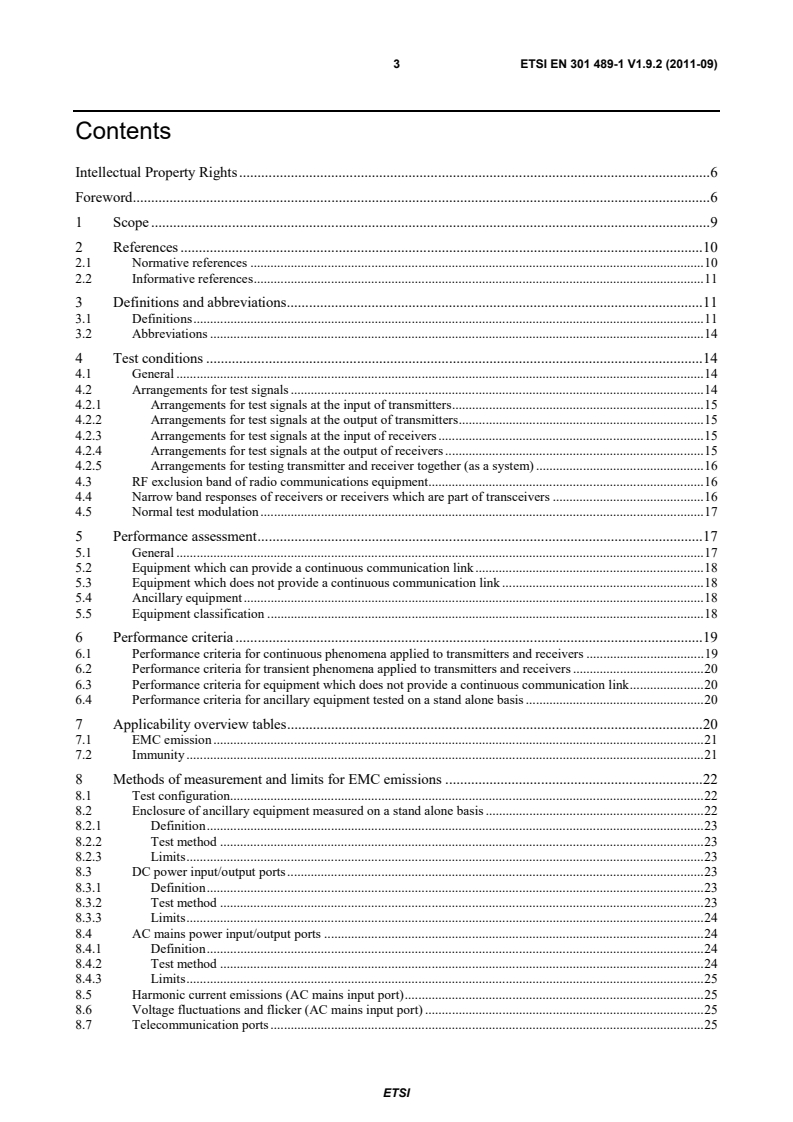
ETSI ETSI EN 301 489-1 V1.9.2 (2011-09) 3 Contents Intellectual Property Rights . 6 Foreword . 6 1 Scope . 9 2 References . 10 2.1 Normative references . 10 2.2 Informative references . 11 3 Definitions and abbreviations . 11 3.1 Definitions . 11 3.2 Abbreviations . 14 4 Test conditions . 14 4.1 General . 14 4.2 Arrangements for test signals . 14 4.2.1 Arrangements for test signals at the input of transmitters . 15 4.2.2 Arrangements for test signals at the output of transmitters . 15 4.2.3 Arrangements for test signals at the input of receivers . 15 4.2.4 Arrangements for test signals at the output of receivers . 15 4.2.5 Arrangements for testing transmitter and receiver together (as a system) . 16 4.3 RF exclusion band of radio communications equipment. 16 4.4 Narrow band responses of receivers or receivers which are part of transceivers . 16 4.5 Normal test modulation . 17 5 Performance assessment . 17 5.1 General . 17 5.2 Equipment which can provide a continuous communication link . 18 5.3 Equipment which does not provide a continuous communication link . 18 5.4 Ancillary equipment . 18 5.5 Equipment classification . 18 6 Performance criteria . 19 6.1 Performance criteria for continuous phenomena applied to transmitters and receivers . 19 6.2 Performance criteria for transient phenomena applied to transmitters and receivers . 20 6.3 Performance criteria for equipment which does not provide a continuous communication link . 20 6.4 Performance criteria for ancillary equipment tested on a stand alone basis . 20 7 Applicability overview tables . 20 7.1 EMC emission . 21 7.2 Immunity . 21 8 Methods of measurement and limits for EMC emissions . 22 8.1 Test configuration. 22 8.2 Enclosure of ancillary equipment measured on a stand alone basis . 22 8.2.1 Definition . 23 8.2.2 Test method . 23 8.2.3 Limits . 23 8.3 DC power input/output ports . 23 8.3.1 Definition . 23 8.3.2 Test method . 23 8.3.3 Limits . 24 8.4 AC mains power input/output ports . 24 8.4.1 Definition . 24 8.4.2 Test method . 24 8.4.3 Limits . 25 8.5 Harmonic current emissions (AC mains input port) . 25 8.6 Voltage fluctuations and flicker (AC mains input port) . 25 8.7 Telecommunication ports . 25 SIST EN 301 489-1 V1.9.2:2011
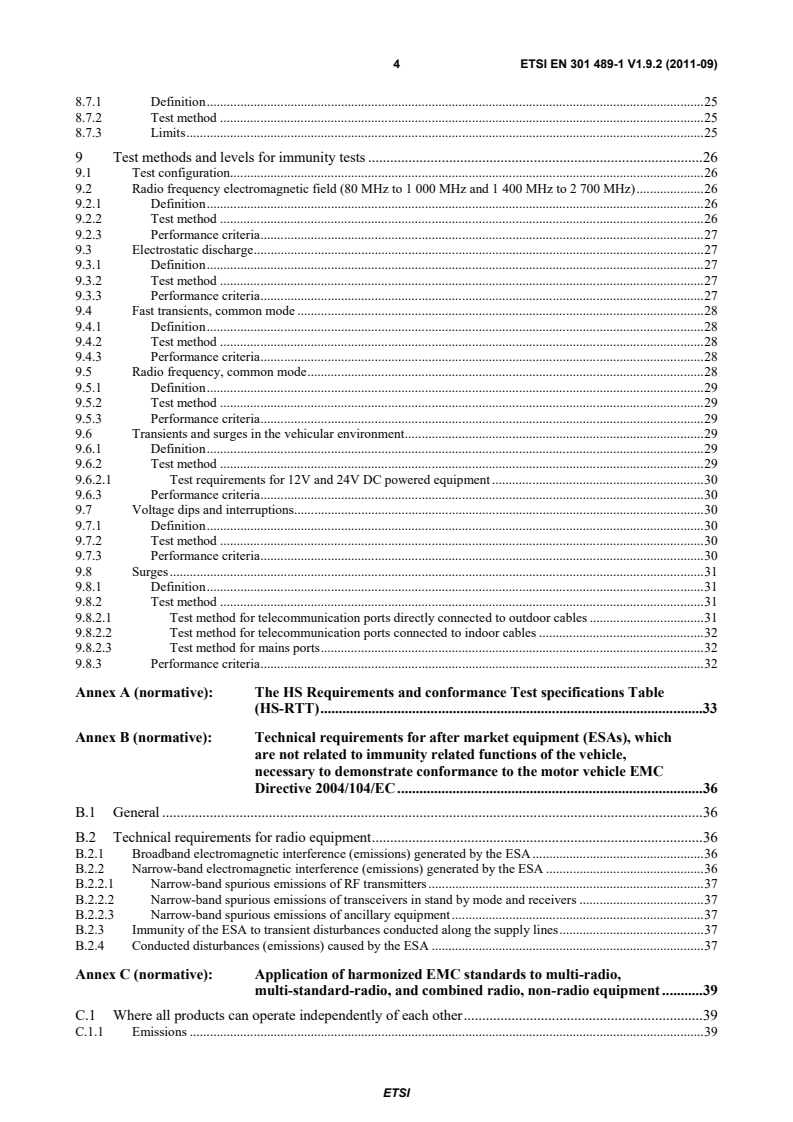
ETSI ETSI EN 301 489-1 V1.9.2 (2011-09) 4 8.7.1 Definition . 25 8.7.2 Test method . 25 8.7.3 Limits . 25 9 Test methods and levels for immunity tests . 26 9.1 Test configuration. 26 9.2 Radio frequency electromagnetic field (80 MHz to 1 000 MHz and 1 400 MHz to 2 700 MHz) . 26 9.2.1 Definition . 26 9.2.2 Test method . 26 9.2.3 Performance criteria . 27 9.3 Electrostatic discharge . 27 9.3.1 Definition . 27 9.3.2 Test method . 27 9.3.3 Performance criteria . 27 9.4 Fast transients, common mode . 28 9.4.1 Definition . 28 9.4.2 Test method . 28 9.4.3 Performance criteria . 28 9.5 Radio frequency, common mode . 28 9.5.1 Definition . 29 9.5.2 Test method . 29 9.5.3 Performance criteria . 29 9.6 Transients and surges in the vehicular environment . 29 9.6.1 Definition . 29 9.6.2 Test method . 29 9.6.2.1 Test requirements for 12V and 24V DC powered equipment . 30 9.6.3 Performance criteria . 30 9.7 Voltage dips and interruptions . 30 9.7.1 Definition . 30 9.7.2 Test method . 30 9.7.3 Performance criteria . 30 9.8 Surges . 31 9.8.1 Definition . 31 9.8.2 Test method . 31 9.8.2.1 Test method for telecommunication ports directly connected to outdoor cables . 31 9.8.2.2 Test method for telecommunication ports connected to indoor cables . 32 9.8.2.3 Test method for mains ports . 32 9.8.3 Performance criteria . 32 Annex A (normative): The HS Requirements and conformance Test specifications Table (HS-RTT) . 33 Annex B (normative): Technical requirements for after market equipment (ESAs), which are not related to immunity related functions of the vehicle, necessary to demonstrate conformance to the motor vehicle EMC Directive 2004/104/EC . 36 B.1 General . 36 B.2 Technical requirements for radio equipment . 36 B.2.1 Broadband electromagnetic interference (emissions) generated by the ESA . 36 B.2.2 Narrow-band electromagnetic interference (emissions) generated by the ESA . 36 B.2.2.1 Narrow-band spurious emissions of RF transmitters . 37 B.2.2.2 Narrow-band spurious emissions of transceivers in stand by mode and receivers . 37 B.2.2.3 Narrow-band spurious emissions of ancillary equipment . 37 B.2.3 Immunity of the ESA to transient disturbances conducted along the supply lines . 37 B.2.4 Conducted disturbances (emissions) caused by the ESA . 37 Annex C (normative): Application of harmonized EMC standards to multi-radio, multi-standard-radio, and combined radio, non-radio equipment . 39 C.1 Where all products can operate independently of each other . 39 C.1.1 Emissions . 39 SIST EN 301 489-1 V1.9.2:2011
...