

SIST EN 474-4:2022
(Main)Earth-moving machinery - Safety - Part 4: Requirements for backhoe loaders
General Information
- Abstract
This document together with EN 474 1:2022 deals with all significant hazards, hazardous situations and events relevant to backhoe loaders when used as intended and under the conditions of misuse which are reasonably foreseeable by the manufacturer (see Annex A) associated with the whole lifetime of the machine as described in EN ISO 12100:2010, 5.4.
The requirements of this document are complementary to the common requirements formulated in EN 474 1:2022. This document does not repeat the requirements of EN 474 1:2022 but supplements or modifies the requirements for backhoe loaders.
This document does not provide requirements for main electrical circuits and drives of machinery when the primary source of energy is an external electrical supply.
This document does not provide performance requirements for safety related functions of control system(s).
This document does not deal with demolition machinery.
This document also deals with fork application, log handling application and lifting operation application.
This document is not applicable to backhoe loaders which are manufactured before the date of publication of this document by CEN.
- Status
- Published
- Public Enquiry End Date
- 21-Jun-2017
- Publication Date
- 11-Apr-2022
- Technical Committee
- I13 - Imaginarni 13
- Current Stage
- 6060 - National Implementation/Publication (Adopted Project)
- Start Date
- 06-Apr-2022
- Due Date
- 11-Jun-2022
- Completion Date
- 12-Apr-2022
- Directive
- 2006/42/EC - Directive 2006/42/EC of the European Parliament and of the Council of 17 May 2006 on machinery, and amending Directive 95/16/EC (recast)OJ Ref: OJ L 194, TIP C, L 7.9.2026 UMIK 20.1.2027 OJ Date: 02-Aug-2023 Conflicting Date: 20-Jan-2027



Overview
EN 474-4:2022 - Earth-moving machinery: Safety - Part 4: Requirements for backhoe loaders is a CEN (European) type‑C standard that specifies safety requirements for backhoe loaders throughout their lifetime, in combination with EN 474-1:2022 (General requirements). Approved in 2022, it addresses significant hazards, foreseeable misuse and protective measures specific to backhoe loaders (including fork, log‑handling and lifting applications). It supplements - and where necessary modifies - the common requirements in EN 474-1 and is intended for machines manufactured after its publication.
Key topics and technical requirements
- Scope & exclusions
- Covers hazards and risk reduction for backhoe loaders per EN ISO 12100:2010.
- Excludes main electrical circuits when powered from an external electricity supply and does not set performance requirements for safety‑related control system functions.
- Not applicable to demolition machinery or machines made before publication.
- Operator’s station and ergonomics
- Minimum cab/visibility requirements (e.g., cab height with retractable rear window).
- Seat vibration/comfort classes referenced to EN ISO 7096:2020.
- Controls, indicators and movement
- Requirements for operator controls, indicators and safe movement between operating positions in the cab.
- Stability and lifting operations
- Stability criteria and requirements for rated lift capacity, including test methods in Annex B for backhoe portion lift capacity.
- Specific provisions for lifting operations, lifting points and attachments.
- Outriggers, quick couplers and safety devices
- Requirements for outrigger protective devices, horns for backhoe portion and added requirements for quick couplers.
- Verification & information
- Clause on verification methods and required machine documentation: safety labels, operator’s manual and other user instructions.
- Annexes
- Annex A: list of significant hazards (informative).
- Annex B: normative test method for lift capacity.
- Annex ZA: relationship to Machinery Directive 2006/42/EC.
Practical applications and users
- Machine manufacturers: design and certify backhoe loaders to meet EU/national standards.
- Regulators & market surveillance bodies: assess conformity with essential safety requirements.
- Employers / fleet managers: select compliant machinery and ensure safe operation (lifting, fork/log handling).
- Service providers & maintenance teams: perform inspections, verification and testing (e.g., lift capacity tests).
- Health & safety professionals: integrate standard requirements into risk assessments and training.
Related standards
- EN 474-1:2022 (General requirements)
- EN ISO 12100:2010 (Risk assessment & risk reduction)
- EN ISO 7096:2020 (Seat vibration)
- ISO 8812:2016 (Backhoe loader terminology)
- ISO 14397-1:2007 (Rated operating capacity calculation)
Keywords: EN 474-4:2022, backhoe loaders, earth-moving machinery safety, operator’s station, stability, lifting operation, rated lift capacity, quick coupler, CEN standard.
Relations
- Effective Date
- 06-Apr-2022
- Effective Date
- 18-Mar-2026
- Effective Date
- 28-Jan-2026
- Effective Date
- 28-Jan-2026
- Effective Date
- 28-Jan-2026
- Effective Date
- 28-Jan-2026
- Effective Date
- 28-Jan-2026
- Effective Date
- 28-Jan-2026
- Effective Date
- 28-Jan-2026
- Effective Date
- 28-Jan-2026
- Referred By
SIST EN 15573:2008 - Earth-moving machinery - Design requirements for circulation on the road - Effective Date
- 28-Jan-2026
Frequently Asked Questions
SIST EN 474-4:2022 is a standard published by the Slovenian Institute for Standardization (SIST). Its full title is "Earth-moving machinery - Safety - Part 4: Requirements for backhoe loaders". This standard covers: This document together with EN 474 1:2022 deals with all significant hazards, hazardous situations and events relevant to backhoe loaders when used as intended and under the conditions of misuse which are reasonably foreseeable by the manufacturer (see Annex A) associated with the whole lifetime of the machine as described in EN ISO 12100:2010, 5.4. The requirements of this document are complementary to the common requirements formulated in EN 474 1:2022. This document does not repeat the requirements of EN 474 1:2022 but supplements or modifies the requirements for backhoe loaders. This document does not provide requirements for main electrical circuits and drives of machinery when the primary source of energy is an external electrical supply. This document does not provide performance requirements for safety related functions of control system(s). This document does not deal with demolition machinery. This document also deals with fork application, log handling application and lifting operation application. This document is not applicable to backhoe loaders which are manufactured before the date of publication of this document by CEN.
This document together with EN 474 1:2022 deals with all significant hazards, hazardous situations and events relevant to backhoe loaders when used as intended and under the conditions of misuse which are reasonably foreseeable by the manufacturer (see Annex A) associated with the whole lifetime of the machine as described in EN ISO 12100:2010, 5.4. The requirements of this document are complementary to the common requirements formulated in EN 474 1:2022. This document does not repeat the requirements of EN 474 1:2022 but supplements or modifies the requirements for backhoe loaders. This document does not provide requirements for main electrical circuits and drives of machinery when the primary source of energy is an external electrical supply. This document does not provide performance requirements for safety related functions of control system(s). This document does not deal with demolition machinery. This document also deals with fork application, log handling application and lifting operation application. This document is not applicable to backhoe loaders which are manufactured before the date of publication of this document by CEN.
SIST EN 474-4:2022 is classified under the following ICS (International Classification for Standards) categories: 53.100 - Earth-moving machinery. The ICS classification helps identify the subject area and facilitates finding related standards.
SIST EN 474-4:2022 has the following relationships with other standards: It is inter standard links to SIST EN 474-4:2007+A2:2012, SIST ISO 2330:2012, SIST EN 13383-2:2019, SIST EN 474-1:2022, kSIST prEN 13450:2018, SIST EN 3135:2001, SIST EN 4266:2014, SIST EN ISO 7096:2020, SIST EN ISO 12100:2011, SIST EN ISO 15701:2000, SIST EN 15573:2008. Understanding these relationships helps ensure you are using the most current and applicable version of the standard.
SIST EN 474-4:2022 is associated with the following European legislation: EU Directives/Regulations: 2006/42/EC; Standardization Mandates: M/396. When a standard is cited in the Official Journal of the European Union, products manufactured in conformity with it benefit from a presumption of conformity with the essential requirements of the corresponding EU directive or regulation.
SIST EN 474-4:2022 is available in PDF format for immediate download after purchase. The document can be added to your cart and obtained through the secure checkout process. Digital delivery ensures instant access to the complete standard document.
Standards Content (Sample)
SLOVENSKI STANDARD
01-maj-2022
Nadomešča:
SIST EN 474-4:2007+A2:2012
Stroji za zemeljska dela - Varnost - 4. del: Zahteve za bagre
Earth-moving machinery - Safety - Part 4: Requirements for backhoe loaders
Erdbaumaschinen - Sicherheit - Teil 4: Anforderungen für Baggerlader
Engins de terrassement - Sécurité - Partie 4 : Prescriptions applicables aux chargeuses-
pelleteuses
Ta slovenski standard je istoveten z: EN 474-4:2022
ICS:
53.100 Stroji za zemeljska dela Earth-moving machinery
2003-01.Slovenski inštitut za standardizacijo. Razmnoževanje celote ali delov tega standarda ni dovoljeno.
EN 474-4
EUROPEAN STANDARD
NORME EUROPÉENNE
March 2022
EUROPÄISCHE NORM
ICS 53.100 Supersedes EN 474-4:2006+A2:2012
English Version
Earth-moving machinery - Safety - Part 4: Requirements
for backhoe loaders
Engins de terrassement - Sécurité - Partie 4 : Erdbaumaschinen - Sicherheit - Teil 4: Anforderungen
Prescriptions applicables aux chargeuses-pelleteuses für Baggerlader
This European Standard was approved by CEN on 14 February 2022.
CEN members are bound to comply with the CEN/CENELEC Internal Regulations which stipulate the conditions for giving this
European Standard the status of a national standard without any alteration. Up-to-date lists and bibliographical references
concerning such national standards may be obtained on application to the CEN-CENELEC Management Centre or to any CEN
member.
This European Standard exists in three official versions (English, French, German). A version in any other language made by
translation under the responsibility of a CEN member into its own language and notified to the CEN-CENELEC Management
Centre has the same status as the official versions.
CEN members are the national standards bodies of Austria, Belgium, Bulgaria, Croatia, Cyprus, Czech Republic, Denmark, Estonia,
Finland, France, Germany, Greece, Hungary, Iceland, Ireland, Italy, Latvia, Lithuania, Luxembourg, Malta, Netherlands, Norway,
Poland, Portugal, Republic of North Macedonia, Romania, Serbia, Slovakia, Slovenia, Spain, Sweden, Switzerland, Turkey and
United Kingdom.
EUROPEAN COMMITTEE FOR STANDARDIZATION
COMITÉ EUROPÉEN DE NORMALISATION
EUROPÄISCHES KOMITEE FÜR NORMUNG
CEN-CENELEC Management Centre: Rue de la Science 23, B-1040 Brussels
© 2022 CEN All rights of exploitation in any form and by any means reserved Ref. No. EN 474-4:2022 E
worldwide for CEN national Members.
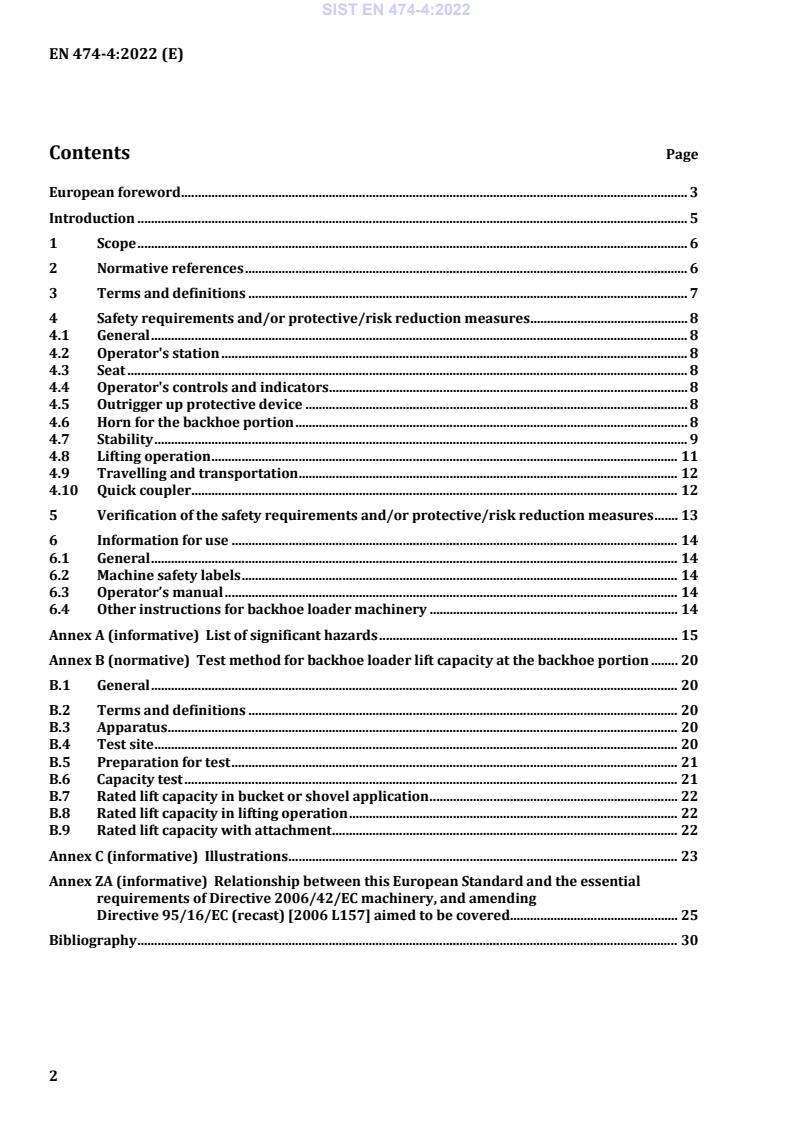
Contents Page
European foreword . 3
Introduction . 5
1 Scope . 6
2 Normative references . 6
3 Terms and definitions . 7
4 Safety requirements and/or protective/risk reduction measures . 8
4.1 General . 8
4.2 Operator's station . 8
4.3 Seat . 8
4.4 Operator's controls and indicators . 8
4.5 Outrigger up protective device . 8
4.6 Horn for the backhoe portion . 8
4.7 Stability . 9
4.8 Lifting operation . 11
4.9 Travelling and transportation . 12
4.10 Quick coupler . 12
5 Verification of the safety requirements and/or protective/risk reduction measures . 13
6 Information for use . 14
6.1 General . 14
6.2 Machine safety labels . 14
6.3 Operator’s manual . 14
6.4 Other instructions for backhoe loader machinery . 14
Annex A (informative) List of significant hazards . 15
Annex B (normative) Test method for backhoe loader lift capacity at the backhoe portion . 20
B.1 General . 20
B.2 Terms and definitions . 20
B.3 Apparatus . 20
B.4 Test site . 20
B.5 Preparation for test . 21
B.6 Capacity test . 21
B.7 Rated lift capacity in bucket or shovel application . 22
B.8 Rated lift capacity in lifting operation . 22
B.9 Rated lift capacity with attachment . 22
Annex C (informative) Illustrations . 23
Annex ZA (informative) Relationship between this European Standard and the essential
requirements of Directive 2006/42/EC machinery, and amending
Directive 95/16/EC (recast) [2006 L157] aimed to be covered. 25
Bibliography . 30
European foreword
This document (EN 474-4:2022) has been prepared by Technical Committee CEN/TC 151 “Construction
equipment and building material machines - Safety”, the secretariat of which is held by DIN.
This European Standard shall be given the status of a national standard, either by publication of an
identical text or by endorsement, at the latest by September 2022, and conflicting national standards shall
be withdrawn at the latest by March 2024.
Attention is drawn to the possibility that some of the elements of this document may be the subject of
patent rights. CEN shall not be held responsible for identifying any or all such patent rights.
This document supersedes EN 474-4:2006+A2:2012.
This document has been prepared under a standardization request given to CEN by the European
Commission and the European Free Trade Association, and supports essential requirements of
EU Directive(s).
For relationship with EU Directive(s), see informative Annex ZA, which is an integral part of this
document.
For bibliographic references, see EN 474-1:2022.
EN 474 “Earth-moving machinery — Safety” comprises the following parts:
— Part 1: General requirements
— Part 2: Requirements for tractor-dozers
— Part 3: Requirements for loaders
— Part 4: Requirements for backhoe-loaders
— Part 5: Requirements for hydraulic excavators
— Part 6: Requirements for dumpers
— Part 7: Requirements for scrapers
— Part 8: Requirements for graders
— Part 9: Requirements for pipelayers
— Part 10: Requirements for trenchers
— Part 11: Requirements for earth and landfill compactors
— Part 12: Requirements for cable excavators
— Part 13: Requirements for rollers
This document is intended for use in combination with part 1 of the series.
The main differences between this document and EN 474-4:2006+A2:2012 are as follows:
a) safety-related functions of control systems (excluded);
b) requirements for attachments, multi-purpose and derivative machinery (deleted);
c) the normative references (updated) (Clause 2);
d) definition of compact crawler backhoe loader up to 6t (modified);
e) requirements for lifting operation of backhoe portion (updated);
f) verification methods table (added) (Clause 5);
g) requirements for quick couplers (added);
h) list of significant hazards (Annex A) (updated);
i) Annex ZA (updated).
Any feedback and questions on this document should be directed to the users’ national standards body.
A complete listing of these bodies can be found on the CEN website.
According to the CEN-CENELEC Internal Regulations, the national standards organisations of the
following countries are bound to implement this European Standard: Austria, Belgium, Bulgaria, Croatia,
Cyprus, Czech Republic, Denmark, Estonia, Finland, France, Germany, Greece, Hungary, Iceland, Ireland,
Italy, Latvia, Lithuania, Luxembourg, Malta, Netherlands, Norway, Poland, Portugal, Republic of North
Macedonia, Romania, Serbia, Slovakia, Slovenia, Spain, Sweden, Switzerland, Turkey and the United
Kingdom.
Introduction
This document is a type C standard as stated in EN ISO 12100:2010.
This document is of relevance, in particular, for the following stakeholder groups representing the market
players with regard to machinery safety:
— machine manufacturers (small, medium and large enterprises);
— health and safety bodies (regulators, accident prevention organizations, market surveillance, etc.).
Others can be affected by the level of machinery safety achieved with the means of the document by the
above-mentioned stakeholder groups:
— machine users/employers (small, medium and large enterprises);
— machine users/employees (e.g. trade unions, organizations for people with special needs);
— service providers, e.g. for maintenance (small, medium and large enterprises);
— consumers (in case of machinery intended for use by consumers).
The above-mentioned stakeholder groups have been given the possibility to participate at the drafting
process of this document.
The machinery concerned and the extent to which hazards, hazardous situations or hazardous events are
covered are indicated in the Scope of this document.
When requirements of this type-C standard are different from those which are stated in type-A or type-B
standards, the requirements of this type-C standard take precedence over the requirements of the other
standards for machines that have been designed and built according to the requirements of this type-C
standard.
1 Scope
This document together with EN 474-1:2022 deals with all significant hazards, hazardous situations and
events relevant to backhoe loaders when used as intended and under the conditions of misuse which are
reasonably foreseeable by the manufacturer (see Annex A) associated with the whole lifetime of the
machine as described in EN ISO 12100:2010, 5.4.
The requirements of this document are complementary to the common requirements formulated in
EN 474-1:2022. This document does not repeat the requirements of EN 474-1:2022 but supplements or
modifies the requirements for backhoe loaders.
This document does not provide requirements for main electrical circuits and drives of machinery when
the primary source of energy is an external electrical supply.
This document does not provide performance requirements for safety related functions of control
system(s).
This document does not deal with demolition machinery.
This document also deals with fork application, log handling application and lifting operation application.
This document is not applicable to backhoe loaders which are manufactured before the date of
publication of this document by CEN.
2 Normative references
The following documents are referred to in the text in such a way that some or all of their content
constitutes requirements of this document. For dated references, only the edition cited applies. For
undated references, the latest edition of the referenced document (including any amendments) applies.
EN 474-1:2022, Earth-moving machinery — Safety — Part 1: General requirements
EN ISO 7096:2020, Earth-moving machinery — Laboratory evaluation of operator seat vibration
(ISO 7096:2020)
EN ISO 12100:2010, Safety of machinery — General principles for design — Risk assessment and risk
reduction (ISO 12100:2010)
ISO 2330:2002, Fork-lift trucks — Fork arms — Technical characteristics and testing
ISO 7451:2007, Earth-moving machinery — Volumetric ratings for hoe-type and grab-type buckets of
hydraulic excavators and backhoe loaders
ISO 7546:1983, Earth-moving machinery — Loader and front loading excavator buckets — Volumetric
ratings
ISO 9248:1992, Earth-moving machinery — Units for dimensions, performance and capacities, and their
measurement accuracies
ISO 9533:2010, Earth-moving machinery — Machine-mounted audible travel alarms and forward
horns — Test methods and performance criteria
ISO 14397-1:2007, Earth-moving machinery — Loaders and backhoe loaders — Part 1: Calculation of
rated operating capacity and test method for verifying calculated tipping load
3 Terms and definitions
For the purposes of this document, the terms and definitions given in EN 474-1:2022, EN ISO 12100:2010
and the following apply.
NOTE Terminology for backhoe loaders is specified in ISO 8812:2016 and most common backhoe loaders are
illustrated in Annex C of this document.
ISO and IEC maintain terminological databases for use in standardization at the following addresses:
— IEC Electropedia: available at https://www.electropedia.org/
— ISO Online browsing platform: available at https://www.iso.org/obp
3.1
backhoe loader
self-propelled crawler or wheeled machine having a main frame designed to carry both front-mounted
equipment and rear-mounted backhoe equipment, normally with stabilisers or outriggers (see
EN ISO 6165:2012)
Note 1 to entry: When used in backhoe mode, the machine is stationary and normally digs below ground level,
but when used in loader mode (bucket use), the machine loads through forward motion.
Note 2 to entry: A backhoe work cycle normally comprises excavating, elevating, swinging and discharging
material. A loader work cycle normally comprises filling, elevating, transporting and discharging material.
3.2
compact backhoe loader
wheeled backhoe loader with an operating mass (see ISO 6016:2008) of ≤ 4 500 kg, or crawler backhoe
loader with an operating mass of ≤ 6 000 kg designed to work in confined spaces with the associated
needs for greater manoeuvrability
3.3
load centre of gravity distance
distance “D” in mm from the centre of gravity “G” of the load measured horizontally to the front face of
the fork shanks as specified in Figure 1
3.4
lift point radius
horizontal distance between the bucket pivot pin and the swing pivot centre
Note 1 to entry: The bucket pivot pin and the swing pivot centre are illustrated in ISO 8812:2016, Figure 15a,
Position 4 and 13.
3.5
rated lift capacity
smaller of either the maximum load or the rated hydraulic lift capacity
4 Safety requirements and/or protective/risk reduction measures
4.1 General
4.1.1 Context
Backhoe loaders shall comply with the safety requirements and/or protective/risk reduction measures
of this clause. In addition, the machines shall be designed according to the principles of
EN ISO 12100:2010 for relevant but not significant hazards which are not dealt with by this document.
4.1.2 Specific relation to EN 474-1
Backhoe loaders shall comply with the requirements of EN 474-1:2022, as far as not modified or replaced
by the requirements of this part.
There are general requirements specified in EN 474-1:2022 that are not applicable because the risk
assessment has shown that for backhoe loaders the corresponding hazard does not exist. Therefore, for
backhoe loaders 4.3.5, 4.4.2.2, 4.22.5 and Annex B in EN 474-1:2022, are not applicable.
4.2 Operator's station
EN 474-1:2022, 4.3 applies, with the following addition to EN 474-1:2022, 4.3.1.2 for backhoe loaders
with retractable rear window:
On backhoe loaders with retractable rear window, the cab height above SIP shall not be less than 920 mm
measured with the window retracted into the cab.
4.3 Seat
EN 474-1:2022, 4.4 applies with the following addition to EN 474-1:2022, 4.4.1.4:
For backhoe loader the seat shall comply with spectral classes of EN ISO 7096:2020 according to Table 1.
Table 1 — Seat criteria for backhoe loaders
Wheeled backhoe loader EM5
Compact wheeled backhoe
loader EM8
Crawler backhoe loader EM6
4.4 Operator's controls and indicators
EN 474-1:2022, 4.5 applies with the following addition:
EN 474-1:2022, 4.5.3 also applies for the operator’s movement in the cab from one operating position to
another operating position (e.g. from the loader operating position to the backhoe operating position),
and the movement of the operator’s seat.
4.5 Outrigger up protective device
An acoustic and visual warning device shall be installed to warn the operator when the travel motion is
engaged with lowered outriggers
4.6 Horn for the backhoe portion
EN 474-1:2022, 4.9 applies with the following addition:
The horn sound pressure level shall be greater than or equal to 93 dB (A) at 7 m distance to the rear of
the backhoe, with the backhoe moved to the least favourable position to provide maximum masking at
position 5 of ISO 9533:2010, 7.1, so that the swing frame, boom or an attachment provide maximum
masking to the warning device(s).
The operator shall be able to activate the horn from the backhoe operation position.
4.7 Stability
4.7.1 General
EN 474-1:2022, 4.11 applies with the additions given in 4.7.2 and 4.7.3 below.
All rated capacities as defined hereafter are based on tests, calculations, or both, of machines on a level
and firm supporting surface.
The mass of the load, its density and the location of its centre of gravity as well as the mass of the
attachment and the quick coupler if fitted, shall be included in the determination of the rated operating
capacity and the size/capacity of the attachment.
To provide a sufficient stability the rated operating capacity/rated lift capacity in intended operations
shall be determined as specified in 4.7.2 and 4.7.3.
4.7.2 Loader portion
4.7.2.1 General
The rated capacities of the backhoe loader used in loader application shall be determined as follows with
the backhoe in its transport position as specified by the manufacturer.
4.7.2.2 Loader bucket application
The rated operating capacity shall be determined according to ISO 14397-1:2007.
The volumetric rating of bucket shall be determined according to ISO 7546:1983.
The mass, volumetric rating of bucket and density of the material have to be taken into account when the
bucket capacity is selected for a specific application.
4.7.2.3 Loader fork application
4.7.2.3.1 Rated operating capacity
The rated operating capacity is based on the use of forks and shall be determined according to
ISO 14397-1:2007 (except for the stability factors (k) stated in ISO 14397-1:2007, 5.1, Table 1) and with
the fork in a horizontal position. Stability factors (k) specified in Table 2 shall apply.
Table 2 — Stability factors in fork application
Ground condition Wheel backhoe loader Crawler backhoe loader
Rough terrain 0,60 -
Firm and level ground 0,80 -
All - 0,35
4.7.2.3.2 Fork load centre of gravity
The load centre of gravity distance, D, is determined as a point on the longitudinal centreline of the
machine at half the distance from the most rearward point of the load opening to the tip of the fork, as
shown in Figure 1.
Key
D distance in millimetres (see Table 3)
F load in Newton
G load centre of gravity
Figure 1 — Load centre of gravity distance with fork arms
4.7.2.3.3 Fork size
Fork arms shall meet the performance requirements stated in ISO 2330:2002.
To select the fork arm size and to determine the load centre of gravity distance (D) as shown in Figure 1,
the specifications in Table 3 shall be followed.
Table 3 — Typical load centre of gravity distance
Load F in N Load centre of gravity distance D in mm
400 500 600 900 1 200
F < 10 000 X
10 000 ≤ F < 50 000 X
50 000 ≤ F < 100 000 X
100 000 ≤ F < 200 000 X X X
200 000 ≤ F < 250 000 X X
F ≥ 250 000 X
NOTE For loads below 10 000 N a 500 mm load spacing dimension is optional.
4.7.2.4 Loader log handling application
4.7.2.4.1 Rated operating capacity
The rated operating capacity is based on a log grapple application and shall be determined according to
ISO 14397-1:2007 (except for stability factors (k) stated in ISO 14397-1:2007, 5.1, Table 1) with the log
grapple fitted. Stability factors (k) specified in Table 4 shall apply.
Table 4 — Stability factors in log handling
Ground condition Wheel backhoe loaders Crawler backhoe
loaders
Rough terrain 0,75 0,50
Firm and level ground 0,85 0,60
4.7.3 Backhoe portion
The rated lift capacity for a backhoe loader used in backhoe application with a bucket or shovel shall be
determined in accordance with Annex B as the value according to B.7.
The volumetric rating of the bucket shall be determined according to ISO 7451:2007 or ISO 7546:1983.
The mass, volumetric rating of bucket and density of the material have to be taken into account when the
bucket capacity is selected for a specific application.
4.8 Lifting operation
4.8.1 Loader portion
EN 474-1:2022, 4.12 shall apply, with the exception of 4.12.2, 4.12.3, 4.12.4, 4.12.5 and 4.12.6.
The rated operating capacity is based on use of a lifting accessory or accessories and the attachment and
shall be determined according to ISO 14397-1:2007.
4.8.2 Backhoe portion
4.8.2.1 General
EN 474-1:2022, 4.12.1, 4.12.2, 4.12.3, 4.12.6 and 4.12.7 shall apply even if intended
...