

SIST EN 13963:2014
(Main)Jointing materials for gypsum boards - Definitions, requirements and test methods
General Information
- Abstract
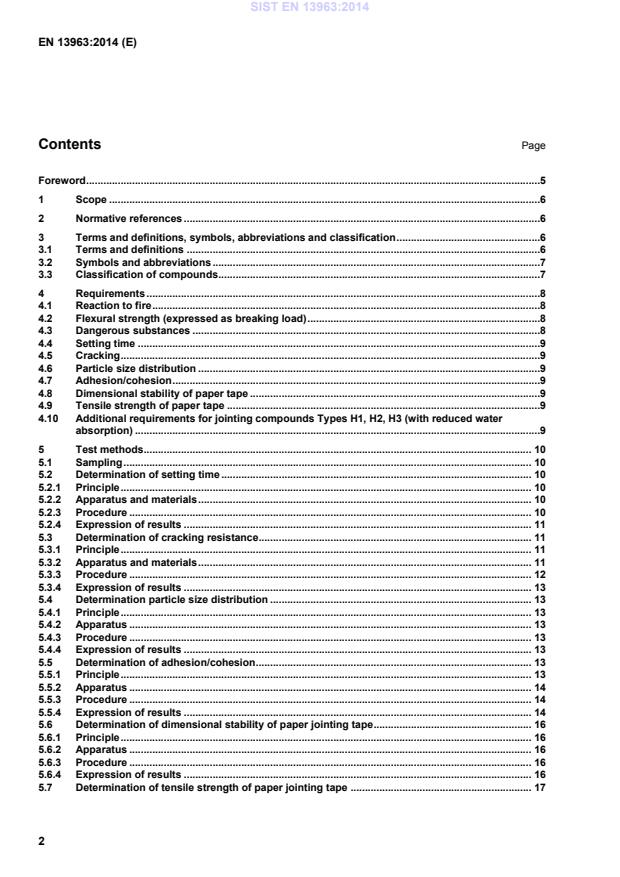
The European Standard specifies the requirements for jointing compounds and paper tapes used to fill and finish the joints formed at the edges and ends of gypsum plasterboards complying with EN 520, products from secondary processing complying with EN 14190, prefabricated gypsum plasterboard panels with a cellular paperboard core complying with EN 13915, thermal/acoustic composite panels complying with EN 13950, preformed plasterboard cornices complying with EN 14209 and gypsum boards with fibrous reinforcement complying with EN 15283 1 and EN 15283 2.
This European Standard does not cover tapes which are made from materials other than paper.
This European Standard covers the following characteristics: reaction to fire and flexural strength, to be measured according to the relevant test methods in this document.
- Status
- Published
- Public Enquiry End Date
- 19-Feb-2012
- Publication Date
- 10-Aug-2014
- Technical Committee
- CAA - Mineral binders and masonry
- Current Stage
- 6060 - National Implementation/Publication (Adopted Project)
- Start Date
- 05-Aug-2014
- Due Date
- 10-Oct-2014
- Completion Date
- 11-Aug-2014

Overview
EN 13963:2014 - Jointing materials for gypsum boards - Definitions, requirements and test methods (CEN) specifies requirements and test methods for jointing compounds and paper jointing tapes used to fill and finish joints in gypsum plasterboards and related gypsum-based panels. The standard applies to products intended for use with EN 520 gypsum plasterboard, secondary-processed products (EN 14190), cellular-core panels (EN 13915), thermal/acoustic composite panels (EN 13950), preformed cornices (EN 14209) and fibrous-reinforced boards (EN 15283‑1 and EN 15283‑2). It does not cover tapes made from non‑paper materials.
Key topics and technical requirements
EN 13963:2014 defines terminology, classification and a comprehensive set of characteristics, together with the test methods and sampling procedures to verify compliance. Major technical topics include:
- Reaction to fire classification and performance (including SBI test mounting guidance)
- Flexural strength (expressed as breaking load) - methods for tensile and flexural determination
- Setting time and cracking resistance of jointing compounds
- Adhesion/cohesion of compounds to board substrates
- Particle size distribution for compounds
- Dimensional stability and tensile strength of paper jointing tape
- Water absorption (surface and total) and special requirements for Types H1, H2, H3 (reduced water absorption)
- Dangerous substances considerations
- Sampling procedures, test apparatus, procedures and expression of results
- Assessment and verification of constancy of performance (AVCP), factory production control (FPC), CE marking and Declaration of Performance (DoP) in line with the Construction Products Regulation (Annex ZA)
Practical applications and users
EN 13963:2014 is used to ensure consistent quality, safety and regulatory compliance of jointing materials in interior drywall and lining systems. Typical users:
- Manufacturers of jointing compounds and paper tapes - for product development, factory production control and CE marking
- Testing laboratories - to perform standardized tests (setting time, flexural strength, reaction to fire, etc.)
- Architects, specifiers and contractors - to select compliant jointing materials for plasterboard installations
- Certification bodies and authorities - for AVCP, DoP verification and regulatory compliance checks
Related standards
Relevant linked standards include EN 520, EN 14190, EN 13915, EN 13950, EN 14209, EN 15283‑1 / EN 15283‑2 and test references such as EN 13823 (SBI test). These define the gypsum board products and complementary test methods referenced by EN 13963:2014.
Relations
- Effective Date
- 01-Sep-2014
- Effective Date
- 01-Sep-2014
- Effective Date
- 25-Aug-2026
- Effective Date
- 28-Jan-2026
- Effective Date
- 28-Jan-2026
- Effective Date
- 28-Jan-2026
- Refers
SIST EN 12503-2:2002 - Sports mats - Part 2: Pole vault and high jump mats, safety requirements - Effective Date
- 28-Jan-2026
- Effective Date
- 28-Jan-2026
- Effective Date
- 28-Jan-2026
- Effective Date
- 28-Jan-2026
- Effective Date
- 28-Jan-2026
- Effective Date
- 28-Jan-2026
- Effective Date
- 28-Jan-2026
- Effective Date
- 28-Jan-2026
- Effective Date
- 28-Jan-2026
Get Certified
Connect with accredited certification bodies for this standard

DIBt (Deutsches Institut für Bautechnik)
German Institute for Building Technology.
DIN CERTCO
DIN Group product certification.

Aboma Certification B.V.
Specialized in construction, metal, and transport sectors.
Sponsored listings
Frequently Asked Questions
SIST EN 13963:2014 is a standard published by the Slovenian Institute for Standardization (SIST). Its full title is "Jointing materials for gypsum boards - Definitions, requirements and test methods". This standard covers: The European Standard specifies the requirements for jointing compounds and paper tapes used to fill and finish the joints formed at the edges and ends of gypsum plasterboards complying with EN 520, products from secondary processing complying with EN 14190, prefabricated gypsum plasterboard panels with a cellular paperboard core complying with EN 13915, thermal/acoustic composite panels complying with EN 13950, preformed plasterboard cornices complying with EN 14209 and gypsum boards with fibrous reinforcement complying with EN 15283 1 and EN 15283 2. This European Standard does not cover tapes which are made from materials other than paper. This European Standard covers the following characteristics: reaction to fire and flexural strength, to be measured according to the relevant test methods in this document.
The European Standard specifies the requirements for jointing compounds and paper tapes used to fill and finish the joints formed at the edges and ends of gypsum plasterboards complying with EN 520, products from secondary processing complying with EN 14190, prefabricated gypsum plasterboard panels with a cellular paperboard core complying with EN 13915, thermal/acoustic composite panels complying with EN 13950, preformed plasterboard cornices complying with EN 14209 and gypsum boards with fibrous reinforcement complying with EN 15283 1 and EN 15283 2. This European Standard does not cover tapes which are made from materials other than paper. This European Standard covers the following characteristics: reaction to fire and flexural strength, to be measured according to the relevant test methods in this document.
SIST EN 13963:2014 is classified under the following ICS (International Classification for Standards) categories: 91.100.10 - Cement. Gypsum. Lime. Mortar. The ICS classification helps identify the subject area and facilitates finding related standards.
SIST EN 13963:2014 has the following relationships with other standards: It is inter standard links to SIST EN 13963:2005/AC:2006, SIST EN 13963:2005, SIST ISO 565:2003, SIST EN 196-3:2017, SIST EN ISO 1924-2:2009, SIST EN 520:2005+A1:2009, SIST EN 12503-2:2002, SIST EN 13823:2020+A1:2022, SIST EN ISO 535:2023, SIST EN 13501-1:2019, SIST EN 15283-1:2008+A1:2009, SIST-TP CEN/TR 16239:2011, SIST EN 16703:2015, SIST EN 15283-2:2008+A1:2009, SIST EN 13915:2007. Understanding these relationships helps ensure you are using the most current and applicable version of the standard.
SIST EN 13963:2014 is associated with the following European legislation: EU Directives/Regulations: 305/2011, 89/106/EEC, TRRTP129; Standardization Mandates: M/106. When a standard is cited in the Official Journal of the European Union, products manufactured in conformity with it benefit from a presumption of conformity with the essential requirements of the corresponding EU directive or regulation.
SIST EN 13963:2014 is available in PDF format for immediate download after purchase. The document can be added to your cart and obtained through the secure checkout process. Digital delivery ensures instant access to the complete standard document.
Standards Content (Sample)
2003-01.Slovenski inštitut za standardizacijo. Razmnoževanje celote ali delov tega standarda ni dovoljeno.Materialien für das Verspachteln von Gipsplatten-Fugen - Begriffe, Anforderungen und PrüfverfahrenMatériaux de jointoiement pour plaques de plâtre - Définitions, exigences et méthodes d'essaiJointing materials for gypsum boards - Definitions, requirements and test methods91.100.10Cement. Mavec. Apno. MaltaCement. Gypsum. Lime. MortarICS:Ta slovenski standard je istoveten z:EN 13963:2014SIST EN 13963:2014en,fr,de01-september-2014SIST EN 13963:2014SLOVENSKI
STANDARDSIST EN 13963:2005/AC:2006SIST EN 13963:20051DGRPHãþD
EUROPEAN STANDARD NORME EUROPÉENNE EUROPÄISCHE NORM
EN 13963
July 2014 ICS 91.100.10 Supersedes EN 13963:2005English Version
Jointing materials for gypsum boards - Definitions, requirements and test methods
Matériaux de jointoiement pour plaques de plâtre - Définitions, spécifications et méthodes d'essai
Materialien für das Verspachteln von Gipsplattenfugen - Begriffe, Anforderungen und Prüfverfahren This European Standard was approved by CEN on 22 May 2014.
CEN members are bound to comply with the CEN/CENELEC Internal Regulations which stipulate the conditions for giving this European Standard the status of a national standard without any alteration. Up-to-date lists and bibliographical references concerning such national standards may be obtained on application to the CEN-CENELEC Management Centre or to any CEN member.
This European Standard exists in three official versions (English, French, German). A version in any other language made by translation under the responsibility of a CEN member into its own language and notified to the CEN-CENELEC Management Centre has the same status as the official versions.
CEN members are the national standards bodies of Austria, Belgium, Bulgaria, Croatia, Cyprus, Czech Republic, Denmark, Estonia, Finland, Former Yugoslav Republic of Macedonia, France, Germany, Greece, Hungary, Iceland, Ireland, Italy, Latvia, Lithuania, Luxembourg, Malta, Netherlands, Norway, Poland, Portugal, Romania, Slovakia, Slovenia, Spain, Sweden, Switzerland, Turkey and United Kingdom.
EUROPEAN COMMITTEE FOR STANDARDIZATION
COMITÉ EUROPÉEN DE NORMALISATION EUROPÄISCHES KOMITEE FÜR NORMUNG
CEN-CENELEC Management Centre:
Avenue Marnix 17,
B-1000 Brussels © 2014 CEN All rights of exploitation in any form and by any means reserved worldwide for CEN national Members. Ref. No. EN 13963:2014 ESIST EN 13963:2014
Sampling procedure for testing . 26 A.1 General . 26 A.2 Sampling procedure . 26 A.2.1 General . 26 A.2.2 Random sampling . 26 A.2.3 Representative sampling . 26 A.2.3.1 General . 26 A.2.3.2 Sampling from a stack . 26 A.2.3.3 Sampling from a consignment formed of banded or wrapped packs . 27 Annex B (normative)
Classes for reaction to fire performance for air drying jointing compounds . 28 Annex C (normative)
Mounting and fixing in the test according to EN 13823 (SBI test) . 29 C.1 Mounting and fixing of the jointing materials. 29 Annex ZA (informative)
Clauses of this European Standard addressing the provisions of the EU Construction Products Regulation . 31 ZA.1 Scope and relevant characteristics . 31 ZA.2 Procedure for AVCP of jointing materials for gypsum boards . 31 ZA.2.1 Systems of AVCP . 31 ZA.2.2 Declaration of performance (DoP) . 34 SIST EN 13963:2014
Typically tapes are approximately 50 mm wide. 3.1.4 bedding compound jointing compound for application directly to the gypsum board and in which the jointing tape is embedded 3.1.5 finishing compound jointing compound for application over bedding compound in one or more applications and which forms the final finished surface of the joint 3.1.6 dual-purpose compound jointing compound suitable for both bedding and finishing 3.1.7 ready-mixed compound compound supplied so that it can be used without the site addition of water or other materials 3.1.8 short setting compound with a setting time greater than 20 min but less than 60 min 3.1.9 normal setting compound with a setting time of 60 min or greater but less than 180 min 3.1.10 long setting compound with a setting time of 180 min or greater 3.1.11 hydrophobised compound joint compound with reduced water absorption rate 3.2 Symbols and abbreviations Table 1 — Symbols and abbreviations Requirement Sub-clause Symbol or abbreviation Reaction to fire 4.1 R2F Flexural strength 4.2 F Dangerous substances 4.3 DS Tensile strength 4.9 1 See manufacturer's literature
www.manufacturers_internet_address.com 3.3 Classification of compounds Compounds specified in this document shall be classified into eight types according to their description and method of hardening as shown in Table 2. SIST EN 13963:2014
(powder or ready-mix) Setting
(powder only) Bedding compound 1A 1B Finishing compound 2A 2B Dual-purpose compound 3A 3B Tapeless jointing compound 4A 4B NOTE See Annex B for guidance for use. 4 Requirements 4.1 Reaction to fire Jointing compound materials for gypsum boards are classified in Euroclass A1 (no contribution to fire) without testing when they contain less than 1 % by weight or by volume (whichever is the more onerous) of organic materials1). If the jointing compound materials contain 1 % or more by weight or by volume (whichever is the more onerous) of organic material, they shall be tested and then classified in accordance with EN 13501-1. Jointing materials tested according to EN 13823 (SBI test) shall be mounted and fixed in accordance with Annex C or, when the manufacturer wishes to claim performance for a specific intended use, the mounting and fixing shall be representative of that intended use. Where subject to regulatory requirements, the air drying jointing compounds of types 1A, 2A and 3A and paper jointing tape shall either be classified without further testing according to the provisions of Annex B or it shall be tested and classified according to EN 13501-1. 4.2 Flexural strength (expressed as breaking load) Breaking load shall be measured according to test method 5.8.2 for types 1, 2 and 3 and according to test method 5.8.1 for types 4A and 4B (tapeless jointing compound). 4.3 Dangerous substances National regulations on dangerous substances may require verification and declaration on release, and sometimes content, when construction products covered by this standard are placed on those markets. In the absence of European harmonized test methods, verification and declaration on release/content should be done taking into account national provisions in the place of use.
1) See Commission Decision 96/603/EC as amended. SIST EN 13963:2014
%. There shall be nothing retained on the 315
4.7 Adhesion/cohesion When tested by the method given in 5.5, the adhesion/cohesion of the compounds shall exceed 0,25 N/mm2. 4.8 Dimensional stability of paper tape When tested by the method given in 5.6, the dimensional change in the length direction shall be less than 0,4 % and in the width direction shall be less than 2,5 %. 4.9 Tensile strength of paper tape When tested by the method given in 5.7, the minimum tensile strength shall be 4,0 N per mm of tape width. 4.10 Additional requirements for jointing compounds Types H1, H2, H3 (with reduced water absorption) The surface water absorption of the jointing compound determined by the method described in 5.9.1 for the face of the jointing compound shall not be greater than the values shown in Table 3. The total water absorption of jointing compounds, determined by the method described in 5.9.2, shall not be greater than the values shown in Table 3. Table 3 — Water absorption classes Water absorption classes Surface water absorption g/m2 Total water absorption % H1 180 ≤ 5 H2 220 ≤ 10 H3 300 ≤ 25 SIST EN 13963:2014
1) Metal rod of 2 mm diameter and 150 mm minimum length;
2) broad knife, nominally 100 mm wide;
3) a piece of gypsum board complying with the requirements of type A of EN 520, 150 mm x 150 mm conditioned at (23 ± 2) °C and (50 ± 5) % of relative humidity. Dimensions in millimetres
Figure 1 — Wedge showing cracking b) For testing type 4 compounds (see Figure 2): SIST EN 13963:2014
NOTE The device can also be used for testing types 1, 2 and 3 compounds in FPC.
1) Stainless steel or hard plastic wedges (195 ± 5) mm long, 25 mm wide and 0,3 mm to 10 mm high at the extremities;
2) broad knife, at least 60 mm wide;
3) a piece of gypsum plasterboard complying with the requirements of type A of EN 520 conditioned at (23 ± 2) °C and (50 ± 5) % of relative humidity. Dimensions in millimetres
Key 1 gypsum plasterboard 2 wedge Figure 2 — Wedge for testing type 4 compounds 5.3.3 Procedure — For testing type 1, 2 or 3 compounds: Prepare approximately 200 g of mixed compound in accordance with the manufacturer's recommendations. Position the rod on the surface for direct decoration, parallel and close to one edge of the gypsum board. Place some of the compound onto the plasterboard and next to the rod. With the broad knife spread the compound to make a wedge, 90 mm to 100 mm wide, which tapers across its width from 2 mm to zero using the rod as a thickness gauge. When spreading the mixture hold the broad knife at an angle of less than 45° to the plane of the board, and smooth the surface 2 to 4 times. Remove the rod and cut the wedge to a length of approximately 130 mm. Dry the specimen to constant mass2) at (23 ± 2) °C and (50 ± 5) % of relative humidity. Inspect the dried specimen and record the type of cracking in both the thick half and the thin half of the wedge, if any. — For testing type 4 compounds: Prepare a quantity of mixed compound depending on the number of test samples in accordance with the manufacturer's recommendations. Position the wedges on the surface for direct decoration parallel and about 40 mm apart. Place some of the compound onto the plasterboard within the wedges. With the broad knife spread the compound to fill the space between the wedges. When spreading the mixture hold the broad knife at an angle of less than 45° to the plane of the board, and smooth the surface 2 to 4 times. Dry the specimen to constant mass2) at (23 ± 2) °C and (50 ± 5) % of relative humidity.
2) Constant mass is defined as two successive weighings 24h apart, differing by less than 0,1 %. SIST EN 13963:2014
A
B
C SIST EN 13963:2014
D Key 1 metal disc 2 adhesive 3 jointing compound 4 board Figure 3 — Adhesion/cohesion – Fracture pattern 5.6 Determination of dimensional stability of paper jointing tape 5.6.1 Principle The length and width of a test piece shall be measured before and after immersion in water and the percentage change in dimensions shall be calculated. 5.6.2 Apparatus a) water bath; b) measuring device permitting readings to 0,1 mm. 5.6.3 Procedure Condition the tape for 24 h before tests at (23 ± 2) °C and (50 ± 5) % of relative humidity. Cut a strip of tape (250 ± 2) mm long and lay it on a flat surface. Cut two 10 mm long reference marks for the length measurement of the tape, perpendicular to the length of the tape and approximately 10 mm from each end. Measure the length down the centre line of the tape between the reference marks to the nearest 0,1 mm with the measuring device. Measure the full width of the tape in a similar manner, marking the points between which the measurement is taken. Roll up the test piece and place it in the container of water at (23 ± 2) °C so that it is entirely submerged. After 30 min remove the test piece from the water and roll it out on the flat surface and remove excessive water. Repeat the measurements of length and width immediately. 5.6.4 Expression of results Report the changes in length and width dimensions as percentages. SIST EN 13963:2014
Key W width of the test pieces Figure 4 — Sampling for tensile strength testing SIST EN 13963:2014
Key 1 wood batten to support board pieces during jointing 2 adhesive tape 3 number of test specimens Figure 5 — Preparing of specimens 5.8.2 Determination of breaking load by flexural method 5.8.2.1 Principle A joint is constructed from the materials to be used and dried under laboratory conditions. The joint shall then be subject to a loading at a controlled rate and the loads at which the first crack and at which failure occurs shall be determined. 5.8.2.2 Apparatus A loading machine permitting readings to 1 % and capable of applying the necessary load at a rate of 250 N/min (±50 %). 5.8.2.3 Procedure For each of the three samples of jointing material, cut 10 pieces of 12,5 mm plasterboard conforming to type A of EN 520 each 200 mm × 300 mm. Joint the pieces in pairs along the long side following the manufacturer's instructions. Before jointing apply strip of adhesive tape along the back of the joint and fix carefully to battens to support the joint while the joint is made (Figure 5). Allow the specimens to dry at (23 ± 2) °C and (50 ± 5) % of relative humidity for seven days. After drying remove the battens and adhesive tape. Mount each specimen horizontally in the loading machine with the joint upwards and supported as shown in Figure 6. Apply the load continuously at a rate of 250 N/min (±125 N/min) and record the deflection and the load. SIST EN 13963:2014
...