


oSIST prEN 18178-5:2025
(Main)Respiratory infection prevention devices for self- and third-party protection - Part 5: Classification
Respiratory infection prevention devices for self- and third-party protection - Part 5: Classification
This document specifies the classification for respiratory infection prevention devices (RIPDs).
RIPDs are intended to reduce the emission of infective agents from the user’s airways into the environment, and also reduce exposure to the user from inhalation of infective agents.
RIPDs are intended for use by everybody regardless of facial morphology or ability.
Atemwegsinfektionsschutzgeräte für den Selbst- und Fremdschutz - Teil 5: Klassifikation
Dieses Dokument legt die Klassifikation für Atemwegsinfektionsschutzgeräte (RIPDs) fest.
RIPDs dienen dazu, die Absonderung von infektiösen Keimen aus den Atemwegen des Anwenders in die Umgebung zu verringern und die Exposition des Anwenders durch das Einatmen infektiöser Keime zu reduzieren.
RIPDs sind für die Verwendung durch alle Personen bestimmt.
Dispositifs de prévention des infections respiratoires pour la protection individuelle et de tiers - Partie 5 : Classification
Le présent document spécifie la classification des dispositifs de prévention des infections respiratoires (DPIR).
Les DPIR sont destinés à réduire l’émission d’agents infectieux des voies respiratoires de l’utilisateur dans l’environnement, et aussi à réduire l’exposition de l’utilisateur à l’inhalation d’agents infectieux.
Les DPIR sont destinés à être utilisés par tout le monde.
Naprave za preprečevanje respiratornih okužb za lastno zaščito in zaščito tretjih oseb - 1. del: Klasifikacija
General Information
- Status
- Not Published
- Public Enquiry End Date
- 24-Dec-2025
- Technical Committee
- VAZ - Healthcare
- Current Stage
- 4020 - Public enquire (PE) (Adopted Project)
- Start Date
- 17-Oct-2025
- Due Date
- 06-Mar-2026
- Completion Date
- 05-Jan-2026
Overview
The oSIST prEN 18178-5:2025:2025 standard, developed by CEN Technical Committee CEN/TC 205, defines the classification system for respiratory infection prevention devices (RIPDs) designed to protect both the user and third parties. RIPDs aim to minimize the emission of infectious agents from the wearer’s airways and reduce inhalation exposure to the user. This classification framework supports universal usability regardless of facial morphology or wearer ability, ensuring clarity and safety for the general population.
This classification standard is part of the broader EN 18178 series, which addresses requirements, testing, human factors, sustainability, and guidance on selection and use of RIPDs. It is specifically tailored for devices used under Medical Device (MD) and Personal Protective Equipment (PPE) regulations across Europe.
Key Topics
Inward Protection Class (IPC)
Based on Total Inward Leakage (TIL) testing, IPC shows how effectively a device prevents contaminated air from entering the wearer’s respiratory tract. Classes range from IPC1 (>20% TIL) to IPC5 (≤1% TIL).Outward Protection Class (OPC)
Derived from Total Outward Leakage (TOL) tests, OPC evaluates the device’s efficiency in containing infectious particles from the wearer to the environment. OPC ratings span from OPC1 (>20% TOL) to OPC3 (≤5% TOL).Work Rate Classification
Categorized by respiratory minute volume, work rates range from W1 (5 l/min) signifying low physical exertion to W4 (65 l/min) for high exertion scenarios.Work of Breathing (WOB) and Breathability Classes
WOB quantifies the breathing resistance caused by the device, influencing user comfort and safety. Classes range from 1 (0.9 kPa) to 3 (0.5 kPa), reflecting decreasing breathing effort. Breathability classes (BR1 to BR3) align with WOB limits at various work rates.Carbon Dioxide (CO₂) Limits
RIPDs are classified by maximum permissible CO₂ concentrations in inhaled air to ensure wearer safety, with classes defined for different flow rates.Particle Filter Efficiency
Particle filters are ranked from F1 (≥80% efficiency) to F5 (≥99.99%), ensuring effective filtration of infectious agents.RIPD Interface Classes
Classification by coverage area and sealing type:- Coverage ranges from "a" (mouth only) to "e" (body coverage)
- Seal types include tight fitting (T) with full skin seal and loose fitting (L) with partial or no seal.
Overall RIPD-Type Categories
Products are grouped into three RIPD-Types (A, B, C) based on aggregated classification results, facilitating clear application and selection for users.
Applications
The classification system outlined in oSIST prEN 18178-5:2025 is critical for:
- Manufacturers designing respiratory infection prevention devices to meet standardized performance and safety metrics.
- Regulators and certification bodies evaluating compliance with EU Medical Device and Personal Protective Equipment regulations.
- Healthcare and workplace safety managers selecting appropriate RIPDs aligned with protection needs and physical activity demands.
- Consumers and general public understanding product markings for informed and safe use of respiratory protection devices.
- Public health authorities recommending effective respiratory protection during outbreaks or high-risk environments.
By ensuring consistent classification and clear labeling, this standard enhances the effective use of RIPDs in diverse environments to limit the spread of respiratory infections.
Related Standards
The oSIST prEN 18178-5:2025 standard complements and references several critical documents, including:
- prEN 18178-1:2025 - Requirements and Markings for RIPDs
- prEN 18178-2:2025 - Test Methods for RIPD Performance
- prEN 18178-3 - Sustainability, Human Factors, and Rationales (under development)
- prEN 18178-4 - Selection and Use Guidance (under development)
- EN 14683 - Medical Face Masks Requirements and Test Methods
- EN 149 - Filtering Half Masks – Requirements and Testing
- CEN/TS 17553 - Minimum Requirements for Community Face Coverings
- EN ISO 16972:2020 - Respiratory Protective Devices Vocabulary and Graphical Symbols
- EN ISO 18562 Series (2024) - Biocompatibility Evaluation of Breathing Gas Pathways in Healthcare
These standards collectively provide a comprehensive framework for designing, testing, classifying, and safely using respiratory infection prevention devices across the medical, industrial, and public domains.
Keywords: respiratory infection prevention devices, RIPD classification, inward protection class, outward protection class, breathability, work of breathing, particle filter efficiency, personal protective equipment, medical devices standard, EN 18178-5, respiratory protection, total inward leakage, total outward leakage

Frequently Asked Questions
oSIST prEN 18178-5:2025 is a draft published by the Slovenian Institute for Standardization (SIST). Its full title is "Respiratory infection prevention devices for self- and third-party protection - Part 5: Classification". This standard covers: This document specifies the classification for respiratory infection prevention devices (RIPDs). RIPDs are intended to reduce the emission of infective agents from the user’s airways into the environment, and also reduce exposure to the user from inhalation of infective agents. RIPDs are intended for use by everybody regardless of facial morphology or ability.
This document specifies the classification for respiratory infection prevention devices (RIPDs). RIPDs are intended to reduce the emission of infective agents from the user’s airways into the environment, and also reduce exposure to the user from inhalation of infective agents. RIPDs are intended for use by everybody regardless of facial morphology or ability.
oSIST prEN 18178-5:2025 is classified under the following ICS (International Classification for Standards) categories: 13.340.20 - Head protective equipment. The ICS classification helps identify the subject area and facilitates finding related standards.
oSIST prEN 18178-5:2025 is associated with the following European legislation: EU Directives/Regulations: 2016/425, 2017/745. When a standard is cited in the Official Journal of the European Union, products manufactured in conformity with it benefit from a presumption of conformity with the essential requirements of the corresponding EU directive or regulation.
oSIST prEN 18178-5:2025 is available in PDF format for immediate download after purchase. The document can be added to your cart and obtained through the secure checkout process. Digital delivery ensures instant access to the complete standard document.
Standards Content (Sample)
SLOVENSKI STANDARD
01-december-2025
Naprave za preprečevanje respiratornih okužb za lastno zaščito in zaščito tretjih
oseb - 1. del: Klasifikacija
Respiratory infection prevention devices for self- and third-party protection - Part 5:
Classification
Atemwegsinfektionsschutzgeräte für den Selbst- und Fremdschutz - Teil 5: Klassifikation
Dispositifs de prévention des infections respiratoires pour la protection individuelle et de
tiers - Partie 5 : Classification
Ta slovenski standard je istoveten z: prEN 18178-5
ICS:
13.340.20 Varovalna oprema za glavo Head protective equipment
2003-01.Slovenski inštitut za standardizacijo. Razmnoževanje celote ali delov tega standarda ni dovoljeno.
DRAFT
EUROPEAN STANDARD
NORME EUROPÉENNE
EUROPÄISCHE NORM
October 2025
ICS 13.340.20
English Version
Respiratory infection prevention devices for self- and
third-party protection - Part 5: Classification
Dispositifs de prévention des infections respiratoires Atemwegsinfektionsschutzgeräte für den Selbst- und
pour la protection individuelle et de tiers - Partie 5 : Fremdschutz - Teil 5: Klassifikation
Classification
This draft European Standard is submitted to CEN members for enquiry. It has been drawn up by the Technical Committee
CEN/TC 205.
If this draft becomes a European Standard, CEN members are bound to comply with the CEN/CENELEC Internal Regulations
which stipulate the conditions for giving this European Standard the status of a national standard without any alteration.
This draft European Standard was established by CEN in three official versions (English, French, German). A version in any other
language made by translation under the responsibility of a CEN member into its own language and notified to the CEN-CENELEC
Management Centre has the same status as the official versions.
CEN members are the national standards bodies of Austria, Belgium, Bulgaria, Croatia, Cyprus, Czech Republic, Denmark, Estonia,
Finland, France, Germany, Greece, Hungary, Iceland, Ireland, Italy, Latvia, Lithuania, Luxembourg, Malta, Netherlands, Norway,
Poland, Portugal, Republic of North Macedonia, Romania, Serbia, Slovakia, Slovenia, Spain, Sweden, Switzerland, Türkiye and
United Kingdom.
Recipients of this draft are invited to submit, with their comments, notification of any relevant patent rights of which they are
aware and to provide supporting documentation.
Warning : This document is not a European Standard. It is distributed for review and comments. It is subject to change without
notice and shall not be referred to as a European Standard.
EUROPEAN COMMITTEE FOR STANDARDIZATION
COMITÉ EUROPÉEN DE NORMALISATION
EUROPÄISCHES KOMITEE FÜR NORMUNG
CEN-CENELEC Management Centre: Rue de la Science 23, B-1040 Brussels
© 2025 CEN All rights of exploitation in any form and by any means reserved Ref. No. prEN 18178-5:2025 E
worldwide for CEN national Members.
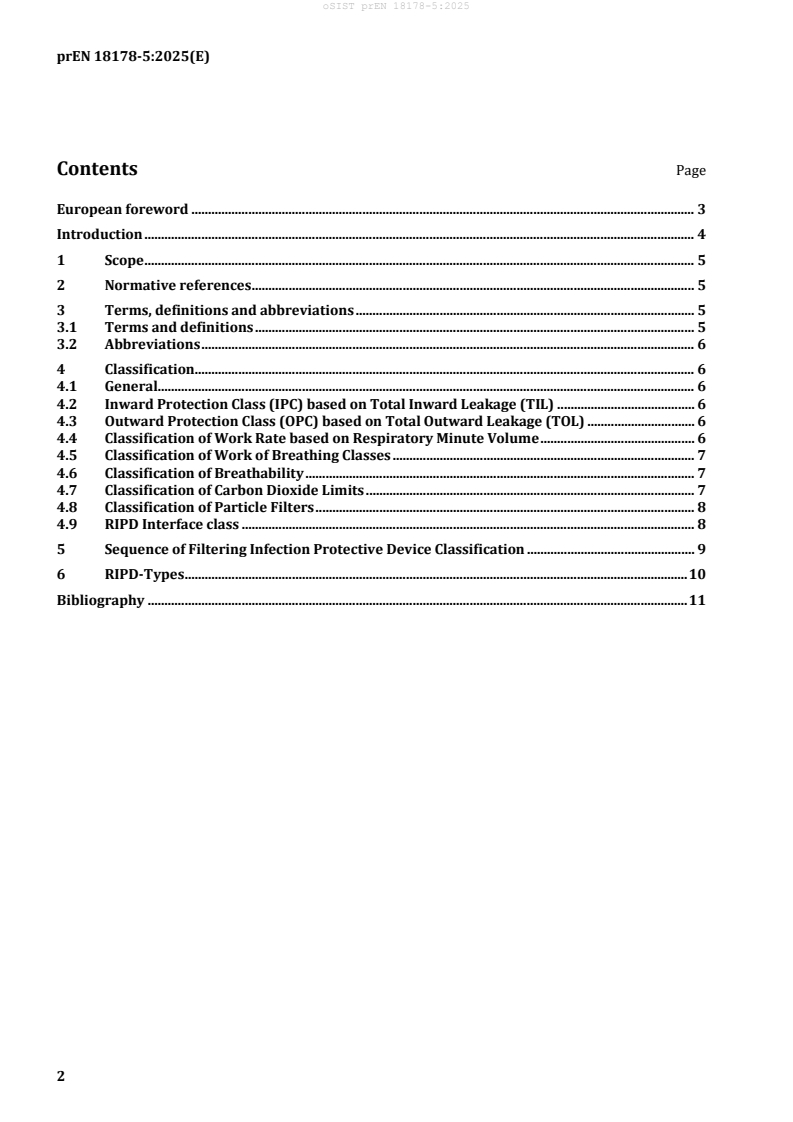
Contents Page
European foreword . 3
Introduction . 4
1 Scope . 5
2 Normative references . 5
3 Terms, definitions and abbreviations . 5
3.1 Terms and definitions . 5
3.2 Abbreviations . 6
4 Classification. 6
4.1 General. 6
4.2 Inward Protection Class (IPC) based on Total Inward Leakage (TIL) . 6
4.3 Outward Protection Class (OPC) based on Total Outward Leakage (TOL) . 6
4.4 Classification of Work Rate based on Respiratory Minute Volume . 6
4.5 Classification of Work of Breathing Classes . 7
4.6 Classification of Breathability . 7
4.7 Classification of Carbon Dioxide Limits . 7
4.8 Classification of Particle Filters . 8
4.9 RIPD Interface class . 8
5 Sequence of Filtering Infection Protective Device Classification . 9
6 RIPD-Types . 10
Bibliography . 11
European foreword
This document (prEN 18178-5:2025) has been prepared by Technical Committee CEN/TC 205 “Non-
active medical devices”, the secretariat of which is held by DIN.
This document is currently submitted to the CEN Enquiry.
EN 18178-5 series consists of the following parts, under the general title Respiratory infection prevention
devices for self- and third-party protection:
— Part 1: Requirements and markings
— Part 2: Test methods
The following parts are under development:
— Part 3: Sustainability, human factors and rationales
— Part 4: Selection and use
— Part 5: Classification
Introduction
Outbreaks of respiratory infection could require a device that is protective in both breathing directions
(outward and inward). In environments relating to the regulation (EU) 2017/745 on Medical Devices
(MD) the applicable standard is EN 14683. In environments relating to the regulation (EU) 2016/425 on
Personal Protective Equipment (PPE) there is a number of applicable standards (for example EN 149). In
environments where the two former EU regulations are not applicable, the General Product Safety
Directive (2001/95/EC) (GPSD) applies supported by CEN/TS 17553. This document intends to define
requirements for respiratory infection prevention devices that will be regulated under both MD and PPE
regulations.
The EN 18178 series is a user- and performance-oriented standard series.
A product, regardless of design, that meets all the requirements of EN 18178-1 might be used as a
respiratory infection prevention device (RIPD) and provides protection against infectious agents at the
level described in the classification.
Essential parts of the EN 18178 series are prEN 18178-1, prEN 18178-2 and prEN 18178-5.
In EN 18178-1 all requirements for a product to be considered as a RIPD are defined whereas the
corresponding test methods to each requirement can be found in prEN 18178-2.
This document defines the classification for a product to be considered as a RIPD.
The resulting classification is part of the mandatory marking. Since the target group is the general
population, it is necessary to supplement this mandatory marking with an immediately recognizable,
clear visual marking that allows a safe and appropriate selection of a product requiring minimal training.
Supplementary parts of the EN 18178 series are EN 18178-3 and EN 18178-4.
EN 18178-3 contains the references and descriptions of the ‘human factors’ that were used to set the
limit values in this document. Rationales about the selected test methods, e.g. representation of infective
agents, are given in part 3 as well.
Furthermore, aspects of environmental compatibility and sustainability are reflected in EN 18178-3.
EN 18178-4 as informative ‘selection and use’, offers a proposal for the correct selection of RIPD for
applications in accordance with the classification.
Under preparation.
Under preparation.
1 Scope
This document specifies the classification for respiratory infection prevention devices (RIPDs).
RIPDs are intended to reduce the emission of infective agents from the user’s airways into the
environment and also reduce exposure to the user from inhalation of infective agents.
RIPDs are intended for use by everybody.
2 Normative references
The following documents are referred to in the text in such a way that some or all of their content
constitutes requirements of this document. For dated references, only the edition cited applies. For
undated references, the latest edition of the referenced document (including any amendments) applies.
prEN 18178-2:2025, Respiratory infection prevention devices for self- and third-party protection — Part 1:
Requirements and markings
3 Terms, definitions and abbreviations
3.1 Terms and definitions
For the purposes of this document, the following terms and definitions apply
ISO and IEC maintain terminology databases for use in standardization at the following addresses:
— ISO Online browsing platform: available at https://www.iso.org/obp/
— IEC Electropedia: available at https://www.electropedia.org/
3.1.1
loose fitting device
respiratory interface that does not rely on forming a complete seal to the wearer’s skin
[SOURCE: EN ISO 16972:2020, 3.132 – modified RI was change to device in the term.]
3.1.2
respiratory infection protection device
RIPD
device intended to reduce the emission of infective agents from the use
...
Questions, Comments and Discussion
Ask us and Technical Secretary will try to provide an answer. You can facilitate discussion about the standard in here.
Loading comments...