

SIST EN 12572-3:2017
(Main)Artificial climbing structures - Part 3: Safety requirements and test methods for climbing holds
General Information
- Abstract
This European Standard specifies the safety requirements and test methods for climbing holds.
This European Standard is applicable to climbing holds, which are used for the natural progression of the climber, i.e. without the use of artificial means (e.g. ice axes, crampons, hooks, nuts) on artificial climbing structures (ACS) and bouldering walls. Climbing holds are designed to be mounted on the ACS with bolts, screws, etc. Climbing holds include large volumes or features that are designed for use without additional climbing holds being attached to them. The main fixation points for climbing holds forms part of the existing layout of the ACS and are considered in FprEN 12572-1 and FprEN 12572-2.
This European Standard is not applicable to ice climbing, dry tooling and playground equipment.
- Status
- Published
- Public Enquiry End Date
- 29-Jul-2015
- Publication Date
- 31-Jan-2017
- Technical Committee
- SPO - Sports
- Current Stage
- 6060 - National Implementation/Publication (Adopted Project)
- Start Date
- 24-Jan-2017
- Due Date
- 31-Mar-2017
- Completion Date
- 01-Feb-2017

Overview
EN 12572-3:2017 - Artificial climbing structures. Part 3: Safety requirements and test methods for climbing holds - is a CEN European Standard that specifies safety, ergonomic and mechanical test requirements for removable climbing holds and large volumes used on artificial climbing structures (ACS) and bouldering walls. It covers material safety, size classification, conditioning and laboratory test methods to verify fixation strength and structural integrity. The standard does not apply to ice climbing, dry tooling or playground equipment.
Key Topics
- Scope and applicability
- Applies to holds mounted with bolts, screws, etc., including large three‑dimensional volumes designed for use without extra holds.
- Excludes ice climbing, dry tooling and playground equipment.
- Size classification
- Hold sizes from XS to Macro are defined by average projected diameter (major and minor axis averaged) - ranges (e.g. XS up to 50 mm; Macro > 550 mm).
- Material and chemical safety
- Prohibits dangerous substances and references Council Directive 1907/2006 (REACH). Examples of prohibited materials include asbestos, lead and PCBs.
- Ergonomics and entrapment
- Surfaces must be free of accessible sharp edges (radius < 0.5 mm prohibited) and burrs.
- No pointed holds < 15 mm diameter that protrude > 40 mm; gaps of 8–25 mm with depth > 15 mm that can entrap are restricted unless specifically designed.
- Mechanical performance and tests
- Conditioning: five temperature cycles (1 h at −30 °C then 1 h at +70 °C), after 10 min water immersion; holds > 100 g are tested.
- Resistance to fixation force: three‑point bend test with specified distances (D) and forces by size (S and smaller 2 kN; M 5 kN; L and bigger 8 kN).
- Structural integrity in use: a 2.4 kN load applied in the most unfavourable direction for 1 minute (holds and volumes).
- Dimension ratio: design requirement to protect the ACS panel and insert; standard details the geometric relationship (d1, d2, d3).
- Volumes
- Must be fixed with multiple fixation points, transfer loads efficiently to the ACS, and conform to ACS surface requirements.
- Marking and manufacturer information
- Holds ≥ 100 g must be marked with manufacturer logo and product ID.
- Manufacturer must supply fixing type, max tightening torque, recommended use, maintenance, repair, disposal and compliance info.
Applications
- Product design and development of climbing holds and volumes.
- Type testing and quality control in manufacturing.
- Safety verification for indoor climbing gyms, bouldering facilities and ACS installers.
- Procurement and regulatory compliance documentation for facility operators and testing laboratories.
- Route setters and facility managers assessing hold selection, fixation and maintenance practices.
Related Standards
- EN 12572-1: Safety requirements and test methods for ACS with protection points
- EN 12572-2: Safety requirements and test methods for bouldering walls
- REACH / Council Directive 1907/2006 (chemical restrictions)
Keywords: EN 12572-3:2017, climbing holds, artificial climbing structures, safety requirements, test methods, bouldering walls, structural integrity, fixation force, size classification.
Relations
- Effective Date
- 01-Mar-2017
- Effective Date
- 28-Jan-2026
- Effective Date
- 28-Jan-2026
- Effective Date
- 28-Jan-2026
- Effective Date
- 28-Jan-2026
- Referred By
SIST EN ISO 19131:2008 - Geographic information - Data product specifications (ISO 19131:2007) - Effective Date
- 28-Jan-2026
- Effective Date
- 28-Jan-2026
- Effective Date
- 28-Jan-2026
- Effective Date
- 28-Jan-2026
- Effective Date
- 28-Jan-2026
- Effective Date
- 28-Jan-2026
- Effective Date
- 28-Jan-2026
- Effective Date
- 28-Jan-2026
- Effective Date
- 07-Feb-2024
Frequently Asked Questions
SIST EN 12572-3:2017 is a standard published by the Slovenian Institute for Standardization (SIST). Its full title is "Artificial climbing structures - Part 3: Safety requirements and test methods for climbing holds". This standard covers: This European Standard specifies the safety requirements and test methods for climbing holds. This European Standard is applicable to climbing holds, which are used for the natural progression of the climber, i.e. without the use of artificial means (e.g. ice axes, crampons, hooks, nuts) on artificial climbing structures (ACS) and bouldering walls. Climbing holds are designed to be mounted on the ACS with bolts, screws, etc. Climbing holds include large volumes or features that are designed for use without additional climbing holds being attached to them. The main fixation points for climbing holds forms part of the existing layout of the ACS and are considered in FprEN 12572-1 and FprEN 12572-2. This European Standard is not applicable to ice climbing, dry tooling and playground equipment.
This European Standard specifies the safety requirements and test methods for climbing holds. This European Standard is applicable to climbing holds, which are used for the natural progression of the climber, i.e. without the use of artificial means (e.g. ice axes, crampons, hooks, nuts) on artificial climbing structures (ACS) and bouldering walls. Climbing holds are designed to be mounted on the ACS with bolts, screws, etc. Climbing holds include large volumes or features that are designed for use without additional climbing holds being attached to them. The main fixation points for climbing holds forms part of the existing layout of the ACS and are considered in FprEN 12572-1 and FprEN 12572-2. This European Standard is not applicable to ice climbing, dry tooling and playground equipment.
SIST EN 12572-3:2017 is classified under the following ICS (International Classification for Standards) categories: 97.220.10 - Sports facilities. The ICS classification helps identify the subject area and facilitates finding related standards.
SIST EN 12572-3:2017 has the following relationships with other standards: It is inter standard links to SIST EN 12572-3:2009, SIST EN 12572-2:2017, SIST EN 12572-1:2017, SIST EN ISO 19126:2010, SIST EN ISO 19115:2005, SIST EN ISO 19131:2008, SIST EN ISO 19115-1:2015, SIST EN 17164:2019, SIST EN ISO 19108:2005, SIST EN ISO 19144-1:2012, SIST-TS CEN ISO/TS 19139:2010, SIST EN ISO 19132:2009, SIST EN ISO 19117:2015, oSIST prEN 12572-3:2025. Understanding these relationships helps ensure you are using the most current and applicable version of the standard.
SIST EN 12572-3:2017 is available in PDF format for immediate download after purchase. The document can be added to your cart and obtained through the secure checkout process. Digital delivery ensures instant access to the complete standard document.
Standards Content (Sample)
2003-01.Slovenski inštitut za standardizacijo. Razmnoževanje celote ali delov tega standarda ni dovoljeno.Umetne plezalne stene - 3. del: Varnostne zahteve in preskusne metode za oprimkeKünstliche Kletteranlagen - Teil 3: Sicherheitstechnische Anforderungen und Prüfverfahren für KlettergriffeStructures artificielles d'escalade - Partie 3 : Exigences de sécurité et méthodes d'essai pour prises d'escaladeArtificial climbing structures - Part 3: Safety requirements and test methods for climbing holds97.220.10Športni objektiSports facilitiesICS:Ta slovenski standard je istoveten z:EN 12572-3:2017SIST EN 12572-3:2017en,fr,de01-marec-2017SIST EN 12572-3:2017SLOVENSKI
STANDARDSIST EN 12572-3:20091DGRPHãþD
EUROPEAN STANDARD NORME EUROPÉENNE EUROPÄISCHE NORM
EN 12572-3
January
t r s y ICS
{ yä t t rä s r Supersedes EN
s t w y tæ uã t r r zEnglish Version
Artificial climbing structures æ Part
uã Safety requirements and test methods for climbing holds Structures artificielles d 5escalade æ Partie
u ã Exigences de sécurité et méthodes d 5essai relatives aux prises d 5escalade
Künstliche Kletteranlagen æ Teil
uã Sicherheitstechnische Anforderungen und Prüfverfahren für Klettergriffe This European Standard was approved by CEN on
t { October
t r s xä
egulations which stipulate the conditions for giving this European Standard the status of a national standard without any alterationä Upætoædate lists and bibliographical references concerning such national standards may be obtained on application to the CENæCENELEC Management Centre or to any CEN memberä
translation under the responsibility of a CEN member into its own language and notified to the CENæCENELEC Management Centre has the same status as the official versionsä
CEN members are the national standards bodies of Austriaá Belgiumá Bulgariaá Croatiaá Cyprusá Czech Republicá Denmarká Estoniaá Finlandá Former Yugoslav Republic of Macedoniaá Franceá Germanyá Greeceá Hungaryá Icelandá Irelandá Italyá Latviaá Lithuaniaá Luxembourgá Maltaá Netherlandsá Norwayá Polandá Portugalá Romaniaá Serbiaá Slovakiaá Sloveniaá Spainá Swedená Switzerlandá Turkey and United Kingdomä
EUROPEAN COMMITTEE FOR STANDARDIZATION COMITÉ EUROPÉEN DE NORMALISATION EUROPÄISCHES KOMITEE FÜR NORMUNG
CEN-CENELEC Management Centre:
Avenue Marnix 17,
B-1000 Brussels
t r s y CEN All rights of exploitation in any form and by any means reserved worldwide for CEN national Membersä Refä Noä EN
s t w y tæ uã t r s y ESIST EN 12572-3:2017
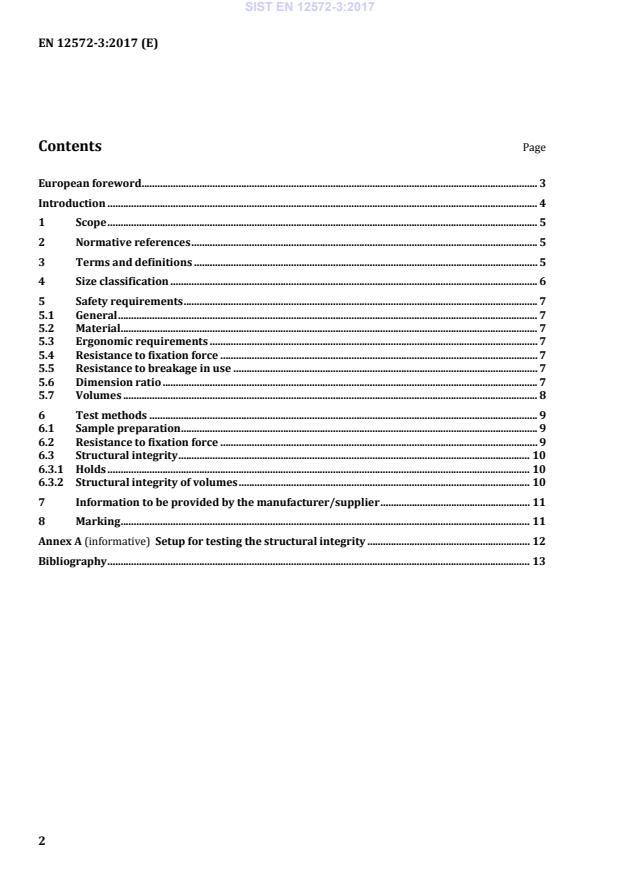
Setup for testing the structural integrity . 12 Bibliography . 13
...