

oSIST prEN 12572-3:2025
(Main)Artificial climbing structures - Part 3: Safety requirements and test methods for climbing holds
General Information
- Abstract
This document specifies the safety requirements and test methods for climbing holds.
This document is applicable to climbing holds which are used for the natural progression of the climber, i.e. without the use of artificial means (e.g. ice axes, crampons, hooks, nuts) on artificial climbing structures (ACS) and bouldering walls. Climbing holds are designed to be mounted on the ACS with bolts, screws, etc. The main fixation points for climbing holds forms part of the existing layout of the ACS and are considered in EN 12572 1 and EN 12572 2.
This document is not applicable to ice climbing, dry tooling and playground equipment.
- Status
- Not Published
- Public Enquiry End Date
- 18-Sep-2025
- Technical Committee
- SPO - Sports
- Current Stage
- 4020 - Public enquire (PE) (Adopted Project)
- Start Date
- 09-Jul-2025
- Due Date
- 26-Nov-2025
- Completion Date
- 16-Mar-2026

Overview
The European Standard oSIST prEN 12572-3:2025:2025, titled "Artificial climbing structures - Part 3: Safety requirements and test methods for climbing holds", is developed by CEN to ensure the safety and reliability of climbing holds used on artificial climbing structures (ACS) and bouldering walls. This standard focuses specifically on the safety requirements, ergonomic considerations, material restrictions, and precise test methods for climbing holds. It aims to prevent failures during use that could cause injury and to promote consistent quality across all climbing holds mounted on ACS.
This standard supersedes EN 12572-3:2017 and is applicable exclusively to climbing holds used for the natural progression of climbers without artificial aids such as ice axes or crampons. It does not cover ice climbing holds, dry tooling, or playground climbing equipment.
Key Topics
Safety Requirements
- Material Safety: Prohibits dangerous substances (e.g., asbestos, lead, formaldehyde), complying with EU Dangerous Substances Directive 1907/2006.
- Ergonomics: Climbing surfaces must be free from sharp edges (radius < 0.5 mm), burrs, and dangerous gaps that could cause entrapment.
- Hold Integrity: Holds must not break when subjected to forces mimicking those applied during climbing, tested for resistance to fixation and breakage in use.
- Dimension Ratios: Holds must adhere to dimension ratio limits to protect both the climber and the climbing panel, ensuring proper hold shape and size.
- Volume Attachments: Volumes (large 3D structural components) must be securely fixed using multiple points without protection points and tested to prevent failure or permanent deformation.
Testing Methods
- Sample Preparation: Includes temperature cycling between -30 °C and +70 °C with pre-conditioning by water immersion to ensure durability under various environmental conditions.
- Resistance to Fixation Force: Tested via a three-point bending test where force is applied to the bolt hole to simulate mechanical stresses.
- Structural Integrity Tests: Holds are mounted and subjected to forces in all unfavorable positions to confirm hold strength against breakage.
- Volume Structural Testing: Volumes are tested at their fixation points with high forces simulating dynamic impacts.
Size Classification
Climbing holds are classified based on average diameter ranging from XS (up to 50 mm) through macro sizes (greater than 550 mm). This classification guides appropriate force levels during testing and safety assessments.
Manufacturer Information & Marking
Manufacturers are required to provide detailed information:
- Fixation types and tightening torques
- Usage recommendations and maintenance instructions
- Repair and disposal guidelines
- Weight data for macros and volumes
- Confirm compliance with oSIST prEN 12572-3:2025
Each climbing hold and volume must be marked clearly with the manufacturer's logo and relevant product details.
Applications
oSIST prEN 12572-3:2025:2025 applies primarily to:
- Artificial climbing walls and bouldering structures in gyms, training facilities, and recreational environments.
- Manufacturers designing and producing climbing holds, ensuring compliance with safety and structural requirements.
- Facility managers and inspectors seeking to implement, verify, or update safety standards for climbing equipment.
- Safety certifiers conducting tests on climbing holds and volumes as part of installation and periodic maintenance.
By adhering to this standard, key stakeholders reduce risk of injuries caused by hold failures, enhance climber safety, and foster consumer confidence in artificial climbing infrastructure.
Related Standards
oSIST prEN 12572-3:2025 forms part of the comprehensive EN 12572 series for artificial climbing structures:
- EN 12572-1: Safety requirements and test methods for ACS with protection points.
- EN 12572-2: Safety requirements and test methods for bouldering walls.
These standards collectively cover the full spectrum of artificial climbing environments, from overall structure safety to detailed component testing, complementing broader sports facility regulations (ICS 97.220.10).
Keywords: climbing hold safety, artificial climbing structures, ACS standard, bouldering wall requirements, climbing hold testing, ergonomic climbing holds, climbing volume safety, CEN standards, EN 12572-3, climbing wall equipment compliance.
Relations
- Effective Date
- 07-Feb-2024
Frequently Asked Questions
oSIST prEN 12572-3:2025 is a draft published by the Slovenian Institute for Standardization (SIST). Its full title is "Artificial climbing structures - Part 3: Safety requirements and test methods for climbing holds". This standard covers: This document specifies the safety requirements and test methods for climbing holds. This document is applicable to climbing holds which are used for the natural progression of the climber, i.e. without the use of artificial means (e.g. ice axes, crampons, hooks, nuts) on artificial climbing structures (ACS) and bouldering walls. Climbing holds are designed to be mounted on the ACS with bolts, screws, etc. The main fixation points for climbing holds forms part of the existing layout of the ACS and are considered in EN 12572 1 and EN 12572 2. This document is not applicable to ice climbing, dry tooling and playground equipment.
This document specifies the safety requirements and test methods for climbing holds. This document is applicable to climbing holds which are used for the natural progression of the climber, i.e. without the use of artificial means (e.g. ice axes, crampons, hooks, nuts) on artificial climbing structures (ACS) and bouldering walls. Climbing holds are designed to be mounted on the ACS with bolts, screws, etc. The main fixation points for climbing holds forms part of the existing layout of the ACS and are considered in EN 12572 1 and EN 12572 2. This document is not applicable to ice climbing, dry tooling and playground equipment.
oSIST prEN 12572-3:2025 is classified under the following ICS (International Classification for Standards) categories: 97.220.10 - Sports facilities. The ICS classification helps identify the subject area and facilitates finding related standards.
oSIST prEN 12572-3:2025 has the following relationships with other standards: It is inter standard links to SIST EN 12572-3:2017. Understanding these relationships helps ensure you are using the most current and applicable version of the standard.
oSIST prEN 12572-3:2025 is available in PDF format for immediate download after purchase. The document can be added to your cart and obtained through the secure checkout process. Digital delivery ensures instant access to the complete standard document.
Standards Content (Sample)
SLOVENSKI STANDARD
01-september-2025
Umetne plezalne stene - 3. del: Varnostne zahteve in preskusne metode za
oprimke
Artificial climbing structures - Part 3: Safety requirements and test methods for climbing
holds
Künstliche Kletteranlagen - Teil 3: Sicherheitstechnische Anforderungen und
Prüfverfahren für Klettergriffe
Structures artificielles d’escalade - Partie 3 : Exigences de sécurité et méthodes d’essai
relatives aux prises d’escalade
Ta slovenski standard je istoveten z: prEN 12572-3
ICS:
97.220.10 Športni objekti Sports facilities
2003-01.Slovenski inštitut za standardizacijo. Razmnoževanje celote ali delov tega standarda ni dovoljeno.
DRAFT
EUROPEAN STANDARD
NORME EUROPÉENNE
EUROPÄISCHE NORM
July 2025
ICS 97.220.10 Will supersede EN 12572-3:2017
English Version
Artificial climbing structures - Part 3: Safety requirements
and test methods for climbing holds
Structures artificielles d'escalade - Partie 3 : Exigences Künstliche Kletteranlagen - Teil 3:
de sécurité et méthodes d'essai relatives aux prises Sicherheitstechnische Anforderungen und
d'escalade Prüfverfahren für Klettergriffe
This draft European Standard is submitted to CEN members for enquiry. It has been drawn up by the Technical Committee
CEN/TC 136.
If this draft becomes a European Standard, CEN members are bound to comply with the CEN/CENELEC Internal Regulations
which stipulate the conditions for giving this European Standard the status of a national standard without any alteration.
This draft European Standard was established by CEN in three official versions (English, French, German). A version in any other
language made by translation under the responsibility of a CEN member into its own language and notified to the CEN-CENELEC
Management Centre has the same status as the official versions.
CEN members are the national standards bodies of Austria, Belgium, Bulgaria, Croatia, Cyprus, Czech Republic, Denmark, Estonia,
Finland, France, Germany, Greece, Hungary, Iceland, Ireland, Italy, Latvia, Lithuania, Luxembourg, Malta, Netherlands, Norway,
Poland, Portugal, Republic of North Macedonia, Romania, Serbia, Slovakia, Slovenia, Spain, Sweden, Switzerland, Türkiye and
United Kingdom.
Recipients of this draft are invited to submit, with their comments, notification of any relevant patent rights of which they are
aware and to provide supporting documentation.
Warning : This document is not a European Standard. It is distributed for review and comments. It is subject to change without
notice and shall not be referred to as a European Standard.
EUROPEAN COMMITTEE FOR STANDARDIZATION
COMITÉ EUROPÉEN DE NORMALISATION
EUROPÄISCHES KOMITEE FÜR NORMUNG
CEN-CENELEC Management Centre: Rue de la Science 23, B-1040 Brussels
© 2025 CEN All rights of exploitation in any form and by any means reserved Ref. No. prEN 12572-3:2025 E
worldwide for CEN national Members.
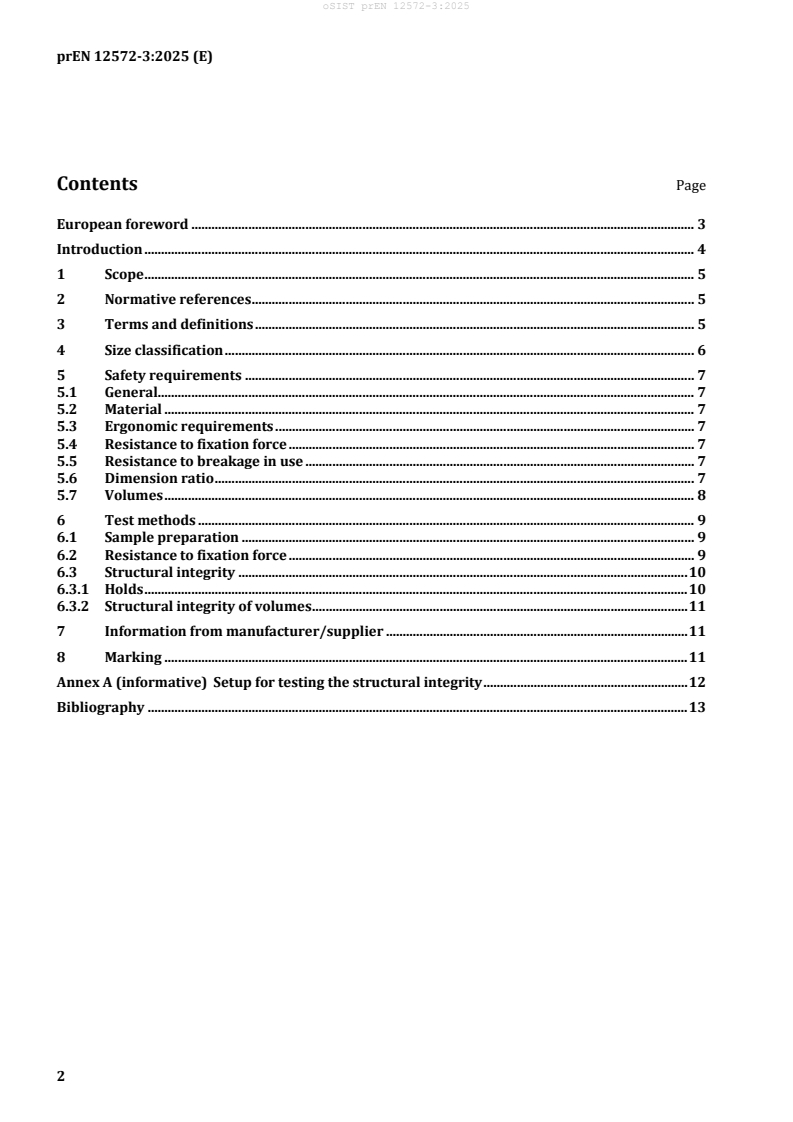
Contents Page
European foreword . 3
Introduction . 4
1 Scope . 5
2 Normative references . 5
3 Terms and definitions . 5
4 Size classification . 6
5 Safety requirements . 7
5.1 General. 7
5.2 Material . 7
5.3 Ergonomic requirements . 7
5.4 Resistance to fixation force . 7
5.5 Resistance to breakage in use . 7
5.6 Dimension ratio . 7
5.7 Volumes . 8
6 Test methods . 9
6.1 Sample preparation . 9
6.2 Resistance to fixation force . 9
6.3 Structural integrity . 10
6.3.1 Holds . 10
6.3.2 Structural integrity of volumes . 11
7 Information from manufacturer/supplier . 11
8 Marking . 11
Annex A (informative) Setup for testing the structural integrity . 12
Bibliography . 13
European foreword
This document (prEN 12572-3:2025) has been prepared by Technical Committee CEN/TC 136 “Sports,
playground and other recreational facilities and equipment”, the secretariat of which is held by DIN.
This document is currently submitted to the CEN Enquiry.
This document will supersede EN 12572-3:2017
The EN 12572 series, Artificial climbing structures, consists of the following parts:
— Part 1: Safety requirements and test methods for ACS with protection points
— Part 2: Safety requirements and test methods for bouldering walls
— Part 3: Safety requirements and test methods for climbing holds
EN 12572-3:2017:
— Modified definition as ACS and protection point. Added new subclause 6.3.2.1 and a Table 3.
— Modified Figure A.1 in Annex A.
Introduction
It is recognized that there is a potential danger to ACS users from being struck by falling pieces of climbing
holds that break whilst in use on an ACS. Some propriety systems within climbing holds have been
developed by manufacturers in response to this problem but the systems have not been perfected and
further development work is required. The aim is to develop a system that would prevent 'large' pieces
of a broken hold that could cause serious injury to ACS users, from being able to 'break-off' and fall from
the ACS.
Designers and manufacturers are requested to work on new systems that would address this problem.
1 Scope
This document specifies the safety requirements and test methods for climbing holds.
This document is applicable to climbing holds which are used for the natural progression of the climber,
i.e. without the use of artificial means (e.g. ice axes, crampons, hooks, nuts) on artificial climbing
structures (ACS) and bouldering walls. Climbing holds are designed to be mounted on the ACS with bolts,
screws, etc. The main fixation points for climbing holds forms part of the existing layout of the ACS and
are considered in EN 12572-1 and EN 12572-2.
This document is not applicable to ice climbing, dry tooling and playground equipment.
2 Normative references
The following documents are referred to in the text in such a way that some or all of their content
constitutes requirements of this document. For dated references, only the edition cited applies. For
undated references, the latest edition of the referenced document (including any amendments) applies.
EN 12572-1 , Artificial climbing structures - Part 1: Safety requirements and test methods for ACS with
protection points
EN 12572-2 , Artificial climbing structures - Part 2: Safety requirements and test methods for bouldering
walls
3 Terms and definitions
For the purposes of this document, the following terms and definitions apply.
ISO and IEC maintain terminology databases for use in standardization at the following addresses:
— ISO Online browsing platform: available at https://www.iso.org/obp/
— IEC Electropedia: available at h
...