

SIST EN 15330-5:2025
(Main)Surfaces for sport areas - Synthetic turf and textile sports surfaces - Part 5: Specification for infill materials
General Information
- Abstract
This document:
a) specifies minimum performance and durability requirements for performance infill materials used in synthetic turf, and textile sports surfaces;
b) describes how the performance of an infill shall be measured, and the results classified;
c) specifies the physical and chemical properties of an infill that are to be declared in a manufacturer’s product declaration;
d) specifies minimum production control tolerance to ensure consistency of infill materials between production batches;
e) describes how reclaimed infill is to be tested to assess its suitability for use.
NOTE If requested, the procedures described in this document can also be used to assess materials intended to be used as stabilizing infills, although not all of the characteristics described in this document are required for stabilizing infills.
- Status
- Published
- Public Enquiry End Date
- 30-Oct-2022
- Publication Date
- 26-Oct-2025
- Technical Committee
- SPO - Sports
- Current Stage
- 6060 - National Implementation/Publication (Adopted Project)
- Start Date
- 20-Oct-2025
- Due Date
- 25-Dec-2025
- Completion Date
- 27-Oct-2025

Overview
SIST EN 15330-5:2025 - Surfaces for Sport Areas: Specification for Infill Materials is a European Standard developed by CEN that sets out the requirement for infill materials used in synthetic turf and textile sports surfaces. This standard defines the minimum performance, durability, and quality measures for various types of infill materials, including polymeric, mineral, vegetal, coated mineral, and blended infills, as well as reclaimed infill. The document also details how to test and report the physical, chemical, and environmental properties of infill materials, ensuring safety, consistency, and suitability for use in sports facilities.
Compliance with SIST EN 15330-5:2025 is essential for manufacturers, designers, suppliers, and facility managers aiming to deliver high-quality, sustainable, and safe sports surfaces.
Key Topics
Performance and Durability Requirements
- Specifies criteria such as elasticity, resistance to deformation, durability, water infiltration, and aging.
- Sets minimum thresholds for aspects like residual deformation, dust creation, and color fastness.
Physical and Chemical Properties
- Details the properties that must be included in the manufacturer’s product declaration: particle size distribution, shape, bulk density, buoyancy, polymer characterization, and water absorption.
- Requires verification of chemical aspects such as toxicology and PAH (polycyclic aromatic hydrocarbons) content.
Production Consistency
- Establishes production tolerance controls to ensure material consistency across batches.
- Emphasizes quality management to avoid variability in infill properties.
Testing and Classification
- Describes standardized test methods for sampling, conditioning, and evaluating infills.
- Includes procedures for reclaimed infills, establishing their reuse potential.
Environmental and Safety Considerations
- Addresses measures to minimize infill migration and environmental contamination.
- Incorporates requirements on reaction to fire and inhalable dust content.
Applications
Sports Facility Construction and Maintenance
- Used by sport surface designers, contractors, and facility managers to select compliant infill materials for new installations or refurbishments of synthetic turf and textile sports surfaces.
- Ensures playing surfaces meet consistent performance and safety standards, benefiting sports clubs, schools, and public venues.
Product Development for Manufacturers
- Provides infill manufacturers with measurable criteria for developing and certifying products, including innovative and reclaimed materials.
- Facilitates competitive differentiation through standardized product declarations and performance guarantees.
Sustainability and Environmental Management
- Supports environmentally conscious choices by including testing and acceptance criteria for reclaimed and blended infill, encouraging recycling and waste reduction.
- Helps mitigate the risk of environmental contamination by setting standards for infill containment and leaching.
Quality Assurance and Compliance
- Serves as a benchmark for regulatory compliance and contracting in sport surface tenders throughout Europe.
- Assists accredited laboratories in conducting uniform and recognized testing procedures.
Related Standards
- EN 15330-1 – Surfaces for sports areas - Synthetic turf and needle-punched surfaces - Specification.
- EN 12616 – Surfaces for sports areas - Determination of vertical water infiltration and horizontal flow.
- EN 14836 – Surfaces for sports areas - Artificial weathering of synthetic turf.
- EN 933-1 & EN 933-2 – Aggregates testing for particle size distribution.
- EN 1097-3 – Determination of bulk density of aggregates.
- EN 17409 – Sampling of performance infills used in synthetic turf surfaces.
- EN 15051-2 – Measurement of dustiness of bulk materials.
- CEN/TR 17519 – Infill containment guidance for minimizing migration.
- EN 71-3 – Safety of toys - Migration of certain elements (applicable to toxicology assessments).
By aligning with SIST EN 15330-5:2025, organizations ensure that sport surfaces not only meet performance expectations but also provide safety, reliability, and environmental stewardship. For the latest practices and compliance, always reference the most recent edition and relevant related standards.
Relations
- Effective Date
- 08-Jul-2026
- Effective Date
- 28-Jan-2026
- Effective Date
- 28-Jan-2026
- Effective Date
- 28-Jan-2026
- Effective Date
- 28-Jan-2026
- Effective Date
- 28-Jan-2026
- Effective Date
- 28-Jan-2026
- Effective Date
- 28-Jan-2026
- Effective Date
- 28-Jan-2026
- Effective Date
- 28-Jan-2026
- Effective Date
- 28-Jan-2026
- Effective Date
- 28-Jan-2026
- Effective Date
- 28-Jan-2026
- Effective Date
- 28-Jan-2026
- Effective Date
- 28-Jan-2026
Frequently Asked Questions
SIST EN 15330-5:2025 is a standard published by the Slovenian Institute for Standardization (SIST). Its full title is "Surfaces for sport areas - Synthetic turf and textile sports surfaces - Part 5: Specification for infill materials". This standard covers: This document: a) specifies minimum performance and durability requirements for performance infill materials used in synthetic turf, and textile sports surfaces; b) describes how the performance of an infill shall be measured, and the results classified; c) specifies the physical and chemical properties of an infill that are to be declared in a manufacturer’s product declaration; d) specifies minimum production control tolerance to ensure consistency of infill materials between production batches; e) describes how reclaimed infill is to be tested to assess its suitability for use. NOTE If requested, the procedures described in this document can also be used to assess materials intended to be used as stabilizing infills, although not all of the characteristics described in this document are required for stabilizing infills.
This document: a) specifies minimum performance and durability requirements for performance infill materials used in synthetic turf, and textile sports surfaces; b) describes how the performance of an infill shall be measured, and the results classified; c) specifies the physical and chemical properties of an infill that are to be declared in a manufacturer’s product declaration; d) specifies minimum production control tolerance to ensure consistency of infill materials between production batches; e) describes how reclaimed infill is to be tested to assess its suitability for use. NOTE If requested, the procedures described in this document can also be used to assess materials intended to be used as stabilizing infills, although not all of the characteristics described in this document are required for stabilizing infills.
SIST EN 15330-5:2025 is classified under the following ICS (International Classification for Standards) categories: 97.220.10 - Sports facilities. The ICS classification helps identify the subject area and facilitates finding related standards.
SIST EN 15330-5:2025 has the following relationships with other standards: It is inter standard links to SIST ISO 3310-2:2015, SIST EN ISO 11358-1:2022, SIST EN 12616:2023, SIST EN ISO 9239-1:2025, SIST EN 20105-A02:1996, SIST-TP CEN ISO/TR 18486:2017, SIST EN 12229:2014, SIST EN 13744:2005, SIST EN 17467:2022, SIST EN 13817:2005, SIST EN ISO 7500-1:2018, SIST EN 14836:2019, SIST EN 14955:2006, SIST EN 1097-3:1999, SIST EN 17409:2020. Understanding these relationships helps ensure you are using the most current and applicable version of the standard.
SIST EN 15330-5:2025 is available in PDF format for immediate download after purchase. The document can be added to your cart and obtained through the secure checkout process. Digital delivery ensures instant access to the complete standard document.
Standards Content (Sample)
SLOVENSKI STANDARD
01-december-2025
Površine za športne dejavnosti - Umetna trava in tekstilne športne podlage - 5. del:
Specifikacija materialov za zapolnitev
Surfaces for sport areas - Synthetic turf and textile sports surfaces - Part 5: Specification
for infill materials
Sportböden - Kunststoffrasenflächen und textile Sportflächen - Teil 5: Spezifikation für
Verfüllgut
Sols sportifs - Sols sportifs en gazon synthétique et en textile - Partie 5 : Spécification
des matériaux de remplissage
Ta slovenski standard je istoveten z: EN 15330-5:2025
ICS:
97.220.10 Športni objekti Sports facilities
2003-01.Slovenski inštitut za standardizacijo. Razmnoževanje celote ali delov tega standarda ni dovoljeno.
EN 15330-5
EUROPEAN STANDARD
NORME EUROPÉENNE
September 2025
EUROPÄISCHE NORM
ICS 97.220.10
English Version
Surfaces for sport areas - Synthetic turf and textile sports
surfaces - Part 5: Specification for infill materials
Sols sportifs - Sols sportifs en gazon synthétique et en Sportböden - Kunststoffrasenflächen und textile
textile - Partie 5 : Spécification des matériaux de Sportflächen - Teil 5: Spezifikation für Verfüllgut
remplissage
This European Standard was approved by CEN on 20 July 2025.
CEN members are bound to comply with the CEN/CENELEC Internal Regulations which stipulate the conditions for giving this
European Standard the status of a national standard without any alteration. Up-to-date lists and bibliographical references
concerning such national standards may be obtained on application to the CEN-CENELEC Management Centre or to any CEN
member.
This European Standard exists in three official versions (English, French, German). A version in any other language made by
translation under the responsibility of a CEN member into its own language and notified to the CEN-CENELEC Management
Centre has the same status as the official versions.
CEN members are the national standards bodies of Austria, Belgium, Bulgaria, Croatia, Cyprus, Czech Republic, Denmark, Estonia,
Finland, France, Germany, Greece, Hungary, Iceland, Ireland, Italy, Latvia, Lithuania, Luxembourg, Malta, Netherlands, Norway,
Poland, Portugal, Republic of North Macedonia, Romania, Serbia, Slovakia, Slovenia, Spain, Sweden, Switzerland, Türkiye and
United Kingdom.
EUROPEAN COMMITTEE FOR STANDARDIZATION
COMITÉ EUROPÉEN DE NORMALISATION
EUROPÄISCHES KOMITEE FÜR NORMUNG
CEN-CENELEC Management Centre: Rue de la Science 23, B-1040 Brussels
© 2025 CEN All rights of exploitation in any form and by any means reserved Ref. No. EN 15330-5:2025 E
worldwide for CEN national Members.
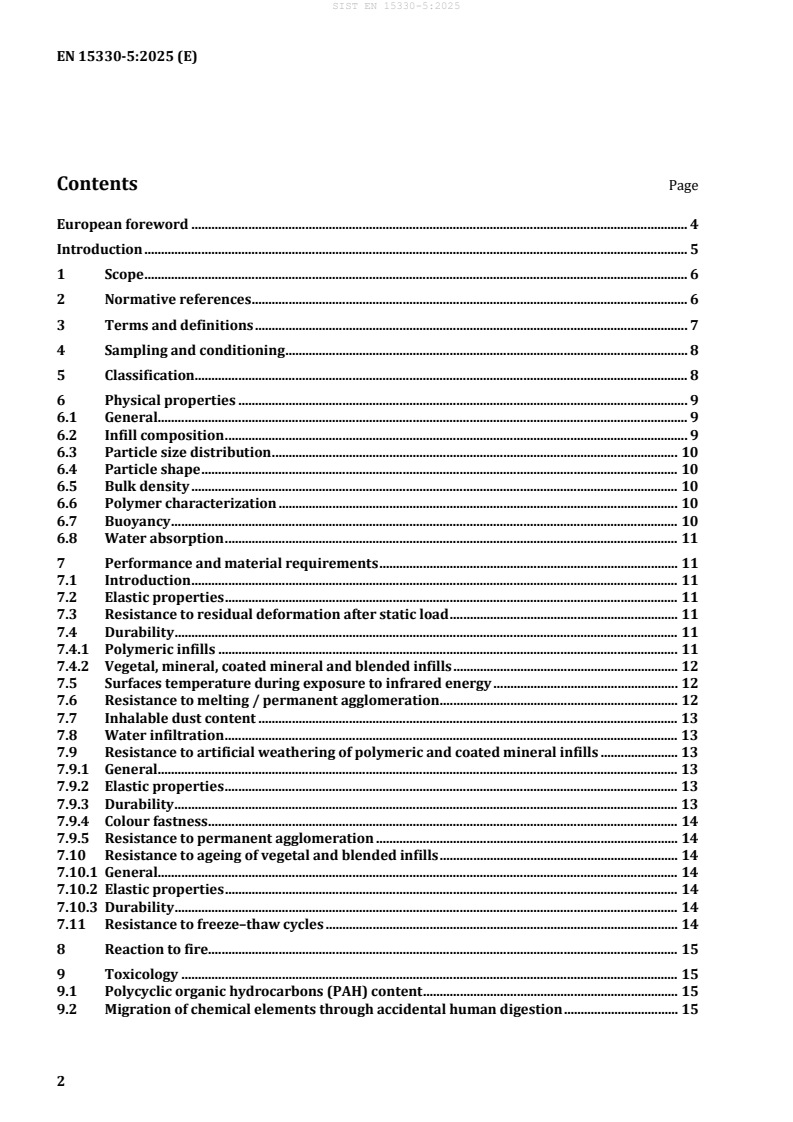
Contents Page
European foreword . 4
Introduction . 5
1 Scope . 6
2 Normative references . 6
3 Terms and definitions . 7
4 Sampling and conditioning . 8
5 Classification. 8
6 Physical properties . 9
6.1 General. 9
6.2 Infill composition . 9
6.3 Particle size distribution . 10
6.4 Particle shape . 10
6.5 Bulk density . 10
6.6 Polymer characterization . 10
6.7 Buoyancy . 10
6.8 Water absorption . 11
7 Performance and material requirements . 11
7.1 Introduction . 11
7.2 Elastic properties . 11
7.3 Resistance to residual deformation after static load . 11
7.4 Durability . 11
7.4.1 Polymeric infills . 11
7.4.2 Vegetal, mineral, coated mineral and blended infills . 12
7.5 Surfaces temperature during exposure to infrared energy . 12
7.6 Resistance to melting / permanent agglomeration . 12
7.7 Inhalable dust content . 13
7.8 Water infiltration . 13
7.9 Resistance to artificial weathering of polymeric and coated mineral infills . 13
7.9.1 General. 13
7.9.2 Elastic properties . 13
7.9.3 Durability . 13
7.9.4 Colour fastness . 14
7.9.5 Resistance to permanent agglomeration . 14
7.10 Resistance to ageing of vegetal and blended infills . 14
7.10.1 General. 14
7.10.2 Elastic properties . 14
7.10.3 Durability . 14
7.11 Resistance to freeze–thaw cycles . 14
8 Reaction to fire. 15
9 Toxicology . 15
9.1 Polycyclic organic hydrocarbons (PAH) content . 15
9.2 Migration of chemical elements through accidental human digestion . 15
9.3 Leaching of chemical elements through immersion in water . 15
10 Production tolerances. 16
10.1 Introduction . 16
10.2 Particle size distribution . 16
10.3 Particle shape . 16
10.4 Bulk density . 16
10.5 Polymer characterization . 17
10.6 Infill colour. 17
10.7 Blended infills . 17
11 Assessment of reclaimed infills to determine suitability for reuse . 17
11.1 General . 17
11.2 Sampling . 17
11.3 Testing and requirements . 17
11.3.1 General . 17
11.3.2 Infill composition. 17
11.3.3 Particle size . 17
11.3.4 Particle shape . 17
11.3.5 Bulk density . 17
11.3.6 Inhalable dust content . 18
11.3.7 PAH content . 18
11.3.8 Migration of chemical elements through accidental human digestion . 18
11.3.9 Elastic properties of reclaimed polymeric infills . 18
11.3.10 Durability of reclaimed performance infills . 18
11.3.11 Resistance to permanent agglomeration . 18
12 Test reports . 18
Annex A (normative) Particle size distribution – Presentation of results . 19
Annex B (normative) Test method for the characterization of polymeric infills and coating . 21
Annex C (normative) Test method for the buoyancy characteristics and the water absorption
properties infill materials . 23
Annex D (normative) Method of test for the determination of the elastic properties of
performance infill materials . 27
Annex E (normative) Method of test for the determination of infill durability . 34
Annex F (normative) Method of test of for the determination of temperature build-up of infill
materials when exposed to infrared heat . 39
Annex G (normative) Method of test of for the determine the temperature required for
permanent agglomeration . 43
Annex H (normative) Method of test of for the determination of infill material’s resistance to
freeze–thaw cycles . 47
Annex I (normative) Method of test of for reaction to fire . 49
Annex J (informative) Guidance on the polycyclic aromatic hydrocarbons (PAH) content of infill
materials . 51
Bibliography . 52
European foreword
This document (EN 15330-5:2025) has been prepared by Technical Committee CEN/TC 217 Surfaces for
sports areas, the secretariat of which is held by AFNOR
This European Standard shall be given the status of a national standard, either by publication of an
identical text or by endorsement, at the latest by March 2026, and conflicting national standards shall be
withdrawn at the latest by March 2026.
Attention is drawn to the possibility that some of the elements of this document may be the subject of
patent rights. CEN shall not be held responsible for identifying any or all such patent rights.
Any feedback and questions on this document should be directed to the users’ national standards body.
A complete listing of these bodies can be found on the CEN website.
According to the CEN-CENELEC Internal Regulations, the national standards organisations of the
following countries are bound to implement this European Standard: Austria, Belgium, Bulgaria, Croatia,
Cyprus, Czech Republic, Denmark, Estonia, Finland, France, Germany, Greece, Hungary, Iceland, Ireland,
Italy, Latvia, Lithuania, Luxembourg, Malta, Netherlands, Norway, Poland, Portugal, Republic of North
Macedonia, Romania, Serbia, Slovakia, Slovenia, Spain, Sweden, Switzerland, Türkiye and the United
Kingdom.
Introduction
Sports performance characteristics
The sports performance characteristics of a synthetic turf or textile sports surface are provided by the
combined characteristics of the synthetic turf or textile surface, any infill within the playing surface pile
and any shockpad laid beneath the synthetic turf or textile sports surface. The selection of the correct
permutations of each is complex and the responsibility of the sports surface designer. Guidance on the
specific sports performance characteristics required by various sports is provided in EN 15330-1 and in
the standards and sporting regulations issued by international sports governing bodies.
Minimizing infill migration into the environment
If infill materials migrate from a synthetic turf or textile sports surface into the surrounding natural
environment, they can become a source of environmental contamination. To minimize the risk of this
occurring, sports fields and courts having synthetic turf or textile sports surfaces containing infill
materials should be designed to incorporate measures to prevent the infill migration. Guidance on
appropriate infill containment is given in CEN Technical Report PD CEN/TR 17519.
1 Scope
This document:
a) specifies minimum performance and durability requirements for performance infill materials used in
synthetic turf, and textile sports surfaces;
b) describes how the performance of an infill shall be measured, and the results classified;
c) specifies the physical and chemical properties of an infill that are to be declared in a manufacturer’s
product declaration;
d) specifies minimum production control tolerance to ensure consistency of infill materials between
production batches;
e) describes how reclaimed infill is to be tested to assess its suitability for use.
NOTE If requested, the procedures described in this document can also be used to assess materials intended
to be used as stabilizing infills, although not all of the characteristics described in this document are required for
stabilizing infills.
2 Normative references
The following documents are referred to in the text in such a way that some or all of their content
constitutes requirements of this document. For dated references, only the edition cited applies. For
undated references, the latest edition of the referenced document (including any amendments) applies.
EN 71-3:2019+A2:2024, Safety of toys — Part 3: Migration of certain elements
EN 933-1, Tests for geometrical properties of aggregates — Part 1: Determination of particle size
distribution — Sieving method
EN 933-2, Tests for geometrical properties of aggregates — Part 2: Determination of particle size
distribution — Test sieves, nominal size of apertures
EN 1097-3, Tests for mechanical and physical properties of aggregates — Part 3: Determination of loose
bulk density and voids
EN 12616, Surfaces for sports areas —Test methods for the determination of vertical water infiltration and
horizontal water flow rates
EN 12229, Surfaces for sports areas — Procedure for the preparation of synthetic turf and needle-punch
test pieces
EN 12457-4, Characterisation of Waste Leaching Compliance test for leaching of granular waste materials
and sludges — Part 4: One stage batch test at a liquid to solid ratio of 10 l/kg for materials with particle
size below 10 mm (without or with size reduction)
EN 13744, Surfaces for sports areas — Procedure for accelerated ageing by immersion in hot water
EN 13817, Surfaces for sports areas — Procedure for accelerated ageing by exposure to hot air
EN 14810, Surfaces for sports areas — Determination of spike resistance
EN 14836, Surfaces for sports areas — Synthetic surfaces for outdoor sports areas — Test method for
artificial weathering
EN 14955, Surfaces for sports areas — Determination of composition and particle shape of unbound mineral
surfaces for outdoor sports areas
EN 15051-2, Workplace exposure — Measurement of the dustiness of bulk materials— Part 2: Rotating
drum method
EN 17409, Surfaces for sports areas — Code of practice for the sampling of performance infills used within
synthetic turf surfaces
EN 17467, Surfaces for sports areas — Test method for the determination of the residual deformation of
synthetic or organic infill granules after static load
EN 20105-A02, Textiles — Tests for colour fastness — Part A02: Grey scale for assessing change in colour
(ISO 105-A02)
EN ISO 7500-1, Metallic materials — Calibration and verification of static uniaxial testing machines — Part
1: Tension/compression testing machines — Calibration and verification of the force-measuring system
(ISO 7500-1)
EN ISO 9239-1, Reaction to fire tests for floorings — Part 1: Determination of the burning behaviour using
a radiant heat source (ISO 9239-1)
EN ISO 11358-1, Plastics — Thermogravimetry (TG) of polymers — Part 1: General principles
(ISO 11358-1)
ISO 3310-1, Test sieves — Technical requirements and testing — Part 1: Test sieves of metal wire cloth
ISO 3310-2, Test sieves — Technical requirements and testing — Part 2: Test sieves of perforated metal
plate
CEN/TS 16384:2012, Synthetic sport systems — Leaching test
3 Terms and definitions
For the purposes of this document, the following terms and definitions apply
ISO and IEC maintain terminology databases for use in standardization at the following addresses:
— ISO Online browsing platform: available at https://www.iso.org/
— IEC Electropedia: available at https://www.electropedia.org/
3.1
infill
particulate materials installed within or over the pile of a synthetic turf or textile sports surface
3.2
manufacturer’s product declaration
statement or datasheet provided by the manufacturer or supplier of the infill that describes the
composition and expected performance of the infill
3.3
performance infill
granular infill material that contributes to the sports performance characteristics of the surface
Note 1 to entry: The performance infill can also act as the stabilizing infill.
3.4
reclaimed infill
infill taken from an existing synthetic turf field for reuse after being cleaned and processed for reuse
3.5
reference sample
infill supplied by the manufacturer or supplier, and that has not been subjected to any sample
conditioning or testing
3.6
stabilizing infill
granular infill material that is used to provide ballast to the sports carpet, and does not contribute to the
sports performance characteristics of the surface
3.7
sports carpet
synthetic turf or textile carpet that comprises the main component of a sports surfacing system
3.8
sports surfacing system
all components that influence the sports performance, bio-mechanical and durability characteristics of
the playing surface, including the sports carpet, any infill and any shockpad
3.9
synthetic polymer
material produced by chemical or biochemical synthesis, rather than occurring naturally
4 Sampling and conditioning
Sampling of infill materials to demonstrate compliance with this document shall be undertaken in
accordance with EN 17409.
Following normal production processes, test samples shall not be washed prior to test.
To enable blended infills to be tested, samples of the blended materials, plus samples of each of the
constituent parts, shall be supplied to the laboratory.
Prior to test, samples shall be prepared and conditioned in accordance with the manufacturer’s
instructions, which shall be described in the test report.
If samples are supplied in a moist or wet condition and require drying prior to test, they shall be placed
in an air circulating oven operating at a temperature of (50 ± 2) °C. They shall remain in the oven until
they reach a constant weight. Following removal from the oven, tests shall not be performed for at least
30 min, to allow the samples to cool to room temperature
5 Classification
Based on the composition of the infill it shall be classified in accordance with Table 1.
Table 1 — Infill type classification
Infill type Characteristics
An infill that is either:
— a homogenous synthetic polymer,
Polymeric infill
— a blend or mix of materials containing at
least one synthetic polymer.
An infill produced entirely from naturally
Vegetal infill
occurring vegetal materials.
An infill produced entirely from naturally
Mineral infills
occurring in-organic materials.
A mineral infill with an outer manmade
Coated mineral infills
coating
An infill formed from a mixture of different
Blended infills infill types, from any of the classifications
detailed above.
NOTE 1 Attention is drawn the European Commission’s Regulation (EU) 2023/2055 which can
affect the use of types of synthetic polymer microparticles used as synthetic turf infill materials.
NOTE 2 Vegetal infills are also known as organic infills.
NOTE 3 Examples of polymeric infills include those made from rubbers and plastics.
NOTE 4 Examples of vegetal infills include cork, coconut fibre, woodchip, nut husks, etc.
NOTE 5 Sand is an examples of a mineral infill.
NOTE 6 Examples of coated mineral infills include ceramic coated sand, polyurethane coated sand
and polylactide coated sand.
NOTE 7 Examples of blended infills include mixtures of polymeric and vegetal materials and
mixtures of vegetal and mineral materials.
6 Physical properties
6.1 General
The physical properties of the infill material shall be measured and reported in accordance with 6.2 to
6.8.
Blended infills shall be tested in accordance with the requirements of the majority constituent part (by
mass), e.g. if a blended infill comprises 70 % vegetal infill and 30 % polymeric infill, it shall be tested as a
vegetal infill. If the weight of each constituent part is equal the manufacturer shall define which is the
principal constituent part.
6.2 Infill composition
A description and photographic record of the infill shall be included in the test report.
If an infill comprises a blend of different materials, the percentage mass of each constituent shall be
determined and reported. For blends where it is not possible to separate the materials, the reported value
shall be taken from the manufacturer’s product declaration.
6.3 Particle size distribution
The particle size distribution of the infill material shall be determined in general accordance with EN 933-
1, using the specific conditions detailed below. For blended materials the particle size distribution of the
blend and each constituent component shall be determined.
A minimum of eight sieves shall be used, from the range detailed in Table 2. The 0,00 mm, 0,063 mm and
0,200 mm sieves shall always be used. The remaining sieves shall be spaced across the aperture sizes d
and D of the product declaration or designated product size, with the largest sieve allowing 100 % of the
infill to pass.
The sieve apertures shall be as specified in EN 933-2 and conform to the requirements of ISO 3310-1 and
ISO 3310-2.
Table 2 — Sieve mesh sizes (mm)
0,00 0,063 0,200 0,315 0,500 0,630
0,800 1,00 1,25 1,60 2,00 2,50
3,15 4,00 5,00 6,30 6,70 7,10
8,00
The sieves shall be mounted in a mechanical device that applies a 3-dimentional vibrating movement.
The equipment shall have a timer and amplitude settings. The amplitude shall be set at (1,5 ± 0,1) mm.
The duration of the sieving operation shall be (20 ± 1) min.
The results of the test shall be reported using the procedure described in Annex A.
Tests may also be undertaken using dynamic image analysis methods in accordance with ISO 13322-2
providing the results are reported in a format compatible with that specified in EN 933-1 and Annex A.
6.4 Particle shape
The particle shape of the infill material shall be determined in accordance with EN 14955.
For blended materials the particle shape of the blend and each constituent component shall be
determined.
6.5 Bulk density
The bulk density of the infill material shall be determined in accordance with EN 1097-3, but the material
shall be dried at (50 ± 2) °C until a constant mass is achieved, prior to test.
For blended materials the bulk density of the blend and each constituent component shall be determined.
6.6 Polymer characterization
The characterization of any polymers (rubbers or plastics, etc) forming part of the infill (including
coatings) shall be determined using the procedure described in Annex B.
6.7 Buoyancy
The buoyancy properties of the infill material shall be measured and reported using the procedure
described in Annex C.
The buoyancy properties of an infill should be considered when selecting an infill for use in a synthetic
turf or textile sports surface that will be laid in locations that are likely to receive prolonged or heavy
rain.
6.8 Water absorption
The water absorption properties of performance infills shall be measured and reported using the
procedure described in Annex C.
The water absorption properties of an infill should be considered when selecting an infill for use in a
synthetic turf or textile sports surface that will be laid in locations that are likely to subjected to
temperatures below zero degrees Celsius (i.e. 0 °C).
7 Performance and material requirements
7.1 Introduction
The performance and material properties of the infill material shall be measured and comply with 7.2 to
7.11 as specified for the type of infill being assessed.
7.2 Elastic properties
The elastic properties of performance infills shall be measured using the procedure described in Annex D
and reported as returned energy and the result classified in accordance with Table 3.
Table 3 — Classification of elastic properties
Classification Returned energy (J)
Non-elastic ˂0,5
Low elasticity ≥ 0,5 and ≤ 1,5
Medium elasticity > 1,5 and ≤ 3,0
High elasticity > 3,0
7.3 Resistance to residual deformation after static load
When tested in accordance with EN 17467 polymeric infills shall satisfy the following requirements:
— the residual deformation shall not exceed 50 %;
— the granules shall not be agglomerated; and
— there shall be no visible signs of oil secretion.
7.4 Durability
7.4.1 Polymeric infills
7.4.1.1 The infill durability shall be assessed using the procedure described in Annex E. Tests shall
be undertaken on dry samples. After 15 000 cycles, the infills shall comply with the requirements of
7.4.1.2 to 7.4.1.4.
7.4.1.2 When tested in accordance with 6.3, the worn infill sample shall have a particle size
distribution that has at least 60 % of the infill within the d – D range of the reference sample, and no more
than 5 % of the worn sample shall pass the 0,063 mm sieve.
NOTE The 5 % limit is applied to ensure that infills do not breakdown and create significant levels of dust that
could impede the water infiltration of the sports surface.
7.4.1.3 When tested in accordance with 6.4, the worn infill sample shall have the same particle shape
classification as the reference sample.
7.4.1.4 When assessed using the procedure described in EN 20105-A02, the worn infill sample shall
have a colour fastness of at least grey scale 3 when compared to the reference sample.
7.4.2 Vegetal, mineral, coated mineral and blended infills
7.4.2.1 The infill durability shall be assessed using the procedure described in Annex E. Tests shall
be undertaken on dry samples, unless the infill is designed to be used under moist conditions, in which
case the test specimens shall be prepared in accordance with the manufacturer’s instructions.
7.4.2.2 Working in 500 cycle increments (500, 1 000, 1 500, 2 000, etc.) the infill shall be tested to
determine the number of cycles it can withstand and comply with the requirements of 7.4.1.3 and 7.4.1.4.
7.4.2.3 When tested in accordance with 6.3, the worn infill shall have a particle size distribution that
has at least 60 % of the infill within the d – D range of the reference sample, and no more than 5 % of the
sample shall pass the 0,063 mm sieve.
7.5 Surfaces temperature during exposure to infrared energy
When tested using the procedure detailed in Annex F, the result obtained shall be classified in accordance
with Table 4.
Table 4 — Classification of surface temperature after prolonged exposure to infrared energy
Class Temperature range °C
1 < 50
2 50 to 65
3 > 65
7.6 Resistance to melting / permanent agglomeration
Polymeric infills shall be tested using the procedure described in Annex G. The temperature at which
melting or permanent agglomeration occurs shall be classified in accordance with Table 5.
Table 5 — Classification of melting /permanent agglomeration temperatures
Class Temperature range °C
1 > 120
2 80 to 120
3 < 80
NOTE The temperature of many of the sports surfacing systems will increase when they are exposed to thermal
energy from the sun. The magnitude of any increase will depend on a number of factors including the intensity of
the solar radiation, the duration of exposure, the colour of the sports surfacing system (including the infill) and
application of any cooling treatments (e.g. wetting). The temperature ranges detailed in Table 5 refer to the
temperature at which melting/permanent agglomeration of the infill material occurred during the test. When
deciding on the suitability of an infill the potential temperature that the sports surfacing system might reach needs
to be considered.
7.7 Inhalable dust content
When tested in accordance with EN 15051-2, the inhalable dust content of the infill shall be classified as
either very low or low.
7.8 Water infiltration
When tested in accordance with EN 12616 using an infiltration ring having an internal diameter of
(300 ± 2) mm and a 0,063 mm gauge support mesh to retain the infill material, the measured water
infiltration rate of the infill shall be greater than 500 mm/h.
The infill material shall be placed into the infiltration ring to a depth of (10 ± 1) mm, before being
compressed by placing a round disc having a dimeter of (295 ± 2) mm and a mass of (5,00 ± 0,25) kg onto
the test specimen. The disc shall be rotated and contra-rotated on the surface a minimum of five full
rotations to ensure compaction and of the infill, ensuring no additional pressure is applied to the disc.
7.9 Resistance to artificial weathering of polymeric and coated mineral infills
7.9.1 General
Polymeric and coated mineral infills shall be subjected to artificial weathering in accordance with
EN 14836 Method 2. The depth of the test sample within the artificial weathering cabinet shall be
approximately 10 mm. After every (336 ± 8) hours (14 days) of conditioning the sample shall be
thoroughly agitated using a small hand rake or comb for at least 60 s, to ensure different portions of the
sample are exposed to the UV light during the test.
If a sample dish containing the test specimen is placed on the base panel of an artificial weathering cabinet
designed for test specimens to normally be side mounted, the level of UV radiation the test sample is
receiving shall be monitored to ensure compliance with the requirements of EN 14836 Method 2.
Following the artificial weathering, samples of polymeric infills shall be tested in accordance with 7.9.2,
7.9.3, 7.9.4 and 7.9.5, and samples of coated mineral infills shall be tested in accordance with 7.9.3 and
7.9.4.
If requested, the procedures described in 7.8 below may also be used to assess the resistance to artificial
weathering properties of vegetal, mineral, and blended infills.
7.9.2 Elastic properties
When assessed using the procedure described in Annex D the classification of the infill’s elastic properties
shall be the same as that measured on the reference sample.
7.9.3 Durability
Following the artificial weathering the test specimen shall be subjected to simulated wear conditioning
in accordance with Annex E. Polymeric infills shall be subjected to 15 000 cycles. Coated mineral infills
shall be subject to the number of cycles determined in 7.4.2.2.
Following the simulated wear conditioning the sample shall:
— when tested in accordance with 6.3, have a particle size distribution with at least 60 % of the infill
within the d – D range of the reference sample;
— when tested in accordance with 6.3 no more than 5 % of the sample shall pass the 0,063 mm sieve.
— when tested in accordance with 6.4, have the same particle shape classification as the reference
sample; and
— show no visible signs of melting or agglomeration.
Photographs showing the appearance and colour of the infill sample before and after the simulated wear
conditioning shall be included in the test report.
7.9.4 Colour fastness
When assessed using the procedure described in EN 20105-A02 the colour fastness of polymeric and
coated mineral infill materials, when compared to the reference sample, shall be Grey Scale 3 or greater.
7.9.5 Resistance to permanent agglomeration
When assessed using the procedure described in Annex G the temperature classification at which
permanent agglomeration or meting occurs shall be the same as that recorded on the reference sample.
7.10 Resistance to ageing of vegetal and blended infills
7.10.1 General
Vegetal and blended infills shall be subjected to accelerated ageing by exposure to hot air in accordance
with EN 13817, followed by immersion in hot water in accordance with EN 13744.
Following the accelerated ageing the infill shall be assessed in accordance with 7.9.2 and 7.9.3.
7.10.2 Elastic properties
When assessed using the procedure described in Annex D the classification of the infill’s elastic properties
shall be the same as that measured on the reference sample.
7.10.3 Durability
Aged infill shall be tested in accordance with Annex E using the same number of cycles in 7.4.2.2.
Following the simulated wear conditioning the sample shall:
— when tested in accordance with 6.3, have a particle size distribution with at least 60 % of the infill
within the d – D range of the reference sample;
— when tested in accordance with 6.3 the worn infill shall have no more than 5 % of the sample passing
the 0,063 mm sieve.
— when tested in accordance with 6.4, have the same particle shape classification as the reference
sample;
— show no visible signs of agglomeration.
Photographs showing the appearance and colour of the infill sample before and after the simulated wear
conditioning shall be included in the test report.
If requested, the procedures described in 7.9.1 may also be used to assess the resistance to ageing of
polymeric infills.
7.11 Resistance to freeze–thaw cycles
Following freeze–thaw conditioning in accordance with Annex H the sample shall:
— when tested in accordance with 6.3, have a particle size distribution with at least 60 % of the infill
within the d – D range of the reference sample;
— when tested in accordance with 6.4, have the same particle shape classification as the reference
sample; or
— when tested in accordance with 6.5, have a bulk density ± 15 % of the reference sample.
8 Reaction to fire
Infills intended for use in synthetic turf or textile sports systems that will be installed indoors, or are
intended for fire sensitive locations, shall have their reaction to fire properties determined in accordance
with the procedure described in Annex I.
9 Toxicology
9.1 Polycyclic organic hydrocarbons (PAH) content
Infills having unacceptable levels of PAH content can expose users of sports facilities fields to
unacceptable health risks. Guidance on the levels of PAH considered acceptable are given in Annex J.
9.2 Migration of chemical elements through accidental human digestion
The infill shall satisfy the requirements of Category 3, Table 1 of EN 71-3:2019+A2:2024, when assessed
using the procedure described in EN 71-3:2019+A2:2024 for synthetic textile materials.
9.3 Leaching of chemical elements through immersion in water
When tested in accordance with CEN/TS 16384:2012, Annex A, using the procedure described in
EN 12457-4, infills shall satisfy the requirements of Tables 6 and 7.
Table 6 — Leaching of chemical elements through immersion in water
Chemical Symbol Unit Requirement
Requirements for all infills types
Cadmium Cd mg/l ≤ 0,005
Chromium VI CrVI mg/l ≤ 0,008
Total chromium content Cr mg/l ≤ 0,05
Lead Pb mg/l ≤ 0,025
Mercury Hg mg/l ≤ 0,001
Tin Sn mg/l ≤ 0,04
Extractible organic halides EOX mg/l ≤ 100
Table 7 — Other requirements for leaching of chemical elements through immersion in water
a
Chemical Symbol Test phase Result Outcome
≤ 0,50 mg/l Pass 1
Phase 1:
0,51 to Continue to
Aqueous eluate
100 mg/l Phase 2
after 24 h
Zn
≥ 100 mg/l Fail 1
Zinc
Phase 2: ≤ 0,50 mg/l Pass 2
Aqueous
≥ 0,51 mg/l Fail 2
eluate after 48 h
Infills passing or failing phase 1 (Aqueous eluate after 24h) do
not require phase 2 testing (Aqueous eluate after 48h.
Additional requirements for polymeric infills
≤ 50 mg/l Pass 1
Phase 1:
Aqueous eluate
51 to Continue to
after 24 h
100 mg/l Phase 2
DOC
Dissolved organic
Phase 2: ≥ 100 mg/l Fail 1
carbon
Aqueous
≤ 50 mg/l Pass
eluate after 48 h
Infills passing or failing phase 1 (Aqueous eluate after 24 h) do
not require phase 2 testing (Aqueous eluate after 48 h
NOTE Regarding infill materials, national environmental regulations and requirements can also apply.
10 Production tolerances
10.1 Introduction
To ensure production consistency, infill materials supplied to site shall comply with 10.2 to 10.7.
10.2 Particle size distribution
Testing shall be undertaken in accordance with 6.3 and the results obtained compared to the
manufacturer’s product declaration. At least 80 % of a production sample shall be within the declared
d – D range.
10.3 Particle shape
When tested in accordance with 6.4 a production sample shall have the shape classification defined in the
manufacturer’s product declaration.
10.4 Bulk density
When tested in accordance with 6.5 the results obtained on a production sample shall be ± 15 % of the
bulk density value defined in the manufacturer’s product declaration
10.5 Polymer characterization
The organic, inorganic and elastomer content of the infill shall be assessed in accordance with Annex B
and be within ± 5 % absolute of the manufacturer’s product declaration.
10.6 Infill colour
The colour of the infill shall be as declared in the manufacturer’s product declaration.
10.7 Blended infills
The composition of blended infills shall be as declared in the manufacturer’s pr
...