

SIST EN 9212:2025
(Main)Aerospace series - Industrialization - Guidelines for establishing the manufacturing and inspection file and the associated justifications
General Information
- Abstract
The aim of a MIF and the associated justifications is to ensure that manufacturing and/or inspection operations are realized in a compliant and reproducible manner.
The purpose of this document is to provide a guide to the elaboration of the MIF and the associated justifications by:
— positioning them within the framework:
o of a programme and its objectives, on the one hand;
o of the realization of a product, on the other;
— describing, until production of the product ceases:
o the principles and conditions applying to the elaboration and then the validation of the MIF within the framework of the industrialization process;
o the principles and conditions applying to the elaboration and then the validation of the MIJF associated with the MIF, within the framework of the industrialization process;
o the principles and change and control conditions applying to the MIF and the MIJF.
This document can be used for all processes or sets of processes implemented on a tangible product, which may incorporate software associated with the product. It does not apply to purely software product, commercial-off-the-shelf product (catalogue part) or service (intangible product).
This document applies more particularly to serial production. Nevertheless, the principles and conditions set forth in this document may be applied, making any necessary adaptations, to unit production or to the realization of products to meet development needs (prototypes, demonstrators, etc.).
This document covers the MIF and the MIJF of a product, including the activities related to procurement and the associated industrial means in particular.
- Status
- Published
- Public Enquiry End Date
- 07-May-2024
- Publication Date
- 08-Apr-2025
- Technical Committee
- I13 - Imaginarni 13
- Current Stage
- 6060 - National Implementation/Publication (Adopted Project)
- Start Date
- 08-Apr-2025
- Due Date
- 13-Jun-2025
- Completion Date
- 09-Apr-2025

Overview
EN 9212:2025 - "Aerospace series - Industrialization - Guidelines for establishing the manufacturing and inspection file and the associated justifications" (CEN) provides structured guidance for creating and maintaining the Manufacturing and Inspection File (MIF) and the associated Manufacturing and Inspection Justification File (MIJF). Its aim is to ensure manufacturing and inspection operations are performed in a compliant, reproducible way throughout the life of a tangible aerospace product (including products that incorporate software), with a particular focus on serial production.
Key topics and technical requirements
- Purpose and scope: Positioning the MIF/MIJF within programme objectives and product realization; applicability to serial production, adaptable to unit/prototype work.
- Structure of documented information: Recommended composition and logical organization of MIF contents to support production and inspection.
- Core MIF elements (detailed in Clause 7):
- Manufacturing and Inspection Flowchart (MIFC)
- Manufacturing Bill of Materials (M‑BOM)
- Manufacturing & Inspection Routines / Operating Instructions
- External procurement file and supplier-related data
- Processes, operations, tooling, software, and workstations
- Documented Manufacturing and Inspection Information Records (DMIIR)
- Skills and competency records
- Justifications and evidence (Clause 8):
- Establishment of Manufacturing and Inspection Justification Plan (MIJP) and MIJF contents to demonstrate producibility, reproducibility and compliance with the Definition Data File (DDF) and customer/industrial objectives.
- Qualification, validation and certification principles for processes and means.
- Change control and lifecycle management: Principles for updating, validating and controlling MIF and MIJF from industrialization through end of production.
- Supporting material: Informative annexes with example MIJP/MIJF presentations, justification tasks, and BOM transformations.
Applications and users
EN 9212:2025 is intended for:
- Manufacturers and suppliers (including designer‑manufacturers) responsible for industrialization and serial production.
- Industrialization engineers, production planners, process owners, quality and inspection teams who create and maintain production documentation and evidence.
- Programme managers and procurers who need traceable, validated manufacturing evidence for customer or regulatory review.
Practical uses include setting up production-ready process documentation, demonstrating process qualification during supplier audits, and maintaining reproducible inspection records for product certification and traceability.
Related standards
- EN 9212:2025 complements the EN 9200 programme management specification family and aligns with established quality and industrialization practices in aerospace (see normative references and bibliography in the standard).
Keywords: EN 9212:2025, Manufacturing and Inspection File, MIJF, industrialization, aerospace standards, manufacturing bill of materials, process qualification, serial production.
Get Certified
Connect with accredited certification bodies for this standard

BSI Group
BSI (British Standards Institution) is the business standards company that helps organizations make excellence a habit.

Bureau Veritas
Bureau Veritas is a world leader in laboratory testing, inspection and certification services.

DNV
DNV is an independent assurance and risk management provider.
Sponsored listings
Frequently Asked Questions
SIST EN 9212:2025 is a standard published by the Slovenian Institute for Standardization (SIST). Its full title is "Aerospace series - Industrialization - Guidelines for establishing the manufacturing and inspection file and the associated justifications". This standard covers: The aim of a MIF and the associated justifications is to ensure that manufacturing and/or inspection operations are realized in a compliant and reproducible manner. The purpose of this document is to provide a guide to the elaboration of the MIF and the associated justifications by: — positioning them within the framework: o of a programme and its objectives, on the one hand; o of the realization of a product, on the other; — describing, until production of the product ceases: o the principles and conditions applying to the elaboration and then the validation of the MIF within the framework of the industrialization process; o the principles and conditions applying to the elaboration and then the validation of the MIJF associated with the MIF, within the framework of the industrialization process; o the principles and change and control conditions applying to the MIF and the MIJF. This document can be used for all processes or sets of processes implemented on a tangible product, which may incorporate software associated with the product. It does not apply to purely software product, commercial-off-the-shelf product (catalogue part) or service (intangible product). This document applies more particularly to serial production. Nevertheless, the principles and conditions set forth in this document may be applied, making any necessary adaptations, to unit production or to the realization of products to meet development needs (prototypes, demonstrators, etc.). This document covers the MIF and the MIJF of a product, including the activities related to procurement and the associated industrial means in particular.
The aim of a MIF and the associated justifications is to ensure that manufacturing and/or inspection operations are realized in a compliant and reproducible manner. The purpose of this document is to provide a guide to the elaboration of the MIF and the associated justifications by: — positioning them within the framework: o of a programme and its objectives, on the one hand; o of the realization of a product, on the other; — describing, until production of the product ceases: o the principles and conditions applying to the elaboration and then the validation of the MIF within the framework of the industrialization process; o the principles and conditions applying to the elaboration and then the validation of the MIJF associated with the MIF, within the framework of the industrialization process; o the principles and change and control conditions applying to the MIF and the MIJF. This document can be used for all processes or sets of processes implemented on a tangible product, which may incorporate software associated with the product. It does not apply to purely software product, commercial-off-the-shelf product (catalogue part) or service (intangible product). This document applies more particularly to serial production. Nevertheless, the principles and conditions set forth in this document may be applied, making any necessary adaptations, to unit production or to the realization of products to meet development needs (prototypes, demonstrators, etc.). This document covers the MIF and the MIJF of a product, including the activities related to procurement and the associated industrial means in particular.
SIST EN 9212:2025 is classified under the following ICS (International Classification for Standards) categories: 49.020 - Aircraft and space vehicles in general. The ICS classification helps identify the subject area and facilitates finding related standards.
SIST EN 9212:2025 is available in PDF format for immediate download after purchase. The document can be added to your cart and obtained through the secure checkout process. Digital delivery ensures instant access to the complete standard document.
Standards Content (Sample)
SLOVENSKI STANDARD
01-junij-2025
Aeronavtika - Industrializacija - Smernice za vzpostavitev proizvodne in
inšpekcijske dokumentacije ter s tem povezane utemeljitve
Aerospace series - Industrialization - Guidelines for establishing the manufacturing and
inspection file and the associated justifications
Luft- und Raumfahrt - Industrialisierung - Leitfaden für die Erstellung der Herstellungs-
und Kontrollakte und der dazugehörigen Begründungen
Série aérospatiale - Industrialisation - Guide pour l’élaboration du dossier de fabrication
et de contrôle et des justifications associées
Ta slovenski standard je istoveten z: EN 9212:2025
ICS:
49.020 Letala in vesoljska vozila na Aircraft and space vehicles in
splošno general
2003-01.Slovenski inštitut za standardizacijo. Razmnoževanje celote ali delov tega standarda ni dovoljeno.
EN 9212
EUROPEAN STANDARD
NORME EUROPÉENNE
March 2025
EUROPÄISCHE NORM
ICS 49.020
English Version
Aerospace series - Industrialization - Guidelines for
establishing the manufacturing and inspection file and the
associated justifications
Série aérospatiale - Industrialisation - Guide pour Luft- und Raumfahrt - Industrialisierung - Leitfaden für
l'élaboration du dossier de fabrication et de contrôle et die Erstellung der Herstellungs- und Kontrollakte und
des justifications associées der dazugehörigen Begründungen
This European Standard was approved by CEN on 17 February 2025.
CEN members are bound to comply with the CEN/CENELEC Internal Regulations which stipulate the conditions for giving this
European Standard the status of a national standard without any alteration. Up-to-date lists and bibliographical references
concerning such national standards may be obtained on application to the CEN-CENELEC Management Centre or to any CEN
member.
This European Standard exists in three official versions (English, French, German). A version in any other language made by
translation under the responsibility of a CEN member into its own language and notified to the CEN-CENELEC Management
Centre has the same status as the official versions.
CEN members are the national standards bodies of Austria, Belgium, Bulgaria, Croatia, Cyprus, Czech Republic, Denmark, Estonia,
Finland, France, Germany, Greece, Hungary, Iceland, Ireland, Italy, Latvia, Lithuania, Luxembourg, Malta, Netherlands, Norway,
Poland, Portugal, Republic of North Macedonia, Romania, Serbia, Slovakia, Slovenia, Spain, Sweden, Switzerland, Türkiye and
United Kingdom.
EUROPEAN COMMITTEE FOR STANDARDIZATION
COMITÉ EUROPÉEN DE NORMALISATION
EUROPÄISCHES KOMITEE FÜR NORMUNG
CEN-CENELEC Management Centre: Rue de la Science 23, B-1040 Brussels
© 2025 CEN All rights of exploitation in any form and by any means reserved Ref. No. EN 9212:2025 E
worldwide for CEN national Members.
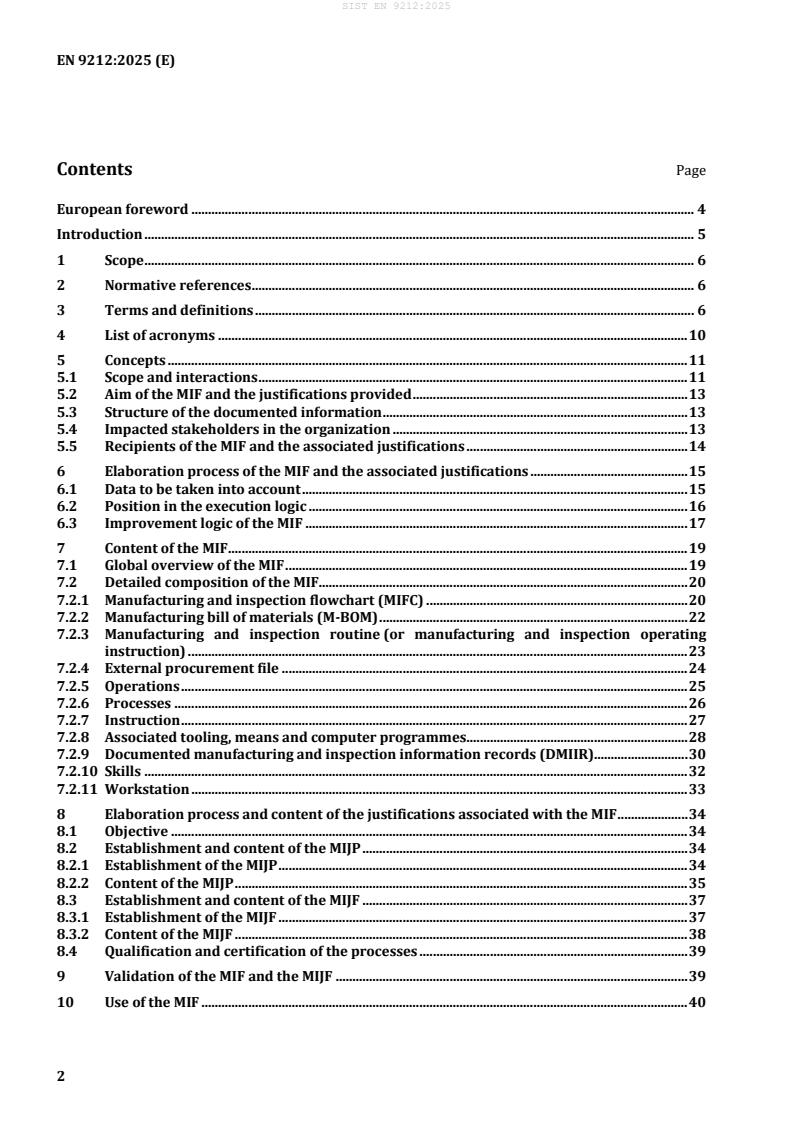
Contents Page
European foreword . 4
Introduction . 5
1 Scope . 6
2 Normative references . 6
3 Terms and definitions . 6
4 List of acronyms . 10
5 Concepts . 11
5.1 Scope and interactions . 11
5.2 Aim of the MIF and the justifications provided . 13
5.3 Structure of the documented information . 13
5.4 Impacted stakeholders in the organization . 13
5.5 Recipients of the MIF and the associated justifications . 14
6 Elaboration process of the MIF and the associated justifications . 15
6.1 Data to be taken into account . 15
6.2 Position in the execution logic . 16
6.3 Improvement logic of the MIF . 17
7 Content of the MIF . 19
7.1 Global overview of the MIF . 19
7.2 Detailed composition of the MIF. 20
7.2.1 Manufacturing and inspection flowchart (MIFC) . 20
7.2.2 Manufacturing bill of materials (M-BOM) . 22
7.2.3 Manufacturing and inspection routine (or manufacturing and inspection operating
instruction) . 23
7.2.4 External procurement file . 24
7.2.5 Operations . 25
7.2.6 Processes . 26
7.2.7 Instruction . 27
7.2.8 Associated tooling, means and computer programmes . 28
7.2.9 Documented manufacturing and inspection information records (DMIIR) . 30
7.2.10 Skills . 32
7.2.11 Workstation . 33
8 Elaboration process and content of the justifications associated with the MIF . 34
8.1 Objective . 34
8.2 Establishment and content of the MIJP . 34
8.2.1 Establishment of the MIJP . 34
8.2.2 Content of the MIJP . 35
8.3 Establishment and content of the MIJF . 37
8.3.1 Establishment of the MIJF . 37
8.3.2 Content of the MIJF . 38
8.4 Qualification and certification of the processes . 39
9 Validation of the MIF and the MIJF . 39
10 Use of the MIF . 40
11 Change of the MIF and the associated justifications . 40
Annex A (informative) Example of the presentation of a manufacturing and inspection
justification plan (MIJP) . 43
Annex B (informative) Example of the presentation of a manufacturing and inspection
justification file – MIJF . 44
Annex C (informative) Examples of justification works to be performed . 47
Annex D (informative) Example of the transformation of the definition bill of materials into a
manufacturing bill of materials according to the industrial organization . 50
Bibliography . 51
European foreword
This document (EN 9212:2025) has been prepared by ASD-STAN.
After enquiries and votes carried out in accordance with the rules of this Association, this document has
received the approval of the National Associations and the Official Services of the member countries of
ASD-STAN, prior to its presentation to CEN.
This document shall be given the status of a national standard, either by publication of an identical text
or by endorsement, at the latest by September 2025, and conflicting national standards shall be
withdrawn at the latest by September 2025.
Attention is drawn to the possibility that some of the elements of this document may be the subject of
patent rights. CEN shall not be held responsible for identifying any or all such patent rights.
According to the CEN-CENELEC Internal Regulations, the national standards organizations of the
following countries are bound to implement this document: Austria, Belgium, Bulgaria, Croatia, Cyprus,
Czech Republic, Denmark, Estonia, Finland, France, Germany, Greece, Hungary, Iceland, Ireland, Italy,
Latvia, Lithuania, Luxembourg, Malta, Netherlands, Norway, Poland, Portugal, Republic of North
Macedonia, Romania, Serbia, Slovakia, Slovenia, Spain, Sweden, Switzerland, Türkiye and the
United Kingdom.
Introduction
This document belongs to the documents supporting EN 9200 relating to the programme
management specification.
This document is written in accordance with the documentary system linked to EN 9200 and takes
account of the current and almost systematic interconnection between the manufacturing and
inspection activities of the product, in keeping with quality management practices.
The manufacturing and inspection file (MIF), and the associated justifications (MIJF), form part of the
output data of the industrialization process. They are intended mainly for actors of the production
process and provide the justifications required by the design and development processes, and by the
acquiring customer. They are elaborated by the actors of industrialization, in partnership with the
actors of development and production.
1 Scope
The aim of a MIF and the associated justifications is to ensure that manufacturing and/or inspection
operations are realized in a compliant and reproducible manner.
The purpose of this document is to provide a guide to the elaboration of the MIF and the associated
justifications by:
— positioning them within the framework:
o of a programme and its objectives, on the one hand;
o of the realization of a product, on the other;
— describing, until production of the product ceases:
o the principles and conditions applying to the elaboration and then the validation of the MIF
within the framework of the industrialization process;
o the principles and conditions applying to the elaboration and then the validation of the MIJF
associated with the MIF, within the framework of the industrialization process;
o the principles and change and control conditions applying to the MIF and the MIJF.
This document can be used for all processes or sets of processes implemented on a tangible product,
which may incorporate software associated with the product. It does not apply to purely software
product, commercial-off-the-shelf product (catalogue part) or service (intangible product).
This document applies more particularly to serial production. Nevertheless, the principles and
conditions set forth in this document may be applied, making any necessary adaptations, to unit
production or to the realization of products to meet development needs (prototypes,
demonstrators, etc.).
This document covers the MIF and the MIJF of a product, including the activities related to procurement
and the associated industrial means in particular.
2 Normative references
There are no normative references in this document.
3 Terms and definitions
For the purposes of this document, the following terms and definitions apply.
ISO and IEC maintain terminology databases for use in standardization at the following addresses:
— ISO Online browsing platform: available at https://www.iso.org/obp/
— IEC Electropedia: available at https://www.electropedia.org/
3.1
measurement systems analysis
study of the effects of selected elements of a measurement process (i.e. people, machines, tools,
methods, materials, environment) on accuracy, precision, and uncertainty of measurement
Note 1 to entry: Applicable MSA studies can be established by several methods [e.g. bias assessment, measuring
tools gage repeatability and reproducibility (Gage R&R), measurement uncertainty analysis].
Note 2 to entry: It should be demonstrated that all measurement and inspection methods included in the
inspection plan are suitable and able to respond to the pace of the customer’s request.
3.2
designer
physical or legal person responsible for the design of a product or service, as well as for the
development of the definition data file
3.3
inspection
activities such as measuring, examining, testing or calibrating one or more characteristics of a product
and comparing the results to the specified requirements (acceptance criteria) to determine whether
compliance is obtained for each of these characteristics
Note 1 to entry: The four typologies of inspection are:
— inspection: examination of a system or item against a specific criterion;
— analysis: assessment based on decomposition into simple elements;
— demonstration: method of proof of performance by observation;
— test: procedure to prove performance using stated objectives criteria with pass or fail result.
3.4
definition data file
structured set of documents formalizing the definition of a product
Note 1 to entry: The definition data file makes it possible to characterize the product and ensure the management
of its evolutions, to bring all the necessary data (requirements, characteristics, processes, etc.) in order to prepare
its manufacturing and inspection file (MIF) and its user and support documentation.
3.5
manufacturing and inspection file
set of elements and documented information materialising, in a structured way, the resources
necessary for the reproducible manufacturing and inspection process of a product in accordance with
its definition data file (DDF), as well as with industrial requirements and objectives
3.6
manufacturing and inspection justification file
document or file gathering evidence demonstrating that the MIF data meets the requirements of the
definition data file (DDF), the industrial performance objectives required internally or by the customer
and the producibility and reproducibility requirements
Note 1 to entry: The MIJF contributes to the qualification of the production system.
3.7
manufacturer
physical or legal person responsible for the industrialization, manufacturing of a product or for the
supply of a service
Note 1 to entry: The manufacturer may own the design and the definition. The manufacturer who owns the
definition is a “designer manufacturer”.
Note 2 to entry: The manufacturer can also be called supplier, external provider or industrial.
3.8
manufacturing
action to elaborate, realize, assemble, integrate and inspect a product from raw materials and/or
components, with resources and following processes described in the manufacturing and inspection
file (MIF)
3.9
industrialization
process, in relation to the design and production processes, which allows to:
— participate in the definition of the product in order to take into account the constraints of the
production system and the programme;
— design, realize and perfect the means and methods of production according to the product
definition;
— depending on the requirements and the industrial performance objectives, validate, qualify or
certify these means and methods;
— monitor, maintain and optimize the means and methods of production according to objectives
3.10
product logbook
documented information allowing the recording of the various data specific to each specimen of the
operational product during its use
Note 1 to entry: It allows to record successive technical events.
3.11
method
person, service or department responsible for defining, commissioning, maintaining all the means
(resources, tooling, documentation) necessary and sufficient for the realization and delivery of
a product
3.12
work order
documented information authorizing the launch of successive manufacturing and inspection operations
to be carried out to produce a part, a series of parts or a given batch of parts
Note 1 to entry: The performance of these operations is recorded in an associated log sheet.
3.13
process
sequence of correlated or interacting activities that transforms input elements into output elements
according to one or more defined objectives
3.14
production
process that covers the manufacturing and inspection of a product to be delivered to the
customer/acquirer, in accordance with the provisions of the manufacturing and inspection file (MIF)
Note 1 to entry: Industrialization supports production.
3.15
product
result of activities or processes
Note 1 to entry: Product categories can be services, hardware, software, processed materials, intermediate work
products from elementary activities, such as documents, models, etc.
Note 2 to entry: In the framework of a product developed to satisfy a customer's need, the processes involved are
the expression of the need, the establishment of the definition, the industrialization, and the production.
Note 3 to entry: The product can be either a final product to be delivered to a customer (aircraft, equipment, etc.)
or one of its constituents. In both cases, it represents the supply due under the contract.
3.16
qualification of a production system
process whose objective is to demonstrate that the production system fulfils the requirements specified
in the context of the realization of a product
Note 1 to entry: This qualification is based on the MIF and associated justifications.
Note 2 to entry: The qualification process is a process related to the customer or a third party appointed by the
customer, where appropriate.
3.17
individual inspection register
batch inspection register
document attached to a product item (IIR) or batch (BIR) and allowing to record at least the as-built
configuration of the product or batch and to pronounce acceptance
Note 1 to entry: Concerning the as-built configuration, see EN 9223-100 and EN 9223-103 relating to
configuration management.
Note 2 to entry: This documented information may contain other compliance elements required by the customer.
3.18
first article critical inspection
first article inspection
planned, complete, independent, and documented inspection and verification process to ensure that
prescribed production processes have produced a reproducible item compliant with the definition,
cycle time related to workflows, purchase order, technical specifications, and/or other applicable
design documents
Note 1 to entry: The first version of an FACI, called the initial FACI, corresponds to the production of a first part in
accordance with its definition and using serial production processes.
Note 2 to entry: The FACI qualifies the production system in its production phase at the required rate of serial
production.
3.19
production system
all the specific resources and technical data necessary for the supply, manufacture, assembly,
integration and inspection of product constituents in accordance with applicable requirements
3.20
product validation
process which demonstrates through objective evidence (results of inspections, measurements,
analysis, tests, etc.) that the product as designed fulfils the operational need in the intended operational
environment
Note 1 to entry: Validation activities may be carried out in a real or simulated operational environment.
Note 2 to entry: Product validation answers the question “Has the right product been built?”.
4 List of acronyms
BIR Batch inspection register
CDR Critical design review
DDF Definition data file
DJD Definition justification dossier
DJP Definition justification plan
DMIIR Documented manufacturing and inspection information records
E-BOM Engineering bill of materials
ERP Enterprise resource planning
FACI First article critical inspection
FMECA Failure modes, effects and criticality analysis
IADT Inspection, analysis, demonstration and test
IF Industrialization file
IIR Individual inspection register
M-BOM Manufacturing bill of materials
MI Manufacturing and inspection
MIF Manufacturing and inspection file
MIFC Manufacturing and inspection flowchart
MIJF Manufacturing and inspection justification file
MIJP Manufacturing and inspection justification plan
MES Manufacturing execution system
MRL Manufacturing readiness level
MSA Measurement systems analysis
NC Numerical control
(N)TS (Need) technical specification
PD Process descriptor
PHS&T Packaging – handling – storage – transport
PL Product logbook
PPAP Production part approval process
PPE Personal protective equipment
QHSE Quality, health, safety, environment
S-BOM Service bill of materials
SPC Statistical process control
WO Work order
5 Concepts
5.1 Scope and interactions
The industrialization process is closely linked to the design and production processes in order to be
able to identify and take account of, at the earliest possible stage of the product definition, the
requirements (contractual, regulatory authorities, etc.), the internal industrial strategies (production
capacity, make or buy, etc.) and the technological constraints (performance of the means of production,
compatibility of the processes, etc.).
The industrialization process begins right at the start of product design and continues as the definition
data file (DDF) progresses, as part of a concurrent engineering approach.
As a general rule, the industrialization of a product is prepared and realized in parallel and consistently
with the detailed design process.
For products with long procurement/manufacturing/factory assembly lead times, or for complex
products, and depending on their readiness level, it may be necessary to anticipate the industrialization
activities in order to meet the cost, deadline, capability, safety, performance and quality targets.
The risks incurred by this anticipation need to be analysed and managed as part of the programme.
The execution logic described below (see Figure 1) shows how the industrialization and production
system qualification processes interact with the development (expression of need, design, etc.) and
production processes.
Key
Review iMIF/iMIJF = intermediate
Customer/authority responsibility Establishment of the definition RG.Aero 000 14
Supplier responsibility Scope of EN 9212
Figure 1 — Processes interfaced with the industrialization process
NOTE A “finalized” file (DDF, MIF, etc.) is a file with a status that meets the internal requirements of the
organization and is submitted to the customer and/or the acceptance authority.
The industrialization process covers several aspects: the industrialization of the product itself, the
elaboration of the manufacturing and inspection file (MIF), the elaboration of the associated
justifications and the qualification of the production system.
The industrialization process of a product needs coordination with the product design process in terms
of methods, synchronization, participants, etc. It obeys the programme management rules and takes
account of the constraints and relations between the various industrialization programmes.
The MIF and the associated justifications [manufacturing and inspection justification plan (MIJP) and
manufacturing and inspection justification file (MIJF)] are elaborated by the manufacturer responsible
for supplying the product on the basis of the DDF (see RG.Aero 000 14).
The elements of the justifications may be analysed and validated, in part or in full, by a third party or by
the manufacturer itself, depending on the contractual, regulatory or internal requirements.
The qualification pronouncement, or equivalent, associated with the producibility and with the
production system is the result of this analysis and validation activity.
5.2 Aim of the MIF and the justifications provided
The MIF is a result of the industrialization process, with the MIJF, which contains the results of the
justification of the elements described in the MIF, on the basis of the MIJP, but also the responses to the
production system qualification needs.
The aim of the MIF and its associated justifications is to guarantee the production, compliance and
reproducibility of the product (in accordance with the DDF), while providing the necessary traceability
with regard to the regulatory and contractual requirements.
The MIF and its associated justifications constitute the reference framework of the production process
in a given industrial context (risk analysis and the associated decision making) and with objectives in
terms of quality, costs, rate and lead times (cycles), capability and safety.
5.3 Structure of the documented information
The MIF and its associated justifications contain all the associated information on the product realized
with regard to the DDF.
The identification of the MIF should contain the identification of the product.
Depending on the organization of the company, the contractual requirements and the constraints
applying to the realized products, the MIF and its associated justifications may be structured into
different parts in order to meet the various external or internal demands more easily. This approach
ensures that only the necessary information is sent to the customer.
NOTE In this case, the goal consists of conserving the knowledge and know-how of the supplier, which can be
open to audit by the customer, but not transmissible.
For each item of documented information, this structure can be used to define the expected objective,
which is characterized by a type file.
EXAMPLE These type files include: the installation and inspection file (IIF) or assembly and inspection
file (AIF), the installation and inspection justification file (IIJF) or assembly and inspection justification file (AIJF),
the manufacturing choices justification file (MIJF), the installation choices justification file (ICJF) or the assembly
choices justification file (ACJF), etc.
The associated justifications may be delivered to an inspection authority or the customer, in accordance
with the terms of the contract.
5.4 Impacted stakeholders in the organization
Figure 2 shows an example of a representation of all the stakeholders involved in the industrialization
process, and in particular in the elaboration of the constituent elements of the MIF and its associated
justifications.
Key
Processes Specialities
Scopes of responsibility Scope of information in the MIF
Functions Scope of information in the MIJF
Figure 2 — Map of the stakeholders that contribute to the industrialization process
5.5 Recipients of the MIF and the associated justifications
The MIF (in part or in full) is intended for:
— production planners, for the aspects related to the operating procedure;
— procurement/purchasing, because it characterizes the raw materials, constituents and
subcontracted products;
— workshop operators, in order to apply the implementing provisions for the manufacturing,
inspection or test operations;
— production support departments (methods, maintenance, quality, etc.), in order to implement the
provisions for controlling and/or monitoring processes, tooling and means of testing and
production;
— the organization’s quality department, because it contains the necessary information for the
various reviews and to control the activities.
It could be made available for the customer for consultation, according to the terms of the contract.
The associated justifications (in part or in full) are intended for:
— the customer, when it is a contractual requirement;
— the organization itself, when required by the organization’s internal procedures, in particular as
proof during technical events, proof of the initial first article critical inspection (initial FACI), etc.;
— the regulatory authorities (pyrotechnical safety, electrical safety, confidentiality, etc.).
The conditions applying to the disclosure of manufacturing and inspection data may be subject to
special contractual provisions (intellectual property, know-how or other regulatory restrictions, etc.).
The customer and the supplier reach an agreement on a selection of data that is necessary and sufficient
to exercise their activities, and, in this regard, the contract specifies the information to be exchanged
and the modes of access.
6 Elaboration process of the MIF and the associated justifications
6.1 Data to be taken into account
In order to be able to carry out the MIF and the associated justifications elaboration process, it is
necessary to perform a precise analysis of the following input data:
— the DDF (technical constraints, imposed processes, results of the product FMECA, the key
characteristics, etc.);
— the requirements of the (need) technical specification [(N)TS] of the customer related to
producibility and reproducibility (control of the production system);
— programme-related requirements (rates, management plan, contractual and regulatory obligations,
technical specifications and standards, costs, requirements related to the quality management
system, configuration management, etc.);
— strategy and industrial constraints:
o lessons learned from the preceding industrializations (know-how of the company);
o taking into account of the constraints and relations with other industrialization programmes in
progress (inspection of common resources, etc.);
o means, skills, methods, instructions and procedures, manufacturing and inspection facilities
and tooling, etc.;
o manufacturing readiness level (MRL) and control of the manufacturing processes to
be implemented;
o capability to maintain the production system in an operational condition;
— procurement strategy and constraints, suppliers and available means (imposed suppliers, single-
sourcing, obsolescence management, export control, etc.);
— regulatory constraints pertaining to security, safety, the environment, health, etc.
The relative importance of each item of input data varies according to the kind of product.
6.2 Position in the execution logic
The elaboration logic of the MIF and its associated justifications needs programme-wide
synchronization that is consistent with the elaboration of the DDF at its different maturity levels [linked
to the milestones of the execution plan (see RG.Aero 000 41)]. This logic allows a gradual construction
of the demonstration of the producibility and reproducibility, between what is planned (DDF) and what
is realized (physical output of the MIF), while taking account of the enablers (production system,
support system) and the necessary stakeholders points of view of the that take part in the activities.
NOTE For details of the support system aspects, see RG.Aero 000 76.
This approach is incorporated in the various phases of the industrialization logic (Figure 3).
Figure 3 — Industrialization logic
The industrialization logic follows an iterative approach that is structured in phases and steps
corresponding to the expected MRLs:
— during the development of the industrialization, co-engineering (design/industrialization) enables
the industrial means of the production system to be deployed to be specified and planned;
— in phase 1 – step 1, the procurement of the means of production, the deployment and adjustment of
the production system, as the taking into account of the associated support system requirements
(including training), are realized. At the end of this period, the DDF of the product is imperatively
validated and the production system can demonstrate producibility;
NOTE Long procurement lead times can be initiated at the end of step 1.
— in phase 1 – step 2, samples are manufactured using processes representative of the serial
production processes. This realization allows to validate the producibility of the product and the
capability of the production system and the associated support system to realize the product;
— in phase 2, the serial production of the product is launched (reproducible product).
The optimization of the production system and its support system is sought in order to achieve the
expected production objectives;
— the last phase, during serial production, allows to ensure the maintenance and continual
improvement of the production system.
This elaboration is validated in successive reviews of the constituent elements of the MIF.
6.3 Improvement logic of the MIF
The following flowchart (Figure 4) shows the various steps of the elaboration of the MIF and its
associated justifications, from its initialization to its validation.
Figure 4 — Elaboration process for the MIF — Project perspective
The elaboration logic of the MIF and its associated justifications follow the industrialization logic.
Consequently, it is necessary to structure three aspects of the elaboration logic of the MIF:
— the strategy to be implemented: this first aspect related to steering needs the elaboration of an
industrialization plan that provides to all the resources working on the programme a coherent
vision of the necessary synchronization between the DDF, the MIF and the MIJF, and also between
the production activities. The definition of this implemented strategy is in general formally laid
down in an industrialization plan. The production plan (see RG.Aero 000 43) is usually launched in
parallel, in order to guarantee industrialization/production consistency. This strategy is updated
and fine-tuned during the phases/steps of the industrialization logic. The industrialization and/or
production plans are updated during the design phase in order to take account of design-
related events;
— the elements linked to the content of the MIF: this second aspect is related to the content of the MIF
and is built gradually, directly in line with the readiness level maturity of the various versions of
the DDF and the aspects related to the production system. This logic is described in 6.3;
— the justification elements of the MIF: this third aspect is related to the content of the MIJP and the
MIJF, which are prepared in parallel, and its construction is directly related to the maturity of the
various versions of the MIF.
In order to control each production elementary process, a file is established at each level of the
production breakdown structure where a constituent part is to be realized by taking account of
the interfaces.
7 Content of the MIF
7.1 Global overview of the MIF
Figure 5 shows a typical breakdown structure of the constitutive elements of an MIF, which are
described in detail in the following paragraphs. In addition to the hierarchical links, transverse
interactions exist between each element.
This typical breakdown structure is designed at a given article level (industrial scope), in correlation
with the breakdown structure of the DDF and according to the complexity of the product, the
contractual terms, etc.
Figure 5 — Typical breakdown structure of the elements of the MIF
The complexity of the constitutive elements of the MIF and its justifications may vary, depending on the
kind of product in question, on the one hand, and on the stage of elaboration of the
product (development, pre-series or serial production) on the other.
The content of the MIF takes account of “functions” lessons learned and of the structure of the available
information systems.
7.2 Detailed composition of the MIF
7.2.1 Manufacturing and inspection flowchart (MIFC)
The MIFC (see Table 1) is a graphic breakdown of the DDF from the perspective of industrialization that
is used to share and collectively understand the cycle of the product production process in order to
make sure that the contractual requirements are taken into account correctly.
Table 1 — Manufacturing and inspection flowchart
Aim: The MIFC materializes the manufacturer’s (industrialization Owner: Users:
team) thinking on the optimized sequence of the manufacturing and
Industrialization Methods
inspection steps, for a given level of production, in response to the
manager
Quality assurance
various requirements.
Procurement manager
Designer
Input and opportunities:
Technical data:
• product DDF: design office/design authority;
• industrial requirements (production costs, reliability, cycle, constraints of the production scheme): programme team;
• industrial policy: company (make or buy, internal standard, purchasing policy, quality policy, etc.);
• normative (e.g. special processes) and regulatory environment;
• contractual requirements: customer demands (e.g. industrial scheme).
Opportunities: contextual parameters/industrial environment (partnerships, etc.).
Transformations:
Following the thinking of the industrialization (compromise between requirements/capacities), the MIFC allows to view
the optimized sequence of the manufacturing steps (meeting the cost, quality and deadline objectives).
It allows to validate the consistency with the DDF, in particular with regard to the checkpoints and forms a link between
the definition and the chosen manufacturing process.
In the event of subcontracting, it constitutes fundamental input data for the teams in order to break down the
requirements in the associated documents.
Output and interfaces:
Flowchart that specifies the following for the different realization teams:
• the chronology of the manufacturing steps with the references of the main documents, if necessary;
• the logic of the steps and the characteristics (including the key characteristics) of the associated internal/external
inspections;
• all the critical information on the sustainability of this manufacturing process.
And it also includes, in the MIFC or an associated document:
• the “industrial breakdown” and the production breakdown structure (make or buy, imposed suppliers, etc.), including
the configuration items and the parameters (key characteristics, for example).
Formalization:
In the form of a “standardized” chronological synoptic/flowchart, with symbolic representations of the manufacturing
steps and the checkpoints/self-checks.
This synoptic can be broken down into several levels or several scopes, while totally covering the product.
Best practices:
• it is produced together with the MIJP: it is implemented right from the detailed design phase as part of the co-
engineering process (managed during the successive project reviews): entry point of the IF;
• it forms the link between production and the design offices (it is used as a link to manage reciprocal impacts in the
event of changes);
• it is elaborated collaboratively by the various methods departments and forms part of the IF;
• it is elaborated in accordance with the definition breakdown structure, in particular for technical change management
aims, while also taking the industrial constraints into account;
• validation is reached during the co-signatory final industrial validation, e.g.: manufacturer, quality, designer, RAMS;
• it is requested from subcontractors;
• it is maintained when a change (in the definition, technical, organizational, etc.) so requires, as part of the updating of
the MIF;
• in cases of multiple sources, there are several MIFCs.
At the start of industrialization, it is the risk analysis that identifies the processes to be monitored particularly closely in
order to realize the product (key characteristics, etc.).
The level of detail and formalization of the MIFC is defined according to the complexity of the process, the customer’s
requirements, etc. It may be limited to the manufacturing routine. By way of example, RC.Aero 003 40 may be consulted.
SIST
...