

SIST EN 62552-2:2020
(Main)Household refrigerating appliances - Characteristics and test methods - Part 2: Performance requirements
General Information
- Abstract
IEC 62552-2:2015 specifies the essential characteristics of household refrigerating appliances cooled by internal natural convection or forced air circulation, and specifies test methods for checking the characteristics.
This part of IEC 62552 describes the methods for the determination of performance requirements. Although there is some commonality in the set-ups for different tests (and so it may be an advantage to apply them all to one sample), these are separate tests to evaluate specific characteristics of the sample being tested. This part of IEC 62552 does not specify a procedure to generalise the results from sample test results to a prediction of the characteristics of the whole population from which that sample was selected.
IEC 62552-1, IEC 62552-2 and IEC 62552-3 cancel and replace the first edition of IEC 62552 published in 2007. IEC 62552-1, IEC 62552-2 and IEC 62552-3 together constitute a technical revision and include the following significant technical changes with respect to IEC 62552:2007:
- A cooling capacity test has been added in Part 2 (this part).
- A pull-down test has been added in Part 2 (this part).
- Performance tests have been added for wine storage appliances in Part 2 (this part).
- Status
- Published
- Publication Date
- 10-May-2020
- Technical Committee
- FGA - Consumer information related to household electrical appliances
- Current Stage
- 6060 - National Implementation/Publication (Adopted Project)
- Start Date
- 05-May-2020
- Due Date
- 10-Jul-2020
- Completion Date
- 11-May-2020



Overview
EN 62552-2:2020 - Household refrigerating appliances: Performance requirements - is the CLC-adopted European version of IEC 62552-2:2015 (modified). It defines essential characteristics and test methods for household and similar refrigerating appliances cooled by natural convection or forced air. Part 2 focuses on methods to determine performance requirements (storage, freezing, cooling and related tests) and aligns with EU ecodesign and energy labelling Regulations (EU) 2019/2019 and 2019/2016.
Key topics and requirements
- Scope and purpose
- Specifies performance test methods for domestic refrigerators, freezers, fridge-freezers and similar appliances.
- Tests are defined per compartment and climate class; results apply to the tested sample (no statistical extrapolation to a population).
- Performance tests included
- Storage test - procedures for loading, thermal equilibration and verifying compartment storage temperatures (detailed package placement rules and M-package counts per chill-volume are specified).
- Freezing capacity test - measures time to freeze a +25 °C “light load” to −18 °C (used to determine four-star freezer rating).
- Cooling capacity and pull-down tests - added in this revision to evaluate cooling power and time-to-temperature under defined conditions.
- Wine storage performance - dedicated test parameters added for wine storage appliances.
- Airborne acoustical noise - normative reference to EN 60704-2-14 for refrigerator noise measurement (added clause Z1).
- Test set-up and load
- Thermal storage devices and M-packages must be positioned per manufacturer instructions or removed if dedicated positions are absent.
- Chill compartment loading is volume-based (e.g., V < 10 L -> 2 M-packages; V ≥ 80 L -> 10 M-packages), with explicit placement order and spacing rules.
- Harmonization and modifications
- EN 62552-2:2020 amends the IEC text for European application and includes annexes linking to EU ecodesign and energy labelling requirements.
Practical applications and users
- Product manufacturers for design verification and performance claims
- Independent test laboratories performing compliance and certification testing
- Conformity assessment bodies and notified bodies assessing ecodesign/energy-labelling compliance
- Regulatory authorities and procurement teams specifying performance criteria for domestic refrigeration
- R&D teams validating cooling capacity, pull-down, freezing and wine-storage performance
Related standards
- EN 62552-1:2020 (general definitions, symbols and test gear)
- EN 62552-3:2020 (energy consumption and specific tests)
- EN 60704-2-14 (airborne acoustical noise for refrigerators)
Keywords: EN 62552-2:2020, household refrigerating appliances, performance requirements, freezing capacity test, storage test, pull-down test, wine storage, ecodesign, energy labelling, test methods.
Relations
- Effective Date
- 01-Jun-2020
- Effective Date
- 28-Jan-2023
- Effective Date
- 03-Feb-2026
- Effective Date
- 03-Feb-2026
- Effective Date
- 03-Feb-2026
- Effective Date
- 26-Jul-2021
Frequently Asked Questions
SIST EN 62552-2:2020 is a standard published by the Slovenian Institute for Standardization (SIST). Its full title is "Household refrigerating appliances - Characteristics and test methods - Part 2: Performance requirements". This standard covers: IEC 62552-2:2015 specifies the essential characteristics of household refrigerating appliances cooled by internal natural convection or forced air circulation, and specifies test methods for checking the characteristics. This part of IEC 62552 describes the methods for the determination of performance requirements. Although there is some commonality in the set-ups for different tests (and so it may be an advantage to apply them all to one sample), these are separate tests to evaluate specific characteristics of the sample being tested. This part of IEC 62552 does not specify a procedure to generalise the results from sample test results to a prediction of the characteristics of the whole population from which that sample was selected. IEC 62552-1, IEC 62552-2 and IEC 62552-3 cancel and replace the first edition of IEC 62552 published in 2007. IEC 62552-1, IEC 62552-2 and IEC 62552-3 together constitute a technical revision and include the following significant technical changes with respect to IEC 62552:2007: - A cooling capacity test has been added in Part 2 (this part). - A pull-down test has been added in Part 2 (this part). - Performance tests have been added for wine storage appliances in Part 2 (this part).
IEC 62552-2:2015 specifies the essential characteristics of household refrigerating appliances cooled by internal natural convection or forced air circulation, and specifies test methods for checking the characteristics. This part of IEC 62552 describes the methods for the determination of performance requirements. Although there is some commonality in the set-ups for different tests (and so it may be an advantage to apply them all to one sample), these are separate tests to evaluate specific characteristics of the sample being tested. This part of IEC 62552 does not specify a procedure to generalise the results from sample test results to a prediction of the characteristics of the whole population from which that sample was selected. IEC 62552-1, IEC 62552-2 and IEC 62552-3 cancel and replace the first edition of IEC 62552 published in 2007. IEC 62552-1, IEC 62552-2 and IEC 62552-3 together constitute a technical revision and include the following significant technical changes with respect to IEC 62552:2007: - A cooling capacity test has been added in Part 2 (this part). - A pull-down test has been added in Part 2 (this part). - Performance tests have been added for wine storage appliances in Part 2 (this part).
SIST EN 62552-2:2020 is classified under the following ICS (International Classification for Standards) categories: 97.040.30 - Domestic refrigerating appliances. The ICS classification helps identify the subject area and facilitates finding related standards.
SIST EN 62552-2:2020 has the following relationships with other standards: It is inter standard links to SIST EN 62552:2013, SIST EN 62552:2013, SIST EN 62552-3:2020, SIST EN 60704-2-14:2013, SIST EN 62552-1:2020, SIST EN 62552-2:2020/A11:2024. Understanding these relationships helps ensure you are using the most current and applicable version of the standard.
SIST EN 62552-2:2020 is associated with the following European legislation: EU Directives/Regulations: 2019/2016, 2019/2019; Standardization Mandates: M/586. When a standard is cited in the Official Journal of the European Union, products manufactured in conformity with it benefit from a presumption of conformity with the essential requirements of the corresponding EU directive or regulation.
SIST EN 62552-2:2020 is available in PDF format for immediate download after purchase. The document can be added to your cart and obtained through the secure checkout process. Digital delivery ensures instant access to the complete standard document.
Standards Content (Sample)
SLOVENSKI STANDARD
01-junij-2020
Nadomešča:
SIST EN 62552:2013
Gospodinjski hladilni aparati - Značilnosti in preskusne metode - 2. del: Zahtevane
lastnosti
Household refrigerating appliances - Characteristics and test methods - Part 2:
Performance requirements
Haushaltskühlgeräte - Eigenschaften und Prüfverfahren - Teil 2: Leistungsanforderungen
Appareils de réfrigération à usage ménager - Caractéristiques et méthodes d'essai -
Partie 2: Exigences de performances
Ta slovenski standard je istoveten z: EN 62552-2:2020
ICS:
97.040.30 Hladilni aparati za dom Domestic refrigerating
appliances
2003-01.Slovenski inštitut za standardizacijo. Razmnoževanje celote ali delov tega standarda ni dovoljeno.
EUROPEAN STANDARD EN 62552-2
NORME EUROPÉENNE
EUROPÄISCHE NORM
April 2020
Supersedes EN 62552:2013 (partially) and all of its
ICS 97.030 amendments and corrigenda (if any)
English Version
Household refrigerating appliances - Characteristics and test
methods - Part 2: Performance requirements
(IEC 62552-2:2015 , modified)
Appareils de réfrigération à usage ménager - Haushaltskühlgeräte - Eigenschaften und Prüfverfahren -
Caractéristiques et méthodes d'essai - Partie 2: Exigences Teil 2: Leistungsanforderungen
de performances (IEC 62552-2:2015 , modifiziert)
(IEC 62552-2:2015 , modifiée)
This European Standard was approved by CENELEC on 2020-02-24. CENELEC members are bound to comply with the CEN/CENELEC
Internal Regulations which stipulate the conditions for giving this European Standard the status of a national standard without any alteration.
Up-to-date lists and bibliographical references concerning such national standards may be obtained on application to the CEN-CENELEC
Management Centre or to any CENELEC member.
This European Standard exists in three official versions (English, French, German). A version in any other language made by translation
under the responsibility of a CENELEC member into its own language and notified to the CEN-CENELEC Management Centre has the
same status as the official versions.
CENELEC members are the national electrotechnical committees of Austria, Belgium, Bulgaria, Croatia, Cyprus, the Czech Republic,
Denmark, Estonia, Finland, France, Germany, Greece, Hungary, Iceland, Ireland, Italy, Latvia, Lithuania, Luxembourg, Malta, the
Netherlands, Norway, Poland, Portugal, Republic of North Macedonia, Romania, Serbia, Slovakia, Slovenia, Spain, Sweden, Switzerland,
Turkey and the United Kingdom.
European Committee for Electrotechnical Standardization
Comité Européen de Normalisation Electrotechnique
Europäisches Komitee für Elektrotechnische Normung
CEN-CENELEC Management Centre: Rue de la Science 23, B-1040 Brussels
© 2020 CENELEC All rights of exploitation in any form and by any means reserved worldwide for CENELEC Members.
Ref. No. EN 62552-2:2020 E
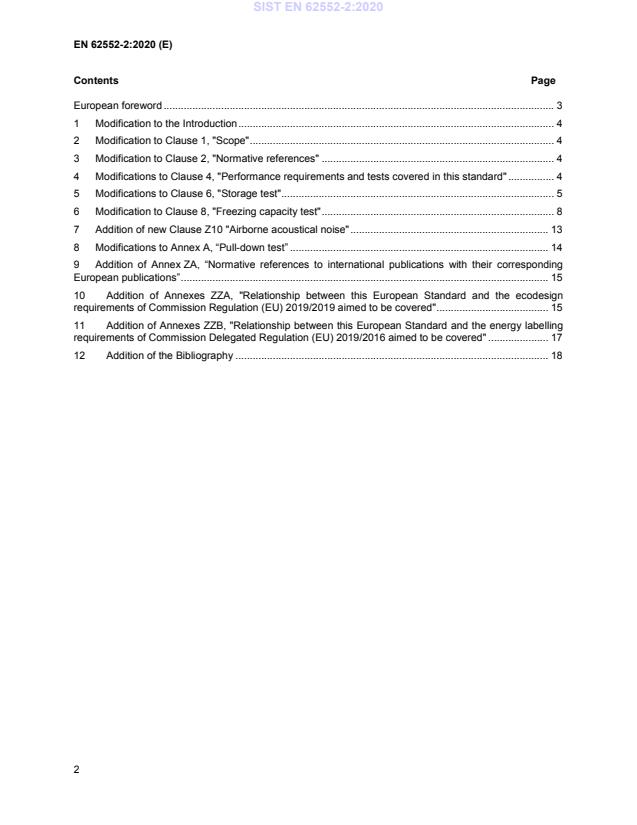
Contents Page
European foreword . 3
1 Modification to the Introduction . 4
2 Modification to Clause 1, "Scope" . 4
3 Modification to Clause 2, "Normative references" . 4
4 Modifications to Clause 4, "Performance requirements and tests covered in this standard" . 4
5 Modifications to Clause 6, "Storage test" . 5
6 Modification to Clause 8, "Freezing capacity test" . 8
7 Addition of new Clause Z10 "Airborne acoustical noise" . 13
8 Modifications to Annex A, “Pull-down test” . 14
9 Addition of Annex ZA, “Normative references to international publications with their corresponding
European publications” . 15
10 Addition of Annexes ZZA, "Relationship between this European Standard and the ecodesign
requirements of Commission Regulation (EU) 2019/2019 aimed to be covered" . 15
11 Addition of Annexes ZZB, "Relationship between this European Standard and the energy labelling
requirements of Commission Delegated Regulation (EU) 2019/2016 aimed to be covered" . 17
12 Addition of the Bibliography . 18
European foreword
This document (EN 62552-2:2020) consists of the text of IEC 62552-2:2015 prepared by IEC/TC 59
“Performance of household and similar electrical appliances”, together with the common modifications
prepared by CLC/TC 59X “Performance of household and similar electrical appliances”.
The following dates are fixed:
• latest date by which this document has (dop) 2021-02-24
to be implemented at national level by
publication of an identical national
standard or by endorsement
• latest date by which the national (dow) 2023-02-24
standards conflicting with this document
have to be withdrawn
This standard in combination with standards EN 62552-1:2020 and EN 62552-3:2020 will supersede
EN 62552:2013.
This standard shall be read in combination with standards EN 62552-1:2020 and EN 62552-3:2020
a) scope is enlarged with respect to similar refrigerating appliances;
b) Table 1 and Clauses 6.3.2.1 and Clause 8 were modified completely;
c) Clause Z1 on airborne acoustical noise was added.
Clauses, subclauses, notes, tables, figures and annexes which are additional to those in IEC 62552-2:2015
are prefixed “Z”.
Attention is drawn to the possibility that some of the elements of this document may be the subject of patent
rights. CENELEC shall not be held responsible for identifying any or all such patent rights.
This document has been prepared under Standardization Request M/459 given to CENELEC by the
European Commission and the European Free Trade Association, and supports essential requirements of
EU Directive(s).
Endorsement notice
The text of IEC 62552-2:2015 was approved by CENELEC as a European Standard with agreed common
modifications.
1 Modification to the Introduction
Add the following paragraph:
"This standard was developed in relationship with Regulations (EU) 2019/2016 of 11.3.2019 on energy
labelling and (EU) 2019/2019 of 1.10.2019 on ecodesign for refrigerating appliances"
2 Modification to Clause 1, "Scope"
Replace the first paragraph with the following:
"This part of EN 62552 specifies the essential characteristics of household and similar refrigerating
appliances cooled by internal natural convection or forced air circulation, and establishes test methods for
checking these characteristics"
3 Modification to Clause 2, "Normative references"
Add the following reference:
"EN 60704-2-14, Household and similar electrical appliances — Test code for the determination of airborne
acoustical noise — Part 2-14: Particular requirements for refrigerators, frozen food storage cabinets and
food freezers"
4 Modifications to Clause 4, "Performance requirements and tests covered in
this standard"
In 4.7, "Test summary", Replace Table 1 with the following:
"
Table 1 — Performance test summary
Temperature
Clause / Pantry
Fresh 1 and 3 and requirement
Annex Ambient and Chill zero star
food 2 star 4 star s after test
and Test cellar
has started
1 star: Type a
Packages No Type b No
Other: Type a
Clause 6 To hold initial
Various
or b
Storage
values
Initial temp Mean Instant Mean Max
Packages No Type b No No No
Clause 7
For test load
Cooling 25 °C
+4 °C ± Maximum/ Average/
final only
Initial temp Table 2 Table 2
capacity
0,5 K minimum minimum
M-packages only
Packages Type b No Type a
Clause 8
Type b
Yes excursion
Freezing 25 °C
and final
capacity Not
Initial temp Table 2 Maximum/minimum
measured
Temperature
Clause / Pantry
Fresh 1 and 3 and requirement
Annex Ambient and Chill zero star
food 2 star 4 star s after test
and Test cellar
has started
Clause 9 Packages No
Auto ice- 25 °C No
Initial temp As for Table 2 Maximum/minimum
making
Packages No
Annex A
Max Final only
Pull-down
Initial temp Maximum temperature according climate class rating
No
Packages Type b No Type a
For –18 °C
Annex C
compartment
25 °C
Temp rise
s only
Initial temp Not specified –18 °C
25 °C for Packages No
Annex D
SN and N To hold initial
Conden-
32 °C for values
Initial temp ≤ energy test temperatures as in Table 1 in IEC 62552-3:2015
sation
ST and T
NOTE 1 For definitions of symbols, see 3.7 in EN 62552-1.
NOTE 2 In the event of any discrepancy between data in this Table and the individual test procedures, the test procedures take
precedence.
NOTE 3 Wine storage test parameters are specified in Annex B.
"
Replace footnote b of Table 2 with the following:
"b
During a defrost and recovery period, these storage temperatures of frost-free refrigerating
appliances are permitted to rise by no more than 3 K with respect to the storage temperature during period
S (see 6.4). The storage temperature is defined as the maximum temperature of any M-package during a
given time period. (See Figure 3.)"
Add the NOTE Z1 in Table 2:
"NOTE Z1 Chill compartment shall be in compliance with the verification test available in Annex ZA
“Chill compartment temperature control test” of EN 62552-3."
5 Modifications to Clause 6, "Storage test"
In 6.1, "Objective", replace the third paragraph with:
"To meet these test requirements, there shall be, for any ambient temperature between and including the
minimum and maximum ambient temperature defined by the rated climate class, at least one control setting
at which all compartments meet the specified internal temperatures. The control(s) however, may be
adjusted for testing at different ambient temperatures."
In 6.2, "Preparation of refrigerating appliance", replace the sixth paragraph with:
"Thermal storage devices shall be placed in the dedicated positions in the respective compartments,
according to the manufacturer’s instructions and shall be independent of location of packages. Instructions
for loose placement of thermal storage devices in the appliance do not define dedicated positions.
NOTE 1 Instructions without specific indication of location or placement of thermal storage device is an example of
loose placement
If dedicated positions are absent, the thermal storage devices shall be removed from the compartment.
The unloaded refrigerating appliance should be set up and operated until it has reached equilibrium at, or
close to, the temperatures specified in Table 2.
The unloaded refrigerating appliance should be set up and operated until it has reached equilibrium at, or
close to, the temperatures specified in Table 2."
Replace subclause 6.3.2.1, "General" with the following:
"All test packages and M-packages shall be as specified in Clause C.2 b) of EN 62552-1:2019.
For determining the storage temperature of any chill compartment, the storage load shall be in
accordance with 6.3.2.2.
The temperatures of the chill compartment T are the instantaneous temperatures of each M-package
cci
in that compartment. The temperatures and conditions specified in Table 2 shall apply.
All test packages and M-packages shall be positioned or suspended so that their largest surface is
horizontal. They may be positioned directly on the floor of the compartment or drawer but shall always be
at least 25 mm away from all walls and ceilings and from the other packages of the test load. The test
packages and M-packages shall be positioned as far as possible in the corners of the compartment and at
two vertical levels:
A) Bottom level, which is the lowest horizontal surface intended for storage
B) Top level, where the packages have 25 mm clearance from the compartment ceiling. Supports can be
used to position the packages.
Loading of packages shall be in the following order:
1. Front left corner of the bottom level
2. Back right corner of the top level
3. Front right corner of the top level
4. Left back corner of the bottom level
5. Front left corner of the top level
6. Back right corner of the bottom level
7. Front right corner of the bottom level
8. Left back corner of the top level
9. Centre of the bottom level
10. Centre of the top level
Loading shall start using M-packages, up to the amount specified in Table 3. After the last M-package,
normal test packages shall be loaded until the total number of packages is reached.
If a package cannot be placed according to the required order, its position shall be skipped and the number
of packages shall be reduced. The number of M-packages shall not be reduced.
In the case of a compartment with special subdivisions (shelves, etc.) which are part of the design, if the
dimensions are too small to allow the horizontal positioning of the M-packages, it is permissible to position
them vertically.
If the dimensions are too small to accommodate an M-package (for example in door shelves), a special
support shall be used to position the M-package next to the shelf and as close as possible to the door liner."
Replace subclause 6.3.2.2, "Chill compartment storage load" with the following:
"The compartment shall be loaded with the number of packages specified in Table 3.
Table 3 — Chill compartment storage load
Volume, V, of chill compartment Total number of M-packages
[l] packages
V < 10
2 2
10 ≤ V < 20 3 2
20 ≤ V < 30 4 2
30 ≤ V < 40 5 3
40 ≤ V < 50 6 3
50 ≤ V < 60 7 4
60 ≤ V < 70 8 4
70 ≤ V < 80 9 5
V ≥ 80 10 5
"
In 6.3.3.3.1, "General" replace the last paragraph of bullet point c) with:
"Surfaces intended for storage with ribs, depressions, slight inclinations (lower than 8 degree), etc. are
treated as horizontal surfaces. If necessary, packers may be used to stabilize stacks.
NOTE 1 Inclinations of less than 15 mm per 100 mm, which equals the width or length of a test package, are
considered slight inclinations."
In 6.4.2, "Details" replace Table 4 with:
"
Table 4 – Requirements for periods S and E
Are there With more than one
Without With only one defrost
temperatu defrost control cycles
Item defrost control cycle starting
re control starting within a 24 h
control cycles within a 24 h test
cycles? test
No Each period shall be at least 3 h long
Length of
periods S
Each period shall consist of the same integral number of temperature
Yes
and E
control cycles totalling not less than 3 h.
Location No
Any convenient Period S ends just before a defrost and recovery
of period
time period begins.
Yes
S
Are there With more than one
Without With only one defrost
temperatu defrost control cycles
Item defrost control cycle starting
re control starting within a 24 h
control cycles within a 24 h test
cycles? test
Period E ends just before
Period E ends at least 24
the first defrost and
Period E ends
h after period S begins
recovery period that
at least 24 h
No and before the beginning
begins after 24 h after the
after period S
of the next defrost and
start of period S
begins
recovery period
Period E ends
Location
Period E ends with the
Period E ends with the
with the
of period
conclusion of a
conclusion of the last
conclusion of a
E
temperature control
temperature control cycle
temperature
cycle that is in progress
completed before the first
control cycle
Yes at least 24 h after period
defrost and recovery
that is in
S begins and before the
period that begins after 24
progress at
beginning of the next
h after the start of period S
least 24 h after
defrost and recovery
the beginning
period
of period S
"
In 6.4.2, "Details" replace Figure 3 with:
"
Figure 3 — Storage test sequence illustration
”
6 Modification to Clause 8, "Freezing capacity test"
Replace all of Clause 8 with the following:
"8.1 Objective
The purpose of this test is to measure the freezing capacity of freezer compartment(s) by adding warm
test packages (the light load) into the compartment. If the freezing capacity is greater than, or equal to,
the specified minimum capacity (see 8.4.3), the compartment(s) may be rated as a four-star
compartment(s).
8.2 Method overview
Apart from space for the light load, ballast packages are loaded into the frozen compartment(s) as for the
storage test (Clause 6). The refrigerating appliance is operated until temperatures are stable and in
compliance with Table 2. Then a load of packages at +25 °C is added. This is the so-called light load
representing a food load to be processed. The time to freeze this load to –18 °C is measured. When this
can be achieved in no more than 24 h and other maximum temperature-excursion conditions are met, a
four-star compartment rating may be claimed.
NOTE 1 Because the frozen compartment loading is largely the same as for the storage test, there might be an
advantage in doing these tests consecutively.
8.3 Set-up procedure
8.3.1 Ambient temperature
The ambient temperature shall be 25 °C (see A.3.2.3 of EN 62552-1:2019).
8.3.2 Preparation of the refrigerating appliance
8.3.2.1 General
The refrigerating appliance shall be installed according to Annex B of EN 62552-1:2019.
If the configuration of the refrigerating appliance can be changed by the user the configuration with the
greatest volume at the lowest temperatures shall be used for this test.
Refrigerating appliances with anti-condensation heater(s) which are permanently on during normal use
shall be tested with the heater(s) operating.
Anti-condensation heaters which can be manually controlled by the user shall be switched on and, if
adjustable, they shall be set at their maximum heating rate.
Anti-condensation heaters which are automatically controlled shall be allowed to operate normally.
Thermal storage devices shall be placed in the dedicated positions in the respective compartments,
according to the manufacturer’s instructions and shall be independent of location of packages. Instructions
for loose placement of thermal storage devices in the appliance do not define dedicated positions.
NOTE Z1 Instructions without specific indication of location or placement of thermal storage device is an example of
loose placement.
If dedicated positions are absent, the thermal storage devices shall be removed from the compartment.
The unloaded refrigerating appliance should be set up and operated until it has reached equilibrium at, or
close to, the temperatures specified in Table 2.
8.3.2.2 Measurement of temperature of chill compartment and all compartments operating above
0 °C
During the test, the chill compartment temperature is not measured, but it shall be loaded with test
packages as for the storage temperature measurement (see 6.3.2). For determining the storage
temperature of the compartments normally operating above 0 °C, measurement points shall be as per
Annex D of EN 62552-1:2019 but with M-packages used instead of cylinders.
8.3.3 Loading of refrigerating appliance
8.3.3.1 Frozen compartment(s) – ballast load
8.3.3.1.1 General
Apart from space for the light load in the appropriate –18 °C compartment(s), ballast packages are
brought to the approximate compartment temperatures and loaded into the frozen compartment(s) as for
the storage test (Clause 6).
A load stack comprises one or more load packages.
In the –18 °C compartment(s), ballast load may be removed to accommodate the light load with the
following constraints:
a) The minimum amount of stacks shall be removed
b) The height of a light load stack shall be 2 packages with the following exceptions:
1. if the light load is to be composed of an odd number of packages, then one light load stack of 1
package is allowed;
2. if the ballast load to be removed only exists out of stacks of 1 package, these shall be replaced
with light load stacks of 1 package;
3. if the ballast load stack to be removed contains 6 or more packages, then it shall be replaced with
a light load stack of half the number of packages in the ballast load stack (rounded down).
c) The minimum ballast load is 1 M-package
d) Light load packages shall be placed flat
e) Light load positioning shall take into account the instructions regarding the location to be used for
freezing. If no instructions are given, the packages shall be placed such that they are likely to be frozen
as rapidly as possible.
f) Light load packages shall be separated by at least 15 mm from ballast load packages. The use of
spacers between adjacent stacks of packages is permitted, but other spacing methods are not (see
6.3.3.2).
If the instructions indicate that there is a separate section for freezing food, this section shall be used for the
light load.
8.3.3.1.2 M-package placement in the ballast load to accommodate the light load
The M-packages in the ballast load shall be located as for the storage test apart from any locations that
are disrupted by the need to leave space for the light load. In that case, the M-packages shall be placed in
the nearest equivalent position to that specified for the storage test and the new positions recorded. If there
are stacks of ballast load packages beside the light load an M-package shall also replace the top test
package in at least one of those stacks on each side of the light load. If there is ballast load above the
light load an M-package shall replace a test package in the centre of the layer immediately above the light
load. If there is ballast load below the light load an M-package may replace a test package in the centre
of the layer immediately below the light load.
8.3.3.2 Refrigerating appliances with separate three-star compartment
If a refrigerating appliance has a separate three-star compartment with its own external access door or
lid, and the instructions recommend that, before freezing, frozen food already in storage be placed in that
compartment while leaving space in the freezer compartment to receive the load for freezing (i.e. the
three-star compartment is to be regarded as an extension of the freezer compartment), a freezing time
claim based upon this method of use is permissible, provided that:
a) when tested according to this method of use, the claimed freezing time is confirmed and the
temperature requirements for the other compartments (see 8.5 a) to g)), if applicable, are fulfilled
during the freezing capacity test, and
b) the light load used in the freezer compartment is at least equivalent to 3,5 kg/100 l of the combined
volumes of the freezer compartment and three-star compartment.
8.4 Test procedure
8.4.1 Starting conditions
After all relevant control devices have been adjusted as required, the loaded refrigerating appliance is left
to run until stable operating conditions are reached.
After stable operating conditions have been attained, internal temperature(s) shall be in accordance with
Table 2 except that the starting temperature of any compartment(s) with no lower temperature limit(s)
specified in that table shall be no more than 2 K below the target temperature.
In the case of a refrigerating appliance where the compartment temperatures cannot be adjusted
independently, if such a setting is not possible, the non-complying compartments below the bottom limit
shall be set to be as warm as possible.
The temperature indication succession from left to right in Table 2 also indicates the order of precedence in
the case of several temperature possibilities.
In some circumstances it might be unnecessary to carry out the stabilization specified here before the
stabilization specified in 8.4.2.
8.4.2 Setting of control devices
If the refrigerating appliance is provided with means for a pre-freezing (fast-freezing or quick-freezing)
operation, after stable operating conditions in accordance with 8.4.1 have been attained, the
refrigerating appliance shall be set in operation in the pre-freezing condition according to the instructions.
The procedure specified in 8.4.3 shall then be carried out.
If there are no special instructions for pre-freezing, the procedure according to 8.4.3 shall be carried out
after the refrigerating appliance has reached stable operating conditions in accordance with the
temperature requirements of 8.4.1.
8.4.3 Freezing of the light load
After the conditions specified in 8.4.2 have been attained, the light load shall be introduced. For models
with defrost control cycles, the light load should be added when stability has been regained and
temperature criteria met after a defrost and recovery period. This test should not overlap a defrost and
recovery period. When stability has been achieved prior to the introduction of the light load, apart from as
in 8.4.2, changes of setting of manually adjustable controls are no longer permitted.
The light load shall be 3,5 kg/100 l of the total volume of all compartments operating at −18 °C (three and
four stars). The calculated load shall be rounded up to the nearest 0,5 kg, except that in no case shall it be
less than 2,0 kg.
The light load is made from packages which have previously been brought to a temperature of
+25 °C ± 1 K.
The light load packages shall be placed flat and positioned taking into account the instructions and the
requirements of the loading storage plan (see Clause 6). If no instructions are given, the packages shall
be placed such that they are likely to be frozen as rapidly as possible.
Light load packages shall be separated by at least 15 mm from ballast load packages. The use of spacers
between adjacent stacks of packages is permitted, but other spacing methods are not (see 6.3.3.2).
M-packages shall be uniformly distributed throughout the light load with at least one as close as practicable
to its geometric centre. The number of M-packages to apply is given in the table below:
Light load [kg] Number of M-packages inside the light load
2 2
2,5 or 3 3
3,5 or 4 4
4,5 or 5 5
> 5 6
8.4.4 Intermediate test data to be recorded
The temperatures of the M-packages in the ballast load and in the light load shall be recorded, together
with those of the M-packages in the other compartment(s), if any. This shall be done until the arithmetic
mean of the instantaneous temperatures of all the M-packages in the light load reaches ≤ –18 °C and all
other criteria in 8.5 are satisfied. The time necessary for reaching this condition shall be noted.
If during the test an M-package exhibits a supercooling effect, the test is invalid and shall be repeated,
possibly with a replaced M-package.
Supercooling, also known as undercooling, is the process of lowering the temperature of a liquid below its
freezing point without it becoming a solid. It can be observed during the test as a rapid increase of the
temperature in an M package. Only in case the increase is more than 3 K, the test shall be considered
invalid.
Z8.5 Determination of the freezing time and freezing capacity and four-star rating
The freezing time ends when the arithmetic mean of the instantaneous temperatures of all the M-packages
in the light load reaches ≤ –18 °C and the following conditions are met:
a) unless a defrost and recovery period overlaps the test, the maximum temperature of any M-packages
of the ballast load remains ≤ –15 °C and at the end of the test the maximum temperature of the
warmest M-package of the ballast load is ≤ –18 °C;
b) if a defrost and recovery period does overlap the test, the maximum temperature of any M-packages
of the ballast load remains ≤ –12 °C during the defrost and recovery period and at the end of the
test the maximum temperature of the warmest M-package of the ballast load is ≤ –18 °C;
c) the maximum temperature of the warmest M-package in any separate three-star compartment not
used for ballast in accordance with 8.3.3.2 remains ≤ –18 °C (plus the allowed excursions during any
defrost and recovery period as specified in Table 2);
d) the maximum temperature of the warmest M-package in any two-star section or two-star
compartment remains ≤ –12 °C (plus the allowed excursions during a defrost and recovery period
as specified in Table 2);
e) the maximum temperature of the warmest M-package in any one-star compartment remains ≤ –6 °C;
f) the instantaneous compartment average temperature T of the fresh food compartment during the
a
test does not exceed +7 °C, with T1, T2, T3 each remaining between –1 °C and +10 °C;
g) the instantaneous temperatures Tc1, Tc2, Tc3 as appropriate of the cellar compartment do not drop
below 0 °C.
M
l
The freezing capacity is: × 24 in kg/24 h
∆t
f
where
M is the light load in kg;
l
Δt is the freezing time in h.
f
In order to meet the four stars rating the freezing capacity shall be at least 4,5 kg per 24 h per 100 l of the
total volume of all compartments operating at −18 °C with a minimum of 2 kg per 24 h.
Z 8.6 Data to be recorded
a) the mass in kg of the ballast load;
b) the mass in kg of the light load;
c) the freezing time in h of the light load;
d) the volume of the relevant compartments;
e) the warmest temperature measured in the M-packages in the ballast load stored during the light-load
freezing capacity test, together with the warmest temperature measured in the M-packages in any
three-star compartment, two-star section or compartment and in any one-star compartment and
the duration of the temperature deviation above –18 °C (or –12 °C as appropriate) and the duration of
any defrost control cycle (see Table 2);
f) the highest and lowest values of T1, T2, T3 and Tc1, Tc2, Tc3, if applicable;
g) the settings of all temperature control devices, including timer(s), if any;
h) a diagram of the storage plan for the refrigerating appliance showing the location of the M-packages
and the location of the warmest M-package(s)for both the ballast load and the light load;
i) if the refrigerating appliance is fitted with a device intended to set the refrigeration of the freezer
compartment into continuous operation when freezing and then to revert to thermostatic operation
automatically, the time which elapsed before it reverted to normal thermostatically controlled operation;
j) whether the time to freeze the light load is achieved in no more than 24 h;
M
l
×12
k) The specific freezing capacity is: in kg/12 h
∆t
f
where
M is the light load in kg;
l
Δt is the freezing time in h.
f
"
7 Addition of new Clause Z1 "Airborne acoustical noise"
Add the following new Clause Z1:
"Z1 Airborne acoustical noise
Where an airborne acoustical noise measurement is required, it shall be measured according to
EN 60704-2-14.
NOTE Z1 A possible procedure for the statistical determination of declared noise values is described in
EN 60704-3:2019."
8 Modifications to Annex A, “Pull-down test”
In A.1, "General", add the following text at the end of the paragraph:
"This test is to be applied at the maximum ambient temperature according to the climate class specified."
Replace the text of A.2, "Method overview" with:
"The pull down part of the test begins when the whole refrigerating appliance, including the inside, is in
thermal equilibrium with the test room. The refrigerating appliance is then switched on and run to determine
the time taken to meet pull-down temperature(s) as specified in Table A.1."
Replace the text of A.3.1, "Test room ambient temperature" with:
"The temperature of the test room shall be set at the required ambient temperature throughout the
temperature stabilization period and for the duration of the test. It shall be maintained at the required
ambient temperature minus 0,5 K or warmer except, when verifying a supplier’s claimed performance
when it shall be maintained at the required ambient temperature ± 0,5 K."
Replace first paragraph of A.3.4, "User-adjustable" with:
"User adjustable features such as baffles, temperature controls and special short-term controls (that are
automatically terminated) shall be set to obtain an optimum result. If available, controls shall be set in
accordance with manufacturer instructions."
Replace the text of A.4.2 with:
"With the test room ambient at the required ambient temperature, and the refrigerating appliance switched
off, open all doors, drawers and lids on the refrigerating appliance and let it stand to allow the whole
refrigerating appliance to reach the ambient temperature.
NOTE 1 Experience suggests that at least six hours with the refrigerating appliance’s door(s) open in the test room
is usually required to meet the equilibrium requirements below.
Close the doors but do not switch the refrigerating appliance on. The refrigerating appliance has reached
the required starting condition for a pull down test when, over a period of 30 min either of the following
applies:
a) The average compartment temperature in each compartment does not vary by more than 0,3 °C.
or
b) The ambient temperature is as follows:
i. For a test to determine the performance of a refrigerating appliance the average compartment
temperature in each compartment does not fall below the required ambient temperature.
ii. For a test to verify claimed performance, the average temperature of each compartment does not
rise above the required ambient temperature."
9 Addition of Annex ZA, “Normative references to international publications with
their corresponding European publications”
Add the following Annex ZA:
Annex ZA
(normative)
Normative references to international publications
with their corresponding European publications
The following documents are referred to in the text in such a way that some or all of their content constitutes
requirements of this document. For dated references, only the edition cited applies. For undated references,
the latest edition of the referenced document (including any amendments) applies.
NOTE Z1 When an International Publication has been modified by common modifications, indicated by (mod),
the relevant EN/HD applies.
NOTE Z2 Up-to-date information on the latest versions of the European Standards listed in this annex is
available here: www.cenelec.eu.
Publication Year Title EN/HD Year
IEC 62552-1 2015 Household refrigerating appliances – EN 62552-1 2020
(mod) Characteristics and test methods – Part 1: General
requirements
IEC 62552-3 2015 Household refrigerating appliances - Characteristics EN 62552-3 2020
(mod) and test methods - Part 3: Energy consumption and
volume
Household and similar electrical appliances — Test
EN 60704-2-14
code for the determination of airborne acoustical noise
— Part 2-14: Particular requirements for refrigerators,
frozen food storage cabinets and food freezers
10 Addition of Annexes ZZA, "Relationship between this European Standard and
the ecodesign requirements of Commission Regulation (EU) 2019/2019 aimed
to be covered"
"
Annex ZZA
(informative)
Relationship between this European Standard and the ecodesign
requirements of Commission Regulation (EU) 2019/2019 aimed to be
covered
This European standard has been prepared under a Commission’s standardisation request “Mandate to
CEN, CENELEC and ETSI for Standardisation in the field of household refrigerating appliances”, M/459
(2009) to provide one voluntary means of conforming to the ecodesign requirements of Commission
Regulation (EU) 2019/2019 of 1.10.2019 laying down ecodesign requirements for refrigerating appliances
pursuant to Directive 2009/125/EC of the European Parliament and of the Council and repealing
Commission Regulation (EC) No 643/2009 [OJEU L315/187 of 5.12.2019].
Once this standard is cited in the Official Journal of the European Union under that Regulation, compliance
with the normative clauses of this standard given in Table ZZA.1 confers, within the limits of the scope of
this standard, a presumption of conformity with the corresponding ecodesign requirements of that
Regulation and associated EFTA Regulations.
Table ZZA.1 – Correspondence between this European Standard and Commission Regulation (EU)
2019/2019 of 1.10.2019 laying down ecodesign requirements for refrigerating appliances pursuant
to Directive 2009/125/EC of the European Parliament and of the Council and repealing Commission
Regulation (EC) No 643/2009 [OJEU L315/187 of 5.12.2019] and Commission’s standardisation
request “Mandate to CEN, CENELEC and ETSI for Standardisation in the field of household
refrigerating appliances”, M/459 (2009)
Ecodesign requirements of
Clause(s) / sub-
Regulation No 2019/2019 clause(s) Remarks/ Notes
of this EN
[OJEU L315/187 of 5.12.2019]
Table 2
Article 4.4Chill requirements
Annex II.2(f)Specific freezing Clause 8
capacity
Article 4.4, Annex II.4(c) Table 2 and Clause 6
Storage test
Article 4.4 Clause Z1 see these standards:
Acoustical noise emission (for EN 60704-2-14:2013 + A11:2015 +
identifying low noise refrigerators) A1:2019
WARNING 1: Presumption of conformity stays valid only as long as a reference to this European Standard
is maintained in the list published in the Official Journal of the European Union. Users of this standard should
consult frequently the latest list published in the Official Journal of the European Union.
WARNING 2: Other Union legislation may be applicable to the products falling within the scope of this
standard.
"
11 Addition of Annexes ZZB, "Relationship between this European Standard and
the energy labelling requirements of Commission Delegated Regulation (EU)
2019/2016 aimed to be covered"
"
Annex ZZB
(informative)
Relationship between this European Standard and the energy labelling
requirements of Commission Delegated Regulation (EU) 2019/2016
aimed to be covered
This European standard has been prepared under a Commission’s standardisation request “Mandate to
CEN, CENELEC and ETSI for Standardisation in the field of household refrigerating appliances”, M/459
(2009) to provide one voluntary means of conforming to the energy labelling requirements of Commission
Delegated Regulation (EU) 2019/2016 of 11.3.2019 supplementing Regulation (EU) 2017/1369 of the
European Parliament and of the Council with regard to energy labelling of refrigerating appliances and
repealing Commission Delegated Regulation (EU) No 1060/2010 [OJEU L315/102 of 5.12.2019].
Once this standard is cited in the Official Journal of the European Union under that Regulation, compliance
with the normative clauses of this standard given in Table ZZB.1 confers, within the limits of the scope of
this standard, a presumption of conformity with the corresponding energy labelling requirements of that
Regulation and associated EFTA Regulations.
Table ZZB.1 – Correspondence between this European Standard and Commission Delegated
Regulation (EU) 2019/2016 of 11.3.2019 supplementing Regulation (EU) 2017/1369 of the European
Parliament and of the Council with regard to energy labelling of refrigerating appliances and
repealing Commission Delegated Regulation (EU) No 1060/2010 [OJEU L315/102 of 5.12.2019] and
Commission’s standardisation request “Mandate to CEN, CENELEC and ETSI for Standardisation
in the field of household refrigerating appliances”, M/459 (2009)
Energy labelling
Clause(s) / sub-
Requirements of
clause(s) Remarks/ Notes
Regulation No 2019/2016
of this EN
[OJEU L315/102 of 5.12.2019]
Annex V, Table 6 (compartment parameters); Table 2
Annex VI, Table 7 (compartment specifications)
Chill requirements
Annex V, Table 6 (compartment Clause 8
parametersFreezing capacity
Annex V, Table 6 (compartment parameters);
Table 2 and Clause
Annex VI, Table 7 (compartment specifications) 6
Storage test
Annex III, 1.2. IX and 2.2. VIII; Annex V, Table Clause Z1
see these standards:
6 (low noise appliance, general product
EN 60704-2-14:2013 +
parameters)
A11:2015 + A1:2019
Acoustical noise emission
WARNING 1: Presumption of conformity stays valid only as long as a reference to this European Standard
is maintained in the list published in the Official Journal of the European Union. Users of this standard should
consult frequently the latest list published in the Official Journal of the European Union.
WARNING 2: Other Union legislation may be applicable to the products falling within the scope of this
standard.
"
12 Addition of the Bibliography
Add the following Bibliography:
Bibliography
COMMISSION DELEGATED REGULATION (EU) 2019/2016 of 11.3.2019 supplementing Regulation (EU)
2017/1369 of the European Parliament and of the Council with regard to energy labelling of
refrigerating appliances and repealing Commission Delegated Regulation (EU) No 1060/2010
COMMISSION REGULATION (EU) 2019/2019 of 1.10.2019 laying down ecodesign requirements for
refrigerating appliances pursuant to Directive 2009/125/EC of the European Parliament and of the
Council and repealing Commission Delegated Regulation (EC) No 643/2009
EN 60704-3:2019, Household and similar electrical appliances - Test code for the determination of
airborne acoustical noise - Part 3: Procedure for determining and verifying declared noise emission
values
IEC 62552-2 ®
Edition 1.0 2015-02
INTERNATIONAL
STANDARD
NORME
INTERNATIONALE
Household refrigerating appliances – Characteristics and test methods –
Part 2: Performance requirements
Appareils de réfrigération à usage ménager – Caractéristiques et méthodes
d'essai –
Partie 2 – Exigences de performances
INTERNATIONAL
ELECTROTECHNICAL
COMMISSION
COMMISSION
ELECTROTECHNIQUE
INTERNATIONALE
ICS 97.030 ISBN 978-2-8322-2232-4
– 2 – IEC 62552-2:2015 © IEC 2015
CONTENTS
FOREWORD .
...