

SIST EN 300 392-3-3 V1.3.1:2012
(Main)Terrestrial Trunked Radio (TETRA) - Voice plus Data (V+D) - Part 3: Interworking at the Inter-System Interface (ISI) - Sub-part 3: Additional Network Feature Group Call (ANF-ISIGC)
General Information
- Abstract
REN/TETRA-03207
- Status
- Published
- Publication Date
- 10-Jan-2012
- Technical Committee
- MOC - Mobile Communications
- Current Stage
- 6060 - National Implementation/Publication (Adopted Project)
- Start Date
- 10-Jan-2012
- Due Date
- 16-Mar-2012
- Completion Date
- 11-Jan-2012
- Mandate
- T-172
Buy Documents

en_3003920303v010300o - Terrestrial Trunked Radio (TETRA); Voice plus Data (V+D); Part 3: Interworking at the Inter-System Interface (ISI); Sub-part 3: Additional Network Feature Group Call (ANF-ISIGC)
en_3003920303v010301p - Terrestrial Trunked Radio (TETRA); Voice plus Data (V+D); Part 3: Interworking at the Inter-System Interface (ISI); Sub-part 3: Additional Network Feature Group Call (ANF-ISIGC)


Overview
SIST EN 300 392-3-3 V1.3.1:2012 specifies the Additional Network Feature - Inter-System Interface Group Call (ANF‑ISIGC) for Terrestrial Trunked Radio (TETRA) Voice plus Data (V+D). It is the Sub‑part 3 specification of Part 3 (Interworking at the Inter‑System Interface, ISI) and is identical to ETSI EN 300 392‑3‑3 V1.3.1 (2011‑11). The standard defines how group calls are established, maintained and released across different TETRA SwMIs (switching and management interfaces) using the ISI to enable multi‑system interworking and interoperable group‑call services.
Key Topics and Technical Requirements
- Scope and definitions: Terminology, abbreviations and applicability to TETRA basic services (V+D).
- Stage‑1 service specification: Functional description of ANF‑ISIGC, provisioning/withdrawal, activation/registration and normal vs exceptional procedures.
- Call procedures: Detailed behaviors for invocation, acknowledged group calls, partial/delayed setups, colliding calls, time‑out control and termination.
- Call maintenance: Request/cease transmit, withdraw/continue, restoration procedures and message sequences for maintaining multi‑site group calls.
- Functional model (Stage‑2): Functional entities (e.g., originating, controlling and participating ISI group call entities; ITSI and GTSI database entities) and their relationships to SwMI CC applications.
- Information flows and messages: Static and dynamic information flows and defined ISI messages such as ISI_SETUP, ISI_CONNECT, ISI_DISCONNECT, ISI_INFO, ISI_TX‑CEASED, ISI_TX‑CONTINUE, ISI_CALL_RESTORATION etc.
- Interactions: Interworking with TETRA supplementary services and other ANFs (e.g., ANF‑ISIIC, ANF‑ISISD, ANF‑ISIMM) and features like Calling Line ID, Call Forwarding, Priority Call, Late Entry and others.
- Modeling and documentation: SDL diagrams, attribute descriptions and normative information flows required for conformance and implementation.
Practical Applications - Who Uses This Standard
- TETRA equipment vendors implementing inter‑system group call features in SwMIs, base stations and gateways.
- Network operators and system integrators planning multi‑system deployments, cross‑border or multi‑vendor TETRA networks for public safety, utilities, transport and emergency services.
- Dispatch and control center integrators ensuring consistent group‑call behavior across linked networks.
- Test labs and certification bodies developing interoperability and conformance test suites for ISI group‑call features.
- Procurement and regulatory authorities specifying required interworking capabilities in tenders and national TETRA policies.
Related Standards
- ETSI EN 300 392‑3 family (TETRA V+D - ISI specifications)
- Other ANF sub‑parts referenced in this document (ANF‑ISIIC, ANF‑ISISD, ANF‑ISIMM)
Keywords: TETRA, ANF‑ISIGC, ISI, group call, interworking, Voice plus Data, SwMI, inter‑system interface, interoperability, ETSI, SIST.
Buy Documents
en_3003920303v010300o - Terrestrial Trunked Radio (TETRA); Voice plus Data (V+D); Part 3: Interworking at the Inter-System Interface (ISI); Sub-part 3: Additional Network Feature Group Call (ANF-ISIGC)
en_3003920303v010301p - Terrestrial Trunked Radio (TETRA); Voice plus Data (V+D); Part 3: Interworking at the Inter-System Interface (ISI); Sub-part 3: Additional Network Feature Group Call (ANF-ISIGC)
Get Certified
Connect with accredited certification bodies for this standard

ANCE
Mexican certification and testing association.

Intertek Slovenia
Intertek testing, inspection, and certification services in Slovenia.

LNE (Laboratoire National de Métrologie et d'Essais)
French national laboratory for metrology and testing.
Sponsored listings
Frequently Asked Questions
SIST EN 300 392-3-3 V1.3.1:2012 is a standard published by the Slovenian Institute for Standardization (SIST). Its full title is "Terrestrial Trunked Radio (TETRA) - Voice plus Data (V+D) - Part 3: Interworking at the Inter-System Interface (ISI) - Sub-part 3: Additional Network Feature Group Call (ANF-ISIGC)". This standard covers: REN/TETRA-03207
REN/TETRA-03207
SIST EN 300 392-3-3 V1.3.1:2012 is classified under the following ICS (International Classification for Standards) categories: 33.070.10 - Terrestrial Trunked Radio (TETRA). The ICS classification helps identify the subject area and facilitates finding related standards.
SIST EN 300 392-3-3 V1.3.1:2012 is associated with the following European legislation: Standardization Mandates: T-172. When a standard is cited in the Official Journal of the European Union, products manufactured in conformity with it benefit from a presumption of conformity with the essential requirements of the corresponding EU directive or regulation.
SIST EN 300 392-3-3 V1.3.1:2012 is available in PDF format for immediate download after purchase. The document can be added to your cart and obtained through the secure checkout process. Digital delivery ensures instant access to the complete standard document.
Standards Content (Sample)
Final draft ETSI EN 300 392-3-3 V1.3.0 (2011-07)
European Standard
Terrestrial Trunked Radio (TETRA);
Voice plus Data (V+D);
Part 3: Interworking at the Inter-System Interface (ISI);
Sub-part 3: Additional Network Feature
Group Call (ANF-ISIGC)
2 Final draft ETSI EN 300 392-3-3 V1.3.0 (2011-07)
Reference
REN/TETRA-03207
Keywords
interworking, radio, TETRA, V+D
ETSI
650 Route des Lucioles
F-06921 Sophia Antipolis Cedex - FRANCE
Tel.: +33 4 92 94 42 00 Fax: +33 4 93 65 47 16
Siret N° 348 623 562 00017 - NAF 742 C
Association à but non lucratif enregistrée à la
Sous-Préfecture de Grasse (06) N° 7803/88
Important notice
Individual copies of the present document can be downloaded from:
http://www.etsi.org
The present document may be made available in more than one electronic version or in print. In any case of existing or
perceived difference in contents between such versions, the reference version is the Portable Document Format (PDF).
In case of dispute, the reference shall be the printing on ETSI printers of the PDF version kept on a specific network drive
within ETSI Secretariat.
Users of the present document should be aware that the document may be subject to revision or change of status.
Information on the current status of this and other ETSI documents is available at
http://portal.etsi.org/tb/status/status.asp
If you find errors in the present document, please send your comment to one of the following services:
http://portal.etsi.org/chaircor/ETSI_support.asp
Copyright Notification
No part may be reproduced except as authorized by written permission.
The copyright and the foregoing restriction extend to reproduction in all media.
© European Telecommunications Standards Institute 2011.
All rights reserved.
TM TM TM
DECT , PLUGTESTS , UMTS and the ETSI logo are Trade Marks of ETSI registered for the benefit of its Members.
TM
3GPP and LTE™ are Trade Marks of ETSI registered for the benefit of its Members and
of the 3GPP Organizational Partners.
GSM® and the GSM logo are Trade Marks registered and owned by the GSM Association.
ETSI
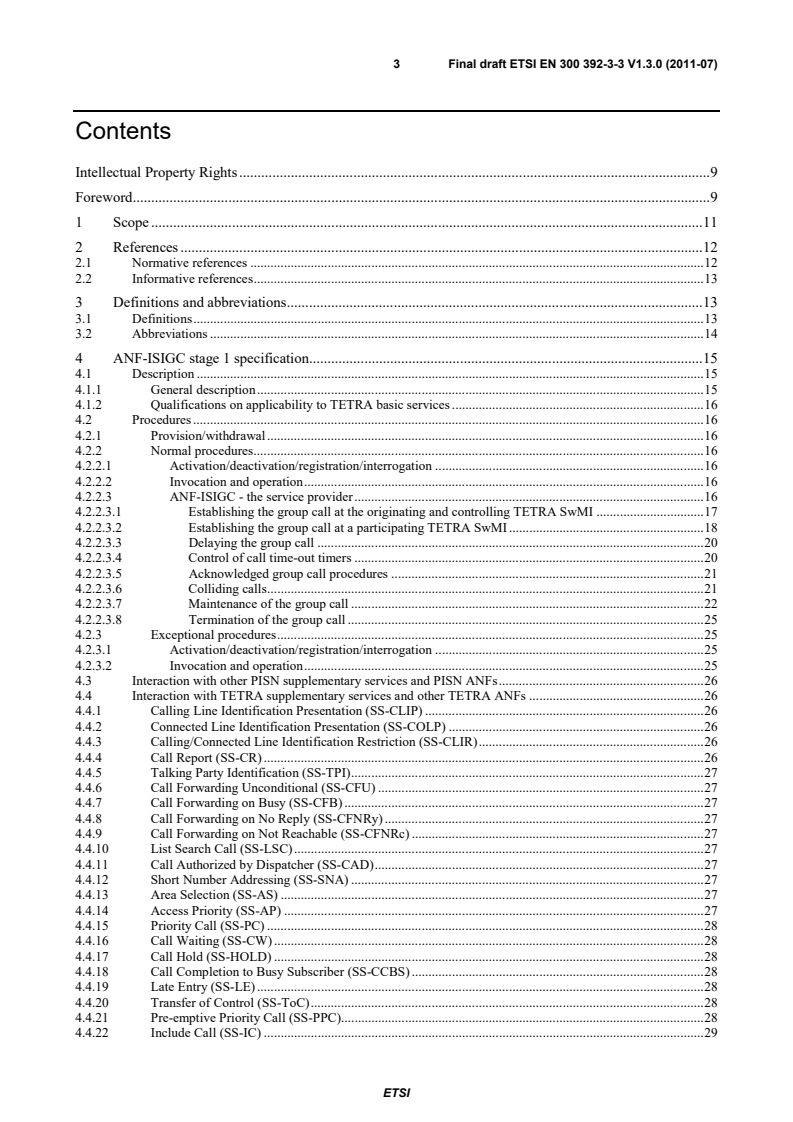
3 Final draft ETSI EN 300 392-3-3 V1.3.0 (2011-07)
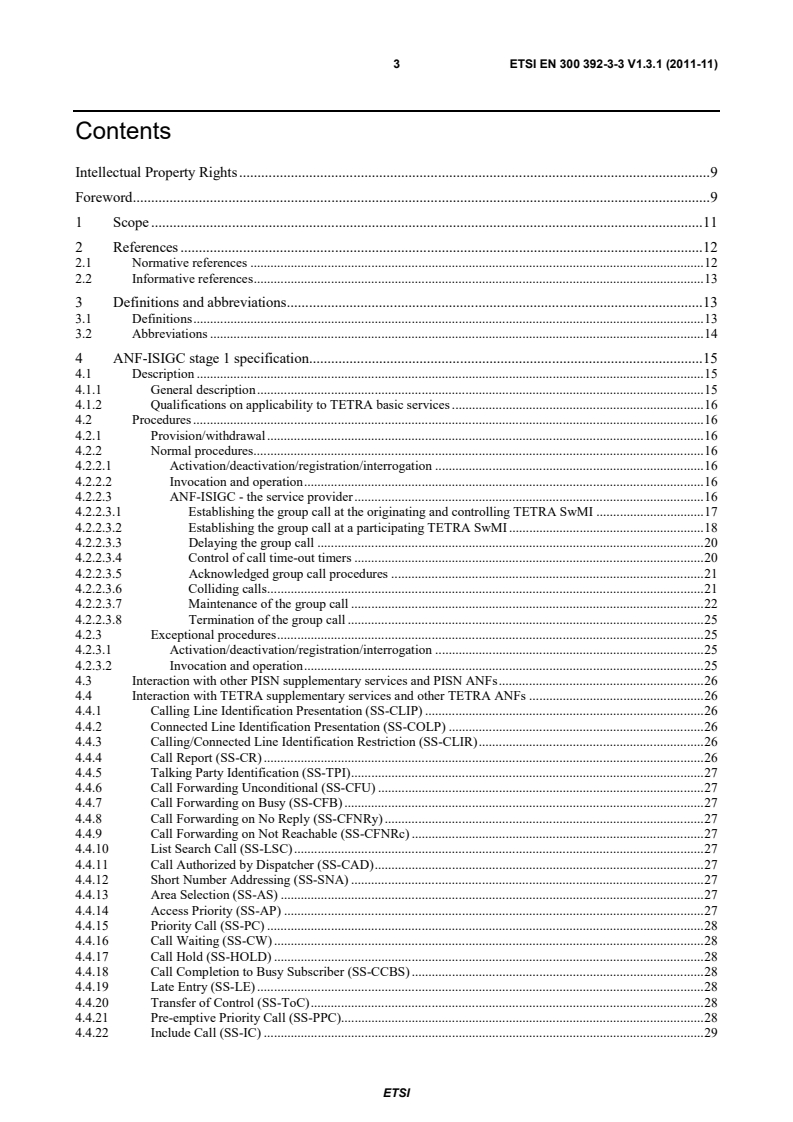
Contents
Intellectual Property Rights . 9
Foreword . 9
1 Scope . 11
2 References . 12
2.1 Normative references . 12
2.2 Informative references . 13
3 Definitions and abbreviations . 13
3.1 Definitions . 13
3.2 Abbreviations . 14
4 ANF-ISIGC stage 1 specification . 15
4.1 Description . 15
4.1.1 General description . 15
4.1.2 Qualifications on applicability to TETRA basic services . 16
4.2 Procedures . 16
4.2.1 Provision/withdrawal . 16
4.2.2 Normal procedures . 16
4.2.2.1 Activation/deactivation/registration/interrogation . 16
4.2.2.2 Invocation and operation . 16
4.2.2.3 ANF-ISIGC - the service provider . 16
4.2.2.3.1 Establishing the group call at the originating and controlling TETRA SwMI . 17
4.2.2.3.2 Establishing the group call at a participating TETRA SwMI . 18
4.2.2.3.3 Delaying the group call . 20
4.2.2.3.4 Control of call time-out timers . 20
4.2.2.3.5 Acknowledged group call procedures . 21
4.2.2.3.6 Colliding calls . 21
4.2.2.3.7 Maintenance of the group call . 22
4.2.2.3.8 Termination of the group call . 25
4.2.3 Exceptional procedures . 25
4.2.3.1 Activation/deactivation/registration/interrogation . 25
4.2.3.2 Invocation and operation . 25
4.3 Interaction with other PISN supplementary services and PISN ANFs . 26
4.4 Interaction with TETRA supplementary services and other TETRA ANFs . 26
4.4.1 Calling Line Identification Presentation (SS-CLIP) . 26
4.4.2 Connected Line Identification Presentation (SS-COLP) . 26
4.4.3 Calling/Connected Line Identification Restriction (SS-CLIR) . 26
4.4.4 Call Report (SS-CR) . 26
4.4.5 Talking Party Identification (SS-TPI) . 27
4.4.6 Call Forwarding Unconditional (SS-CFU) . 27
4.4.7 Call Forwarding on Busy (SS-CFB) . 27
4.4.8 Call Forwarding on No Reply (SS-CFNRy) . 27
4.4.9 Call Forwarding on Not Reachable (SS-CFNRc) . 27
4.4.10 List Search Call (SS-LSC) . 27
4.4.11 Call Authorized by Dispatcher (SS-CAD) . 27
4.4.12 Short Number Addressing (SS-SNA) . 27
4.4.13 Area Selection (SS-AS) . 27
4.4.14 Access Priority (SS-AP) . 27
4.4.15 Priority Call (SS-PC) . 28
4.4.16 Call Waiting (SS-CW) . 28
4.4.17 Call Hold (SS-HOLD) . 28
4.4.18 Call Completion to Busy Subscriber (SS-CCBS) . 28
4.4.19 Late Entry (SS-LE) . 28
4.4.20 Transfer of Control (SS-ToC) . 28
4.4.21 Pre-emptive Priority Call (SS-PPC) . 28
4.4.22 Include Call (SS-IC) . 29
ETSI
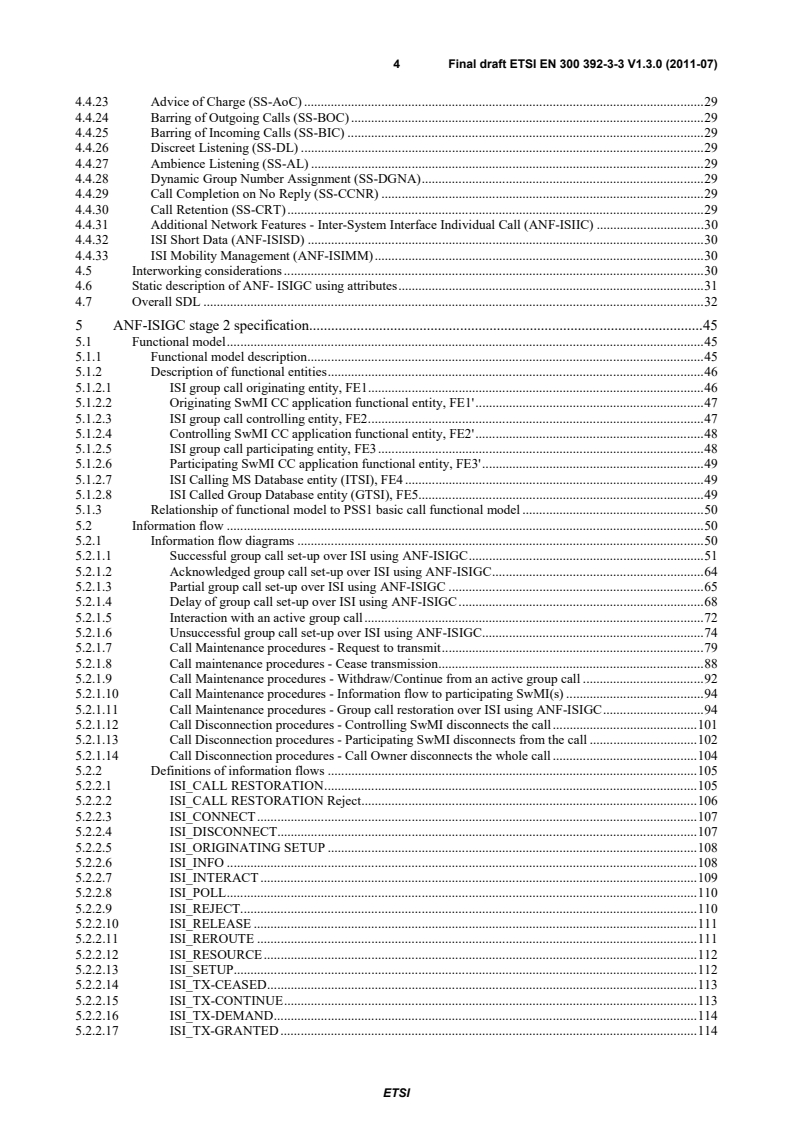
4 Final draft ETSI EN 300 392-3-3 V1.3.0 (2011-07)
4.4.23 Advice of Charge (SS-AoC) . 29
4.4.24 Barring of Outgoing Calls (SS-BOC) . 29
4.4.25 Barring of Incoming Calls (SS-BIC) . 29
4.4.26 Discreet Listening (SS-DL) . 29
4.4.27 Ambience Listening (SS-AL) . 29
4.4.28 Dynamic Group Number Assignment (SS-DGNA) . 29
4.4.29 Call Completion on No Reply (SS-CCNR) . 29
4.4.30 Call Retention (SS-CRT) . 29
4.4.31 Additional Network Features - Inter-System Interface Individual Call (ANF-ISIIC) . 30
4.4.32 ISI Short Data (ANF-ISISD) . 30
4.4.33 ISI Mobility Management (ANF-ISIMM) . 30
4.5 Interworking considerations . 30
4.6 Static description of ANF- ISIGC using attributes . 31
4.7 Overall SDL . 32
5 ANF-ISIGC stage 2 specification . 45
5.1 Functional model . 45
5.1.1 Functional model description . 45
5.1.2 Description of functional entities . 46
5.1.2.1 ISI group call originating entity, FE1 . 46
5.1.2.2 Originating SwMI CC application functional entity, FE1' . 47
5.1.2.3 ISI group call controlling entity, FE2 . 47
5.1.2.4 Controlling SwMI CC application functional entity, FE2' . 48
5.1.2.5 ISI group call participating entity, FE3 . 48
5.1.2.6 Participating SwMI CC application functional entity, FE3' . 49
5.1.2.7 ISI Calling MS Database entity (ITSI), FE4 . 49
5.1.2.8 ISI Called Group Database entity (GTSI), FE5. 49
5.1.3 Relationship of functional model to PSS1 basic call functional model . 50
5.2 Information flow . 50
5.2.1 Information flow diagrams . 50
5.2.1.1 Successful group call set-up over ISI using ANF-ISIGC . 51
5.2.1.2 Acknowledged group call set-up over ISI using ANF-ISIGC . 64
5.2.1.3 Partial group call set-up over ISI using ANF-ISIGC . 65
5.2.1.4 Delay of group call set-up over ISI using ANF-ISIGC . 68
5.2.1.5 Interaction with an active group call . 72
5.2.1.6 Unsuccessful group call set-up over ISI using ANF-ISIGC. 74
5.2.1.7 Call Maintenance procedures - Request to transmit . 79
5.2.1.8 Call maintenance procedures - Cease transmission . 88
5.2.1.9 Call Maintenance procedures - Withdraw/Continue from an active group call . 92
5.2.1.10 Call Maintenance procedures - Information flow to participating SwMI(s) . 94
5.2.1.11 Call Maintenance procedures - Group call restoration over ISI using ANF-ISIGC . 94
5.2.1.12 Call Disconnection procedures - Controlling SwMI disconnects the call . 101
5.2.1.13 Call Disconnection procedures - Participating SwMI disconnects from the call . 102
5.2.1.14 Call Disconnection procedures - Call Owner disconnects the whole call . 104
5.2.2 Definitions of information flows . 105
5.2.2.1 ISI_CALL RESTORATION . 105
5.2.2.2 ISI_CALL RESTORATION Reject . 106
5.2.2.3 ISI_CONNECT . 107
5.2.2.4 ISI_DISCONNECT. 107
5.2.2.5 ISI_ORIGINATING SETUP . 108
5.2.2.6 ISI_INFO . 108
5.2.2.7 ISI_INTERACT . 109
5.2.2.8 ISI_POLL . 110
5.2.2.9 ISI_REJECT. 110
5.2.2.10 ISI_RELEASE . 111
5.2.2.11 ISI_REROUTE . 111
5.2.2.12 ISI_RESOURCE . 112
5.2.2.13 ISI_SETUP. 112
5.2.2.14 ISI_T X-CE ASED . 113
5.2.2.15 ISI_TX-CONTINUE . 113
5.2.2.16 ISI_T X-DEM AND . 114
5.2.2.17 ISI_TX-GRANTED . 114
ETSI
5 Final draft ETSI EN 300 392-3-3 V1.3.0 (2011-07)
5.2.2.18 ISI_TX-INTERRUPT . 115
5.2.2.19 ISI_TX-WAIT . 115
5.2.2.20 VERIFY_GROUP . 115
5.2.2.21 VERIFY_INDIV . 116
5.3 Functional Entity Actions (FEAs) . 116
5.3.1 FEA of FE1 . 116
5.3.2 FEA of FE1' . 117
5.3.3 FEA of FE2 . 117
5.3.4 Functional entity actions of FE2' . 121
5.3.5 FEA of FE3 . 121
5.3.6 Functional entity actions of FE3' . 123
5.3.7 Functional entity actions of FE4 . 124
5.3.8 Functional entity actions of FE5 . 125
6 ANF-ISIGC stage 3 specification . 125
6.1 ANF-ISIGC description . 125
6.2 ANF-ISIGC operational requirements. 125
6.2.1 PISN connection oriented call related connection . 125
6.2.1.1 Requirements on the originating SwMI . 125
6.2.1.1.1 PSS1 SETUP message . 125
6.2.1.2 Requirements on the group home SwMI . 126
6.2.1.2.1 PSS1 DISCONNECT or PSS1 RELEASE COMPLETE message . 126
6.2.1.3 Requirements on the controlling SwMI . 126
6.2.1.3.1 PSS1 DISCONNECT or PSS1 RELEASE COMPLETE message . 126
6.2.1.3.2 PSS1 SETUP message . 126
6.2.1.3.3 PSS1 CONNECT message . 127
6.2.1.4 Requirements on the participating SwMI . 128
6.2.1.4.1 PSS1 DISCONNECT or PSS1 RELEASE COMPLETE message . 128
6.2.1.4.2 PSS1 CONNECT message . 128
6.2.1.5 Requirements on the originating SwMI with PSTN/ISDN/PISN incoming gateway . 128
6.2.1.5.1 PSS1 SETUP message . 128
6.2.2 PISN connection oriented, call independent connection . 129
6.3 ANF-ISIGC coding requirements . 130
6.3.1 TETRA ANF-ISIGC PDUs . 130
6.3.1.1 PISN connection oriented call related connection . 131
6.3.1.1.1 TETRA PDU giving complementary information in the PSS1 SETUP, PSS1 CONNECT or
PSS1 FACILITY message . 131
6.3.1.1.2 TETRA PDU giving complementary information in the PSS1 CONNECT or
PSS1 FACILITY message . 135
6.3.1.1.3 TETRA PDU giving complementary information in the PSS1 FACILITY message . 137
6.3.1.1.4 TETRA PDU giving complementary information in the PSS1 DISCONNECT or PSS1
FACILITY message . 145
6.3.1.1.5 TETRA PDU giving complementary information in the PSS1 DISCONNECT, PSS1
FACILITY or PSS1 RELEASE message . 146
6.3.1.1.6 TETRA PDU giving complementary information in the PSS1 DISCONNECT or PSS1
RELEASE COMPLETE message . 147
6.3.1.2 PISN connection oriented, call independent connections . 148
6.3.1.2.1 TETRA PDU sent by the participating SwMI of the migrated user - used to initiate call
restoration . 148
6.3.1.2.2 TETRA PDU sent by the controlling SwMI - used to confirm call restoration . 149
6.3.1.2.3 TETRA PDU sent by the controlling SwMI - used to reject call restoration . 149
6.3.2 TETRA PDU information element coding . 149
6.3.2.1 Additional information to existing information element at the ISI . 150
6.3.2.1.1 Call status . 150
6.3.2.1.1a Call time-out, set-up phase . 150
6.3.2.1.2 Call time-out . 150
6.3.2.1.3 Disconnect cause information element . 151
6.3.2.1.4 Temporary group basic migration profile . 151
6.3.2.1.5 PDU type . 152
6.3.2.1.6 SS-migration profile . 152
6.3.2.2 New information elements used at the ISI . 153
6.3.2.2.1 Call amalgamation . 153
ETSI
6 Final draft ETSI EN 300 392-3-3 V1.3.0 (2011-07)
6.3.2.2.1a Call resource time-out . 153
6.3.2.2.2 Call diverted to dispatcher . 153
6.3.2.2.3 Call owner request . 153
6.3.2.2.4 Calling group identifier . 154
6.3.2.2.4a Calling party information present . 154
6.3.2.2.5 Connected party SSI and extension . 154
6.3.2.2.6 Controlling/originating/participating SwMI MNI . 154
6.3.2.2.7 Critical connected party/requesting party/restoring party/transmitting party SSI and extension. 154
6.3.2.2.8 Critical user list. 154
6.3.2.2.9 Disconnect type . 155
6.3.2.2.10 Dispatcher acceptance . 155
6.3.2.2.11 External group member identity . 155
6.3.2.2.12 External subscriber number digits . 155
6.3.2.2.13 External subscriber number length . 156
6.3.2.2.14 External subscriber number parameter . 156
6.3.2.2.15 Fail Cause . 156
6.3.2.2.16 Group attachment indicator . 157
6.3.2.2.16a Group call SwMI type . 157
6.3.2.2.17 Group information . 157
6.3.2.2.17a ISI-INFO type . 158
6.3.2.2.17b Linking group identifier. 158
6.3.2.2.18 New calling party . 158
6.3.2.2.19 Numbering plan identifier . 159
6.3.2.2.20 Poll request type . 159
6.3.2.2.21 Poll result identifier . 159
6.3.2.2.22 Reject cause information element . 159
6.3.2.2.23 Resource allocation . 161
6.3.2.2.24 Resource indicator . 161
6.3.2.2.25 Screening indicator . 161
6.3.2.2.26 Security level at air interface/Security level used in other network. 161
6.3.2.2.26a Setup response time-out. 161
6.3.2.2.27 Set-up type . 162
6.3.2.2.28 Speech service chosen/requested/used . 162
6.3.2.2.29 Speech services supported . 162
6.3.2.2.30 SS-CLIR invoked for calling/transmitting/restoring/connected party . 163
6.3.2.2.31 Temporary group member indication . 163
6.3.2.2.32 Transmission Ceased . 163
6.3.2.2.33 Type of number . 164
6.3.3 PSS1 facility information element . 164
6.4 ANF-ISIGC state definitions . 165
6.4.1 States at the originating SwMI . 165
6.4.1.1 IDLE . 165
6.4.1.2 FORWARD CALL . 165
6.4.1.3 WAIT CONNECT . 165
6.4.1.4 DELAY ENTRY . 166
6.4.1.5 DELAY GROUP CALL . 166
6.4.1.6 CALL DISCONNECT . 166
6.4.1.7 CALL RELEASE . 167
6.4.2 States at the controlling SwMI . 167
6.4.2.1 IDLE . 167
6.4.2.2 GROUP CALL INITIATE . 167
6.4.2.3 DELAY GROUP CALL . 168
6.4.2.4 ACTIVE . 168
6.4.2.5 Void. 169
6.4.2.6 CALL RELEASE . 169
6.4.3 States at the participating SwMI . 169
6.4.3.1 IDLE . 169
6.4.3.2 WAIT CONNECT . 170
6.4.3.3 DELAY ENTRY . 170
6.4.3.4 DELAY GROUP CALL . 170
6.4.3.5 ACTIVE . 171
6.4.3.6 CALL DISCONNECT . 171
ETSI
7 Final draft ETSI EN 300 392-3-3 V1.3.0 (2011-07)
6.4.3.7 CALL RELEASE . 171
6.5 ANF-ISIGC signalling procedures . 172
6.5.1 Call set-up procedures . 172
6.5.1.1 Forward set-up request and PISN called number sending . 172
6.5.1.2 Group linking . 172
6.5.1.3 Call request, information channel selection and PISN called number sending . 172
6.5.1.4 Call confirmation and call characteristics notification by the originating and participating
SwMI(s) . 173
6.5.1.5 Call confirmation indication and call connected by the controlling SwMI . 174
6.5.1.6 Delay of call set-up . 174
6.5.1.7 Failure of call establishment . 175
6.5.1.8 Multiple calling parties . 175
6.5.1.8.1 A new calling party appears at a SwMI not currently in the group call. 175
6.5.1.8.2 A new, compatible, calling party appears at a SwMI where a group call is active . 175
6.5.1.8.3 A new, compatible, calling party appears at an OSwMI where a group call is still in the setup
phase . 175
6.5.1.8.4 A new, compatible, calling party appears at an PSwMI where a group call is still in the setup
phase . 175
6.5.1.8.5 A new calling party requesting an emergency call appears at a SwMI where the existing call
is not at an emergency priority . 176
6.5.1.8.6 A new, non compatible, calling party appears at a SwMI where a group call is already active . 176
6.5.1.8.7 A new calling party appears at a CSwMI that only supports a single ISI-Originating-Setup . 176
6.5.1.8.8 The sending of subsequent ISI-Originating-Setups to the CSwMI . 176
6.5.1.9 Security level. 177
6.5.2 Acknowledge group call . 177
6.5.3 Call maintenance procedures . 177
6.5.3.1 Transmission control procedures . 177
6.5.3.2 Call modification and/or continuation . 179
6.5.3.3 Call restoration . 179
6.5.3.4 DTMF procedures . 180
6.5.4 Call disconnection procedures . 180
6.5.5 Call collisions . 181
6.5.6 Mapping of PSS1 messages with ISI PDUs. . 181
6.6 ANF-ISIGC impact from interworking with ISDN/PISN/PSTN . 183
6.6.1 Call set-up procedures . 183
6.6.2 Call maintenance procedures . 183
6.6.3 Call disconnection procedures . 183
6.7 Protocol interaction between ANF-ISIGC and supplementary services and other ANFs . 184
6.7.1 Call Forwarding Unconditional (SS-CFU) . 184
6.7.2 Call Authorized by Dispatcher (SS-CAD) . 184
6.7.3 Area Selection (SS-AS) and selected area number . 185
6.7.4 Priority Call (SS-PC) . 185
6.7.5 Pre-emptive Priority Call (SS-PPC) . 185
6.7.6 Include Call (SS-IC) . 185
6.7.7 Call Retention (SS-CRT) . 186
6.7.8 Interactions with other supplementary services . 186
6.8 ANF-ISIGC parameter values (timers). 186
Annex A (normative): Specification and Description Language (SDL) representation of
procedures .
...
European Standard
Terrestrial Trunked Radio (TETRA);
Voice plus Data (V+D);
Part 3: Interworking at the Inter-System Interface (ISI);
Sub-part 3: Additional Network Feature
Group Call (ANF-ISIGC)
2 ETSI EN 300 392-3-3 V1.3.1 (2011-11)
Reference
REN/TETRA-03207
Keywords
interworking, radio, TETRA, V+D
ETSI
650 Route des Lucioles
F-06921 Sophia Antipolis Cedex - FRANCE
Tel.: +33 4 92 94 42 00 Fax: +33 4 93 65 47 16
Siret N° 348 623 562 00017 - NAF 742 C
Association à but non lucratif enregistrée à la
Sous-Préfecture de Grasse (06) N° 7803/88
Important notice
Individual copies of the present document can be downloaded from:
http://www.etsi.org
The present document may be made available in more than one electronic version or in print. In any case of existing or
perceived difference in contents between such versions, the reference version is the Portable Document Format (PDF).
In case of dispute, the reference shall be the printing on ETSI printers of the PDF version kept on a specific network drive
within ETSI Secretariat.
Users of the present document should be aware that the document may be subject to revision or change of status.
Information on the current status of this and other ETSI documents is available at
http://portal.etsi.org/tb/status/status.asp
If you find errors in the present document, please send your comment to one of the following services:
http://portal.etsi.org/chaircor/ETSI_support.asp
Copyright Notification
No part may be reproduced except as authorized by written permission.
The copyright and the foregoing restriction extend to reproduction in all media.
© European Telecommunications Standards Institute 2011.
All rights reserved.
TM TM TM
DECT , PLUGTESTS , UMTS and the ETSI logo are Trade Marks of ETSI registered for the benefit of its Members.
TM
3GPP and LTE™ are Trade Marks of ETSI registered for the benefit of its Members and
of the 3GPP Organizational Partners.
GSM® and the GSM logo are Trade Marks registered and owned by the GSM Association.
ETSI
3 ETSI EN 300 392-3-3 V1.3.1 (2011-11)
Contents
Intellectual Property Rights . 9
Foreword . 9
1 Scope . 11
2 References . 12
2.1 Normative references . 12
2.2 Informative references . 13
3 Definitions and abbreviations . 13
3.1 Definitions . 13
3.2 Abbreviations . 14
4 ANF-ISIGC stage 1 specification . 15
4.1 Description . 15
4.1.1 General description . 15
4.1.2 Qualifications on applicability to TETRA basic services . 16
4.2 Procedures . 16
4.2.1 Provision/withdrawal . 16
4.2.2 Normal procedures . 16
4.2.2.1 Activation/deactivation/registration/interrogation . 16
4.2.2.2 Invocation and operation . 16
4.2.2.3 ANF-ISIGC - the service provider . 16
4.2.2.3.1 Establishing the group call at the originating and controlling TETRA SwMI . 17
4.2.2.3.2 Establishing the group call at a participating TETRA SwMI . 18
4.2.2.3.3 Delaying the group call . 20
4.2.2.3.4 Control of call time-out timers . 20
4.2.2.3.5 Acknowledged group call procedures . 21
4.2.2.3.6 Colliding calls . 21
4.2.2.3.7 Maintenance of the group call . 22
4.2.2.3.8 Termination of the group call . 25
4.2.3 Exceptional procedures . 25
4.2.3.1 Activation/deactivation/registration/interrogation . 25
4.2.3.2 Invocation and operation . 25
4.3 Interaction with other PISN supplementary services and PISN ANFs . 26
4.4 Interaction with TETRA supplementary services and other TETRA ANFs . 26
4.4.1 Calling Line Identification Presentation (SS-CLIP) . 26
4.4.2 Connected Line Identification Presentation (SS-COLP) . 26
4.4.3 Calling/Connected Line Identification Restriction (SS-CLIR) . 26
4.4.4 Call Report (SS-CR) . 26
4.4.5 Talking Party Identification (SS-TPI) . 27
4.4.6 Call Forwarding Unconditional (SS-CFU) . 27
4.4.7 Call Forwarding on Busy (SS-CFB) . 27
4.4.8 Call Forwarding on No Reply (SS-CFNRy) . 27
4.4.9 Call Forwarding on Not Reachable (SS-CFNRc) . 27
4.4.10 List Search Call (SS-LSC) . 27
4.4.11 Call Authorized by Dispatcher (SS-CAD) . 27
4.4.12 Short Number Addressing (SS-SNA) . 27
4.4.13 Area Selection (SS-AS) . 27
4.4.14 Access Priority (SS-AP) . 27
4.4.15 Priority Call (SS-PC) . 28
4.4.16 Call Waiting (SS-CW) . 28
4.4.17 Call Hold (SS-HOLD) . 28
4.4.18 Call Completion to Busy Subscriber (SS-CCBS) . 28
4.4.19 Late Entry (SS-LE) . 28
4.4.20 Transfer of Control (SS-ToC) . 28
4.4.21 Pre-emptive Priority Call (SS-PPC) . 28
4.4.22 Include Call (SS-IC) . 29
ETSI
4 ETSI EN 300 392-3-3 V1.3.1 (2011-11)
4.4.23 Advice of Charge (SS-AoC) . 29
4.4.24 Barring of Outgoing Calls (SS-BOC) . 29
4.4.25 Barring of Incoming Calls (SS-BIC) . 29
4.4.26 Discreet Listening (SS-DL) . 29
4.4.27 Ambience Listening (SS-AL) . 29
4.4.28 Dynamic Group Number Assignment (SS-DGNA) . 29
4.4.29 Call Completion on No Reply (SS-CCNR) . 29
4.4.30 Call Retention (SS-CRT) . 29
4.4.31 Additional Network Features - Inter-System Interface Individual Call (ANF-ISIIC) . 30
4.4.32 ISI Short Data (ANF-ISISD) . 30
4.4.33 ISI Mobility Management (ANF-ISIMM) . 30
4.5 Interworking considerations . 30
4.6 Static description of ANF- ISIGC using attributes . 31
4.7 Overall SDL . 32
5 ANF-ISIGC stage 2 specification . 45
5.1 Functional model . 45
5.1.1 Functional model description . 45
5.1.2 Description of functional entities . 46
5.1.2.1 ISI group call originating entity, FE1 . 46
5.1.2.2 Originating SwMI CC application functional entity, FE1' . 47
5.1.2.3 ISI group call controlling entity, FE2 . 47
5.1.2.4 Controlling SwMI CC application functional entity, FE2' . 48
5.1.2.5 ISI group call participating entity, FE3 . 48
5.1.2.6 Participating SwMI CC application functional entity, FE3' . 49
5.1.2.7 ISI Calling MS Database entity (ITSI), FE4 . 49
5.1.2.8 ISI Called Group Database entity (GTSI), FE5. 49
5.1.3 Relationship of functional model to PSS1 basic call functional model . 50
5.2 Information flow . 50
5.2.1 Information flow diagrams . 50
5.2.1.1 Successful group call set-up over ISI using ANF-ISIGC . 51
5.2.1.2 Acknowledged group call set-up over ISI using ANF-ISIGC . 64
5.2.1.3 Partial group call set-up over ISI using ANF-ISIGC . 65
5.2.1.4 Delay of group call set-up over ISI using ANF-ISIGC . 68
5.2.1.5 Interaction with an active group call . 72
5.2.1.6 Unsuccessful group call set-up over ISI using ANF-ISIGC. 74
5.2.1.7 Call Maintenance procedures - Request to transmit . 79
5.2.1.8 Call maintenance procedures - Cease transmission . 88
5.2.1.9 Call Maintenance procedures - Withdraw/Continue from an active group call . 92
5.2.1.10 Call Maintenance procedures - Information flow to participating SwMI(s) . 94
5.2.1.11 Call Maintenance procedures - Group call restoration over ISI using ANF-ISIGC . 94
5.2.1.12 Call Disconnection procedures - Controlling SwMI disconnects the call . 101
5.2.1.13 Call Disconnection procedures - Participating SwMI disconnects from the call . 102
5.2.1.14 Call Disconnection procedures - Call Owner disconnects the whole call . 104
5.2.2 Definitions of information flows . 105
5.2.2.1 ISI_CALL RESTORATION . 105
5.2.2.2 ISI_CALL RESTORATION Reject . 106
5.2.2.3 ISI_CONNECT . 107
5.2.2.4 ISI_DISCONNECT. 107
5.2.2.5 ISI_ORIGINATING SETUP . 108
5.2.2.6 ISI_INFO . 108
5.2.2.7 ISI_INTERACT . 109
5.2.2.8 ISI_POLL . 109
5.2.2.9 ISI_REJECT. 110
5.2.2.10 ISI_RELEASE . 110
5.2.2.11 ISI_REROUTE . 111
5.2.2.12 ISI_RESOURCE . 111
5.2.2.13 ISI_SETUP. 112
5.2.2.14 ISI_T X-CE ASED . 113
5.2.2.15 ISI_TX-CONTINUE . 113
5.2.2.16 ISI_T X-DEM AND . 114
5.2.2.17 ISI_TX-GRANTED . 114
ETSI
5 ETSI EN 300 392-3-3 V1.3.1 (2011-11)
5.2.2.18 ISI_TX-INTERRUPT . 114
5.2.2.19 ISI_TX-WAIT . 115
5.2.2.20 VERIFY_GROUP . 115
5.2.2.21 VERIFY_INDIV . 115
5.3 Functional Entity Actions (FEAs) . 116
5.3.1 FEA of FE1 . 116
5.3.2 FEA of FE1' . 117
5.3.3 FEA of FE2 . 117
5.3.4 Functional entity actions of FE2' . 120
5.3.5 FEA of FE3 . 121
5.3.6 Functional entity actions of FE3' . 123
5.3.7 Functional entity actions of FE4 . 124
5.3.8 Functional entity actions of FE5 . 124
6 ANF-ISIGC stage 3 specification . 125
6.1 ANF-ISIGC description . 125
6.2 ANF-ISIGC operational requirements. 125
6.2.1 PISN connection oriented call related connection . 125
6.2.1.1 Requirements on the originating SwMI . 125
6.2.1.1.1 PSS1 SETUP message . 125
6.2.1.2 Requirements on the group home SwMI . 126
6.2.1.2.1 PSS1 DISCONNECT or PSS1 RELEASE COMPLETE message . 126
6.2.1.3 Requirements on the controlling SwMI . 126
6.2.1.3.1 PSS1 DISCONNECT or PSS1 RELEASE COMPLETE message . 126
6.2.1.3.2 PSS1 SETUP message . 126
6.2.1.3.3 PSS1 CONNECT message . 127
6.2.1.4 Requirements on the participating SwMI . 127
6.2.1.4.1 PSS1 DISCONNECT or PSS1 RELEASE COMPLETE message . 127
6.2.1.4.2 PSS1 CONNECT message . 128
6.2.1.5 Requirements on the originating SwMI with PSTN/ISDN/PISN incoming gateway . 128
6.2.1.5.1 PSS1 SETUP message . 128
6.2.2 PISN connection oriented, call independent connection . 129
6.3 ANF-ISIGC coding requirements . 130
6.3.1 TETRA ANF-ISIGC PDUs . 130
6.3.1.1 PISN connection oriented call related connection . 131
6.3.1.1.1 TETRA PDU giving complementary information in the PSS1 SETUP, PSS1 CONNECT or
PSS1 FACILITY message . 131
6.3.1.1.2 TETRA PDU giving complementary information in the PSS1 CONNECT or
PSS1 FACILITY message . 135
6.3.1.1.3 TETRA PDU giving complementary information in the PSS1 FACILITY message . 137
6.3.1.1.4 TETRA PDU giving complementary information in the PSS1 DISCONNECT or PSS1
FACILITY message . 145
6.3.1.1.5 TETRA PDU giving complementary information in the PSS1 DISCONNECT, PSS1
FACILITY or PSS1 RELEASE message . 146
6.3.1.1.6 TETRA PDU giving complementary information in the PSS1 DISCONNECT or PSS1
RELEASE COMPLETE message . 147
6.3.1.2 PISN connection oriented, call independent connections . 148
6.3.1.2.1 TETRA PDU sent by the participating SwMI of the migrated user - used to initiate call
restoration . 148
6.3.1.2.2 TETRA PDU sent by the controlling SwMI - used to confirm call restoration . 149
6.3.1.2.3 TETRA PDU sent by the controlling SwMI - used to reject call restoration . 149
6.3.2 TETRA PDU information element coding . 149
6.3.2.1 Additional information to existing information element at the ISI . 150
6.3.2.1.1 Call status . 150
6.3.2.1.1a Call time-out, set-up phase . 150
6.3.2.1.2 Call time-out . 150
6.3.2.1.3 Disconnect cause information element . 151
6.3.2.1.4 Temporary group basic migration profile . 151
6.3.2.1.5 PDU type . 152
6.3.2.1.6 SS-migration profile . 152
6.3.2.2 New information elements used at the ISI . 153
6.3.2.2.1 Call amalgamation . 153
ETSI
6 ETSI EN 300 392-3-3 V1.3.1 (2011-11)
6.3.2.2.1a Call resource time-out . 153
6.3.2.2.2 Call diverted to dispatcher . 153
6.3.2.2.3 Call owner request . 153
6.3.2.2.4 Calling group identifier . 154
6.3.2.2.4a Calling party information present . 154
6.3.2.2.5 Connected party SSI and extension . 154
6.3.2.2.6 Controlling/originating/participating SwMI MNI . 154
6.3.2.2.7 Critical connected party/requesting party/restoring party/transmitting party SSI and extension. 154
6.3.2.2.8 Critical user list. 154
6.3.2.2.9 Disconnect type . 155
6.3.2.2.10 Dispatcher acceptance . 155
6.3.2.2.11 External group member identity . 155
6.3.2.2.12 External subscriber number digits . 155
6.3.2.2.13 External subscriber number length . 156
6.3.2.2.14 External subscriber number parameter . 156
6.3.2.2.15 Fail Cause . 156
6.3.2.2.16 Group attachment indicator . 157
6.3.2.2.16a Group call SwMI type . 157
6.3.2.2.17 Group information . 157
6.3.2.2.17a ISI-INFO type . 158
6.3.2.2.17b Linking group identifier. 158
6.3.2.2.18 New calling party . 158
6.3.2.2.19 Numbering plan identifier . 159
6.3.2.2.20 Poll request type . 159
6.3.2.2.21 Poll result identifier . 159
6.3.2.2.22 Reject cause information element . 159
6.3.2.2.23 Resource allocation . 161
6.3.2.2.24 Resource indicator . 161
6.3.2.2.25 Screening indicator . 161
6.3.2.2.26 Security level at air interface/Security level used in other network. 161
6.3.2.2.26a Setup response time-out. 161
6.3.2.2.27 Set-up type . 162
6.3.2.2.28 Speech service chosen/requested/used . 162
6.3.2.2.29 Speech services supported . 162
6.3.2.2.30 SS-CLIR invoked for calling/transmitting/restoring/connected party . 163
6.3.2.2.31 Temporary group member indication . 163
6.3.2.2.32 Transmission Ceased . 163
6.3.2.2.33 Type of number . 164
6.3.3 PSS1 facility information element . 164
6.4 ANF-ISIGC state definitions . 165
6.4.1 States at the originating SwMI . 165
6.4.1.1 IDLE . 165
6.4.1.2 FORWARD CALL . 165
6.4.1.3 WAIT CONNECT . 165
6.4.1.4 DELAY ENTRY . 166
6.4.1.5 DELAY GROUP CALL . 166
6.4.1.6 CALL DISCONNECT . 166
6.4.1.7 CALL RELEASE . 167
6.4.2 States at the controlling SwMI . 167
6.4.2.1 IDLE . 167
6.4.2.2 GROUP CALL INITIATE . 167
6.4.2.3 DELAY GROUP CALL . 168
6.4.2.4 ACTIVE . 168
6.4.2.5 Void. 169
6.4.2.6 CALL RELEASE . 169
6.4.3 States at the participating SwMI . 169
6.4.3.1 IDLE . 169
6.4.3.2 WAIT CONNECT . 170
6.4.3.3 DELAY ENTRY . 170
6.4.3.4 DELAY GROUP CALL . 170
6.4.3.5 ACTIVE . 171
6.4.3.6 CALL DISCONNECT . 171
ETSI
7 ETSI EN 300 392-3-3 V1.3.1 (2011-11)
6.4.3.7 CALL RELEASE . 171
6.5 ANF-ISIGC signalling procedures . 172
6.5.1 Call set-up procedures . 172
6.5.1.1 Forward set-up request and PISN called number sending . 172
6.5.1.2 Group linking . 172
6.5.1.3 Call request, information channel selection and PISN called number sending . 172
6.5.1.4 Call confirmation and call characteristics notification by the originating and participating
SwMI(s) . 173
6.5.1.5 Call confirmation indication and call connected by the controlling SwMI . 174
6.5.1.6 Delay of call set-up . 174
6.5.1.7 Failure of call establishment . 175
6.5.1.8 Multiple calling parties . 175
6.5.1.8.1 A new calling party appears at a SwMI not currently in the group call. 175
6.5.1.8.2 A new, compatible, calling party appears at a SwMI where a group call is active . 175
6.5.1.8.3 A new, compatible, calling party appears at an OSwMI where a group call is still in the setup
phase . 175
6.5.1.8.4 A new, compatible, calling party appears at an PSwMI where a group call is still in the setup
phase . 175
6.5.1.8.5 A new calling party requesting an emergency call appears at a SwMI where the existing call
is not at an emergency priority . 176
6.5.1.8.6 A new, non compatible, calling party appears at a SwMI where a group call is already active . 176
6.5.1.8.7 A new calling party appears at a CSwMI that only supports a single ISI-Originating-Setup . 176
6.5.1.8.8 The sending of subsequent ISI-Originating-Setups to the CSwMI . 176
6.5.1.9 Security level. 177
6.5.2 Acknowledge group call . 177
6.5.3 Call maintenance procedures . 177
6.5.3.1 Transmission control procedures . 177
6.5.3.2 Call modification and/or continuation . 179
6.5.3.3 Call restoration . 179
6.5.3.4 DTMF procedures . 180
6.5.4 Call disconnection procedures . 180
6.5.5 Call collisions . 181
6.5.6 Mapping of PSS1 messages with ISI PDUs. . 181
6.6 ANF-ISIGC impact from interworking with ISDN/PISN/PSTN . 183
6.6.1 Call set-up procedures . 183
6.6.2 Call maintenance procedures . 183
6.6.3 Call disconnection procedures . 183
6.7 Protocol interaction between ANF-ISIGC and supplementary services and other ANFs . 184
6.7.1 Call Forwarding Unconditional (SS-CFU) . 184
6.7.2 Call Authorized by Dispatcher (SS-CAD) . 184
6.7.3 Area Selection (SS-AS) and selected area number . 185
6.7.4 Priority Call (SS-PC) . 185
6.7.5 Pre-emptive Priority Call (SS-PPC) . 185
6.7.6 Include Call (SS-IC) . 185
6.7.7 Call Retention (SS-CRT) . 185
6.7.8 Interactions with other supplementary services . 186
6.8 ANF-ISIGC parameter values (timers). 186
Annex A (normative): Specification and Description Language (SDL) representation of
procedures . 187
A.1 SDL represe
...
2003-01.Slovenski inštitut za standardizacijo. Razmnoževanje celote ali delov tega standarda ni dovoljeno.Prizemni snopovni radio (TETRA) - Govor in podatki (V+D) - 3. del: Medsebojno delovanje na medsistemskem vmesniku (ISI) - 3. poddel: Dodatna omrežna funkcija: skupinski klic (ANF-ISIGC)Terrestrial Trunked Radio (TETRA) - Voice plus Data (V+D) - Part 3: Interworking at the Inter-System Interface (ISI) - Sub-part 3: Additional Network Feature Group Call (ANF-ISIGC)33.070.10Prizemni snopovni radio (TETRA)Terrestrial Trunked Radio (TETRA)ICS:Ta slovenski standard je istoveten z:EN 300 392-3-3 Version 1.3.1SIST EN 300 392-3-3 V1.3.1:2012en01-februar-2012SIST EN 300 392-3-3 V1.3.1:2012SLOVENSKI
STANDARD
European Standard SIST EN 300 392-3-3 V1.3.1:2012
ETSI ETSI EN 300 392-3-3 V1.3.1 (2011-11)2
Reference REN/TETRA-03207 Keywords interworking, radio, TETRA, V+D ETSI 650 Route des Lucioles F-06921 Sophia Antipolis Cedex - FRANCE
Tel.: +33 4 92 94 42 00
Fax: +33 4 93 65 47 16
Siret N° 348 623 562 00017 - NAF 742 C Association à but non lucratif enregistrée à la Sous-Préfecture de Grasse (06) N° 7803/88
Important notice Individual copies of the present document can be downloaded from: http://www.etsi.org The present document may be made available in more than one electronic version or in print. In any case of existing or perceived difference in contents between such versions, the reference version is the Portable Document Format (PDF). In case of dispute, the reference shall be the printing on ETSI printers of the PDF version kept on a specific network drive within ETSI Secretariat. Users of the present document should be aware that the document may be subject to revision or change of status. Information on the current status of this and other ETSI documents is available at http://portal.etsi.org/tb/status/status.asp If you find errors in the present document, please send your comment to one of the following services: http://portal.etsi.org/chaircor/ETSI_support.asp Copyright Notification No part may be reproduced except as authorized by written permission. The copyright and the foregoing restriction extend to reproduction in all media.
© European Telecommunications Standards Institute 2011. All rights reserved.
DECTTM, PLUGTESTSTM, UMTSTM and the ETSI logo are Trade Marks of ETSI registered for the benefit of its Members. 3GPPTM and LTE™ are Trade Marks of ETSI registered for the benefit of its Members and of the 3GPP Organizational Partners. GSM® and the GSM logo are Trade Marks registered and owned by the GSM Association. SIST EN 300 392-3-3 V1.3.1:2012
ETSI ETSI EN 300 392-3-3 V1.3.1 (2011-11)3 Contents Intellectual Property Rights . 9 Foreword . 9 1 Scope . 11 2 References . 12 2.1 Normative references . 12 2.2 Informative references . 13 3 Definitions and abbreviations . 13 3.1 Definitions . 13 3.2 Abbreviations . 14 4 ANF-ISIGC stage 1 specification . 15 4.1 Description . 15 4.1.1 General description . 15 4.1.2 Qualifications on applicability to TETRA basic services . 16 4.2 Procedures . 16 4.2.1 Provision/withdrawal . 16 4.2.2 Normal procedures . 16 4.2.2.1 Activation/deactivation/registration/interrogation . 16 4.2.2.2 Invocation and operation . 16 4.2.2.3 ANF-ISIGC - the service provider . 16 4.2.2.3.1 Establishing the group call at the originating and controlling TETRA SwMI . 17 4.2.2.3.2 Establishing the group call at a participating TETRA SwMI . 18 4.2.2.3.3 Delaying the group call . 20 4.2.2.3.4 Control of call time-out timers . 20 4.2.2.3.5 Acknowledged group call procedures . 21 4.2.2.3.6 Colliding calls . 21 4.2.2.3.7 Maintenance of the group call . 22 4.2.2.3.8 Termination of the group call . 25 4.2.3 Exceptional procedures . 25 4.2.3.1 Activation/deactivation/registration/interrogation . 25 4.2.3.2 Invocation and operation . 25 4.3 Interaction with other PISN supplementary services and PISN ANFs . 26 4.4 Interaction with TETRA supplementary services and other TETRA ANFs . 26 4.4.1 Calling Line Identification Presentation (SS-CLIP) . 26 4.4.2 Connected Line Identification Presentation (SS-COLP) . 26 4.4.3 Calling/Connected Line Identification Restriction (SS-CLIR) . 26 4.4.4 Call Report (SS-CR) . 26 4.4.5 Talking Party Identification (SS-TPI) . 27 4.4.6 Call Forwarding Unconditional (SS-CFU) . 27 4.4.7 Call Forwarding on Busy (SS-CFB) . 27 4.4.8 Call Forwarding on No Reply (SS-CFNRy) . 27 4.4.9 Call Forwarding on Not Reachable (SS-CFNRc) . 27 4.4.10 List Search Call (SS-LSC) . 27 4.4.11 Call Authorized by Dispatcher (SS-CAD) . 27 4.4.12 Short Number Addressing (SS-SNA) . 27 4.4.13 Area Selection (SS-AS) . 27 4.4.14 Access Priority (SS-AP) . 27 4.4.15 Priority Call (SS-PC) . 28 4.4.16 Call Waiting (SS-CW) . 28 4.4.17 Call Hold (SS-HOLD) . 28 4.4.18 Call Completion to Busy Subscriber (SS-CCBS) . 28 4.4.19 Late Entry (SS-LE) . 28 4.4.20 Transfer of Control (SS-ToC) . 28 4.4.21 Pre-emptive Priority Call (SS-PPC) . 28 4.4.22 Include Call (SS-IC) . 29 SIST EN 300 392-3-3 V1.3.1:2012
ETSI ETSI EN 300 392-3-3 V1.3.1 (2011-11)4 4.4.23 Advice of Charge (SS-AoC) . 29 4.4.24 Barring of Outgoing Calls (SS-BOC) . 29 4.4.25 Barring of Incoming Calls (SS-BIC) . 29 4.4.26 Discreet Listening (SS-DL) . 29 4.4.27 Ambience Listening (SS-AL) . 29 4.4.28 Dynamic Group Number Assignment (SS-DGNA) . 29 4.4.29 Call Completion on No Reply (SS-CCNR) . 29 4.4.30 Call Retention (SS-CRT) . 29 4.4.31 Additional Network Features - Inter-System Interface Individual Call (ANF-ISIIC) . 30 4.4.32 ISI Short Data (ANF-ISISD) . 30 4.4.33 ISI Mobility Management (ANF-ISIMM) . 30 4.5 Interworking considerations . 30 4.6 Static description of ANF- ISIGC using attributes . 31 4.7 Overall SDL . 32 5 ANF-ISIGC stage 2 specification . 45 5.1 Functional model . 45 5.1.1 Functional model description . 45 5.1.2 Description of functional entities . 46 5.1.2.1 ISI group call originating entity, FE1 . 46 5.1.2.2 Originating SwMI CC application functional entity, FE1' . 47 5.1.2.3 ISI group call controlling entity, FE2 . 47 5.1.2.4 Controlling SwMI CC application functional entity, FE2' . 48 5.1.2.5 ISI group call participating entity, FE3 . 48 5.1.2.6 Participating SwMI CC application functional entity, FE3' . 49 5.1.2.7 ISI Calling MS Database entity (ITSI), FE4 . 49 5.1.2.8 ISI Called Group Database entity (GTSI), FE5. 49 5.1.3 Relationship of functional model to PSS1 basic call functional model . 50 5.2 Information flow . 50 5.2.1 Information flow diagrams . 50 5.2.1.1 Successful group call set-up over ISI using ANF-ISIGC . 51 5.2.1.2 Acknowledged group call set-up over ISI using ANF-ISIGC . 64 5.2.1.3 Partial group call set-up over ISI using ANF-ISIGC . 65 5.2.1.4 Delay of group call set-up over ISI using ANF-ISIGC . 68 5.2.1.5 Interaction with an active group call . 72 5.2.1.6 Unsuccessful group call set-up over ISI using ANF-ISIGC. 74 5.2.1.7 Call Maintenance procedures - Request to transmit . 79 5.2.1.8 Call maintenance procedures - Cease transmission . 88 5.2.1.9 Call Maintenance procedures - Withdraw/Continue from an active group call . 92 5.2.1.10 Call Maintenance procedures - Information flow to participating SwMI(s) . 94 5.2.1.11 Call Maintenance procedures - Group call restoration over ISI using ANF-ISIGC . 94 5.2.1.12 Call Disconnection procedures - Controlling SwMI disconnects the call . 101 5.2.1.13 Call Disconnection procedures - Participating SwMI disconnects from the call . 102 5.2.1.14 Call Disconnection procedures - Call Owner disconnects the whole call . 104 5.2.2 Definitions of information flows . 105 5.2.2.1 ISI_CALL RESTORATION . 105 5.2.2.2 ISI_CALL RESTORATION Reject . 106 5.2.2.3 ISI_CONNECT . 107 5.2.2.4 ISI_DISCONNECT. 107 5.2.2.5 ISI_ORIGINATING SETUP . 108 5.2.2.6 ISI_INFO . 108 5.2.2.7 ISI_INTERACT . 109 5.2.2.8 ISI_POLL . 109 5.2.2.9 ISI_REJECT. 110 5.2.2.10 ISI_RELEASE . 110 5.2.2.11 ISI_REROUTE . 111 5.2.2.12 ISI_RESOURCE . 111 5.2.2.13 ISI_SETUP. 112 5.2.2.14 ISI_TX-CEASED . 113 5.2.2.15 ISI_TX-CONTINUE . 113 5.2.2.16 ISI_TX-DEMAND . 114 5.2.2.17 ISI_TX-GRANTED . 114 SIST EN 300 392-3-3 V1.3.1:2012
ETSI ETSI EN 300 392-3-3 V1.3.1 (2011-11)5 5.2.2.18 ISI_TX-INTERRUPT . 114 5.2.2.19 ISI_TX-WAIT . 115 5.2.2.20 VERIFY_GROUP . 115 5.2.2.21 VERIFY_INDIV . 115 5.3 Functional Entity Actions (FEAs) . 116 5.3.1 FEA of FE1 . 116 5.3.2 FEA of FE1' . 117 5.3.3 FEA of FE2 . 117 5.3.4 Functional entity actions of FE2' . 120 5.3.5 FEA of FE3 . 121 5.3.6 Functional entity actions of FE3' . 123 5.3.7 Functional entity actions of FE4 . 124 5.3.8 Functional entity actions of FE5 . 124 6 ANF-ISIGC stage 3 specification . 125 6.1 ANF-ISIGC description . 125 6.2 ANF-ISIGC operational requirements. 125 6.2.1 PISN connection oriented call related connection . 125 6.2.1.1 Requirements on the originating SwMI . 125 6.2.1.1.1 PSS1 SETUP message . 125 6.2.1.2 Requirements on the group home SwMI . 126 6.2.1.2.1 PSS1 DISCONNECT or PSS1 RELEASE COMPLETE message . 126 6.2.1.3 Requirements on the controlling SwMI . 126 6.2.1.3.1 PSS1 DISCONNECT or PSS1 RELEASE COMPLETE message . 126 6.2.1.3.2 PSS1 SETUP message . 126 6.2.1.3.3 PSS1 CONNECT message . 127 6.2.1.4 Requirements on the participating SwMI . 127 6.2.1.4.1 PSS1 DISCONNECT or PSS1 RELEASE COMPLETE message . 127 6.2.1.4.2 PSS1 CONNECT message . 128 6.2.1.5 Requirements on the originating SwMI with PSTN/ISDN/PISN incoming gateway . 128 6.2.1.5.1 PSS1 SETUP message . 128 6.2.2 PISN connection oriented, call independent connection . 129 6.3 ANF-ISIGC coding requirements . 130 6.3.1 TETRA ANF-ISIGC PDUs . 130 6.3.1.1 PISN connection oriented call related connection . 131 6.3.1.1.1 TETRA PDU giving complementary information in the PSS1 SETUP, PSS1 CONNECT or PSS1 FACILITY message . 131 6.3.1.1.2 TETRA PDU giving complementary information in the PSS1 CONNECT or PSS1 FACILITY message . 135 6.3.1.1.3 TETRA PDU giving complementary information in the PSS1 FACILITY message . 137 6.3.1.1.4 TETRA PDU giving complementary information in the PSS1 DISCONNECT or PSS1 FACILITY message . 145 6.3.1.1.5 TETRA PDU giving complementary information in the PSS1 DISCONNECT, PSS1 FACILITY or PSS1 RELEASE message . 146 6.3.1.1.6 TETRA PDU giving complementary information in the PSS1 DISCONNECT or PSS1 RELEASE COMPLETE message . 147 6.3.1.2 PISN connection oriented, call independent connections . 148 6.3.1.2.1 TETRA PDU sent by the participating SwMI of the migrated user - used to initiate call restoration . 148 6.3.1.2.2 TETRA PDU sent by the controlling SwMI - used to confirm call restoration . 149 6.3.1.2.3 TETRA PDU sent by the controlling SwMI - used to reject call restoration . 149 6.3.2 TETRA PDU information element coding . 149 6.3.2.1 Additional information to existing information element at the ISI . 150 6.3.2.1.1 Call status . 150 6.3.2.1.1a Call time-out, set-up phase . 150 6.3.2.1.2 Call time-out . 150 6.3.2.1.3 Disconnect cause information element . 151 6.3.2.1.4 Temporary group basic migration profile . 151 6.3.2.1.5 PDU type . 152 6.3.2.1.6 SS-migration profile . 152 6.3.2.2 New information elements used at the ISI . 153 6.3.2.2.1 Call amalgamation . 153 SIST EN 300 392-3-3 V1.3.1:2012
ETSI ETSI EN 300 392-3-3 V1.3.1 (2011-11)6 6.3.2.2.1a Call resource time-out . 153 6.3.2.2.2 Call diverted to dispatcher . 153 6.3.2.2.3 Call owner request . 153 6.3.2.2.4 Calling group identifier . 154 6.3.2.2.4a Calling party information present . 154 6.3.2.2.5 Connected party SSI and extension . 154 6.3.2.2.6 Controlling/originating/participating SwMI MNI . 154 6.3.2.2.7 Critical connected party/requesting party/restoring party/transmitting party SSI and extension. 154 6.3.2.2.8 Critical user list. 154 6.3.2.2.9 Disconnect type . 155 6.3.2.2.10 Dispatcher acceptance . 155 6.3.2.2.11 External group member identity . 155 6.3.2.2.12 External subscriber number digits . 155 6.3.2.2.13 External subscriber number length . 156 6.3.2.2.14 External subscriber number parameter . 156 6.3.2.2.15 Fail Cause . 156 6.3.2.2.16 Group attachment indicator . 157 6.3.2.2.16a Group call SwMI type . 157 6.3.2.2.17 Group information . 157 6.3.2.2.17a ISI-INFO type . 158 6.3.2.2.17b Linking group identifier. 158 6.3.2.2.18 New calling party . 158 6.3.2.2.19 Numbering plan identifier . 159 6.3.2.2.20 Poll request type . 159 6.3.2.2.21 Poll result identifier . 159 6.3.2.2.22 Reject cause information element . 159 6.3.2.2.23 Resource allocation . 161 6.3.2.2.24 Resource indicator . 161 6.3.2.2.25 Screening indicator . 161 6.3.2.2.26 Security level at air interface/Security level used in other network. 161 6.3.2.2.26a Setup response time-out. 161 6.3.2.2.27 Set-up type . 162 6.3.2.2.28 Speech service chosen/requested/used . 162 6.3.2.2.29 Speech services supported . 162 6.3.2.2.30 SS-CLIR invoked for calling/transmitting/restoring/connected party . 163 6.3.2.2.31 Temporary group member indication . 163 6.3.2.2.32 Transmission Ceased . 163 6.3.2.2.33 Type of number . 164 6.3.3 PSS1 facility information element . 164 6.4 ANF-ISIGC state definitions . 165 6.4.1 States at the originating SwMI . 165 6.4.1.1 IDLE . 165 6.4.1.2 FORWARD CALL . 165 6.4.1.3 WAIT CONNECT . 165 6.4.1.4 DELAY ENTRY . 166 6.4.1.5 DELAY GROUP CALL . 166 6.4.1.6 CALL DISCONNECT . 166 6.4.1.7 CALL RELEASE . 167 6.4.2 States at the controlling SwMI . 167 6.4.2.1 IDLE . 167 6.4.2.2 GROUP CALL INITIATE . 167 6.4.2.3 DELAY GROUP CALL . 168 6.4.2.4 ACTIVE . 168 6.4.2.5 Void. 169 6.4.2.6 CALL RELEASE . 169 6.4.3 States at the participating SwMI . 169 6.4.3.1 IDLE . 169 6.4.3.2 WAIT CONNECT . 170 6.4.3.3 DELAY ENTRY . 170 6.4.3.4 DELAY GROUP CALL . 170 6.4.3.5 ACTIVE . 171 6.4.3.6 CALL DISCONNECT . 171 SIST EN 300 392-3-3 V1.3.1:2012
ETSI ETSI EN 300 392-3-3 V1.3.1 (2011-11)7 6.4.3.7 CALL RELEASE . 171 6.5 ANF-ISIGC signalling procedures . 172 6.5.1 Call set-up procedures . 172 6.5.1.1 Forward set-up request and PISN called number sending . 172 6.5.1.2 Group linking . 172 6.5.1.3 Call request, information channel selection and PISN called number sending . 172 6.5.1.4 Call confirmation and call characteristics notification by the originating and participating SwMI(s) . 173 6.5.1.5 Call confirmation indication and call connected by the controlling SwMI . 174 6.5.1.6 Delay of call set-up . 174 6.5.1.7 Failure of call establishment . 175 6.5.1.8 Multiple calling parties . 175 6.5.1.8.1 A new calling party appears at a SwMI not currently in the group call. 175 6.5.1.8.2 A new, compatible, calling party appears at a SwMI where a group call is active . 175 6.5.1.8.3 A new, compatible, calling party appears at an OSwMI where a group call is still in the setup phase . 175 6.5.1.8.4 A new, compatible, calling party appears at an PSwMI where a group call is still in the setup phase . 175 6.5.1.8.5 A new calling party requesting an emergency call appears at a SwMI where the existing call is not at an emergency priority . 176 6.5.1.8.6 A new, non compatible, calling party appears at a SwMI where a group call is already active . 176 6.5.1.8.7 A new calling party appears at a CSwMI that only supports a single ISI-Originating-Setup . 176 6.5.1.8.8 The sending of subsequent ISI-Originating-Setups to the CSwMI . 176 6.5.1.9 Security level. 177 6.5.2 Acknowledge group call . 177 6.5.3 Call maintenance procedures . 177 6.5.3.1 Transmission control procedures . 177 6.5.3.2 Call modification and/or continuation . 179 6.5.3.3 Call restoration . 179 6.5.3.4 DTMF procedures . 180 6.5.4 Call disconnection procedures . 180 6.5.5 Call collisions . 181 6.5.6 Mapping of PSS1 messages with ISI PDUs. . 181 6.6 ANF-ISIGC impact from interworking with ISDN/PISN/PSTN . 183 6.6.1 Call set-up procedures . 183 6.6.2 Call maintenance procedures . 183 6.6.3 Call disconnection procedures . 183 6.7 Protocol interaction between ANF-ISIGC and supplementary services and other ANFs . 184 6.7.1 Call Forwarding Unconditional (SS-CFU) . 184 6.7.2 Call Authorized by Dispatcher (SS-CAD) . 184 6.7.3 Area Selection (SS-AS) and selected area number . 185 6.7.4 Priority Call (SS-PC) . 185 6.7.5 Pre-emptive Priority Call (SS-PPC) . 185 6.7.6 Include Call (SS-IC) . 185 6.7.7 Call Retention (SS-CRT) . 185 6.7.8 Interactions with other supplementary services . 186 6.8 ANF-ISIGC parameter values (timers).
...