

SIST EN 300 395-2 V1.3.3:2025
(Main)TETRA and Critical Communications Evolution (TCCE) - Speech codec for full-rate traffic channel - Part 2: TETRA codec
General Information
- Abstract
The present document contains the full specification of the speech codecs for use in the Terrestrial Trunked Radio (TETRA) system.
The TETRA codec specified in clauses 4 to 8 is mandatory for all TETRA mobiles and networks. The AMR codec specified in clauses 9 to 12 is optional. If the AMR codec is implemented, all clauses from 9 to 12 applies.
- Status
- Published
- Public Enquiry End Date
- 31-Dec-2024
- Publication Date
- 09-Feb-2025
- Technical Committee
- MOC - Mobile Communications
- Current Stage
- 6060 - National Implementation/Publication (Adopted Project)
- Start Date
- 10-Feb-2025
- Due Date
- 17-Apr-2025
- Completion Date
- 10-Feb-2025
Buy Documents
ETSI EN 300 395-2 V1.3.2 (2024-10) - TETRA and Critical Communications Evolution (TCCE); Speech codec for full-rate traffic channel; Part 2: TETRA codec
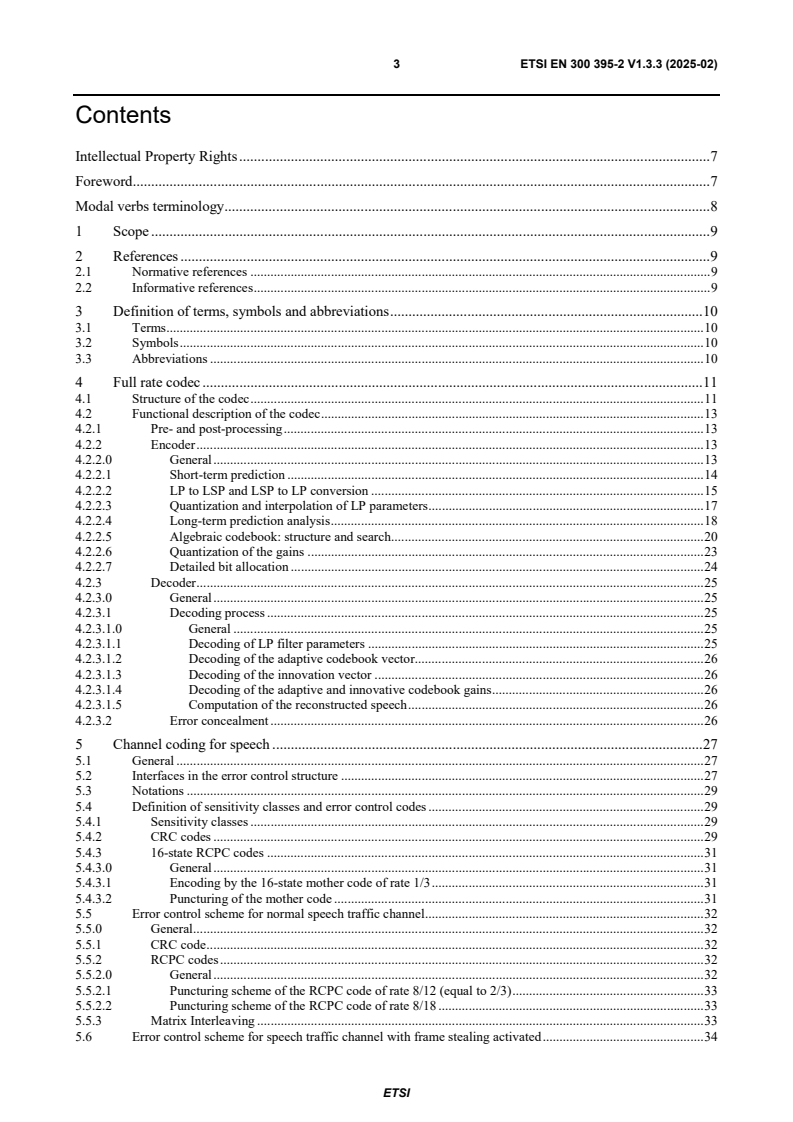
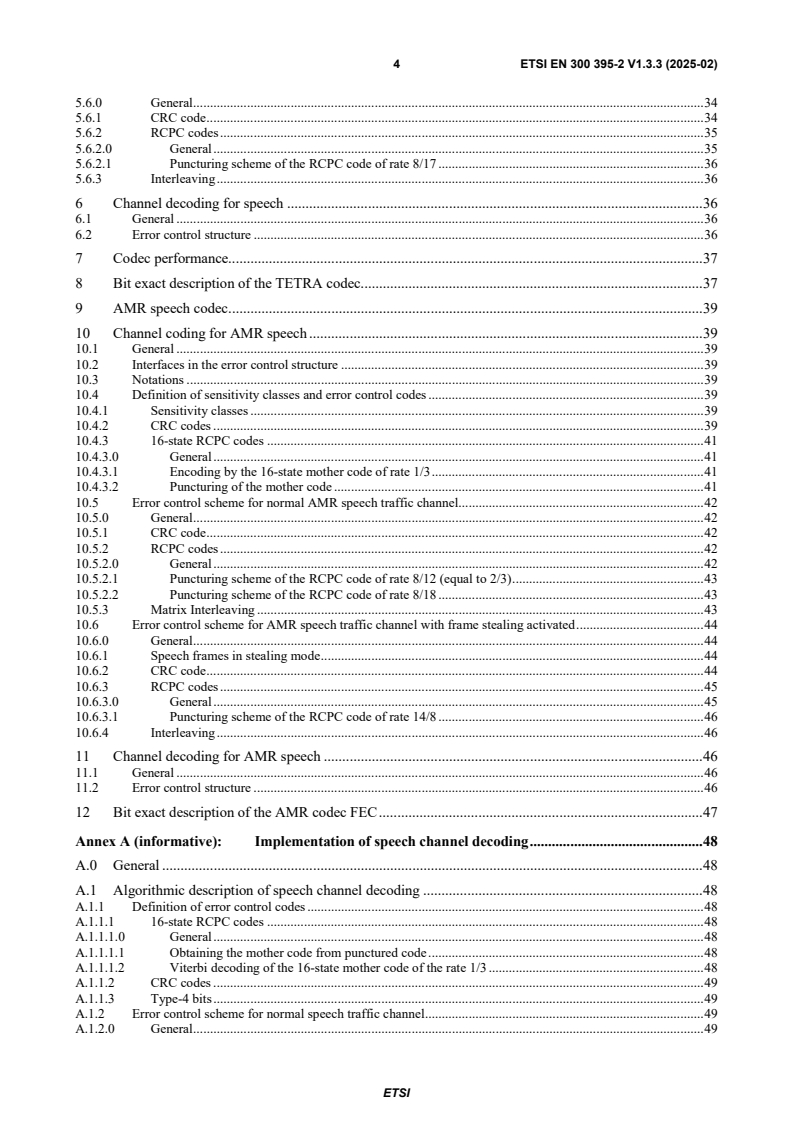
ETSI EN 300 395-2 V1.3.3 (2025-02) - TETRA and Critical Communications Evolution (TCCE); Speech codec for full-rate traffic channel; Part 2: TETRA codec

Overview
SIST EN 300 395-2 V1.3.3:2025 - part of the TETRA and Critical Communications Evolution (TCCE) family - provides the full specification of the speech codecs intended for the Terrestrial Trunked Radio (TETRA) system. Published by SIST and identical to ETSI EN 300 395-2 V1.3.3 (2025-02), this standard defines the TETRA codec (mandatory for all TETRA mobiles and networks) and an optional AMR codec (clauses 9–12 apply if implemented). The document contains encoder/decoder architectures, channel coding and decoding schemes, bit-exact descriptions, and performance guidance for full-rate traffic channels.
Key topics and technical requirements
- Mandatory TETRA codec specification (clauses 4–8): structural and functional details for encoder and decoder, pre/post‑processing, short-term prediction, LP/LSP conversions, long-term prediction and algebraic codebook design.
- Optional AMR codec (clauses 9–12): alternative codec specification and related channel coding rules when implemented.
- Channel coding and error control (clauses 5, 10): sensitivity class definitions, CRC schemes, 16-state RCPC (rate-compatible punctured convolutional) codes, puncturing patterns and matrix interleaving for robust transmission.
- Channel decoding (clauses 6, 11): decoding structures, error concealment and implementation guidance for speech channel recovery.
- Bit-exact codec descriptions and performance (clauses 7, 8, 12): precise bit-level definitions for interoperability and testability, plus codec performance metrics.
- Implementation annex: algorithmic descriptions and practical notes for implementing speech channel decoding.
Practical applications
- Ensures interoperability between TETRA handsets, base stations and infrastructure across vendors.
- Enables robust voice communications in mission-critical systems (public safety, emergency services, transportation, utilities and industrial operations).
- Supports product development (firmware/software codec implementations) and conformance testing (test labs require bit-exact descriptions).
- Guides radio manufacturers and network integrators on error control, frame handling and performance tuning for full-rate traffic channels.
Who should use this standard
- Radio equipment manufacturers and firmware developers implementing TETRA voice codecs.
- Network operators and system integrators deploying TETRA/Critical Communications systems.
- Test laboratories and certification bodies performing interoperability and conformance testing.
- Standards engineers, product managers and technical procurement teams specifying TETRA-compliant devices.
Related standards
- ETSI EN 300 395-2 V1.3.3 (2025-02) - the originating ETSI deliverable (document is identical).
- Other TCCE/TETRA family standards covering air interface, signalling and network profiles (consult ETSI and SIST catalogs for related parts).
Keywords: TETRA codec, TCCE, speech codec, full-rate traffic channel, AMR codec, RCPC, CRC, matrix interleaving, bit-exact description, critical communications.
Buy Documents
ETSI EN 300 395-2 V1.3.2 (2024-10) - TETRA and Critical Communications Evolution (TCCE); Speech codec for full-rate traffic channel; Part 2: TETRA codec
ETSI EN 300 395-2 V1.3.3 (2025-02) - TETRA and Critical Communications Evolution (TCCE); Speech codec for full-rate traffic channel; Part 2: TETRA codec
Get Certified
Connect with accredited certification bodies for this standard

ANCE
Mexican certification and testing association.

Intertek Slovenia
Intertek testing, inspection, and certification services in Slovenia.

LNE (Laboratoire National de Métrologie et d'Essais)
French national laboratory for metrology and testing.
Sponsored listings
Frequently Asked Questions
SIST EN 300 395-2 V1.3.3:2025 is a standard published by the Slovenian Institute for Standardization (SIST). Its full title is "TETRA and Critical Communications Evolution (TCCE) - Speech codec for full-rate traffic channel - Part 2: TETRA codec". This standard covers: The present document contains the full specification of the speech codecs for use in the Terrestrial Trunked Radio (TETRA) system. The TETRA codec specified in clauses 4 to 8 is mandatory for all TETRA mobiles and networks. The AMR codec specified in clauses 9 to 12 is optional. If the AMR codec is implemented, all clauses from 9 to 12 applies.
The present document contains the full specification of the speech codecs for use in the Terrestrial Trunked Radio (TETRA) system. The TETRA codec specified in clauses 4 to 8 is mandatory for all TETRA mobiles and networks. The AMR codec specified in clauses 9 to 12 is optional. If the AMR codec is implemented, all clauses from 9 to 12 applies.
SIST EN 300 395-2 V1.3.3:2025 is classified under the following ICS (International Classification for Standards) categories: 33.070.10 - Terrestrial Trunked Radio (TETRA). The ICS classification helps identify the subject area and facilitates finding related standards.
SIST EN 300 395-2 V1.3.3:2025 is available in PDF format for immediate download after purchase. The document can be added to your cart and obtained through the secure checkout process. Digital delivery ensures instant access to the complete standard document.
Standards Content (Sample)
Draft ETSI EN 300 395-2 V1.3.2 (2024-10)
EUROPEAN STANDARD
TETRA and Critical Communications Evolution (TCCE);
Speech codec for full-rate traffic channel;
Part 2: TETRA codec
2 Draft ETSI EN 300 395-2 V1.3.2 (2024-10)
Reference
REN/TCCE-00266
Keywords
codec, radio, TETRA
ETSI
650 Route des Lucioles
F-06921 Sophia Antipolis Cedex - FRANCE
Tel.: +33 4 92 94 42 00 Fax: +33 4 93 65 47 16
Siret N° 348 623 562 00017 - APE 7112B
Association à but non lucratif enregistrée à la
Sous-Préfecture de Grasse (06) N° w061004871
Important notice
The present document can be downloaded from the
ETSI Search & Browse Standards application.
The present document may be made available in electronic versions and/or in print. The content of any electronic and/or
print versions of the present document shall not be modified without the prior written authorization of ETSI. In case of any
existing or perceived difference in contents between such versions and/or in print, the prevailing version of an ETSI
deliverable is the one made publicly available in PDF format on ETSI deliver.
Users should be aware that the present document may be revised or have its status changed,
this information is available in the Milestones listing.
If you find errors in the present document, please send your comments to
the relevant service listed under Committee Support Staff.
If you find a security vulnerability in the present document, please report it through our
Coordinated Vulnerability Disclosure (CVD) program.
Notice of disclaimer & limitation of liability
The information provided in the present deliverable is directed solely to professionals who have the appropriate degree of
experience to understand and interpret its content in accordance with generally accepted engineering or
other professional standard and applicable regulations.
No recommendation as to products and services or vendors is made or should be implied.
In no event shall ETSI be held liable for loss of profits or any other incidental or consequential damages.
Any software contained in this deliverable is provided "AS IS" with no warranties, express or implied, including but not
limited to, the warranties of merchantability, fitness for a particular purpose and non-infringement of intellectual property
rights and ETSI shall not be held liable in any event for any damages whatsoever (including, without limitation, damages
for loss of profits, business interruption, loss of information, or any other pecuniary loss) arising out of or related to the use
of or inability to use the software.
Copyright Notification
No part may be reproduced or utilized in any form or by any means, electronic or mechanical, including photocopying and
microfilm except as authorized by written permission of ETSI.
The content of the PDF version shall not be modified without the written authorization of ETSI.
The copyright and the foregoing restriction extend to reproduction in all media.
© ETSI 2024.
All rights reserved.
ETSI
3 Draft ETSI EN 300 395-2 V1.3.2 (2024-10)
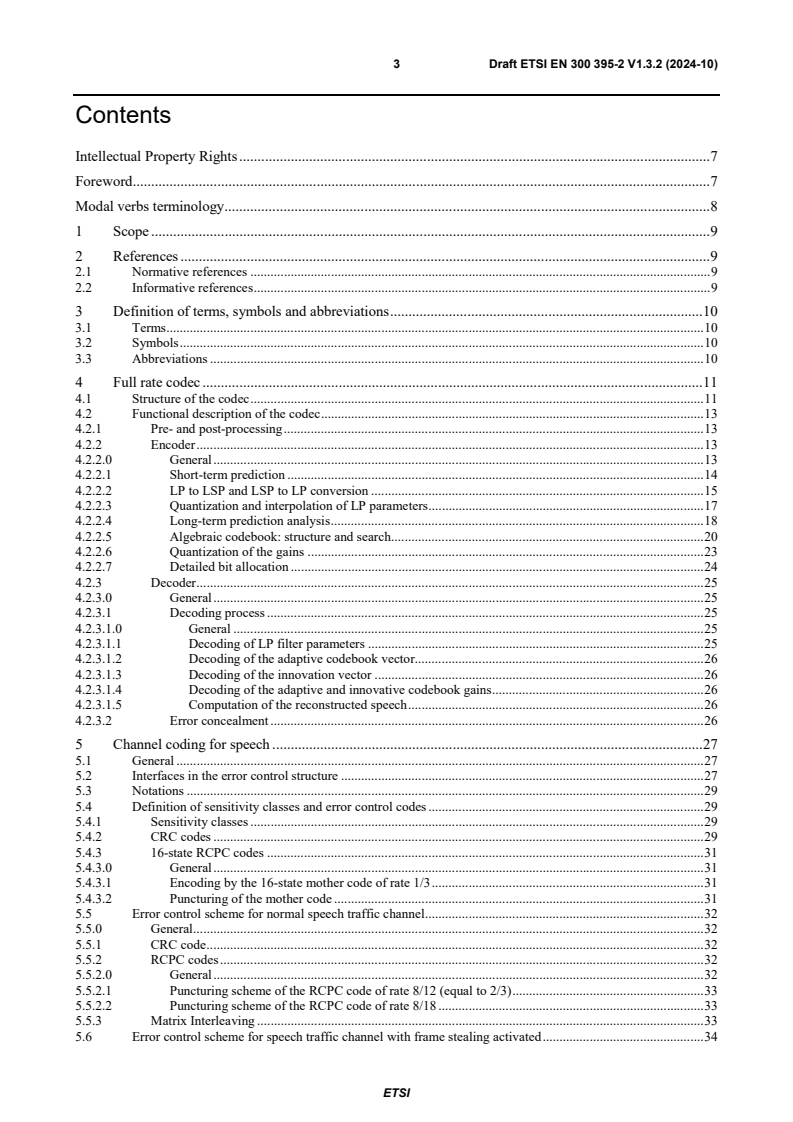
Contents
Intellectual Property Rights . 7
Foreword . 7
Modal verbs terminology . 8
1 Scope . 9
2 References . 9
2.1 Normative references . 9
2.2 Informative references . 9
3 Definition of terms, symbols and abbreviations . 10
3.1 Terms . 10
3.2 Symbols . 10
3.3 Abbreviations . 10
4 Full rate codec . 11
4.1 Structure of the codec . 11
4.2 Functional description of the codec . 13
4.2.1 Pre- and post-processing . 13
4.2.2 Encoder . 13
4.2.2.0 General . 13
4.2.2.1 Short-term prediction . 14
4.2.2.2 LP to LSP and LSP to LP conversion . 15
4.2.2.3 Quantization and interpolation of LP parameters . 17
4.2.2.4 Long-term prediction analysis . 18
4.2.2.5 Algebraic codebook: structure and search . 20
4.2.2.6 Quantization of the gains . 23
4.2.2.7 Detailed bit allocation . 24
4.2.3 Decoder . 25
4.2.3.0 General . 25
4.2.3.1 Decoding process . 25
4.2.3.1.0 General . 25
4.2.3.1.1 Decoding of LP filter parameters . 25
4.2.3.1.2 Decoding of the adaptive codebook vector. 26
4.2.3.1.3 Decoding of the innovation vector . 26
4.2.3.1.4 Decoding of the adaptive and innovative codebook gains . 26
4.2.3.1.5 Computation of the reconstructed speech . 26
4.2.3.2 Error concealment . 26
5 Channel coding for speech . 27
5.1 General . 27
5.2 Interfaces in the error control structure . 27
5.3 Notations . 29
5.4 Definition of sensitivity classes and error control codes . 29
5.4.1 Sensitivity classes . 29
5.4.2 CRC codes . 29
5.4.3 16-state RCPC codes . 31
5.4.3.0 General . 31
5.4.3.1 Encoding by the 16-state mother code of rate 1/3 . 31
5.4.3.2 Puncturing of the mother code . 31
5.5 Error control scheme for normal speech traffic channel . 32
5.5.0 General . 32
5.5.1 CRC code . 32
5.5.2 RCPC codes . 32
5.5.2.0 General . 32
5.5.2.1 Puncturing scheme of the RCPC code of rate 8/12 (equal to 2/3) . 33
5.5.2.2 Puncturing scheme of the RCPC code of rate 8/18 . 33
5.5.3 Matrix Interleaving . 33
5.6 Error control scheme for speech traffic channel with frame stealing activated . 34
ETSI
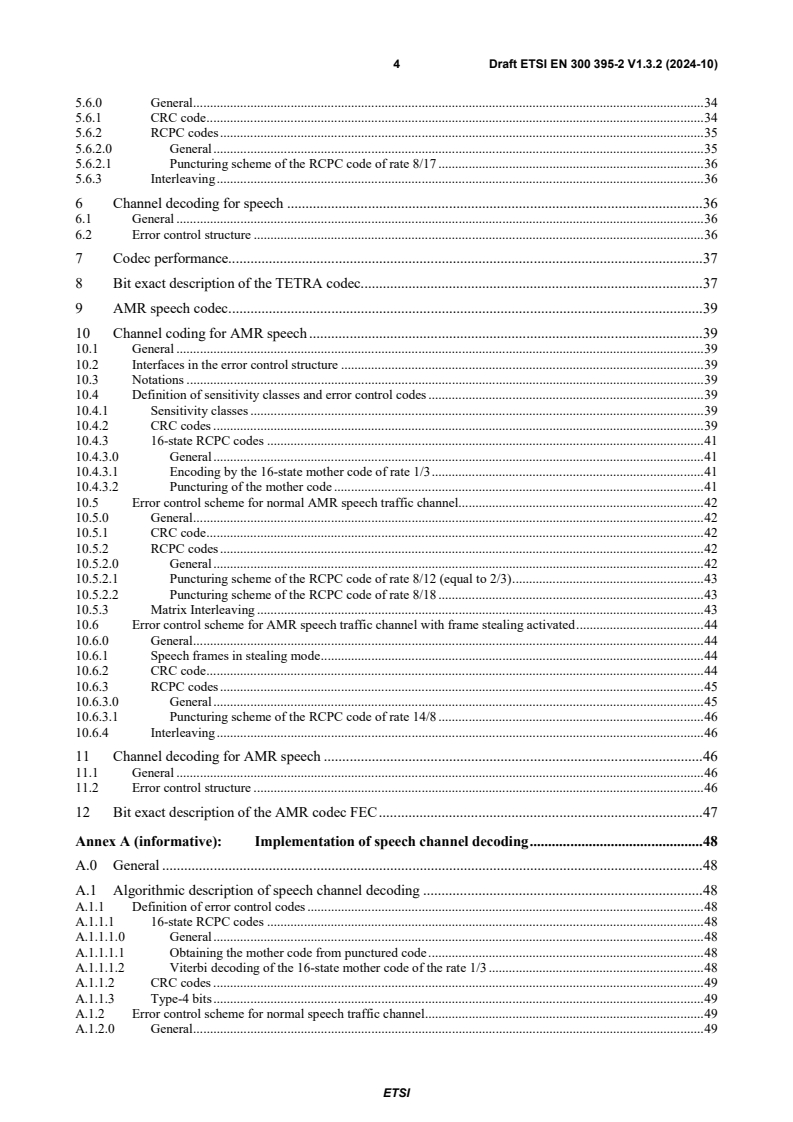
4 Draft ETSI EN 300 395-2 V1.3.2 (2024-10)
5.6.0 General . 34
5.6.1 CRC code . 34
5.6.2 RCPC codes . 35
5.6.2.0 General . 35
5.6.2.1 Puncturing scheme of the RCPC code of rate 8/17 . 36
5.6.3 Interleaving . 36
6 Channel decoding for speech . 36
6.1 General . 36
6.2 Error control structure . 36
7 Codec performance. 37
8 Bit exact description of the TETRA codec. 37
9 AMR speech codec . 39
10 Channel coding for AMR speech . 39
10.1 General . 39
10.2 Interfaces in the error control structure . 39
10.3 Notations . 39
10.4 Definition of sensitivity classes and error control codes . 39
10.4.1 Sensitivity classes . 39
10.4.2 CRC codes . 39
10.4.3 16-state RCPC codes . 41
10.4.3.0 General . 41
10.4.3.1 Encoding by the 16-state mother code of rate 1/3 . 41
10.4.3.2 Puncturing of the mother code . 41
10.5 Error control scheme for normal AMR speech traffic channel. 42
10.5.0 General . 42
10.5.1 CRC code . 42
10.5.2 RCPC codes . 42
10.5.2.0 General . 42
10.5.2.1 Puncturing scheme of the RCPC code of rate 8/12 (equal to 2/3) . 43
10.5.2.2 Puncturing scheme of the RCPC code of rate 8/18 . 43
10.5.3 Matrix Interleaving . 43
10.6 Error control scheme for AMR speech traffic channel with frame stealing activated . 44
10.6.0 General . 44
10.6.1 Speech frames in stealing mode . 44
10.6.2 CRC code . 44
10.6.3 RCPC codes . 45
10.6.3.0 General . 45
10.6.3.1 Puncturing scheme of the RCPC code of rate 14/8 . 46
10.6.4 Interleaving . 46
11 Channel decoding for AMR speech . 46
11.1 General . 46
11.2 Error control structure . 46
12 Bit exact description of the AMR codec FEC . 47
Annex A (informative): Implementation of speech channel decoding . 48
A.0 General . 48
A.1 Algorithmic description of speech channel decoding . 48
A.1.1 Definition of error control codes . 48
A.1.1.1 16-state RCPC codes . 48
A.1.1.1.0 General . 48
A.1.1.1.1 Obtaining the mother code from punctured code . 48
A.1.1.1.2 Viterbi decoding of the 16-state mother code of the rate 1/3 . 48
A.1.1.2 CRC codes . 49
A.1.1.3 Type-4 bits . 49
A.1.2 Error control scheme for normal speech traffic channel . 49
A.1.2.0 General . 49
ETSI
5 Draft ETSI EN 300 395-2 V1.3.2 (2024-10)
A.1.2.1 Matrix Interleaving . 49
A.1.2.2 RCPC codes . 49
A.1.2.2.0 General . 49
A.1.2.2.1 Puncturing scheme of the RCPC code of rate 8/12 (equal to 2/3) . 50
A.1.2.2.2 Puncturing scheme of the RCPC code of rate 8/18 . 50
A.1.2.3 CRC code . 50
A.1.2.4 Speech parameters . 50
A.1.3 Error control scheme for speech traffic channel with frame stealing activated . 50
A.1.3.0 General . 50
A.1.3.1 Interleaving . 50
A.1.3.2 RCPC codes . 51
A.1.3.2.0 General . 51
A.1.3.2.1 Puncturing scheme of the RCPC code of rate 8/17 . 51
A.1.3.3 CRC code . 51
A.1.3.4 Speech parameters . 51
A.2 C Code for speech channel decoding . 51
Annex B (informative): Indexes . 52
B.1 Index of C code routines . 52
B.2 Index of files . 55
Annex C (informative): Codec performance . 56
C.1 General . 56
C.2 Quality . 56
C.2.1 Subjective speech quality . 56
C.2.1.1 Description of characterization tests . 56
C.2.1.2 Absolute speech quality . 56
C.2.1.3 Effect of input level . 56
C.2.1.4 Effect of input frequency characteristic . 56
C.2.1.5 Effect of transmission errors . 57
C.2.1.6 Effect of tandeming . 57
C.2.1.7 Effect of acoustic background noise . 57
C.2.1.8 Effect of vocal effort . 57
C.2.1.9 Effect of frame stealing . 57
C.2.1.10 Speaker and language dependency . 57
C.2.2 Comparison with analogue FM . 57
C.2.2.0 General . 57
C.2.2.1 Analogue and digital systems results . 57
C.2.2.2 All conditions. 58
C.2.2.3 Input level . 58
C.2.2.4 Error patterns . 59
C.2.2.5 Background noise . 59
C.2.3 Additional tests . 59
C.2.3.0 General . 59
C.2.3.1 Types of signals . 59
C.2.3.2 Codec behaviour . 59
C.3 Performance of the channel coding/decoding for speech . 60
C.3.0 General . 60
C.3.1 Classes of simulation environment conditions . 60
C.3.2 Classes of equipment . 60
C.3.3 Classes of bits . 61
C.3.4 Channel conditions . 61
C.3.5 Results for normal case . 61
C.4 Complexity . 62
C.4.0 General . 62
C.4.1 Complexity analysis . 62
C.4.1.1 Measurement methodology . 62
C.4.1.2 TETRA basic operators . 62
ETSI
6 Draft ETSI EN 300 395-2 V1.3.2 (2024-10)
C.4.1.3 Worst case path for speech encoder . 64
C.4.1.4 Worst case path for speech decoder . 65
C.4.1.5 Condensed complexity values for encoder and decoder . 66
C.4.2 DSP independence . 67
C.4.2.0 General . 67
C.4.2.1 Program control structure . 67
C.4.2.2 Basic operator implementation . 67
C.4.2.3 Additional operator implementation . 67
C.5 Delay . 67
Annex D (informative): Results of the TETRA codec characterization listening and
complexity tests . 68
D.1 Characterization listening test . 68
D.1.1 Experimental conditions . 68
D.1.2 Tables of results . 69
D.2 TETRA codec complexity study . 77
D.2.1 Computational analysis results . 77
D.2.1.1 TETRA speech encoder . 77
D.2.1.2 TETRA speech decoder . 85
D.2.1.3 TETRA channel encoder and decoder . 88
D.2.2 Memory requirements analysis results . 90
D.2.2.1 TETRA speech encoder . 90
D.2.2.2 TETRA speech decoder . 91
D.2.2.3 TETRA speech channel encoder . 91
D.2.2.4 TETRA speech channel decoder . 91
Annex E (informative): Description of attached computer files . 92
E.0 General . 92
E.1 Directory C-WORD . 92
E.2 Directory C-CODE . 92
E.3 Directory AMR-Code . 92
Annex F (informative): Bibliography . 93
History . 94
ETSI
7 Draft ETSI EN 300 395-2 V1.3.2 (2024-10)
Intellectual Property Rights
Essential patents
IPRs essential or potentially essential to normative deliverables may have been declared to ETSI. The declarations
pertaining to these essential IPRs, if any, are publicly available for ETSI members and non-members, and can be
found in ETSI SR 000 314: "Intellectual Property Rights (IPRs); Essential, or potentially Essential, IPRs notified to
ETSI in respect of ETSI standards", which is available from the ETSI Secretariat. Latest updates are available on the
ETSI Web server (https://ipr.etsi.org/).
Pursuant to the ETSI Directives including the ETSI IPR Policy, no investigation regarding the essentiality of IPRs,
including IPR searches, has been carried out by ETSI. No guarantee can be given as to the existence of other IPRs not
referenced in ETSI SR 000 314 (or the updates on the ETSI Web server) which are, or may be, or may become,
essential to the present document.
Trademarks
The present document may include trademarks and/or tradenames which are asserted and/or registered by their owners.
ETSI claims no ownership of these except for any which are indicated as being the property of ETSI, and conveys no
right to use or reproduce any trademark and/or tradename. Mention of those trademarks in the present document does
not constitute an endorsement by ETSI of products, services or organizations associated with those trademarks.
DECT™, PLUGTESTS™, UMTS™ and the ETSI logo are trademarks of ETSI registered for the benefit of its
Members. 3GPP™ and LTE™ are trademarks of ETSI registered for the benefit of its Members and of the 3GPP
Organizational Partners. oneM2M™ logo is a trademark of ETSI registered for the benefit of its Members and of the ®
oneM2M Partners. GSM and the GSM logo are trademarks registered and owned by the GSM Association.
Foreword
This draft European Standard (EN) has been produced by ETSI Technical Committee TETRA and Critical
Communications Evolution (TCCE), and is now submitted for the combined Public Enquiry and Vote phase of the
ETSI EN Approval Procedure.
The present document is part 2 of a multi-part deliverable covering speech codec for full-rate traffic channel, as
identified below:
Part 1: "General description of speech functions";
Part 2: "TETRA codec";
Part 3: "Specific operating features";
Part 4: "Codec conformance testing".
Clause 4 provides a complete description of the full rate speech source encoder and decoder, whilst clause 5 describes
the speech channel encoder and clause 6 the speech channel decoder.
Clause 7 describes the codec performance.
Clause 8 introduces the bit exact description of the codec. This description is given as an ANSI C code, fixed point, bit
exact. The whole C code corresponding to the TETRA codec is given in computer files attached to the present
document, and are an integral part of this multi-part deliverable.
Clause 9 describes the optional AMR codec.
Clause 10 describes the AMR speech channel encoder.
Clause 11 describes the AMR speech channel decoder.
Clause 12 introduces the AMR speech channel encoder and decoder. This description is given as an ANSI C code.
ETSI
8 Draft ETSI EN 300 395-2 V1.3.2 (2024-10)
In addition to these clauses, five informative annexes are provided.
Annex A describes a possible implementation of the speech channel decoding function.
Annex B provides comprehensive indexes of all the routines and files included in the C code associated with the present
document.
Annex C describes the actual quality, performance and complexity aspects of the codec.
Annex D reports detailed results from codec characterization listening and complexity tests.
Annex E contains instructions for the use of the attached electronic files.
Annex F lists informative references relevant to the speech codec.
Proposed national transposition dates
Date of latest announcement of this EN (doa): 3 months after ETSI publication
Date of latest publication of new National Standard
or endorsement of this EN (dop/e): 6 months after doa
Date of withdrawal of any conflicting National Standard (dow): 6 months after doa
Modal verbs terminology
In the present document "shall", "shall not", "should", "should not", "may", "need not", "will", "will not", "can" and
"cannot" are to be interpreted as described in clause 3.2 of the ETSI Drafting Rules (Verbal forms for the expression of
provisions).
"must" and "must not" are NOT allowed in ETSI deliverables except when used in direct citation.
ETSI
9 Draft ETSI EN 300 395-2 V1.3.2 (2024-10)
1 Scope
The present document contains the full specification of the speech codecs for use in the Terrestrial Trunked Radio
(TETRA) system.
The TETRA codec specified in clauses 4 to 8 is mandatory for all TETRA mobiles and networks. The AMR codec
specified in clauses 9 to 12 is optional. If the AMR codec is implemented, all clauses from 9 to 12 applies.
2 References
2.1 Normative references
References are either specific (identified by date of publication and/or edition number or version number) or
non-specific. For specific references, only the cited version applies. For non-specific references, the latest version of the
referenced document (including any amendments) applies.
Referenced documents which are not found to be publicly available in the expected location might be found at
https://docbox.etsi.org/Reference/.
NOTE: While any hyperlinks included in this clause were valid at the time of publication, ETSI cannot guarantee
their long term validity.
The following referenced documents are necessary for the application of the present document.
[1] ETSI EN 300 392-2: "Terrestrial Trunked Radio (TETRA); Voice plus Data (V+D); Part 2: Air
Interface (AI)".
[2] ETSI TS 126 073: "Universal Mobile Telecommunications System (UMTS); ANSI-C code for the
Adaptive Multi Rate speech codec (3GPP TS 26.073 Release 4)".
[3] ETSI TS 126 074: "Universal Mobile Telecommunications System (UMTS); Mandatory speech
codec speech processing functions; AMR speech codec test sequences (3GPP TS 26.074
Release 4)".
[4] ETSI TS 126 090: "Universal Mobile Telecommunications System (UMTS); Mandatory Speech
Codec speech processing functions AMR Speech Codec - Transcoding functions (3GPP TS 26.090
Release 4)".
2.2 Informative references
References are either specific (identified by date of publication and/or edition number or version number) or
non-specific. For specific references, only the cited version applies. For non-specific references, the latest version of the
referenced document (including any amendments) applies.
NOTE: While any hyperlinks included in this clause were valid at the time of publication, ETSI cannot guarantee
their long term validity.
The following referenced documents are not necessary for the application of the present document but they assist the
user with regard to a particular subject area.
[i.1] Recommendation ITU-T P.48 (1988): "Specification for an intermediate reference system".
[i.2] ETSI ETR 300-1: "Terrestrial Trunked Radio (TETRA); Voice plus Data (V+D); Designers'
guide; Part 1: Overview, technical description and radio aspects".
ETSI
10 Draft ETSI EN 300 395-2 V1.3.2 (2024-10)
3 Definition of terms, symbols and abbreviations
3.1 Terms
Void.
3.2 Symbols
Void.
3.3 Abbreviations
For the purposes of the present document, the following abbreviations apply:
ACELP Algebraic CELP
AMR Adaptive Multi-Rate
ANSI American National Standards Institute
BER Bit Error Ratio
BFI Bad Frame Indicator
BS Base Station
CELP Code-Excited Linear Predictive
CRC Cyclic Redundancy Code
DSP Digital Signal Processor
DTMF Dual Tone Multiple Frequency
EP Error Pattern
EQ EQualizer test
FEC Forward Error Correction
FIR Finite Impulse Response
FM Frequency Modulation
GSM Global System for Mobile communications
HT Hilly Terrain
IRS Intermediate Reference System
LP Linear Prediction
LPC Linear Predictive Coding
LSB Least Significant Bit
LSF Line Spectral Frequency
LSP Line Spectral Pair
MER Message Error Rate
MNRU Multiplicative Noise Reference Unit
MOPS Million of Operations per Second
MOS Mean Opinion Score
MS Mobile Station
MSB Most Significant Bit
MSE Mean Square Error
PCM Pulse Code Modulation
PDF Probability Density Function
PUEM Probability of Undetected Erroneous Message
RAM Random Access Memory
RCPC Rate-Compatible Punctured Convolutional
RF Radio Frequency
ROM Read-Only Memory
SCR Source Controlled Rate
SNR Signal to Noise Ratio
STCH STealing CHannel
TCH/S Speech Traffic Channel
TDM Time Division Multiplex
TU Typical Urban
UPCM Uniform PCM
ETSI
11 Draft ETSI EN 300 395-2 V1.3.2 (2024-10)
V+D Voice + Data
VQ Vector Quantization
4 Full rate codec
4.1 Structure of the codec
The TETRA speech codec is based on the Code-Excited Linear Predictive (CELP) coding model. In this model, a block
of N speech samples is synthesized by filtering an appropriate innovation sequence from a codebook, scaled by a gain
factor g , through two time varying filters. A simplified high level block diagram of this synthesis process, as
c
implemented in the TETRA codec, is shown in figure 1.
Digital
Input
Algebraic codebook index
D
E
Pitch delay
M
U
L
T
GAIN PREDICTION
Gains I
P
AND VQ
L
E
Past
X
Excitation
g
T
p
ADAPTIVE
LPC Info
CODEBOOK
SHORT-TERM
LONG-TERM SYNTHESIS FILTER Output
SYNTHESIS FILTER Speech
g
k
c
ALGEBRAIC
CODEBOOK
Figure 1: High level block diagram of the TETRA speech synthesizer
The first filter is a long-term prediction filter (pitch filter) aiming at modelling the pseudo-periodicity in the speech
signal and the second is a short-term prediction filter modelling the speech spectral envelope.
The long-term or pitch, synthesis filter is given by:
=
(1)
−T
Bz
()
1−gz
p
where T is the pitch delay and g is the pitch gain. The pitch synthesis filter is implemented as an adaptive
p
codebook, where for delays less than the sub-frame length the past excitation is repeated.
The sho
...
EUROPEAN STANDARD
TETRA and Critical Communications Evolution (TCCE);
Speech codec for full-rate traffic channel;
Part 2: TETRA codec
2 ETSI EN 300 395-2 V1.3.3 (2025-02)
Reference
REN/TCCE-00266
Keywords
codec, radio, TETRA
ETSI
650 Route des Lucioles
F-06921 Sophia Antipolis Cedex - FRANCE
Tel.: +33 4 92 94 42 00 Fax: +33 4 93 65 47 16
Siret N° 348 623 562 00017 - APE 7112B
Association à but non lucratif enregistrée à la
Sous-Préfecture de Grasse (06) N° w061004871
Important notice
The present document can be downloaded from the
ETSI Search & Browse Standards application.
The present document may be made available in electronic versions and/or in print. The content of any electronic and/or
print versions of the present document shall not be modified without the prior written authorization of ETSI. In case of any
existing or perceived difference in contents between such versions and/or in print, the prevailing version of an ETSI
deliverable is the one made publicly available in PDF format on ETSI deliver repository.
Users should be aware that the present document may be revised or have its status changed,
this information is available in the Milestones listing.
If you find errors in the present document, please send your comments to
the relevant service listed under Committee Support Staff.
If you find a security vulnerability in the present document, please report it through our
Coordinated Vulnerability Disclosure (CVD) program.
Notice of disclaimer & limitation of liability
The information provided in the present deliverable is directed solely to professionals who have the appropriate degree of
experience to understand and interpret its content in accordance with generally accepted engineering or
other professional standard and applicable regulations.
No recommendation as to products and services or vendors is made or should be implied.
In no event shall ETSI be held liable for loss of profits or any other incidental or consequential damages.
Any software contained in this deliverable is provided "AS IS" with no warranties, express or implied, including but not
limited to, the warranties of merchantability, fitness for a particular purpose and non-infringement of intellectual property
rights and ETSI shall not be held liable in any event for any damages whatsoever (including, without limitation, damages
for loss of profits, business interruption, loss of information, or any other pecuniary loss) arising out of or related to the use
of or inability to use the software.
Copyright Notification
No part may be reproduced or utilized in any form or by any means, electronic or mechanical, including photocopying and
microfilm except as authorized by written permission of ETSI.
The content of the PDF version shall not be modified without the written authorization of ETSI.
The copyright and the foregoing restriction extend to reproduction in all media.
© ETSI 2025.
All rights reserved.
ETSI
3 ETSI EN 300 395-2 V1.3.3 (2025-02)
Contents
Intellectual Property Rights . 7
Foreword . 7
Modal verbs terminology . 8
1 Scope . 9
2 References . 9
2.1 Normative references . 9
2.2 Informative references . 9
3 Definition of terms, symbols and abbreviations . 10
3.1 Terms . 10
3.2 Symbols . 10
3.3 Abbreviations . 10
4 Full rate codec . 11
4.1 Structure of the codec . 11
4.2 Functional description of the codec . 13
4.2.1 Pre- and post-processing . 13
4.2.2 Encoder . 13
4.2.2.0 General . 13
4.2.2.1 Short-term prediction . 14
4.2.2.2 LP to LSP and LSP to LP conversion . 15
4.2.2.3 Quantization and interpolation of LP parameters . 17
4.2.2.4 Long-term prediction analysis . 18
4.2.2.5 Algebraic codebook: structure and search . 20
4.2.2.6 Quantization of the gains . 23
4.2.2.7 Detailed bit allocation . 24
4.2.3 Decoder . 25
4.2.3.0 General . 25
4.2.3.1 Decoding process . 25
4.2.3.1.0 General . 25
4.2.3.1.1 Decoding of LP filter parameters . 25
4.2.3.1.2 Decoding of the adaptive codebook vector. 26
4.2.3.1.3 Decoding of the innovation vector . 26
4.2.3.1.4 Decoding of the adaptive and innovative codebook gains . 26
4.2.3.1.5 Computation of the reconstructed speech . 26
4.2.3.2 Error concealment . 26
5 Channel coding for speech . 27
5.1 General . 27
5.2 Interfaces in the error control structure . 27
5.3 Notations . 29
5.4 Definition of sensitivity classes and error control codes . 29
5.4.1 Sensitivity classes . 29
5.4.2 CRC codes . 29
5.4.3 16-state RCPC codes . 31
5.4.3.0 General . 31
5.4.3.1 Encoding by the 16-state mother code of rate 1/3 . 31
5.4.3.2 Puncturing of the mother code . 31
5.5 Error control scheme for normal speech traffic channel . 32
5.5.0 General . 32
5.5.1 CRC code . 32
5.5.2 RCPC codes . 32
5.5.2.0 General . 32
5.5.2.1 Puncturing scheme of the RCPC code of rate 8/12 (equal to 2/3) . 33
5.5.2.2 Puncturing scheme of the RCPC code of rate 8/18 . 33
5.5.3 Matrix Interleaving . 33
5.6 Error control scheme for speech traffic channel with frame stealing activated . 34
ETSI
4 ETSI EN 300 395-2 V1.3.3 (2025-02)
5.6.0 General . 34
5.6.1 CRC code . 34
5.6.2 RCPC codes . 35
5.6.2.0 General . 35
5.6.2.1 Puncturing scheme of the RCPC code of rate 8/17 . 36
5.6.3 Interleaving . 36
6 Channel decoding for speech . 36
6.1 General . 36
6.2 Error control structure . 36
7 Codec performance. 37
8 Bit exact description of the TETRA codec. 37
9 AMR speech codec . 39
10 Channel coding for AMR speech . 39
10.1 General . 39
10.2 Interfaces in the error control structure . 39
10.3 Notations . 39
10.4 Definition of sensitivity classes and error control codes . 39
10.4.1 Sensitivity classes . 39
10.4.2 CRC codes . 39
10.4.3 16-state RCPC codes . 41
10.4.3.0 General . 41
10.4.3.1 Encoding by the 16-state mother code of rate 1/3 . 41
10.4.3.2 Puncturing of the mother code . 41
10.5 Error control scheme for normal AMR speech traffic channel. 42
10.5.0 General . 42
10.5.1 CRC code . 42
10.5.2 RCPC codes . 42
10.5.2.0 General . 42
10.5.2.1 Puncturing scheme of the RCPC code of rate 8/12 (equal to 2/3) . 43
10.5.2.2 Puncturing scheme of the RCPC code of rate 8/18 . 43
10.5.3 Matrix Interleaving . 43
10.6 Error control scheme for AMR speech traffic channel with frame stealing activated . 44
10.6.0 General . 44
10.6.1 Speech frames in stealing mode . 44
10.6.2 CRC code . 44
10.6.3 RCPC codes . 45
10.6.3.0 General . 45
10.6.3.1 Puncturing scheme of the RCPC code of rate 14/8 . 46
10.6.4 Interleaving . 46
11 Channel decoding for AMR speech . 46
11.1 General . 46
11.2 Error control structure . 46
12 Bit exact description of the AMR codec FEC . 47
Annex A (informative): Implementation of speech channel decoding . 48
A.0 General . 48
A.1 Algorithmic description of speech channel decoding . 48
A.1.1 Definition of error control codes . 48
A.1.1.1 16-state RCPC codes . 48
A.1.1.1.0 General . 48
A.1.1.1.1 Obtaining the mother code from punctured code . 48
A.1.1.1.2 Viterbi decoding of the 16-state mother code of the rate 1/3 . 48
A.1.1.2 CRC codes . 49
A.1.1.3 Type-4 bits . 49
A.1.2 Error control scheme for normal speech traffic channel . 49
A.1.2.0 General . 49
ETSI
5 ETSI EN 300 395-2 V1.3.3 (2025-02)
A.1.2.1 Matrix Interleaving . 49
A.1.2.2 RCPC codes . 49
A.1.2.2.0 General . 49
A.1.2.2.1 Puncturing scheme of the RCPC code of rate 8/12 (equal to 2/3) . 50
A.1.2.2.2 Puncturing scheme of the RCPC code of rate 8/18 . 50
A.1.2.3 CRC code . 50
A.1.2.4 Speech parameters . 50
A.1.3 Error control scheme for speech traffic channel with frame stealing activated . 50
A.1.3.0 General . 50
A.1.3.1 Interleaving . 50
A.1.3.2 RCPC codes . 51
A.1.3.2.0 General . 51
A.1.3.2.1 Puncturing scheme of the RCPC code of rate 8/17 . 51
A.1.3.3 CRC code . 51
A.1.3.4 Speech parameters . 51
A.2 C Code for speech channel decoding . 51
Annex B (informative): Indexes . 52
B.1 Index of C code routines . 52
B.2 Index of files . 55
Annex C (informative): Codec performance . 56
C.1 General . 56
C.2 Quality . 56
C.2.1 Subjective speech quality . 56
C.2.1.1 Description of characterization tests . 56
C.2.1.2 Absolute speech quality . 56
C.2.1.3 Effect of input level . 56
C.2.1.4 Effect of input frequency characteristic . 56
C.2.1.5 Effect of transmission errors . 57
C.2.1.6 Effect of tandeming . 57
C.2.1.7 Effect of acoustic background noise . 57
C.2.1.8 Effect of vocal effort . 57
C.2.1.9 Effect of frame stealing . 57
C.2.1.10 Speaker and language dependency . 57
C.2.2 Comparison with analogue FM . 57
C.2.2.0 General . 57
C.2.2.1 Analogue and digital systems results . 57
C.2.2.2 All conditions. 58
C.2.2.3 Input level . 58
C.2.2.4 Error patterns . 59
C.2.2.5 Background noise . 59
C.2.3 Additional tests . 59
C.2.3.0 General . 59
C.2.3.1 Types of signals . 59
C.2.3.2 Codec behaviour . 59
C.3 Performance of the channel coding/decoding for speech . 60
C.3.0 General . 60
C.3.1 Classes of simulation environment conditions . 60
C.3.2 Classes of equipment . 60
C.3.3 Classes of bits . 61
C.3.4 Channel conditions . 61
C.3.5 Results for normal case . 61
C.4 Complexity . 62
C.4.0 General . 62
C.4.1 Complexity analysis . 62
C.4.1.1 Measurement methodology . 62
C.4.1.2 TETRA basic operators . 62
ETSI
6 ETSI EN 300 395-2 V1.3.3 (2025-02)
C.4.1.3 Worst case path for speech encoder . 64
C.4.1.4 Worst case path for speech decoder . 65
C.4.1.5 Condensed complexity values for encoder and decoder . 66
C.4.2 DSP independence . 67
C.4.2.0 General . 67
C.4.2.1 Program control structure . 67
C.4.2.2 Basic operator implementation . 67
C.4.2.3 Additional operator implementation . 67
C.5 Delay . 67
Annex D (informative): Results of the TETRA codec characterization listening and
complexity tests . 68
D.1 Characterization listening test . 68
D.1.1 Experimental conditions . 68
D.1.2 Tables of results . 69
D.2 TETRA codec complexity study . 77
D.2.1 Computational analysis results . 77
D.2.1.1 TETRA speech encoder . 77
D.2.1.2 TETRA speech decoder . 85
D.2.1.3 TETRA channel encoder and decoder . 88
D.2.2 Memory requirements analysis results . 90
D.2.2.1 TETRA speech encoder . 90
D.2.2.2 TETRA speech decoder . 91
D.2.2.3 TETRA speech channel encoder . 91
D.2.2.4 TETRA speech channel decoder . 91
Annex E (informative): Description of attached computer files . 92
E.0 General . 92
E.1 Directory C-WORD . 92
E.2 Directory C-CODE . 92
E.3 Directory AMR-Code . 92
Annex F (informative): Bibliography . 93
History . 94
ETSI
7 ETSI EN 300 395-2 V1.3.3 (2025-02)
Intellectual Property Rights
Essential patents
IPRs essential or potentially essential to normative deliverables may have been declared to ETSI. The declarations
pertaining to these essential IPRs, if any, are publicly available for ETSI members and non-members, and can be
found in ETSI SR 000 314: "Intellectual Property Rights (IPRs); Essential, or potentially Essential, IPRs notified to
ETSI in respect of ETSI standards", which is available from the ETSI Secretariat. Latest updates are available on the
ETSI IPR online database.
Pursuant to the ETSI Directives including the ETSI IPR Policy, no investigation regarding the essentiality of IPRs,
including IPR searches, has been carried out by ETSI. No guarantee can be given as to the existence of other IPRs not
referenced in ETSI SR 000 314 (or the updates on the ETSI Web server) which are, or may be, or may become,
essential to the present document.
Trademarks
The present document may include trademarks and/or tradenames which are asserted and/or registered by their owners.
ETSI claims no ownership of these except for any which are indicated as being the property of ETSI, and conveys no
right to use or reproduce any trademark and/or tradename. Mention of those trademarks in the present document does
not constitute an endorsement by ETSI of products, services or organizations associated with those trademarks.
DECT™, PLUGTESTS™, UMTS™ and the ETSI logo are trademarks of ETSI registered for the benefit of its
Members. 3GPP™, LTE™ and 5G™ logo are trademarks of ETSI registered for the benefit of its Members and of the
3GPP Organizational Partners. oneM2M™ logo is a trademark of ETSI registered for the benefit of its Members and of ®
the oneM2M Partners. GSM and the GSM logo are trademarks registered and owned by the GSM Association.
Foreword
This European Standard (EN) has been produced by ETSI Technical Committee TETRA and Critical Communications
Evolution (TCCE).
The present document is part 2 of a multi-part deliverable covering speech codec for full-rate traffic channel, as
identified below:
Part 1: "General description of speech functions";
Part 2: "TETRA codec";
Part 3: "Specific operating features";
Part 4: "Codec conformance testing".
Clause 4 provides a complete description of the full rate speech source encoder and decoder, whilst clause 5 describes
the speech channel encoder and clause 6 the speech channel decoder.
Clause 7 describes the codec performance.
Clause 8 introduces the bit exact description of the codec. This description is given as an ANSI C code, fixed point, bit
exact. The whole C code corresponding to the TETRA codec is given in computer files attached to the present
document, and are an integral part of this multi-part deliverable.
Clause 9 describes the optional AMR codec.
Clause 10 describes the AMR speech channel encoder.
Clause 11 describes the AMR speech channel decoder.
Clause 12 introduces the AMR speech channel encoder and decoder. This description is given as an ANSI C code.
ETSI
8 ETSI EN 300 395-2 V1.3.3 (2025-02)
In addition to these clauses, five informative annexes are provided.
Annex A describes a possible implementation of the speech channel decoding function.
Annex B provides comprehensive indexes of all the routines and files included in the C code associated with the present
document.
Annex C describes the actual quality, performance and complexity aspects of the codec.
Annex D reports detailed results from codec characterization listening and complexity tests.
Annex E contains instructions for the use of the attached electronic files.
Annex F lists informative references relevant to the speech codec.
National transposition dates
Date of adoption of this EN: 7 January 2025
Date of latest announcement of this EN (doa): 30 April 2025
Date of latest publication of new National Standard
or endorsement of this EN (dop/e): 31 October 2025
Date of withdrawal of any conflicting National Standard (dow): 31 October 2025
Modal verbs terminology
In the present document "shall", "shall not", "should", "should not", "may", "need not", "will", "will not", "can" and
"cannot" are to be interpreted as described in clause 3.2 of the ETSI Drafting Rules (Verbal forms for the expression of
provisions).
"must" and "must not" are NOT allowed in ETSI deliverables except when used in direct citation.
ETSI
9 ETSI EN 300 395-2 V1.3.3 (2025-02)
1 Scope
The present document contains the full specification of the speech codecs for use in the Terrestrial Trunked Radio
(TETRA) system.
The TETRA codec specified in clauses 4 to 8 is mandatory for all TETRA mobiles and networks. The AMR codec
specified in clauses 9 to 12 is optional. If the AMR codec is implemented, all clauses from 9 to 12 applies.
2 References
2.1 Normative references
References are either specific (identified by date of publication and/or edition number or version number) or
non-specific. For specific references, only the cited version applies. For non-specific references, the latest version of the
referenced document (including any amendments) applies.
Referenced documents which are not found to be publicly available in the expected location might be found in the
ETSI docbox.
NOTE: While any hyperlinks included in this clause were valid at the time of publication, ETSI cannot guarantee
their long term validity.
The following referenced documents are necessary for the application of the present document.
[1] ETSI EN 300 392-2: "Terrestrial Trunked Radio (TETRA); Voice plus Data (V+D); Part 2: Air
Interface (AI)".
[2] ETSI TS 126 073: "Universal Mobile Telecommunications System (UMTS); ANSI-C code for the
Adaptive Multi Rate speech codec (3GPP TS 26.073 Release 4)".
[3] ETSI TS 126 074: "Universal Mobile Telecommunications System (UMTS); Mandatory speech
codec speech processing functions; AMR speech codec test sequences (3GPP TS 26.074
Release 4)".
[4] ETSI TS 126 090: "Universal Mobile Telecommunications System (UMTS); Mandatory Speech
Codec speech processing functions AMR Speech Codec - Transcoding functions (3GPP TS 26.090
Release 4)".
2.2 Informative references
References are either specific (identified by date of publication and/or edition number or version number) or
non-specific. For specific references, only the cited version applies. For non-specific references, the latest version of the
referenced document (including any amendments) applies.
NOTE: While any hyperlinks included in this clause were valid at the time of publication, ETSI cannot guarantee
their long term validity.
The following referenced documents are not necessary for the application of the present document but they assist the
user with regard to a particular subject area.
[i.1] Recommendation ITU-T P.48 (1988): "Specification for an intermediate reference system".
[i.2] ETSI ETR 300-1: "Terrestrial Trunked Radio (TETRA); Voice plus Data (V+D); Designers'
guide; Part 1: Overview, technical description and radio aspects".
ETSI
10 ETSI EN 300 395-2 V1.3.3 (2025-02)
3 Definition of terms, symbols and abbreviations
3.1 Terms
Void.
3.2 Symbols
Void.
3.3 Abbreviations
For the purposes of the present document, the following abbreviations apply:
ACELP Algebraic CELP
AMR Adaptive Multi-Rate
ANSI American National Standards Institute
BER Bit Error Ratio
BFI Bad Frame Indicator
BS Base Station
CELP Code-Excited Linear Predictive
CRC Cyclic Redundancy Code
DSP Digital Signal Processor
DTMF Dual Tone Multiple Frequency
EP Error Pattern
EQ EQualizer test
FEC Forward Error Correction
FIR Finite Impulse Response
FM Frequency Modulation
GSM Global System for Mobile communications
HT Hilly Terrain
IRS Intermediate Reference System
LP Linear Prediction
LPC Linear Predictive Coding
LSB Least Significant Bit
LSF Line Spectral Frequency
LSP Line Spectral Pair
MAC Media Access Control
MER Message Error Rate
MNRU Multiplicative Noise Reference Unit
MOPS Million of Operations per Second
MOS Mean Opinion Score
MS Mobile Station
MSB Most Significant Bit
MSE Mean Square Error
PCM Pulse Code Modulation
PDF Probability Density Function
PUEM Probability of Undetected Erroneous Message
RAM Random Access Memory
RCPC Rate-Compatible Punctured Convolutional
RF Radio Frequency
ROM Read-Only Memory
SCR Source Controlled Rate
SNR Signal to Noise Ratio
STCH STealing CHannel
TCH/S Speech Traffic Channel
TDM Time Division Multiplex
TU Typical Urban
ETSI
11 ETSI EN 300 395-2 V1.3.3 (2025-02)
UPCM Uniform PCM
V+D Voice + Data
VQ Vector Quantization
4 Full rate codec
4.1 Structure of the codec
The TETRA speech codec is based on the Code-Excited Linear Predictive (CELP) coding model. In this model, a block
of N speech samples is synthesized by filtering an appropriate innovation sequence from a codebook, scaled by a gain
factor g , through two time varying filters. A simplified high level block diagram of this synthesis process, as
c
implemented in the TETRA codec, is shown in figure 1.
Digital
Input
Algebraic codebook index
D
E
Pitch delay
M
U
L
T
GAIN PREDICTION
Gains I
P
AND VQ
L
E
Past
X
Excitation
g
T
p
ADAPTIVE
LPC Info
CODEBOOK
SHORT-TERM
LONG-TERM SYNTHESIS FILTER Output
SYNTHESIS FILTER
Speech
g
k c
ALGEBRAIC
CODEBOOK
Figure 1: High level block diagram of the TETRA speech synthesizer
The first filter is a long-term prediction filter (pitch filter) aiming at modelling the pseudo-periodicity in the speech
signal and the second is a short-term prediction filter modelling the speech spectral envelope.
The long-term or pitch, synthesis filter is given by:
=
(1)
−T
Bz
()
1−gz
p
where T is the pitch delay and g is the pitch gain. The pitch synthesis filter is implemented as an adaptive
p
codebook, where for delays less than the sub-frame length the past excitation is repeated.
The short-term synthesis filter is given by:
Hz()==
p
Az
()
−i
(2)
1+ az
i
i=1
where a ,i = 1,., p, are the Linear Prediction (LP)
...
SLOVENSKI STANDARD
01-april-2025
TETRA in razvoj kritičnih komunikacij (TCCE) - Govorni kodek za kanal s polno
hitrostjo - 2. del: Kodek TETRA
TETRA and Critical Communications Evolution (TCCE) - Speech codec for full-rate traffic
channel - Part 2: TETRA codec
Ta slovenski standard je istoveten z: ETSI EN 300 395-2 V1.3.3 (2025-02)
ICS:
33.070.10 Prizemni snopovni radio Terrestrial Trunked Radio
(TETRA) (TETRA)
2003-01.Slovenski inštitut za standardizacijo. Razmnoževanje celote ali delov tega standarda ni dovoljeno.
EUROPEAN STANDARD
TETRA and Critical Communications Evolution (TCCE);
Speech codec for full-rate traffic channel;
Part 2: TETRA codec
2 ETSI EN 300 395-2 V1.3.3 (2025-02)
Reference
REN/TCCE-00266
Keywords
codec, radio, TETRA
ETSI
650 Route des Lucioles
F-06921 Sophia Antipolis Cedex - FRANCE
Tel.: +33 4 92 94 42 00 Fax: +33 4 93 65 47 16
Siret N° 348 623 562 00017 - APE 7112B
Association à but non lucratif enregistrée à la
Sous-Préfecture de Grasse (06) N° w061004871
Important notice
The present document can be downloaded from the
ETSI Search & Browse Standards application.
The present document may be made available in electronic versions and/or in print. The content of any electronic and/or
print versions of the present document shall not be modified without the prior written authorization of ETSI. In case of any
existing or perceived difference in contents between such versions and/or in print, the prevailing version of an ETSI
deliverable is the one made publicly available in PDF format on ETSI deliver repository.
Users should be aware that the present document may be revised or have its status changed,
this information is available in the Milestones listing.
If you find errors in the present document, please send your comments to
the relevant service listed under Committee Support Staff.
If you find a security vulnerability in the present document, please report it through our
Coordinated Vulnerability Disclosure (CVD) program.
Notice of disclaimer & limitation of liability
The information provided in the present deliverable is directed solely to professionals who have the appropriate degree of
experience to understand and interpret its content in accordance with generally accepted engineering or
other professional standard and applicable regulations.
No recommendation as to products and services or vendors is made or should be implied.
In no event shall ETSI be held liable for loss of profits or any other incidental or consequential damages.
Any software contained in this deliverable is provided "AS IS" with no warranties, express or implied, including but not
limited to, the warranties of merchantability, fitness for a particular purpose and non-infringement of intellectual property
rights and ETSI shall not be held liable in any event for any damages whatsoever (including, without limitation, damages
for loss of profits, business interruption, loss of information, or any other pecuniary loss) arising out of or related to the use
of or inability to use the software.
Copyright Notification
No part may be reproduced or utilized in any form or by any means, electronic or mechanical, including photocopying and
microfilm except as authorized by written permission of ETSI.
The content of the PDF version shall not be modified without the written authorization of ETSI.
The copyright and the foregoing restriction extend to reproduction in all media.
© ETSI 2025.
All rights reserved.
ETSI
3 ETSI EN 300 395-2 V1.3.3 (2025-02)
Contents
Intellectual Property Rights . 7
Foreword . 7
Modal verbs terminology . 8
1 Scope . 9
2 References . 9
2.1 Normative references . 9
2.2 Informative references . 9
3 Definition of terms, symbols and abbreviations . 10
3.1 Terms . 10
3.2 Symbols . 10
3.3 Abbreviations . 10
4 Full rate codec . 11
4.1 Structure of the codec . 11
4.2 Functional description of the codec . 13
4.2.1 Pre- and post-processing . 13
4.2.2 Encoder . 13
4.2.2.0 General . 13
4.2.2.1 Short-term prediction . 14
4.2.2.2 LP to LSP and LSP to LP conversion . 15
4.2.2.3 Quantization and interpolation of LP parameters . 17
4.2.2.4 Long-term prediction analysis . 18
4.2.2.5 Algebraic codebook: structure and search . 20
4.2.2.6 Quantization of the gains . 23
4.2.2.7 Detailed bit allocation . 24
4.2.3 Decoder . 25
4.2.3.0 General . 25
4.2.3.1 Decoding process . 25
4.2.3.1.0 General . 25
4.2.3.1.1 Decoding of LP filter parameters . 25
4.2.3.1.2 Decoding of the adaptive codebook vector. 26
4.2.3.1.3 Decoding of the innovation vector . 26
4.2.3.1.4 Decoding of the adaptive and innovative codebook gains . 26
4.2.3.1.5 Computation of the reconstructed speech . 26
4.2.3.2 Error concealment . 26
5 Channel coding for speech . 27
5.1 General . 27
5.2 Interfaces in the error control structure . 27
5.3 Notations . 29
5.4 Definition of sensitivity classes and error control codes . 29
5.4.1 Sensitivity classes . 29
5.4.2 CRC codes . 29
5.4.3 16-state RCPC codes . 31
5.4.3.0 General . 31
5.4.3.1 Encoding by the 16-state mother code of rate 1/3 . 31
5.4.3.2 Puncturing of the mother code . 31
5.5 Error control scheme for normal speech traffic channel . 32
5.5.0 General . 32
5.5.1 CRC code . 32
5.5.2 RCPC codes . 32
5.5.2.0 General . 32
5.5.2.1 Puncturing scheme of the RCPC code of rate 8/12 (equal to 2/3) . 33
5.5.2.2 Puncturing scheme of the RCPC code of rate 8/18 . 33
5.5.3 Matrix Interleaving . 33
5.6 Error control scheme for speech traffic channel with frame stealing activated . 34
ETSI
4 ETSI EN 300 395-2 V1.3.3 (2025-02)
5.6.0 General . 34
5.6.1 CRC code . 34
5.6.2 RCPC codes . 35
5.6.2.0 General . 35
5.6.2.1 Puncturing scheme of the RCPC code of rate 8/17 . 36
5.6.3 Interleaving . 36
6 Channel decoding for speech . 36
6.1 General . 36
6.2 Error control structure . 36
7 Codec performance. 37
8 Bit exact description of the TETRA codec. 37
9 AMR speech codec . 39
10 Channel coding for AMR speech . 39
10.1 General . 39
10.2 Interfaces in the error control structure . 39
10.3 Notations . 39
10.4 Definition of sensitivity classes and error control codes . 39
10.4.1 Sensitivity classes . 39
10.4.2 CRC codes . 39
10.4.3 16-state RCPC codes . 41
10.4.3.0 General . 41
10.4.3.1 Encoding by the 16-state mother code of rate 1/3 . 41
10.4.3.2 Puncturing of the mother code . 41
10.5 Error control scheme for normal AMR speech traffic channel. 42
10.5.0 General . 42
10.5.1 CRC code . 42
10.5.2 RCPC codes . 42
10.5.2.0 General . 42
10.5.2.1 Puncturing scheme of the RCPC code of rate 8/12 (equal to 2/3) . 43
10.5.2.2 Puncturing scheme of the RCPC code of rate 8/18 . 43
10.5.3 Matrix Interleaving . 43
10.6 Error control scheme for AMR speech traffic channel with frame stealing activated . 44
10.6.0 General . 44
10.6.1 Speech frames in stealing mode . 44
10.6.2 CRC code . 44
10.6.3 RCPC codes . 45
10.6.3.0 General . 45
10.6.3.1 Puncturing scheme of the RCPC code of rate 14/8 . 46
10.6.4 Interleaving . 46
11 Channel decoding for AMR speech . 46
11.1 General . 46
11.2 Error control structure . 46
12 Bit exact description of the AMR codec FEC . 47
Annex A (informative): Implementation of speech channel decoding . 48
A.0 General . 48
A.1 Algorithmic description of speech channel decoding . 48
A.1.1 Definition of error control codes . 48
A.1.1.1 16-state RCPC codes . 48
A.1.1.1.0 General . 48
A.1.1.1.1 Obtaining the mother code from punctured code . 48
A.1.1.1.2 Viterbi decoding of the 16-state mother code of the rate 1/3 . 48
A.1.1.2 CRC codes . 49
A.1.1.3 Type-4 bits . 49
A.1.2 Error control scheme for normal speech traffic channel . 49
A.1.2.0 General . 49
ETSI
5 ETSI EN 300 395-2 V1.3.3 (2025-02)
A.1.2.1 Matrix Interleaving . 49
A.1.2.2 RCPC codes . 49
A.1.2.2.0 General . 49
A.1.2.2.1 Puncturing scheme of the RCPC code of rate 8/12 (equal to 2/3) . 50
A.1.2.2.2 Puncturing scheme of the RCPC code of rate 8/18 . 50
A.1.2.3 CRC code . 50
A.1.2.4 Speech parameters . 50
A.1.3 Error control scheme for speech traffic channel with frame stealing activated . 50
A.1.3.0 General . 50
A.1.3.1 Interleaving . 50
A.1.3.2 RCPC codes . 51
A.1.3.2.0 General . 51
A.1.3.2.1 Puncturing scheme of the RCPC code of rate 8/17 . 51
A.1.3.3 CRC code . 51
A.1.3.4 Speech parameters . 51
A.2 C Code for speech channel decoding . 51
Annex B (informative): Indexes . 52
B.1 Index of C code routines . 52
B.2 Index of files . 55
Annex C (informative): Codec performance . 56
C.1 General . 56
C.2 Quality . 56
C.2.1 Subjective speech quality . 56
C.2.1.1 Description of characterization tests . 56
C.2.1.2 Absolute speech quality . 56
C.2.1.3 Effect of input level . 56
C.2.1.4 Effect of input frequency characteristic . 56
C.2.1.5 Effect of transmission errors . 57
C.2.1.6 Effect of tandeming . 57
C.2.1.7 Effect of acoustic background noise . 57
C.2.1.8 Effect of vocal effort . 57
C.2.1.9 Effect of frame stealing . 57
C.2.1.10 Speaker and language dependency . 57
C.2.2 Comparison with analogue FM . 57
C.2.2.0 General . 57
C.2.2.1 Analogue and digital systems results . 57
C.2.2.2 All conditions. 58
C.2.2.3 Input level . 58
C.2.2.4 Error patterns . 59
C.2.2.5 Background noise . 59
C.2.3 Additional tests . 59
C.2.3.0 General . 59
C.2.3.1 Types of signals . 59
C.2.3.2 Codec behaviour . 59
C.3 Performance of the channel coding/decoding for speech . 60
C.3.0 General . 60
C.3.1 Classes of simulation environment conditions . 60
C.3.2 Classes of equipment . 60
C.3.3 Classes of bits . 61
C.3.4 Channel conditions . 61
C.3.5 Results for normal case . 61
C.4 Complexity . 62
C.4.0 General . 62
C.4.1 Complexity analysis . 62
C.4.1.1 Measurement methodology . 62
C.4.1.2 TETRA basic operators . 62
ETSI
6 ETSI EN 300 395-2 V1.3.3 (2025-02)
C.4.1.3 Worst case path for speech encoder . 64
C.4.1.4 Worst case path for speech decoder . 65
C.4.1.5 Condensed complexity values for encoder and decoder . 66
C.4.2 DSP independence . 67
C.4.2.0 General . 67
C.4.2.1 Program control structure . 67
C.4.2.2 Basic operator implementation . 67
C.4.2.3 Additional operator implementation . 67
C.5 Delay . 67
Annex D (informative): Results of the TETRA codec characterization listening and
complexity tests . 68
D.1 Characterization listening test . 68
D.1.1 Experimental conditions . 68
D.1.2 Tables of results . 69
D.2 TETRA codec complexity study . 77
D.2.1 Computational analysis results . 77
D.2.1.1 TETRA speech encoder . 77
D.2.1.2 TETRA speech decoder . 85
D.2.1.3 TETRA channel encoder and decoder . 88
D.2.2 Memory requirements analysis results . 90
D.2.2.1 TETRA speech encoder . 90
D.2.2.2 TETRA speech decoder . 91
D.2.2.3 TETRA speech channel encoder . 91
D.2.2.4 TETRA speech channel decoder . 91
Annex E (informative): Description of attached computer files . 92
E.0 General . 92
E.1 Directory C-WORD . 92
E.2 Directory C-CODE . 92
E.3 Directory AMR-Code . 92
Annex F (informative): Bibliography . 93
History . 94
ETSI
7 ETSI EN 300 395-2 V1.3.3 (2025-02)
Intellectual Property Rights
Essential patents
IPRs essential or potentially essential to normative deliverables may have been declared to ETSI. The declarations
pertaining to these essential IPRs, if any, are publicly available for ETSI members and non-members, and can be
found in ETSI SR 000 314: "Intellectual Property Rights (IPRs); Essential, or potentially Essential, IPRs notified to
ETSI in respect of ETSI standards", which is available from the ETSI Secretariat. Latest updates are available on the
ETSI IPR online database.
Pursuant to the ETSI Directives including the ETSI IPR Policy, no investigation regarding the essentiality of IPRs,
including IPR searches, has been carried out by ETSI. No guarantee can be given as to the existence of other IPRs not
referenced in ETSI SR 000 314 (or the updates on the ETSI Web server) which are, or may be, or may become,
essential to the present document.
Trademarks
The present document may include trademarks and/or tradenames which are asserted and/or registered by their owners.
ETSI claims no ownership of these except for any which are indicated as being the property of ETSI, and conveys no
right to use or reproduce any trademark and/or tradename. Mention of those trademarks in the present document does
not constitute an endorsement by ETSI of products, services or organizations associated with those trademarks.
DECT™, PLUGTESTS™, UMTS™ and the ETSI logo are trademarks of ETSI registered for the benefit of its
Members. 3GPP™, LTE™ and 5G™ logo are trademarks of ETSI registered for the benefit of its Members and of the
3GPP Organizational Partners. oneM2M™ logo is a trademark of ETSI registered for the benefit of its Members and of ®
the oneM2M Partners. GSM and the GSM logo are trademarks registered and owned by the GSM Association.
Foreword
This European Standard (EN) has been produced by ETSI Technical Committee TETRA and Critical Communications
Evolution (TCCE).
The present document is part 2 of a multi-part deliverable covering speech codec for full-rate traffic channel, as
identified below:
Part 1: "General description of speech functions";
Part 2: "TETRA codec";
Part 3: "Specific operating features";
Part 4: "Codec conformance testing".
Clause 4 provides a complete description of the full rate speech source encoder and decoder, whilst clause 5 describes
the speech channel encoder and clause 6 the speech channel decoder.
Clause 7 describes the codec performance.
Clause 8 introduces the bit exact description of the codec. This description is given as an ANSI C code, fixed point, bit
exact. The whole C code corresponding to the TETRA codec is given in computer files attached to the present
document, and are an integral part of this multi-part deliverable.
Clause 9 describes the optional AMR codec.
Clause 10 describes the AMR speech channel encoder.
Clause 11 describes the AMR speech channel decoder.
Clause 12 introduces the AMR speech channel encoder and decoder. This description is given as an ANSI C code.
ETSI
8 ETSI EN 300 395-2 V1.3.3 (2025-02)
In addition to these clauses, five informative annexes are provided.
Annex A describes a possible implementation of the speech channel decoding function.
Annex B provides comprehensive indexes of all the routines and files included in the C code associated with the present
document.
Annex C describes the actual quality, performance and complexity aspects of the codec.
Annex D reports detailed results from codec characterization listening and complexity tests.
Annex E contains instructions for the use of the attached electronic files.
Annex F lists informative references relevant to the speech codec.
National transposition dates
Date of adoption of this EN: 7 January 2025
Date of latest announcement of this EN (doa): 30 April 2025
Date of latest publication of new National Standard
or endorsement of this EN (dop/e): 31 October 2025
Date of withdrawal of any conflicting National Standard (dow): 31 October 2025
Modal verbs terminology
In the present document "shall", "shall not", "should", "should not", "may", "need not", "will", "will not", "can" and
"cannot" are to be interpreted as described in clause 3.2 of the ETSI Drafting Rules (Verbal forms for the expression of
provisions).
"must" and "must not" are NOT allowed in ETSI deliverables except when used in direct citation.
ETSI
9 ETSI EN 300 395-2 V1.3.3 (2025-02)
1 Scope
The present document contains the full specification of the speech codecs for use in the Terrestrial Trunked Radio
(TETRA) system.
The TETRA codec specified in clauses 4 to 8 is mandatory for all TETRA mobiles and networks. The AMR codec
specified in clauses 9 to 12 is optional. If the AMR codec is implemented, all clauses from 9 to 12 applies.
2 References
2.1 Normative references
References are either specific (identified by date of publication and/or edition number or version number) or
non-specific. For specific references, only the cited version applies. For non-specific references, the latest version of the
referenced document (including any amendments) applies.
Referenced documents which are not found to be publicly available in the expected location might be found in the
ETSI docbox.
NOTE: While any hyperlinks included in this clause were valid at the time of publication, ETSI cannot guarantee
their long term validity.
The following referenced documents are necessary for the application of the present document.
[1] ETSI EN 300 392-2: "Terrestrial Trunked Radio (TETRA); Voice plus Data (V+D); Part 2: Air
Interface (AI)".
[2] ETSI TS 126 073: "Universal Mobile Telecommunications System (UMTS); ANSI-C code for the
Adaptive Multi Rate speech codec (3GPP TS 26.073 Release 4)".
[3] ETSI TS 126 074: "Universal Mobile Telecommunications System (UMTS); Mandatory speech
codec speech processing functions; AMR speech codec test sequences (3GPP TS 26.074
Release 4)".
[4] ETSI TS 126 090: "Universal Mobile Telecommunications System (UMTS); Mandatory Speech
Codec speech processing functions AMR Speech Codec - Transcoding functions (3GPP TS 26.090
Release 4)".
2.2 Informative references
References are either specific (identified by date of publication and/or edition number or version number) or
non-specific. For specific references, only the cited version applies. For non-specific references, the latest version of the
referenced document (including any amendments) applies.
NOTE: While any hyperlinks included in this clause were valid at the time of publication, ETSI cannot guarantee
their long term validity.
The following referenced documents are not necessary for the application of the present document but they assist the
user with regard to a particular subject area.
[i.1] Recommendation ITU-T P.48 (1988): "Specification for an intermediate reference system".
[i.2] ETSI ETR 300-1: "Terrestrial Trunked Radio (TETRA); Voice plus Data (V+D); Designers'
guide; Part 1: Overview, technical description and radio aspects".
ETSI
10 ETSI EN 300 395-2 V1.3.3 (2025-02)
3 Definition of terms, symbols and abbreviations
3.1 Terms
Void.
3.2 Symbols
Void.
3.3 Abbreviations
For the purposes of the present document, the following abbreviations apply:
ACELP Algebraic CELP
AMR Adaptive Multi-Rate
ANSI American National Standards Institute
BER Bit Error Ratio
BFI Bad Frame Indicator
BS Base Station
CELP Code-Excited Linear Predictive
CRC Cyclic Redundancy Code
DSP Digital Signal Processor
DTMF Dual Tone Multiple Frequency
EP Error Pattern
EQ EQualizer test
FEC Forward Error Correction
FIR Finite Impulse Response
FM Frequency Modulation
GSM Global System for Mobile communications
HT Hilly Terrain
IRS Intermediate Reference System
LP Linear Prediction
LPC Linear Predictive Coding
LSB Least Significant Bit
LSF Line Spectral Frequency
LSP Line Spectral Pair
MAC Media Access Control
MER Message Error Rate
MNRU Multiplicative Noise Reference Unit
MOPS Million of Operations per Second
MOS Mean Opinion Score
MS Mobile Station
MSB Most Significant Bit
MSE Mean Square Error
PCM Pulse Code Modulation
PDF Probability Density Function
PUEM Probability of Undetected Erroneous Message
RAM Random Access Memory
RCPC Rate-Compatible Punctured Convolutional
RF Radio Frequency
ROM Read-Only Memory
SCR Source Controlled Rate
SNR Signal to Noise Ratio
STCH STealing CHannel
TCH/S Speech Traffic Channel
TDM Time Division Multiplex
TU Typical Urban
ETSI
11 ETSI EN 300 395-2 V1.3.3 (2025-02)
UPCM Uniform PCM
V+D Voice + Data
VQ Vector Quantization
4 Full rate codec
4.1 Structure of the codec
The TETRA speech codec is based on the Code-Excited Linear Predictive (CELP) coding model. In this model, a block
of N speech samples is synthesized by filtering an appropriate innovation sequence from a codebook, scaled by a gain
factor g , through two time varying filters. A simplified high level block diagram
...