

SIST EN 303 758 V1.1.1:2021
(Main)TETRA radio equipment using non-constant envelope modulation operating in a channel bandwidth of 25 kHz, 50 kHz, 100 kHz or 150 kHz - Harmonised Standard for access to radio spectrum
General Information
- Abstract
The present document specifies the technical requirements and methods of measurements for TETRA radio transmitters
and receivers used in stations and technical requirements and methods of measurements for TMO repeater in the Private
Mobile Radio (PMR) service.
It applies to use in the land mobile service, operating on radio frequencies between 137 MHz and 1 GHz, with channel
separations of 25 kHz, 50 kHz, 100 kHz and 150 kHz.
It applies to equipment for continuous and/or discontinuous transmission of data and/or digital speech.
The equipment (base station and mobile station) comprises a transmitter and associated encoder and modulator and/or a
receiver and associated demodulator and decoder.
The types of equipment covered by the present document are as follows:
• base station (equipment fitted with an antenna connector, intended for use in a fixed location);
• mobile station (equipment fitted with an antenna connector, normally used in a vehicle or as a transportable);
• TMO Repeater; and
• those hand portable stations:
a) fitted with an antenna connector; or
b) without an external antenna connector (integral antenna equipment), but fitted with a permanent internal
or a temporary internal 50 Ω Radio Frequency (RF) connector which allows access to the transmitter
output and the receiver input.
Hand portable equipment without an external or internal RF connector and without the possibility of having a temporary
internal 50 Ω RF connector is not covered by the present document.
NOTE: The relationship between the present document and essential requirements of article 3.2 of Directive
2014/53/EU [i.2] is given in annex A.
- Status
- Published
- Public Enquiry End Date
- 29-Jun-2021
- Publication Date
- 21-Jul-2021
- Technical Committee
- MOC - Mobile Communications
- Current Stage
- 6060 - National Implementation/Publication (Adopted Project)
- Start Date
- 21-Jul-2021
- Due Date
- 25-Sep-2021
- Completion Date
- 22-Jul-2021
Buy Documents
ETSI EN 303 758 V1.1.0 (2021-04) - TETRA radio equipment using non-constant envelope modulation operating in a channel bandwidth of 25 kHz, 50 kHz, 100 kHz or 150 kHz; Harmonised Standard for access to radio spectrum
ETSI EN 303 758 V1.1.1 (2021-07) - TETRA radio equipment using non-constant envelope modulation operating in a channel bandwidth of 25 kHz, 50 kHz, 100 kHz or 150 kHz; Harmonised Standard for access to radio spectrum

Overview
SIST EN 303 758 V1.1.1:2021 (identical to ETSI EN 303 758 V1.1.1:2021) is a harmonised standard for access to radio spectrum that defines technical requirements and measurement methods for TETRA radio equipment using non‑constant envelope modulation. It applies to TETRA transmitters, receivers and TMO repeaters in the Private Mobile Radio (PMR) service operating in the land mobile service between 137 MHz and 1 GHz with channel bandwidths of 25 kHz, 50 kHz, 100 kHz and 150 kHz. The standard covers equipment for continuous and discontinuous transmission of digital speech and data and is intended for base stations, mobile stations, TMO repeaters and certain hand‑portable stations with RF access.
Key Topics and Technical Requirements
The standard specifies measurable technical characteristics and test arrangements, including:
- Test conditions and environmental profiles (normal and extreme temperatures, power sources and setup for conducted/radiated tests).
- Transmitter characteristics: conducted output power, adjacent and alternate channel power, spurious emissions, wideband noise and intermodulation attenuation.
- Receiver testing: sensitivity, blocking, selectivity and performance with representative TETRA test signals.
- Test signals and framing: defined wanted and unwanted signal types (T1–T4) for phase modulation and QAM modulation modes.
- Measurement methods: use of artificial antenna/test loads, measurement filters, conducted and radiated measurement procedures and options.
- Equipment types and presentation for testing: base stations (fixed), mobile stations (vehicle/transportable), TMO repeaters, and hand‑portable devices with external or internal RF connectors. (Note: hand portables without RF access are excluded.)
- References to regulatory compliance: relationship to essential requirements of Directive 2014/53/EU (radio equipment directive) is addressed in annexes.
The document includes detailed methods of measurement and limit-setting procedures but does not alter national spectrum allocation rules.
Practical Applications
- Manufacturers and designers of TETRA base stations, mobile units and repeaters use the standard to design compliant RF transmitter/receiver chains and to prepare type‑approval test reports.
- Test laboratories and certification bodies apply the measurement methods and test signal definitions to verify compliance with harmonised limits for spectrum access.
- Network operators and system integrators use the standard to specify equipment performance for PMR deployments, ensuring interoperability and regulatory conformity.
- Regulators and procurement teams reference the standard when defining technical acceptance criteria for equipment used in public safety, utilities and transport communications.
Related Standards
- ETSI EN 303 758 V1.1.1:2021 (the ETSI equivalent)
- Directive 2014/53/EU (Radio Equipment Directive) - relation to essential requirements is provided in the standard’s annexes.
Keywords: TETRA radio, non‑constant envelope modulation, EN 303 758, PMR, TMO repeater, transmitter measurements, receiver testing, harmonised standard, radio spectrum access.
Buy Documents
ETSI EN 303 758 V1.1.0 (2021-04) - TETRA radio equipment using non-constant envelope modulation operating in a channel bandwidth of 25 kHz, 50 kHz, 100 kHz or 150 kHz; Harmonised Standard for access to radio spectrum
ETSI EN 303 758 V1.1.1 (2021-07) - TETRA radio equipment using non-constant envelope modulation operating in a channel bandwidth of 25 kHz, 50 kHz, 100 kHz or 150 kHz; Harmonised Standard for access to radio spectrum
Get Certified
Connect with accredited certification bodies for this standard

ANCE
Mexican certification and testing association.

Intertek Slovenia
Intertek testing, inspection, and certification services in Slovenia.

LNE (Laboratoire National de Métrologie et d'Essais)
French national laboratory for metrology and testing.
Sponsored listings
Frequently Asked Questions
SIST EN 303 758 V1.1.1:2021 is a standard published by the Slovenian Institute for Standardization (SIST). Its full title is "TETRA radio equipment using non-constant envelope modulation operating in a channel bandwidth of 25 kHz, 50 kHz, 100 kHz or 150 kHz - Harmonised Standard for access to radio spectrum". This standard covers: The present document specifies the technical requirements and methods of measurements for TETRA radio transmitters and receivers used in stations and technical requirements and methods of measurements for TMO repeater in the Private Mobile Radio (PMR) service. It applies to use in the land mobile service, operating on radio frequencies between 137 MHz and 1 GHz, with channel separations of 25 kHz, 50 kHz, 100 kHz and 150 kHz. It applies to equipment for continuous and/or discontinuous transmission of data and/or digital speech. The equipment (base station and mobile station) comprises a transmitter and associated encoder and modulator and/or a receiver and associated demodulator and decoder. The types of equipment covered by the present document are as follows: • base station (equipment fitted with an antenna connector, intended for use in a fixed location); • mobile station (equipment fitted with an antenna connector, normally used in a vehicle or as a transportable); • TMO Repeater; and • those hand portable stations: a) fitted with an antenna connector; or b) without an external antenna connector (integral antenna equipment), but fitted with a permanent internal or a temporary internal 50 Ω Radio Frequency (RF) connector which allows access to the transmitter output and the receiver input. Hand portable equipment without an external or internal RF connector and without the possibility of having a temporary internal 50 Ω RF connector is not covered by the present document. NOTE: The relationship between the present document and essential requirements of article 3.2 of Directive 2014/53/EU [i.2] is given in annex A.
The present document specifies the technical requirements and methods of measurements for TETRA radio transmitters and receivers used in stations and technical requirements and methods of measurements for TMO repeater in the Private Mobile Radio (PMR) service. It applies to use in the land mobile service, operating on radio frequencies between 137 MHz and 1 GHz, with channel separations of 25 kHz, 50 kHz, 100 kHz and 150 kHz. It applies to equipment for continuous and/or discontinuous transmission of data and/or digital speech. The equipment (base station and mobile station) comprises a transmitter and associated encoder and modulator and/or a receiver and associated demodulator and decoder. The types of equipment covered by the present document are as follows: • base station (equipment fitted with an antenna connector, intended for use in a fixed location); • mobile station (equipment fitted with an antenna connector, normally used in a vehicle or as a transportable); • TMO Repeater; and • those hand portable stations: a) fitted with an antenna connector; or b) without an external antenna connector (integral antenna equipment), but fitted with a permanent internal or a temporary internal 50 Ω Radio Frequency (RF) connector which allows access to the transmitter output and the receiver input. Hand portable equipment without an external or internal RF connector and without the possibility of having a temporary internal 50 Ω RF connector is not covered by the present document. NOTE: The relationship between the present document and essential requirements of article 3.2 of Directive 2014/53/EU [i.2] is given in annex A.
SIST EN 303 758 V1.1.1:2021 is classified under the following ICS (International Classification for Standards) categories: 33.070.10 - Terrestrial Trunked Radio (TETRA). The ICS classification helps identify the subject area and facilitates finding related standards.
SIST EN 303 758 V1.1.1:2021 is associated with the following European legislation: EU Directives/Regulations: 2014/53/EU. When a standard is cited in the Official Journal of the European Union, products manufactured in conformity with it benefit from a presumption of conformity with the essential requirements of the corresponding EU directive or regulation.
SIST EN 303 758 V1.1.1:2021 is available in PDF format for immediate download after purchase. The document can be added to your cart and obtained through the secure checkout process. Digital delivery ensures instant access to the complete standard document.
Standards Content (Sample)
Draft ETSI EN 303 758 V1.1.0 (2021-04)
HARMONISED EUROPEAN STANDARD
TETRA radio equipment using non-constant envelope
modulation operating in a channel bandwidth
of 25 kHz, 50 kHz, 100 kHz or 150 kHz;
Harmonised Standard for access to radio spectrum
2 Draft ETSI EN 303 758 V1.1.0 (2021-04)
Reference
DEN/ERM-TGDMR-381
Keywords
data, mobile, PMR, radio, repeater, TETRA, voice
ETSI
650 Route des Lucioles
F-06921 Sophia Antipolis Cedex - FRANCE
Tel.: +33 4 92 94 42 00 Fax: +33 4 93 65 47 16
Siret N° 348 623 562 00017 - NAF 742 C
Association à but non lucratif enregistrée à la
Sous-Préfecture de Grasse (06) N° 7803/88
Important notice
The present document can be downloaded from:
http://www.etsi.org/standards-search
The present document may be made available in electronic versions and/or in print. The content of any electronic and/or
print versions of the present document shall not be modified without the prior written authorization of ETSI. In case of any
existing or perceived difference in contents between such versions and/or in print, the prevailing version of an ETSI
deliverable is the one made publicly available in PDF format at www.etsi.org/deliver.
Users of the present document should be aware that the document may be subject to revision or change of status.
Information on the current status of this and other ETSI documents is available at
https://portal.etsi.org/TB/ETSIDeliverableStatus.aspx
If you find errors in the present document, please send your comment to one of the following services:
https://portal.etsi.org/People/CommiteeSupportStaff.aspx
Copyright Notification
No part may be reproduced or utilized in any form or by any means, electronic or mechanical, including photocopying
and microfilm except as authorized by written permission of ETSI.
The content of the PDF version shall not be modified without the written authorization of ETSI.
The copyright and the foregoing restriction extend to reproduction in all media.
© ETSI 2021.
All rights reserved.
DECT™, PLUGTESTS™, UMTS™ and the ETSI logo are trademarks of ETSI registered for the benefit of its Members.
3GPP™ and LTE™ are trademarks of ETSI registered for the benefit of its Members and
of the 3GPP Organizational Partners.
oneM2M™ logo is a trademark of ETSI registered for the benefit of its Members and
of the oneM2M Partners. ®
GSM and the GSM logo are trademarks registered and owned by the GSM Association.
ETSI
3 Draft ETSI EN 303 758 V1.1.0 (2021-04)
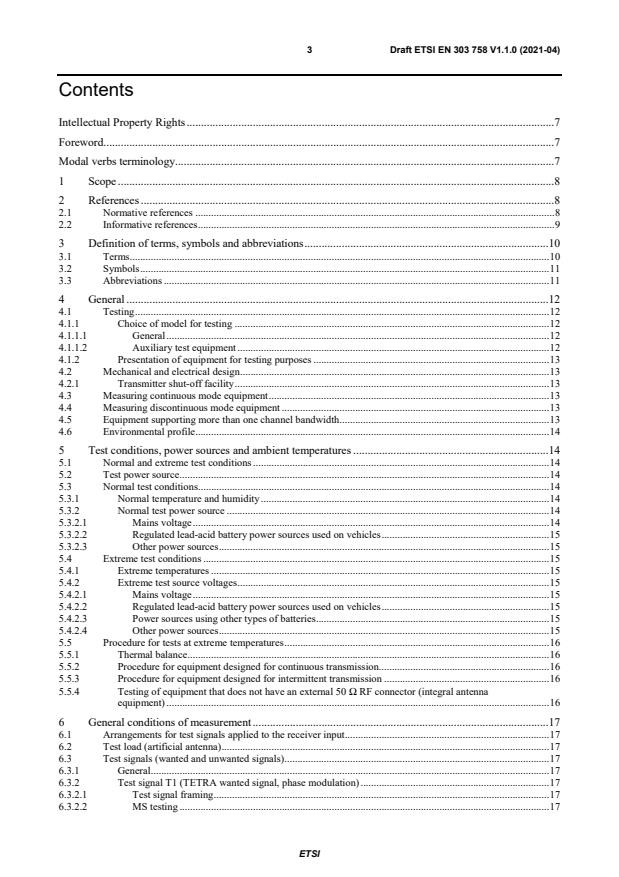
Contents
Intellectual Property Rights . 7
Foreword . 7
Modal verbs terminology . 7
1 Scope . 8
2 References . 8
2.1 Normative references . 8
2.2 Informative references . 9
3 Definition of terms, symbols and abbreviations . 10
3.1 Terms . 10
3.2 Symbols . 11
3.3 Abbreviations . 11
4 General . 12
4.1 Testing . 12
4.1.1 Choice of model for testing . 12
4.1.1.1 General . 12
4.1.1.2 Auxiliary test equipment . 12
4.1.2 Presentation of equipment for testing purposes . 13
4.2 Mechanical and electrical design . 13
4.2.1 Transmitter shut-off facility . 13
4.3 Measuring continuous mode equipment . 13
4.4 Measuring discontinuous mode equipment . 13
4.5 Equipment supporting more than one channel bandwidth . 13
4.6 Environmental profile . 14
5 Test conditions, power sources and ambient temperatures . 14
5.1 Normal and extreme test conditions . 14
5.2 Test power source . 14
5.3 Normal test conditions . 14
5.3.1 Normal temperature and humidity . 14
5.3.2 Normal test power source . 14
5.3.2.1 Mains voltage . 14
5.3.2.2 Regulated lead-acid battery power sources used on vehicles . 15
5.3.2.3 Other power sources . 15
5.4 Extreme test conditions . 15
5.4.1 Extreme temperatures . 15
5.4.2 Extreme test source voltages . 15
5.4.2.1 Mains voltage . 15
5.4.2.2 Regulated lead-acid battery power sources used on vehicles . 15
5.4.2.3 Power sources using other types of batteries . 15
5.4.2.4 Other power sources . 15
5.5 Procedure for tests at extreme temperatures . 16
5.5.1 Thermal balance . 16
5.5.2 Procedure for equipment designed for continuous transmission. 16
5.5.3 Procedure for equipment designed for intermittent transmission . 16
5.5.4 Testing of equipment that does not have an external 50 Ω RF connector (integral antenna
equipment) . 16
6 General conditions of measurement . 17
6.1 Arrangements for test signals applied to the receiver input . 17
6.2 Test load (artificial antenna) . 17
6.3 Test signals (wanted and unwanted signals) . 17
6.3.1 General . 17
6.3.2 Test signal T1 (TETRA wanted signal, phase modulation) . 17
6.3.2.1 Test signal framing . 17
6.3.2.2 MS testing . 17
ETSI
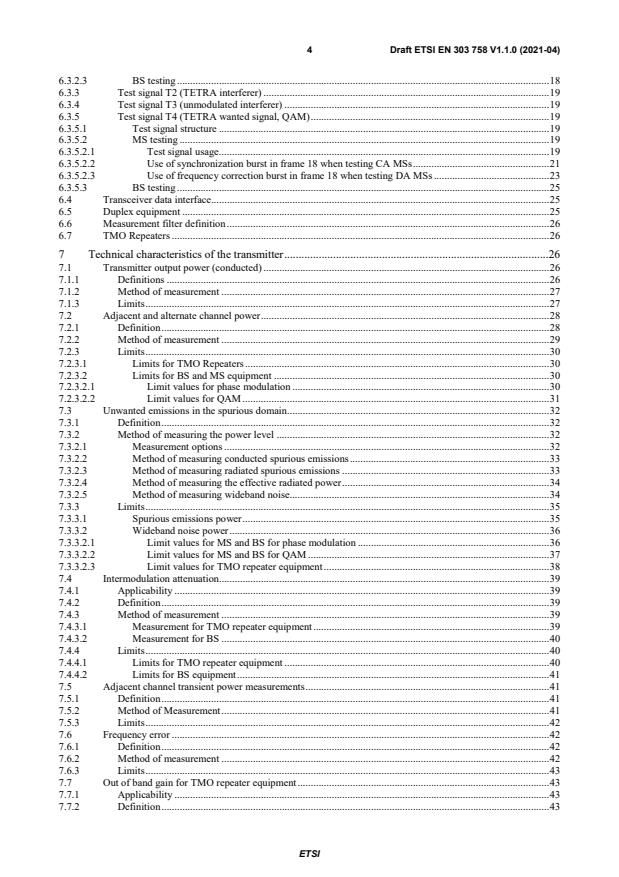
4 Draft ETSI EN 303 758 V1.1.0 (2021-04)
6.3.2.3 BS testing . 18
6.3.3 Test signal T2 (TETRA interferer) . 19
6.3.4 Test signal T3 (unmodulated interferer) . 19
6.3.5 Test signal T4 (TETRA wanted signal, QAM) . 19
6.3.5.1 Test signal structure . 19
6.3.5.2 MS testing . 19
6.3.5.2.1 Test signal usage. 19
6.3.5.2.2 Use of synchronization burst in frame 18 when testing CA MSs . 21
6.3.5.2.3 Use of frequency correction burst in frame 18 when testing DA MSs . 23
6.3.5.3 BS testing . 25
6.4 Transceiver data interface. 25
6.5 Duplex equipment . 25
6.6 Measurement filter definition . 26
6.7 TMO Repeaters . 26
7 Technical characteristics of the transmitter . 26
7.1 Transmitter output power (conducted) . 26
7.1.1 Definitions . 26
7.1.2 Method of measurement . 27
7.1.3 Limits . 27
7.2 Adjacent and alternate channel power . 28
7.2.1 Definition . 28
7.2.2 Method of measurement . 29
7.2.3 Limits . 30
7.2.3.1 Limits for TMO Repeaters . 30
7.2.3.2 Limits for BS and MS equipment . 30
7.2.3.2.1 Limit values for phase modulation . 30
7.2.3.2.2 Limit values for QAM . 31
7.3 Unwanted emissions in the spurious domain. 32
7.3.1 Definition . 32
7.3.2 Method of measuring the power level . 32
7.3.2.1 Measurement options . 32
7.3.2.2 Method of measuring conducted spurious emissions . 33
7.3.2.3 Method of measuring radiated spurious emissions . 33
7.3.2.4 Method of measuring the effective radiated power . 34
7.3.2.5 Method of measuring wideband noise. 34
7.3.3 Limits . 35
7.3.3.1 Spurious emissions power . 35
7.3.3.2 Wideband noise power . 36
7.3.3.2.1 Limit values for MS and BS for phase modulation . 36
7.3.3.2.2 Limit values for MS and BS for QAM . 37
7.3.3.2.3 Limit values for TMO repeater equipment . 38
7.4 Intermodulation attenuation. 39
7.4.1 Applicability . 39
7.4.2 Definition . 39
7.4.3 Method of measurement . 39
7.4.3.1 Measurement for TMO repeater equipment . 39
7.4.3.2 Measurement for BS . 40
7.4.4 Limits . 40
7.4.4.1 Limits for TMO repeater equipment . 40
7.4.4.2 Limits for BS equipment . 41
7.5 Adjacent channel transient power measurements . 41
7.5.1 Definition . 41
7.5.2 Method of Measurement . 41
7.5.3 Limits . 42
7.6 Frequency error . 42
7.6.1 Definition . 42
7.6.2 Method of measurement . 42
7.6.3 Limits . 43
7.7 Out of band gain for TMO repeater equipment . 43
7.7.1 Applicability . 43
7.7.2 Definition . 43
ETSI
5 Draft ETSI EN 303 758 V1.1.0 (2021-04)
7.7.3 Method of measurement . 43
7.7.4 Limits . 44
7.8 Modulation accuracy . 44
7.8.1 Applicability . 44
7.8.2 Definition . 44
7.8.3 Method of measurement . 44
7.8.4 Limits . 45
8 Technical characteristics of the receiver . 45
8.1 Applicability . 45
8.2 Receiver sensitivity . 45
8.2.1 General . 45
8.2.2 Definition . 45
8.2.3 Method of measurement . 46
8.2.4 Limits . 46
8.2.4.1 Limit values for phase modulation . 46
8.2.4.2 Limit values for QAM . 47
8.3 Blocking or desensitization . 47
8.3.1 Definition . 47
8.3.2 Method of measurement . 47
8.3.3 Limits . 48
8.4 Adjacent channel selectivity . 48
8.4.1 Definition . 48
8.4.2 Method of measurement . 48
8.4.3 Limits . 49
8.5 Spurious radiations . 50
8.5.1 Definition . 50
8.5.2 Methods of measurement . 50
8.5.2.1 Method of measuring the power level in a specified load . 50
8.5.2.2 Method of measuring the effective radiated power . 50
8.5.3 Limits . 51
8.6 Co-channel rejection. 52
8.6.1 Definition . 52
8.6.2 Method of measurement . 52
8.6.3 Limits . 53
8.6.3.1 Limit values for phase modulation . 53
8.6.3.2 Limit values for QAM . 53
8.7 Intermodulation response rejection . 53
8.7.1 Definition . 53
8.7.2 Method of measurement . 54
8.7.3 Limit . 54
8.8 Spurious response rejection . 55
8.8.1 Definition . 55
8.8.2 Method of measurement . 55
8.8.3 Limits . 55
Annex A (informative): Relationship between the present document and the essential
requirements of Directive 2014/53/EU . 56
Annex B (normative): Radiated measurement . 58
B.1 Test sites and general arrangements for measurements involving the use of radiated fields . 58
B.1.1 General . 58
B.1.2 Anechoic chamber . 58
B.1.3 Anechoic chamber with a conductive ground plane . 59
B.1.4 Open Area Test Site (OATS) . 60
B.1.5 Test antenna . 61
B.1.6 Substitution antenna . 61
B.1.7 Measuring antenna . 62
B.2 Guidance on the use of radiation test sites . 62
B.2.1 General . 62
B.2.2 Verification of the test site . 62
ETSI
6 Draft ETSI EN 303 758 V1.1.0 (2021-04)
B.2.3 Preparation of the EUT . 62
B.2.4 Power supplies to the EUT . 62
B.2.5 Range length . 62
B.2.6 Site preparation . 63
B.3 Coupling of signals . 64
B.3.1 General . 64
B.3.2 Data signals . 64
Annex C (normative): Spectrum analyser specification . 65
Annex D (normative): TETRA receiver testing . 66
D.1 Test signal T1/T4, content of BSCH, BSCH-Q/T, BNCH/T and BNCH-Q/T . 66
D.2 Frequencies of spurious response . 71
Annex E (informative): Example arrangement for transmitter intermodulation measurement . 73
Annex F (informative): Maximum measurement uncertainty . 74
Annex G (informative): Selection of technical parameters to meet the essential requirements
of Directive 2014/53/EU . 75
Annex H (informative): Change History . 76
History . 77
ETSI
7 Draft ETSI EN 303 758 V1.1.0 (2021-04)
Intellectual Property Rights
Essential patents
IPRs essential or potentially essential to normative deliverables may have been declared to ETSI. The information
pertaining to these essential IPRs, if any, is publicly available for ETSI members and non-members, and can be found
in ETSI SR 000 314: "Intellectual Property Rights (IPRs); Essential, or potentially Essential, IPRs notified to ETSI in
respect of ETSI standards", which is available from the ETSI Secretariat. Latest updates are available on the ETSI Web
server (https://ipr.etsi.org/).
Pursuant to the ETSI IPR Policy, no investigation, including IPR searches, has been carried out by ETSI. No guarantee
can be given as to the existence of other IPRs not referenced in ETSI SR 000 314 (or the updates on the ETSI Web
server) which are, or may be, or may become, essential to the present document.
Trademarks
The present document may include trademarks and/or tradenames which are asserted and/or registered by their owners.
ETSI claims no ownership of these except for any which are indicated as being the property of ETSI, and conveys no
right to use or reproduce any trademark and/or tradename. Mention of those trademarks in the present document does
not constitute an endorsement by ETSI of products, services or organizations associated with those trademarks.
Foreword
This draft Harmonised European Standard (EN) has been produced by ETSI Technical Committee Electromagnetic
compatibility and Radio spectrum Matters (ERM), and is now submitted for the combined Public Enquiry and Vote
phase of the ETSI standards EN Approval Procedure.
The present document has been prepared under the Commission's standardisation request C(2015) 5376 final [i.6] to
provide one voluntary means of conforming to the essential requirements of Directive 2014/53/EU on the harmonisation
of the laws of the Member States relating to the making available on the market of radio equipment and repealing
Directive 1999/5/EC [i.2].
Once the present document is cited in the Official Journal of the European Union under that Directive, compliance with
the normative clauses of the present document given in table A.1 confers, within the limits of the scope of the present
document, a presumption of conformity with the corresponding essential requirements of that Directive and associated
EFTA regulations.
Proposed national transposition dates
Date of latest announcement of this EN (doa): 3 months after ETSI publication
Date of latest publication of new National Standard 6 months after doa
or endorsement of this EN (dop/e):
Date of withdrawal of any conflicting National Standard (dow): 18 months after doa
Modal verbs terminology
In the present document "shall", "shall not", "should", "should not", "may", "need not", "will", "will not", "can" and
"cannot" are to be interpreted as described in clause 3.2 of the ETSI Drafting Rules (Verbal forms for the expression of
provisions).
"must" and "must not" are NOT allowed in ETSI deliverables except when used in direct citation.
ETSI
8 Draft ETSI EN 303 758 V1.1.0 (2021-04)
1 Scope
The present document specifies the technical requirements and methods of measurements for TETRA radio transmitters
and receivers used in stations and technical requirements and methods of measurements for TMO repeater in the Private
Mobile Radio (PMR) service.
It applies to use in the land mobile service, operating on radio frequencies between 137 MHz and 1 GHz, with channel
separations of 25 kHz, 50 kHz, 100 kHz and 150 kHz.
Table 1: Radiocommunications service frequency bands
Radiocommunications service frequency bands
Transmit 137 MHz to 1 000 MHz
Receive 137 MHz to 1 000 MHz
It applies to equipment for continuous and/or discontinuous transmission of data and/or digital speech.
The equipment (base station and mobile station) comprises a transmitter and associated encoder and modulator and/or a
receiver and associated demodulator and decoder.
The types of equipment covered by the present document are as follows:
• base station (equipment fitted with an antenna connector, intended for use in a fixed location);
• mobile station (equipment fitted with an antenna connector, normally used in a vehicle or as a transportable);
• TMO Repeater; and
• those hand portable stations:
a) fitted with an antenna connector; or
b) without an external antenna connector (integral antenna equipment), but fitted with a permanent internal
or a temporary internal 50 Ω Radio Frequency (RF) connector which allows access to the transmitter
output and the receiver input.
Hand portable equipment without an external or internal RF connector and without the possibility of having a temporary
internal 50 Ω RF connector is not covered by the present document.
NOTE: The relationship between the present document and essential requirements of article 3.2 of Directive
2014/53/EU [i.2] is given in annex A.
2 References
2.1 Normative references
References are either specific (identified by date of publication and/or edition number or version number) or
non-specific. For specific references, only the cited version applies. For non-specific references, the latest version of the
referenced document (including any amendments) applies.
Referenced documents which are not found to be publicly available in the expected location might be found at
https://docbox.etsi.org/Reference.
NOTE: While any hyperlinks included in this clause were valid at the time of publication, ETSI cannot guarantee
their long term validity.
The following referenced documents are necessary for the application of the present document.
[1] Recommendation ITU-T O.153 (10-1992): "Basic parameters for the measurement of error
performance at bit rates below the primary rate".
ETSI
9 Draft ETSI EN 303 758 V1.1.0 (2021-04)
[2] IEEE/ANSI C63.5 (2017): "American National Standard for Electromagnetic Compatibility --
Radiated Emission Measurements in Electromagnetic Interference (EMI) Control -- Calibration
and Qualification of Antennas (9 kHz to 40 GHz)".
[3] ETSI EN 300 392-2 (V3.8.1) (08-2016): "Terrestrial Trunked Radio (TETRA); Voice plus Data
(V+D); Part 2: Air Interface (AI)".
2.2 Informative references
References are either specific (identified by date of publication and/or edition number or version number) or
non-specific. For specific references, only the cited version applies. For non-specific references, the latest version of the
referenced document (including any amendments) applies.
NOTE: While any hyperlinks included in this clause were valid at the time of publication, ETSI cannot guarantee
their long term validity.
The following referenced documents are not necessary for the application of the present document but they assist the
user with regard to a particular subject area.
[i.1] CEPT/ERC/REC 74-01 (2019): "Unwanted Emissions in the Spurious domain".
[i.2] Directive 2014/53/EU of the European Parliament and of the Council of 16 April 2014 on the
harmonisation of the laws of the Member States relating to the making available on the market of
radio equipment and repealing Directive 1999/5/EC.
NOTE: Article 3.2 and article 10.8.
[i.3] ETSI TS 101 789-1 (V1.1.2): "Terrestrial Trunked Radio (TETRA); TMO Repeaters; Part 1:
Requirements, test methods and limits".
[i.4] ETSI EN 300 394-1 (V3.3.1) (04-2015): "Terrestrial Trunked Radio (TETRA); Conformance
testing specification; Part 1: Radio".
[i.5] ETSI EN 303 035-1 (V1.2.1) (12-2001): "Terrestrial Trunked Radio (TETRA); Harmonized EN
for TETRA equipment covering essential requirements under article 3.2 of the R&TTE Directive;
Part 1: Voice plus Data (V+D)".
[i.6] Commission Implementing Decision C(2015) 5376 final of 4.8.2015 on a standardisation request
to the European Committee for Electrotechnical Standardisation and to the European
Telecommunications Standards Institute as regards radio equipment in support of Directive
2014/53/EU of the European Parliament and of the Council.
[i.7] ETSI EN 300 793 (V1.1.1) (02-1998): "Electromagnetic compatibility and Radio spectrum
Matters (ERM); Land mobile service; Presentation of equipment for type testing".
[i.8] ETSI TR 102 273 (V1.2.1) (12-2001) (all parts): "Electromagnetic compatibility and Radio
spectrum Matters (ERM); Improvement on Radiated Methods of Measurement (using test site) and
evaluation of the corresponding measurement uncertainties".
[i.9] ETSI EG 203 336 (V1.2.1) (05-2020): "Guide for the selection of technical parameters for the
production of Harmonised Standards covering article 3.1(b) and article 3.2 of Directive
2014/53/EU".
ETSI
10 Draft ETSI EN 303 758 V1.1.0 (2021-04)
3 Definition of terms, symbols and abbreviations
3.1 Terms
For the purposes of the present document, the following terms apply:
base station: equipment fitted with an antenna connector, for use with an external antenna, and intended for use in a
fixed location
bit: binary digit
block: smallest quantity of information that is sent over the radio channel
NOTE: A constant number of useful bits are always sent together with the corresponding redundancy bits.
broadband repeater: repeater which is designed for operation on any combination of carriers (up to a specified
maximum number) within the operating band of the repeater
burst or transmission (physical): one or several packets transmitted between power on and power off of a particular
transmitter
channelized repeater: repeater which is designed for operation on a specified subset of carriers within the operating
band of the repeater
NOTE: The subset of the channels may be determined during the manufacture of the repeater, or may be
programmable.
conducted measurements: measurements which are made using direct 50 Ω connection to the equipment under test
data transmission systems: systems which transmit and/or receive data and/or digitized voice
downlink: signal path where base station transmits and mobile or hand portable station receives
hand portable station: equipment either fitted with an antenna connector or integral antenna, or both, normally used on
a stand-alone basis, to be carried on a person or held in the hand
NOTE: Test limits specified for MS within the present document apply to mobile stations and handportable
stations.
integral antenna: antenna designed to be connected to the equipment without the use of a 50 Ω external connector and
considered to be part of the equipment
NOTE: An integral antenna may be fitted internally or externally to the equipment.
mobile station: mobile equipment fitted with an antenna connector, for use with an external antenna, normally used in
a vehicle or as a transportable station
NOTE: Test limits specified for MS within the present document apply to mobile stations and handportable
stations.
radiated measurements: measurements which involve the absolute measurement of a radiated field
receive band of the equipment: maximum frequency range in accordance with the intended operation of the
equipment over which the receiver can be operated without reprogramming or realignment
spurious emissions: unwanted emissions in the spurious domain
testing laboratory: laboratory that performs tests
TMO Repeater: bi-directional Radio Frequency (RF) amplifier which can amplify and transmit a received Mobile
Station (MS) signal in the MS transmit band, simultaneously it can amplify and transmit a received Base Station (BS)
RF signal in the BS transmit band
ETSI
11 Draft ETSI EN 303 758 V1.1.0 (2021-04)
transmit band of the equipment: maximum frequency range in accordance with the intended operation of the
equipment over which the transmitter can be operated without reprogramming or realignment
Trunked Mode Operation (TMO): mode of operation where a network is used for communication
uplink: signal path where mobile or hand portable station transmits and base station receives
3.2 Symbols
For the purposes of the present document, the following symbols apply:
α Filter roll-off factor
dB decibel
dBm dB relative to 1 mW
dBμV dB
...
HARMONISED EUROPEAN STANDARD
TETRA radio equipment using non-constant envelope
modulation operating in a channel bandwidth
of 25 kHz, 50 kHz, 100 kHz or 150 kHz;
Harmonised Standard for access to radio spectrum
2 ETSI EN 303 758 V1.1.1 (2021-07)
Reference
DEN/ERM-TGDMR-381
Keywords
data, mobile, PMR, radio, repeater, TETRA, voice
ETSI
650 Route des Lucioles
F-06921 Sophia Antipolis Cedex - FRANCE
Tel.: +33 4 92 94 42 00 Fax: +33 4 93 65 47 16
Siret N° 348 623 562 00017 - APE 7112B
Association à but non lucratif enregistrée à la
Sous-Préfecture de Grasse (06) N° w061004871
Important notice
The present document can be downloaded from:
http://www.etsi.org/standards-search
The present document may be made available in electronic versions and/or in print. The content of any electronic and/or
print versions of the present document shall not be modified without the prior written authorization of ETSI. In case of any
existing or perceived difference in contents between such versions and/or in print, the prevailing version of an ETSI
deliverable is the one made publicly available in PDF format at www.etsi.org/deliver.
Users of the present document should be aware that the document may be subject to revision or change of status.
Information on the current status of this and other ETSI documents is available at
https://portal.etsi.org/TB/ETSIDeliverableStatus.aspx
If you find errors in the present document, please send your comment to one of the following services:
https://portal.etsi.org/People/CommiteeSupportStaff.aspx
Notice of disclaimer & limitation of liability
The information provided in the present deliverable is directed solely to professionals who have the appropriate degree of
experience to understand and interpret its content in accordance with generally accepted engineering or
other professional standard and applicable regulations.
No recommendation as to products and services or vendors is made or should be implied.
In no event shall ETSI be held liable for loss of profits or any other incidental or consequential damages.
Any software contained in this deliverable is provided "AS IS" with no warranties, express or implied, including but not
limited to, the warranties of merchantability, fitness for a particular purpose and non-infringement of intellectual property
rights and ETSI shall not be held liable in any event for any damages whatsoever (including, without limitation, damages
for loss of profits, business interruption, loss of information, or any other pecuniary loss) arising out of or related to the use
of or inability to use the software.
Copyright Notification
No part may be reproduced or utilized in any form or by any means, electronic or mechanical, including photocopying and
microfilm except as authorized by written permission of ETSI.
The content of the PDF version shall not be modified without the written authorization of ETSI.
The copyright and the foregoing restriction extend to reproduction in all media.
© ETSI 2021.
All rights reserved.
ETSI
3 ETSI EN 303 758 V1.1.1 (2021-07)
Contents
Intellectual Property Rights . 7
Foreword . 7
Modal verbs terminology . 8
1 Scope . 9
2 References . 9
2.1 Normative references . 9
2.2 Informative references . 10
3 Definition of terms, symbols and abbreviations . 11
3.1 Terms . 11
3.2 Symbols . 12
3.3 Abbreviations . 12
4 General . 13
4.1 Testing . 13
4.1.1 Choice of model for testing . 13
4.1.1.1 General . 13
4.1.1.2 Auxiliary test equipment . 13
4.1.2 Presentation of equipment for testing purposes . 14
4.2 Mechanical and electrical design . 14
4.2.1 Transmitter shut-off facility . 14
4.3 Measuring continuous mode equipment . 14
4.4 Measuring discontinuous mode equipment . 14
4.5 Equipment supporting more than one channel bandwidth . 14
4.6 Environmental profile . 15
5 Test conditions, power sources and ambient temperatures . 15
5.1 Normal and extreme test conditions . 15
5.2 Test power source . 15
5.3 Normal test conditions . 15
5.3.1 Normal temperature and humidity . 15
5.3.2 Normal test power source . 15
5.3.2.1 Mains voltage . 15
5.3.2.2 Regulated lead-acid battery power sources used on vehicles . 16
5.3.2.3 Other power sources . 16
5.4 Extreme test conditions . 16
5.4.1 Extreme temperatures . 16
5.4.2 Extreme test source voltages . 16
5.4.2.1 Mains voltage . 16
5.4.2.2 Regulated lead-acid battery power sources used on vehicles . 16
5.4.2.3 Power sources using other types of batteries . 16
5.4.2.4 Other power sources . 16
5.5 Procedure for tests at extreme temperatures . 17
5.5.1 Thermal balance . 17
5.5.2 Procedure for equipment designed for continuous transmission. 17
5.5.3 Procedure for equipment designed for intermittent transmission . 17
5.5.4 Testing of equipment that does not have an external 50 Ω RF connector (integral antenna
equipment) . 17
6 General conditions of measurement . 18
6.1 Arrangements for test signals applied to the receiver input . 18
6.2 Test load (artificial antenna) . 18
6.3 Test signals (wanted and unwanted signals) . 18
6.3.1 General . 18
6.3.2 Test signal T1 (TETRA wanted signal, phase modulation) . 18
6.3.2.1 Test signal framing . 18
6.3.2.2 MS testing . 18
ETSI
4 ETSI EN 303 758 V1.1.1 (2021-07)
6.3.2.3 BS testing . 19
6.3.3 Test signal T2 (TETRA interferer) . 20
6.3.4 Test signal T3 (unmodulated interferer) . 20
6.3.5 Test signal T4 (TETRA wanted signal, QAM) . 20
6.3.5.1 Test signal structure . 20
6.3.5.2 MS testing . 20
6.3.5.2.1 Test signal usage. 20
6.3.5.2.2 Use of synchronization burst in frame 18 when testing CA MSs . 22
6.3.5.2.3 Use of frequency correction burst in frame 18 when testing DA MSs . 24
6.3.5.3 BS testing . 26
6.4 Transceiver data interface. 26
6.5 Duplex equipment . 26
6.6 Measurement filter definition . 27
6.7 TMO Repeaters . 27
7 Technical characteristics of the transmitter . 27
7.1 Transmitter output power (conducted) . 27
7.1.1 Definitions . 27
7.1.2 Method of measurement . 28
7.1.3 Limits . 28
7.2 Adjacent and alternate channel power . 29
7.2.1 Definition . 29
7.2.2 Method of measurement . 30
7.2.3 Limits . 31
7.2.3.1 Limits for TMO Repeaters . 31
7.2.3.2 Limits for BS and MS equipment . 31
7.2.3.2.1 Limit values for phase modulation . 31
7.2.3.2.2 Limit values for QAM . 32
7.3 Unwanted emissions in the spurious domain. 33
7.3.1 Definition . 33
7.3.2 Method of measuring the power level . 33
7.3.2.1 Measurement options . 33
7.3.2.2 Method of measuring conducted spurious emissions . 34
7.3.2.3 Method of measuring radiated spurious emissions . 34
7.3.2.4 Method of measuring the effective radiated power . 35
7.3.2.5 Method of measuring wideband noise. 35
7.3.3 Limits . 36
7.3.3.1 Spurious emissions power . 36
7.3.3.2 Wideband noise power . 37
7.3.3.2.1 Limit values for MS and BS for phase modulation . 37
7.3.3.2.2 Limit values for MS and BS for QAM . 38
7.3.3.2.3 Limit values for TMO repeater equipment . 39
7.4 Intermodulation attenuation. 40
7.4.1 Applicability . 40
7.4.2 Definition . 40
7.4.3 Method of measurement . 40
7.4.3.1 Measurement for TMO repeater equipment . 40
7.4.3.2 Measurement for BS . 41
7.4.4 Limits . 41
7.4.4.1 Limits for TMO repeater equipment . 41
7.4.4.2 Limits for BS equipment . 42
7.5 Adjacent channel transient power measurements . 42
7.5.1 Definition . 42
7.5.2 Method of Measurement . 42
7.5.3 Limits . 43
7.6 Frequency error . 43
7.6.1 Definition . 43
7.6.2 Method of measurement . 43
7.6.3 Limits . 44
7.7 Out of band gain for TMO repeater equipment . 44
7.7.1 Applicability . 44
7.7.2 Definition . 44
ETSI
5 ETSI EN 303 758 V1.1.1 (2021-07)
7.7.3 Method of measurement . 44
7.7.4 Limits . 45
7.8 Modulation accuracy . 45
7.8.1 Applicability . 45
7.8.2 Definition . 45
7.8.3 Method of measurement . 45
7.8.4 Limits . 46
8 Technical characteristics of the receiver . 46
8.1 Applicability . 46
8.2 Receiver sensitivity . 46
8.2.1 General . 46
8.2.2 Definition . 46
8.2.3 Method of measurement . 47
8.2.4 Limits . 47
8.2.4.1 Limit values for phase modulation . 47
8.2.4.2 Limit values for QAM . 48
8.3 Blocking or desensitization . 48
8.3.1 Definition . 48
8.3.2 Method of measurement . 48
8.3.3 Limits . 49
8.4 Adjacent channel selectivity . 49
8.4.1 Definition . 49
8.4.2 Method of measurement . 49
8.4.3 Limits . 50
8.5 Spurious radiations . 51
8.5.1 Definition . 51
8.5.2 Methods of measurement . 51
8.5.2.1 Method of measuring the power level in a specified load . 51
8.5.2.2 Method of measuring the effective radiated power . 51
8.5.3 Limits . 52
8.6 Co-channel rejection. 53
8.6.1 Definition . 53
8.6.2 Method of measurement . 53
8.6.3 Limits . 54
8.6.3.1 Limit values for phase modulation . 54
8.6.3.2 Limit values for QAM . 54
8.7 Intermodulation response rejection . 54
8.7.1 Definition . 54
8.7.2 Method of measurement . 55
8.7.3 Limit . 55
8.8 Spurious response rejection . 56
8.8.1 Definition . 56
8.8.2 Method of measurement . 56
8.8.3 Limits . 56
Annex A (informative): Relationship between the present document and the essential
requirements of Directive 2014/53/EU . 57
Annex B (normative): Radiated measurement . 59
B.1 Test sites and general arrangements for measurements involving the use of radiated fields . 59
B.1.1 General . 59
B.1.2 Anechoic chamber . 59
B.1.3 Anechoic chamber with a conductive ground plane . 60
B.1.4 Open Area Test Site (OATS) . 61
B.1.5 Test antenna . 62
B.1.6 Substitution antenna . 62
B.1.7 Measuring antenna . 63
B.2 Guidance on the use of radiation test sites . 63
B.2.1 General . 63
B.2.2 Verification of the test site . 63
ETSI
6 ETSI EN 303 758 V1.1.1 (2021-07)
B.2.3 Preparation of the EUT . 63
B.2.4 Power supplies to the EUT . 63
B.2.5 Range length . 63
B.2.6 Site preparation . 64
B.3 Coupling of signals . 65
B.3.1 General . 65
B.3.2 Data signals . 65
Annex C (normative): Spectrum analyser specification . 66
Annex D (normative): TETRA receiver testing . 67
D.1 Test signal T1/T4, content of BSCH, BSCH-Q/T, BNCH/T and BNCH-Q/T . 67
D.2 Frequencies of spurious response . 72
Annex E (informative): Example arrangement for transmitter intermodulation measurement . 74
Annex F (informative): Maximum measurement uncertainty . 75
Annex G (informative): Selection of technical parameters to meet the essential requirements
of Directive 2014/53/EU . 76
Annex H (informative): Change History . 77
History . 78
ETSI
7 ETSI EN 303 758 V1.1.1 (2021-07)
Intellectual Property Rights
Essential patents
IPRs essential or potentially essential to normative deliverables may have been declared to ETSI. The declarations
pertaining to these essential IPRs, if any, are publicly available for ETSI members and non-members, and can be
found in ETSI SR 000 314: "Intellectual Property Rights (IPRs); Essential, or potentially Essential, IPRs notified to
ETSI in respect of ETSI standards", which is available from the ETSI Secretariat. Latest updates are available on the
ETSI Web server (https://ipr.etsi.org/).
Pursuant to the ETSI Directives including the ETSI IPR Policy, no investigation regarding the essentiality of IPRs,
including IPR searches, has been carried out by ETSI. No guarantee can be given as to the existence of other IPRs not
referenced in ETSI SR 000 314 (or the updates on the ETSI Web server) which are, or may be, or may become,
essential to the present document.
Trademarks
The present document may include trademarks and/or tradenames which are asserted and/or registered by their owners.
ETSI claims no ownership of these except for any which are indicated as being the property of ETSI, and conveys no
right to use or reproduce any trademark and/or tradename. Mention of those trademarks in the present document does
not constitute an endorsement by ETSI of products, services or organizations associated with those trademarks.
DECT™, PLUGTESTS™, UMTS™ and the ETSI logo are trademarks of ETSI registered for the benefit of its
Members. 3GPP™ and LTE™ are trademarks of ETSI registered for the benefit of its Members and of the 3GPP
Organizational Partners. oneM2M™ logo is a trademark of ETSI registered for the benefit of its Members and of the ®
oneM2M Partners. GSM and the GSM logo are trademarks registered and owned by the GSM Association.
Foreword
This Harmonised European Standard (EN) has been produced by ETSI Technical Committee Electromagnetic
compatibility and Radio spectrum Matters (ERM).
The present document has been prepared under the Commission's standardisation request C(2015) 5376 final [i.6] to
provide one voluntary means of conforming to the essential requirements of Directive 2014/53/EU on the harmonisation
of the laws of the Member States relating to the making available on the market of radio equipment and repealing
Directive 1999/5/EC [i.2].
Once the present document is cited in the Official Journal of the European Union under that Directive, compliance with
the normative clauses of the present document given in table A.1 confers, within the limits of the scope of the present
document, a presumption of conformity with the corresponding essential requirements of that Directive and associated
EFTA regulations.
National transposition dates
Date of adoption of this EN: 30 June 2021
Date of latest announcement of this EN (doa): 30 September 2021
Date of latest publication of new National Standard
or endorsement of this EN (dop/e): 31 March 2022
Date of withdrawal of any conflicting National Standard (dow): 31 March 2023
ETSI
8 ETSI EN 303 758 V1.1.1 (2021-07)
Modal verbs terminology
In the present document "shall", "shall not", "should", "should not", "may", "need not", "will", "will not", "can" and
"cannot" are to be interpreted as described in clause 3.2 of the ETSI Drafting Rules (Verbal forms for the expression of
provisions).
"must" and "must not" are NOT allowed in ETSI deliverables except when used in direct citation.
ETSI
9 ETSI EN 303 758 V1.1.1 (2021-07)
1 Scope
The present document specifies the technical requirements and methods of measurements for TETRA radio transmitters
and receivers used in stations and technical requirements and methods of measurements for TMO repeater in the Private
Mobile Radio (PMR) service.
It applies to use in the land mobile service, operating on radio frequencies between 137 MHz and 1 GHz, with channel
separations of 25 kHz, 50 kHz, 100 kHz and 150 kHz.
Table 1: Radiocommunications service frequency bands
Radiocommunications service frequency bands
Transmit 137 MHz to 1 000 MHz
Receive 137 MHz to 1 000 MHz
It applies to equipment for continuous and/or discontinuous transmission of data and/or digital speech.
The equipment (base station and mobile station) comprises a transmitter and associated encoder and modulator and/or a
receiver and associated demodulator and decoder.
The types of equipment covered by the present document are as follows:
• base station (equipment fitted with an antenna connector, intended for use in a fixed location);
• mobile station (equipment fitted with an antenna connector, normally used in a vehicle or as a transportable);
• TMO Repeater; and
• those hand portable stations:
a) fitted with an antenna connector; or
b) without an external antenna connector (integral antenna equipment), but fitted with a permanent internal
or a temporary internal 50 Ω Radio Frequency (RF) connector which allows access to the transmitter
output and the receiver input.
Hand portable equipment without an external or internal RF connector and without the possibility of having a temporary
internal 50 Ω RF connector is not covered by the present document.
NOTE: The relationship between the present document and essential requirements of article 3.2 of Directive
2014/53/EU [i.2] is given in annex A.
2 References
2.1 Normative references
References are either specific (identified by date of publication and/or edition number or version number) or
non-specific. For specific references, only the cited version applies. For non-specific references, the latest version of the
referenced document (including any amendments) applies.
Referenced documents which are not found to be publicly available in the expected location might be found at
https://docbox.etsi.org/Reference.
NOTE: While any hyperlinks included in this clause were valid at the time of publication, ETSI cannot guarantee
their long term validity.
The following referenced documents are necessary for the application of the present document.
[1] Recommendation ITU-T O.153 (10-1992): "Basic parameters for the measurement of error
performance at bit rates below the primary rate".
ETSI
10 ETSI EN 303 758 V1.1.1 (2021-07)
[2] IEEE/ANSI C63.5 (2017): "American National Standard for Electromagnetic Compatibility --
Radiated Emission Measurements in Electromagnetic Interference (EMI) Control -- Calibration
and Qualification of Antennas (9 kHz to 40 GHz)".
[3] ETSI EN 300 392-2 (V3.8.1) (08-2016): "Terrestrial Trunked Radio (TETRA); Voice plus Data
(V+D); Part 2: Air Interface (AI)".
2.2 Informative references
References are either specific (identified by date of publication and/or edition number or version number) or
non-specific. For specific references, only the cited version applies. For non-specific references, the latest version of the
referenced document (including any amendments) applies.
NOTE: While any hyperlinks included in this clause were valid at the time of publication, ETSI cannot guarantee
their long term validity.
The following referenced documents are not necessary for the application of the present document but they assist the
user with regard to a particular subject area.
[i.1] CEPT/ERC/REC 74-01 (2019): "Unwanted Emissions in the Spurious domain".
[i.2] Directive 2014/53/EU of the European Parliament and of the Council of 16 April 2014 on the
harmonisation of the laws of the Member States relating to the making available on the market of
radio equipment and repealing Directive 1999/5/EC.
NOTE: Article 3.2 and article 10.8.
[i.3] ETSI TS 101 789-1 (V1.1.2): "Terrestrial Trunked Radio (TETRA); TMO Repeaters; Part 1:
Requirements, test methods and limits".
[i.4] ETSI EN 300 394-1 (V3.3.1) (04-2015): "Terrestrial Trunked Radio (TETRA); Conformance
testing specification; Part 1: Radio".
[i.5] ETSI EN 303 035-1 (V1.2.1) (12-2001): "Terrestrial Trunked Radio (TETRA); Harmonized EN
for TETRA equipment covering essential requirements under article 3.2 of the R&TTE Directive;
Part 1: Voice plus Data (V+D)".
[i.6] Commission Implementing Decision C(2015) 5376 final of 4.8.2015 on a standardisation request
to the European Committee for Electrotechnical Standardisation and to the European
Telecommunications Standards Institute as regards radio equipment in support of Directive
2014/53/EU of the European Parliament and of the Council.
[i.7] ETSI EN 300 793 (V1.1.1) (02-1998): "Electromagnetic compatibility and Radio spectrum
Matters (ERM); Land mobile service; Presentation of equipment for type testing".
[i.8] ETSI TR 102 273 (V1.2.1) (12-2001) (all parts): "Electromagnetic compatibility and Radio
spectrum Matters (ERM); Improvement on Radiated Methods of Measurement (using test site) and
evaluation of the corresponding measurement uncertainties".
[i.9] ETSI EG 203 336 (V1.2.1) (05-2020): "Guide for the selection of technical parameters for the
production of Harmonised Standards covering article 3.1(b) and article 3.2 of Directive
2014/53/EU".
ETSI
11 ETSI EN 303 758 V1.1.1 (2021-07)
3 Definition of terms, symbols and abbreviations
3.1 Terms
For the purposes of the present document, the following terms apply:
base station: equipment fitted with an antenna connector, for use with an external antenna, and intended for use in a
fixed location
bit: binary digit
block: smallest quantity of information that is sent over the radio channel
NOTE: A constant number of useful bits are always sent together with the corresponding redundancy bits.
broadband repeater: repeater which is designed for operation on any combination of carriers (up to a specified
maximum number) within the operating band of the repeater
burst or transmission (physical): one or several packets transmitted between power on and power off of a particular
transmitter
channelized repeater: repeater which is designed for operation on a specified subset of carriers within the operating
band of the repeater
NOTE: The subset of the channels may be determined during the manufacture of the repeater, or may be
programmable.
conducted measurements: measurements which are made using direct 50 Ω connection to the equipment under test
data transmission systems: systems which transmit and/or receive data and/or digitized voice
downlink: signal path where base station transmits and mobile or hand portable station receives
hand portable station: equipment either fitted with an antenna connector or integral antenna, or both, normally used on
a stand-alone basis, to be carried on a person or held in the hand
NOTE: Test limits specified for MS within the present document apply to mobile stations and handportable
stations.
integral antenna: antenna designed to be connected to the equipment without the use of a 50 Ω external connector and
considered to be part of the equipment
NOTE: An integral antenna may be fitted internally or externally to the equipment.
mobile station: mobile equipment fitted with an antenna connector, for use with an external antenna, normally used in
a vehicle or as a transportable station
NOTE: Test limits specified for MS within the present document apply to mobile stations and handportable
stations.
radiated measurements: measurements which involve the absolute measurement of a radiated field
receive band of the equipment: maximum frequency range in accordance with the intended operation of the
equipment over which the receiver can
...
SLOVENSKI STANDARD
01-september-2021
Radijska oprema TETRA, ki uporablja modulacijo z nekonstantno ovojnico in
deluje v kanalih s pasovnimi širinami 25 kHz, 50 kHz, 100 kHz ali 150 kHz -
Harmonizirani standard za dostop do radijskega spektra
TETRA radio equipment using non-constant envelope modulation operating in a channel
bandwidth of 25 kHz, 50 kHz, 100 kHz or 150 kHz - Harmonised Standard for access to
radio spectrum
Ta slovenski standard je istoveten z: ETSI EN 303 758 V1.1.1 (2021-07)
ICS:
33.070.10 Prizemni snopovni radio Terrestrial Trunked Radio
(TETRA) (TETRA)
2003-01.Slovenski inštitut za standardizacijo. Razmnoževanje celote ali delov tega standarda ni dovoljeno.
HARMONISED EUROPEAN STANDARD
TETRA radio equipment using non-constant envelope
modulation operating in a channel bandwidth
of 25 kHz, 50 kHz, 100 kHz or 150 kHz;
Harmonised Standard for access to radio spectrum
2 ETSI EN 303 758 V1.1.1 (2021-07)
Reference
DEN/ERM-TGDMR-381
Keywords
data, mobile, PMR, radio, repeater, TETRA, voice
ETSI
650 Route des Lucioles
F-06921 Sophia Antipolis Cedex - FRANCE
Tel.: +33 4 92 94 42 00 Fax: +33 4 93 65 47 16
Siret N° 348 623 562 00017 - APE 7112B
Association à but non lucratif enregistrée à la
Sous-Préfecture de Grasse (06) N° w061004871
Important notice
The present document can be downloaded from:
http://www.etsi.org/standards-search
The present document may be made available in electronic versions and/or in print. The content of any electronic and/or
print versions of the present document shall not be modified without the prior written authorization of ETSI. In case of any
existing or perceived difference in contents between such versions and/or in print, the prevailing version of an ETSI
deliverable is the one made publicly available in PDF format at www.etsi.org/deliver.
Users of the present document should be aware that the document may be subject to revision or change of status.
Information on the current status of this and other ETSI documents is available at
https://portal.etsi.org/TB/ETSIDeliverableStatus.aspx
If you find errors in the present document, please send your comment to one of the following services:
https://portal.etsi.org/People/CommiteeSupportStaff.aspx
Notice of disclaimer & limitation of liability
The information provided in the present deliverable is directed solely to professionals who have the appropriate degree of
experience to understand and interpret its content in accordance with generally accepted engineering or
other professional standard and applicable regulations.
No recommendation as to products and services or vendors is made or should be implied.
In no event shall ETSI be held liable for loss of profits or any other incidental or consequential damages.
Any software contained in this deliverable is provided "AS IS" with no warranties, express or implied, including but not
limited to, the warranties of merchantability, fitness for a particular purpose and non-infringement of intellectual property
rights and ETSI shall not be held liable in any event for any damages whatsoever (including, without limitation, damages
for loss of profits, business interruption, loss of information, or any other pecuniary loss) arising out of or related to the use
of or inability to use the software.
Copyright Notification
No part may be reproduced or utilized in any form or by any means, electronic or mechanical, including photocopying and
microfilm except as authorized by written permission of ETSI.
The content of the PDF version shall not be modified without the written authorization of ETSI.
The copyright and the foregoing restriction extend to reproduction in all media.
© ETSI 2021.
All rights reserved.
ETSI
3 ETSI EN 303 758 V1.1.1 (2021-07)
Contents
Intellectual Property Rights . 7
Foreword . 7
Modal verbs terminology . 8
1 Scope . 9
2 References . 9
2.1 Normative references . 9
2.2 Informative references . 10
3 Definition of terms, symbols and abbreviations . 11
3.1 Terms . 11
3.2 Symbols . 12
3.3 Abbreviations . 12
4 General . 13
4.1 Testing . 13
4.1.1 Choice of model for testing . 13
4.1.1.1 General . 13
4.1.1.2 Auxiliary test equipment . 13
4.1.2 Presentation of equipment for testing purposes . 14
4.2 Mechanical and electrical design . 14
4.2.1 Transmitter shut-off facility . 14
4.3 Measuring continuous mode equipment . 14
4.4 Measuring discontinuous mode equipment . 14
4.5 Equipment supporting more than one channel bandwidth . 14
4.6 Environmental profile . 15
5 Test conditions, power sources and ambient temperatures . 15
5.1 Normal and extreme test conditions . 15
5.2 Test power source . 15
5.3 Normal test conditions . 15
5.3.1 Normal temperature and humidity . 15
5.3.2 Normal test power source . 15
5.3.2.1 Mains voltage . 15
5.3.2.2 Regulated lead-acid battery power sources used on vehicles . 16
5.3.2.3 Other power sources . 16
5.4 Extreme test conditions . 16
5.4.1 Extreme temperatures . 16
5.4.2 Extreme test source voltages . 16
5.4.2.1 Mains voltage . 16
5.4.2.2 Regulated lead-acid battery power sources used on vehicles . 16
5.4.2.3 Power sources using other types of batteries . 16
5.4.2.4 Other power sources . 16
5.5 Procedure for tests at extreme temperatures . 17
5.5.1 Thermal balance . 17
5.5.2 Procedure for equipment designed for continuous transmission. 17
5.5.3 Procedure for equipment designed for intermittent transmission . 17
5.5.4 Testing of equipment that does not have an external 50 Ω RF connector (integral antenna
equipment) . 17
6 General conditions of measurement . 18
6.1 Arrangements for test signals applied to the receiver input . 18
6.2 Test load (artificial antenna) . 18
6.3 Test signals (wanted and unwanted signals) . 18
6.3.1 General . 18
6.3.2 Test signal T1 (TETRA wanted signal, phase modulation) . 18
6.3.2.1 Test signal framing . 18
6.3.2.2 MS testing . 18
ETSI
4 ETSI EN 303 758 V1.1.1 (2021-07)
6.3.2.3 BS testing . 19
6.3.3 Test signal T2 (TETRA interferer) . 20
6.3.4 Test signal T3 (unmodulated interferer) . 20
6.3.5 Test signal T4 (TETRA wanted signal, QAM) . 20
6.3.5.1 Test signal structure . 20
6.3.5.2 MS testing . 20
6.3.5.2.1 Test signal usage. 20
6.3.5.2.2 Use of synchronization burst in frame 18 when testing CA MSs . 22
6.3.5.2.3 Use of frequency correction burst in frame 18 when testing DA MSs . 24
6.3.5.3 BS testing . 26
6.4 Transceiver data interface. 26
6.5 Duplex equipment . 26
6.6 Measurement filter definition . 27
6.7 TMO Repeaters . 27
7 Technical characteristics of the transmitter . 27
7.1 Transmitter output power (conducted) . 27
7.1.1 Definitions . 27
7.1.2 Method of measurement . 28
7.1.3 Limits . 28
7.2 Adjacent and alternate channel power . 29
7.2.1 Definition . 29
7.2.2 Method of measurement . 30
7.2.3 Limits . 31
7.2.3.1 Limits for TMO Repeaters . 31
7.2.3.2 Limits for BS and MS equipment . 31
7.2.3.2.1 Limit values for phase modulation . 31
7.2.3.2.2 Limit values for QAM . 32
7.3 Unwanted emissions in the spurious domain. 33
7.3.1 Definition . 33
7.3.2 Method of measuring the power level . 33
7.3.2.1 Measurement options . 33
7.3.2.2 Method of measuring conducted spurious emissions . 34
7.3.2.3 Method of measuring radiated spurious emissions . 34
7.3.2.4 Method of measuring the effective radiated power . 35
7.3.2.5 Method of measuring wideband noise. 35
7.3.3 Limits . 36
7.3.3.1 Spurious emissions power . 36
7.3.3.2 Wideband noise power . 37
7.3.3.2.1 Limit values for MS and BS for phase modulation . 37
7.3.3.2.2 Limit values for MS and BS for QAM . 38
7.3.3.2.3 Limit values for TMO repeater equipment . 39
7.4 Intermodulation attenuation. 40
7.4.1 Applicability . 40
7.4.2 Definition . 40
7.4.3 Method of measurement . 40
7.4.3.1 Measurement for TMO repeater equipment . 40
7.4.3.2 Measurement for BS . 41
7.4.4 Limits . 41
7.4.4.1 Limits for TMO repeater equipment . 41
7.4.4.2 Limits for BS equipment . 42
7.5 Adjacent channel transient power measurements . 42
7.5.1 Definition . 42
7.5.2 Method of Measurement . 42
7.5.3 Limits . 43
7.6 Frequency error . 43
7.6.1 Definition . 43
7.6.2 Method of measurement . 43
7.6.3 Limits . 44
7.7 Out of band gain for TMO repeater equipment . 44
7.7.1 Applicability . 44
7.7.2 Definition . 44
ETSI
5 ETSI EN 303 758 V1.1.1 (2021-07)
7.7.3 Method of measurement . 44
7.7.4 Limits . 45
7.8 Modulation accuracy . 45
7.8.1 Applicability . 45
7.8.2 Definition . 45
7.8.3 Method of measurement . 45
7.8.4 Limits . 46
8 Technical characteristics of the receiver . 46
8.1 Applicability . 46
8.2 Receiver sensitivity . 46
8.2.1 General . 46
8.2.2 Definition . 46
8.2.3 Method of measurement . 47
8.2.4 Limits . 47
8.2.4.1 Limit values for phase modulation . 47
8.2.4.2 Limit values for QAM . 48
8.3 Blocking or desensitization . 48
8.3.1 Definition . 48
8.3.2 Method of measurement . 48
8.3.3 Limits . 49
8.4 Adjacent channel selectivity . 49
8.4.1 Definition . 49
8.4.2 Method of measurement . 49
8.4.3 Limits . 50
8.5 Spurious radiations . 51
8.5.1 Definition . 51
8.5.2 Methods of measurement . 51
8.5.2.1 Method of measuring the power level in a specified load . 51
8.5.2.2 Method of measuring the effective radiated power . 51
8.5.3 Limits . 52
8.6 Co-channel rejection. 53
8.6.1 Definition . 53
8.6.2 Method of measurement . 53
8.6.3 Limits . 54
8.6.3.1 Limit values for phase modulation . 54
8.6.3.2 Limit values for QAM . 54
8.7 Intermodulation response rejection . 54
8.7.1 Definition . 54
8.7.2 Method of measurement . 55
8.7.3 Limit . 55
8.8 Spurious response rejection . 56
8.8.1 Definition . 56
8.8.2 Method of measurement . 56
8.8.3 Limits . 56
Annex A (informative): Relationship between the present document and the essential
requirements of Directive 2014/53/EU . 57
Annex B (normative): Radiated measurement . 59
B.1 Test sites and general arrangements for measurements involving the use of radiated fields . 59
B.1.1 General . 59
B.1.2 Anechoic chamber . 59
B.1.3 Anechoic chamber with a conductive ground plane . 60
B.1.4 Open Area Test Site (OATS) . 61
B.1.5 Test antenna . 62
B.1.6 Substitution antenna . 62
B.1.7 Measuring antenna . 63
B.2 Guidance on the use of radiation test sites . 63
B.2.1 General . 63
B.2.2 Verification of the test site . 63
ETSI
6 ETSI EN 303 758 V1.1.1 (2021-07)
B.2.3 Preparation of the EUT . 63
B.2.4 Power supplies to the EUT . 63
B.2.5 Range length . 63
B.2.6 Site preparation . 64
B.3 Coupling of signals . 65
B.3.1 General . 65
B.3.2 Data signals . 65
Annex C (normative): Spectrum analyser specification . 66
Annex D (normative): TETRA receiver testing . 67
D.1 Test signal T1/T4, content of BSCH, BSCH-Q/T, BNCH/T and BNCH-Q/T . 67
D.2 Frequencies of spurious response . 72
Annex E (informative): Example arrangement for transmitter intermodulation measurement . 74
Annex F (informative): Maximum measurement uncertainty . 75
Annex G (informative): Selection of technical parameters to meet the essential requirements
of Directive 2014/53/EU . 76
Annex H (informative): Change History . 77
History . 78
ETSI
7 ETSI EN 303 758 V1.1.1 (2021-07)
Intellectual Property Rights
Essential patents
IPRs essential or potentially essential to normative deliverables may have been declared to ETSI. The declarations
pertaining to these essential IPRs, if any, are publicly available for ETSI members and non-members, and can be
found in ETSI SR 000 314: "Intellectual Property Rights (IPRs); Essential, or potentially Essential, IPRs notified to
ETSI in respect of ETSI standards", which is available from the ETSI Secretariat. Latest updates are available on the
ETSI Web server (https://ipr.etsi.org/).
Pursuant to the ETSI Directives including the ETSI IPR Policy, no investigation regarding the essentiality of IPRs,
including IPR searches, has been carried out by ETSI. No guarantee can be given as to the existence of other IPRs not
referenced in ETSI SR 000 314 (or the updates on the ETSI Web server) which are, or may be, or may become,
essential to the present document.
Trademarks
The present document may include trademarks and/or tradenames which are asserted and/or registered by their owners.
ETSI claims no ownership of these except for any which are indicated as being the property of ETSI, and conveys no
right to use or reproduce any trademark and/or tradename. Mention of those trademarks in the present document does
not constitute an endorsement by ETSI of products, services or organizations associated with those trademarks.
DECT™, PLUGTESTS™, UMTS™ and the ETSI logo are trademarks of ETSI registered for the benefit of its
Members. 3GPP™ and LTE™ are trademarks of ETSI registered for the benefit of its Members and of the 3GPP
Organizational Partners. oneM2M™ logo is a trademark of ETSI registered for the benefit of its Members and of the ®
oneM2M Partners. GSM and the GSM logo are trademarks registered and owned by the GSM Association.
Foreword
This Harmonised European Standard (EN) has been produced by ETSI Technical Committee Electromagnetic
compatibility and Radio spectrum Matters (ERM).
The present document has been prepared under the Commission's standardisation request C(2015) 5376 final [i.6] to
provide one voluntary means of conforming to the essential requirements of Directive 2014/53/EU on the harmonisation
of the laws of the Member States relating to the making available on the market of radio equipment and repealing
Directive 1999/5/EC [i.2].
Once the present document is cited in the Official Journal of the European Union under that Directive, compliance with
the normative clauses of the present document given in table A.1 confers, within the limits of the scope of the present
document, a presumption of conformity with the corresponding essential requirements of that Directive and associated
EFTA regulations.
National transposition dates
Date of adoption of this EN: 30 June 2021
Date of latest announcement of this EN (doa): 30 September 2021
Date of latest publication of new National Standard
or endorsement of this EN (dop/e): 31 March 2022
Date of withdrawal of any conflicting National Standard (dow): 31 March 2023
ETSI
8 ETSI EN 303 758 V1.1.1 (2021-07)
Modal verbs terminology
In the present document "shall", "shall not", "should", "should not", "may", "need not", "will", "will not", "can" and
"cannot" are to be interpreted as described in clause 3.2 of the ETSI Drafting Rules (Verbal forms for the expression of
provisions).
"must" and "must not" are NOT allowed in ETSI deliverables except when used in direct citation.
ETSI
9 ETSI EN 303 758 V1.1.1 (2021-07)
1 Scope
The present document specifies the technical requirements and methods of measurements for TETRA radio transmitters
and receivers used in stations and technical requirements and methods of measurements for TMO repeater in the Private
Mobile Radio (PMR) service.
It applies to use in the land mobile service, operating on radio frequencies between 137 MHz and 1 GHz, with channel
separations of 25 kHz, 50 kHz, 100 kHz and 150 kHz.
Table 1: Radiocommunications service frequency bands
Radiocommunications service frequency bands
Transmit 137 MHz to 1 000 MHz
Receive 137 MHz to 1 000 MHz
It applies to equipment for continuous and/or discontinuous transmission of data and/or digital speech.
The equipment (base station and mobile station) comprises a transmitter and associated encoder and modulator and/or a
receiver and associated demodulator and decoder.
The types of equipment covered by the present document are as follows:
• base station (equipment fitted with an antenna connector, intended for use in a fixed location);
• mobile station (equipment fitted with an antenna connector, normally used in a vehicle or as a transportable);
• TMO Repeater; and
• those hand portable stations:
a) fitted with an antenna connector; or
b) without an external antenna connector (integral antenna equipment), but fitted with a permanent internal
or a temporary internal 50 Ω Radio Frequency (RF) connector which allows access to the transmitter
output and the receiver input.
Hand portable equipment without an external or internal RF connector and without the possibility of having a temporary
internal 50 Ω RF connector is not covered by the present document.
NOTE: The relationship between the present document and essential requirements of article 3.2 of Directive
2014/53/EU [i.2] is given in annex A.
2 References
2.1 Normative references
References are either specific (identified by date of publication and/or edition number or version number) or
non-specific. For specific references, only the cited version applies. For non-specific references, the latest version of the
referenced document (including any amendments) applies.
Referenced documents which are not found to be publicly available in the expected location might be found at
https://docbox.etsi.org/Reference.
NOTE: While any hyperlinks included in this clause were valid at the time of publication, ETSI cannot guarantee
their long term validity.
The following referenced documents are necessary for the application of the present document.
[1] Recommendation ITU-T O.153 (10-1992): "Basic parameters for the measurement of error
performance at bit rates below the primary rate".
ETSI
10 ETSI EN 303 758 V1.1.1 (2021-07)
[2] IEEE/ANSI C63.5 (2017): "American National Standard for Electromagnetic Compatibility --
Radiated Emission Measurements in Electromagnetic Interference (EMI) Control -- Calibration
and Qualification of Antennas (9 kHz to 40 GHz)".
[3] ETSI EN 300 392-2 (V3.8.1) (08-2016): "Terrestrial Trunked Radio (TETRA); Voice plus Data
(V+D); Part 2: Air Interface (AI)".
2.2 Informative references
References are either specific (identified by date of publication and/or edition number or version number) or
non-specific. For specific references, only the cited version applies. For non-specific references, the latest version of the
referenced document (including any amendments) applies.
NOTE: While any hyperlinks included in this clause were valid at the time of publication, ETSI cannot guarantee
their long term validity.
The following referenced documents are not necessary for the application of the present document but they assist the
user with regard to a particular subject area.
[i.1] CEPT/ERC/REC 74-01 (2019): "Unwanted Emissions in the Spurious domain".
[i.2] Directive 2014/53/EU of the European Parliament and of the Council of 16 April 2014 on the
harmonisation of the laws of the Member States relating to the making available on the market of
radio equipment and repealing Directive 1999/5/EC.
NOTE: Article 3.2 and article 10.8.
[i.3] ETSI TS 101 789-1 (V1.1.2): "Terrestrial Trunked Radio (TETRA); TMO Repeaters; Part 1:
Requirements, test methods and limits".
[i.4] ETSI EN 300 394-1 (V3.3.1) (04-2015): "Terrestrial Trunked Radio (TETRA); Conformance
testing specification; Part 1: Radio".
[i.5] ETSI EN 303 035-1 (V1.2.1) (12-2001): "Terrestrial Trunked Radio (TETRA); Harmonized EN
for TETRA equipment covering essential requirements under article 3.2 of the R&TTE Directive;
Part 1: Voice plus Data (V+D)".
[i.6] Commission Implementing Decision C(2015) 5376 final of 4.8.2015 on a standardisation request
to the European Committee for Electrotechnical Standardisation and to the European
Telecommunications Standards Institute as regards radio equipment in support of Directive
2014/53/EU of the European Parliament and of the Council.
[i.7] ETSI EN 300 793 (V1.1.1) (02-1998): "Electromagnetic compatibility and Radio spectrum
Matters (ERM); Land mobile service; Presentation of equipment for type testing".
[i.8] ETSI TR 102 273 (V1.2.1) (12-2001) (all parts): "Electromagnetic compatibility and Radio
spectrum Matters (ERM); Improvement on Radiated Methods of Measurement (using test site) and
evaluation of the corresponding measurement uncertainties".
[i.9] ETSI EG 203 336 (V1.2.1) (05-2020): "Guide for the selection of technical parameters for the
production of Harmonised Standards covering article 3.1(b) and article 3.2 of Directive
2014/53/EU".
ETSI
11 ETSI EN 303 758 V1.1.1 (2021-07)
3 Definition of terms, symbols and abbreviations
3.1 Terms
For the purposes of the present document, the following terms apply:
base station: equipment fitted with an antenna connector, for use with an external antenna, and intended for use in a
fixed location
bit: binary digit
block: smallest quantity of information that is sent over the radio channel
NOTE: A constant number of useful bits are always sent together with the corresponding redundancy bits.
broadband repeater: repeater which is designed for operation on any combination of carriers (up to a specified
maximum number) within the operating band of the repeater
burst or transmission (physical): one or several packets transmitted between power on and power off of a particular
transmitter
channelized repeater: repeater which is designed for operation on a specified subset of carriers within the operating
band of the repeater
NOTE: The subset of the channels may be determined during the manufacture of the repeater, or may be
programmable.
conducted measurements: measurements which are made using direct 50 Ω connection to the equipment under test
data transmission sys
...