

SIST EN 14601:2025
(Main)Railway applications - Straight and angled end cocks for brake pipe and main reservoir pipe
General Information
- Abstract
This document is applicable to manually operated end cocks designed to cut-off the brake pipe and the main reservoir pipe of the air brake and compressed air system of rail vehicles; without taking the type of vehicles and track-gauge into consideration.
This document specifies requirements for the design, dimensions, testing and certification (qualification and/or type test), and marking.
- Status
- Published
- Public Enquiry End Date
- 30-Apr-2023
- Publication Date
- 25-Nov-2024
- Technical Committee
- IŽNP - Reilway applications
- Current Stage
- 6060 - National Implementation/Publication (Adopted Project)
- Start Date
- 21-Nov-2024
- Due Date
- 26-Jan-2025
- Completion Date
- 26-Nov-2024

Overview
EN 14601:2024 - published by CEN - specifies requirements for manually operated end cocks used to cut off the brake pipe and the main reservoir pipe in the compressed‑air braking systems of rail vehicles. It applies to both straight and angled end cocks (angled outlet axis = 35 ± 2°) regardless of vehicle type or track gauge and covers design, dimensions, testing, certification (qualification and/or type test), marking and in‑service assessment.
Key topics and technical requirements
- Scope & applicability: Manually operated, two‑position, three‑way cocks with rotary spindle and handle; standard applies across rolling stock types.
- Design and types: Definitions for straight and angled end cocks, and orientation options (right‑hand / left‑hand handle positions).
- Functional characteristics: Requirements for open/closed states, venting port behaviour, lubrication, torque limits, spindle handle, fall time (pressure decay characteristic), leakage (internal/external), vacuum withstanding and resistance to pneumatic shock.
- Constructional characteristics: External appearance, connection types, space envelope, mechanical shock resistance, torque resistance and defined life expectancy.
- Testing and certification: Detailed type and qualification tests including:
- physical and geometrical checks,
- operating torque measurement and drift,
- pressure fall time measurement,
- hydraulic (water) proof test,
- pneumatic performance at specified pressures and temperatures,
- endurance under reduced air flow,
- vibration and shock tests,
- vacuum, corrosion (salt spray) and resistance to torque tests.
- Marking & designation: Requirements for product identification and conformity marking; dimensions provided in Annex A.
- Standards lifecycle: EN 14601:2024 supersedes EN 14601:2005+A2:2021 and was approved by CEN in August 2024.
Practical applications and users
Who uses EN 14601:2024:
- Rolling stock manufacturers (OEMs) specifying compliant end cocks for new vehicles.
- Component manufacturers designing and certifying end cocks to meet European requirements.
- Rail operators and maintenance organisations selecting replacement parts and verifying in‑service conformity.
- Test laboratories and notified bodies conducting type and qualification tests and issuing certificates.
- Procurement and safety engineers ensuring interoperability and safety of compressed‑air brake systems.
Benefits:
- Ensures interchangeability, safety and predictable performance of end cocks across fleets.
- Provides clear test regimes and acceptance criteria for compliance and procurement.
Related standards
Normative references used in EN 14601:2024 include:
- EN 50125‑1 (environmental conditions for rolling stock),
- EN 61373 (shock & vibration),
- EN ISO 228‑1 (pipe threads),
- EN ISO 9227 (salt spray corrosion tests),
- ISO 4975 (compressed air quality),
- ISO 5208 (pressure testing of metallic valves).
Keywords: EN 14601:2024, end cocks, brake pipe, main reservoir pipe, railway applications, straight end cock, angled end cock, type test, CEN.
Relations
- Effective Date
- 01-Jan-2025
- Effective Date
- 09-Feb-2026
- Effective Date
- 09-Feb-2026
- Refers
SIST EN ISO 9227:2023 - Corrosion tests in artificial atmospheres - Salt spray tests (ISO 9227:2022) - Effective Date
- 28-Jan-2026
- Effective Date
- 28-Jan-2026
- Effective Date
- 28-Jan-2026
- Effective Date
- 20-May-2026
- Effective Date
- 28-Jan-2026
- Referred By
SIST EN 15612:2009+A1:2011 - Railway applications - Braking - Brake pipe accelerator valve - Effective Date
- 28-Jan-2026
- Effective Date
- 28-Jan-2026
- Effective Date
- 28-Jan-2026
- Effective Date
- 28-Jan-2026
- Effective Date
- 28-Jan-2026
- Effective Date
- 28-Jan-2026
- Effective Date
- 28-Jan-2026
Get Certified
Connect with accredited certification bodies for this standard

IRIS Certification (UNIFE)
International Railway Industry Standard certification.

TÜV SÜD Rail GmbH
TÜV SÜD railway certification services.

Bureau Veritas Railway Certification
Railway and transportation certification.
Sponsored listings
Frequently Asked Questions
SIST EN 14601:2025 is a standard published by the Slovenian Institute for Standardization (SIST). Its full title is "Railway applications - Straight and angled end cocks for brake pipe and main reservoir pipe". This standard covers: This document is applicable to manually operated end cocks designed to cut-off the brake pipe and the main reservoir pipe of the air brake and compressed air system of rail vehicles; without taking the type of vehicles and track-gauge into consideration. This document specifies requirements for the design, dimensions, testing and certification (qualification and/or type test), and marking.
This document is applicable to manually operated end cocks designed to cut-off the brake pipe and the main reservoir pipe of the air brake and compressed air system of rail vehicles; without taking the type of vehicles and track-gauge into consideration. This document specifies requirements for the design, dimensions, testing and certification (qualification and/or type test), and marking.
SIST EN 14601:2025 is classified under the following ICS (International Classification for Standards) categories: 45.040 - Materials and components for railway engineering. The ICS classification helps identify the subject area and facilitates finding related standards.
SIST EN 14601:2025 has the following relationships with other standards: It is inter standard links to SIST EN 14601:2005+A2:2022, SIST EN 50125-1:2014, SIST EN 61373:2010, SIST EN ISO 9227:2023, SIST EN ISO 228-1:2003, SIST EN ISO 12215-2:2018, SIST EN 14198:2026, SIST EN 14198:2017+A1:2019, SIST EN 15612:2009+A1:2011, SIST EN 15734-1:2011, SIST EN 14198:2017+A2:2021, SIST EN 14033-1:2017, SIST EN 17065:2018, SIST EN 15955-1:2013, SIST EN 14198:2017. Understanding these relationships helps ensure you are using the most current and applicable version of the standard.
SIST EN 14601:2025 is associated with the following European legislation: EU Directives/Regulations: 2016/797/EU, 2016/797/EU, 2016/797/EU, 2016/797/EU, 2016/797/EU, 2016/797/EU, 2016/797/EU, 2016/797/EU, 2016/797/EU, 2016/797/EU, 2016/797/EU, 2016/797/EU, 2016/797/EU; Standardization Mandates: M/483, M/591. When a standard is cited in the Official Journal of the European Union, products manufactured in conformity with it benefit from a presumption of conformity with the essential requirements of the corresponding EU directive or regulation.
SIST EN 14601:2025 is available in PDF format for immediate download after purchase. The document can be added to your cart and obtained through the secure checkout process. Digital delivery ensures instant access to the complete standard document.
Standards Content (Sample)
SLOVENSKI STANDARD
01-januar-2025
Železniške naprave - Ravne in kotne zaporne pipe za zavorne in glavne zračne
vode
Railway applications - Straight and angled end cocks for brake pipe and main reservoir
pipe
Bahnanwendungen - Gerade und abgewinkelte Luftabsperrhähne für die Hauptluftleitung
und Hauptbehälterleitung
Applications ferroviaires - Robinets d'arrêt droit ou coudé pour conduite générale de frein
et conduite principale
Ta slovenski standard je istoveten z: EN 14601:2024
ICS:
45.040 Materiali in deli za železniško Materials and components
tehniko for railway engineering
2003-01.Slovenski inštitut za standardizacijo. Razmnoževanje celote ali delov tega standarda ni dovoljeno.
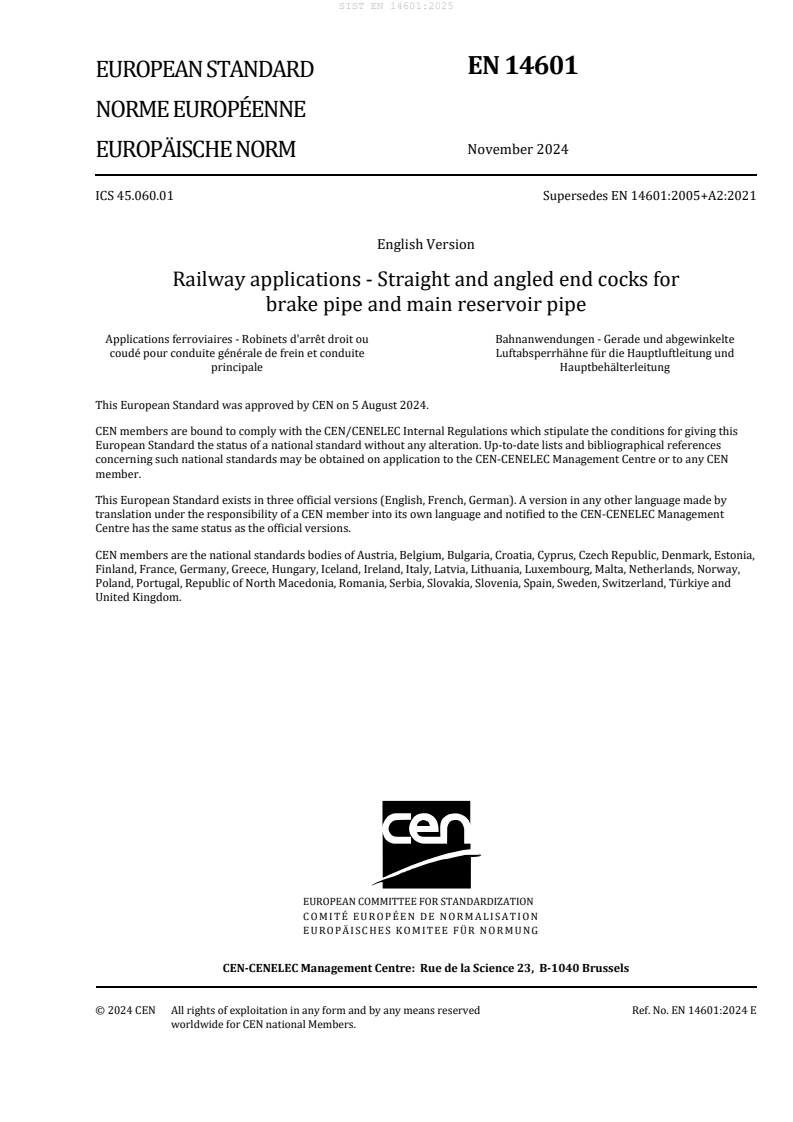
EN 14601
EUROPEAN STANDARD
NORME EUROPÉENNE
November 2024
EUROPÄISCHE NORM
ICS 45.060.01 Supersedes EN 14601:2005+A2:2021
English Version
Railway applications - Straight and angled end cocks for
brake pipe and main reservoir pipe
Applications ferroviaires - Robinets d'arrêt droit ou Bahnanwendungen - Gerade und abgewinkelte
coudé pour conduite générale de frein et conduite Luftabsperrhähne für die Hauptluftleitung und
principale Hauptbehälterleitung
This European Standard was approved by CEN on 5 August 2024.
CEN members are bound to comply with the CEN/CENELEC Internal Regulations which stipulate the conditions for giving this
European Standard the status of a national standard without any alteration. Up-to-date lists and bibliographical references
concerning such national standards may be obtained on application to the CEN-CENELEC Management Centre or to any CEN
member.
This European Standard exists in three official versions (English, French, German). A version in any other language made by
translation under the responsibility of a CEN member into its own language and notified to the CEN-CENELEC Management
Centre has the same status as the official versions.
CEN members are the national standards bodies of Austria, Belgium, Bulgaria, Croatia, Cyprus, Czech Republic, Denmark, Estonia,
Finland, France, Germany, Greece, Hungary, Iceland, Ireland, Italy, Latvia, Lithuania, Luxembourg, Malta, Netherlands, Norway,
Poland, Portugal, Republic of North Macedonia, Romania, Serbia, Slovakia, Slovenia, Spain, Sweden, Switzerland, Türkiye and
United Kingdom.
EUROPEAN COMMITTEE FOR STANDARDIZATION
COMITÉ EUROPÉEN DE NORMALISATION
EUROPÄISCHES KOMITEE FÜR NORMUNG
CEN-CENELEC Management Centre: Rue de la Science 23, B-1040 Brussels
© 2024 CEN All rights of exploitation in any form and by any means reserved Ref. No. EN 14601:2024 E
worldwide for CEN national Members.
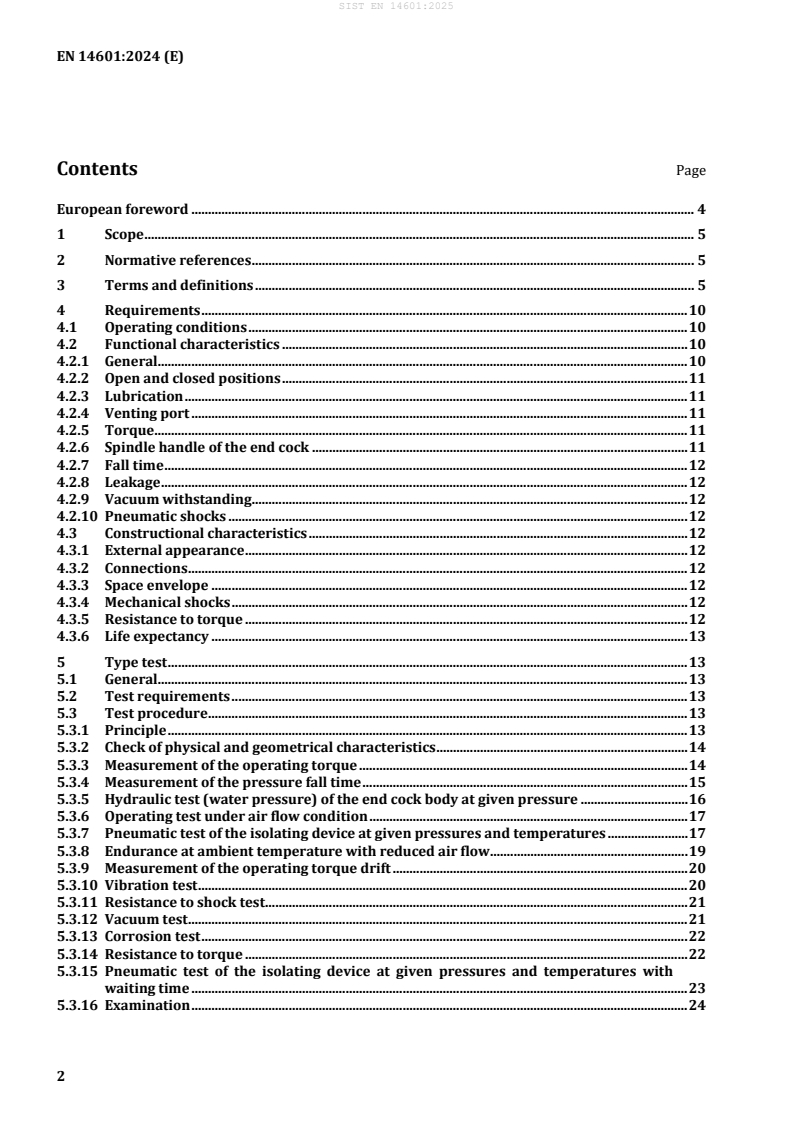
Contents Page
European foreword . 4
1 Scope . 5
2 Normative references . 5
3 Terms and definitions . 5
4 Requirements . 10
4.1 Operating conditions . 10
4.2 Functional characteristics . 10
4.2.1 General. 10
4.2.2 Open and closed positions . 11
4.2.3 Lubrication . 11
4.2.4 Venting port . 11
4.2.5 Torque. 11
4.2.6 Spindle handle of the end cock . 11
4.2.7 Fall time . 12
4.2.8 Leakage . 12
4.2.9 Vacuum withstanding . 12
4.2.10 Pneumatic shocks . 12
4.3 Constructional characteristics . 12
4.3.1 External appearance . 12
4.3.2 Connections . 12
4.3.3 Space envelope . 12
4.3.4 Mechanical shocks . 12
4.3.5 Resistance to torque . 12
4.3.6 Life expectancy . 13
5 Type test . 13
5.1 General. 13
5.2 Test requirements . 13
5.3 Test procedure . 13
5.3.1 Principle . 13
5.3.2 Check of physical and geometrical characteristics . 14
5.3.3 Measurement of the operating torque . 14
5.3.4 Measurement of the pressure fall time . 15
5.3.5 Hydraulic test (water pressure) of the end cock body at given pressure . 16
5.3.6 Operating test under air flow condition . 17
5.3.7 Pneumatic test of the isolating device at given pressures and temperatures . 17
5.3.8 Endurance at ambient temperature with reduced air flow . 19
5.3.9 Measurement of the operating torque drift . 20
5.3.10 Vibration test . 20
5.3.11 Resistance to shock test . 21
5.3.12 Vacuum test . 21
5.3.13 Corrosion test . 22
5.3.14 Resistance to torque . 22
5.3.15 Pneumatic test of the isolating device at given pressures and temperatures with
waiting time . 23
5.3.16 Examination . 24
5.4 Approval validity . 24
6 In-service assessment . 24
7 Designation . 25
8 Marking . 25
Annex A (normative) Dimensions of end cocks . 26
Bibliography . 30
European foreword
This document (EN 14601:2024) has been prepared by Technical Committee CEN/TC 256 “Railway
applications”, the secretariat of which is held by DIN.
This European Standard shall be given the status of a national standard, either by publication of an
identical text or by endorsement, at the latest by May 2025, and conflicting national standards shall be
withdrawn at the latest by May 2025.
Attention is drawn to the possibility that some of the elements of this document may be the subject of
patent rights. CEN shall not be held responsible for identifying any or all such patent rights.
This document supersedes EN 14601:2005+A2:2021.
EN 14601:2005+A2:2021:
— normative references have been updated;
— tested end cock numbers in Table 1 “Operations to carry out for qualification” have been
supplemented for 5.3.7;
— in 5.3.7 “Pneumatic test of the isolating device at given pressures and temperatures” a new time
requirement for performance of the test has been added.
This document has been prepared under a standardization request addressed to CEN by the European
Commission. The Standing Committee of the EFTA States subsequently approves these requests for its
Member States.
Any feedback and questions on this document should be directed to the users’ national standards body.
A complete listing of these bodies can be found on the CEN website.
According to the CEN-CENELEC Internal Regulations, the national standards organisations of the
following countries are bound to implement this European Standard: Austria, Belgium, Bulgaria,
Croatia, Cyprus, Czech Republic, Denmark, Estonia, Finland, France, Germany, Greece, Hungary, Iceland,
Ireland, Italy, Latvia, Lithuania, Luxembourg, Malta, Netherlands, Norway, Poland, Portugal, Republic of
North Macedonia, Romania, Serbia, Slovakia, Slovenia, Spain, Sweden, Switzerland, Türkiye and the
United Kingdom.
1 Scope
This document is applicable to manually operated end cocks designed to cut-off the brake pipe and the
main reservoir pipe of the air brake and compressed air system of rail vehicles; without taking the type
of vehicles and track-gauge into consideration.
This document specifies requirements for the design, dimensions, testing and certification (qualification
and/or type test), and marking.
2 Normative references
The following documents are referred to in the text in such a way that some or all of their content
constitutes requirements of this document. For dated references, only the edition cited applies. For
undated references, the latest edition of the referenced document (including any amendments) applies.
EN 50125-1:2014, Railway applications — Environmental conditions for equipment — Part 1: Rolling
stock and on-board equipment
EN 61373:2010, Railway applications — Rolling stock equipment — Shock and vibration tests
(IEC 61373:1999)
EN ISO 228-1:2003, Pipe threads where pressure-tight joints are not made on the threads — Part 1:
Dimensions, tolerances and designation (ISO 228-1:2000)
EN ISO 9227:2022, Corrosion tests in artificial atmospheres — Salt spray tests (ISO 9227:2022)
ISO 4975:2022, Railway applications — Braking system — Quality of compressed air for pneumatic
apparatus and systems
ISO 5208:2015, Industrial valves — Pressure testing of metallic valves
3 Terms and definitions
For the purposes of this document, the following terms and definitions apply.
ISO and IEC maintain terminology databases for use in standardization at the following addresses:
— ISO Online browsing platform: available at https://www.iso.org/obp/
— IEC Electropedia: available at https://www.electropedia.org/
3.1
end cock
two position, three way cock, with no piped vent and, with a rotary spindle moved by the operating
handle
3.2
components
3.2.1
port
terminus of a fluid passage in a component (to which pipelines can be connected) for the transmission
of fluid to, or from the component
As impacted by EN 61373:2010/AC:2017-09.
3.2.1.1
venting port
port which provides passage to atmosphere
3.2.1.2
outlet port
port which is vented to atmosphere when the cock is closed
3.2.1.3
inlet port
port which is not vented when the cock is closed
3.2.1.4
threaded port
port arranged to accept screw threaded connection
3.2.2
direction of rotation
direction of rotation quoted as viewed looking at the handle side
3.2.3
mechanical detent
spring arrangement to retain moving parts in open or closed position and only able to be moved to
another position with the specified force
3.2.4
latch
mechanical device to retain moving parts in open or closed position which can only be moved when the
latch is released
3.3
types of end cocks
3.3.1
design
3.3.1.1
straight end cock
cock with axis of inlet and outlet ports in line
Note 1 to entry: See Figure 1.
Figure 1 — Straight end cock
3.3.1.2
angled end cock
cock with axis of outlet port at an angle of (35 ± 2)° with axis of inlet port
Note 1 to entry: See Figure 2.
Figure 2 — Angled end cock
3.3.2
location of the handle
3.3.2.1
right hand end cock
end cock with handle located at the right hand side of the end cock with the handle closed in a vertically
upwards position
Note 1 to entry: The end cock is opened by rotating the handle in an anticlockwise direction (see Figure 3).
Note 2 to entry: Standard mounting position. Other positions of handle are defined by drawing (see Figure 3).
Key
1 closed position
2 open position
3 outlet port
4 inlet port
Figure 3 — Right hand end cock
3.3.2.2
left hand end cock
end cock with handle located at the left hand side of the cock with the handle closed is in a vertically
upwards position
Note 1 to entry: The cock is opened by rotating the handle in a clockwise direction (see Figure 4).
Note 2 to entry: Standard mounting position. Other positions of handle are defined by drawing (see Figure 4).
Key
1 closed position
2 open position
3 outlet port
4 inlet port
Figure 4 — Left hand end cock
3.4
states
3.4.1
closed position
position of the valve component part in which the flow path between inlet and outlet ports is closed and
the venting passage is open and connected to the hose and coupling side of the cock
Note 1 to entry: The cock handle is closed in the vertically upwards position on the vehicle.
Note 2 to entry: The purchaser will define the angle between the cock inlet port axis and the vertically upwards
handle position for cocks not mounted horizontally.
3.4.2
open position
position of the valve member in which the flow path between inlet and outlet ports is fully open, and the
venting passage is closed
3.4.3
fall time
time taken in a device for a quantity of air to fall from a specified high pressure level down to a specified
lower pressure level
Note 1 to entry: Parameter used to define the fluid characteristic of the cock.
3.4.4
proof pressure
test pressure, in excess of a maximum rated pressure, which causes no malfunction or permanent
deformation damage
3.5
temperature range
range of the temperature within which the apparatus can operate satisfactorily
3.6
leakage
3.6.1
external leakage
leakage of the fluid contained in the end cock to atmosphere
3.6.2
internal leakage
leakage of the fluid contained in the end cock from one side to the other side with the valve component
part in the closed position
3.7
drift
change or variation of a condition with time under steady state operating conditions
3.8
life expectancy
predicted working period during which a component or system will maintain a specified level of
performance under specified conditions
Note 1 to entry: Sometimes expressed in statistical term as a probability.
4 Requirements
4.1 Operating conditions
The end cock shall be able to function under the following conditions:
a) with at least “compressed air purity (ISO 4975) 4 – 4 – X [-40 °C; +35 °C]” in accordance with
ISO 4975:2022 (or other specified maximum temperature than +35 °C). This requirement is
verified when tests are carried out in accordance with 5.2;
b) in the temperature range for the environmental conditions to which the rail vehicle is submitted
during its operation and at least for a temperature range defined by the class T2 of EN 50125-
1:2014. The purchaser can specify a higher temperature value if operational constraints demand it.
This requirement is tested in accordance with 5.3.3, 5.3.7 and 5.3.12;
c) the end cock shall withstand the external corrosion due to normal atmospheric pollutants as
specified in EN 50125-1:2014. The end cock is tested in accordance with the test shown in 5.3.13;
d) in the vibrational environment of the rail vehicle on which it is mounted and it shall remain in
either the open or closed position. The cock shall be tested in accordance with 5.3.10.
4.2 Functional characteristics
4.2.1 General
The operating handle of the end cock shall be equipped with a detent or latch system.
The requirements given in 4.2.2 to 4.2.10 are defined to ensure the air flow through the brake pipe and
main reservoir pipe and ensure no malfunction of the cock after the brake pipe test (as part of the
routine brake test before the trains start).
4.2.2 Open and closed positions
The opening and closing of the cock shall be achieved by turning its spindle through a minimum of 90°
and not more than 100°. Stops shall be provided at the extremes of rotation, so that the open and closed
positions are achieved positively. The open and closed positions are defined in 3.4.1 and 3.4.2.
4.2.3 Lubrication
It shall be possible to operate the end cock at all pressures without additional lubrication.
4.2.4 Venting port
The end cock shall incorporate a venting port with a minimum area of 80 mm , arranged so that when
the cock is closed the compressed air from the coupling hose end of the cock (outlet port connected to
the next vehicle) can be exhausted to atmosphere. Venting shall have commenced when the operation
of the end cock has reduced the cross-sectional area of the bore of the end cock by one third. The
venting port should not be able to be obstructed when the cock is mounted on the rail vehicle.
The venting port should be designed and arranged such that the under usual operation, the operating
personnel are not endangered by the exhaust-flow, or objects carried by it, nor by excessive noise level.
4.2.5 Torque
All end cocks with mechanical detent, or with latch engaged shall not be operated by vibration or
shocks. The end cock shall be capable of manual operation therefore the operating torque of the handle
shall be in the range of 9 Nm to 20 Nm for end cocks with detent and a maximum of 6 Nm for cocks with
latch. The torque is tested in accordance with 5.3.3. Torque drifts shall not be allowed. This requirement
is tested in accordance with 5.3.9.
4.2.6 Spindle handle of the end cock
Where the handle is detachable and the unique angular relationship between it and the spindle is not
constructionally ensured, permanent markings on the handle and the spindle (see for an example
Figure 5) shall allow to identify the correct assembly. The relative position of the handle and spindle,
when assembled, shall be maintained under all operating and environmental conditions.
Detachable handles and the spindle should be designed in such a way that an unambiguous angular
relationship between handle and spindle will remain.
Figure 5 — Marking example on the handle and on the end of the spindle
4.2.7 Fall time
The air passages shall be designed to minimize the air flow losses within the cock and the cross-
sectional area shall not be smaller than the cross-sectional area of a plain pipe of 25 mm internal
diameter. The pressure fall time should not be longer than that for an equivalent pipe of the same
nominal diameter, as tested in 5.3.4.
4.2.8 Leakage
The sealing arrangement within the end cock shall prevent any unacceptable loss of air. The allowable
loss of air shall be less than the leakage values when tested in accordance with 5.3.7.
4.2.9 Vacuum withstanding
If a vacuum withstand is required, the end cock shall be able to function with a pressure of 0,75 bar
below atmospheric pressure. The leakage is tested in accordance with 5.3.12.
4.2.10 Pneumatic shocks
The components shall be able to resist the pneumatic shocks to which the cock is subject when opening
quickly. This requirement is tested in accordance with 5.3.6.
4.3 Constructional characteristics
4.3.1 External appearance
The external surfaces of the end cock shall be free of sharp edges which could be a danger to those
persons handling the cock or to other equipment in the proximity of the end cock. This requirement
shall be checked while testing the other constructional features in accordance with 5.3.2.
At least the handles of the end cocks of the brake pipe should be in a red colour (e.g. RAL 2002,
RAL 3020) and of the end cocks of the main reservoir pipe should be in a light colour, e.g. yellow (e.g.
RAL 1003, RAL 1023) or white (e.g. RAL 9002, RAL 9003, RAL
...