

SIST EN 3864:2014
(Main)Aerospace series - Non-metallic materials - Glass transparencies - Test methods - Determination of modulus of rupture
General Information
- Abstract
This European Standard defines the requirements for the determination of the modulus of rupture of glass transparencies for aircraft applications, whether in the annealed or chemically or thermally tempered condition.
- Status
- Published
- Publication Date
- 12-Jan-2014
- Technical Committee
- I13 - Imaginarni 13
- Current Stage
- 6060 - National Implementation/Publication (Adopted Project)
- Start Date
- 03-Jan-2014
- Due Date
- 10-Mar-2014
- Completion Date
- 13-Jan-2014

Overview
SIST EN 3864:2014 is a European Standard developed by CEN that specifies test methods for determining the modulus of rupture (MOR) of glass transparencies used in aerospace applications. This standard applies to non-metallic glass materials employed in aircraft windows and other transparencies, whether annealed, chemically tempered, or thermally tempered. It establishes rigorous testing procedures using four-point bending to assess the strength and failure point of aerospace-grade glass, ensuring reliable performance under operational stresses.
Key Topics
Scope and Applicability
- Focus on glass transparencies for aircraft applications
- Covers annealed, chemically tempered, and thermally tempered glass conditions
- Part of the aerospace series for non-metallic materials (linked with EN 4385)
Test Methodology
- Four-point bending technique to induce controlled stress until rupture
- Specimens prepared as rectangular beams with precise dimensional requirements (width-to-thickness ratio between 2:1 and 10:1)
- Use of hardened steel cylindrical loading rollers with specified dimensions and spacing for consistent load application
Calculation of Modulus of Rupture
- MOR is computed from measured breaking load and beam dimensions using the formula:
MOR = 3 × a × (L / (w × d))
where L is breaking load, a is distance between loading rollers, w is beam width, and d is beam thickness - Includes statistical treatment such as standard deviation for test result consistency
- MOR is computed from measured breaking load and beam dimensions using the formula:
Test Setup and Requirements
- Need for calibrated loading machines with recording capability of maximum load
- Measurement tools such as micrometers and calipers for precise beam dimension determination
- Guidelines for test sample preparation including cutting and edge finishing methods
Health and Safety
- Emphasizes adherence to normal laboratory and test house safety practices
- Users responsible for compliance with applicable local and European regulations
Documentation
- Detailed test report requirements ensuring traceability and reproducibility:
- Test method references, apparatus details
- Semi-finished product identification
- Specimen dimensions, loading rates, and results
- Fracture origin location and test anomalies
- Detailed test report requirements ensuring traceability and reproducibility:
Applications
SIST EN 3864:2014 is critical for aerospace manufacturers, material scientists, and testing laboratories focusing on the durability and safety of aircraft glass transparencies. Practical applications include:
- Certification and quality control of aircraft windows, canopies, and cockpit glass components
- Validation of glass tempering processes to ensure structural integrity under in-flight mechanical stresses
- Material development and selection for enhanced transparency panels within aircraft cabins and cockpit environments
- Ensuring compliance with aerospace industry specifications for glass resistance and rupture behaviour
- Supporting aerospace design engineers in selecting appropriate glass transparencies for varying operational conditions
Related Standards
- EN 4385 - Aerospace series - Non-metallic materials - General organisation of standardisation - Links between types of standards
- EN 3001 - Aerospace series - Tempered float glass plies for aircraft applications - Technical specification
- TR 4386 - Aerospace series - Non-metallic materials - Rules for the drafting and presentation of test method standards
These standards complement SIST EN 3864:2014 by outlining broader material definitions, technical requirements, and general aviation industry standardization frameworks.
Keywords: SIST EN 3864:2014, aerospace glass testing, modulus of rupture, aircraft glass transparency, non-metallic materials standard, four-point bending, glass rupture test, tempered glass aerospace, aircraft window certification, CEN aerospace standards
Relations
- Effective Date
- 28-Jan-2026
Get Certified
Connect with accredited certification bodies for this standard

BUREAU VERITAS Certification Germany
Bureau Veritas certification in Germany.

Element Materials Technology
Materials testing and product certification.

AQMS Ltd.
AQMS provides ISO certification to SMEs across the UK.
Sponsored listings
Frequently Asked Questions
SIST EN 3864:2014 is a standard published by the Slovenian Institute for Standardization (SIST). Its full title is "Aerospace series - Non-metallic materials - Glass transparencies - Test methods - Determination of modulus of rupture". This standard covers: This European Standard defines the requirements for the determination of the modulus of rupture of glass transparencies for aircraft applications, whether in the annealed or chemically or thermally tempered condition.
This European Standard defines the requirements for the determination of the modulus of rupture of glass transparencies for aircraft applications, whether in the annealed or chemically or thermally tempered condition.
SIST EN 3864:2014 is classified under the following ICS (International Classification for Standards) categories: 49.025.99 - Other materials. The ICS classification helps identify the subject area and facilitates finding related standards.
SIST EN 3864:2014 has the following relationships with other standards: It is inter standard links to SIST EN 3001:2019. Understanding these relationships helps ensure you are using the most current and applicable version of the standard.
SIST EN 3864:2014 is available in PDF format for immediate download after purchase. The document can be added to your cart and obtained through the secure checkout process. Digital delivery ensures instant access to the complete standard document.
Standards Content (Sample)
SLOVENSKI STANDARD
01-februar-2014
Aeronavtika - Nekovinski materiali - Prozornost stekla - Preskusne metode -
Ugotavljanje modulov lomljivosti
Aerospace series - Non-metallic materials - Glass transparencies - Test methods -
Determination of modulus of rupture
Luft- und Raumfahrt - Nichtmetallische Werkstoffe - Transparente Glaswerkstoffe -
Prüfverfahren - Bestimmung des Bruchmoduls
Série aérospatiale - Matériaux non-métalliques - Transparents en verre - Méthodes
d’essais - Détermination du module de rupture
Ta slovenski standard je istoveten z: EN 3864:2013
ICS:
49.025.99 Drugi materiali Other materials
2003-01.Slovenski inštitut za standardizacijo. Razmnoževanje celote ali delov tega standarda ni dovoljeno.
EUROPEAN STANDARD
EN 3864
NORME EUROPÉENNE
EUROPÄISCHE NORM
May 2013
ICS 49.025.99
English Version
Aerospace series - Non-metallic materials - Glass
transparencies - Test methods - Determination of modulus of
rupture
Série aérospatiale - Matériaux non-métalliques - Luft- und Raumfahrt - Nichtmetallische Werkstoffe -
Transparents en verre - Méthodes d'essais - Détermination Transparente Glaswerkstoffe - Prüfverfahren - Bestimmung
du module de rupture des Bruchmoduls
This European Standard was approved by CEN on 19 January 2013.
CEN members are bound to comply with the CEN/CENELEC Internal Regulations which stipulate the conditions for giving this European
Standard the status of a national standard without any alteration. Up-to-date lists and bibliographical references concerning such national
standards may be obtained on application to the CEN-CENELEC Management Centre or to any CEN member.
This European Standard exists in three official versions (English, French, German). A version in any other language made by translation
under the responsibility of a CEN member into its own language and notified to the CEN-CENELEC Management Centre has the same
status as the official versions.
CEN members are the national standards bodies of Austria, Belgium, Bulgaria, Croatia, Cyprus, Czech Republic, Denmark, Estonia,
Finland, Former Yugoslav Republic of Macedonia, France, Germany, Greece, Hungary, Iceland, Ireland, Italy, Latvia, Lithuania,
Luxembourg, Malta, Netherlands, Norway, Poland, Portugal, Romania, Slovakia, Slovenia, Spain, Sweden, Switzerland, Turkey and United
Kingdom.
EUROPEAN COMMITTEE FOR STANDARDIZATION
COMITÉ EUROPÉEN DE NORMALISATION
EUROPÄISCHES KOMITEE FÜR NORMUNG
Management Centre: Avenue Marnix 17, B-1000 Brussels
© 2013 CEN All rights of exploitation in any form and by any means reserved Ref. No. EN 3864:2013: E
worldwide for CEN national Members.
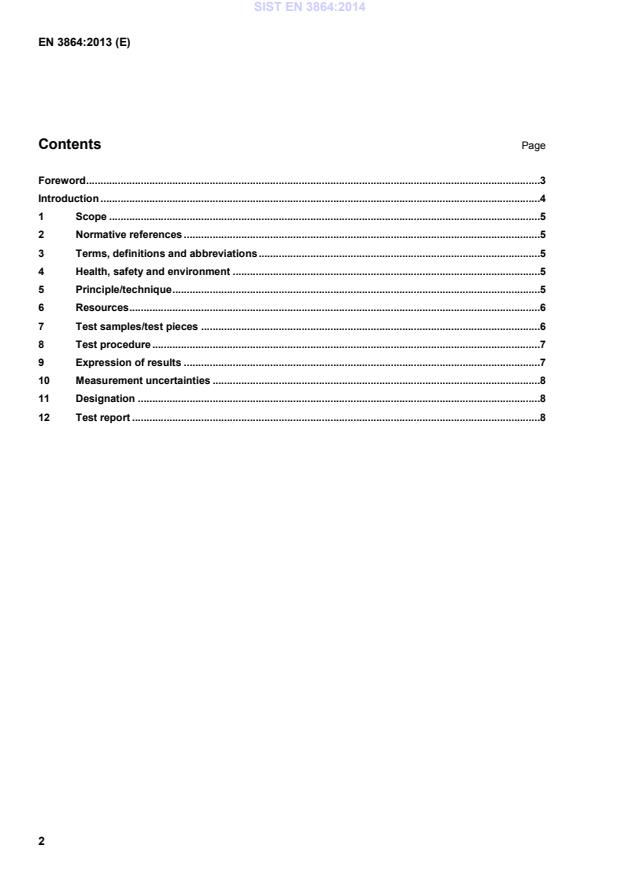
Contents Page
Foreword .3
Introduction .4
1 Scope .5
2 Normative references .5
3 Terms, definitions and abbreviations .5
4 Health, safety and environment .5
5 Principle/technique .5
6 Resources .6
7 Test samples/test pieces .6
8 Test procedure .7
9 Expression of results .7
10 Measurement uncertainties .8
11 Designation .8
12 Test report .8
Foreword
This document (EN 3864:2013) has been prepared by the Aerospace and Defence Industries Association of
Europe - Standardization (ASD-STAN).
After enquiries and votes carried out in accordance with the rules of this Association, this Standard has
received the approval of the National Associations and the Official Services of the member countries of ASD,
prior to its presentation to CEN.
This European Standard shall be given the status of a national standard, either by publication of an identical
text or by endorsement, at the latest by November 2013, and conflicting national standards shall be withdrawn
at the latest by November 2013.
Attention is drawn to the possibility that some of the elements of this document may be the subject of patent
rights. CEN [and/or CENELEC] shall not be held responsible for identifying any or all such patent rights.
According to the CEN/CENELEC Internal Regulations, the national standards organizations of the following
countries are bound to implement this European Standard: Austria, Belgium, Bulgaria, Croatia, Cyprus, Czech
Republic, Denmark, Estonia, Finland, Former Yugoslav Republic of Macedonia, France, Germany, Greece,
Hungary, Iceland, Ireland, Italy, Latvia, Lithuania, Luxembourg, Malta, Netherlands, Norway, Poland, Portugal,
Romania, Slovakia, Slovenia, Spain, Sweden, Switzerland, Turkey and the United Kingdom.
EN 3864
...