

oSIST prEN IEC 60343:2026
(Main)Recommended test methods for determining the relative resistance of insulating materials to breakdown by surface discharges - Part 1: General methods
General Information
- Abstract
- Status
- Not Published
- Public Enquiry End Date
- 28-Feb-2026
- Technical Committee
- IIZS - Insulating materials and systems
- Current Stage
- 4020 - Public enquire (PE) (Adopted Project)
- Start Date
- 16-Dec-2025
- Due Date
- 05-May-2026
- Completion Date
- 25-Feb-2026

Overview
oSIST prEN IEC 60343:2026 - Recommended test methods for determining the relative resistance of insulating materials to breakdown by surface discharges - Part 1: General methods - establishes internationally harmonized procedures for assessing the breakdown resistance of electrical insulating materials when exposed to surface discharges. Published by the International Electrotechnical Commission (IEC) and the European Committee for Electrotechnical Standardization (CLC), this standard is intended to support wide-scale adoption and interoperability in testing electrical insulation across industries.
Surface discharges pose a significant threat to the long-term reliability and safety of electrical equipment, as they can lead to the gradual or sudden failure of insulating materials used in power systems, industrial controls, and electronic devices. By standardizing the key test methods, oSIST prEN IEC 60343:2026 enables consistent, repeatable, and objective evaluation of how materials perform under electrical and environmental stress.
Key Topics
- Standardized Test Methods: Procedures for endurance testing of solid insulating materials subjected to surface discharges in air, relevant for a wide range of industrial conditions.
- Test Apparatus and Conditions: Specifications for the test setup, including electrodes, voltage application, ambient environment, insulation thickness, and control devices, to ensure reproducibility.
- Criteria for Insulation Failure: Detailed guidance on evaluating when material breakdown has occurred due to surface discharge activity.
- Reporting Requirements: Documentation and test reporting protocols for clear communication and traceability of results.
- Factors Influencing Breakdown: Considerations such as ambient temperature, air pressure, mechanical stresses, and environmental byproducts (e.g., ozone, nitrogen dioxide) which affect insulation performance.
- Terminology and Definitions: Harmonized definitions of key terms such as 'corona' and 'surface discharge' as provided by IEC Electropedia.
Applications
oSIST prEN IEC 60343:2026 is particularly valuable for a variety of sectors and use cases:
- Material Qualification and R&D: Assists manufacturers and research labs in assessing new or modified insulating materials for use in electrical systems.
- Product Development: Enables design engineers to choose materials with adequate surface discharge resistance, improving the safety and longevity of products such as transformers, switchgear, power electronics, and electric motors.
- Quality Assurance and Compliance: Facilitates routine acceptance testing and benchmarking against international performance expectations during production or procurement.
- Failure Analysis and Root Cause Investigation: Used by testing laboratories and safety assessors to determine if surface discharges have contributed to insulation breakdown in failed components.
- Standardization of Global Supply Chains: Ensures materials procured from various sources adhere to a common set of electrical insulation testing protocols, promoting reliability and market access.
Related Standards
oSIST prEN IEC 60343:2026 is part of a broader family of standards governing the evaluation of surface tracking and electrical breakdown of insulating materials:
- IEC 61621: Resistance test to high-voltage, low-current arc discharges (for dry test surfaces).
- IEC 60112: Method for determination of the proof and comparative tracking indices (CTI/PTI) of solid insulating materials; surface is wetted at intervals.
- IEC 60587: Test methods for evaluating resistance to tracking and erosion under severe ambient conditions (including inclined plane testing).
- IEC 60505: Guide for evaluating the ageing of electrical insulation systems, covering thermal, electrical, ambient/environmental, and mechanical stresses.
For comprehensive material evaluation, users should consult the Selection Guides developed by IEC TC 112, which map relevant standards to different insulation properties and use cases.
By following oSIST prEN IEC 60343:2026, organizations can ensure consistent, reliable, and internationally accepted testing of insulating materials subjected to surface discharges, supporting improved product safety, durability, and regulatory compliance across electrical and electronic domains.
Relations
- Effective Date
- 23-Jan-2023
Get Certified
Connect with accredited certification bodies for this standard

IMQ S.p.A. (Certification)
Italian electrical product certification.

SLG Prüf- und Zertifizierungs GmbH
German testing and certification body.

UL Solutions
Global safety science company with testing, inspection and certification.
Sponsored listings
Frequently Asked Questions
oSIST prEN IEC 60343:2026 is a draft published by the Slovenian Institute for Standardization (SIST). Its full title is "Recommended test methods for determining the relative resistance of insulating materials to breakdown by surface discharges - Part 1: General methods". This standard covers: Recommended test methods for determining the relative resistance of insulating materials to breakdown by surface discharges - Part 1: General methods
Recommended test methods for determining the relative resistance of insulating materials to breakdown by surface discharges - Part 1: General methods
oSIST prEN IEC 60343:2026 is classified under the following ICS (International Classification for Standards) categories: 17.220.99 - Other standards related to electricity and magnetism; 29.035.01 - Insulating materials in general. The ICS classification helps identify the subject area and facilitates finding related standards.
oSIST prEN IEC 60343:2026 has the following relationships with other standards: It is inter standard links to SIST EN 60343:1998. Understanding these relationships helps ensure you are using the most current and applicable version of the standard.
oSIST prEN IEC 60343:2026 is available in PDF format for immediate download after purchase. The document can be added to your cart and obtained through the secure checkout process. Digital delivery ensures instant access to the complete standard document.
Standards Content (Sample)
SLOVENSKI STANDARD
01-februar-2026
Priporočene preskusne metode za določanje relativne odpornosti izolacijskih
materialov proti preboju zaradi površinskih razelektritev - 1. del: Splošne metode
Recommended test methods for determining the relative resistance of insulating
materials to breakdown by surface discharges - Part 1: General methods
Empfohlene Prüfverfahren zur Bestimmung der relativen Beständigkeit isolierender
Werkstoffe gegen Durchschlag infolge Oberflächenteilentladung
Méthodes d'essai recommandées pour déterminer la résistance relative au claquage des
matériaux isolants exposés à des décharges superficielles - Partie 1: Méthodes
générales
Ta slovenski standard je istoveten z: prEN IEC 60343:2025
ICS:
17.220.99 Drugi standardi v zvezi z Other standards related to
elektriko in magnetizmom electricity and magnetism
29.035.01 Izolacijski materiali na Insulating materials in
splošno general
2003-01.Slovenski inštitut za standardizacijo. Razmnoževanje celote ali delov tega standarda ni dovoljeno.
112/700/CDV
COMMITTEE DRAFT FOR VOTE (CDV)
PROJECT NUMBER:
IEC 60343-1 ED1
DATE OF CIRCULATION: CLOSING DATE FOR VOTING:
2025-12-12 2026-03-06
SUPERSEDES DOCUMENTS:
112/654/CD, 112/661/CC
IEC TC 112 : EVALUATION AND QUALIFICATION OF ELECTRICAL INSULATING MATERIALS AND SYSTEMS
SECRETARIAT: SECRETARY:
Germany Mr Bernd Komanschek
OF INTEREST TO THE FOLLOWING COMMITTEES: HORIZONTAL FUNCTION(S):
TC 15
ASPECTS CONCERNED:
Electricity transmission and distribution
SUBMITTED FOR CENELEC PARALLEL VOTING NOT SUBMITTED FOR CENELEC PARALLEL VOTING
Attention IEC-CENELEC parallel voting
The attention of IEC National Committees, members of CENELEC,
is drawn to the fact that this Committee Draft for Vote (CDV) is
submitted for parallel voting.
The CENELEC members are invited to vote through the CENELEC
online voting system.
This document is still under study and subject to change. It should not be used for reference purposes.
Recipients of this document are invited to submit, with their comments, notification of any relevant patent rights of which t hey are aware
and to provide supporting documentation.
Recipients of this document are invited to submit, with their comments, notification of any relevant “In Some Countries” clau ses to be
included should this proposal proceed. Recipients are reminded that the CDV stage is the final stage for submitting ISC c lauses. (SEE
AC/22/2007 OR NEW GUIDANCE DOC).
TITLE:
Recommended test methods for determining the relative resistance of insulating materials to breakdown by
surface discharges – Part 1: General methods
PROPOSED STABILITY DATE: 2029
NOTE FROM TC/SC OFFICERS:
electronic file, to make a copy and to print out the content for the sole purpose of preparing National Committee positions.
You may not copy or "mirror" the file or printed version of the document, or any part of it, for any other purpose without
permission in writing from IEC.
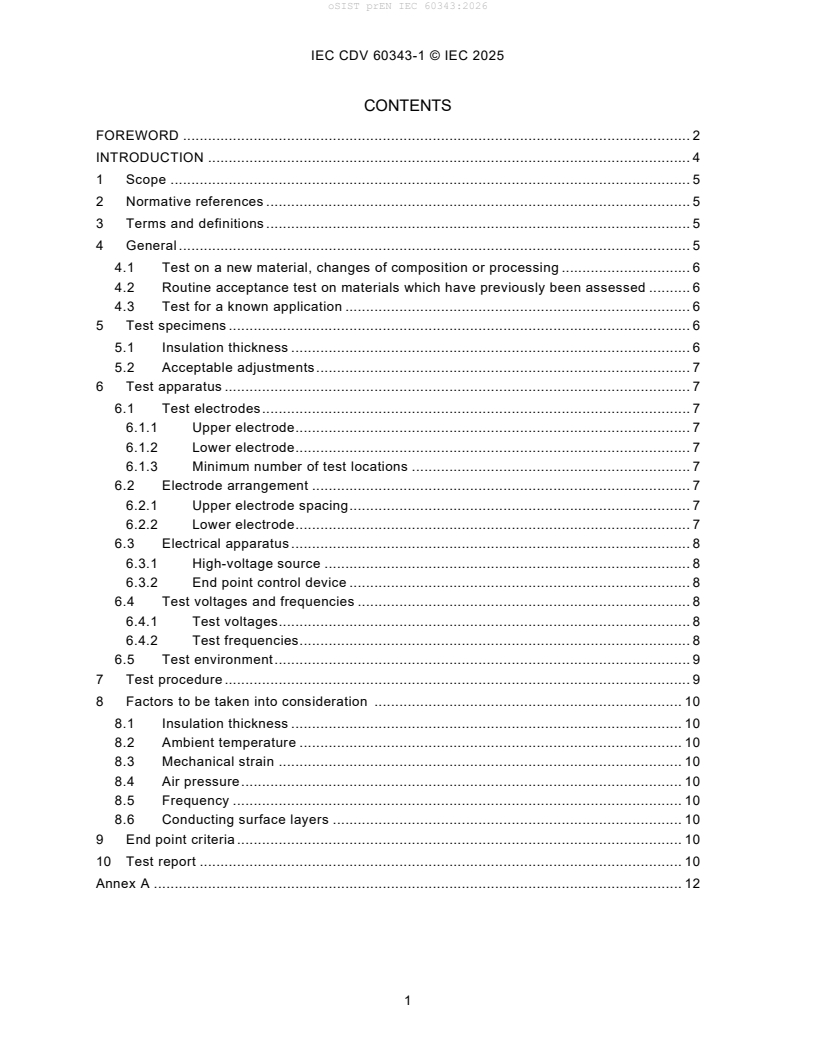
IEC CDV 60343-1 © IEC 2025
CONTENTS
FOREWORD . 2
INTRODUCTION . 4
1 Scope . 5
2 Normative references . 5
3 Terms and definitions . 5
4 General . 5
4.1 Test on a new material, changes of composition or processing . 6
4.2 Routine acceptance test on materials which have previously been assessed . 6
4.3 Test for a known application . 6
5 Test specimens . 6
5.1 Insulation thickness . 6
5.2 Acceptable adjustments . 7
6 Test apparatus . 7
6.1 Test electrodes . 7
6.1.1 Upper electrode. 7
6.1.2 Lower electrode. 7
6.1.3 Minimum number of test locations . 7
6.2 Electrode arrangement . 7
6.2.1 Upper electrode spacing . 7
6.2.2 Lower electrode. 7
6.3 Electrical apparatus . 8
6.3.1 High-voltage source . 8
6.3.2 End point control device . 8
6.4 Test voltages and frequencies . 8
6.4.1 Test voltages. 8
6.4.2 Test frequencies. 8
6.5 Test environment . 9
7 Test procedure . 9
8 Factors to be taken into consideration . 10
8.1 Insulation thickness . 10
8.2 Ambient temperature . 10
8.3 Mechanical strain . 10
8.4 Air pressure . 10
8.5 Frequency . 10
8.6 Conducting surface layers . 10
9 End point criteria . 10
10 Test report . 10
Annex A . 12
IEC CDV 60343-1 © IEC 2025
INTERNATIONAL ELECTROTECHNICAL COMMISSION
____________
Recommended test methods for determining the relative resistance
of insulating materials to breakdown by surface discharges –
Part 1: General methods
FOREWORD
1) The International Electrotechnical Commission (IEC) is a worldwide organization for standardization comprising all
national electrotechnical committees (IEC National Committees). The object of IEC is to promote international co -
operation on all questions concerning standardization in the electrical and electronic fields. To this end and in addition
to other activities, IEC publishes International Standards, Technical Specifications, Technical Reports, Publicly
Available Specifications (PAS) and Guides (hereafter referred to as “IEC Publication(s)”). Their preparation is
entrusted to technical committees; any IEC National Committee interested in the subject dealt with may participate
in this preparatory work. International, governmental and non-governmental organizations liaising with the IEC also
participate in this preparation. IEC collaborates closely with the International Organization for Standardization (ISO)
in accordance with conditions determined by agreement between the two organizations.
2) The formal decisions or agreements of IEC on technical matters express, as nearly as possible, an international
consensus of opinion on the relevant subjects since each technical committee has representation from all interested
IEC National Committees.
3) IEC Publications have the form of recommendations for international use and are accepted by IEC National
Committees in that sense. While all reasonable efforts are made to ensure that the technical content of IEC
Publications is accurate, IEC cannot be held responsible for the way in which they are used or for any
misinterpretation by any end user.
4) In order to promote international uniformity, IEC National Committees undertake to apply IEC Publications
transparently to the maximum extent possible in their national and regional publications. Any divergence between
any IEC Publication and the corresponding national or regional publication shall be clearly indicated in the latter.
5) IEC itself does not provide any attestation of conformity. Independent certification bodies provide conformity
assessment services and, in some areas, access to IEC marks of conformity. IEC is not responsible for any services
carried out by independent certification bodies.
6) All users should ensure that they have the latest edition of this publication.
7) No liability shall attach to IEC or its directors, employees, servants or agents including individual experts and
members of its technical committees and IEC National Committees for any personal injury, property damage or other
damage of any nature whatsoever, whether direct or indirect, or for costs (including legal fees) and expenses arising
out of the publication, use of, or reliance upon, this IEC Publication or any other IEC Publications.
8) Attention is drawn to the Normative references cited in this publication. Use of the referenced publications is
indispensable for the correct application of this publication.
9) IEC draws attention to the possibility that the implementation of this document may involve the use of (a) patent(s).
IEC takes no position concerning the evidence, validity or applicability of any claimed patent rights in respect thereof.
As of the date of publication of this document, IEC had not received notice of (a) patent(s), which may be required
to implement this document. However, implementers are cautioned that this may not represent the latest information,
which may be obtained from the patent database available at https://patents.iec.ch. IEC shall not be held responsible
for identifying any or all such patent rights.
IEC 60343 has been prepared by IEC technical committee 112: Evaluation and qualification of
electrical insulating materials and systems. It is an International Standard.
This first edition cancels and replaces the first edition of IEC 60343 published in [1991-01-23].
This edition constitutes a technical revision.
This edition includes the following significant technical changes with respect to the previous
edition:
a) No technical procedure changes have been made in this revision. The revision is to improve
the editorial structure to bring this standard up to the present IEC format.
IEC CDV 60343-1 © IEC 2025
b) The Introduction section is expanded to link this test method with other IEC test methods
c) The original information has been repositioned to have a better presentation of the information.
d) An illustration of the surface discharges was added.
The text of this International Standard is based on the following documents:
Draft Report on voting
112/XX/FDIS 112/XX/RVD
Full information on the voting for its approval can be found in the report on voting indicated in the
above table.
The language used for the development of this International Standard is English.
This document was drafted in accordance with ISO/IEC Directives, Part 2, and developed in
accordance with ISO/IEC Directives, Part 1 and ISO/IEC Directives, IEC Supplement, available at
www.iec.ch/members_experts/refdocs. The main document types developed by IEC are described
in greater detail at www.iec.ch/publications.
The committee has decided that the contents of this document will remain unchanged until the
stability date indicated on the IEC website under webstore.iec.ch in the data related to the specific
document. At this date, the document will be
• reconfirmed,
• withdrawn, or
• revised.
IEC CDV 60343-1 © IEC 2025
1 INTRODUCTION
2 This International Standard is part of a group of standards related to the evaluation of the relative
3 resistance (endurance) of electrical insulating materials to withstand electrical discharges onto the
4 surface of the material.
5 IEC 60505 provides four categories of ageing stresses which influence the performance of
6 products in use under a wide range of operating conditions. In IEC 60505 the stresses are
7 presented as thermal (T), electrical (E), environmental (E) and mechanical (M). For this standard
8 environmental (E) is replaced with ambient (A) to avoid the confusion of having two stresses
9 represented by the same letter. In IEC 60343 the stresses are electrical (E) caused by normal or
10 abnormal electrical discharges, and ambient/environmental (A) caused by the ozone (O3) or
11 nitrogen dioxide (NO ) which can occur as a result of discharges in the presence of oxygen and
12 nitrogen.
13 IEC 60343 is related to other test standards for the evaluation of the breakdown of electrical
14 insulating materials resulting from surface tracking. Other test standards provide a broader
15 understanding of the endurance of electrical insulating materials . Refer to the Selection Guide of
16 standards for surface tracking evaluations developed by IEC TC 112. TC 112 has developed
17 Selection Guides to provide information to users of the test standards related for specific
18 categories of properties. The Selection Guides are intended to present all test standards related
19 to the same topic which are often not in sequential numbers making it easier for users to know of
20 related standards. For surface tracking:
21 IEC 61621 Dry, solid insulating materials – Resistance test to high-voltage, low-current arc
22 discharges. This method is recommended as the screening surface tracking test. The test surface
23 is dry.
24 IEC 60112 Method for the determination of the proof and the comparative tracking indices of solid
25 insulating materials, commonly known as Comparative Tracking Index (CTI) and Proof Tracking
26 Index (PTI). The test surface is wetted at specific intervals for the whole test duration. Test
27 voltages for CTI/PTI are across the range of 100 VAC to 600 VAC. This test method is
28 recommended for applications in which the location of energized components and earth grounds
29 are fixed.
30 IEC 60587 Electrical insulating materials used under severe ambient conditions - Test methods for
31 evaluating resistance to tracking and erosion. This method is commonly known as inclined plane
32 tracking.
33 Two test methods are given, and the surface is continually rewetted for both methods.
34 Method 1 - Constant tracking with the preferred test voltages are 2,5 kV / 3,5 kV / and 4,5 kV.
35 Method 2- Stepwise tracking with the preferred starting test voltage 3.0 kV with voltage adjusted
36 in 0,25kV increments.
37 This test method is recommended for applications in which the location of energized components
38 and earth grounds are not fixed.
IEC CDV 60343-1 © IEC 2025
40 Recommended test methods for determining the relative resistance
41 of insulating materials to breakdown by surface discharges –
42 Part 1: General methods
45 1 Scope
46 This International Standard concerns endurance tests with surface discharges by electrical field
47 strength used in industrial service in air. It is intended to assess the resistance of a solid electrical
48 insulating material to breakdown when exposed to surface discharges.
50 2 Normative references
52 3 Terms and definitions
53 For the purposes of this document, the following terms and definitions apply.
54 ISO and IEC maintain terminological databases for use in standardization at the following
55 addresses:
56 • IEC Electropedia: available at http://www.electropedia.org/
57 • ISO Online browsing platform: available at http://www.iso.org/obp
59 3.1
60 Corona
61 Set of partial discharges in a gas, immediately adjacent to an uninsulated or lightly insulated
62 conductor which creates a highly divergent field remote from other conductors which usually
63 produces light and noise.
64 [Source: Electropedia.org/212-11-44]
65 4 General
66 This standard defines default values for the test
...